December 28 is Childermas, or Holy Innocents’ Day, when the church commemorates the slaughter of young male children in Bethlehem by the order of Herod the Great, attempting to quash the threat of a rival king. This, too, is part of the Christmas story. The Gospel account of the “massacre of the innocents” quotes Jeremiah: “A voice was heard in Ramah, weeping and loud lamentation, / Rachel weeping for her children; / she refused to be comforted, because they are no more” (Matt. 2:18).
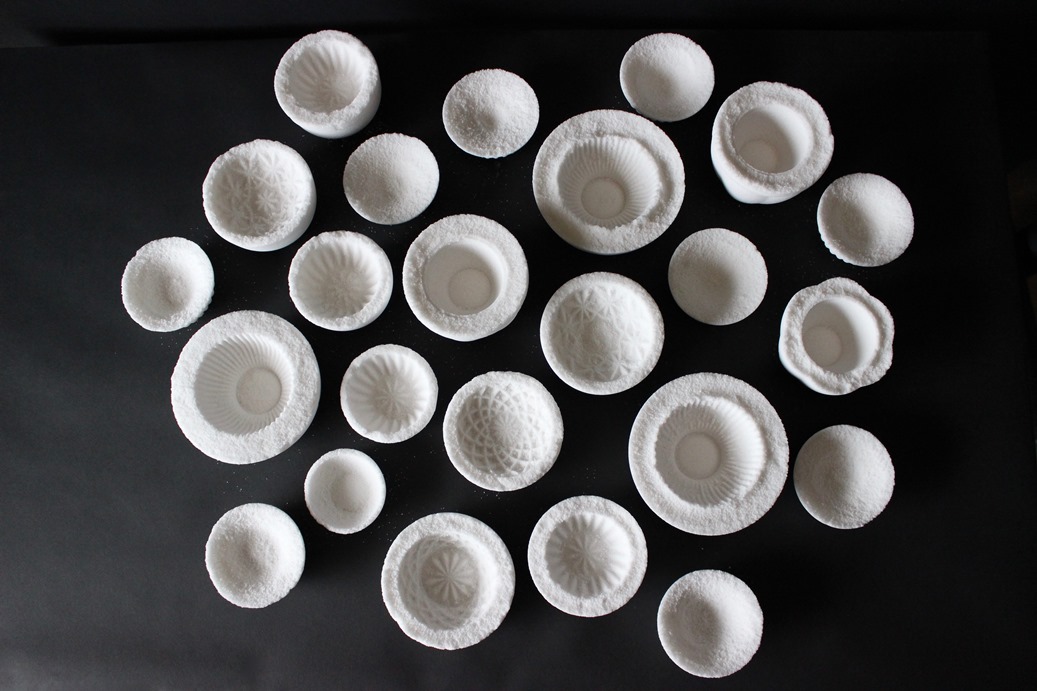
This ensemble of delicate containers made entirely of salt “is a motif of maternal lament,” says Australian artist Rebekah Pryor. “My Saltcellars functions to preserve and offer a taste of both the bitterness of maternal lament and the wisdom of love that enables the mother to survive it.”
LISTEN: “Mothers and Shepherds” by Brittney Spencer, Emil Sydhage, Gilbert Nanlohy, and Connor Wheaton, 2018 | Released as a single by Common Hymnal (feat. Brittney Spencer), 2019 | CCLI #7141753
Come now and hear the sound Of mothers gathered round Tears are streaming down in Bethlehem Grieving life that didn’t have to end Asking God to justify the pain Never knowing He would feel the same The powerful oppress the prophecy But shepherds passing through have found a King
Rumor has it that a child is born And it’s said that we will call him Lord Heaven’s angels came to let us know That our freedom rests upon His throne So we’ve traveled from across this land Seeking out the new and precious Lamb The One who came and made time stand still When heaven opened up at God’s own will
Hallelujah Glory in the highest King Messiah Savior of the world
Now forever we will sing the song Of the One who was and is to come All creation joins in harmony In declaring He is perfectly
Holy, holy Merciful and mighty God has sent The Savior of the world
Hallelujah Glory in the highest King Messiah Savior of the world
Ooh-ooh, ooh-ooh Ooh-ooh-ooh-ooh-ooh-ooh Ooh-ooh, ooh Savior of the world Ooh-ooh, ooh-ooh Ooh-ooh-ooh-ooh-ooh-ooh Ooh-ooh, ooh Savior of the world
Songwriter Brittney Spencer describes “Mothers and Shepherds” as “a Christmas song that forces hope, disaster, and pursuit to meet on a painful yet dauntingly beautiful path that exposes how much we’ve always needed a savior.” Find the chords here.
No one has ever seen God. But the unique One, who is himself God, is near to the Father’s heart. He has revealed God to us.
—John 1:18 (NLT)
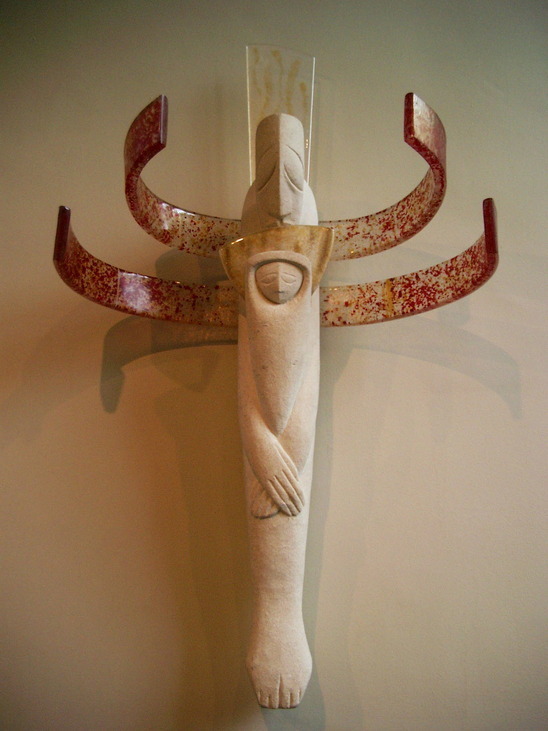
LOOK: The Word by Nicholas Mynheer
Nicholas Mynheer (British, 1958–), The Word, 2000. English limestone and cast glass, height 102 cm. South aisle, Birmingham Cathedral, UK.
This sculpture on the theme of the Incarnation of the Word was commissioned by the Cathedral Church of Saint Philip in Birmingham, England, for the new millennium. The sun shines on the work through the south window, casting light from the colored glass pieces over and across the stone and the surrounding wall.
“The changing light and shadows represent for me the ongoing Incarnation and not merely an historical event,” says artist Nicholas Mynheer. He notes the combination of heaven (glass) and earth (stone).
This is a Trinitarian image: the Father, anthropomorphized but nongendered, presents his glory, the Son, spoken, breathed, coming as infant, and both are embraced by the arcing sweep of the Holy Spirit.
LISTEN: “The Glory of the Father” | Words adapted from John 1 | Music by Egil Hovland, 1957; edited by Frank Pooler, 1974 | Performed by the National Lutheran Choir (US), dir. David Cherwien, 2018
The Word was made flesh, and dwelt among us. We beheld the glory of the Father, Full of grace and truth.
In the beginning was the Word, and the Word was with God. In Him was life, and the life was the light of all. He came to his own, and his own, received him not.
The Word was made flesh, and dwelt among us. We beheld the glory of the Father, Full of grace and truth.
Andrea Mantegna (Italian, 1431–1506), Madonna with Sleeping Child, ca. 1465. Tempera on canvas, 16 1/2 × 12 1/2 in. (42 × 32 cm). Gemäldegalerie, Berlin.
She took it all in: the shepherds and the royal and learned
men with their prophecies and proclamations. Resting among
common beasts, nipples sore and womb-ached, she smiled at
their praise—but her awe had begun with the angel’s decree.
At the mysterious life-pulse deep inside her. When flicker-
kicks strengthened to rolls and turns, elbows and heels in her
ribs. As buttocks bounced on her bladder.

The brightest star above them—a wondrous sign, but no
more miraculous than when, far from her mother and the
other village women, the flesh of her depth awakened and she
willed the baby from contentment into a harsh night. His cry
pierced the darkness, then quieted as, pressed to her breast,
he found her heartbeat again.
“After Luke 2:19” by Michelle Ortega, reproduced here by the author’s permission, was written for the 2021–22 exhibition Mary, Mary: Contemporary Poets and Artists Consider Mary at St. Michael’s Episcopal Church in Arlington, Virginia. Ortega is the author of the chapbooks Don’t Ask Why (Seven Kitchens Press, 2020) and Tissue Memory (Porkbelly Press, forthcoming).
Wayne Forte (Filipino American, 1950–), Jesus, Light of the World, 2009. Oil and acrylic on canvas, 30 × 24 in.
LISTEN: “Jesus, Light of the World” | Words by Charles Wesley (stanzas), 1739, and George D. Elderkin (refrain), 1890 | Music by George D. Elderkin, 1890 | Performed by Isaac Cates and Ordained on Carol of the Bells, 2014 (soloists: Margaret Rainey and Kami Woodard)
Hark! the herald angels sing. Jesus, the light of the world. Glory to the newborn King, Jesus, the light of the world.
We’ll walk in the light, beautiful light. Come where the dewdrops of mercy shine bright. Oh, shine all around us by day and by night. Jesus, the light of the world.
Joyful, all you nations, rise. Jesus, the light of the world. Join the triumph of the skies. Jesus, the light of the world.
Christ, by highest heav’n adored. Jesus, the light of the world. Christ, the everlasting Lord, Jesus, the light of the world.
Hail the heav’n-born Prince of Peace. Jesus, the light of the world. Hail the Sun of righteousness! Jesus, the light of the world.
In 1890 Chicago publisher George D. Elderkin adapted Charles Wesley’s beloved Christmas hymn text “Hark! the Herald Angels Sing,” using the first two lines of Wesley’s stanzas 1, 2, 3, and 5 and adding a refrain that’s based on a Fanny Crosby text from 1880. For the music, he wrote a gospel waltz. Although Elderkin was not African American, this hymn has become especially well loved in Black churches. Read a more detailed history of the hymn’s composition at the UMC Discipleship website.
Isaac Cates’s 2014 arrangement and recording is my favorite. Cates is a gospel vocalist, arranger, and pianist who performs with his choir, Ordained.
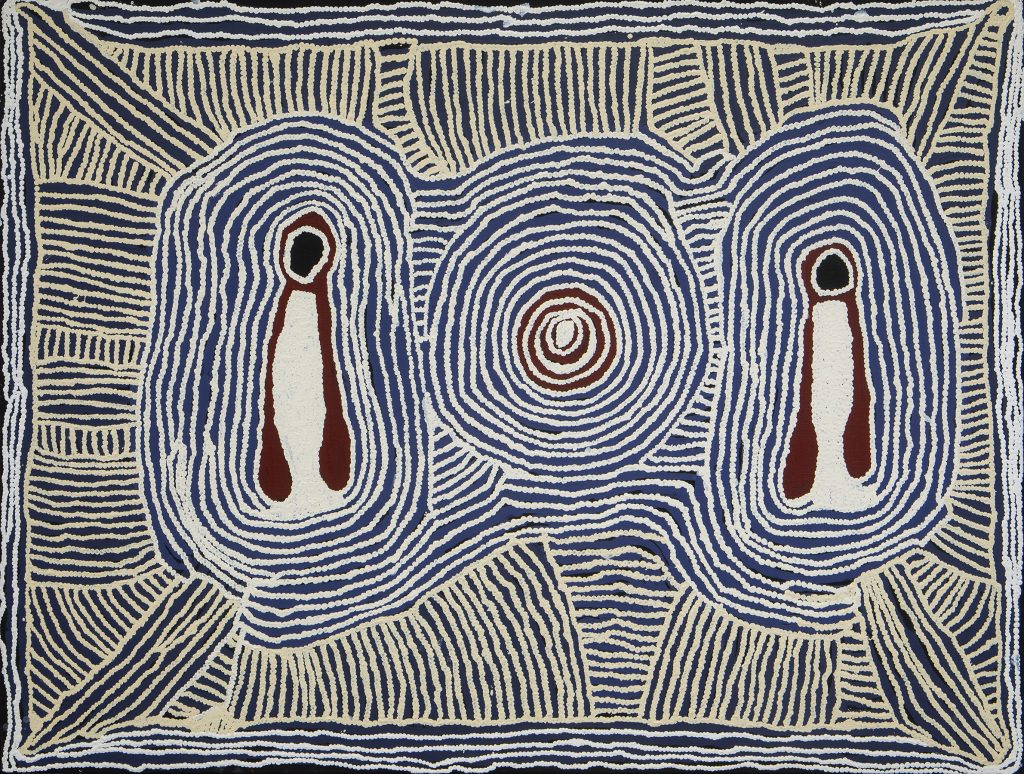
Linda Syddick Napaltjarri (Pintupi, ca. 1937–2021), Nativity, 2003. Acrylic on linen, 37 × 48 in. The Ahmanson Collection, Los Angeles.
Linda Syddick (Aboriginal name Tjunkiya Wukula Napaltjarri) (ca. 1937–2021) was a Pintupi artist from Australia’s Western Desert region whose work was influenced by her Christian and Indigenous beliefs and heritage. Living a seminomadic lifestyle until the age of eight or nine, she settled with her family at the Lutheran Mission at Haasts Bluff in the 1940s. She was taught to paint in the 1980s by her uncles Uta Uta Tjangala and Nosepeg Tjupurrula, who were both significant figures in the Papunya Tula art movement. She painted Tingari and biblical stories and was a three-time finalist for the prestigious Blake Prize, a religious art competition. Her works are held by the National Gallery of Australia, the Art Gallery of New South Wales, the Art Gallery of South Australia, and many other institutions.
In Syddick’s 2003 Nativity, a series of wavy, concentric blue and white lines encompass Joseph, baby Jesus, and Mary, while many more lines in blue and beige converge on the trio from the image’s border. To me the artwork conveys a vibrating joy! And myriad pathways leading to the birth of the Savior.
Jesus is the centerpiece of the composition, a little tot represented geometrically as a circle. What do you see in this form? A sun? An egg? A pebble thrown into a lake, sending ripples outward? A reverberant well?
LISTEN: “Shout Your Joy” | Original German words by Johannes David Falk, 1816 (stanza 1), and Heinrich Holzschuher, 1826 (stanzas 2–3) | English translator unknown | Music by Reindeer Tribe, 2011
O thou joyous day! O thou holy day! Gladsome Christmas is here again!
O thou joyous day! O thou holy day! Gladsome Christmas is here again! When the world was rent and torn, Christ was born on Christmas morn! Shout your joy to all the world! Shout your joy to all the world!
O thou joyous day! O thou holy day! Gladsome Christmas is here again! Christ now is living, his mercy giving. Shout your joy to all the world! Shout your joy to all the world!
O thou joyous day! O thou holy day! Gladsome Christmas is here again! Choirs of angels singing, joy and honor bringing, Shout your joy to all the world! Shout your joy to all the world!
This song by Reindeer Tribe has its origins in a tri-holiday hymn written in German in 1816 by Johannes David Falk. Falk wrote one stanza for each of the three main festivals of the church year—Christmas, Easter, and Pentecost—for the use of the children at the orphans’ school he ran in Weimar, paired with a preexisting tune known as O SANCTISSIMA or SICILIAN MARINERS. After Falk’s death, in 1826, his assistant Heinrich Holzschuher isolated the Christmas stanza and added two additional stanzas, turning it into a carol, known by its opening phrase, “O du Fröhliche” (O Thou Joyous [Day]). This Christmas carol is still widely sung in Germany today.
O du fröhliche, o du selige, gnadenbringende Weihnachtszeit! Welt ging verloren, Christ ist geboren: Freue, freue dich, o Christenheit!
O du fröhliche, o du selige, gnadenbringende Weihnachtszeit! Christ ist erschienen, uns zu versöhnen: Freue, freue dich, o Christenheit!
O du fröhliche, o du selige, gnadenbringende Weihnachtszeit! Himmlische Heere jauchzen Dir Ehre: Freue, freue dich, o Christenheit!
Reindeer Tribe chose one of the several available English translations (translator unknown) and wrote new music for it that really captures its celebratory spirit. They add a repeat of the last line of each stanza and call the song “Shout Your Joy.” If you’re looking for recordings in English that use the traditional tune, you can search under “O Thou Joyful Day” or “Oh How Joyfully.” For alternative English translations, which each has merit, see here, here, and (by Beale M. Schmucker) here.
Ring the bells for Christmas Vigil Ring the bells and light your candles now The stars are out
All the angels with covered faces Let all mortal flesh keep silence now All devout Keep silence now All devout
Ring the bells in every tower Ring the bells, let every hour tell All will be well
All the faithful come together Hear the name they love and know so well Emmanuel All is well Emmanuel
Ring the bells for Christmas Vigil Ring the bells and light your candles now The stars are out Keep silence now All devout
Lee Bozeman’s Jubilee is a wonderful little acoustic EP with three originals and a traditional. The title track, which Bozeman refers to as “a sorrow,” begins, “The kids won’t be home for Christmas . . .” That’s followed by “The First Artificial Snow of the Year,” an instrumental piano piece with jingle bells. Then “Down in Yon Forest,” a Renaissance-era carol from England that Bozeman sings a cappella. And lastly, “Christmas Vigil,” my favorite of the four—slow and solemn like the others, with understated echo effects, and I don’t know what that sound is he’s producing for the last thirty seconds, but it suggests an arrival.
Christmas Vigil is a common practice across church traditions, though the particulars may vary. Many churches hold their vigil around midnight on December 24, the time when Christmas Eve gives way to Christmas Day, so that the congregation can welcome in the feast of Christ’s birth just as soon as the clock ticks over into the a.m. (We have accounts of Midnight Masses being celebrated on Christmas Eve as early as the fourth century in Jerusalem.)
Other churches hold their Christmas Eve service earlier in the evening. Candlelight and corporate carol singing are usually involved. Churches that have lit an Advent wreath for each of the previous four Sundays will complete the wreath by lighting the Christ candle in the center.
Some Christians worship at home instead on this day with just their own family unit, perhaps with an informal liturgy or with special family traditions.
No matter how you mark the day, I pray that you are filled with excitement for God’s arrival in human flesh—that divine gift of himself—and with the peaceful assurance that, as God promised, all will be well.
This is the final post in the 2021 Advent Series—thank you for journeying with me through the season! Daily posts will continue throughout the twelve days of Christmas to the feast of Epiphany on January 6.
If you appreciated this series and have the means, please consider making a donation to the site to support future projects like this so that I won’t have to put them behind a paywall.
For as the lightning comes from the east and flashes as far as the west, so will be the coming of the Son of Man.
—Matthew 24:27
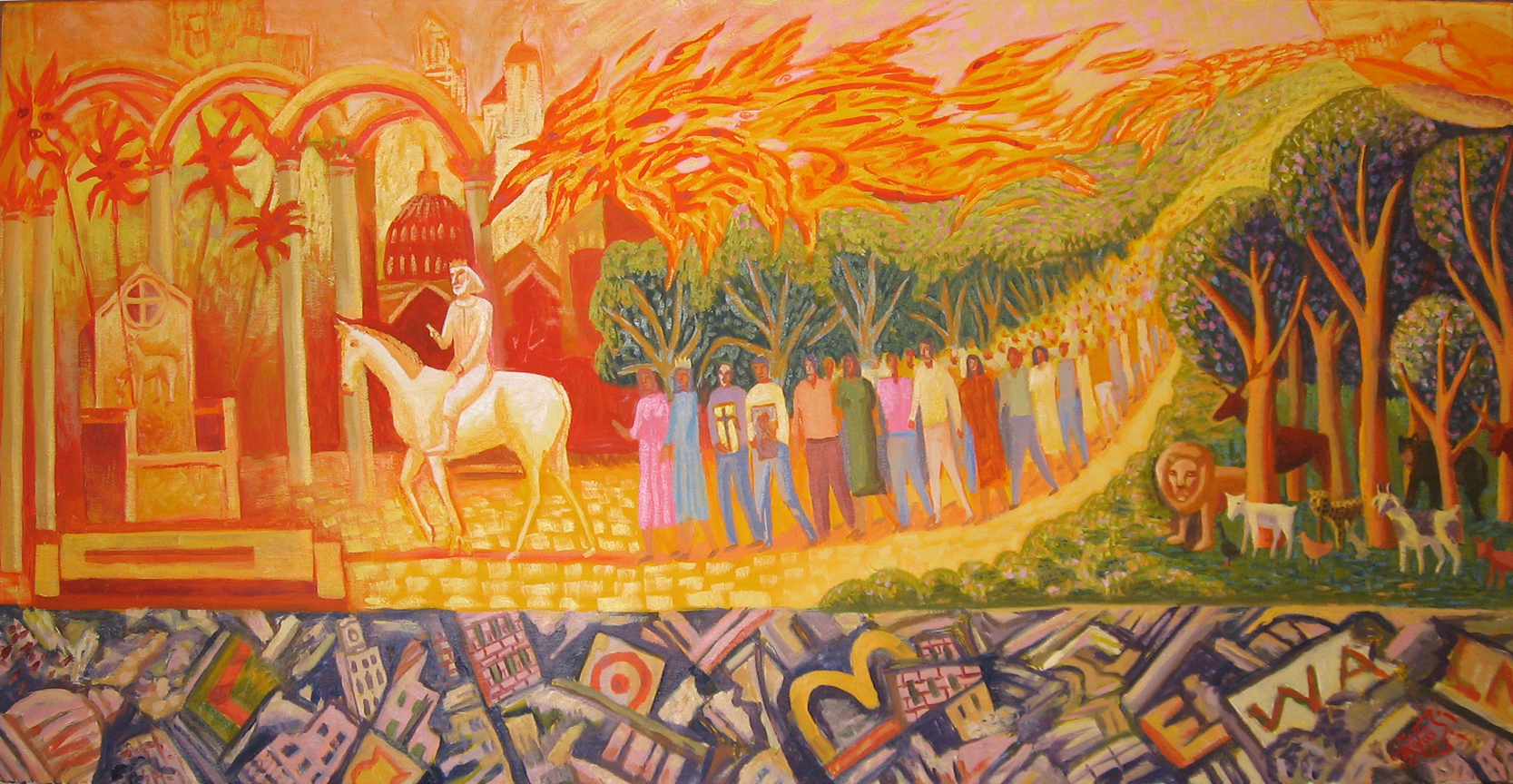
Then I saw heaven opened, and there was a white horse! Its rider is called Faithful and True, and in righteousness he judges and makes war. His eyes are like a flame of fire, and on his head are many diadems; and he has a name inscribed that no one knows but himself. He is clothed in a robe dipped in blood, and his name is called The Word of God.
—Revelation 19:11–13
LOOK: Jesus Rides a White Horse by James B. Janknegt
You shall have the trumpet sounded throughout all your land. And you shall hallow the fiftieth year and you shall proclaim liberty throughout the land to all its inhabitants. It shall be a jubilee for you . . .
—Leviticus 25:9–10
The LORD has proclaimed to the end of the earth: Say to daughter Zion, “See, your salvation comes . . .”
—Isaiah 62:11
Immediately after the suffering of those days
the sun will be darkened, and the moon will not give its light; the stars will fall from heaven, and the powers of heaven will be shaken.
Then the sign of the Son of Man will appear in heaven, and then all the tribes of the earth will mourn, and they will see “the Son of Man coming on the clouds of heaven” with power and great glory. And he will send out his angels with a loud trumpet call, and they will gather his elect from the four winds, from one end of heaven to the other.
—Matthew 24:29–31
“Look, I tell you, lift up your eyes, and see that the fields are white for harvest.”
—John 4:35
LOOK: Middle Eastern manuscript illumination of a trumpeting angel
Written around 1270, Aja’ib al-Makhluqat wa Ghara’ib al-Mawjudat (The Wonders of Creation and the Oddities of Existence) by the Persian cosmographer Zakriya ibn Muhammad al-Qazwini was one of the best known and most copied texts in the medieval Islamic world. This leaf from a fourteenth-century illuminated version shows an angel blowing a long trumpet that resembles a karnay, an ancient brass instrument still used throughout Central Asia, especially Uzbekistan, to herald celebrations.
The British Museum website identifies the angel in this painting as Gabriel; however, according to the hadith (records of the traditions and sayings of the prophet Muhammad) and the verso of this page, it is the angel Israfil who will blow the horn on the Day of Resurrection. Similar representations can be found here, here, here, and here. I sent a query to the museum asking why they’ve titled the painting “The Angel Gabriel” and whether it might be a mistake, and they told me they are looking into it.
Even though the Bible never specifies Gabriel as the trumpeter of the last days, he has come to be associated with that role in Christian tradition. The Armenian church was the first to assign it to him beginning in the twelfth century, and John Milton did likewise in his seventeenth-century epic, Paradise Lost. Gabriel’s trumpet is also a familiar trope in African American spirituals.
Israfil is not mentioned in the Bible. However, because whole hosts of angels exist and so few are named in scripture, all three Abrahamic religions (Judaism, Christianity, Islam) have naturally taken to supplying some names of their own.
The unknown artist of this image has creatively imagined an angel’s wing that tapers off into what looks like an animal head!
I chose the image for its ability to evoke Christ’s return—which, FYI, Muslims are also waiting for.
LISTEN: “Days of Elijah” by Robin Mark, 1996 | Arranged by Keith Lancaster and performed by the Acappella Company on Glorious God: A Cappella Worship, 2007
These are the days of Elijah Declaring the Word of the Lord And these are the days of your servant Moses Righteousness being restored And though these are days of great trials Of famine and darkness and sword Still we are the voice in the desert crying Prepare ye the way of the Lord
Behold he comes Riding on the clouds Shining like the sun At the trumpet call So lift your voice It’s the year of Jubilee And out of Zion’s hill Salvation comes
And these are the days of Ezekiel The dry bones becoming as flesh And these are the days of your servant David Rebuilding a temple of praise And these are the days of the harvest The fields are as white in the world And we are the laborers in your vineyard Declaring the Word of the Lord
Behold he comes Riding on the clouds Shining like the sun At the trumpet call So lift your voice It’s the year of Jubilee And out of Zion’s hill Salvation comes
There’s no god like Jehovah There’s no god like Jehovah There’s no god like Jehovah There’s no god like Jehovah
In the fifth century BCE God told Israel through his prophet Malachi, “See, I am sending my messenger to prepare the way before me. . . . Lo, I will send you the prophet Elijah before the great and terrible day of the LORD comes” (Mal. 3:1a; 4:5; cf. Isa. 40:3).
Four hundred years later came John the Baptist, whom Jesus referred to as Elijah (Matt. 11:14)—preparing the way, preaching the Word.
Northern Irish singer-songwriter Robin Mark invokes Elijah and, implicitly, his new-covenant counterpart, John, in the first stanza of “Days of Elijah,” comparing the ministries of these two prophets to that of the church. Just as John the Baptist prepared the way for the Messiah’s first coming, we are to prepare the way for his second.
The refrain pictures that second coming as a jubilee celebration—as freedom, rest, wholeness, the world set right—announced by a trumpet blast.
We are in the last days, the time between Christ’s two advents. And though we await the fullness of redemption, we do not do so passively. Filled with Christ’s Spirit, we labor as agents of justice and resurrection and praise, as the song suggests.
Above I featured a fairly standard (and skillful!) version of “Days of Elijah” that could be sung by your average church congregation. But here’s one to really knock your socks off: an arrangement by the South African gospel group Joyous Celebration, which they performed live in Johannesburg last month:
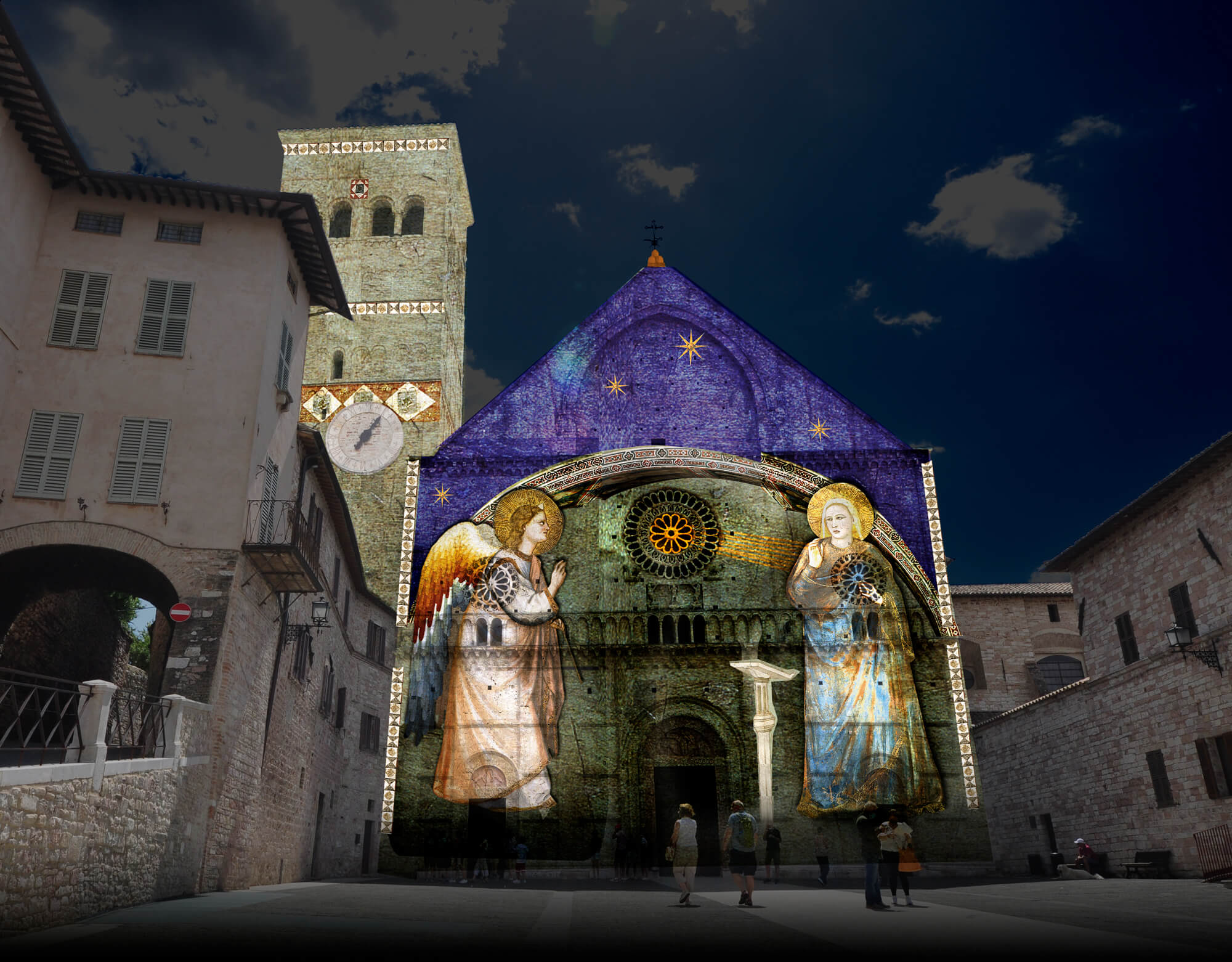
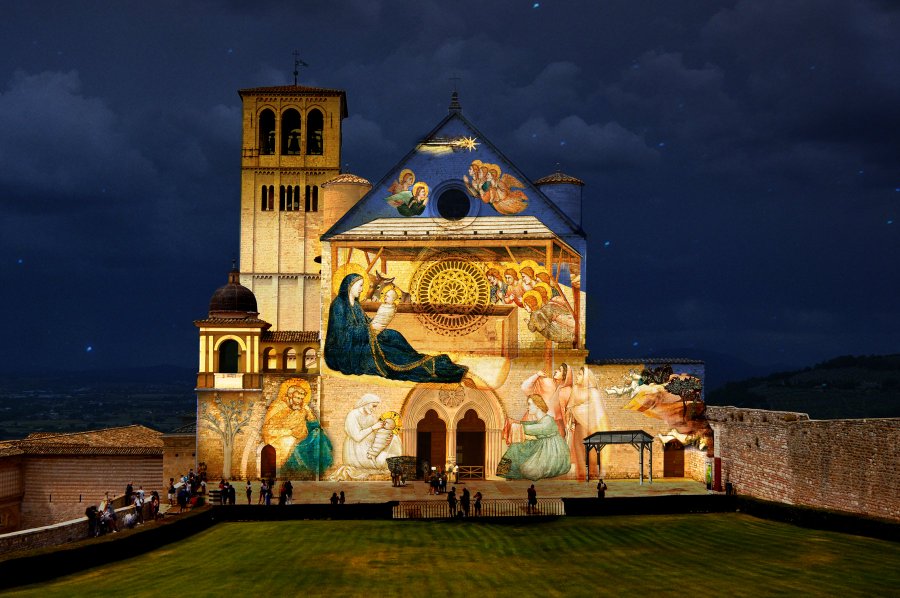
PROJECTION MAPPING INSTALLATION: Il Natale di Francesco (The Christmas of Francis): Last year the Sacro Convento in Assisi, a Franciscan friary, initiated an architectural lighting project called Il Natale di Francesco that featured projections of Christmas-themed frescoes by Giotto from the Lower Basilica of St. Francis onto several of the city’s landmark churches. Architect Mario Cucinella served as artistic director, and the company Enel X realized the installation, which ran throughout Advent and Christmastide, from December 8, 2020, to January 6, 2021 (and I hear it’s been reprised this year!). The pièce de résistance was the projection of Giotto’s Nativity onto the facade of the Upper Basilica of St. Francis. Other projections included the Annunciation on the Cathedral of San Rufino, the Visitation on the Basilica of Saint Clare, and the Adoration of the Magi on the abbey church of San Pietro in Valle—all images adapted using advanced technology to suit the spaces they illuminated.
Other components of the installation included frescoed stars from the main basilica’s vaults projected onto the streets; a re-creation of Giotto’s scenes with dozens of sculpted figures, including the addition of a masked nurse at the crèche in honor of all the frontline healthcare workers serving during the COVID-19 crisis; and every thirty minutes a video-mapping show that offered views of the basilica’s interior. I so love the creativity of bringing the sacred art treasures of the church out into the town squares when the pandemic necessitated church closures.
+++
VIRTUAL CONCERT: Christmas with the Sakhnini Brothers: The Sakhnini Brothers are Adeeb, Elia, and Yazeed, three Arabic-speaking brothers from Nazareth who are followers of Jesus. They play about twenty instruments collectively but specialize in piano, oud, and violin, respectively, and love to blend modern Western and ancient Middle Eastern musical styles.
In this half-hour living room concert that premiered December 13, they are joined by vocalist Nareen Farran, pianist Sireen Elias, and percussionist Firas Haddad. They perform an instrumental rendition of “God Rest Ye Merry Gentlemen”; “Amano Morio,” a traditional hymn from the Syriac Maronite liturgy, whose lyrics translate to “The Lord is with us day and night”; “O Come, All Ye Faithful” in Arabic; “Sobhan Al Kalima” (Glory to the Word), another traditional hymn in Syriac (see YouTube video description for full English translation); “Mary, Did You Know”; and “Laylet Eid” (Christmas Eve), a song by Fairuz to the tune of “Jingle Bells.” Their arrangements are fantastic! (You especially have to hear what they do with that closing number; I can’t stop smiling.)
Neeley also put together a listening guide so that you can follow along with the lyrics.
+++
VIRTUAL EXHIBITION: Visual Music: Calligraphy and Sacred Texts, Henry Luce III Center for the Arts & Religion: “‘Form,’ wrote Jewish-American artist Ben Shahn, ‘is the very shape of content.’ Shahn’s statement serves as the guiding principle for this exhibit. Each of these fifteen pieces, all by living artists, is a calligraphic interpretation of a text sacred to Jews, Christians, or both. Each artist has pondered their chosen text, explored it inside and outside, and provided their own rendition of it—their own ‘translation’ into visual form.”
Jonathan Homrighausen, a doctoral student in Hebrew Bible at Duke University who writes and researches at the intersection of Hebrew Bible, calligraphic art, and scribal craft, has curated this wonderful online art exhibition for the Henry Luce III Center for the Arts & Religion at Wesley Theological Seminary in Washington, DC. I spent hours viewing all the rich content on the website, including Homrighausen’s illuminating commentaries (which take us beyond a simplistic “ooh, pretty” response), and following links to learn more. From the exhibition homepage you can click on any of the images for a detailed description, detail photos, embedded videos and music, and suggested articles for further reading.
Also check out the video presentation Homrighausen gave on December 12 for the Jewish Art Salon in New York City in which he discusses five of the Hebrew Bible–based pieces on display, plus two that render rabbinic quotes. The Q&A that follows is moderated by Jewish calligrapher Judith Joseph.
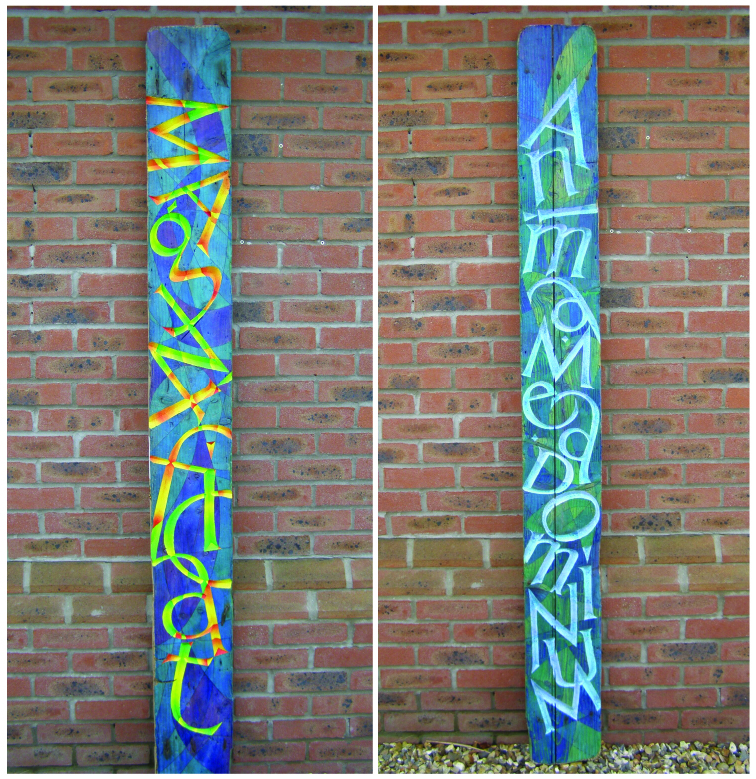
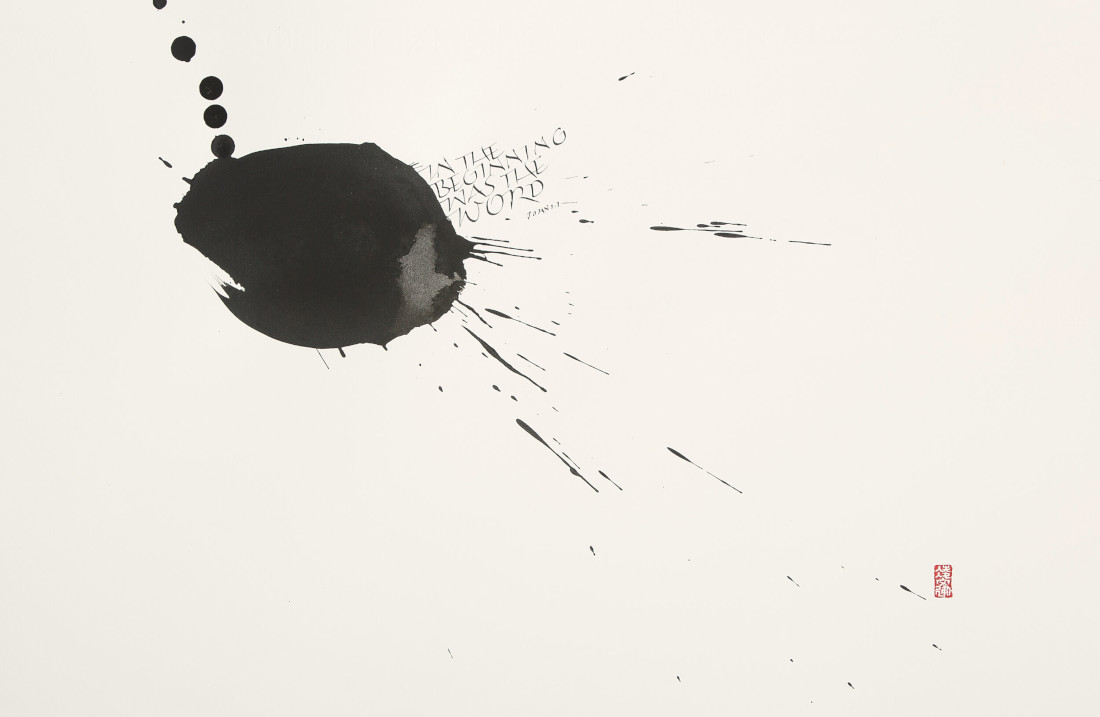
Since many of my blog readers will have just read Mary’s Magnificat from Luke 1 this past Sunday (it’s one of the assigned lections for Advent 4) and we’re just a few days away from the feast of Christmas, let me share these two timely images from the exhibition:
Martin Wenham (British, 1941–), Magnificat (front and back), 2008. Paint on found pinewood, 84 × 8 1/2 in.Manny Ling (Chinese, 1966–), ‘In the beginning was the word’ (John 1:1), 2018. Chinese ink on paper, 11 11/16 × 16 1/2 in.
+++
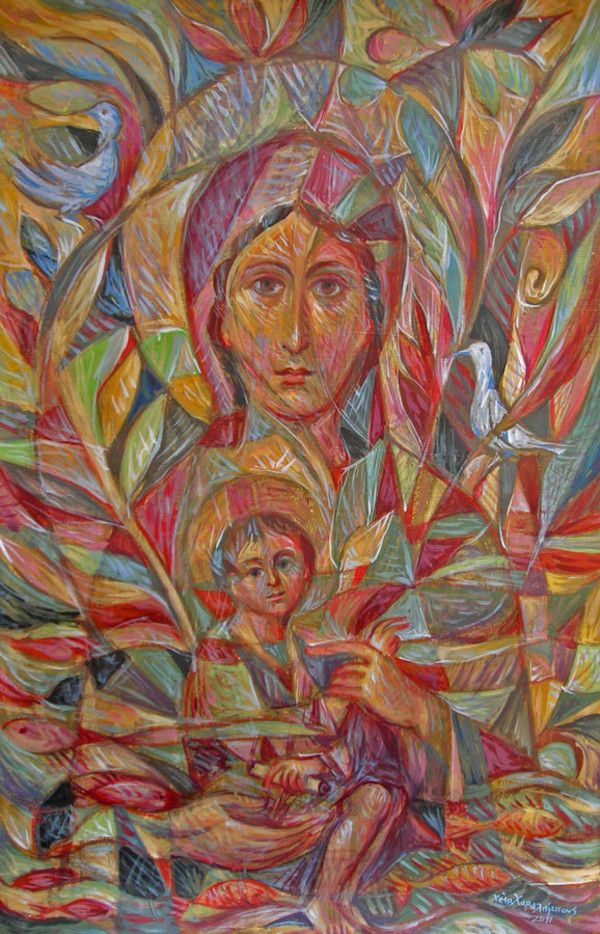
VISUAL MEDITATION: “An Icon of Deep Incarnation” by John A. Kohan: Art collector John A. Kohan reflects on the painting Madonna of the Woods by Cypriot artist Charalambos Epaminonda, a variation on the Virgin Hodegetria type. “God took on human flesh and entered creation not just to bring you and me personal salvation or rescue the human race from sin and death, but to restore and renew the entire earth and all that is therein. Contemporary theologians in our age of ecological awareness call this concept ‘deep incarnation’ . . .”
Charalambos Epaminonda (Cypriot, 1962–), Madonna of the Woods, 2011. Acrylic on canvas, 46 × 29 cm. Sacred Art Pilgrim Collection.
Delita Martin (American, 1972–), Night Travelers, 2016. Gelatin printing, conté, collage, fabric, hand-stitching, and decorative paper, 72 × 149 in.
I saw an exhibition last year of Delita Martin’s work at the National Museum of Women in the Arts in Washington, DC, and I was so taken by it. Though this piece wasn’t included, I was able to get a good sense of Martin’s unique technical approach, which combines printmaking, drawing, painting, and hand-stitching. The strength of African American women is a key theme in Martin’s work, as are African tradition, community, memory, and the spirit world.
Sister, here’s a song for the long night Sister, here’s a song for the longest night Sister, here’s a song for the long night And I’ll sing with you till the morning comes
Brother, here’s a prayer for the long night Brother, here’s a prayer for the longest night Brother, here’s a prayer for the long night And I’ll pray with you till the morning comes
Mama, here’s a dream for the long night Mama, here’s a dream for the longest night Mama, here’s a dream for the long night And I’ll dream with you till the morning comes
Father, what’s your wish for the long night? Father, what’s your wish for the longest night? Father, what’s your wish for the long night? And I’ll wish for you till the morning comes
Neighbor, here’s a hand in the long night Neighbor, here’s a hand in the longest night Neighbor, here’s a hand in the long night And I’ll build with you till the morning comes
And I’ll build with you (We will sing) Till the morning comes (We will pray) And I’ll build with you (We will dream) Till the morning comes
Dan + Claudia Zanes [previously] wrote this song last year during the early waves of the COVID-19 pandemic, premiering it as part of their Social Isolation Song Series on YouTube the week of George Floyd’s murder. It is included on the duo’s debut album in a version that features a kora solo by Amadou Kouyate.
A song of consolation, “For the Long Night” is especially fitting for December 21, the shortest day (longest night) of the year in the northern hemisphere. Sometimes it feels like we’re traveling through a night with no end, with no dawn on the horizon—but realizing that there are others in our boat, making the journey with us, is a tremendous encouragement. Together we must continue to sing, pray, dream, and build “till the morning comes.”
This year for the first time I learned about the Christian tradition of Blue Christmas / Longest Night services. Typically held on the winter solstice (either December 21 or 22), these services hold space for grief, whether over relationship loss or fracture, the death of a loved one, physical or mental health struggles, racialized hate and violence, financial hardship, loneliness, disappointment, or anything else. They also gesture toward hope and healing.

#/media/File:Andrea_Mantegna_108.jpg)




 Art & Theology