This article contains a synopsis of sorts, which means there are some mild “spoilers.” Page numbers are from the Picador Modern Classics edition, published in 2015.
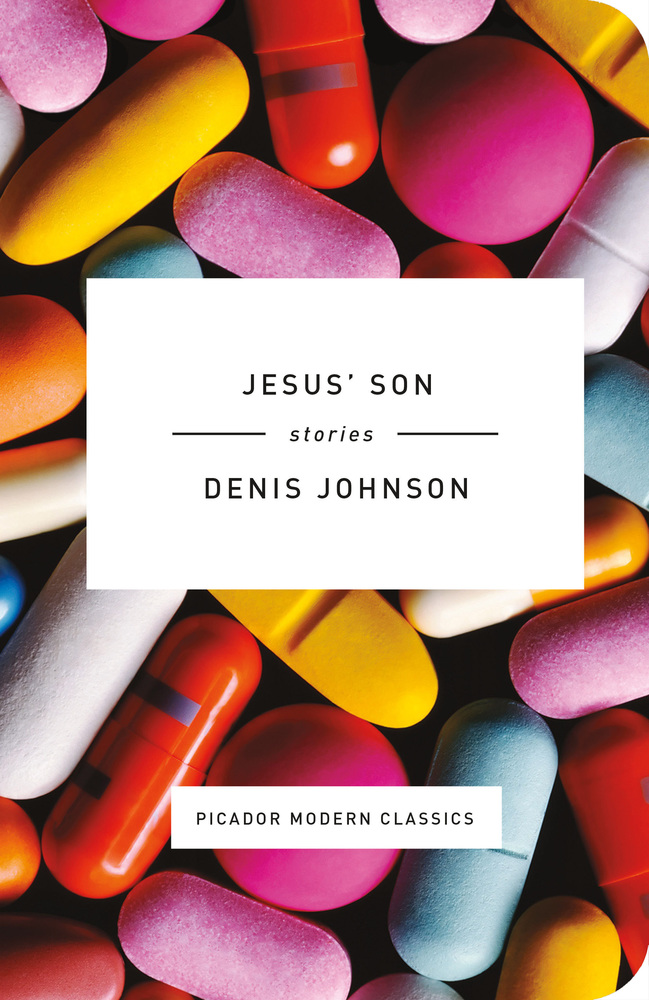
A masterpiece of twentieth-century literature, Jesus’ Son (1992) by Denis Johnson is a semiautobiographical collection of loosely linked short stories narrated by a twenty-something male drug addict named F***head (“FH” for short). The book, set in the early 1970s, has nothing to do with a holy bloodline; its title refers to two lines from the Lou Reed song “Heroin,” which are given as the epigraph:
When I’m rushing on my run
And I feel just like Jesus’ Son . . .
FH’s drug-induced escapades constitute the main narrative, which meanders through vignettes that are by turns mundane, repulsive, darkly comic, or just pathetic. Some of the events, like Georgie’s acts of life-saving heroism, are likely hallucinated (FH’s narration is unreliable). But over all the depravity, boredom, and pain that feature prominently in the book, a subtle through line of redemption winds haphazardly, as FH searches for spiritual purpose and connection, for someone “who knew my real name” (111).
Part of this search involves his struggle to overcome the emotional numbness that prevents him from feeling both happiness and pain. In the opening story, “Car Crash While Hitchhiking,” a married couple traveling with their infant picks up FH on the side of the road and soon after collides with an oncoming car. At the hospital, FH twistedly muses on how “wonderful” and radiant the newly widowed woman’s wail is:
Down the hall came the wife. She was glorious, burning. She didn’t know yet that her husband was dead. We knew. That’s what gave her such power over us. The doctor took her into a room with a desk at the end of the hall, and from under the closed door a slab of brilliance radiated as if, by some stupendous process, diamonds were being incinerated in there. What a pair of lungs! She shrieked as I imagined an eagle would shriek. It felt wonderful to be alive to hear it! I’ve gone looking for that feeling everywhere. (12)
FH feels completely detached from the woman’s grief and yet envious of it—a grief so raw, so real. He wishes he could feel as deeply as her.
This desire to feel something, anything, is what attracts him to the passionate Michelle, who so often sweeps him up into her passion, whether it be angry or romantic. Their relationship is volatile:
When we were arguing on my twenty-fourth birthday, she left the kitchen, came back with a pistol, and fired it at me five times from right across the table. But she missed. It wasn’t my life she was after. It was more. She wanted to eat my heart and be lost in the desert with what she’d done, she wanted to fall on her knees and give birth from it, she wanted to hurt me as only a child can be hurt by its mother. (116)
FH’s desperate pursuit of aliveness leads him to drugs, under whose influence he receives visions—a naked woman parasailing (embodying pure freedom), a mysterious man on the subway whose “chest was like Christ’s” (“I decided to follow him,” 108), and a Jacob’s ladder:
We bumped softly down a hill toward an open field that seemed to be a military graveyard, filled with rows and rows of austere identical markers over soldiers’ graves. I’d never before come across this cemetery. On the farther side of the field, just beyond the curtains of snow, the sky was torn away and the angels were descending out of a brilliant blue summer, their huge faces streaked with light and full of pity. The sight of them cut through my heart and down the knuckles of my spine, and if there’d been anything in my bowels I would have messed my pants from fear.
Georgie opened his arms and cried out, “It’s the drive-in, man!”
“The drive-in . . .” I wasn’t sure what these words meant.
“They’re showing movies in a f***ing blizzard!” Georgie screamed.
“I see. I thought it was something else,” I said. (91–92)
Billy Crudup as FH in Jesus’ Son (1999)
Visions like this transport FH to a higher plane, making him feel momentarily connected to something larger than himself. And he continues to crave that connection, as does his friend Georgie, who states at one point, “I want to go to church. . . . I’d like to worship. I would. . . . I need a quiet chapel about now” (85–86). (They go to the county fair instead.) Continue reading ““Cheer up, my brother, live in the sunshine”: Searching for light in Jesus’ Son“→
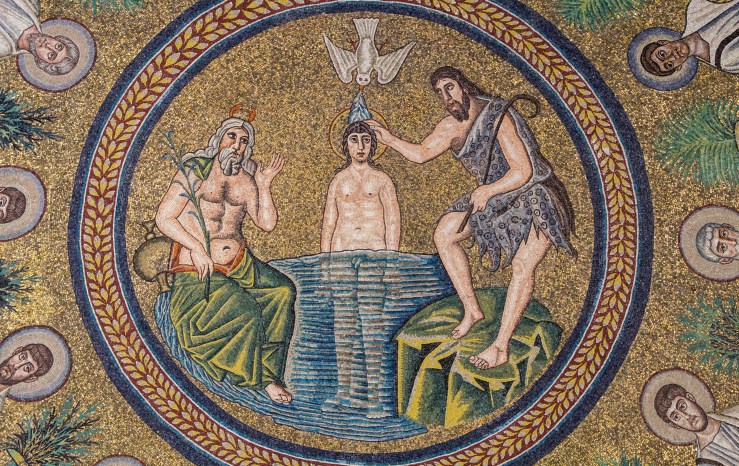
The Baptism of Christ, early 6th century. Ceiling mosaic, Arian Baptistery, Ravenna, Italy. Photo: Jim Forest.
Behold my servant, whom I uphold,
my chosen, in whom my soul delights;
I have put my Spirit upon him;
he will bring forth justice to the nations.
He will not cry aloud or lift up his voice,
or make it heard in the street;
a bruised reed he will not break,
and a faintly burning wick he will not quench;
he will faithfully bring forth justice.
He will not grow faint or be discouraged
till he has established justice in the earth;
and the coastlands wait for his law.
Thus says God, the LORD,
who created the heavens and stretched them out,
who spread out the earth and what comes from it,
who gives breath to the people on it
and spirit to those who walk in it:
“I am the LORD; I have called you in righteousness;
I will take you by the hand and keep you;
I will give you as a covenant for the people,
a light for the nations,
to open the eyes that are blind,
to bring out the prisoners from the dungeon,
from the prison those who sit in darkness.
I am the LORD; that is my name;
my glory I give to no other,
nor my praise to carved idols.
Behold, the former things have come to pass,
and new things I now declare;
before they spring forth
I tell you of them.”
—Isaiah 42:1–9
Then Jesus came from Galilee to the Jordan to John, to be baptized by him. John would have prevented him, saying, “I need to be baptized by you, and do you come to me?” But Jesus answered him, “Let it be so now, for thus it is fitting for us to fulfill all righteousness.” Then he consented. And when Jesus was baptized, immediately he went up from the water, and behold, the heavens were opened to him, and he saw the Spirit of God descending like a dove and coming to rest on him; and behold, a voice from heaven said, “This is my beloved Son, with whom I am well pleased.”
—Matthew 3:13–17
You yourselves know what happened throughout all Judea, beginning from Galilee after the baptism that John proclaimed: how God anointed Jesus of Nazareth with the Holy Spirit and with power. He went about doing good and healing all who were oppressed by the devil, for God was with him. . . .
He is the one appointed by God to be judge of the living and the dead. To him all the prophets bear witness that everyone who believes in him receives forgiveness of sins through his name.
—Acts 10:37–38, 42–43
+++
SONG: “Hail to the Lord’s Anointed” | Words by James Montgomery, 1821 | Music by the Rev. Vito Aiuto, on Welcome to the Welcome Wagon, 2008 [previously]
Hail to the Lord’s Anointed,
great David’s greater Son!
Hail in the time appointed,
his reign on earth begun!
He comes to break oppression,
to set the captive free;
to take away transgression,
and rule in equity.
He comes with succor speedy
to those who suffer wrong;
to help the poor and needy,
and bid the weak be strong;
to give them songs for sighing,
their darkness turn to light,
whose souls, condemned and dying,
are precious in his sight.
He shall come down like showers
upon the fruitful earth;
love, joy, and hope, like flowers,
spring in his path to birth.
Before him on the mountains
shall peace, the herald, go,
and righteousness, in fountains,
from hill to valley flow.
To him shall prayer unceasing
and daily vows ascend;
his kingdom still increasing,
a kingdom without end.
The tide of time shall never
his covenant remove;
his name shall stand forever;
that name to us is love.
+++
Arian Baptistery, Ravenna. Photo: Georges Jansoone.Photo: Peter MiloševićPhoto: Fr. Lawrence Lew, OPPhoto: Jim Forest
The dome of the great sixth-century Arian Baptistery in Ravenna, Italy, shows, in glimmering mosaic, a young, beardless, fully nude Christ standing waist-deep in the waters of the Jordan as John the Baptist, dressed in leopard skin, anoints him—the archetypal event for the liturgy that used to be performed below. And actually, the anointing water in this representation comes from the beak of a dove, God the Holy Spirit.
The old man on the left is a personification of the Jordan River, whose attributes are derived from that of the Hellenistic river gods. He holds a reed in his hand and leans against a spilled jar, from whose mouth flows the river water, while from his head there sprouts a pair of red crab claws. He is clothed in the same moss that covers the rock John stands on.
Around this central scene, which is framed by a laurel wreath, is a procession of the twelve apostles, led by Peter (the gray-haired man with the key) and Paul (the dark-haired man with the scrolls). The apostles carry jeweled crowns in their veiled hands—a sign of humility—as they make their way to the empty throne of Christ’s promised return, the hetoimasia, prepared with a plush purple cushion and jeweled cross.
This post belongs to the weekly series Artful Devotion. If you can’t view the music player in your email or RSS reader, try opening the post in your browser.
To view all the Revised Common Lectionary scripture readings for the feast of the Baptism of the Lord, cycle A, click here.
Clementine Hunter (American, 1886/87–1988), The Annunciation and the Adoration of the Wise Men, 1957. Oil on board, 48 × 78 in. Photo courtesy of Neal Auction Company.
Arise, shine, for your light has come,
and the glory of the LORD has risen upon you.
—Isaiah 60:1
May the kings of Tarshish and of the coastlands
render him tribute;
may the kings of Sheba and Seba
bring gifts!
May all kings fall down before him,
all nations serve him!
—Psalm 72:10–11
Now after Jesus was born in Bethlehem of Judea in the days of Herod the king, behold, wise men from the east came to Jerusalem, saying, “Where is he who has been born king of the Jews? For we saw his star when it rose and have come to worship him.” When Herod the king heard this, he was troubled, and all Jerusalem with him; and assembling all the chief priests and scribes of the people, he inquired of them where the Christ was to be born. They told him, “In Bethlehem of Judea, for so it is written by the prophet:
‘And you, O Bethlehem, in the land of Judah,
are by no means least among the rulers of Judah;
for from you shall come a ruler
who will shepherd my people Israel.’”
Then Herod summoned the wise men secretly and ascertained from them what time the star had appeared. And he sent them to Bethlehem, saying, “Go and search diligently for the child, and when you have found him, bring me word, that I too may come and worship him.” After listening to the king, they went on their way. And behold, the star that they had seen when it rose went before them until it came to rest over the place where the child was. When they saw the star, they rejoiced exceedingly with great joy. And going into the house, they saw the child with Mary his mother, and they fell down and worshiped him. Then, opening their treasures, they offered him gifts, gold and frankincense and myrrh. And being warned in a dream not to return to Herod, they departed to their own country by another way.
—Matthew 2:1–12
+++
SONG: “Behold That Star” or “Behold the Star” | African American spiritual | Performed by various artists (see below)
I first heard this song years ago on Pete Seeger’s Traditional Christmas Carols (1967; reissued 1989), one of my favorite Christmas albums.
William L. Dawson’s choral arrangement, recorded by the St. Olaf Choir in 1997, has become the standard for choirs all over the country. The recording features, as soloist, African American operatic soprano Marvis Martin:
For a gospel version, check out Fred Waring and the Pennsylvanians’ album Christmas Time (1955, reissued 2015), which combines the song with “Carol of the Bells”:
Or the version by James Cleveland with the Angelic Choir and the Cleveland Singers on Merry Christmas (1969, reissued 1987):
One of the most upbeat gospel renditions is by the Patterson Singers from 1963:
There’s also a much slower R&B rendition from Black Nativity: A Gospel Christmas Musical Experience, a musical produced by Dominion Entertainment Group in Atlanta and adapted from the 1961 song play by Langston Hughes. (“Behold That Star” is not in the Hughes original.) I couldn’t find who arranged this version, but the performers are Lawrence Flowers, Benjamin Moore, and Brandin Jay. Oddly (and perhaps under the influence of the song “Rise Up, Shepherd, and Follow”), this production has the song being sung by shepherds rather than wise men:
You can also find numerous recordings of “Behold That Star” being performed by children’s choirs, its simplicity making it accessible to young ages. It was one of several spirituals and other classics the kiddos at my church sang in our 2018 Christmas play (see video below). I’m at the piano playing from the African American Heritage Hymnal, no. 216, transposed down three half-steps to D; the arrangement is by Nolan Williams Jr. (I’m still woefully lacking in the ability to embellish in a gospel style, I’m afraid!)
+++
Clementine (pronounced KLEH-mehn-teen) Hunter was a self-taught Afro-Creole artist known for depicting life in the Cane River region of central Louisiana, especially in and around Melrose Plantation, where she worked as a farm laborer for most of her life, even into old age. She didn’t begin painting until she was in her fifties, and she would do it at night on whatever surfaces she could find—window shades, jugs, bottles, gourds, snuff boxes, iron pots.
During her early art career she would sell her paintings at the local drugstore for a dollar or less, but by the time of her death, her paintings were selling to dealers for thousands. She received significant recognition during her lifetime, including from US presidents. Today her work can be found in the collections of the Smithsonian, the Los Angeles County Museum of Art, the Minneapolis Institute of Art, and other prestigious institutions.
In the Christmas-/Epiphanytide painting reproduced above, Christ is born on Melrose Plantation in the southern US, surrounded by sheep and chickens and horses and palm trees. On the left a black angel leads a pregnant black Mary down a footpath to a farmhouse, while on the other side Mary sits on a stool with the newborn Jesus in her lap and Joseph behind her, as three men in wide-brimmed hats come bearing gourds as gifts. Above the scene is the giant yellow star that led these men to the spot, and two white-clad angels (with a scattered choir of others) trumpeting the good news of the Savior’s birth.
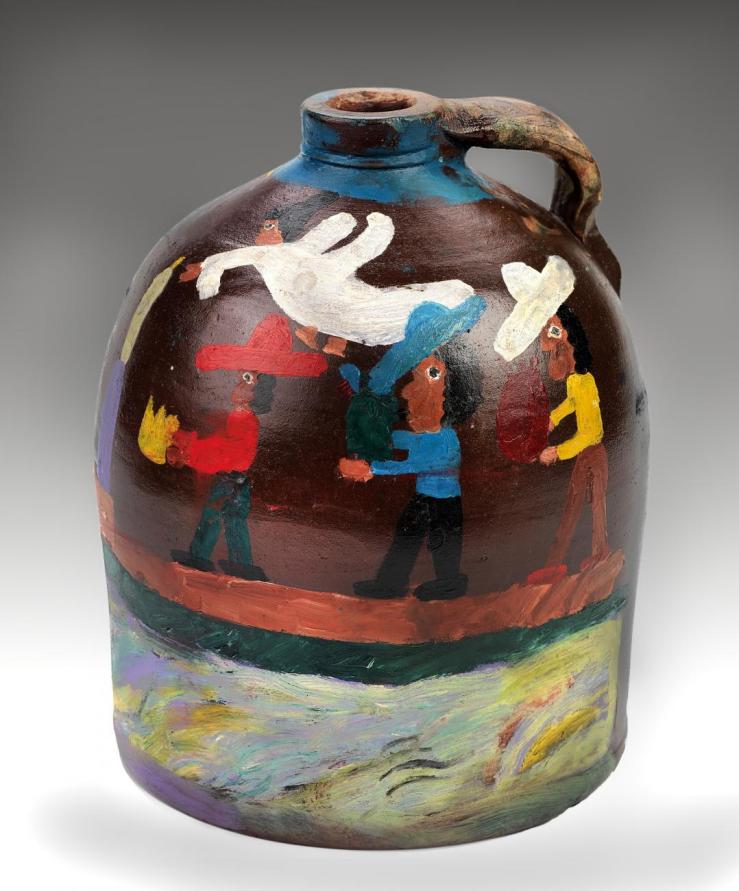
The magi were a subject Hunter turned to in many of her paintings. Here’s another fine example:
Clementine Hunter (American, 1886/87–1988), Untitled (Magi Bearing Gifts), ca. 1970–80. Paint on an albany slip whiskey jug, approx. 10 in. (25.4 cm) high. Smithsonian American Art Museum, Washington, DC.
I love how Hunter was able to see the sacred in the everyday—God’s grand story unfolding in her immediate environs. It reminds me of a poem by Wendell Berry from A Timbered Choir that begins,
Remembering that it happened once,
We cannot turn away the thought,
As we go out, cold, to our barns
Toward the long night’s end, that we
Ourselves are living in the world
It happened in when it first happened,
That we ourselves, opening a stall
(A latch thrown open countless times
Before), might find them breathing there,
Foreknown: the Child bedded in straw,
The mother kneeling over Him,
The husband standing in belief
He scarcely can believe . . .
This post belongs to the weekly series Artful Devotion. If you can’t view the music players in your email or RSS reader, try opening the post in your browser.
To view all the Revised Common Lectionary scripture readings for Epiphany, cycle A, click here.
Written in 1941 by Katherine Kennicott Davis, “Carol of the Drum,” later retitled “The Little Drummer Boy,” tells the story of a poor boy who cannot afford to bring any material gifts to the newborn Christ child, so instead he brings a heartfelt drum song.
Come, they told me Pa rum pum pum pum
A newborn king to see Pa rum pum pum pum
Our finest gifts we bring Pa rum pum pum pum
To lay before the king Pa rum pum pum pum Rum pum pum pum Rum pum pum pum
So to honor him Pa rum pum pum pum
When we come
Little baby Pa rum pum pum pum
I am a poor boy too Pa rum pum pum pum
I have no gift to bring Pa rum pum pum pum
That’s fit to give a king Pa rum pum pum pum Rum pum pum pum Rum pum pum pum
Shall I play for you Pa rum pum pum pum
On my drum
Mary nodded Pa rum pum pum pum
The ox and lamb kept time Pa rum pum pum pum
I played my drum for him Pa rum pum pum pum
I played my best for him Pa rum pum pum pum Rum pum pum pum Rum pum pum pum
Then he smiled at me Pa rum pum pum pum
Me and my drum
The song has been recorded hundreds of times, even serving as the basis of an animated children’s movie, and yet it often makes the top of “most hated Christmas carols” lists. It’s far too sentimental, people say, or just plain annoying. Some Christians get in a huff about the invented drummer boy character; “there was no such boy at the birth!” they insist.
But I must admit, I rather like the song. Like the story of the widow’s mite, “The Little Drummer Boy” affirms that no gift offered in love is insignificant. The child has no gold, frankincense, or myrrh to offer to God, but he offers his very self, which is no meager thing. He brings his love and devotion. This idea of bringing a sacrificeof praise for the Savior’s birthday is found in other carols too, such as “In the Bleak Midwinter” and “What Can I Give” (Mahalia Jackson).
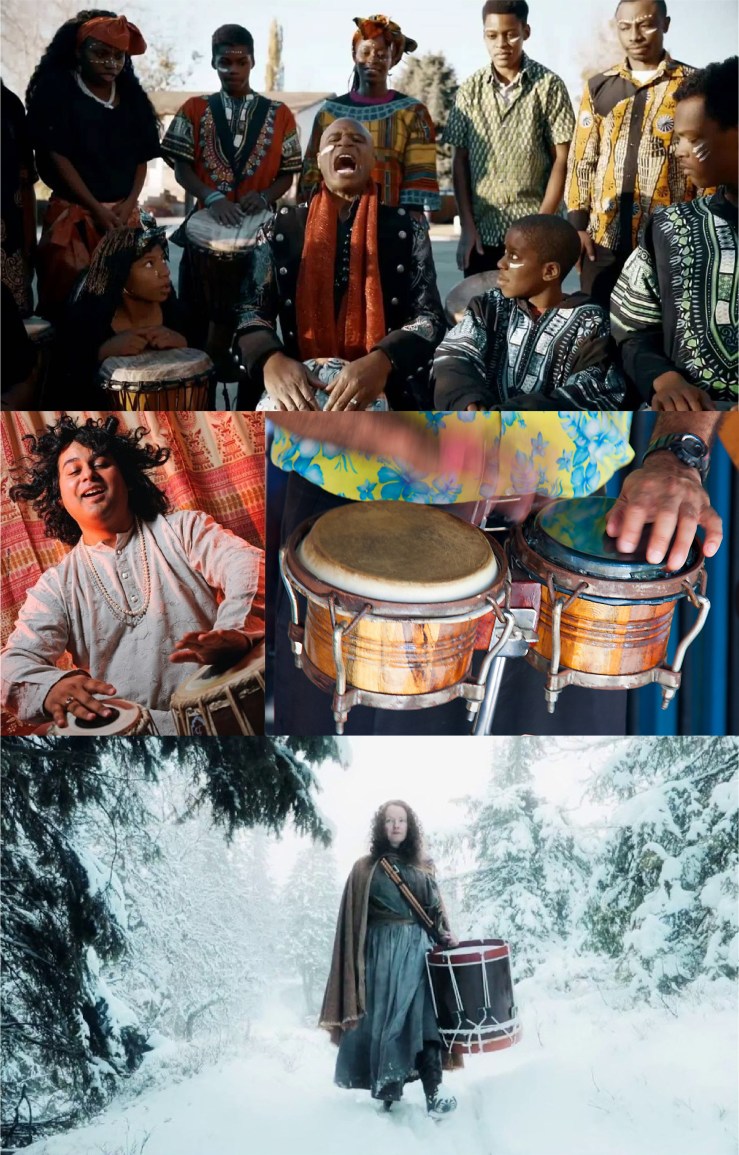
From top to bottom: Alex Boyé, Cassius Khan [source], unidentified bongo player [source], Henriette KolsetHere I’d like to call out four global renditions of “The Little Drummer Boy.” I know the song has been performed in many languages and countries, but these four have distinct cultural flavors that make them unique among the many covers of the carol over the years.
Nigeria: Alex Boyé, feat. Genesis Choir, 2015
Alex Boyé is a British-born singer, dancer, and actor of Nigerian descent. He became a Mormon in 1986 at age sixteen, moved to Salt Lake City in 2000, and became a US citizen in 2012. He is known for his uplifting African-infused pop music, much of it of a religious nature.
In 2015 Boyé created a music video for an “African tribal version” of “The Little Drummer Boy,” which starts with a mother and her two daughters being evicted from their home. A neighbor lets them stay in his RV, but they are obviously dejected. Over this introductory narrative, Boyé sings “Nearer, My God, to Thee”:
Nearer, my God, to thee,
Nearer to thee!
E’en though it be a cross
That raiseth me.
Then a knock comes at the door of the camper. It’s a bright-eyed little African drummer boy, come to cheer up the family. The mom dismisses him, but another knock brings her to the door once more. This time it’s the whole neighborhood, bearing a song, a dance, and gifts.
Oluwa! Olodumare! Olorun! Boyé exclaims before he and his troupe break out into their syncopated number. These are Yoruba names for God, so this is a way, I’d imagine, of marking the song as one of worship, suggesting that the love of neighbor expressed through the characters’ gift giving is an extension of their love of God.
India: Terry McDade and the McDades, feat. Cassius Khan, 2004
The McDades are siblings Shannon Johnson (fiddle, vocals), Solon McDade (upright bass, vocals), and Jeremiah McDade (woodwinds, vocals, etc.), hailing from Canada. Their music is multicultural to begin with, blending Celtic, jazz, Canadian folk, and worldbeat influences. It’s hard to categorize, and that’s one of the things I like about it.
They sometimes perform with their dad, harpist Terry McDade, as on the album Noël. For their mostly instrumental rendition of “The Little Drummer Boy,” they also collaborated with classical Indian musician Cassius Khan, who plays the tabla (drum) and tanpura (drone) on the track, as well as sings the opening vocals.
Shannon plays the violin and Jeremiah plays the bansuri (Indian bamboo flute).
Because of the group’s improvisatory approach to music making (and a change in guest percussionist), the studio recording sounds quite different from the live stage performance from 2016, which features Eric Breton on frame drum (in place of Khan on tabla), Andrew Hillhouse on acoustic guitar, Solon McDade on upright bass, Terry McDade on harp, and a chamber orchestra:
There are no Indian musicians in this performance, so it doesn’t have as strong of an Indian feel, and in fact the drum has a smaller role overall, giving way in parts to a full orchestral sound. Also, Khan’s classical Indian singing at the beginning of the song on the album is replaced here by Jeremiah McDade’s Tuvan throat singing!
“El Pequeño Cantor (Little Drummer Boy)” appears on the 2009 compilation album Natale a Cuba [Spotify], whose metadata credits “Tania Tania” as the singer and Luis Ríos (born 1963) as the arranger. I wasn’t able to find any information about the singer, whom I suspect goes by just the first name Tania, or when the song was originally recorded. And I don’t know enough about Cuban music to identify the genre. But I really like this fun, danceable arrangement.
Norway:Eva Holm Foosnæs (arr.) and theNTNU Department of Music, 2016
OK, so Norway is not known for its drumming as are Africa, South Asia, and Latin America, so this arrangement, by Eva Holm Foosnæs, is not as rhythmic as the others, nor is there anything particularly “Norwegian” about the music that I can tell, other than that it’s performed by singers and instrumentalists from Norwegian University of Science and Technology (NTNU) in Trondheim. But the gorgeous regional landscapes in which the music video was shot—over snowy mountain paths, through evergreen forests—give the song a magical, wintry, dark, folklorish feel that I associate with Scandinavia.
This feel comes across too in the dramatic swells and minor chords of the music.
The singers are Magnus Fremstad, Sivert Jullumstrø, Thale Jørstad, Torunn Kroknes, Eline Kolstad, Trygve Misvær, Fredrick Skjeldal, and Frida Skotte. The strings players are Björn Guo, Astri C. Hoffman, Anders Holmås, Anders H. Rove, and Carl N. Wika. And the percussionist is Henriette Kolset (a drummer girl—nice!).
+++
Are there any culturally specific renditions of “The Little Drummer Boy” that you know of and enjoy? I was hoping to find one from Japan, as I love listening to taiko drumming, but had no luck.
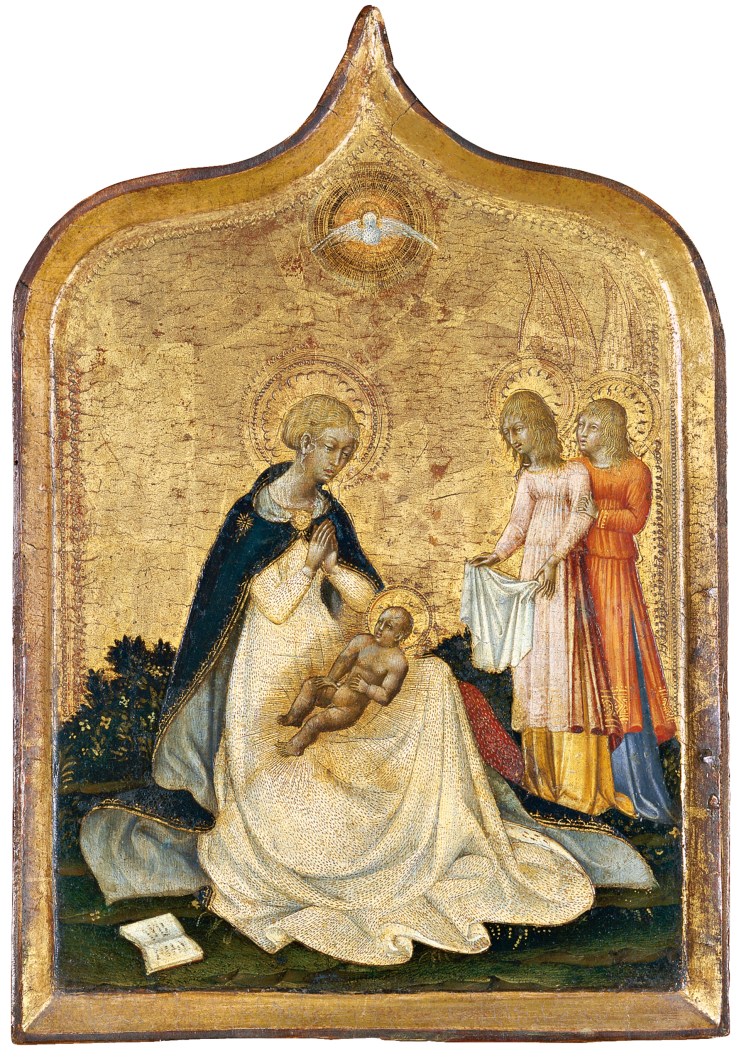
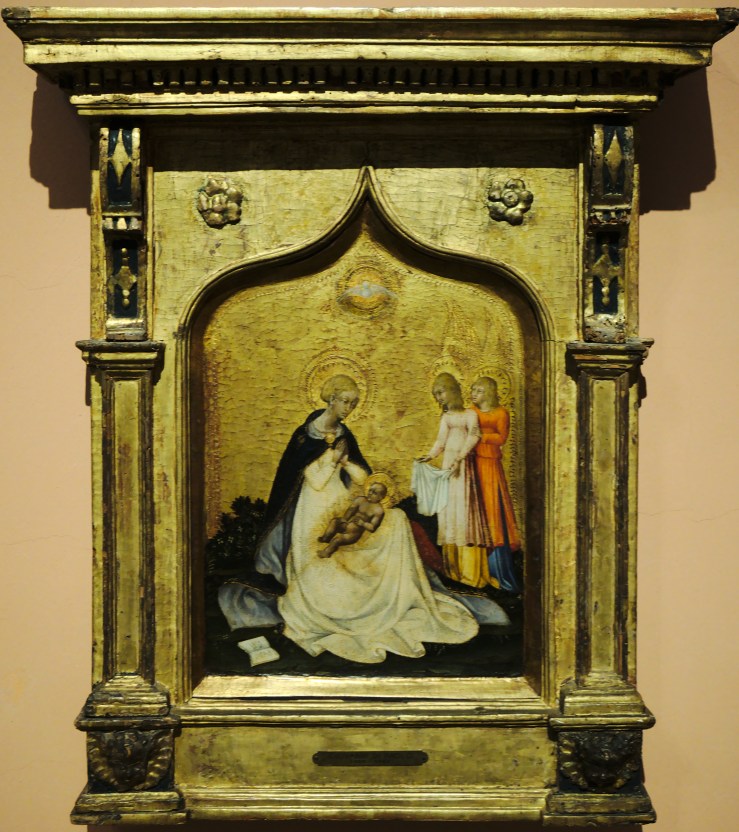
Giovanni di Paolo (Italian, ca. 1399–1482), The Virgin of Humility, ca. 1440. Tempera and gold on panel, 32.5 × 22.5 cm. Museo Nacional Thyssen-Bornemisza, Madrid.
What has come into being in him was life, and the life was the light of all people. . . . The true light, which enlightens everyone, was coming into the world.
—John 1:3b–4, 9
+++
SONG: “Lux Aurumque” | Original English text (“Light and Gold”) by Edward Esch (born 1970), translated into Latin by Charles Anthony Silvestri, 2000 | Music by Eric Whitacre, 2000 | Performed by Eric Whitacre’s Virtual Choir, 2010
A professional studio recording by the Eric Whitacre Singers was released on the 2010 album Light & Gold:
Lux,
Calida gravisque pura velut aurum
Et canunt angeli molliter
modo natum.
Light,
warm and heavy as pure gold
and angels sing softly
to the new-born babe.
“The Virtual Choir is a global phenomenon, creating a user-generated choir that brings together singers from around the world and their love of music in a new way through the use of technology. Singers record and upload their videos from locations all over the world. Each one of the videos is then synchronised and combined into one single performance to create the Virtual Choir.” With 185 singers from twelve countries, “Lux Aurumque” was the Virtual Choir’s first project. Four other songs have since followed, the latest one featuring more than eight thousand singers, ages four to eighty-seven, from 120 countries.
To listen to another composition by Eric Whitacre that I’ve previously featured on the blog, see “i thank you God for most this amazing,” a choral setting of an E. E. Cummings poem.
Photo: Victoria Emily Jones
This post belongs to the weekly series Artful Devotion. If you can’t view the music player in your email or RSS reader, try opening the post in your browser.
To view all the Revised Common Lectionary scripture readings for the Second Sunday after Christmas Day, cycle A, click here.
Oscar Rabin (Russian, 1928–2018), Flight into Egypt, 1977. Oil on canvas, 49 × 70 cm.
Now when they had departed, behold, an angel of the Lord appeared to Joseph in a dream and said, “Rise, take the child and his mother, and flee to Egypt, and remain there until I tell you, for Herod is about to search for the child, to destroy him.” And he rose and took the child and his mother by night and departed to Egypt and remained there until the death of Herod. This was to fulfill what the Lord had spoken by the prophet, “Out of Egypt I called my son.”
Then Herod, when he saw that he had been tricked by the wise men, became furious, and he sent and killed all the male children in Bethlehem and in all that region who were two years old or under, according to the time that he had ascertained from the wise men. Then was fulfilled what was spoken by the prophet Jeremiah:
“A voice was heard in Ramah,
weeping and loud lamentation,
Rachel weeping for her children;
she refused to be comforted, because they are no more.”
When was he born? When was he born?
When was he born? On a cold dark night.
The king said, “Kill every baby boy that you can find.
There’s been too much talk about a new king born,
And this throne is mine.”
When was he born? When was he born?
When was he born? On a cold dark night.
He wasn’t born to be a king. He wasn’t born to fight.
He knew this world can get so dark that when you can
You’ve got to turn on the light.
When was he born? When was he born?
When was he born? On a cold dark night.
+++
A Russian painter and activist, Oscar Rabin was one of the founders of the Soviet Nonconformist Art movement. After being stripped of his citizenship in 1978 for political dissidence, he emigrated to Paris, where he lived until his death last year at age ninety. He is the subject of the feature-length documentaries Oscar (2018) and, with his wife and fellow artist Valentina Kropivnitskaya, In Search of a Lost Paradise (2015).
This post belongs to the weekly series Artful Devotion. If you can’t view the music player in your email or RSS reader, try opening the post in your browser.
To view all the Revised Common Lectionary scripture readings for the First Sunday after Christmas Day, cycle A, click here.
Noel, Noel
Yesu me kwisa ku zinga ti beto
Noel, noel
Yesu me kwisa ku zinga ti beto
Kana nge zola ku zaba mwana
Nge fwiti kwisa ku fukama
Kana nge zola ku zaba mwana
Nge fwiti kwisa ku fukama
English translation:
Noel, Noel
Jesus has come to live with us
Noel, Noel
Jesus has come to live with us
If you want to know the Child
You have to come kneel
If you want to know the Child
You have to come kneel
Kituba is the official language of the Democratic Republic of the Congo, where singer-songwriter Todd Smith grew up, from 1978 to 1986, as a missionary kid. (The country was then known as Zaire.) Smith is one of three members of the award-winning band Selah, which helped initiate a hymn revival in Christian music that is still thriving today.
+++
See the Artful Devotions for the last two Christmases:
This post belongs to the weekly series Artful Devotion. If you can’t view the music player in your email or RSS reader, try opening the post in your browser.
To view all the Revised Common Lectionary scripture readings for Christmas Day, cycle A, click here.
Bartolomé Esteban Murillo (Spanish, 1617–1682), The infant Christ asleep on the cross, ca. 1660–65. Oil on canvas, 24 4/5 × 34 3/5 in. (63 × 88 cm). Prado Museum, Madrid.
When, in the cavern darkness, Jesus
opened his small, bleating mouth (even before
his eyes widened to the supple world his
lungs had sighed into being), did he intuit
how hungrily the lungs gasp? Did he begin, then,
to love the way air sighs as it brushes in and out
through the portals of tissue to sustain
the tiny heart’s iambic beating? And how,
fueled by air, the dazzling blood tramps
the crossroads of the brain like donkey tracks,
corpuscles skittering to the earlobes and toenails?
Bottle of the breath of God, speaking in stories,
shouting across wild, obedient water, his voice
was stoppered only by inquisition, unfaith
and anguish. Did he know that he would,
in the end, leak all his blood, heave a final
groan and throw his breath,
oxygen for the world, back to its Source
before the next dark cave?
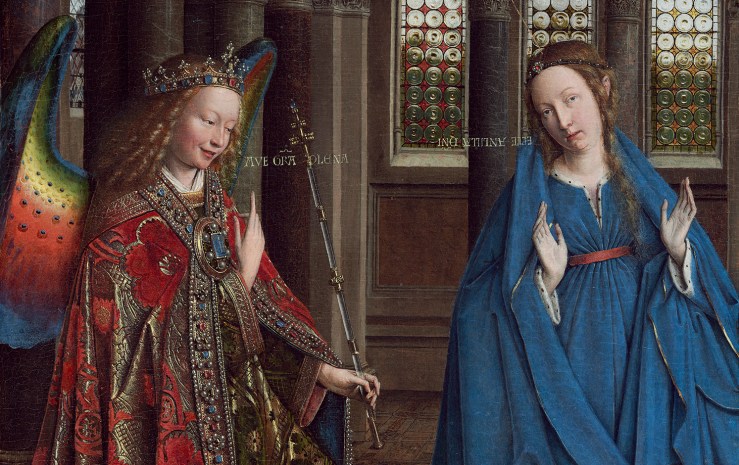
One of the most celebrated paintings of the Northern Renaissance, Jan van Eyck’s 1430s Annunciation depicts the moment of Christ’s conception in a world of forms that have weight and volume and shade and texture that was largely unprecedented in European painting at the time. The extraordinary realism of the Annunciation—its deep, rich, subtly gradated colors, varied textural details (from hard, polished gems to soft, fragile flower petals and plush velvet), and intricate play of light and shadow—were enabled by the use of oil paint, a medium that was not widely used then. van Eyck’s “virtuoso handling of the medium . . . represented a turning point in its eventual adoption as the major painting medium in Europe in the sixteenth century,” replacing egg tempera.
Jan van Eyck (Netherlandish, ca. 1390–1441), The Annunciation, 1434/36. Oil on canvas transferred from panel, 35 1/2 × 13 7/16 in. (90.2 × 34.1 cm). National Gallery of Art, Washington, DC.
This three-foot-tall painting probably originally formed the left wing of a triptych, whose other panels, now lost, may have depicted the Nativity or the Adoration of the Magi and the Visitation or the Presentation in the Temple. It likely spent its first centuries in the ducal chapel of a Carthusian monastery in Dijon, then-capital of Burgundy (van Eyck served as court painter to Philip the Good, duke of Burgundy, from 1425 to 1441), and has since passed through various other rich and powerful hands, including those of King William II of the Netherlands and Czar Nicholas I of Russia. It is now in the collection of the National Gallery of Art in Washington, DC, where it is viewed by people from all over the world.
Several iconographic elements in van Eyck’s Annunciation were already standard for the subject: the dove, the lilies, the Bible laid open to Isaiah 7:14. But van Eyck also introduced his own sophisticated program of typological imagery, which plays out in the background frescoes and the niello floor designs, connecting Old and New Testaments—in addition to other innovative touches that we will explore below.
He was also one of the first artists to locate this momentous event inside a church (as opposed to a portico or domestic space), which would become a popular choice in the Low Countries. In her 1999 Art Bulletin article “Van Eyck’s Washington Annunciation: Narrative Time and Metaphoric Tradition,” Carol J. Purtle argues that van Eyck was connecting the Lukan narrative of the Annunciation with the Golden Mass (“Missa Aurea”), a liturgical drama that was popular in the Netherlands at the time. Taking place yearly on Ember Wednesday (the Wednesday following the third Sunday of Advent), the Golden Mass featured a reenactment of the Annunciation, dove and all, by two young choirboys.
There’s much to lavish attention on in this painting, but I’d like to let three poets be our eyes: Pimone Triplett, Terri Witek, and Peter Steele, each of whom has written a poem reflecting on their encounter with the Annunciation by van Eyck. (The vivid poetic description of a work of visual art is known as ekphrasis, and it is an ancient tradition that I’ve seen explode in recent decades.) Notice what the poets notice in the painting as they pore over van Eyck’s artistic choices and their spiritual import. There is some overlap in their discoveries, but the landing point, and even the emphasis, of each poem is unique.
Starts with a stream of gold that’s ridden
      by a relentlessly linear dove,
ready to pierce a young girl’s head.

            Then, her face, her gaze looking up, out
past the easel and later, past the frame,
      eyes raised as if to ask a question. Take

the virgin robe, for instance, which van Eyck has made
      to fall luxuriously as a second chance
across the old storyline etched below her.

            And, further down, the church’s intricately
strict apse, each floorboard, painstaked as lace, showing here,
      David’s lesson in beheading, there Samson’s

tearing down the temple—that history
            interrupted by her silken, layered folds:
each blue built up from perfecting the oil.

            His favorite signature, “As best I can”
or “As I was able, but not just as I wished.”
      Imagine the endless effort: a man

in the distance, deep in the could have been,
      who sat before the easel, hours, perhaps,
past his patience for lasting regrets,

            flat refusals—the quick-drying water-based
attempts flung around a room.
      And how, alone with pigment barrels, chamber pots,

the canvasses stretched, the fire exhumed,
      he poured a stream of oil back and forth,
watching it catch the light, change a wooden bowl.

            For the sake of making the mundane
seem to marry the mysterious,
      her eyes raised—lacquered, slippery wells, caught—

her startled acceptance. Since it’s her choosing
      to be chosen that mattered, largest figure
in the frame, the virgin form layered

            with gold light, blue, her pale hands open
for the god imagined sick with thin horizon,
      and ready to enter thickness now, the body’s

blood, gristle, vertebrae, whorled fingerprint.
      The oil spread back and forth. His wrist stiffened.
“As I was able, but not just as I wished.”

            So, out to pay the right kind of attention
to detail, as if, in the lengthening
      carelessness of cracked roads leading away

from his town, beneath a matted pulp
      of the year’s leaves, he wished he could hear
silence taking shape: a weed, say, starting

            to split the surface, part vegetal
altar and example of dumb, green change.
      Or, say, through the window, a flock of geese

receding, advancing, by turns, as the sky’s gray
      sometimes meets the double strength gray of sea,
he might have looked between the shapes,

            their invisible lines blooded, some racing ahead,
others falling behind, each filling in, quickly,
      empty spaces where the wings once beat.

And still, she looks up, asking to be entered.
      So that if she turned away from shadows, wood panels,
chamber pots, winter coats lined against the wall,

            he might have looked so far into the difficult
that he finally could believe: behind her gaze,
      beneath her brow, under the layers of

shell, salt, finally skin-white, lay the mind
      of a mother giving birth to a father
and a son, the flesh—a color, an instant, spared.
Pimone Triplett’s poem explores the physicality of the oil-paint medium, focusing on van Eyck’s innovations in that area and as one who both accepts and transcends his limitations. She refers to the personal motto with which he signed several of his paintings (although not this one): Als ich chan, which means “As best I can.” Even with as advanced a painter’s toolkit as he developed and his great skill, how could he possibly succeed in depicting the holy mysteries?
The physicality of the artist’s studio, too, comments on the Incarnation. Christ came into a world of chamber pots! Triplett describes Jesus’s coming into human being, his traveling those seven thin gold rays of light into the womb of his mother, where he takes on flesh: “the god imagined sick with thin horizon, / and ready to enter thickness now, the body’s // blood, gristle, vertebrae, whorled fingerprint.”
There are also some lovely lines that touch on Mary’s agency (“it’s her choosing / to be chosen that mattered”; “she looks up, asking to be entered”) and her role as the Second Eve, whose obedience leads to the redemption of humanity (her robe “fall[s] luxuriously as a second chance” over the Old Testament story line told in the floor below her).
The two most visible floor designs depict Samson destroying the temple of Dagon, killing the Philistines inside, and David cutting off the head of Goliath. These and other Old Testament scenes are framed by stylized columbine and clover and roundels bearing signs of the zodiac.
I’m not entirely sure how to interpret the last stanza. It’s possible that “father” refers to van Eyck as the father of oil painting: his many Marian paintings in this medium cemented his reputation as such, so in that sense Mary gave birth to him as an artist, as well as, of course, to her son Jesus. Shell and salt were ground into pigments to render realistic flesh tones, and the slow drying time of oil paint enabled artists to better blend colors on the canvas, creating subtle variations, and to develop the painting gradually. But why “a color, an instant, spared”? Any thoughts?
+++
“Take a World”by Terri Witek
The Annunciation by Jan Van Eyck, 1434–36
Take a world in which each flower’s an Easter lily
and books chivvy open to the place where our names leap.
Then step into the temple where Mary,
gown belled like a Christmas tree angel’s,
speaks with a real one. Their hands negotiate:
Mary is asking why light curls to ribbony rainbow
on the angel’s back while through her own body
it shoots in stiff gold arrows. The angel nods, grins.
Nothing more gorgeous than their drapery-softened
gesticulation, the room’s blue-propped lilies
and plump ottoman. It’s enough to make us think
they’re standing in the world, two women alert
to the heft of their clothes as Mary asks,
“Who, me?”, her eyes sliding sideways to her painter,
master of distraction. She can’t see Jehovah
behind her, his one blazing window, though we can,
we see the room’s whole depth falling into light
as we wait for someone not transfixed by dilemma
who’s standing where we are. As we wait for Joseph.
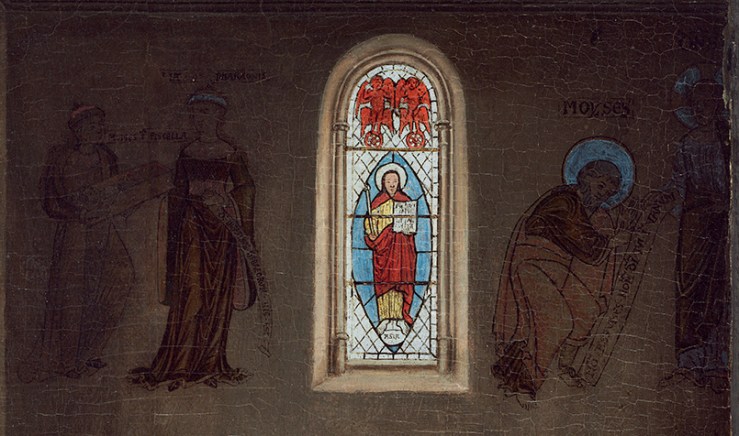
Terri Witek’s poem focuses on the paradox of the Annunciation’s being both an entirely thisworldly and yet profoundly otherworldly moment. The two figures in van Eyck’s painting have bulk and heft, and their clothes hang on their bodies, subject to the laws of gravity, and yet in the scene they inhabit, everything is so carefully placed, so perfect—so divine. Witek mentions the stained glass window in the back, which shows God in a mandorla, standing underneath his fiery chariot on a globe labeled ASIA and holding an open book and a scepter; the light that comes through this window and fills the room is thus refracted through him who is all-sovereign.
(Note: The iconography in the window is very similar to the type known as Christ in Majesty, though there’s no cross-shape inside the halo; I wonder whether the figure is meant to be Jesus in his then-future exaltation. But the art historians I’ve read identify him, along with Witek, as God the Father. I think a case could be made for either.)
To the left of the stained glass window, the baby Moses is presented to Pharaoh’s daughter, while on the right, God presents Moses with a scroll bearing the words of Exodus 20:7: “You shall not take the name of the Lord your God in vain.”Gabriel tells Mary that Jesus “will reign over the house of Jacob forever, and of his kingdom there will be no end” (Luke 1:33). The two roundels painted on the rear wall depict Isaac blessing Jacob (Gen. 27).
I especially like how Witek points out the contrast between the pleasant, blended, colorful way light interacts with the angel’s wings and the severe, narrow manner in which it comes diving toward Mary—and humorously suggests that Mary’s expansis manibus gesture is her asking why. This observation unpeeled for me an additional layer of van Eyck’s possible meaning: how God’s coming to Mary was direct and piercing. His messenger, sure, has a soft rainbow glow, but the actual implantation of God in the womb happens with a laser focus that sears Mary in ways that will be all the more keenly felt as the years go by (see Simeon’s prophecy in Luke 2:34–35).
I got stuck on the last two lines, though: Why do we wait for Joseph? Isn’t he peripheral to the event? And was he not also “transfixed by dilemma” for a time, as he debated whether to say yes or no to God’s plan? So I asked the poet what she had in mind. She said how, standing before the painting, we, like Mary, become transported into this drama that lifts us up to a heavenly plane (I’m paraphrasing here), where we interact vicariously with Gabriel. We need someone to bring us back down to earth, so “we will be glad of Joseph, the human, the touch of the everyday real,” Witek explained to me.
The room “falling into light” describes the painted scene but also the public gallery where the painting is on display, and the name Joseph also has a double meaning, as Witek’s husband’s name is Joseph. In their museum going, his presence sometimes shakes her gently out of her reveries, reminding her that it’s time “to move on to the next painting, though it might not be as gorgeous,” she told me.
+++
“Waiting for the Revolution”by Peter Steele
If love is ‘the bright foreigner’, then here’s
      not Amour himself but still
a follower afire, his wings a blend
      of peacock and rainbow, the pearled cope
blooming to crimson on its ground of gold,
      his hair a downspill from the lock
of a coronet badged with jewels, the fingered sceptre
      a rod of crystal, and the smile
something they practise in another country.

This is not wasted on the woman who,
      her hands come up from the shell of a robe
which seems to have been steeped in ocean when
      darkness and light were still contending,
gazes now from the blaze of being at
      van Eyck, the Duke of Burgundy,
a Tsar made out of ice and marble, or
      whoever gives the alms of an hour
in minute-hungry fuming Washington.

Outside, a beat or two of an angel’s wings
      away on the Capitol is Freedom,
one of the later products of the Bronze
      Age, equipped with shield and sword,
a wreath for some earthly use or other, plumes,
      an eagle-crested helmet. She eyes
the status quo from her eminence and murmurs,
      ‘The past is prologue’, a Delphic saying
which she construes as ‘blessed are those in possession’.

I have been in and out of the world worlds,
      amphibious and double-hearted,
and still am. The shimmer of July
      speaks now for a perpetual
immobility, bronzing the will. The pavement
      beneath woman and angel shows
Goliath down and done with, Samson at grips
      with a sheltering enslaving place:
and for some want of the white bird of esprit

that plunges goldrayed into the woman’s mind,
      I’m in the middle. They say that she
has her consent to the revolution printed
      upside down for easier reading
in heaven. It may be so, but I’m guessing that
      the words in their reversal figure
a world swung round upon its axis, the all-
      clear given to those in quest
of the bright foreigner who lightens angels.
“Waiting for the Revolution” by Peter Steele appears in Plenty: Art into Poetry (Melbourne: Macmillan Art Publishing, 2003).
Peter Steele (1939–2012), a Jesuit priest from Australia, opens and closes his poem with a phrase from a 1849 journal entry by Ralph Waldo Emerson that says, “Love is the bright foreigner, the foreign self.” Steele interprets Jesus as that “bright foreigner” from heaven, Love, Amour, whose light gives angels their light. Those who search for themselves, he suggests implicitly, can find themselves in Jesus, who created them in love and calls them back into that love that is the ground of their being.
Before moving to this conclusion, Steele first relishes the painting’s fabulous details, especially the clothing: Gabriel’s elaborate, brocaded silk cope, with gold embroidery and green fringe, and Mary’s ultramarine robe trimmed in ermine. He also notes the angel’s wry and mysterious smile, an expression that draws me in every time I see this painting.
He considers how Mary’s eyes gazed out first at van Eyck the painter, then at the painting’s various owners over the centuries, and now at any visitor to or resident of Washington, DC, who stands before it in its dimly lit gallery on the National Mall.
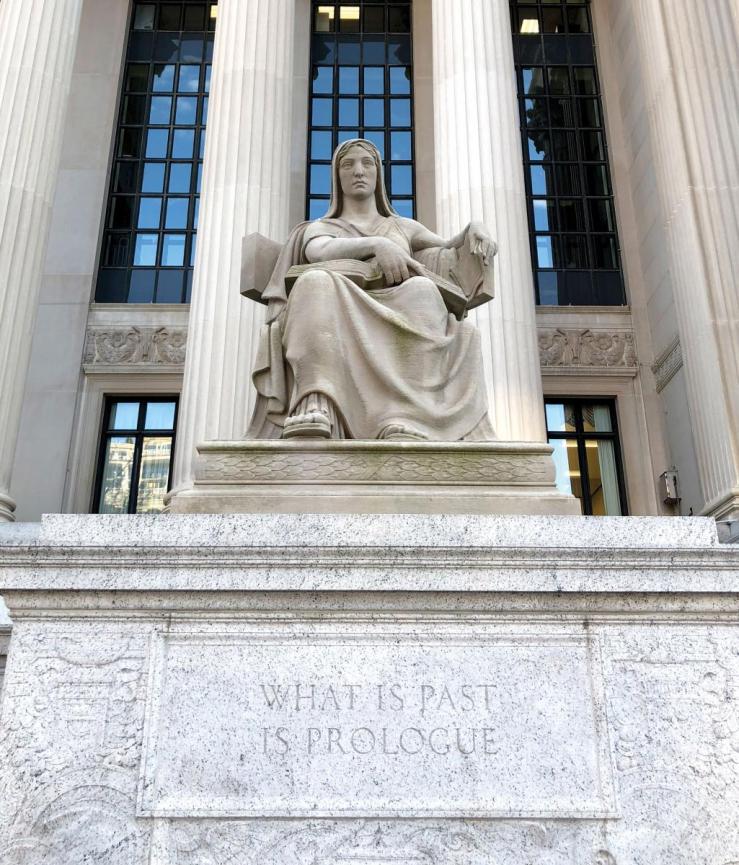
Its location in the United States capital city prompts Steele to contrast it with the nearby monument originally known as Freedom Triumphant in War and Peaceor Armed Freedom, an allegorical figure in bronze that crowns the Capitol building. He has Freedom reciting a famous line from act 2, scene 1 of Shakespeare’s The Tempest—“What’s past is prologue”—spoken by the villainous Anthony in an attempt to convince Sebastian to murder his sleeping father and thus make himself king; the idea is that his whole life up to this point was merely an introduction to the great story that will be underway if he goes through with the plan. (The line is inscribed on the base of Robert Aitken’s sculpture Future, located on the northeast corner of the National Archives Building, which shows a young woman holding an open blank book and contemplating the things to come.) Steele imagines this saying, in the mouth of Freedom, as bearing the subtext “Blessed are those in possession” (or, in its original Latin, Beati sunt possidentes), a proverb popularized by the Prussian general and military theorist Carl von Clausewitz in reference to the possession of power and force.
Thomas Crawford (American, 1814–1857), Statue of Freedom, 1863. Bronze, 19 1/2 ft. tall. Atop the dome of the US Capitol, Washington, DC.Robert Aitken (American, 1878–1949), Future, 1935. Indiana limestone, 20 × 8 × 12 ft. (sculpture), plus 12 × 12 × 15 ft. (base). Outside the National Archives Building, Washington, DC. Photo: Rania Hassan.
The two government-commissioned artworks and two quotes Steele’s poem references ping around in my mind as I think about how they relate to the Annunciation. The picture of Freedom as a colossal helmeted woman bearing a sword differs from the smaller, quieter way “Freedom” comes to reign in the Christmas story: that is, as a babe in a manger. And the self-protecting, self-aggrandizing path commended by Clausewitz butts heads against the self-emptying ethic at the heart of Christianity. So does the motivation of the Shakespearean character—treacherous, underhanded—who was the first to say, “What’s past is prologue.” But when considered in light of Luke 1 and even the Future sculpture in DC, this “Delphic” (obscure, ambiguous) saying from the Bard can be seen as alluding to Mary’s position at the Annunciation, at the turning point of history. Mary is fated to act; the past has set the stage for her yes, and for all that will happen next. The New Testament is as yet unwritten—until her bravely submissive response to the angel’s invitation sets God’s grand redemption plan, on hold for four hundred years, into motion once again, and what we call “gospel,” good news, arrives on earth at last in the person of Christ.
In van Eyck’s Annunciation, as in many others, the words AVE GRA[TIA] PLENA (“Hail, full of grace”) stream forth from Gabriel’s mouth in gold lettering, to which Mary replies, ECCE ANCILLA D[OMI]NI (“Behold the handmaiden of the Lord” [Luke 1:38]). Amusingly, van Eyck renders her response upside-down, a device he also uses in the Ghent Altarpiece, presumably so that God can read it from heaven. Steele playfully interprets the inversion as signaling the upside-down nature of God’s incoming kingdom; the world has been turned on its head by Mary’s yes—which is why that yes is rotated 180 degrees!
One aspect of this upside-down-ness is how Mary contradicts the aforementioned adage, used in diplomacy, “Blessed are those in possession.” In scripture Mary is called blessed, but not because she seizes or owns or controls anything. Quite the opposite: because she relinquishes her right to go on living a normal, play-it-safe life. And because she is humble, God raises her up, and those like her. (She sings about this in her Magnificat.) That’s not at all to say that Mary is passive or lacks agency. She stands actively with open hands to receive grace, to receive God himself, and to gift him to the world. She “consent[s] to the revolution.”
I’m reminded of the song “Canticle of the Turning,” written by Rory Cooney in 1990 based on Mary’s Magnificat and set to the traditional Irish tune STAR OF THE COUNTY DOWN. Listen to an acoustic performance by Katherine Moore:
“The world is about to turn.”
+++
For a further in-depth look at the symbolic significance of the architecture and objects in Jan van Eyck’s Annunciation—including the wall paintings and windows in the background, the nielli in the floor, the footstool in the foreground, and the missing boards in the ceiling—see Early Netherlandish Painting: The Collections of the National Gallery of Art by John and Oliver Hand and Martha Wolff, pages 76–86: a PDF of the entire book is provided for free download by the National Gallery of Art. See also the NGA’s special webpage for this collection highlight.
Yaroslava Tkachuk (Ukrainian, 1981–), Expectant, 2014. Linen, silk, seeds, copper, and acrylic, 100 × 40 cm. Photo courtesy of the artist. [Original for sale; click photo for more info]
Therefore the Lord himself will give you a sign. Behold, the virgin shall conceive and bear a son, and shall call his name Immanuel.
—Isaiah 7:14
+++
SONG: “Maria” by David Maloney, on A Christmas Album by Reilly & Maloney (1984, reissued 2012)
Christmas Day, it’s coming fast
Bringing joy to the world at last
Joy to the world
Maria . . .
This post belongs to the weekly series Artful Devotion. If you can’t view the music player in your email or RSS reader, try opening the post in your browser.
To view all the Revised Common Lectionary scripture readings for the Fourth Sunday of Advent, cycle A, click here.







.jpg)





 Art & Theology