Frida Hansen (Norwegian, 1844–1931), Melkeveien (Milky Way), 1898. Tapestry, 260 × 345 cm. Museum für Kunst und Gewerbe (Museum of Arts and Crafts), Hamburg, Germany.
This art nouveau tapestry by Norwegian artist Frida Hansen received a gold medal at the world’s fair in Paris in 1900. It shows angelic figures unfolding a starry veil over the night sky. They glide forward above a band of Hebrew script that references the creation of the stars in Genesis 1.
The God who brought light in darkness in the beginning is bringing light again as we enter a new liturgical year.
Comprising the first five weeks of that new year, Advent-Christmas-Epiphany is a time of starlight, promise, and revelation. The first of the triad, Advent, is particularly concerned with themes of longing, waiting, lament, and future-oriented hope. We make ready our hearts to receive Christ—he who came to us first as a babe in a manger, in a vulnerable body like ours, to teach and suffer and redeem, and who is coming back one day in unveiled power and majesty to bring the fullness of God’s heavenly kingdom to earth.
Two millennia ago, God hung a special star in the sky for the magi to follow, guiding them on their way to the Christ child. May God similarly illumine our way to Christ as we seek him this season, giving us eyes to see and ears to hear the gospel of God-with-us and cultivating in us an eager readiness for Christ’s return.
I think of Hansen’s crowned young ladies as ushering us into the deep, dark blue of Advent to behold the signs that sparkle in scripture, foretelling a wondrous future.
LISTEN: “Star of Wonder” by Sara Groves, on O Holy Night, 2008; adapted and arranged from the refrain of “We Three Kings” by John Henry Hopkins, 1857
Star of wonder, star of light Star of royal beauty bright Guide us O guide us Won’t you guide us
Want to follow along with the music on Spotify? Most of the songs in this Advent blog series, and many more besides, can be found on the Art & Theology Advent Playlist.
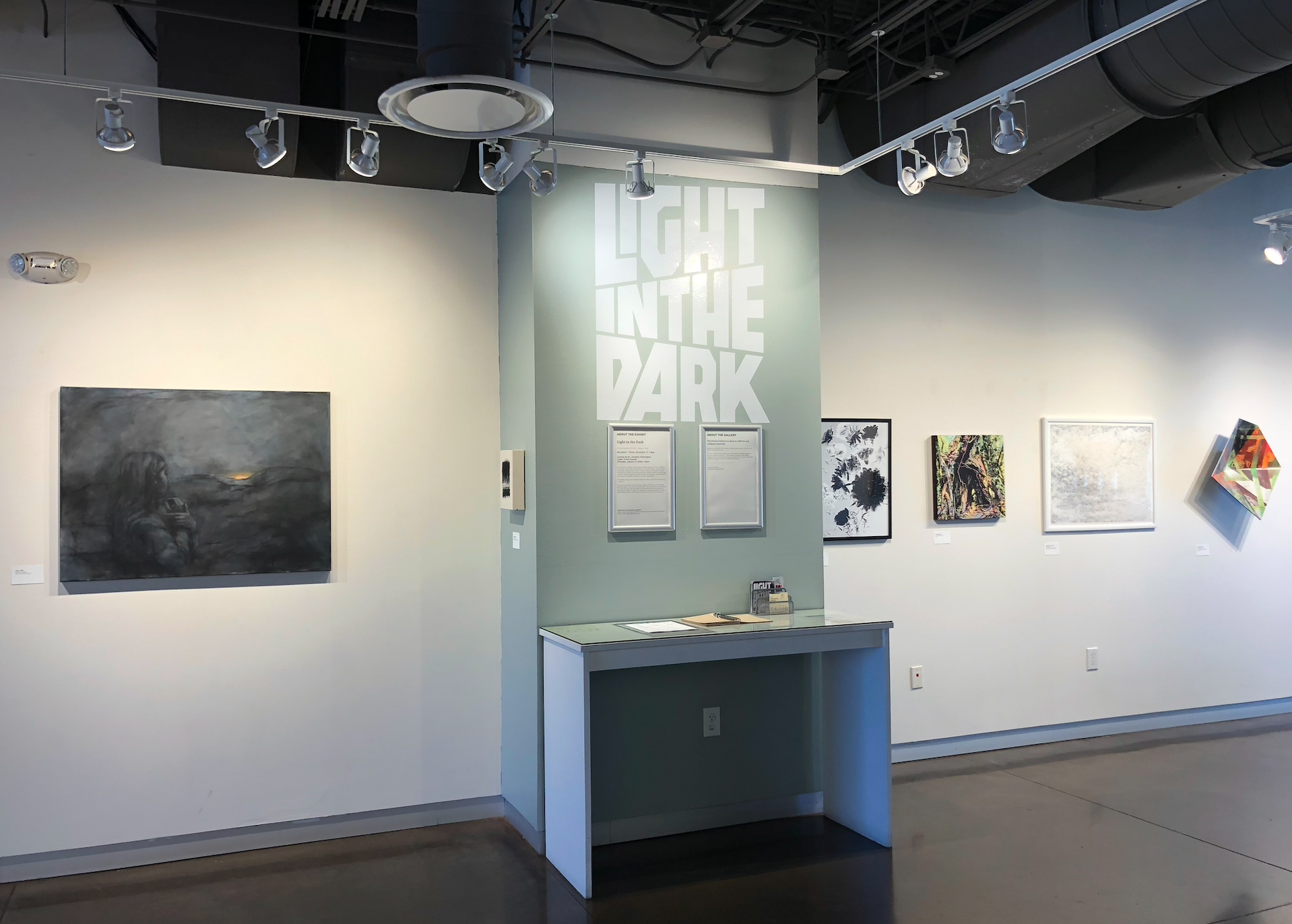
>> Light in the Dark, Sojourn Church Midtown, Louisville, Kentucky, November 17, 2023–January 7, 2024: Organized by Sojourn Arts, this juried exhibition features work by twenty-four artists from throughout the United States. It explores contrasts between light and dark, a powerful artistic as well as biblical theme with strong connections to the Christmas story. A complementary lecture on “Light in the Gospels” by Dr. Jonathan Pennington will take place on January 11, 2024.
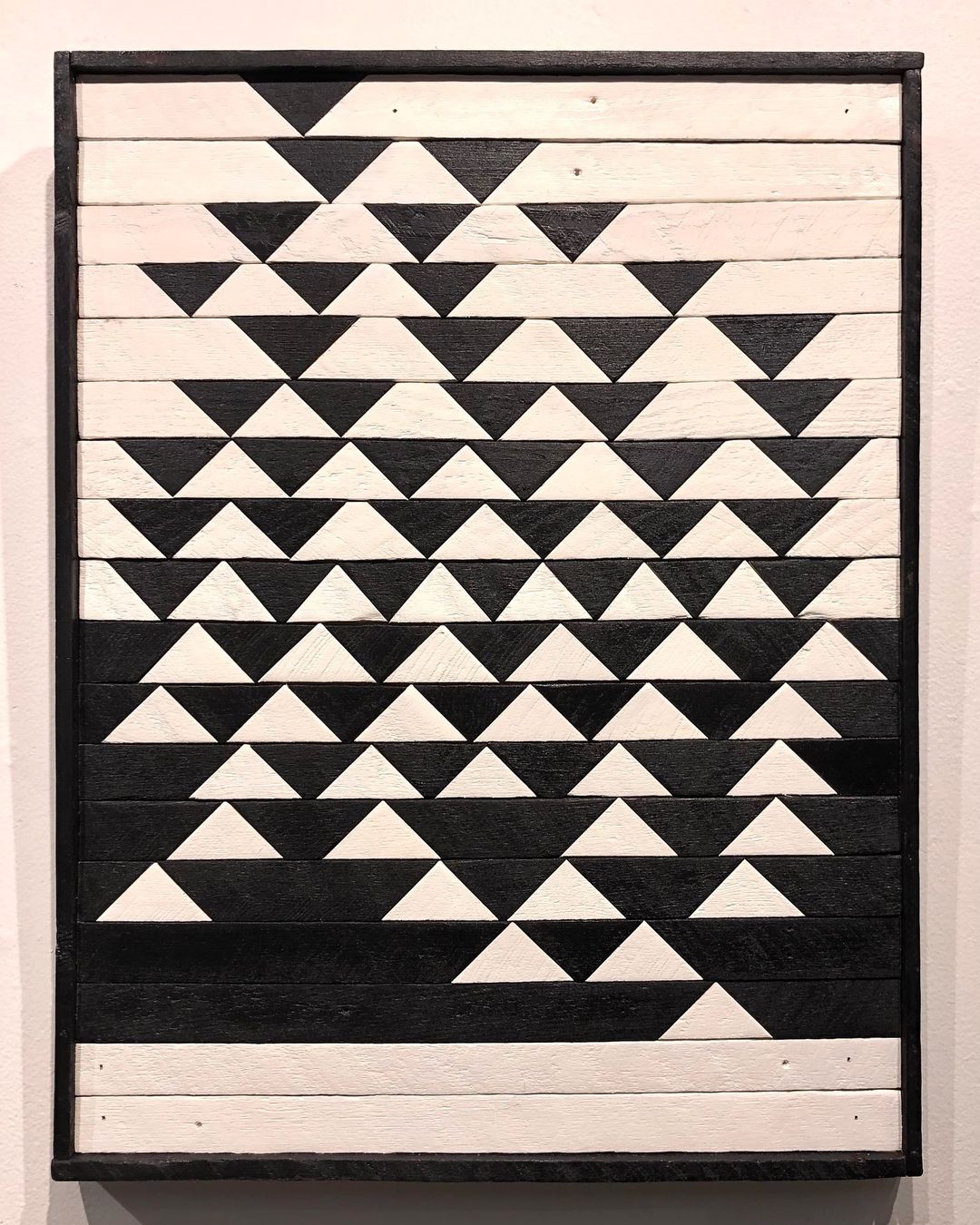
Brandon Hochhalter, The Incredible Power of Light, 2023. Reclaimed lath wood from homes in Old Louisville, 18 × 24 × 1 in. [artist’s website]
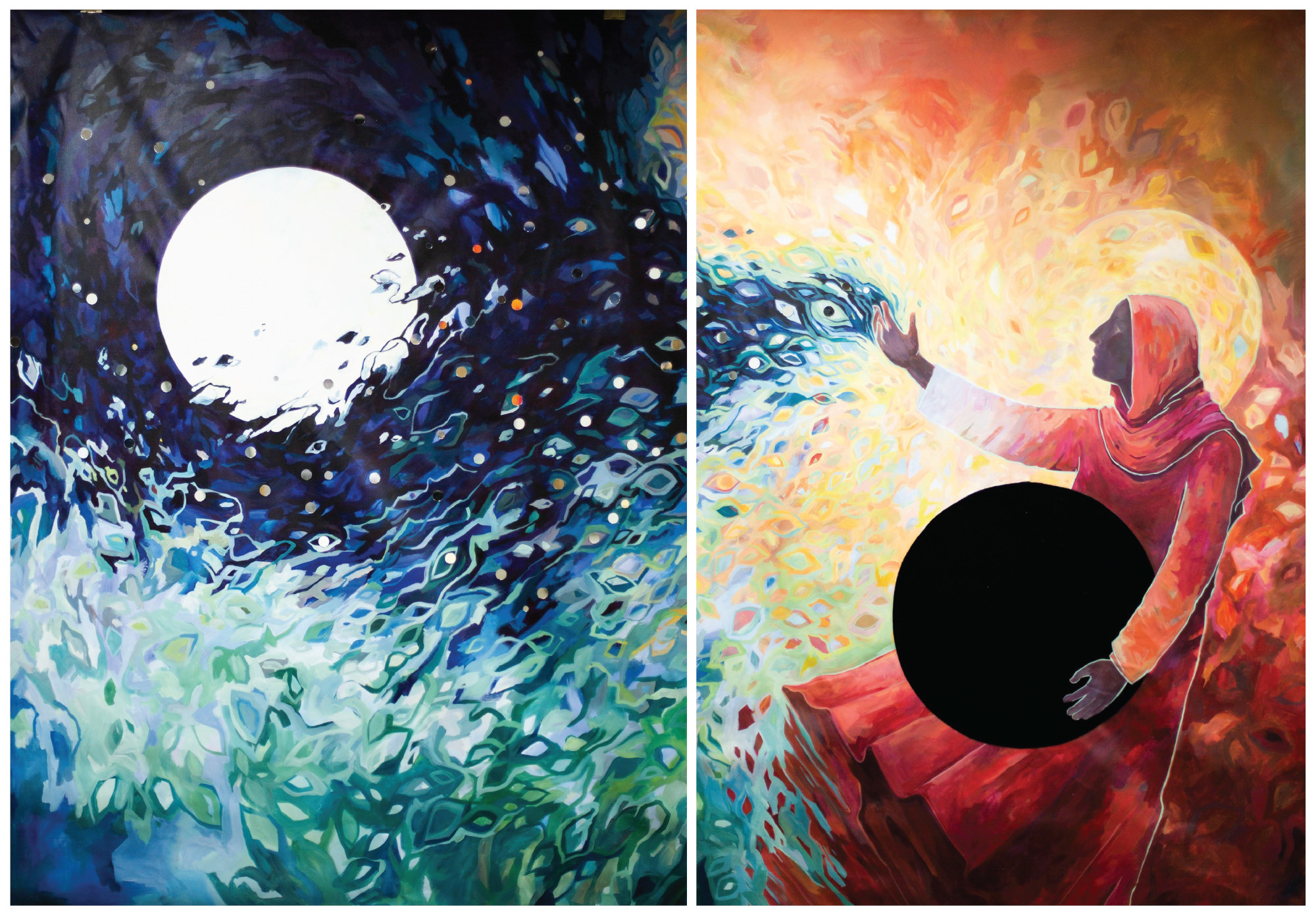
>> Wilson Abbey Advent Windows, 935 W. Wilson Ave., Chicago, December 1, 2023–January 6, 2024: A business under the umbrella of Jesus People USA, Wilson Abbey in uptown Chicago is a neighborhood gathering place for coffee, art shows, workshops, theater, dance, film screenings, and live music. Every December since 2016, they have installed a three-story-tall Advent calendar in their windows to be enjoyed from the streets, with one new artwork revealed each day from December 1 to 24. Directed by the building manager, Karl Sullivan, the project commissions local artists to contribute a painting, photograph, or other graphic work, and this year there are twenty-three participating artists. It will be a brand-new series of images, all on the theme “The Soul Felt Its Worth”—which, Sullivan told me, will “explore the idea of the Christ child coming to earth as a promise of justice and care for those who are seen by God, showcasing people groups who may not be seen, or whom we may not want to see because their problems are bigger than us.”
Below are two of the paintings from a previous iteration of the project, which together form an Annunciation scene. The drone video that follows was shot in 2020 by Mike Angelo Rivera.
Stop by 935 West Wilson Avenue in Chicago to see the progressively illuminated windows throughout the month of December (the full display will be up from December 24 to January 6), or follow along on Facebook or Instagram @wilsonabbeywindows. What a unique gift to the city! A fun way to engage the community.
+++
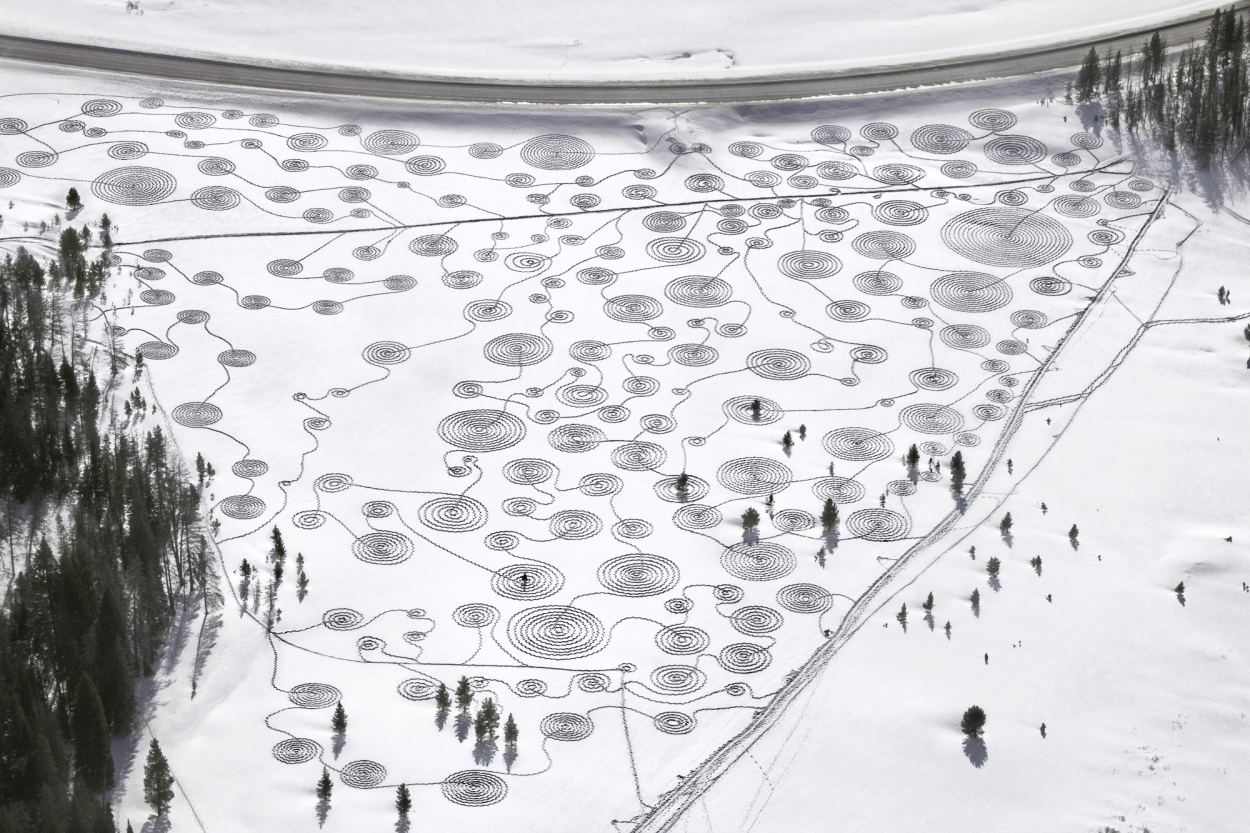
LAND ART: Snow Drawings by Sonja Hinrichsen: German-born, San Francisco–based artist Sonja Hinrichsen creates large-scale, ephemeral “snow drawings” in wintry locations around the world with the help of local volunteers who don snowshoes and track through the snow in patterns. She then photographs the land art from a helicopter or ski lift. These are amazing! Here’s a video by Cedar Beauregard of a drawing in progress at Rabbit Ears Pass, Colorado:
Snow Drawing by Sonja Hinrichsen, Rabbit Ears Pass, Colorado, 2012
Advent is a season of waiting with deep longing and hope for that long-looked-for day when fear and pain will be no more because Christ will reign and set this world free. These songs tap into that.
>> “Redemption Draweth Nigh”by Gordon Jensen (1970), performed by Rumbi Lee (2018): The title and refrain of this contemporary hymn are drawn from Luke 21:28: “And when these things begin to come to pass, then look up, and lift up your heads; for your redemption draweth nigh” (KJV).
+++
STREET ART SERIES: Medicinal Flowers of Lebanon by Faith XLVII: In September 2021, South African artist Faith XLVII (Liberty Du) traveled to Beirut to paint curative flowers across the rubble of the Lebanese city in the wake of the August 4, 2020, port explosion that caused at least 218 deaths, 7,000 injuries, and $15 billion in property damage, as well as leaving an estimated 300,000 people homeless. Rosehips, horned poppies, chicory, African carline thistle—all these botanicals are used in remedies for common ailments. “Each flower urges us, in a sense, towards healing as they grow out of the concrete,” the artist said.
Faith XLVII (South African, 1979–), Glaucium flavum, from the Medicinal Flowers of Lebanon series, Beirut, Lebanon, 2021. Photo courtesy of the artist.
+++
NEW ALBUMS:
>> The Soil and The Seed Project, vol. 8: Advent-Christmas-Epiphany: For the Advent-Christmas-Epiphany triad of the church year comes this new album from The Soil and The Seed Project, a ministry of Virginia Mennonite Missions—and recently Lilly-Endowed! All their music is free—for download, and even as physical CDs while supplies last. Below are two of my favorite tracks, both written by new contributors to the project. The first verse of Philip Fisher Rhodes’s “Bethlehem One” is in the voice of the in utero Christ; the second, the shepherds; the third, the wise men. The song is sung by Ben Luna. And “Peace Prayer” by Susan Gascho-Cooke is a plea that God would hold his arms around “this tilting planet,” the world’s wounds, and all people.
Each TSATP album is part of a larger project that also includes “Little Liturgies” booklets perfect for families with small kids (but that can also be used by individuals and small groups). Each booklet includes litanies, prayers, reflection questions, suggested activities, and visual art—and again, they’re free! Request a digital or physical copy here.
>> Kindness Is Solid Stone, Violence Is a Heavy Loan to Pay by David Benjamin Blower: Released November 3 and available on Bandcamp only, this album features nine original songs by writer, poet, theologian, and podcaster David Benjamin Blower of Birmingham, UK. I appreciate the minimalist sound and the stark lyricism. My favorite track is probably “Meet Me Where I Sing and Stamp My Feet”:
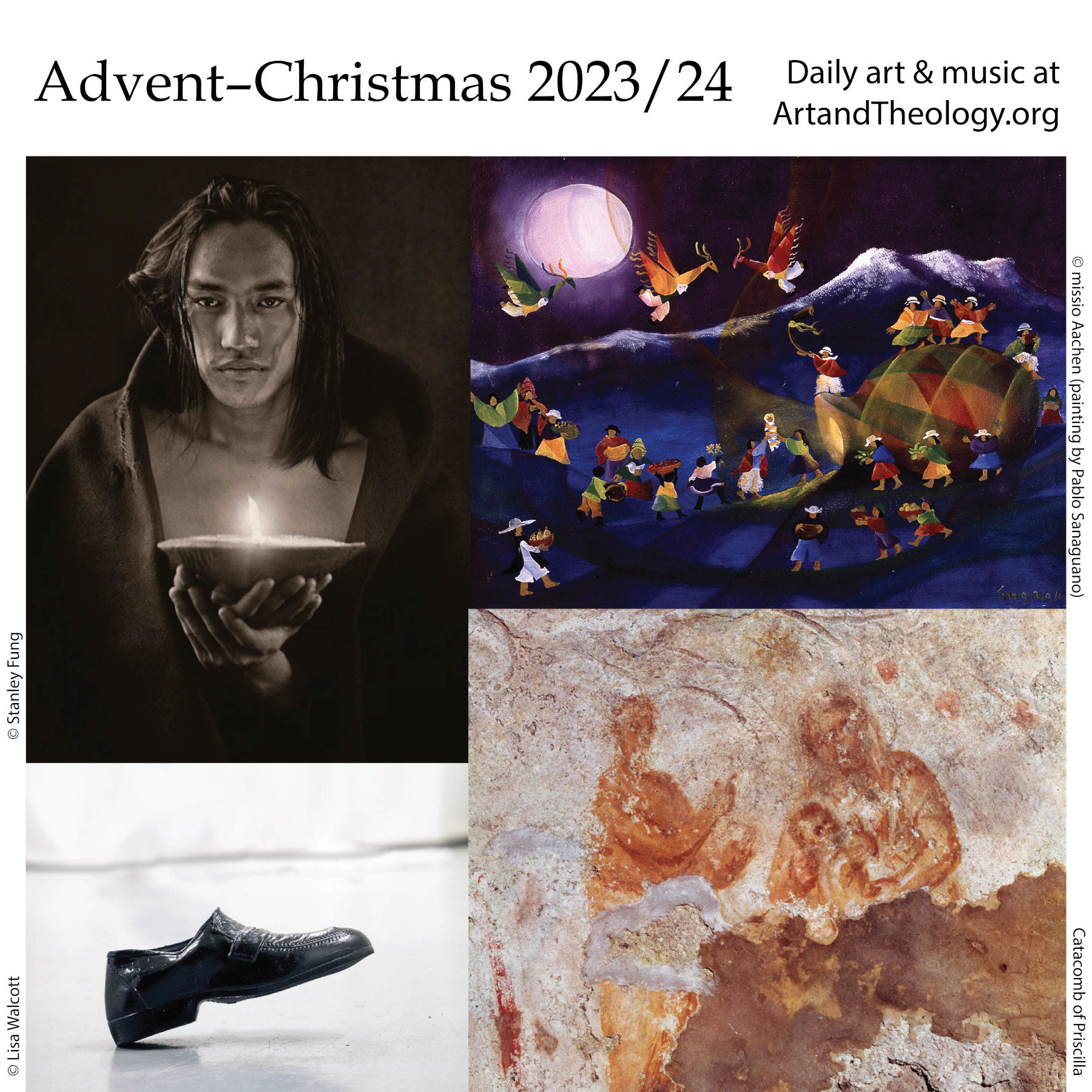
This year I’m continuing my Advent and Christmas tradition of daily art-music pairings on the blog, from December 2 (a prologue before the official start of Advent on December 3) through January 6, Epiphany. If you know of anyone who might be interested to follow along, they can subscribe here.
An ancient catacomb painting, a contemporary light installation, an Urdu anthem, a French West Indian carol, an Ethiopian tapestry, an impearled chasuble, a kinetic sculpture, a jazz rhapsody, a Byzantine-inspired piano quintet, an isicathamiya-style song, a Puerto Rican bulto, a Netherlandish altarpiece, and settings of Herbert, Blake, Wilbur, and Augustine—these are some of the gifts from artists on offer this season, inviting us to deepen our desire for and celebration of Christ Emmanuel, God with us.
+++
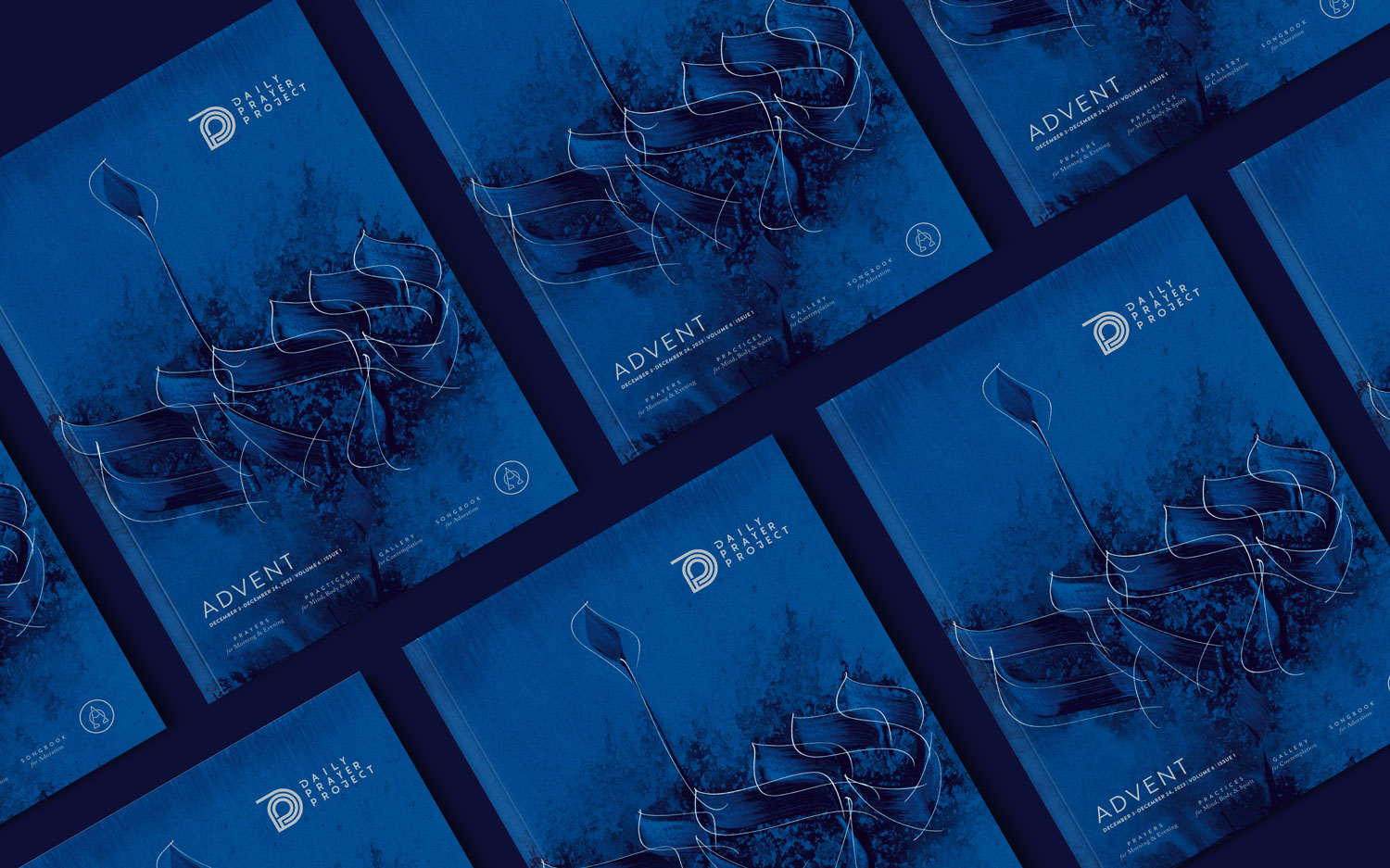
THE DAILY PRAYER PROJECT:Advent 2023: With Advent comes the start of a new liturgical year—which means a new volume of the Daily Prayer Project’s Living Prayer Periodical! Published in six editions a year, this periodical aims to “connect and unify Christians by resourcing them with daily prayers, practices, and music from the global-historical church, and visual art of spiritual and artistic value.” I curate the art. The cover image for Advent 2023—which, providentially, was finalized before the Hamas attack on Israel on October 7 and the ensuing retaliations—is a calligraphic rendering of the Hebrew word shalom by Michel D’anastasio, a French Catholic artist with Jewish ancestry. The lamed is like a candle held hopefully aloft against a dark-blue midnight.
Rev. Joel Littlepage, who is the pastor of worship and formation at Grace Mosaic in Washington, DC, curates the prayers. Here’s Friday evening’s, from the church in New Guinea: “Lord, oil the hinges of our hearts’ doors, that they may swing gently and easily to welcome your coming.” Wednesday morning’s prayer is a responsive confession by Jorge Lockward, a Dominican song leader from New York, which begins, “Por tantas injusticias, perdón, Señor. Por tanta indiferencia, perdón, Señor.” (For so much injustice, forgive us, Lord. For so much indifference, forgive us, Lord.)
+++
NEW BOOK: A Radiant Birth: Advent Readings for a Bright Season, ed. Leslie Leyland Fields and Paul J. Willis: New this fall from InterVarsity Press, this Advent devotional book is a multiauthor compilation of forty-two readings for Advent through Epiphany, consisting of literary essays, poems, and short stories. Contributors are affiliated with the Chrysostom Society and include Richard Foster, Lauren Winner, Madeleine L’Engle, Philip Yancey, Walter Wangerin Jr., Eugene Peterson, Luci Shaw, and Marilyn McEntyre. About one-third of the content is previously unpublished, including a wonderful little reader’s theater (pages 81–89) by Leslie Leyland Fields that I can imagine working really well as part of a church service (and I received confirmation from Fields that people may use it freely in such settings). I know the market is really thick with Advent books, and I’ve read a lot of them, but this one has to be one of my favorites—the selections are wonderful.
+++
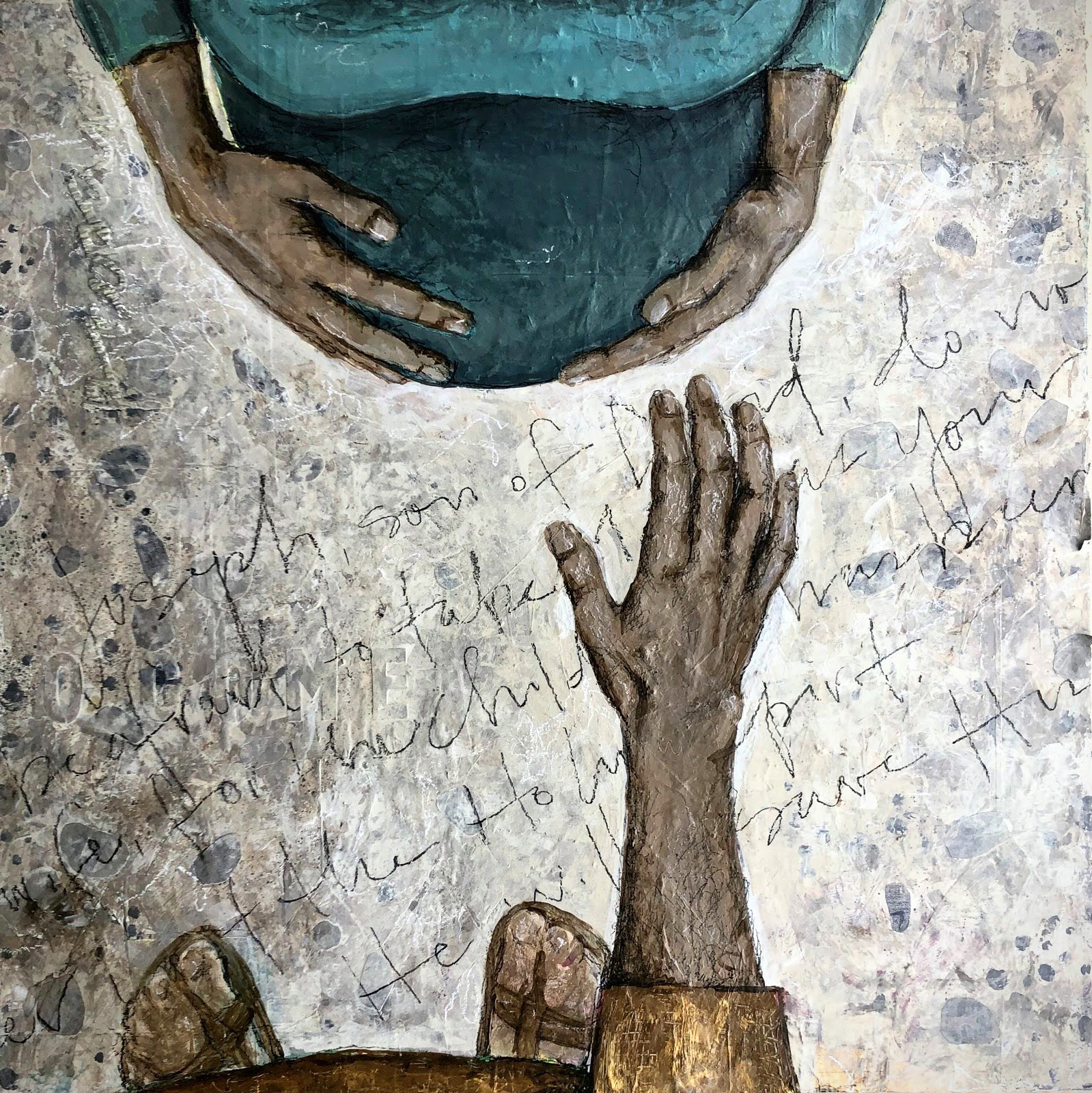
ART SERIES: Advent by Riki Yarbrough: For Advent 2018, artist Riki Yarbrough set herself a challenge: each day, create a 24 × 24-inch mixed media work corresponding to that day’s family devotions, structured around Jesus’s lineage. She didn’t have nearly enough canvases to last the duration of the season, so on day two “I woke up, took the very same canvas I had painted the day before, and worked right on top.” The final product was an artwork twenty-seven layers deep—the various people, prophecies, and foreshadowings adding weight and texture to the progressing story that culminated, in Yarbrough’s devotional program, with the infant Christ in a manger. “To cover the previous day’s work under the beauty of a new focus and set of Scriptures became both an offering and a sacrifice,” she said. “I wasn’t worried about meeting someone’s expectation or coming back to rework it later. I was simply conversing with the Lord over the truth of His Word in those wonderful moments on that particular day.”
Riki Yarbrough (American, 1975–), Joseph, Husband of Mary, 2018. Mixed media on canvas, 24 × 24 in.
Here’s a thirty-second time lapse of the Cain and Abel composition transforming into Noah:
In Advent 2022 Yarbrough reprised the daily challenge, this time executing her images on separate canvases. You can find this series on her Instagram @rikiyarbrough, starting with the candle image—but you can also purchase it in book form, as this month, Yarbrough released Advent in Art and Verse, combining full-color photos of all twenty-seven works from her 2022 Advent series with scripture passages and original poetic reflections. I received my copy, and my first impression was: what a beautiful design!
I like the allusiveness of her paintings: a set of footprints, stalks of grain, a red cord, tongs gripping a hot coal, tree rings, harp strings, a split fig, a cairn—simple objects like these guide us through the narrative of the Old Testament and the opening pages of the New.
+++
SONG MEDLEY: “O Come, O Come, Emmanuel / Come, Thou Long-Expected Jesus” by the Petersens: In this video shot in Weddings at the Homestead in their hometown of Branson, Missouri, family bluegrass band The Petersens perform the two best-known Advent hymns—the one mournful, meditative, and minor key, the other bright and exuberant. They recorded both songs (released as two separate tracks) for their 2020 album Christmas with the Petersens.
+++
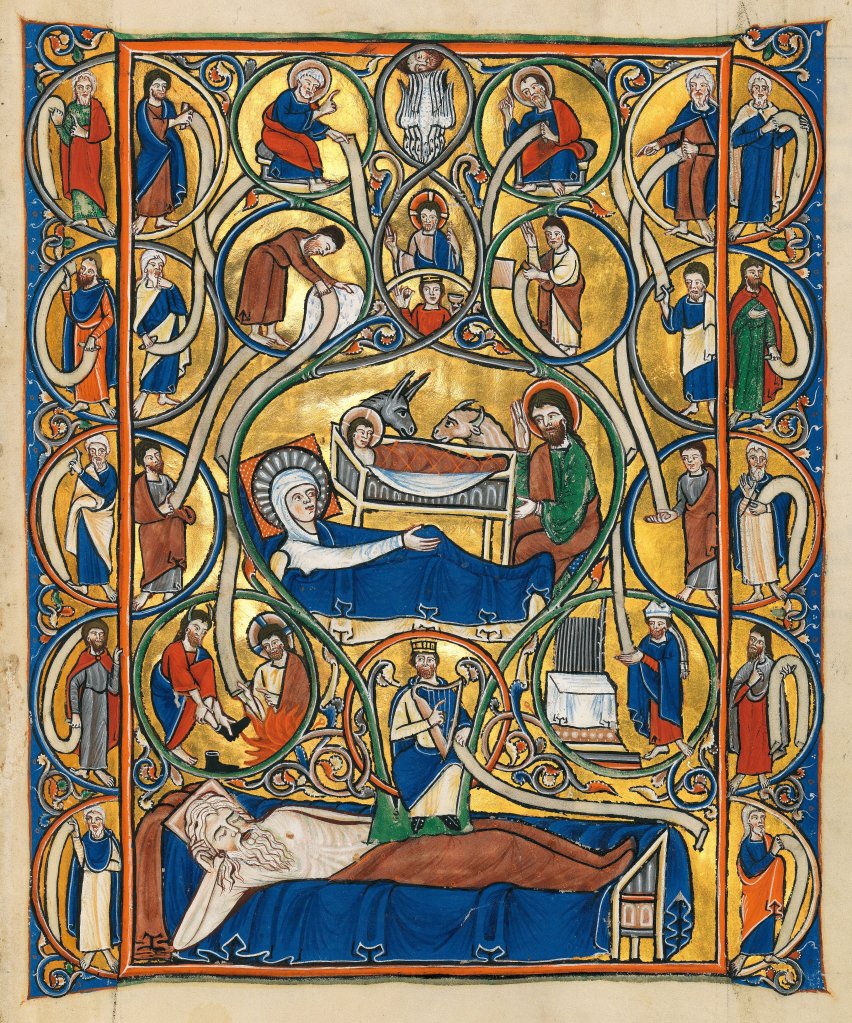
SUBSTACK POST: “O Come, Thou Rod of Jesse” by Grace Hamman, Medievalish 1.12, December 12, 2022: In last December’s installment of her monthly Medievalish newsletter, Grace Hamman considers Jesus’s family tree, visualized in the Middle Ages as what’s called, after Isaiah 11:1, the Tree of Jesse [previously here and here]. What does it mean that Jesus came from a real human family, a “complex web of generation, adoption, relationship, and dependence”? “The Son did not only take on flesh,” Hamman writes, “he took on David’s sometimes troublesome courage and cowlicks, Anne’s devotion and double-jointed pinky fingers. He comes from a line of real and complex people: faithless and faithful, abusers and abused, holy and broken. Baby Jesus is born into our funny human particularities and our burdensome histories, into created time and place.”
Tree of Jesse from an English Psalter in Latin, ca. 1190–1210. Bayerische Staatsbibliothek, Munich, BSB Clm 835, fol. 121r.
+++
PODCAST EPISODE: “The Season of Waiting (and Waiting . . . and Waiting),”Everything Happens with Kate Bowler, November 29, 2022: In this podcast episode from the beginning of last Advent, bestselling author Kate Bowler introduces the season as one of waiting. She explains the history of the Advent wreath, and takes calls from listeners who share Christmas traditions they observe to honor a loved one they’ve lost. Be sure to download Bowler’s 2023 Advent guide, titled Bless the Advent We Actually Have. Here’s an excerpt from Day 1:
Advent is a time marked by waiting. We wait for God to make all things right. For justice to be meted. For democracy to feel stable. For wrongs to be righted. For our communities to be safe spaces for the vulnerable. For our earth to heal. We wait for our lives to get easier—for us to have the financial security we need, for our relationships to be restored, for our bodies to ache less. We wait for our parents to understand us and our families to feel whole. We wait for our kids and grandkids to be healed or come back home. We wait for the grief to end.
But the waiting of Advent is one marked by hope. We wait with expectancy. With anticipation for the inbreaking of God to make all things new. . . .
Advent hope is gritty. It shirks all false optimism. It is hope as protest. Hope in the face of impossibilities. . . .
The excerpt Bowler reads in the podcast is from her 2022 Advent guide, The Season of Waiting (and Waiting . . . and Waiting . . .) (which you can also download for free, along with 2021’s A Good Enough Advent + Christmastide, at https://katebowler.com/advent/).
When I was little, my bedtime routine involved me propping up my plush Precious Moments doll beside me on my bedside floor, her hands Velcroed together, so that she could accompany me in praying this prayer:
Now I lay me down to sleep I pray the Lord my soul to keep If I should die before I wake I pray the Lord my soul to take
This rhyming quatrain from colonial New England,[1] simple though it is, cultivated in me a warm sense of God’s care and protection through the night.
Perhaps the latter half sounds morbid—but keep in mind that it comes from a time when child mortality rates were much higher, as, given the lack of advanced medicine and effective vaccines, illnesses were frequent and often fatal. A later variation of the prayer omits the reference to death, replacing the second couplet with the cutesier “Thy love guard me through the night, / And wake me with the morning light.”
I will both lie down and sleep in peace, for you alone, O LORD, make me lie down in safety.
—Psalm 4:8
As an adult, I’ve encountered another evening prayer that reminds me of “Now I Lay Me Down to Sleep”—similar content, same meter, but likely dating all the way back to the fifth or sixth century, and originally written in Latin. It’s called Te lucis ante terminum (Before the Ending of the Day):
Te lucis ante terminum,
Rerum Creator poscimus,
Ut pro tua clementia
Sis præsul et custodia.

Procul recedant somnia,
Et noctium phantasmata;
Hostemque nostrum comprime,
Ne polluantur corpora.

Præsta, Pater piissime,
Patrique compar Unice,
Cum Spiritu Paraclito
Regnans per omne sæculum.
Before the ending of the day,
Creator of the world, we pray
That with Thy wonted favor Thou
Wouldst be our Guard and Keeper now.

From all ill dreams defend our eyes,
From nightly fears and fantasies;
Tread under foot our ghostly foe,
That no pollution we may know.

O Father, that we ask be done,
Through Jesus Christ, Thine only Son;
Who, with the Holy Ghost and Thee,
Doth live and reign eternally.

Trans. John Mason Neale
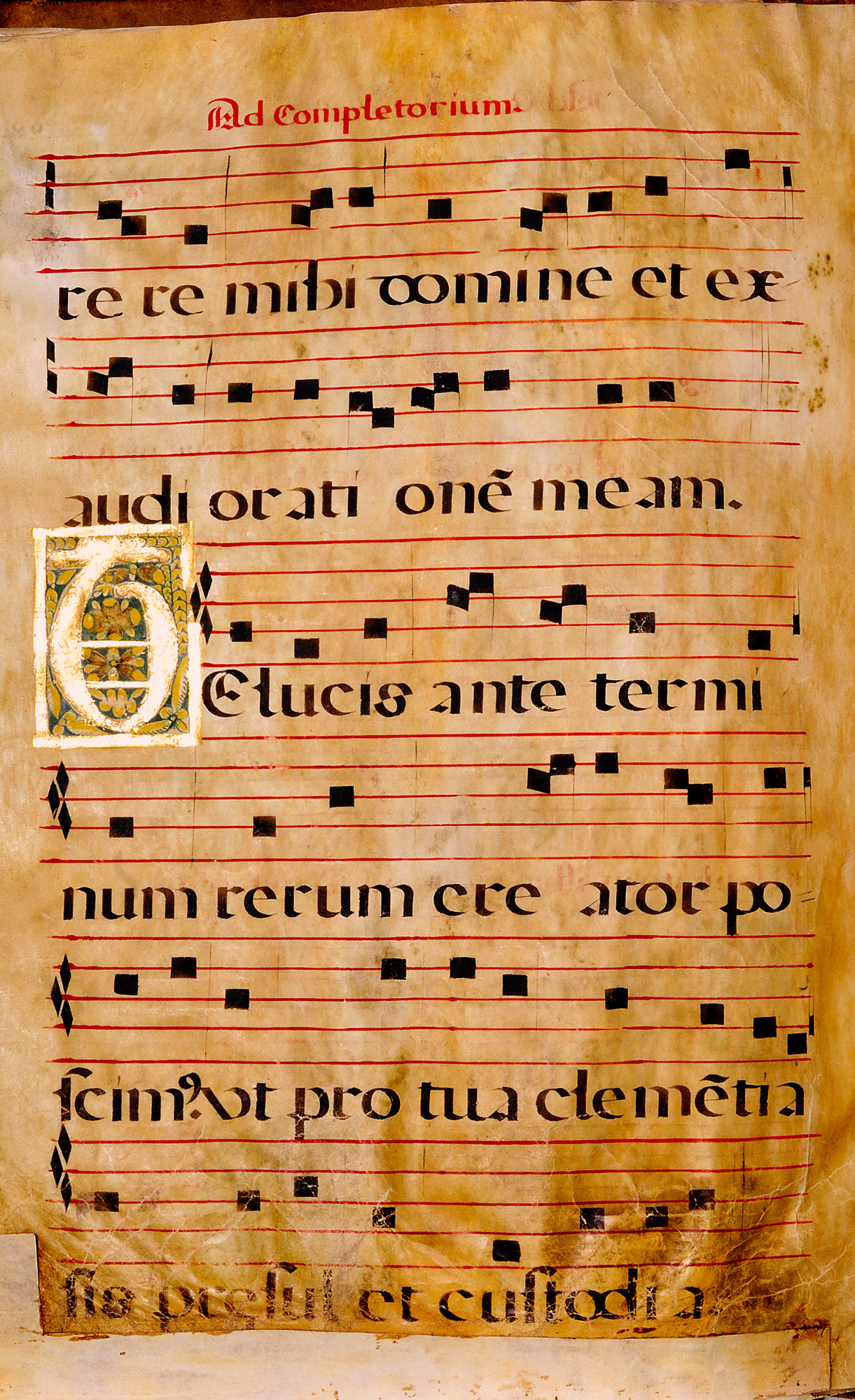
This prayer is sung liturgically as the office hymn at Compline in the Roman Rite. It was originally, and continues to be, sung to plainsong melodies from the Liber Usualis (Usual Book) and the Sarum Rite, such as this one:
Te lucis ante terminum from an antiphonary, Spain, 1575–1625. Rare Books and Special Collections, University of British Columbia Library, Vancouver. [object record]
The great English High Renaissance composer Thomas Tallis wrote two five-voice settings of the hymn in 1575, of which the ferial tone is performed here by The King’s Singers:
Upon my first reading [of Te lucis] I was immediately struck by the color and imagination inherent in the language, particularly in the second stanza – where the deep calm of the previous verse is replaced by foreboding images of the shades of night. A beautiful symmetry is achieved by the addition of the eloquent Gloria Patri that brings the hymn to a close. Through the patient and fluid unfolding of the Latin, St. Ambrose[2] has imbued this hymn with a sense of comfort and warmth, offering hope for a light to illumine the dark hours to come.
The last setting I want to share is Owain Park’s from 2020, released under the title “Night Prayer.” His was inspired by ancient plainchant and was specially composed for virtual choirs during COVID-19. Listen to the premiere performance by his vocal consort, the Gesualdo Six (Park is the singer at bottom right):
The photographs by Ash Mills in this video, some of them long-exposure (gorgeous!), are of Salisbury Cathedral’s annual “From Darkness to Light” Advent procession, in which the medieval church is gradually filled with the light of over one thousand candles.
The music gives the words a gravitas and a beauty that I think they lack on their own. Why not choose one of these as a bedtime track to play for your little one as they fall asleep! Or for your own anxious soul. The pronouns are first-person plural, indicating that this prayer is intended to be prayed in community. Make it a family listening event. And if you feel so inclined, you might even try chanting along with the choir of Yorkminster Park Baptist Church in Toronto!
NOTES
1. Although I’ve seen “As I Lay Me Down to Sleep” spuriously attributed as “Old English,” its earliest known appearance in print is in the 1737 edition of the New England Primer, a popular reading textbook used in the American colonies, published in Boston.
2. Abbot S.-G. Pimont, author of Les Hymnes du Bréviaire romaine (Paris, 1874), is the one who attributed the text of Te lucis to Ambrose of Milan (ca. 339–397), but this authorship claim was rejected by the Benedictine editors of The Catholic Encyclopedia (Robert Appleton, 1912) and by patristics scholar Luigi Biraghi and today is generally regarded as false.
SPOTIFY PLAYLIST:November 2023 (Art & Theology): In this month’s playlist I nod, in part, to All Saints’ Day (November 1), Christ the King Sunday (November 26), and world events. It includes “Ad Ana” (How Long), a setting of Psalm 13 in its original Hebrew by Miqedem (a Tel Aviv–based band made up of Shai Sol [previously] and three other musical artists from a mix of Jewish and Christian backgrounds), and “Touba” (Blessed), a sung recitation of the Beatitudes in Arabic by the Sakhnini Brothers [previously], Arab Christians from Nazareth, with oud and keyboard accompaniment.
As American Thanksgiving is November 23, you may also want to check out my Thanksgiving Playlist, comprising songs of gratitude. Originally created in 2021, each year I add to and remix the list as I encounter new recordings. One of the newer additions is “He Has Made Me Glad” by Leona Von Brethorst, based on Psalm 100, as arranged and performed on organ by the amazing Cory Henry.
The Christian life consists of both praise and lament, both tears and laughter—which is why in any given worship service or Art & Theology playlist or blog post, as in the biblical psalter, you can find songs that express joy and others, heaviness. They don’t negate one another but rather give fuller expression to the breadth of religious experience.
+++
NEW ALBUM: Some Mississippi Sunday Morning by Parchman Prison Prayer: After a bureaucratic process that took over three years, music producer Ian Brennan was finally granted permission in February to record a Sunday worship service at the Mississippi State Penitentiary, aka Parchman Farm, a notorious prison with a rich musical history. The prison chaplains convened a unique service of inmate singers from various Christian denominations ranging in age from twenties to seventies, who were given turns at the mic and even collaborated on a few tracks. Brennan said he wanted to give the men a platform for their voices to be heard. All profits from the album benefit the Mississippi Department of Corrections Chaplain Services.
“You can hear the way Sunday services are particularly restorative for someone incarcerated – not simply because of the promise of redemption, but the solace of not being alone,” writes Sheldon Pearce for the Guardian. “Some Mississippi Sunday Morning feels like these men reaching out for the things such a barbaric system tries to deny them: compassion, intimacy, and mercy. The songs are not just purges of anxieties accrued on the inside or calls for the Lord’s embrace, but also pleas to be acknowledged as a person and not an ID number.”
(Thanks to Art & Theology reader Ted Olsen for alerting me to this! He compared the album to Angola Prison Spirituals, recorded in the 1950s.)
+++
PODCAST EPISODE: “Sarah Clarkson: The Gift of Beauty,”Life with God: A Renovaré Podcast, October 20, 2023:Sarah Clarkson, author of This Beautiful Truth: How God’s Goodness Breaks into Our Darkness, speaks with Renovaré community life director Nathan Foster about her struggle with OCD and, amid the great suffering wrought by that illness, how God’s goodness has been mediated to her by beauty—in nature, poetry, music, story, tea, ritual, and so on. Responding to the idea that beauty is a luxury for the affluent, she says, “Well, [it is] if beauty is about having a perfect house. But beauty is healing those who have been hurt in a war zone. It’s creating shelters where children can have refuge. It’s rebuilding what has been destroyed. . . . Beauty is a defiance of the forces of evil and disorder and destruction because it is [their] opposite: where evil tears down, beauty creates; where there is absence, beauty fills.”
+++
PRESS RELEASE: “Toledo Museum of Art Adds Armenian Gospel Manuscript with 46 Paintings to the Collection”: After centuries passing through private collections, in June the Pozzi Gospels, a sixteenth-century illuminated manuscript from Armenia, entered the collection of the Toledo Museum of Art, which will make it more accessible to the public. (I’m not sure when the book will go on display. And it doesn’t have an object page on the museum’s website yet.) The artist and scribe of this extraordinary, sumptuous manuscript was Hakob Jughayets’i. His forty-six full-page miniatures and marginal decorations combine Christian iconography with Byzantine, Islamic, and Buddhist design elements.
The Sam Fogg gallery, which exhibited the manuscript last year as part of The Medieval Body, created this short video about it, narrated by art historian Jack Hartnell:
Hakob Jughayets’i (Armenian, ca. 1550–1613), The Pozzi Gospels, 1586. Paper with blind-stamped brown leather binding, 403 folios with 46 full-page illuminations and numerous marginal miniatures, 7 3/4 × 5 3/4 in. (19.8 × 14.5 cm). This spread shows the Creation of Eve and the Temptation of Eve.
VIRTUAL MUSIC COLLECTION: Armenian Spiritual Music Special Vol. 1: NTS Radio in London has curated ninety minutes of traditional Armenian Christian music. (They’ve done the same for Byzantine chant, Welsh hymns, Hildegard von Bingen, and numerous other categories.) I wish the lyrics and translations were provided, but regardless of my understanding of the words, what beauty. [HT: ImageUpdate]
UPCOMING EVENT: The Guild Creative Arts Conference, November 4, 2023, Church on Morgan, Raleigh: Organized by singer-songwriter Jess Ray, spoken word poet Sharlene Provilus, and event curator Cary Brege, The Guild Conference endeavors “to care for the craft and character of creative people while encouraging creative community. We want to inspire your creative work, spiritual journey, and daily rhythms.” The special guests this year are singer-songwriters Dwan Hill, Andy Squyres, and Taylor Leonhardt; JourneyMates director Mary Vandel Young; and Makers & Mystics podcaster Stephen Roach. The day-long conference includes sessions, a panel discussion, an artist showcase, and a concert by The Choir Room. The regular ticket price is $75 (group rates and concert-only tickets also available).
+++
ARTICLE: “A Cloud of Witnesses: Why We Should Celebrate All Saints Day” by Leonard J. Vander Zee: In this June 2008 article from Reformed Worship, the Rev. Leonard J. Vander Zee writes to his fellows in the Reformed Protestant tradition, explaining what All Saints’ Day is and why it’s important to celebrate it, as Methodists, Lutherans, Anglicans, and Roman Catholics do every November 1. (Churches without midweek services typically celebrate the feast corporately on whatever Sunday precedes the first of November: this year, October 29.) Vander Zee also offers a sample order of worship, including specific hymn suggestions.
For all the saints who’ve shown your love In how they live and where they move For mindful women, caring men Accept our gratitude again
For all the saints who loved your name Whose faith increased the Savior’s fame Who sang your songs and shared your word Accept our gratitude, good Lord
For all the saints who named your will And showed the kingdom coming still Through selfless protest, prayer, and praise Accept the gratitude we raise
Bless all whose will or name or love Reflects the grace of heav’n above Though unacclaimed by earthly pow’rs Your life through theirs has hallowed ours
>> “Lux Aeterna (Nimrod)”by Edward Elgar, arr. John Cameron, performed by Voces8: The orchestral work “Nimrod” is movement 9 from the Enigma Variations by British composer Edward Elgar (1857–1934). In 2004 John Cameron wrote an SSAATTBB choral arrangement of the tune using the words of “Lux aeterna” from the Requiem Mass—which is what Voces8 performs in this video.
Lux aeterna luceat eis, Domine, cum sanctis tuis in aeternum, quia pius es.
Requiem aeternam dona eis, Domine, et lux perpetua leceat eis.
English translation:
May light eternal shine upon them, O Lord, with thy saints forever, for thou art kind.
Eternal rest give to them, O Lord, and let perpetual light shine upon them.
+++
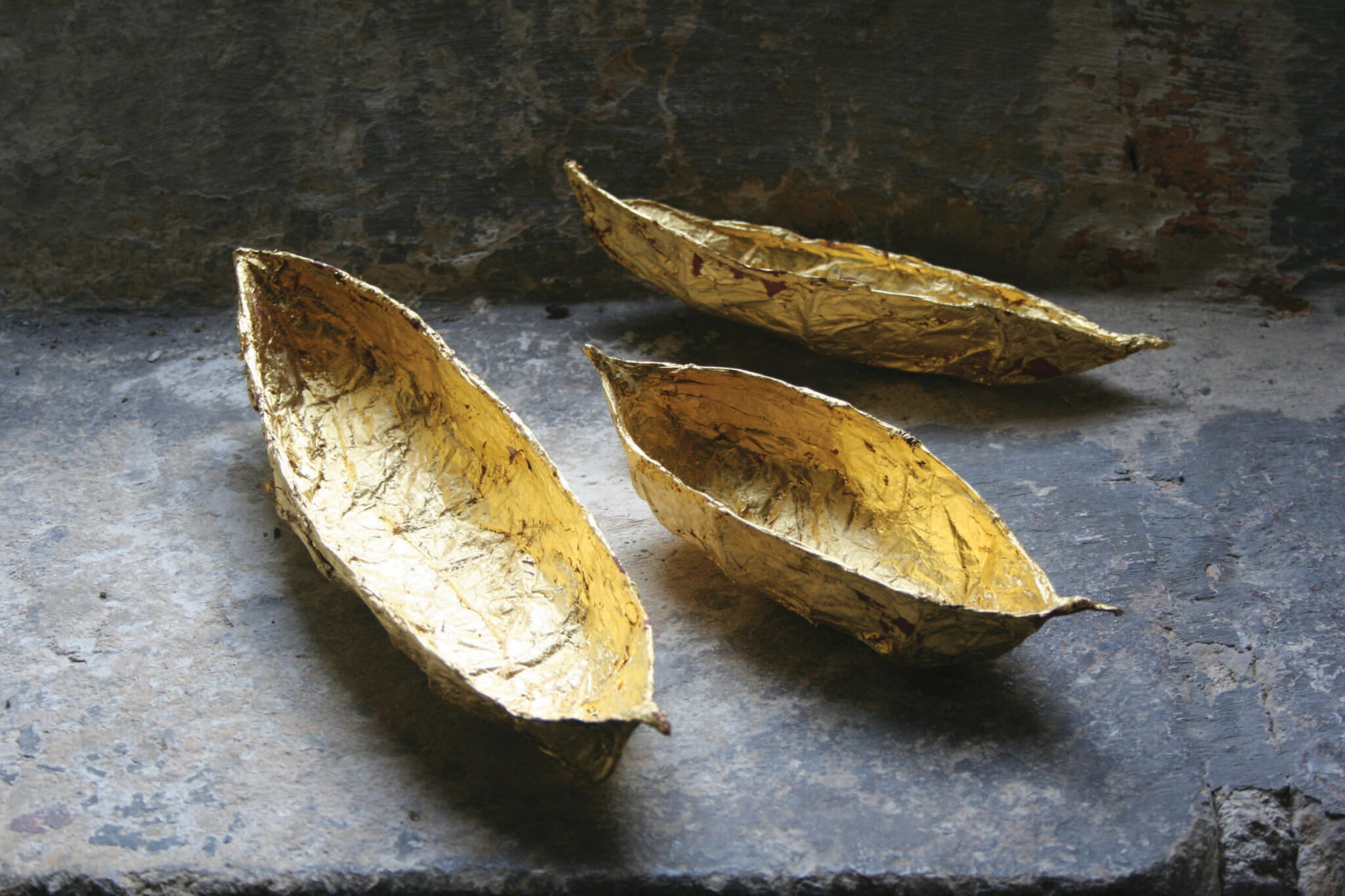
ARTICLE: “Soul on Deck” by Jake Lever: In Image no. 117 (Summer 2023), artist Jake Lever writes about a handful of his artworks having to do with the archetype of the boat as a vessel of passage: Ark, Bardsey Boats, Hailes Boats, Soul Boats, and Do the Little Things. He describes the fragile vessels he creates out of branches or wire, tissue paper, and gold leaf as “both cradle and coffin . . . something akin to a giant belly, cocoon, or womb . . . empty seed pods suggestive of cycles of birth, death, and resurrection.” Editions of some of these were given as gifts to family and friends during COVID, or to members of his collaborator-priest friend’s parish journeying through the final stages of a terminal illness.
Jake Lever (British, 1963–), Hailes Boats, 2013. Wire, tissue paper, and gold leaf, dimensions variable.Jake Lever (British, 1963–), Soul Boats, installed at Birmingham Cathedral, 2015–16. Photo by the artist.
For Soul Boats, installed at Birmingham Cathedral for its tercentenary, Lever invited city residents to fill the two thousand boats that would hang from the ceiling of the nave with personal memories, prayers, and reflections. “Created in hospices, youth clubs, schools, sacred spaces, and scores of community settings across the city, boats were made in memory of loved ones who had died, as cries for help in finding employment, as prayers of thanksgiving and gratitude, for peace and justice.” Heading east toward the high altar in the sanctuary, these boats formed a “constellation of souls.”
+++
LITANY: “Litany for All Saints Day” by Fran Pratt: I always appreciate the litanies (responsive prayers for congregational use) that Fran Pratt writes. This one is from 2016.
+++
And for some lighthearted fun: a GIF by James Kerr (artist name: Scorpion Dagger), of Jesus and the twelve apostles riding a tandem bicycle! Kerr makes humorous animated digital collages mostly from Northern and Early Renaissance art.
SYMPOSIUM: “Kunst en religie nu” (Art and Religion Now), October 20, 2023, 1:30–4:30 p.m., Museum Catharijneconvent, Utrecht, Netherlands: A week from Friday, attend a free afternoon of talks (in Dutch) on the topic of religion in modern and contemporary art. The speakers are Lieke Wijnia, who will present the results of her past two years of research on religious themes that crop up in modern and contemporary artworks in the Collectie Nederland (Netherlands Collection); Rozanne de Bruijne, on religion in art of the interwar period (1918–1940), the topic of a spring 2025 exhibition she’s curating; Wouter Prins from the Museum Krona, on the state of religious art in the post-Nietzsche era; and Joost de Wal on contemporary art in church spaces. Here’s the autotranslated description:
“The more modern the art, the smaller the presence of religion.” This frequently heard approach appears to be anything but justified. In fact, at the beginning of the twenty-first century, spirituality seems to be on the rise in the visual arts, resulting in a multitude of artistic interpretations. What does this say about the relationship between religion and art?
This symposium focuses on the multifaceted and sometimes unexpected presence of religion in visual art. For example, how does contemporary (religious) art relate to ongoing secularization on the one hand and to flourishing international religious communities on the other? What does the growing interest in spirituality mean for the arts? And what about the use of religious symbolism in visual art, both inside and outside the church? The speakers also shed light on how the wealth of (religious) stories and images can provide guidance in times of social uncertainty and uprooting.
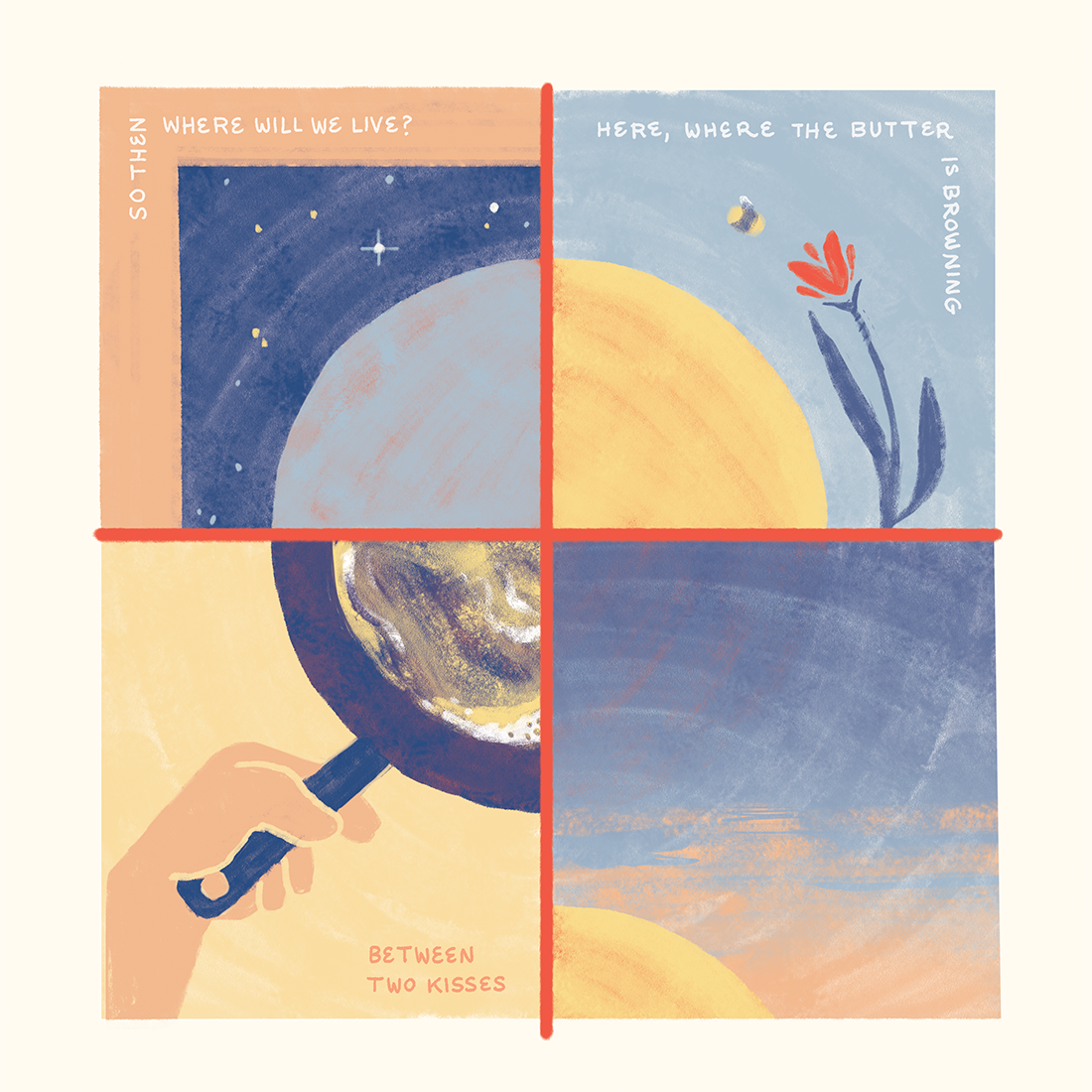
ONLINE WORKSHOP: “Deep Dive into Poetry Comics,” led byMadeleine Jubilee Saito, November 2, 9, 16, 30, 5–7 p.m. Pacific (8–10 p.m. Eastern):Madeleine Jubilee Saito [previously] is a cartoonist from Seattle who makes “poetry comics” about the environment and the sacred—and in four virtual sessions offered through Push/Pull, she’ll teach you how to make your own on topics of your choice!
Madeleine Jubilee Saito, Love Poem, 2019
“In this online course, you’ll practice exercises to explore your own voice and interests in drawing and text, creating poetry comics in a variety of styles. You’ll learn about minicomics, how to do basic layout for printing, and how to print a quarter-page minicomic. We’ll end the course with a celebratory comics reading for friends and family on Zoom. Students need to either be comfortable drawing digitally (Procreate, Photoshop, etc.) or have access to a scanner. Students will be also need access to a printer or local print shop for the last phase of the course.”
NEW ALBUM: You Don’t Carry It Alone by Leila Way:Leila Way is a singer-songwriter from Austin, Texas, writing songs for the church. Her first full-length album, “You Don’t Carry It Alone is a collection of songs for hard times. Some of these are old hymns; some were written during a period of intense grief and loneliness, while others grew out of prayers for friends. The album was created to comfort those who mourn; to remind God’s people that He is always faithful, always present and at work, even when we can’t see what He’s up to.”
The album consists of four original songs, two original instrumentals, a cover of “Be Still, My Soul,” and new retunes of George Matheson’s “O Love That Wilt Not Let Me Go” (one of my favorite hymns) and James Montgomery’s “I cannot call affliction sweet.”
+++
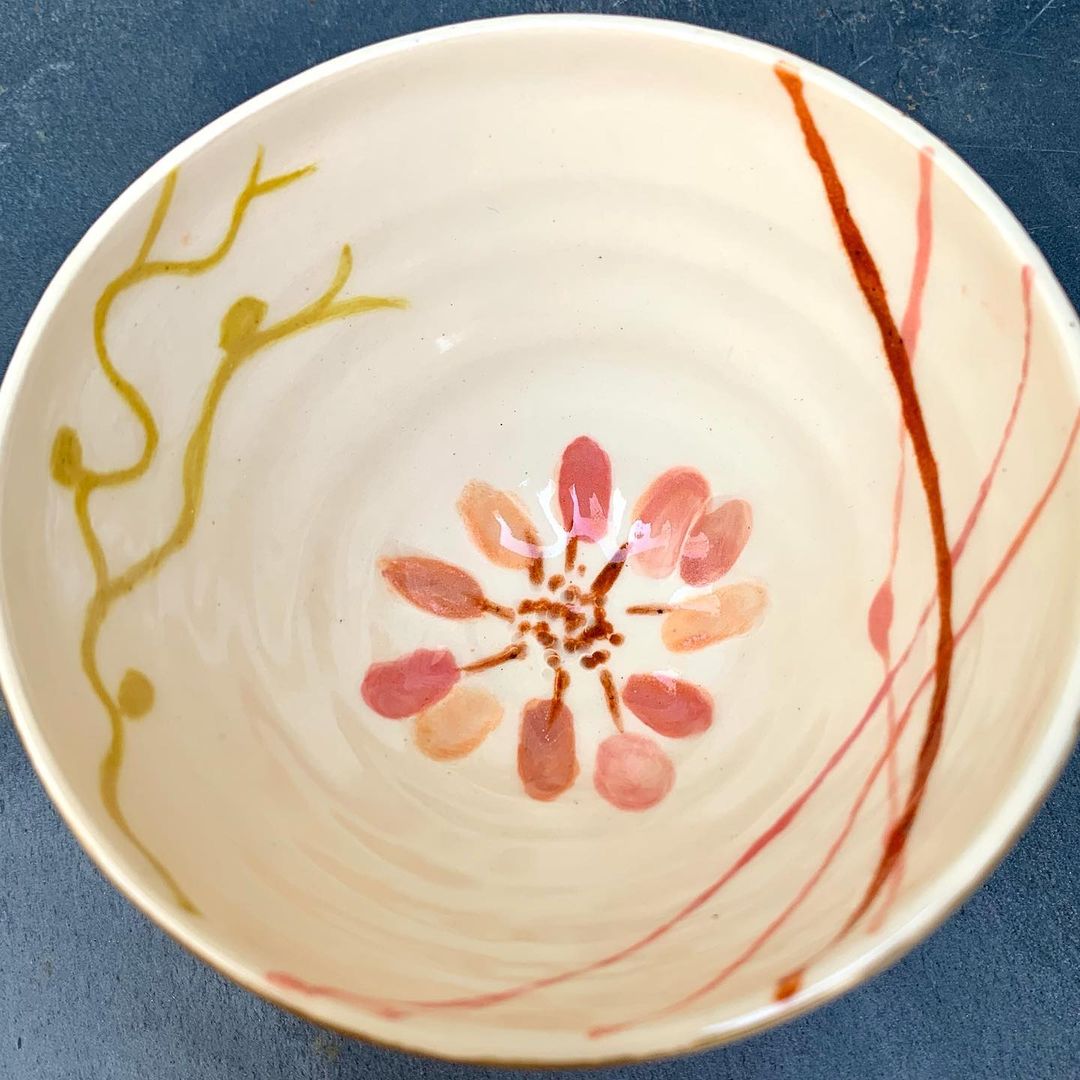
CERAMIC BOWLS:Nurture Collection by Jane Boutwell: I met artist Jane Boutwell at a Christians in the Visual Arts (CIVA) conference in 2021 after she presented this body of work that really moved me—a collection of ceramic bowls that take as their three design elements anatomical features of the female breast: lymph nodes (gold, river-like), mammary glands (pink and blooming), and musculature. She started the Nurture Collection after having one of her milk ducts surgically removed in 2019 for a biopsy (it turned out not to be cancer), as a meditation on the strength and inner beauty of this part of the body that is so often objectified or shamed. She recommends the bowls as a gift for a woman in your life who has had a tender year with regard to her breasts—cancer, nursing, etc.—to honor her journey.
Bowl from the Nurture Collection by Jane Boutwell, 2020
I share these now because October is Breast Cancer Awareness Month. Below is an eight-minute video explanation by the artist, followed by a short “making of” montage:
There are five Nurture bowls currently for sale in Boutwell’s online shop: Joan, Tracy, Colleen, Rita, and Wendy. Each is named after a woman she knows with breast cancer.
+++
PODCAST EPISODES:
>> “Landscape of the Body with David Taylor,”Makers & Mystics, September 13, 2023: Constructing a cogent theology of the body, theologian W. David O. Taylor discusses why it’s important that we honor and understand our bodies, and why having a right relationship to our bodies is imperative to the quest of art. Christians have often feared, distrusted, or despised the body; sin has meant that we’ve become alienated from our own bodies and the bodies of others, that we harm our bodies and others’, and that we often flee from our bodies, dissimulate. But Jesus wants us to be at home in our bodies, Taylor says—in worship, and in day-to-day life. He talks about Jesus as an icon of care-filled touch and the implications of that.
>> “On Being in a Body,”On Being with Krista Tippett, September 21, 2023: At the 2023 Aspen Ideas Festival, Krista Tippett interviewed Kate Bowler, author of Everything Happens for a Reason (and Other Lies I’ve Loved), a reflection on how she moved through learning at age thirty-five that she had Stage IV colon cancer. “From the new reality in our time of living with cancer as a chronic illness, to the telling of truths to our young as we face precarity in our collective body, this conversation is full of the vividly-whole humanity that Kate Bowler singularly embodies.” I heard Kate in person at Duke University a few years ago talking on a panel about suffering. She’s full of wisdom, wit, and raw tenderness and so, so endearing, and even though I’ve heard her story many times, every conversation with her brings up something new.
Be still and know that I am God Be still and know that I am Be still and know Be still Be
Rev. Dr. Cynthia Bourgeault, an Episcopal priest, writer, and retreat leader, mentions this chant in her book Chanting the Psalms. “Each time the line is repeated,” she writes, “key words are taken away. The result is a funnel-like effect that leads straight down into silence. . . . Each phrase expresses its own unique meaning and understanding as the prayer moves toward utter simplicity” (185). Bourgeault recommends working with the recording “Be Still and Know” found on the album Songs of Presence: Contemplative Chants for the New Millennium from Praxis Publishing House; I couldn’t find the audio online, but I did find a song by The River’s Voice (Trish and Richard Bruxvoort Colligan) that’s also based on this exercise of Fr. Rohr’s: “Be (Still and Know That I Am God)”:
+++
PODCAST EPISODES: Here are two podcast episodes I caught up with recently and enjoyed. Both links include transcripts.
>> “Jan Richardson: Stubborn Hope,”Everything Happens with Kate Bowler, October 27, 2020:Kate Bowler, a historian and cancer survivor who has done much academic work on the prosperity gospel, talks with spiritual writer Jan Richardson [previously], whose husband died unexpectedly in 2013, about the hidden rooms of grief, being disciplined by hope, and how the concept of blessing in the Jewish and Christian traditions differs from the #blessed culture of social media. Don’t miss the three discussion questions in the show notes.
POEM COMMENTARY:“Learning about Constellations” by Saddiq Dzukogi, commentary by Pádraig Ó Tuama: On this episode of On Being’s Poetry Unbound podcast, host Pádraig Ó Tuama unpacks a poem written by Saddiq Dzukogi in the aftermath of his one-year-old daughter’s death. It’s from his 2021 collection Your Crib, My Qibla.
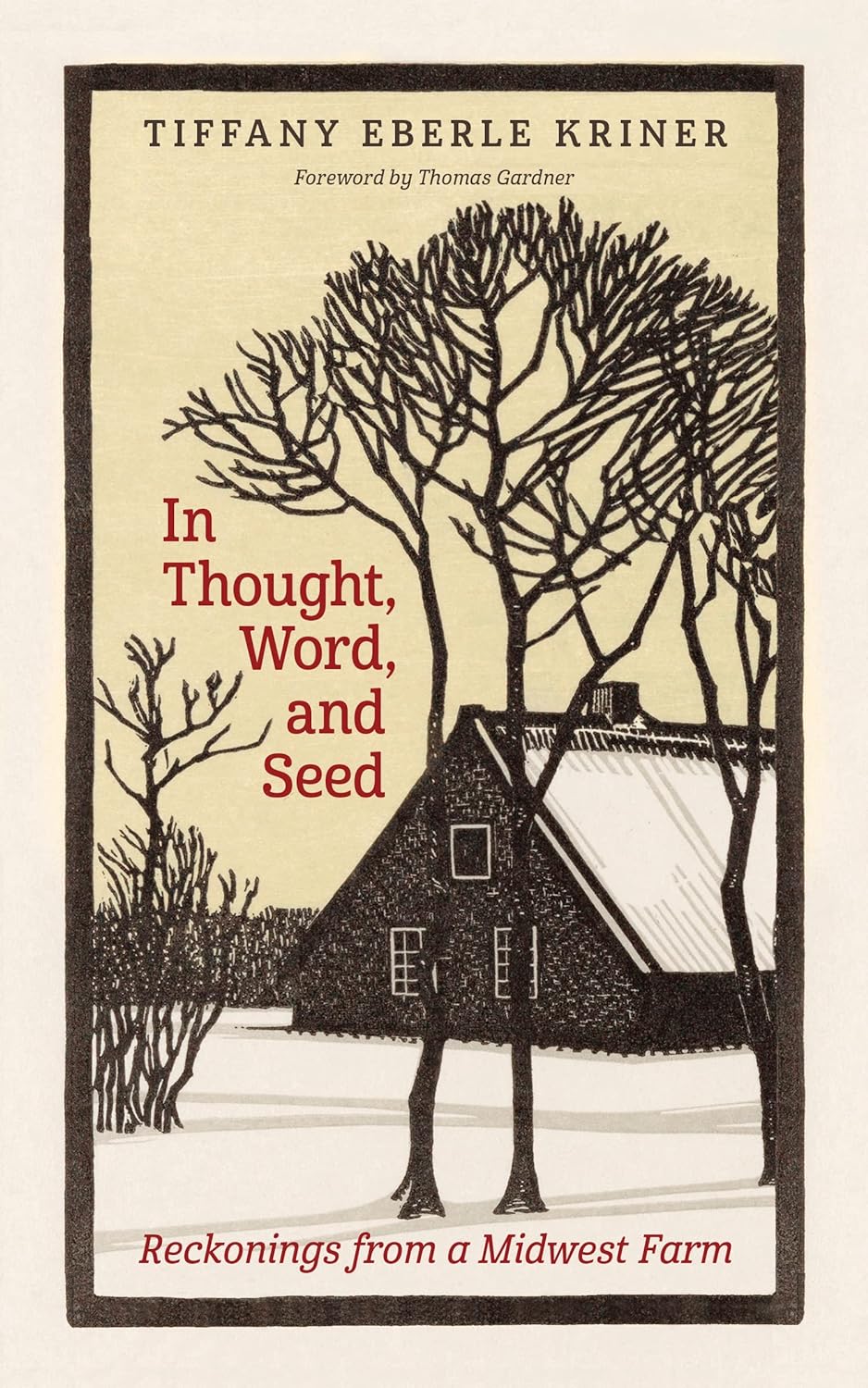
NEW BOOK: In Thought, Word, and Seed: Reckonings from a Midwest Farmby Tiffany Eberle Kriner: As a freelance copyeditor, I’ve worked on many projects for Eerdmans, and this has been one of my favorites: an essay collection by Tiffany Kriner, a Wheaton English professor and farmer from Illinois. It’s a unique blend of literary criticism, nature writing, and memoir. Virgil, George Eliot, James Baldwin, and Walt Whitman are among the authors she engages, respectfully weaving their stories into and around her own experiences of cultivating sixty acres of land and raising livestock with her husband, Josh. Today is the book’s official release date, and I can’t recommend it enough!
+++
(FIVE-WEEK) ONLINE COURSE: “Notes of Rest: Receiving Rest from Scripture and Black Music in Our Restless World,” taught by Julian Davis Reid: On Monday evenings from October 9 to November 6, pianist, speaker, and writer Julian Davis Reid, MDiv, of Chicago will be leading five, seventy-five-minute virtual discussions and meditations on the theme of rest, explored through the lenses of scripture and Black music. “Salvation,” “Sabbath,” “Sleep,” “Stillness,” and “Sanctuary” are the organizing principles. “The purpose of the class is to help the Body of Christ hear God’s invitation to rest,” Reid told me. “The means of getting there is through a mixture of artistic reflection and practical theology grounded in biblical analysis, reflection questions, and musical performance.” No prior musical knowledge is required.
The spiritual “Give Me Jesus” is an example of one of the songs Reid will be playing and guiding participants through (this recording is from his 2021 album Rest Assured, with album art by Shin Maeng):
This course is presented by the Candler Foundry, an initiative of Emory University’s Candler School of Theology that aims to make theological education accessible to everyone. It’s only $29! Reid has been leading Notes of Rest sessions since 2021, and he is currently accepting bookings from churches, universities, and parachurch ministries; you can contact him through his website.
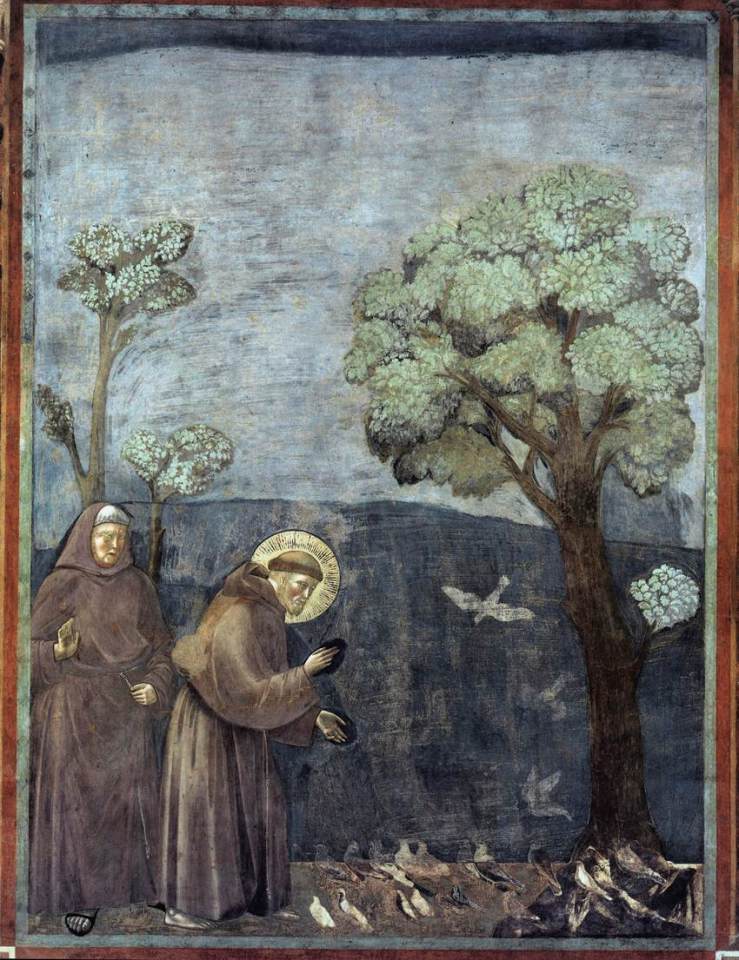
POEM: “Saint Francis and the Birds” by Seamus Heaney: Giovanni di Pietro di Bernardone (ca. 1181–1226), better known as Francis of Assisi, was an Italian mystic and friar who founded the religious order named after him, the Franciscans. Because of his love for all God’s creatures, he is considered the patron saint of animals, and his feast day is October 4. One story about him says he preached to the birds, as he believed the gospel is for them too, and that they, too, have a duty to praise God. This poem by the Nobel Prize–winning Seamus Heaney evokes Saint Francis’s sermon to his feathered friends.
“Sermon to the Birds,” from the Legends of Saint Francis cycle, attributed to Giotto, 1297–1300. Fresco, 270 × 200 cm. Upper Church, Basilica of St. Francis of Assisi, Assisi, Italy.
From the blog archives: For another poem about this legend, see “Saint Francis Endeth His Sermon” by Louise Imogen Guiney. For a brilliant literary essay by Kimberly Johnson on Francis’s “Canticle of the Creatures” (which evolved into the hymn “All Creatures of Our God and King”), see here.
+++
INTERVIEW: “The Artist’s Gift of Reckless Courage” with Betty Spackman: Comfort, confront, teach, heal—those are just a few of the actions the arts can perform, says Canadian installation artist Betty Spackman in this insightful interview for Radix Magazine (available in audio format wherever you get your podcasts, and in print). Spackman discusses misconceptions about artists and the arts, the expansive definition of “creativity,” the gifts artists offer the church, and the charge of elitism. She also gives advice to pastors and to artists.
Here are just two snippets:
“The artist can reveal the heart of God in unique ways, and that gives us a responsibility. We can be vessels of wonder and light, through sound and image and movement and story. . . . By their very nature, [artists] are more open to thinking outside the box, to going past the status quo, to dreaming and to imagining. . . . Scripture tells us a child will lead us and it is childlike faith that will lead us forward. Perhaps what we can learn from artists is to be more childlike.”
“When someone paints their pain, or sings it, or dances it, our response should not be to ignore or condemn it because it’s not pretty or is outside of our worldview. We should find out what it is, and then respond in a meaningful way to the person who made it. The arts are really a place of opportunity to both express and to listen to the grief of the world, and Christians need to be there to do both.”








 Art & Theology