Advent, Day 19

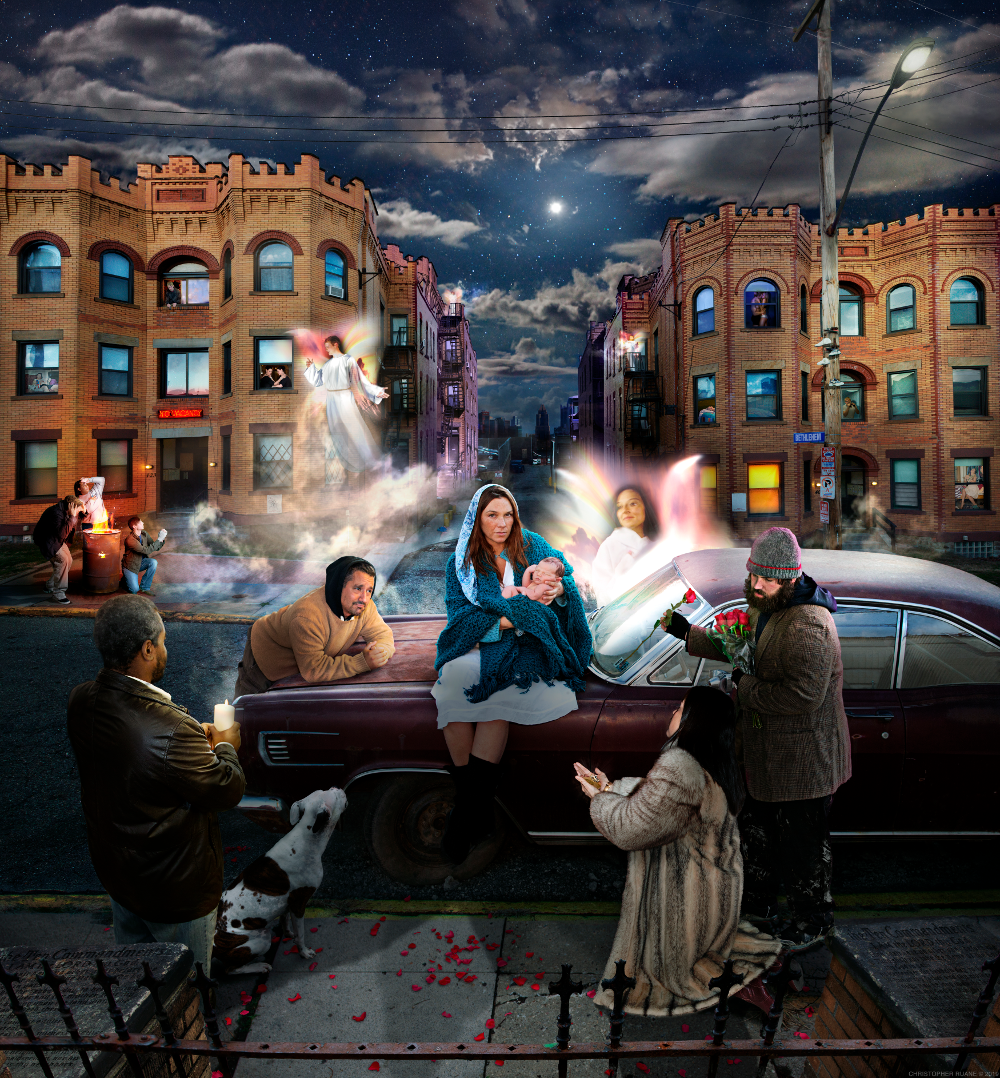
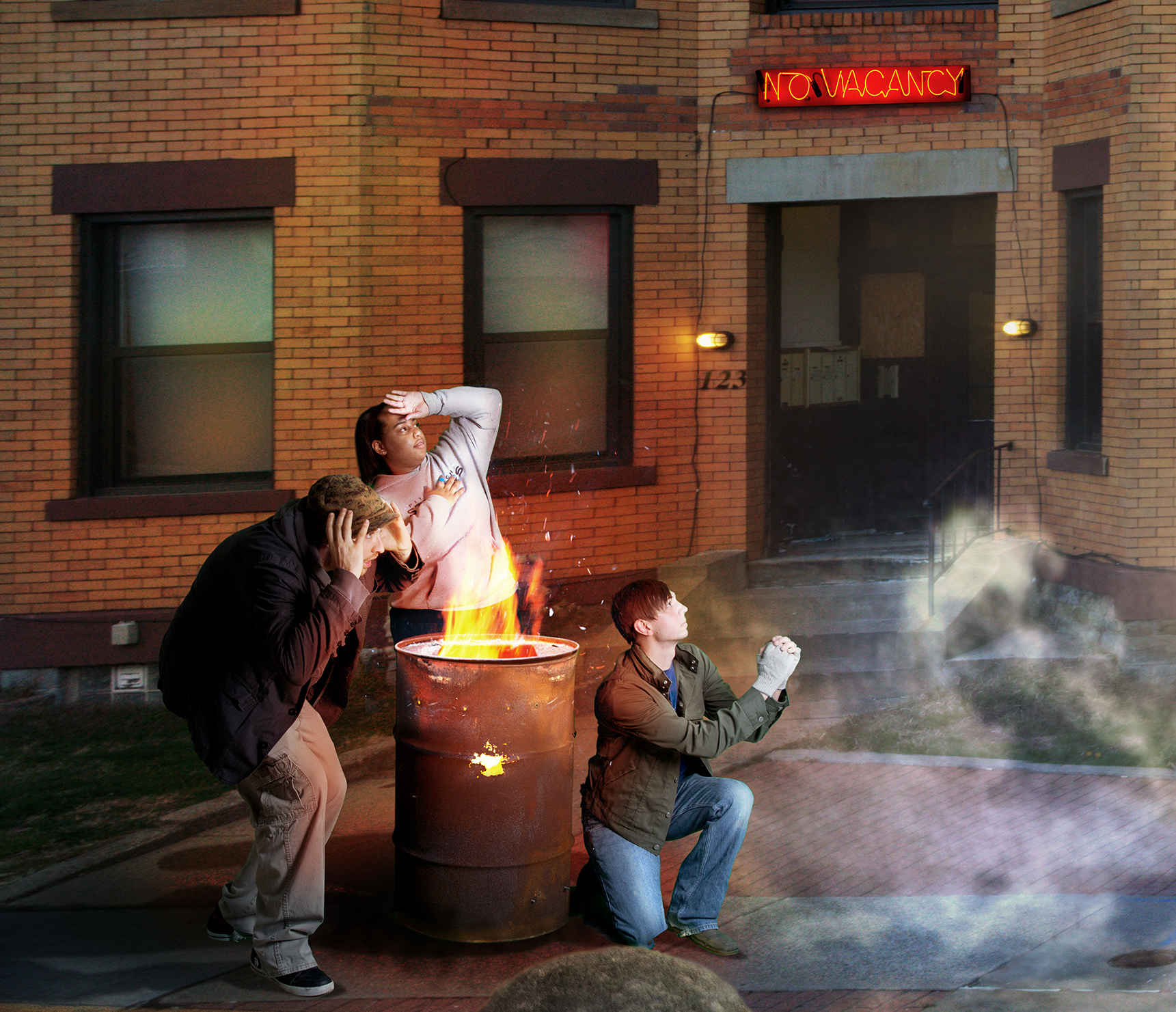
LOOK: Closed Society by Frank Kunert

Kunert, Frank_Closed Society
Frank Kunert (German, 1963–), Geschlossene Gesellschaft (Closed Society), 2011. C-print, 40 × 30 cm. Edition of 50 + 3 ap.

LISTEN: “The Ditchling Carol” (Roud 3216) | Words by William Robert Spencer, 1811 | Music by Peter Parsons, before 1901 | Performed by Waterson:Carthy on Broken Ground (1999; reissued 2013)

Be merry all, be merry all
With holly dress the festive hall
Prepare the song, the feast of all
To welcome Merry Christmas

And all remember, gentles gay
For you who bask in fortune’s ray
The year is all a holiday
The poor have only Christmas

When you with velvets mantled o’er
Defy December’s tempest’s roar
Oh spare one garment from your store
To clothe the poor at Christmas

And all remember, gentles gay
For you who bask in fortune’s ray
The year is all a holiday
The poor have only Christmas

When you the costly banquet deal
To guests who never famine feel
Oh spare one morsel from your meal
To feed the poor at Christmas

And all remember, gentles gay
For you who bask in fortune’s ray
The year is all a holiday
The poor have only Christmas

From blazing logs of fuel awhile
Your homes are within summer’s smile
Oh spare one log from off the pile
To warm the poor at Christmas

And all remember, gentles gay
For you who bask in fortune’s ray
The year is all a holiday
The poor have only Christmas

So shall each note of mirth appear
More sweet to heaven than praise or prayer
And angels in their carols there
Shall bless the poor at Christmas

And all remember, gentles gay
For you who bask in fortune’s ray
The year is all a holiday
The poor have only Christmas

This carol from Ditchling in East Sussex has a very Dickensian feel to it. More sobering than the usual Christmas fare, it contrasts the lavish holiday feasts of the well-off with the poverty that exists outside their doors. Think Lazarus and the rich man. The poor rely on the feelings of goodwill and generosity that Christmas engenders, but as this song acknowledges, the needs persist year-round. Those whom God has blessed with good fortune would do well to share it—not just with family and friends of like socioeconomic status but with neighbors of all classes, and not just during the “season of giving” but on a continuing basis.

Peter Parsons (1825–1901), a Ditchling shoemaker and leader of the village glee club, found the poem above on a broadside ballad sheet from the early nineteenth century and was moved to write a tune for it. I encountered the carol through a nineties recording by Norma Waterson, her husband Martin Carthy, and their daughter Eliza Carthy, who have been at the forefront of the English folk music scene for decades.

I would go even further than the lyrics do and say, don’t just give the poor a morsel or a log; invite them in! What might radical hospitality look like for you this Christmas? How might your merriment expand to embrace those who are typically excluded?

Advent, Day 18

“There will be signs in the sun, the moon, and the stars, and on the earth distress among nations confused by the roaring of the sea and the waves. People will faint from fear and foreboding of what is coming upon the world, for the powers of the heavens will be shaken. Then they will see ‘the Son of Man coming in a cloud’ with power and great glory. Now when these things begin to take place, stand up and raise your heads, because your redemption is drawing near.”

Then he told them a parable: “Look at the fig tree and all the trees; as soon as they sprout leaves you can see for yourselves and know that summer is already near. So also, when you see these things taking place, you know that the kingdom of God is near. Truly I tell you, this generation will not pass away until all things have taken place. Heaven and earth will pass away, but my words will not pass away.

“Be on guard so that your hearts are not weighed down with dissipation and drunkenness and the worries of this life, and that day does not catch you unexpectedly, like a trap. For it will come upon all who live on the face of the whole earth. Be alert at all times, praying that you may have the strength to escape all these things that will take place, and to stand before the Son of Man.”

—Luke 21:25–36

LOOK: Country Gospel Music by Robert Gwathmey

Gwathmey, Robert_Country Gospel Music
Robert Gwathmey (American, 1903–1988), Country Gospel Music, 1971. Oil on canvas, 40 × 50 in. Private collection.

LISTEN: “I Believe in Being Ready” | Appalachian spiritual, 19th century | Performed by Rising Appalachia on Leylines (2019) [see also this performance at the Yuba River in Northern California]

I believe in being ready
For the time is drawing near

Brothers, sisters, please get ready
For the time is drawing near

Oh there’ll be signs and wonders
For the time is drawing near

We’ll turn round and just start over
For the time is drawing near

I believe in being ready
For the time is drawing near

I believe in being ready
For the time is drawing near

For the time is drawing near

Folklorist Gerald Milnes gives some context to this religious folk song from the nineteenth-century frontier revival tradition in his book Play of a Fiddle: Traditional Music, Dance, and Folklore in West Virginia:

Whereas the Great Awakening may have brought about the first American break from established religious musical form, the Second Awakening and the rise of evangelical religious fervor, mostly in the Pennsylvania backcountry and southern mountains, left us with the spiritual folk songs, or folk hymns, that have a lingering legacy in West Virginia. This musical form developed during the period from the 1780s to the 1830s. The camp meeting was an old-world form brought by the Scots-Irish to America. The new spirituals that developed along with this form of worship on the frontier directly contributed to the religious fervor generated through the camp meeting.

“One might well remember, for example, that the camp meetings began and remained in nature surroundings, in the wilderness,” wrote [George Pullen] Jackson. Camp meetings in America (also called bush meetings, field meetings, and, today, brush-arbor revival or tent meetings) spawned a new emotion which materialized in song as the spiritual. At this point the chorus was introduced to the songs and became an identifying mark.

Choruses were repetitive, and verses were simplified for easy memorization by illiterate participants and where songbooks were nonexistent. Often only the introduction of a new person, as in mother, father, sister, and brother, differentiated one verse from another. Additional verses suggest more people such as sinner, preacher, playmates, etc. But it is the music—the old folk tunes clinging to all the sensitive and moving traits that attract many to folk music—that has caught the attention and held the fancy of West Virginians for as long as two centuries. These folk hymns are the predecessors to the “gospel hymns” that began about 1870 in the Protestant churches and continue to be sung today.

The song is more commonly called “When This World Comes to an End” and has been recorded under that title in this millennium by, for example, Tim O’Brien, Ashley Cleveland, and David Powell. We know of it thanks to Maggie Hammons Parker (1899–1987) from Pocahontas County, West Virginia, whose family participated in camp meetings in the early twentieth century. Parker sang the song as she remembers it for Alan Jabbour on a 1970 field recording, with the following lyrics. For more information, see the 1973 American Folklife Center publication The Hammons Family: A Study of a West Virginia Family’s Traditions.

I believe in being ready,
I believe in a-being ready,
I believe in being ready,
When this world comes to an end.

Oh, sinners, do get ready,
For the times is a-drewing near.

Oh, there’ll be signs and wonders,
Yes, there’ll be signs and wonders,
Oh, there’ll be signs and wonders,
When this world is to an end.

Oh, the sun, she will be darkened,
Yes, the sun, she will be darkened,
Oh, the sun she will be darkened,
When this world is to an end.

Oh, the moon, she will be a-bleeding,
Yes, the moon, she will be bleeding,
Oh, the moon, she will be bleeding,
When this world is to an end.

I believe in a-being ready,
I believe in being ready,
When this world is to an end.

Oh, the stars, they’ll all be a-falling,
Yes, the stars will all be falling,
Oh, the stars will all be falling,
When this world is to an end.

Oh, sisters, do get ready,
For the times is a-drewing near.

Oh, fathers, do get ready,
Yes, fathers, do get ready,
Oh, fathers, do get ready,
When this world is to an end.

Oh, mothers, do get ready,
Yes, mothers, do get ready,
Oh, mothers, do get ready,
For the times is a-drewing near.

For there’ll be them signs and wonders,
Yes, there’ll be them signs and wonders,
There will be them signs and wonders,
When this world comes to an end.

For their 2019 recording of the song, the band Rising Appalachia adapted the lyrics and retitled the song after its first line. “Drawn to its haunting, modal melody and stark lyrics,” they write, “we put the heavy drum pulse of the bodhran behind it to rattle the ribcage. It is both apocalyptic and soothing to call forth and sing these words.”

Rising Appalachia was founded in 2004 by sisters Leah and Chloe Smith, who grew up in Atlanta, absorbing the city’s emerging hip-hop scene as well as traveling with their family to fiddle camps across the Southeast on weekends. Their music is a blend of folk, world, and urban. “Rising Appalachia has come out of this idea that we can take these traditions of southern music—that we’ve been born and raised with—and we can rise out of them, creating all these different bridges between cultures and stories to make them feel alive,” Leah says. “Our music has its foundation in heritage and tradition, but we’re creating a music that also feels reflective of the times right now. That’s always been our work.”

The Smiths are joined on the album Leylines by longtime band members David Brown (upright bass, baritone guitar) and Biko Casini (world percussion, n’goni) and by two new members: West African musician Arouna Diarra (n’goni, talking drum) and Irish musician Duncan Wickel (fiddle, cello). Special guests on the album include singer-songwriters Ani DiFranco and Trevor Hall and jazz trumpeter Maurice Turner.

“I Believe in Being Ready” is one of many songs on the Art & Theology Advent playlist on Spotify. Also check out my Christmastide playlist.

Advent, Day 17

“Then the kingdom of heaven will be like this. Ten bridesmaids took their lamps and went to meet the bridegroom. Five of them were foolish, and five were wise. When the foolish took their lamps, they took no oil with them; but the wise took flasks of oil with their lamps. As the bridegroom was delayed, all of them became drowsy and slept. But at midnight there was a shout, ‘Look! Here is the bridegroom! Come out to meet him.’ Then all those bridesmaids got up and trimmed their lamps. The foolish said to the wise, ‘Give us some of your oil, for our lamps are going out.’ But the wise replied, ‘No! there will not be enough for you and for us; you had better go to the dealers and buy some for yourselves.’ And while they went to buy it, the bridegroom came, and those who were ready went with him into the wedding banquet; and the door was shut. Later the other bridesmaids came also, saying, ‘Lord, lord, open to us.’ But he replied, ‘Truly I tell you, I do not know you.’ Keep awake therefore, for you know neither the day nor the hour.”

—Matthew 25:1–13

LOOK: Byzantine fresco of the Parable of the Ten Virgins

Parable of the Ten Virgins
Parable of the Ten Virgins, ca. 1600. Fresco, Chapel of the Virgin, Monastery of Saint John the Theologian, Chora, Patmos, Greece.

LISTEN: “ها هوذا الختن” (“Behold the Bridegroom”), a troparion (short hymn) in Arabic from the Antiochian Orthodox Church in Syria

من الليل تبتكر روحي إليك يا الله لإنّ أوامرك نورٌ على الأرض.

ها هوذا الختن يأتي في نصف الليل فطوبى للعبد الذي يجده مستيقظا، أما الذي يجده متغافلا فهو غير مستحق. فانظري يا نفسي ألا تستغرقي في النوم ويغلق عليك خارج الملكوت وتسلمي إلى الموت، بل كوني منتبهة صارخة : قدوس قدوس قدوس أنت يا الله، من أجل والدة الإله ارحمنا.

English translation:

My spirit seeks you early in the night watches, for your commandments are a light on the earth. Alleluia, alleluia, alleluia.

Behold, the Bridegroom is coming in the middle of the night, and blessed is the servant he shall find awake and watching; but unworthy is the one he shall find neglectful. Beware, therefore, O my soul. Be not overcome by sleep, lest you be given over to death and shut out from the kingdom. But return to soberness and cry aloud, “Holy, holy, holy are you, our God.” Through the Theotokos, have mercy on us.

In Orthodox churches the parable of the ten virgins is read, and “Behold the Bridegroom” sung, on Tuesday of Holy Week. In the West, however, the parable is associated more with Advent, since its focus is on Christ’s return.

(Related post: “Clever Maids” by Thomas J. O’Gorman)

Advent, Day 16

And I saw the holy city, the new Jerusalem, coming down out of heaven from God, prepared as a bride adorned for her husband. And I heard a loud voice from the throne saying,

“See, the home of God is among mortals.
He will dwell with them;
they will be his peoples,
and God himself will be with them;
he will wipe every tear from their eyes.
Death will be no more;
mourning and crying and pain will be no more,
for the first things have passed away.”

And the one who was seated on the throne said, “See, I am making all things new.”

—Revelation 21:2–5a

LOOK: The New Jerusalem by Sassandra

Sassandra_The New Jerusalem
Jacques Richard Sassandra (French, 1932–), The New Jerusalem (Rev. 21:1–4a), 1970–80. Paper collage with AquaLac, 86 × 110 cm.

Jacques Richard, whose artist name is Sassandra, was born in 1932 to a French missionary family in Sassandra, Ivory Coast, where he spent his youth. Upon returning to France, he studied art, followed by theology, and soon became an art teacher in Paris public schools while also maintaining a studio art practice of drawing, painting, collaging, and woodblock printing.

This image is the last of thirty-four collages in his Apocalypse series, compiled in the beautifully produced book Apocalypse: A travers le dernier livre de la Bible | Bilder zum letzten Buch der Bibel (Pictures from the Last Book of the Bible) (1980), with text from Revelation in French and German. View selections from the book at http://galeriesassandra.fr/Apocalypse/index.html.

It shows the hands of God lovingly lowering the heavenly city to earth—the two realms reunited at last. The cross is at the center, forming the trunk of the tree of life, and the Holy Spirit spreads her wings over all.

[Related post: “Grief and Loss Will Be Undone (Artful Devotion)”]

LISTEN: “New World Coming” by Barry Mann and Cynthia Weil, 1969 | Performed by Nina Simone on Here Comes the Sun, 1971

There’s a new world comin’
And it’s just around the bend
There’s a new world comin’ (joy, joy, joy . . .)
This one’s comin’ to an end

There’s a new voice callin’
And you can hear it if you try
And it’s growing stronger
With every day that passes by (yeah, yeah, yeah . . .)

There’s a brand-new mornin’
Rising clear and sweet and free
There’s a new day dawning
That belongs to you and me

Yes, a new world’s comin’
You know the one I’m talking about
The one we’ve had visions of
And it’s comin’ in peace, comin’ in joy
Comin’ in peace, comin’ in joy
Come in peace, come in joy
Comin’ in love

And I saw another sign in heaven
Great and marvelous
Seven angels having the seven last plagues
For in them is filled up the wrath of God
And I saw, as it were, a sea of glass mingled with fire
And them that had gotten the victory over the beast
And over his image
And over his mark
And over the number of his name
Stand on the sea of glass
Having the harps of God all around them

There’s a new world comin’
And it’s just around the bend
There’s a new world comin’
This one’s comin’ to an end

There’s a new voice callin’
And you could hear it if you would just give it a try
And it’s growing stronger
With every day that passes by

And there’s a brand-new mornin’
Rising clear and sweet and free
There’s a new day dawning
That belongs to you and me

Yes, a new world’s comin’
The one we’ve had visions of

Comin’ in peace, yeah
Comin’ in joy, yeah
Comin’ in peace now, yeah
Comin’ in love now, yeah
Comin’ in peace now, yeah
Comin’ in joy now, yeah
Comin’ in peace now, yeah
Comin’ in love, yeah
Comin’ in peace . . .
Comin’ in joy . . .
Comin’ in love (joy)

This song, as you may have noticed, includes a recitation of Revelation 15:1–2:

Then I saw another portent in heaven, great and amazing: seven angels with seven plagues, which are the last, for with them the wrath of God is ended.

And I saw what appeared to be a sea of glass mixed with fire, and those who had conquered the beast and its image and the number of its name, standing beside the sea of glass with harps of God in their hands. (NRSV)

After a cosmic battle between good and evil, peace, love, and joy come to roost.

Advent, Day 15

Jesus began his public teaching ministry by reading the following passage from an Isaiah scroll at his local synagogue:

The Spirit of the Lord is upon me,
    because he has anointed me
        to bring good news to the poor.
He has sent me to proclaim release to the captives
    and recovery of sight to the blind,
        to let the oppressed go free,
to proclaim the year of the Lord’s favor. (Luke 4:18–19)

Some theologians call this the Nazareth Manifesto. It’s Jesus’s inauguration speech, if you will, where he lays out his platform, his values, his mission.

The freedom that Jesus came to bring is not just spiritual, although it is at least that. It is also physical. He came to liberate us body and soul—from sin and its many ugly manifestations, both personal and systemic, that prevent us and others from thriving. 

As we await Christ’s second advent, we can look forward to this promise: freedom is coming.

[Related post: “Jubilee (Artful Devotion)”]

LOOK: Freedom Quilt by Jessie B. Telfair

Telfair, Jessie B._Freedom Quilt
Jessie B. Telfair (American, 1913–1986), Freedom Quilt, Parrott, Georgia, United States, 1983. Cotton, with pencil, 74 × 68 in. American Folk Art Museum, New York.

Curator Stacy C. Hollander writes,

When Jessie Telfair invoked the power of a single word repeated over and over in this quilt, she knew the word would reverberate through the history of the United States, back to the “peculiar institution” of slavery and the freedom that she was still struggling to attain in the 1960s at the beginning of the Civil Rights movement. The making of the quilt was incited by an incident she suffered in those years, when registering to vote was enough to cost this African American woman her job in a school kitchen. The bitterness of that experience still burned years later, and fellow quiltmakers urged her to express the pain through her art. Worked in the colors of the American flag, the quilt cries freedom. In a subtle metaphor, Telfair has set each repeated letter in its own block; all are visually related, but no two are alike.

LISTEN: “Freedom Is Coming” from South Africa, third quarter of 20th century | Performed by Kate Marks and friends on Circle of Song: Chants and Songs for Ritual and Celebration, 1999

Freedom is coming
Freedom is coming
Freedom is coming
Oh yes, I know!

Jesus is coming
Jesus is coming
Jesus is coming
Oh yes, I know!

This South African freedom song originated during the apartheid era (1948–1994). It’s one of the many songs collected by Swedish musician Anders Nyberg when he traveled with his choir Fjedur to South Africa in 1978 at the invitation of the South African Lutheran Church. Upon his return, “Freedom Is Coming” and other South African freedom songs and hymns were published in Sweden and soon after in the United States in the collection Freedom Is Coming: Songs of Protest and Praise from South Africa (Utryck, 1984), which is still in print. Fjedur’s performance of “Freedom Is Coming” at the Budapest Assembly of the Lutheran World Federation in 1984 was instrumental in disseminating the song around the world, and afterward it started appearing in more hymnals.

Advent, Day 14

LOOK: Outside In by Ryan Kapp

Ryan Kapp (American, 1973–), Outside In, 2004. Oil on canvas, 18 × 24 in.

LISTEN: “Come into My Heart” by David Maloney, on A Christmas Album by Reilly & Maloney (1984; reissued 2012)

Snow is falling, now recalling
Winter’s icy face
North wind’s humming, Christ is coming
Into this worldly place

Will there be no room for him?
He who travels far
I will light my soul tonight
Come into my heart

All the children of the world
Know the Prince of Peace
In their hearts there is the hope
That every war shall cease

See the wisdom of the ages shining
In the young Child’s eyes
Behold the King and all he brings
The precious gift of life

Christmas bells and Santa’s elves
Fill the world with joy
Angel wings and shiny things
For every girl and boy

Around the Christmas tree we gather singing
Carols by the fire
Voices ringing, the Savior’s bringing
The gift of mercy mild

Snow is falling, now recalling
Winter’s icy face
North wind’s humming, Christ is coming
Into this worldly place

Will there be no room for him?
He who travels far
I will light my soul tonight
Come into my heart

For another Advent devotion featuring Reilly & Maloney, see here.

Advent, Day 13

LOOK: Mary by Gertrude H. Fiske

Fiske, Gertrude_Mary
Gertrude H. Fiske (American, 1878–1961), Mary, 1920. Oil on canvas, 39 1/2 × 30 in. (100.3 × 76.2 cm). Davis Museum, Wellesley College, Wellesley, Massachusetts.

In the exhibition catalog Divine Mirrors: The Virgin Mary in the Visual Arts (2001), Rebecca Mongeon writes,

Fiske did not intend to present this Mary as the Virgin Mary, but because they share a name, the viewer begins to notice similarities. Images of the young Virgin Mary present her as innocent and demure, with her head lowered humbly, eyes downcast, and hands drawn to her chest. In Fiske’s portrait, the girl’s innocence is suggested by her youth. Though she may be a teenager, the braids in her hair and the pinafore she wears tie her to childhood. This Mary also slightly bows her head and modestly holds her hands close to her body. In addition, the Virgin’s traditional colors, royal blue and blood red, appear in the long dress worn by Fiske’s Mary. The Virgin’s head is usually framed by a halo; in Fiske’s portrait, a framed picture placed directly behind her Mary’s head creates a haloing effect. (248)

LISTEN: “Ave Maria (The Song for Mary)” by Jason Gray, on Christmas Stories: Repeat the Sounding Joy (2012)

She picks the flowers in the morning
Tucks just a few in her hair
The joy of her mother and father
As she spins around unaware
She carries her song in the evening
And the dreams of all little girls
She carries the bread to the table
She carries the hope of the world

Ave Maria
Ave Maria

Angels can carry glad tidings
Or burdens to bear in the dark
Love can take both fear and wondering
And hold them inside the same heart
You carried hope and a promise
You carried shame and disgrace
Which was the heavier burden
That drew lines in a little girl’s face

Ave Maria, gratia plena
Maria, gratia plena
Maria, gratia plena
Ave, ave dominus
Dominus tecum
Benedicta tu in mulieribus
Et benedictus
Et benedictus fructus ventris
Ventris tui, Jesus

Held by the love you were holding
Is this what it means to be blessed
To carry your hope through the darkness
As it carries you into your rest

Ave Maria
Ave Maria

Singer-songwriter Jason Gray describes the vision behind the song:

When Nichole Nordeman, Cason Cooley, and I were conceptualizing this song, the idea was that musically it would be something like Michael Bublé meets Elvis and that lyrically it would zoom in on very personal details of what it might have been like in Mary’s world and then zoom out to the broad historical view, going back and forth between personal/intimate/rooted in the story that belonged to Mary alone, and then timeless/big picture/rooted in the story that belongs to all of humanity.

As a kid growing up Protestant, I sometimes felt like I didn’t quite know what to do with Mary—it seemed to my young mind that maybe she belonged more to my Catholic friends, so I felt tentative around the idea of her. But she has since become very dear to my heart and an inspiration to me—the progenitor of all who are called to bear Christ to the world.

My hope was to write a song that would contain both a very earthy picture of Mary intermingled with an otherworldly reverence of the mother of Christ. I love getting to sing it every year.

Hear Gray discuss the song further in this two-minute video, especially the double-sided nature of being “chosen”:

The refrain is, of course, a traditional Roman Catholic prayer in Latin, set to the famous tune by Franz Schubert (who actually wrote the tune for a Walter Scott poem!). Taken from the words of the angel Gabriel and, later, Elizabeth to Mary, it translates to “Hail Mary, full of grace, the Lord is with thee; blessed art thou among women, and blessed is the fruit of thy womb, Jesus.”

I love how Gray’s adaptation of the Ave Maria captures Mary’s youthful innocence and the sense of her being forever changed by God’s call on her life.

Advent, Day 12

In the days of King Herod of Judea, there was a priest named Zechariah, who belonged to the priestly order of Abijah. His wife was a descendant of Aaron, and her name was Elizabeth. Both of them were righteous before God, living blamelessly according to all the commandments and regulations of the Lord. But they had no children, because Elizabeth was barren, and both were getting on in years.

Once when he was serving as priest before God and his section was on duty, he was chosen by lot, according to the custom of the priesthood, to enter the sanctuary of the Lord and offer incense. Now at the time of the incense offering, the whole assembly of the people was praying outside. Then there appeared to him an angel of the Lord, standing at the right side of the altar of incense. When Zechariah saw him, he was terrified; and fear overwhelmed him. But the angel said to him, “Do not be afraid, Zechariah, for your prayer has been heard. Your wife Elizabeth will bear you a son, and you will name him John. You will have joy and gladness, and many will rejoice at his birth, for he will be great in the sight of the Lord. He must never drink wine or strong drink; even before his birth he will be filled with the Holy Spirit. He will turn many of the people of Israel to the Lord their God. With the spirit and power of Elijah he will go before him, to turn the hearts of parents to their children, and the disobedient to the wisdom of the righteous, to make ready a people prepared for the Lord.” Zechariah said to the angel, “How will I know that this is so? For I am an old man, and my wife is getting on in years.” The angel replied, “I am Gabriel. I stand in the presence of God, and I have been sent to speak to you and to bring you this good news. But now, because you did not believe my words, which will be fulfilled in their time, you will become mute, unable to speak, until the day these things occur.”

Meanwhile the people were waiting for Zechariah, and wondered at his delay in the sanctuary. When he did come out, he could not speak to them, and they realized that he had seen a vision in the sanctuary. He kept motioning to them and remained unable to speak. When his time of service was ended, he went to his home.

After those days his wife Elizabeth conceived, and for five months she remained in seclusion. She said, “This is what the Lord has done for me when he looked favorably on me and took away the disgrace I have endured among my people.”

—Luke 1:5–25

LOOK: Zacharias and Elizabeth by Stanley Spencer

Spencer, Stanley_Zacharias and Elizabeth
Stanley Spencer (British, 1891–1959), Zacharias and Elizabeth, 1913–14. Oil and graphite on canvas, 142.6 × 142.8 cm. Tate Britain, London.

The modern British artist Stanley Spencer is famous for his paintings depicting the New Testament narrative unfolding in his small village of Cookham on the River Thames. The English countryside was a balm for him after his return from World War I, as in it he sensed the Divine. “Quite suddenly I became aware that everything was full of special meaning, and this made everything holy,” he said. “The instinct of Moses to take his shoes off when he saw the burning bush was very similar to my feelings. I saw many burning bushes in Cookham. I observed the sacred quality in the most unexpected quarters.”

Like Spencer’s other biblical paintings, Zacharias and Elizabeth features people and places that were familiar to him. Tate Britain, the museum that owns the work, describes it like this:

In the foreground of the composition is Zacharias, an elderly male figure dressed in white who is holding a pair of tongs over a flame, while another aged male, also wearing white – the Archangel Gabriel – approaches him stealthily from behind. The figure of Zacharias is also repeated in the background of the painting: behind a wood and metal fence, staring blankly outward while the auburn-haired Elizabeth stands to his right with her arms outstretched. A large, smooth, curved wall divides the painting vertically, separating these two scenes. The figure of Elizabeth appears again behind the wall, with only her upper body visible. Two further figures are also depicted in the painting: a gardener who resembles traditional representations of both Jesus and John the Baptist is seen at the right dragging an ivy branch, a conventional symbol of everlasting life and Resurrection, and an unidentified woman wearing a dark claret dress kneels behind a gravestone while touching the curved dividing wall with her right hand.

Art critic and curator Sarah Milroy interprets this woman in the left midground as a surrogate for Spencer. She writes,

In childhood, Spencer believed that the Bible stories his father read aloud to the family at night could be glimpsed in Cookham, if only he could get a peek over top of the cottage walls. The little girl with her feverish, ember-red eyes, spying on the holy scene from her hiding place behind the curved white wall, serves as a stand-in for the artist himself.

For another meditation I wrote on a Spencer painting, see “Resurrection Now,” part of the Visual Commentary on Scripture project.

LISTEN: “Zechariah and the Least Expected Places” by Ben Thomas, on The Bewildering Light by So Elated (2008)

Jerusalem and the holy temple filled with smoke
Zechariah shuns the news from the angel of hope
Stuck behind an incense cloud of religion and disappointment

God keeps slipping out of underneath rocks
In alleys off the beaten path
Open both your eyes

Prophets and kings and poets can contribute their work
Just like eggs in a nest are alive with the promise of birds
But the Lord of creation will not be subjected to expectation

God keeps slipping out of underneath rocks
In alleys off the beaten path
Open both your eyes

Elizabeth, barren, her knees black and dirty like coal
Her consistent prayers float to the sky and revive her soul
God, we will wait though we don’t understand your redemptive story

God keeps slipping out of underneath rocks
In alleys off the beaten path
Open both our eyes

Advent, Day 11

LOOK: John the Baptist Receiving Instructions by David LaChapelle

LaChapelle, David_John the Baptist
David LaChapelle (American, 1963–), John the Baptist Receiving Instructions, 1985. Hand-painted negative.

A chronicler of pop culture, David LaChapelle is best known for photographing celebrities—Michael Jackson, Andy Warhol, Madonna, Elton John, Courtney Love, Kanye West, Lady Gaga, and so on. But he also maintains a fine-art photography practice, creating pieces that regularly reference religion and the metaphysical. His style is highly saturated and dramatic and combines elements of surrealism and pop art. He has exhibited at the Victoria and Albert Museum, the Tel Aviv Museum of Art, the Musée d’Orsay, and the National Portrait Gallery in Washington, DC.

In this photograph, John the Baptizer hears from God, his eyes rolled back as if in a trance. Perhaps he is receiving words for a sermon—he was a fiery preacher of repentance—or the call to rebuke the tetrarch Herod Antipas for divorcing his wife to marry his brother’s ex. He holds a palm branch, a symbol of martyrdom. For speaking truth to power, John literally lost his head.

(Related posts: “Behold!”; “Prepare the Way”)

LISTEN: “He’s a Keeper of the Fire” by Buffy Sainte-Marie, on Illuminations (1969)

He’s as heavy as a lead weight, baby
He’s as skinny as a wire
He’s a prophet of a new day, baby
He’s a keeper of the fire

He’s got a funny kinda voodoo, baby
You oughta see him at the zoo
He’s got a heavy kinda hoodoo, baby
And he can lay it on you

He can say it like an angel, baby
He can say it like a blowhorn
He can see a-seven devils, baby
And never even give a whole turn

Been haunted like a razor, baby
He’s been tested in the blood
He’s a walker on the hot coals, baby
And he’s a-heavenly bound

I saw him walkin’ in the valley, baby
I could see him through the trees
I saw him talkin’ to the moon there, baby
He was walkin’ on his knees

He can play it like a rainbow, baby
He can play it like a clown
He can play it like a river, baby
And he can follow you down

He’s as heavy as a lead weight, baby
And he’s as skinny as a wire
He’s a prophet of a new day, baby
He’s a keeper of the fire

Buffy Sainte-Marie is a Canadian American singer-songwriter, visual artist, and social activist. I’ve not found any indication that she wrote this song with John the Baptizer in mind, but boy does that reading seem to fit! The wild-eyed, desert-dwelling, locust-eating ascetic, burning with a heavenly ardor and treading flat the valleys to make way for his cousin Jesus. John prophesies a new day coming, one involving judgment. He carries the weight of this message. Unfazed by societal ridicule, he continues on in communion with God, inviting folks down to the river to be baptized—cleansed of their sin and awakened to new life, in preparation for the coming of Christ.

It’s worth noting that other songs on Sainte-Marie’s Illuminations center on biblical figures—namely, “Adam” and “Mary.” And the opening track is “God Is Alive, Magic Is Afoot” (brilliantly covered earlier this year by Chris Thile).

Annunciation roundup: “The Parliament of Heaven” mystery play, reversioning the story through poetry, and more

Those of you who follow this blog regularly know that the Annunciation is one of my favorite biblical stories. It’s beautiful and wild—and rife with artistic potential! The church celebrates Jesus’s conception in Mary’s womb yearly on March 25, but naturally, it also comes up in the songs, prayers, image cycles, dramas, and meditations of the Advent season. Here’s a roundup of Annunciation-themed art. (You can find more by searching the “Annunciation” tag in the blog archives.)

SONG: “Never Before” by Deanna Witkowski: Jazz pianist and composer Deanna Witkowski [previously] wrote this three-part women’s a cappella piece in 1998 for a Lessons and Carols service at All Angels’ Church in New York City. In the song Mary marvels at the uncanny prospect that she will feel God growing inside her womb, will breastfeed him, will mend his boo-boos—and mourns that she will one day watch him die. “Never Before” appears on Witkowski’s 2009 album From This Place, sung by her, Laila Biali, and Kate McGarry, and was also featured on NPR’s Weekend Edition Sunday (see “Deanna Witkowski: Liturgical Jazz”).

The angel said the Lord is with me:

The Lord is with me in a way he’s never been before;
his Spirit is my lover, his son shall fill my womb
with holiness and joy
and with life that I can feel kicking at my insides.

The Lord will stay with me in a way he’s never stayed before;
he will suckle at my breast and let me hold him in my arms.
He will run to me when he cuts his finger
or wonders aloud at his Father’s creation in a brightly colored butterfly.

Oh, who is this child, Lord, who comes from up above,
whose eyes will look beyond my own to a destiny I do not know?
Oh, who is this God-boy whose hands shall clasp mine
and whose tears I shall wipe away with trembling fingers of my own?

The Lord will leave me in a way he’s never left before;
as a king whose time has come, as a son his mother loved,
as a boy whose laughter has filled my heart,
and as a baby whose tears I have cried as if they were my own.

The angel said the Lord is with me.

+++

ESSAY: “Saying Yes to the Annunciation” by Peggy Rosenthal: Peggy Rosenthal, author of The Poets’ Jesus: Representations at the End of a Millennium, is an excellent guide through poetry. Here she meditates on lines from five poems on the Annunciation: by Hildegard of Bingen, John Donne, Rupert Brooke, Kathleen Wakefield, and Katharine Coles.

+++

CONVERSATION: “Aliens, angels & annunciations”: In this article, poets Sarah Cave and Rupert Loydell dialogue about their 2020 book A Confusion of Marys, a collection of poems they’ve written inspired by the Annunciation. It’s a series of (sometimes irreverent or humorous) variations on a theme, and not what you’d call devotional poetry. Loydell quotes Gabriel Josipovici, who said stories die unless they are changed, reinvented, argued over, and made new, and that’s what this book does. I definitely gravitated more to some poems than to others.

A Confusion of Mary book cover

“I’m interested in the idea of regenerative theology,” Cave says. “I was a cradle Anglican and within that tradition Mary is more of a backseat figure – usually appearing in knitted form at crib services – no intercessions, etc. I wanted to bring her to the forefront and to understand how, in her all-pervasive way, she has shaped my life and the expectations people place on my life – gender, sexuality, politics, mysticism – and the lives of the women around me, and of course, how those expectations must have affected Mary’s own life.”

As for Loydell, he says he’s interested not in theological certainty but in “doubt and myth, symbolism and tangential ideas”—the Marian annunciation scene as palimpsest. He comes at it from a less personal angle.

+++

MYSTERY PLAY + ART PRESENTATION: “Hope Ubiqui: The Gift of the Annunciation”: This online event hosted by Holy Family (Catholic) Church in South Pasadena, California, on March 16, 2021, combines art reflections by Dr. Leah Marie Buturain Schneider (who’s incredibly warm, wise, and engaging) with a performance of the medieval mystery play The Parliament of Heaven, Salutation, and Conception (from the N-town cycle), translated from the Middle English by Colleen E. Donnelly and directed here by Grete Gryzwana.

The video starts with artist Patty Wickman [previously] outlining the five emotional states Mary cycled through in response to the angel Gabriel, as famously identified by art historian Michael Baxandall. Schneider then discusses a handful of historical artworks depicting the Annunciation, including ones by Fra Angelico and Andrea della Robbia. The thirty-minute play follows, which enacts not only the Annunciation but also an imagined precursor: a heavenly debate among four of God’s virtues—Truth, Mercy, Peace, and Righteousness [previously; see also this Instagram post]—about how to answer humanity’s cries for salvation. (Keep in mind that this was Zoom-mediated, with each actor calling in from a different location, and some with spotty internet connections, so there are some technical glitches, but it’s still a stirring and enjoyable performance!) Schneider continues by highlighting additional artworks of significance, focusing on Dieric Bouts’s Getty Annunciation, particularly the detail of Mary’s hands. She reads from the mystics Meister Eckhart and Julian of Norwich on responding to Love’s call; they ask, What does it matter if Mary gives birth to Jesus if we ourselves do not give birth to him in our souls, in our lives?

2:51–7:41: Introduction by Patty Wickman
9:44–18:16: Leah Marie Buturain Schneider
18:37–50:10: Mystery play
52:01–1:08:27: Leah Marie Buturain Schneider
1:08:52–1:31:00: Q&A

The remaining video is just informal chatting among a few church members who linger behind on the call.

+++

CHILDREN’S VIDEO: “The Gospel According to Hamlet” by SALT Project: A whimsical retelling of the Annunciation story, narrated by kids—and by a small ceramic pig figurine! The characters are played by a reproduction of Antonello da Messina’s Virgin Annunciate, a Barbie with tinsel wings, and a matryoshka doll.