Roundup: Grief work, kintsugi, “The O in Hope,” and more

INTERACTIVE PERFORMANCE ART: DIG: A Hole to Put Your Grief In by Cara Levine: Last month artist Cara Levine led a weeklong collaborative project in which she invited those in and around Malibu to join her in digging a hole to visualize the depth of grief being experienced right now in response to personal losses as well as national and global crises. Carried out on a property owned by the Shalom Institute, the project was inspired in part by the Jewish ritual of shiva, the seven-day mourning period following the burial of a family member, during which the bereaved discuss their loss and accept comfort from the community.

“Whatever one is grieving is welcome—be it the loss of a loved one, or more nuanced and subtle grief—the grief that comes with aging, with watching children grow, loss of friendships, habitat, completions to other life cycles, opportunities, loves, that one won’t see flourish, and so on,” Levine wrote in an email to Hyperallergic.

Levine, Cara_Dig a Hole to Put Your Grief In
Cara Levine, DIG: A Hole to Put Your Grief In, August 14–21, 2021, Shalom Institute, Malibu, California. Photo: Nir Yaniv.

“Part of the act of inviting others to share in the digging, is an invitation for the collective to lift the burden of the individual. I think digging together, expressing the depth and weight of the grief all around us, can be a shared burden.”

At week’s end the hole was filled with water and transformed into a mikvah (ritual bath) for a ceremonial hand washing, before being refilled with the original dirt. As arts writer Matt Stromberg reported, participants were invited to write down what they were grieving on sheets of paper embedded with flower seeds, which were then buried in small pots that could be taken home, while native seeds were scattered in the hole, a symbol of renewal. Though I, living on the opposite coast, didn’t participate, it sounds like it was a meaningful time of healing and of giving and receiving support.

+++

VIDEO: “Mending Trauma” by Makoto Fujimura: In this video from the 2019 Theology of Making series from Fuller Studio, artist and author Makoto Fujimura describes the Japanese art of kintsugi (literally “golden seams”) and how it reflects the beauty that can emerge from our own fractured hearts and lives.

“Kintsugi theology,” he says, is the theology of the new creation, and it’s embodied by Jesus himself. His resurrection body retains the wounds of crucifixion, but there is light flowing through them, suggesting how our traumas will be carried into the new creation but wholly transformed. Like broken bowls mended with gold.

Check out the three other videos in the series:

+++

SONG: This video, taken in June 2015 by someone from the Free Burma Rangers humanitarian service movement, shows an Assyrian Christian woman in Kurdistan lingering behind after church let out, singing a praise song to Jesus alone in a pew. She had recently returned home after having fled an ISIS attack. [HT: Global Christian Worship]

+++

NEW BOOKS:

>> The O in Hope by Luci Shaw, illustrated by Ned Bustard: “Combining a joyful poem from the much-celebrated poet Luci Shaw with playful cut-paper art created by Ned Bustard, The O in Hope helps us experience the goodness of God’s gifts of hope and love.” I found out about this recent release from IVP Kids at a Zoom event, where Shaw [previously] read the poem—it’s so delightful!

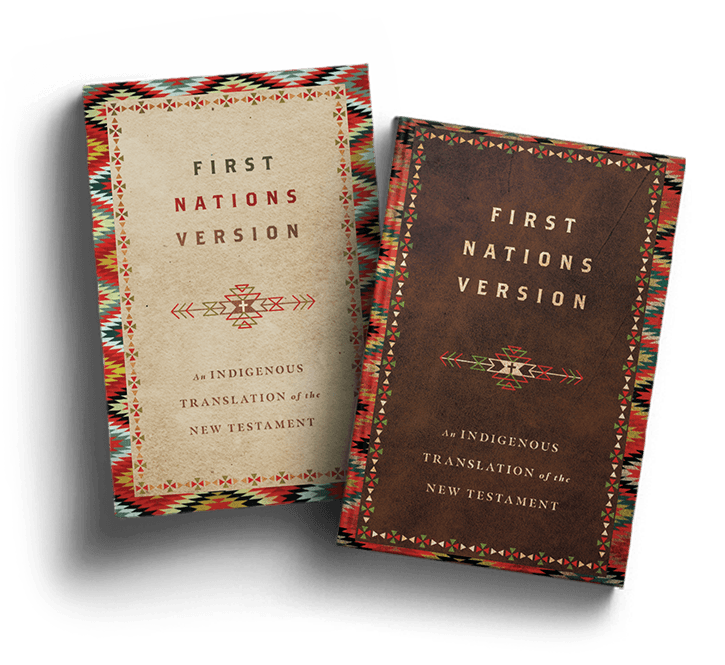
>> First Nations Version: An Indigenous Translation of the New Testament: “Many First Nations tribes communicate with the cultural and linguistic thought patterns found in their original tongues. The First Nations Version (FNV) recounts the Creator’s Story—the Christian Scriptures—following the tradition of Native storytellers’ oral cultures. This way of speaking, with its simple yet profound beauty and rich cultural idioms, still resonates in the hearts of First Nations people.

“The FNV is a dynamic equivalence translation that captures the simplicity, clarity, and beauty of Native storytellers in English, while remaining faithful to the original language of the New Testament.” The project was carried out by an eleven-member council selected from a cross-section of Native North Americans (elders, pastors, young adults, and men and women from different tribes and geographic locations) and overseen by Ojibwe storyteller Terry M. Wildman. Here is Wildman reciting the FNV translation of the Lord’s Prayer from the Gospels, accompanied by his wife, Darlene, on cedar flute:
Roundup: “De-Colonizing Christ” art exhibit, “God in the Modern Wing” book launch, and more

ART EXHIBITION: De-Colonizing Christ, Riverfront Gallery, St. Stephen’s Episcopal Cathedral, September 12–December 19, 2021 (preview: September 11): St. Stephen’s Episcopal Cathedral in Harrisburg, Pennsylvania, is hosting a juried art exhibition that highlights non-Caucasian representations of Jesus. There are twenty-eight original artworks in the show, plus a dozen on loan from private collections. An opening reception (with hors d’oeuvres) will take place Saturday, September 11, from 7 to 9 p.m., which I’ll be attending! It is open to the public, and masks are required in the sanctuary and cloister gallery.

De-Colonizing Christ exhibition poster
The poster image is Pantocrator in Black and Brown by Brian Behm from Chapel Hill, North Carolina, which has been awarded Best in Show.

“Recent events have opened conversations among churches, theologians, and biblical scholars, considering in what way the western portrayal of Jesus as a European has been used to marginalize people of color,” the press release reads. “Many suggest that the pursuit of racial justice demands the exploration of ways in which we can de-colonize the Christ—releasing the image of Jesus from a legacy of White Supremacy and exploring images of Jesus as a man of color. This exhibit invites the Central Pennsylvania community into the conversation.” Read more about the impetus behind the exhibition in this opinion piece by the dean of the cathedral, the Very Rev. Dr. Amy Welin.

In addition to the preview night, where many of the artists will be present, there are three related lectures scheduled:

  • September 12, 2 p.m.: “The Arts, Justice, and Faith: The Role of a Holy Imagination” by artist Steve Prince
  • October 17, 2 p.m.: “White Jesus: Mangling Christianity and the Birth of White Supremacy in the West” by Dr. Drew G.I. Hart, Assistant Professor of Theology, Messiah University
  • November 28, 2 p.m.: Discussion about the tensions inherent in inclusive worship in predominantly white congregations, led by the Rev. Dr. Catherine Williams, Assistant Professor of Preaching and Worship, Lancaster Theological Seminary

+++

BOOK LAUNCH EVENTS: God in the Modern Wing: Viewing Art with Eyes of Faith, September 17–18, 2021: In anticipation of this book’s release on October 12, Upper House in Madison, Wisconsin, is hosting a string of free events two weekends from now. The two lectures can be attended in person or virtually, but the workshop is in-person only. Coeditors Cameron J. Anderson (an artist) [previously] and G. Walter Hansen (a theologian and art collector) will be present.

God in the Modern Wing grew out of a series of lectures that Hansen organized in 2015, one of which I wrote about. The book description is as follows: “Should Christians even bother with the modern wing at the art museum? After all, modern art and artists are often caricatured as rabidly opposed to God, the church—indeed, to faith of any kind. But is that all there is to the story? In this Studies in Theology and the Arts volume, coeditors Cameron J. Anderson and G. Walter Hansen gather the reflections of artists, art historians, and theologians who collectively offer a more complicated narrative of the history of modern art and its place in the Christian life. Here, readers will find insights on the work and faith of artists including Marc Chagall, Jackson Pollock, Mark Rothko, Andy Warhol, and more.”

+++

(IN-PERSON) ARTS FESTIVAL: Faith in Arts Institute, October 13–16, 2021, Asheville, North Carolina: “The inaugural Faith in Arts Institute hosted by UNC Asheville and the Black Mountain College Museum + Arts Center, intended for anyone interested in the role of art in religious and spiritual experience, will be led and facilitated by artists and  scholars. The number of participants for the institute itself will be limited to create the possibility for rich and meaningful dialogue and engagement among the participants and faculty.

“In addition to talks on religion and art in the 21st century, sacred art in secular spaces / secular art in sacred spaces, and small group discussions on topics including devotion and discipline, revelation and inspiration, faith and hope, ritual and routine, vision and imagination, the institute will also include several workshops, film screenings and more.” Registration is $60. View a schedule and find out more information here.

Faith in Arts Institute

The presenters are:

  • Julie Levin Caro, Professor of Art History, Warren Wilson College (specializes in modern American art and African American art)
  • Curt Cloninger, artist, designer, writer
  • Marie T. Cochran, Founder and Director, Affrilachian Artist Project
  • David Hinton, essayist and translator of Chinese poetry
  • Rachel Elizabeth Harding, Associate Professor of Indigenous Spiritual Traditions, University of Colorado–Denver (specializes in religions of the Afro-Atlantic diaspora)
  • Jessica Jacobs, author of the coming-of-age memoir-in-poems Take Me with You, Wherever You’re Going
  • Kay Larson, author of Where the Heart Beats: John Cage, Zen Buddhism, and the Inner Life of Artists
  • Thomas Moore, pianist
  • Alicia Jo Rabins, writer, musician, composer, performer, Torah teacher (check out her Girls in Trouble, an indie-folk song cycle about the complicated lives of biblical women!)
  • Christopher-Rasheem McMillan, Assistant Professor of Dance and of Gender, Women’s, and Sexuality Studies, University of Iowa
  • Aaron Rosen, Professor of Religion and Visual Culture, Wesley Theological Seminary
  • Pamela D. Winfield, Professor of Religious Studies, Elon University (specializes in the visual/material culture of Japanese Buddhism)

+++

SONG FOR SUKKOT: “Whoever Is Thirsty” by Marty Goetz: Every fall Jews celebrate Sukkot, aka the Feast of Tabernacles or Festival of Booths, a seven-day commemoration of God’s provision for their people during their desert sojourn after the exodus. This year the holiday falls on September 20–27. Four Sukkots ago, singer-songwriter Marty Goetz, a Jewish believer in Jesus, posted this video of a song he composed, “Whoever Is Thirsty,” from his 2010 album Sanctuary. It is an original setting of Revelation 22:17 (a book that “herald[s] the return of Yeshua the Messiah,” he says), and he performs it here with his daughter Misha Goetz.

The Spirit and the bride say, “Come.”
And let everyone who hears say, “Come.”
And let everyone who is thirsty come.
Let anyone who wishes take the water of life as a gift.

—Revelation 22:17

+++

NEW PLAYLIST: September 2021 (Art & Theology): I’m continuing to put together a short monthly Spotify playlist as a way to share great music mainly from the Judeo-Christian tradition. Per usual, it consists mostly of folk and gospel, which are my personal preferences. I realized after the fact that this month’s selection has quite a bit of banjo! (I do love that instrument . . .): a setting by bluegrass quintet Crooked Still of Wendell Berry’s poem “The Peace of Wild Things”; Béla Fleck jamming with Ugandan kalimba player Ruth Akello on “Jesus Is the Only Answer” [previously]; Rhiannon Giddens playing and singing the spiritual “I’m Gonna Tell God All of My Troubles”; Ellen Petersen and her siblings covering the Mark Bishop song “With the Spirit of the Lord Inside”; “Esa Einai,” a setting of Psalm 121:1–2 in English and Hebrew by Jewish bluegrass duo Nefesh Mountain; and an original song by the Westbound Rangers [previously], led by one of my high school friends, Graham Sherrill.

The closing song is “Kia Hora Te Marino,” a collection of Maori blessings and proverbs set to music by Christopher Tin. The first stanza goes,

Kia hora te marino,
Kia whakapapa pounamu te moana,
Kia tere te rohirohi.
Kia hora te marino,
Te marino ara
Mo ake tonu ake.

English translation:
May peace be widespread,
may the sea glisten like greenstone,
and may the shimmer of light guide you.
May peace be widespread,
be widespread
now and forever more.

Music documentary: Throw Down Your Heart

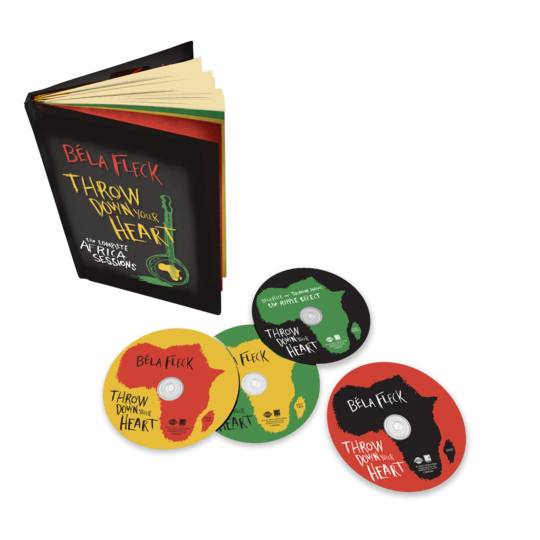
Directed by Sascha Paladino, Throw Down Your Heart (2008) follows world-renowned banjo player Béla Fleck on his journey through Africa to connect with the banjo’s origins through jam sessions and conversations with local musicians. It’s full of intercultural exchanges that result in creative stylistic fusions that are amazingly seamless. It’s thrilling to hear the banjo so at home outside the US! Here’s the trailer:

Most people associate the banjo with white people from the American South, but it actually evolved from the akonting, a hide-covered gourd instrument from Gambia with three strings attached to a pole, brought to America by enslaved Africans. Among the many musical artists Fleck meets is the Jatta Family, a Gambian troupe dedicated to preserving akonting music in Africa.

The title of the documentary, Throw Down Your Heart, is a translation of the Swahili word Bagamoyo, the name of a trading port along the East African coast. According to John Kitime, Fleck’s guide and translator, during the eighteenth and nineteenth centuries, Tanzanians were captured inland and brought to the eastern shores for “export” to the Middle East as slaves. They knew that once they saw the Indian Ocean, they would never come home again, so they would “throw down [their] heart” in despair. Fleck wrote a banjo composition inspired by this painful history, which is performed on the Special Features of the DVD.

Besides Gambia and Tanzania, Fleck also visits Uganda and Mali, and the documentary highlights a variety of musical traditions and instruments from those countries—harps and panpipes and giant xylophones and guitars. I especially love the performance of “Jesus Is the Only Answer” by Ruth Akello from Jinja, Uganda, who plays the kalimba (thumb piano), an instrument consisting of metal tines of varying length attached to a wooden board. She also sings. She’s accompanied by the Ateso Jazz Band and by Fleck.

All the performances are wonderful, but another standout for me is by Grammy Award–winning Wassoulou singer Oumou Sangaré, a national icon in Mali. She sings “Djorolen,” a lament for the fatherless. An English translation of the Bambara lyrics is below.

The worried songbird cries out in the forest
Her thoughts go far away
For those of us without fathers
Her thoughts go out to them

Abandoned by her father when she was two, Sangaré dropped out of school as a child to help her mother raise the family by singing in the streets. She rose to stardom in her early twenties with the release of her first album, Moussolou (1990). She now tours internationally and is an advocate for women’s rights, opposing child marriage and polygamy.

(Related post: “Music making at Keur Moussa Abbey, Senegal”)

Though marketed as a film about the banjo, Throw Down Your Heart is more broadly a celebration of the diverse musics of the African continent. Through collaborations with virtuoso musicians, Fleck explores how a modern banjo can fit into that soundscape.

The documentary appears not to be available for online streaming, but I rented a copy of the DVD at my local library. There’s also a reasonably priced box set that was released last year, which includes not only the DVD but also a deluxe edition—forty-two tracks!—of the critically acclaimed companion album, featuring a complete disc of previously unreleased material from Fleck performing with kora master Toumani Diabaté.

Album recommendation: Mercy by Natalie Bergman

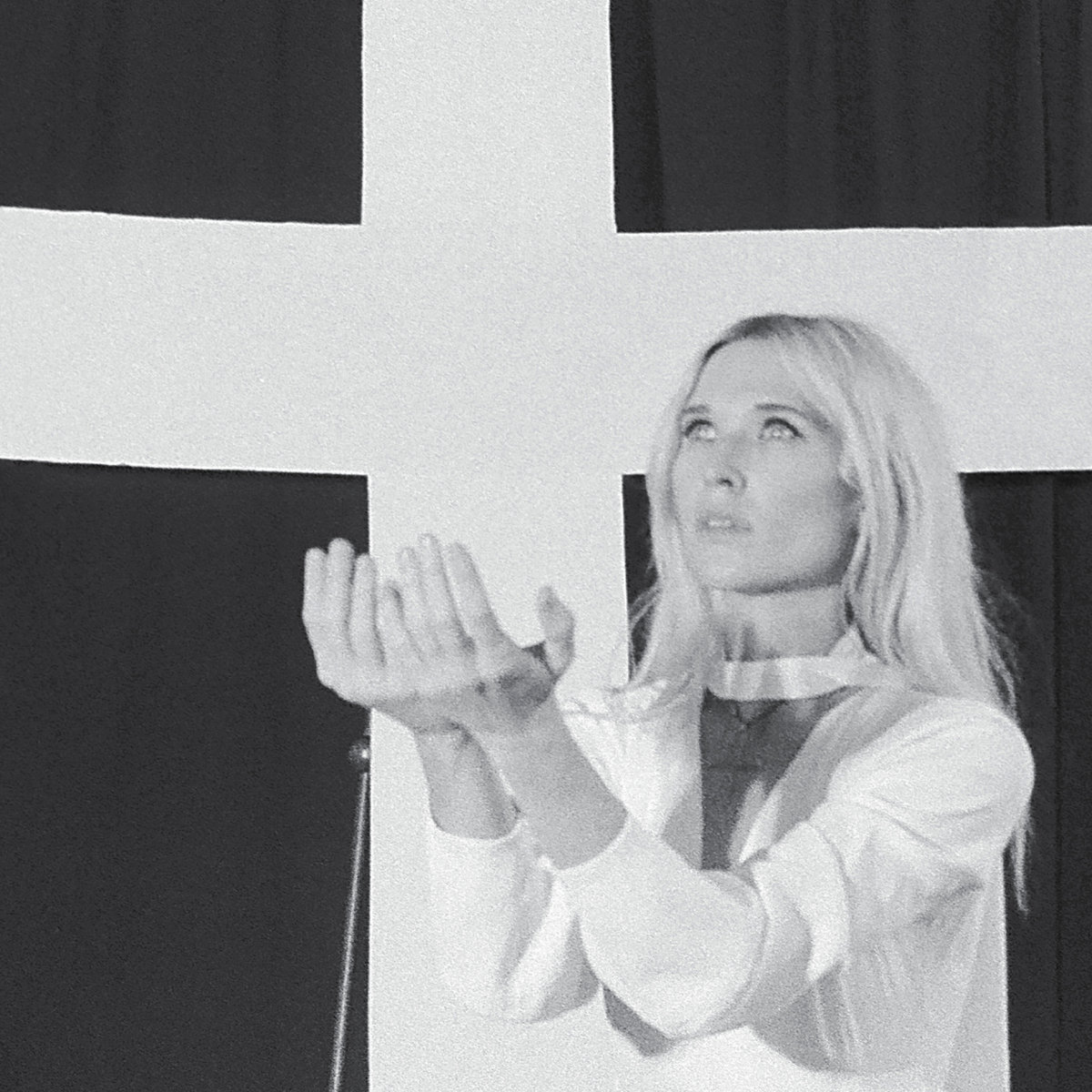
Much has been written about Natalie Bergman’s debut solo album, Mercy, which she self-produced and released May 7 through Third Man Records. Described as “a psychedelic spin on vintage gospel-soul” (Brooklyn Vegan), it comprises twelve original songs that combine praises and intercessions to God with expressions of grief over the recent, sudden death of her dad in a car accident. It’s excellent, and I wish I had time to write about it in more depth. Instead, let me just share four of the music videos Bergman created to coincide with the album, and commend to you the interviews she did with Aquarium Drunkard and Hero magazine, both in which she discusses her Christian faith, her visual and musical influences, and the impetus behind the album.

Natalie Bergman, Mercy

Chicago-bred and Los Angeles–based, Bergman formed a band with her brother Elliot after high school, the psych-pop duo Wild Belle; they eventually signed to Columbia Records, and have toured internationally.

In October 2019, when Wild Belle was getting ready to go onstage at Radio City Music Hall, the siblings learned that their father and stepmother had been killed by a drunk driver. To process her grief, Bergman retreated to the Benedictine Monastery of Christ in the Desert in New Mexico’s Chama Valley in February 2020, where she spent time in silence and going to chapel, where the resident monks prayed the Divine Office seven times a day, starting at 4 a.m. The seeds for the album were planted there, as she talked to God and listened.

As evidenced by comments on social media, some people are incredulous that a singer of this status and level of artistry would choose to sing about Jesus in a nonironic way, from a place of genuine faith. Could contemporary Christian music really be this beautiful? Could a sung spirituality that straightforwardly proclaims things like “Jesus is our friend” and “Oh, I need you, Lord” really have a broad appeal, one that extends beyond churchgoers, as Bergman’s music does?

Unwilling to take her new music at face value, some have even suggested that Bergman’s videos are making fun of Christianity, or that she’s using the name “Jesus” as some kind of metaphor. Bunk!

In addition to referring to Mercy as a gospel album, Bergman speaks openly, in secular media, about her love of “traditional praise music” and her desire to share “the good news” and her “testimony”—of hope in the midst of sorrow, of the companionship of Christ, of a Love that calls us home.

  • “I have my own poems that I want to sing about God and about my father . . . my own Psalms.” [source]
  • “I’m a Christian fighting the good fight, and I want that to be the message. I want the message to be love and the goodness of the creator and why we were created.” [source]
  • “I think that God has given me this platform to praise his name in a loving way. I would love this music to work through people and become a sort of healing agent for others.” [source]
  • “I need my art and I need my faith. . . . Faith has become my greatest consolation, and it’s really allowed me to see the light. I think that the relationship between music and faith go hand in hand—one needs the other.” [source]

Because Mercy completely defies the expectations set by the contemporary Christian music industry, on the one hand, and alternative music on the other, it has confounded some listeners. Music podcaster John J. Thompson—rightfully, I think—sees the album as in line with the countercultural Christian music (sometimes referred to as “Jesus Music”) of the 1970s, an association Bergman embraces.

(Related post: “Of pain and praise: Cherry Blossoms by Andy Squyres”)

I see Mercy as a gorgeous (and groovy!) example of moving through grief with hope, clinging unabashedly to God’s promises and inviting others to do the same. Whereas doubt and cynicism seem to be the order of the day in US culture, Bergman demonstrates a trust in the Divine that is childlike but not childish, simple but not simplistic. She confronts the pain of loss while also consenting to the uplift that God brings. She sings praises in the valley, plays in puddles.

Not only do I love Bergman’s sound; I dig her style too! You’ll see what I mean in the music videos below.

Purchase Mercy on Bandcamp, or wherever else you get your music.

“Talk to the Lord”

This is my favorite song on the album, and the video is so enchanting! Bergman designed and made by hand her wardrobe as well as the set pieces. The blocks were inspired partly by Sister Corita Kent, a sixties pop artist and nun, and the banners were prompted by Bergman’s memory of the liturgical banners her mother made for their church growing up.

Bergman also made the kite in the video, which she yokes to her back—a reference, I’m assuming, to Matthew 11:28–30, where Jesus says, “Come to me, all you that are weary and are carrying heavy burdens, and I will give you rest. Take my yoke upon you, and learn from me; for I am gentle and humble in heart, and you will find rest for your souls. For my yoke is easy, and my burden is light.”

In other video segments Bergman dances in the grass wearing a black leotard and a black cardboard cutout around her face with white stripes projecting outward like flower petals or rays of light. This recalls lines from the song: “He who makes the flowers face the sun / And all the creatures sing / He can make the heavens rain . . .” Her mourning is turned to dancing as she lets in the Light.

You can also watch Bergman perform “Talk to the Lord” with the Chicago Children’s Choir as part of GRAMMY.com’s Positive Vibes Only video series. What joy!

“Shine Your Light on Me”

This music video was filmed in 4:3 on television cameras from the 1960s, with an aesthetic inspired by a 1967 performance by Diana Ross and the Supremes. Bergman performs in a beehive hairdo and a vintage mirror dress that reflects the light (“light is the inherent message behind this music,” she says), on a set designed by Hanrui Wang.

The song includes contributions from Elsa Harris and the Larry Landfair Singers, whom Bergman previously sang with at her father’s funeral.

“I Will Praise You”

This one has a reggae rhythm.

“Home at Last”

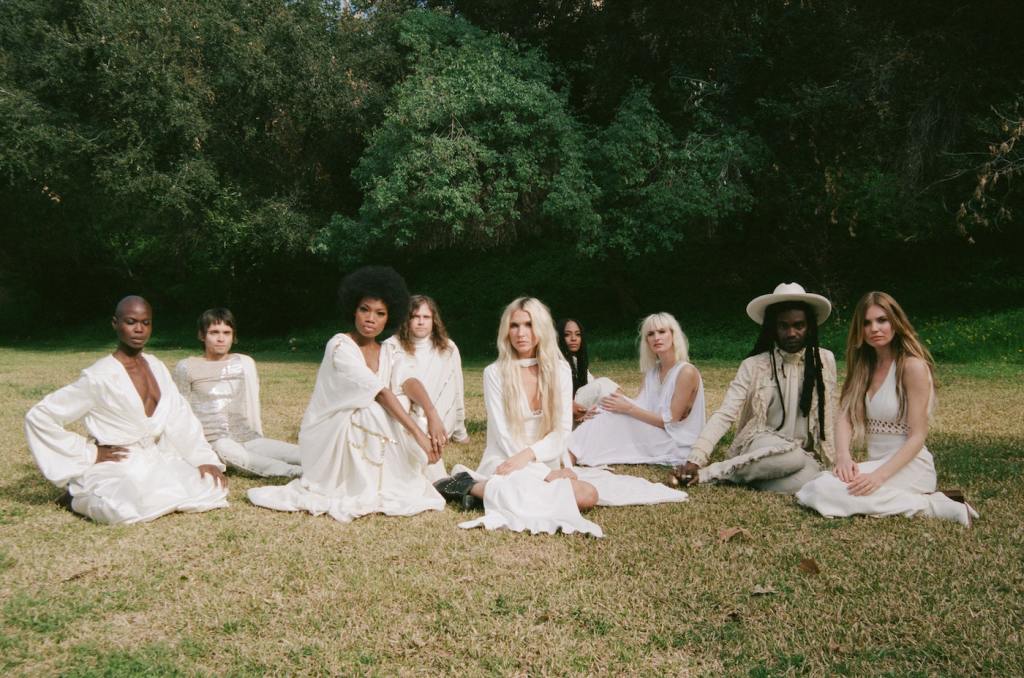
“Home at Last” was filmed in and around the historic Lincoln Avenue Methodist Church in the Montecito Heights neighborhood of Los Angeles, a Carpenter Gothic and Queen Anne–style building from the turn of the century that is now part of the Heritage Square Museum. Footage of the band inside the sanctuary is intercut with shots of them relaxing in a green space, eating fruit and enjoying one another’s company—a vision of paradise. They’re all dressed in white, per Revelation 7.

Roundup: Call for creation care songs; an ode to red hair; and more

SONGWRITING CONTEST: 2021 Creation Care and Climate Justice Songwriting Contest, sponsored by The Porter’s Gate: “We are working on new worship resources celebrating God’s creation and His call to care for the created world. Over the next year we’ll be writing new songs on this subject and recording them. As part of this project, we are looking for submissions from anyone who would like to write a song or has already written a song on this subject. If you are a songwriter or composer, or if you know a songwriter who would be interested, click on this link for all the details of the contest. Songwriters are invited to submit worship songs related to caring for God’s creation, and we are offering a $500 cash prize to the winner. We’ll also record the winning piece.” No entry fee. Deadline August 30, 2021.

+++

CINEPOEM: “First Grade Activist” – Poem by Nic Sebastian, video by Marie Craven: This 2014 short by Australian filmmaker Marie Craven takes a poem written and read by Nic Sebastian—one of many poems made freely available for “remixing” through the now-defunct Poetry Storehouse—and sets it to moving images and music. About bullying in schools and transforming perceptions, the poem suggests concrete ways to turn a personal attribute that elicits taunts into one that’s praiseworthy, merely by reframing it. It’s an ode to red hair!

Video poetry, sometimes called “cinepoetry,” is a hybrid genre that combines the best of both art forms to make dynamic new works. To explore more, visit Moving Poems, Poetry + Video, filmpoetry.org, and the Film and Video Poetry Society, which is currently accepting submissions for its fourth annual symposium.

+++

NEW SONGS BY IAMSON:

IAMSON is the alias of Orlando Palmer, a Christian singer-songwriter from Richmond, Virginia. Here are two of his recent songs, each of which he invited a friend to perform.

>> “Peace” by IAMSON, performed by Caleb Carroll:

>> “Always with Me (Song for Anxiety)” by IAMSON, Jessica Fox, Paul Zach, and Kate Bluett; performed by IAMSON and Caiah Jones:

(See the original solo recording by IAMSON here.)

+++

PODCAST EPISODE: “Worship and the Formative Power of the Arts” with Dr. W. David O. Taylor, Theology in Motion: An excellent conversation with one of my favorite people! Host Steve Zank, director of theology at the Center for Worship Leadership at Christ College, Concordia University Irvine, talks with liturgical theologian, author, and professor David Taylor about his book Glimpses of the New Creation: Worship and the Formative Power of the Arts, about how the arts help shape individuals and communities, particularly in corporate worship contexts.

They discuss the role of metaphor in the Bible, the unique powers of different art forms, and the ways our aesthetic choices open up and close down opportunities for formation in worship.

I so appreciate Taylor’s ecumenicism. He’s an Anglican priest in the United States but does not prescribe any one “right” way of using the arts in worship. In all his examples from across Christian traditions and even historical eras, he’s keen on exploring what motivates aesthetic choices and the benefits and drawbacks of any given choice. For instance, he compares the experiences of worshipping in a Gothic cathedral versus in a living room; neither one is inherently better than the other, but each setting will inevitably form worshippers in distinct ways. He also compares two songs centered on the idea of God as rescuer: the Gettys’ “In Christ Alone” and Hillsong’s “Oceans”; both have a similar aim but take very different approaches to reach it, and that’s OK.

Lots of great content here, folks, and a great intro to the themes in Taylor’s book.

Roundup: Call for Jubilee-themed submissions; “coronasolfège for 6”; and more

NEW PLAYLIST: August 2021 (Art & Theology): This month’s thirty-song roundup opens with a 1936 recording by blues guitarist and singer Blind Roosevelt Graves and goes on to include “Amazing Grace” sung to the tune of HOUSE OF THE RISISNG SUN; “Amaholo,” a song in Luganda performed by a youth choir from Kkindu Village, Uganda (its first line is “God’s blessing can’t be blocked by the devil!”); some Joan Baez and Johnny Cash; “Pretty Home,” a Shaker hymn by Patsy Roberts Williamson, an enslaved African American woman whose freedom was purchased by the Pleasant Hill Shaker community in the early 1800s; Psalm 118:1–4 in Hebrew, set by one of the most popular contemporary singer-songwriters of Jewish religious songs, Debbie Friedman, and sung by a trio of brothers; a gospel song from one of my favorite films of 2019, Peanut Butter Falcon; and “God Yu Takem Laef Blong Mi,” a Melanesian choir rendition of “Take My Life and Let it Be” from Terrence Malick’s The Thin Red Line.

+++

CALL FOR PITCHES: Geez 63 Jubilee: “What would the biblical practice of Jubilee look like today? Geez magazine is looking for submissions that reimagine ideas of debt forgiveness, reparations, trumpets singing, and a whole lot of radical rest. Deadline for pitches: August 12.” [HT: ImageUpdate]

Creative nonfiction essays, investigative articles, “flash nonfiction” (short insights, as few as fifty words), photographs, and poems are among the forms accepted. To get you started, Geez provides a whole host of questions for pondering, as well as specific prompts, such as:

  • Rewrite Isaiah 61, “The year of the Lord’s favor,” in the context of today’s struggles for justice.
  • Take a nap. Write a poem about it.
  • Write a street liturgy for the front steps of Navient, American Educational Services, or other student loan debt collectors.
  • Explore global social movements that have employed practices of Jubilee, implicitly or explicitly.
  • Describe the sounds of a great Jubilee party.

If you want to stay apprised of what the quarterly is up to in the future, sign up for their newsletter (there’s an option to receive contributor pitch emails) and/or follow them on Facebook and Twitter.

+++

THE GESUALDO SIX:

The Gesualdo Six is an award-winning British vocal ensemble directed by Owain Park. I’ve really been enjoying all the content on their YouTube channel, which includes original performances of sacred motets, hymns, carols, chansons, and contemporary pieces—like the two below, both written specifically for the group. Be sure to check out their website for information about live concerts!

>> “The Blue Bird” by Andrew Maxfield: The composer writes, “The text [see below]—a beloved poem by Mary Elizabeth Coleridge—evokes ‘blueness’ not just in its title; every image is blue: the lake, the bird’s wings, the sky above and beneath. Far from being monochromatic, though, this poetic meditation reveals a multiplicity within the narrow spectrum we label ‘blue.’ Royal. Navy. Cobalt. Tiffany. Sky. Midnight. All of these flash, but only briefly, as our winged protagonist catches his fleeting reflection in the lake’s glassy surface. Blue, then, is the subject and substance of my musical setting. Harmonically, the piece hovers, as the bird does, in what feels to me like a cool, gentle, blue sound—little variations and reflections on the wings and water here and there, but the piece attempts to remain ‘blue in blue’ (or what Miles Davis might have called ‘Kind of Blue’) and, after not too long, disappears, as the birds shifts, glides, and vanishes. Melodically, this bird nods to another: to William Byrd, one of the great composers of the English Renaissance, whose contrapuntal inventiveness inspires me. And—I couldn’t help myself—my setting alludes to Joni Mitchell’s song ‘Blue,’ but I leave it to you to locate the reference.”

The lake lay blue below the hill.
O’er it, as I looked, there flew
Across the waters, cold and still,
A bird whose wings were palest blue.

The sky above was blue at last,
The sky beneath me blue in blue.
A moment, ere the bird had passed,
It caught his image as he flew.

>> “coronasolfège for 6” by Héloïse Werner: Super-fun and quirky!

+++

ONLINE EVENTS: “Origin, an Art House Dallas program, seeks to establish a wholeness and connectedness between spiritual formation, imagination, and the arts with the ultimate intent to establish a sacred perspective on how we individually and collectively live and create. We believe that beauty shown through the arts, culture, and creation holds a powerful ability to form the way we see ourselves, the world, and our interaction with both.”

This summer’s iteration of the program consists of a series of online Thursday night talks by artists or pastors, followed by facilitated discussions. Two of these have already passed, but two are still upcoming: “Embodiment” with Guy Delcambre on August 12, and “Beauty” with Kelly Kruse on August 26. RSVP at Eventbrite.

In addition to the free events, there’s an accompanying anthology of articles, poems, visual art, scripture, and questions for prayerful reflection, which is on sale for $8.

+++

MOVIE OPENING: I’m working my way through all the Best Picture Oscar winners since the award’s inception in 1928 and have come upon 1980’s Ordinary People, Robert Redford’s directorial debut. Based on the novel by Judith Guest, it’s about the fragmentation of an upper middle-class family, the Jarretts, following the death of the eldest son, Buck, in a sailing accident and a subsequent suicide attempt by the other son, Conrad (played by Timothy Hutton).

I was really struck by its opening, which features a sacred choral version of Pachelbel’s Canon in D by Noel Goemanne. Although the film is not a religious one, the choice to open it with a prayer from the lips of Conrad, albeit one assigned by his high school choir teacher, is very fitting, as it voices the character’s longings. Throughout the film Conrad will struggle to find that peace, joy, and love he sings about in class—learning over time to assert with sincerity, in spite of grave tragedy, “Alleluia.”

The full lyrics by Goemanne are below, and you can watch a performance of the full song by the Meridian Community College Chorus and Guitar Ensemble here.

In the silence of our souls
O Lord, we contemplate Thy peace
Free from all the world’s desires
Free of fear and all anxiety

O Lord our God
Wisdom, joy, and peace and love divine
O Lord our God
Glory, praise, and honor be always thine

O dearest Lord, come to us now
Have mercy on us, stay with us and protect us all

O Lord our God
Wisdom, truth, and love and peace and joy
O Lord our King
Thy praises we will always sing

Alleluia

Roundup: Conferences, recorded talks by Jyoti Sahi and Patty Wickman, and the arts in spiritual formation

UPCOMING CONFERENCES:

>> (Virtual) Christian Fellowship of Art Music Composers, October 23, 2021: The CFAMC is soliciting videos of live musical performances (or works designed with videography), original hymns, and papers. Twelve art music pieces will be chosen to be shown at the conference, followed by conversations about each, as will three hymns, to be sung during a time of worship.

>> (In Person) Transcend, CIVA Biennale, November 4–6, 2021, Austin, Texas: I’ll be attending! “Beauty is compelling. It binds itself to the Truth and the Good in such a way that, as Dante said, ‘Beauty awakens the soul to act.’ It moves us from the rooted realities of canvas, clay, notes, or language into the transcendental nature of God Himself, our Beautiful, True, and Good Creator. Join CIVA [Christians in the Visual Arts] as artists, pastors, curators, and cultural leaders explore the divine spark of the image of God in each of us that initiates and propels our journey to perceiving anew an intuitive, expressive, and fulfilling reality.” The conference will include a juried art show, plenary talks, paper presentations, times of worship, workshops, portfolio reviews and mentoring sessions, author signings, “explore groups” around the city (I signed up for the Blanton Museum of Art and Ellsworth Kelly’s Austin), and artists’ show and tell.

+++

ARTIST PRESENTATIONS:

It can be so illuminating to hear an artist discuss their work—their influences, their process, how particular artworks came about. Below are two virtual talks I attended last month and really enjoyed, both by artists who are Catholic.

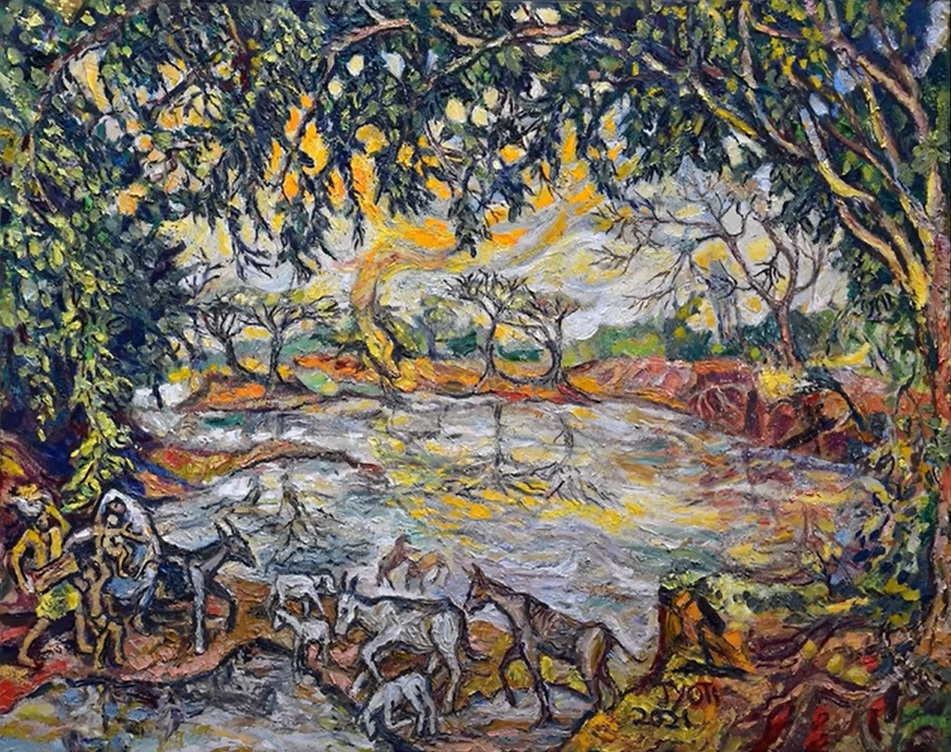
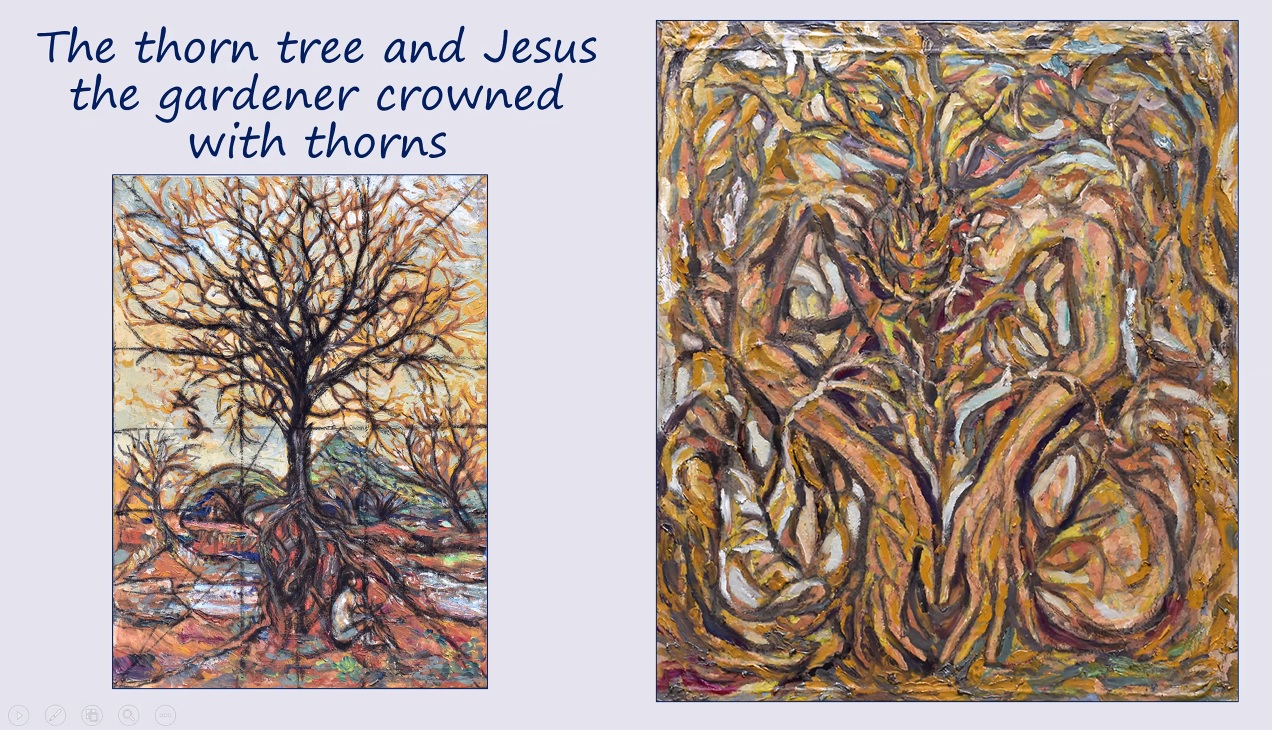
>> Jyoti Sahi, June 19, 2021: In this virtual talk organized by the UK organization Christians Aware, my friend Jyoti Sahi [previously] shares several of the paintings he has produced during the past year in quarantine in and around his home in Silvepura Village in Karnataka, South India, inspired by the local landscapes and vegetation. Over the years Jyoti has developed a Christian spirituality that is very earthy, one that sees the natural world as reflective of, and even participating in, the divine mysteries. His Jesus is in and of the land. Images start at 11:20.

Sahi, Jyoti_Flight of the Holy Family
Jyoti Sahi (Indian, 1944–), Flight of the Holy Family, 2021. Oil and acrylic on canvas.

Sahi, Jyoti_Jesus the Gardener

In his recent body of work, Jyoti shows, among other things:

  • Jesus being born in a makeshift encampment beside a kere (manmade lake), among the brick kilns, a child of migrant laborers.
  • Jesus giving a sermon in a sacred grove underneath a yellow bodhi tree, where herdsmen graze their flocks. The snake-stones, erected by the Adivasi (tribal peoples of India), allude to healing and to Jesus’s being lifted up on the cross like the serpent on Moses’s staff (John 3:14–15; cf. Num. 21:4–9).
  • Jesus entering Jerusalem, his face gloriously framed by palm fronds. He’s reminiscent of the leafy-headed Green Man present in the mythologies of many ancient cultures but found particularly in medieval English church carvings.
  • Christ crucified in the palash tree, the “flame of the forest.” (Jyoti notes that in the Sanskrit epic poem the Mahabharata, the hero’s wounds are compared to the flowers of the palash tree.)
  • Jesus in the garden of the resurrection, standing in front of a flowering datura tree, which is poisonous but also medicinal. (“Poison can be a way of discovering healing,” Jyoti says—a truth that has implications for a theology of the cross.)
  • The journey to Emmaus, showing two of Jesus’s disciples entering the garden, a metaphor for wholeness or home.

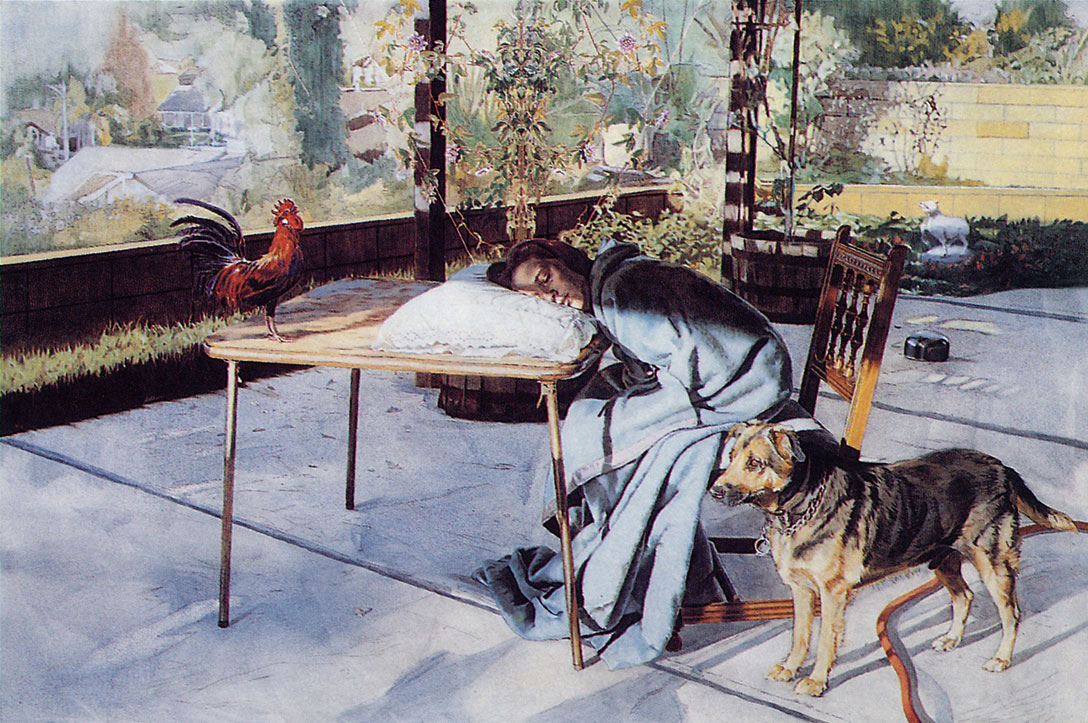
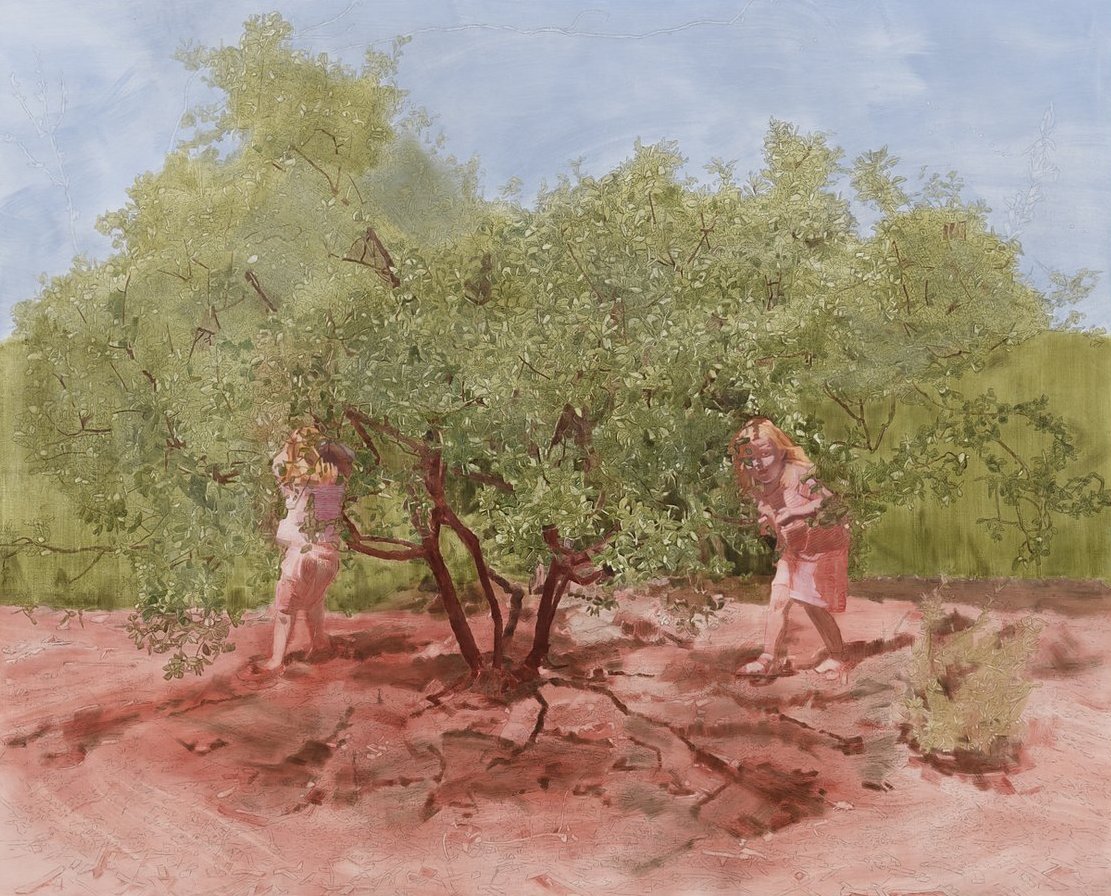
>> “Gift Paintings: The Invitation to See Anew” with Patty Wickman, June 24, 2021: As part of its Art & Faith series, Holy Family Church in South Pasadena, California, hosted a virtual talk by one of its members, Patty Wickman [previously], a nationally exhibited artist and longtime professor in UCLA’s art department. Her paintings are figural, and she describes several of them as “gifts,” sparked by things like the discovery of one of her mother’s unusual rest rituals, encounters with unhoused persons in San Jose, a cut-paper environment inside a Disney World ride, flea market finds, a plate of dirt her young daughter served her, and a little boy’s eating apples stark naked on a hot summer day in her backyard.

Among her influences are Shaker gift drawings and worship spaces; Victorian hair wreaths; the illuminations of Hildegard of Bingen; performance art pieces by Joseph Beuys, Chris Burden, and Ana Mendieta; Cindy Sherman’s photographic self-portraits; and historical religious paintings by Fra Angelico, Piero della Francesca, Georges de La Tour, Geertgen tot Sint Jans, Caravaggio, and others.

At twenty-four minutes in she starts discussing her own work, with reference to specific artworks that informed her. Compare her Entheos, for example, to Caravaggio’s Crucifixion of Saint Peter; her Struggle Garden to frescoes by Giotto of Anne and Joachim at the golden gate, and Judas betraying Jesus in Gethsemane; and her A Thief in the Night to Peter Menzel’s Material World project. When her early days of motherhood prevented her from having the time to plan and execute large-scale paintings like these, she painted smaller, quicker works—daily during Lent—with subjects including dust bunnies, daddy longlegs, a stick of incense, and a birdbath with the first blooms from her camellia tree having fallen inside. Her work has a sacramental quality to it that’s really compelling.

Wickman, Patty_Passion Painting
Patty Wickman (American, 1959–), Passion Painting, 1997. Oil on canvas, 60 × 90 in.

Wickman, Patty_Circumscribe
Patty Wickman (American, 1959–), Circumscribe, 2017–19. Oil on linen, 84 × 104 in.

The last half-hour of the video is Q&A.

+++

ARTICLE: “Artful Discipleship: The Role of the Arts in Spiritual Formation” by Carolyn Arends: Singer-songwriter Carolyn Arends discusses four ways the arts are important in our training to follow Jesus: (1) the arts help us train to pay attention; (2) the arts help us train in longing; (3) the arts help us train for the renewing of our minds; and (4) the arts help us train to appreciate things (and especially people) for more than their ​“usefulness.” She closes with a list of suggestions for practicing intentional engagement with the arts.

(See also a recent interview with Arends, “Art and Spiritual Formation,” on the Art & Faith Conversations podcast.)

Greg Pennoyer on why the arts matter

The arts don’t just fill our time with uplifting stories and pretty pictures. They don’t just distract us with things to look at; they teach us how to look. They train our vision, down to the level of our souls.

Art can teach us to see the tiny gradations in a field of green—or how to see a suffering world in the context of grace. How to recognize the humanity of a character who seems like an irredeemable villain. How to slow down. How to pay attention not just to the notes but the silences between the notes. How to hear the echo of divine music in human speech. How to look at our own failures and successes with perspective, even laughter. The arts ask us to use the full range of our senses. And they can restore us to our full, God-given humanity.

—Greg Pennoyer, executive director of Image journal [source]

Roundup: My new YouTube channel, “Constructed Mysteries” exhibition, and more

VISUAL MEDITATION: “Mary’s Fecund Yes” by Victoria Emily Jones, on Annunciation by Mats Rehnman: My latest ArtWay reflection was published Sunday. It’s on a whimsical Annunciation painting by touring storyteller, author, and visual artist Mats Rehnman, influenced in part by the Annunciation design woven into several nineteenth-century carriage cushions from Scania, Sweden.

Rehnman, Mats_Annunciation
Mats Rehnman (Swedish, 1954–), Annunciation, 2001. Aquarelle and acrylic.

Annunciation carriage cushion (Sweden)
Carriage cushion: The Annunciation, Scania (Skåne), Sweden, first half of 19th century. Tapestry weave, 52 × 96.5 cm.

+++

ART TALK: “Saying Yes: The Annunciation in Contemporary Art” by Victoria Emily Jones: Speaking of the Annunciation . . . my March 18 presentation from the Breath and the Clay creative arts gathering is now online! (The aforementioned Rehnman piece is one of six I discuss.) With permission from the conference organizers, I have uploaded it to my YouTube channel for public viewing.

It’s an act of vulnerability for me to share it with you, as I’m aware of the ways in which it is deficient (in terms of speech delivery and production values). I lack technical prowess and a charismatic personality and am self-conscious about being on camera—but hopefully with practice, I will improve. The main thing is, I want the work of these artists to be known and shared. I hope to demonstrate how art can pull us deeper into the biblical story, revealing new and sometimes surprising angles or simply helping us dwell there with love and intent, and also how it’s possible to do “theology through art,” relying not exclusively on academic writings or sermons (great as they both are) to do that important work.

While I have created a video for a scholar friend’s art history channel, this is the first on my own channel—which I invite you to subscribe to. (I need at least 100 subscribers to create a custom URL for the channel.) I don’t have imminent plans for more videos, but I am starting to brainstorm ideas and will probably send out a survey to my blog subscribers to get a better sense of what you all would want to see. Several of you have requested that I get into video making, but I’ve been slow to move on it, wanting to better figure out my niche and what I could uniquely bring to such a dense market. I realize that video is a content format that is overwhelmingly preferred to blog posts these days, so I want to make use of it. But videos are much more time-consuming and difficult to produce without having a budget or a team behind me, and also not having the direct access to artworks that museums and other entities have. Please pray for this upcoming venture!

+++

CROSS-CONTINENTAL MUSIC VIDEO: “Song of Hope” by Praveen Francis and friends: This Afro-pop music video is a collaboration between musicians, dancers, and technicians in India, Guatemala, the UK, Republic of the Congo, Cameroon, and the United States. The project was initiated by Praveen Francis, a music producer and sound engineer from Coimbatore in Tamilnadu, India, who wrote the original composition. The languages are English, French, and Lingala, but the hook is a series of nonlexical vocables: “Na na na . . .” [HT: Global Christian Worship]

The video was released April 10, 2021, shortly before the second COVID wave hit India. “This Pandemic has ravaged all our lives,” Francis says. “But we will not give up. We will fight back because there is still HOPE.”

+++

EXHIBITION: Constructed Mysteries: Spirituality and Creative Practice, February 8–April 18, 2021, Olson Gallery, Bethel University: Curated by Kenneth Steinbach and Michelle Westmark Wingard, Constructed Mysteries showcased the art of nine mid-career artists or artist teams whose work engages Christian spirituality: Heather Nameth Bren, Shin-hee Chin, Caroline Kent, Scott Kolbo, Joyce Yu-Jean Lee, Nery Gabriel Lemus, Marianne Lettieri, Cherith Lundin, and Justin Randolph Thompson and Bradly Dever Treadaway. The exhibition has come to a close, but there’s a wonderful twenty-minute video tour of it that’s archived on YouTube, with artist commentaries starting at 2:44:

In addition to the video, there’s an exhibition catalog available for online viewing. It features a series of artist interviews, which address topics such as silence, the importance of process, and the nature of parable. And of course it includes photos of all the works in the exhibition. Let me highlight just two.

Lettieri, Marianne_Fenetre de Reparateurs
Marianne Lettieri, Fenêtre de Réparateurs (Window of Repairers), 2020. Vintage pincushions, wood, paper, 33 × 18 × 3 1/2 in.

The first is by my friend Marianne Lettieri [previously], whose work is informed by her “increased awareness of the enchantment of everyday actions and moments—the sequences of ordinary human existence.

I would hate to think that life is just the important events. You get married, you get an award, have a baby. These are big things, and some are what we call sacraments in the church, but I’ve realized that peeling potatoes, fixing the faucet, and other common tasks make up most of our daily living. The big moments are a part of it, but it’s the string of these small moments that are present and sacred acts we need to pay attention to.

Much of her art illuminates the value of domestic labor, such as Fenêtre de Réparateurs, which sets forty-one used pincushions, still bearing the threads put there by their previous owners, into a wooden framework, evoking a stained glass window. “This work speaks about a culture of menders—people who choose to save, repair, and transform damaged things,” says Lettieri.

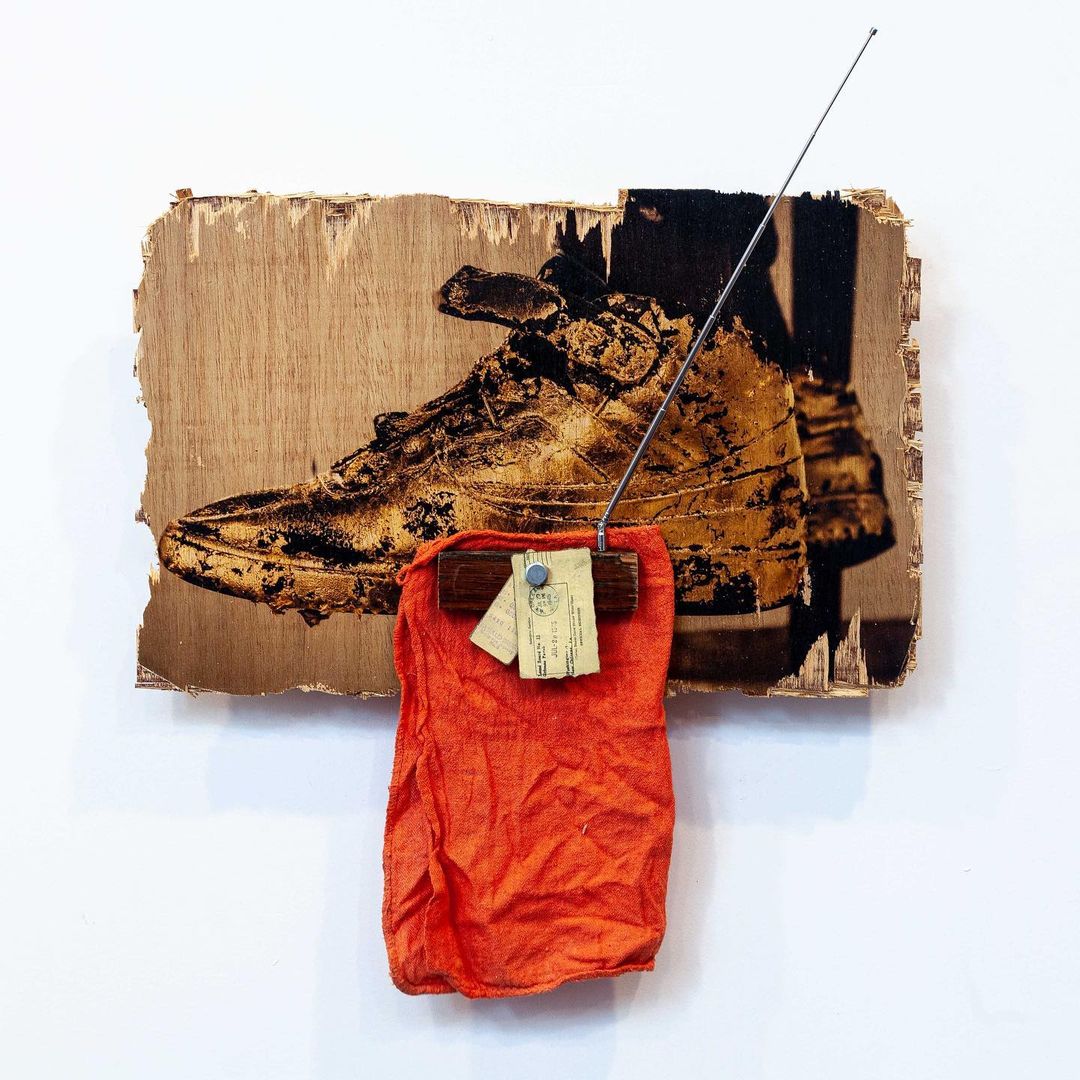
Baby Needs New Shoes (Thompson and Treadaway)
Justin Randolph Thompson and Bradly Dever Treadaway, Baby Needs New Shoes, 2021. Photographic transfer on wood with antenna and rag, 20 × 13 × 2 in.

Second, Traveling Shoes is a performative sound work by longtime collaborators Justin Randolph Thompson and Bradly Dever Treadaway, from 2013’s Flux Night in Atlanta. It involved a two-seat shoe-shine “chariot” being dragged through the crowds, stopping to gold-leaf the shoes of anyone who was interested. All the while, on the back of the chariot, a three-piece jazz band played the traditional African American song “Traveling Shoes,” which is about getting ready for Jesus’s return. The original performance, which lasted around three hours and has been re-created in several different contexts since then, is archived in a twelve-minute video, which is what was on display at Bethel. To go alongside, the curators asked the duo to submit a photograph from the performance series; they went the extra mile and used a photo as the basis of a new mixed-media work that incorporates objects used in the performance, such as a mechanic’s rag and an antenna, which is what I’ve posted here.

+++

RELIGIOUS POEMS SAMPLER: “Original and unorthodox poems about theology,” compiled by Mark Jarman: An excellent selection of ten poems, all but one available for reading from the Poetry Foundation. Jarman is a leading poet of the twenty-first century and a Christian. He was too humble to include one of his own poems on the list, but his poetry is much in this vein, so for number 11 I would add Jarman’s “Five Psalms,” from his collection To the Green Man (2004).

Roundup: Ethan Hawke on creativity; Jesse Pinkman as child-prophet; 1843 abolitionist hymn; and more

JULY PLAYLIST: The songs I’ve compiled this month on Spotify include Audrey Assad’s rewrite of a classic patriotic hymn [previously], a Bach partita with added words by Alanna Boudreau inspired by Dante’s Inferno, a Sotho interpretation of Psalm 23 by the Soweto Gospel Choir, a celebration of God as artist written and sung by a Franciscan friar from the Bronx, a song of testimony performed by blues musician Elizabeth Cotten and her great-granddaughter Brenda Evans, a multilingual song setting of Matthew 5:9 (“Blessed are the peacemakers . . .”) (again, with multigenerational participation!), Psalm 103 sung in Hebrew with ancient Middle Eastern instruments, and more.

+++

KICKSTARTER CAMPAIGN: Great Cloud by Nick Chambers: This is one of the creative projects I donated to this week. Chambers writes, “For over a decade, I have written music for the Church without much concern for the songs reaching beyond the particular place and people to which I belong. Now I want to release and share this music more widely. And you can help.

“I write songs to help give voice for people to pray, question, confess, doubt, lament, give thanks, and praise. Because I owe so much in this to the many faithful voices of history of the Church, this first record will be a collection of prayers of the saints—faithful voices such as Ephrem the Syrian, Teresa of Avila, Howard Thurman, and more.

“I have been planning with producer Isaac Wardell (The Porter’s Gate, Bifrost Arts) to record in early September in Paris near where he is currently based. The Porter’s Gate will be recording the same week, which means your support toward my $15k goal will go toward my record and travel costs, as well as allowing me to contribute in person to the next Porter’s Gate project.”

Here’s an example of Chambers’s singing-songwriting—a setting of Psalm 22:

+++

TED TALK: “Give yourself permission to be creative” by Ethan Hawke: I could listen to actor Ethan Hawke talk about any subject; he’s so interesting and passionate. (His recent conversation with the American Cinematheque on his new limited series The Good Lord Bird, for example, about abolitionist John Brown, was fascinating!) In this video he was asked to talk about creativity and the arts. He says,

There’s a thing that worries me sometimes whenever you talk about creativity, ’cause it can have the feel that it’s just nice, you know; or it’s warm or it’s something pleasant. It’s not. It’s vital. It’s the way we heal each other. In singing our song, in telling our story, . . . we’re starting a dialogue. And when you do that, healing happens. And we come out of our corners. And we start to witness each other’s common humanity. We start to assert it. And when we do that, really good things happen.

+++

TRANSPOSITIONS ESSAYS:

>> “‘Stop Working Me’: Jesse Pinkman as Child-Prophet in Vince Gilligan’s Breaking Bad” by Mary McCampbell: Jesse Pinkman from Breaking Bad, played by Aaron Paul, is one of my favorite TV characters of all time; I think I can truly say I’ve never been more emotionally invested in, or rooted harder for, any other. Mary McCampbell, author of the forthcoming book Imagining Our Neighbors as Ourselves: Empathy, the Arts, and the Religious Imagination (Fortress, 2021), writes about Jesse’s role as “child-prophet,” who sees and exposes with increasing clarity and conviction the amoral decay of the empire he helped Walt build. (Note: the article contains some series spoilers.)

>> “Revealing the Father: L. M. Montgomery, Dorothy L. Sayers, and Doctrine in Art” by Alicia Pollard: This article examines how the doctrine of God the Father shows up in Lucy Maud Montgomery’s novel Anne of Green Gables and Dorothy Sayers’s play The Emperor Constantine. The former chooses “the way of whimsical unorthodoxy”; the latter, “the way of passionate orthodoxy and reenchanted dogma as a living agent of truth.”

+++

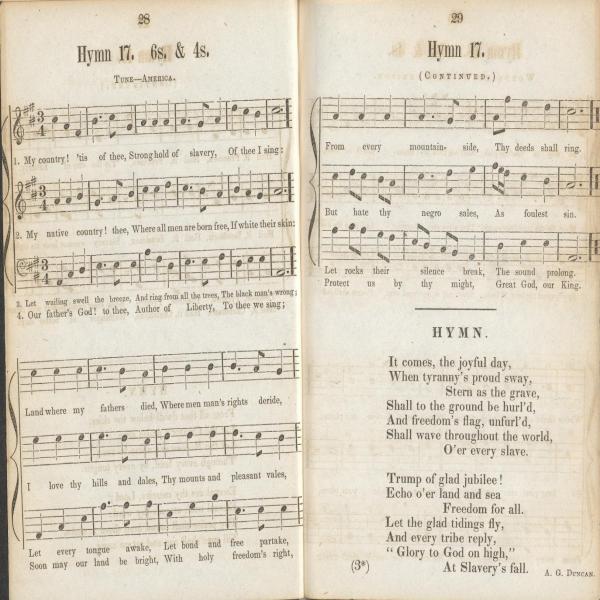
SONG: “My Country ’Tis of Thee” (abolitionist version by A. G. Duncan, 1843): I wanted to post this for Juneteenth, but alas, I’m two weeks late. Just twelve years after Samuel Francis Smith wrote “My Country ’Tis of Thee,” a scathing rewrite by abolitionist A. G. Duncan was published in Massachusetts in the book Anti-Slavery Melodies. Exposing the hypocrisy of a nation that proclaimed life and liberty for all and yet perpetuated the evil institution of race-based chattel slavery, it’s a call to lament—“let wailing swell the breeze”—as well as an anticipation of coming liberation, God be praised. (Again, this was 1843, almost two decades before the Civil War.) This vocal arrangement and performance using Duncan’s alt lyrics is by Chase Holfelder, who sings the song in a minor key. [HT: Global Christian Worship]

My country, ’tis of thee,
Stronghold of slavery, of thee I sing;
Land where my fathers died,
Where men man’s rights deride,
From every mountainside thy deeds shall ring.

My native country, thee,
Where all men are born free, if white’s their skin;
I love thy hills and dales,
Thy mounts and pleasant vales,
But hate thy negro sales, as foulest sin.

Let wailing swell the breeze,
And ring from all the trees the black man’s wrong;
Let every tongue awake;
Let bond and free partake;
Let rocks their silence break, the sound prolong.

Our father’s God! to thee,
Author of Liberty, to thee we sing;
Soon may our land be bright,
With holy freedom’s right,
Protect us by thy might, great God, our King.

It comes, the joyful day,
When tyranny’s proud sway, stern as the grave,
Shall to the ground be hurl’d,
And freedom’s flag, unfurl’d,
Shall wave throughout the world o’er every slave.

Trump of glad jubilee!
Echo o’er land and sea freedom for all.
Let the glad tidings fly,
And every tribe reply,
“Glory to God on high,” at Slavery’s fall!

Antis