
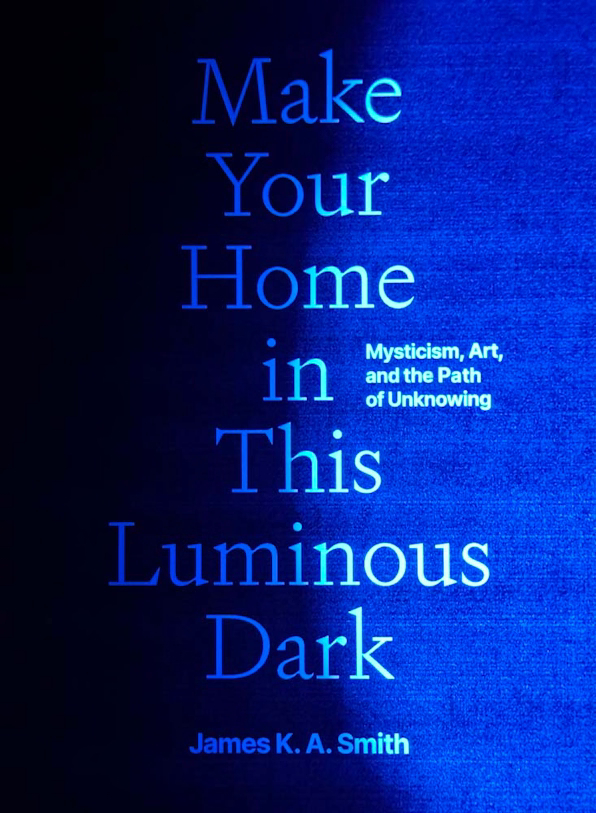
The following two excerpts are from James K. A. Smith, Make Your Home in This Luminous Dark: Mysticism, Art, and the Path of Unknowing (Yale University Press, 2026). Reproduced by permission of the publisher.
When I look back at my own path to a contemplative phenomenology, I am surprised to note that the places I learned to befriend mystery were rarely “religious” in the usual, institutional sense. Religious institutions seem as committed as Descartes was to certainty, clarity, and binary conceptions of knowledge. Instead, I have learned to love the inscrutable in spaces devoted to the imagination. I see now that the art gallery has been a “desert” of sorts into which I have retreated to find a stillness that makes me available for surprise. The cinema has been a cloister for contemplation. The novel has been a sanctuary into which I would retreat, only to discover the utter mystery of human beings on kaleidoscopic display. The wager of my book is that the modes of attention and contemplation that characterize “the aesthetic mindset” [Susan Magsamen and Ivy Ross, Your Brain on Art, xiii] are analogous to the spiritual itinerary of contemplation that we find in ancient desert dwellers, medieval mystics, and twentieth-century sages like Thomas Merton, Howard Thurman, and Henri Nouwen. In our culture of distraction and self-absorption, as well as skepticism and doubt, one of the best paths for cultivating openness to mystic contemplation is to engage regularly with contemporary art in all its conceptual upending and difficult beauty.
Contemporary art invites an itinerary that tracks with monastic contemplation: we withdraw from the grind of the everyday to retreat to a space of reflection. Whether we are reading a poem or facing a painting, we have to still the chatter and noise to be present for the encounter. But one of the reasons I am specifically arguing for the contemplative significance of contemporary art is that the vanguard of the avant-garde is a terrain in which our expectations are upended. Unlike confrontations with “classics” (which, of course, have their depth and profundity), engagement with art and literature from our own generation means encountering art for which we don’t yet have established habits. And so I find myself drawn to the avant-garde and the experimental. By subjecting myself to such art, I forgo control and comfort. I can’t rely on existing habits of perception. Such art disrupts my predilections and demands that I make myself available for the aesthetic encounter in a new way. Sometimes this is maddening, even alienating. Sometimes it leaves me cold. But this, too, is an aspect of the mystical experience. To engage the experimental and avant-garde requires “a beginner’s mind.” “Isn’t a beginner’s mind,” Henri Nouwen asks [in The Genesee Diary], “a mind without the thought, ‘I have attained something,’ a mind opened for grace?”
Art holds together contradictions that discursive rationality disallows. The best artworks make room for the messiness of the world around us, the swirling complexity of the soul within, and even, sometimes, the infinite mystery of the divine. Where a syllogism has to resolve to a conclusion, a poem remains open. While a treatise has to make an argument, a sculpture can evoke fourteen feelings and seven ideas all at once, and all of them can be true. A movie like Terence Malick’s Thin Red Line doesn’t take sides; instead, it immerses us in a world that is a heart-rending conflation of good and evil, darkness and light, beauty and horror, and we recognize all of it.
Next to the antiseptic precision of binary logic, art is messy and maddening. Michael Kimmage, in a provocative essay “The Bad and the Beautiful,” describes this as “art’s salutary impurity.” This, he says, is a central endeavor of what we call modern art: it “defies expectations by rejecting the expected structures, pushing sense and language and image in bizarre, unpredictable directions, breaking up straight lines, flirting with ugliness, defying representation, leaving much unsaid, smudging borders, bubbling over into excess.” He takes James Joyce’s Ulysses as a prime example: “the mongrelness of the distinction,” he argues, “is not impurity for impurity’s sake. Joyce was striving to make discoveries about life by defying and discomposing the conventions of language, to take the lid off the consciousness of his characters, to peer into their souls.” It is the disruptive difficulty of the prose in Ulysses that is the means of epiphany, somehow displaying the abyssal mystery of human consciousness in a way that an fMRI never could. And I, curled up on my sofa in what looks like “private” absorption, am, in fact, in solidarity with the beautiful monstrosity called humanity that lies beyond the reach of “philosophy of mind.” By cultivating an “aesthetic mindset” and a contemplative posture, we learn new habits of attention and wonder that underwrite a life of compassion and peace. Contemplation of contemporary art could engender just the sort of rupture and disruption that can make us aware of our ek-static being, our longing for communion, and break us open to the possibility of grace—the arrival and incursion of something unanticipated.
pp. 50–53
In many ways, art has been an occasion for me to practice friendship with epistemic failure. Artworks have helped me learn how to feel at home in the dark. Held by a painting that baffles me, rapt by a poem that eludes me, dazzled by a film that defies my comprehension, I practice dwelling in epistemic darkness. I can find a certain thrill in perplexity. I start to find joy in unknowing. Moments of analytic failure in front of artworks become occasions for a new kind of patience. It’s not that I resolve to stay until the artwork reveals an answer; it’s rather that the aesthetic experience lures me into a strange kind of waiting that doesn’t expect resolution. I am still expectant, even hopeful. But I am learning that what is given will not be a disclosure that can be fed back into my syllogisms; instead, a different kind of truth dawns, on a register of awareness that exceeds binary logic. . . .
Part of the joy I experience with contemporary art is the peculiar elation that comes from being in a “beginner’s” space. It is the joy of perpetually learning something new; the joy of being an eternal novice. To live a life in the company of contemporary art is to be thrown into unfamiliar territory where all of my acquired imaginative prowess seems useless and irrelevant. Like I’m just learning how to see. I encounter such works and, as [John] Carvalho puts it [in Thinking with Images], I don’t know what to think. My inclination is to move on—turn the page, change the song, move to the next sculpture, looking for something familiar, comfortable. But when I look away from what arrives as opaque, I evade possibility. For to run away from the darkness of an aesthetic encounter—the inscrutability, even offense, of the work—is always to run backward, to comfort and familiarity. The challenge of the artwork arrives, then, as something of a threat to self-assurance and command. But what it invites is a breakdown that could be a breakthrough. To dwell with such artworks is to make one’s home in the dark. To wait with them—quietly gazing at the opaque painting, continuing to read the vexing story, staying in one’s seat despite the alienating film—is already an act that unsettle autarky. To trust that something might be happening that you don’t recognize, can’t control, and don’t understand. Who knows?”
pp. 142, 163–64

