Beverly McIver (American, 1962–), Truly Grateful, 2011. Oil on canvas, 30 × 30 in. (76.2 × 76.2 cm). North Carolina Museum of Art, Raleigh. Photo: Victoria Emily Jones.
I give thanks to you, O Lord my God, with my whole heart,
and I will glorify your name forever.
For great is your steadfast love toward me;
you have delivered my soul from the depths of Sheol.
. . . You, O Lord, are a God merciful and gracious,
slow to anger and abounding in steadfast love and faithfulness . . .
—Psalm 86:12–13, 15
+++
SONG: “Gospel Medley” by Beyoncé Knowles, Kirk Franklin, and Richard Smallwood | Performed by Destiny’s Child, on Survivor (2001)
The liner notes of Survivor credit Beyoncé [previously], Kirk Franklin, and Richard Smallwood as the writers of this song, but from what I can tell, the credit goes mainly to Beyoncé, who has woven together different gospel fragments and, it seems, written the first two-thirds of the song, which fan web pages say is an interpolation of Franklin’s “Now Behold the Lamb” and “So Good” (I myself can’t hear much of a resemblance). This is followed by a gospel rendition of the Anna B. Warner hymn “Jesus Loves Me” that is much like the one Michele Lamar Richards and Whitney Houston sing in the 1992 movie The Bodyguard. The medley concludes with the “Amen” section of Smallwood’s “Total Praise.”
+++
About the above painting by Beverly McIver, the North Carolina Museum of Art writes,
McIver is renowned for her expression-filled, emotive canvases that commemorate her life and the lives of those closest to her—in particular, her mother, who passed away in 2004, and her sister, who is mentally disabled. Such works reveal as much about the artist as they do about the subjects portrayed therein. As McIver has noted about her paintings, “All of my portraits are self-portraits,” says the artist. “I use the faces of others who reflect my most inner being.”
In Truly Grateful, the artist moves her focus away from her family and back towards herself, and the resulting self-portrait is one of quiet, contemplative acceptance. The artist represents herself at bust length, draped in a bright blue scarf, with her head bowed and eyes closed, perhaps in midst of prayer. McIver’s signature brushwork, patchy and lively, adds a marked contrast to an otherwise peaceful scene. She does not highlight any other figures or objects in this canvas, allowing the viewer to focus solely on the artist herself and her emotional state. The yellow-orange background surrounds her figure with a warm glow, reminiscent of the traditional gold-leaf ground seen in traditional European icons. As a result, the painting exudes a calming, almost spiritual atmosphere.
It is possible to examine McIver’s personal biography to determine the significance of the title, Truly Grateful. Over the past five years, McIver has grappled with the ongoing repercussions of her mother’s death. Her mother’s passing left Renee, McIver’s sister, without a caretaker to provide her with the assistance, comfort and protection required due to her disabilities. McIver, bolstered by a promise made to her mother years prior, became Renee’s primary guardian, taking on all related responsibilities and allowing her sister to move into her home. After years of struggle, Renee recently moved into her own apartment complex for the handicapped and disabled, freeing McIver to pursue her artistic career at a more fervent pace while being reassured of Renee’s continued care and contentment.
This post belongs to the weekly series Artful Devotion. If you can’t view the music player in your email or RSS reader, try opening the post in your browser.
To view all the Revised Common Lectionary scripture readings for Proper 11, cycle A, click here.
Written by British New Zealander Richard Gillard in 1977, “The Servant Song” (CCLI #72673) is such a beautiful expression of the Christian call to community and friendship, marked by selfless service, a walking alongside, and the bearing of one another’s joys, sorrows, and fears.
And, from 2017, a performance by Lowana Wallace [previously], accompanied by Matt Froese on guitar. Wallace has one of the most gorgeous voices I’ve heard.
The first line was originally written as “Brother, let me be your servant” but has since been updated to be gender-inclusive, as either “Brother, sister, let me serve you” or “Will you let me be your servant.” Wallace uses “Sister” as the address in the first verse and then “Brother” in the repeat of that verse at the end.
Will you let me be your servant
Let me be as Christ to you
Pray that I may have the grace
To let you be my servant too
We are pilgrims on a journey
Fellow travelers on the road
We are here to help each other
Walk the mile and bear the load
I will hold the Christ-light for you
In the nighttime of your fear
I will hold my hand out to you
Speak the peace you long to hear
I will weep when you are weeping
When you laugh, I’ll laugh with you
I will share your joy and sorrow
Till we’ve seen this journey through
When we sing to God in heaven
We will find such harmony
Born of all we’ve known together
Of Christ’s love and agony
Will you let me be your servant
Let me be as Christ to you
Pray that I may have the grace
To let you be my servant too
Jesus’s words to his disciples in Matthew 20:26–28 inspired the song’s main theme: “But whoever would be great among you must be your servant, and whoever would be first among you must be your slave, even as the Son of Man came not to be served but to serve, and to give his life as a ransom for many.” Other scriptural allusions include “And if anyone forces you to go one mile, go with him two miles” (Matt. 5:41), “Rejoice with those who rejoice, weep with those who weep” (Rom. 12:15), and “Bear one another’s burdens, and so fulfill the law of Christ” (Gal. 6:2).
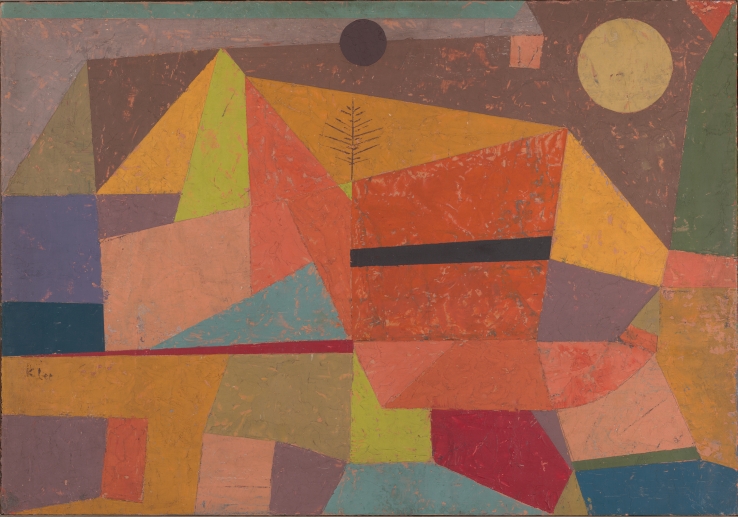
Paul Klee (Swiss, 1879–1940), Heitere Gebirgslandschaft (Joyful Mountain Landscape), 1929. Oil on board, 17 5/16 × 24 13/16 in. (43.9 × 63.1 cm). Yale University Art Gallery, New Haven, Connecticut.
By awesome deeds you answer us with righteousness,
O God of our salvation,
the hope of all the ends of the earth
and of the farthest seas;
the one who by his strength established the mountains,
being girded with might;
who stills the roaring of the seas,
the roaring of their waves,
the tumult of the peoples,
so that those who dwell at the ends of the earth are in awe at your signs.
You make the going out of the morning and the evening to shout for joy.
You visit the earth and water it;
you greatly enrich it;
the river of God is full of water;
you provide their grain,
for so you have prepared it.
You water its furrows abundantly,
settling its ridges,
softening it with showers,
and blessing its growth.
You crown the year with your bounty;
your wagon tracks overflow with abundance.
The pastures of the wilderness overflow,
the hills gird themselves with joy,
the meadows clothe themselves with flocks,
the valleys deck themselves with grain,
they shout and sing together for joy.
—Psalm 65:5–13
Psalm 65 is a such a magnificent praise song, and I especially love the expression in verse 12: “the hills gird themselves with joy” (ESV). Other translations have “the little hills rejoice on every side” (KJV), “the hillsides blossom with joy” (NLT), and “the hills [are set] to dancing” (MSG). The picture extends into the final verse, where, along with pastures, meadows, and valleys, the mountains “shout and sing” to their Creator. Last year when I saw Paul Klee’s Joyful Mountain Landscape at the Yale University Art Gallery, I instantly thought of this psalm—of how nature sings praises to God simply by being itself.
Human beings are called to join in creation’s joyful song.
SONG: “I Sing the Mighty Power of God” | Words by Isaac Watts, 1715 | Music (tune: ELLACOMBE) from Gesangbuch der Herzogl, Württemberg, 1784
I sing the mighty power of God
that made the mountains rise,
that spread the flowing seas abroad
and built the lofty skies.
I sing the wisdom that ordained
the sun to rule the day;
the moon shines full at his command,
and all the stars obey.
I sing the goodness of the Lord
that filled the earth with food;
he formed the creatures with his word
and then pronounced them good.
Lord, how thy wonders are displayed,
where’er I turn my eye,
if I survey the ground I tread
or gaze upon the sky.
There’s not a plant or flower below
but makes thy glories known,
and clouds arise and tempests blow
by order from thy throne;
while all that borrows life from thee
is ever in thy care,
and everywhere that man can be,
thou, God, art present there.
For a fairly traditional rendition of this classic hymn, here’s a three-part a cappella arrangement performed by the Ball Brothers in 2012:
If you prefer a more modern sound, check out the version by Ben Thomas on the 2015 album Bring Forth. Thomas wrote a new melody for the song and recorded it under the title “I Sing the Goodness” (using the language of verse 2 instead of 1).
The whole Bring Forth album is great, which takes as its basis thirteen hymn lyrics dating from the fourth through twentieth centuries—“all seeking to find the Divine in the everyday elements of our existence,” Thomas says. Thomas adapted and retuned the hymns and released them in three movements that echo the cycle of time: Dawn, Day, and Dusk. To guide you through your listening, there is a meditation and prayer for each movement published on his website.
Other favorites of mine from the album are “Creator God, Creating Still,” “Tell Me the Old, Old Story,” “Lord of All Being,” “Peace, Troubled Soul,” and “Bring Forth.”
This post belongs to the weekly series Artful Devotion. If you can’t view the music player in your email or RSS reader, try opening the post in your browser.
To view all the Revised Common Lectionary scripture readings for Proper 10, cycle A, click here.
Franz von Lenbach (German, 1836–1904), The Red Umbrella, ca. 1860. Oil on paper mounted on cardboard, 10 1/2 × 13 3/5 in. (26.9 × 34.6 cm). Hamburger Kunsthalle, Hamburg.
Come to me, all who labor and are heavy laden, and I will give you rest.
This post belongs to the weekly series Artful Devotion. If you can’t view the music player in your email or RSS reader, try opening the post in your browser.
To view all the Revised Common Lectionary scripture readings for Proper 9, cycle A, click here.
VIDEO TALK: “The Breath of Life: Why Art Matters in a Pandemic” by James K.A. Smith: In this half-hour Zoom talk released June 2, Image journal editor in chief Jamie Smith [previously] discusses the ability of the arts to stimulate our cultural imagination in much-needed ways. “The arts matter in a pandemic,” he says, “because they shape us for the work of reshaping and rebuilding society. In other words, we all need artists to continue creating for us so the rest of us can cultivate the imagination we need to re-create our common life, our social bonds.” And again: “The arts train our imagination so that we relearn to see what we need to see. . . . It’s art as imagination therapy, it’s art as an ophthalmology of the soul that we need in order to build and sustain and restore the institutions of a healthy, flourishing society. . . . If we’re going to imagine the world otherwise, we need imaginations that are trained in subtlety, that have been humbled by mystery, and that are infused with infinity.”
At 14:44 Smith introduces three ways in which art matters during and after a pandemic: art helps us (1) attend, (2) transcend, and (3) mend. That is, art helps us attend more carefully to the world and our neighbors, calling sometimes for gratitude, sometimes for grief, often both; art helps us transcend despair, attesting to the “something more” we long for (“the arts enable us to transcend the tragic when they invite us into a joy that forgets nothing”); and art helps us mend our tattered social fabric by helping us to better understand one another and to imagine possibilities. For each of these functions he provides a few concrete examples, including the current Home Alone Together exhibition.
Photo by Yola Monakhov Stockton, May 17, 2020, for the “Home Alone Together” exhibition
+++
Along these same lines . . . at the end of the Makers & Mystics podcast episode “Art as Healing,” recorded live last year at The Farm House in Charlottesville, Virginia, and released June 5, 2020, host Stephen Roach reads an excerpt from a book he’s writing:
In our present day, it can be easy to conclude from the various crises taking place around the world, all the injustice and political unrest, the rampant poverty and environmental threats, persecution and killings, diseases and displacements, that art and beauty are mere luxury. It could even make some feel that to focus on art and beauty is insensitive or shortsighted. However, I want to suggest that it’s precisely because of these desperate situations that the artist is called upon to beautify the world with art and engage these issues from a vantage point of hope.
The desperate situation in our world calls for the artist to emerge as a prophetic voice for change and to offer heaven’s alternatives. I’m reminded of the example of Iraqi cellist Karim Wasfi, who countered the tragedy of war by playing music at the sites of car-bomb explosions, with smoldering buildings in the background of his concertos. Wasfi said, “The other side chose to turn every element, every aspect of life in Iraq into a battle and into a war zone. I chose to turn every corner of Iraq into a spot for civility, beauty, and compassion.”
This is the call of the artist in collaboration with God: we are called to be the architects of hope and to counter the destruction of life with the opposite spirit in beauty and creativity.
Here’s a video of Wasfi playing an original cello composition in the destroyed buildings of Al Shifa Hospital in Mosul, Iraq, in September 2018, where some two thousand explosive hazards were removed by UNMAS (United Nations Mine Action Service):
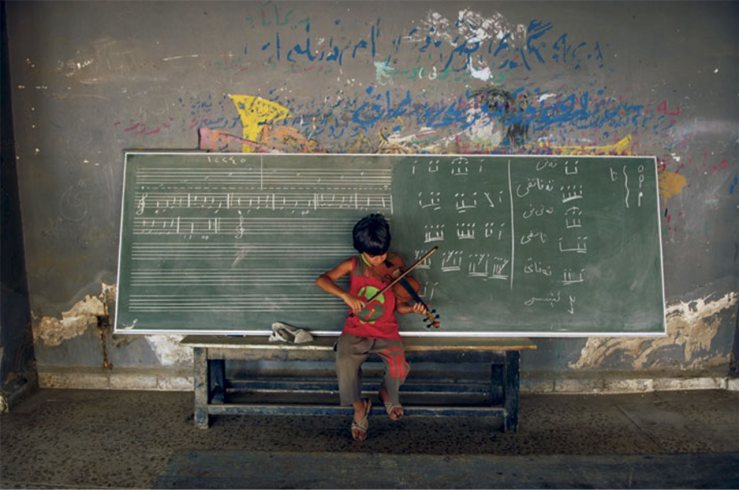
It reminds me of a photograph by Julie Adnan that I saw in National Geographic a decade ago and that, of all the extraordinary photos published in that magazine, has stuck with me the most. Its caption reads, “Some 160 miles northeast of Baghdad, in a Sulaymaniyah music hall ravaged by war, looting, and neglect, a violin-playing boy sounds a note of hope. His teacher, Azad Maaruf, lives there, instructing scores of students.”
Photo by Julie Adnan, taken in Sulaymaniyah, Iraq, published in the February 2010 issue of National Geographic
The expression “fiddling while Rome burns,” which legend says the emperor Nero did in 64 CE, is used deprecatingly to refer to the doing of something trivial and irresponsible during a crisis. But beauty is not trivial, and its pursuit during times of crisis does not indicate apathy. I love that this little boy wants to play music while bombs sound out around him. Making art can be a daring act of resistance, an assertion of and call to common humanity, a better way. It’s life-affirming. As artist Laura Bon says: “Artists need to create on the same scale that society has the capacity to destroy.”
+++
NEW SONG: “The Medicine” by Dee Wilson: Dee Wilson of Common Hymnal premiered this song on his YouTube channel on May 27, and then Good Shepherd New York and friends put together a beautiful arrangement for the church’s June 7 virtual worship service. It’s a prayer that God would save us from the virus of racism, which harms and divides. The chorus goes: “We don’t know what to do, so we turn our eyes to you. We’ve run out of words to say. But if you come and have your way, you can save us from ourselves before our wounds hurt someone else. We need you now.” The video features Wilson on lead vocals, Liz Vice on background vocals, Orlando Palmer and Charles Jones on keyboard, Franklin Rankin on guitar, Michael Decena on bass, and Terence F. Clark on drums.
Every Sunday since March 15, Good Shepherd New York (“an interdenominational church helping New Yorkers embody the love of Christ for the good of our neighbors”) has been releasing a worship service video with liturgy, prayer, sermon, open communion—and phenomenal music led by associate pastor David Gungor, which engages current events. The whole services are worth watching/participating in, but here are a few musical highlights I’ve queued up. I especially like the medleys, which blend together excerpts from a range of songs:
May 10: MEDLEY: “My Brother, My Sister” by David Gungor / “Higher Love” by Steve Winwood
March 22: MEDLEY: “All Who Are Thirsty” by Brenton Brown and Glenn Roberts / “Take Me to the River” by Leon Bridges / “Amazing Grace” (with traditional English folk tune RISING SUN)
“Way Maker”– Written by Sinach (Osinachi Kalu) – Performed by Zanbeni and Benny Prasad – This husband-wife duo [previously] brings a fusion of R&B, jazz, and Indian classical music to this 2015 gospel song.
+++
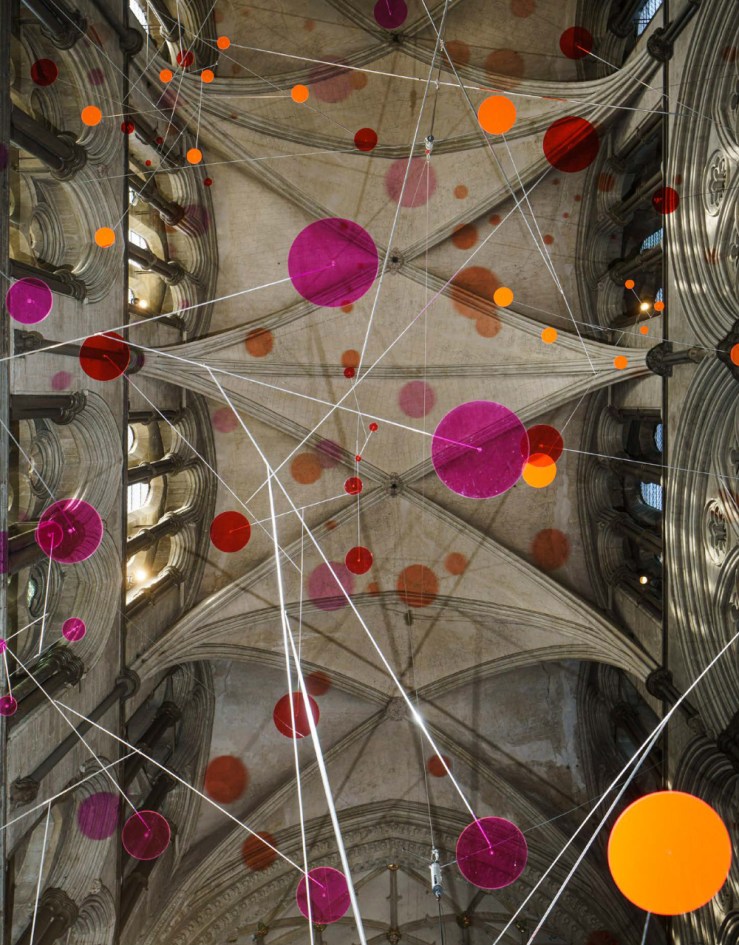
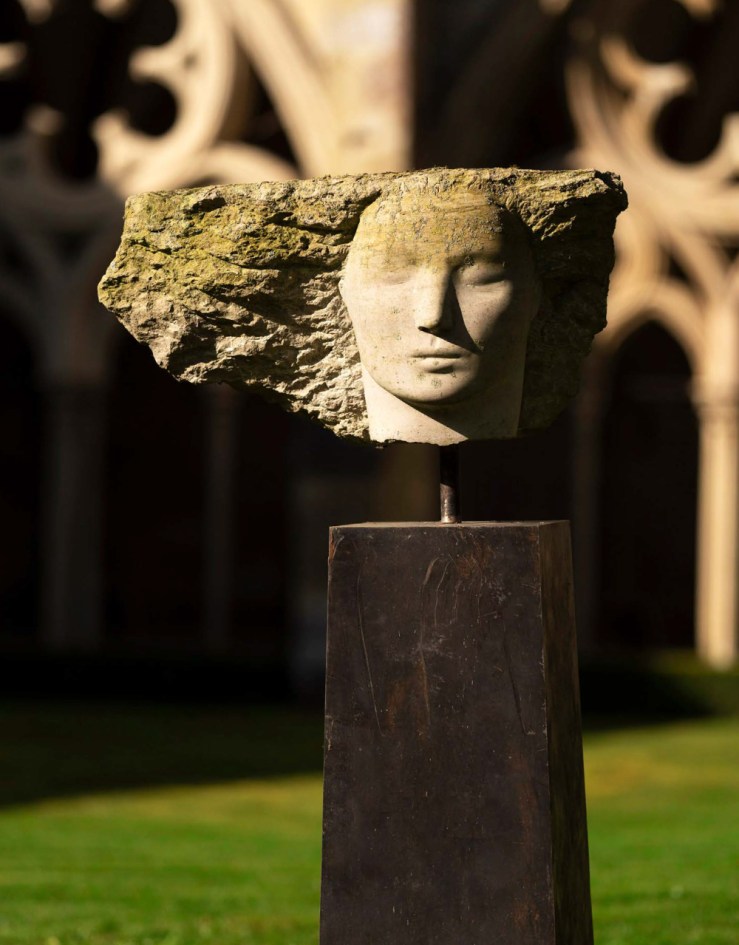
EXHIBITION / VIRTUAL ART TOUR: Celebrating 800 Years of Spirit and Endeavour: To celebrate the eight hundredth anniversary of the laying of its first foundation stone, Salisbury Cathedral organized a major exhibition this year, which was three years in the making. After the art was sited and installed both inside the building and outside on the lawns, COVID-19 hit, and the cathedral was forced to close. But the planning team adapted to the setback, developing a virtual tour that uses panorama technology to enable the viewer to enter the cathedral virtually, watch a video introduction, and navigate around the exhibition space by clicking on thumbnail images of the works and links to the corresponding catalog pages.
Curated by Jacquiline Creswell, who has led the cathedral’s visual arts program for the past eleven years, the exhibition features twenty-nine works of art by significant artists of the modern and contemporary eras, including Henry Moore, Elisabeth Frink, Antony Gormley, Mark Wallinger, Shirazeh Houshiary, and Subodh Gupta. Nine of the works are from the cathedral’s permanent collection, while the other twenty were specially brought in, of which two were newly commissioned: the abstract, solar-powered mobile in the nave by Daniel Chadwick, and the light installation in the north porch by Bruce Munro.
The beautifully photographed, ninety-page exhibition catalog is available for free download from the Spirit and Endeavour page of the cathedral website. Besides providing commentary on all the artworks, it also includes an essay by Sandy Nairne that discusses significant art commissions by British churches in the twentieth and twenty-first centuries and the difference between viewing art in a cathedral versus a museum gallery. Another available resource is a guide for kids with questions and activities. While I do hope the interior portion of the exhibition is able to open to visitors soon, I’m grateful that the online resources enable me to “visit” from my living room in the US.
Daniel Chadwick (British, 1965–), Somewhere in The Universe, 2019–20. Acrylic sheet, stainless steel, solar-powered motor, 1,000 × 1,000 cm. Temporary installation at Salisbury Cathedral. Photo: Ash Mills.Bill Woodrow (British, 1948–), Clockswarm, 2001. Bronze, 25 × 35 × 11 cm. Photo: Ash Mills.Emily Young (British, 1951–), Angel Gabriel, 2008. Purbeck stone, 90 cm. Collection of Salisbury Cathedral. Photo: Ash Mills.
PSALM 13 SETTINGS FROM INDIA: In November 2015 a group of musicians from Poona Faith Community Church in Pune, India, composed and recorded worship songs in several of the country’s languages. Because Psalm 13 is assigned in today’s lectionary, here are three settings of that lament, in Marathi, Hindi, and Nepali. [HT: Global Christian Worship]
How long, O LORD? Will you forget me forever?
How long will you hide your face from me?
How long must I take counsel in my soul
and have sorrow in my heart all the day?
How long shall my enemy be exalted over me?
Consider and answer me, O LORD my God;
light up my eyes, lest I sleep the sleep of death,
lest my enemy say, “I have prevailed over him,”
lest my foes rejoice because I am shaken.
But I have trusted in your steadfast love;
my heart shall rejoice in your salvation.
I will sing to the LORD,
because he has dealt bountifully with me.
(This psalm has also been impactfully adapted by Isaac Wardell, as “How Long,” on Bifrost Arts’ 2016 Lamentations album.)
Greg Bailey (Jamaican, 1986–), The Sacrifice of Isaac, 2017. Oil on canvas, 90 × 57 in.
After these things God tested Abraham and said to him, “Abraham!” And he said, “Here I am.” He said, “Take your son, your only son Isaac, whom you love, and go to the land of Moriah, and offer him there as a burnt offering on one of the mountains of which I shall tell you.” So Abraham rose early in the morning, saddled his donkey, and took two of his young men with him, and his son Isaac. And he cut the wood for the burnt offering and arose and went to the place of which God had told him. On the third day Abraham lifted up his eyes and saw the place from afar. Then Abraham said to his young men, “Stay here with the donkey; I and the boy will go over there and worship and come again to you.” And Abraham took the wood of the burnt offering and laid it on Isaac his son. And he took in his hand the fire and the knife. So they went both of them together. And Isaac said to his father Abraham, “My father!” And he said, “Here I am, my son.” He said, “Behold, the fire and the wood, but where is the lamb for a burnt offering?” Abraham said, “God will provide for himself the lamb for a burnt offering, my son.” So they went both of them together.
When they came to the place of which God had told him, Abraham built the altar there and laid the wood in order and bound Isaac his son and laid him on the altar, on top of the wood. Then Abraham reached out his hand and took the knife to slaughter his son. But the angel of the LORD called to him from heaven and said, “Abraham, Abraham!” And he said, “Here I am.” He said, “Do not lay your hand on the boy or do anything to him, for now I know that you fear God, seeing you have not withheld your son, your only son, from me.” And Abraham lifted up his eyes and looked, and behold, behind him was a ram, caught in a thicket by his horns. And Abraham went and took the ram and offered it up as a burnt offering instead of his son. So Abraham called the name of that place, “The LORD will provide”; as it is said to this day, “On the mount of the LORD it shall be provided.”
Sunday’s lectionary reading from Genesis is a difficult one—about Abraham’s near-sacrifice of his son Isaac. Christians have traditionally understood it as a prefiguration of the sacrifice of Jesus, the beloved and faithful Son who, like Isaac, carried the wood for his own sacrifice to the top of a mountain and laid down on it to die. He is also the lamb who takes our place, saving us from the flames of death.
Jamaican artist Greg Bailey casts two young black men as Abraham and Isaac. Isaac lies down on a floral-printed sheet, his open palms facing upward in surrender, as Abraham, whose face is hidden from our view, raises his machete. Scattered around them are Polaroids that allude to other elements of the story: the “angel of the Lord” who stops the killing, the ram that’s sacrificed instead, and, anticipating the New Testament fulfillment, crosses. Two of the Polaroids are of Baroque paintings of the sacrifice of Isaac by Caravaggio and Titian.
This painting was exhibited at St. Stephen Walbrook in London in July 2017 as part of the Jamaican Spiritual exhibition.
This post belongs to the weekly series Artful Devotion. If you can’t view the music player in your email or RSS reader, try opening the post in your browser.
To view all the Revised Common Lectionary scripture readings for Proper 8, cycle A, click here.
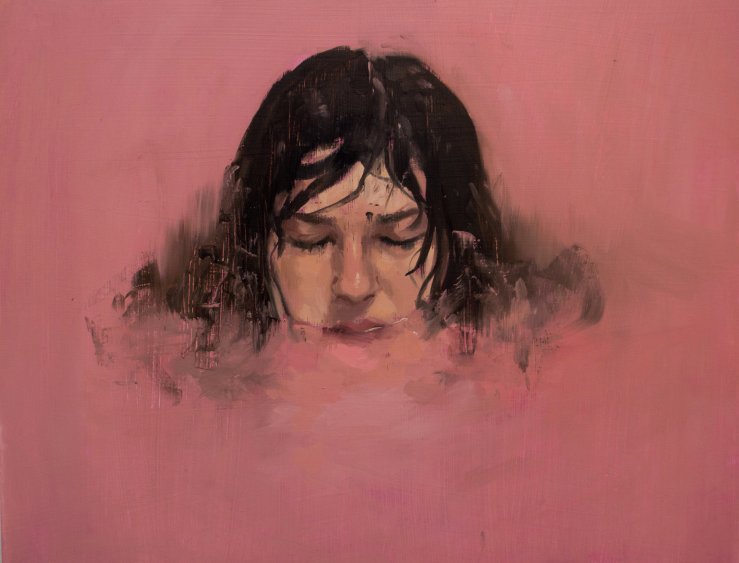
Catherine Graffam (American, 1993–), Head High, Tears Dry, 2015. Oil on wood, 27.9 × 35.5 cm.
Save me, O God!
For the waters have come up to my neck.
I sink in deep mire,
where there is no foothold;
I have come into deep waters,
and the flood sweeps over me.
I am weary with my crying out;
my throat is parched.
My eyes grow dim
with waiting for my God.
. . .
My prayer is to you, O LORD.
At an acceptable time, O God,
in the abundance of your steadfast love answer me in your saving faithfulness.
Deliver me
from sinking in the mire;
let me be delivered from my enemies
and from the deep waters.
Let not the flood sweep over me,
or the deep swallow me up,
or the pit close its mouth over me.
Answer me, O LORD, for your steadfast love is good;
according to your abundant mercy, turn to me.
Hide not your face from your servant,
for I am in distress; make haste to answer me.
This post belongs to the weekly series Artful Devotion. If you can’t view the music player in your email or RSS reader, try opening the post in your browser.
To view all the Revised Common Lectionary scripture readings for Proper 7, cycle A, click here.
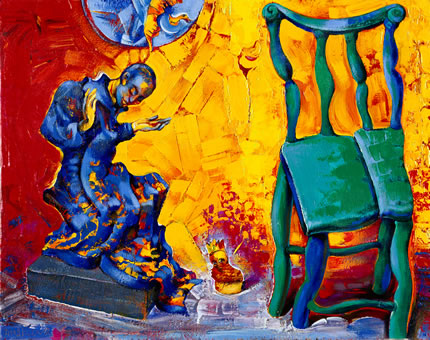
Vladimir Meglić (Croatian, 1955–), Evangelist, 2006. Acrylic on canvas, 63 × 80 cm.
God’s love has been poured into our hearts through the Holy Spirit who has been given to us.
—Romans 5:5b
+++
SONG: “When God Dips His Pen of Love in My Heart” by Cleavant Derricks, 1945
The Rev. Cleavant Derricks (1909–1977) was a gospel songwriter who pastored and directed the choir of a number of black Baptist churches throughout the South. He was inducted into the Gospel Music Hall of Fame in 1984. His song “When God Dips His Pen of Love in My Heart” (sometimes shortened to “When God Dips His Love in My Heart”) was first recorded by the Blackwood Brothers Quartet in 1946. Hank Williams followed that up with his own recording in December 1950—though it wasn’t released until 1985.
The Million Dollar Quartet (Elvis Presley, Jerry Lee Lewis, Carl Perkins, and Johnny Cash) also covered the song during their famous impromptu jam session of 1956, though only in excerpt: they sing it as a lead-in to another Derricks song, “Just a Little Talk with Jesus.” (Listen to the full track here.)
For a great gospel-style rendition, here’s a 1984 recording by Albertina Walker and the Christ Universal Temple Ensemble:
This post belongs to the weekly series Artful Devotion. If you can’t view the music player in your email or RSS reader, try opening the post in your browser.
To view all the Revised Common Lectionary scripture readings for Proper 6, cycle A, click here.
INTERVIEW:“Singing the Songs of Injustice” with David M. Bailey and W. David O. Taylor: David Bailey is the director of the reconciliation ministry Arrabon and founder of its music-making and liturgical resource arm, Urban Doxology, and David Taylor is an assistant professor of theology and culture at Fuller Theological Seminary. In this conversation the two men discuss how “biblical, angry, congregational worship can help transform our hearts and churches.” “God has given us the psalms to be an ‘anger school’ for us and I’ve discovered that when we skip class, we aren’t emotionally equipped to deal with difficult stuff we’re experiencing now,” Taylor says. “The extraordinary gift of the psalms is that they show us how to pray angry prayers without being overcome by our anger, how to hate without sinning (to borrow from Saint Paul’s language), or, as Eugene Peterson once put it, how to ‘cuss without cussing.’”
Bailey and Taylor talk about the constant simmer of race relations in America, faithful versus unfaithful expressions of anger, the language of “enemy” in the Psalms, the importance of lament in Sunday gatherings and the need for language that expresses the horizontal aspects of what it means to be a Christian, and leading without moderation during turbulent times.
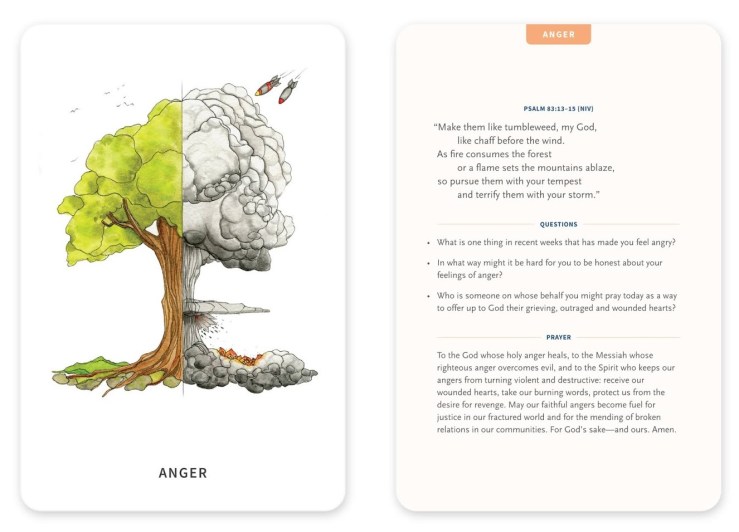
The Psalms of Anger: Prayer Card (illustration by Phaedra Taylor)
Taylor’s latest book, Open and Unafraid: The Psalms as a Guide to Life, contains a chapter on “The Psalms of Anger.” Read an excerpt here, or view this video talk. To coincide with the release in March, he and his wife Phaedra created a set of fifteen prayer cards. His prayer on the “Anger” card reads, “To the God whose holy anger heals, to the Messiah whose righteous anger overcomes evil, and to the Spirit who keeps our angers from turning violent and destructive: receive our wounded hearts, take our burning words, protect us from the desire for revenge. May our faithful angers become fuel for justice in our fractured world and for the mending of broken relations in our communities. For God’s sake—and ours. Amen.”
“I Just Wanna Live” by Johnnetta Bryant, performed by Keedron Bryant: Twelve-year-old gospel singer Keedron Bryant posted a video on Instagram last week of himself singing a song his mom wrote in response to the killing of George Floyd. “God gave me those lyrics” for Keedron, she said in a joint interview on Today. Keedron said he prayed the song, meditated with it, then hit record. It’s a heart-baring, heartbreaking lament, a plea for divine protection in a world that is especially dangerous for young black males.
“It Is Enough!” by R. DeAndre Johnson: R. DeAndre Johnson is the pastor of music and worship life at Christ Church Sugar Land outside Houston. He wrote the lyrics for “It Is Enough!” in July 2016 following the deaths of Alton Sterling and Philando Castile but hadn’t set them to music until now. The nine verses bear the refrain “Kyrie eleison” (Lord, have mercy!), or “Christe eleison” (Christ, have mercy!), a common cry of lament. “There are no words that can contain / The depth of sorrow, grief, and pain / That mothers, sons, and all exclaim: / Kyrie eleison!” Johnson sang the song for his church’s livestreamed service on May 31. A lead sheet is available on his Facebook page. [HT: Global Christian Worship]
“I Want Jesus to Walk with Me”: Sharon Irving is a singer-songwriter, spoken-word artist, and worship leader from Chicago who was also a semifinalist on season 10 of America’s Got Talent. In this video from 2015 she sings a spiritual that expresses deep sorrow—“When my strength is failing,” “When my heart is aching,” “When my life feels like a burden”—but also trust in the companionship of Christ, who walks with us through valleys of death. Having likely originated as an improvisation, the song has several lyrical variations and can be easily adapted to voice a range of feelings: “In my rage,” “In my frustration,” “In my exhaustion,” “In my confusion,” etc.
“O This Night Is Dark” by Tom Wuest: Last Sunday my congregation sang Isaac’s Wardell’s setting of Psalm 126 [previously], whose refrain is “Although we are weeping, Lord, help us keep sowing the seeds of your kingdom . . .” Seeds of love, truth, justice, hope. I just learned that Wardell’s song was inspired by Tom Wuest’s “O This Night Is Dark,” released in 2008 on Rain Down Heaven. In addition to Psalm 126, Wuest’s song also references 1 Corinthians 15, Isaiah 2, Amos 9, and Isaiah 65.
And this week as I was listening to the song, the following image by Scott Erickson showed up on my Instagram feed, with the caption “If one part suffers, all the parts suffer with it” (1 Cor. 12:26).
Scott Erickson (American, 1977–), The Sorrowful Saint, 2016
Erickson painted the image in July 2016 in response to the fatal shootings of Sterling and Castile. It suggests that tears of grief can be generative, that new life can rise out of death. That’s not at all to say that death is good because it catalyzes a movement of change, but that our mourning the evils of racism and murder, our publicly crying out “Enough!,” is not fruitless, though it often seems so. Growth will come.
+++
VIDEO ART: Weight by André Daughtry: “Weight is an attempt to visualize societal projections on the black male body,” writes André Daughtry, a Brooklyn-based interdisciplinary photography and media artist, writer, and performer. The piece is from 2014, and last year PBS’s AllArts station commissioned Daughtry to restage it in New York City as part of a larger video work. [HT: ImageUpdate]
Daughtry has a master’s degree in theology and the arts from Union Theological Seminary and serves as community minister of the arts at Judson Memorial Church, which has a long history of nurturing artists. “We believe that artists have the potential to serve as our modern-day prophets,” the church website reads. “They show us where we’ve been, who we are, and what we can become.”
+++
PODCAST EPISODE: “The SPU Conversation About Spike Lee Films,”North by Pacific Northwest: In this Seattle Pacific University conversation released April 11, 2019, two cinephiles, Jeffrey Overstreet and Josh Hornbeck, discuss some of the films of writer-director Spike Lee, “the boldest and brashest auteur in American film” (Guardian). The first several minutes, though, are spent decrying the then recent Oscar win of Green Book, which popular audiences loved but critics were generally sour on because it perpetuates the simplistic and ultimately false notion that to solve racism, white people just need to realize that “we’re all the same” and find a black friend.
Best known for Do the Right Thing (1989), Lee is one of several filmmakers they cite who deals with race in more complex ways, and while some people dismiss him as an “angry black man,” many celebrate him for forcing audiences to reckon with the problem of racism. “I think there should be rage inside of every conscious human being in the world, because there’s stuff that’s just not right,” he said in a 2000 interview. “Anger can be constructive.” Lee’s films are heavy-handed, in-your-face; they shout and unsettle. Heavy-handedness usually makes for bad art, but Overstreet and Hornbeck show how the approach works for Lee.
Starting at 16:44, they focus on the satirical comedy-drama Bamboozled (2000), which joined the prestigious Criterion Collection just this March. (It’s also been the subject of much scholarly study across fields, one instance I’ve come across being an essay by art theorist W. J. T. Mitchell, titled “Living Color: Race, Stereotype, and Animation in Spike Lee’s Bamboozled,” in What Do Pictures Want? The Lives and Loves of Images.) “Under pressure to help revive his network’s low rating, television writer Pierre Delacroix (Damon Wayans) hits on an explosively offensive idea: bringing back blackface with The New Millennium Minstrel Show. The white network executives love it, and so do audiences, forcing Pierre and his collaborators to confront their public’s insatiable appetite for dehumanizing stereotypes.”
From 25:54 onward, Overstreet and Hornbeck discuss more generally their passion for cinema and the importance of revisiting films.
People have been expressing frustration that The Help, a civil rights era drama that sidelines the perspectives of its black characters, is the number one most-streamed movie on Netflix right now. Film critic Alissa Wilkinson gives a list of fifteen movies to watch instead on racial injustice and being black in America. A mix of dramas and documentaries by such filmmakers as Barry Jenkins, Ava DuVernay, Spike Lee, and others, these are black-centered stories that help illuminate where we’re at right now. All are available for online streaming, and Wilkinson provides links to her reviews.
Fr. A. J. Thamburaj, SJ (Indian,, 1939–), The Holy Trinity, before 1982. Oil painting, 23 × 33 in.
The grace of the Lord Jesus Christ and the love of God and the fellowship of the Holy Spirit be with you all.
—2 Corinthians 13:14
+++
SONG: “Om Bhagwan” | Song from the Saccidananda Ashram songbook, composer unknown | Arranged by Chris Hale and Miranda Stone | Performed by Yeshu Satsang Toronto, on Bhakti Geet, vol. 4 (2019)
This Trinitarian song in Hindi comes from a Benedictine monastery in Tamil Nadu. It is performed here by married couple Chris Hale (who grew up in Nepal and India) and Miranda Stone and others from Yeshu Satsang Toronto, a community whose expression of Yeshu Bhakti (Jesus devotion) is “distinctly urban and Canadian, yet informed by the simplicity of the village, honouring what is handmade, humble, and real . . . , navigating . . . between what is traditional and what is progressive.” A transliteration, with English translation, follows. The sacred syllable Om, or Aum, isn’t really translatable.
Om Bhagawan, Om Bhagawan, Om Bhagawan, Prabhu Pita Bhagawan
Om God, Om God, Om God, Lord Father God
Om Bhagawan, Om Bhagawan, Om Bhagawan, Prabhu Putra Bhagawan
Om God, Om God, Om God, Lord Son God
Om Bhagawan, Om Bhagawan, Om Bhagawan, Prabhu Aatma Bhagawan
Om God, Om God, Om God, Lord Spirit God
Om Bhagawan, Om Bhagawan, Om Bhagawan, Prabhu Yeshu Bhagawan
Om God, Om God, Om God, Lord Jesus God
Painted by the Jesuit artist-priest Father A. J. Thamburaj, The Holy Trinity expresses a complex theological doctrine through mudras (Indian hand gestures) and color. I scanned the image from the excellent book Christian Art in India by Herbert E. Hoefer (Chennai: Gurukul Lutheran Theological College and Research Institute, 1982), which features art by thirty-five artists and essay contributions by Jyoti Sahi. Hoefer describes the painting:
Green is the colour of creativity and fertility. Red is the colour of activity. Blue is the colour of the sea and sky, symbols of mystery and eternity. Yellow [saffron] is an auspicious and joyful colour in Indian custom.
The upraised hand [abaya mudra] is a symbol of protection in Indian art and dance. It represents the Father. Its message is ‘Fear not’. The fish denotes the ever-watching eye of God, for the eyelids of the fish never close.
The downward hand [varada mudra] represents Christ. This gesture is common in Indian sculpture and dance. God is said to point his devotees to hide under the arch of his foot for refuge. The red wound reminds us that the risen Lord bears the redemptive marks of the crucifixion.
The red hand symbolizes the purifying fire, the Holy Spirit. The spiral line indicates the wind, connecting all three Persons in unity. Fire and wind are power.
Our life is in the ever-present protecting, redeeming, purifying and empowering hands of the Triune God.
+++
In the church’s year, Trinity Sunday is the day when we stand back from the extraordinary sequence of events that we’ve been celebrating for the previous five months—Advent, Christmas, Epiphany, Lent, Good Friday, Easter, Ascension, Pentecost—and when we rub the sleep from our eyes and discover what the word “god” might actually mean. These events function as a sequence of well-aimed hammer-blows which knock at the clay jars of the gods we want, the gods who reinforce our own pride or prejudice, until they fall away and reveal instead a very different god, a dangerous god, a subversive god, a god who comes to us like a blind beggar with wounds in his hands, a god who comes to us in wind and fire, in bread and wine, in flesh and blood: a god who says to us, “You did not choose me; I chose you.”
You see, the doctrine of the Trinity, properly understood, is as much a way of saying “we don’t know” as of saying “we do know.” To say that the true God is Three and One is to recognize that if there is a God then of course we shouldn’t expect him to fit neatly into our little categories. If he did, he wouldn’t be God at all, merely a god, a god we might perhaps have wanted. The Trinity is not something that the clever theologian comes up with as a result of hours spent in the theological laboratory, after which he or she can return to announce that they’ve got God worked out now, the analysis is complete, and here is God neatly laid out on a slab. The only time they laid God out on a slab he rose again three days afterwards.
On the contrary: the doctrine of the Trinity is, if you like, a signpost pointing ahead into the dark, saying: “Trust me; follow me; my love will keep you safe.” Or, perhaps better, the doctrine of the Trinity is a signpost pointing into a light which gets brighter and brighter until we are dazzled and blinded, but which says: “Come, and I will make you children of light.” The doctrine of the Trinity affirms the rightness, the propriety, of speaking intelligently that the true God must always transcend our grasp of him, even our most intelligent grasp of him.
This post belongs to the weekly series Artful Devotion. If you can’t view the music player in your email or RSS reader, try opening the post in your browser.
To view all the Revised Common Lectionary scripture readings for Trinity Sunday, cycle A, click here.


.jpg)





 Art & Theology