Not only are humans tired and stressed and in need of deliverance; so is the environment. Today’s two featured works function as a call to care for the earth—the one a performative enactment of said care, tender and consoling, and the other an urgent lament by choir.
The gospel is for more than just humanity; it’s for all the earth—animals and insects, plants and soil, skies and oceans. All creation groans for redemption, Paul says in his letter to the early church in Rome. And in the final book of the Bible, John the Revelator’s vision is of the whole world renewed.
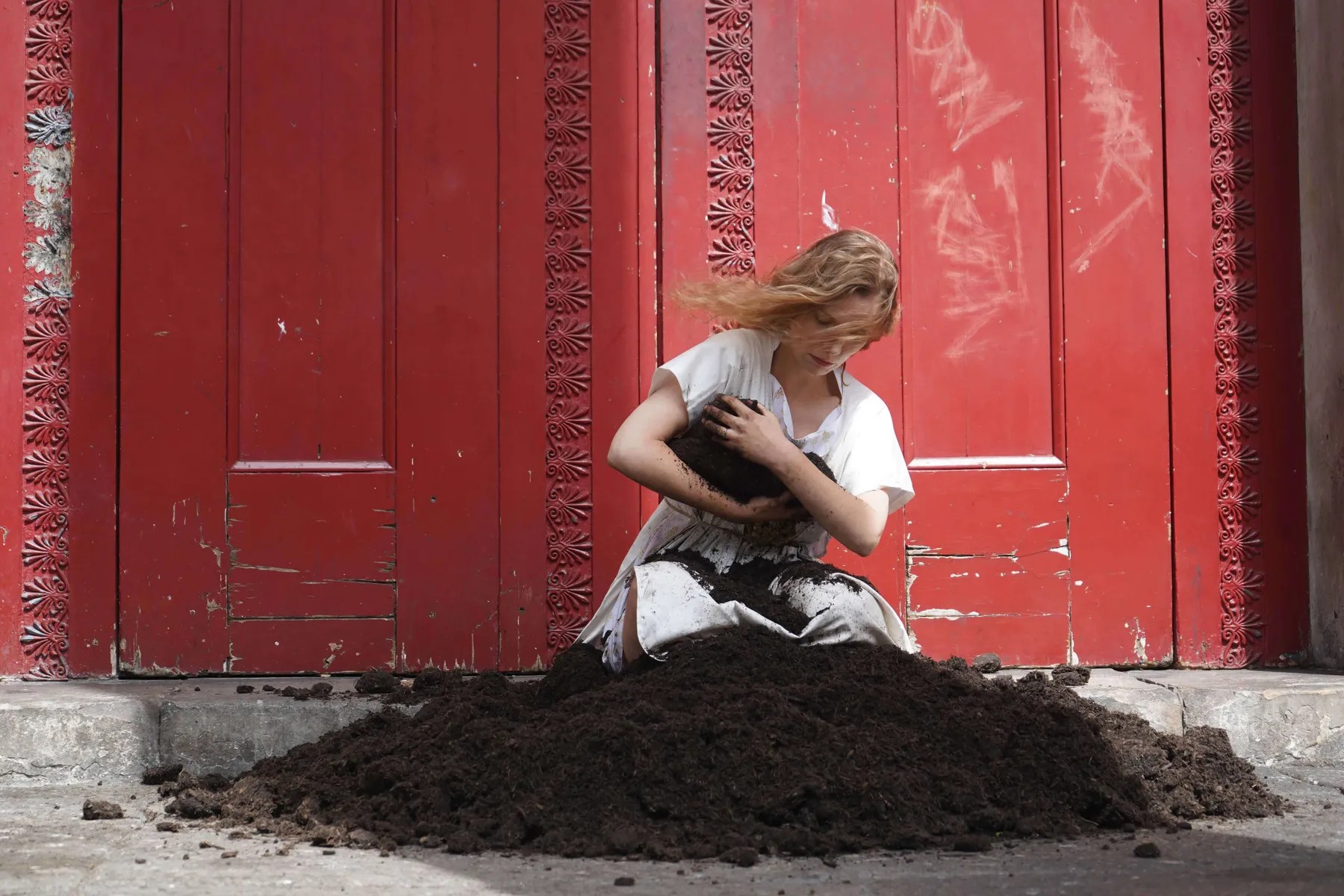
LOOK: Earth Rite by Holly Slingsby
Holly Slingsby (British, 1983–), Earth Rite, performance at St Pancras Church, London, July 6, 2024. Duration: 1 hour. Photo: Adam Papaphilippopoulos.
Artist Holly Slingsby’s Earth Rite premiered at the Ritual/Bodies live performance event that took place at St Pancras Church in London on July 6, 2024, organized by Dr. Kate Pickering. It was one of eight performance works by eight different artists (one work was by two performers; two works were by one) that collectively spanned some three hours, followed by a ninety-minute panel discussion.
In Earth Rite, “a solo performer sits atop a mound of earth, cradling it in her arms. The earth slips away only to be regathered, in a continuous act of generating, losing, and regenerating.” Charles Pickstone, an Anglican priest, reviewed the work in the Autumn 2024 issue of Art + Christianity journal, writing:
Holly Slingsby, in a loose white dress, sat on the church steps on a mound of rich soil, arms folded in embrace. Where one might have expected a baby, the artist was embracing armfuls of soil, constantly replenishing her burden as the soil slipped away from her. Part earth mother, part mourner, on the edge of the busy and noisy Euston Road, the artist made what could have been rather a moralistic revisiting of a well-known theme (compare William-Adolphe Bouguereau’s Charity, perhaps an influence on this work) into a courageous and compelling glimpse of the earth’s abused and vulnerable soil.
Slingsby reprised the performance on September 27, 2025, at the International Forum of Performance Art in Drama, Greece.
LISTEN: “Kasar mie la Gaji” (The Earth Is Tired) by Alberto Grau, 1987 | Performed by Stellenbosch University Choir, dir. André van der Merwe, 2024
“Kasar mie la gaji” is a Hausa saying from the Sahel region of Africa that means roughly “The earth is tired.” In 1987 leading contemporary Venezuelan composer Alberto Grau (b. 1937) set it to music, creating a magnetic choral composition for, in his words, “an international mobilization to save THE EARTH.”
In their performance notes, the Stellenbosch University Choir from South Africa writes: “The composition is designed on hypnotic repetition, with a steady reiteration of the text. Plaintive glissandos and layered ostinato patterns create a compelling chant, begging for justice and rebirth.”
Kathy Romey, the director of choral activities at the University of Minnesota, offers further description:
The work is broken into three distinct sections, of which the first and third incorporate short melodic motives combined with rhythms from traditional South American dance music intensified by clapping and stomping. The middle section is a slow lament and utilizes various special effects for a cappella chorus, including glissandi, whispering, talking, and hissing.
Why is the earth tired? Because we are depleting her resources. We are disrupting her ecosystems. The carbon emissions from our burning of fossil fuels for energy and transportation are trapping heat in her atmosphere and causing extreme weather.
Lord, have mercy. Please help us restore our planet to health and treat her with respect, recognizing that she, as part of your creation, is precious to you.
Then the angel showed me the river of the water of life, bright as crystal, flowing from the throne of God and of the Lamb through the middle of the street of the city. On either side of the river is the tree of life with its twelve kinds of fruit, producing its fruit each month, and the leaves of the tree are for the healing of the nations.
—Revelation 22:1–2
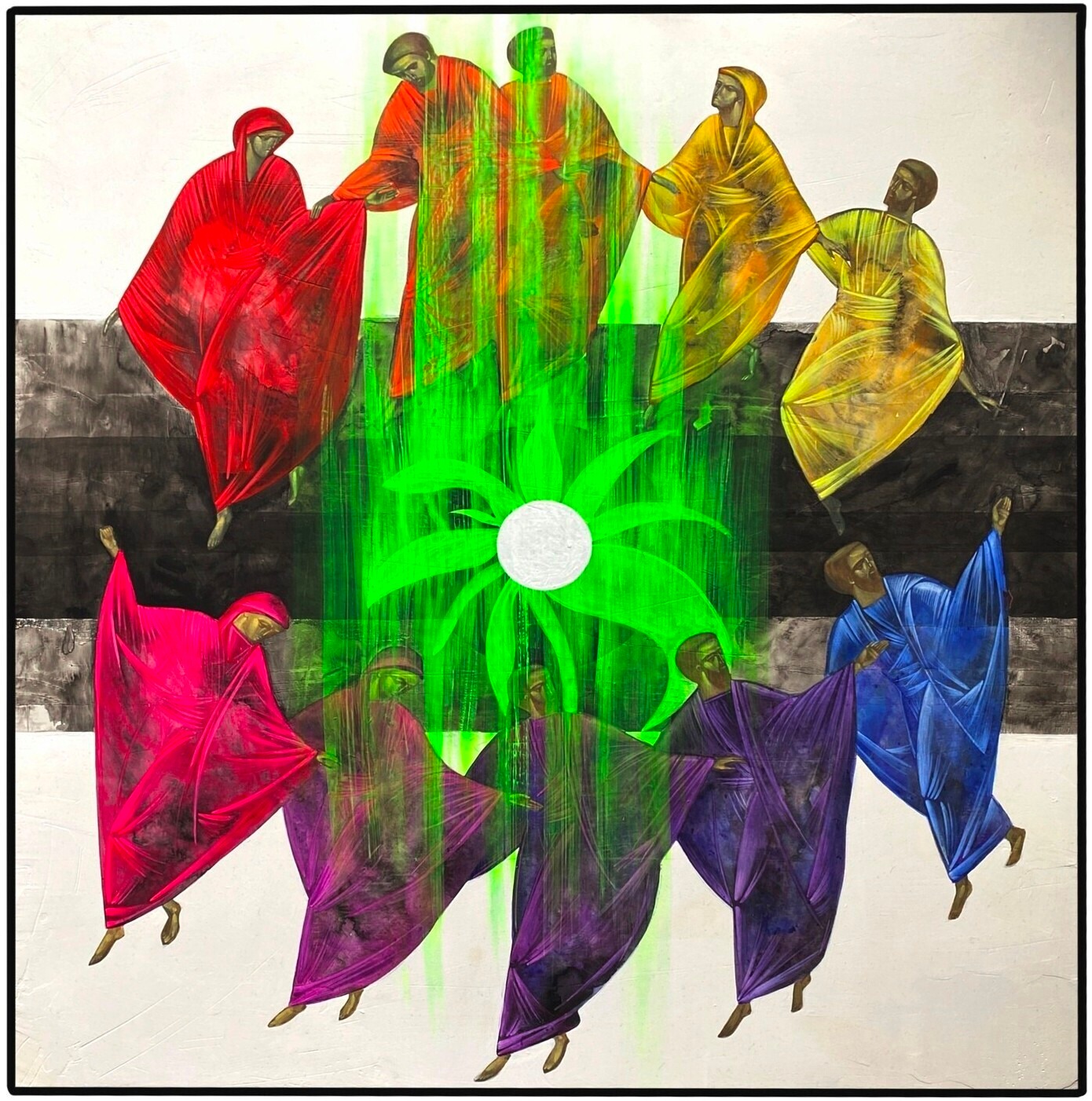
LOOK: Tree of Life by Kateryna Shadrina
Kateryna Shadrina (Ukrainian, 1995–), Tree of Life, 2022. Acrylic on gessoed wood, 60 × 60 cm.
For the healing of the nations, God, we pray with one accord; for a just and equal sharing of the things that earth affords; to a life of love in action help us rise and pledge our word.
Lead us forward into freedom; from despair your world release, that, redeemed from war and hatred, all may come and go in peace. Show us how through care and goodness fear will die and hope increase.
All that kills abundant living, let it from the earth be banned; pride of status, race, or schooling, dogmas that obscure your plan. In our common quest for justice may we hallow life’s brief span.
You, Creator God, have written your great name on humankind; for our growing in your likeness bring the life of Christ to mind, that by our response and service earth its destiny may find.
ONLINE DISCUSSION: “Poems of Advent, Christmas, and Epiphany” led by Brian Volck,December 13, 2025, 12–1:30 p.m. ET: Poet Brian Volck (whose work I’ve shared here and here) is leading a free online discussion on Advent, Christmas, and Epiphany poetry next Saturday. Sponsored by the Ekklesia Project, it will bring together diverse poetic styles and voices. “Each poem is read by a volunteer and then the group discusses what stood out, what struck them, and what questions the poem raises,” Volck says. “My goal is to encourage a diversity of responses rather than impose mine. No preparation is required.” Register here to receive the Zoom link and the poems in advance.
+++
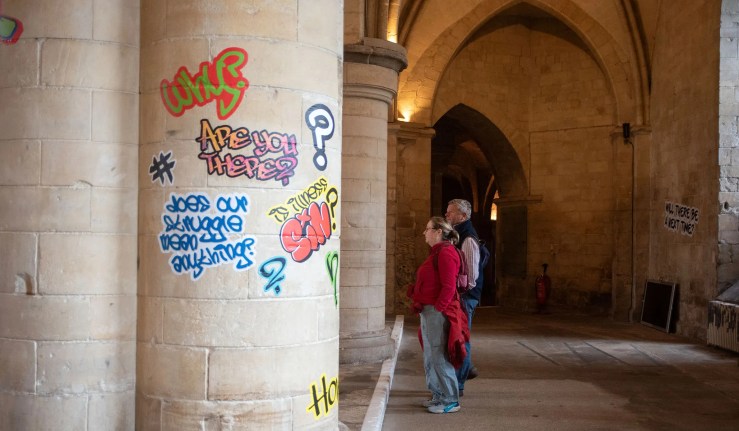
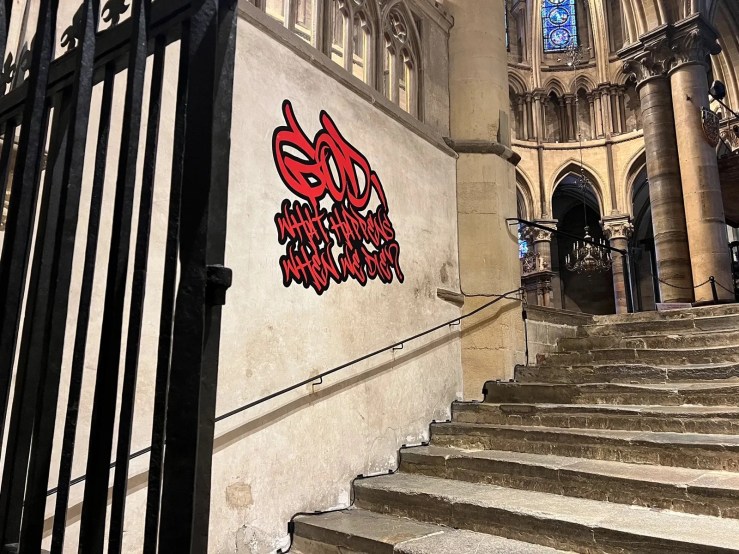
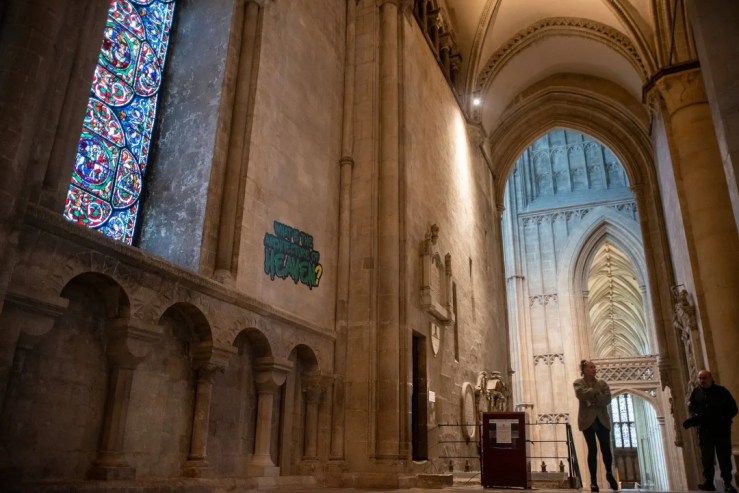
INSTALLATION: Hear Us, Canterbury Cathedral, October 17, 2025–January 18, 2026: Graffiti-style stickers are affixed to the medieval walls, floors, and pillars of England’s Canterbury Cathedral in the temporary installation Hear Us, voicing questions to God collected from local marginalized individuals, such as:
Why is there so much pain and destruction?
Is this all there is?
Are you there?
Does everything have a soul?
Do you ever regret your creations?
How do I break the cycle?
Does our struggle mean anything?
How is my dog Bear doing?
God, do you know me?
Photo: Krisztian Elek
Photo courtesy of Canterbury Cathedral
Photo: Krisztian Elek
Curator Jacquiline Creswell [previously], collaborating with poet Alex Vellis, organized a series of workshops led by artists Sven Stears, Henry Madd, Jasbir Dhillon, Adam Littlefield, Alice Gretton, and Callum Farley, which invited people who felt the cathedral was not for them to gather together and delve into discussions about their lives, experiences, and aspirations. Among the participants were members of the Black and Brown diasporas, LGBTQIA+ people, neurodivergent people, people in addiction recovery, and people with mental health disorders. They were asked to respond to the prompt “If you could ask God a question, what would it be?”
Many of the responses were then translated into big, colorful word graphics that cannot be overlooked. “All of the questions are prayers. All of the questions are already sacred,” Vellis says. “So by putting the questions into an already existent sacred space, we are saying you are valid, your words are valid, your prayers are in a place in which they can be heard and they can be seen and they can be supported.”
I learned about this installation from the Exhibiting Faith podcast’s interview with Creswell and Vellis—an episode I heartily commend. They explain how the exhibition was developed, how they persuaded the cathedral to agree to it, and how they have dealt with the storm of criticism it has generated. Many have called it an act of vandalism (even though the stickers were authorized by the dean and will leave no trace when they’re removed next month) and irreverence, desecration. US Vice President JD Vance said the exhibition “mak[es] a beautiful historical building really ugly,” and Elon Musk called it a “suiciding” of Western culture.
I have not seen the exhibition in person, and I am neither British nor Anglican, so I don’t possess the same sense of my identity or heritage being threatened that many Church of Englanders have expressed. But I personally like the confrontational clash of aesthetics: traditional juxtaposed with modern; majestic Gothic architecture, staid limestone, garishly “spray-painted” in a street style, bringing contemporary spiritual and theological questions into a nearly millennium-old church building. I also like the concept of amplifying rather than diminishing the voices of those who feel marginalized by the church but who still want to engage, who are curious—bringing their questions into the space where we gather as a community of Christ followers and using them as a portal into further faith conversations, as Creswell put it in a media interview.
+++
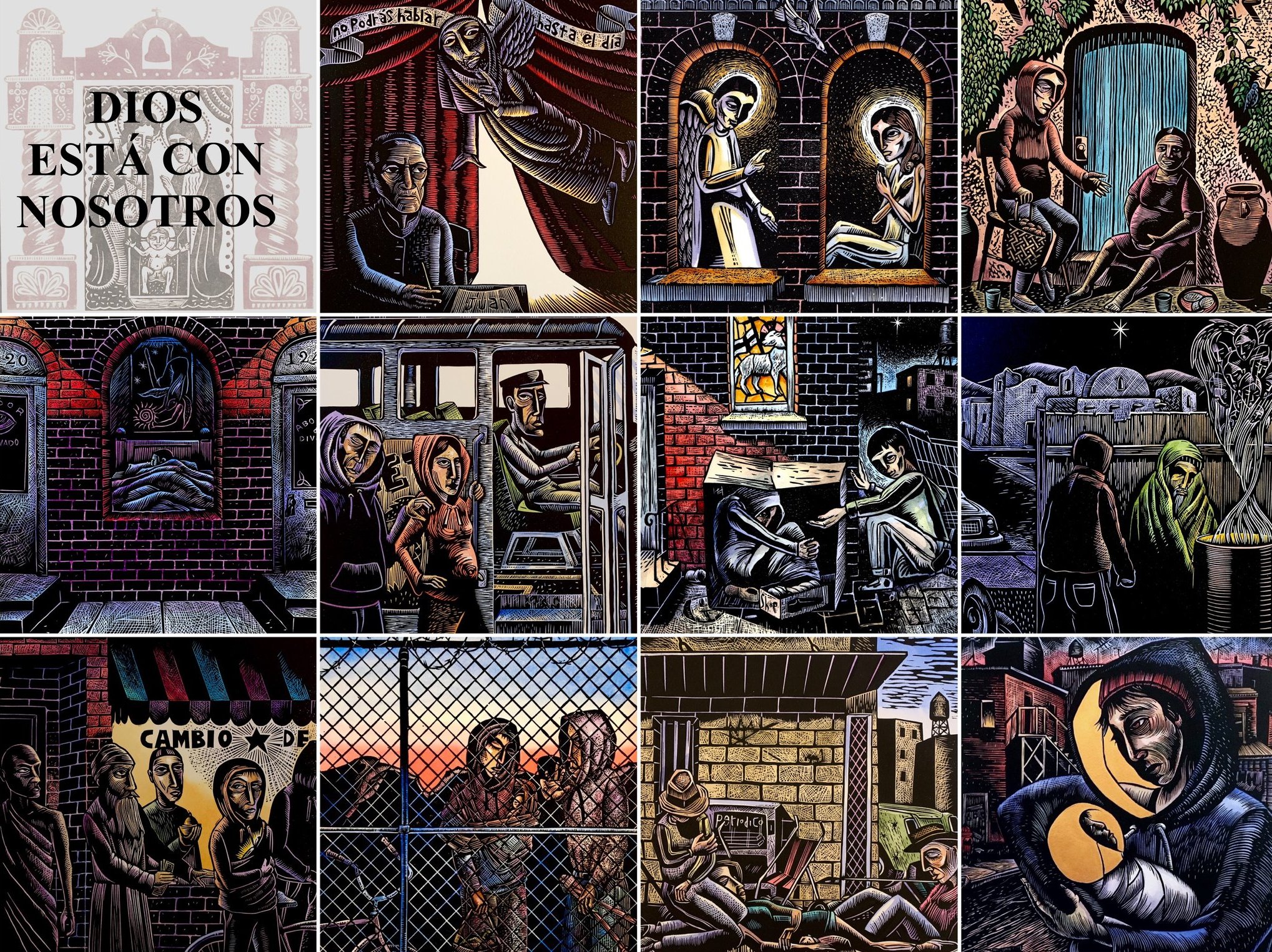
BLOCKPRINT SERIES: Dios con Nosotros (God with Us) by Kreg Yingst:Kreg Yingst [previously] is my favorite contemporary printmaker working on religious themes. Last December he shared a series of hand-colored linocut prints that he started in 2019 and that is ongoing, collectively titled Dios con Nosotros (God with Us)—“a modern-day American Christmas story which takes place somewhere south of the U.S. border,” he writes.
>> “Un Cuento de Navidad” (A Song of Christmas): This original song by Adrian Roberto and Melissa Romero is about a town that had lost its wonder—until a child discovered a Bible, and his reading aloud its story of a Savior sparked revival.
>> “What Child Is This / Child of the Poor”: The Hound + The Fox are Reilly and McKenzie Zamber, a husband-wife musical duo from Oregon. This song of theirs interleaves the classic Christmas carol “What Child Is This” by William Chatterton Dix with a 2008 song by Scott Soper that emphasizes Christ’s solidarity with the poor.
Here are the lyrics to Soper’s “Child of the Poor”:
Helpless and hungry, lowly, afraid, Wrapped in the chill of midwinter; Comes now, among us, born into poverty’s embrace, New life for the world.
Who is this who lives with the lowly, Sharing their sorrows, Knowing their hunger? This is Christ revealed to the world In the eyes of a child, a child of the poor.
Who is the stranger here in our midst, Looking for shelter among us? Who is the outcast? Who do we see amidst the poor, The children of God?
So bring all the thirsty, all who seek peace; Bring those with nothing to offer. Strengthen the feeble; Say to the frightened heart, “Fear not: here is your God!”
>> “Everybody Ought to Treat a Stranger Right”: Arranged and expanded by Dan Damon [previously], this traditional blues song is performed here by the Dan Damon Quartet, featuring guest vocalist Sheilani Alix, at a concert at Community Church of Mill Valley in California on December 10, 2023. “Blind Willie Johnson recorded this song in 1930 with two Christmas verses mixed in. I separated them out, added two verses to tell a fuller Christmas story, and recorded the Christmas version with my band on the album No Obvious Angels,” Damon explains. “According to the writer of Hebrews, some have entertained angels unawares.”
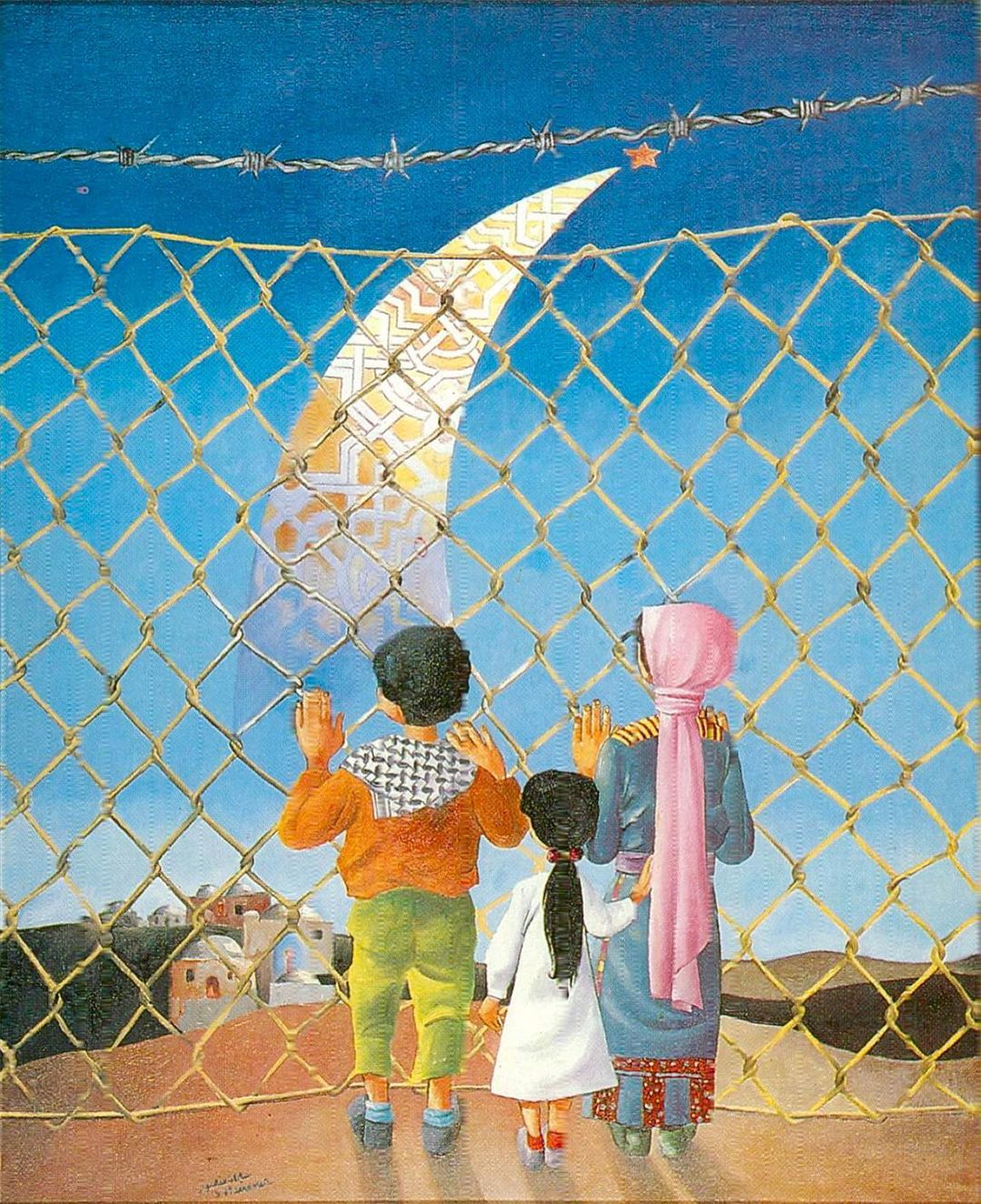
Sliman Mansour (Palestinian, 1947–), The Way to Bethlehem, 1990s. Acrylic on canvas.
LISTEN: “Bethlehem” by Jack Henderson | Performed by Over the Rhine, feat. Jack Henderson, on Blood Oranges in the Snow (2014)
Oh little town of Bethlehem Have you been forsaken? In your dark and dreamless sleep Your heart is breaking And in your wounded sky The silent stars go by
Oh little town of Bethlehem Be still tonight, be still
Mary, she was just a kid Jesus was a refugee A virgin and a vagabond Yearning to be free Now in the dark streets shining Is their last chance of a dream
Oh little town of Bethlehem Be still tonight, be still
Cradled by a crescent moon Born under a star Sometimes there’s no difference Between a birthmark and a scar
Oh little town of Bethlehem With your sky so black May God impart to human hearts The wisdom that we lack Should you chance to find A hope for all mankind
Oh little town of Bethlehem Be still tonight, be still
Over the Rhine is Karin Bergquist and Linford Detweiler, a married, music-making couple from Ohio. In preparation for their album Blood Oranges in the Snow, they put out a call to a few select colleagues for assistance with the songwriting. Glasgow-based singer-songwriter Jack Henderson responded with a demo of “Bethlehem,” which “reinvents the nativity story as a very modern tale set amid the ongoing Palestinian-Israeli conflict,” he writes. Over the Rhine arranged it, with Henderson singing lead and Bergquist providing backing vocals.
“How ironic that the very birthplace of Jesus should prove to be one of the most conflicted, unpeaceful regions of the world,” Bergquist says. Bethlehem is located in the West Bank, a Palestinian territory that has been under the military occupation of Israel since 1967. Numerous checkpoints have been set up in and around the Bethlehem district to restrict Palestinian movement.
The lyrics to Henderson’s “Bethlehem” pick up lines from the traditional Christmas carol “O Little Town of Bethlehem,” transposing them to the present day and giving them a dark twist. Phrases like “dreamless sleep” and “silent stars,” which in the original carol connote inexpectant slumber and a hushed nighttime idyll, in their new context allude to the nightmare of occupation (unjust arrests and imprisonments, shootings, house demolitions, impoverishment, impeded access to essential services like water and hospitals) and the seeming silence of God. The second verse highlights the Holy Family’s vulnerable status after Herod deployed troops to exterminate Jesus in an attempt to protect his own power.
The refrain, “Be still tonight, be still,” is a prayer for the cessation of violence in the land of Jesus’s birth.
Withdrawing from Kyiv on April 2, 2022, after a lost battle, Russian troops left destruction in their wake. A bullet-riddled car with a flat tire sits abandoned, along with a doll, on the bridge crossing into Irpin, Ukraine. Photo: Franco Fafasuli.
The Russo-Ukrainian war is now in its twelfth year, and it’s been almost four years since Russia’s full-scale military invasion of Ukraine. The devastation is staggering. I can’t even imagine what it must be like to live in a war zone, with bombs, missiles, and gunfire an ever-present threat, part of the everyday background noise. While many photographs have documented the wider destruction and human losses in Ukraine, I was struck by this one by the young Argentine journalist Franco Fafasuli, which focuses not on leveled buildings or intimate griefs but on possessions left behind in the chaos of war: a car, now dotted with dozens of bullet holes, and a plastic-headed baby doll, now covered in grime.
As I reflect on Christ’s coming this Advent season, I think of how he came as a vulnerable child, into a world where people deliberately hurt and kill other people. Then, it was with swords, daggers, spears, arrows, and stones; now we’ve added all manner of firearms and large explosives to our arsenal. That innocent, bald little babe sitting by a deflated tire, suggesting a family with child having suddenly fled their hometown—it looks at me with the eyes of Christ, wondering why we continue to harm each other, but smiling, too, a smile of divine grace. He’s here to show us another way.
LISTEN: “О, Зійди” (Oh, Come Down) by Room for More, 2022
Вся земля cхилилася
Втомлена від боротьби
Зітхаємо у марноті
Бо втратили ми Твій дотик

Заспів:
О, зійди!
Спасе відроди.
Зійди!

Небеса далекі нам
Власний шлях обрали ми
Вся земля чекає на
Спасителя, на мир і спокій

Заспів:
О, прийди!
Царю милості, прийди!
Освіти!
Всім хто в темноті, світи

Небеса схиляються
Являють нам святе Дитя
Земле вся, заспівай
Правдивий Цар, Бог наш з нами

Заспів:
О, радій!
Спас Месія нам родивсь!
О, вклонись!
Царю всіх царів, вклонись!

Бридж:
Підіймай опущені руки
Потішай тих хто відчаєм скуті
Відкриває Син нову
Надію, силу й повноту

Заспів:
О, радій!
Спас Месія нам родивсь!
О, прийми!
Це рятунок твій, прийми!
The whole earth bows down
Weary of the struggle
We sigh in vain
For we have lost your touch

Refrain:
Oh, come down!
Savior, revive
Come down!

The heavens are far from us
We have chosen our own path
The whole earth awaits
The Savior, peace and tranquility

Refrain:
Oh, come!
King of mercy, come!
Enlighten!
Onto all who are in darkness, shine

The heavens bow down
Show us the holy Child
All the earth, sing
The true King, our God is with us

Refrain:
Oh, rejoice!
The Messiah is born to us!
Oh, bow down!
He’s the King of all kings, bow down!

Bridge:
Lift up your hands that hang down
Comfort those who are bound by despair
The Son reveals a new
Hope, strength, and fullness

Refrain:
Oh, rejoice!
The Messiah is born to us!
Oh, accept!
This is your salvation, accept!
The lead singer on “О, Зійди” (Oh, Come Down) is Yaryna Vyslotska. The song was written by Jonathan (Jon) Markey, an American-born minister and musician who grew up as a missionary kid in Ukraine and since 2008 has been a pastor at Calvary Chapel in Ternopil. In 2017 he and his wife Stephanie (Steffie) founded the Ukrainian Christian music collective Room for More.
At Christmas, we celebrate how light entered into darkness. But first, Advent bids us to pause and look, with complete honesty, at the darkness. Advent asks us to name what is dark in the world and in our own lives and to invite the light of Christ into each shadowy corner. To practice Advent is to lean into a cosmic ache: our deep, wordless desire for things to be made right. We dwell in a world shrouded in sin, conflict, violence, and oppression. . . .
Before the delight of Christmas, Advent invites us to a vulnerable place—a place of individual and communal confession where we honestly name unjust systems, cultural decay, sorrow, the sin of the world, and the sin in our own lives. Only by dwelling in that vulnerable place can we learn to profess true hope. Not cheap hope, spun from falsehoods, half-truths, or denial, but a hope offered by the very light that darkness cannot overcome.
Watch therefore: for ye know not what hour your Lord doth come.
—Matthew 24:42 (KJV)
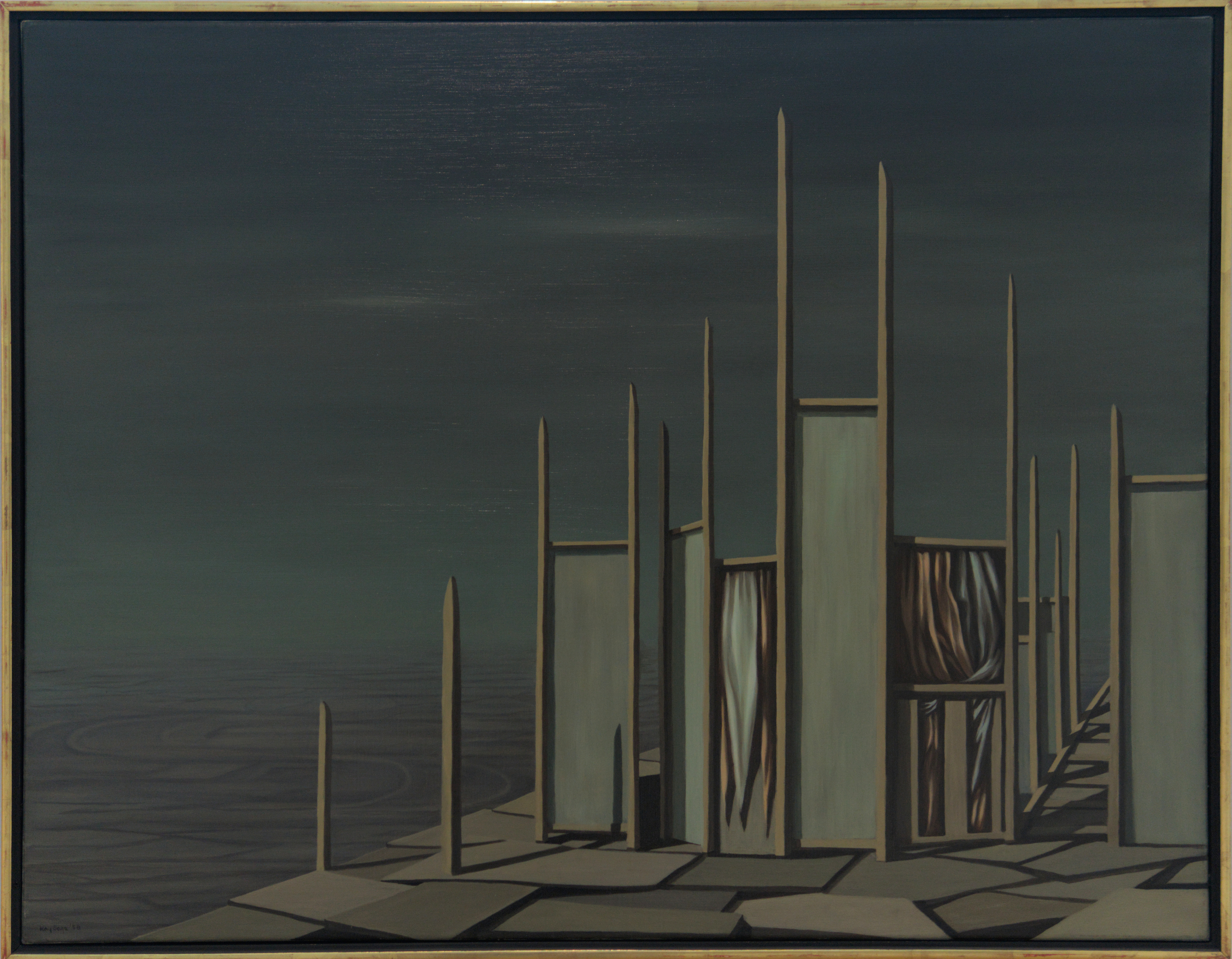
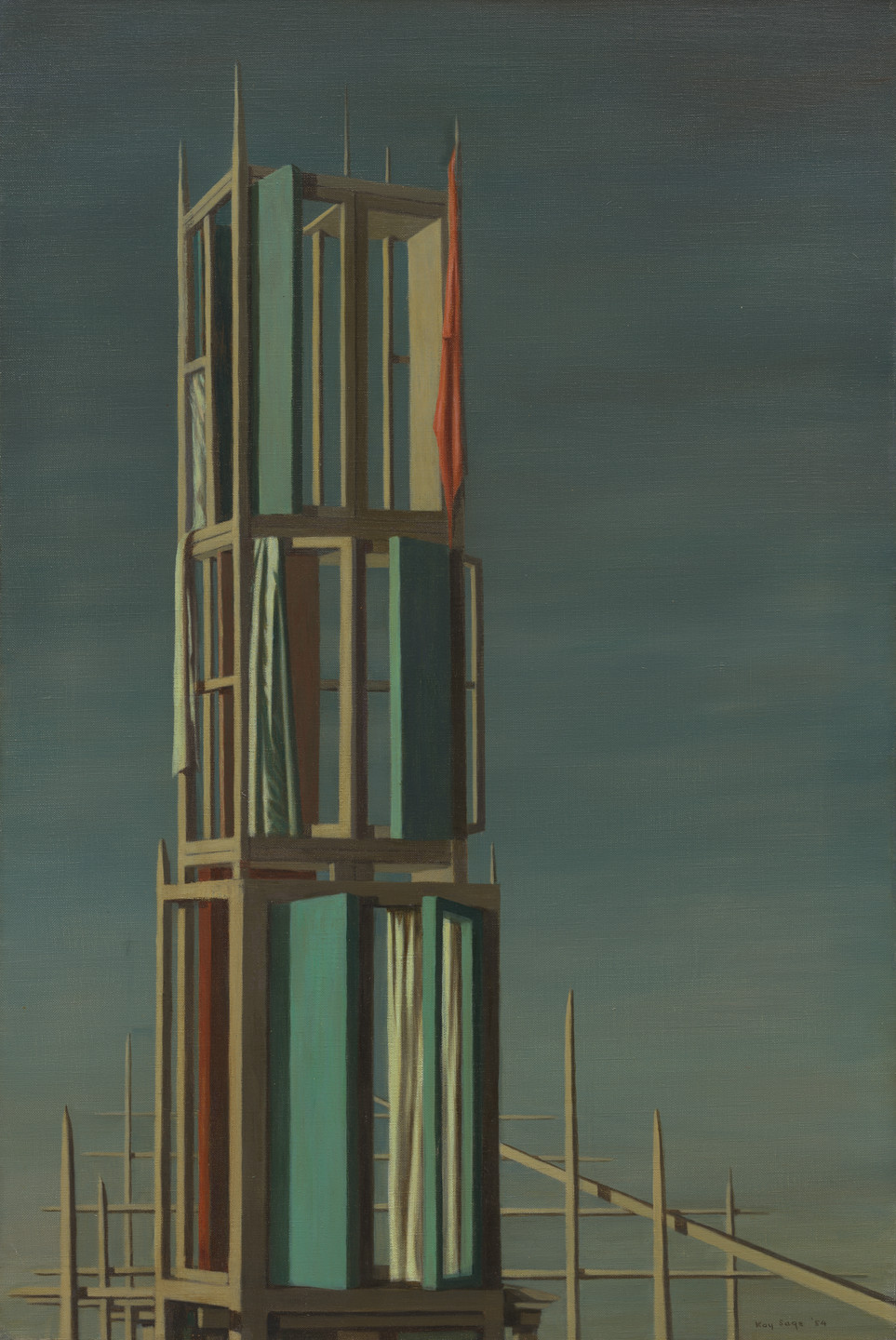
LOOK: Quote-Unquote, Hyphen, and The Point of Intersection by Kay Sage
There’s a wistful quality to the paintings of the midcentury American surrealist artist Kay Sage [previously], which often feature tenuous, draped structures and a distant light in the vast dark. The first work of hers I saw in person was Quote-Unquote, which shows a ragged, exposed architectonic form—is it fallen into disrepair, or incomplete?—whose vertical wood beams pierce the dreary gray sky.
The museum label at the Wadsworth Atheneum reads in part: “Sage’s later paintings featured vertical architectural structures, such as walls and scaffolding, set in otherwise deserted landscapes. These inanimate forms were often draped with plain fabric, as if to suggest a human presence or absence.” The title Quote-Unquote provides little interpretive help. What is being quoted here? Is irony intended?
Painted the same decade, Sage’s Hyphen shows a towering structure of open doors and windows.
And ThePoint of Intersection shows a series of wooden boards and frames standing, slightly diagonal to the viewer, on a ground that recedes into infinity. In the bottom left corner a rumpled sheet or garment lies on a squat platform.
Is the “intersection” of the title between time and eternity, or . . . ?
LISTEN: “Not Knowing When the Dawn Will Come” | Words by Emily Dickinson, ca. 1884 | Music by Jan Van Outryve, 2018 | Performed by Naomi Beeldens (voice) and Jeroen Malaise (piano) on Elysium, Emily Dickinson Project, 2018
Not knowing when the Dawn will come, I open every Door, Or has it Feathers, like a Bird, Or Billows, like a Shore –
This is one of twelve musical settings of Dickinson poems for piano and voice by the Belgian composer Jan Van Outryve. It’s sung by soprano Naomi Beeldens, with Jeroen Malaise on keys.
I’ve always read “Not knowing” as an Advent poem, as promoting a posture of readiness for the coming of Christ—he who is, as we call out in the O Antiphons of late Advent, our Oriens, Rising Sun, Dayspring. Will he come softly, rustling, avian-like, or will he come crashing onto earth’s shore like a wave?
Expecting Dawn’s imminent arrival, the speaker of the poem opens every door, welcoming its light.
From Augustine (Confessions) to Teresa of Ávila (The Interior Castle), the picture-making nunsof St. Walburga’s Abbey in Eichstätt to C. S. Lewis (Mere Christianity), the human heart has long been compared to a house. To open the windows or doors of the heart to Christ is to invite him to come in and dwell there and to transform the place.
Advent commemorates threecomings of Christ: his coming in “history, mystery, and majesty,” as one priest put it. That is, Christ’s coming (1) as a babe in Bethlehem, (2) in the Spirit, to convert, illuminate, equip, and console, and in the bread and wine of the Eucharist, and (3) at the end of time.
Have you opened every door to him? Do you eagerly expect him to arrive—this Christmas (are you telling, singing, enacting the story of his nativity?); into your struggles and brokenness, to companion you and to heal and strengthen; and again on earth, to unite it with heaven and establish, fully and finally, his universal reign?
This is the first post in a daily Advent and Christmastide series that will extend to January 6.I hope you follow along!
ADVENT SERIES: Restful Advent by Tamara Hill Murphy:Tamara Hill Murphy [previously] is one of my favorite spiritual writers, her thoughtful words and curation of resources having served as a well of inspiration for me over the years. Each year, similar to Art & Theology but with the sensibilities and expertise of an Anglican spiritual director, she publishes a new daily Advent and Christmastide guide through her Substack, Restful, running this year from November 30 to January 5. Each post in the series includes lectionary readings, art, music, a prayer, and a simple practice to help us notice God’s presence during these waiting days. This time around, the Daybook will feature excerpts from Claude Atcho’s new book Rhythms of Faith along with ideas from The Liturgical Home by Ashley Tumlin Wallace and some of my own formerly published art commentaries.
“The Daybook is a way to pay attention to Christ’s three arrivals—then, now, and still to come—and to walk through December with a quieter heart and a stronger hope,” Murphy writes.
Murphy is offering Art & Theology readers a 50% discount to Restful using this link, which brings the subscription cost down to $4/month (let it run for two months if you want to receive the full Christmastide Daybook) or $32/year, which will give you access to her year-round content. The offer expires January 5, 2026.
+++
BLOG POST: “The Sacred Journey of Advent” by Ashley Tumlin Wallace, The Liturgical Home: “Advent,” writes Wallace, “is a season of preparation, for the coming of Christ at Christmas, and also for His return in glory at the end of time.” This is a great introduction to the season that kicks off the new church year.
+++
SONGS:
One of the scripture texts of Advent is Isaiah 40:3–5:
A voice cries out: “In the wilderness prepare the way of the LORD; make straight in the desert a highway for our God. Every valley shall be lifted up, and every mountain and hill be made low; the uneven ground shall become level, and the rough places a plain. Then the glory of the LORD shall be revealed, and all flesh shall see it together, for the mouth of the LORD has spoken.”
The Gospel-writers Matthew (3:3), Mark (1:3), and Luke (3:4) all see this exclamatory figure as John the Baptist, who told people to prepare for God’s coming by repenting of sin, since holding on tightly to ways of unlove erects barriers to God’s entry into one’s life. Here are two songs based on this Advent passage.
>> “Prepare the Way” by Maverick City Music and Tribl, feat. Chandler Moore and Siri Worku, on Tribl I (2021): This song repeats, again and again, the Advent mantra “Prepare the way,” embedding John the Baptist’s invitation deeply into hearts and minds. Its tag beseeches Christ to come with the fire of purging, the rain of refreshment, and the oil of blessing. To welcome this coming, this transformation and growth, we need to decenter ourselves, ceding to God the place of primacy, from which he works our good and his glory.
>> “Prepare the Way” by Christopher Walker, on Rise Up and Sing, 3rd ed., vol. 3 (2009): This 1991 song is by Christopher Walker, a church music composer, lecturer, and choral conductor originally from the UK but now living in Santa Monica, California. Published by OCP (Oregon Catholic Press), it would make a great song for a children’s Advent choir.
+++
2018 SERIES: Advent Caravan: Walking with the Holy Family by Sarah Quezada: I learned about Sarah Quezada’s work at the intersection of faith, justice, and culture through Tamara Hill Murphy (see first roundup item) in 2018, when Quezada published a five-part series reflecting on the likelihood that Mary and Joseph traveled to Bethlehem for the census not alone but in a caravan. Interweaving personal story, biblical interpretation, and current events, Quezada considers how the holy couple’s experience in the final months of Mary’s pregnancy connects to the reality of people on the move seeking hope, peace, joy, and love today.
While the series is not hosted online, I received permission from Quezada to reproduce it here.
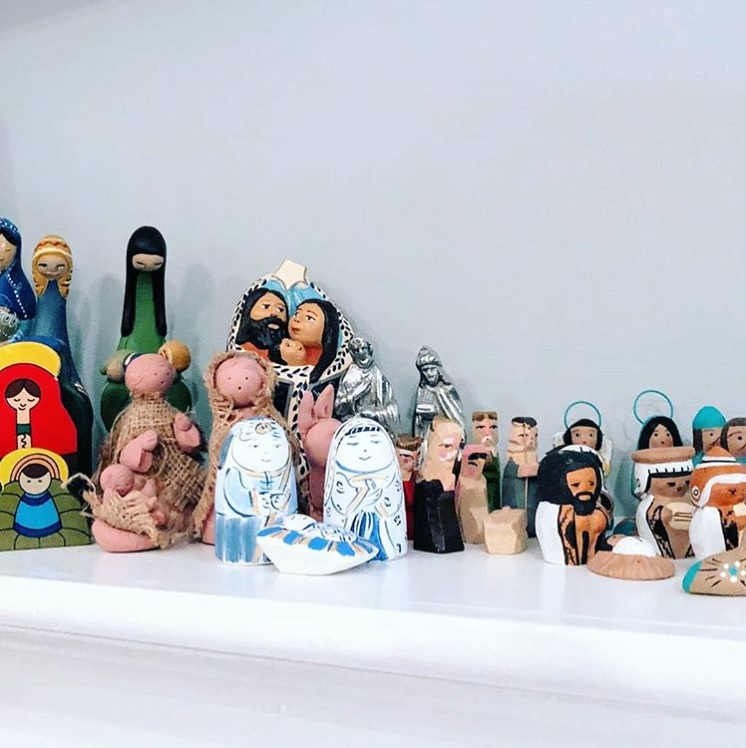
On Instagram, Quezada also shared a photo of her friend’s Advent mantel, where she combined figurines from her various nativity sets to form a “caravan” of travelers.
Photo via @sarahquezada
+++
YOUTUBE PLAYLIST: Jouluradion Hoosianna: Jouluradio is a Finnish radio station that broadcasts annually from November 1 to January 6, playing all Advent and Christmas music. Since 2012, every year they premiere a new arrangement and video performance of the popular Scandinavian Advent hymn “Hoosianna” (Hosanna, an Aramaic expression meaning “Save now!”), which Lutheran and Catholic churches in Finland sing on the first Sunday of the season. Based on Matthew 21:9, its lyrics greet the approaching Christ, affirming his identity and craving the deliverance only he can bring:
Hoosianna, Daavidin Poika,
kiitetty olkoon hän!
Kiitetty Daavidin Poika,
joka tulee Herran nimeen.
Hoosianna, hoosianna,
hoosianna, hoosianna!
Kiitetty Daavidin Poika,
joka tulee Herran nimeen.
Hosanna, Son of David,
Most blessed Holy One,
Hosanna, Son of David,
Who comes in the name of the Lord!
Hosanna, hosanna, hosanna
In the highest!
Hosanna, Son of David,
Who comes in the name of the Lord!
This hymn was written by the German composer, educator, and piano and organ virtuoso Georg Joseph Vogler in 1795 while working in Sweden as court conductor as well as tutor to the crown prince Gustav IV Adolf.
The Jouluradio commissions, which the station has compiled in a YouTube playlist, encompass a range of genres, including jazz, hip-hop, choral, pop, and electronic. Below is a list of previous years’, of which I’ve embedded the two asterisked ones on this page. Jouluradio typically releases their annual “Hoosianna” the day before Advent, so 2025’s will likely be posted this Saturday. [HT: Gracia Grindal]
*2015: Sointi Jazz Orchestra, arr. Jukka Perko (I don’t really understand the narrative in the video. I think the man is remembering a time in his childhood when he got lost in the woods, and then was found by his mother?)
BLOG SERIES: Three excellent, brief musings on the season of Advent by W. David O. Taylor, published last year on his blog:
“Advent is for singing not-Christmas songs”: “This is, of course, easier said than done. Hymnals fail to supply a decent list of options and congregants often clamor for the ‘traditional’ carols, the songs of triumphant appearance and glorious coming. Yet this insistence fights against the dominant concern of the Gospels. Luke especially spends the bulk of his story anticipating Christ’s birth rather than narrating his arrival. The dramatic tension lies in what’s to come—not in what’s happened already . . .”
“Advent is about the goodness of divine interruptions”: “The entire story of Advent is a story of interruptions. . . . May we, like the actors in God’s divine nativity drama, have eyes to see and hearts to welcome his interrupting work in our lives. May we trust that he wills our deepest good in these interruptions. May we be blessed in our trust in him.”
+++
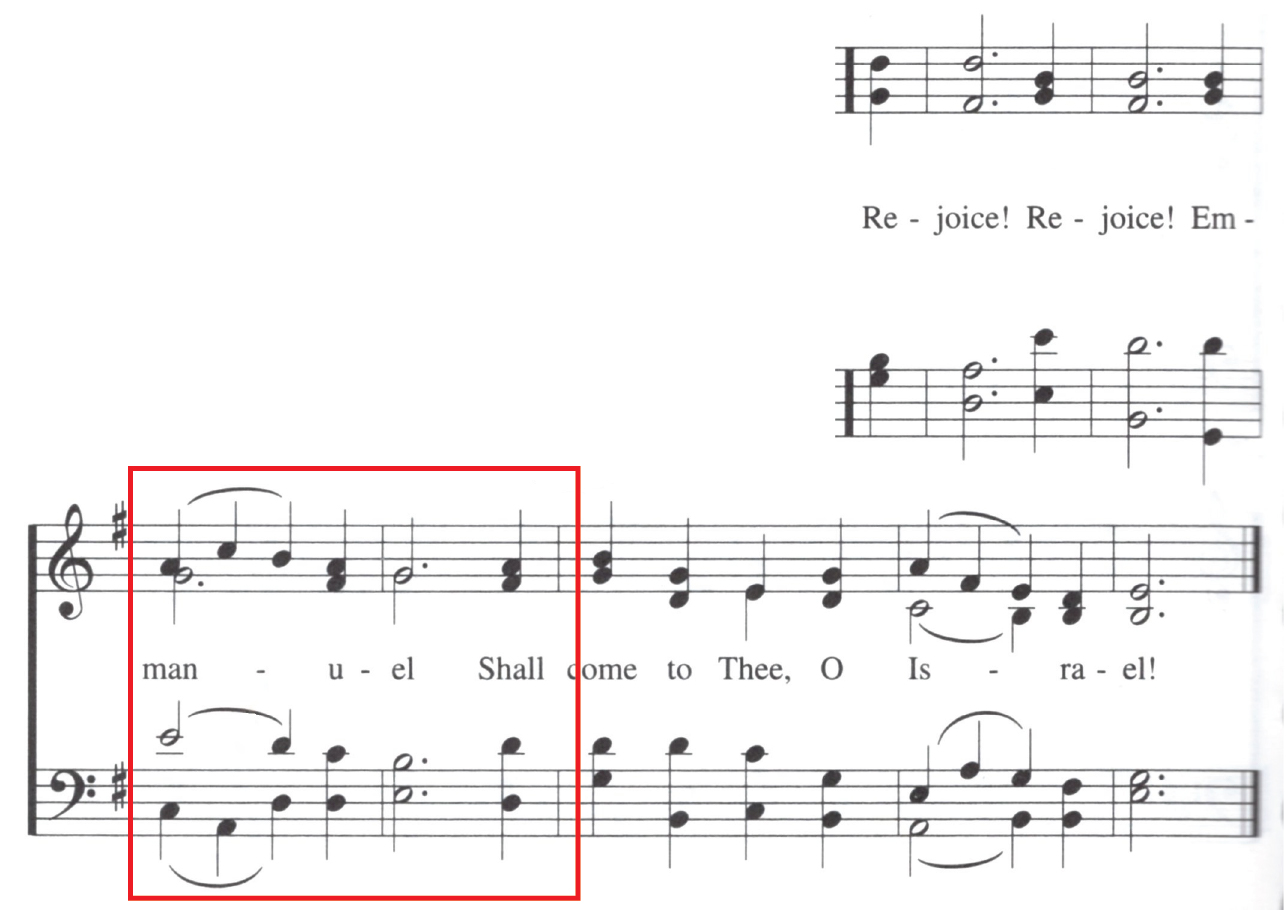
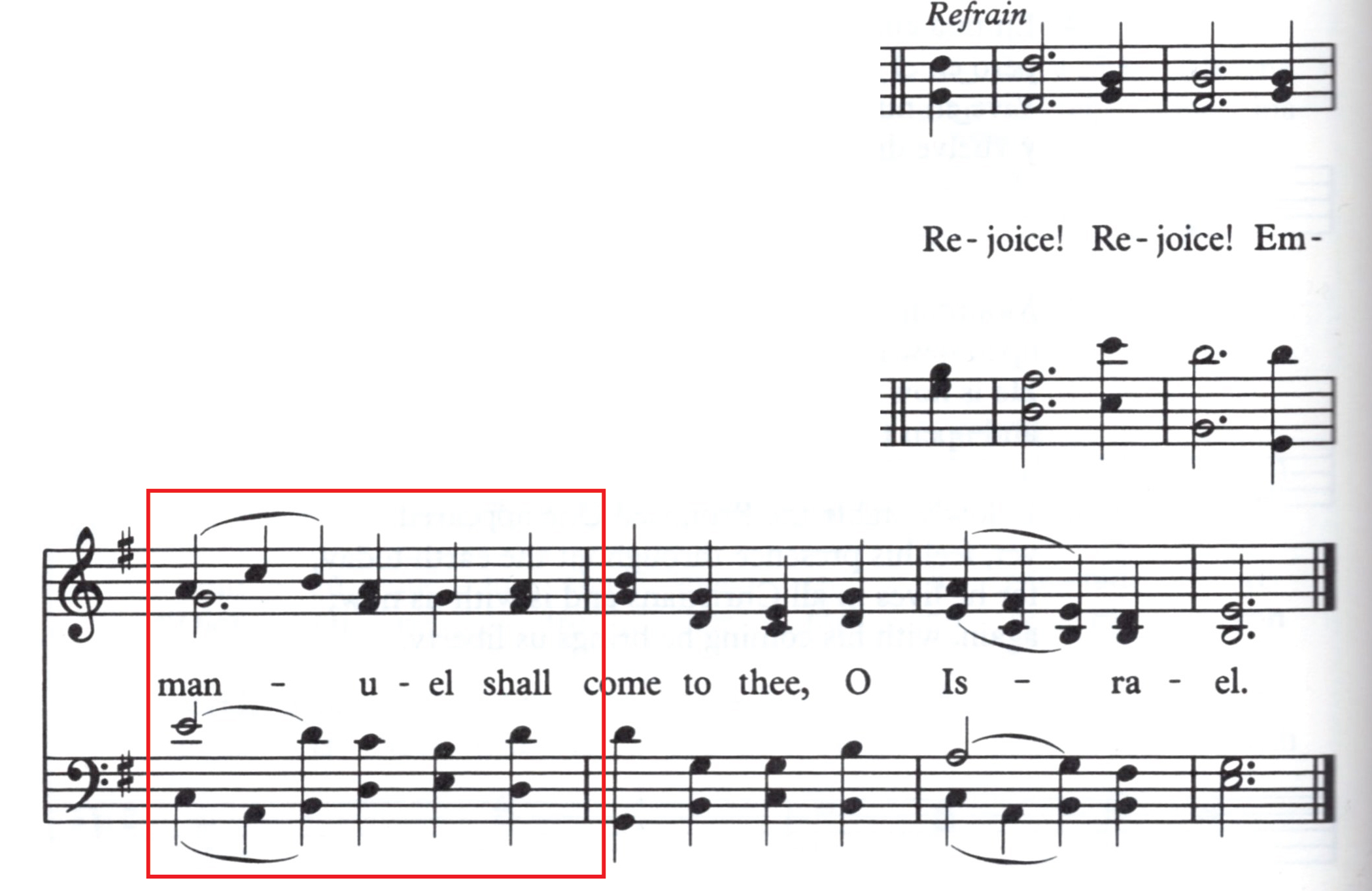
ESSAY: “O Come, O Come, Emmanuel: Dark Good News” by Linda Gregerson, Image: Poet Linda Gregerson reflects, in prose, on the quintessential Advent hymn, which dates back to the Middle Ages. She grew up singing it in her Methodist church every December. “It’s ironic, really—it quite betrays me—to realize that I must have loved this hymn for its whiff of the monastery: chalice and incense smuggled in by way of the minor chord. There’s a moment, a breathtaking moment, when the meter defies expectation. Everything has been steady-as-you-go, four-four time, all quarter notes and dotted halves. But during that remarkable refrain, just when you expect to dwell on the last syllable of the holy name for a count of three, as every verse before this has prepared you to do, the hymn leaps forward and anticipates itself by half a measure. No breath, no stately pause: Emmanuel / Shall come to thee, as though rushing to arrival. Those missed beats never fail to stop my heart.”
I didn’t know what Gregerson was talking about until I looked up the notation in TheUnited Methodist Hymnal no. 211, and sure enough, in measure 15 there are two extra beats. In all the other hymnals I have (and all the recordings of the song I’ve heard), that measure is divided into two and the regular meter sustained, with “el” held out for three beats. Interesting! It does feel unnatural to me to sing it the way she suggests, but she offers a compelling theological reason for why the arranger made that decision.
This is the standard way (as far as I’m concerned) of singing “O Come, O Come, Emmanuel.” Sheet music excerpt from Majesty Hymns, the hymnal of my youth.Sheet music excerpt from The United Methodist Hymnal, showing the unusual (but significant, Gregerson claims) shift from 4/4 meter to 6/4 in one of the measures of the refrain
Here’s an example of a congregation (First United Methodist Houston) singing the refrain the way Gregerson so fondly remembers:
+++
NEW BOOKS:
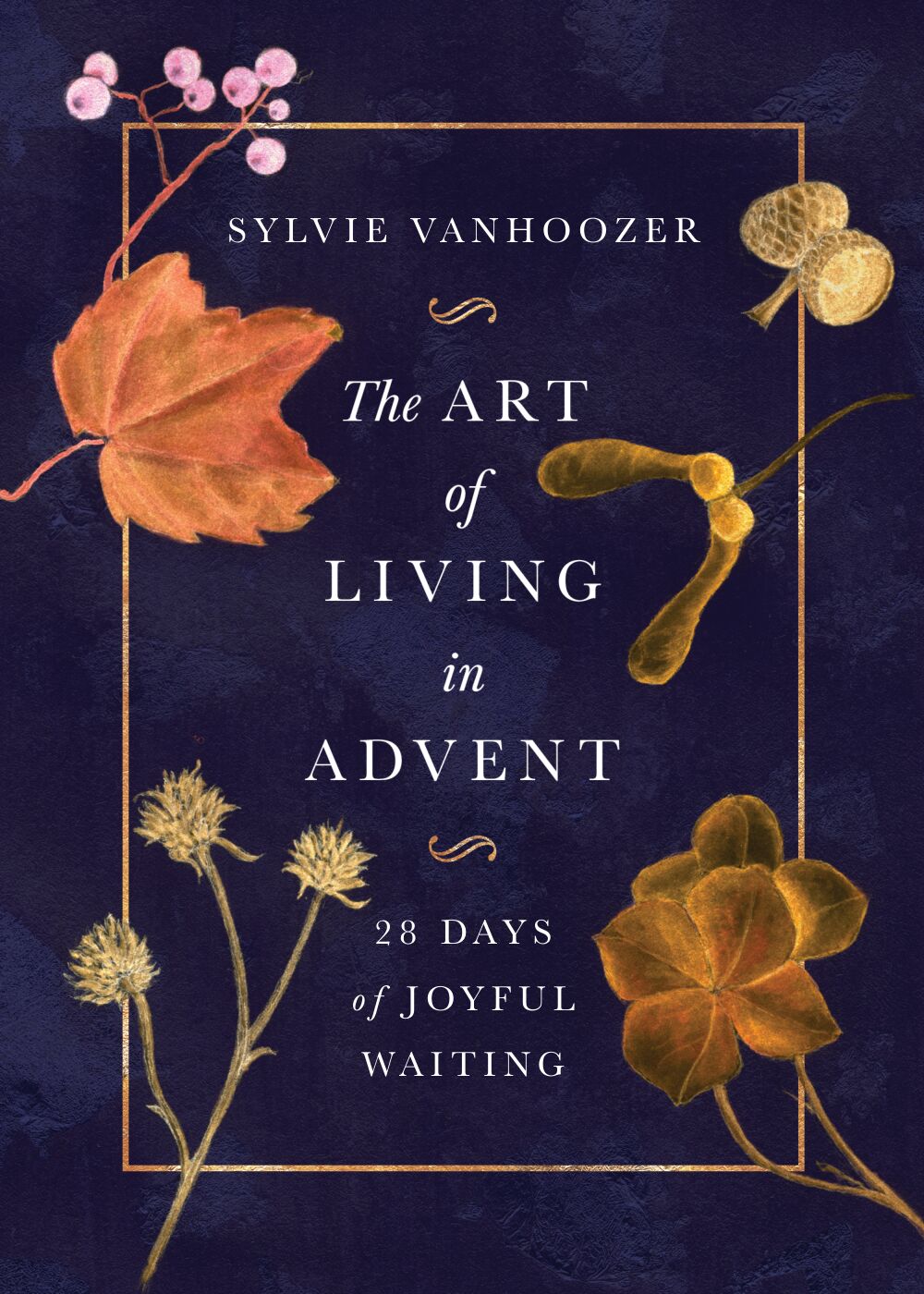
>> The Art of Living in Advent: 28 Days of Joyful Waiting by Sylvie Vanhoozer: A retired French teacher and a botanical artist, Sylvie Vanhoozer was born and grew up in Provence and now lives in Illinois with her husband, the theologian Kevin Vanhoozer. In this little illustrated book, she introduces readers to the tradition of Provençal crèches, localized nativity scenes populated by santons (“little saints”). Made from the land’s clay, the santons resemble nineteenth-century villagers, who offer up gifts from their vocations—olives, bread, wine, wood, sheep, hurdy-gurdy music, herbal remedies. (Reminds me of the presepe from southern Italy that I encountered some years ago!) The crèches are also traditionally decorated with native vegetation, such as thyme, juniper, lavender, and rosemary, freshly harvested on the first weekend of Advent. This is one of the ways in which Provençals embrace Christ’s presence in their own time and place.
“I am not inviting readers to leave their place and go to some distant land in a distant past,” Vanhoozer writes. “The invitation is rather to transpose this Provençal scene into one’s own place, to live the same story in a different context. . . . The question is not ‘Did Jesus really come to Provence?’ but rather ‘Could Jesus really come here, to me?’ Could my home, my neighborhood, my church, become a crèche scene, with Christ right here beside me, in me?”
I think this book would have worked better as a literary essay, as it feels padded out to make its ninety-page count, with redundancies and somewhat arbitrary divisions. But I love how Vanhoozer draws us into this cherished and still-living tradition from her childhood and calls us to see and participate in the story of God’s coming where we live, in all its particularities.
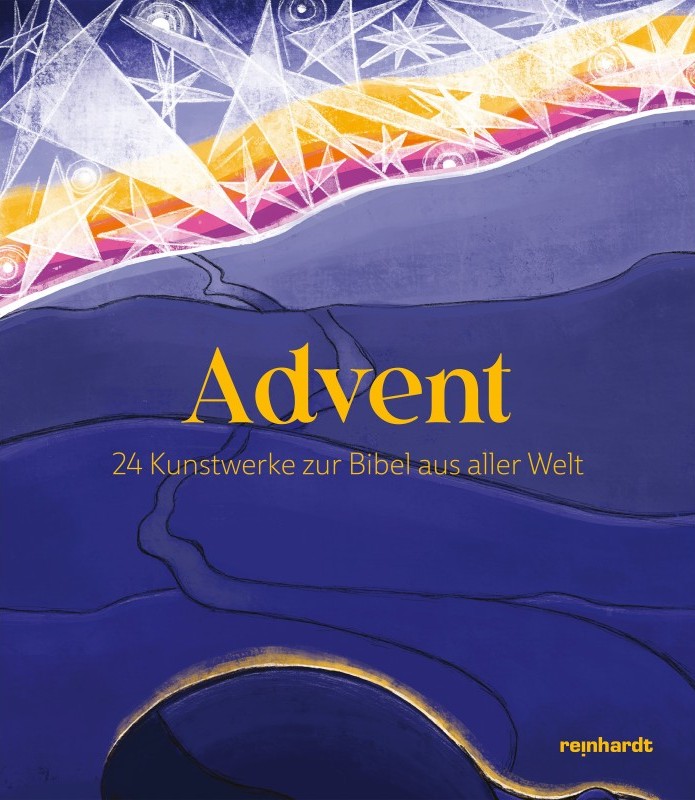
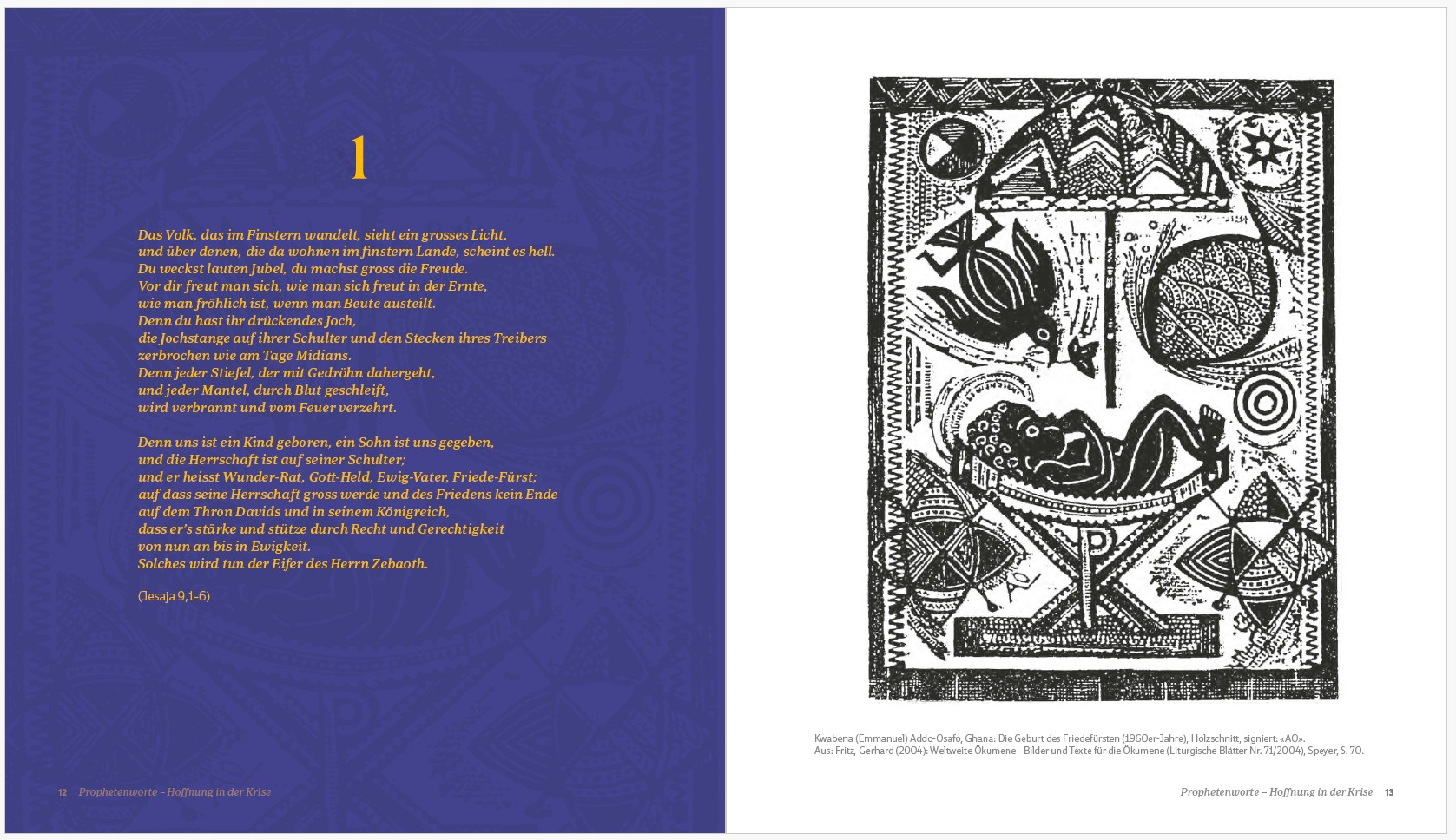
>> Advent: 24 Kunstwerke zur Bibel aus aller Welt by Christian Weber: Rev. Dr. Christian Weber [previously] is the director of studies for Mission 21, an international mission agency of the Protestant Reformed Churches in Switzerland. His work brings him into contact with religious art from diverse parts of the globe. I’m delighted by this new (German-language) book of his, whose title translates to Advent: 24 Bible-Inspired Artworks from Around the World. Organized into four parts (“Words of Prophecy,” “Parables of Jesus,” “John the Baptist,” and “Mary”) and printed in full color, the book features twenty-four primary artworks (plus some supplementary) from twenty-two countries, providing background on and interpretations of each, as well as information about the artists and a bibliography.
Sample page spread from Advent: 24 Kunstwerke zur Bibel aus aller Welt, showing a woodcut by the Ghanaian artist Kwabena (Emmanuel) Addo-Osafo
A church mural from Zimbabwe, a kalamkari from South India, a gourd carving from Peru, a manuscript illumination from Armenia—these are among the artworks Weber highlights. Some of the works are of higher quality than others, but the emphasis is on how the scripture texts of the Advent season have prompted artistic responses in a variety of places outside Europe, which is the continent that has most shaped the popular imagination when it comes to the biblical story. Weber’s Advent encourages us to widen those imaginations. Despite my fifteen or so years spent researching global Christian art, Weber is always bringing new artists to my attention! You can view sample pages from the book on the publisher’s website.
The cover image is a detail of For Those in Darkness by the American artist Lauren Wright Pittman.
Weber is looking for a North American publisher to release an English-language edition of the book.
+++
ARTICLE/VIDEO: “Five Films to Help You Observe Advent” by Abby Olcese, Think Christian: Abby Olcese, author of Films for All Seasons: Experiencing the Church Year at the Movies, provides five movie suggestions for Advent, corresponding to the themes of Hope, Faith, Joy, Peace, and Christ. (Other churches and families, like mine, substitute “Faith” with “Love” on their Advent wreaths; Olcese’s fifth pick, for Christmas Eve, would fit the “Love” theme perfectly, but see also my suggestion below.) You can read the content as an article or watch it in video format, which includes a few film clips:
ALSO: Allow me to add one of my own suggestions: American Symphony, a 2023 documentary about musical artist Jon Batiste, whose meteoric rise to fame coincided with the return of his partner Suleika Jaouad’s leukemia. Directed by Matthew Heineman, the film follows a year in the life of the married couple, as Batiste prepared for the premiere of his boundary-breaking American Symphony composition at Carnegie Hall in September 2022 while Jaouad endured chemotherapy. It has a very Advent-y feel, by which I mean its calling on God in the darkness (Batiste is a devout Christian) and its orientation around faith, hope, and love. It’s a beautiful, intimate portrait of a marriage, of creativity, courage, and care.
+++
ART: Advent Wreath by Beach4Art: Beach4Art is a family of four who create beach art inspired by beautiful nature in Devon, UK. (Follow them on Facebook, Instagram, or TikTok, and see their Etsy shop.) Below are some photos of the Advent wreath they made out of twigs, stones, and shellson Sandymere beach for the first Sunday of Advent in 2023.
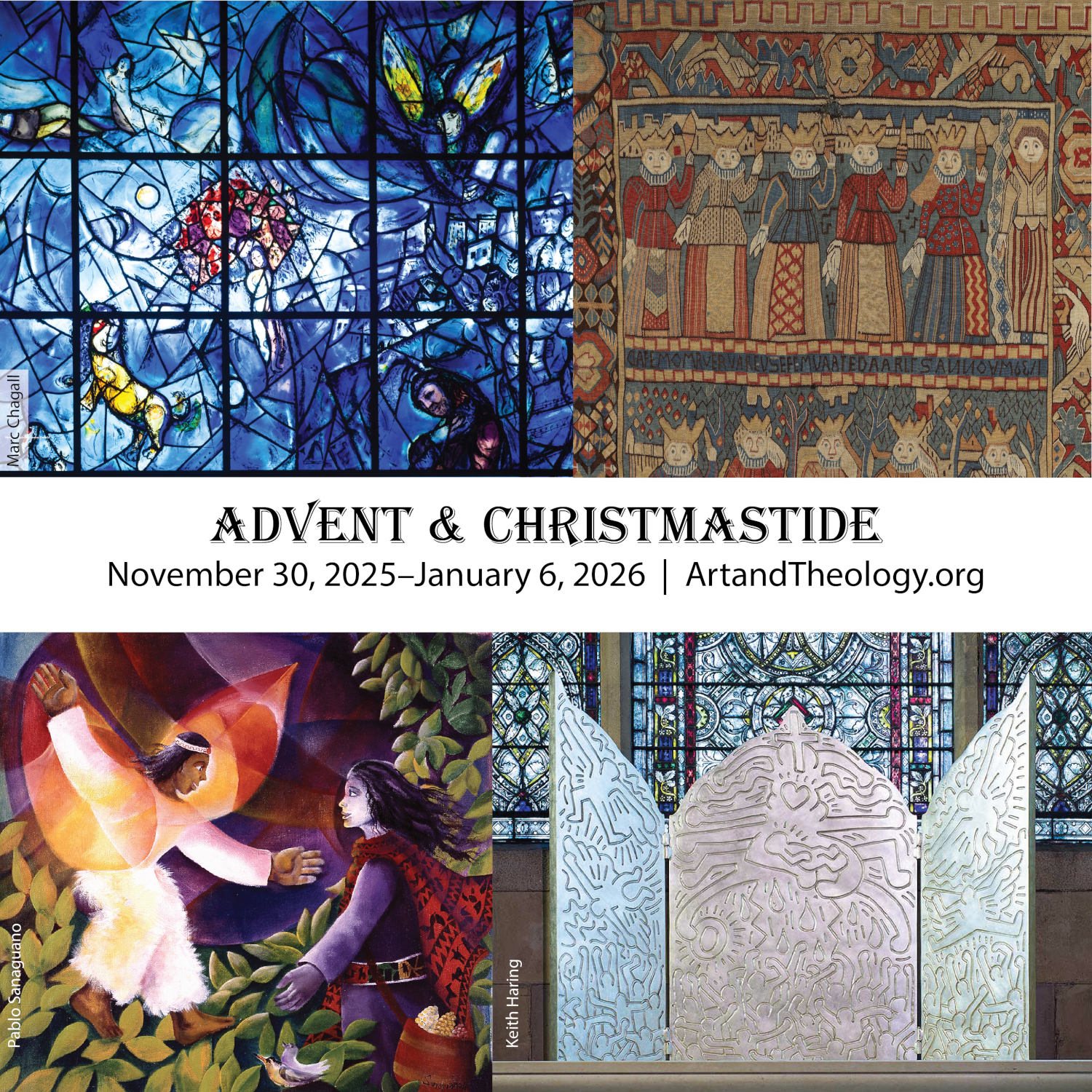
Want to receive a daily pairing of art and music in your inbox during this Advent and Christmas season? Sign up here. (If you already subscribe to the blog, you’re all set.) Posts will run from November 29, the day before the first Sunday of Advent, to Epiphany on January 6. I have also planned a few poems and roundups to go out during that time.
Advent is my favorite season of the church year because it taps into the deep yearning I feel for this world to be set right, for God’s beauty to burst into it with an irrefutable finality—no more sin, no more sorrow. The season is a chance to practice hope, something I sometimes struggle with, as I tend to lean more cynical.
The readings, art, and music of Advent sweep me up into the grand narrative of scripture, attuning me to the ways God has always been coming to us, but fixing me especially on how in Bethlehem of Judea, he came in a very special way—as a human being—and nurturing my excitement for his imminent return to earth to wed it to heaven.
Advent themes include:
Lament and longing
Hope, peace, joy, love
Promise
John the Baptist, especially his call to repentance in preparation for the coming kingdom
The second coming of Christ (individual judgment, cosmic renewal)
The parable of the ten bridesmaids
The new heavens and the new earth
Isaiah’s messianic prophecies: a virgin conceiving, swords into plowshares, a peaceable kingdom, a great light shining on a people in darkness, a flowering branch from the root of Jesse, etc.
Pregnancy
Mary’s song
God with us
Based on these, I’ve curated dozens of visual and musical selections that I hope will make God’s story come alive to you in fresh ways. A thread installation, a soil-based performance, quilted detritus, a photograph from a war zone, confetti skies, stained glass oracles, a sixth-century apsidal mosaic from a Roman basilica, a medieval German New Year’s greeting by and for nuns, a Jemez Pueblo nativity in clay, a site-specific dance before a mural in Atlanta . . . these are some of the artworks that will be featured.
As for music, you’ll hear a classical setting of an Emily Dickinson poem, an adaptation of Psalm 27 by a Ugandan worship collective, a contemporary “Mass for Peace,” a Latin American song of the Annunciation, a dialogue between Mary and the infant Christ from Renaissance England, a responsory by the medieval polymath Hildegard of Bingen, offerings from many different singer-songwriters, and more.
Many of the songs will be drawn from my Advent playlist on Spotify, which I first published in 2020 but have been adding to each year:
If you know of anyone else who might be interested in an arts-based approach to Advent and Christmas devotions, please share with them the link to this post. You can peruse previous years’ entries to get a flavor:
I’m looking forward to sharing what I’ve curated for the start of this new liturgical year, as time unfolds across four hallowed weeks of expectant waiting and then Twelve Days of festivity and wonder.



 Art & Theology