He Reigns Forever (Artful Devotion)

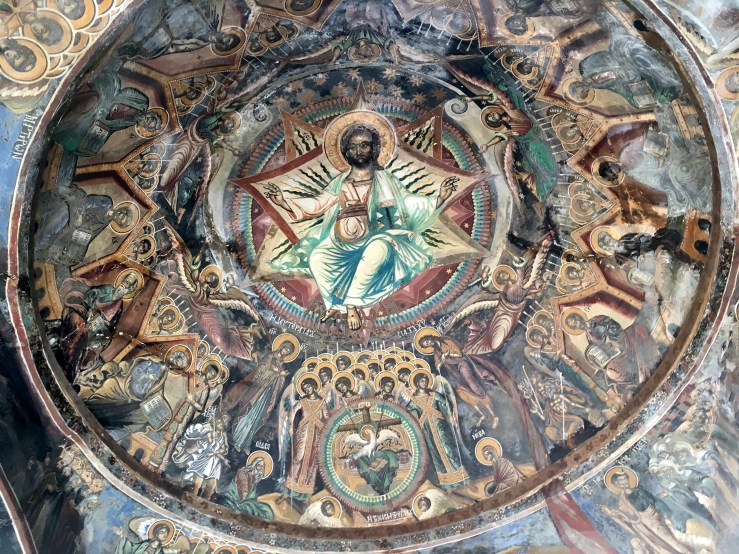
Christ Enthroned (Koutloumousiou Monastery)
Christ in Glory, 1744. Fresco on a dome of the katholikon (major church building) of Koutloumousiou Monastery, Mount Athos, Greece. Photo: Jim Forest.

As I watched, thrones were set in place, and an Ancient One took his throne. . . . To him was given dominion and glory and kingship, that all peoples, nations, and languages should serve him. His dominion is an everlasting dominion that shall not pass away, and his kingship is one that shall never be destroyed.

—Daniel 7:9, 14

+++

SONG: “He Reigns Forever (We Sing Praises)” | Words and music by Marshall Carpenter, 2002 | Choral arrangement by Carol Cymbala | Performed by the Times Square Church Choir, 2015


This post belongs to the weekly series Artful Devotion. If you can’t view the music player in your email or RSS reader, try opening the post in your browser.

To view all the Revised Common Lectionary scripture readings for Reign of Christ Sunday, cycle B, click here.

Roundup: Norman Rockwell updated; snow-crystal photography; Good Samaritan icon; and more

Freedom of Worship by Hank Willis Thomas and Emily Shur
Hank Willis Thomas (American, 1976–) and Emily Shur (American), Freedom of Worship, 2018. While Norman Rockwell’s illustration of the same name contains specific representations of Protestantism, Catholicism, and Judaism, this reinterpretation goes even further to include Islam, Native American spirituality, and Sikhism.

NEW PHOTOGRAPH SERIES: “The Four Freedoms” by Hank Willis Thomas and Emily Shur: In his 1941 State of the Union address, President Franklin D. Roosevelt insisted that people in all nations share Americans’ entitlement to four basic freedoms: freedom of speech, freedom of worship, freedom from want, and freedom from fear. This famous speech became the basis for Norman Rockwell’s set of four illustrations, originally published in the Saturday Evening Post in 1943, that have become some of history’s most iconic representations of the American idea.

Artist Hank Willis Thomas and photographer Emily Shur decided to reimagine these scenes with a cast that’s more representative of American diversity. One of the eighty-two final images they created is published on the cover of the current issue of Time magazine. It and others will form the backbone of a national billboard campaign by the nonpartisan organization For Freedoms to encourage civic engagement. “We believe that if artists’ voices replace advertising across the country, public discourse will become more nuanced,” their website says.

+++

IN CONCERT: Eric and I went to see brother-sister folk duo The Oh Hellos (Tyler Heath and Maggie Heath Chance) in Baltimore earlier this month and had a great time. My favorite song from their set list was “Soldier, Poet, King,” which describes Jesus’s coming in all three roles—perfectly appropriate for the upcoming Advent season! Jesus, the Word of God, comes to tear down Satan’s kingdom and establish his just rule in our lives and world (1 John 3:8bRev. 19:11–16). The final verse affirms Jesus’s status as Messiah, the waited-for “Anointed One,” and celebrates his power marked by humility, even unto death. The blood he wears into battle is his own.

There will come a soldier
Who carries a mighty sword
He will tear your city down
O lei o lai o lord

There will come a poet
Whose weapon is his word
He will slay you with his tongue
O lei o lai o lord

There will come a ruler
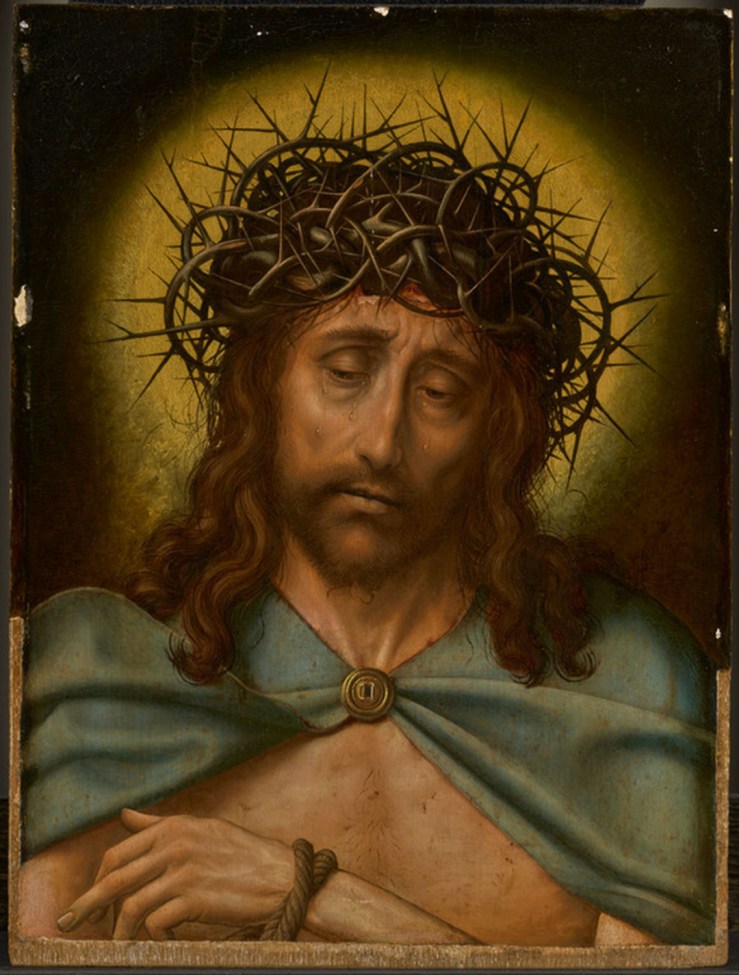
Whose brow is laid in thorn
Smeared with oil like David’s boy
O lei o lai o lord

The Oh Hellos’ nationwide tour continues through the end of the year, so visit their website to see if they’ll be stopping near you.

+++

NEW ALBUM: Crumbs by Liturgical Folk: Liturgical Folk (previously here and here) released its third album this month, which “build[s] on the themes of eucharist and the mission of the church to bring peace and reconciliation to the world.” The title comes from the track “Prayer of Humble Access,” a verbatim setting from the “Holy Eucharist Rite I” in the Book of Common Prayer that alludes to the story of the Syrophoenician woman.


Most of the song texts on the album come from that traditional Anglican prayer-book and were set to music by Ryan Flanigan, though a few texts are contemporary. “Lord, Lord, Lord,” for example, was written in the wake of the August 9, 2014, shooting of Michael Brown in Ferguson, Missouri, and amid the subsequent escalation of racial tensions in the country. “As a privileged, white, middle class, American man,” Flanigan wrote,

I felt for the first time in my life the systemic injustice against black males in our country. What I found most troubling, besides death itself, was the response of some white, privileged people to the shooting, particularly the response of some Christians on social media and the News. When we should have been mourning with those who mourn, confessing our fears and sins, and seeking reconciliation, many of us turned a blind eye or, worse, assumed a posture of defensiveness and denial. I wrote this song as a corporate confession of sin to God and our fellow men, a plea for God to forgive us and restore our broken trust with him and with those we’ve failed to love.

+++

WORLD’S FIRST SNOWFLAKE PHOTOS: “The Man Who Revealed the Hidden Structure of Falling Snowflakes”: Maryland saw its first snow of the season this week, as did most of the East Coast, which means Twitter saw a flurry of snowflake images! The Smithsonian posted about Wilson “Snowflake” Bentley (1865–1931), whose perfection of innovative photomicrographic equipment and techniques (which included chilled velvet and a turkey feather) enabled him to photograph thousands of individual snowflakes without their melting, providing valuable scientific records of snow crystals and their many types.

The first person to photograph a single snowflake, . . . Wilson A. Bentley used a microscope with his bellows camera—plus years of trial and error—to get a photo of one flake in 1885. But he didn’t stop there. Bentley went on to take thousands more, . . . which helped support the belief that no two snowflakes are alike. In 1903, he sent 500 prints of his snowflakes to the Smithsonian, hoping they might be of interest to our Secretary. The images are now part of the Smithsonian Archives.

Snowflake photo by Wilson Bentley

Snowflake photo by Wilson Bentley

+++

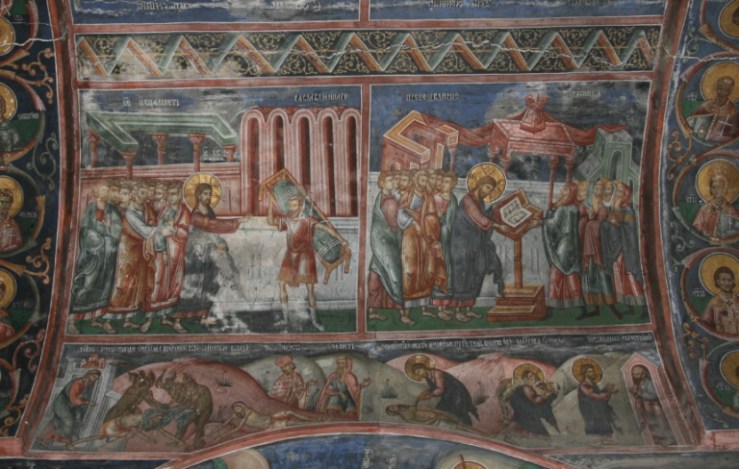
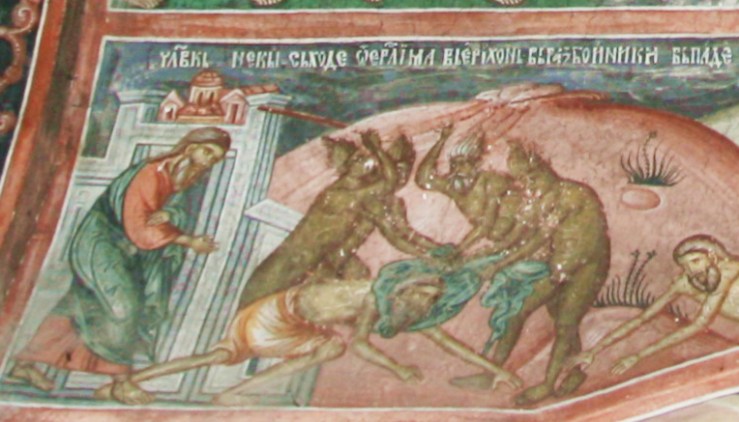
BALKAN ICON: “Transforming a Parable: The Good Samaritan”: Run by David Coomler, a museum researcher, Icons and Their Interpretations discusses aspects of traditional Russian, Greek, and Balkan iconography, inviting people to submit photos of icons for identification of subject or meaning, and translation of inscriptions. Recently he wrote about a fourteenth-century Serbian Orthodox fresco that, like many of the church fathers, promotes an allegorical reading of the parable of the good Samaritan. In this interpretation, the man en route to Jerusalem is Adam, or Everyman, who is beaten by demons; the priest and the Levite represent the law of Moses and the priesthood of Aaron, which cannot help the wounded man. But the “good Samaritan,” Jesus, stoops down to save, carrying the man not on a beast of burden but on his own back, to an “inn,” the church. He hands two “coins,” the Bible and tradition, to the innkeeper, and promises to return. See further image details and commentary at the web link above.

Good Samaritan fresco (Balkans)
Parable of the Good Samaritan (see bottom register), 14th century. Fresco in the narthex of the Patriarchal of Pech, a Serbian Orthodox monastery in Kosovo.

Good Samaritan fresco (Balkans) (detail)

+++

OBITUARY: Christian composer Kurt Kaiser dies at 83: On November 12, Kaiser passed away at his home in Waco, Texas, after a six-decade-long career in composing, playing, arranging, and producing Christian music. A Gospel Music Hall of Famer and a progenitor of CCM, he’s best known for his song “Pass It On,” but I know him for “Oh How He Loves You and Me,” two renditions of which are posted below; the first is a solo performance by Vanessa Williams with gospel piano accompaniment by Richard Smallwood, and the second is performed a capella in four-part harmony by Kaoma Chende with the use of overdubbing.

Approach (Artful Devotion)

Christ exalted (Santa Prassede)
This 9th-century mosaic of Christ between the cherubim is located above the apse of the Basilica of Santa Prassede in Rome. Photo: Fr. Lawrence Lew, OP.

Therefore, my friends, since we have confidence to enter the sanctuary by the blood of Jesus, by the new and living way that he opened for us through the curtain (that is, through his flesh), and since we have a great priest over the house of God, let us approach with a true heart in full assurance of faith, with our hearts sprinkled clean from an evil conscience and our bodies washed with pure water.

—Hebrews 10:19–22

+++

SONG: “Approach, My Soul, the Mercy Seat” | Words by John Newton, 1779 | Music by Kevin Twit, 1999 | Performed by Indelible Grace on Indelible Grace Side B, 2008

+++

Lord, how excellent are Thy ways, and how devious and dark are the ways of man. Show us how to die, that we may rise again to newness of life. Rend the veil of our self-life from the top down as Thou didst rend the veil of the Temple. We would draw near in full assurance of faith. We would dwell with Thee in daily experience here on this earth so that we may be accustomed to the glory when we enter Thy heaven to dwell with Thee there. In Jesus’ Name, Amen.

—A. W. Tozer, The Pursuit of God


This post belongs to the weekly series Artful Devotion. If you can’t view the music player in your email or RSS reader, try opening the post in your browser.

To view all the Revised Common Lectionary scripture readings for Proper 28, cycle B, click here.

C’mon! (Artful Devotion)

Resurrection of the Dead (stained glass)
The angel Gabriel awakes the dead on Resurrection Day in this medieval stained glass tondo from the Musée de Cluny in Paris. Photo: Spencer Means.

And just as it is appointed for man to die once, and after that comes judgment, so Christ, having been offered once to bear the sins of many, will appear a second time, not to deal with sin but to save those who are eagerly waiting for him.

—Hebrews 9:27–28

+++

SONG: “Get Happy” | Words by Ted Koehler, 1930 | Music by Harold Arlen, 1930 | Performed by the Puppini Sisters, on Hollywood (2011)

See also the Judy Garland version from Summer Stock (1950), below, which the American Film Institute ranked #61 in its survey of top tunes in American cinema.

+++

“The Day of Judgment” by Henry Vaughan

O day of life, of light, of love!
The only day dealt from above!
A day so fresh, so bright, so brave,
’Twill show us each forgotten grave,
And make the dead, like flowers, arise
Youthful and fair to see new skies.
All other days, compared to thee,
Are but Light’s weak minority;
They are but veils, and cypress drawn
Like clouds, before thy glorious dawn.
O come! arise! shine! do not stay,
Dearly loved day!
The fields are long since white, and I
With earnest groans for freedom cry;
My fellow-creatures too say “Come!”
And stones, though speechless, are not dumb.
When shall we hear that glorious voice
Of life and joys?
That voice, which to each secret bed
Of my Lord’s dead,
Shall bring true day, and make dust see
The way to immortality?
When shall those first white pilgrims rise,
Whose holy, happy histories
—Because they sleep so long—some men
Count but the blots of a vain pen?
Dear Lord! make haste!
Sin every day commits more waste;
And Thy old enemy, which knows
His time is short, more raging grows.
Nor moan I only—though profuse—
Thy creature’s bondage and abuse;
But what is highest sin and shame,
The vile despite done to Thy name;
The forgeries, which impious wit
And power force on Holy Writ,
With all detestable designs,
That may dishonor those pure lines.
O God! though mercy be in Thee
The greatest attribute we see,
And the most needful for our sins,
Yet, when Thy mercy nothing wins
But mere disdain, let not man say
“Thy arm doth sleep,” but write this day
Thy judging one: descend, descend!
Make all things new, and without end!

(Related post: “Get Ready (Artful Devotion)”)


This post belongs to the weekly series Artful Devotion. If you can’t view the music player in your email or RSS reader, try opening the post in your browser.

To view all the Revised Common Lectionary scripture readings for Proper 27, cycle B, click here.

Joyful on the Way (Artful Devotion)

The Arrival of Spring in Woldgate, East Yorkshire, in 2011 by David Hockney
David Hockney (British, 1937–), The Arrival of Spring in Woldgate, East Yorkshire in 2011 (twenty eleven), 2011. Oil on 32 canvases, 365.8 × 975.4 cm (each 91.4 × 121.9 cm); one of a 52-part work. Photo: Jonathan Wilkinson.

Psalm 119:1, three translations:

Blessed are the undefiled in the way, who walk in the law of the LORD. (KJV)

Joyful are people of integrity,
who follow the instructions of the LORD. (NLT)

You’re blessed when you stay on course,
walking steadily on the road revealed by GOD. (The Message)

+++

SONG: “Beati quorum via” (Blessed are those whose way) | Music by Charles Villiers Stanford, ca. 1892 | Performed by VOCES8, 2017

Stanford’s “Beati quorum via,” op. 38, no. 3, is a motet for mixed unaccompanied six-part choir, a setting of Psalm 119:1 in Latin: “Beati quorum via integra est, qui ambulant in lege Domini.” It is the last of Stanford’s Three Latin Motets, published in 1905—the other two being on the subjects of Christ’s ascension and the souls of the just at rest in heaven.


This post belongs to the weekly series Artful Devotion. If you can’t view the music player in your email or RSS reader, try opening the post in your browser.

To view all the Revised Common Lectionary scripture readings for Proper 26, cycle B, click here.

Sky World (Artful Devotion)

Tomorrow begins Allhallowtide, a three-day Christian festival in which the saints in heaven are remembered. Several friends of mine have lost loved ones this year—siblings, parents, uncles—and just this month my church said goodbye to one of its dear members who passed on. All Hallows’ Day, the central observance of the triduum, recognizes that a spiritual bond still exists between the departed saints and those on earth, whom Christ binds together in one communion. So let us honor this week the memory of those who have gone before us in faith, praising our great and gracious God who sanctifies his people—and who is preparing a family reunion like no other!

Visitations by Joseph Kinnebrew
Joseph Kinnebrew (American, 1942–), Visitations: Gifts; A Slight Lapse of Purpose; Hand Stands; Yea; Majorette, 1994–97. Cast iron, 54 to 69 inches tall. Frederik Meijer Gardens and Sculpture Park, Grand Rapids, Michigan. Photo: Victoria Emily Jones.

. . . they seemed to have died, and their departure was thought to be an affliction, and their going from us to be their destruction; but they are at peace. . . . Their hope is full of immortality.

—Wisdom of Solomon 3:2–4

(Note: The Wisdom of Solomon, or the Book of Wisdom, is a deuterocanonical book, meaning it is part of the Septuagint but not the Hebrew canon and therefore is not recognized as canonical by Protestants. However, it still contains spiritual wisdom and, as Martin Luther believed, is “useful and good to read” alongside the inspired scriptures.)

+++

SONG: “Sky World” | Words and music by Theresa Bear Fox, 2015 | Performed by Teio Swathe (vocals) and Supaman (dance), 2017

“Sky World” was written in Mohawk and English by Theresa Bear Fox of the Akwesasne Mohawk Nation as a song of remembrance for those who have passed on. An abridged version was recently recorded by Teio Swathe and released as a music video with Apsáalooke hip-hop artist Supaman fancy-dancing (that’s actually the name of the style!) in White Sands, New Mexico. On October 12 the video won a Nammy Award.

Ha io ho we iaa
Ha na io ho we ia he
Io ha io ha io ho we ia
Ha na io ho we ia he
Ha io ha io ho we ia
Ha na io haioho we ia
Iooho we ia
We ha na io ho we ia he

Let’s put our minds together as one
And remember those who have passed on to the sky world
Their life duties are complete, they are living peacefully
In the sky world, in the sky world

Supaman lives on the Crow Nation reservation in south-central Montana. His own music fuses rapping with traditional Native American sounds and aims to inspire hope; he is best known for his “Prayer Loop Song,” which has over 2.3 million views on YouTube. In 2011 Supaman was interviewed on NPR’s All Things Considered, where he shared the story of his conversion to Christianity as an adult and the influence it has had on his life and work.

+++

This world is not conclusion;
A sequel stands beyond,
Invisible, as music,
But positive, as sound.

—Emily Dickinson


This post belongs to the weekly series Artful Devotion. If you can’t view the music player in your email or RSS reader, try opening the post in your browser.

To view all the Revised Common Lectionary scripture readings for All Saints’ Day, cycle B, click here.

Roundup: Imagination; inclusive dance; art theft; singing through divorce; and more

JOHN PIPER ON IMAGINATION: “Obey God with Your Creativity: The Christian Duty of Imagination”: Within evangelicalism (the tradition I belong to), the imagination is often deemed more of a liability than a virtue, something to be distrusted, at the very least, and at most, to be rejected as evil. So I was thrilled earlier this month to hear John Piper, one of America’s leading evangelicals, speak out in strong affirmation of imagination, which he calls “one of the great duties of the Christian mind.” It can be used destructively, he cautions, but it’s a God-given capacity that God wants us to exercise and strengthen, like a muscle, so that we can see more clearly what is and what could or what will be.

“The imagination,” Piper writes, “calls up new words, new images, new analogies, new metaphors, new illustrations, new connections to say old, glorious truth—whether from the world or from the word of God. Imagination is the faculty of the mind that God has given us to make the communication of his beauty beautiful.” To communicate breathtaking truth in a boring way is “probably a sin,” he says, for God is “infinitely worthy of ever-new verbal, musical, and visual expressions.”

“A college—or a church, or a family—which is committed to the supremacy of God in the life of the mind will cultivate many fertile, and a few great, imaginations. And oh, how the world needs God-besotted minds that can say the great things of God and sing the great things of God and play the great things of God in ways that have never been said or sung or played before.”

+++

Wheelchair dancing (Infinite Flow)

INCLUSIVE DANCE: Founded by Marisa Hamamoto in 2015, Infinite Flow is a professional dance company and nonprofit whose mission is “to use dance as a vehicle to create an inclusive world and eliminate the stigma and inequality associated with disability,” especially wheelchair use. Artistic excellence, social innovation, empowerment, community, and integration are among its values, which are played out through dance classes, workshops, and outreach events that incorporate people with and without disabilities. You can view snippets from classes and rehearsals as well as polished, artfully filmed choreographed routines on their Facebook page—like this most recent one, in which Hamamoto dances with Piotr Iwanicki, a multiple wheelchair World Latin Champion.

After twenty years of training in ballet and contemporary dance, Hamamoto suffered a spinal cord infarction, which left her temporarily paralyzed from the neck down. Upon recovery, she developed an interest in and pursued ballroom dancing, which led her to imagine what an inclusive form of the genre might look like. To learn more about Infinite Flow, see these two promo videos, and follow them on Facebook. You’ll also want to check out “Gravity.”

+++

PODCAST: Speaking with Joy: Lately I’ve been devouring this podcast by Joy Clarkson, a doctoral candidate at the Institute for Theology, Imagination, and the Arts at St. Andrew’s University in Scotland (she’s studying the role of the affections and the arts in moral formation). Though it was launched last November, I first discovered it in July at the tail-end of her summer book series on The Great Divorce, an allegorical tale by C. S. Lewis, in which she discusses themes such as desire, grace, the real, incurvatus in se (St. Augustine), self-choice, being seen and known, and need-love versus gift-love. I was hooked! Now I’m a Patreon supporter.

Speaking with Joy

Speaking with Joy is such a bright corner of the Internet, full of hope, wisdom, and delight. The standard episode format is an exploration of a given theme through three pieces of art: one literary, one visual, and one musical. I really enjoyed the last three I listened to: “The Army of Emotions,” featuring St. Macrina, Mister Rogers’s ditty “What Do You Do with the Mad That You Feel?,” and the Irish animated film The Song of the Sea; “The Wisdom of Whimsy,” featuring Manalive by G. K. Chesterton, the illustrations of Beatrix Potter and Breezy Brookshire, and “On the Radio” by singer-songwriter Regina Spektor; and “Decent Men in Indecent Times,” which explores why and how we tell stories of the two world wars by looking at the contrasting poetry of Wilfred Owen and Laurence Binyon, the movie Dunkirk, and John Williams’s score for Schindler’s List.

+++

NEW IMAGE STAFF: Last week Image journal announced that James K. A. Smith, a professor of philosophy at Calvin College, will be taking the helm of Image as the journal’s new editor in chief. What a perfect choice! I’ve been hearing a lot of Smith since the publication of his book You Are What You Love: The Spiritual Power of Habit in 2016 and have appreciated his recognition of the important role of artists. “If you want to change how the world thinks, you first have to change how they imagine,” he once said. “That’s why, today, artists are our apologists.” More recently, in a letter to the Image search committee, he wrote,

The arts speak to aspects of human nature ignored or denied by a culture captivated by brutal notions of “efficiency” or quasi-scientific narratives that reduce us to animality. It’s in literature, poetry, film, and so many other art forms that we hear echoes of a biblical understanding of humanity—that we are created in God’s image, animated by hungers and hopes, made to delight and play. In other words, the arts are evidence of what I’ve called “cracks in the secular”—the recalcitrant mystery at the heart of the human that refuses to be eviscerated. Art continues to shout Nein! to our disenchantment.

I’m looking forward to this next chapter of Image.

+++

ART HEIST: “Police back on the trail of ‘world’s most wanted’ stolen Caravaggio painting”: On October 15, nearly fifty years after Caravaggio’s Nativity with San Lorenzo and San Francesco was stolen from the Oratory of San Lorenzo in Palermo, Sicily, experts met at the Vatican to discuss reinstating an active search. Speculation of mafia collusion and espionage have circulated around the case, which ranks second on the FBI’s list of top ten unsolved art crimes.

Nativity by Caravaggio
Caravaggio (Italian, 1571–1610), Nativity with San Lorenzo and San Francesco, 1609. Oil on canvas. The angel’s banderole reads, “Gloria in eccelsis Deo.”

+++

NEW ALBUM: Yesterday Moda Spira (the stage name of Latifah Alattas) released Divorce, an intimate musical chronicle of the unexpected end of her marriage and the journey of grief she’s been on since. “I hope it helps those of you that might feel alienated or lost in the throes of divorce or disconnection from someone you love,” she says. In response to a request, Alattas released a series of podcast episodes that discuss each song on the album in depth; listen here. I first learned about the project back in July when Stephen Roach interviewed Alattas on the Makers & Mystics podcast—such a rich and memorable conversation that deepened my empathy for the loved ones of mine who have had to endure the pain of divorce.

Below is a video promo Alattas made for the album’s Kickstarter campaign. Click here to view the variety of streaming and purchase options.

Son of David, I Want to See (Artful Devotion)

Christ and Bartimaeus by Julia Stankova
Julia Stankova (Bulgarian, 1954–), Christ and Bartimaeus, 2017. Tempera on primed wooden panel and lacquer technique, 36 × 45 cm.

And they came to Jericho. And as he was leaving Jericho with his disciples and a great crowd, Bartimaeus, a blind beggar, the son of Timaeus, was sitting by the roadside. And when he heard that it was Jesus of Nazareth, he began to cry out and say, “Jesus, Son of David, have mercy on me!” And many rebuked him, telling him to be silent. But he cried out all the more, “Son of David, have mercy on me!” And Jesus stopped and said, “Call him.” And they called the blind man, saying to him, “Take heart. Get up; he is calling you.” And throwing off his cloak, he sprang up and came to Jesus. And Jesus said to him, “What do you want me to do for you?” And the blind man said to him, “Rabbi, let me recover my sight.” And Jesus said to him, “Go your way; your faith has made you well.” And immediately he recovered his sight and followed him on the way.

—Mark 10:46–52 (cf. Matthew 20:29–34; Luke 18:35–43)

+++

SONG: “Son of David” by Ghost Ship, on The Good King (2013)

Here’s an introduction and acoustic performance by band leader Cam Huxford, who cowrote “Son of David” with fellow Ghost Ship member Shay Carlucci:

+++

“The Blind Suppliant” by Richard Crashaw

Silence, silence, O vile crowd;
Yea, I will now cry aloud:
He comes near, Who is to me
Light and life and liberty.
Silence seek ye? yes, I’ll be
Silent when He speaks to me,
He my Hope; ah, meek and still,
I shall ’bide His holy will.
O crowd, ye it may surprise,
But His voice holdeth my eyes:
O have pity on my night,
By the day that gives glad light;
O have pity on my night,
By the day would lose its light,
If it gat not of Thee sight;
O have pity on my night,
By day of faith upspringing bright;
That day within my soul that burns,
And for eyes’ day unto Thee turns.
Lord, O Lord, give me this day,
Nor do Thou take that away.


This post belongs to the weekly series Artful Devotion. If you can’t view the music player in your email or RSS reader, try opening the post in your browser.

To view all the Revised Common Lectionary scripture readings for Proper 25, cycle B, click here.

Good Letters roundup

One of the blogs I follow is Good Letters, run by Image journal and authored by a diverse, gifted team of spiritual writers. Updated each weekday, it features short personal essays that make fresh connections between faith and daily life. Here are a few posts from the past month that I particularly enjoyed.

Ballet

“Beginner Ballet” by Melissa Florer-Bixler: Like the author, I too took a beginner’s ballet class at a late age (mid-twenties), and her words capture my felt experience so well:

I assumed ballet would be an interesting and different way to exercise, the chance to try a new fitness routine and to escape the general chaos of my life for an hour each week.

But in this dance class, the ballet one does in socks after work, I discovered that dance offers an aesthetic world, a way for me to discover new possibilities for my body. How strange it was to push my energy down a smooth line as my body sunk to the floor, to wonder over the shape of my fingers, to imagine a string lifting me up, off my toes, to float an inch above the gleaming rehearsal studio floor.

Everything in ballet was strength in the service of beauty. Even the language was beautiful. . . .

+++

“The Ordinary Time” (poem) by Dana Littlepage Smith: I love Good Letters’ ongoing “Poetry Fridays,” in which a writer will introduce a poem with brief commentary. A few weeks ago Suzanne Nussey introduced this little gem in which the speaker learns through the observance of barnyard creatures how to slow down and be more attentive to life’s ordinary moments, how to enter God’s time. (The title references the liturgical season the church is currently in.) As she considers the birds, she sees how they work with joy, singing as they build, and are content just to be. The poem opens with a beautiful image and a subtle admonition:

Goldfish in the horse trough
nibble at morning’s surface.

They are not busy;
they are breathing.

+++

“On Writing Odes: Taking Time to Celebrate” by Tania Runyan: Runyan has been doing a Good Letters teaching series on poetic forms—sonnets, sestinas, villanelles, and now odes, which are characterized by praise and celebration. Here she presents the ode “To Autumn” by John Keats as a choice example, and then shares one of her own, “Ode to a Bodhran Player.” (A bodhran is a traditional Irish drum.) She concludes with an assignment: “Find something that you love, or maybe even something you don’t, and regale it with an ode. Give yourself to the true, noble, lovely, and excellent practice of praise.”

“To Autumn” by John Keats

Season of mists and mellow fruitfulness,
   Close bosom-friend of the maturing sun;
Conspiring with him how to load and bless
   With fruit the vines that round the thatch-eves run;

[Read the rest on Good Letters]

+++

This Is Us

“Emmy Watch: This Is Us by Tania Runyan: Eric and I enjoy watching this TV show together and appreciate its complex portrayals of familial relationships: husband-wife, parent-child, and sibling (including siblings-in-law). Even within the parent-child category, different forms of parenthood are explored—biological, adoptive, and foster. Here Runyan writes about the show’s positive portrayal of open adoption, which is now more common in the US than traditional “closed” adoption. When Runyan and her husband adopted their son, Samuel, they chose the open option, which in their case means they deliberately entered into and maintain in-person relationships with Samuel’s biological family. (To read more about Runyan’s experience, see “He Fits Right In: Our Story of Open Adoption.”) Runyan shares a conversation she had with her son’s biological grandmother about the show.

The third season of This Is Us began September 25. It airs Tuesdays at 9 p.m. on NBC.

+++

“Leonard Cohen’s Holy and Broken Hallelujah” by Alisa Ungar-Sargon: Leonard Cohen’s “Hallelujah” is one of the most-covered songs of all time, and it’s full of biblical references. (Like the writer, my first introduction to it was also as a preteen through the movie Shrek!) “The song’s central premise is the value, even the necessity, of praise in the face of confusion, doubt, or dread,” writes Ungar-Sargon, who led her high school English students in an analysis of its lyrics as poetry.

Here’s a cover by the husband-wife duo Gungor (that is, Michael and Lisa Gungor).

Creation Psalm (Artful Devotion)

And the Mountains Rose by Barbara Wolff
Barbara Wolff (American), “And the Mountains Rose” (vv. 5–8), from Psalm 104: You Renew the Face of the Earth, 2006–10. Contemporary pigments and precious metals on goatskin. Morgan Library and Museum, New York. MS M.1190, fol. 2.

Bless the LORD, O my soul!
O LORD my God, you are very great!
You are clothed with splendor and majesty,
covering yourself with light as with a garment,
stretching out the heavens like a tent.
He lays the beams of his chambers on the waters;
he makes the clouds his chariot;
he rides on the wings of the wind;
he makes his messengers winds,
his ministers a flaming fire.

He set the earth on its foundations,
so that it should never be moved.
You covered it with the deep as with a garment;
the waters stood above the mountains.
At your rebuke they fled;
at the sound of your thunder they took to flight.
The mountains rose, the valleys sank down
to the place that you appointed for them.
You set a boundary that they may not pass,
so that they might not again cover the earth.

You make springs gush forth in the valleys;
they flow between the hills;
they give drink to every beast of the field;
the wild donkeys quench their thirst.
Beside them the birds of the heavens dwell;
they sing among the branches.
From your lofty abode you water the mountains;
the earth is satisfied with the fruit of your work.

You cause the grass to grow for the livestock
and plants for man to cultivate,
that he may bring forth food from the earth
and wine to gladden the heart of man,
oil to make his face shine
and bread to strengthen man’s heart.

The trees of the LORD are watered abundantly,
the cedars of Lebanon that he planted.
In them the birds build their nests;
the stork has her home in the fir trees.
The high mountains are for the wild goats;
the rocks are a refuge for the rock badgers.

He made the moon to mark the seasons;
the sun knows its time for setting.
You make darkness, and it is night,
when all the beasts of the forest creep about.
The young lions roar for their prey,
seeking their food from God.
When the sun rises, they steal away
and lie down in their dens.
Man goes out to his work
and to his labor until the evening.

O LORD, how manifold are your works!
In wisdom have you made them all;
the earth is full of your creatures.
Here is the sea, great and wide,
which teems with creatures innumerable,
living things both small and great.
There go the ships,
and Leviathan, which you formed to play in it.

These all look to you,
to give them their food in due season.
When you give it to them, they gather it up;
when you open your hand, they are filled with good things.
When you hide your face, they are dismayed;
when you take away their breath, they die
and return to their dust.
When you send forth your Spirit, they are created,
and you renew the face of the ground.

May the glory of the LORD endure forever;
may the LORD rejoice in his works,
who looks on the earth and it trembles,
who touches the mountains and they smoke!
I will sing to the LORD as long as I live;
I will sing praise to my God while I have being.
May my meditation be pleasing to him,
for I rejoice in the LORD.
Let sinners be consumed from the earth,
and let the wicked be no more!
Bless the LORD, O my soul!
Praise the LORD!

—Psalm 104

+++

SONG: “Psalm 104” | Text: Psalm 104:1–5 (Hebrew) | Traditional Jewish Babylonian melody, arranged by Yonnie (Jonathan) Dror | Performed by Yamma Ensemble, 2012

An ancient setting of the first five verses of Psalm 104, composed by the Jewish diaspora community in Babylon and passed down aurally, is refreshed through this modern arrangement by Yamma Ensemble, whose instrumentation blends the old and the new. It opens with a virtuosic oud solo by Sefi Asfuri. At 1:13, the other instrumentalists come in, creating rhythmic complexity: Yonnie Dror (clarinet and flute), Aviad Ben Yehuda (darbuka), and Avri Borochov (double bass). The lead vocalist, Talya G.A Solan, enters at 2:00. At 3:48, all the instruments drop out, and male vocals are added.

While this particular performance is from 2012, an earlier one, from 2011, can be heard on the album Yamma under the title “Bless the Lord, O My Soul.” The lyrics are on YouTube.

Yamma Ensemble presents original contemporary Hebrew music in which group members stay true to the character of the Middle East, the region where they were born and raised. The soulful, exotic music is accompanied by ancient musical instruments (kopuz, duduk, ney, oud, shofar, hand drums), which are typical of the Middle East. In addition to this unique art, Yamma also performs the traditional music and material of the various Jewish diasporas. We present songs of the Jewish communities from Yemen, Babylon, and Sefarad, as well as Hasidic music, with the fascinating forms and rhythms that have been preserved by generations of Jewish traditions. [source]

To hear more from Yamma Ensemble, visit their Facebook page and YouTube channel. If you like their music, consider supporting them on Patreon.

+++

The manuscript illumination above is one of ten from Barbara Wolff’s unbound cycle Psalm 104: You Renew the Face of the Earth. The artist writes (in the third person),

The 104th Psalm is a song in celebration of all creation. The psalmist marvels at the infinite variety of life on earth. With words that reflect a deep awareness of our finitude and an implicit faith in the eternity of creation, we are reminded of the intricate web which connects all living creatures. In the ten illuminations which comprise Psalm 104: You Renew the Face of the Earth, Barbara Wolff has attempted to reflect some of the light and brilliance of this word picture of the cosmos and illuminate its profound sense of reverence for all creation. In a number of the paintings she has portrayed flora and fauna which the ancient Psalmist would certainly have known, and which still may be found in the land of Israel today. She has included the flowers and grasses of its fields and forests, birds which pass through the land each spring and fall, and sea creatures of the Mediterranean, from a precious Murex snail to the great whales.

Among the Branches They Sing by Barbara Wolff
Barbara Wolff (American), “Among the Branches They Sing” (v. 12), from Psalm 104: You Renew the Face of the Earth, 2006–10. Contemporary pigments and precious metals on goatskin. Morgan Library and Museum, New York. MS M.1190, fol. 3.
To Bring Forth Bread by Barbara Wolff
Barbara Wolff (American), “To Bring Forth Bread” (v. 14), from Psalm 104: You Renew the Face of the Earth, 2006–10. Contemporary pigments and precious metals on goatskin. Morgan Library and Museum, New York. MS M.1190, fol. 4.
Leviathan Whom Thou Hast Formed by Barbara Wolff
Barbara Wolff (American), “Leviathan Whom Thou Hast Formed” (vv. 25–26), from Psalm 104: You Renew the Face of the Earth, 2006–10. Contemporary pigments and precious metals on goatskin. Morgan Library and Museum, New York. MS M.1190, fol. 8.
You Renew the Face of the Earth by Barbara Wolff
Barbara Wolff (American), “You Renew the Face of the Earth” (v. 30), from Psalm 104: You Renew the Face of the Earth, 2006–10. Contemporary pigments and precious metals on goatskin. Morgan Library and Museum, New York. MS M.1190, fol. 9.

Prior to pursuing a career in fine art, Wolff spent many years illustrating natural science texts, honing her eye to see and her hands to reproduce the miniscule details of different plant, animal, and insect species. In the early 2000s, on a whim, she took a course on medieval manuscript illumination, learning, among other things, how to work with parchment, gesso, mineral pigments, and precious metal leaf (silver, gold, and platinum). “It just changed by life,” she said. She has since devoted the bulk of her time to illuminating Jewish texts, a focus made possible by individual and institutional patrons. Her Psalm 104 and Rose Haggadah were commissioned by philanthropists Daniel and Joanna S. Rose and subsequently donated to the Morgan Library and Museum in New York City. Other patrons of hers include the Israel Museum and the Jewish Theological Seminary of America.

Joanne Palmer, reviewing Wolff’s work for the Jewish Standard, writes,

Psalm 104 is about beauty. It is about other things as well, true, but it starts with beauty and returns to it as a touchstone. It describes the world with rapturous metaphor. God, who is “clothed with glory and majesty,” who covers himself with “light as with a garment, who stretches out the heavens like a curtain,” has made the world in his image.

When you [see Wolff’s illumination cycle], you are surrounded by the wild precise beauty of that creation, in rich, lush, exquisite, witty, masterfully detailed, controlled miniatures. To [view these paintings] is to be stunned by beauty.

To view all ten illuminations from Wolff’s Psalm 104 cycle and to purchase facsimiles, visit http://www.artofbarbarawolff.com/projects.php?psalm. To learn more about the materials Wolff uses and to read commentaries on individual folios, see the links below.

Further Reading:

“Hebrew Illumination for Our Time: The Art of Barbara Wolff,” Morgan Library and Museum press release, January 5, 2015.

Holly Cohen, “A conversation with Barbara Wolff,” Letter Arts Review 26:1 (Winter 2012): 47–58.

Mark Michael Epstein, ed., Skies of Parchment, Seas of Ink: Jewish Illuminated Manuscripts (Princeton, NJ: Princeton University Press, 2015). Wolff contributed a chapter to this book, and folio 9 from her Psalm 104 graces the front cover.


This post belongs to the weekly series Artful Devotion. If you can’t view the music player in your email or RSS reader, try opening the post in your browser.

To view all the Revised Common Lectionary scripture readings for Proper 24, cycle B, click here.