Sunday will mark the start of Advent and a new liturgical year (cycle B in the Revised Common Lectionary). In this season we dwell on the “three comings” of Christ—into human history, into our hearts, and at the eschaton. We cry out with Asaph the psalmist, “Shine forth!”
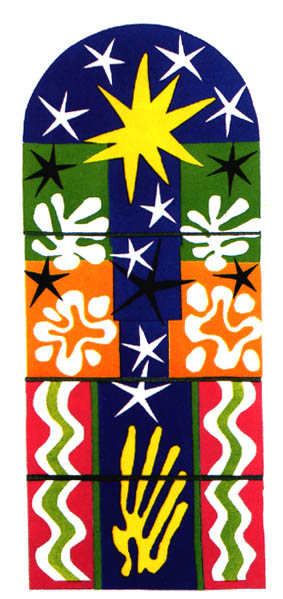
Henri Matisse (French, 1869–1954), Maquette for Nuit de Noël, 1952. Gouache on paper, cut and pasted, mounted on board, 271.8 × 135.9 cm (107 × 53.5 in.). Museum of Modern Art, New York.
Give ear, O Shepherd of Israel,
you who lead Joseph like a flock.
You who are enthroned upon the cherubim, shine forth.
Before Ephraim and Benjamin and Manasseh,
stir up your might,
and come to save us!
Restore us, O God;
let your face shine, that we may be saved!
—Psalm 80:1–3
+++
SONG: “Holy Love Come Down” by David Isaac Rivers, from Psalms (2016)
This post belongs to the weekly series Artful Devotion. If you can’t view the music player in your email or RSS reader, try opening the post in your browser.
To view all the Revised Common Lectionary scripture readings for the First Sunday of Advent, cycle B, click here.
Peter Eugene Ball (British, 1943–), Christus Rex, 1999. Wood sculpture covered in copper and embellished with silver and gold leaf. Ely Cathedral, Cambridgeshire, England.
The final Sunday in the 2016–17 lectionary year, November 26 is designated in the Western church as the feast of Christ the King, known formally as the Solemnity of Our Lord Jesus Christ, King of the Universe. One of the scripture readings for the conclusion of cycle A is as follows:
I pray that the God of our Lord Jesus Christ, the Father of glory, may give you the Spirit of wisdom and of revelation in the knowledge of him, having the eyes of your hearts enlightened, that you may know what is the hope to which he has called you, what are the riches of his glorious inheritance in the saints, and what is the immeasurable greatness of his power toward us who believe, according to the working of his great might that he worked in Christ when he raised him from the dead and seated him at his right hand in the heavenly places, far above all rule and authority and power and dominion, and above every name that is named, not only in this age but also in the one to come. And he put all things under his feet and gave him as head over all things to the church, which is his body, the fullness of him who fills all in all.
If to Christ our Lord is given all power in heaven and on earth; if all people, purchased by his precious blood, are by a new right subjected to his dominion; if this power embraces all people, it must be clear that not one of our faculties is exempt from his empire. He must reign in our minds, which should assent with perfect submission and firm belief to revealed truths and to the doctrines of Christ. He must reign in our wills, which should obey the laws and precepts of God. He must reign in our hearts, which should spurn natural desires and love God above all things, and cleave to him alone. He must reign in our bodies and in our members, which should serve as instruments for the interior sanctification of our souls, or to use the words of the Apostle Paul, as instruments of justice unto God.
This post belongs to the weekly series Artful Devotion. If you can’t view the music player in your email or RSS reader, try opening the post in your browser.
To view all the Revised Common Lectionary scripture readings for Proper 29, cycle A, click here.
Leonardo da Vinci painting breaks all-time sales record: A painting of Christ by the Renaissance master sold for $450.3 million at Christie’s on Wednesday to an anonymous bidder, making it the most expensive painting ever acquired, either at auction or (it’s believed) through private sales. (It displaced by a long shot Picasso’s Women of Algiers, which sold for $179.4 million at auction in 2015, and the reported $300 million paid privately for Gauguin’s Nafea Faa Ipoipo?, also in 2015.) A common iconographic subject in the sixteenth century, “Salvator Mundi” translates as “Savior of the World”; Leonardo’s shows Christ in Renaissance dress, holding a crystal orb in his left hand (representative of Earth) and raising his right hand in benediction. He painted it around 1500 for King Louis XII of France, but it was presumed lost until 2005—“the biggest [artistic?] discovery of the 21st century,” said Christie’s. It’s one of only twenty known paintings attributed to Leonardo.
Leonardo da Vinci (Italian, 1452–1519), Salvator Mundi (Savior of the World), ca. 1500. Oil on walnut, 45.4 × 65.6 cm (25.8 × 19.2 in.).
+++
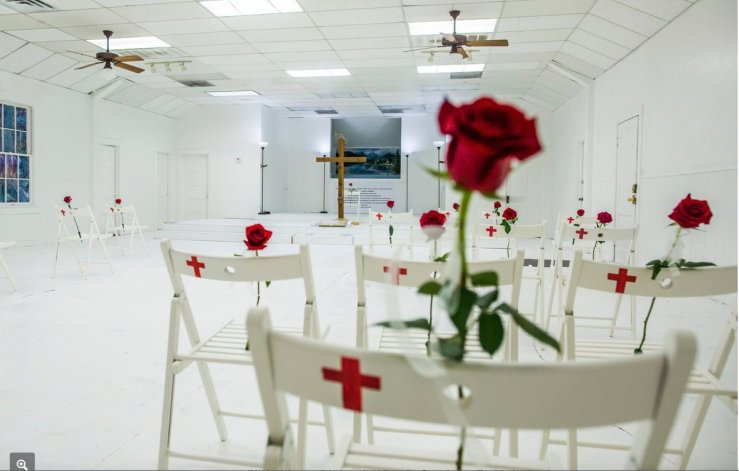
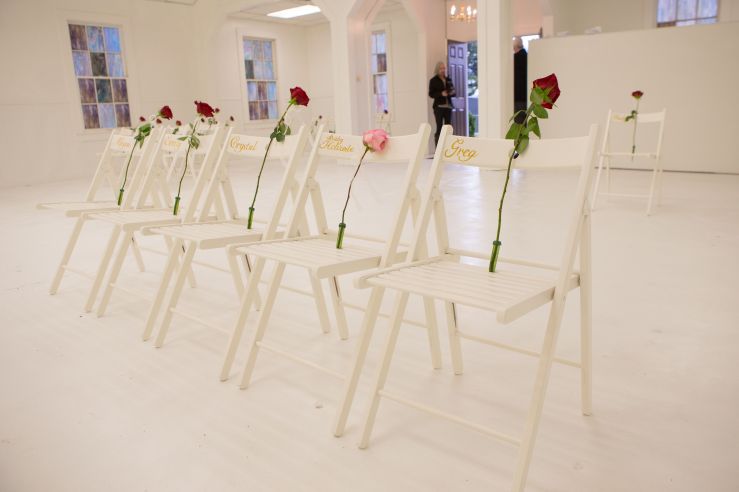
White-chair memorial inside Sutherland Springs church opens to public before demolition: First Baptist Church in Sutherland Springs, Texas, reopened to the public on Sunday evening for the first time since a mass shooting on November 5 killed twenty-six people attending worship. In the week between, volunteers came in and repaired all the bullet holes, ripped up the carpet and tore out the pews, and applied fresh coats of white paint to the walls and concrete floor. A temporary memorial has been erected, consisting of white folding chairs that bear the names of the victims in gold paint as well as roses with chiffon ribbons. The one pink rose among twenty-five red ones is for the unborn child who died with his or her eight-months-pregnant mother.
Temporary memorial, November 12, 2017, First Baptist Church, Sutherland Springs, Texas. Photo: Drew Anthony Smith for the New York TimesBaby Holcombe’s pink rose sits between roses for his or her mom Crystal and brother Greg. Nine of the twenty-six shooting victims were from the Holcombe family.
Although the congregation has not yet officially voted on it, it’s likely that the church will be demolished and a new one built in its place; the pastor said many congregants do not want to go back in there because of the trauma. (The Sunday after the shooting, they worshipped in a large outdoor tent nearby.) Preemptively, a San Antonio contractor teamed up with other local business owners to form a nonprofit, Rebuilding Sutherland Springs Inc., to raise money for a new church building and park. Through GoFundMe, they have already raised $1.1 million of their $2.5 million goal. Click here to donate.
Advent candle-lighting liturgy: Advent season is just around the corner. Here are five dramatic readings for the lighting of the Advent candles, based on traditional liturgies. They were written by Kathy Larson, director of Christian education and creative arts at Good Shepherd Presbyterian Church in Charlotte, North Carolina. They sound very compelling!
+++
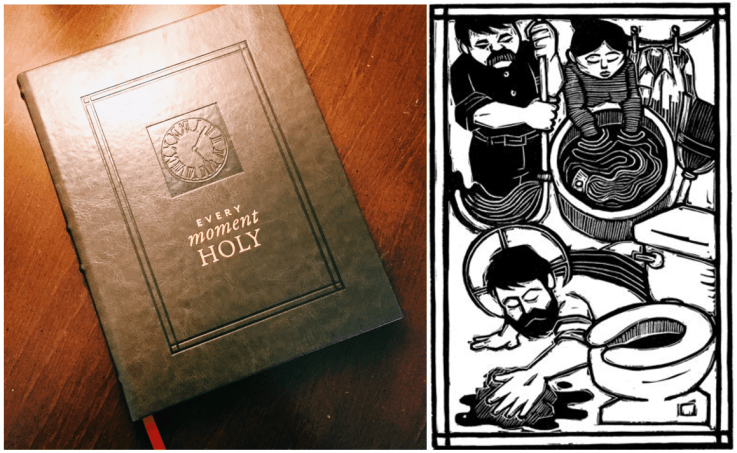
NEW BOOK: Every Moment Holy by Douglas Kaine McKelvey: On November 3 Rabbit Room Press released a collection of one hundred-plus new liturgies for daily life bound together in a beautiful hardcover volume with linocut illustrations by Ned Bustard. Some of the prayers are intended for routine acts, while others are for special, memorable, difficult, or even tragic occasions. Included are liturgies for laundering, for home repair, for the watching of storms, for the first hearthfire of the season, before beginning a book, for setting up a Christmas tree, for the welcoming of a new pet, for the morning of a medical procedure, for the death of a dream, upon tasting pleasurable food, and for the sound of sirens. The aim is to encourage mindfulness of the constant presence of God. Five free liturgies are available for download at https://www.everymomentholy.com/liturgies. The book is for sale exclusively at the online Rabbit Room Store. Read an interview with the illustrator here.
Communing with the Lord during one’s daily tasks is what the seventeenth-century monk Brother Lawrence calls “practicing the presence of God”; poet George Herbert calls it “drudgery made divine.” The Anglican priest Jonathan Evens led a short meditation a few months ago at St. Stephen Walbrook that draws on the wisdom of these two near contemporaries, titled “Doing Our Common Business for the Love of God”—very much in the same spirit as McKelvey’s book.
Every Moment Holy by Douglas Kaine McKelvey (Rabbit Room Press, 2017). Right: Part opener illustration by Ned Bustard for “Liturgies of Labor and Vocation.”
John R. P. Russell (American, 1980–), Nepsis, 2006. Acrylic on wooden door, 80 × 24 in.
The day of the Lord will come like a thief in the night. While people are saying, “There is peace and security,” then sudden destruction will come upon them as labor pains come upon a pregnant woman, and they will not escape.
But you are not in darkness, brothers, for that day to surprise you like a thief. For you are all children of light, children of the day. We are not of the night or of the darkness. So then let us not sleep, as others do, but let us keep awake and be sober. For those who sleep, sleep at night, and those who get drunk, are drunk at night.
But since we belong to the day, let us be sober, having put on the breastplate of faith and love, and for a helmet the hope of salvation. For God has not destined us for wrath, but to obtain salvation through our Lord Jesus Christ, who died for us so that whether we are awake or asleep we might live with him.
—1 Thessalonians 5:2b–10
+++
MUSIC: “Riding Light” | Composed and performed by Joshua Roman
The cello composition “Riding Light” was commissioned in 2013 by Grace Cathedral in San Francisco to complement an installation by artist-in-residence Anne Patterson. This video captures a performance from May 2017, filmed in the Crypt chapel beneath the Church of the Intercession in Manhattan. The venue is home to the “Crypt Sessions” concert series organized by Unison Media, a company that seeks new ways to present and promote classical music.
+++
John R. P. Russell, a Byzantine Catholic priest and artist, on his painting Nepsis:
Nepsis means “watchfulness” and it is a spiritually aware state of being ever vigilant against temptation and attacks of the enemy. It is both a means to the end of theosis and a trait of those who have become one with God. This posture of the figure in this painting is taken from paintings of monks in the church of St. Mercurius in Old Cairo, Egypt. I think of the halo, which has obliterated even the face of the figure, as representing the divinity with which the person is united and the lower part of the figure’s body as representing the passions against which the person is struggling.
This post belongs to the weekly series Artful Devotion. If you can’t view the music player in your email or RSS reader, try opening the post in your browser.
To view all the Revised Common Lectionary scripture readings for Proper 28, cycle A, click here.
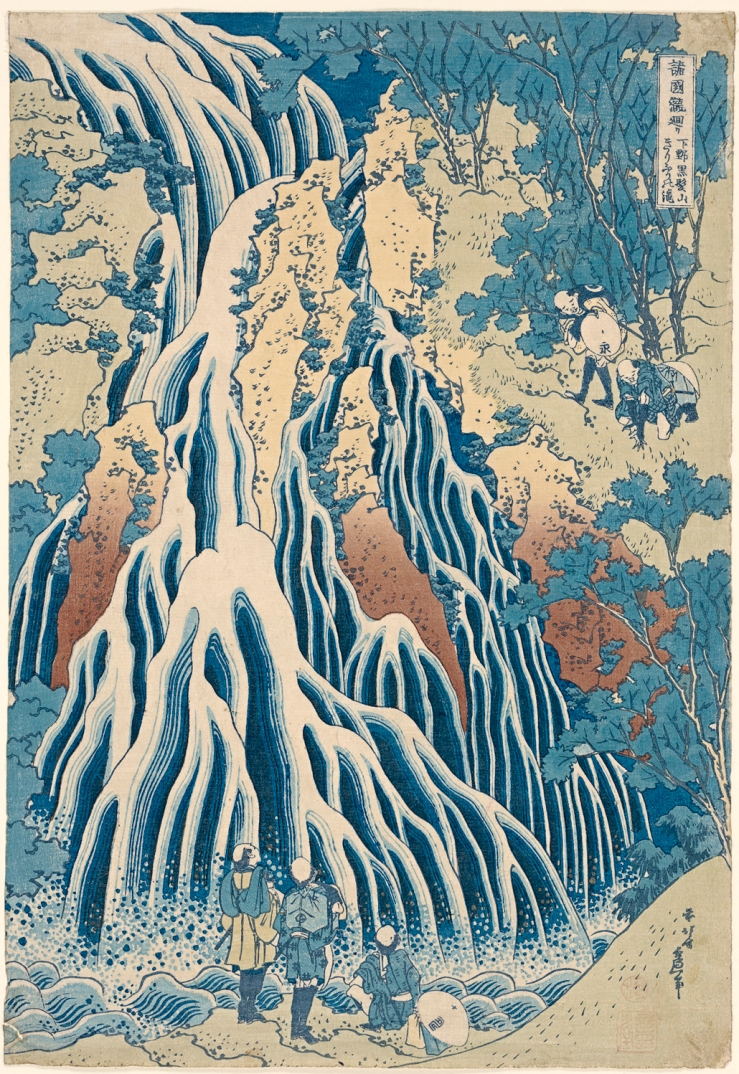
Katsushika Hokusai (Japanese, 1760–1849), Misty Kirifuri Waterfall at Kurokami Mountain, ca. 1833. Woodblock print on dyed paper, 37.6 × 27 cm. National Gallery of Victoria, Melbourne.
God condemns the two-facedness of his people, who offer praise to him in song and sacrifice but fail to uphold his laws of social justice:
I hate, I despise your feasts,
and I take no delight in your solemn assemblies.
Even though you offer me your burnt offerings and grain offerings,
I will not accept them;
and the peace offerings of your fattened animals,
I will not look upon them.
Take away from me the noise of your songs;
to the melody of your harps I will not listen.
But let justice roll down like waters,
and righteousness like an ever-flowing stream.
I have not said to my people: “Get rid of your discontent.” Rather, I have tried to say that this normal and healthy discontent can be channeled into the creative outlet of nonviolent direct action. And now this approach is being termed extremist.
But though I was initially disappointed at being categorized as an extremist, as I continued to think about the matter I gradually gained a measure of satisfaction from the label. Was not Jesus an extremist for love: “Love your enemies, bless them that curse you, do good to them that hate you, and pray for them which despitefully use you, and persecute you.” Was not Amos an extremist for justice: “Let justice roll down like waters and righteousness like an ever-flowing stream.” Was not Paul an extremist for the Christian gospel: “I bear in my body the marks of the Lord Jesus.” Was not Martin Luther an extremist: “Here I stand; I cannot do otherwise, so help me God.” And John Bunyan: “I will stay in jail to the end of my days before I make a butchery of my conscience.” And Abraham Lincoln: “This nation cannot survive half slave and half free.” And Thomas Jefferson: “We hold these truths to be self-evident, that all men are created equal . . .”
So the question is not whether we will be extremists, but what kind of extremists we will be. Will we be extremists for hate or for love? Will we be extremists for the preservation of injustice or for the extension of justice? In that dramatic scene on Calvary’s hill three men were crucified. We must never forget that all three were crucified for the same crime—the crime of extremism. Two were extremists for immorality, and thus fell below their environment. The other, Jesus Christ, was an extremist for love, truth and goodness, and thereby rose above his environment. Perhaps the South, the nation and the world are in dire need of creative extremists.
—Martin Luther King Jr., Letter from a Birmingham Jail
This post belongs to the weekly series Artful Devotion. If you can’t view the music player in your email or RSS reader, try opening the post in your browser.
To view all the Revised Common Lectionary scripture readings for Proper 27, cycle A, click here.
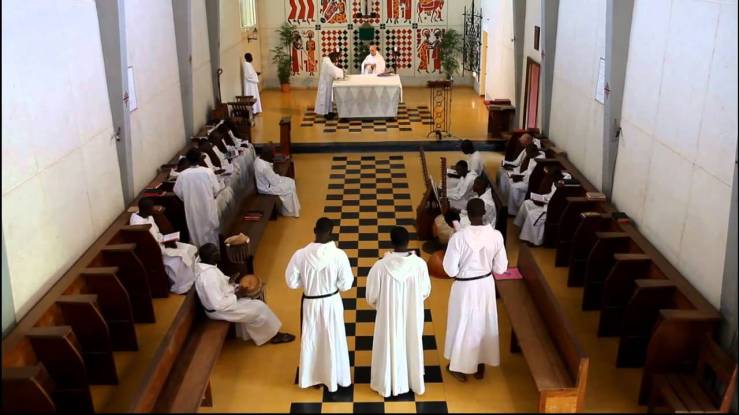
Lately I’ve been enjoying the music of the monks at Keur Moussa Abbey, a brotherhood of French expatriates and Senegalese who wed Western liturgical chant with the rhythms and instrumental textures of West Africa. One of their income streams is musical recording sales—in North America, for example, Sounds True distributes Keur Moussa: Sacred Chant and African Rhythms from Senegal. It’s an excellent, seventeen-track CD that comprises songs of praise, exhortation, confession, and supplication in French and Wolof. Below you will find two of those tracks, embedded with the kind permission of Sounds True.
The first is “Suma Hol Nam” (“I Was Glad”), an adaptation of Psalm 122 in Wolof, accompanied by tom-tom. “Let peace reign in your tents, joy within your walls!” it exclaims. The refrain is “How glad I was when they said to me, ‘Let us go to the house of the Lord.’”
The second is “Yesu Dekalikuna” (“Jesus Is Risen”), a brisk instrumental kora interlude that evokes the holy women hastening from the tomb on Easter morning.
From the liner notes:
In 1963, nine monks from the French monastery of Saint-Pierre of Solesmes—a centuries-old stronghold of the ancient Gregorian plainchant tradition—journeyed to the remote Wolof village of Keur Moussa in Senegal to found the Benedictine Abbey of the Immaculate Heart of Mary [Abbaye du Cœur Immaculé de Marie]. Keur Moussa Abbey, as it is known to the villagers, means “House of Moses.” It is above all a place of prayer, where praise of God is celebrated through hard work, contemplative silence, and joyful music. From the first day of their arrival, these expatriate monks sought to invite the traditions, music, and people of their host village into the monastery grounds.
Today, Keur Moussa Abbey houses 35 brothers, 24 of whom are Senegalese. [According to OSB International, the current number of brothers is 44.] The abbey also sponsors an elementary school and dispensary, run by sisters and laypeople. The monks themselves live from the work of their hands, tending fruit trees, making cheese, and hand-crafting their renowned koras.
The kora, employed for both solos and accompaniment, is an African lute-harp of Mandingo origin. Enchanted by its lyrical voice, the first monks of Keur Moussa Abbey learned from the griots (nomadic Mandingo kora players and storytellers) to play the instrument, and eventually adapted it for use in their liturgical services. Through careful changes in the kora’s construction, they have made it easier to tune—a process that once frustrated even the most experienced of players—without altering its extraordinarily beautiful timbre. . . .
Through the continual exploration of their convergent musical worlds, the monks of Keur Moussa have created an entirely new liturgical choral tradition . . . weav[ing] the rhythms and instrumental textures of the African continent with the sacred words and compositional structures of traditional Western plainchant (sung in French and Wolof, the language of the region). Here, as in the daily masses at the abbey, the choral works are occasionally preceded or followed by instrumental performances on kora, tabala (a large Mauritanian camel-skin drum), balafon (a Malinke instrument similar to the xylophone), tom-tom, and flute.
About the painting: Before he became a world-famous pioneer of geometric abstraction, Piet Mondrian (1872–1944) spent his early artistic career painting pastoral images of his native Netherlands in an impressionist style—churches, windmills, fields, rivers, sand dunes, and lighthouses. He made several paintings, using different color palettes, of the “tall lighthouse” of Westkapelle, which stands at the entrance to the village. The structure is actually a fifteenth-century Gothic church tower that was converted into a lighthouse in 1818 after the church burned down. It is still active, serving along with the “short lighthouse” to lead vessels coming in from the northern part of the North Sea. The loose pointillist technique Mondrian uses here enables him to fuse the lighthouse with the surrounding sky, producing a sense of vibration and ethereality.
About the singer: Blind Willie Johnson (1897–1945) was a gospel blues singer, slide guitarist, and evangelist from Texas about whom little is known. Besides the one-time payments he received from Columbia for his studio recordings of 1927–30, most of his income was earned by performing and preaching on the streets; appreciative passersby would drop coins into the tin cup tied to his Stella. Johnson is known for his unique style of singing: in a gravelly “false bass,” or growl, which he drops into in verse 2 of “Let Your Light Shine on Me.” His is the earliest known recording of this traditional gospel song.
This post belongs to the weekly series Artful Devotion. If you can’t view the music player in your email or RSS reader, try opening the post in your browser.
To view all the Revised Common Lectionary scripture readings for Proper 26, cycle A, click here.
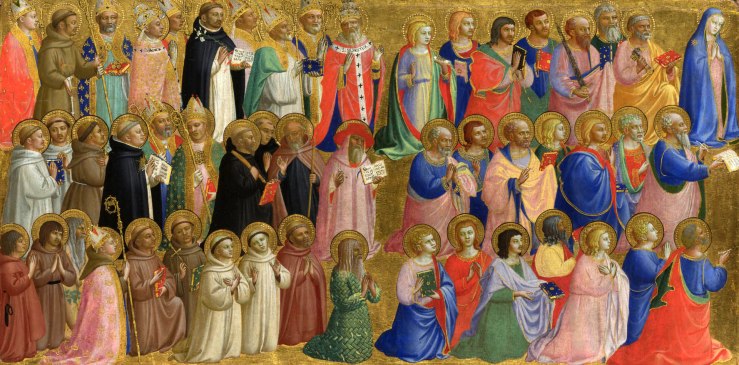
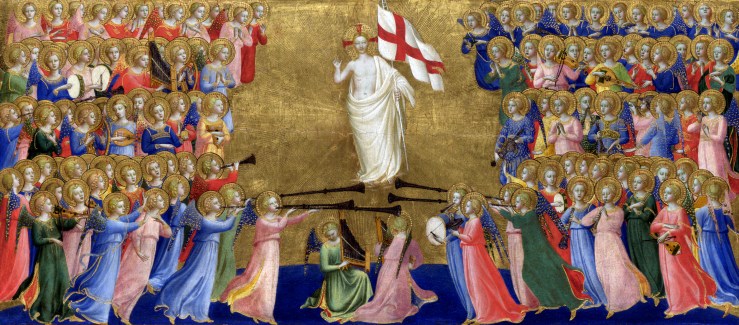
Predella of the San Domenico Altarpiece at Fiesole, ca. 1424, probably by Fra Angelico (Italian, ca. 1395–1455). Tempera and gold leaf on panels, 32 × 244 cm. National Gallery, London.
This week the Revised Common Lectionary assigns an additional set of readings, on top of Sunday’s, for the special celebration of All Saints’ Day (Hallowmas) on November 1. Among them is John’s vision of a multitude of angels and faithful departed surrounding the enthroned Christ in heaven, sounding forth his praise.
After this I looked, and behold, a great multitude that no one could number, from every nation, from all tribes and peoples and languages, standing before the throne and before the Lamb, clothed in white robes, with palm branches in their hands, and crying out with a loud voice, “Salvation belongs to our God who sits on the throne, and to the Lamb!” And all the angels were standing around the throne and around the elders and the four living creatures, and they fell on their faces before the throne and worshiped God, saying, “Amen! Blessing and glory and wisdom and thanksgiving and honor and power and might be to our God forever and ever! Amen.”
—Revelation 7:9–12
+++
O quam gloriosum est regnum (“O how glorious is the kingdom”) — A cappella motet for four voices composed by Tomás Luis de Victoria, 1572 | Performed by the University of Utah Chamber Choir
O quam gloriosum est regnum in quo cum Christo gaudent omnes sancti! Amicti stolis albis, sequuntur Agnum quocumque ierit.
O how glorious is the kingdom
in which all the saints rejoice with Christ!
Clad in robes of white,
they follow the Lamb wherever he goes.
+++
Explore the individual panels from Fra Angelico’s “court of heaven” predella in greater detail on the National Gallery of London’s website, and rejoice this All Saints’ Day in the Christian witness of those who have gone before us!
Probably Fra Angelico (Italian, ca. 1395–1455), The Virgin Mary with the Apostles and Other Saints, ca. 1424. Tempera and gold leaf on panel, 32 × 64 cm. From the San Domenico Altarpiece predella, National Gallery, London.Probably Fra Angelico (Italian, ca. 1395–1455), Christ Glorified in the Court of Heaven, ca. 1424. Tempera and gold leaf on panel, 31.7 × 73 cm. From the San Domenico Altarpiece predella, National Gallery, London.Probably Fra Angelico (Italian, ca. 1395–1455), The Forerunners of Christ with Saints and Martyrs, ca. 1424. Tempera and gold leaf on panel, 31.9 × 63.5 cm. From the San Domenico Altarpiece predella, National Gallery, London.
This post belongs to the weekly series Artful Devotion. If you can’t view the music player in your email or RSS reader, try opening the post in your browser.
To view all the Revised Common Lectionary scripture readings for All Saints’ Day, cycle A, click here.
Right: Mary Magdalen at the Foot of the Cross, Netherlands, ca. 1420–30. Alabaster, 8 7/16 × 3 11/16 × 4 1/16 in. (21.5 × 9.3 × 10.3 cm). Metropolitan Museum of Art, New York. Photo: Victoria Emily Jones. This fragment served as the base of a now-lost crucifix.
“You shall love the Lord your God with all your heart, and with all your soul, and with all your mind. This is the greatest and first commandment.” (Matthew 22:37–38)
+++
SONG: “More Love to Thee” | Words by Elizabeth Prentiss, 1869 | Music by William H. Doane, 1868 | Arranged and performed by One Eighty (Amy J. Kim, Joon Park)
“O Lord, from now on let me love You as intensely as I have loved sin.”
—John Chrysostom
“To Thee alone my spirit cries;
In Thee my whole ambition lies,
And still Thy Wealth is far above
The poverty of my small love.”
—Dhul-Nun al-Misri, 9th-century Egyptian Sufi mystic (trans. A. J. Arberry)
This post belongs to the weekly series Artful Devotion. If you can’t view the music player in your email or RSS reader, try opening the post in your browser.
To view all the Revised Common Lectionary scripture readings for Proper 25, cycle A, click here.
Affiliate links:Art & Theology is now a participant in the Amazon Associates program, an affiliate marketing tool that enables me to potentially collect a little change by hosting Amazon links on my website. I already do that anyway—link to Amazon product pages when I mention books, movies, or less often, music (I try to drive sales directly to the artist’s website, if one exists)—so you will not notice any change in blog post appearance or the frequency of links. But now that I’m registered, if you were to click through one of those Amazon links (for example, Shout Because You’re Free or The Seventh Seal below) and make a purchase, any purchase, I would earn a referral fee of 2.5% to 5% of the purchase price. I have to generate at least three purchases every 180 days to stay in the program. As of now, this is the website’s sole income stream.
+++
EXHIBITION: “The Ivory Mirror: The Art of Mortality in Renaissance Europe,” June 24–November 26, 2016, Bowdoin College Museum of Art, Brunswick, Maine: Skeletons, skulls, and other dark images of death from the fourteenth and fifteenth centuries were meant to remind their owners of life’s brevity and thereby prompt repentance. Some target specific sins, like clinging too tightly to one’s wealth or good looks. “This exhibition represents a significant contribution to our understanding of the rich visual culture of mortality in Renaissance Europe. The appeal of the memento mori, featuring macabre imagery urging us to ‘remember death,’ reached the apex of its popularity around 1500, when artists treated the theme in innovative and compelling ways. Exquisite artworks—from ivory prayer beads to gem-encrusted jewelry—evoke life’s preciousness and the tension between pleasure and responsibility, then and now.” A symposium, “Last Things: Luxury Goods and Memento Mori Culture in Europe, ca. 1400-1550,” will be held November 3–4. You can read a review of the exhibition at Hyperallergic.
Ivory prayer bead, France or southern Netherlands, 1530. Victoria and Albert Museum, London. On one side of the carving is a man, on another a woman, and grinning sardonically between them is a skull, worms crawling through its bared teeth.Vanitas, Germany, ca. 1525. Boxwood. Harvard Art Museums/Busch-Reisinger Museum, Cambridge, Massachusetts.
+++
ART COMMENTARY:The Seven Works of Mercyby the Master of Alkmaar: The corporal works of mercy, seven in number, are a traditional Catholic practice of serving the physical needs of others. Derived from Matthew 25:31–46 (cf. Isaiah 58:6–10) and Tobit 1:16–22, they are to: (1) feed the hungry, (2) give water to the thirsty, (3) clothe the naked, (4) shelter the homeless, (5) care for the sick, (6) visit the imprisoned, and (7) bury the dead. Earlier this month Marleen Hengelaar-Rookmaaker wrote a two-part visual meditation on a Netherlandish polyptych (altarpiece with four or more panels) from the sixteenth century that treats this topic. In the background of each contemporary enactment of mercy stands a silently affirming Jesus. To view the panels in high resolution, visit the Rijksmuseum website.
The Master of Alkmaar, The Seven Works of Mercy, 1504. Oil on seven panels, 120 × 472 cm. Rijksmuseum, Amsterdam.
+++
ALBUM:Spirituals and Shout Songs from the Georgia Coastby the McIntosh County Shouters: The McIntosh County Shouters from coastal Georgia are the last community in America to perform the traditional ring shout, a shuffle-step devotional movement, accompanied by singing, that is rooted in the ritual dances of West Africa and was forged by the Atlantic slave trade. Shouting differs from traditional black religious music in repertory, style, and execution, Art Rosenbaum writes in Shout Because You’re Free: The African American Ring Shout Tradition in Coastal Georgia. In 1980 two folklorists, astonished to find the form still in use, encouraged practitioners to take it public. The community thus assembled a small touring group, and in 1984, under the Smithsonian Folkways label, they released their first album. This year they released their second, with a mostly new selection of songs (all but three) and all-new performances. You can watch “Jubilee” below. (Thanks, Global Christian Worship, for the tip!)
+++
FILM: The Seventh Seal (1958): After receiving several recommendations, I finally watched this classic of world cinema, directed by Ingmar Bergman, and actually enjoyed it more than I expected. It follows the medieval knight Antonius Block as he returns, disillusioned and exhausted, from a decade-long Crusade, only to encounter Death, whom he challenges to a fateful game of chess. (This central image, Bergman said, was inspired by a church fresco, reproduced below.)
Albertus Pictor (Swedish, ca. 1440–ca. 1507), Death Playing Chess, 1480s. Fresco, Täby Church, Uppland, Sweden.
The movie’s title is taken from Revelation 8:1—“And when the Lamb opened the seventh seal, there was silence in heaven for about half an hour”—establishing the silence of God as a major theme. Antonius’s monologue in the chapel confessional evinces his struggle between doubt and belief:
I want to confess as best I can, but my heart is void. The void is a mirror. I see my face and feel loathing and horror. My indifference to men has shut me out. I live now in a world of ghosts, a prisoner in my dreams. . . .
Is it so hard to conceive God with one’s senses? Why must he hide in a mist of vague promises and invisible miracles? How are we to believe the believers when we don’t believe ourselves? What will become of us who want to believe but cannot? And what of those who neither will nor can believe? Why can I not kill God within me? Why does he go on living in a painful, humiliating way? I want to tear him out of my heart, but he remains a mocking reality which I cannot get rid of. . . .
I want knowledge. Not belief. Not surmise. But knowledge. I want God to put out his hand, show his face, speak to me. . . . I cry to him in the dark, but there seems to be no one there.
But along his way he ends up meeting a “holy family”—simple and with pure faith and hope—whose names, Mia and Jof, are diminutives of Mary and Joseph. Bergman presents their worldview as a contrast to the bitter skepticism of Antonius.


#/media/File:Leonardo_da_Vinci,_Salvator_Mundi,_c.1500,_oil_on_walnut,_45.4_%C3%97_65.6_cm.jpg)






 Art & Theology
