Now Jesus stood before the governor, and the governor asked him, “Are you the King of the Jews?” Jesus said, “You have said so.” But when he was accused by the chief priests and elders, he gave no answer. Then Pilate said to him, “Do you not hear how many things they testify against you?” But he gave him no answer, not even to a single charge, so that the governor was greatly amazed.
—Matthew 27:11–14
Consider the incredible self-control Jesus exercises in his appearance before Pilate. He has just come from his religious trial, where he was passed from Annas to Caiaphas to the Sanhedrin and found guilty of blasphemy. But the Sanhedrin does not have the authority to issue death sentences, so they turn Jesus over to the civil authorities, claiming he’s a threat to Roman power, guilty of sedition.
Both charges are false, and yet Jesus gives no defense against either one. Why? Why not prove that he truly is the Son of God, and that he’s no insurrectionist? Why not clear his name? In John’s account of the trial before Pilate (18:33–38), Jesus is more verbal; he explains, “My kingdom is not of this world.” But still, he offers no hard evidence, calls no witnesses (they’ve scattered anyway). He essentially sits back and lets the judgment fall.
English poet and clergyman Richard Crashaw (1612–1649) was inspired by Christ’s silence under pressure to pen an epigrammatic verse unpacking its significance. As a teenager attending Charterhouse School in London, he and his fellow students were required to write epigrams based on the epistle and Gospel readings from the day’s chapel services, and it’s a practice Crashaw continued throughout his life. The following was originally published in Steps to the Temple: Sacred Poems, with Other Delights of the Muses in 1646.
“Matthew 27” by Richard Crashaw
And he answered them nothing.
O Mighty Nothing! unto thee,
Nothing, we owe all things that be.
God spake once when he all things made,
He sav’d all when he Nothing said.
The world was made of Nothing then;
’Tis made by Nothing now again.
In “Matthew 27,” Crashaw apostrophizes the word Nothing. (Apostrophe is a poetic device in which the speaker addresses an absent person, an abstract idea, or a thing; Paul does it, for example, in 1 Corinthians 15:55: “O death, where is thy sting? O grave, where is thy victory?”) He plays on its opposite: everything. By no thing comes all things. Continue reading “The “Nothing” that won our salvation”→
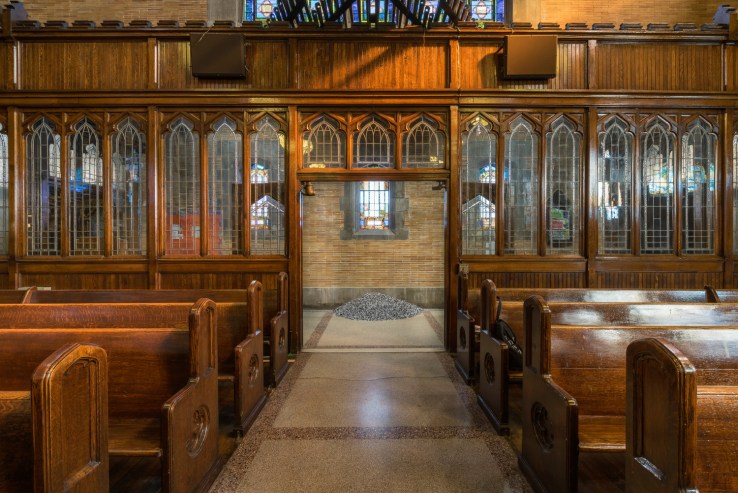
In March 2017, the “. . . circle through New York” project brought Felix Gonzalez-Torres’s 1991 work Untitled (Public Opinion)—a large pile of individually wrapped licorice candies, available for viewers to take and eat—from the Guggenheim to St. Philip’s Church in Harlem. St. Philip’s, in turn, lent out its call to social justice, which will rotate among the project’s five other participating venues.
“. . . circle through New York” project: What a clever way to foster relationships and spread cultural wealth! “In their new project A talking parrot, a high school drama class, a Punjabi TV show, the oldest song in the world, a museum artwork, and a congregation’s call to action circle through New York, artists Lenka Clayton and Jon Rubin create a complex system of social and material exchange that brings together city communities often separated by cultural, economic, geographic, or circumstantial boundaries. The artists have drawn an imaginary circle through Harlem, the South Bronx, Queens, and Manhattan’s Upper East Side and invited six public venues along the circle’s path to participate in a system of social and material exchange. These spaces, which include a pet store, a high school, a TV network, an academic research institute, the Guggenheim, and a church, serve as the project’s cocreators and hosts. The artists worked with the venues to select aspects of their identities—referenced in the project’s full title—that will rotate among the six locations over a period of six months.” Commissioned as part of the Guggenheim Social Practice initiative, the project is now in its second month and will wrap up in August.
+++
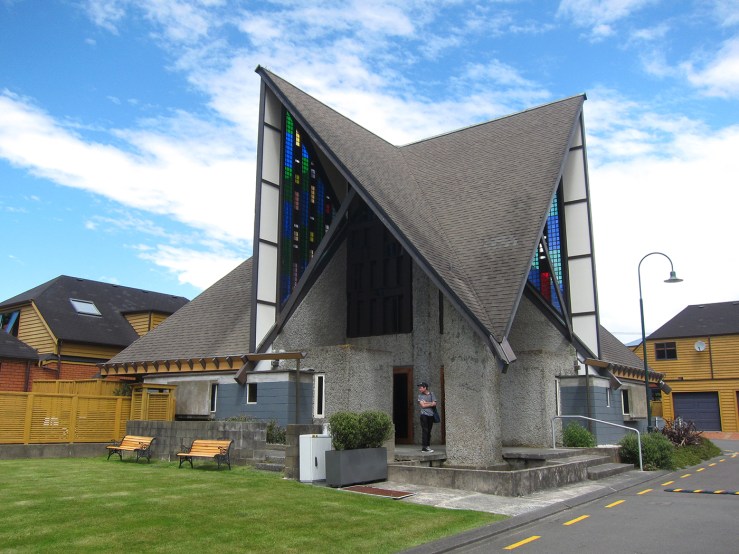
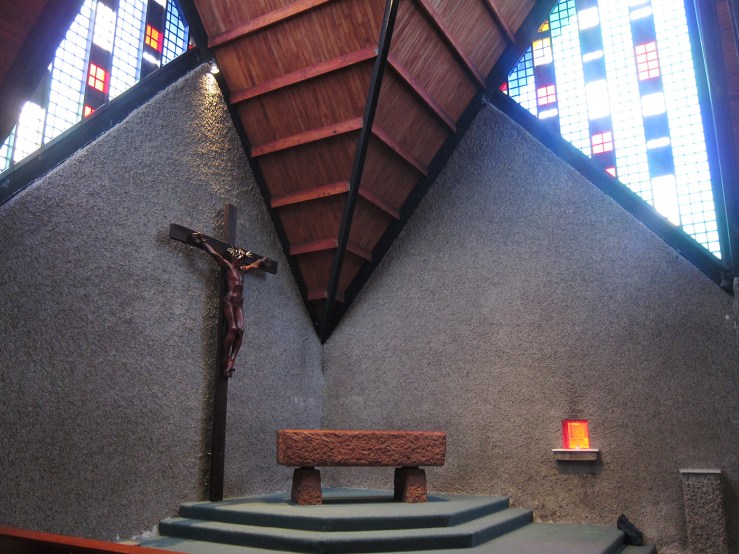
“The Shimmering Glory of a Modern Indigenous New Zealand Chapel”: Completed in 1961, the Futuna Chapel in Wellington is, according to architect Nick Bevin, “New Zealand’s most significant building of the twentieth century.” Influenced by elements of wharenui (Maori meetinghouses), it was designed by John Scott, the country’s first university-trained Maori architect, as part of a retreat center for the Catholic Marist Brothers, and was built by volunteers from the order. Auckland artist Jim Allen was hired to design the acrylic glass windows, a Stations of the Cross frieze, and several mosaics, and to sculpt a crucifix for the main altar. The Society of Mary had to sell the retreat center in 2000 for financial reasons; the Futuna Trust has been formed to protect the chapel from demolition, but not before the surrounding land was turned into a townhouse development. The chapel is now deconsecrated, serving as host to lectures, concerts, and other events. Many great photos of its interior and exterior can be viewed at the link above, or, for further study, check out the recent book Futuna: Life of a Building.
Futuna Chapel, Wellington, New Zealand, designed by John Scott. Photo: Claire Voon/HyperallergicMain altar of Futuna Chapel, Wellington, New Zealand, showing a mahogany crucifix and rough-hewn granite slab altar by Jim Allen. Photo: Claire Voon/Hyperallergic
+++
Disney animator Glen Keane on spiritual transformation: Last month’s theatrical release of Disney’s live-action Beauty and the Beast has sparked renewed interest in the 1991 animated classic. On one of the special features of the DVD/Blu-ray release of the animated version, I was fascinated to hear that Glen Keane—who animated the original Beast along with Ariel, Aladdin, Pocahontas, Tarzan, Rapunzel, and many other beloved Disney characters—is a Christian whose own story of spiritual transformation was the driving inspiration, for him, behind the Beast’s transformation sequence at the end of the movie. (Visual influences included Rodin’s The Burghers of Calais and Michelangelo’s slave sculptures.) In an interview, Keane described his approach to animating this climactic moment:
For me, it’s really an expression of my spiritual life. There’s a verse in the Bible that says, “If any man is in Christ, he is a new creation. Old things have passed away, and all things have become new.” I wrote that on my exposure sheet there as I’m drawing this, because it’s really about an inner spiritual transformation that’s taking place with the Beast. And I saw it as a parable of my own life—that I got to express that. It was sincere, it was real for me. It was very real for the prince. I don’t know that there’s ever an illustration more clear as to what really can take place in a person’s life spiritually than this animated character transforming from an animal to the prince.
“The Dark of Doubt Dispelled: Odilon Redon’s Day appears at last . . .”: On March 26 I wrote a reflection for ArtWay on one of Odilon Redon’s lithographs. Showing the head of Christ haloed by the sun, his crown of thorns disentangling, it’s the last in a suite of twenty-four prints inspired by Gustave Flaubert’s novel/drama The Temptation of Saint Anthony.
Odilon Redon (French, 1840–1916), Day appears at last . . . and in the very disk of the sun shines face of Jesus Christ (detail), 1896. Lithograph on chine appliqué, from Redon’s third Temptation of Saint Anthony portfolio, published by Ambroise Vollard, Paris.
+++
Cities, a five-song cycle by Jonathon Roberts: “I have a personal goal of setting the whole Bible to music,” writes Jonathon Roberts. “The Bible is the starting point for most of my projects, regardless of the style. I connect best with a passage of Scripture when I explore it artistically. The challenge has led me down some interesting roads musically and lyrically, since the subject matter doesn’t always fit in a nice box.” Cities is Roberts’s most recent work; it’s a chamber-pop song cycle personifying the biblical cities of Bethlehem, Ephesus, Jerusalem, Jericho, and the “New City” described in Revelation. Listen to “Bethlehem,” inspired by Micah 5:2, below, and the rest here. The whole piece is a lot of fun!
Roberts’s interest in deepening his and others’ engagement with the Bible led him to found, with Emily Clare Zempel, the organization Spark and Echo Arts, which commissions works of visual art, music, theater, poetry, fiction, dance, and film that respond directly to scripture. Its aim is to “illuminate” the entire Bible, using various art forms, by 2020, creating a platform and framework for artists to explore this ancient sacred text, as well as a rich resource for the church. Look out for a major web redesign, to launch in the next few months.
As you may have noticed, I’ve had to ease up lately on my self-imposed one-post-a-week rule to accommodate other projects. For February and March, I’ve been teaching an adult Sunday school course at my church called “Art and the Church: Seeing the Sacred in Global Christian Art”; I have a really great group of people exploring the topic with me, and I’ve enjoyed seeing which images they respond to most. I’ve also been invited by three separate entities to produce content on their platforms this spring: by a missions organization, to curate an online gallery of Passion art; by a divinity school, to write a post for its blog; and by a Christian ministry at Brown University, to deliver a talk to undergraduates. Moreover, I just returned from a trip to California, where I attended a Biola University–sponsored art symposium called “Art in a Postsecular Age”; I got to meet Matthew Milliner and Jonathan Anderson and hear from a panel of other distinguished speakers.
So, while I had every intention of getting this list out last week to coincide with the start of Lent, slide preparations, permissions e-mails, and travels have claimed my focus. I regret that all this revving up has come during a season dedicated to slowing down. Please forgive the slackness, but I’ve decided to practice the “holy pause” for the next forty days (through Easter Sunday). To fast from my obsession with productivity. I will still honor my obligation to those who have commissioned me for specific tasks, but I will be lightening up on the frequency of blog posts. In lieu of Lent-related Art & Theology content, I lift up the following supports for your journey.
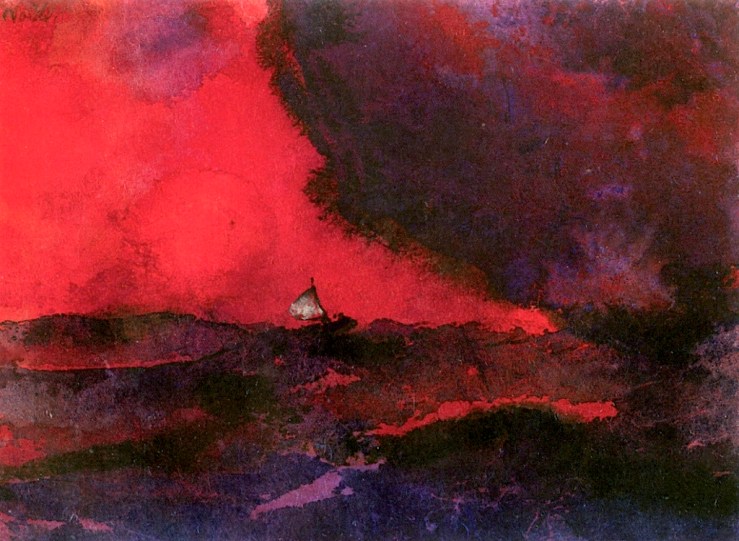
Online devotional with visual art and music: Each Lenten season since 2012, Kevin Greene, an associate pastor at West End Presbyterian Church in Richmond, Virginia, has published an online devotional that comprises for each day an art image, a short scripture reading, a prayer, and a music file. I absolutely love this model, with its spare style: because the entries are light on text, they invite silence, contemplation, seeing, listening. Greene’s image selection is stellar. He doesn’t go for the obvious choices but rather aims at something more atmospheric, more slant. Among the painted subjects, for example, you’ll find a stairway, a storm, a dancer, a reaper; day 1, Ash Wednesday, was a sailboat on troubled waters (pictured below). Fine-art viewing isn’t something that’s typically a part of Protestant devotional practice, so in response to questions he’s received, Greene has described how art operates on the imagination and the spirit. I’ve been greatly blessed moving through the first week of Lent with this companion, and I can’t wait to dive into the backlist entries later on. You can sign up via e-mail in the left sidebar, or simply bookmark the website and visit it each morning.
Emil Nolde (German, 1867–1956), Dark Red Sea, ca. 1938. Watercolor. Nolde Museum, Seebüll, Schleswig-Holstein, Germany.
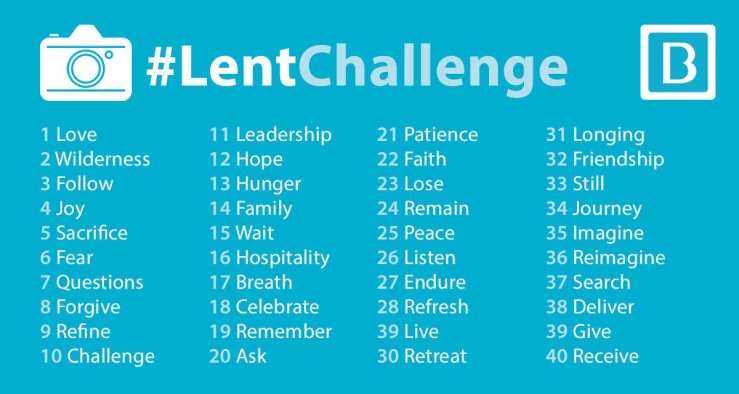
Lent Photo Challenge: The UK-based Bible Society invites people to take one photo per day throughout the season based on rotating themes (e.g., wilderness, hospitality, ask), then share them on social media using the hashtag #LentChallenge. Today is the sixth day of Lent (Sundays are excluded from the traditional forty-day count), and the assigned theme is “fear.”
Essays, short stories, poems, art: Founded in 1989, Image journal seeks “to demonstrate the continued vitality and diversity of contemporary art and literature that engage with the religious traditions of Western culture.” This Lent they’ve curated a selection of literary essays, short stories, poems, and art images from their back issues and their blog, Good Letters, that relate to the season, as well as to Easter. I especially enjoyed “Jeffrey Mongrain: An Iconography of Eloquence.” A few selections might be accessible only to subscribers (you can subscribe here; you won’t be disappointed!). Also available: the book God For Us: Rediscovering the Meaning of Lent and Easter, a full-color devotional with contributions by some of Image’s favorites. Lent is not about becoming lost in our brokenness, the description says, but about cleansing the palate so that we can taste life more fully.
Jeffrey Mongrain (American, 1956–), Blood Pool, 2006. Plexiglas, 47 × 88 in. Saint Peter’s Catholic Church, Columbia, South Carolina.
“Lent Is Here to Throw Us Off Again: Finding healing in repetition, community, and art” by W. David O. Taylor: An excellent introduction to Lent, addressing unselfing, dying a good death, opening up vacant space, and praying with the eyes. This Christianity Today article is adapted from the foreword Taylor wrote for artist James B. Janknegt’s new book, Lenten Meditations, which features forty of Janknegt’s paintings on the parables of Jesus, along with written reflections. Artists like Janknegt, Taylor writes, “fix before us an image of a world broken by our own doing, but not abandoned by God. They question our habits of sight. They arrest our attention. See this image. See it for the first time, again. See what has become hidden and distorted. See the neglected things. See the small but good things. It is in this way that artists can rescue us from what the poet Samuel Taylor Coleridge calls the ‘film of familiarity’ and the ‘lethargy of custom.’”
James B. Janknegt (American, 1953–), The Wicked Tenants, 2008. Oil on canvas, 24 × 72 in.
Stations of the Cross in Washington, DC: This Lent, Dr. Aaron Rosen and the Rev. Dr. Catriona Laing of the Church of the Epiphany have organized a combination pilgrimage and art exhibition, featuring works located throughout Washington, DC, in places both sacred and secular. Mostly contemporary, some newly commissioned, the works include George Segal’s Depression Bread Line, the Vietnam Women’s Memorial by Glenna Goodacre, Barnett Newman’s Stations cycle at the National Gallery of Art, a video installation at First Congregational United Church of Christ by Leni Diner Dothan, and more. Participants can follow the stations by downloading the app “Alight: Art and the Sacred,” which offers maps and audio commentary (my friend Peggy Parker is a contributor!). (If you don’t have a smartphone, you can view the maps and listen to the commentary through a browser by following the primary link above.) Also check out the accompanying devotional guide.
Lent by The Brilliance: This 2012 EP by The Brilliance, a duo comprising David Gungor and John Arndt, has seven tracks: “Dust We Are,”“Now and at the Hour of Our Death” (the rerelease on Brother removes the invocation to Mary), “Dayspring of Life,”“Does Your Heart Break?,” “Holy Communion,” “Violent Loving God,” and “Have You Forsaken Me?” Each one is a beautiful prayer, the words organized around a string quartet. Some take the shape of praise, others lament. God is supplicated for peace, mercy, light. The first track well captures the spirit of Lent: “Be still my soul and let it go, just let it go.” Click here to read a 2015 Hallels interview with The Brilliance, or here to listen to a podcast interview by David Santistevan.
“Translate: Art as Mission” symposium, February 25, 9 a.m.–3:30 p.m.: This Saturday, Third Church of Richmond, Virginia, is bringing together twenty practitioners, advocates, and theorists of the arts as front-line missions (both local and abroad) for a series of presentations and discussions that is free and open to the public. “Our aim is to demonstrate that ‘art as mission’ is not about using people and objects merely as ‘tools’ for missions or proselytization, but is about recognizing that generative, creative practices can and should be intrinsically, inherently ‘missional’ because they put on display and draw people towards the rich, abundant life we were made to experience and have together as God’s children, renewed as the Body of Christ. Together we’ll explore how the arts are a distinctively integrative, incarnational way to be human, and to bear the image of our creator God.” Click on the link to see the schedule and to find out more about the speakers.
+++
“Charged with the Grandeur of God: Faithful Imaginations in a Meaningful Creation” lecture, February 25, 7–9 p.m.: Also on Saturday, Ken Myers, founder and host of Mars Hill Audio and author of All God’s Children and Blue Suede Shoes: Christians and Popular Culture, will be speaking at Wallace Presbyterian Church in College Park, Maryland, on how alert imaginations enable us to receive the meaning in Creation and to rearticulate Creation’s meaning in works of art. A former arts and humanities editor for NPR, Myers writes of the mission of Mars Hill’s bimonthly “audio journal”: “We explore the various factors that have given modern Western culture its distinctive character. We also try to describe what cultural life — its practices, beliefs, and artifacts — might look like if it was the product of thoughtful Christian imaginations.” Each issue features guests from a variety of disciplines (poets, visual artists, scientists, philosophers, musicians and musicologists, social commentators, etc.); you can listen to back issues here, and read a 2013 profile on Myers from the Weekly Standard here. This event is sponsored by the Eliot Society, a new nonprofit in Washington, DC, that aims to “draw Christian faith and artistic culture back together, by promoting the thoughtful exploration of the work of creative men and women from both the past and the present.” Click here to RSVP.
+++
Last season’s Italia’s Got Talent featured a group called Quadri Plastici (“Living Paintings,” or “Tableaux”), which uses actors in period costumes and special lighting effects to recreate famous religious paintings in the flesh. According to the group’s website, the tradition of staging live reproductions of paintings originated in Avigliano in southern Italy in the 1920s: the participants, frozen in position, would be rolled into the town square on mule-drawn carts as part of the celebration of Saint Vitus’s feast day on June 15. In their television performance last year, Quadri Plastici recreated three Caravaggio paintings: The Crucifixion of Saint Peter, The Calling of Saint Matthew, and The Death of the Virgin. Gabriele Finaldi, director of London’s National Gallery, was impressed, and he commissioned the group to perform two of the paintings from the museum’s “Beyond Caravaggio” exhibition in October: The Taking of Christ and Salome Receives the Head of John the Baptist. To better engage the public, these stagings took place outside in Trafalgar Square.
+++
Through Paul Neeley’s Global Christian Worship blog, I discovered a gem of a song: a heavy-metal arrangement of the nineteenth-century Swedish hymn “Bred dina vida vingar” (Thy Holy Wings) by the Finnish worship band Metallmässa (Metal Mass). Unlike its marginal status in most countries, heavy metal music is mainstream in Finland, which has the most heavy metal bands per capita in the world. “Metal masses”—church services performed in a heavy-metal style—became a trend in 2006; into this current stepped the group Metallmässa, whose lead singer, Christer Romberg, was a contestant on the 2007 Finnish Idols. Their headbanging rendition of “Bred dina vida vingar,” performed in the music video below, is from their 2012 EP Sanctus. The words are by Lina Sandell, “the Fanny Crosby of Sweden”; the tune—which I think is just beautiful (and quite catchy!)—is a traditional Swedish folk tune. Metallmässa is no longer active, but Romberg can be found performing a cappella with his four siblings as part of Vokalgruppen Romberg.
Augustine is a remarkable exegete of cultural liturgies that beset us—the rites and rituals of ambition, consumption, privilege, that aren’t just things that we do but do things to us. The frat house, the football stadium, the rituals of Wall Street finance—these are quasi-religious sites in late modern culture, not because they purvey a message but because they are incubators of love that are rife with rituals that train and direct our hearts and our desires. And conversion is no magical panacea for that; belief doesn’t inoculate our loves from their immersion in those cultural liturgies. So we need to constantly take stock of the formation of our loves and longings, all the subtle ways that secular liturgies bend our desires toward earth rather than heaven.
Consider, too, the act of looking as a cultural liturgy: at our phones and computer screens; at the staged displays in store windows, and the staged photos on social media; at the thirty-second commercial the network forces us to watch before we get back to our show, or the billboard we can’t help but notice when we’re stuck in traffic. Sometime around the year 600, Pope Gregory I insightfully wrote that pictures teach us what to adore, what to imitate. What pictures do you see throughout the day? Is Christ one of them?
CALL FOR BOOK PROPOSALS: Arts and the Sacred (ASAC) series: Brepols Publishers has launched a new academic series of richly illustrated books on theology and the arts, with a focus on visual art—historical and contemporary—and they’re looking for proposals. The series editors are Chloë Reddaway (Howard and Roberta Ahmanson Fellow in Art and Religion at the National Gallery, London) and Aaron Rosen (author of, among other titles, Art and Religion in the 21st Century). First-time authors are welcome.
+++
DOUBLE ALBUM RELEASE: Table Settings and Edenland by Liturgical Folk: This month Ryan Flanigan, worship director at All Saints Dallas, released the first two albums of his Liturgical Folk project, the aim of which is to root historical church language in the inherently joyful sounds of the American folk tradition. I love how Flanigan describes it: “a vision of something refreshingly old for churches that have grown tired of the same new thing.” The first volume, Table Settings, offers twelve traditional prayers and creeds—among them the Lord’s Prayer, the Gloria, and the Trisagion—for churches and families, set to singable tunes; accompanying Flanigan on vocals are his wife, Melissa, and his three kids. The second volume, Edenland, is a collaboration with retired priest and contemplative poet Nelson Koscheski, who wrote all the lyrics; it features a wider range of vocalists. The intergenerational partnership is one element that drew producer Isaac Wardell to the project and that is highlighted in last month’s Dallas News feature story, in addition to the project’s contributions to the liturgical renewal movement in North America.
+++
ART EXHIBITION: “Behold the Man: Jesus in Israeli Art,”December 22, 2016–April 16, 2017, Israel Museum, Jerusalem: “From the 19th century until today, Jewish and Israeli artists have engaged with the figure of Jesus, addressing complex questions of collective and individual identity. This exhibition, the result of extensive scholarly research, presents multivalent, unexpected, and at times subversive artistic responses: European artists reclaimed Jesus as a Jew and portrayed him as a symbol of Jewish suffering, and Zionist artists used the resurrection as a metaphor for the rebirth of the Jewish homeland; some Israeli artists related to Jesus as a social rebel or misunderstood prophet, while others identified with his personal torment or his sacrifice for the sake of humanity, which they connected to more recent victims of intolerance and warfare.” Click here to listen to audio commentary on fourteen of the works from the exhibition. See also this essay from the IMJ on the figure of Jesus in the work of Reuven Rubin.
Motti Mizrachi (Israeli, 1946–), Via Dolorosa, 1973. Lambda print. The Israel Museum, Jerusalem.Menashe Kadishman (Israeli, 1932–2015), Untitled (Lamb), 1999. Acrylic on canvas. Rachel and Dov Gottesman Collection, Tel Aviv.
+++
MOVIE TRAILER: Hacksaw Ridge, directed by Mel Gibson: The hero of one of this year’s Academy Award nominees for Best Picture is a Christian whose beliefs impel him to enlist in the US Army only on the condition that he not be made to carry a weapon—and this during World War II, when pacifism was far less acceptable than it is today. “While everybody else is takin’ life, I’m gonna be savin’ it,” says Desmond T. Doss, played by Andrew Garfield, in the trailer below. “That’s gonna be my way to serve.” Based on the true story of Desmond T. Doss, who served during the Battle of Okinawa and became the first man in American history to receive the Medal of Honor without firing a shot.
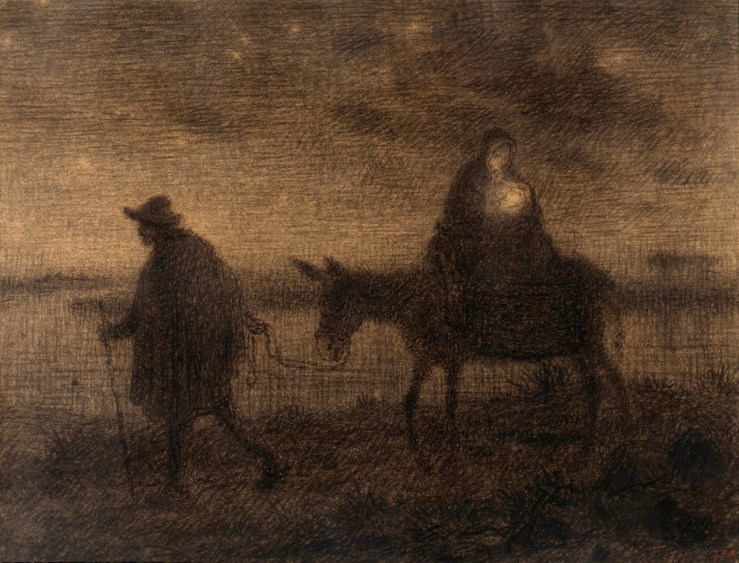
On the heels of Jesus’s birth came his frantic flight, with parents Mary and Joseph, from the sword of an egomaniacal politician who swore death to all the male children of Bethlehem under the age of two. To secure his own power and advantage, Herod had to squash all potential threats.
Thus the birthday festivities were cut short as the Holy Family packed up what little they had and hit the road running, seeking asylum in another country.
Jean-François Millet (French, 1814–1875), The Flight into Egypt, ca. 1864. Conté crayon, pen, ink, and pastel over gray washes on paper, 31.1 × 39.4 cm. Art Institute of Chicago.
Many families are still making this difficult journey today: fleeing home in order to escape persecution and/or death.
Even though the Flight to Egypt is a part of the Christmas story, it’s often omitted from present-day nativity pageants and carol services because we prefer to bask in that which is quaint and cozy and cute and joyful, and we want that happy ending. We don’t want the darkness to rain on all the Christmas light. This is a real shame. By leaving out this event from our retellings of Jesus’s birth narrative, not only do we do a disservice to his memory, we neglect an opportunity to see Christ in our refugee neighbors.
To help remedy this omission, I’ve compiled a list of songs based on the Flight to Egypt so that churches can consider using them (or be inspired to write their own!) as part of their Christmas observances. I’ve purposely excluded “The Cherry-Tree Carol,” a centuries-old ballad derived from an apocryphal story about the Flight to Egypt from the Gospel of Pseudo-Matthew (chapter 20); I did so not only because the anonymous lyricist reset the episode during the Journey to Bethlehem, when Jesus was still in the womb, but because, though charming, there’s nothing historic, spiritually valuable, or socially conscious about it, and it perpetuates a popular stereotype of Joseph as stubborn and unkind that I believe scripture itself does not bear.
Also excluded are the several carols about the Massacre of the Innocents—the episode that prompted the Flight to Egypt. The two episodes are obviously related, but I want to focus here on the Flight.
CONGREGATIONAL HYMNS
I could find only one song on the topic that was written with congregational singing in mind, and that is “Flight into Egypt” by the Rev. Vincent William Uher III (1963–). It’s made up of four verses and the refrain “Kyrie eleison” (Lord, have mercy), a common prayer in Christian liturgies. Because the hymn uses a plainchant tune, it has an irregular meter and may therefore be a little tricky for congregations to pick up right away. But the words are so beautifully crafted and set, and Rev. Uher gives his permission for noncommercial use, as long as credit is given. I put together a printable hymn sheet, reproduced below the lyrics. (Click on the image to open up the sheet as a PDF in a new tab.)
“Flight into Egypt” (1997) –Words: Vincent Uher | Music: Plainchant mode V, 13th century
Lonely travelers from the stable
Out beneath the hard blue sky
Journeying, wandering, hoping, praying
For the safety of their child
While our mother Rachel’s weeping
Fills the streets of Bethlehem.
Kyrie eleison.
Warned by angels moved to save him Who was born our kind to save Joseph leads his holy family Far from Herod and harm’s way Mary shielding and consoling Jesus Christ the Son of God. Kyrie eleison.
Fleeing from the land of promise They in Egypt find a home Strange the workings of God’s mercy House of bondage now God’s throne But for sons who all were murdered Sorrow breaks the House of Bread. Kyrie eleison.
True the tale of flight and exile Out of Egypt comes God’s Son Angels tell of Herod’s dying All is ended, all begun Jesus will grow up in Nazareth And the world will all be stunned. Kyrie eleison.
Because of the scarcity of carols referencing the Flight to Egypt, I took to writing some verses of my own, using already-popular hymn tunes. Each of these verses is intended not as an additional stanza to the carol whose tune it shares (that would render the narrative structure incoherent) but as a standalone reprise of sorts. I envisioned any one of them being sung as part of a Christmas Eve service following the reading, as part of the total Christmas story, of Matthew 2:13–14. Continue reading “Songs about the Flight to Egypt”→
A popular song in choir repertoires, “Betelehemu” is a Yoruba Christmas carol by the Grammy-nominated drummer Babatunde Olatunji, arranged for men’s choir by Wendell P. Whalum. It came into being while Olatunji was a student on scholarship at Morehouse College in the 1950s: he shared it with Whalum, director of the school’s glee club, and that spawned a collaboration.
There have been numerous recordings of “Betelehemu” over the years, and each one has its own distinct flavor, especially in the percussion sections. I really like the one by The Young People’s Choir of New York City from the 2003 album It Is Possible. But here’s a version from Brazil, arranged for SATB by Jonathan Crutchfield:
Here are the Yoruba lyrics and English translation to follow along with, provided courtesy of my friends Ezekiel Olagoke and Temidayo Akinsanya. For a pronunciation guide, click here.
Betelehemu Awa yio ri Baba gbojule Awa yio ri Baba fehinti Nibo labi Jesu Nibo labe bi i Betelehemu, ilu ara Nibe labi Baba o daju Iyin, iyin, iyin nifun o Adupe fun o, adupe fun o, adupe fun ojo oni Baba oloreo Iyin, iyin, iyin fun o Baba anu Baba toda wasi Betelehemu
Bethlehem
We shall see that we have a Father to trust
We shall see that we have a Father to rely on
Where was Jesus born?
Where was he born?
Bethlehem, the city of wonder
That is where the Father was born for sure
Praise, praise, praise be to Him
We thank You, we thank You, we thank You for this day
Blessed Father
Praise, praise, praise be to You, merciful Father
Father who delivered us
Bethlehem
The lyrics are simple, rejoicing in the Father’s glory and grace in giving his Son over to be born in Bethlehem. I asked my Yoruba friends about the line “That is where the Father was born for sure,” which seems problematic from a Trinitarian perspective, because it was the Son, Jesus—not the Father—who was born in Bethlehem. The Yoruba word Baba has more nuance than the English “Father”; it is used to signify a biological relationship but also as an honorific for wise men or elders. But still I wondered whether it is theologically appropriate.
Ezekiel told me that Yoruba Christians understand the distinctions between the three persons of the Trinity and that Baba is not commonly used to refer to Jesus, but in defense of it, he pointed me to scripture passages like Daniel 7:9–14 (cf. the book of Revelation), which describes Jesus as “the Ancient of Days”; John 8:58, in which Jesus tells his disciples, “Before Abraham was, I am,” ascribing to himself a status greater than that of the greatest Jewish patriarch; and Colossians 1:15–17: “He [Jesus] is the image of the invisible God, the firstborn of all creation. For by him all things were created, in heaven and on earth, visible and invisible, whether thrones or dominions or rulers or authorities—all things were created through him and for him. And he is before all things, and in him all things hold together.” In Yoruba culture and other African cultures as well, says Ezekiel, Jesus is sometimes called “Chief” or “Ancestor,” a similar notion that emphasizes his being before all things, the eternal Source in whom all things consist.
Temi said that to avoid confusion, he would probably recommend a revision from Nibe labi Baba o daju to Nibe labi Jesu o daju (or else he’d drop the name so that the indefinite pronoun “he” is implied instead).
Both friends felt that the phrase Awa yio ri (“We shall see”) in the second and third lines is awkward in this context. All the other lyric translations I’ve found translate the phrase as “We are glad,” but that would be Awa ni, Ezekiel said—and that doesn’t quite fit the musical meter. It’s possible that the song is merging Advent with Christmas: it starts with looking forward to the birth, then it acknowledges the birth as having happened, eliciting appellations of praise.
Wooden door detail by George Bandele, 1962, showing the Adoration of the Magi. Collection of the SMA Fathers, Cadier en Keer, Netherlands. Source: Christliche Kunst in Afrika, p. 144
It seems that “Betelehemu” is more popular outside Nigeria than in. Ezekiel and Temi and one other Yoruba friend (from different generations) said that despite growing up in Christian homes in Nigeria, they’ve never heard it before, but they’ve heard ones similar to it. So while some sources credit “Betelehemu” as a “Yoruba folk text” and “Yoruba folk tune,” leaving Olatunji out entirely, I think it’s more likely that Olatunji drew on the song traditions of his people to create a new composition. At the very least, Olatunji introduced the song to the United States—and our Christmas concerts are all the richer for it! Continue reading “Yoruba Christmas carol and art (Nigeria)”→
WHY CELEBRATE ADVENT? Some of my evangelical friends don’t understand why I observe Advent. Cheryl Bridges Johns’s recent Seedbed article “Advent and the Winter of Our Disenchantment” answers the question so well, opening like this: “Advent is the time to open the first pages of the Church’s story of salvation. It is an enchanted portal into a world of darkness, deep mystery and the Spirit’s hidden brooding. Advent asks us to sit a while in the darkness, waiting for the light of God.” It’s a counterweight to “the unbearable lightness of Christmas,” a space to groan alongside our spiritual forebears. See also the Desiring God articles “Christmas Is Too Big for One Day” and “Seven Reasons to Celebrate Advent.” Christmas didn’t occur in a vacuum! Advent makes us mindful of the larger story of God’s promise to his people.
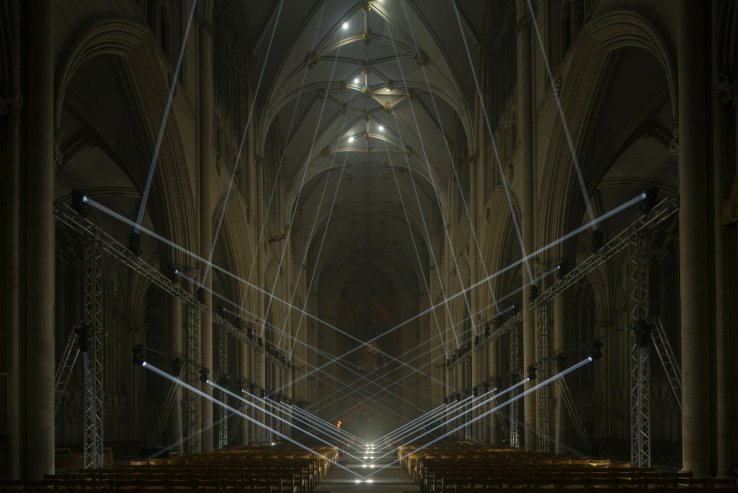
LIGHT MASONRY:Michael Wright tipped me off to this stunning light installation by Jason Bruges Studio in the main nave of York Minster. It was one of six works commissioned for Illuminating York, an annual nighttime festival supported by Arts Council England that encourages visitors to explore and discover the historic city through the imagination of artists who use the medium of light in all its forms. Designed to highlight the cathedral’s Gothic architecture, Light Masonry was constructed using a bespoke system of forty-eight computer-controlled, icon-beam moving-head luminaires (see the “making of” video) and was complemented by the live performance of Arvo Pärt’s Pari intervallo on organ. It ran October 26–29, 2016. The video below captures some of its magnificence.
Light Masonry installation by Jason Bruges Studio, York Minster, York, England, October 26–29, 2016.
BOOK LIST: I recently compiled an annotated bibliography of books published in English between 2014 and 2016 on the subject of Christianity and art: http://www.artway.eu/content.php?id=2204&action=show&lang=en. The thirty-seven entries, from a variety of authors and publishers, cover topics such as iconographic exegesis of the Hebrew Bible, the religious art of Pablo Picasso, contemporary church art commissions, visual culture in the Christian kingdom of Kongo, black public religious art in Chicago, a theology of human creativity, how to launch and manage a church gallery, and building a curriculum for the fine arts in Christian education. Let me know if I’m missing any!
INTERVIEW: Earlier this month I was interviewed by Joan Huyser-Honig for the Calvin Institute of Christian Worship about my vocation as a Christian arts blogger, the two Advent art resources I developed, and my participation in the “Bodies of Christ” seminar at Calvin College this summer. (Read the interview: “Victoria Emily Jones on Gazing as a Spiritual Practice.”) Joan had some good questions, including
When you post to your Art & Theology blog, who do you hope will see it and what do you hope they’ll do with it?
Your blog’s tagline is “Revitalizing the Christian imagination through painting, poetry, music, and more.” What might or does happen in Christians and congregations who are open to revitalizing imagination?
Picture a worship planner without your deep knowledge of art and theology. How might he or she start using resources from your blog in planning public worship?
THEOARTISTRY:TheoArtistry is a new initiative of the Institute for Theology, Imagination and the Arts at the University of St. Andrews in Scotland. “Through new projects and research, TheoArtistry celebrates the practice, making, performance, curatorship, and reception of Christian art. It also seeks to inform the scholarly and public perception of the role of the arts in theology and church practice.” The first project they’ve launched is a collaboration between internationally selected composers and PhD candidates in the St. Andrews Divinity School to set to music “annunciation” texts from the Hebrew Bible. (Two of the participants talk process in the recent Transpositions article “Setting Fire to Music.”) TheoArtistry will also be launching a new database that links artists interested in working with Christian themes, theologians interested in creative collaborations with artists, and commissioners of Christian art. I am SO stoked about all this! For more information, see http://theoartistry.org.
Shepherds, I sing you this winter’s night
Our Hope new-planted, the womb’d, the buried Seed:
For a strange Star has fallen, to blossom from a tomb,
And infinite Godhead circumscribed hangs helpless at the breast.
Now the cold airs are musical, and all the ways of the sky
Vivid with moving fires, above the hills where tread
The feet—how beautiful!—of them that publish peace.
The sacrifice, which is not made for them,
The angels comprehend, and bend to earth
Their worshipping way. Material kind Earth
Gives Him a Mother’s breast, and needful food.
A Love, shepherds, most poor,
And yet most royal, kings,
Begins this winter’s night;
But oh, cast forth, and with no proper place,
Out in the cold He lies!
This poem is published in Collected Poems 1943–1987 by John Heath-Stubbs (Carcanet Press, 1988) and is reprinted here by permission of David Higham Associates.
+++
John Heath-Stubbs (1918–2006) was an English poet, translator, critic, and anthologist whose lifelong fascination with world history and literature was borne out in his career. He translated poetry from Greek (Sappho, Anyte, Anacreon), Latin (Horace, Catullus), Persian (Hafiz, Omar Khayyam), Italian (Dante, Giacomo Leopardi), and French (Paul Verlaine) and wrote many verses of his own influenced by classical myths, including an Arthurian epic, Artorius.
Described by friends as a “devout” and “committed” Christian, Heath-Stubbs sometimes turned to the lives of Christ and the saints as subjects for his poetry, as in “‘Through the Dear Might of Him That Walk’d the Waves,’” “Dionysius the Areopagite” (on a pagan’s response to the eclipse during the Crucifixion), “Canticle of the Sun” (on the Resurrection), “Alexandria,” “Maria Aegyptiaca,” and “Virgin Martyrs,” to name a few. In his introduction to his Collected Poems, he wrote that he was interested in “the reaffirmation of orthodox religious themes in the poetry of TS Eliot and Charles Williams and others.”
Among other distinctions, Heath-Stubbs was awarded the Queen’s Gold Medal for Poetry in 1973 and in 1989 was appointed OBE (Officer of the Most Excellent Order of the British Empire). At his death, publications celebrated his style and influence:
“His distinctive achievement was to forge a modern pastoral out of unlikely sources, a style which can encompass Yeatsian symbolism and dry irony.”—Poetry Archive
His diction was conservative, but his lyricism was always modern.—The Telegraph
“His finest work is to be found in his huge output of shorter poems. In their technical mastery, wry wisdom and gloriously deceptive lightness, these place him in the company of W.H. Auden and Robert Graves, a major English poet of the 20th century.”—The Independent
Heath-Stubbs was nearly blind from age three, his eyesight progressively worsening until he lost it completely at age fifty-nine. But rather than regard his blindness as a disability, he regarded it as a gift. “As a poet, I have found that blindness actually tends to stimulate the imagination,” he said.
+++
First published in 1965, “For the Nativity” by John Heath-Stubbs is an ode to the infant Jesus—to him who is Hope, Seed, Star, and Love.
The first stanza is a loose paraphrase of the Annunciation to the Shepherds in Luke 2:10–13, in which an angel tells a group of Jewish night workers that Emmanuel, God-with-us, has been born. Heath-Stubbs uses horticultural imagery: Jesus was planted in Mary’s womb, and now he breaks through into air, blooming for all the world to see. Foreshadowing future events, the “tomb” refers not only to the cave he was born in but also to the cave he’d be buried in. He’d be seeded once again (in death), and again (in resurrection) he’d flower forth with new life. The fourth line embraces the paradox of the Incarnation: that infinite God became a finite human being; the omnipotent Creator, an impotent babe reliant on his mother’s milk. Continue reading ““For the Nativity” by John Heath-Stubbs + choral setting”→
Whenever I meet new people and they ask what I do, I always tell them I’m a writer on Christianity and the arts. The follow-up question is often, “Oh, are you an artist?,” to which I respond with something like “No, but I love to study art, and I want to make Christians aware of the church’s rich artistic heritage.”
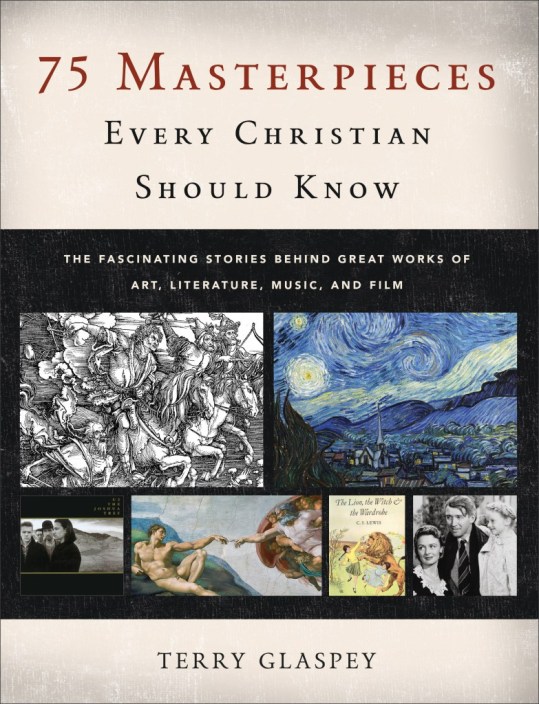
In this full-color survey, Glaspey—curator and tour guide—invites us to be “inspired, entertained, and challenged” as we encounter artists’ material witness to their faith through the ages. An Eastern Orthodox icon, a Renaissance altarpiece, a metaphysical poetry collection, a jazz suite, a rock album, children’s fantasy stories, an Italian neorealist film, a radio drama, and contemporary nihonga are just some of the many creative works featured. Organized chronologically from the Roman catacomb paintings to Terrence Malick’s TheTree of Life, the book encompasses almost all the major artistic disciplines (dance is conspicuously absent) and a variety of styles and eras, with a focus on Western art. (Sadao Watanabe’s Last Supper stencil print, Japanese American artist Makoto Fujimura’s illuminated Gospels project, and a few works from Russia are the only exceptions.) I’m impressed by how fluent Glaspey is in each area. He can speak just as easily about silent film as he can about Gothic architecture and contemporary folk art!
The author says his selection process was guided by these criteria:
works that are universally esteemed for their craftsmanship and creativity, admired not only by Christians but also by those outside the faith
works that stand up well to repeated exposure, the kind of art that can be visited again and again, because there is always something new to discover
works that speak to people across time, cultures, national boundaries, and denominational divides
Preempting readers’ tendencies to object to certain omissions, Glaspey adds,
This is most emphatically not a list of the absolute best or greatest works, nor does it imply any ranking system. Instead, it attempts to represent the breadth and depth of what Christians have accomplished in the arts, and is an intentionally quirky mix of the widely known and the mostly unknown.
Each of the seventy-five entries contains not only discussion of the content, formal qualities, and historical context of the highlighted work but also an overview of the artist’s oeuvre and a mini spiritual biography. These are not generic glosses or rote info dumps. On the contrary, Glaspey devotes individualized care to each one in the space of about four pages, giving us both concision and substance. He likens his offerings to movie trailers: they are meant to give you a sense of the artwork’s flavor and entice you to explore it more fully on your own.
Ceiling detail of La Sagrada Familia Cathedral in Barcelona, designed by Antoni Gaudí, begun 1882