If I speak in tongues of justice or spirituality,
but do not have ashes,
I am a self-congratulating vigil,
a Sunday service inspired by itself.

If I have social media outreach,
a labyrinth in the church garden,
Bible study in the brewpub,
and if I have a capital campaign
to remove pews, put in church chairs,
and even add a coffee shop,
but do not have ashes, I am nothing.

If I give to church-wide offerings,
and go on mission trips so that I may boast,
but do not have ashes, I gain nothing.

Ashes are awkward; ashes are dirty;
ashes, like love,
are not envious, boastful, arrogant, or rude.
Ashes do not insist on a perfect Lent;
they do not even need to be in church
or be a gimmick getting folks to church;
they do not inventory wrongdoing,
especially the wrongdoing of others,
but rejoice in the precious now,
the very fragility of life.

Ashes bear love, believe in love,
hope in the possibility
of forgiveness for everyone,
endure even times of lovelessness.
Forgiveness never ends.

As for spiritual practices,
they will come to an end;
as for precious old hymns
and passionate praise songs,
they will grow quiet;
as for theology and faith formation,
believe me, it will shift and change again.

For churches are always reaching
for a part of things,
while those who flee church
reach for another part,
but when the full forgiveness comes,
it will look more like Valentine’s Day.

When I was a child, I said, “I love you,”
I cut out pink and red hearts,
I sent them to everyone, even the bullies,
but when I became an adult,
I decided to make it more complicated.

Now in our churches and lives
we have become too fond of mirrors,
but someday we will see each other
face to smudged face.
Now I love only in part;
then I will love fully,
even as I have been fully loved.

Today ashes, dust,
and a child’s pink paper art abide, these three;
but the greatest of these is the heart.
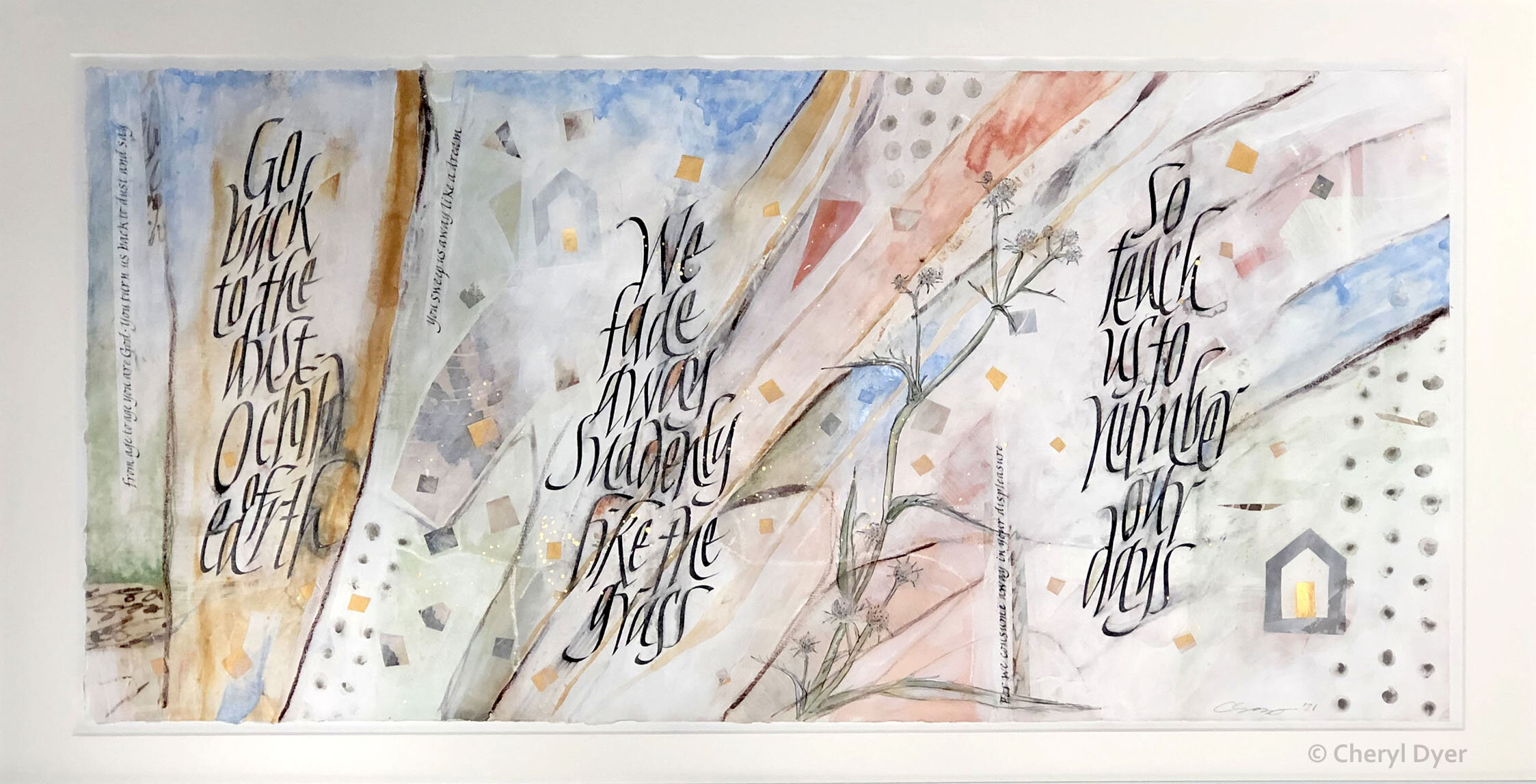
In this piece, lettering artist and calligrapher Cheryl Dyer of Omaha takes Psalm 90 (traditionally read on Ash Wednesday) as her subject, embellishing excerpts with watercolor and other media. Rattlesnake master is a perennial herb of the parsley family native to the tallgrass prairies of central and eastern North America.
+++
ARTICLE: “The Vindication and Blessing of Lent” by Rev. Dr. Michael Farley, Modern Reformation: I also sometimes receive pushback from others in my Reformed Christian circles for my observance of Lent. I appreciate Farley’s response to such concerns, explaining why he finds Lent—and the liturgical calendar as a whole—biblically, theologically, and practically compelling.
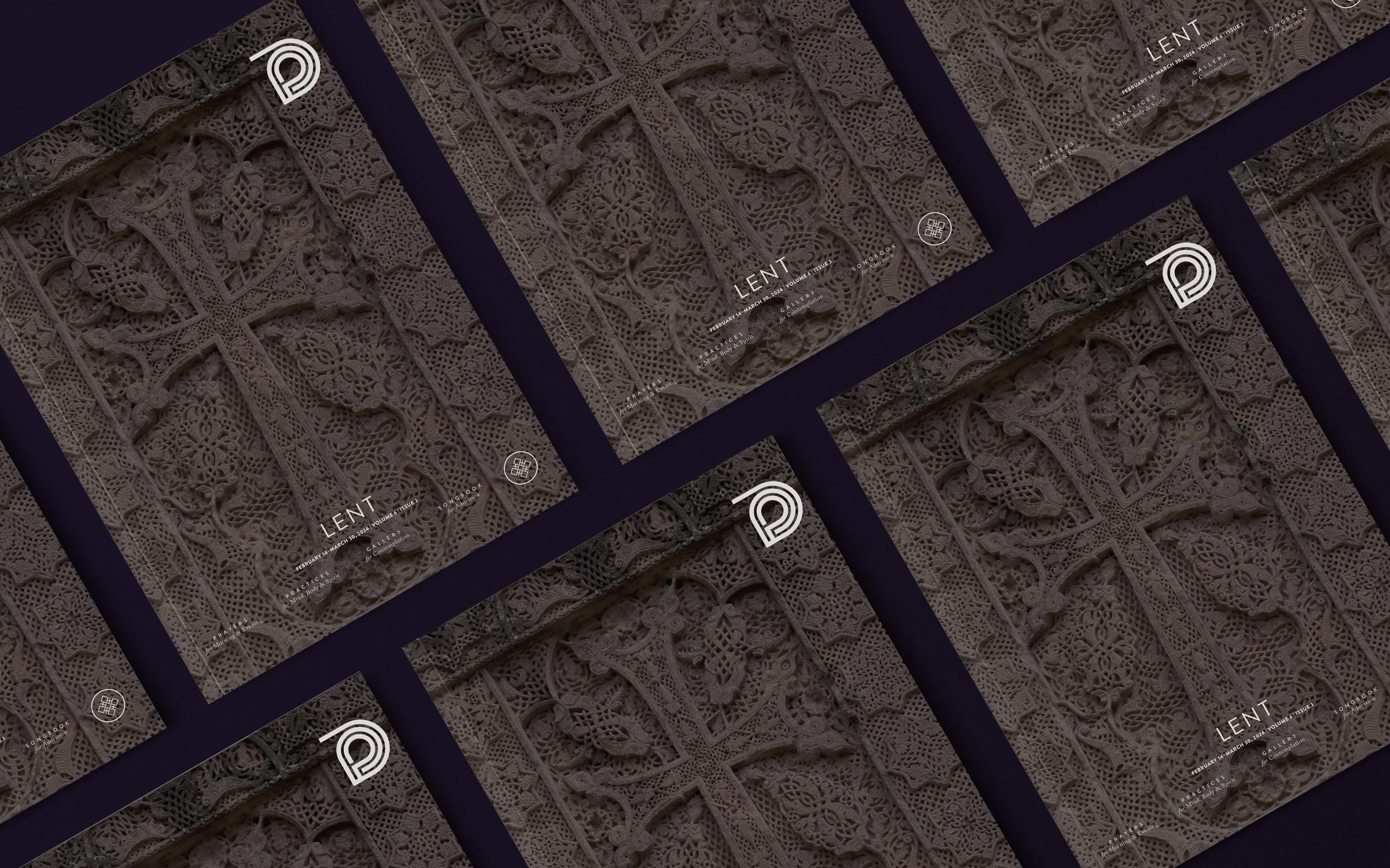
Note: If you’d like a new devotional booklet to work through this Lent that is broadly Reformed and that combines scripture readings, prayers, songs, art, and other elements, I recommend the Daily Prayer Project’s Living Prayer Periodical, which, full disclosure, I had a hand in producing. New for this year’s Lent edition, we’ve added a special page spread for each day of the Triduum: Maundy Thursday, Good Friday, and Holy Saturday. The cover image is of a thirteenth-century Armenian khachkar from the Monastery of Gosh and is one of eight featured artworks inside (three accompanied by written reflections, three by visio divina prompts). If you want to receive a copy by the start of Lent on Wednesday, order the digital version; otherwise, expect a few business days for shipping.
+++
SERMON: “Seasons of the Heart: Preparing for Lent” by James K. A. Smith: Last February, Jamie Smith preached on Ecclesiastes 3:1–8 and John 16:12–15 at his home church, Sherman Street Christian Reformed Church in Grand Rapids, Michigan. He talks about seasonality—how we creatures experience time in seasons, both personally and collectively—and encourages us to ask, “When am I?” Along the way he references Gustavo Gutiérrez, Rita Felski, and Bruce Springsteen. Below is a transcription of 23:42 onward, which I find so resonant. To receive the full force of this conclusion, listen to the whole sermon.
God has more to say to us in his word that we haven’t yet got. There is something in us, for us, in the word that we hear over and over and over again, and the way that we will get to the place of receiving it is precisely by giving ourselves over to the seasons in our lives and letting God do the work in us so that we get new ears, because we have new hearts. This is one of the reasons why . . . repetition is at the heart of the spiritual life. It’s exactly why we keep repeating the liturgical seasons over and over again. Why? Because every single one of us is a different person every time Advent arrives. Every single one of us has undergone something every single time Lent rolls around again.
And so as we’re preparing for Lent—this season of repentance, this season of encountering our mortality—again, I want to encourage us to ask: When am I? When are we? What am I going through? What season am I in? And then from that place, come to Lent with expectation. What does God want to say to me in the now that I find myself? What are you newly ready for because of what you’ve come through? What can Jesus say to you this year that he couldn’t tell you last year?
So many of you are mourning. And the journey of Lent is really a journey of yearning for resurrection. But it passes through the valley of the shadow of death. Unapologetically. And the psalmists’ cries that you’re going to hear in Lent, maybe this year they’re going to give voice to a cry of your own that you didn’t have before. The experience of being bereft on Holy Saturday is going to hit some of you in a way it never has before this year. But maybe that also means that Easter dawns for you in a way it never has before.
Friends, maybe some of you feel, to go back to Ecclesiastes, that it’s a time to build and plant. Because you’ve come through the season of tearing down and uprooting. Maybe this Lent you feel like you’re finally in a place where you can be vulnerable to a God that you finally learned is compassionate, who loves you all the way down. This is a season to build, to plant.
Friends, maybe some of you feel like it’s the time of giving up and throwing away. There is a time for everything, the Teacher tells us. There’s a time to give up, there’s a time to throw away. But maybe it’s precisely what you need to let go of that has been blocking your ability to experience God’s incessant, steadfast, always love.
Whenever you are, whatever season you find yourself in, God has good news to share with you. That’s what we can rely on. No matter what season you’re in, the God who is eternal—the same yesterday, today, and forever—has always a word of good news, because he is always the God with us. He is always Emmanuel. And so this Lent and Eastertide, maybe this is the year you finally get God’s song. You finally hear the song of new life. And friends, I hope you hear that God is singing to you.
+++
VESPERS SERVICES AT CALVIN UNIVERSITY:
I’ve just returned from another inspiring Calvin Symposium on Worship, so grateful for all the gifts and wisdom that were shared. There’s much I could say, but one thing I discovered was how much I loved participating in Vespers, a short evening worship service consisting of scripture readings, prayers, and song (vesper in Latin simply means “evening”). It’s not something that’s regularly offered in my (Presbyterian) tradition, at least not near me. Here are three of the Vespers services that took place this week at Calvin, the latter two at which I was present:
>> Celtic Vespers: “Psalms of Healing and Hope for a Troubled World,” led by Kiran Young Wimberly and The McGraths: This service of psalms set to Celtic melodies was led by Kiran Young Wimberly and The McGraths (a Northern Ireland–based group that performs and records together), Mary Beth Mardis-LeCroy (violin), and Brian Hehn (piano). Since Ash Wednesday is this coming week, I’ll draw your attention especially to “From Dust We Came (Psalm 90)” (see timestamp 15:28), which uses the eighteenth-century Irish tune CASADH AN T’SÚGÁIN. Plus, another highlight for me: “Love and Mercy (Psalm 85),” set to the eighteenth-century Scottish tune LOVELY MOLLY (39:55)—I’ve added this to my Advent Playlist! For more info about the musicians and their work, see https://www.celticpsalms.com/.
>> Jazz Vespers: “Lament as Worship,” led by Ruth Naomi Floyd and her jazz quartet: Ruth Naomi Floyd is a phenomenal jazz vocalist, composer, and fine-art photographer. This liturgy that she crafted and presented is so moving. In her thoughtful selection of readings, Floyd brings a James Baldwin poem into conversation with Psalm 42:7–11 and even includes an amusing proverb from Chinua Achebe’s novel Arrow of God. She also adds a visual element: black-and-white photographic portraits she shot, which were displayed on slides during each segment (not all of them are featured in the video recording).
The musical performance, I hardly have words for. All I can say is, it was utterly engrossing. The expressiveness of Floyd’s voice is unmatched, carrying such pathos. I couldn’t pick a favorite song, but the opening spiritual, “Trouble So Hard” (11:37), hit me forcefully. The first verse talks about a mountaintop experience of spiritual ecstasy (“getting happy” refers to being filled with the Spirit), and that’s contrasted in the second verse with a descent into the valley of deep suffering and grief. The refrain asserts to God, seeking divine consolation, “Oh Lord, trouble so hard,” and then testifies that only God truly knows our troubles. Also take note of the concluding song, “Press On” (34:31), an original Floyd composition whose text is taken from the writings of Frederick Douglass, part of a larger body of work that has been recorded and will most likely be released by the end of this year, Floyd told me; see https://frederickdouglassjazzworks.com/.
The amazing instrumentalists are James Weidman (piano), Keith Loftis (saxophone), Matthew Parrish (bass), and Mark Prince (drums).
>> Choral Vespers: “Christ, Holy Vine, Christ, Living Tree,” led by David M. Cherwien and The Choral Scholars: Led by the West Michigan chamber ensemble The Choral Scholars and organist/pianist David Cherwien, this service centers on botanical imagery of Christ and his people—such a generative idea! I enjoyed singing Gerald Cartford’s responsorial setting of Psalm 141:1–4a and 8 (see timestamp 12:48); the refrain is “Let my prayer rise before you as incense; and the lifting of my hands as the evening sacrifice” (the plant connection is that incense is derived from fragrant gum resins, i.e., tree sap). Also, this was my first time hearing Elizabeth Poston’s “Jesus Christ, the Apple Tree” performed live (20:48), and the first time its words truly registered with me.
+++
PRAYER-POEM: “Marked by Ashes” by Walter Brueggemann: “. . . On this Wednesday, we submit our ashen way to you—you Easter parade of newness. Before the sun sets, take our Wednesday and Easter us, Easter us to joy and energy and courage and freedom . . .” This prayer by the Old Testament scholar and theologian Walter Brueggemann, from his book Prayers for a Privileged People (2008), is ostensibly for any ol’ Wednesday in the church year, but it could be used, with one small elision, for Ash Wednesday itself. I love how it reads Easter backward into Lent, recognizing that the fruits of Christ’s resurrection are borne all year round.
P.S. This year, Ash Wednesday falls on February 14, Valentine’s Day. It did too in 2018; read the poem by Luci Shaw that I published for that occasion.
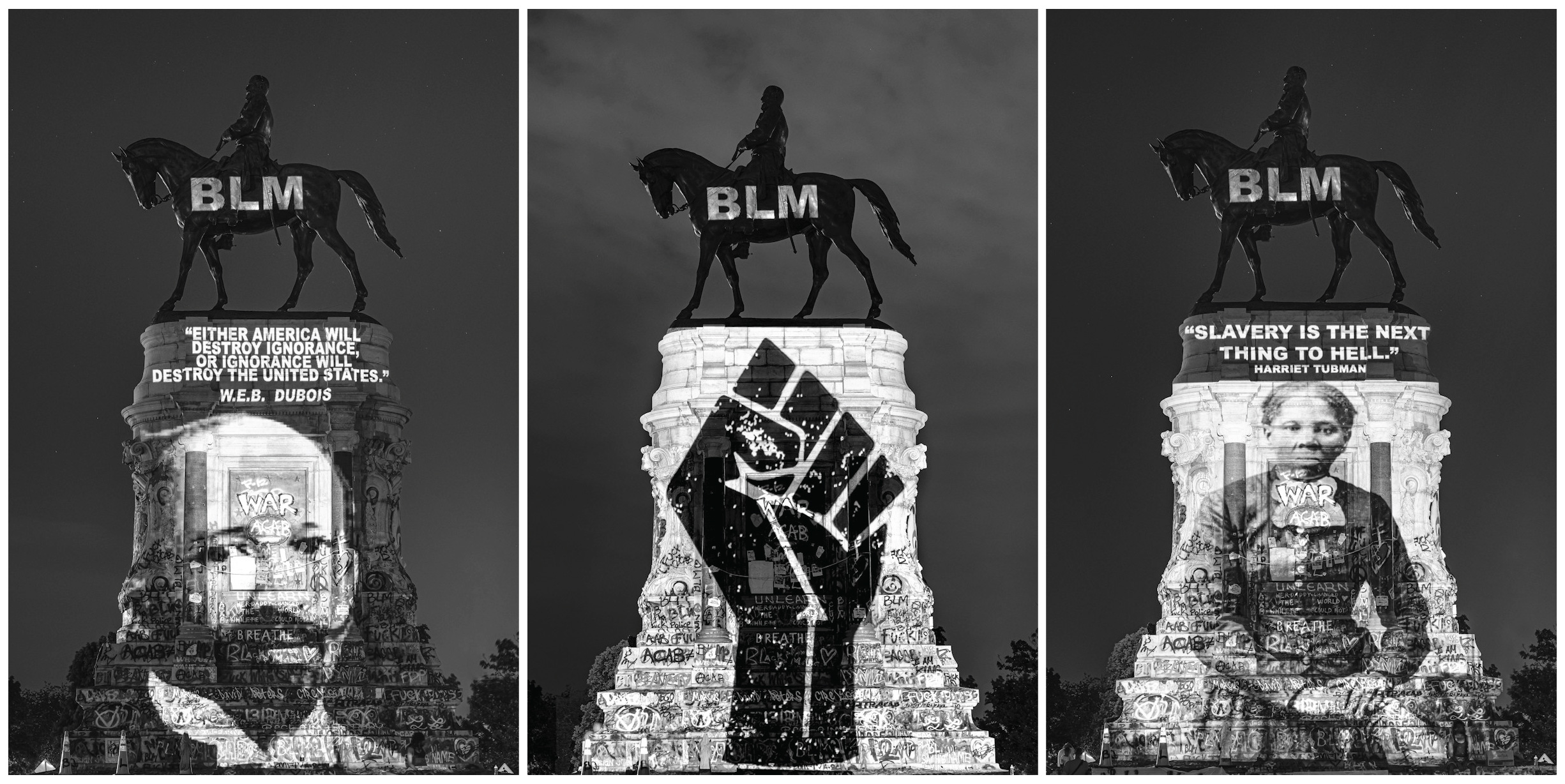
In summer 2020, artists Dustin Klein and Alex Criqui projected images of Black lament and empowerment onto the Robert E. Lee Monument at Marcus-David Peters Circle in Richmond, Virginia, part of their Reclaiming the Monument project. Read more at bottom of post.
Song of the Agitators
“Cease to agitate!” we will, When the slave whip’s sound is still; When no more on guiltless limb Fetters print their circlet grim; When no hound athirst for blood Scours the thorny Georgian wood; When no mother’s pleading prayer, On the sultry Southern air, Quivereth out in accents wild, “Master, give me back my child!” In the day when men shall be Brethren, equal-born, and free— Day for which we work and wait— We will “cease to agitate”!
When our statute books proclaim To the world no more our shame, And a freeman’s rights shall hold Dearer than the Judas gold; When the Polar Star shall give Light to the last fugitive; When our border lakes shall rise On the last lone bondman’s eyes, And their waves for him no more Haste to clasp the Northern shore; In the day when men shall be Brethren, equal-born, and free— Day for which we work and wait— We will “cease to agitate”!
Written by an anonymous abolitionist during the days of race-based chattel slavery in the United States, this poem was originally published in the Ohio Star (Ravenna, OH) in 1852 and was reprinted shortly after in the Anti-Slavery Bugle (Oct. 9, 1852) (Lisbon, OH), the Liberator (Nov. 19, 1852) (Boston), and the Voice of the Fugitive (Dec. 16, 1852) (Windsor, Ontario).
The poem addresses those who, with the status quo working in their favor, would tell the enslaved to stop complaining about the injustices being perpetuated against them, stop ruffling feathers and demanding change, and instead just sit back and be content with the way things are.
The speaker of the poem responds with a defiant no; they and their fellow activists will stop agitating only when their cause is won. When the enslaver’s whip ceases to crack the air, and shackles no longer imprint themselves on ankles and wrists. When bloodhounds are no longer unleashed on freedom seekers, and children are no longer forcibly separated from their parents. When the country’s founding documents are scrubbed of their racism, and its legislation protects the rights of all Americans in equal measure. When the North Star and the Great Lakes are no longer needed to guide people, and offer passage, out of bondage, because everyone is already home and free.
Those who work for justice today still often encounter the demand “Cease to agitate!” “Stop stirring up trouble.” “Don’t be such a downer.” “Why are you so angry?” “Why can’t you just be grateful for the progress we’ve made?” “When will you ever be satisfied?”
Struck by its contemporary relevance, Detroit-born, Vancouver-based musical artist Khari Wendell McClelland adapted the above poem and set it to music. “I sing this song for all those who are living under tyranny, escaping tyranny, and searching for peace,” he wrote in a 2015 Facebook post sharing a demo video.
McClelland’s “Song of the Agitator” appears on his 2018 album, Freedom Singer. The album is dedicated to his great-great-great-grandmother Kizzy, who fled US slavery through the Underground Railroad to Windsor, Ontario, settling in Detroit after slavery was abolished.
While the first stanza he sings almost verbatim from the nineteenth-century source material, the second stanza he reworks to highlight present-day grievances:
Now here we are today Still pushing for equal pay And these treaty rights don’t hold They’re shiny like the Judas gold The stain of blood remains A mother’s only son slain Our kids are crying out for more Continually being ignored
And here’s how he’s adapted the refrain:
On that day we will be Family, equal-born, and free Dawn will come, night will cease We’ll rejoice, mind at ease For that day we’ll work and wait That’s when we’ll cease to agitate
In a Geopoetics podcast interview that aired February 25, 2023, McClelland said, “For some of us, it’s been hundreds of years of incredible terror. And, you know, it’s a great luxury to feel in this moment like something’s wrong.” He continues, “It’s good to be agitated—to want to make things be different. When we start to become a little too comfortable with things being out of sort, being unjust, that’s where . . . it’s a problem. . . . Agitation is actually . . . good fuel.”
About the images above:
The Robert E. Lee Monument in Richmond, Virginia, was erected in 1890 during the Jim Crow era to glorify the Confederate general (who fought against the Union to preserve slavery). A bronze equestrian statue atop a giant plinth in the center of one of the historic city’s traffic circles, it had been controversial from the beginning, with many of Richmond’s Black residents regarding it as an oppressive and traumatic presence.
After the murder of George Floyd, the monument became an epicenter of Black Lives Matter protests as well as a site of vandalism, and Virginia governor Ralph Northam announced on June 4, 2020, that it would be removed. While the legality of that intent was being litigated, light projection artist and Richmonder Dustin Klein, later joined by collaborator Alex Criqui, cast nightly image projections onto the statue—first of Black victims of police violence, and then of Black activists, writers, theologians, artists, and politicians and associated quotes. In October 2020, the graffiti-covered, image-lit Robert E. Lee Monument was declared the most influential American protest artwork since World War II by the New York Times.
On September 2, 2021, the Virginia Supreme Court upheld Northam’s decision, and the statue was removed shortly after.
To view more photos and learn more about Klein and Criqui’s Reclaiming the Monument project, see www.reclaimingthemonument.com.
Whereas in our present age it’s common for families to take down their Christmas decorations on Twelfth Night (January 5) or Epiphany (January 6)—and many American Christians do so even sooner—in medieval Europe they typically stayed up through Candlemas on February 2, or were removed the evening before. Yes, Christmas was celebrated for forty days in the Middle Ages! Why that span? Because forty days after his birth, the infant Christ was presented in the temple according to Jewish custom and inspired the famous song of Simeon about finally getting to see God’s salvation and glory. The feast of Candlemas commemorates this event each year, which many medieval worshipping communities regarded as the bookend of the Christmas season.
In her book Winters in the World: A Journey through the Anglo-Saxon Year, Eleanor Parker notes that Candlemas is the last feast of winter and the first feast of spring—a transitional festival that looks back to Christmas and forward to Easter (86). The date coincides with a significant point in the solar year: midway between the winter solstice and the spring equinox. Read more in an UnHerd article by Parker, “Light a candle; spring is coming.”
So as we celebrate Candlemas this Friday, we bid farewell to Christmas and prepare to welcome Lent. The Chorus of Westerly models a respectful send-off in a video they released in January 2021, combining a choral performance of the “Candlemas Eve Carol” with a recitation by James Lawson of “Now Have Good Day”—both texts from early modern England.
The text of the first carol, originally published with the title “Ceremonies for Candlemasse Eve,” is by the poet-priest Robert Herrick (1591–1674), and the tune is traditional, collected from an old church gallery book; the two appear together in The English Carol Book (Second Series) (1923), edited by Martin Shaw and Percy Dearmer. The Chorus of Westerly sings the first two stanzas and refrain:
Down with the rosemary and bays, Down with the mistletoe; Instead of holly, now upraise The greener box (for show).
The holly hitherto did sway; Let box now domineer Until the dancing Easter day, Or Easter’s eve appear.
Thus times do shift; each thing his turn does hold; New things succeed, as former things grow old.
(Update, 12/31/25: I just learned that Kate Rusby sings this text, to an original tune, on her 2008 album Sweet Bells.)
Herrick describes the English family tradition of taking down the Christmas greens—rosemary, bay, mistletoe, holly—on Candlemas Eve, replacing them with boxwood, which would stay up for the duration of Lent.
“Burning the Christmas Greens,” uncredited illustration from the January 29, 1876, edition of Harper’s Weekly
The remaining three stanzas move through the rest of the church year, associating yew with Easter, birch with Pentecost, and rushes and oak with Ordinary Time. The changing of seasonal decorations becomes for Herrick an emblem of the transience of life.
Now have good day, now have good day! I am Christmas, but now I go my way.
Here have I dwelt with more and less [i.e., everyone] From Hallowtide till Candlemas, And now I must from you hence pass; Now have good day!
I take my leave of king and knight, Earl and baron, and lady bright; To wilderness I must me dight; [I must prepare myself to go into the wilderness] Now have good day!
And of the good lord of this hall I take my leave, and of guests all; Methinks I hear that Lent doth call; Now have good day!
. . . . . . . . . . . . . . . . . . .
Another year I trust I shall Make merry in this hall, If rest and peace in our fair land may fall; Now have good day!
. . . . . . . . . . . . . . . . . . .
Now fare ye well, all in fere; [together] Now fare ye well for all this year; Yet for my sake make ye good cheer; Now have good day!
This sixteenth-century carol is compiled in the commonplace book of the London merchant Richard Hill (Oxford, Balliol College MS 354).
>> Calvin Symposium on Worship, February 7–9, 2024, Calvin University, Grand Rapids, MI: I’ve promoted this event in years past—see, e.g., here and here—and am excited to be attending again this year! I’ll be coleading a breakout session with Joel Littlepage and Ashley Williams about our work at the Daily Prayer Project, curating textual, visual, and musical resources from across time and place to encourage a life of prayer that reflects the church’s beautiful diversity. There are plenty of other sessions being offered as well; a few that stand out to me are “Blues: The Art of Lament” with Ruth Naomi Floyd (she’s also leading a Jazz Vespers service), “Music, Architecture, and the Arts: Early Christian Worship Practices” with Vince Bantu [previously], and “The First Nations Version New Testament and Its Impact on Worship” with Terry Wildman. This is in addition to what is probably my favorite part: the multiple worship services, led by liturgists, preachers, and musicians from different denominations and cultural backgrounds. I love my local church community, but I also love worshipping with folks from outside it—a reminder that the church is far broader than what I’m used to on a weekly basis.
>> “Poetry and Theology: 1800–Present,” February 22–24, 2024, Duke University, Durham, NC: Supported in part by Duke Initiatives in Theology and the Arts, next month Duke is hosting a poetry symposium that’s free and open to the public! The speakers are Lisa Russ Spaar, Judith Wolfe, Toby Martinez de las Rivas, Thomas Pfau, Kevin Hart, Anne M. Carpenter, Ian Cooper, Anthony Domestico, Luke Fischer, Dante Micheaux, Łukasz Tischner, and Bernadette Waterman Ward. Papers are on the poetry of Hopkins, Eliot, Rilke, Miłosz, and more.
>> The Breath and the Clay, March 22–24, 2024, Awake Church, Winston-Salem, NC: Organized by Stephen Roach and friends, this annual creative arts gathering aims to foster community and connection around the pursuit of truth, beauty, and goodness, providing opportunities for immersive encounters and kindling for the imagination. There will be main-room sessions, workshops, a juried art exhibition (entry deadline: February 16), a poetry slam and songwriters’ round, a panel discussion on reconciling artists and the church, concerts, a dance performance, a short film screening, and more. Musical artists include Victory Boyd, John Mark McMillan, Young Oceans, and Lowland Hum, and among the keynote speakers are Rachel Marie Kang, Mary McCampbell, Junius Johnson, Vesper Stamper, and Justin McRoberts. I appreciate the bringing together of various artistic disciplines and the emphasis on practice. For tickets, there are both virtual ($99) and in-person ($299) options.
+++
NEW SONG: “MLK Blessing” by the Porter’s Gate: Written by Paul Zach and IAMSON (Orlando Palmer) and just released for Martin Luther King Jr. Day, this song is based on a benediction that MLK prayed, a variant of the ancient Jewish benediction known as the Birkat Kohahim or Aaronic blessing (Num. 6:24–26). It’s sung by Liz Vice and Paul Zach.
PAST LECTURE:“Rupture as Invitation: Generosity and Contemporary Art” by Elissa Yukiko Weichbrodt: I’ve mentioned Elissa several times on the blog—I find her work so illuminating—and was grateful to have her in town last fall to deliver a lecture for the Eliot Society. “Contemporary art can often be unexpected or downright unsettling in its form and subject matter. But what if we reframed our discomfort as an invitation to enter rather than an unbridgeable divide? In this lecture from November 11, 2023, Dr. Elissa Yukiko Weichbrodt demonstrates how approaching contemporary art with humility, love, and courage can be a powerful means of growing in love for our neighbors.”
+++
UPCOMING EVENT: “Why Should Christians Care About Abstract Art?” with Elissa Yukiko Weichbrodt and Jonathan Anderson, February 22, 2024, Gordon-Conwell Theological Seminary–Charlotte, NC: Hosted by the Leighton Ford Initiative for Art, Theology, and Gospel Witness, this evening will consist of an opening of the exhibition Alfred Manessier: Composer in Colors (on display through April 30) and dessert reception, lectures by Elissa Yukiko Weichbrodt and Jonathan Anderson, and a Q&A. “For some people of faith, abstract art is difficult to engage because the meaning remains unclear, and the form can appear chaotic or uncompelling. For others, abstract art is an invitation to engage the whole person, contemplate spiritual realities, and encounter God in transformative ways. If abstract art can facilitate the latter, then Christians have a unique opportunity to learn and care about abstract art for theological, practical, missional, and relational reasons. This event is a unique opportunity to experience abstract art, learn about abstract art, and have formative interaction with one another on this topic.” The cost is just $10, and there is an online option.
Alfred Manessier (French, 1911–1993), La montée au Calvaire (Mount Calvary), from the Suite de Pâques (Easter Series), 1978. Chromolithograph on Arches paper, 22 × 29 9/10 in. (56 × 76 cm). Edition of 99.
Sir Henry Raeburn (Scottish, 1756–1823), Reverend Robert Walker Skating on Duddingston Loch, aka The Skating Minister, ca. 1795. Oil on canvas, 76.2 × 63.5 cm. National Galleries of Scotland, Edinburgh. Robert Walker (1755–1808) was senior minister at the Canongate Kirk, a prominent abolitionist, and a member of the Edinburgh Skating Society.
        Portrait in oil, Sir Henry Raeburn, c. 1795

I’d like to think it’s late Saturday afternoon, sky on fire,
sermon finished, and he’s happy to be skating
alone, the village children gathered in for early supper and bed.
Then again, this might be a method of composing
just shy of dancing’s pleasure.

Dressed in black skates with red laces,
black leggings and coat, wide-brimmed black top hat
tipped back from flushed cheeks and pointed nose,
he cuts a fine figure against the green ice,
one leg swept up behind him, arms folded across his chest.

Drawn, it seems, by his steady gaze, does he lean
toward thoughts of the heaven he hopes for,
or the house ahead and his supper?
He’ll stay out there as long as he can.
This poem is from Grip, Give and Sway by Kathleen A. Wakefield (Los Angeles: Silver Birch, 2016).
Kathleen A. Wakefield (born 1954) is the author of two books of poetry: the prize-winning Notations on the Visible World (Anhinga, 2000) and Grip, Give and Sway (Silver Birch, 2016). She was a recipient of the University of Rochester Lillian Fairchild Award and has received grants from the New York State Foundation for the Arts, the Constance Saltonstall Foundation, and Mount Holyoke College. She taught creative writing at the Eastman School of Music and the University of Rochester and has worked as a poet-in-the-schools. She is also a singer, mainly of sacred and classical music.
Käthe Kollwitz (German, 1867–1945), Turm der Mütter (Tower of Mothers), 1937–38. Bronze, 27.9 × 27.4 × 28.8 cm. Art Gallery of Ontario, Toronto. Photo: Craig Boyko / AGO. Kollwitz lost her son in World War I, and much of her work from then on grappled with the horror of that loss or expressed antiwar resistance.
  a sculpture by Käthe Kollwitz

Five Bethlehem women close ranks
to shield sons with hip and hide.
“We will rest in the peace of His hands
before your swords pierce a child.
Spare them or shower us with spears.
Let our blood disarm you, rout you,
haunt you, cowering through nights
that smother your sleep.”
A bosom is no breastplate,
a skirt no fortress wall.
As futile as Babel
the tower falls in,
life upon life.
Death seizes all.
Evelyn Bence (born 1952) is a writer and editor living in Arlington, Virginia. She is the author of Room at My Table; Prayers for Girlfriends and Sisters and Me; Spiritual Moments with the Great Hymns; and the award-winning Mary’s Journal, a novel written in the voice of Jesus’s mother. She has served as religion editor at Doubleday, managing editor for Today’s Christian Woman, and senior editor at Prison Fellowship Ministries. Her personal essays, poems, and devotional reflections have appeared in various publications.
            What is the Christ of God?
It is his touch, his sign, his making known,
His coming forth from out the all-alone,
            The stretching of a rod,

            Abloom with his intent,
From the invisible. He made worlds so:
And souls, whose endless life should be to know
            What the worlds meant.

            Christ is the dear “I am,”
The voice that the cool garden-stillness brake.—
The human heart to human hearts that spake,
            Long before Abraham.

            The word, the thought, the breath,—
All chrism of God that in creation lay,—
Was born unto a life and name this day;
            Jesus of Nazareth!

            With man whom he had made
God came down side by side. Not from the skies
In thunders, but through brother lips and eyes,
            His messages he said.

            Close to our sin he leant,
Whispering, “Be clean!” The high, the awful-holy,—
Utterly meek,—ah! infinitely lowly,—
            Unto our burden bent

            The might it waited for.
“Daughter, be comforted. Thou art made whole.
Son, be forgiven through all thy guilty soul.
            Sin—suffer ye—no more!

            “O dumb, deaf, blind, receive!
Shall he who shaped the ear not hear your cry?
Doth he not tenderly see, who made the eye?
            Ask me, that I may give!

            “O Bethany and Nain!
I show your hearts how safe they are with me.
I reach into my deep eternity
            And bring your dead again!

            “My kingdom cometh nigh.
Look up, and see the lightning from afar.
Over my Bethlehem behold the star
            Quickening the eastward sky!

            “From end to end, always,
The same Lord, I am with you. Down the night,
My visible steps make all the mystery bright.
            Lo! it is Christmas-day!”
This poem was originally published in Pansies: “…for Thoughts” by Adeline T. Whitney (London: Strahan & Co., 1872) and is in the public domain.
Adeline Dutton Train Whitney (1824–1906) was an American writer of poems and juvenile fiction, living in Massachusetts.
The heavens bespeak the glory of God.
The firmament ablaze, a text of his works.
Dawn whispers to sunset.
Dark to dark the word passes: glory glory.

All in a great silence,
no tongue’s clamor—
yet the web of the world trembles
conscious, as of great winds passing.

The bridegroom’s tent is raised,
a cry goes up: He comes! a radiant sun
rejoicing, presiding, his wedding day.
From end to end of the universe his progress.
No creature, no least being but catches fire from him.
This paraphrase of Psalm 19:1–6 by Daniel Berrigan is from Uncommon Prayer: A Book of Psalms(University of Michigan Press, 1978; Orbis, 1998).Used by permission of the Daniel Berrigan Literary Trust. www.danielberrigan.org
The first section of Psalm 19 is about how the natural world declares the glories of its Maker. The night sky, the psalmist describes, is like a tent that spreads its cover over the sun, parting open every morning to release it on the world. The sun is compared to a bright-eyed, handsome, and happy bridegroom emerging from his chamber, and to a vigorous runner who tracks a massive course.
I like to read Psalm 19:1–6 for Advent, especially the poet-priest Fr. Daniel Berrigan’s paraphrase of it, as his use of he/him/his pronouns instead of it/its draws out a Christological connection I hadn’t seen before in this text, made even more pronounced by the apocalyptic tone Berrigan adopts and the sense of excitement he conveys. The poem can, of course, be read as simply the glorious waking of a day, as the psalmist intended. But there’s another layer I want to explore: signs in the heavens, and the coming of Christ.
In the Christian tradition, Jesus is compared to both a sun and a bridegroom, and he, too, like the skies, “bespeak[s] the glory of God.” “Oriens”—Dawn or Dayspring—is one of the traditional titles of Christ, typically invoked in liturgies on December 21 as part of the O Antiphons cycle. From the Church of England’s Common Worship: “O Morning Star, splendor of light eternal and sun of righteousness: come and enlighten those who dwell in darkness and the shadow of death” (cf. Luke 1:78–79; John 8:12; Mal. 4:2). The coming of Jesus—in Bethlehem, in human hearts, and on the last day—illuminates and sets ablaze, revealing who God is and who we ourselves most truly are and exciting the world, flinging abroad the divine light.
As for the bridegroom, Jesus uses this metaphor for himself in his parable of the ten bridesmaids (Matt. 25), as God does in Isaiah 62:5, and indeed one of the major motifs in the book of Revelation is a wedding between Christ and his people. Christ will return to us, scripture suggests, like a husband coming to bring home his new bride.
One of the antiphons for First Vespers of Christmas, I’ve just learned, sung the evening of December 24, connects the bridegroom of Psalm 19 with Jesus. Cum ortus fuerit sol de caelo, the church chants, videbitis Regem regum procedentem a Patre, tanquam sponsum de thalamo suo. (“When the sun shall have risen in the heavens, ye shall see the King of kings coming from the Father, as a Bridegroom from his bride-chamber.”)
Tanja Butler (American, 1955–), Woman Clothed with the Sun, 2008. Acrylic paint, collaged painted paper, and cotton fabric on gessoed acid-free paper, 14 × 5 in. Collection of Victoria Emily Jones.
Artist Tanja Butler further extends Psalm 19’s fittingness for Advent by drawing the passage into conversation with Revelation 12:1–6. This section of John’s Apocalypse introduces us to “a woman clothed with the sun, with the moon under her feet, and on her head a crown of twelve stars”; she gives birth to a baby boy “who is to rule all the nations” but whom a great dragon seeks to devour. In most Christian interpretations, this Woman of the Apocalypse is associated with the Virgin Mary, and there’s a robust iconographic tradition in this vein.
Butler innovates on that tradition with her mixed-media work Woman Clothed with the Sun by showing the infant Jesus busting out of his mother’s womb like the strong athlete of Psalm 19:5. (Ready. Set. Go!) He has a race to run, a mission to fulfill. He is also shown as the sun that clothes his mother and that emerges from a dark (uterine) tent. He is the source and center point of the explosive rays of colorful light in the painting.
In an ArtWay profile, Butler describes her piece as follows:
Mary is represented with the unborn Christ, Light of the World, ready to “come forth from his pavilion, like a champion rejoicing to run his course” (Psalm 19:5). She holds a ladder, referencing both Jacob’s vision and the cross, the ladder of ascent between earth and heaven.
This is a cosmic birth necessitated by a cosmic struggle that will resolve in a cosmic victory: the reunion of God and humanity.
Daniel Joseph Berrigan, SJ, (1921–2016) was an American Jesuit priest, peace activist, award-winning poet, and professor of theology and biblical studies. Through his writings and public witness, he endorsed a consistent life ethic, opposing war, nuclear armament, abortion, capital punishment, and the causes of poverty in the name of Jesus Christ and his holy gospel. Fr. Berrigan, along with his brother Philip, was one of the Catonsville Nine, imprisoned in 1968 for destroying draft files in a protest against the Vietnam War. Later, he spent much of the eighties ministering to AIDS patients in New York City. He is the author of some fifty books.
Tanja Butler (born 1955) is a painter and liturgical artist based in the Albany, New York, area. Her subjects are devotional in character, and her sources of inspiration include Byzantine icons, medieval art, and folk art. Her work is included in the collections of the Vatican Museums, the Hammer Museum in Los Angeles, the Portland Museum of Art in Maine, and the Boston Public Library. “My aim is to develop imagery that has the simplicity and clarity of a child-like vision,” she says, “required, we’re told, if we are to see the kingdom of God.”
Arcade, Main Chapel, Marianist Retreat and Conference Center, Eureka, Missouri. The chapel was designed by Br. Mel Meyer, SM. Photo: Kelly Kruse.
Behold the natural light filtered through the stained glass windows of this Marianist chapel in Eureka, Missouri, bathing the walls and flat arches in color.
LISTEN: “Come, My Way” | Words by George Herbert, 1633 | Music by Ralph Vaughan Williams, 1911; arr. Edward A. David, 2013 | Performed by Fr. Austin Dominic Litke, OP; Fr. Bob Koopman, OSB; and Leah Sedlacek of Blackfriar Music, 2013
Come, my Way, my Truth, my Life: such a way as gives us breath, such a truth as ends all strife, such a life as killeth death.
Come, my Light, my Feast, my Strength: such a light as shows a feast, such a feast as mends in length, such a strength as makes his guest.
Come, my Joy, my Love, my Heart: such a joy as none can move, such a love as none can part, such a heart as joys in love.
This phenomenal poem, “The Call,” is from The Temple by George Herbert (1633), a posthumously published collection of all his English-language poems. The famous British composer Ralph Vaughan Williams (1872–1958) set it to music in 1911, along with three of Herbert’s other religious poems (“Easter,” split into two parts, “Love [III],” and “Antiphon [I]”) for his composition Five Mystical Songs. Williams’s setting can be found in dozens of hymnals, usually under the title “Come, My Way, My Truth, My Life.”
In 2013, the media division of the Dominican Province of St. Joseph—one of four Dominican provinces in the United States, extending from New England to Virginia to Ohio—produced a music video featuring a new arrangement of the hymn by Edward A. David, who has a bachelor of music degree in classical piano performance from New York University. (He later went on to earn a master’s and doctorate in theology at Oxford and is now an ethicist.)
The project was inspired by Pope Francis’s call during the World Youth Day festivities in Rio de Janeiro in July 2013 to “take to the streets” in sharing the gospel. Scenes were filmed throughout New York City: at Brooklyn Bridge, Our Lady of Good Counsel Roman Catholic Church, Grand Central Station, Columbus Circle, and on the Staten Island ferry.
The filmmakers are graduates of NYU’s film school: A. Joshua Vargas, John S. Fisher, and Michael Crommett.
The singer in the video is Father Austin Litke, who at the time served as chaplain of NYU’s Catholic Center. He is currently an adjunct instructor at The Saint Paul Seminary and a visiting professor of Catholic studies at the University of St. Thomas.
For an acoustic performance by Ryan Flanigan, an Anglican church music director and the founder of Liturgical Folk, see here:
This post is part of a daily Advent series from December 2 to 24, 2023 (with Christmas to follow through January 6, 2024). View all the posts here, and the accompanying Spotify playlist here.Blackfriar Music’s and Ryan Flanigan’s recordings of “Come, My Way” are not on Spotify.







 Art & Theology