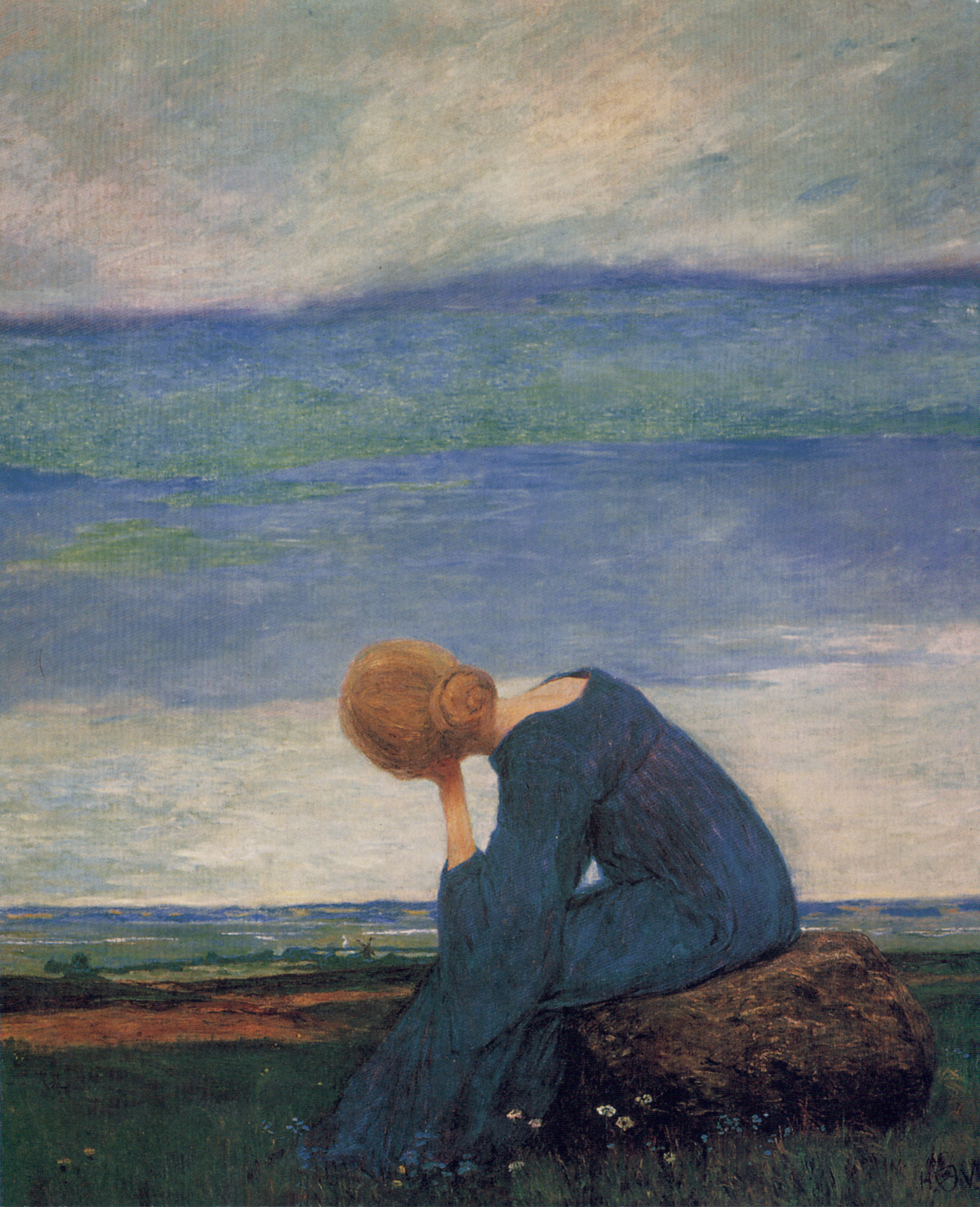
Heinrich Vogeler (German, 1872–1942), Reverie, ca. 1900. Oil on canvas.
               1.
New Year met me somewhat sad:
     Old Year leaves me tired,
Stripped of favourite things I had,
Baulked of much desired:
     Yet farther on my road today
God willing, farther on my way.

New Year coming on apace,
     What have you to give me?
Bring you scathe, or bring you grace,
Face me with an honest face;
     You shall not deceive me:
Be it good or ill, be it what you will,
It needs shall help me on my road,
My rugged way to heaven, please God.

               2.
Watch with me, men, women, and children dear,
You whom I love, for whom I hope and fear,
Watch with me this last vigil of the year.
Some hug their business, some their pleasure scheme;
Some seize the vacant hour to sleep or dream;
Heart locked in heart some kneel and watch apart.

Watch with me, blessed spirits, who delight
All thro’ the holy night to walk in white,
Or take your ease after the long-drawn fight.
I know not if they watch with me: I know
They count this eve of resurrection slow,
And cry, “How long?” with urgent utterance strong.

Watch with me, Jesus, in my loneliness:
Tho’ others say me nay, yet say Thou yes;
Tho’ others pass me by, stop Thou to bless.
Yea, Thou dost stop with me this vigil night;
Tonight of pain, tomorrow of delight:
I, Love, am Thine; Thou, Lord my God, art mine.

               3.
Passing away, saith the World, passing away:
Chances, beauty and youth sapped day by day:
Thy life never continueth in one stay.
Is the eye waxen dim, is the dark hair changing to grey
That hath won neither laurel nor bay?
I shall clothe myself in Spring and bud in May:
Thou, root-stricken, shalt not rebuild thy decay
On my bosom for aye.
Then I answered: Yea.

Passing away, saith my Soul, passing away:
With its burden of fear and hope, of labour and play;
Hearken what the past doth witness and say:
Rust in thy gold, a moth is in thine array,
A canker is in thy bud, thy leaf must decay.
At midnight, at cockcrow, at morning, one certain day
Lo the bridegroom shall come and shall not delay:
Watch thou and pray.
Then I answered: Yea.

Passing away, saith my God, passing away:
Winter passeth after the long delay:
New grapes on the vine, new figs on the tender spray,
Turtle calleth turtle in Heaven’s May.
Tho’ I tarry, wait for Me, trust Me, watch and pray.
Arise, come away, night is past and lo it is day,
My love, My sister, My spouse, thou shalt hear Me say.
Then I answered: Yea.
This poem was originally published in Goblin Market and Other Poems (Macmillan, 1862) and appears inThe Complete Poemsby Christina Rossetti (Penguin, 2001). It is in the public domain.
Andrea Mantegna (Italian, 1431–1506), Madonna with Sleeping Child, ca. 1465. Tempera on canvas, 16 1/2 × 12 1/2 in. (42 × 32 cm). Gemäldegalerie, Berlin.
She took it all in: the shepherds and the royal and learned
men with their prophecies and proclamations. Resting among
common beasts, nipples sore and womb-ached, she smiled at
their praise—but her awe had begun with the angel’s decree.
At the mysterious life-pulse deep inside her. When flicker-
kicks strengthened to rolls and turns, elbows and heels in her
ribs. As buttocks bounced on her bladder.

The brightest star above them—a wondrous sign, but no
more miraculous than when, far from her mother and the
other village women, the flesh of her depth awakened and she
willed the baby from contentment into a harsh night. His cry
pierced the darkness, then quieted as, pressed to her breast,
he found her heartbeat again.
“After Luke 2:19” by Michelle Ortega, reproduced here by the author’s permission, was written for the 2021–22 exhibition Mary, Mary: Contemporary Poets and Artists Consider Mary at St. Michael’s Episcopal Church in Arlington, Virginia. Ortega is the author of the chapbooks Don’t Ask Why (Seven Kitchens Press, 2020) and Tissue Memory (Porkbelly Press, forthcoming).
Max Ernst (German French, 1891–1976), Thirty-Three Little Girls Set Out for the White Butterfly Hunt, 1958. Oil on canvas, 137 × 107 cm. Museo Nacional Thyssen-Bornemisza, Madrid. Photo: Victoria Emily Jones.
Let the Christbrand burst! Let the Christbrand blazon! Dartle whitely under the hearth-fire, Unwind the wind, turn the thunderer, And never, never thinning, Forfend fear. Flare up smartly, fix, flex, bless, inspire, Instar the time, sear the sorcerer, And never, never sparing, Save all year. Let the Christbrand burst! Let the Christbrand blazon!
This poem appears in Scholastic 115, no. 10 (March 1, 1974), a publication of the University of Notre Dame. It is also kept in the Francis J. O’Malley Papers in the university’s archives (see CFOM 7/26), though they do not own the copyright and do not know who does. I post it under Fair Use.
Born in Massachusetts in 1909, Francis (Frank) J. O’Malley studied at the University of Notre Dame in Indiana as an undergraduate from 1928 to 1932 and earned his master’s in history there the following year. He wanted to pursue further studies in literature, but there were no UND doctoral programs in that field at the time. Even without a PhD, he was hired by Notre Dame to teach in the English department, which he did for forty-one years, until his death in 1974. For the entire duration of his career, he lived on campus in Lyons Hall, and he is buried in the university’s Holy Cross Community Cemetery.
O’Malley had a huge influence on students—not just literary but also moral and religious. His “Modern Catholic Writers” and “Philosophy of English Literature” courses are legendary, and he served as a mentor to hundreds. He also dabbled in writing poetry, his style influenced by Gerard Manley Hopkins, and he maintained correspondence with writers like Willa Cather and Jacques Maritain.
I don’t know what year O’Malley wrote his Hopkins-esque poem “At Christmas,” but it was sometime before 1966. Using the metaphor of a firebrand, it anticipates the kindling and flaring up of Christ’s kingdom in the world. I read it as an Advent prayer. I love not only its central image of the Incarnation as an ongoing blaze, but also its clever play with language and its rhythmic quality, formed in part by consonance (the repetition of consonant sounds).
To dartle means to shoot forth repeatedly, so the image in that line is of a crackling hearth fire, something homey and welcoming. The image then shifts to a piece of burning wood held aloft for light and protection—casting out shadows, thwarting attackers. (To forfend is to ward off something evil.)
An “instar” is a stage in the life of an insect between two successive molts. O’Malley uses the word as a verb, suggesting that Christ’s birth means the old is gone and the new is come. It’s a turning point in world history.
The sorcerer in line 8 likely refers to Satan, a reference reinforced by the alliteration of the letter s, which hisses like a serpent.
“Sparing” can have multiple meanings, but I think of Romans 8:32: “He who did not spare his own Son but gave him up for us all . . .” The speaker asks God to not withhold himself, to come again for his people, bringing redemption.
The word “firebrand” is commonly used to describe a person who is divisive, someone who creates trouble, who instigates. Jesus definitely fits that description! He rattled the powers and authorities of his day and initiated a new covenant through his blood, through the scandal of the cross. His coming lit a fire that has never thinned or tapered off but, on the contrary, gained intensity as it spread from Judea and Samaria into the uttermost parts of the earth. And that fire continues to burn brightly in communities from east to west, north to south, where the gospel is lived out and proclaimed.
Rest, little guest,
Beneath my breast.
Feed, sweet seed,
At your need.
I took Love for my lord
And this is my reward—
My body is good earth,
That you, dear plant, have birth.
Anna Wickham is the pen name of British/Australian modernist poet Edith Alice Mary Harper (1883–1947). “After Annunciation”was originally published in the January 1917 issue of Poetry magazine and is in the public domain.
Those of you who follow this blog regularly know that the Annunciation is one of my favorite biblical stories. It’s beautiful and wild—and rife with artistic potential! The church celebrates Jesus’s conception in Mary’s womb yearly on March 25, but naturally, it also comes up in the songs, prayers, image cycles, dramas, and meditations of the Advent season. Here’s a roundup of Annunciation-themed art. (You can find more by searching the “Annunciation” tag in the blog archives.)
SONG: “Never Before” by Deanna Witkowski: Jazz pianist and composer Deanna Witkowski [previously] wrote this three-part women’s a cappella piece in 1998 for a Lessons and Carols service at All Angels’ Church in New York City. In the song Mary marvels at the uncanny prospect that she will feel God growing inside her womb, will breastfeed him, will mend his boo-boos—and mourns that she will one day watch him die. “Never Before” appears on Witkowski’s 2009 album From This Place, sung by her, Laila Biali, and Kate McGarry, and was also featured on NPR’s Weekend Edition Sunday (see “Deanna Witkowski: Liturgical Jazz”).
The angel said the Lord is with me:
The Lord is with me in a way he’s never been before; his Spirit is my lover, his son shall fill my womb with holiness and joy and with life that I can feel kicking at my insides.
The Lord will stay with me in a way he’s never stayed before; he will suckle at my breast and let me hold him in my arms. He will run to me when he cuts his finger or wonders aloud at his Father’s creation in a brightly colored butterfly.
Oh, who is this child, Lord, who comes from up above, whose eyes will look beyond my own to a destiny I do not know? Oh, who is this God-boy whose hands shall clasp mine and whose tears I shall wipe away with trembling fingers of my own?
The Lord will leave me in a way he’s never left before; as a king whose time has come, as a son his mother loved, as a boy whose laughter has filled my heart, and as a baby whose tears I have cried as if they were my own.
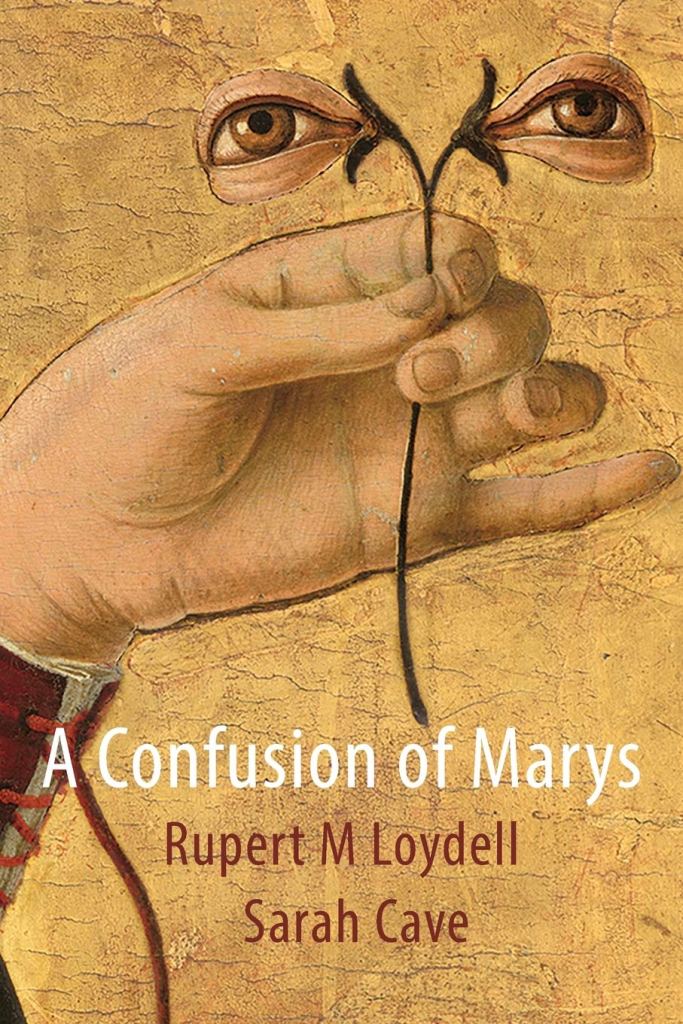
CONVERSATION: “Aliens, angels & annunciations”: In this article, poets Sarah Cave and Rupert Loydell dialogue about their 2020 book A Confusion of Marys, a collection of poems they’ve written inspired by the Annunciation. It’s a series of (sometimes irreverent or humorous) variations on a theme, and not what you’d call devotional poetry. Loydell quotes Gabriel Josipovici, who said stories die unless they are changed, reinvented, argued over, and made new, and that’s what this book does. I definitely gravitated more to some poems than to others.
“I’m interested in the idea of regenerative theology,” Cave says. “I was a cradle Anglican and within that tradition Mary is more of a backseat figure – usually appearing in knitted form at crib services – no intercessions, etc. I wanted to bring her to the forefront and to understand how, in her all-pervasive way, she has shaped my life and the expectations people place on my life – gender, sexuality, politics, mysticism – and the lives of the women around me, and of course, how those expectations must have affected Mary’s own life.”
As for Loydell, he says he’s interested not in theological certainty but in “doubt and myth, symbolism and tangential ideas”—the Marian annunciation scene as palimpsest. He comes at it from a less personal angle.
+++
MYSTERY PLAY + ART PRESENTATION:“Hope Ubiqui: The Gift of the Annunciation”: This online event hosted by Holy Family (Catholic) Church in South Pasadena, California, on March 16, 2021, combines art reflections by Dr. Leah Marie Buturain Schneider (who’s incredibly warm, wise, and engaging) with a performance of the medieval mystery play The Parliament of Heaven, Salutation, and Conception (from the N-town cycle), translated from the Middle Englishby Colleen E. Donnelly and directed here by Grete Gryzwana.
The video starts with artist Patty Wickman [previously] outlining the five emotional states Mary cycled through in response to the angel Gabriel, as famously identified by art historian Michael Baxandall. Schneider then discusses a handful of historical artworks depicting the Annunciation, including ones by Fra Angelico and Andrea della Robbia. The thirty-minute play follows, which enacts not only the Annunciation but also an imagined precursor: a heavenly debate among four of God’s virtues—Truth, Mercy, Peace, and Righteousness [previously; see also this Instagram post]—about how to answer humanity’s cries for salvation. (Keep in mind that this was Zoom-mediated, with each actor calling in from a different location, and some with spotty internet connections, so there are some technical glitches, but it’s still a stirring and enjoyable performance!) Schneider continues by highlighting additional artworks of significance, focusing on Dieric Bouts’s Getty Annunciation, particularly the detail of Mary’s hands. She reads from the mystics Meister Eckhart and Julian of Norwich on responding to Love’s call; they ask, What does it matter if Mary gives birth to Jesus if we ourselves do not give birth to him in our souls, in our lives?
2:51–7:41: Introduction by Patty Wickman 9:44–18:16: Leah Marie Buturain Schneider 18:37–50:10: Mystery play 52:01–1:08:27: Leah Marie Buturain Schneider 1:08:52–1:31:00: Q&A
The remaining video is just informal chatting among a few church members who linger behind on the call.
+++
CHILDREN’S VIDEO: “The Gospel According to Hamlet” by SALT Project: A whimsical retelling of the Annunciation story, narrated by kids—and by a small ceramic pig figurine! The characters are played by a reproduction of Antonello da Messina’s Virgin Annunciate, a Barbie with tinsel wings, and a matryoshka doll.
Maybe it’s the ocean’s rhythmic tug that helps me sleep, my body’s own surge remembering its deepest pulse.
Think of those Celtic monks who scaled the slippery rocks carrying vellum and inks while the sea broke
and battered beneath them. High in a crevice, a hidden stone hut with cot and candle. The scribe
dips and swirls his quill to preserve the story—Luke’s genealogy, name after name, letters shaped
like birds in every color, a flight of messengers released into history. Each word unfurls the promise,
like Gabriel kneeling. The body knows that wings, like waves, can break through walls and enter,
that the secret of the story is love, that even as we sleep, its tides carry us in a wild safety.
The poem “What the Body Knows” by Jean Janzen is from her collection What the Body Knows (DreamSeeker Books / Cascadia Publishing House, 2015) and is used here by permission of the publisher.
The pages from the early ninth-century Book of Kells (IE TCD MS 58, fols. 200r, 200v, 201r, 201v, 202r) are sourced from the Digital Collections of the Library of Trinity College Dublin. They illuminate Luke 3:23–38 in the Latin Vulgate: Et ipse Iesus erat incipiens quasi annorum triginta ut putabatur filius Ioseph qui fuit Heli qui fuit Matthat qui fuit Levi . . . (“And Jesus himself began to be about thirty years of age, being, as was supposed, the son of Joseph, which was the son of Heli, which was the son of Matthat, which was the son of Levi . . .”) Click on the library link to zoom in and explore more, or on the individual images to view at full resolution.
ALBUM REVIEW:“Let’s Go Down: Joy and Humility in Psallos’s Philippians Album” by Victoria Emily Jones: Psallos’s latest album, a musical adaptation of Paul’s letter to the church at Philippi, released on Thursday, and, as I’ve come to expect from the collective, it’s a brilliant work of art, with much to discover! In this review I wrote for the Gospel Coalition, I of course couldn’t address all the album’s intricacies, but I trace a few main themes and motifs. This is the New Testament epistle that gives us such memorable lines, phrases, and passages as “Rejoice in the Lord always!,” “Be anxious for nothing,” “the peace of God that passes all understanding,” “I can do all things through Christ who strengthens me,” and the glorious Christ Hymn (“Let this mind be in you, which was also in Christ Jesus, who, being in the form of God . . .”). It’s delightful to hear what Psallos does with these oft-quoted verses and, even more, to be guided in understanding the larger context in which they appear.
It’s near impossible to choose favorite tracks, as they gain impact from being heard all together and in order, but if Ihad to choose, I’d say “Complete My Joy,” “Hymnos Christou,” “I Am Better Than You” (feat. Shai Linne), and “Will You Go Down?” (feat. Taylor Leonhardt).
+++
POETS’ PANEL:“Surprised by Joy: Poetry about Happiness,” recorded at the Festival of Faith and Writing, April 2018: In Rewrite Radio Episode 29 (a production of the Calvin Center for Faith and Writing), poets Anya Silver, Tania Runyan, Barbara Crooker, and Julie Moore “discuss the landscape of joy amidst suffering in their personal and public lives. Joy, distinct from happiness, can be a form of religious practice. They explore questions regarding what cheapens joy, how Christians view joy, and how to ‘balance the scale’ of joy and pain in writing.” Zora Neale Hurston, Ælfric of Eynsham, Ralph Waldo Emerson, Christian Wiman, Jane Kenyon, John Milton, Dietrich Bonhoeffer, Thornton Wilder, and the apostle Paul are just some of the additional voices they draw into their conversation. They each read three to four of their own poems, and there is an audience Q&A starting at 57:54. A transcript is provided.
Silver and Runyan are two of my favorite poets, and this is such a rich hour spent with them and two of their colleagues.
+++
INTERVIEW: “It’s Not a Poem Until You Discover Something: An Interview with Scott Cairns” by Andy Patton: In this conversation, poet Scott Cairns talks about writing as a discipline, the writer as reader (“The writing life is primarily the reading life”), staying conversant with tradition, the fallacy of originality, the one quality shared most between prayer and poetry, and writing not as giving, serving, but as getting, receiving.
+++
LECTURE: “What Did Jesus Look Like?” by Joan E. Taylor, St. Paul’s Cathedral, London, June 2, 2019: Historian Joan E. Taylor, a professor of Christian origins and Second Temple Judaism at King’s College London, discusses the influences on early depictions of Jesus in art and what they tell us about what he did, or definitely didn’t, look like. This talk is a great intro to her research on the topic, but if you want to learn more, I recommend her full-color book What Did Jesus Look Like? (T&T Clark, 2018), which goes into much more detail, examining artistic, literary, and archaeological evidence, including first- and second-century coins, textiles, skulls, and Egyptian mummy portraits. She also dedicates two chapters to the three most famous acheropitae (images “made without [human] hands”): the Veil of Veronica, the Mandylion, and the Shroud of Turin.
In her talk, Taylor shows how most of the visual representations of Jesus in the Early Christian era were based on Greco-Roman imagery of Zeus Olympus or Zeus Serapis (strong, powerful, seated on a throne; this image came after Constantine), Dionysus (young, curly-haired, beardless), or philosophers. These images aim to show us the meaning of Jesus but not necessarily his physical reality.
Interestingly, Taylor points out that while it’s common to picture Jesus in a long robe (stolē, plural stolai) with baggy sleeves, such clothing indicated social privilege in Jesus’s time, and in Mark 12:38, Jesus explicitly denounces those who parade around in such dress! Jesus would have worn a short, simple tunic, probably undyed—which is how he is depicted in the frescoes from the ancient Dura-Europos house church in present-day Syria.
She also identifies a common strain in early Christian and non-Christian writings that describes Jesus as “little and ugly and undistinguished” (Celsus), probably owing largely to the messianic interpretation of Isaiah 53:2: “he had no form or majesty that we should look at him, nothing in his appearance that we should desire him.” However, there were some claims to the contrary—for example, from Origen—that stated that Jesus was the epitome of physical beauty; after all, divinity must be beautiful, right? We often find throughout art history an attempt to backfill the earthly life of Jesus with his resurrected, ascended, glorified form.
Taylor is not suggesting, as far as I can tell, that all artistic representations of Jesus must be historically authentic to have validity. Rather, she says that if we are going to imagine Jesus humanly doing things—healing the paralytic, for example, or preaching the Sermon on the Mount—we will inevitably have to picture him in our mind, and we might as well have as accurate a picture as possible. She reminds us that if we imagine Jesus as supremely beautiful and well kept and richly arrayed instead of as the poor, bedraggled itinerant that he was, there’s a dissonance with his message; he becomes no longer one of the people but apart from them.
+++
ARTICLE: “Are Images of Jesus a Violation of the Commandments?” by Chad Bird: “Different groups within Christianity disagree as to whether Jesus should be depicted in icons, crucifixes, paintings, or other visual media. In this article, Chad Bird [scholar in residence at 1517] approaches the question from the angle of both the commandments and the incarnation.”
The most pushback I receive on my blogging ministry comes from those who believe it is inherently wrong, even “idolatrous,” to represent Jesus visually. Bird addresses this concern in much the same way I do when asked, and in such a succinct way!
The following four poets/pray-ers express awe and gratitude for God’s bountiful heart as conveyed through nature, a gift given freely to everyone—new every morning. Each attributes to God an exceeding liberality, even prodigality (wastefulness), in such daily bestowals, which, as the Brazilian Catholic archbishopHélder Pessoa Câmara (1909–1999) suggests below, ought to inform our own giving.
Jan Sluijters (Dutch, 1881–1957), October Sun, Laren, 1910. Oil on canvas, 48.3 × 52.7 cm. Frans Hals Museum, Haarlem, Netherlands. Photo: Victoria Emily Jones.
Untitled poem by Emily Dickinson
As if I asked a common Alms—
And in my wondering hand
A Stranger pressed a Kingdom,
And I, bewildered, stand—
As if I asked the Orient
Had it for me a Morn—
And it should lift its purple Dikes,
And shatter Me with Dawn!
Written in 1858; source: The Complete Poems of Emily Dickinson, ed. Thomas H. Johnson (Cambridge, MA: The Belknap Press of Harvard University Press, 1955)
+++
Untitled poem by George MacDonald
Gloriously wasteful, O my Lord, art thou!
Sunset faints after sunset into the night,
Splendorously dying from thy window-sill—
For ever. Sad our poverty doth bow
Before the riches of thy making might:
Sweep from thy space thy systems at thy will—
In thee the sun sets every sunset still.
Source: A Book of Strife in the Form of the Diary of an Old Soul (self-pub., 1880)
+++
“The Excesses of God”by Robinson Jeffers
Is it not by his high superfluousness we know
Our God? For to equal a need
Is natural, animal, mineral: but to fling
Rainbows over the rain
And beauty above the moon, and secret rainbows
On the domes of deep sea-shells,
And make the necessary embrace of breeding
Beautiful also as fire,
Not even the weeds to multiply without blossom
Nor the birds without music:
There is the great humaneness at the heart of things,
The extravagant kindness, the fountain
Humanity can understand, and would flow likewise
If power and desire were perch-mates.
Source: Be Angry at the Sun and Other Poems (New York: Random House, 1941)
+++
Untitled prayer by Hélder Pessoa Câmara, OFS
Lord,
isn’t your creation wasteful?
Fruits never equal
the seedlings’ abundance.
Springs scatter water.
The sun gives out
enormous light.
May your bounty teach me
greatness of heart.
May your magnificence
stop me being mean.
Seeing you a prodigal
and open-handed giver,
let me give unstintingly
like a king’s child,
like God’s own.
Source: The Hodder Book of Christian Prayers, compiled by Tony Castle (London: Hodder and Stoughton, 1986)
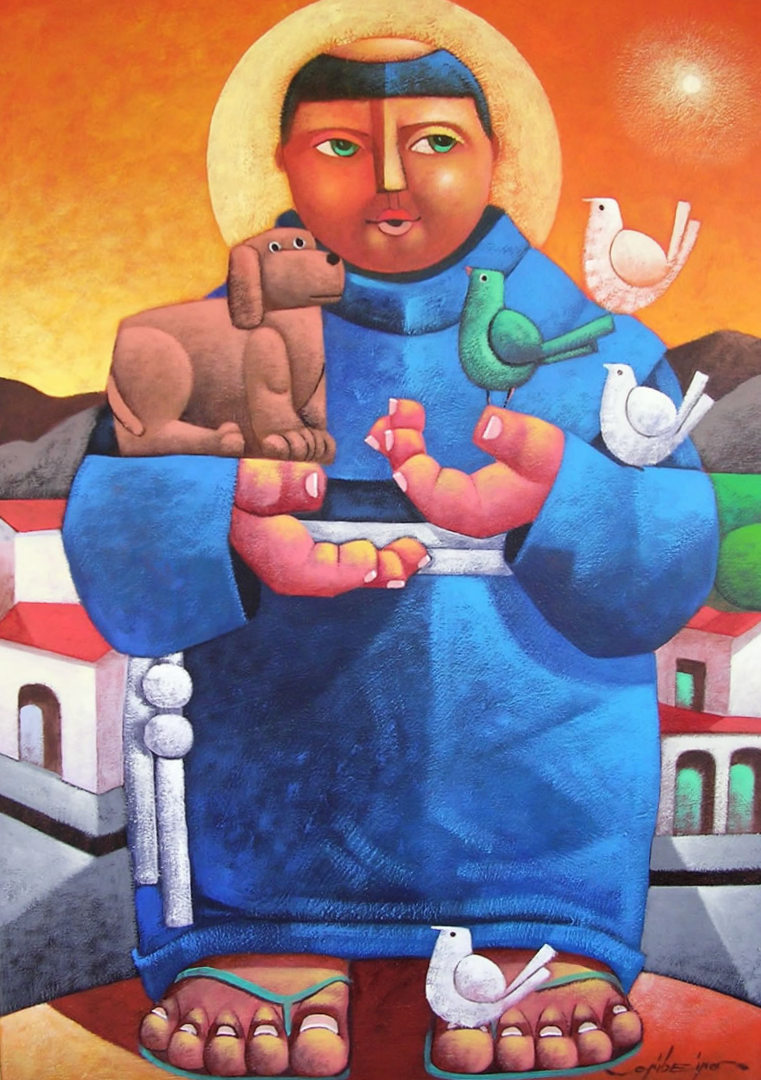
Osvaldo Ribeiro (Brazilian, 1950–), St. Francis I. Oil on canvas, 70 × 50 cm.
“And now, my clerks who go in fur or feather
Or brighter scales, I bless you all. Be true
To your true Lover and Avenger, whether
By land or sea ye die the death undue.
Then proffer man your pardon; and together
Track him to Heaven, and see his heart made new.

“From long ago one hope hath in me thriven,
Your hope, mysterious as the scented May:
Not to Himself your titles God hath given
In vain, nor only for our mortal day.
O doves! how from The Dove shall ye be driven?
O darling lambs! ye with The Lamb shall play.”
This poem appears in Happy Ending: The Collected Lyrics of Louise Imogen Guiney (Houghton Mifflin, 1909) and is in the public domain.
WEBINAR: “Formational Films Round-Up: Movies That Matter,” hosted by Renovaré: Recorded August 24, this is an excellent eighty-minute conversation with film critic and professor Jeffrey Overstreet [previously], minister Catherine Barsotti, and theologian Chris Hall, led by Carolyn Arends [previously]. Each of the three guests identifies and discusses five films that have been spiritually formative to them—and what great selections! (Though there are four I have not yet seen.) Barsotti’s number one is one of my all-time favorites.
Because the movie ratings issue (that is, content like violence, sex, and/or profanity) is almost always raised by Christian audiences, Arends asks, “Are there some films that are bad for you to watch, and if so, why?” The question is wisely addressed from 34:52 to 49:40.
+++
INTERVIEW: “We must become poetry,”Still Life: For the September 13, 2021, edition of his weekly Still Life letter, Michael Wright [previously] interviewed Christian author Paul J. Pastor, having been intrigued by a recent tweet of his, which asks, “Where are the bardic preachers, wild at the eye, speaking not just to mind or heart, but to gut?” Pastor talks about the connection between the seen and the unseen; the relationality of poetry and finding shelter in the words, images, and emotions of another; holistic knowing; the disservice of reducing the Bible’s poetry to moral lessons with tidy applications; the nearness of Walt Whitman’s poetic vision to the Christian vision of sanctification; and more.
“My passion is for Christians to reclaim our way’s remarkable resources for living virtuously, beautifully, and well,” he says. Mine too!
To subscribe to Still Life, distributed for free every Monday over email, click here.
+++
Lecture by David Brinker for the 8th Catholic Arts Biennial, Verostko Center for the Arts at Saint Vincent College, Latrobe, PA, September 12, 2021: I mentioned the call for entries for this exhibition back in June. Of the 396 entries from artists from around the country, MOCRA director and guest juror David Brinker has selected 52. In this talk given the weekend after the exhibition’s opening (which starts at 14:47), he discusses the following three questions, pulling in artworks from the current exhibition and from his twenty-five-plus years as an art curator at a Catholic institution.
What identifies contemporary art as “Catholic”?
What contributions can Catholic art and artists offer to the broader contemporary art world?
What can Catholic art and artists receive from the broader art world?
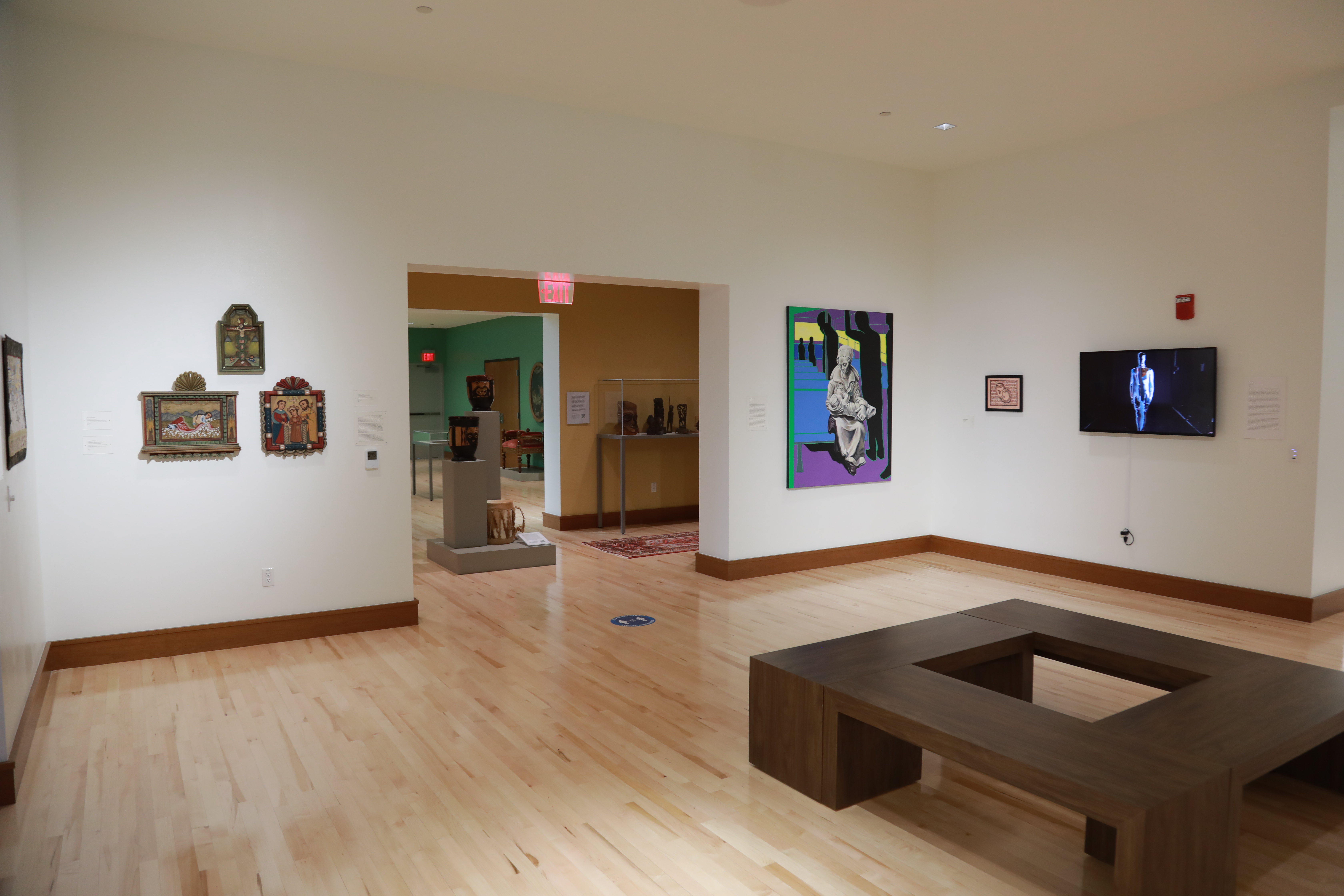
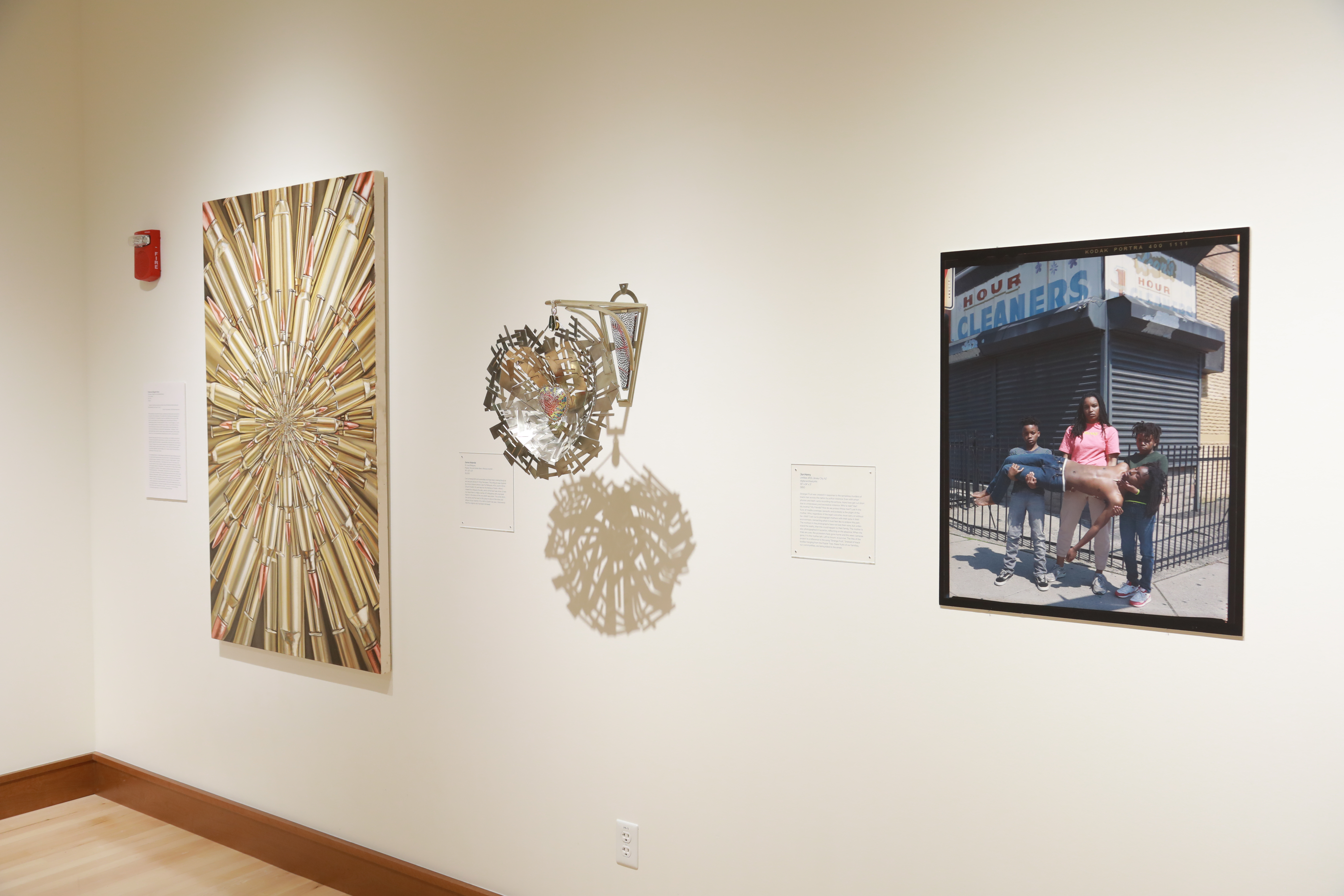
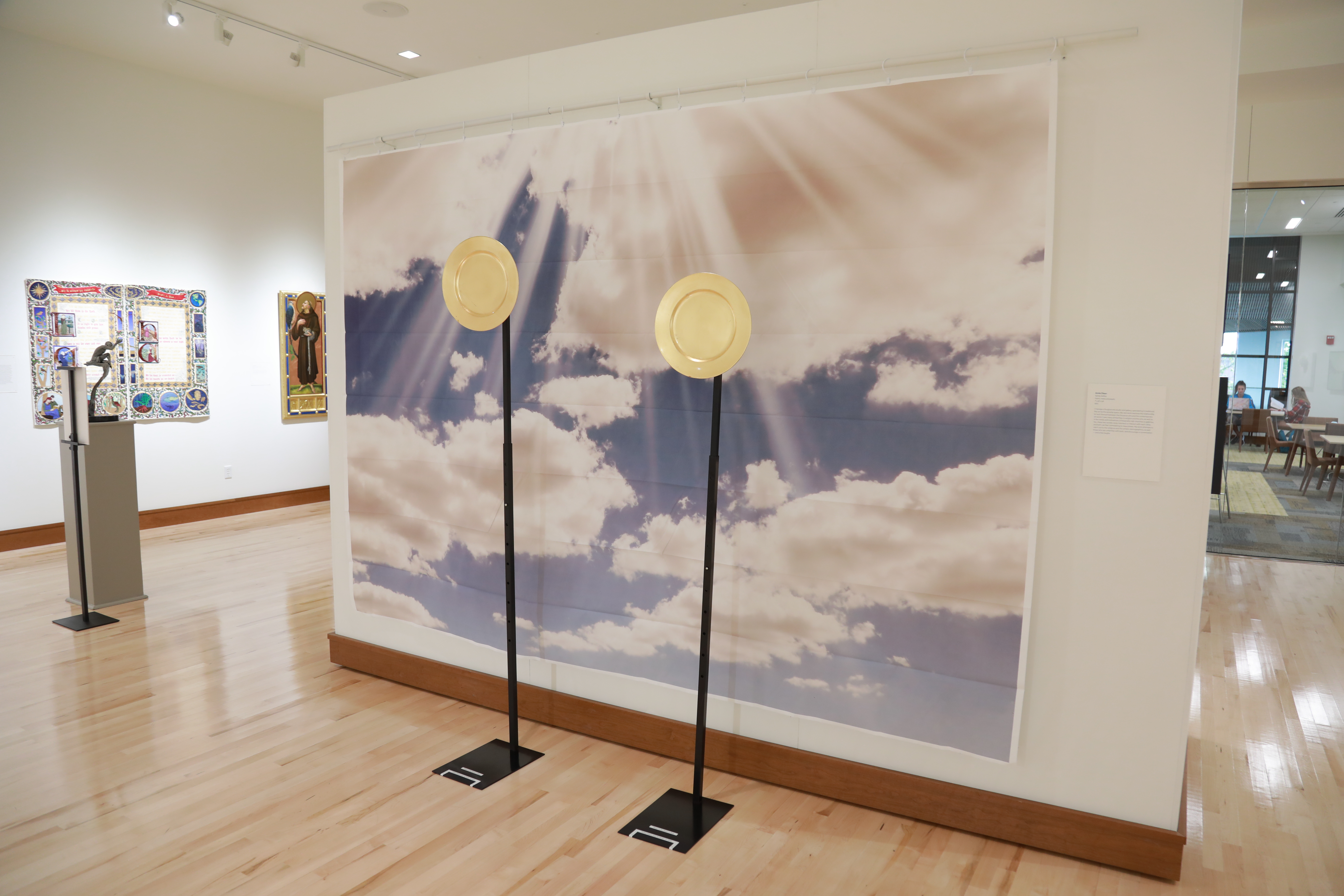
Exhibition view, 8th Catholic Arts Biennial. From left to right are three retablos by Vicente Telles, Maternidad by Piki Mendizabal, Iesu in Utero by Rebecca Spilecki, and The Living Temple by Jesse Klassen.The Heart of Man by Kristen van Diggelen Sloan; St. Laud Reliquary by James Malenda; Untitled, #33, Jersey City, NJ by Jon HenryForeground: Saintly Selfies by Annie Dixon
(The three photos above are provided courtesy of the Verostko Center for the Arts.)
Saint Vincent’s 8th Catholic Arts Biennial exhibition is on view through October 29, 2021; off-campus visitors are asked to make an appointment by emailing verostkocenter@stvincent.edu. While you’re in the area, you might also want to visit the Fred Rogers Center at Saint Vincent College, which houses artifacts from Mister Rogers’ Neighborhood as part of a larger permanent exhibition on his life, work, and influence. (Latrobe was Fred Rogers’s hometown.) And Pittsburgh is just an hour away!
+++
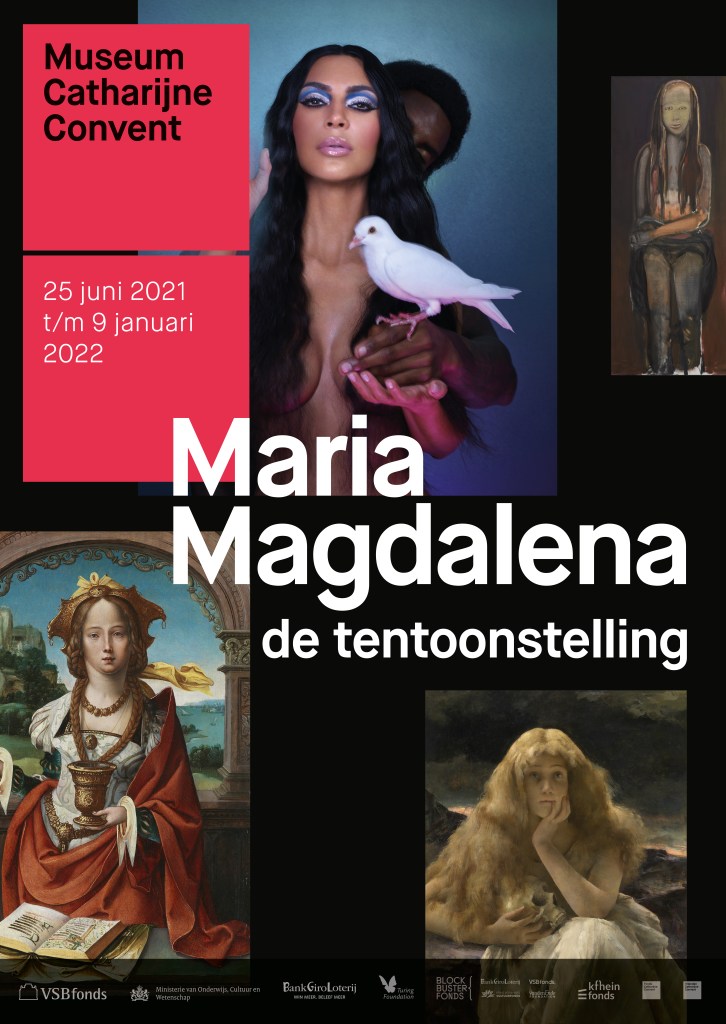
EXHIBITION: Maria Magdalena (Mary Magdalene),Museum Catharijneconvent, Utrecht, Netherlands, June 25, 2021–January 9, 2022: Curated by Lieke Wijnia. “Mary Magdalene is one of the most enigmatic women from the New Testament. Through a trans-historical display of artistic representations from the eleventh century to the present day, this exhibition explores the enduring fascination for this mysterious saint.” The catalog, Mary Magdalene: Chief Witness, Sinner, Feminist, is available in Dutch or English from the publisher Waanders. In addition to the exhibition page on the museum’s website, which hosts select images and a series of videos, resources in Dutch include an audio tour (with images), a podcast episode and accompanying article, and a video preview with commentary by Karin Haanappel.
I’m fascinated by Mary Magdalene, and while I won’t get to see this exhibition, it appears that it does an excellent job of exploring the many facets of her life and identity (including both before meeting Jesus and after his ascension), as told through canonical and apocryphal texts, and her complicated reception history. It addresses her role as the first witness to Jesus’s resurrection; the so-called Gnostic Gospel of Mary, which has Peter saying, “Sister, we know that the Savior loved you more than the rest of the women. Tell us the words of the Savior which you remember—which you know (but) we do not, nor have we heard them”; the legacy of Pope Gregory the Great’s infamous Easter sermon of 591 CE, which, in its (many would say erroneous) conflation of the Magdalen with other New Testament women, identified her as a converted prostitute; the development of legends about her later life in southern France, as an evangelist, a miracle-worker, and a penitent, cave-dwelling ascetic; modern films and literature that cast her as a romantic lover, or even the wife, of Jesus; and Pope Francis’s elevation of her liturgical commemoration from an obligatory memorial to a feast day in 2016, in which she is to be celebrated not as a fallen woman doing penance but as the “apostle to the apostles,” a title of hers dating back to the High Middle Ages.
The poster above features Mary Magdalene Receives the Holy Spirit by American photographer David LaChapelle, Magdalena by contemporary South African artist Marlene Dumas, The Magdalen from a sixteenth-century Flemish workshop, and Mary Magdalene by nineteenth-century Belgian artist Alfred Stevens.
+++
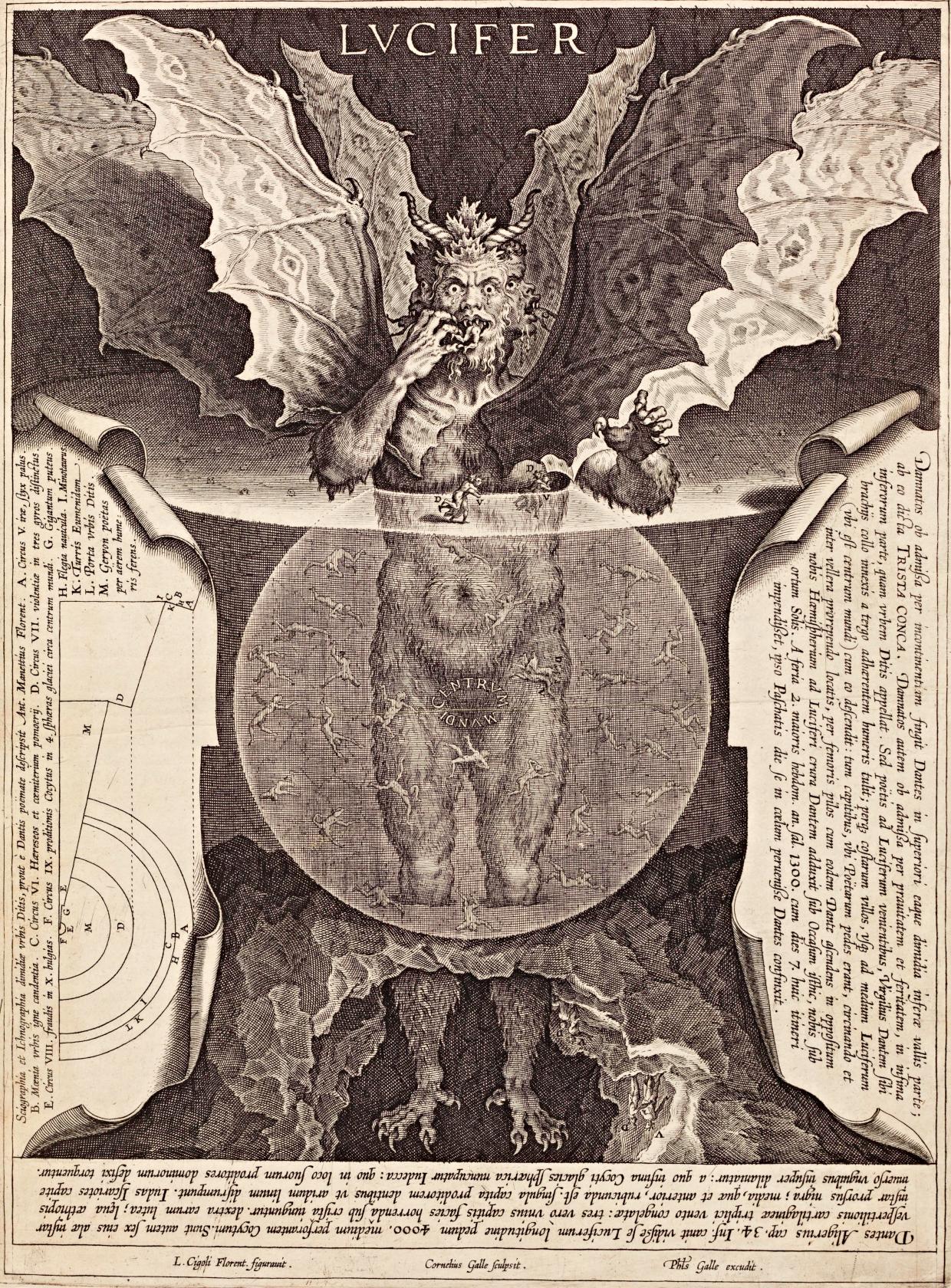
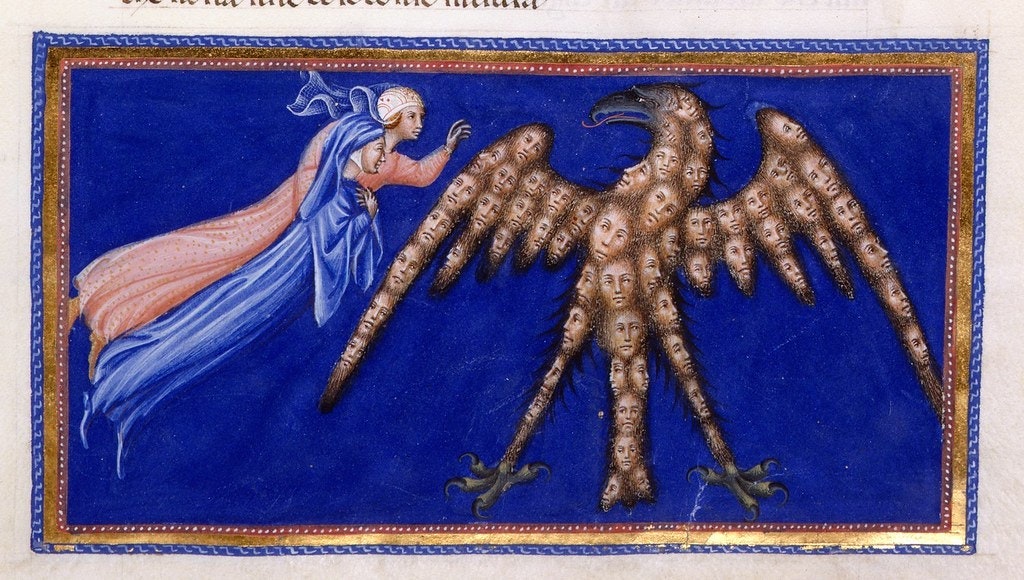
ARTICLE: “700 Years of Dante’s Divine Comedy in Art”: In honor of the seven hundredth anniversary of the Italian poet Dante Alighieri’s death on September 14, the Public Domain Review has collected art directly inspired by his Commedia from over the last seven centuries—on the nine circles of hell, the beatific vision, and much more. Under the tutelage of literature professor Stefano Gidari, I read and studied Dante’s groundbreaking afterlife-adventure trilogy—in Italian!—in 2009 while living in Florence, where it was written, which was such an invaluable experience.
Cornelis Galle I (Flemish, 1576–1650), Lucifer, after Stradanus, ca. 1595. Engraving, 27.5 × 20 cm.Giovanni di Paolo (Italian, ca. 1403–1482), Dante and Beatrice before the Eagle of Justice, ca. 1450. From Yates Thompson 36, fol. 162, British Library, London.

#/media/File:Andrea_Mantegna_108.jpg)



 Art & Theology