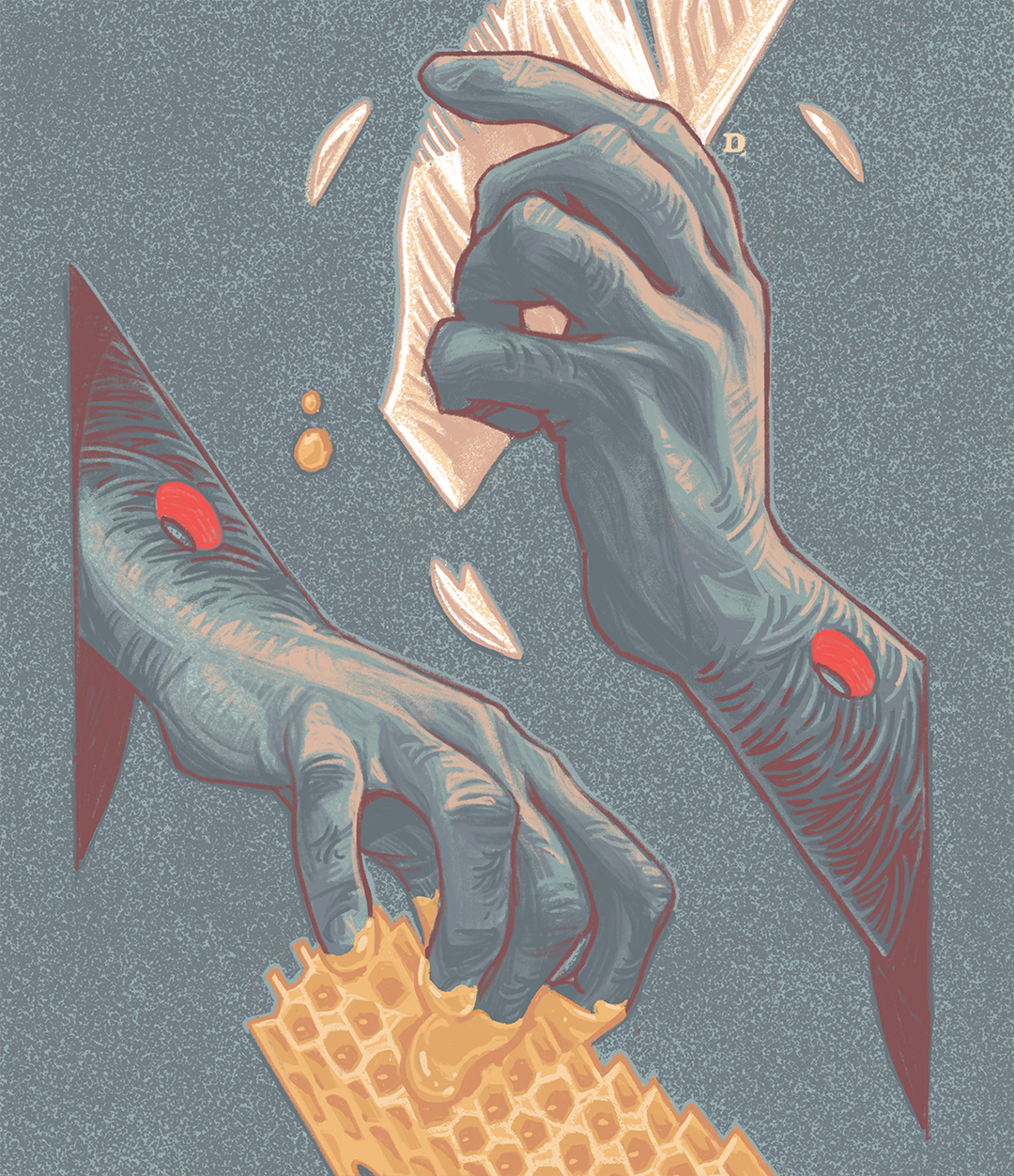
Illustration by Duncan Robertson for BEHOLD: The Resurrection and the Life trading cards from Fish Coin Press
On that final night, his meal was formal:
lamb with bitter leaves of endive, chervil,
bread with olive oil and jars of wine.

Now on Tiberias’ shores he grills
a carp and catfish breakfast on a charcoal fire.
This is not hunger, this is resurrection:

he eats because he can, and wants to
taste the scales, the moist flakes of the sea,
to rub the salt into his wounds.
From Corpus(Jonathan Cape / Penguin Random House, 2004)
Sharing food with friends was a significant aspect of Jesus’s ministry, so it’s no surprise that it’s one of the first things he does with his resurrected body. Based on the “breakfast on the shore” episode in John 21, “Food for Risen Bodies II” by Michael Symmons Roberts “exults in the renewal of bodily sensations” experienced by the risen Christ, writes commentator Janet Morley in The Heart’s Time. Gloriously corporeal, Jesus enjoys tastes and textures once again and, in my interpretation of the poem’s final line, is even glad to be able to feel pain, because it’s a marker of being alive. (Theologians disagree on whether Jesus could feel pain in his risen state.) Roberts mentions the saltiness of the fish; I think, too, of the stickiness of the honeycomb, which some manuscripts of the parallel passage in Luke 24 mention Jesus ate that day. The poem contrasts the somber formality of the Last Supper with the joyous informality of this barbecue on the beach, this Easter feasting.
Michael Symmons Roberts (born 1963) is an award-winning British poet, librettist, broadcaster, and dramatist. A Fellow of the Royal Society of Literature, he is the author of nine poetry collections and a professor of poetry at Manchester Metropolitan University.
It is the day of Resurrection and an auspicious beginning. Let us be made brilliant by the feast and embrace each other. . . .
Yesterday the lamb was slaughtered, and the doorposts were anointed, and the Egyptians lamented the firstborn, and the destroyer passed over us, and the seal was awesome and venerable, and we were walled in by the precious blood. Today we have totally escaped Egypt and Pharaoh the harsh despot and the burdensome overseers, and we have been freed from the clay and the brick-making. And nobody hinders us from celebrating a feast of exodus for the Lord our God. . . .
Yesterday I was crucified with Christ, today I am glorified with him; yesterday I died with him, today I am made alive with him; yesterday I was buried with him, today I rise with him.
—Gregory of Nazianzus, “On Pascha and on His Slowness,” an Easter sermon from ca. 362, trans. Nonna Verna Harrison in Festal Orations by Saint Gregory of Nazianzus (St. Vladimir’s Seminary Press, 2008)
LOOK: Miniature from the Tomić Psalter
The prophet Miriam leading the women with timbrels and dances, from the Tomić Psalter, Bulgaria, ca. 1360. Tempera on paper, 30 × 25 cm. State Historical Museum, Moscow.
This miniature comes from a fourteenth-century illuminated psalter from Bulgaria, a masterpiece of the Tarnovo art school. It’s linked to Psalm 105, which exults in the memory of God bringing Israel up out of Egypt, providing for them in the desert, and establishing them in the promised land. “So he brought his people out with joy, his chosen ones with singing,” the psalmist writes (Ps. 105:43).
More directly, the image is an illustration of Exodus 15:20–21, an episode of female-led worship that occurs just after the crossing of the Red Sea:
And Miriam the prophetess, the sister of Aaron, took a timbrel in her hand; and all the women went out after her with timbrels and with dances.
And Miriam answered them, Sing ye to the LORD, for he hath triumphed gloriously; the horse and his rider hath he thrown into the sea.
The only percussion instrument mentioned in the Hebrew Bible, the timbrel (Heb. toph), or hand drum, consists of a hoop of wood or metal over which the skin of an animal is stretched. Some have jingles around the rim, like the modern tambourine, and some do not. The instrument is associated with women and celebration.
In the visual imagination of the anonymous Tomić Psalter artist, Miriam beats a drum with a stick while two of her companions clash cymbals and other women interlock arms and dance. The artist probably took inspiration from the folk music and dancing of women in his own culture.
LISTEN: “Da Mariae tympanum” (Give Mary a Tambourine) | Words by Peter Abelard, 1130s | Music by Georg Forster, 16th century | Performed by the Augsburg Early Music Ensemble on Medieval Pilgrimage to Santiago, 2003
Da Mariae tympanum
resurrexit Dominus,
Hebraes ad canticum
cantans provocet,
Holocausta carminum
Iacob immolet.

Subvertens Aegyptios,
resurrexit Dominus,
Rubri Maris alveos
replens hostibus,
quos involvit obrutos
undis pelagus.

Dicat tympanistria,
Resurrexit Dominus,
illa quidem altera
re, non nomine,
resurgentem merita
prima cernere.

Cantet carmen dulcius,
resurrexit Dominus,
reliquis fidelibus
mixta feminis,
cum ipsa narrantibus
hoc discipulis.

Deo patri gloria,
resurrexit Dominus,
salus et victoria
Christo Domini;
par honor per saecula
sit Spiritui.
Give Mary a tambourine,
    for the Lord has risen;
as she sings, let her incite
    Hebrew women to song;
let too Jacob sacrifice
    holocausts of songs.

Egyptians he did overwhelm,
    for the Lord has risen,
filled the Red Sea’s submerged caves
    with his enemies,
whom the sea caught and buried
    in the waves below.

Let the timbrel player sing,
    For the Lord has risen,
a second Mary, different in
    her person, not in name,
she deserved to be the first
    to see him risen up.

Let her sing a sweeter song,
    for the Lord has risen,
as she mingles with the rest
    of the faithful women,
who with her proclaim the news
    to the Lord’s disciples.

Glory be to God the Father,
    for the Lord has risen,
health restored and victory
    to the Lord’s anointed;
equal honor through the years
    to the Holy Spirit.
This hymn is from the second book of the Hymnarius Paraclitensis (Hymnary of the Paraclete), a collection of over 130 Latin hymns written by the French philosopher and theologian Peter Abelard (1079–1142) [previously] for the convent of the Paraclete near Troyes, headed by Héloïse. It imagines Mary Magdalene as the New Miriam (Mary is the anglicized form of the Hebrew Miriam), leading women in song and dance in celebration of God’s victory over the forces of sin and death through the resurrection of God’s Son, Jesus Christ.
In Christianity, the exodus is interpreted not just as a literal saving act in Israel’s history but also as a prefigurement of the Resurrection. In many churches, Exodus 14, recounting the Israelites’ crossing of the Red Sea, is part of the Easter liturgy. The Orthodox word for Easter, Pascha—a Greek word from the Hebrew Pesach—itself means “Passover,” further reinforcing the connection between the Israelites’ liberation from Egyptian slavery and the liberation of God’s New Testament people from spiritual bondage, both made possible by the blood of a lamb and requiring passage through the waters—sea versus baptismal.
Mary Magdalene was one of Jesus’s closest disciples, and it’s she, according to the Gospel of John, to whom he first appeared following his resurrection. He then commissioned her to go tell the other disciples—to beat the drum, as it were, announcing the good news that he is alive. The Gospels of Matthew and Luke have her joined in this task by other faithful women: “the other Mary” and “Joanna, Mary the mother of James, and the other women,” respectively.
I like the image Abelard gives us of Mary Magdalene rousing her female companions with a tambourine, leading them in the song and dance of resurrection. In the new exodus, Christ guides humanity into freedom, from death to life, as Mary praisefully proclaims, across the path he has paved by his own rising. “Resurrexit Dominus!” The men at first disbelieve her testimony . . . but once they see what she’s seen, they, too, rejoice.
The musical setting of Abelard’s text featured above is by the German Renaissance composer and physician Georg Forster (ca. 1510–1568).
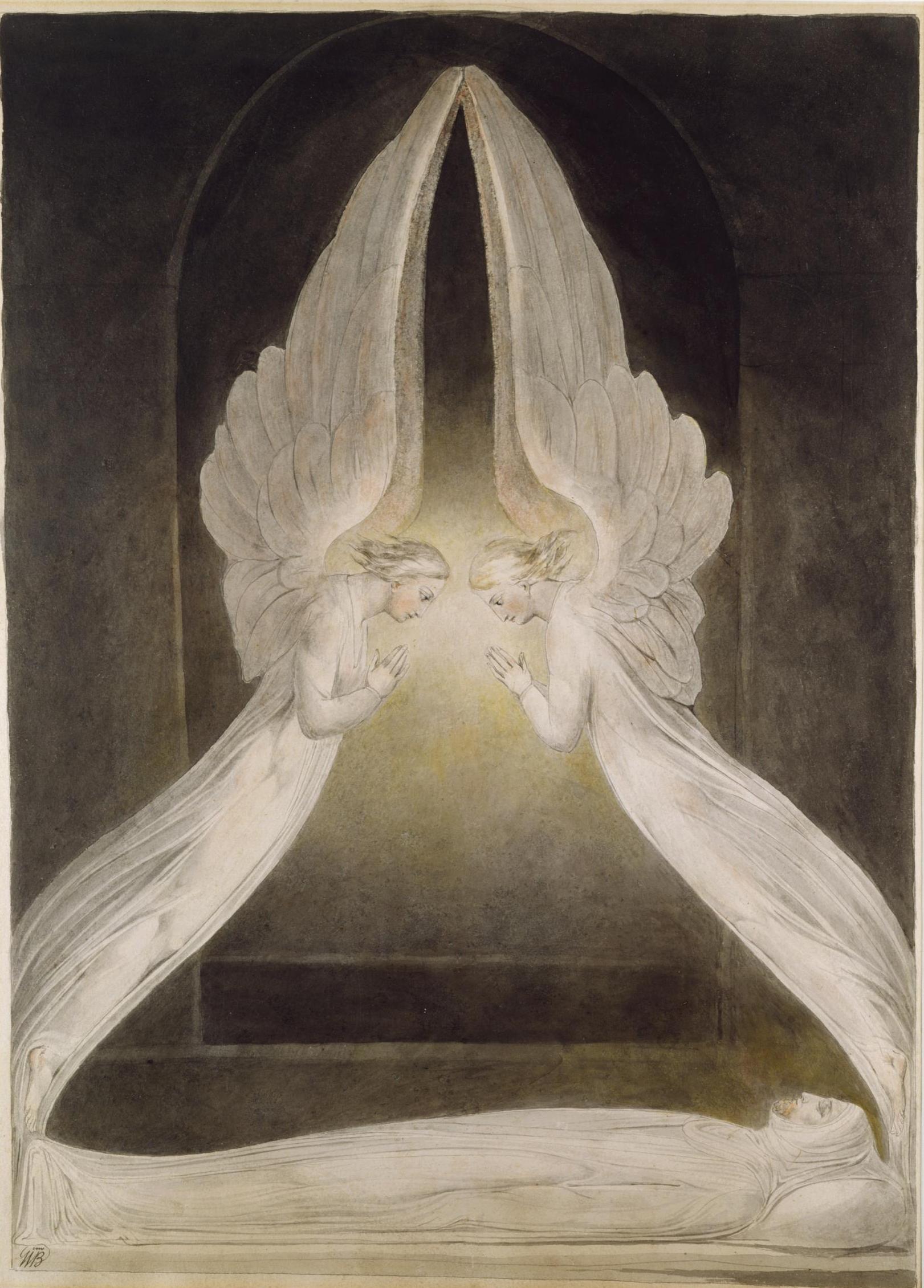
William Blake (British, 1757–1827), The Angels Hovering over the Body of Christ in the Sepulchre, ca. 1805. Watercolor on paper, 42 × 30.2 cm. Victoria and Albert Museum, London.
A robin’s egg in a nest,

a row of yellow tulips, petals closed,

the last few shadowed moments
on the eastern horizon,

and Holy Saturday,
as Christ was lying in the sealed tomb,
       and angels were waiting.
Comprising just seven spare lines, this poem is a wonderfully succinct evocation of the anticipation of Easter. An egg about to hatch, a flower about to bloom, the sun about to rise—Leslie Anne Bustard gives us these images from nature to sit with on Holy Saturday, a day of waiting in the still, silent moment before life, light, and beauty break forth from Christ’s tomb and he ambles out, calling our names.
Leslie Anne Bustard (1968–2023) was a teacher, a writer, and a producer of high school and children’s theater in Lancaster, Pennsylvania, where she lived with her husband, Ned, and raised three daughters. A lover of the arts, she was the vice president of Square Halo, a Christian nonprofit that publishes books, hosts an annual conference, curates a contemporary art gallery, and records a podcast. She is the coeditor, with Carey Bustard and Théa Rosenburg, of Wild Things and Castles in the Sky: A Guide to Choosing the Best Books for Children (2022) and the author of The Goodness of the Lord in the Land of the Living: Selected Poems (2023) and the posthumously published Tiny Thoughts That I’ve Been Thinking: Selected Writings of Leslie Anne Bustard (2024) and Strong Allies: Creating, Cultivating, Restoring (2026). She died of cancer at age fifty-five.
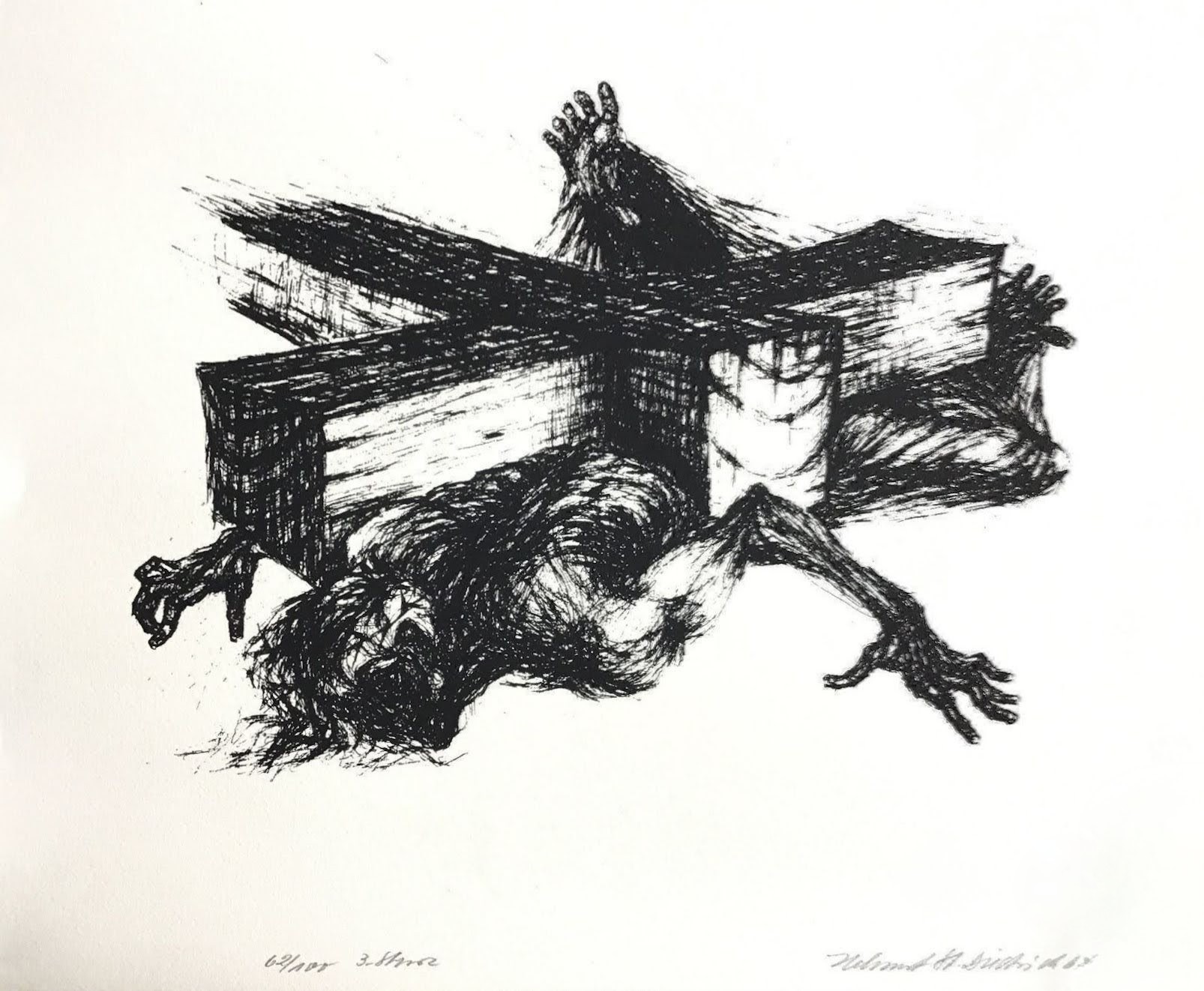
Helmut Stephan Diedrich (German, 1937–), Kreuzfall, 1964. Lithograph, edition 62/100.
You fall, sparrow-bone, God-eyed leaf,
black hair of ox, kernel of wheat,
gold blown from the stalk. You lift wood,
trudge, and lurch, your back pulped. You would
spit up the cup-dregs for relief—

but no, you want not; you believe
your master’s dream. You toss your dreams
like chaff to the breeze. You lift wood.
You fall,

            thin coin,

                          widow’s all,

                                       copper seed
into the mouth of the box. She
brushed you a hundred times, so good
to hold, but better to drop. Wood
weights you, snapped bone, wind-flung leaf.
You fall.
This poem was originally published in Christianity and Literature 59, no. 2 (Winter 2010) and is anthologized in Imago Dei: Poems from Christianity and Literature, ed. Jill Peláez Baumgaertner (Abilene Christian University Press, 2012). Used by permission of the poet.
Originating in the Middle Ages, the Stations of the Cross is a Christian devotional practice in which participants commemorate the journey Jesus took down the Via Dolorosa (Way of Sorrows) to his death—either on location in the Holy Land, physically following a demarcated route, or, more accessibly, in their imaginations, through the aid of images or meditative texts. Traditionally, there are fourteen stations, the third, seventh, and ninth of which are “Jesus falls.” At these stopping places, Christians reflect on the crushing weight of sin and wood, on Jesus’s intensifying exhaustion, and yet, too, on his perseverance to get up each time and, pushing through the debility, to continue his trek to its fatal, foreordained end.
In his poem “Sparrow Lament,” William Woolfitt alludes to Jesus’s three falls on his way to Golgotha: “You fall,” “You fall,” “You fall.” He uses a string of metaphors from the natural world for the falling Christ: He’s a sparrow bone (spat out by a predator?), a floating leaf, a shed bovine hair, a grain of wheat blown loose from its stalk. These are wistful images of solitariness, passage, decease—and yet the descriptor “God-eyed” indicates that the path Christ is on is governed by divine providence.
The sparrow reference, given further weight by its use in the poem’s title, evokes Jesus’s teaching in Matthew 10:28–31: “Do not fear those who kill the body but cannot kill the soul; rather, fear the one who can destroy both soul and body in hell. Are not two sparrows sold for a penny? Yet not one of them will fall to the ground apart from your Father. And even the hairs of your head are all counted. So do not be afraid; you are of more value than many sparrows.”
The Father has willed the Son to drink the bitter cup of suffering and death, which, despite Jesus’s distressed plea less than twenty-four hours prior that the cup be removed, he downs in trust, casting off any dreams he had for living into old age. As he carries out his calling, he stumbles, he falls to the ground—but not apart from the will of his Father.
In the middle of the poem, the lineation—the arrangement of words using lines and line breaks—mimics a downward motion. Like the drop of the storied widow’s coin into the offering box (Mark 12:41–44; Luke 21:1–4). Most biblical interpreters assume that Mary, Jesus’s mother, was a widow by the time Jesus started his ministry, since Joseph is never mentioned in any of the Gospel accounts after the episode of Jesus disappearing in the temple at age twelve. Woolfitt refers to Jesus as “widow’s all”—Mary’s everything, her firstborn son, whom she sacrificially gives to the world, knowing God will bless her gift. She doesn’t hoard this dear treasure of hers. She surrenders him to God’s greater plan.
It wasn’t an easy choice to make. Mothers instinctively want to hold on to their children, and tight. Many intrusively fear dropping them as infants and would do anything to spare them pain. Well, Mary drops her son, on purpose. She relinquishes him, “copper seed,” whose death bears fruit, yields dividends.
William Woolfitt is a writer across the genres of poetry, fiction, and essay. His poetry collections are The Night the Rain Had Nowhere to Go (Belle Point, 2024), Spring Up Everlasting (Mercer, 2020), Charles of the Desert (Paraclete, 2016), and Beauty Strip (Texas Review, 2014). He is an associate professor of creative writing at Lee University in Cleveland, Tennessee, where he lives with his wife and two children. He founded and edits Speaking of Marvels, a blog that features interviews with authors of chapbooks, novellas, and books of assorted lengths.
There are hundreds of creative works I could feature on the topic of Christ’s wounds. Here are just a few of note.
ARTICLE: “‘Your body is full of wounds’: references, social contexts and uses of the wounds of Christ in Late Medieval Europe” by Johanna Pollick, Emily Poore, Sophie Sexon, and Sara Stradal: In this three-part collaborative essay, I was most intrigued, in part because of its newness to me, by the first section, “The flowering wound: Christ’s heart in Princeton University, MS Taylor 17,” in which Dr. Johanna Pollick explores a small English illuminated devotional book, dating from around 1500, that portrays Christ’s wounds as wells. For help in interpreting these images, she turns to medieval literary traditions as well as to the Carthusian Miscellany.
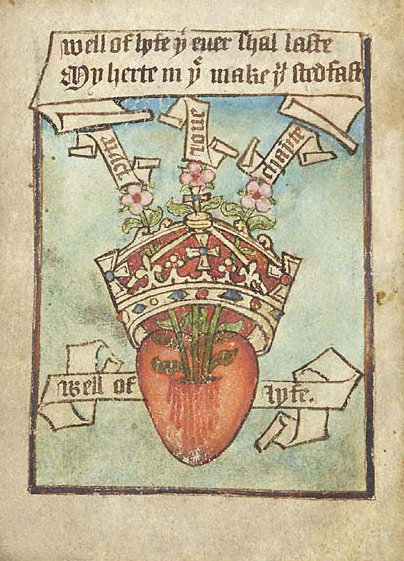
Wounded Heart of Christ as the Well of Lyfe, England, ca. 1500. Princeton University Library, MS Taylor 17, fol. 10v.
Dr. Grace Hamman writes about MS Taylor 17’s extraordinary “well of lyfe” page in Jesus through Medieval Eyes (and for InterVarsity’s The Well), which is what brought me to this essay. The hand-colored image shows flowers—labeled “pyte” (pity), “loue” (love), and “charyte” (charity)—springing forth from the wounded heart of Jesus. The verse prayer at the top reads, “Well of lyfe that ever shall laste / My herte in thee make it stedfast.”
The same theme shows up in another late fifteenth-century English lyric in MS Arundel 286 at the British Library, which appears in modern compilations under the title “The Wounds, as Wells of Life” or “The Wells of Jesus’ Wounds”:
Ihesus woundes so wide
Ben welles of lif to the goode,
Namely the stronde of his syde
That ran ful breme on the rode.
Yif thee list to drinke
To fle fro the fendes of helle,
Bowe thu doun to the brinke
And mekely taste of the welle.
Jesus’s wounds so wide
Are wells of life to the good,
Namely the stream from his side
That ran fiercely on the rood.
If thou list to drink,
To flee from the fiends of hell,
Bow thou down to the brink
And meekly taste of the well.

Trans. Victoria Emily Jones
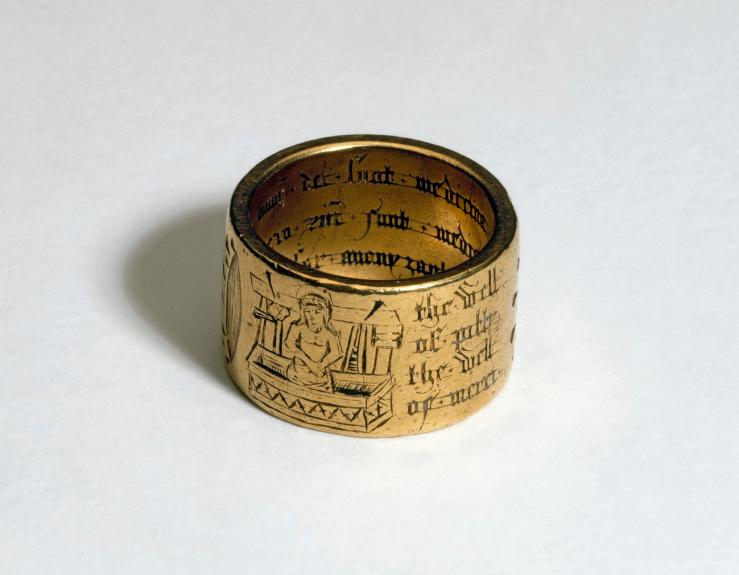
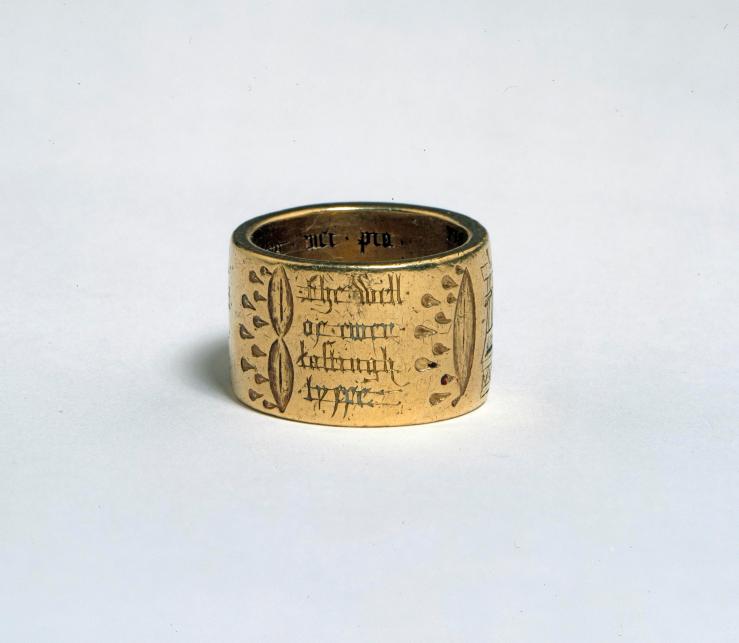
And in a late fifteenth-century gold ring, also from England, engraved with a Man of Sorrows image and hieroglyphs of Christ’s five wounds, labeled “The well of pitty, the well of merci, the well of confort, the well of gracy, the well of everlastingh lyffe”:
SONG: “Deep Were His Wounds” by William Johnson, 1953: This midcentury hymn is composed of three simple stanzas: The first half of each meditates on Jesus’s cruel death on the cross, whereas each second half (“But . . .”) celebrates the healing, freedom, and eternal life that death wrought.
>> Music by Leland B. Sateren, 1958: I like this tune, called MARLEE, but it’s difficult to sing congregationally. Here’s a soloist, Sarah Gulseth, singing it for her church’s 2011 Good Friday service, accompanied on organ by Luther Gulseth:
>> Music by Vito Aiuto, 2008: I was first introduced to “Deep Were His Wounds” through the Welcome Wagon’s debut album, Welcome to the Welcome Wagon, “a ramshackle singalong enterprise of a Presbyterian pastor (the Rev. Vito Aiuto) and his wife (Monique) wrestling out the influences of folk music, religion, popular culture, and church tradition.” Mood-wise, Aiuto’s tune wouldn’t work as well for Good Friday—even given the paradox of that day, it’s too bright, in my opinion, for that somber observance. But it’s great for throughout the year, especially for churches that favor a contemporary/folksy style of music.
+++
CANTATA CYCLE:“Membra Jesu Nostri” (The Limbs of Our Suffering Jesus) by Dieterich Buxtehude: Dieterich Buxtehude (ca. 1637–1707) was a Danish German organist and composer of the mid-Baroque period. For Good Friday 1680, he composed a cycle of seven concerto-aria cantatas. The texts of the aria sections are taken from the medieval Latin hymn “Salve mundi salutare” (Hail, the World’s Salvation) by the Cistercian abbot Arnulf of Leuven (ca. 1200–1250), whereas the concerto section texts are Old Testament quotations. The following video is a 2004 performance from Payerne, Switzerland; see the YouTube video description for further credits. The video includes English subtitles, but you can also read the lyrics (with translation) here.
The cycle begins by paying homage to Christ’s wounded feet (“Ad Pedes” = “To the Feet”), and then progresses upward to his knees, hands, side, breast, heart, and finally, face/head. Traditionally, Christ’s wounds are enumerated as five: a hole in each foot, a hole in each hand, and a hole through his side/heart (from the centurion’s spear). But Arnulf meditates on seven distinct body parts of Christ’s that were injured on Good Friday.
+++
ARTWORKS:
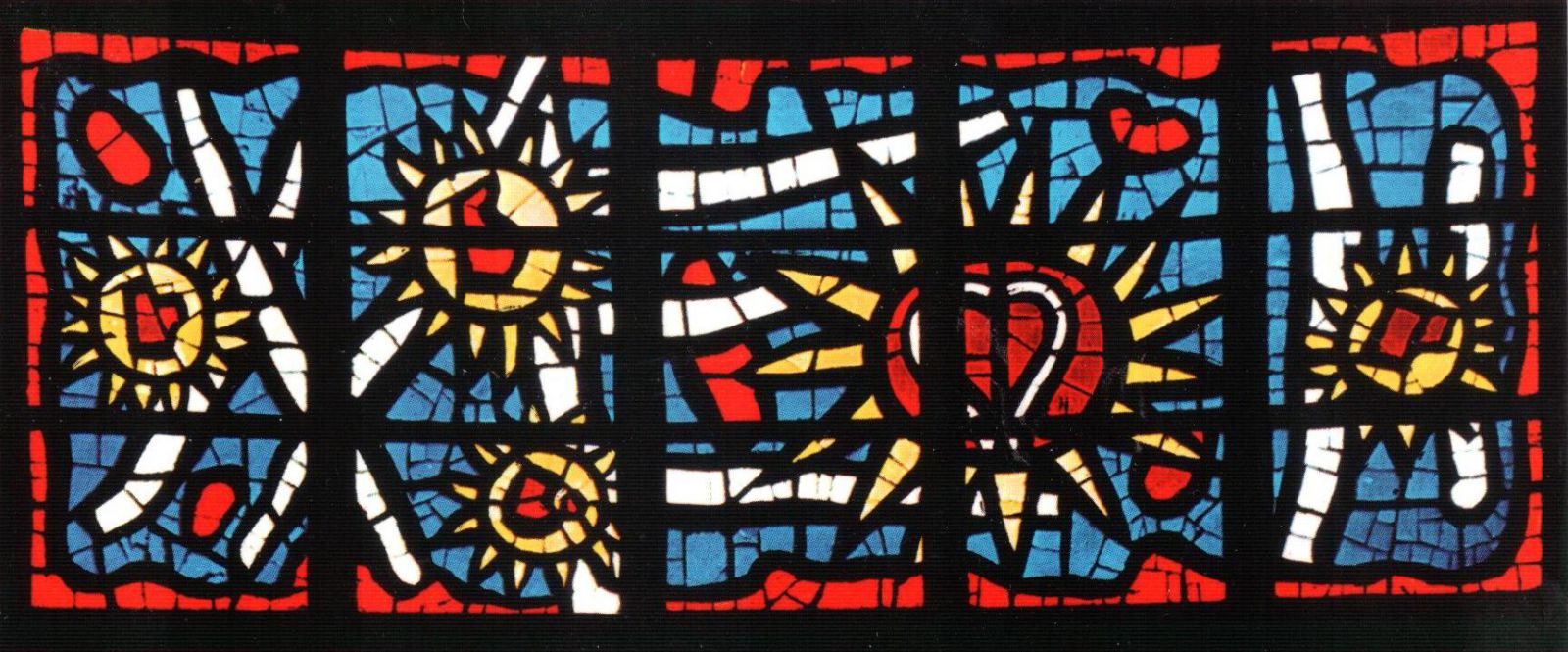
>> The Five Wounds of Christ by Fernand Léger | Commentary by Albert Hengelaar: This visual meditation is about the architecture and interior decoration of the Sacré-Coeur in Audincourt, France, a product of the Art Sacré movement, a Catholic art renaissance spearheaded by the French Dominican Order from 1919 to the 1950s. The centerpiece of the church, sited above the high altar, is a stained glass window depicting the five wounds of Christ shining like suns—one of seventeen windows the artist Fernand Léger designed to encircle the space in a strip.
Fernand Léger (French, 1881–1955), The Five Wounds of Christ, 1950–52. Stained glass window, Église du Sacré-Cœur (Church of the Sacred Heart), Audincourt, France.
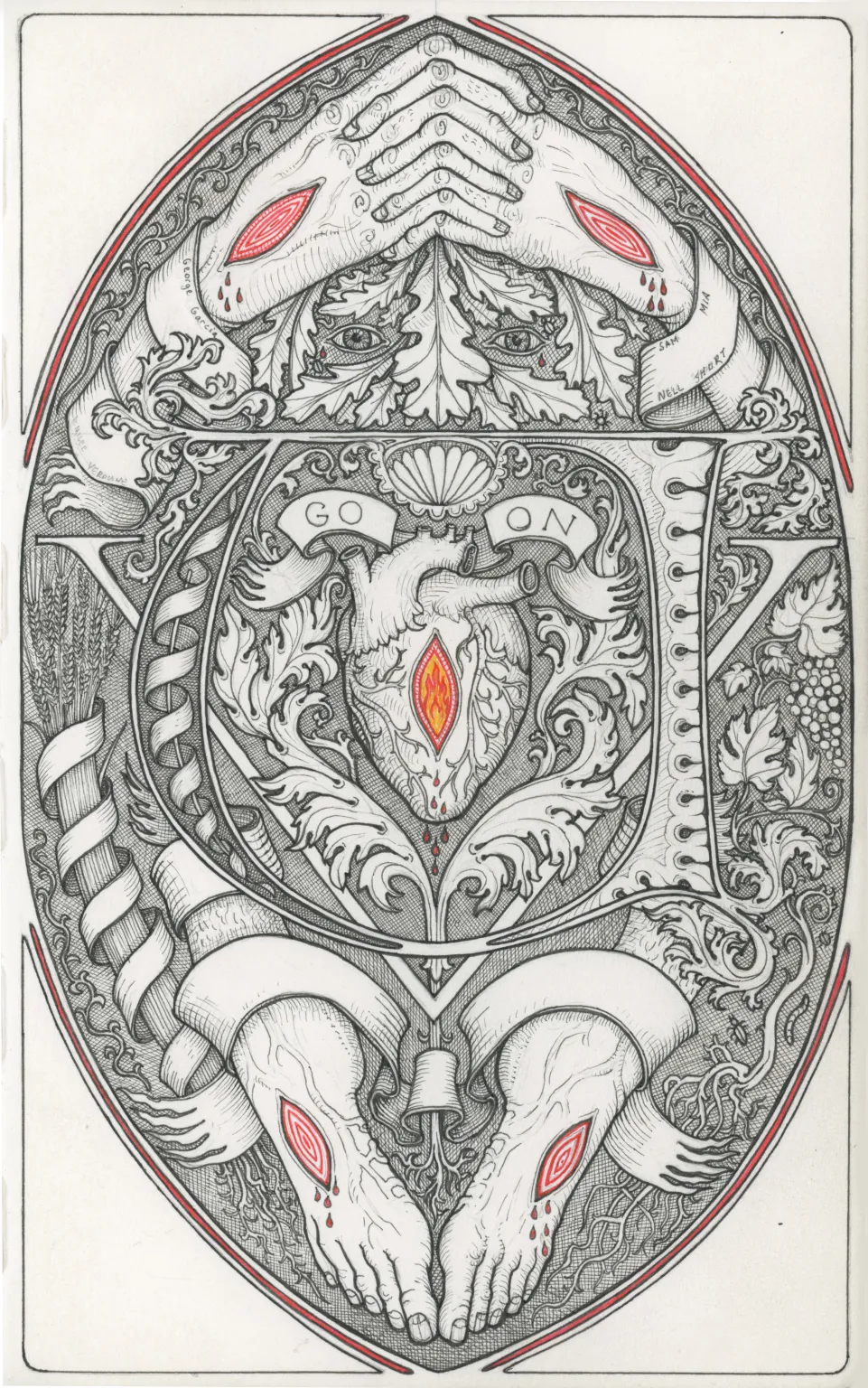
>> The Great Wound, aka Go On, Wounded Healer by Jack Baumgartner | Commentary by Sam Kee: In this Substack post, Sam Kee unpacks a drawing by his friend Jack Baumgartner [previously], which shows that “there is life in His [Christ’s] wounds, and He pours His life into our wounds.” The drawing started with the roman numeral V, which stands for the five wounds of Christ. The circumference is one large wound that encompasses five smaller wounds, eye-like, each one weeping blood. Other symbols that Kee analyzes in the drawing are wheat, grapes, fig leaves, seashell, fire, heart, and womb. “Go on” is a refrain that Baumgartner uses often in his work, a mantra for persevering in the faith, for continuing on the path.
Jack Baumgartner (American, 1976–), The Great Wound, 2024. Drawing from the series The Diary of a Tree Standing on Its Head.
Kee concludes with an original ekphrastic poem.
You can purchase an archival reproduction of The Great Wound from Baumgartner’s online shop. I encourage you to explore his website as well. I admire how his work is somehow both mystical and earthy, rooted.
In honor of Women’s History Month, here are a few creative works by and/or (in the case of Kinloch’s “Some Women” poems) about women.
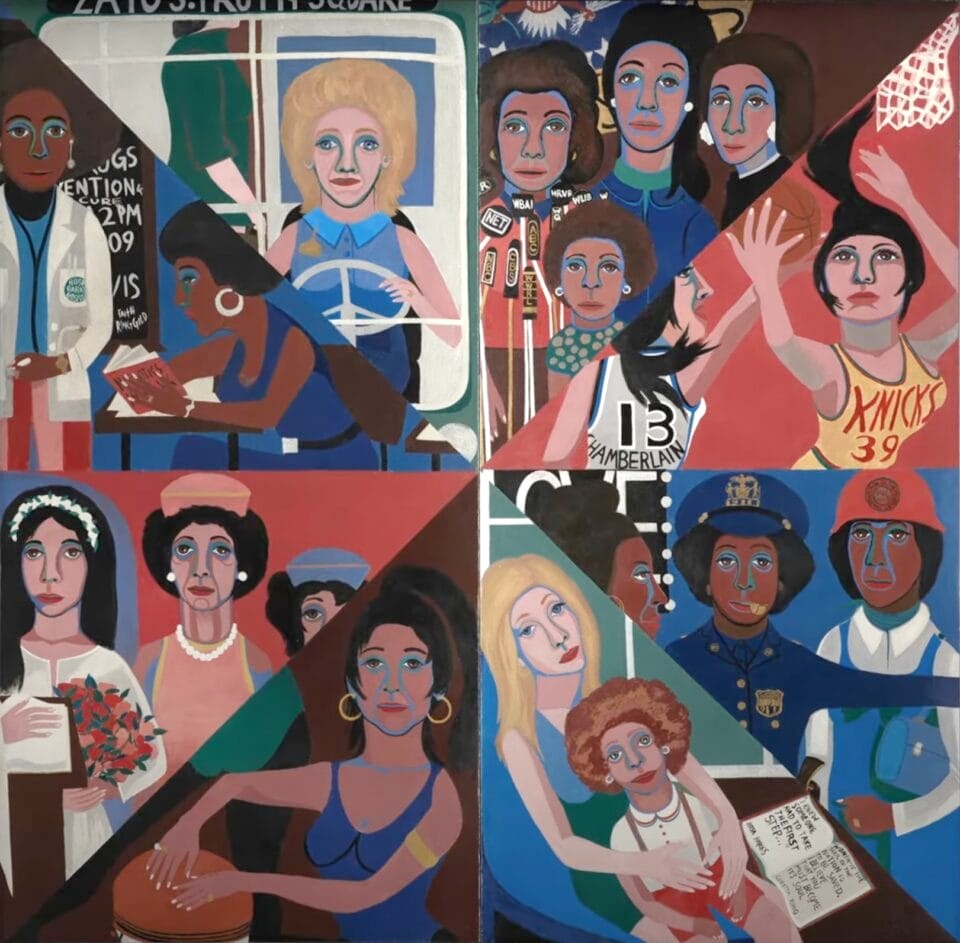
ARTICLE: “A New Documentary Traces How a Faith Ringgold Mural at Rikers Island Helped Women Break Free,”Colossal: Directed by Catherine Gund, the documentary Paint Me a Road Out of Here (2025) tells the story of Faith Ringgold’s For the Women’s House (1971), a mural commissioned by the New York State Council on the Arts for the Correctional Institution for Women on Rikers Island. When Ringgold asked the incarcerated women what they wanted her to paint, they said, “I want to see a road leading out of here.”
Faith Ringgold (American, 1930–2024), For the Women’s House, 1971. Oil on canvas, 96 × 96 in. Commissioned by the New York State Council on the Arts for the Correctional Institution for Women on Rikers Island; on loan to Brooklyn Museum.
Organized into eight triangular sections, the painting portrays women of various races (Black, white, Latina, Asian) in professional roles “that have not traditionally been theirs,” Ringgold says: doctor, bus driver, US president, basketball player, police officer, construction worker, drummer, priest. At the bottom, a white mother reads to her multiracial daughter words by Rosa Parks and Coretta Scott King, and in another scene, a bride is given away by her mother.
When Rikers Island transitioned to housing men in 1988, the women were moved to the Rose M. Singer Center, and the prison staff painted over Ringgold’s mural. Gund’s documentary chronicles the fight—by Ringgold and other artists, activists, politicians, and correctional officers—to have the mural restored, relocated, and preserved, but more deeply, the film is a “parable for a world without mass incarceration.”
Paint Me a Road Out of Here is not currently available on VOD, but here’s a list of public screenings: https://paintmearoadfilm.com/watch.
+++
LECTURE: “Re-Valuing Women Hymn Writers” by Dr. Lyn Loewi, St. John’s Church, Lafayette Square, Washington, DC, June 11, 2023: “Women have always been making sacred music, but they are underrepresented in our hymnals. Their contribution lies in the stories they tell from the margins, away from the narratives of dominant power. In this talk, Lyn Loewi will look at the poetry women have brought to our understanding of the Sacred. From the 9th-century Greek Orthodox nun Kassia to newly written hymns, women have expanded our language for God, remembered the stories of biblical women, and spoken for other discounted voices in society.”
Loewi, who has a doctorate in musical arts, has been an organist and church choir director for over forty years. She is currently the director of music ministries at Christ Church Capitol Hill, as well as the president of the Women’s Sacred Music Project. In this talk she discusses:
The Hymn of Kassiani
“The first one ever, oh, ever to know” by Linda Wilberger Egan
“Healing River of the Spirit” by Ruth Duck (text)
“Down by the Riverside” by Sister Rosetta Tharpe (arrangement)
“Balulalow” by Elizabeth Poston (music)
“Beyond the hopes and dreams of all creation” by Fr. Robert Easton (text) and Ghislaine Reece-Trapp (music)
The last few minutes of the recording, starting at 38:33, comprise audience Q&A; don’t miss the last question (41:29), where a woman expresses exasperation with all the “he/him” pronouns used for God in hymns—Loewi’s response is helpful.
+++
HYMNS:
When I was responsible for choosing songs for my church’s worship services, I made sure that every week I was on, at least one of the five songs we sang was written by a woman. Here are just three female-authored hymns that were part of my rotation—one (likely) from the tenth century, one from the eighteenth century, and one from the twenty-first century.
>> “Bí Thusa Mo Shúile” (Be Thou My Vision), Anon., trans. Mary Elizabeth Byrne, vers. Eleanor Hull: I can’t believe I’ve never featured this hymn on the blog before; it’s one of my all-time favorites. Its precise origins are not known. Most scholars date the original Early Middle Irish text, a lorica (prayer recited for protection), to the late tenth or eleventh century. It was translated into English in 1905 by Mary Elizabeth Byrne and then versified in 1912 by Eleanor Hull—meaning she adapted Byrne’s translation to fit a meter so that the words could be more easily sung. The music is a traditional Irish folk tune.
In this video, the hymn is sung in modern Irish by Madelyn Monaghan, a New York City–based soprano specializing in Irish traditional (Sean-nós) singing. It was for her friend’s wedding Mass. And wow, is her voice gorgeous!
>> “Dear Refuge of My Weary Soul” by Anne Steele (text) and Kevin Twit (music): Anne Steele was a Baptist hymn writer, poet, and essayist from Georgian England who published under the pen name Theodosia. Coming from a well-off family, she was educated and chose to remain single (she rejected several marriage proposals) so that she could focus on her writing, which she considered a calling. Rev. Kevin Twit, a Reformed University Fellowship pastor in Nashville and the founder of Indelible Grace, says Steele was the first significant female Christian hymn writer and the first, of either sex, to write lament hymns; over half her oeuvre, he says, deals with suffering and doubt.
Twit has set several of Steele’s hymns to music, most famously “Dear Refuge of My Weary Soul,” which Steele wrote in 1760. The solo performance above is from the January 24, 2021, worship service at Second Presbyterian Church in Memphis, Tennessee. The names of the singer and accompanist are not given. You can also listen to the song on Indelible Grace’s 2008 album.
>> “We Will Feast in the House of Zion” by Sandra McCracken and Joshua Moore:Sandra McCracken is one of today’s leading Christian singer-songwriters, and this hymn, which she wrote with Josh Moore, is the most popular of her congregational songs. From her 2015 album Psalms, it paints a vision of the eschaton, of the new heavens and the new earth, marked by restoration, shalom, and celebration. One thing I noticed as a church music leader is how many hymns and other worship songs use first-person singular pronouns (I/me/my) and emphasize one’s personal relationship with God; those are fine and even necessary, as the book of Psalms models, but I always made sure, when making a song list, to balance them with songs that use first-personal plural (us/we/our) and that convey a more communal picture of the Christian life and of the gospel, which is at least but also much more than what Jesus did for me. This is perhaps my favorite hymn about heaven, a place of safety and rest, yes, but also where all of creation is redeemed, made new; where everyone and everything flourishes in harmony under the benevolent reign of Christ.
“We Will Feast” works well during Communion (a ritual that anticipates the marriage supper of the Lamb) or as a closer, as it sends worshippers out with a benediction, a good word—a promise of the restorative beauty to come.
+++
VIDEO: “Poetry Unbound: A Conversation with David Kinloch and Pádraig Ó Tuama,” Washington National Cathedral, April 26, 2021: The On Being Project in partnership with Washington National Cathedral presents Pádraig Ó Tuama in conversation with the Scottish poet David Kinloch, part of a series of interviews with contemporary poets whose work demonstrates an artistic and literary engagement with biblical narratives and characters. They primarily discuss Kinloch’s extensive “Some Women” sequence of poems from his collection In Search of Dustie-Fute (Carcanet, 2017), voiced by women of the Bible (or, in the case of the first, Jewish folklore): Lilith, Cain’s wife, Adah and Zillah, Sarah, Lot’s wife, Rebekah, Zipporah, Deborah, Rahab, the Levite’s concubine, Ruth, Bathsheba, the daughters of Job, King David’s concubines, Hannah, Martha, the Virgin Mary, Mary Magdalene, and the Jewish women followers of Jesus responding to the apostle Paul’s teachings.
(The conversation starts at 7:55.)
Kinloch reads three poems from “Some Women”: “First Letter of the Hebrew Women to St Paul” (15:36), “Ruth” (23:49), and “Cain’s Wife” (29:58). He also reads two additional poems from the same volume, from the sequence “Joseph’s Dreams”: “St Joseph’s Dream” (40:44) and “Another Dream” (1:08:53).
This conversation impelled to check out In Search of Dustie-Fute from the library. I like the “Some Women” sequence overall—Kinloch’s creative engagement with the stories of these women, some very little known (e.g., I had to look up “Adah” and “Zillah”!) or little thought about (like the unnamed victims of sexual abuse)—though I will warn you that it contains some profanity and crude sexual language. In the Q&A that starts at 49:09, one of the questions is about the role of shock and humor in his poetry. (Kinloch says if his poems offend, they fail.) Other questions are about the biblical literacy that he does or does not presuppose, his editing process, a character from the Bible that he wants to write about but hasn’t yet, and why he, a man, feels justified in writing from the perspective of women.
Kinloch is an agnostic, so his relationship with biblical texts is different from that of one who is devout. But the Bible is not the exclusive domain of believers; Kinloch can just as well help us inhabit these stories and can derive questions or insights from them. I really appreciated hearing from him. Here’s what he had to say on the vernacular of everyday human experience:
It seems to me that there’s such distance—in terms of time, in terms of culture—between us in the twenty-first century and the people of those [ancient Near Eastern] communities. You need to find common ground so that some kind of dialogue can open up, so that you can shrink that distance. And therefore, the emphasis in all of these poems, really, is on the humanity of the people. I’m not writing sermons, I’m not writing homilies; I’m writing little dramatic monologues, mostly, and trying to make these people as believable, as real, as possible in the present moment of reading about them. My hope, I suppose, is that if people have enjoyed the poems, then maybe they might go back to those stories in the Bible. And it’s at that point that there will be an encounter with the divine, with the extraordinary. I don’t really feel that I have access to those moments of extraordinariness. All the extraordinariness is in the Bible, and I can only offer an avenue of approach to that.
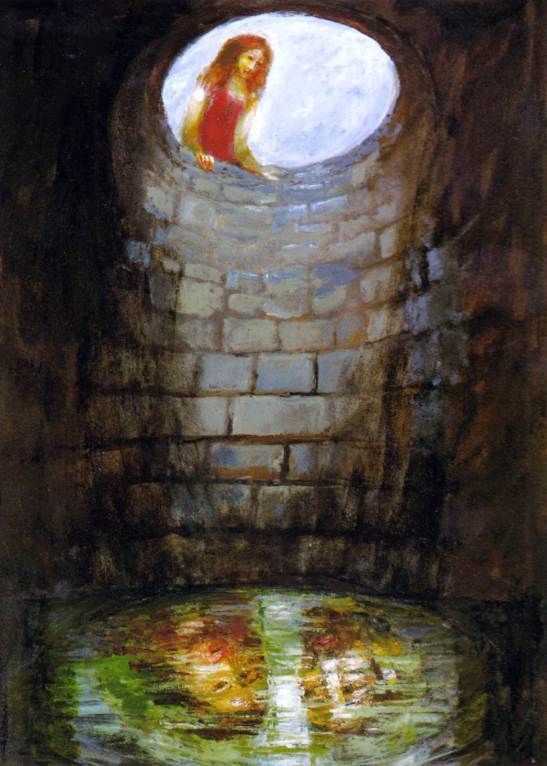
It joined us together, the well;
the well led me into you.
No one between us but light
deep in the well, the pupil of the eye
set in an orbit of stones.

Within your eyes, I,
drawn by the well,
am enclosed.
Translated by Jerzy Peterkiewicz, fromCollected Poemsby Karol Wojtyla (Random House, 1982)
This contemplative poem was originally published in Polish in Kraków’s leading Catholic periodical, Tygodnik Powszechny (Universal Weekly), on May 7, 1950, when Karol Wojtyla was a twenty-nine-year-old parish priest. It’s the sixth in a sequence of eight poems collectively titled “Song of the Brightness of Water” (Pieśń o blasku wody), all reflecting on Jesus’s encounter with the Samaritan woman in John 4.
Karol Wojtyla (1920–2005) was a theologian, philosopher, poet, and priest best known for serving as head of the Catholic Church as Pope John Paul II from 1978 until his death. He traveled more than any other pope (visiting 129 countries), helped end Communism in Eastern Europe, fostered interfaith dialogue, and promoted human rights. He was canonized on April 27, 2014. Born, raised, and educated in Poland, in 1938–39 Karol studied Polish philology (literature and language) at Jagiellonian University, but his academic pursuits were interrupted by the Nazi occupation. He avoided conscription in the German military by working as a manual laborer in a quarry—which he did while secretly taking seminary courses in Kraków from 1942 to 1946 (Catholicism was suppressed at the time) and participating in the underground theater scene as both an actor and a playwright. After graduating, he was ordained to the priesthood. Throughout the first half of his adult life—as a student, young parish priest, bishop, archbishop, and cardinal—Karol wrote and published poetry anonymously and then pseudonymously under the names Andrzej Jawień and Stanisław Andrzej Gruda. After he became pope, many of these poems were compiled into a collection, translated into English with Vatican approval, and released in book form under his given name. Karol continued writing poetry during his pontificate, but at a much slower pace. His most famous writings are in prose and include the landmark encyclical Evangelium Vitae (The Gospel of Life) on human dignity, the international bestseller Crossing the Threshold of Hope, and a series of 129 addresses titled The Theology of the Body.
Jerzy Peterkiewicz (1916–2007) was a Polish poet, novelist, and translator. In 1940 he fled his home country, arriving in England as a war refugee with no knowledge of the language. He went on to become a literature professor at London University, and in 1960, with coeditor and cotranslator Burns Singer, he published the influential anthology Five Centuries of Polish Poetry, 1450–1950. He was later chosen by a papal commission to translate the poetry of Pope John Paul II (Karol Wojtyla).
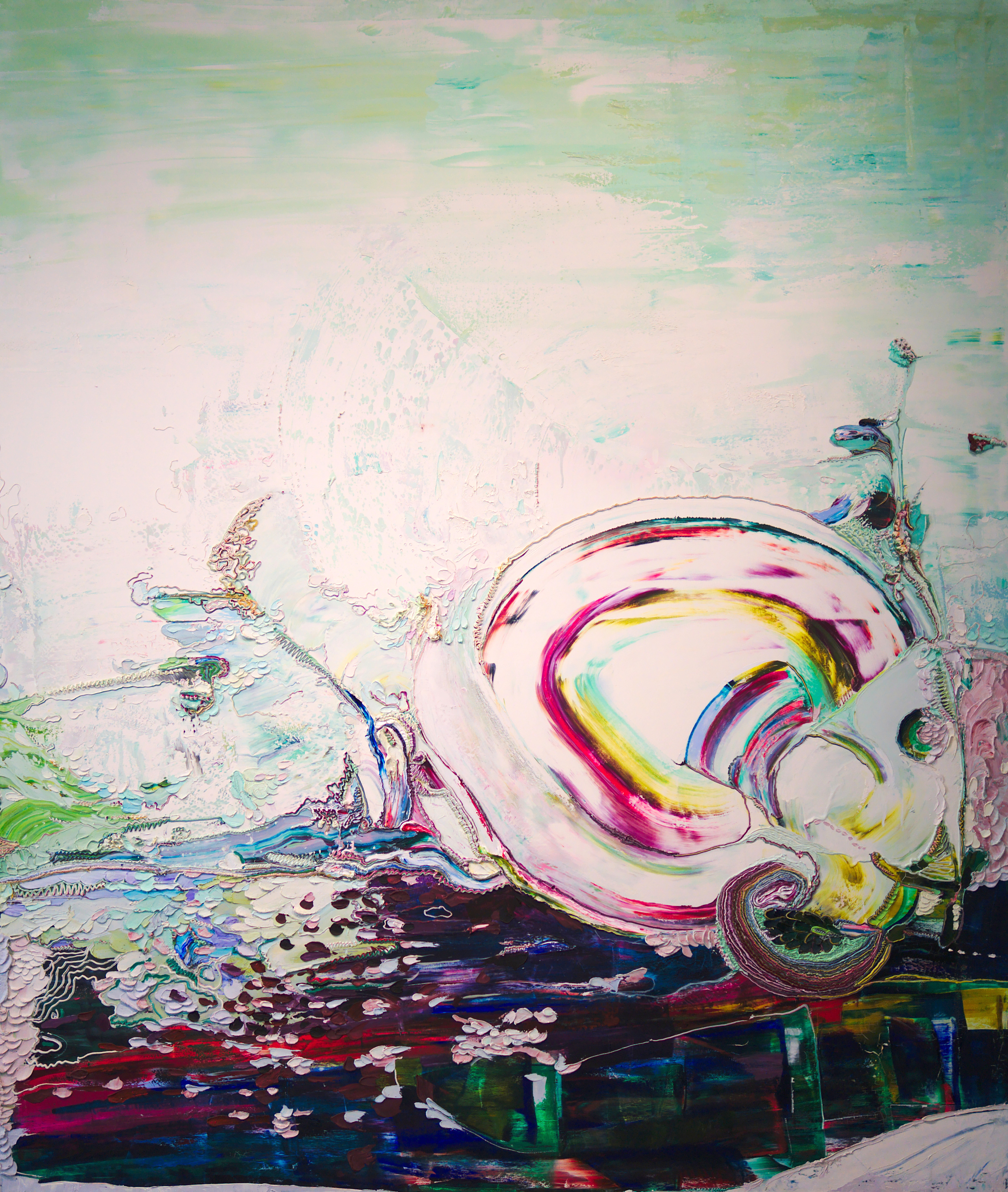
Julia Fernandez-Pol (Argentine, 1984–), Glacial Rain, 2008. Oil on canvas. Colorado Springs Fine Arts Center at Colorado College, Colorado Springs. Photo: Victoria Emily Jones.
Make me river, cold
with mountain, green
with quiver, silver in

the run and churn of
winter leaving, valley
waking, sheet moss

breathing. Make me
flash of mica, drift of
foam. O Lord of flux,

make these dry bones
flow, teach me to spill,
pool, glide, fall, tutor me

to long for depth, seek
downward paths, indwell
the low. Oh teach me

liturgy of keel, swirl,
flume, the breaking into
mist, the pull, the press,

the song. Oh form me
into blood of bedrock,
quest of glacier, dream

of sea, release me, set
me free to course, surge,
pour, sweep, issue, eddy,

shower, plummet, roll.
O Lord of flood, O Lord
of spray, unstill my soul.
Abigail Carroll is a poet whose work, as Walter Brueggemann described it, is “an unflinching witness to the reality and goodness of God.” She has authored the collections Cup My Days Like Water (Cascade, 2023), Habitation of Wonder (Cascade, 2018), and A Gathering of Larks: Letters to Saint Francis from a Modern-Day Pilgrim (Eerdmans, 2017), and her poems have also been published in anthologies and periodicals. She makes her home in Vermont, where she serves as associate pastor at Church at the Well. In addition to writing, she enjoys walking, photographing nature, and playing piano.
February is Black History Month, and while I endeavor to showcase Black art year-round, today’s post gives it dedicated attention.
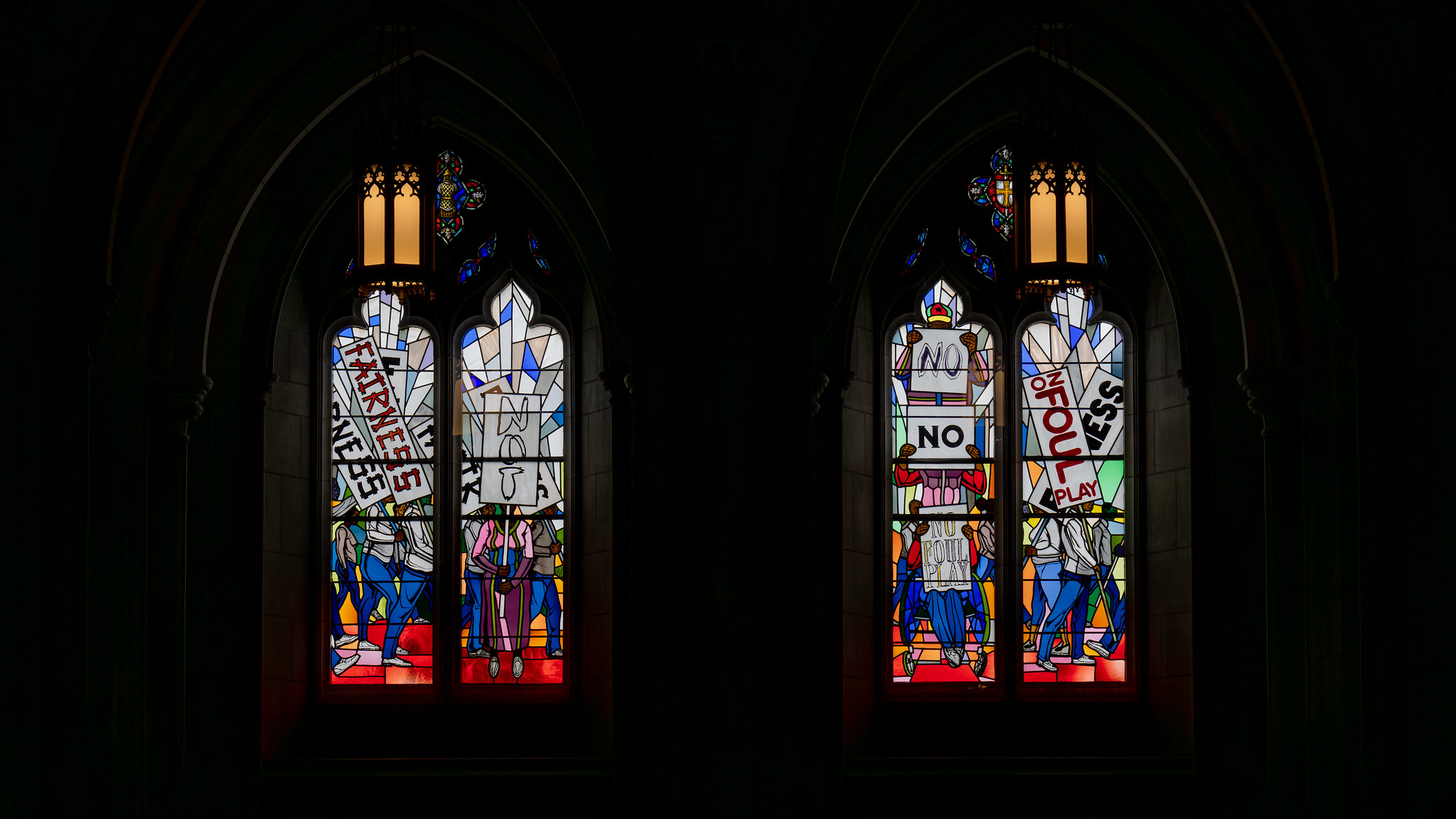
VIDEO: “Kerry James Marshall, Now and Forever; Elizabeth Alexander, ‘American Song,’ Washington National Cathedral,” Smarthistory, January 22, 2024: Art historian Beth Harris and Kevin Eckstrom, former chief public affairs officer of Washington National Cathedral, explore the latest artwork to be permanently installed in the US capital’s “house of prayer for all people”: two Now and Forever stained glass windows by Kerry James Marshall, depicting a march for racial justice. Unveiled on September 23, 2023, these replace windows that memorialized Confederate generals Robert E. Lee and Stonewall Jackson, which had been donated by the United Daughters of the Confederacy and installed in 1953. (For my international readers: The Confederacy was a group of eleven Southern US states that seceded from the Union in 1860 and 1861 to preserve the institution of race-based chattel slavery on which their plantation economies relied; its government was dissolved in 1865 following the end of the Civil War, but its legacy continued.)
In 2015, when a white supremacist, who touted the Confederate flag as symbolic of his ideology, murdered nine Black churchgoers in Charleston, South Carolina, Washington National Cathedral’s dean at the time, the Very Rev. Gary Hall, called for the removal of the Lee-Jackson windows, which initiated a two-year discernment process involving ample community discussions. The cathedral finally took down the windows in 2017 following a white nationalist rally in Charlottesville, Virginia, that claimed yet another life. The Very Rev. Randolph Hollerith, then the dean, said the windows “were a barrier to our mission, and an impediment to worship in this place.” Their removal and the installation of the Now and Forever windows in their place were funded by private foundations.
Kerry James Marshall (American, 1955–), Now and Forever, 2023. Fabricated by Andrew Goldkuhle. Stained glass windows, south outer aisle, bay 7, Washington National Cathedral, Washington, DC. Photo: Steven Zucker.
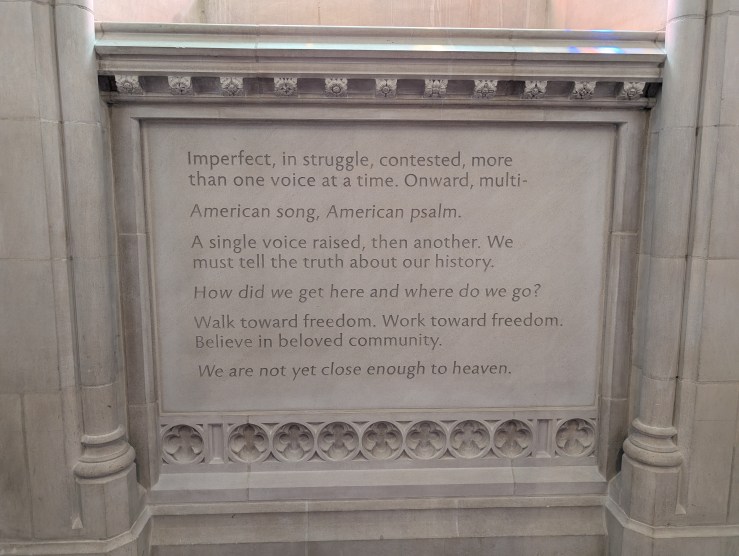
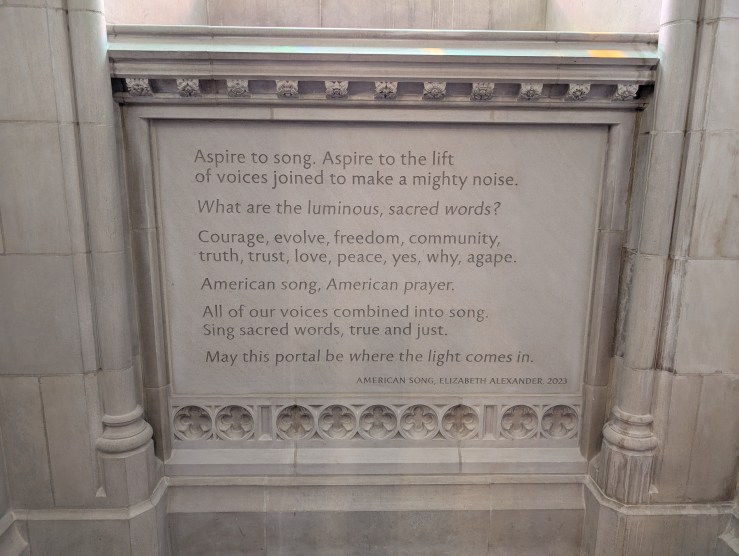
“American Song” by Elizabeth Alexander, commissioned by Washington National Cathedral and inscribed below Kerry James Marshall’s Now and Forever windows in bay 7. Photo: Victoria Emily Jones.
In addition to commissioning Marshall to design new windows, the cathedral commissioned the Pulitzer-nominated poet Elizabeth Alexander, who wrote and read “Praise Song for the Day” for President Barack Obama’s 2009 inauguration, to write a poem for this occasion. Titled “American Song,” it is inscribed on two limestone tablets beneath Marshall’s windows. The Windows Replacement Committee gave both artists this assignment:
We seek to tell a story of resilience, endurance, and courage that gives meaning and expression to the long and arduous plight of the African American, from slavery to freedom, from alienation to the hope of reconciliation, through physical and spiritual regeneration, as we move from the past to present day. The artist will capture both darkness and light, both the pain of yesterday and the promise of tomorrow, as well as the quiet and exemplary dignity of the African American struggle for justice and equality and the indelible and progressive impact it has had on American society. Each artist should respond in his or her own creative way to these ideals and aspirations, framing both the earthly and the divine, within the sacred space of the Washington National Cathedral.
When I was there last year, I asked the guide why the signs the figures hold don’t bear any of the more familiar slogans of our historical moment, such as “Black Lives Matter.” She said the artist deliberately did not want to tether the protest to a particular time period, in order to emphasize that the struggle for racial equality is ongoing. “Fairness,” “No Foul Play,” “No,” “Not”—these are expressions of demand and defiance that could apply to a number of justice-related issues and that encompass people of all races.
DANCE: “Still I Rise,” choreographed by Sean Cheesman: I really miss the TV show So You Think You Can Dance, which had aspiring dancers train across genres—contemporary, hip-hop, ballroom, jazz, etc.—with renowned choreographers, performing to compete for the title of “America’s favorite dancer.” It was entertaining, impressive (the athleticism!), and often moving. Here’s a contemporary routine choreographed by Sean Cheesman to spoken word artist Alexis Henry’s reading of a classic poem by Maya Angelou about Black strength and defiance. It’s danced by Koine “Koko” Iwasaki, Kiki Nyemchek, Taylor Sieve, and Mark Villaver. It’s from season 14, episode 12, which aired September 4, 2017.
(Another memorable Cheesman-choreographed dance from season 14 is an African jazz duet to Sheila Chandra’s “Speaking in Tongues II,” which unfortunately, I cannot find online.)
+++
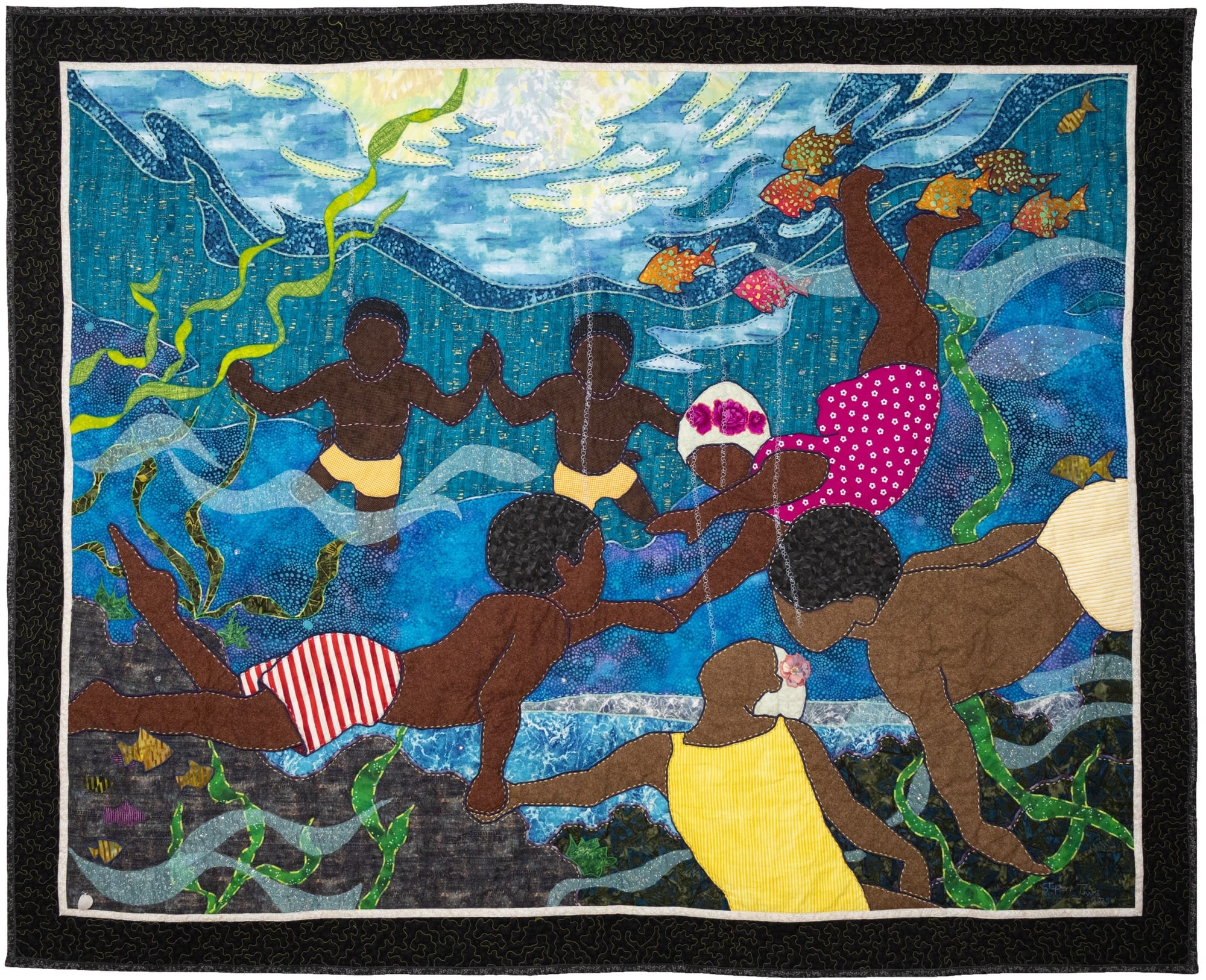
ARTICLE: “Stephen Towns’ Quilted Works Emphasize Black Joy as Resistance in ‘Safer Waters’” by Kate Mothes: Through June 14, the Wichita Art Museum in Kansas is hosting the exhibition Safer Waters: Picturing Black Recreation at Midcentury, featuring eleven quilts and six paintings by the Baltimore-based artist Stephen Towns [previously]. Black history has always been an important aspect of Towns’s work, and in this series he was inspired by historic photographs (by Bruce Mozert) of Paradise Park, a segregated attraction in Silver Springs, Florida, that operated from 1949 to 1969 and that was popular among Black vacationers, providing a space for leisure and togetherness away from Jim Crow.
Stephen Towns (American, 1980–), All We Knew Was Joy, 2025. Natural and synthetic fabric, polyester and cotton thread, cubic zirconia, glass beads, and shell, 55 × 65 1/2 in.
Towns began his Paradise Park series in 2022 after reading Remembering Paradise Park by Cynthia Wilson-Graham and Lu Vickers, and this show is a continuation of it, for which he made seven new quilts (pictured in Mothes’s article). His art is displayed alongside some of Mozert’s photographs and related objects from Florida archives and collectors. See an exhibition walk-through on the artist’s Instagram page; see also photos from the opening on January 16–17.
Gospel music is one of the many gifts the Black church has given the world. Here are two songs from that distinctive choral tradition.
>> “Perfect Praise (How Excellent)” by Brenda Joyce Moore, performed by the Sunday Service Choir: Written in 1989 based on Psalm 8, this song gained recognition through its performance on the 1990 album This Is the Day by Walt Whitman and the Soul Children of Chicago, featuring Lecresia Campbell. It has since become a gospel choir standard, though often with the lead vocals eliminated (and that part taken by the full choir). It’s performed in this video by Sunday Service at the Théâtre des Bouffes du Nord in Paris on March 1, 2020.
>> “He’s a Wonder” by Jamel Garner, performed by the Chicago Mass Choir, feat. Cornelius Owens: This song about Jesus’s miracles is from the Chicago Mass Choir’s 2024 album Greater Is Coming.
+++
PODCAST EPISODES:
>> “Artist Archetypes with Jakari Sherman,”Be. Make. Do., January 21, 2025: I really enjoyed this conversation with Jakari Sherman on the soul|makers podcast hosted by Rev. Lisa Cole Smith, where he describes his journey as an artist and a believer. Sherman is a choreographer within the tradition of stepping, a percussive dance practice in which dancers use primarily their hands and feet to create music. Stepping comes from the African American Greek letter organizations and has roots, Sherman explains, in the antebellum South, where enslaved people had their drums taken away and thus had to find ways to express the rhythms they felt using just the floor and their own bodies. (Tap evolved largely for the same reason.)
Sherman is the creative director of [Jk]creativ, a multidisciplinary company developing purpose-driven and truth-seeking cultural works. From 2007 to 2014 he served as the artistic director of Step Afrika! and has continued to develop and direct works for them, such as Drumfolk and The Migration (which I saw in 2024 and was excellent). To establish a foundation for his scholarly research on the history of stepping, he completed a master of arts program in ethnochoreology at the Irish World Academy of Music and Dance in 2015. Below is a trailer for one of Sherman’s latest works, Our Road Home, an interactive rhythmic production that meditates “on what is means to find freedom—and to live it fully in body, soul, and spirit”; it premiered last June as part of a year-long collaboration with the Houston Freedmen’s Town Conservancy.
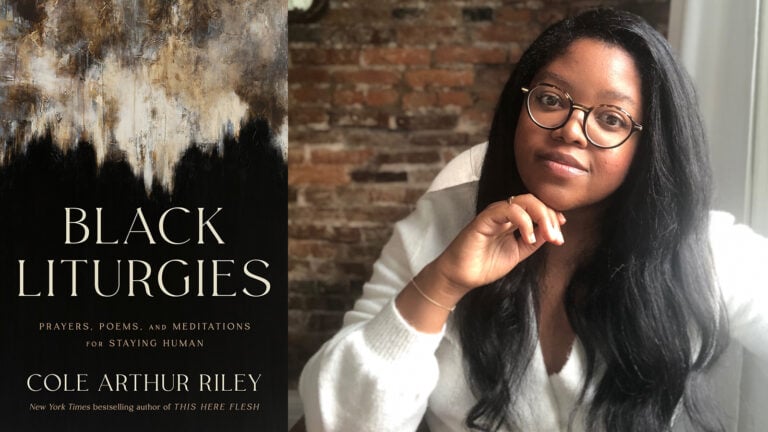
>> “Cole Arthur Riley – Black Liturgies,”Nomad, February 9, 2024: Tim Nash interviews Cole Arthur Riley, the best-selling author of Black Liturgies: Prayers, Poems, and Meditations for Staying Human(which grew out of her popular Instagram account @blackliturgies) and This Here Flesh: Spirituality, Liberation, and the Stories That Make Us. She is a wise, feeling, richly spiritual and embodied writer and speaker whose work I’ve appreciated. In this conversation she discusses her hang-ups with the Book of Common Prayer; battling chronic illness; balancing the active and contemplative lives; the revival of lament; self-sacrifice versus self-care; her experience of white people engaging with her work (“I like to think that there’s something mysterious that’s healed in us when we encounter each other’s interior worlds; when we hear words written by a Black woman toward God, that that could somehow move someone in some way, and move us closer to each other”); and what hope means to her and where she sees signs of it.
Even though I, as a white person, am not the intended audience for the book Black Liturgies, in reading it, I found it meaningful to listen to the cries of Riley’s heart. While many of the prayers are particular to the experience of being Black, still many others are general enough that they could be prayed by anyone. Part 1, organized thematically, consists of chapters such as “Dignity,” “Wonder,” “Doubt,” “Lament,” “Rage,” and “Rest,” whereas part 2 contains prayers for dawn, day, and dusk as well as for the liturgical year, secular holidays, and life occasions. I like the names for God with which she opens each prayer—e.g., “God of the shadows,” “God who expands,” “Divine Labyrinth,” “God aware,” “God of locked doors,” “God who reclaims,” “God our home,” “God of delight,” “God of the art that will never be seen,” “God who whispers”; it has prompted me to consider the names and descriptions I use for God and how they influence how I pray.
To give you a flavor of Black Liturgies, here are two prayers from the book (and note that prayers are only one component; also included are letters, quotes, questions for contemplation, confessions and assurances of pardon, and benedictions):
For Marveling at Your Own Face
God of the flesh, When we consider what is worthy of our wonder, it is easy to forget our own faces, our bodies. The world is relentless in indoctrinating us into self-hatred—into anti-Blackness, into transphobia, into misogyny in all forms. We are slowly and steadily brainwashed to despise our own faces from the time we’re tall enough to stare up at ourselves in the mirror. How can we resist this? Let the tyranny of the mirror be no more. May it instead become a portal—to delight, to pleasure, and to love. These noses, these hips, the way our hair rises and falls. The memories etched into our hands and faces. Remind us of the miracle of flesh that grows back, of blood that pulses warm beneath the skin that holds us. Of bodies, these holy beautiful bodies, that are working a thousand unseen miracles just so that we can read these lines, breathe this air, cry or not cry. As we peer into the face before us, remind us that we are something to behold. We believe; forgive our unbelief. Ase.
For Those Who Doomscroll
Still God, We confess that we are addicted to pessimism. Although we rarely name it as such, so much of our attention is devoted to negativity. Show us how we use technology to soothe and stir the aches in us. Keep us from turning control over to our anxiety, that it would no longer feed itself with news of tragedy and impending disaster. It is easy to become lost, buried in the quicksand of digital catastrophe. Draw our attention upward. Guide us to look away habitually; and not just away, but up at the sky, the grass, the table. Guide us inward as well. Acquaint us with goodness again. In the world, and in ourselves. Let us follow the children, freed from the grip of seriousness. Renew our playfulness. Lead us into wise rhythms of engagement, retreating to rest and breathe. Remind us that there is much the world needs, including our attention to atrocity—but if we watch the world burn for long enough, the fire will become our only reality. Amen.
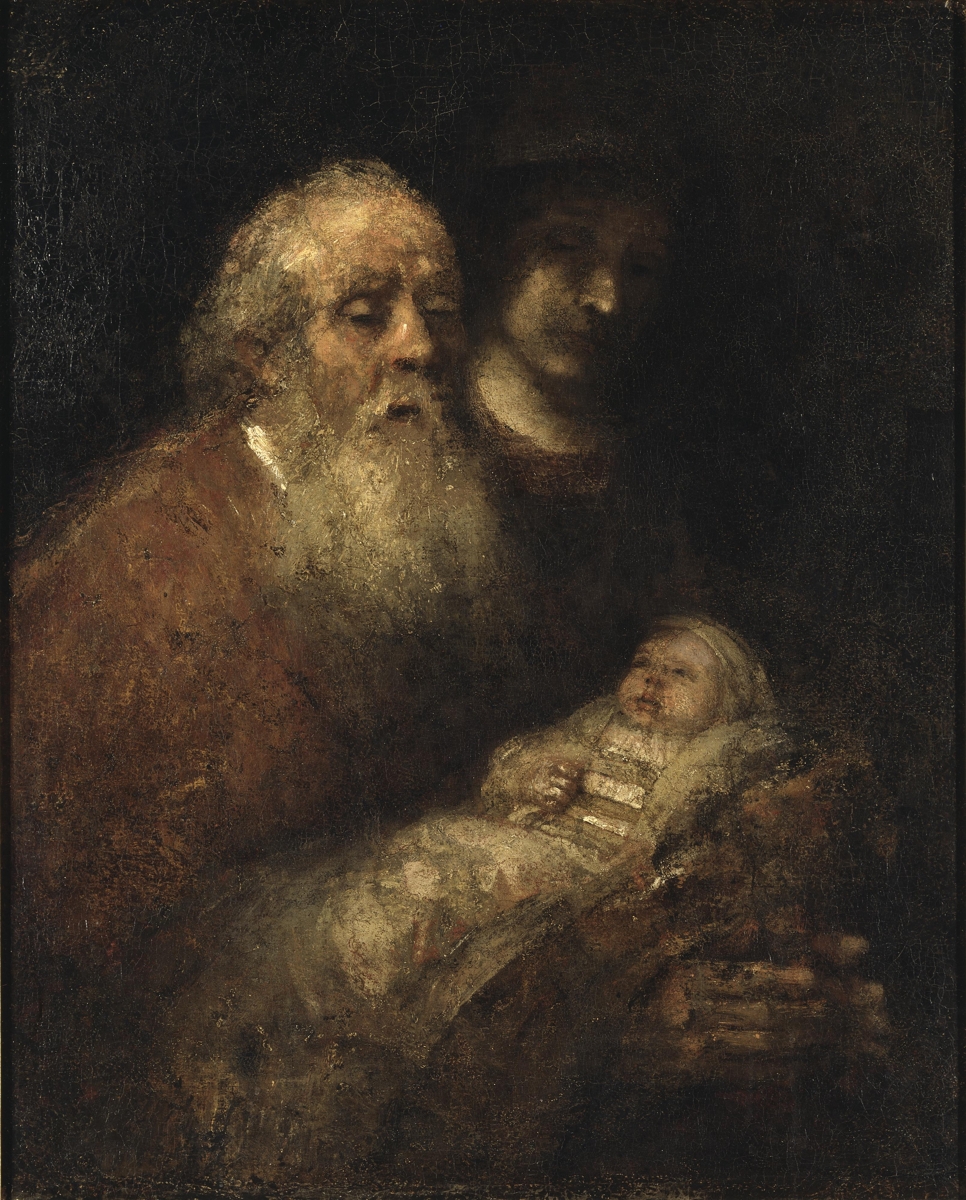
Rembrandt Harmensz. van Rijn (Dutch, 1606–1669), Simeon in the Temple, 1669. Oil on canvas, 98.5 × 79.5 cm. Nationalmuseum Stockholm, Sweden. Photo: Erik Cornelius.
after Simeon in the Temple, Rembrandt, 1669
Fingers stretch as if supplicating hands are interrupted— the answer placed in his waiting arms.
Light glistens on his temple— the mind consoled by consolation’s burden.
Death takes the prophet; takes the artist before his painting is complete; takes the one already bearing sin’s stripes.