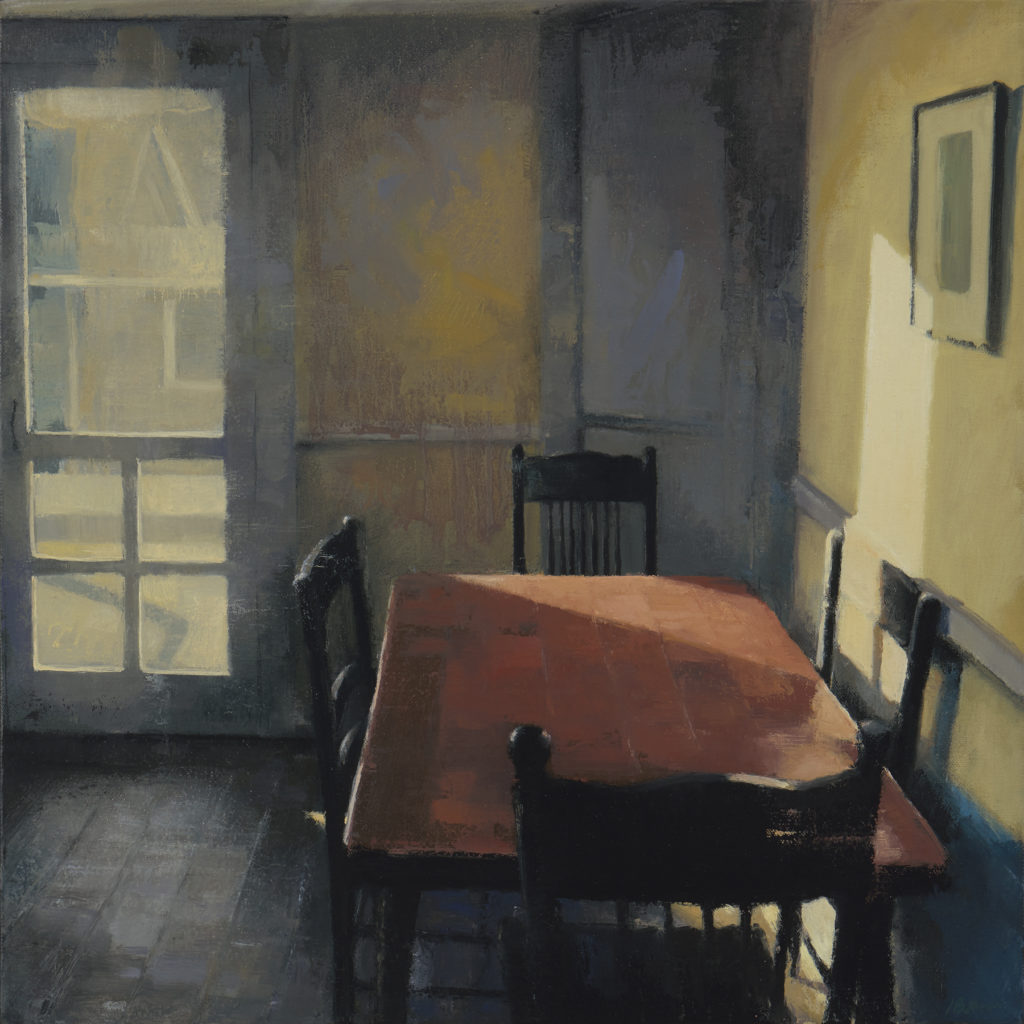
Jeff Bellerose (American, 1973–), Tranquil, 2018. Oil on canvas, 20 × 20 in. (50.8 × 50.8 cm).
1

Then shall all the trees of the wood sing for joy
      while each leaf thrusts into the universe of air
and the light green haze of April rises like smoke
      sweet in the nostril. Let the mind fill the hemisphere
of day while the sun beats a million white wings.
      Let each yellow and red bud in the dew
blaze forth with a hundred suns while night
      picks up her gauze and vanishes over the hills.
Let the rabbit’s eye shine while he drums the turf
      summoning his brethren;
the squirrels spiral down, their tails like clouds,
      to clatter among the woodsy rubble;
and the shrew shriek and hide herself under the root.

2

The cat stretches by the window and cries at the door;
      the dog yawns, then yelps at the rising sun
that will run all day till it drops in the west.
      The mattress creaks as the man rises to fix breakfast,
his back telling him he is—ah!—alive
      while the neighbor’s car snorts and gulps air
in an ascending whine.
      Children feel their way through cool porcelain bathrooms,
teenagers dream a world of shimmering electric presences
      and clothes rise from the dresser to glide across the skin,
the belt firmly encircles the waist
      and the tie mounts to prop the chin.

3

Yet, staring back from the bathroom mirror are
      the ghost of the office, the boss’s purposeful smile,
fog of the night’s dream, the nattering conscience,
      the gluttonous mortgage, the skin in love with gravity,
and the razor’s unkind cut—awareness of
      what is done and undone—the thousand engines of destruction
the cerebral cortex draws across its synapses
      toward the fragile sanctum of the present moment.
Let each ghost wither and vanish in sunlight,
      crisp to the nothing it is,
while a joyful procession dances along
      the myriad lightning pathways of the mind.

4

Tree and house are clear in this moment
      when light is given shape and each thing pauses,
itself—before the frame blurs, the attention fails
      and we fall into one or another distraction:
the horrors and banalities of the news, the half-typed letter,
      the mysteries of long division, the tumbled tower of blocks,
regret’s heavy shadow or the usual obsession.
      Lord, in the bright vehicle of this moment,
descend to us and spread your golden tent
      that we might keep sweet breakfast together, your beard dripping
honey as we ascend the dayspring of your eyes
      into an emptiness that is present, solid and real.
Now is the shining fabric of our day
Torn open, flung apart,
Rent wide by Love.
Never again
The tight, enclosing sky,
The blue bowl,
Or the star-illumined tent.
We are laid open to infinity,
For Easter Love
Has burst His tomb and ours.
Now nothing shelters us
From God’s desire—
Not flesh, not sky,
Not stars, not even sin.
Now Glory waits
So He can enter in.
Now does the dance begin.
This poem, written in 1981, is used by permission of the Elizabeth B. Rooney Family Trust, www.brighamfarm.com.
Felice Casorati (Italian, 1883–1963), Study for Portrait, 1919. Oil on cardboard. Museo del Novecento, Florence.
God whispered, and a silence fell; the world Poised one expectant moment, like a soul Who sees at heaven’s threshold the unfurled White wings of cherubim, the sea impearled, And pauses, dazed, to comprehend the whole; Only across all space God’s whisper came And burned about her heart like some white flame.
Then suddenly a bird’s note thrilled the peace, And earth again jarred noisily to life With a great murmur as of many seas. But Mary sat with hands clasped on her knees, And lifted eyes with all amazement rife, And in her heart the rapture of the spring Upon its first sweet day of blossoming.
This sonnet by Theodosia Garrison (1874–1944) originally appeared in The Earth Cry: And Other Poems (New York: Mitchell Kennerly, 1910) and is in the public domain.
O come away, Make no delay, Come while my heart is clean and steady! While faith and grace Adorn the place, Making dust and ashes ready!
No bliss here lent Is permanent, Such triumphs poor flesh cannot merit; Short sips and sights Endear delights: Who seeks for more, he would inherit.
Come then, True Bread, Quick’ning the dead, Whose eater shall not, cannot die! Come, antedate On me that state Which brings poor dust the victory.
Ay! victory, Which from Thine eye Breaks as the day doth from the East; When the spilt dew Like tears doth shew The sad world wept to be released.
Spring up, O wine, And springing shine With some glad message from His heart, Who did, when slain, These means ordain For me to have in Him a part.
Such a sure part In His blest heart, The Well where living waters spring, That with it fed, Poor dust, though dead, Shall rise again, and live, and sing.
O drink and bread, Which strikes Death dead, The food of man’s immortal being! Under veils here Thou art my cheer, Present and sure without my seeing.
How dost thou fly And search and pry Through all my parts, and, like a quick And knowing lamp, Hunt out each damp, Whose shadow makes me sad or sick!
O what high joys! The turtle’s voice And songs I hear! O quick’ning showers Of my Lord’s blood, You make rocks bud, And crown dry hills with wells and flowers!
For this true ease, This healing peace, For this taste of living glory, My soul and all Kneel down and fall, And sing His sad victorious story!
O thorny crown, More soft than down! O painful cross, my bed of rest! O spear, the key Opening the way! O Thy worst state, my only best!
Oh! all Thy griefs Are my reliefs, And all my sins Thy sorrows were! And what can I To this reply? What—O God!—but a silent tear?
Some toil and sow That wealth may flow, And dress this Earth for next year’s meat: But let me heed Why Thou didst bleed And what in the next world to eat.
Henry Vaughan (1621–1695) [previously] was a Welsh metaphysical poet, translator, and physician, known chiefly for his religious poetry in English. For info on his life and times, as well as his literary importance, see https://www.poetryfoundation.org/poets/henry-vaughan.
Vaughan’s “The Feast” was originally published in 1655 in the expanded edition of his celebrated collection Silex Scintillans (1650). (The book’s title is Latin for “The Fiery Flint,” referring to the stony hardness of man’s heart, from which divine steel strikes fire.) The poem consists of thirteen sestets (six-line stanzas), each following the syllable pattern 4-4-8-4-4-8, with a few cheats. More specifically: the first two lines of each stanza are in iambic dimeter, and the third is in iambic tetrameter, repeat. Which is simply the technical way of saying that the rhythm sounds like da-DUM, da-DUM—unstressed syllable, stressed syllable. The rhyme scheme is aabccb. I mention these details because it’s important to see the structure of a poem.
Now let’s walk through it piece by piece.
O come away, Make no delay, Come while my heart is clean and steady! While faith and grace Adorn the place, Making dust and ashes ready!
No bliss here lent Is permanent, Such triumphs poor flesh cannot merit; Short sips and sights Endear delights: Who seeks for more, he would inherit.
The speaker starts out by beseeching Christ’s return. He’s saying that he, who is mere dust, has put the affairs of his heart in order and is ready for the next life. He has come to realize that earthly pleasures are but “short sips,” quick delights, and he wants a long, slow drink, one that infinitely satisfies. Like the Samaritan woman at the well in John 4:13–14, to whom Jesus said, “Everyone who drinks of this [physical] water will be thirsty again, but whoever drinks of the water that I will give him will never be thirsty again. The water that I will give him will become in him a spring of water welling up to eternal life.”
Those who truly seek for more than what this world has to offer will find it.
Come then, True Bread, Quick’ning the dead, Whose eater shall not, cannot die! Come, antedate On me that state Which brings poor dust the victory.
“Come then, True Bread,” the speaker exclaims, addressing Christ in biblical metaphor. John 6 is a major reference point for Vaughan throughout this poem, which is where Jesus addresses the crowds whom he had just fed the day before with miraculously multiplied loaves and fishes:
“Do not work for the food that perishes, but for the food that endures to eternal life, which the Son of Man will give to you. For on him God the Father has set his seal.” Then they said to him, “What must we do, to be doing the works of God?” Jesus answered them, “This is the work of God, that you believe in him whom he has sent.” So they said to him, “Then what sign do you do, that we may see and believe you? What work do you perform? Our fathers ate the manna in the wilderness; as it is written, ‘He gave them bread from heaven to eat.’” Jesus then said to them, “Truly, truly, I say to you, it was not Moses who gave you the bread from heaven, but my Father gives you the true bread from heaven. For the bread of God is he who comes down from heaven and gives life to the world.” They said to him, “Sir, give us this bread always.”
Jesus said to them, “I am the bread of life; whoever comes to me shall not hunger, and whoever believes in me shall never thirst. . . .
“Your fathers ate the manna in the wilderness, and they died. This is the bread that comes down from heaven, so that one may eat of it and not die. I am the living bread that came down from heaven. If anyone eats of this bread, he will live forever. And the bread that I will give for the life of the world is my flesh.”
Jesus is the bread of life, whose flesh we eat at the Communion table, taking his self into our selves. Those who feed on Christ are strengthened in their union with him in both his crucifixion and resurrection. As the apostle Paul writes in 1 Corinthians 10:16, “The cup of blessing that we bless, is it not a participation in the blood of Christ? The bread that we break, is it not a participation in the body of Christ?”
“Come,” the poem’s speaker continues, “antedate / On me that state / Which brings poor dust the victory.” He, as one who has already lost battle after battle against sin, asks that Christ grant him the victory post-factum, rendering his past losses of no account. In other words: “Christ, have mercy.”
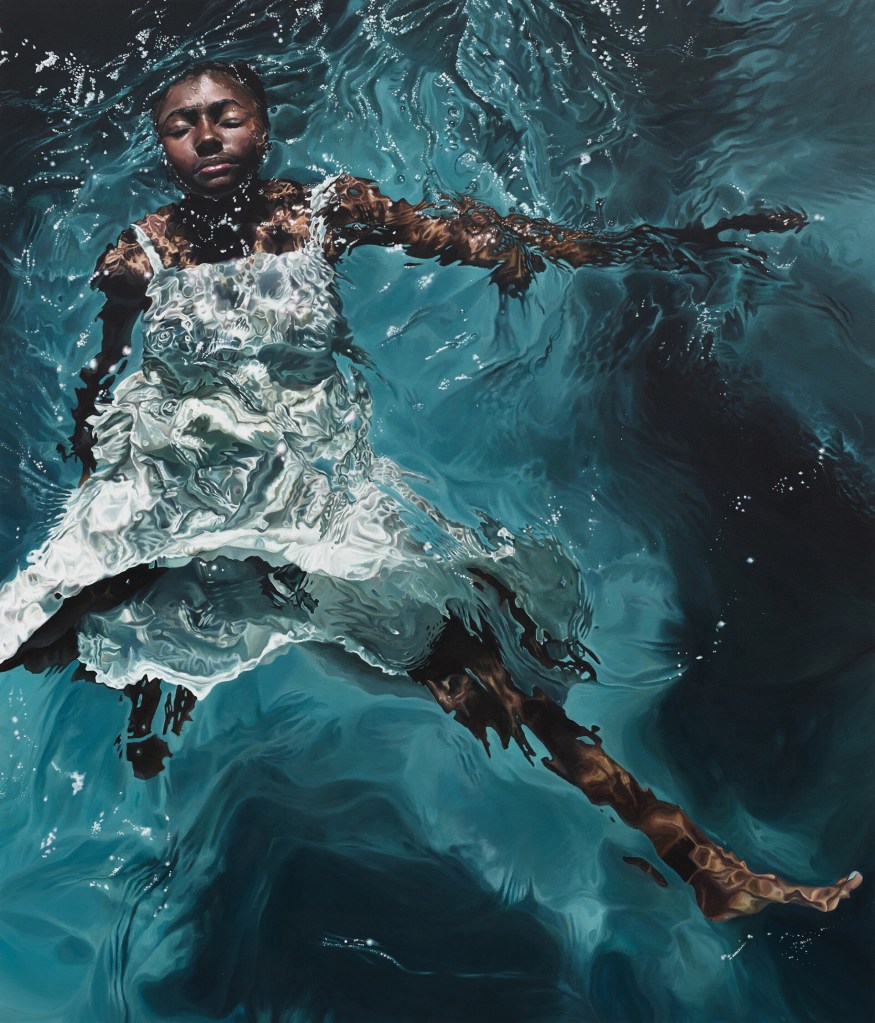
Calida Garcia Rawles (American, 1976–), Radiating My Sovereignty, 2019. Acrylic on canvas, 84 × 72 in.
For Carolyn Kizer and John Woodbridge, Recalling Our Celebration of George Herbert’s Birthday, 1983
As swimmers dare to lie face to the sky and water bears them, as hawks rest upon air and air sustains them, so would I learn to attain freefall, and float into Creator Spirit’s deep embrace, knowing no effort earns that all-surrounding grace.
This year’s The Breath and the Clay creative arts gathering, on the theme of “Reenchantment,” is taking place March 17–21, with both in-person (in Winston-Salem, North Carolina) and virtual options. Registration for virtual attendees is pay-what-you-wish. Presenters include theologian Jeremy Begbie, poet Pádraig Ó Tuama, singer-songwriter Joy Ike, contemplative author Christine Valters Paintner, dancer Camille D.C. Sutton, and many more . . . including me! On the evening of March 18 I’ll be giving a twenty-minute talk titled “Saying Yes: The Annunciation in Contemporary Art,” which will be archived online afterward. (The global church celebrates the feast of the Annunciation the following week, on March 25.) (Update: Watch here.) Here’s the description:
The story of Jesus’s miraculous conception in the womb of Mary, a first-century Galilean peasant girl, told in Luke 1 has activated the imaginations of artists since the early Christian era. When an angelic messenger came and told Mary she had been chosen to bear God’s Son, she cycled through a range of emotions before ultimately accepting the call, stepping onto a path that, though scary, would be life-giving not only for her but also for her religious and ethnic community and for the whole world.
God invites us to participate in his work in the world and gives us the grace to do it. When his voice breaks through our safe, predictable routines, calling us to something big, do we respond with brave obedience? In this talk Victoria Emily Jones will share a handful of contemporary artworks that visualize that pivotal moment in salvation history when Mary said yes and set in motion the incarnation. These works show us the wild beauty of God’s plans and can help us tune our ears to the annunciations in our own lives.
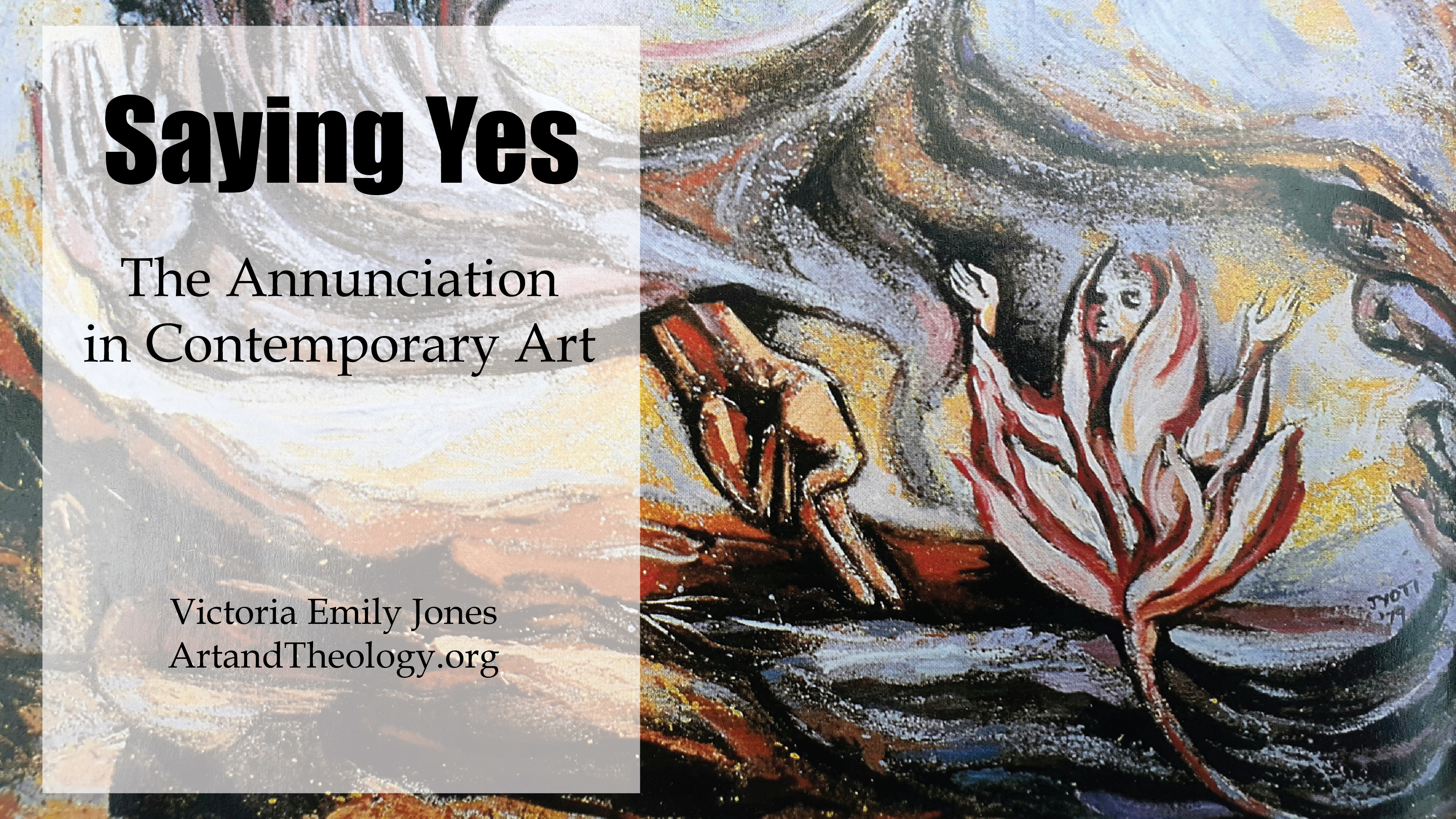
(The title slide image is a detail of an Annunciation painting by Jyoti Sahi.)
I’m always impressed by the variety of artists, arts professionals, and art lovers that director Stephen Roach manages to bring together for The Breath and the Clay. Click here to learn more and to register.
+++
ONLINE LENT SERIES:
>> VCS Lent 2021: The Visual Commentary on Scripture is highlighting a different exhibition from its archives for each week of Lent, with new content including a video introduction to the week by Ben Quash and an audio reading of each of the three constituent commentaries.
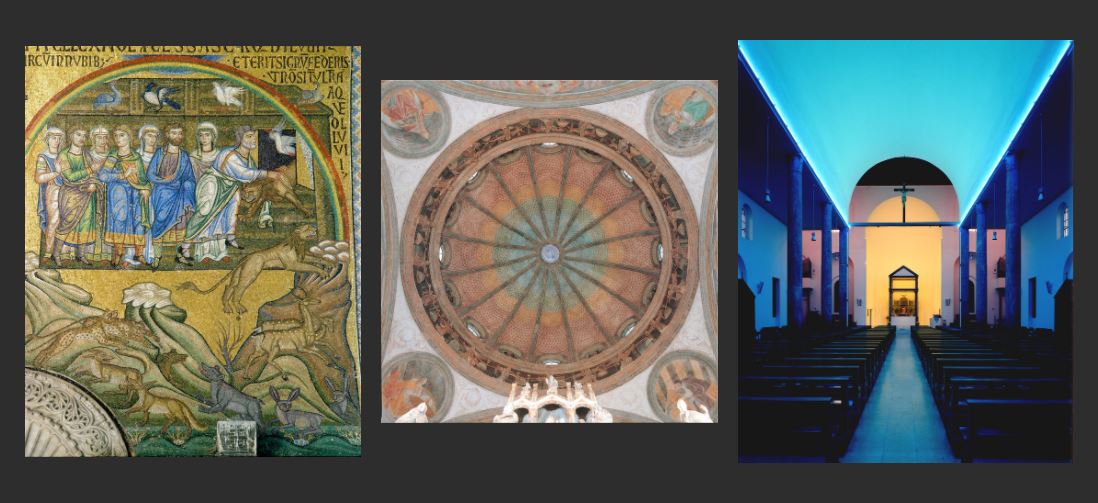
The first week was on the theme of Covenant and covers Genesis 8:20–9:17. Stefania Gerevini curated three artworks from Italy that convey some aspect of the rainbow as divine promise: a thirteenth-century mosaic from the Basilica di San Marco in Venice, a colorful dome fresco (fifteenth century) from the Cappella Portinari in Milan, and a contemporary light installation by Dan Flavin at Santa Maria Annunciata in Chiesa Rossa, also in Milan.
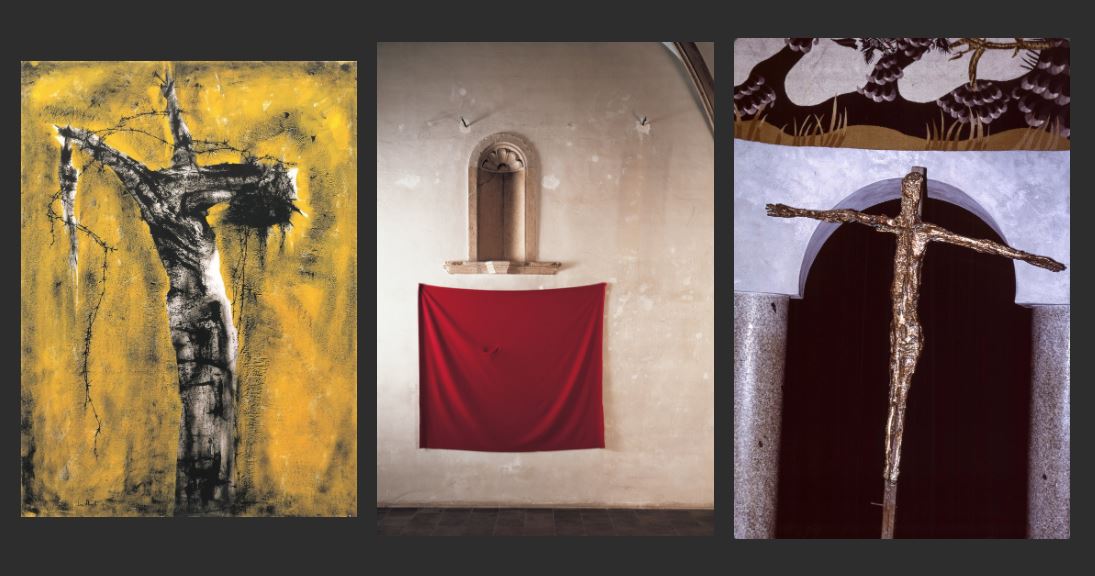
Week 2, on Prophecy, explores the Suffering Servant of Isaiah 53. Jonathan Koestlé-Cate comments on three modern artworks: Crucified Tree Form by Theyre Lee-Elliott, a crucifix by Germaine Richier (which sparked outrage when it was unveiled at Notre-Dame de Toute Grâce, Assy, in 1950), and an installation by postminimalist artist Anish Kapoor at the church of Saint Peter, Cologne.
>> “The Many Faces of Jesus”: I’ve been enjoying this Lenten series (on blog andpodcast) by medievalist Dr. Grace Hamman, who makes medieval lit super accessible.“For Lent, Old Books With Grace will share and explore some medieval representations of Jesus in art and literature—the versions of Jesus that dominate the medieval church’s imagination. These medieval portrayals of Jesus may strike us as odd, threatening, charming, creative, stupid, or inspiring. In attending to these versions of Jesus, I hope for a few end goals: the first is that we may expand our Christian imagination. Perhaps a side of Jesus that has never occurred to you, or been sideswept by our contemporary culture, will suddenly illuminate an aspect of the Jesus of scripture. The second is that we may better identify the ways that we ourselves have culturally contained and portrayed Jesus, in positive and negative ways. Often the strangeness of the past helps us recognize the weird or damaging things we believe in order to make Jesus more palatable, understandable, or like us.”
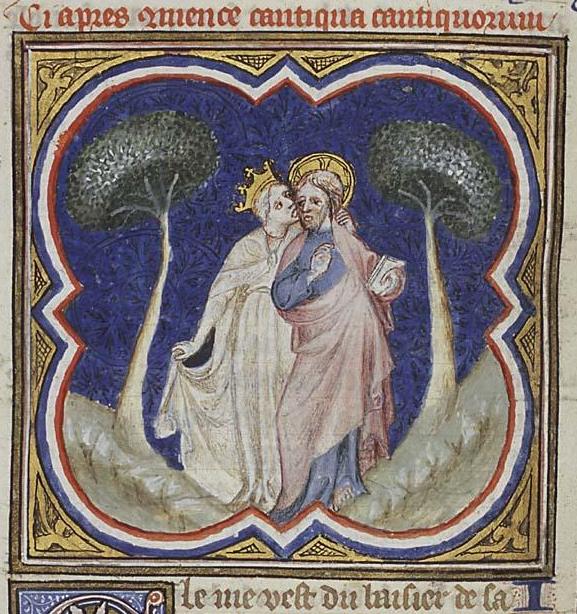
Jean Bondol, “The bride (Ecclesia) and bridegroom (Christ),” from a Bible Historiale made in Paris, 1371–72. The Hague, MMW, 10 B 23, fol. 330v.
>> “Up from My Youth (Psalm 129)” by Advent Birmingham, feat. CashBack and Terence June Gray: This is such a strange and compelling fusion! “An 1806 hymn by Isaac Watts meets hip-hop meets Johnny Cash meets folk meets New Orleans jazz meets industrial steel factory.”
Led by Zac Hicks, Advent Birmingham [previously] is a group of worship musicians from the Cathedral Church of the Advent in downtown Birmingham, Alabama. Hicks wrote this new tune for Isaac Watts’s metrical paraphrase of Psalm 129 and integrated a rap by guest artist Terence June Gray from Memphis. Singing lead (and playing drums) is Leif Bondarenko, the front man of the Johnny Cash tribute band CashBack. The video was filmed at Birmingham’s historic Sloss Furnaces. Available on iTunes, Amazon, and Spotify.
You can read the lyrics here, which include a slight revision of Watts’s verse 6.
POETRY READING:“Phase One” by Dilruba Ahmed, read, with commentary, by Pádraig Ó Tuama, Poetry Unbound: “What do you find hard to forgive in yourself? What might help? In this poem, the poet makes a list of all the things she holds against herself: opening fridge doors, fantasies, wilted seedlings, unkempt plants, lost bags, feeling awkward, treating someone poorly. Dilruba Ahmed repeats the line ‘I forgive you’ over and over, like a litany, in a hope to deepen what it means to be in the world, and be a person of love.”
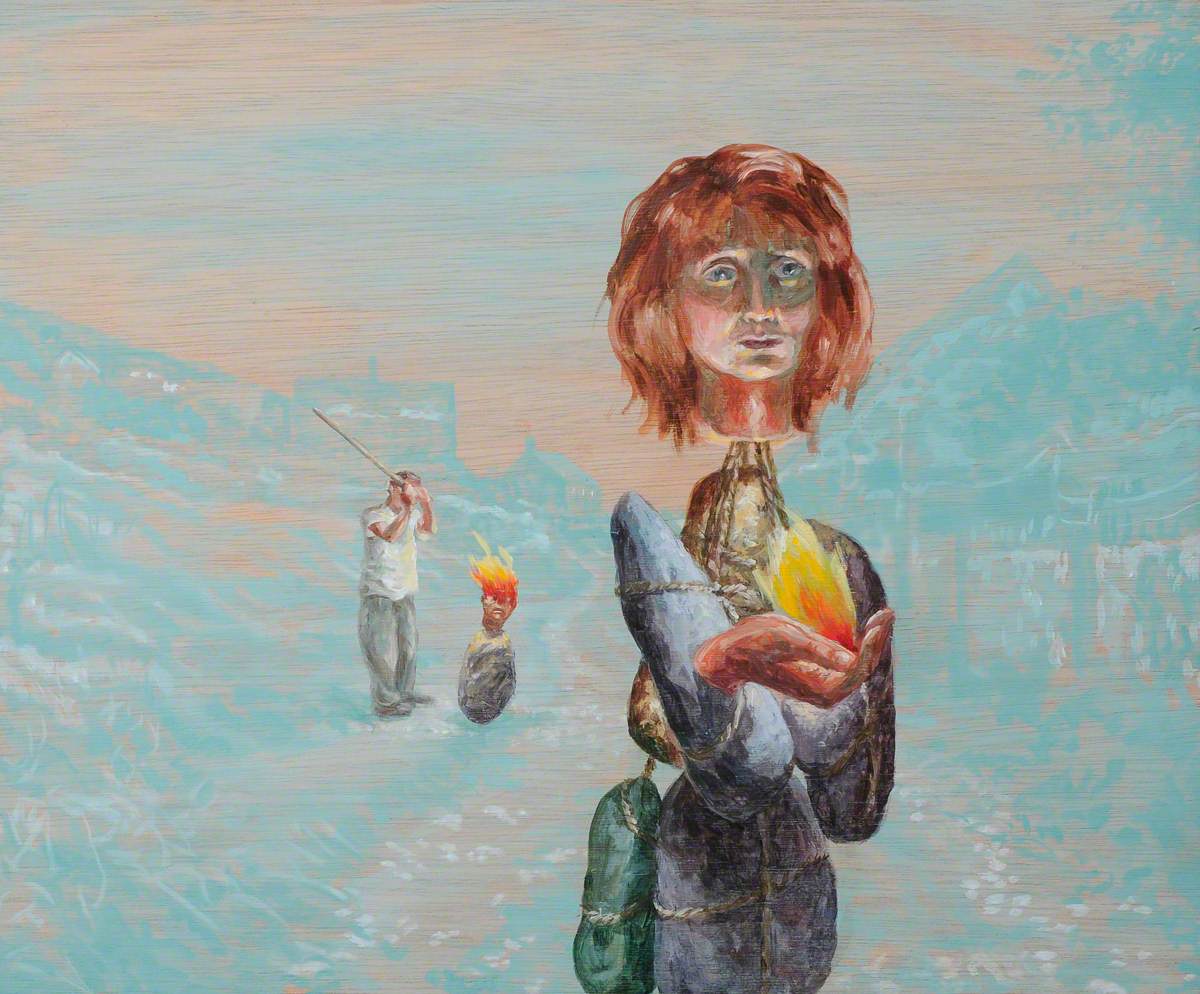
Susan Adams (British, 1966–), Waiting for Something, 2002. Oil on panel, 36 × 58 cm. Gwynedd Museum and Art Gallery, Bangor, Wales.
What love is this of thine, that cannot be In thine infinity, O Lord, confined, Unless it in thy very person see Infinity and finity conjoin’d? What! hath thy Godhead, as not satisfied, Married our manhood, making it its bride?
Oh matchless love! filling heaven to the brim! O’errunning it: all running o’er beside This world! Nay, overflowing hell, wherein, For thine elect, there rose a mighty tide! That there our veins might through thy person bleed, To quench those flames that else would on us feed.
Oh! that thy love might overflow my heart! To fire the same with love: for love I would. But oh! my straight’ned breast! my lifeless spark! My fireless flame! What chilly love, and cold? In measure small! In manner chilly! See. Lord, blow the coal: thy love enflame in me.
Edward Taylor (1642–1729) was an American Puritan poet and minister of the Congregational church in Westfield, Massachusetts, for over fifty years. This is Meditation 1 in his Preparatory Meditations, a collection of over two hundred poems divided into two series. A private spiritual diary written from 1682 to 1725, the collection was unpublished until the twentieth century.
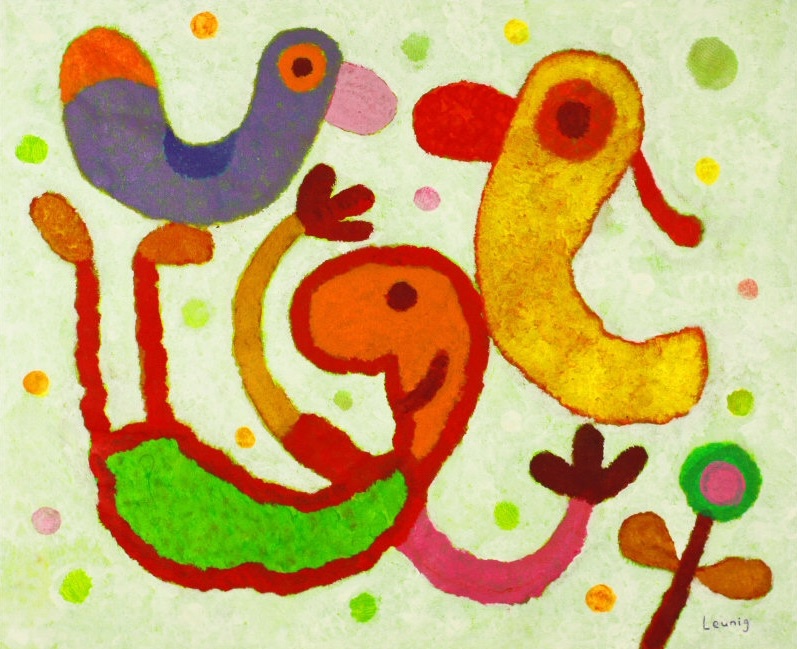
Falling Fool by Michael Leunig (Australian, 1945–)
What is the difference Between your experience of Existence And that of a saint?
The saint knows That the spiritual path Is a sublime chess game with God
And that the Beloved Has just made such a Fantastic Move
That the saint is continually Tripping over Joy And bursting out in Laughter And saying, “I Surrender!”
Whereas, my dear, I am afraid you still think You have a thousand serious moves.
This poem, inspired by the fourteenth-century Persian poet Hafiz, appears in I Heard God Laughing: Poems of Hope and Joy (Penguin, 2006) and is used here by permission of the author.
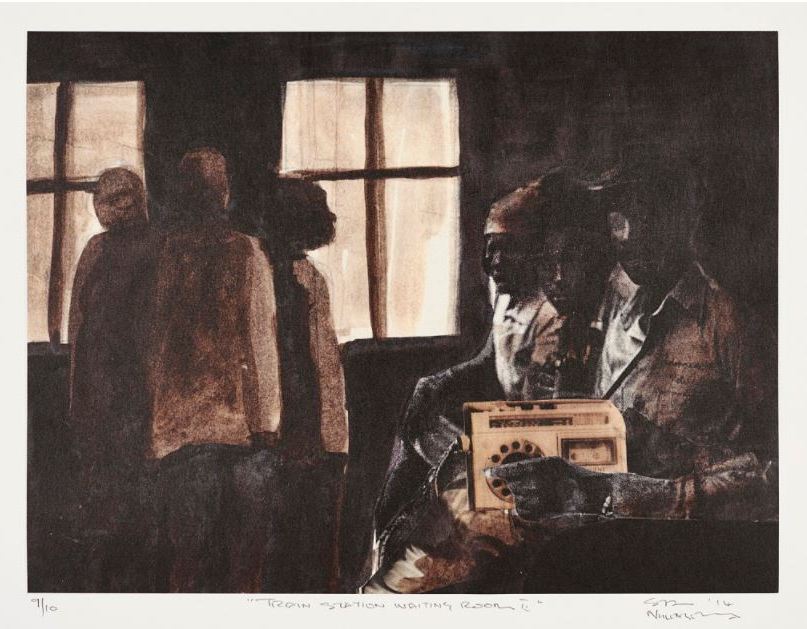
In the drab waiting-room the failed travellers, resigned, sleep on the hard benches, inured to postponement and foul coffee. Hope has given up on them.
There are also the impatient, pacing platforms, and the driven, purple with frustration, abusing their mobiles, for the hardest part of waiting is the not doing.
Truly to wait is pure dependence. But waiting too long the heart grows sclerotic. Will it still be fit to leap when the time comes? Prayer is waiting with desire.
Two aged lives incarnate century on century of waiting for God, their waiting-room his temple, waiting on his presence, marking time by practicing
the cycle of the sacrifices, ferial and festival, circling onward, spiralling towards a centre out ahead, seasons of revolving hope.
Holding out for God who cannot be given up for dead, holding him to his promises – not now, not just yet, but soon, surely, eyes will see what hearts await.
Richard Bauckham, FRSE, FBA, is a renowned English biblical scholar and theologian, whose many published works include The Theology of the Book of Revelation (1993) and Jesus and the Eyewitnesses (2006). He’s also a hobbyist poet! I’ve published this poem with his permission. It’s inspired by Luke 2:22–38, which describes two elderly Jews, “righteous and devout,” who had been “waiting for the consolation of Israel,” the Messiah, for many years and finally encountered him at the temple one day in the infant Jesus of Nazareth. This “Presentation at the Temple,” as the episode is called, is commemorated yearly by Christians on February 2, Candlemas.
Bauckham’s definition of prayer—“waiting with desire”—is the most succinct, and probably the best, I’ve ever heard. His poem enjoins us to assume the same “waiting with desire” posture as Simeon and Anna as we look fervently toward the Christ’s second coming, when God will dwell with humanity face to face once again, this time everlastingly.
(Update, December 2022: This poem now appears in Bauckham’s first volume of poetry, Tumbling into Light, published by Canterbury Press.)
ONLINE LECTURES, organized by Bridge Projects: This Los Angeles gallery is offering a series of free online events to complement A Composite Leviathan, an exhibition of emerging Chinese artists that runs through February 27, 2021. Here are two I RSVPed for. (Both will be presented in English and Chinese.)
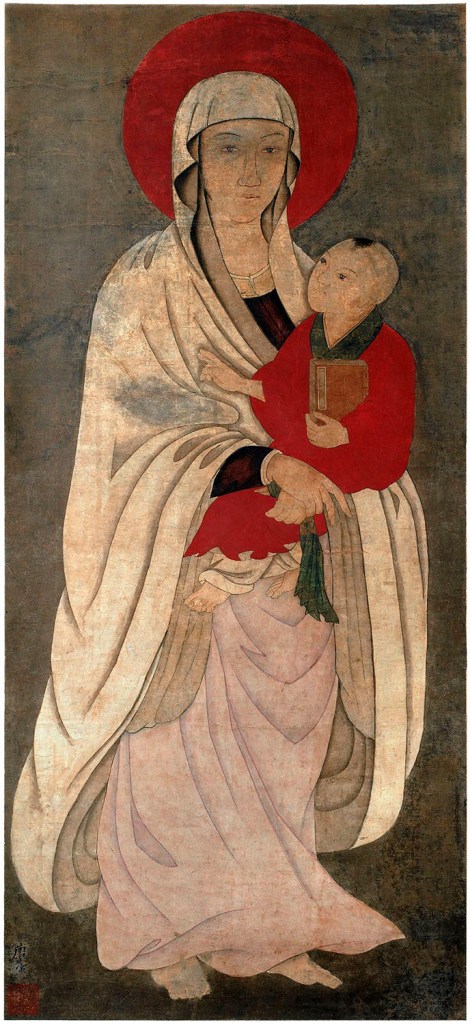
“The Virgin Mother, Her Majesty, Our Lady: Globalism, All-Under-Heaven, and Madonna In-Between” by Dong Lihui, January 12, 8–9:30 p.m. EST: Dong Lihui (PhD, art history), whose research centers on art exchange between East and West, is the author of Chinese Translation of Western Images: Christian Art in China in the 16th and 17th century. In this talk she will discuss the hybridization of European globalism and the Chinese “all-under-heaven” worldview as observed in Chinese Madonna icons made between the sixteenth and twentieth centuries.
Madonna and Child, China, 15th–17th century. Painting on silk, 8 feet high. Field Museum of Natural History, Chicago. Photo: John Weinstein.
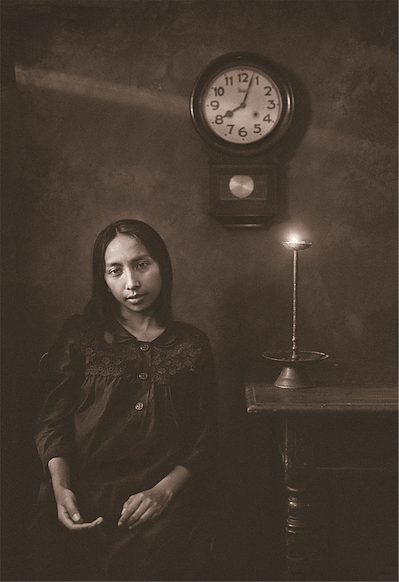
“Counterculture: Chinese Contemporary Christian Art and the Bible” by Clover Xuesong Zhou, January 26,8–9:30 p.m. EST: “The advent of modernity brought with it enmity between Christian traditions and a newly liberated art world. Similarly, contemporary artists in China found themselves at odds with the government beginning in the 1980s. All the while, Christianity has had a torrid relationship with Chinese government and culture. Thus, Chinese artists who are also practicing Christians work within these complex intersections.” Art writer and art theologian Clover Xuesong Zhou will be discussing some such artists, including photographer Stanley Fung (Feng Junlan), video artist Li Ran, and installation artist Gao Lei.
Stanley Fung (Chinese, 1961–), The Lord’s Handmaiden, 2012
+++
SONG: “O Holy Night” by Ben Caplan and friends: An absolutely stunning minor-key rendition by Canadian singer-songwriter Ben Caplan (who is often compared to Leonard Cohen) and a team of others, combining gypsy jazz, classical, and Jewish folksong influences. Caplan, who is Jewish, didn’t grow up listening to much Christmas music. “I have to admit that I find a lot of that music a bit corny. Where is that minor fall? Where is the major lift? Where is the bafflement?” He continues, “I have a deep felt belief that if you don’t like something, you should do something about it. It’s not enough to complain from the sidelines! There are some truly beautiful songs and carols out there, and I wanted to make something that tip-toes towards the sublime rather than shopping-mall-easy-listening.” Arcade Fire’s “My Body Is a Cage” was one of his reference points. (“I wanted to try to recreate that gradual build, and the sublime surrender to an enormous scale of sound.”) There are a few intentional semitone clashes to generate dissonance.
Filmed last year inside Halifax’s Fort Massey United Church and released in November, this recording was in the making for four years and is the result of much collaboration. The left-handed violinist in the video, Donald MacLennan (see, e.g., 1:34), reharmonized the carol, and he, Caplan, upright bass player Anna Ruddick, drummer Jamie Kronick, and vocalist Taryn Kawaja worked out an arrangement for their band, which they performed at a Christmas concert in 2016. Peter-Anthony Togni, who plays organ for the song, was brought in later to arrange the song for string quartet, pipe organ, and bass clarinet. Caplan chose the instrumentation and aesthetic shape. He recounts the process in detail and names all the people involved on his Bandcamp page. “I want to dispel the myth of the lone genius,” he says. “It took a lot of people with a lot of talent to pull this off. I am just the lead singer, and the guy who was stubborn enough to bring all the people together and spend an outlandish amount of money trying to achieve this vision.” Purchase on Bandcamp, and/or stream on Spotify.
I am truly moved by this atmospheric take on an old classic, which perfectly brings together the darkness and light of the Christmas season. “Original, and righteous—hymn for the COVID time,” says one YouTube user. “You’ve found things in this old carol that I never knew existed,” says another. And another: “A sensory feast. So deeply piercing.”



 Art & Theology