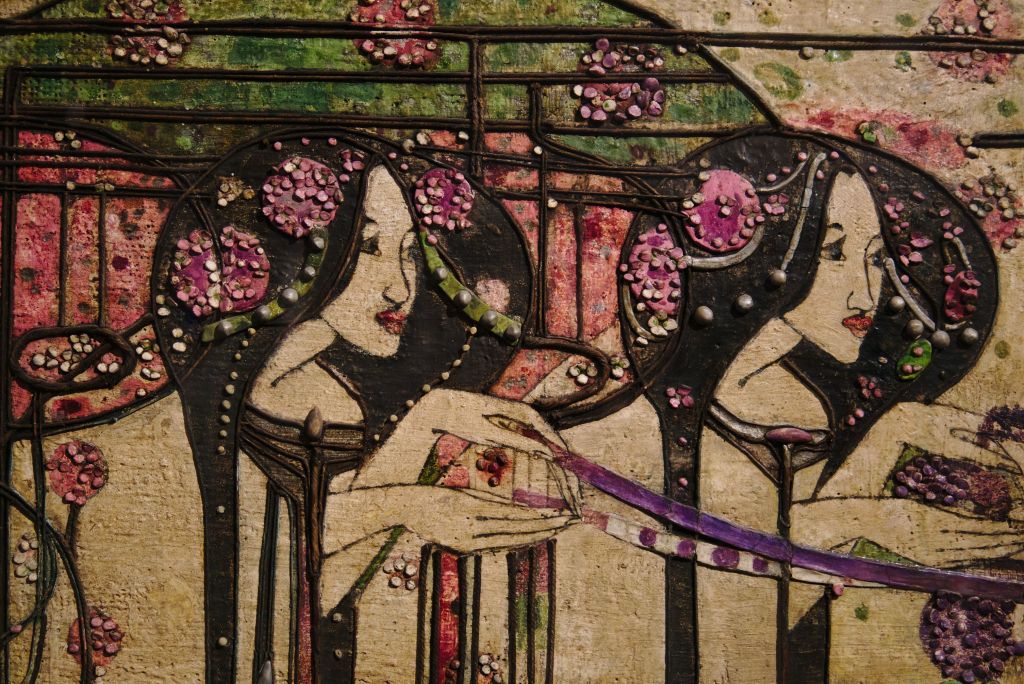
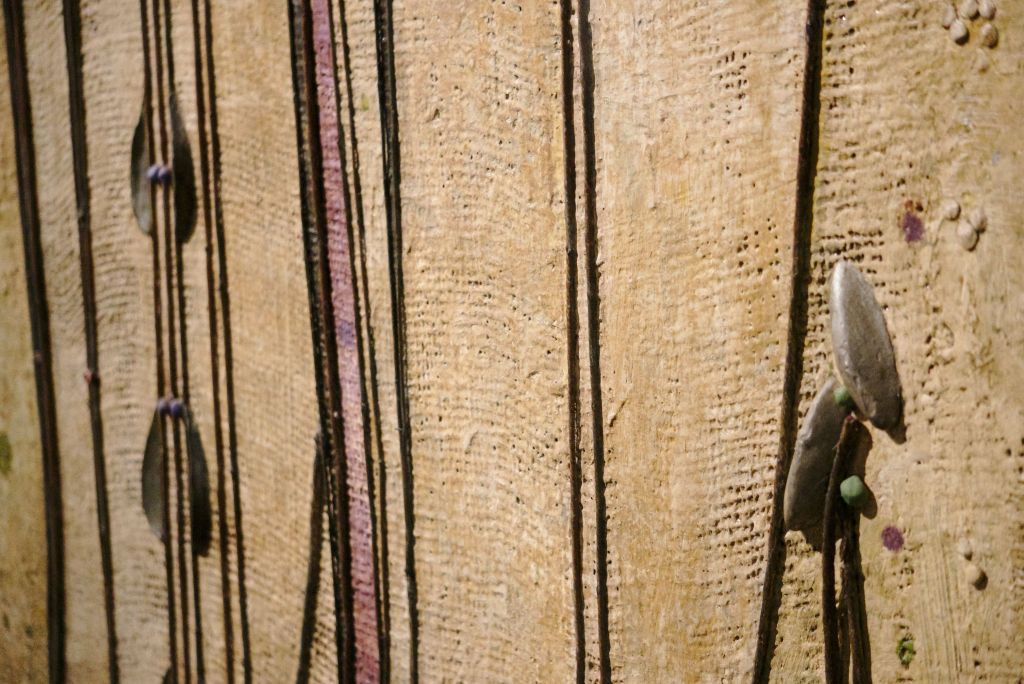
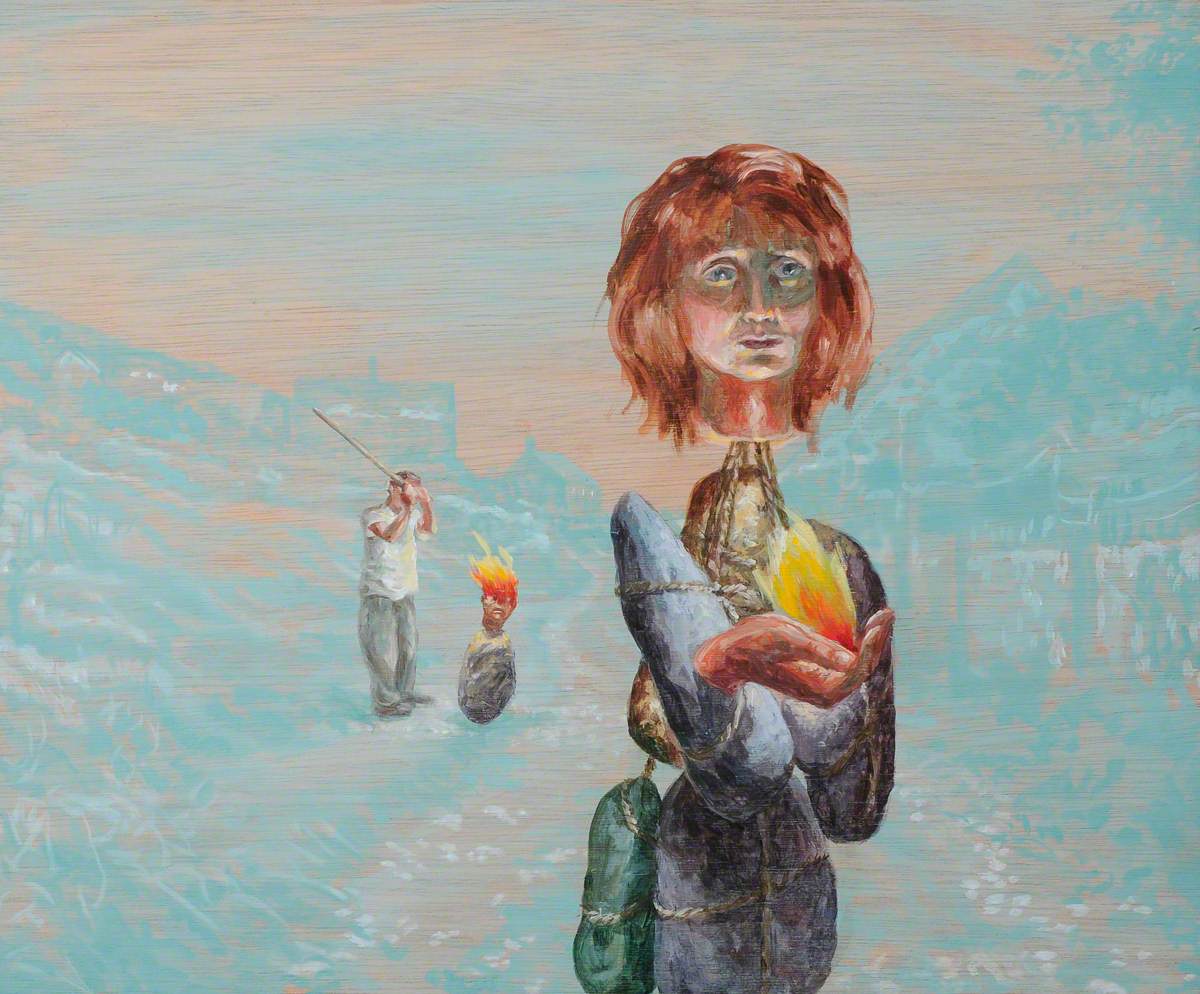
Susan Adams (British, 1966–), Waiting for Something, 2002. Oil on panel, 36 × 58 cm. Gwynedd Museum and Art Gallery, Bangor, Wales.
What love is this of thine, that cannot be In thine infinity, O Lord, confined, Unless it in thy very person see Infinity and finity conjoin’d? What! hath thy Godhead, as not satisfied, Married our manhood, making it its bride?
Oh matchless love! filling heaven to the brim! O’errunning it: all running o’er beside This world! Nay, overflowing hell, wherein, For thine elect, there rose a mighty tide! That there our veins might through thy person bleed, To quench those flames that else would on us feed.
Oh! that thy love might overflow my heart! To fire the same with love: for love I would. But oh! my straight’ned breast! my lifeless spark! My fireless flame! What chilly love, and cold? In measure small! In manner chilly! See. Lord, blow the coal: thy love enflame in me.
Edward Taylor (1642–1729) was an American Puritan poet and minister of the Congregational church in Westfield, Massachusetts, for over fifty years. This is Meditation 1 in his Preparatory Meditations, a collection of over two hundred poems divided into two series. A private spiritual diary written from 1682 to 1725, the collection was unpublished until the twentieth century.
Falling Fool by Michael Leunig (Australian, 1945–)
What is the difference Between your experience of Existence And that of a saint?
The saint knows That the spiritual path Is a sublime chess game with God
And that the Beloved Has just made such a Fantastic Move
That the saint is continually Tripping over Joy And bursting out in Laughter And saying, “I Surrender!”
Whereas, my dear, I am afraid you still think You have a thousand serious moves.
This poem, inspired by the fourteenth-century Persian poet Hafiz, appears in I Heard God Laughing: Poems of Hope and Joy (Penguin, 2006) and is used here by permission of the author.
In the drab waiting-room the failed travellers, resigned, sleep on the hard benches, inured to postponement and foul coffee. Hope has given up on them.
There are also the impatient, pacing platforms, and the driven, purple with frustration, abusing their mobiles, for the hardest part of waiting is the not doing.
Truly to wait is pure dependence. But waiting too long the heart grows sclerotic. Will it still be fit to leap when the time comes? Prayer is waiting with desire.
Two aged lives incarnate century on century of waiting for God, their waiting-room his temple, waiting on his presence, marking time by practicing
the cycle of the sacrifices, ferial and festival, circling onward, spiralling towards a centre out ahead, seasons of revolving hope.
Holding out for God who cannot be given up for dead, holding him to his promises – not now, not just yet, but soon, surely, eyes will see what hearts await.
Richard Bauckham, FRSE, FBA, is a renowned English biblical scholar and theologian, whose many published works include The Theology of the Book of Revelation (1993) and Jesus and the Eyewitnesses (2006). He’s also a hobbyist poet! I’ve published this poem with his permission. It’s inspired by Luke 2:22–38, which describes two elderly Jews, “righteous and devout,” who had been “waiting for the consolation of Israel,” the Messiah, for many years and finally encountered him at the temple one day in the infant Jesus of Nazareth. This “Presentation at the Temple,” as the episode is called, is commemorated yearly by Christians on February 2, Candlemas.
Bauckham’s definition of prayer—“waiting with desire”—is the most succinct, and probably the best, I’ve ever heard. His poem enjoins us to assume the same “waiting with desire” posture as Simeon and Anna as we look fervently toward the Christ’s second coming, when God will dwell with humanity face to face once again, this time everlastingly.
(Update, December 2022: This poem now appears in Bauckham’s first volume of poetry, Tumbling into Light, published by Canterbury Press.)
ONLINE LECTURES, organized by Bridge Projects: This Los Angeles gallery is offering a series of free online events to complement A Composite Leviathan, an exhibition of emerging Chinese artists that runs through February 27, 2021. Here are two I RSVPed for. (Both will be presented in English and Chinese.)
“The Virgin Mother, Her Majesty, Our Lady: Globalism, All-Under-Heaven, and Madonna In-Between” by Dong Lihui, January 12, 8–9:30 p.m. EST: Dong Lihui (PhD, art history), whose research centers on art exchange between East and West, is the author of Chinese Translation of Western Images: Christian Art in China in the 16th and 17th century. In this talk she will discuss the hybridization of European globalism and the Chinese “all-under-heaven” worldview as observed in Chinese Madonna icons made between the sixteenth and twentieth centuries.
Madonna and Child, China, 15th–17th century. Painting on silk, 8 feet high. Field Museum of Natural History, Chicago. Photo: John Weinstein.
“Counterculture: Chinese Contemporary Christian Art and the Bible” by Clover Xuesong Zhou, January 26,8–9:30 p.m. EST: “The advent of modernity brought with it enmity between Christian traditions and a newly liberated art world. Similarly, contemporary artists in China found themselves at odds with the government beginning in the 1980s. All the while, Christianity has had a torrid relationship with Chinese government and culture. Thus, Chinese artists who are also practicing Christians work within these complex intersections.” Art writer and art theologian Clover Xuesong Zhou will be discussing some such artists, including photographer Stanley Fung (Feng Junlan), video artist Li Ran, and installation artist Gao Lei.
Stanley Fung (Chinese, 1961–), The Lord’s Handmaiden, 2012
+++
SONG: “O Holy Night” by Ben Caplan and friends: An absolutely stunning minor-key rendition by Canadian singer-songwriter Ben Caplan (who is often compared to Leonard Cohen) and a team of others, combining gypsy jazz, classical, and Jewish folksong influences. Caplan, who is Jewish, didn’t grow up listening to much Christmas music. “I have to admit that I find a lot of that music a bit corny. Where is that minor fall? Where is the major lift? Where is the bafflement?” He continues, “I have a deep felt belief that if you don’t like something, you should do something about it. It’s not enough to complain from the sidelines! There are some truly beautiful songs and carols out there, and I wanted to make something that tip-toes towards the sublime rather than shopping-mall-easy-listening.” Arcade Fire’s “My Body Is a Cage” was one of his reference points. (“I wanted to try to recreate that gradual build, and the sublime surrender to an enormous scale of sound.”) There are a few intentional semitone clashes to generate dissonance.
Filmed last year inside Halifax’s Fort Massey United Church and released in November, this recording was in the making for four years and is the result of much collaboration. The left-handed violinist in the video, Donald MacLennan (see, e.g., 1:34), reharmonized the carol, and he, Caplan, upright bass player Anna Ruddick, drummer Jamie Kronick, and vocalist Taryn Kawaja worked out an arrangement for their band, which they performed at a Christmas concert in 2016. Peter-Anthony Togni, who plays organ for the song, was brought in later to arrange the song for string quartet, pipe organ, and bass clarinet. Caplan chose the instrumentation and aesthetic shape. He recounts the process in detail and names all the people involved on his Bandcamp page. “I want to dispel the myth of the lone genius,” he says. “It took a lot of people with a lot of talent to pull this off. I am just the lead singer, and the guy who was stubborn enough to bring all the people together and spend an outlandish amount of money trying to achieve this vision.” Purchase on Bandcamp, and/or stream on Spotify.
I am truly moved by this atmospheric take on an old classic, which perfectly brings together the darkness and light of the Christmas season. “Original, and righteous—hymn for the COVID time,” says one YouTube user. “You’ve found things in this old carol that I never knew existed,” says another. And another: “A sensory feast. So deeply piercing.”
Danylo Movchan (Ukrainian, 1979–), Nativity, 2015. Egg tempera and gilding on board, 32 × 24 cm.
There has fallen on earth for a token A god too great for the sky. He has burst out of all things and broken The bounds of eternity: Into time and the terminal land He has strayed like a thief or a lover, For the wine of the world brims over, Its splendor is spilt on the sand.
Who is proud when the heavens are humble, Who mounts if the mountains fall, If the fixed stars topple and tumble And a deluge of love drowns all— Who rears up his head for a crown, Who holds up his will for a warrant, Who strives with the starry torrent, When all that is good goes down?
For in dread of such falling and failing The fallen angels fell Inverted in insolence, scaling The hanging mountain of hell: But unmeasured of plummet and rod Too deep for their sight to scan, Outrushing the fall of man Is the height of the fall of God.
Glory to God in the Lowest The spout of the stars in spate— Where the thunderbolt thinks to be slowest And the lightning fears to be late: As men dive for a sunken gem Pursuing, we hunt and hound it, The fallen star that has found it In the cavern of Bethlehem.
“Gloria in Profundis” (Latin for “Glory in the Depths”) by G. K. Chesterton is the fifth poem in the Ariel Poems series of pamphlets, published by Faber and Gwyer for the Christmas gift market from 1927 to 1931. It was reprinted in the posthumous Chesterton compilation The Spirit of Christmas: Stories, Poems, Essays(Dodd, Mead, 1985).
Face to face with our limits, Blinking before the frightful Stare of our frailty, Promise rises Like a posse of clever maids Who do not fear the dark Because their readiness Lights the search. Their oil Becomes the measure of their love, Their ability to wait— An indication of their Capacity to trust and take a chance. Without the caution or predictability Of knowing day or hour, They fall back on that only Of which they can be sure: Love precedes them, Before it No door will ever close.
This poem by Thomas J. O’Gorman appears, untitled, in The Advent Sourcebook (Liturgy Training Publications, 1988) and is published here with O’Gorman’s permission. He told me he suggests the title “Clever Maids.”
The Wise Virgins icon by George Kordis (Greek, 1956–), pictured above, is sold, but the artist has seven signed, limited-edition giclée prints available; contact him through his website if interested.
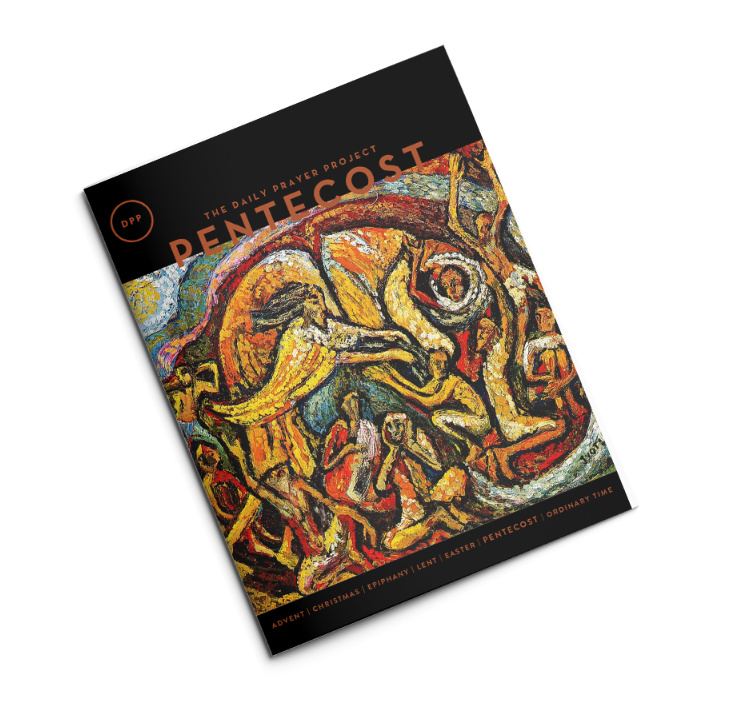
The Christmas–Epiphany 2020/21 edition of the Daily Prayer Project [previously], a publication I work for part-time, released this week! The cover image is from the sanctuary mural at Holy Angels Catholic Church in Chicago, by Cameroonian artist-priest Engelbert Mveng. (See the full mural here.) Also in this edition are images of Grace Carol Bomer’s From Strength to Strength, showing Light stepping into darkness, and the Piper-Reyntiens stained glass window in Coventry Cathedral, with its yellow sunburst amid an abstract pattern of reds, blues, and greens. We include visual art as a supplement to the prayers, scripture readings, and songs with the understanding that it, too, can promote spiritual development and a deeper communion with God.
You can purchase a digital copy (PDF) of the Christmas–Epiphany edition (December 24–February 16) through the website, and if in the future you’d like to receive hard copies, starting with Lent 2021, you can become a monthly subscriber. Part of the money goes to supporting artists.
+++
Whenever I see a Helena Sorensen [previously] byline, I perk up, because I always find myself connecting so much with her writing. She’s a regular contributor to the Rabbit Room blog. Her two most recent posts are “Things Fall Apart” and “Advent, Week One: Hope.”They’re both great.
+++
Unburden: A Virtual Interactive Exhibit, December 4, 2020–January 8, 2021: The Gallery at W83 is part of a 45,000-square-foot cultural center built by Redeemer Presbyterian Church in Manhattan’s Upper West Side as a service to the city’s artists and larger community. W83 Events and Programming Director Eva Ting has curated a virtual exhibition of photographs and stories from Kristina Libby’s Floral Heart Project, a series of living memorials to those lost to or suffering from COVID-19. Libby initiated the project in New York City in May, partnering with 1800Flowers.com to place floral heart garlands all around the city to create space for ceremony and to invite the community to process and mourn. The project has since grown nationwide.
“Many of us are carrying burdens of loss, anxiety, and uncertainty as we move towards the end of 2020,” Ting writes. “We have all been impacted in some way by the events of this year, and we bear fatigue weighed heavier by the inability to gather as a community to collectively grieve. In this interactive virtual exhibit Unburden, the Gallery at W83 invites you to participate in an unburdening of the load we carry.”
The exhibition webpage invites you to release personal burdens by writing down any grief, fears, loss, or anxiety you wish to let go of (can be submitted anonymously if desired). These words will be incorporated into a new floral heart laying on December 20 at Fort Tryon Park, an event that will be livestreamed. You can also ask for prayer, and members of the W83 team will pray for your requests. “Through these individual and collective acts of unburdening, may we imagine what it would look like to truly let go of these burdens.”
Photo by Erica Reade
+++
I enjoyed attending the virtual “Songs of Hope: A TGC Advent Concert,” featuring music and spoken-word performances from a variety of artists (see YouTube description), interspersed with Advent readings. It was a truly meaningful worship experience.
I’m sure there are many more virtual Advent/Christmas concerts and other online events coming up. What ones are you most looking forward to?
One that I’ll probably be tuning in to is “We Three Queens Holiday Show” by Pegasis, a sister trio, on December 17, 8:30 p.m. EST (7:30 p.m. CST). It will be live on Facebook and and Instagram. (Update, 12/17/20: View the performance here. My favorite two songs are probably “Poncho Andino” at 19:04 and “Mary Had a Baby” at 45:24—such a unique arrangement!)
There’s also “A Candlelit (Virtual) Room: The Advent Christmas Music of Ben Thomas” on December 11 and 12 (10 p.m. EST and 8 p.m. EST, respectively), two private Zoom concerts open to the first twenty-five registrants each. He’ll be performing original songs from his albums The Bewildering Light, The Wilderness Voice, and Peace Here, all of which I recommend. My favorite tracks: “Justice Will Sprout from the Ground,” “Zechariah and the Least Expected Places,” and “Shepherds and Angels.” (The latter two were recorded under the name So Elated.)
POEM: “Harlem” by Langston Hughes: This is a brilliant poem—its sensory images, its rhythm, its rhyme, its multivalence (especially the last line). I loved it so much when I first read it in ninth grade that I memorized it unbidden. When writer and podcaster Joy Clarkson posted a reflection on the poem for her Patreon community in October, resulting in a lively conversation thread in the comments section, it reignited my enthusiasm for and got me thinking more deeply about “Harlem.” She opened by quoting Proverbs 13:12: “Hope deferred makes the heart sick, / But desire fulfilled is a tree of life.”
“What happens to a dream deferred? // Does it dry up / like a raisin in the sun?” Written in 1951 as part of a sequence of poems exploring black life in Harlem, “Harlem” is inextricably tied to the civic discourse of the contemporary American moment, writes Scott Challener in Poetry Foundation’s guide to the poem. The “dream” he refers to is the American Dream, unattainable for so many due to racial inequalities and oppression. (Also assigned in ninth-grade English curricula in the US is Lorraine Hansberry’s A Raisin in the Sun, which takes its title from and addresses the questions of “Harlem.”)
While not wishing to strip the poem of its specific context, I have been thinking about all the dreams that have been deferred this year—put on hold, or even irretrievably lost, because of COVID-19. Hughes posits a string of descriptive similes for a deferred dream: a dried-up raisin, a festering sore, rotting meat, a crusted-over sweet, a sagging load. One commenter on Joy’s Patreon observed how a raisin can’t turn back into a grape, rotten meat can’t be made fresh again, and an overcooked dessert can’t be cooked back down, but a sore can heal and a load can be lifted.
The final suggestion—“or does it explode?”—can be read in myriad ways. In one respect it could refer to the explosion of cultural output, of creativity, that results from deferred dreams—i.e., the Harlem Renaissance. I’ve definitely seen this happen this year, as people, in the face of crushing personal and professional disappointments, have found unique ways to come together and produce and share works of beauty within the restrictiveness of health and safety protocols. One example—speaking of Harlem—is the Dance Theatre of Harlem, a groundbreaking neoclassical ballet company founded at the height of the civil rights movement in 1969 and still active today. Bans on gatherings of certain numbers have meant that dancers and other performers have had to find alternative ways of reaching their audiences, so DTH artists Derek Brockington and Alexandra Hutchinson created “Dancing Through Harlem,” taking choreography from Robert Garland’s “New Bach” out into the streets and capturing it on video for people to enjoy from home. To help support the DTH during this time, you can donate easily through the fundraising sidebar on the video’s YouTube page or through the company’s website.
+++
SONG: “400 Years” by Sarah Sparks: This original song, sung with Kate Lab, appears on Sarah Sparks’s new album, Advent, Pt. One. It’s about how the centuries-long silence of God between the ministry of Malachi (ca. 420 BCE) and the appearance of John the Baptist in the early first century CE was broken with the birth of Jesus—the Word made flesh. Its refrain, “For the first time, not a silent night,” cleverly turns on its head the sweet, familiar carol “Silent Night.” Through the incarnation, God spoke to all who would listen.
Life is a waiting beside the pool of Bethesda, Where the reeling crowds go by Under the five porches of sense. Life is a lying crippled Beside the pool of deep longing, Waiting for the water to unfold Its white petals of healing, Waiting for Someone to draw near and say: “Arise.”
Image credit: Léon Spilliaert (Belgian, 1881–1946), The Bather, 1910, India ink and pastel on paper, Musée Modern Museum (Royal Museums of Fine Arts of Belgium), Brussels.
One of the reasons I love poetry is it brings me into more intimate contact with the world. It slows me down and asks me to give my attention to things that, in my constant, often self-inflicted busyness, I fail to notice. And it shepherds me into a deeper sense of gratitude and awe. It’s really easy for me to see the world’s ugliness—sin, suffering—and to be scared, angry, disgusted, horrified, or overwhelmed. My inclination is to see what’s wrong instead of what’s right. While poetry can perform many different functions, one of them is to attune us to the daily gifts and graces that come to us from, I believe, the hand of God.
In the spirit of Thanksgiving, here are ten contemporary poems of gratitude that can be read online. A popular tradition for this holiday is, when gathered with others round the feasting table, to take turns sharing what you’re thankful for. The three most typical answers for adults are: my family, my health, my job. These are perfectly fine answers. But poets can show us what it feels like to be blessed with family, for example, and can teach us how to offer praise even when our health is declining or we’re unemployed. Moreover, poets help us expand our repertoire of thanksgivings, naming things with specificity: “the incense of butter on toast” (Siegel), “the honey-colored toes of mice” (Singleton), “two daughters and one cloud, an old oak / and a great love” (Wiman), the moon that “shakes a dress of light onto my body” (Silver) and “shuffl[es] its soft, blind slippers over the floor” (Hirshfield).
Susan Lichtman (American, 1952–), Orchard Bag and Bouquet, 2015. Oil on linen, 24 × 22 in.
I’ve listed the volume that each poem is published in—I’ve read all but the Browning one, and they’re all excellent. I hope this tiny sampling from the trove of contemporary poetry enlarges your thankfulness and inspires you to read more! Happy Thanksgiving, friends.
“When the sun returns”by Sarah Browning, in Killing Summer (2017): Jesus said to consider the birds. Browning does. “it is hallelujah time, / the swallows tracing an arc / of praise just off our balcony, / the mountains snow-sparkling / in gratitude . . .”
“A Song of Praises”by Robert Siegel (scroll to bottom of page), in Within This Tree of Bones(2013): In this very textural, sensory poem, a humdrum morning routine becomes a litany of more than two dozen in-the-moment gratitudes, for everything from warm washcloths to the snap of elastic to grapefruit flesh to a beautiful face at the breakfast table.
“I Praise Unsalted Butter”by Sharron Singleton, in Our Hands a Hollow Bowl (2018): Another litany of thanksgivings for the mundane, like pearl buttons, babies’ fingernail parings, freckles, delphinium’s cobalt, unseen dendrites, the word “rhubarb,” and so on. In spite of great evil (the poet references the famous “Napalm Girl” photograph), there is still much to wonder at.
“Fifty”by Christian Wiman, in Survival Is a Style (2020): “I never thought I’d live to the age of fifty, so my inclination these days is to praise,” says Wiman, who was diagnosed with a rare blood cancer in 2006 during his first year of marriage. “I wasn’t able to write about joy until I got sick. It wasn’t that sickness brought joy. It’s made me much more conscious of how much joy was in my life and gave me some impetus to articulate it.”
“Morning”by Yahia Lababidi, inBarely There: Short Poems (2013): This six-liner celebrates the newness and invitation of each day. (For a bonus poem by the same author, see “Breath.”)
“Psalm”by Marilyn Nelson, in The Fields of Praise (1997): Reflecting on the inherently dangerous act of driving, Nelson is thankful for (God’s) ongoing protection in the car. The poem ends with a classic line from the biblical book of Psalms.
“How Rarely I Have Stopped to Thank the Steady Effort”by Jane Hirshfield (scroll down to fourth poem), in The Beauty: Poems (2015): I would have never thought to be thankful for walls that stand up! But yes, the basic architecture of my little suburban home is a marvel—how it all holds together. In a pause in conversation, the speaker of this poem ponders all that’s going on in the silence: tree bark absorbing the scent of crow feathers, honey dissolving into tea, DNA replicating. The poem then turns into an expansive reflection on all the invisible phenomena of bodies and lives, of emotions and desires that ebb and flow as their building blocks get rearranged.
“A Handful of Berakhot” by Anya Krugovoy Silver, in The Ninety-Third Name of God (2010): Silver [previously] is one of the consummate poets of gratitude, particularly gratitude amid illness. She was pregnant with her first and only son, Noah, when she was diagnosed with inflammatory breast cancer in 2004. She died in 2018. Her body of work is characterized by a stubborn holding on to joy even as she wrestles honestly with God through many painful years of chemo and a mastectomy. Silver, a Christian, married a Jewish man, whose faith tradition inspired this poem. “In Judaism, a berakhah (pl. berakhot) is a formula of blessing or thanksgiving, recited in public or private, usually before the performance of a commandment, or the enjoyment of food or fragrance, and in praise on various occasions. The function of a berakhah is to acknowledge God as the source of all blessing” [source]. Silver’s nineteen custom berakhot are for such occasions as “buckling my son’s shoes,” “slipping my prosthetic breast into my bra,” “riding the ferris wheel,” and “going to the post office.”
“Gratitude”by Anna Kamieńska, in Astonishments: Selected Poems(2007): “I was full of thanks / like a Sunday alms-box,” Kamieńska writes in this rapturous poem, which bursts with love for everyone and everything.
Do not wait for the earth to shatter,
Sodom’s consumption by fire.
Tiny wonders from day to day are
Greater, deeper to admire.
Come, place your hand upon your heart and
Hear well, observe what it conveys.
Is this fine beating not by far the
Greatest, most wonderous music phrase?
Come, look into that deep blue Endless,
Look at those tiny silver things:
Not wonderous that your orphaned soul is
Rising towards them, spreading wings?
Look how your shadow runs before you,
How it expands and shrinks with you.
Not a wonder? Or that the waters
Reflect the heavens for your view?
Do not expect big things in life, for
Joys are snowflakes, they drift and stray.
Silent, sifting petals of wonder.
In them’s God’s voice: I’m coming.
Translated from the Hungarian by Leslie A. Kery. Reproduced by permission of Mr. Kery.
Image credit: Gina Gilmour (American, 1948–), A Door in the Woods, 1994. Oil on canvas, 79 × 88 3/4 in. (200.7 × 225.4 cm). Bechtler Museum of Modern Art, Charlotte, North Carolina. Photo: Victoria Emily Jones.