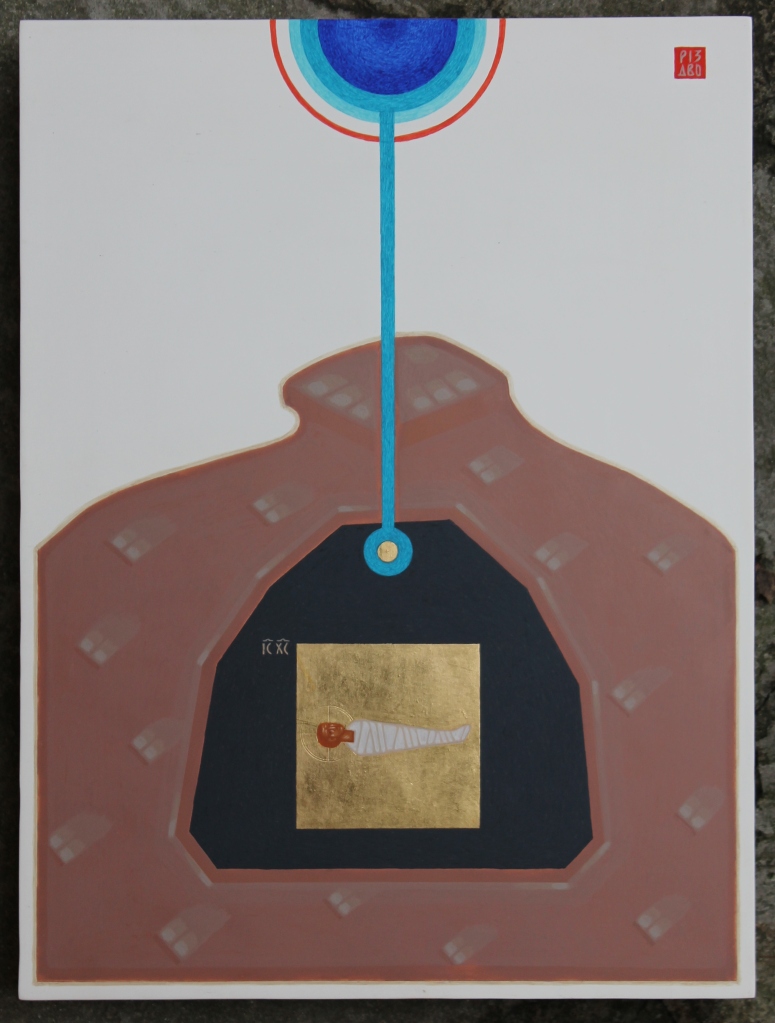
Danylo Movchan (Ukrainian, 1979–), Nativity, 2015. Egg tempera and gilding on board, 32 × 24 cm.
There has fallen on earth for a token A god too great for the sky. He has burst out of all things and broken The bounds of eternity: Into time and the terminal land He has strayed like a thief or a lover, For the wine of the world brims over, Its splendor is spilt on the sand.
Who is proud when the heavens are humble, Who mounts if the mountains fall, If the fixed stars topple and tumble And a deluge of love drowns all— Who rears up his head for a crown, Who holds up his will for a warrant, Who strives with the starry torrent, When all that is good goes down?
For in dread of such falling and failing The fallen angels fell Inverted in insolence, scaling The hanging mountain of hell: But unmeasured of plummet and rod Too deep for their sight to scan, Outrushing the fall of man Is the height of the fall of God.
Glory to God in the Lowest The spout of the stars in spate— Where the thunderbolt thinks to be slowest And the lightning fears to be late: As men dive for a sunken gem Pursuing, we hunt and hound it, The fallen star that has found it In the cavern of Bethlehem.
“Gloria in Profundis” (Latin for “Glory in the Depths”) by G. K. Chesterton is the fifth poem in the Ariel Poems series of pamphlets, published by Faber and Gwyer for the Christmas gift market from 1927 to 1931. It was reprinted in the posthumous Chesterton compilation The Spirit of Christmas: Stories, Poems, Essays(Dodd, Mead, 1985).
Face to face with our limits, Blinking before the frightful Stare of our frailty, Promise rises Like a posse of clever maids Who do not fear the dark Because their readiness Lights the search. Their oil Becomes the measure of their love, Their ability to wait— An indication of their Capacity to trust and take a chance. Without the caution or predictability Of knowing day or hour, They fall back on that only Of which they can be sure: Love precedes them, Before it No door will ever close.
This poem by Thomas J. O’Gorman appears, untitled, in The Advent Sourcebook (Liturgy Training Publications, 1988) and is published here with O’Gorman’s permission. He told me he suggests the title “Clever Maids.”
The Wise Virgins icon by George Kordis (Greek, 1956–), pictured above, is sold, but the artist has seven signed, limited-edition giclée prints available; contact him through his website if interested.
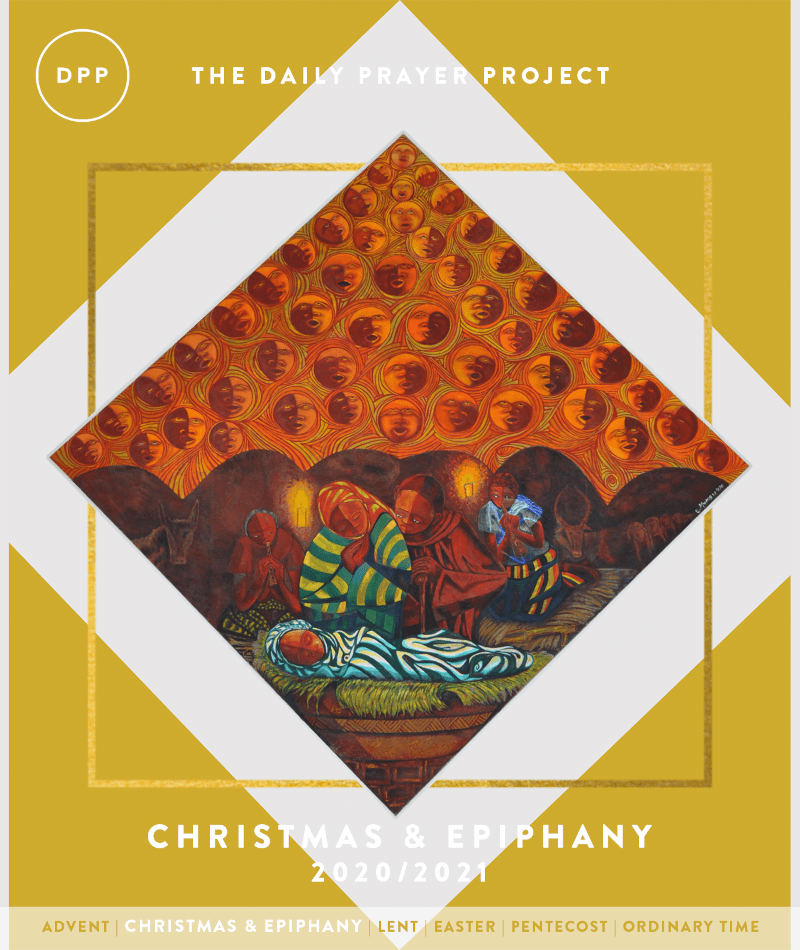
The Christmas–Epiphany 2020/21 edition of the Daily Prayer Project [previously], a publication I work for part-time, released this week! The cover image is from the sanctuary mural at Holy Angels Catholic Church in Chicago, by Cameroonian artist-priest Engelbert Mveng. (See the full mural here.) Also in this edition are images of Grace Carol Bomer’s From Strength to Strength, showing Light stepping into darkness, and the Piper-Reyntiens stained glass window in Coventry Cathedral, with its yellow sunburst amid an abstract pattern of reds, blues, and greens. We include visual art as a supplement to the prayers, scripture readings, and songs with the understanding that it, too, can promote spiritual development and a deeper communion with God.
You can purchase a digital copy (PDF) of the Christmas–Epiphany edition (December 24–February 16) through the website, and if in the future you’d like to receive hard copies, starting with Lent 2021, you can become a monthly subscriber. Part of the money goes to supporting artists.
+++
Whenever I see a Helena Sorensen [previously] byline, I perk up, because I always find myself connecting so much with her writing. She’s a regular contributor to the Rabbit Room blog. Her two most recent posts are “Things Fall Apart” and “Advent, Week One: Hope.”They’re both great.
+++
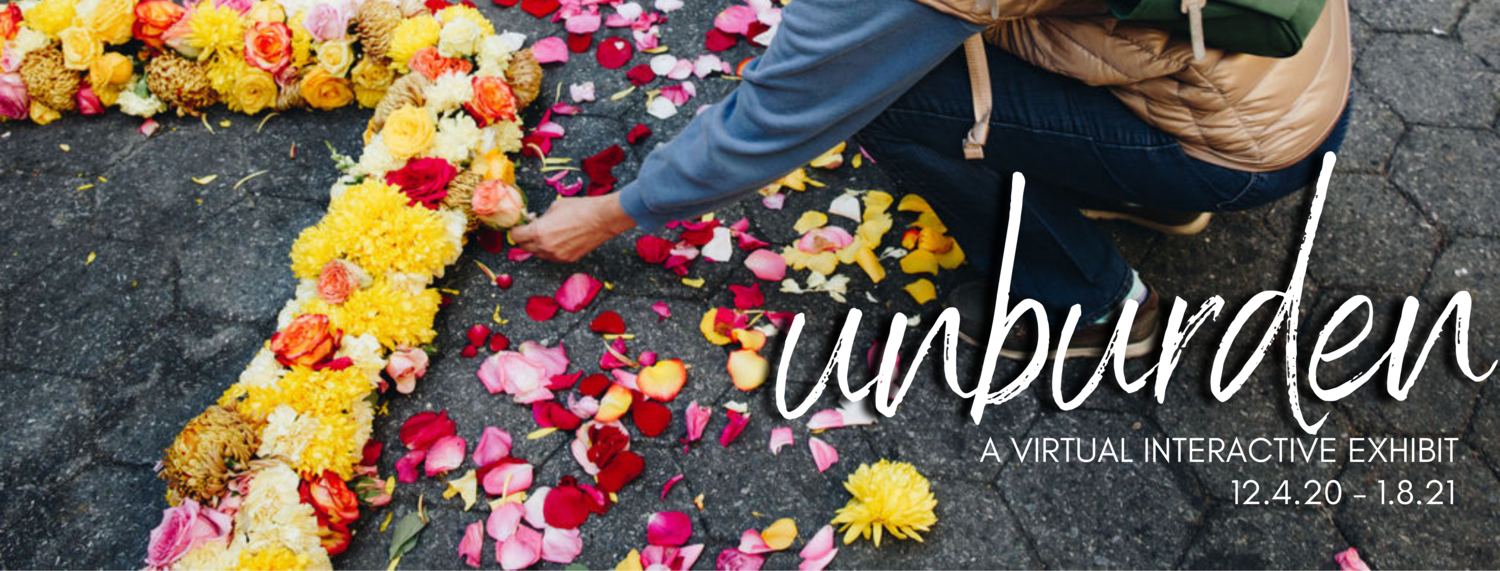
Unburden: A Virtual Interactive Exhibit, December 4, 2020–January 8, 2021: The Gallery at W83 is part of a 45,000-square-foot cultural center built by Redeemer Presbyterian Church in Manhattan’s Upper West Side as a service to the city’s artists and larger community. W83 Events and Programming Director Eva Ting has curated a virtual exhibition of photographs and stories from Kristina Libby’s Floral Heart Project, a series of living memorials to those lost to or suffering from COVID-19. Libby initiated the project in New York City in May, partnering with 1800Flowers.com to place floral heart garlands all around the city to create space for ceremony and to invite the community to process and mourn. The project has since grown nationwide.
“Many of us are carrying burdens of loss, anxiety, and uncertainty as we move towards the end of 2020,” Ting writes. “We have all been impacted in some way by the events of this year, and we bear fatigue weighed heavier by the inability to gather as a community to collectively grieve. In this interactive virtual exhibit Unburden, the Gallery at W83 invites you to participate in an unburdening of the load we carry.”
The exhibition webpage invites you to release personal burdens by writing down any grief, fears, loss, or anxiety you wish to let go of (can be submitted anonymously if desired). These words will be incorporated into a new floral heart laying on December 20 at Fort Tryon Park, an event that will be livestreamed. You can also ask for prayer, and members of the W83 team will pray for your requests. “Through these individual and collective acts of unburdening, may we imagine what it would look like to truly let go of these burdens.”
Photo by Erica Reade
+++
I enjoyed attending the virtual “Songs of Hope: A TGC Advent Concert,” featuring music and spoken-word performances from a variety of artists (see YouTube description), interspersed with Advent readings. It was a truly meaningful worship experience.
I’m sure there are many more virtual Advent/Christmas concerts and other online events coming up. What ones are you most looking forward to?
One that I’ll probably be tuning in to is “We Three Queens Holiday Show” by Pegasis, a sister trio, on December 17, 8:30 p.m. EST (7:30 p.m. CST). It will be live on Facebook and and Instagram. (Update, 12/17/20: View the performance here. My favorite two songs are probably “Poncho Andino” at 19:04 and “Mary Had a Baby” at 45:24—such a unique arrangement!)
There’s also “A Candlelit (Virtual) Room: The Advent Christmas Music of Ben Thomas” on December 11 and 12 (10 p.m. EST and 8 p.m. EST, respectively), two private Zoom concerts open to the first twenty-five registrants each. He’ll be performing original songs from his albums The Bewildering Light, The Wilderness Voice, and Peace Here, all of which I recommend. My favorite tracks: “Justice Will Sprout from the Ground,” “Zechariah and the Least Expected Places,” and “Shepherds and Angels.” (The latter two were recorded under the name So Elated.)
POEM: “Harlem” by Langston Hughes: This is a brilliant poem—its sensory images, its rhythm, its rhyme, its multivalence (especially the last line). I loved it so much when I first read it in ninth grade that I memorized it unbidden. When writer and podcaster Joy Clarkson posted a reflection on the poem for her Patreon community in October, resulting in a lively conversation thread in the comments section, it reignited my enthusiasm for and got me thinking more deeply about “Harlem.” She opened by quoting Proverbs 13:12: “Hope deferred makes the heart sick, / But desire fulfilled is a tree of life.”
“What happens to a dream deferred? // Does it dry up / like a raisin in the sun?” Written in 1951 as part of a sequence of poems exploring black life in Harlem, “Harlem” is inextricably tied to the civic discourse of the contemporary American moment, writes Scott Challener in Poetry Foundation’s guide to the poem. The “dream” he refers to is the American Dream, unattainable for so many due to racial inequalities and oppression. (Also assigned in ninth-grade English curricula in the US is Lorraine Hansberry’s A Raisin in the Sun, which takes its title from and addresses the questions of “Harlem.”)
While not wishing to strip the poem of its specific context, I have been thinking about all the dreams that have been deferred this year—put on hold, or even irretrievably lost, because of COVID-19. Hughes posits a string of descriptive similes for a deferred dream: a dried-up raisin, a festering sore, rotting meat, a crusted-over sweet, a sagging load. One commenter on Joy’s Patreon observed how a raisin can’t turn back into a grape, rotten meat can’t be made fresh again, and an overcooked dessert can’t be cooked back down, but a sore can heal and a load can be lifted.
The final suggestion—“or does it explode?”—can be read in myriad ways. In one respect it could refer to the explosion of cultural output, of creativity, that results from deferred dreams—i.e., the Harlem Renaissance. I’ve definitely seen this happen this year, as people, in the face of crushing personal and professional disappointments, have found unique ways to come together and produce and share works of beauty within the restrictiveness of health and safety protocols. One example—speaking of Harlem—is the Dance Theatre of Harlem, a groundbreaking neoclassical ballet company founded at the height of the civil rights movement in 1969 and still active today. Bans on gatherings of certain numbers have meant that dancers and other performers have had to find alternative ways of reaching their audiences, so DTH artists Derek Brockington and Alexandra Hutchinson created “Dancing Through Harlem,” taking choreography from Robert Garland’s “New Bach” out into the streets and capturing it on video for people to enjoy from home. To help support the DTH during this time, you can donate easily through the fundraising sidebar on the video’s YouTube page or through the company’s website.
+++
SONG: “400 Years” by Sarah Sparks: This original song, sung with Kate Lab, appears on Sarah Sparks’s new album, Advent, Pt. One. It’s about how the centuries-long silence of God between the ministry of Malachi (ca. 420 BCE) and the appearance of John the Baptist in the early first century CE was broken with the birth of Jesus—the Word made flesh. Its refrain, “For the first time, not a silent night,” cleverly turns on its head the sweet, familiar carol “Silent Night.” Through the incarnation, God spoke to all who would listen.
Life is a waiting beside the pool of Bethesda, Where the reeling crowds go by Under the five porches of sense. Life is a lying crippled Beside the pool of deep longing, Waiting for the water to unfold Its white petals of healing, Waiting for Someone to draw near and say: “Arise.”
Image credit: Léon Spilliaert (Belgian, 1881–1946), The Bather, 1910, India ink and pastel on paper, Musée Modern Museum (Royal Museums of Fine Arts of Belgium), Brussels.
One of the reasons I love poetry is it brings me into more intimate contact with the world. It slows me down and asks me to give my attention to things that, in my constant, often self-inflicted busyness, I fail to notice. And it shepherds me into a deeper sense of gratitude and awe. It’s really easy for me to see the world’s ugliness—sin, suffering—and to be scared, angry, disgusted, horrified, or overwhelmed. My inclination is to see what’s wrong instead of what’s right. While poetry can perform many different functions, one of them is to attune us to the daily gifts and graces that come to us from, I believe, the hand of God.
In the spirit of Thanksgiving, here are ten contemporary poems of gratitude that can be read online. A popular tradition for this holiday is, when gathered with others round the feasting table, to take turns sharing what you’re thankful for. The three most typical answers for adults are: my family, my health, my job. These are perfectly fine answers. But poets can show us what it feels like to be blessed with family, for example, and can teach us how to offer praise even when our health is declining or we’re unemployed. Moreover, poets help us expand our repertoire of thanksgivings, naming things with specificity: “the incense of butter on toast” (Siegel), “the honey-colored toes of mice” (Singleton), “two daughters and one cloud, an old oak / and a great love” (Wiman), the moon that “shakes a dress of light onto my body” (Silver) and “shuffl[es] its soft, blind slippers over the floor” (Hirshfield).
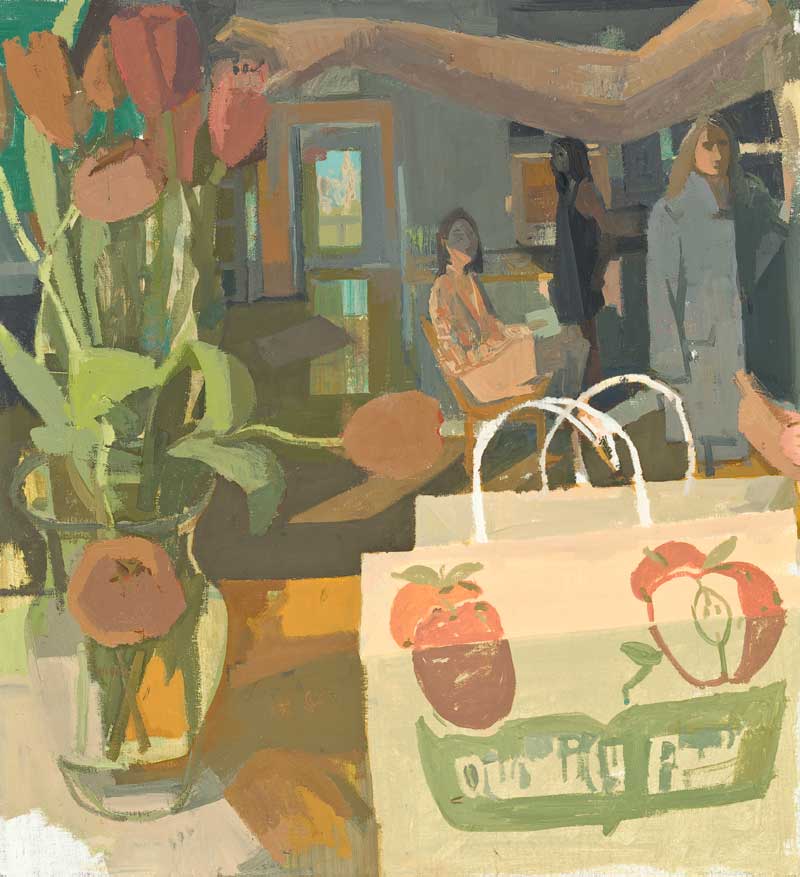
Susan Lichtman (American, 1952–), Orchard Bag and Bouquet, 2015. Oil on linen, 24 × 22 in.
I’ve listed the volume that each poem is published in—I’ve read all but the Browning one, and they’re all excellent. I hope this tiny sampling from the trove of contemporary poetry enlarges your thankfulness and inspires you to read more! Happy Thanksgiving, friends.
“When the sun returns”by Sarah Browning, in Killing Summer (2017): Jesus said to consider the birds. Browning does. “it is hallelujah time, / the swallows tracing an arc / of praise just off our balcony, / the mountains snow-sparkling / in gratitude . . .”
“A Song of Praises”by Robert Siegel (scroll to bottom of page), in Within This Tree of Bones(2013): In this very textural, sensory poem, a humdrum morning routine becomes a litany of more than two dozen in-the-moment gratitudes, for everything from warm washcloths to the snap of elastic to grapefruit flesh to a beautiful face at the breakfast table.
“I Praise Unsalted Butter”by Sharron Singleton, in Our Hands a Hollow Bowl (2018): Another litany of thanksgivings for the mundane, like pearl buttons, babies’ fingernail parings, freckles, delphinium’s cobalt, unseen dendrites, the word “rhubarb,” and so on. In spite of great evil (the poet references the famous “Napalm Girl” photograph), there is still much to wonder at.
“Fifty”by Christian Wiman, in Survival Is a Style (2020): “I never thought I’d live to the age of fifty, so my inclination these days is to praise,” says Wiman, who was diagnosed with a rare blood cancer in 2006 during his first year of marriage. “I wasn’t able to write about joy until I got sick. It wasn’t that sickness brought joy. It’s made me much more conscious of how much joy was in my life and gave me some impetus to articulate it.”
“Morning”by Yahia Lababidi, inBarely There: Short Poems (2013): This six-liner celebrates the newness and invitation of each day. (For a bonus poem by the same author, see “Breath.”)
“Psalm”by Marilyn Nelson, in The Fields of Praise (1997): Reflecting on the inherently dangerous act of driving, Nelson is thankful for (God’s) ongoing protection in the car. The poem ends with a classic line from the biblical book of Psalms.
“How Rarely I Have Stopped to Thank the Steady Effort”by Jane Hirshfield (scroll down to fourth poem), in The Beauty: Poems (2015): I would have never thought to be thankful for walls that stand up! But yes, the basic architecture of my little suburban home is a marvel—how it all holds together. In a pause in conversation, the speaker of this poem ponders all that’s going on in the silence: tree bark absorbing the scent of crow feathers, honey dissolving into tea, DNA replicating. The poem then turns into an expansive reflection on all the invisible phenomena of bodies and lives, of emotions and desires that ebb and flow as their building blocks get rearranged.
“A Handful of Berakhot” by Anya Krugovoy Silver, in The Ninety-Third Name of God (2010): Silver [previously] is one of the consummate poets of gratitude, particularly gratitude amid illness. She was pregnant with her first and only son, Noah, when she was diagnosed with inflammatory breast cancer in 2004. She died in 2018. Her body of work is characterized by a stubborn holding on to joy even as she wrestles honestly with God through many painful years of chemo and a mastectomy. Silver, a Christian, married a Jewish man, whose faith tradition inspired this poem. “In Judaism, a berakhah (pl. berakhot) is a formula of blessing or thanksgiving, recited in public or private, usually before the performance of a commandment, or the enjoyment of food or fragrance, and in praise on various occasions. The function of a berakhah is to acknowledge God as the source of all blessing” [source]. Silver’s nineteen custom berakhot are for such occasions as “buckling my son’s shoes,” “slipping my prosthetic breast into my bra,” “riding the ferris wheel,” and “going to the post office.”
“Gratitude”by Anna Kamieńska, in Astonishments: Selected Poems(2007): “I was full of thanks / like a Sunday alms-box,” Kamieńska writes in this rapturous poem, which bursts with love for everyone and everything.
Do not wait for the earth to shatter,
Sodom’s consumption by fire.
Tiny wonders from day to day are
Greater, deeper to admire.
Come, place your hand upon your heart and
Hear well, observe what it conveys.
Is this fine beating not by far the
Greatest, most wonderous music phrase?
Come, look into that deep blue Endless,
Look at those tiny silver things:
Not wonderous that your orphaned soul is
Rising towards them, spreading wings?
Look how your shadow runs before you,
How it expands and shrinks with you.
Not a wonder? Or that the waters
Reflect the heavens for your view?
Do not expect big things in life, for
Joys are snowflakes, they drift and stray.
Silent, sifting petals of wonder.
In them’s God’s voice: I’m coming.
Translated from the Hungarian by Leslie A. Kery. Reproduced by permission of Mr. Kery.
Image credit: Gina Gilmour (American, 1948–), A Door in the Woods, 1994. Oil on canvas, 79 × 88 3/4 in. (200.7 × 225.4 cm). Bechtler Museum of Modern Art, Charlotte, North Carolina. Photo: Victoria Emily Jones.
“Psalms in Dialogue: Psalms 22, 23, and 24,” presented by Duke University Chapel: This multidisciplinary video presentation brings together dancers, musicians, a theologian, a painter, and (other) members of the Duke community to draw out the meaning of, or respond to, these three sequential psalms through art, prayer, and conversation. The livestreamed event aired October 17 and will be available for viewing for a limited time. Several of the segments, which I’ve time-stamped below, are intercut with photos from the streets in 2020 (showing the impact of the pandemic and racial unrest), of artist Makoto Fujimura in his studio and of his three finished paintings, and of Ekklesia Contemporary Ballet dancers in training. I wish more university chapels and well-resourced churches would offer experiences like this! Thank you to my friend Peggy for telling me about it. Read more about Duke Chapel’s multiyear Psalms project here.
1:51: “How do we name the impossible mystery?,” a theological reflection by Morley Van Yperen
6:02: Organ: “Jésus accepte la souffrance,” from La Nativité du Seigneur [previously] by Olivier Messiaen, performed by Christopher Jacobson
10:58: Psalm 22 by Makoto Fujimura, 2020, oyster shell on Belgium canvas, 48 × 48 in.
49:45: Recitation of Psalm 24 by Julia Hendrickson
51:32: Conversation continued
1:11:49: “He’s Got the Whole World in His Hands,” African American spiritual arranged by Mark A. Miller, performed by the Duke Chapel Choir
+++
POEMS: This week’s edition ofImageUpdate includes two poems that I really appreciated. The first, which was new to me, is “America” by Claude McKay, a key figure in the Harlem Renaissance. Originally published in The Liberator in 1921, it expresses the pain of living in a country where you’re hated for your race and yet remains optimistic, beginning, “Although she feeds me bread of bitterness, / And sinks into my throat her tiger’s tooth, / Stealing my breath of life, I will confess / I love this cultured hell . . .” The second poem is “Making Peace” by Denise Levertov, one of the best-known Christian poets of the twentieth century. “The poets must give us / imagination of peace, to oust the intense, familiar / imagination of disaster,” she writes. Poets can help us feel our way toward shalom—give us a vision of its permeating the world that inspires us to live out its rhythms, its metaphors, its structure, its grammar, our lives like poems.
+++
MUSIC VIDEO: “We Americans” by the Avett Brothers: I’m so moved by this song from the Avett Brothers’ 2019 album Closer Than Together—its grappling with the historical legacy of the US, its greatness and its guilt, with a mixture of heartache, empathy, and hope. It’s one of the healthiest expressions of patriotism I’ve ever come across in a song. We need to see America as the complex entity that she is, which means in part not ignoring her flaws but with love exposing them so that they can be remediated and we can move forward together more faithful to her celebrated ideals. “We Americans” is both confession and supplication, an “I’m sorry, God” and “God, help us to do better.” The final chorus:
I am a son of God and man And I may never understand The good and evil But I dearly love this land Because of and in spite of We the People We are more than the sum of our parts All these broken bones and broken hearts God, will you keep us wherever we go? Can you forgive us for where we’ve been? We Americans
>> “Bring Your Peace” by the Walking Roots Band: This song was written this year by Seth Thomas Crissman and Greg J. Yoder of the Walking Roots Band as part of a collection of fifteen songs for Shine, a children’s Sunday school curriculum published by MennoMedia and Brethren Press. It appears on Everybody Sing: Worship Songs for Children, released in June as a double album with Everybody Sing: Songs for the Seasons (which comprises ten original songs by The Many). The song asks God to bring his peace into our fears and into the storms we face, and to make us instruments of that peace to others.
>> “Rest Assured,” sung by the Walking Roots Band: TWRB learned this song from a bandmate’s parent (original authorship unknown) and recorded it a cappella in their separate locations at the start of quarantine in March. The chorus goes,
Rest assured, He’s not forgotten Rest assured, He’ll take care of you Look at the times He’s been there before He’ll be there again, rest assured
Montevideo
Virgin! Daughter of mine
Where have you been
You’re all dirty
You smell of jasmine
Your skirt’s stained carmine
And your earrings are clinking
Tlintlintlin?
Mother dear
I’ve been in the garden
I went to look at the sky
And I fell asleep.
When I awoke
I smelled of jasmine
An angel was scattering petals
Over me . . .
Vinícius de Moraes (1913–1980) was a Brazilian poet, lyricist, essayist, playwright, and diplomat who contributed to the birth of bossa nova music. Natalie d’Arbeloff (b. 1929) is a London-based painter, printmaker, cartoonist, and maker of artist’s books, born in Paris of French and Russian parents; she has also lived in Mexico, Paraguay, Brazil, Italy, and the United States.
“Annunciation” takes as its subject the teenage Mary’s mystical encounter with an angel (Luke 1:26–38), after which she becomes pregnant with the Son of God. Moraes sets the event in Montevideo, Uruguay, imagining a dialogue, after the fact, between Mary and her mother.
The central image of scattered jasmine petals is a lovely inversion of the “deflowering” euphemism for first-time sex. In the Holy Spirit’s coming upon her to conceive Jesus, Mary was flowered—her prime beauty bestowed, not (if we were to use the outdated, sexist metaphor) taken away.
While Christianity maintains that Mary remained a virgin at least until Jesus’s birth, her becoming pregnant marked her physically, indelibly. Moraes goes so far as to suggest there was a tearing of the hymen—hence her red-stained skirt, which I read as blood. However, his retelling is nonliteral, more in the mode of magic realism, so there’s no need to get all clinical or to try to “explain” the imagery. It’s dreamlike.
The Gospel writer suggests that Mary interacted with the angel Gabriel in waking reality, but in Moraes’s poem the primary interaction takes place during sleep. In her dream, Mary hears the divine call and consents to its demands, and when she awakes, like in the movies, a material manifestation of the spiritual experience is there to tell her it was real: she is covered in sweet-smelling jasmine.
What is your reaction to or interpretation of the poem?
+++
Annunciation-themed posts from the Art & Theology archives include:
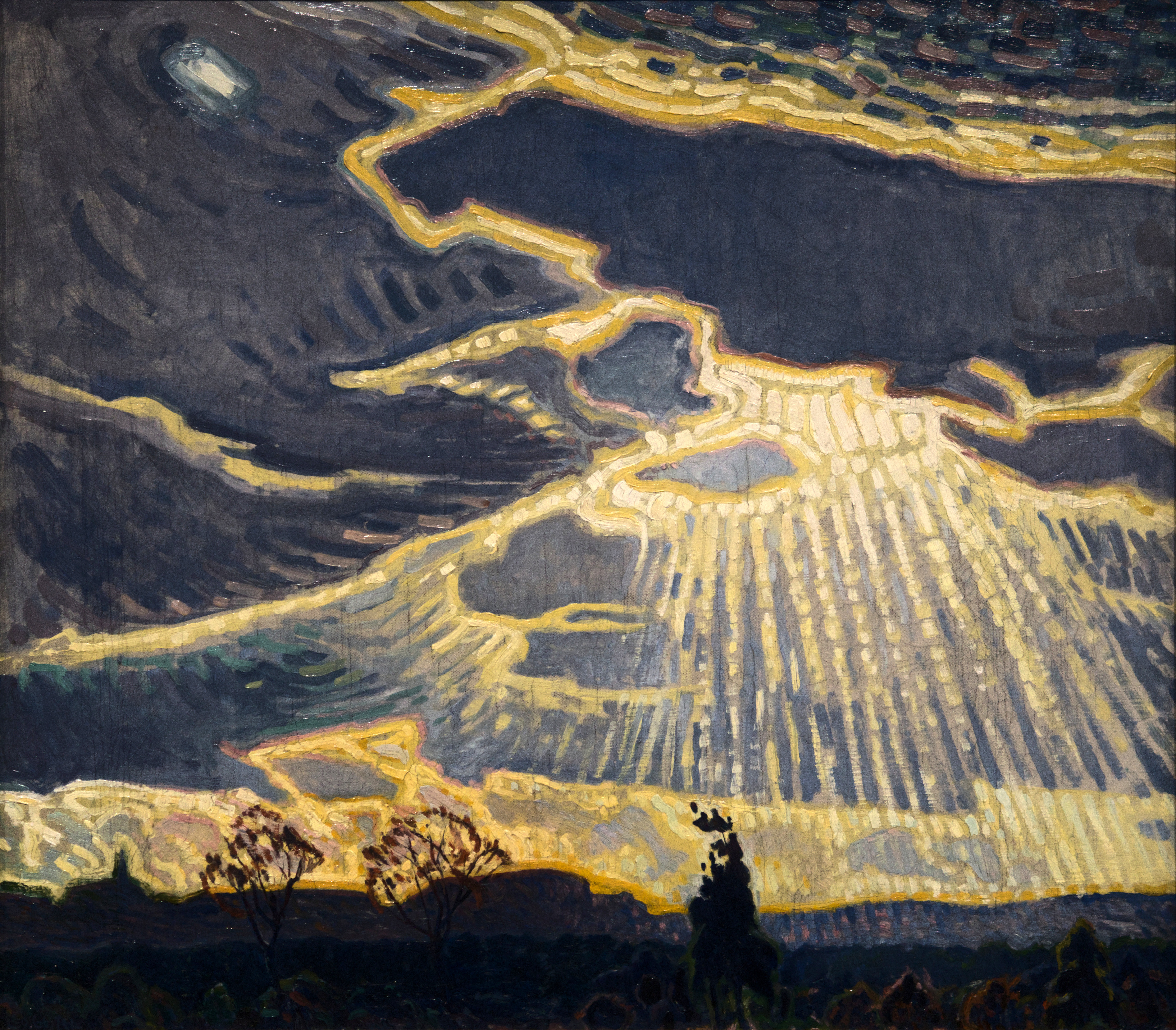
Leo Gestel (Dutch, 1881–1941), Autumn, 1909. Oil on canvas, 53.5 × 61 cm. Museum Kranenburgh, Bergen, Netherlands. Photo: Victoria Emily Jones.
You, Sunshine,
strand of pearls,
lay yourself down
on a country pond
one at a time
. . . . . . . . . . .
You, Sunshine,
bountiful benefactor,
. . . . . . . . . . . . . . . . .
dangle your golden earrings
never grow old
teach me to roam.
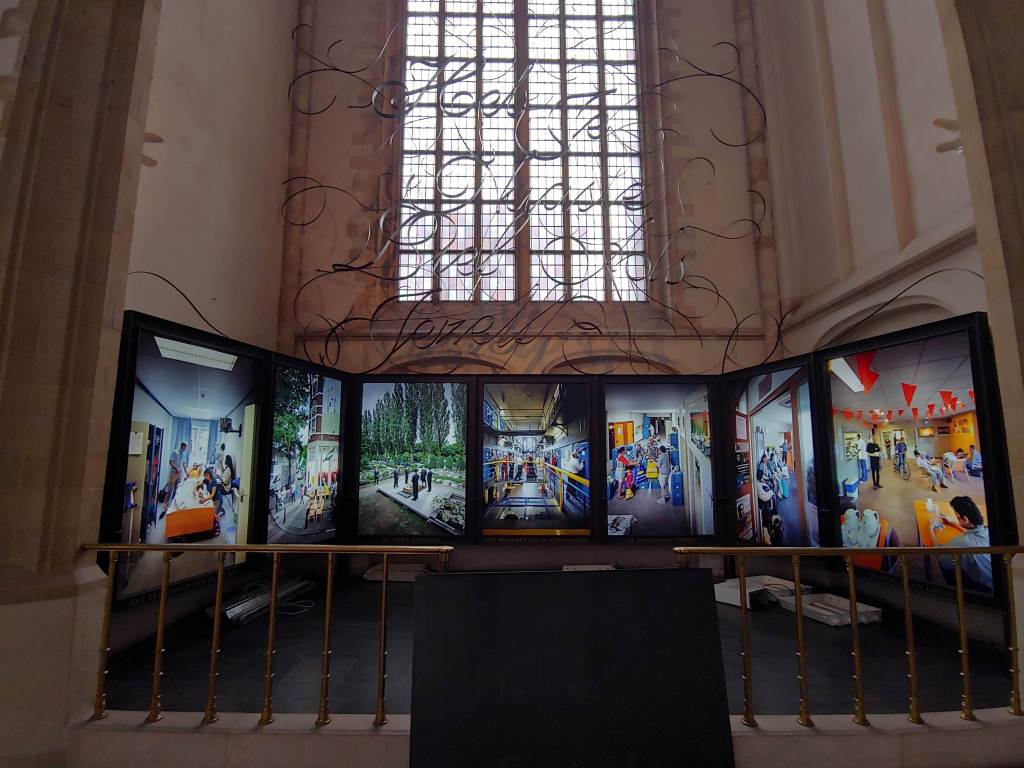
RADIX ARTICLE: “The Seven Works of Mercy: How two Dutch artworks—one Renaissance, one contemporary—can help us recover an ethic of neighborly care” by Victoria Emily Jones: When I was in the Netherlands last year, I saw lots of artistic representations of what are called the seven works of mercy, derived from Matthew 25. (Even after the Protestant Reformation, the subject remained popular among Dutch artists, who delighted in representations of everyday life.) In this article, published last week, I share just two. One is a multipaneled painting, now at the Rijksmuseum, commissioned in 1504 by the Holy Ghost Confraternity in Alkmaar, which ran an almshouse that provided medical care for the sick and housing for the poor (social welfare programs were carried out by the church in those days); notably, in each contemporary townscape, Jesus stands among the afflicted—a theologically loaded artistic choice. The other artwork is a set of photographs by Thijs Wolzak on display inside Rotterdam Cathedral, which feature community service organizations in action, caring for drug users, undocumented immigrants, and others. (Note: The chapel was in a bit of disarray when I was there, with light fixtures disassembled all over the floor and a ramp blocking my entrance, hence the messy staging of my photo! See a professional photograph in the article link, including photos of individual panels.)
Master of Alkmaar, Feeding the Hungry, leftmost panel from the Seven Works of Mercy polyptych, 1504. Oil on panel, 103.5 × 55 cm. Rijksmuseum, Amsterdam. The inscription on the original frame underneath (not pictured) is a rhyming Dutch couplet: “Deelt mildelick den armen / God zal u weder ontfarmen” (Share generously [with] the poor, [and] God shall have mercy on you).Thijs Wolzak (Dutch, 1965–), in collaboration with Kathelijne Eisses, Werken van Barmhartigheid (Works of Mercy), 2010. Duratrans prints in light boxes. Chapel of Works of Mercy, Sint-Laurenskerk (Church of St. Lawrence), Rotterdam, Netherlands. Photo: Victoria Emily Jones.
It’s interesting to consider the overlap of Christian and civic duty the images present and the way in which they function(ed) in their disparate spaces. The more explicitly theological Alkmaar polyptych was originally owned by a lay brotherhood and sited in a church beside the collection box, and its primary purpose was “to stir up . . . to love and good works” (Heb. 10:24), and to financial giving—but it is now in a large, government-run art museum, where it’s viewed mainly as an art historical object. The Wolzak piece, on the other hand, was commissioned as a permanent installation inside an active church that is also a heritage museum and something like a community center, with the purpose of highlighting the charitable work being done in the city. I like how Wolzak helps us to see where some of the needs lie in contemporary society and examples of tangible ways they might be met, through such services as safe-injection sites (for those suffering from heroin addiction) or the Lonely Funeral Foundation (for the anonymous dead).
NEW BOOK: Off the Walls: Inspired Re-Creations of Iconic Artworks: This March on social media, the Getty Museum issued the #GettyMuseumChallenge, inviting art lovers to channel the stir-crazy energy of COVID-19 quarantine into crafting themselves, their families, and their pets into masterpieces of world art and posting the photos online. By May there were at least 100,000 re-creations uploaded to the Internet—246 of which are featured in the new book Off the Walls, released this month by Getty Publications. All profits from the book will go to the charity Artist Relief to support artists facing financial emergencies to the coronavirus pandemic. This is such a fun way to get people to engage with art!
+++
NEW SONG RELEASES
“Hallelujah (Come Bless the Lord)” by September Penn:September Penn is a singer, songwriter, performance artist, worship leader, and cofounder of The Power of Song Inc., an organization that educates about social justice issues through song, theater, and art. She wrote “Hallelujah” while directing the Kaleo Choir at Fuller Theological Seminary, where she earned an MDiv this year with a focus on Worship, Theology, and the Arts. The song was released September 3 as a single on all music-streaming platforms.
“Nara Ekele Mo” by Tim Godfrey, performed by Resonance: Last month the Global Resonance Multicultural Worship Collective, under the organization Arts Release, posted on YouTube a multicontinent, multilingual cover of the Nigerian Igbo song “Nara Ekelo Mo” by Tim Godfrey. It features thirty-seven singers from Brazil, England, France, Indonesia, Singapore, and Spain, with lyrics in Igbo, Yoruba, Tamil, Bahasa Indonesia, French, Mandarin, Portuguese, Spanish, and English. (See the original version of the song here.) [HT: Global Christian Worship]
+++
POEMS
“Field Guide” by Tony Hoagland: A few weeks ago SALT Project reprinted this poem that celebrates the ordinary in nature—along with brief commentary and a stunning macrophoto of a dragonfly. An excerpt from the opening chapter of Ralph Waldo Emerson’s essay “Nature” is referenced: “If the stars should appear one night in a thousand years, how would men believe and adore; and preserve for many generations the remembrance of the city of God which had been shown! But every night come out these envoys of beauty, and light the universe with their admonishing smile.” (The poem is from Hoagland’s 2010 collection Unincorporated Persons in the Late Honda Dynasty, published by Graywolf Press.)
from the current issue of Image:Image journal is the one piece of mail I most look forward to receiving every quarter—full of poetry, visual art, literary essays, and short stories with a spiritual sensibility. In its current issue, no. 105, some of the poems I particularly enjoyed were “Trench Coat” by Cameron Alexander Lawrence, on the accumulation of things; “Pastoral with Wheat” by John Hart, on fatherhood as beatitude, and as a continual lesson in dying to self; “Duet” by Chelsea Wagenaar [previously], about the “music” of the ordinary moments of motherhood, like tending to your child’s bee sting; and “The Eighth Sacrament” by Peter Cooley, on grief, written after the death of his wife, Jacqueline.








 Art & Theology