As the liturgical calendar was turning over into a new year this week, my husband Eric and I were at the tail end of a visit to India, staying with new friends Jyoti and Jane Sahi. Jyoti’s an artist, and Jane is a children’s educator, and together they live in the Christian village of Silvepura, north of Bangalore, where for years they ran, respectively, an art ashram and a school. It was a lot of fun getting to know them and their work, and discussing art, culture, theology, politics.
Before our flight departed in the wee hours of Sunday morning, the first day of Advent, Jane had set an oil lamp on the dinner table, decorated with flowers from the garden, and selected two poems for us to read aloud: an excerpt from the Gitanjali(Song Offerings) by Bengali poet Rabindranath Tagore [previously], and “Advent Calendar” by Rowan Williams. It was a meaningful welcoming in of the new season, and a beautiful blend of our hosts’ mixed cultural heritage: Indian and British.
All photos by Victoria Emily Jones
Gitanjali XLVby Rabindranath Tagore:
Have you not heard his silent steps? He comes, comes, ever comes.
Every moment and every age, every day and every night he comes, comes, ever comes.
Many a song have I sung in many a mood of mind, but all their notes have always proclaimed, “He comes, comes, ever comes.”
In the fragrant days of sunny April through the forest path he comes, comes, ever comes.
In the rainy gloom of July nights on the thundering chariot of clouds he comes, comes, ever comes.
In sorrow after sorrow it is his steps that press upon my heart, and it is the golden touch of his feet that makes my joy to shine.
“Advent Calendar”by Rowan Williams, published in After Silent Centuries (The Perpetua Press, 1994) and The Poems of Rowan Williams (The Perpetua Press, 2002; Carcanet Press, 2014):
He will come like last leaf’s fall.
One night when the November wind
has flayed the trees to bone, and earth
wakes choking on the mould,
the soft shroud’s folding.
He will come like frost.
One morning when the shrinking earth
opens on mist, to find itself
arrested in the net
of alien, sword-set beauty.
He will come like dark.
One evening when the bursting red
December sun draws up the sheet
and penny-masks its eye to yield
the star-snowed fields of sky.
He will come, will come,
will come like crying in the night,
like blood, like breaking,
as the earth writhes to toss him free.
He will come like child.
While I was at Jyoti’s, I bought three paintings of his. One of them is an Annunciation image that shows Mary in a termite mound, which are considered sacred in India—microcosms of the temple, sources of fertility, and containers of treasure. I saw these tall, hard, insect-built structures in many areas around Bangalore where I was traveling, including a few on Jyoti’s property. (Note that locals refer to termites misleadingly as “white ants,” so these are “anthills.”)
Jyoti Sahi (Indian, 1944–), Incarnation within the Anthill, 2019. Mixed media on canvas, 28 × 10 1/2 in. (71.1 × 26.7 cm). Collection of Victoria Emily Jones.
Anthill at Vishram in Silvepura with a Mary figure at the base, made of leaves and bark
According to Indian folklore, anthills are the ears of the earth, and Jyoti plays on that belief in his visualization of the moment of the Incarnation, of God’s becoming human in the person of Jesus. Mary’s womb is in the shape of an ear, which receives the Word of God. This Word is shown first at the top of the composition in the form of two hamsas (Sanskrit for “I am he,” or “I am that I am”), a mythical swan-like bird whose body resembles an AUM, the ancient threefold syllable, “the Sound that is believed to reverberate creatively through eternity,” Jyoti said. (“In the beginning was the Word . . .”)
Mary listens to the Word, becomes pregnant with the Word, which takes on flesh inside her. Christ, the primordial One, is implanted in the womb of the earth, of humanity—and a tree of life grows forth.
There’s a sixth-century hymn, known as the Akathist Hymn to the Theotokos (Mother of God), that celebrates Mary’s role as container of the Divine: “Hail! tabernacle of God and the Word. Hail! greater than the holy of holies. Hail! ark gilded by the Spirit. Hail! unfailing treasure-house of life.” Mary as temple, as holy of holies, as ark of the covenant, contains the world’s greatest Treasure: Jesus Christ, the Son of God.
You can hear Jyoti introduce the painting in the short video above, which is just a snippet of the footage Eric and I took while we were there. (More to come!)
As I traveled back home to the US with this rolled-up canvas last Sunday, I kept thinking about the words of the two poets I had just read—Tagore and Williams. I thought about how Christ came once “like child” but also how he “comes, comes, ever comes” even still today, “in sorrow after sorrow . . . press[ing] upon my heart . . . mak[ing] my joy to shine.”
ADVENT RESOURCES: Advent is just over a month away, and once again, SALT Project [previously] has produced some wonderful new devotional resources: (1) a customizable “Say Yes!” video for churches (see below), (2) a set of five unique “Say Yes” placements in three different color schemes, including black-and-white to be colored in by you and/or your family (note: these are sold as a digital download, so you will have to print and laminate them yourself), and (3) “Advent and Hygge: The Art of Coziness,” five devotional table tents, one for each week of Advent and a fifth for Christmas Eve/Day (promo video below).
“The Porter’s Gate is a sacred ecumenical arts collective reimagining and recreating worship that welcomes, reflects and impacts both the community and the church. The group was founded in 2017 by Isaac and Megan Wardell with a mission to be a ‘porter’ for the Christian church—one who looks beyond church doors for guests to welcome. It started as a group of 50-plus songwriters, musicians, scholars, pastors and music industry professionals from a variety of worship traditions and cultural backgrounds who gathered to discuss challenges in the church and write songs in response.”
+++
ARTICLE: “The Best Christian Albums of the 2010s”: Three of my choices for top Christian albums of the decade were selected for this Gospel Coalition article—and I got to write about them! Liz Vice (whom I saw in concert this year), Psallos, and Poor Bishop Hooper are creating excellent, exciting, soul-nourishing music that every Christian should know about; these albums of theirs that I’ve blurbed make a good entryway into their fuller body of work.
+++
POETRY COLUMN: “Poetry Rx,”The Paris Review: Launched in March 2018, “Poetry Rx” is a column in which “readers write in with a specific emotion, and our resident poets—Sarah Kay, Kaveh Akbar, and Claire Schwartz—take turns prescribing the perfect poems to match.” Some letter writers need hope or forgiveness; others, self-motivation or courage. Others want to feel love, or want to know how to express immense gratitude, or joy. Schwartz writes, “When I sit down to answer these letters, I often find myself reflecting on the purpose of my response. What should the poem offer? Challenge? Company? Direction? Language for an old feeling? A way toward new possibility?”
I’ve so appreciated not only the prescribed poetry but also the vulnerability of the letter writers, who present complex cocktails of feelings that show the multifariousness of being human. For example, the September 5 write-ins were: someone who is terrified of forgetting little pieces of a loved one who has died; a college student experiencing a growing apart from her childhood BFF and who is therefore lamenting the loss of “the magic that is young female friendship”; and a novelist who is hurt that her boyfriend and mother are not interested in reading her latest book (“I am destroyed that those who urged me to chase my dreams now cannot be bothered to witness them. . . . Do you have a poem for me that can ease the loneliness of being a writer? Of creating a world that those you love will not step into?”). How to be optimistic for your partner, how to work through feelings of restlessness, how to deal with a loved one’s addiction, how to manage the inevitable losses inherent to the medical profession, how to navigate the disorientation following a loss of faith, how to make last an ecstatic moment in nature, how to persevere as a schoolteacher who is pouring all her intellectual passion into a seeming void (bored students)—these are all situations for which poetic wisdom or solace is sought.
One woman wrote in looking for a poem “for a mother’s love.” (“My love for my daughter sometimes feels terrible and desperate and weighty with responsibility. But also sweet and tender and silly.”) Kay prescribed “Saying Our Names” by Marianne Murphy Zarzana, which begins,
Notice how just one syllable—
say Jack—can expand and become
the world, round and whole,
when it is a child’s name
being formed by a mother’s mouth.
For someone who is “unfamiliar with the geography of joy” and wants to learn how to navigate that space, Akbar recommends “So Much Happiness” by Naomi Shihab Nye, which begins,
It is difficult to know what to do with so much happiness.
With sadness there is something to rub against,
a wound to tend with lotion and cloth.
When the world falls in around you, you have pieces to pick up,
something to hold in your hands, like ticket stubs or change.
i pledge allegiance to my
homies to my mother’s
small & cool palms to
the gap between my brother’s
two front teeth & to
my grandmother’s good brown
hands good strong brown
hands gathering my bare feet
in her lap
Introducing the column, the “doctors” wrote,
No, I don’t think that poetry will save us. And yet, and yet . . . The “and yet” is what this column is for. And yet, maybe we can find poems that vibrate at the same frequency that your heart is humming. And yet, maybe we can find a poem you can escape inside of for a few minutes. And yet, maybe you just needed an excuse to share the vulnerable parts of yourself, and what better way to honor that courage than to offer you the poems that carry us through our own vulnerable times.
If you’re feeling something that you want to see reflected back to you in poetry or through which you want poetry to guide you, write in!
+++
TV SERIES: Civilizations: Released last year and available on Netflix, Civilizations is a global art history series in nine episodes that “examine[s] the formative role of art and the creative imagination in the forging of humanity.” It expands on Kenneth Clark’s 1969 landmark series, Civilisation, which was criticized for covering only Western art history. Its three presenters are Simon Schama, Mary Beard, and David Olusoga.
As with any project of this scope, criticisms are bound to arise (several are mentioned, for example, in the mixed review from Hyperallergic), especially in how cultural interaction and exchange are discussed. But this focus on said interactions is, in my opinion, a hallmark of the series, and I think it was handled well overall. Rather than showing cultural production happening all over the globe in isolated pockets, it shows a mutual influencing in various directions. Episode 4, “Encounters,” is particularly dedicated to this theme, though it recurs throughout. Narrator Liev Schreiber opens that episode:
From the moment they meet, civilizations begin to influence one another’s art. During the 15th century, European sailors embarked on a new age of exploration. Cultures that previously were vast oceans apart now met for the first time. But before this became a story of conquest, plunder, and empire, there was a forgotten era of discovery. And for many, this was a golden age, when curiosity, mutual respect, and the exchange of goods and ideas were recorded in the art of countless human encounters.
So yes, you can see from this quote that the series does tend toward Westocentrism—but given that it was produced by Nutopia for PBS and BBC, I’d say that was unavoidable. This episode highlights, among many other artworks, Benin bronzes from what is today Nigeria (whose artists acquired their raw materials from Muslim merchants crossing the Sahara and, later, the Portuguese); namban screens from feudal Japan; the folk art associated with Day of the Dead in Mexico (a fusion of Aztec beliefs and Catholicism), as well as the Aztec influence on the gory religious art of the Spanish Baroque; and zoological and botanical illustrations, including Dürer’s famous rhinoceros woodcut (based on a written description of a rhino that was sent to Lisbon as a diplomatic gift from India) and the revolutionary drawings of naturalist Maria Sibylla Merian, a woman from seventeenth-century Holland who traveled unaccompanied to Surinam in South America to document the plants and insects there.
In episode 5, “Renaissances,” I learned that at the same time Michelangelo was building St. Peter’s dome in Rome, the famous Turkish architect Mimar Sinan was building Süleymaniye Mosque in Istanbul, both men vying for world’s biggest dome, to eclipse the Hagia Sophia. Michelangelo was aware of Sinan’s building projects through diplomatic and commercial reports. The East was also aware of the West—the Ottoman sultans invited Michelangelo and Leonardo in the early 1500s to build bridges in Istanbul.
Religion, of course, is a major through line, and there’s a whole episode (number 3), “God and Art,” devoted to it.
I also really enjoyed episode 6, “Paradise on Earth,” about landscape art from around the world. It covers, among others, Chinese ink brush paintings, carpet weaving in Pakistan and Morocco, Jacob van Ruisdael and other Dutch landscape painters, J. M. W. Turner and Romanticism in England, the Hudson River School in America, Anselm Adams, and Hubble Space Telescope photography.
The whole series is beautifully shot and presented, and I recommend it. It enlarged my vision of the beauty of other cultures.
On September 15 I was invited by North Decatur Presbyterian Church in Georgia to lead a visio divina exercise during their morning worship services. Visio divina, or sacred seeing, is the practice of gazing on an image and opening yourself up to receive the gift that it holds. I approach images this way all the time, and while some people formalize the practice with a set of steps to follow, timed silences, restrictions, and such, my approach is a bit looser.
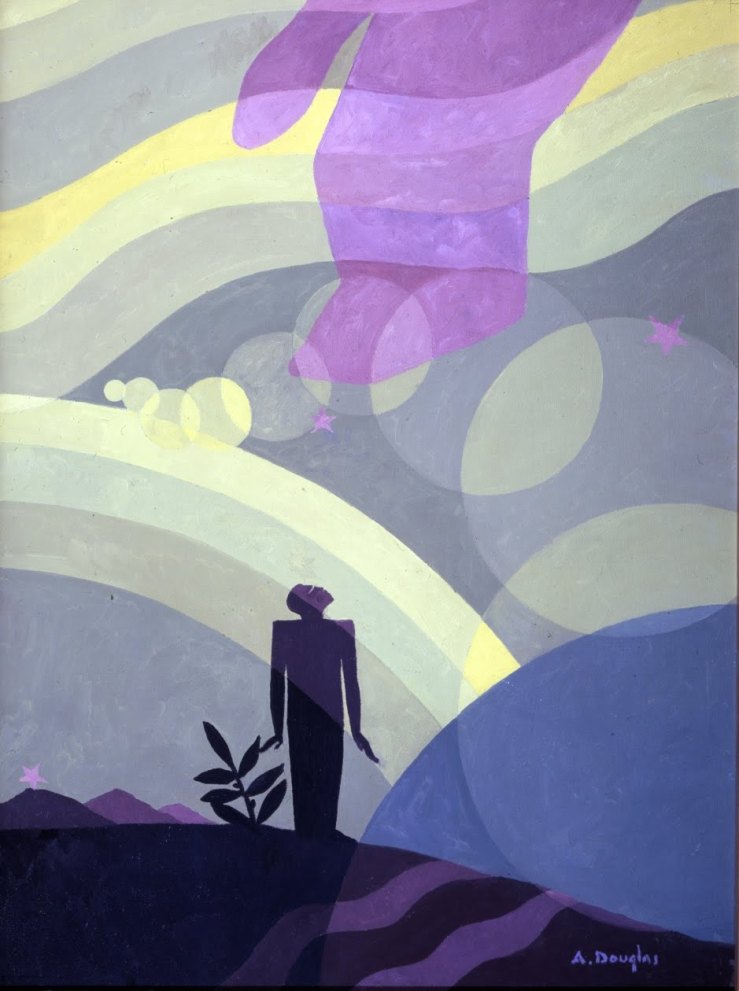
Because Pastor David Lewicki was preaching on Genesis 2, I chose Aaron Douglas’s painting The Creation. The leadership had already programmed in a reading of the James Weldon Johnson poem that directly inspired the painting, so introducing this visual corollary seemed particularly appropriate.
Note: I disagree with the popular notion, perpetuated by Johnson, that God created humanity because he was lonely; because he is in himself a loving community of Three, he did not lack companionship. Lewicki addresses this concern somewhat in his sermon and rightfully notes how the Genesis 2 creation account presents a God who is closer to humanity and the created world (he digs in the dirt!) and more vulnerable and improvisational than the God we meet in Genesis 1. I don’t believe Johnson’s beautiful poem should be scrapped because of those two (in my opinion) theologically problematic lines, but discretion should be used before presenting it in a worship context. For example, this wouldn’t fly at my church. The NDPC congregation, however, is more welcoming of imaginative engagements with the biblical story that might challenge traditional readings, so those lines were not for them impediments to worship, and I appreciated that Lewicki commented on them in his sermon, wondering about the “holy longing” the Creator must have felt for us.
Below are Johnson’s poem, Douglas’s image, and the transcript of my contribution, which I peppered with substantial pauses. To promote a better visio divina experience on your computer, I’d recommend right-clicking the image and selecting “Open link in new window,” then split-screening that window with this one; that way, you can more easily reference the image while you read. (In the future, I will try to produce audio for exercises like these.)
+++
Aaron Douglas (American, 1899–1979), The Creation, 1935. Oil on Masonite, 48 × 36 in. Howard University Gallery of Art, Washington, DC.
“The Creation”by James Weldon Johnson
And God stepped out on space,
And he looked around and said: I’m lonely— I’ll make me a world.
And far as the eye of God could see
Darkness covered everything,
Blacker than a hundred midnights
Down in a cypress swamp.
Then God smiled,
And the light broke,
And the darkness rolled up on one side,
And the light stood shining on the other,
And God said: That’s good!
Then God reached out and took the light in his hands,
And God rolled the light around in his hands
Until he made the sun;
And he set that sun a-blazing in the heavens.
And the light that was left from making the sun
God gathered it up in a shining ball
And flung it against the darkness,
Spangling the night with the moon and stars.
Then down between
The darkness and the light
He hurled the world;
And God said: That’s good!
Then God himself stepped down—
And the sun was on his right hand,
And the moon was on his left;
The stars were clustered about his head,
And the earth was under his feet.
And God walked, and where he trod
His footsteps hollowed the valleys out
And bulged the mountains up.
Then he stopped and looked and saw
That the earth was hot and barren.
So God stepped over to the edge of the world
And he spat out the seven seas—
He batted his eyes, and the lightnings flashed—
He clapped his hands, and the thunders rolled—
And the waters above the earth came down,
The cooling waters came down.
Then the green grass sprouted,
And the little red flowers blossomed,
The pine tree pointed his finger to the sky,
And the oak spread out his arms,
The lakes cuddled down in the hollows of the ground,
And the rivers ran down to the sea;
And God smiled again,
And the rainbow appeared,
And curled itself around his shoulder.
Then God raised his arm and he waved his hand
Over the sea and over the land,
And he said: Bring forth! Bring forth!
And quicker than God could drop his hand,
Fishes and fowls
And beasts and birds
Swam the rivers and the seas,
Roamed the forests and the woods,
And split the air with their wings.
And God said: That’s good!
Then God walked around,
And God looked around
On all that he had made.
He looked at his sun,
And he looked at his moon,
And he looked at his little stars;
He looked on his world
With all its living things,
And God said: I’m lonely still.
Then God sat down—
On the side of a hill where he could think;
By a deep, wide river he sat down;
With his head in his hands,
God thought and thought,
Till he thought: I’ll make me a man!
Up from the bed of the river
God scooped the clay;
And by the bank of the river
He kneeled him down;
And there the great God Almighty
Who lit the sun and fixed it in the sky,
Who flung the stars to the most far corner of the night,
Who rounded the earth in the middle of his hand;
This Great God,
Like a mammy bending over her baby,
Kneeled down in the dust
Toiling over a lump of clay
Till he shaped it in his own image;
Then into it he blew the breath of life,
And man became a living soul.
Amen. Amen.
We are filled with the divine breath; we breathe God.
Take a moment to meditate on Aaron Douglas’s painting The Creation, made in response to the James Weldon Johnson poem that was just read.
What colors do you notice? What shapes? What movement? What shimmers for you in this image? Whatever it is, fix your eyes there. Now expand your gaze to encompass the whole image.
For me, what shimmers are the purples and blues, and especially the hand of God that reaches through the undulating atmosphere. In this image, creation swirls and dances, rises and rolls—the colors river every which way. Eight spheres—the planets, perhaps—float playfully like bubbles. It’s all a wondrous, dynamic, primordial burst of life, and we’re a part of it.
At the bottom, man emerges plant-like from the shadows, his face extending into an arc of light, the light of God. His feet are planted in the soil of earth, but heaven blazes all around him. He is an amphibious creature, belonging to both worlds, which here are united.
The poet uses maternal language to describe God’s ultimate creative act, saying that he knelt down at a riverbank and gently scooped up clay from its bed—then, like a mother coddling her baby, he formed humanity. Majesty stooping down in tenderness.
“Then into it he blew the breath of life,
And man became a living soul.
Amen. Amen.”
David Grossman (American, 1984–), Autumn Flight, 2018. Oil on linen panel, 30 × 40 in. Private collection.
It’s all a farce,—these tales they tell
About the breezes sighing,
And moans astir o’er field and dell,
Because the year is dying.
Such principles are most absurd,—
I care not who first taught ’em;
There’s nothing known to beast or bird
To make a solemn autumn.
In solemn times, when grief holds sway
With countenance distressing,
You’ll note the more of black and gray
Will then be used in dressing.
Now purple tints are all around;
The sky is blue and mellow;
And e’en the grasses turn the ground
From modest green to yellow.
The seed burrs all with laughter crack
On featherweed and jimson;
And leaves that should be dressed in black
Are all decked out in crimson.
A butterfly goes winging by;
A singing bird comes after;
And Nature, all from earth to sky,
Is bubbling o’er with laughter.
The ripples wimple on the rills,
Like sparkling little lasses;
The sunlight runs along the hills,
And laughs among the grasses.
The earth is just so full of fun
It really can’t contain it;
And streams of mirth so freely run
The heavens seem to rain it.
Don’t talk to me of solemn days
In autumn’s time of splendor,
Because the sun shows fewer rays,
And these grow slant and slender.
Why, it’s the climax of the year,—
The highest time of living!—
Till naturally its bursting cheer
Just melts into thanksgiving.
“Merry Autumn” by Paul Laurence Dunbar originally appeared in Oak and Ivy(Press of United Brethren Publishing House, 1893) and is now in the public domain.
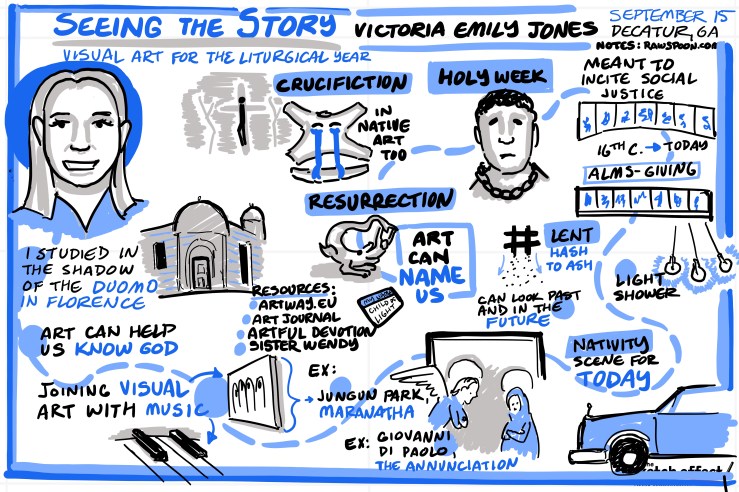
Last weekend I was in Atlanta giving a talk on art and theology at North Decatur Presbyterian Church as part of the church’s “God’s Creative Story” program, enabled by a Vital Worship Grant from the Calvin Institute of Christian Worship. One of the attendees, Ross Boone (aka Raw Spoon), a local artist, took “sketch notes” of the talk, which I am so delighted by! I am posting them here with his permission. He does a lot of faith-inspired digital illustration, often in partnership with churches; you should definitely check him out.
For “Seeing the Story: Visual Art for the Liturgical Year,” I used fifteen artworks, a mix of historical and contemporary, to chart a way through the church calendar, showing how art opens us up to the beauty of God’s story and helps us to see ourselves as participants in that story.
I really enjoyed getting to meet and worship with the folks at NDPC, and to continue the art conversation with them over the weekend. There was lots of engagement, which was really encouraging. Ellen Gadberry showed me some of the projects made by the liturgical art group she leads at the church. Many involved repurposed bulletins, which I love! One that’s currently in progress picks up on the lozenge shape present in the church’s architectural design, drawing on its symbolic use in Celtic art. Ellen also brought me to the High Museum of Art to see the new Romare Bearden exhibition and, at my request, the Clark Atlanta University Art Museum, where three new exhibitions, curated from the museum’s wonderful permanent collection, opened Sunday afternoon. (The museum was closed when we were there on Friday, as the art and signage were still being hung, but the curator graciously let us in for an unofficial preview!)
+++
CALL FOR RESEARCH PROPOSALS: Through its new Art Seeking Understanding initiative, the Templeton Religion Trust anticipates granting $12 million in funding over the next five years to research projects that connect art and spirituality. In particular: “Is there an empirically demonstrable connection between art and understanding? And if so, what distinctive cognitive value does engagement with the arts (production and/or consumption) generate? Under what conditions and in what ways does participation in artistic activities encourage or stimulate spiritual understanding, insight, or growth (meaning- or sense-making)?
“We’re bringing together writers, poets, painters, sculptors, musicians, dancers, filmmakers – artists of all kinds – as well as art historians and musicologists with philosophers, theologians, and scientists from a variety of sub-disciplines within the psychological, cognitive, and social sciences to conceive and design empirical and statistical studies of the cognitive significance of the arts with respect to spiritual realities and the discovery of new spiritual information.”
+++
POETRY BOOK CONTEST: Paraclete Press invites poets to submit a book-length (unpublished) manuscript for consideration of the inaugural Paraclete Poetry Prize, with a deadline of January 30, 2020. Two winners will be selected by a three-judge panel and announced April 1, 2020. Both prizes involve cash and book publication. Paraclete, the publishing arm of the Community of Jesus, publishes some of today’s best spiritual poets, including Scott Cairns, Paul Mariani, Jeanne Murray Walker, Luci Shaw, and Tania Runyan.
+++
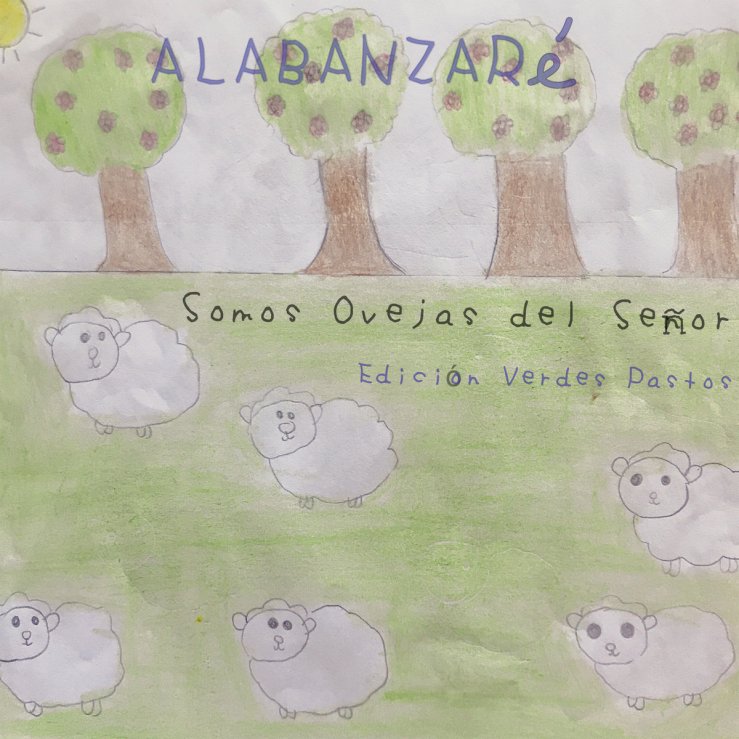
ALBUM FOR IMMIGRANT CHILDREN:Somos Ovejas del Señorby Alabanzaré: Jared Weatherholtz is the director of a South City Church Hispanic ministry called Refugio, through which he teaches the Bible, develops worship resources, invests in relationship, and helps immigrants navigate life in St. Louis. He said US immigration policy has been taking a toll on the community he serves, especially its children, who fear going to school not only because of the bullying they encounter (“Go back to where you came from!”) but also because they could come home to no parents (detained by ICE).
As “a way to care for [the kids] and show them God’s goodness and promises to them through music,” Weatherholtz wrote the song “Somos Ovejas del Señor” (We Are the Sheep of the Lord), based on Psalm 23. The kids really took to it, and it became the seed for an entire album, recorded last year in Mexico City under the moniker Alabanzaré (“I Will Praise”). To learn more about the inspiration behind and making of the album, watch the half-hour documentary below. For English subtitles, click the “CC” button on the video player.
“I want immigrants and children of immigrants to hear and to know that they are important, that they have worth in this life, that they bear the image of God,” Weatherholtz said. “God is present, taking care of them.”
The album gives children a language of prayer and praise that they can sing amid their present circumstances. The opening track, “Espíritu Santo, Compañero Fiel,” celebrates the Holy Spirit as a faithful companion in good times and bad, accompanying us at school, when we play, and when we sleep. In “Como Niños,” Jesus invites boys and girls to “come closer,” tells them they’re small in size but big in faith—they’re wise and revolutionary. “Necesito Tu Ayuda, Oh Dios” is a prayer for protection, beginning “I need your help, oh God / Great sorrows I bring today / I feel sad and I don’t know what to do / Come to me soon, Protector.”
ARTICLE: “The Hidden Life of a Forgotten Sixteenth-Century Female Poet” by Jamie Quatro, New Yorker: Quatro writes about her distant relative Anne Vaughan Lock, a poet, translator, Calvinist religious figure, and, significantly, the first writer to publish a sonnet sequence in English. A gloss of Psalm 51, Lock’s “A Meditation of a Penitent Sinner” comprises twenty-six poems, published in 1560, thirty-one years before Philip Sidney’s “Astrophil and Stella” (long held to be the world’s first English sonnet sequence). “Lock’s cardinal place in the history of the sonnet cycle may not be news to scholars. But for me—a poetry-loving, feminist, conflicted Protestant English-Ph.D. dropout—it was an endorphin-surge of a discovery.” [HT: ImageUpdate]
+++
DANCE: Last month I posted a dance number from my favorite television dance show, So You Think You Can Dance, and now I’m going to post another one—from September 2’s episode. Choreographed by Talia Favia, “Amen” is danced by Ezra Sosa, Gino Cosculluela, and Bailey Muñoz to a song by Amber Run. It’s not a religious song, but it does use the language of prayer (and is performed with a choir), which the choreography and set design highlight. The speaker of the song is presumably talking to his recently deceased lover, trying to come to terms with his grief, to accept the painful loss. An anguished “Amen”—“Let it be”—repeats throughout. The dance routine expresses rage in the face of death and the struggle to submit to what is. It’s a phenomenal performance by these three young men.
After nudges from several readers, I’ve decided to join Instagram! Follow me @art_and_theology. I’m still trying to settle on how I’d like to use the platform, but in the meantime, I’ve been sharing photos I’ve taken on visits to art museums and spaces that house sacred art. (And in case you don’t already know, Art & Theology is also on Facebook and Twitter.)
+++
DANCE: “Sign of the Times,” choreographed by Travis Wall: Premiering August 19, 2019, on Fox’s So You Think You Can Dance (season 16, episode 11), this contemporary dance piece is choreographer Travis Wall’s response to the gun violence epidemic in America. It’s a communal lament through movement, really—an expression of fear, sadness, pain, anger, frustration, and defiance. It is performed by this season’s “top ten”: Benjamin Castro, Gino Cosculluela, Eddie Hoyt, Madison Jordan, Anna Linstruth, Bailey Muñoz, Sophie Pittman, Mariah Russell, Ezra Sosa, and Stephanie Sosa.
+++
FEATURED POET: Marjorie Maddox: The latest installment of Abbey of the Arts’ Featured Poet series is, as usual, wonderful! I’ve read some of Maddox’s poems in magazines and anthologies but haven’t yet gotten my hands on one of her collections. This feature has incentivized me to request a copy of Transplant, Transport, Transubstantiation through my local library.
“The work of poetry,” Maddox writes, is “empathy and epiphany. The process of writing and reading allows us to better understand this world and the next. Poetry connects the local and universal, the mundane and the miraculous. It gives us those ears to hear and eyes to see that we might, then, head back into the turning world sustained, nourished, and willing to learn more. And will this not lead us to the Sacred? Yes, I say. Yes.”
+++
ESSAY: “Acts of Attention: On Poetry and Spirituality” by Robert Cording: I really enjoyed this essay from Image journal about the importance of attending to the world. “Attention is simply a loving look at what is,” writes Cording, a poet and birdwatcher. He discusses seeing not as a physiological act but as perceiving the fullness that exists in each moment. “Seeing is impossible without love or reverence,” he says. Along the way he engages with Marie Howe, Aristotle, Emerson and Thoreau, Tolstoy, Ruskin, Heidegger, Hopkins, Czesław Miłosz, and Marilynne Robinson. He also walks us through three poems: Robert Frost’s “Two Tramps in Mud Time,” Wallace Stevens’s “Man on the Dump,” and Seamus Heaney’s “The Pitchfork.” So much goodness here!
If you enjoyed this essay as much as I did, be sure to also check out “Cloud Shapes and Oak Trees,” also by Cording, from 2017.
+++
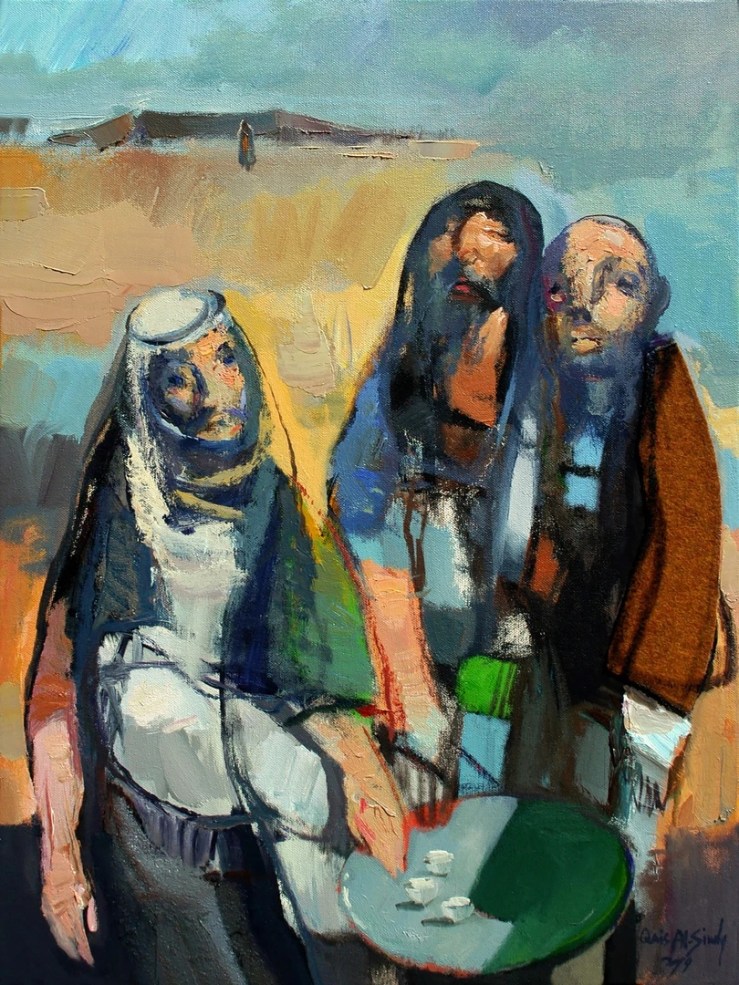
EXHIBITION: Abraham: Out of One, Many, curated by Rev. Paul-Gordon Chandler of Caravan: Caravan is an international nonprofit that uses the arts to build sustainable peace around the world. “Our peacebuilding work is based on the belief that the arts can serve as one of the most effective mediums to enhance understanding, bring about respect, enable sharing, and facilitate friendship between diverse peoples, cultures and faiths.”
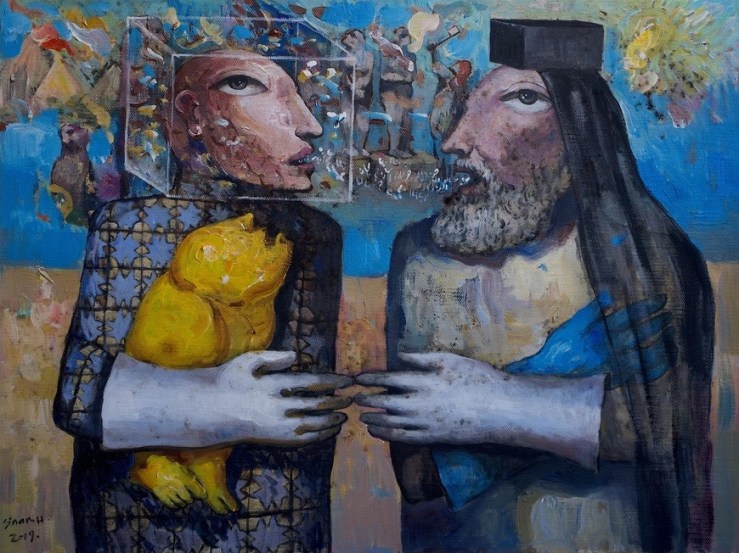
Caravan’s current exhibition is built around Abraham, a key ancestral figure shared by the world’s three major monotheistic religions: Judaism, Christianity, and Islam. Caravan commissioned three Middle Eastern artists, one from each of these faith traditions, to each create five paintings on these subjects: Living as a Pilgrim, Welcoming the Stranger, Sacrificial Love, The Compassionate, and A Friend of God. The exhibition of resulting works opened May 3 at St. Paul’s Within the Walls in Rome. From there it has traveled to Paris and Edinburgh and, starting September 8, will be in the States, touring through 2021 with stops in Boston, Atlanta, Houston, Washington, DC, Chicago, and more (see schedule). There’s an excellent digital catalog available, which contains full-color reproductions and descriptions of all fifteen paintings.
Sinan Hussein (Iraqi, 1977–), Living as a Pilgrim, 2019. Mixed media on canvas, 45 × 60 cm. Part of the “Abraham: Out of One, Many” exhibition organized by Caravan.Qais Al Sindy (Iraqi, 1967–), Welcoming the Stranger, 2019. Oil and collage on canvas, 60 × 45 cm. Part of the “Abraham: Out of One, Many” exhibition organized by Caravan.
+++
MUSICAL: In the Green by Grace McLean:Lincoln Center Theater’s LCT3 produces shows by new playwrights, directors, and designers, and for this summer, they commissioned a musical about the twelfth-century German mystic Hildegard of Bingen. (It finished its run on August 4, so I’m late in publicizing it—sorry!) A Benedictine nun and later abbess, Hildegard was also a composer, poet, dramatist, theologian, botanist, and healer—a true polymath. In the Green focuses on her relationship with her mentor, Jutta, just six years her senior.
Here’s Grace McLean, the show’s lyricist, composer, playwright, and player of Jutta, performing “Eve” (which uses looping technology!), followed by a short conversation between her and one of the other cast members. [HT: Still Life]
In a recent conversation, poet and novelist Joy Kogawa said, “We need to see each other’s eyes, and see each other through each other’s eyes.” Art, from all disciplines, can help us do that. Art can awaken our social conscience and breed empathy and understanding. It can serve as a vehicle for lament, a practice of voicing suffering before God. It can also widen our imaginations—that is, in part, our ability to think up creative solutions to problems both big and small. Here are just a few recent justice-oriented art projects that inspire me.
+++
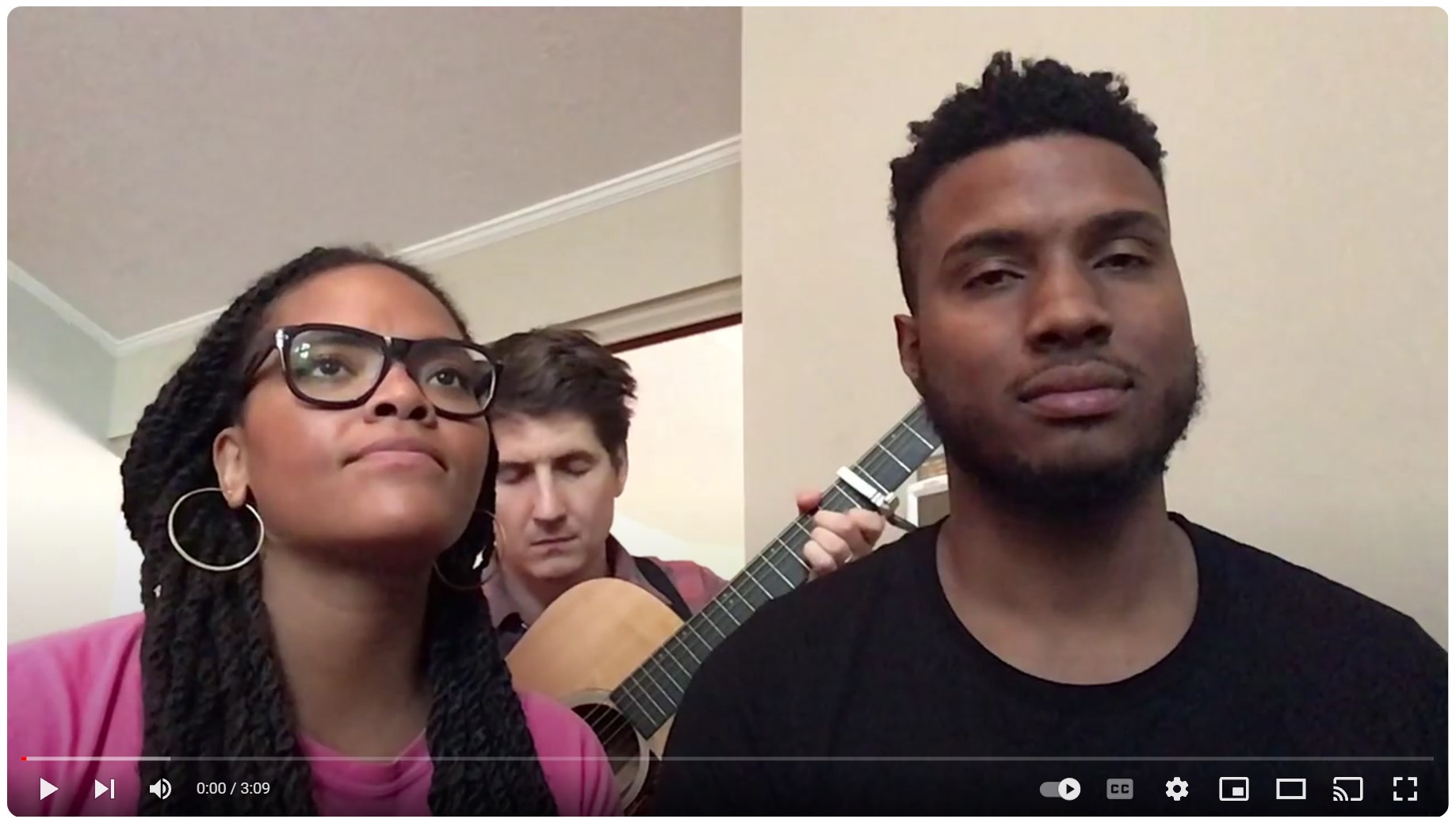
CLASSIC SONG REVISED: Earlier this month Liz Vice, Paul Zach, and Orlando Palmer took Woody Guthrie’s folk classic “This Land Is Your Land” and, gathering at Trinity Church in Charlottesville, Virginia, revised the lyrics and tone to project lament over some of America’s more troubling legacies. The lyrical turn happens in the fourth line: where we would expect “To the New York islands,” we get “To the Texas border,” turning our mind from the country’s beauty to its broken systems that prevent us from sharing abundance with our southern neighbors fleeing violence. The song continues to plot a path through various places of historical and present-day suffering in the US, the three stanzas compactly addressing immigration; slavery, the “New Jim Crow,” and police brutality against black people; and the forcible expulsion of Native Americans from their ancestral territories, as well as massacres and other forms of colonialist violence.
This land is your land
This land is my land
From California
To the Texas border
Through the Juarez mountains
With the migrant caravans
This land was made for you and me
This land is your land
This land is my land
From the piers of Charleston
To the fields of cotton
From the crowded prisons
To the streets of Ferguson
This land was made for you and me
This land is your land
This land is my land
From the Jamestown landing
To Lakota Badlands
From the Trail of Tears to
The reservations
This land was made for you and me
Most people don’t know it, but Guthrie actually wrote “This Land Is Your Land” as a protest against the vast income inequalities in the US. Two of its original verses, the radical ones, were nixed when it came time to record (it was the McCarthy era, after all); these referenced breadlines and tall walls with “No Trespassing” signs. In its original form, the song celebrated America as a place of natural abundance—forests and streams and wheat fields under “endless skyways”—while lamenting the scarcity that many Americans experience. The refrain, therefore, was more loaded. Learn more about the song’s history at https://www.npr.org/2000/07/03/1076186/this-land-is-your-land.
+++
An interactive art installation by Rael San Fratello on July 27, 2019, fostered cross-border interactions between residents of Sunland Park, New Mexico, and Colonia Anapra, Mexico.
SEESAWS AT THE BORDER: On July 27, Oakland-based creative duo Ronald Rael and Virginia San Fratello installed three bright pink teeter-totters through the slats of a section of the US-Mexico border wall that separates the neighboring communities of Sunland Park, New Mexico and Colonia Anapra, Mexico. Citizens on both sides were invited to ride this playground essential with a cross-border partner—a whimsical way to engage the other. As the creators said, it enabled people to literally feel the weight of humanity on the other side, using the wall as a fulcrum. The installation lasted forty minutes before it was dismantled (without incident).
I love this idea of play as protest—teeter-tottering as an act of creative defiance. What was enacted July 27 at the wall was a theater of the absurd, something that Rael, an architect, is especially drawn to in his practice. He actually conceived of Teeter-Totter Wall ten years ago, publishing a conceptual drawing in the book Borderwall as Architecture (University of California Press, 2009), along with other outlandish design possibilities for turning the wall into something that brings together rather than divides—these include its use as a massive xylophone played with weapons of mass percussion, a bookshelf feature inside a binational library, and more. Through these humorous proposals, Rael “reimagin[es] design as both an undermining and reparative measure,” as Dr. Marilyn Gates put it.
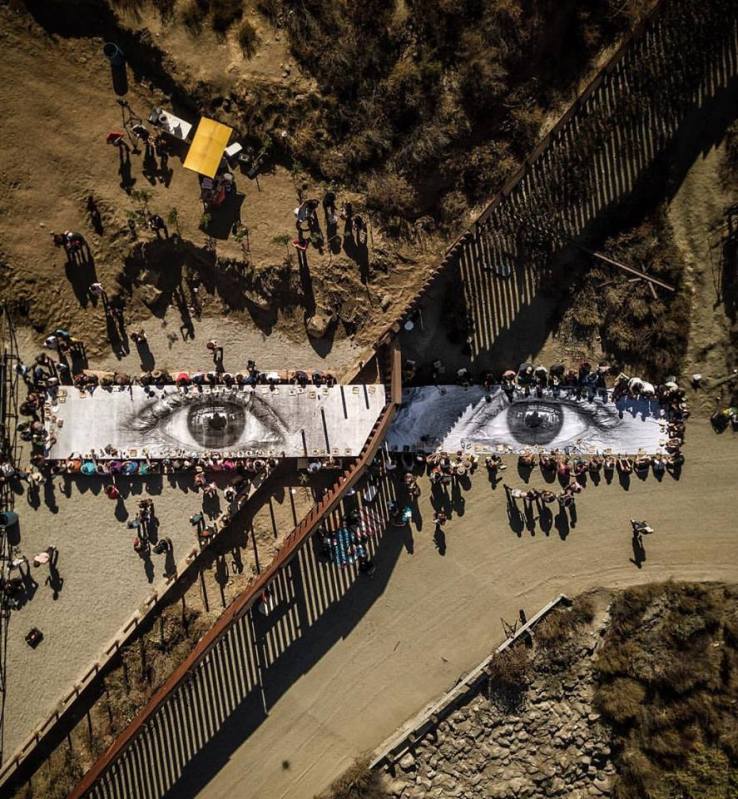
In his 2018 TED Talk, Rael discusses how the wall, meant to separate, has actually served to unite people in some instances. He mentions, for example, games of Wall y Ball, a variation on volleyball that was established at the wall in 1979, and binational yoga classes. I’ve heard of the Eucharist being celebrated jointly through the slats, and picnics hosted—such as the one organized in Tecate by the French artist JR on October 8, 2017: families passed plates of food between the bars, and musicians on both sides played the same songs.
A picnic at the US-Mexico border on October 8, 2017, organized by the elusive street artist JR
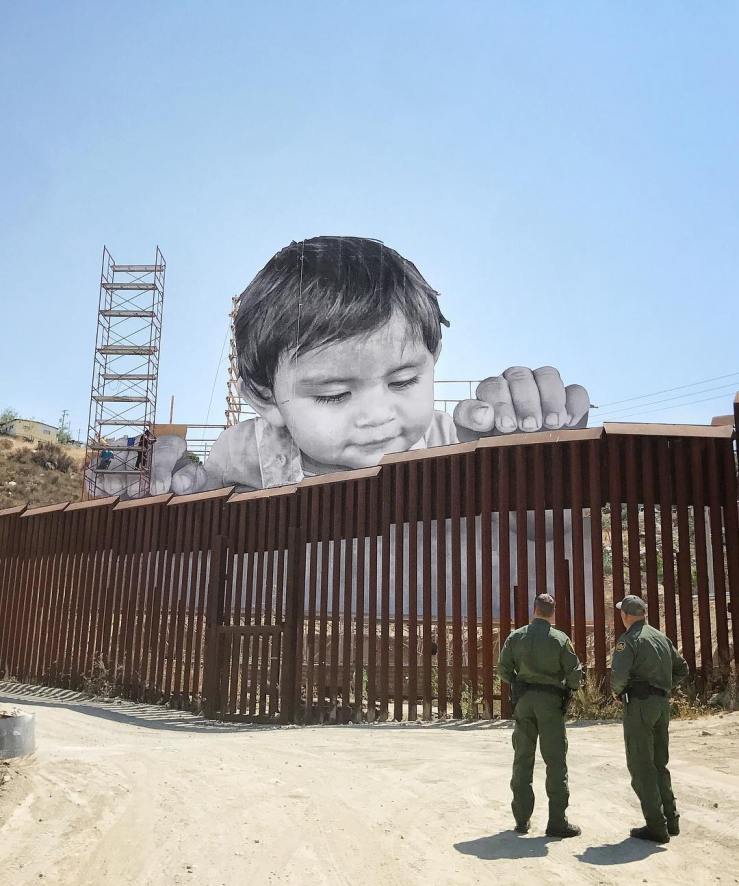
This picnic was the capstone of a month-long installation by JR featuring a monumental photograph of a Mexican toddler named Kikito, peering over the border wall into California from Tecate. (The photograph was held up with scaffolding.)
In early September 2017, street artist JR created a massive art installation on the Mexican side of the US border wall in Tecate showing a child, Kikito, peering over.
Shared play, shared food, shared music, shared sacrament—these are such breathtakingly beautiful countermeasures to separatism. The world needs more imaginative acts like these.
+++
POEM: Timothy E.G. Bartel has just published a new poem, “Status Check,” over at Curator. It’s only five lines, seven questions. A must-read. It’s not about immigration policy per se (it’s open-ended), but it took me back to another poem by Bartel that I featured back in 2017 as part of a blog post entitled “One sonnet vs. shouted prose: Lady Liberty, Emma Lazarus, and Trump.” Bartel has since published a freely downloadable chapbook (a compilation of Sapphic stanzas he wrote this year during National Poetry Month) and a traditionally published collection with Kelsay Books, Aflame but Unconsumed, which I just ordered and am excited about.
+++
VIRTUAL REALITY INSTALLATION: This was in DC last year and I missed it! A VR experience directed by the multi-Academy-Award-winning Alejandro G. Iñárritu, known for the films Birdman, The Revenant, Biutiful, and Babel, and shot by (also multiple-award-winning) cinematographer Emmanuel Lubezki. “Carne y Arenais a six-and-a-half-minute solo experience that employs state-of-the-art technology to create a multi-narrative space with human characters. . . . Based on true accounts from Central American and Mexican refugees, [it] blurs and binds together the superficial lines between subject and bystander, allowing individuals to walk in a vast space and live a fragment of a refugee’s personal journey.”
Image journal subscriptions are 50% off through the summertime—only $24 for four full-color issues! This is the magazine I most look forward to receiving in the mail. So much great poetry, art, essays, and more.
+++
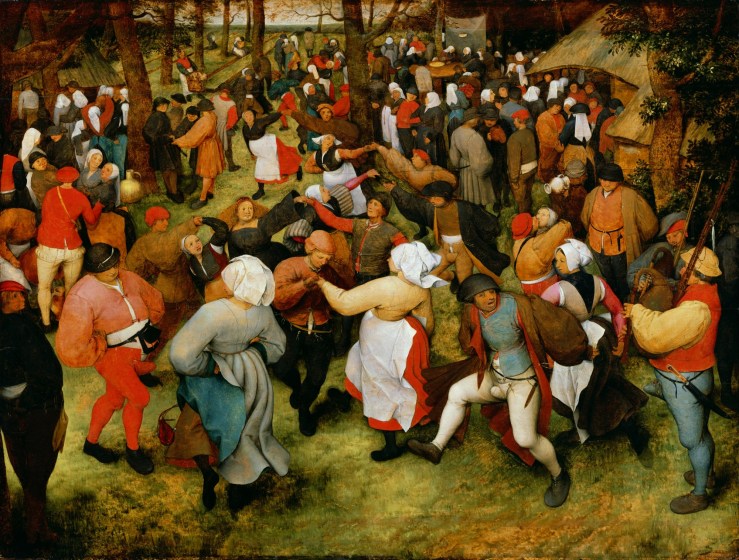
NEW POEM: “They Too Go Round” by Paul Mariani: This poem from the current issue of Image journal (no. 101) brings together Pieter Bruegel the Elder’s Wedding Dance with Fra Angelico’s Last Judgment at San Marco, gesturing toward a vision in which the terrestrial is taken up into the celestial. Bruegel’s Dutch peasant dancers “pound” and “rollick” with beer foam on their faces and general bawdiness; the saints from the Fra Angelico painting, by contrast, step lithely and with reverence in their round dance on the very grasses of paradise. Disparate though they are in tone, Mariani connects these two images, playing with the idea of circling. Just as the wedding guests dance round and round, so too does time; so too the spheres. And at the center of this cosmic round dance is praise: humanity linked hand in hand with the angels, not closed in on themselves but opening up into the glory of God.
Pieter Bruegel the Elder (ca. 1525–1569), The Wedding Dance, ca. 1566. Oil on panel, 119.3 × 157.4 cm. Detroit Institute of Arts, Michigan, USA.Fra Angelico (ca. 1395–1455), The Last Judgment (detail), ca. 1431. Tempera on wood, 105 × 210 cm. Museum of San Marco, Florence, Italy.
The last stanza quotes an excerpt from a famous medieval Catholic prayer: “Sinning daily, and not repenting, the fear of death disturbs me, for there is no redemption in Hell. Have mercy on me, O God, and save me.” The speaker’s anxiety has been building up as he reflects on the empty pleasures to which he has been so long devoted and the imminence of death. This anxiety, however, is swept away in one turn as he catches a glimpse of God’s abundant salvation and its final consummation—a “sea-changing moment, now and forever.” Christ, the fulfillment of all desire, sits on his throne at the center of this turning world, beckoning us into the dance of the redeemed.
(FYI, Paul Mariani will be one of the plenary speakers at the Catholic Imagination Conference at Loyola in September. Registration is still open!)
+++
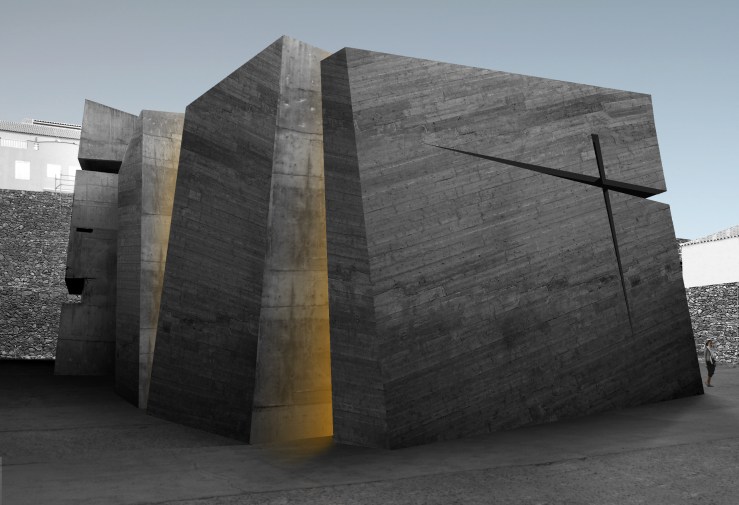
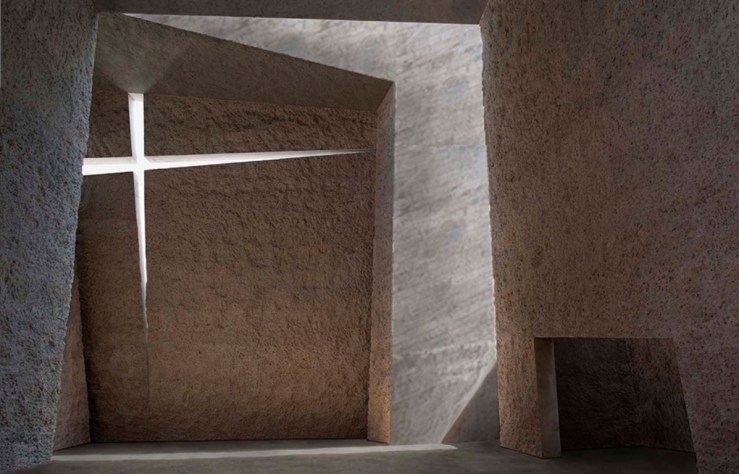
CHURCH ARCHITECTURE: Known for his work in concrete, Spanish architect Fernando Menis designed the new Holy Redeemer Church in Tenerife, Spain, consecrated May 12. I’m digging the minimalism. Learn more and view more photos on the architect’s website. [HT: ArtWay]
Holy Redeemer Church, Tenerife, Spain. Designed by Fernando Menis, completed 2019.Interior: Holy Redeemer Church, Tenerife, Spain. Designed by Fernando Menis, completed 2019.
+++
CHORAL ARRANGEMENT: “Dios es Nuestro Amparo” (God Is Our Refuge), arr. Alfredo Colman: I love this traditional setting of Psalm 46 in Spanish, recently arranged by Alfredo Colman and performed by the Coro del Seminario Internacional Teológico Bautista (Choir of the International Baptist Theological Seminary) in Buenos Aires, Argentina. [HT: Global Christian Worship]
I was curious about the history of the song, so I wrote to Colman; he said he first encountered it in Paraguay, where he grew up, but doesn’t know its country of origin. The song, he told me, has been well known in Latin America since the 1970s. While this particular arrangement of Colman’s has not yet been published, you can find a simpler arrangement for congregational singing in the bilingual hymnal Santo, Santo, Santo: Cantos para el pueblo de Dios / Holy, Holy, Holy: Songs for the People of God, released just this month. Edited by the Calvin Institute of Christian Worship (CICW) in partnership with GIA Publications, it contains over 700 songs in Spanish and English.
For a vision and resources for singing together in Spanish and English, see this recorded CICW workshop, led by Colman and five others, and also the article “Expand Your Church’s Bilingual Music Repertoire.” Introducing bilingual music to a church congregation is “like introducing a new vegetable to toddlers,” says María Eugenia Cornou, the CICW program manager for international and intercultural learning. “Some kids love it, but usually it takes time. It’s a new flavor.”
+++
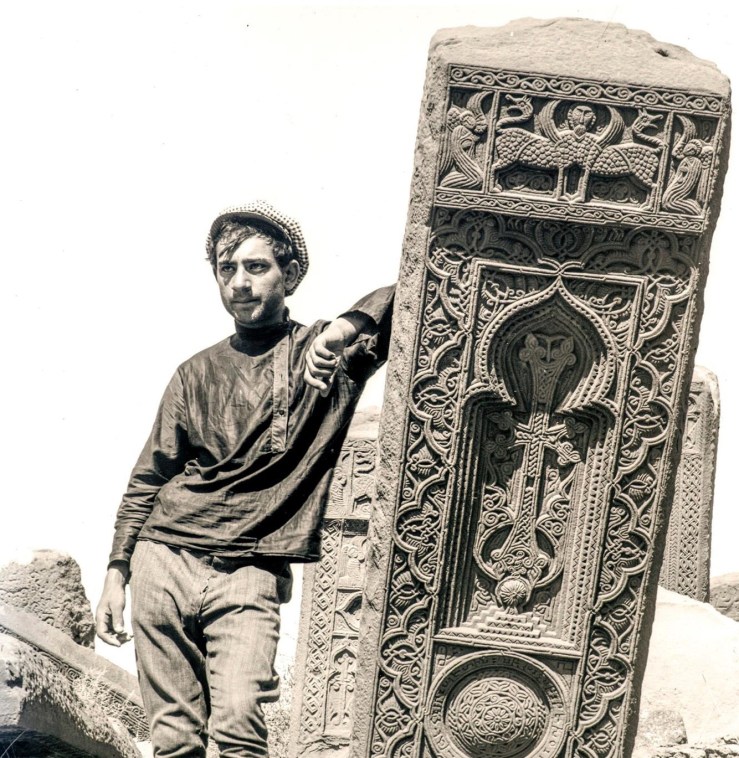
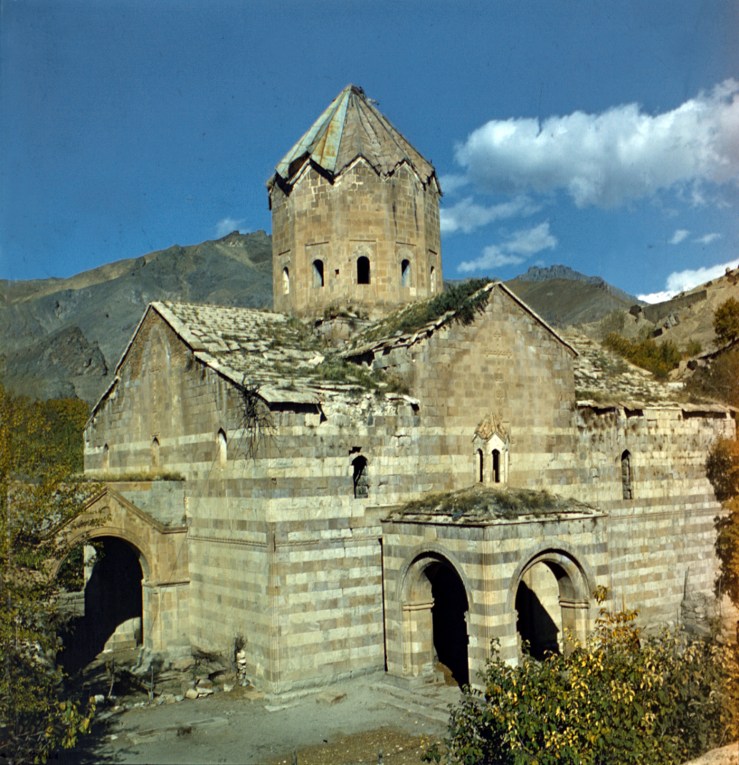
CULTURAL DESTRUCTION: “A Regime Conceals Its Erasure of Indigenous Armenian Culture” by Simon Maghakyan and Sarah Pickman: An investigative report published in February exposed Azerbaijan’s destruction of thousands of medieval Christian Armenian artworks and objects at the necropolis of Djulfa in Nakhichevan. The cemetery at Djulfa contained the world’s largest collection of khachkars, ornately carved memorial steles with crosses, characteristic of Armenian Christianity; 2,920 were documented clandestinely by native Argam Ayvazyan from 1964 to 1987, half of the 5,840 he documented in Nakhichevan as a whole. But, other than the dozen that were removed from the region during or before the Soviet era into church or museum collections, all these were demolished by Azerbaijani soldiers in 1997, 2002, and 2005–6, expunging the region’s last remaining traces of Christianity. (This was in addition to the demolition of 89 Armenian churches and 22,000 tombstones in Nakhichevan.)
“Unlike the self-publicized cultural destruction of ISIS, independent Azerbaijan’s covert campaign to re-engineer Nakhichevan’s historical landscape between 1997 and 2006 is little known outside the region. . . . While some Azerbaijanis have embraced their government’s vandalism as either righteous revenge or a national security measure against potential Armenian territorial claims, other Azerbaijanis . . . have mourned the destruction.”
Here is a short video posted in December 2005 by Nshan Topouzian, the leader of north Iran’s Armenian church, who was tipped off to the destructive activity taking place at the Djulfa cemetery by an Iranian border patrol. (Djulfa is located at the border of Azerbaijan and Iran.)
Hyperallergic pointed out the “cruel irony” and “insult” of Azerbaijan hosting UNESCO’s World Heritage Committee session earlier this month. UNESCO not only avoided a public condemnation of the destruction of Armenian Christian artifacts and churches in Nakhichevan but also praised Azerbaijan (one of its biggest donors) as a “land of tolerance.”
+++
ARTICLE: “6 Works of Classical Music Every Christian Should Know” by Jeremy Begbie: Theologian and pianist Jeremy Begbie is a superstar in the field of theology and the arts. Most of his books, published for academic audiences, are pretty dense, but this article that he wrote for The Gospel Coalition is wonderfully accessible. It opens, “Why bother with classical music? On the face of it, it seems like a serious indulgence to give time and attention to something so trivial as music—classical or otherwise. Yet the fact remains that no human society, however impoverished, has yet managed to do without music in some form. The impulse to sing, to blow air through wooden tubes, and to draw hair across strings seems ineradicable. What’s more, it’s long been recognized that people pour their deepest longings and passions into music-making. Music can be a remarkable index of the profoundest impulses and stirrings of a culture—impulses and stirrings that are often theologically charged.”
He then recommends six works of classical music to spend time with, highlighting the best recordings and musical guides available. From the “bubbling, joyful abundance” of a Mozart piano concerto (“a fresh iteration of creation’s hallelujah”) to the “aching beauty” of Rachmaninov, there’s variety here. Find out what Begbie considers to be “the greatest Christian musical achievement of the early modern era,” and which symphony contains, from its penultimate to final movement, one of the best transitions in Western music.
Begbie is the founder Duke Initiatives in Theology and the Arts, and the program is throwing a big symposium in September to celebrate its ten-year anniversary. I’ll be there! Join me? If you can’t swing the registration cost but live in the Triangle area of North Carolina, consider coming out on Saturday night to “Making All Things New: The Sound of New Creation,” a concert featuring a range of music, “from Bach to Bernstein, Rachmaninov to Latino, medieval to jazz, concert music to film music,” as well as a reflection by N. T. Wright. I attended a similar Begbie-led concert at Duke two years ago, and it was phenomenal.
+++
FILM: Ida (2013), dir. Pavel Pawlikowski: This Oscar Award–winning film about identity and faith is a great watch, especially for its stunning cinematography by Lukasz Zal and Ryszard Lenczewski. Shot in high-contrast black-and-white in the classic 4:3 format, it is almost entirely made up of static frames, exquisitely composed. I really just can’t get over the visuals. Watch the trailer and film clip below, and you’ll get a sense of what I mean. The movie is available on Kanopy, an on-demand streaming service provided for free by many public libraries.
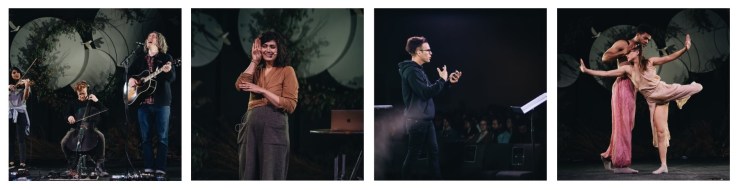
Readers often ask me what podcasts I listen to, so today I want to share one of them with you, which comes out of my home state of North Carolina: Makers & Mystics.
Hosted by Stephen Roach, Makers & Mystics is a biweekly podcast that aims to “develop a greater cultural understanding of why creativity abides at the core of our spirituality and why artists are called to be ‘architects of hope’ for our cities.” It is run by The Breath & the Clay, an organization based in Winston-Salem, which, in addition to producing regular online audio content, also hosts an annual conference and artist retreats. (Their 2019 conference already passed—you can purchase audio of all the presentations here—but two retreats are still being offered this year, in June and October; I just added them to my recent roundup, but you can also just go directly here for all the info.)
Besides interviewing people from our own time, Roach and friends also highlight historical figures who have contributed to the practice or discourse of art, faith, and spirituality. These short (ten- to fifteen-minute) scripted episodes make up the Artist Profile Series. Spotlighted individuals include Hans Rookmaaker, Dorothy Sayers, Hildegard von Bingen, Wassily Kandinsky, and Sadhu Sundar Singh, among others.
The Breath & the Clay creative arts gathering is held in North Carolina every March.
I love to find out about the various creative endeavors that the people of God are engaged in, and Makers & Mystics is one of my primary avenues for doing that. I’m impressed by the wide variety of disciplines and styles that Roach has curated in his selection of interview subjects, and I appreciate the mix of fine and folk art (some people reject this distinction, but you know what I mean). Though there are recurring themes in some of the interviews—things like the importance of honesty and integrity, and how to live a life awake to wonder—I find each episode so unique. It’s fun to hear different people’s stories and creative processes.
If this is the first time you’re encountering Makers & Mystics, you might want to start with one of the foundational episodes, which do not follow an interview format:
The very first things we learn about God in Genesis, Roach says, is that he’s a creative being, and that he takes immense joy in the creative process. So when we’re told in Genesis 1:26 that humans are created in God’s image, Roach continues, our only concept of God up to this point is that he’s a creator who delights in creating. That’s why creativity is not ornamental but, rather, is in our blood; it’s our birthright as human beings.
“Lawgivers don’t shape culture,” says Ray Hughes. “Artists do. They’re the ones that tell us who we are. That’s why I say, songwriters: hey, you’re not writing next year’s most popular chorus; you’re writing the next generation’s language for accessing God.”
To sample some interview highlights from Makers & Mystics, check out the 2017 year-in-review episode. I’ve enjoyed all the episodes, but a few that have particularly stood out to me, in addition to the ones I list above, are “On Vocation and Calling” with Josh Garrels (+ part 2), one of my favorite music artists; “Evergreen” with Audrey Assad, where Audrey discusses overcoming religious trauma, dealing healthily with emotions, and her love of Celtic spirituality and music; and “Ring of Fire” with Moda Spira, which I linked to last fall, on the grief that accompanies divorce.
To explore the Makers & Mystics archives, hop on over to their website, http://www.makersandmystics.com/, and check them out on Patreon if you’re interested in giving financial support. You can also download episodes from iTunes, Spotify, or your favorite podcast-listening app.
Here is a list of upcoming arts conferences and retreats. I will be attending the CIVA conference next month as well as the DITA conference in September—if you’ll be at either, please let me know; I’d love to meet you!
All Things New (International Arts Festival) Date: June 15, 2019 Location: Waterras Common Hall 3F, Tokyo, Japan Cost: ¥2500 (about $22) Presenters: Joshua Messick, Gerda Liebmann, Christopher Elmerick, Roger Lowther, and more Organizer:Community Arts Tokyo (with additional sponsorship by Grace City Church Tokyo) Description: “How can people in a city experience personal, social, and economic flourishing? What is the role of artists in making this world a better place? How can faith, work, and the arts come together for a holistic view of peace for the good of mankind? At this conference, we will hear from artists in the business world, the media world, and the plight of refugees from other countries. Their stories will give us a vision for how the arts point a way to new beginnings and bring goodness and hope into a broken world. Join us as we enter this world through speaker presentations, music performances, a short film, gallery exhibits, small group discussions, and more!” (Note: Presentations in Japanese will have simultaneous English translation over the wireless earphone system.)
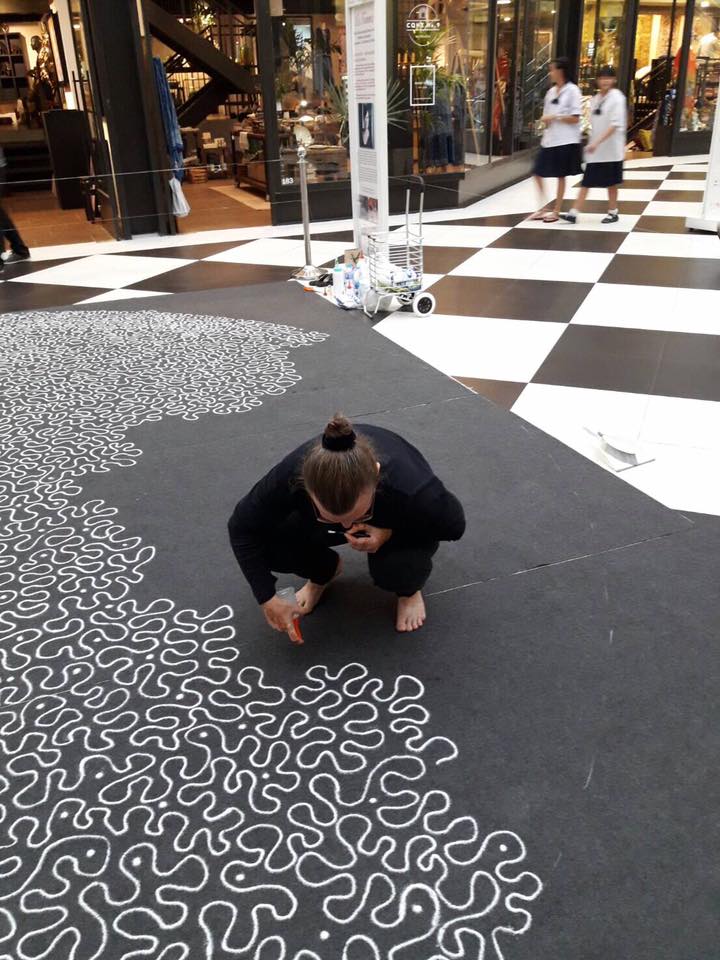
At the “All Things New” festival next month, Thai artist Gerda Liebmann will be installing one of her “salt art” pieces.
The festival will include presentations/workshops/performances by
hammered dulcimer player Joshua Messick, who contributed to the soundtrack of the Japanese animated fantasy film Mary and the Witch’s Flower
visual artist Gerda Liebmann, on how art can foster relationship and connection
Christopher Elmerick, who founded and runs a cultural center in Berlin that promotes the free exchange of ideas through shared work- and performance spaces and more
Megumi Project, a group of women artisans who upcycle vintage kimonos into shawls, scarves, bags, journals, and other accessories
the Charis Chamber Players
organist Roger Lowther, on the physics of music
Roger Lowther is, with his wife Abi, the founder and director of Community Arts Tokyo, “a team of artists, professionals, and Japanese nationals assisting church planting through outreach, discipleship, worship, and disaster relief.” Their work is supported through Mission to the World, the international missions arm of the Presbyterian Church in America (PCA).
+++
Are We There Yet? Date: June 13–16, 2019 Location: Bethel University, St. Paul, Minnesota, USA Cost: $350 for nonmembers; $300 for members Presenters: Sedrick Huckaby, Letitia Huckaby, Hawona Sullivan Janzen, Chris Larson, Rico Gatson, Nate Young, Linnéa Spransy, Cara Megan Lewis, Rev. Babette Chatman, Jamie Bennett, Joanna Taft, Kelly Chatman, Joyce Lee, Caroline Kent, Lyz Wendland, Betsy Carpenter, Amanda Hamilton, Catherine Prescott, Vito Aiuto, and others Organizer:Christians in the Visual Arts (CIVA) Description: “If you’re anything like us, working in an age of high anxiety and disruption has been trying. At the same time, the art world has never seen more diversity, wealth, interconnection, and popular appreciation. Some experience our current creative conditions as a ‘joyful noise,’ others a ‘resounding gong.’ This makes art difficult yet at the same time crucial. With our hope rooted in the Lord, we can rejoice in the unfinished state of our work. There is still so much to be made!
“Are We There Yet invites us to inhabit questions together: What are our shared pursuits? What practices and commitments can guide us in our work and collaboration? What would radical generosity do to the global art market? And how might we be participants in making ‘impossible things possible,’ as described by curator Hans Ulrich Obrist? With a commitment to hospitality, we will ask these questions and many more.”
At Valley House Gallery in Dallas, Sedrick Huckaby stands in front of portraits he painted of his children, his wife Letitia, and himself. Sedrick and Letitia are two of the keynote speakers for CIVA’s 2019 Biennial Conference. Photo: Dane Walters/Kera News.
The conference will consist of plenary talks, panel discussions, and breakout sessions and will include a juried art show, late-night artist show & tells, optional day-ahead tours (art museums, city architecture, or sculpture garden) or workshops (printmaking or photography), a Liz Vice concert, and an ecumenical worship service.
+++
Visual Arts Retreat Date: June 21–23, 2019 Location: Apple Hill Lodge, Moravian Falls, North Carolina, USA Cost: $450 (includes lodging, food, and class materials) Presenters: Allison Luce, Corey Frey, Ty Nathan Clark (via satellite), Stephen Roach, Thomas Torrey, Lauren Olinger Organizer:The Breath & the Clay Description: “Come get away for a weekend designed to inspire and deepen your understanding of visual art both as a spiritual practice and as an art form.”
+++
Vocation, Motherhood, and Artmaking Date: July 25–28, 2019 Location: Laity Lodge, Leakey, Texas, USA Cost: $495 (scholarships available) Presenters: Andi Ashworth, W. David O. Taylor, Letitia Huckaby, Phaedra Taylor, Sandra McCracken, Ashley Cleveland Organizer:Laity Lodge Description: “This retreat is an invitation to explore the opportunities and challenges that are involved in the twin calling to motherhood and artmaking. It is open to mothers in all stations and circumstances of life, whether at the beginning of motherhood or in the fullest years of grandmothering, and to artists of all media, disciplines and contexts.” (Read more from David Taylor.)
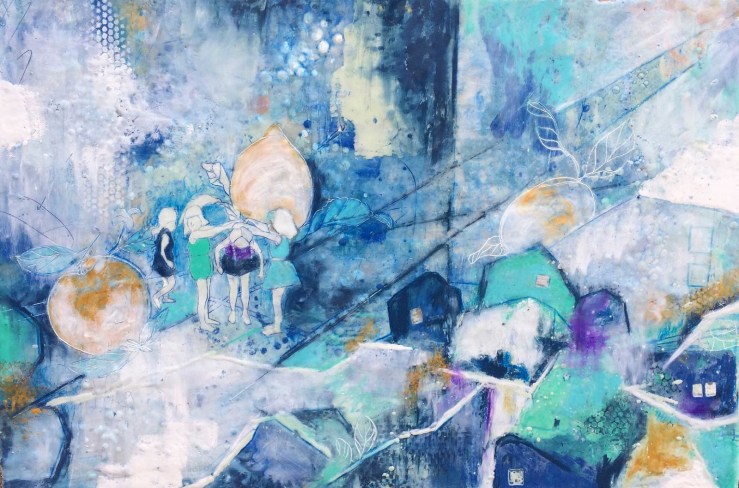
Phaedra Taylor (American), The Book of Games: Oranges & Lemons, 2018. Encaustic on wood panel, 20 × 30 in.
+++
Kingdom Creatives Con Date: August 3, 2019 Location: National Union Building, Washington, DC Cost: $99 Presenters: Noah Elias, Othello Banaci, Rachel Petrillo, Anifa Mvuemba, John David Harris, Ryan Han, Andrew Hochradel Organizer: Bemnet Yemesgen Description: A conference “aimed at igniting inspiration, learning, and networking in the Christian creative community. . . . Attendees will enjoy workshops and talks by creatives from diverse backgrounds and industries. The conference is specifically tailored towards creatives who love Jesus Christ . . . graphic designers, illustrators, photographers, filmmakers, developers, animators, copywriters,” etc.
+++
New York City Arts Weekend Date: August 9–10, 2019 Location: Various venues, New York, USA Cost: $295 CAN Presenters:Makoto Fujimura, Iwan Russell-Jones Organizer:Regent College (host: Jeff Greenman) Description: “Makoto Fujimura and Iwan Russell-Jones lead this exploration of Christian faith and the visual arts in New York City. Enjoy a fascinating tour of the Metropolitan Museum of Art and participate in shared meals, stimulating presentations, and challenging conversations. Develop a deeper understanding of how creativity finds its place in the new creation.”
+++
Creation and New Creation: Discerning the Future of Theology and the Arts Date: September 5–8, 2019 Location: Duke University, Durham, North Carolina, USA Cost: $175 (student discounts available) Presenters: Jeremy Begbie, Malcolm Guite, Christian Wiman, N. T. Wright, Natalie Carnes, Jennifer Craft, Carlos Colón, Steve Prince, Bruce Herman, Judith Wolfe, and others Organizer:Duke Initiatives in Theology and the Arts (DITA) Description: “At DITA10, we will celebrate past scholarship, reflect on today’s landscape, and imagine with tomorrow’s leaders.” The colloquium will include keynote lectures; workshops for church leaders and artists addressing the challenges of theology and the arts in the church and in our daily lives; panel discussions with artists and theologians; a concert by the New Caritas Orchestra; and a corporate worship service.
Bruce Herman (American, 1953–), Riven Tree, 2016. Oil on wood panels with gold, silver, and platinum leaf, 96 × 47 in. York Chapel, Duke Divinity School, Durham, North Carolina. [see “making of” video] [see in situ photo]
+++
The Future of the Catholic Literary Tradition (Catholic Imagination Conference) Date: September 19–21, 2019 Location: Loyola University Chicago, USA Cost: $150 Presenters: Tobias Wolff, Alice McDermott, Paul Schrader, Dana Gioia, Paul Mariani, Richard Rodriguez, Angela Alaimo O’Donnell, and others Organizer:Hank Center for the Catholic Intellectual Heritage Description: “This international biennial conference, sponsored by Loyola’s Hank Center, features over 60 writers, poets, filmmakers, playwrights, journalists, editors, publishers, students, and critics who will explore a variety of questions surrounding the Catholic imagination in literature and the arts. What is the future of the Catholic literary tradition? What is the state of discourses in faith and Christian humanism in a world increasingly described as ‘Post’—postmodern, post-human, post-Christian, post-religious? How is Catholic thought and practice (or the absence of it) represented in literature, poetry, and cinema? If, as David Tracy observes, religion’s ‘closest cousin is not rigid logic, but art,’ what might literary art be trying to communicate to its ‘cousin’—and to us all—as we travel along the first decades of the 21st century?”
The call for papers is still open, until June 15. Also check out some of the special events being offered, which will include a theatrical performance of Flannery O’Connor’s Everything That Rises Must Converge and an evening of poetry readings, live music, and a Chicago blues panel.
+++
Writer’s Retreat Date: October 25–27, 2019 Location: Apple Hill Lodge, Moravian Falls, North Carolina, USA Cost: $450 (includes lodging and food) Presenters: TBA Organizer:The Breath & the Clay Description: “Come get away for a weekend designed to develop your writing both as a spiritual practice and as an art form.”
+++
The Art of the Lost: Destruction, Reconstruction, and Change Date: November 27–29, 2019 Location: Canterbury Cathedral, England Cost: £175 for full conference (single-day tickets also available) Presenters: Sandy Nairne, Simon Cane, James Clark, Ascensión Hernández Martínez, Emma J. Wells, and others Organizer:Canterbury Cathedral Description: “This conference will explore and appraise current and developing studies of how art changes, is reused or repurposed, disappears or is rediscovered. It will look at how and why art is defaced, destroyed or is lost within architectural settings, with a particular focus on art within the context of cathedrals, churches or other places of worship. It will consider changing ideologies, iconoclasm, war, fashion and symbolism. It will cover art from the 6th century to the modern day.”









 Art & Theology