Upcoming lectures

“The Perils and Peculiarities of Visually Depicting the Trinity”
Speakers: Dr. Ben Quash, Professor of Christianity and the Arts at King’s College London; Dr. Scott Nethersole, Senior Lecturer in Italian Renaissance Art at the Courtauld Institute of Art
Date: February 21, 2018
Location: Courtauld Institute of Art, Somerset House, Strand, London
Organizer: Department of Theology and Religious Studies at King’s College and the Courtauld Institute of Art
Cost: Free
Description: Nethersole will discuss Botticelli’s Trinity Altarpiece, with special attention paid to its unsettling disjunctions of scale and space—a theological decision on the part of the artist. Then Quash “will examine some of the larger theological problems that are raised by trinitarian visual imagery, and look at . . . some of the successes and failures of various artistic experiments, including one or two very recent ones.” Q&A and informal reception to follow.

Holy Trinity by Sandro Botticelli
Sandro Botticelli (Italian, ca. 1445–1510), Holy Trinity with Mary Magdalene, John the Baptist, and Tobias and the Angel, 1491–93. Tempera on panel, 215 × 192 cm. Courtauld Gallery, London.

“Religion in Museum Education” (conference)
Speakers: Dr. Caroline Widmer, Dr. Anna Chiara Cimoli, et al. (see link for full list)
Date: February 23, 2018
Location: Lorenzo de’ Medici Institute, Florence
Organizer: Forum on Museums and Religion, an initiative of the Lorenzo de’ Medici Institute’s Museum Studies MA program
Cost: Free
Description: This one-day conference will bring together museum educators and religious authorities to discuss how secular museums housing religious objects might develop educational programming that highlights sacred functions without risking the impression of a religious agenda. Lecture topics include “Understanding Religion through Art,” “Sharing the Sacred with Schools,” “Teaching from Paintings with Religious Subject Matter,” “Churches as Living Museums,” and more, and case studies will come from the British Museum, the Uffizi in Florence, Museum Rietberg in Zurich, the National Museum for the History of Immigration in Paris, and the Shoah Memorial and Pinateca di Brera in Milan. The conference will conclude with a roundtable discussion.

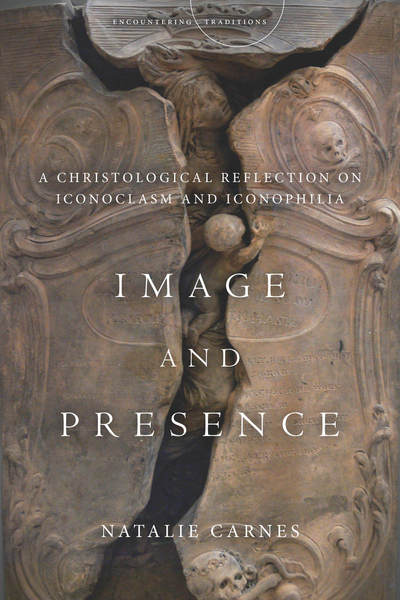
“The New Iconoclasm: A Christological Reflection on Making and Breaking Images”
Speaker: Dr. Natalie Carnes, Associate Professor of Theology at Baylor University
Date: February 28, 2018
Location: Alumni Memorial Common Room, Duke Divinity School, Durham, North Carolina, USA
Organizer: Duke Initiatives in Theology and the Arts (DITA)
Cost: Free
Description: Carnes’s lecture will draw on the content of her new book from Stanford University Press, Image and Presence: A Christological Reflection on Iconoclasm and Iconophilia. “Christians of many epochs—glutted with images, shocked by them—have resorted to the iconoclast’s hammer or its successor, the authoritarianism of empty space. Natalie Carnes proposes a better way to live through our senses” (Mark D. Jordan, Harvard University). “A major contribution to the discussion of image as and in theology” (Judith Wolfe, University of St. Andrews).

Image and Presence (book cover)

“‘In the manner of smoke’: Leonardo, Art, and Faith” (5-hour mini-course)
Lecturer: Rev. Iain Lane, Tutor in Christian Doctrine and the Visual Arts
Date: March 3, 2018
Location: Holywell Lodge, St. Albans, Hertfordshire, England
Organizer: St. Albans Cathedral
Cost: £25
Description: “Leonardo da Vinci produced some of the most compelling images in the history of Christian art. . . . This study day explores each of Leonardo’s surviving, overtly Christian works in detail, exploring their meaning and setting them in context. The picture which is revealed is of an artist of profound religious sensibility rooted in both scientific rationality and a deep awareness of the human condition: a man who embodied a unity of vision which has arguably been lost in our own age.”

Annunciation by Leonardo da Vinci
Leonardo da Vinci (Italian, 1452–1519), Annunciation, ca. 1472. Oil on panel, 98 × 217 cm. Uffizi Gallery, Florence.

“Swords into Ploughshares: The Ambivalent Role of the Arts and Religion in Building Peace”
Lecturer: Dr. Jolyon Mitchell, Professor of Communication, Arts, and Religion at the University of Edinburgh
Date: March 7, 2018
Location: Sarum College, Salisbury, England
Organizer: Centre for Theology, Imagination, and Culture at Sarum College
Cost: Free (advance booking required)
Description: This lecture will explore the role of different media arts in both inciting violence and promoting peace, drawing on examples from countries such as Israel-Palestine, Mozambique, Rwanda, and the UK.

“Scandal and Glory: The Cross in the Bible and Poetry”
Speakers: Paula Gooder, Director of Mission, Learning, and Development in the Birmingham Diocese; Mark Oakley, Canon Chancellor of St. Paul’s Cathedral
Date: March 13, 2018
Location: St. Paul’s Cathedral, London
Organizer: St. Paul’s Cathedral (Adult Learning initiative)
Cost: Free
Description: “Is Christ on the cross our brother in suffering or our King in triumph? Jesus’ death is at the heart of Christianity, but the four Gospel accounts are very different and the cross has been seen as both the throne of God’s glory and the place of ultimate desolation and defeat. In addition we have 2,000 years of interpretations, paintings, poems, theologies, and liturgies that add to the complexity, and sometimes to the confusion. . . . Paula Gooder and Mark Oakley will look at different aspects of the cross through the Gospels and poetry, exploring some of what we might learn from it not only of sin and reconciliation, but also of new life, love, freedom, and creation made new.” Q&A to follow.

“Art and the Apocalypse: The Book of Revelation and Visual Exegesis”
Speakers: Dr. Natasha O’Hear, Lecturer in Theology and Visual Art at ITIA, University of St. Andrews, Scotland; Dr. Anthony O’Hear, Professor of Philosophy at the University of Buckingham
Date: March 16, 2018
Location: The Gallery, 70 Cowcross Street, London
Organizer: Art and Christianity
Cost: £12
Description: Drawing on their recent award-winning book Picturing the Apocalypse: The Book of Revelation in the Arts over Two Millennia, the O’Hears will explore the visual history of the book of Revelation as well as the notion of the artist as biblical exegete. The focus will be on the Four Horsemen of the Apocalypse (Rev. 6) and the Rider on the White Horse (Rev. 19).

Picturing the Apocalypse

“Women Artists and the Modern Church in Britain”
Lecturer: Dr. Ayla Lepine, Visiting Fellow in Art History at the University of Essex
Date: April 4, 2018
Location: The Gallery, 70 Cowcross Street, London
Organizer: Art and Christianity
Cost: £14.21
Description: “From the turn of the twentieth century to the present, women have produced diverse and complex works of art for and in response to the Church. This talk explores the relationship between Christian sacred spaces, from vast and well-known cathedrals to rural chapels, and women artists in a period in which feminism, culture, and Christianity engaged in new dialogues.” Artists include Winifred Knights, Elizabeth Frink, Enid Chadwick, and Tracey Emin.

For You by Tracey Emin
Tracey Emin (British, 1963–), For You, 2008. Neon. Liverpool Cathedral, England.

+++

Many of these events I found out about through the weekly Arts and the Sacred at King’s (ASK) e-bulletin compiled by Dr. Chloë Reddaway. If you would like to be added to the ASK listserv or announce a relevant event through it, contact her at chloe.1.reddaway@kcl.ac.uk.

Note: The two book cover images on this webpage are Amazon affiliate links, meaning that Art & Theology will earn a small commission on any purchase that originates here.

“Highway Song for Valentine’s Day” by Luci Shaw

This year the lunar calendar has given us a unique confluence of holidays on today’s date: Valentine’s Day, and the first day of Lent. Journalists are really playing up their antithetical nature . . . but maybe the two observances aren’t entirely at odds. After all, Lent is about reconnecting and deepening our intimacy with Love himself.

In the following poem Luci Shaw reflects on how human love, despite bold attestations to the contrary, is often ephemeral, whereas God is a “longer Lover” whose vow to love and to cherish is truly eternal, and is evidenced by daily tokens.

Via dell'Amore, Cinque Terre

Highway Song for Valentine’s Day

by Luci Shaw

“Kim, I love you — Danny”
roadside graffito

On overhead and underpass,
beside the road, beyond the grass,

in aerosol or paint or chalk
the stones cry out, the billboards talk.

On rock and wall and bridge and tree,
boldly engraved for all to see,

hearts and initials intertwine
their passionate, short-lived valentine.

I’m listening for a longer Lover
whose declaration lasts forever:

from field and flower, through wind and breath,
in straw and star, by birth and death,

his urgent language of desire
flickers in dew and frost and fire.

This earliest spring that I have seen
shows me that tender love in green,

and on my windshield, clear and plain,
my Dearest signs his name in rain.

“Highway Song for Valentine’s Day” is published in Accompanied by Angels: Poems of the Incarnation by Luci Shaw (Eerdmans, 2006) and is used here by permission of the publisher. Reproduction of the poem without express permission from Wm. B. Eerdmans Publishing Company is a violation of copyright.

+++

Unlike in her other poems, Shaw uses here a simple, singsongy meter (iambic tetrameter) that evokes the standard Valentine’s Day fare. Hinging the poem at stanza 5, she spends the first half musing on the myriad ways in which young couples broadcast their love, and the second half recounting, by contrast, God’s declarations through nature, through miracle, through beauty. With a love both passionate and tender, he romances us. A soft wind, a starry night, the green of spring—these are his love letters.

This poem urges us to open ourselves to this divine wooing. While we’re busy longing and searching for some perfect love, we may be missing the tokens of God’s affection lavished on us right now.

Today, these words or something like them will be spoken by pastors all over the world:

Remember you are dust, and to dust you shall return.
Turn away from sin and be faithful to Christ.
Repent and believe the Good News: God longs for you to be whole.

And this scripture read: “Return to the LORD your God, for he is . . . abounding in steadfast love” (Joel 2:13).

We can still celebrate romantic love with our partner—which itself can be a gift and a blessing—but with our foreheads marked with ash, we ought to realize that this love is not ultimate. It is a shadow of a greater, fuller love offered to us from on high, by One who spared no expense in proving it, to the point of giving up his own life. “Greater love has no one than this” (John 15:13a).

And this Lover sends us valentines all year round.

So the next time you’re driving down the highway, caught in a rain shower, remember that you are beloved of God, and that he will never stop reaching out to you, beckoning you into a deeper relationship with him.

Via dell'Amore, Cinque Terre

About the photos: In Cinque Terre, Italy, young couples wanting to declare their eternal love write their names on padlocks and attach them to wire mesh and cables along the Via dell’Amore (Lovers’ Lane). I took these photos in 2009.

Joyful Lent (Artful Devotion)

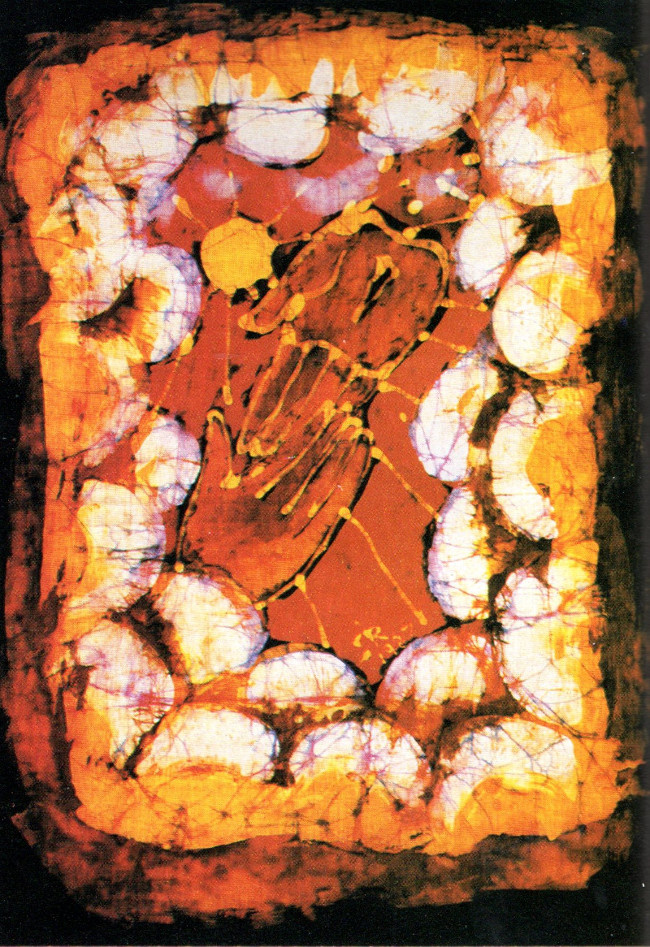
Genesis 9:13 by Sawai Chinnawong
Sawai Chinnawong (Thai, 1959–), Genesis 9:13, 2004. Acrylic on canvas, 27 × 27 in.

Then God said to Noah and to his sons with him, “Behold, I establish my covenant with you and your offspring after you, and with every living creature that is with you, the birds, the livestock, and every beast of the earth with you, as many as came out of the ark; it is for every beast of the earth. I establish my covenant with you, that never again shall all flesh be cut off by the waters of the flood, and never again shall there be a flood to destroy the earth.”

And God said, “This is the sign of the covenant that I make between me and you and every living creature that is with you, for all future generations: I have set my bow in the cloud, and it shall be a sign of the covenant between me and the earth. When I bring clouds over the earth and the bow is seen in the clouds, I will remember my covenant that is between me and you and every living creature of all flesh. And the waters shall never again become a flood to destroy all flesh. When the bow is in the clouds, I will see it and remember the everlasting covenant between God and every living creature of all flesh that is on the earth.”

God said to Noah, “This is the sign of the covenant that I have established between me and all flesh that is on the earth.”

—Genesis 9:8–17

+++

MUSIC: Keyboard Sonata in C Major (K. 159, L. 104) by Domenico Scarlatti | Arranged for banjo by Béla Fleck and for mandolin by Edgar Meyer | Performed by Béla Fleck and Chris Thile on Perpetual Motion (2001)

+++

This art and music may seem inappropriately light and bright for the first Sunday of Lent, a season that’s stereotypically thought of as gloomy and self-deprecating. But the Old Testament reading the Revised Commentary Lectionary assigns to this day is God’s covenant with Noah after the Flood, a passage filled with great hope.

Contrary to popular misconceptions, Lent does not mean forty days of beating yourself up. It literally means “springtime,” and it’s a time of renewal in preparation for Easter. Self-examination is a major component, yes, but so is grabbing hold of the divine promise—of God’s wondrous love and mercy.

In my church’s liturgy (and this is common across denominations), the confession of sin is always followed by words of assurance—a verse of scripture, spoken by the pastor, that reminds us of the pardon we receive through Christ. We are not left in the darkness of our failures; we are brought into the light, and given power to live as children of the light. Repentance is a joyous thing! That’s why the Constitution on the Sacred Liturgy, a Second Vatican Council document, refers to Lent as the “joyful season.” It’s joyful because God’s mercy is amazing.

After forty days on a dark boat, and then some, Noah, his family, and a whole bunch of animals come out to a renewed earth, and to a promise painted across the sky in bright colors that never again will all God’s creation be destroyed. Similarly, during Lent we choose to enter a period of darkness, taking stock of our sin. It may be a rocking journey, but it’s ultimately a period of regeneration, and when we arrive at Easter we receive, as confirmation of the new life that’s possible, the resurrected Christ. He’s there for us all along—we need not wait till Lent’s over to enter his forgiveness and to rise with him. But we also don’t want to skip over the necessary steps of first acknowledging the depth of our sin, and confessing it with a contrite heart.

+++

Excerpt from “The Agreement” by Henry Vaughan, from Silex Scintillans:

But while Time runs, and after it
Eternity, which never ends,
Quite through them both, still infinite,
Thy covenant by Christ extends;
No sins of frailty, nor of youth,
Can foil His merits, and Thy truth.

And this I hourly find, for Thou
Dost still renew, and purge and heal:
Thy care and love, which jointly flow,
New cordials, new cathartics deal.
But were I once cast off by Thee,
I know—my God!—this would not be.

+++

Tomorrow is Ash Wednesday, and I have a poem planned for publication here at Art & Theology. But I also wrote a short visual meditation for the Anglican Church in North America, which you can find at the bottom of their Lent website, https://giftoflent.org/. It’s on Ted Prescott’s mixed-media artwork All My Sins, which incorporates paper ash, the residue left over from the artist’s burning of a list of his personal sins.

All My Sins by Ted Prescott
Theodore Prescott (American, 1944–), All My Sins, 1996. Cherry, lead, hand-blown glass, paper ash, and silicon, 36.5 × 24.5 × 5 in.

This post belongs to the weekly series Artful Devotion. If you can’t view the music player in your email or RSS reader, try opening the post in your browser.

To view all the Revised Common Lectionary scripture readings for the First Sunday of Lent, cycle B, click here.

Stations of the Cross at the SAAM

Welcome to the Stations of the Cross audio tour at the Smithsonian American Art Museum (SAAM), developed by Victoria Emily Jones at ArtandTheology.org.

SAAM Stations of the Cross 2018

Originating in the thirteenth century, the Stations of the Cross is a Christian devotional practice whereby participants immerse themselves in the story of Jesus Christ’s final sufferings by metaphorically journeying with him from his trial to his entombment. The road between is known as the Via Dolorosa (“Way of Sorrows”) or Via Crucis (“Way of the Cross”).

In this eighteen-stop tour we will walk this road with Jesus, recognizing along the way the many other paths of sorrow that were traveled in America’s history and that are still being traveled today. Migrant workers, soldiers, prisoners, victims of racial discrimination and violence, the poor and the homeless, the grieving, and the mentally ill are among the many people we will meet through these paintings, sculptures, and mixed-media works that bear witness to human suffering.

The American novelist and social critic James Baldwin said of Beauford Delaney, one of the artists on our tour, “The reality of his seeing caused me to begin to see.” That is my hope: that as we encounter these visual narratives of suffering from our nation’s past and present, we will begin to see. This tour obviously doesn’t cover all the oppressed groups in the US, but this is a starting point for further conversation, discovery, intercessory prayer, confession, and action.

My other hope is that we will be led to a deeper engagement with the biblical narrative—with Jesus’s way of sorrows and why he walked it, what it achieved.

Jesus began his public ministry by reading these words from an Isaiah scroll at his local synagogue at Nazareth:

The Spirit of the Lord is upon me,
because he has anointed me
to proclaim good news to the poor.
He has sent me to proclaim liberty to the captives
and recovering of sight to the blind,
to set at liberty those who are oppressed,
to proclaim the year of the Lord’s favor.

Then, as Luke 4:20–21 tells us, “he rolled up the scroll and gave it back to the attendant and sat down. And the eyes of all in the synagogue were fixed on him. And he began to say to them, ‘Today this Scripture has been fulfilled in your hearing.’” This was a very bold move: here, he is claiming to be the messianic servant of the Lord prophesied about in Isaiah 61, who would bring spiritual and, ultimately, material salvation to the world. But the cost of this salvation, the Hebrew prophet tells us, is suffering; the messianic servant must suffer and die. “He was pierced for our transgressions; he was crushed for our iniquities; upon him was the chastisement that brought us peace, and with his wounds we are healed” (Isaiah 53:5).

Below you will find eighteen audio tracks of art commentary available for free streaming or download, as well as transcripts and artwork locations. If you are taking this tour virtually, you can click on any of the featured images to jump to that object’s museum page, where you can zoom in on details.

As you walk this Way of Sorrows, beholding the sufferings both of Christ and of those he came to redeem, may these artists’ seeing help you to see.   Continue reading “Stations of the Cross at the SAAM”

Lent devotionals with arts component

Next Wednesday, February 14, is the first day of Lent—a season of focused prayer and simple living. During this time I will continue publishing weekly “Artful Devotion” posts based on scripture readings from the Revised Common Lectionary, plus I have a few other posts planned. I’m especially excited about what I’ll be publishing this Sunday—the fruits of many months of labor; I hope you’ll check back!

If you are looking for daily devotional content during Lent that incorporates the arts, check out some of these resources. See also last year’s list: https://artandtheology.org/2017/03/07/art-resources-for-lent/.

“The Lent Project V” by Biola University: From Ash Wednesday through the first week of Easter, Biola University’s Center for Christianity, Culture, and the Arts will be publishing daily “aesthetic meditations” on Christ’s life, death, and resurrection. The scripture texts, art images, music, and poetry are curated by a CCCA team, and staff are invited to contribute written reflections that respond to them. “The mood of Lent can be beautifully captured through the arts, which are often cathartic expressions of longing, suffering, loneliness, love, death and rebirth,” says university president Barry H. Corey. “Art is a great chronicler both of the drama of human history and the aches of the human heart.” Here are some artworks Biola has featured in previous years; click on each to experience the full devotion:

The Bread by Michael Borremans
Michaël Borremans (Belgian, 1963–), The Bread, 2012. Oil on canvas, 29 × 23 cm.
Lamb of God by Arcabas
Arcabas (French, 1926–), Lamb of God. Stained glass, Notre-Dame des Neiges Church, Alpe d’Huez, France.
Deposition and Christ Falling on the Way to Calvary (Palestinian Museum)
The Deposition & Christ Falling on the Way to Calvary, 2014. Collage, from “The Presence of the Holy See” project at the Palestinian Museum. Photographs by Alexandra Boulat (French, 1962–2007); paintings by Raphael.
Jesus on the Shore by Maja Lisa Engelhardt
Maja Lisa Engelhardt (Danish, 1956–), Jesus on the Shore. Altarpiece, Turup Church, Assens, Denmark.

Lenten Readings 2018 by Kevin Greene: For the seventh year in a row, Kevin Greene, a teaching elder at West End Presbyterian Church in Richmond, Virginia, is publishing short daily devotions, each one containing an art image and a piece of music. (Last year I learned of lots of new artists through him!) For the prayer component he has used various resources in the past—the Revised Common Lectionary, sermons on the cross of Christ across the centuries, Wesley’s Scripture Hymns, and excerpts from the early church fathers—but this year he will be using collects (pronounced COL-lects) from the Book of Common Prayer. Unfamiliar with the term? Click here to read how a collect works.   Continue reading “Lent devotionals with arts component”

Roundup: RIP Edwin Hawkins; why Christians should read poetry (and who to read); new Reconciliation Window; global song in white churches

Grammy-winning gospel pioneer Edwin Hawkins dies at 74: African American gospel musician, pianist, choir master, composer, and arranger Edwin Hawkins passed away on January 15. He’s best known for his 1967 R&B arrangement of the eighteenth-century hymn “Oh Happy Day,” which became an unexpected international hit and Grammy winner and is now a gospel standard. [HT: Global Christian Worship]

“Oh Happy Day” was one of eight arrangements Hawkins put together for his Northern California State Youth Choir, made up of forty-six singers ages 17 to 25, to record, planning to sell the album to finance a trip to a church youth conference in Washington, DC. They recorded the songs live at Hawkins’s church, the Ephesian Church of God in Christ in Berkeley, California, on a primitive two-track recorder. After hearing the self-published record, Buddah Records signed the group, helping to launch “Oh Happy Day” to the top of the pop charts in the US, UK, France, Germany, and the Netherlands and bringing attention to lead vocalist Dorothy Combs Morrison, 22. At the time, denomination officials did not approve of Christian singers crossing over into secular markets, and they refused to let Hawkins use the name of the choir on the Buddah reissue—hence the “Edwin Hawkins Singers” were born.

Check out the Christianity Today article “How ‘Oh Happy Day’ Gave Gospel a New Beat,” and this clip of the show-stopping performance of the song in the movie Sister Act 2, featuring a young Ryan Toby.

+++

“Ten poets every pastor should know” by Kolby Kerr (+ Part 2): “Preachers need poetry if for no other reason than to be reminded of the palpable weight of language,” writes Kolby Kerr for LeaderWorks, whose vision is “to provide the tools, training, and support to strengthen the church and its leaders to fulfill their God-given mission.” I love this ten-poet “mixtape” Kerr has put together as an entry point for those who have told him they want to “get into poetry.” An ordained minister with a BA in English and an MFA in creative writing, he offers a wise disclaimer: “I point you toward these poets so that you would read them, not strip mine their work for a quick sermon illustration. Before any of this shows up in your preaching, heed Thomas Cranmer: read, mark, learn, and inwardly digest.” [HT: David Taylor]

I recently wrote about one of Kerr’s recommendations, Richard Wilbur, here.

+++

“The Splash of Words: Believing in Poetry” by Mark Oakley: “Poetry is what we reach for when we are falling in love, when we are grieving and when we search the great mysteries. It’s easy to think the language of faith is in creeds, sermons and certainties, but Mark Oakley says that it is poetry that is the person of faith’s native language. In this talk he will invite us on an adventure into poetry’s power to startle, challenge and reframe our vision: like throwing a pebble into water, the words of a poem cause a splash whose ripples can, if we let them, transform the way we see the world, ourselves, and God.”

I mentioned Mark Oakley in a previous roundup. This lecture, given at St. Paul’s Cathedral in London in November 2016, is based on Oakley’s latest book The Splash of Words, which he says he wrote as a way of celebrating the truth that God is in this world. The first half of the video comprises his talk; the second half, Q&A. I was so enthralled by what he had to say that I immediately bought a copy of the book. It contains a twenty-two-page introduction on the value of poetry, but its bulk consists of twenty-nine poems, carefully selected, with commentary. Love it!

+++

New stained-glass window by Thomas Denny: My friend Paul Neeley tipped me off to this new Reconciliation Window by contemporary stained-glass artist Tom Denny, whose distinctive style, characterized by blazing color, is achieved by acid etching and silver staining. Installed at St. John’s Church in Tralee, County Kerry, Ireland, in October 2017, the window depicts, in its central light, the Return of the Prodigal Son. The right panel shows Jesus reading from the book of Isaiah, and the left panel shows John the Baptist, the church’s patron saint. Throughout are names and vignettes from Traelee’s history and landscape. Bloggers Finola Finlay and Robert Harris have just visited St. John’s and have taken many beautiful detail shots of the window; have a look! For more on Denny, see the recently published book Glory, Azure and Gold: The Stained-Glass Windows of Thomas Denny or the article “Walking Man: The Art of Thomas Denny” from issue 86 of Image journal.

Reconciliation Window by Thomas Denny
Thomas Denny (British, 1956–), Reconciliation Window, 2017. Stained glass, 5 × 3 m. St. John’s Church, Tralee, County Kerry, Ireland.

+++

“Appropriation or Activism? Reflections on ‘Global Song’” by Marissa Glynias Moore: This article was posted this week in the Multicultural Worship Leaders Network Facebook group I’m a part of, addressing a question I’ve pondered a lot. A doctoral candidate in ethnomusicology at Yale University, Moore is wrapping up her dissertation on the use of “global songs” in the worship services of white, North American mainline Protestant congregations. She recounts her initial skepticism:

Within my first weeks at Battell [the University Church in Yale], I began to notice a shift in congregational repertoire compared to that of my college church. We rarely sang the hymns that had become dear to me; instead, we were more likely to be singing an Alleluia from Peru or a South African anti-apartheid “freedom song.” While I was curious about this unfamiliar genre of congregational music, the practice itself made me decidedly uncomfortable as I looked around the space: why were we, a bunch of predominantly white American college and graduate students, singing world music? Did we have the right to sing this music? Hadn’t my training as an ethnomusicologist prepared me to vehemently critique such a practice as a manifestation of appropriation?

But as her research developed she has been led to see that singing global song can actually be a gesture of hospitality and solidarity. (Update, 9/4/18: Listen to Moore on episode 24 of Sarah Bereza’s Music and the Church podcast, “Global Song and the Universal Church.”)

Torn-Down Kingdom (Artful Devotion)

Christ Exorcising the Evil Spirit by James Ensor
James Ensor (Belgian, 1860–1949), Christ Exorcising the Evil Spirit, 1921. Color lithograph from the portfolio Scènes de la vie du Christ (Scenes from the Life of Christ).

And immediately there was in their synagogue a man with an unclean spirit. And he cried out, “What have you to do with us, Jesus of Nazareth? Have you come to destroy us? I know who you are—the Holy One of God.” But Jesus rebuked him, saying, “Be silent, and come out of him!” And the unclean spirit, convulsing him and crying out with a loud voice, came out of him. And they were all amazed, so that they questioned among themselves, saying, “What is this? A new teaching with authority! He commands even the unclean spirits, and they obey him.” And at once his fame spread everywhere throughout all the surrounding region of Galilee.

—Mark 1:23–28

+++

SONG: “Satan, Your Kingdom Must Come Down” | Traditional, performed by Willie Nelson on Country Music (2010)

This spiritual was first recorded and released by Blind Joe Taggart in 1931. An alternative version, “Satan, We’re Gonna Tear Your Kingdom Down,” is #485 in the African American Heritage Hymnal.

+++

Haste to me, Lord, when this fool-heart of mine
Begins to gnaw itself with selfish craving;
Or, like a foul thing scarcely worth the saving,
Swoln up with wrath, desireth vengeance fine.
Haste, Lord, to help, when reason favours wrong;
Haste when thy soul, the high-born thing divine,
Is torn by passion’s raving, maniac throng.

Fair freshness of the God-breathed spirit air,
Pass through my soul, and make it strong to love;
Wither with gracious cold what demons dare
Shoot from my hell into my world above;
Let them drop down, like leaves the sun doth sear,
And flutter far into the inane and bare,
Leaving my middle-earth calm, wise, and clear.

—George MacDonald, from A Book of Strife in the Form of the Diary of an Old Soul (1880)


This post belongs to the weekly series Artful Devotion. If you can’t view the music player in your email or RSS reader, try opening the post in your browser.

To view all the Revised Common Lectionary scripture readings for the Fourth Sunday after Epiphany, cycle B, click here.

The year is going, let him go

What Alfred Lord Tennyson instructs the church bells in canto CVI of “In Memoriam A.H.H.,” I am begging the Holy Spirit to do in my own heart and mind, my communities, and across the world for the new year:

Ring out, wild bells, to the wild sky,
The flying cloud, the frosty light:
The year is dying in the night;
Ring out, wild bells, and let him die.

Ring out the old, ring in the new,
Ring, happy bells, across the snow:
The year is going, let him go;
Ring out the false, ring in the true.

Ring out the grief that saps the mind
For those that here we see no more;
Ring out the feud of rich and poor,
Ring in redress to all mankind.

Ring out a slowly dying cause,
And ancient forms of party strife;
Ring in the nobler modes of life,
With sweeter manners, purer laws.

Ring out the want, the care, the sin,
The faithless coldness of the times;
Ring out, ring out my mournful rhymes,
But ring the fuller minstrel in.

Ring out false pride in place and blood,
The civic slander and the spite;
Ring in the love of truth and right,
Ring in the common love of good.

Ring out old shapes of foul disease;
Ring out the narrowing lust of gold;
Ring out the thousand wars of old,
Ring in the thousand years of peace.

Ring in the valiant man and free,
The larger heart, the kindlier hand;
Ring out the darkness of the land,
Ring in the Christ that is to be.

This passage, from one of the greatest (and longest!) poems of the nineteenth century, is the source of the popular expression “ring out the old, ring in the new.” Ringing church bells at midnight on New Year’s Eve was already a deep-set tradition in England, and people understood the ringing as ushering in both life (the new year ahead) and death (saying good-bye to the past). But Tennyson’s poeticization of this symbolic practice has made its symbolism all the more enduring, and his list of specific qualities to let go of and others to welcome in provides a helpful template for new-year prayer and resolution making.

Roof, Winter by Arkhip Kuindzhi
Arkhip Kuindzhi (Russian, ca. 1842–1910), Roof. Winter, 1876. Oil on canvas on cardboard, 40 × 25 cm.

Tennyson apostrophizes his city’s church bells, telling them to ring out all of last year’s sins and griefs, falsehoods, feuds, strife, greed, bad-mouthing, economic disparities, political posturing, spite, war, and disease—all the year’s coldness and darkness, be gone. And ring in, sweet bells, truth, redress, purity, peace, joy, righteousness, love of the good, large hearts and kind hands, courage, freedom. And most important, “ring in the Christ that is to be.” Extending the cry of Advent, this final line acknowledges that although Christ was born into our world at Christmas, he is still yet to come in all his power and glory. That’s why we pray, “Thy kingdom come on earth as it is in heaven”—or, “ring in the Christ that is to be.” Savior, come, uprooting all wrongs, setting all to right.

In 1948 Mormon composer Crawford Gates set Tennyson’s text to music; the hymn sheet can be downloaded for free from the LDS website, and authorization is given for live church performances, no license required.

Then in 2014 singer-songwriter Callie Crofts wrote an absolutely beautiful three-part a cappella arrangement of Gates’s hymn, which she performed with her sisters, Colette Butler and Devri Esplin, on their family Christmas album, Sparrow in the Birch. (The entire album is a treasure; the title track—wow!)

Crofts’s version, which omits Tennyson’s fourth and sixth stanzas, captures a dual sense of lament (this is what we’ve done to each other; this is the darkness we’ve created) and expectation (God’s light will shine into this; this is what we want him to do). A modulation from the minor mode to the major occurs on the word “peace” in the penultimate verse, a sudden flash of hopefulness. The rich voice blending continues, the key melting gently back into A minor, until that final chord sounds—a Picardy third—surprising, again, with its brightness.

A form of resolution, a Picardy third is a major chord of the tonic that occurs at the end of a minor-key musical section or piece, achieved by raising the third of the expected minor triad by one half-step. So while we would expect the middle note of the final A chord to be C, Crofts raises it up by one semitone to C♯, creating a “happier triad.” Originating during the Renaissance, this harmonic device was especially used during the seventeenth and eighteenth centuries to end solemn organ preludes and toccatas.

In The Language of Music, Deryck Cooke writes,

Western composers, expressing the “rightness” of happiness by means of a major third, expressed the “wrongness” of grief by means of the minor third, and for centuries, pieces in a minor key had to have a “happy ending”—a final major chord.

There was so much wrong committed this past year, so much closing down of possibilities, it would be easy to dwell in that minor mode. But we need to lean into the major. We need to confidently claim the promise of a bright and happy future, through the Christ who was and is and is to be, to whom belong all power, honor, and glory.

Below is a list of other musical settings of “Ring Out, Wild Bells.” It’s fun to hear the various interpretations, but of all of them, I still prefer Gates/Crofts:

  • Charles Gounod, 1880 [Listen]
  • Percy Fletcher, 1914 [Listen]
  • George Harrison, excerpted in “Ding Dong, Ding Dong,” 1974 [Listen]
  • Ron Nelson, 1990 [Listen]
  • Andrew Downes, from Ballads for Christmas song cycle (No. 8, “New Year Bells”), 1992 [Listen]
  • Karl Jenkins, from the finale (“Better Is Peace”) to The Armed Man (A Mass for Peace), 1999 [Listen]
  • Jonathan Dove, from The Passing of the Year song cycle (No. 7), 2000 [Listen]
  • Godfrey Birtill, 2010 [Listen]
  • James Q. Mulholland, 2011 [Listen]
  • Stuart Brown, from Idylls song cycle (No. 1), 2015 [Listen]
  • [Update, 12/29/17—This song was just released today!] Alana Levandoski, 2017 [Listen]

Roundup: Animated Nativity short; Bethlehem speaks; “Glory in the Darkest Place”; Norwegian jazz; gilding goldfinch

SHORT FILMS:

>> Rozhdestvo (The Nativity) (1996), written and directed by Mikhail Aldashin: I am blown away by this wordless animated short from Russia. Using a naive art style washed in sepia tones and set to a soundtrack of Bach and Beethoven, it tells the story of how angels, humans, and animals came together on the first Christmas to worship the newborn Christ. It opens with Gabriel peeking out from behind a tree at Mary hanging laundry, then chasing her down a footpath to tell her what God is up to. For every person and critter he encounters, Gabriel flashes open the book of God’s word, pointing them to the shalom it prophesies and inviting them to enter in. By the end, shepherds, fishermen, kings, rabbits, lambs, and lion are participating in a round dance outside the stable, while an angel orchestra (which includes violins and timpani!) plays from the rooftop.

An emphasis on the sweet humanity of the holy couple—scared, tired, joyful, loving—makes this film especially endearing, and the roles given to animals reminds us that under Christ, all creation will be redeemed. I’m adding this to my annual Christmas watchlist! [HT: ArtWay]

>> O Little Town of Bethlehem (2012), dir. Tim Parsons: Commissioned by St. Paul’s Arts and Media (SPAM) in Auckland, New Zealand, this film tells the story of Christ’s Nativity through the voices of those who currently live in and around his birthplace of Bethlehem. A Palestinian shepherd, taxi driver, street vendor, midwife, peace activist, and antiquities dealer are among those interviewed, each reflecting on the significance of Christ’s story and providing a window into Middle Eastern culture. Some are Christian, others are Muslim (the Koran has its own account of the virginal conception and birth of Jesus—or Isa, as he is known in that tradition).

Though filmed five years ago, the living conditions captured in this video still exist. The West Bank’s 440-mile wall, built by Israel on seized land, plows through front yards, farms, and university campuses and restricts the movement of Palestinians—to water, work, prayer, and hospitals. Since the establishment of the modern State of Israel in 1948, many Palestinians have been displaced from their homes and live in refugee camps. The director said he didn’t want to make the film political but that he couldn’t avoid filming these realities. The hopes and prayers expressed by the film’s subjects we should adopt as our own this Christmas as we reflect on the birth of Hope, Peace, Joy, and Love two thousand years ago in this little Palestinian town.

+++

SONGS:

>> “Glory in the Darkest Place” by Brittany Hope: Last December Brittany Hope Kauflin (whose professional name drops the “Kauflin”) wrote “a song for those in darkness this Christmas season,” video-recording it at home with her sister McKenzie and her dad Bob. The outpouring of appreciation she received made her recognize the demand for soft and somber Christmas songs that probe for the light—as for many people, the holidays are characterized more by sadness than by celebration. Now the song is available, along with seven others in the same vein, on the album Glory in the Darkest Place. To read an introduction to the song by Bob Kauflin and/or to download the chord chart, piano score, and lyrics, click here. [HT: Bruce Benedict]

>> “Hellige Natt” (O Holy Night), arr. Eirik Hegdal, feat. Kirsti Huke: This innovative Norwegian jazz arrangement of the Christmas classic “O Holy Night” is performed inside the medieval Nidaros Cathedral in Trondheim by the Norwegian University of Science and Technology (NTNU) Jazz Ensemble and the NTNU Chamber Orchestra. An impressive space whose grandeur is matched by this rich, expressive performance. [HT: Global Christian Worship]

+++

ILLUMINATED POEM: “Goldfinch” by Robert Macfarlane, illuminated by Jackie Morris: Nature writer Robert Macfarlane’s critically acclaimed book The Lost Words: A Spell Book, illustrated by Jackie Morris and published this October, is a joyful celebration of the nature words that were dropped from the 2008 edition of the Oxford Junior Dictionary. Aiming to “enchant nearby nature again” for both kids and adults, it comprises a series of acrostic poems whose main letters are gilded in gold leaf.

Goldfinch poem
Poem by Robert Macfarlane. Art by Jackie Morris.

I’m pleased to see that Macfarlane’s collaboration with Morris has continued with his latest “Goldfinch”—a “‘charm’ about hope, harm, gift & darkness.” Handwritten over a painting by Morris, the poem begins

God knows the world needs all the good it can get right now—and
out in the gardens, the woods, goldfinches are gilding the land for free,
leaving little gifts of light . . .

The piece is reproduced in the latest issue of Elementum Journal, and the original has sold. Hear Morris read the poem in the SoundCloud player above.

Click here to read an interview with Macfarlane and Morris on the making of The Lost Words, and here to read Macfarlane’s response to a 2002 study that found that four- to eleven-year-old Brits are better at identifying Pokémon characters than native species of plants and animals, like oak tree and badger. Also, check out his other books, like Landscape, The Old Ways: A Journey on Foot, The Wild Places, and Mountains of the Mind.


Many of the artworks and resources I share on these roundup posts I discover through the individuals, organizations, or publications I follow on social media or via RSS. If I’m not introduced to the content directly by its maker, I will try to indicate an “HT” credit, shorthand for “hat tip,” meaning thank you, X, for bringing this to my attention! All descriptions and commentary, however, are my own, unless set in quote marks.

Roundup: Cracked lanterns; Incarnation songs; Christmas gallery talks; pregnancy poem

COMMUNITY ART PROJECT + INSTALLATION: Light the Well by Anna Sikorska: Last month artist Anna Sikorska led the congregation of St. Martin-in-the-Fields in creating a constellation of cracked, translucent porcelain globes, lit from within like lanterns and linked together—a visualization of Paul’s words in 2 Corinthians 4:6–12, about our hearts being clay jars whose fragility and brokenness enable the light of Christ to shine through all the more. Light the Well was installed at St. Martin’s on November 11, and since November 19 the individual lanterns have been selling for £10 a piece to benefit New Art Studio and Art Refuge UK, charities working with art therapy in the context of migration and displacement. Associate vicar Jonathan Evens delivered a beautiful reflection on this artwork and the scripture that inspired it, as well as a prayer and benediction, which you can read in full here.

Light the Well installation

I love it when churches use art not merely to decorate or prettify the building but to further the congregation’s engagement with scripture and to foster shared doing and seeing.

+++

SONGS:

“City of David” by the Gray Havens: The Gray Havens, a “narrative pop folk duo” from Nashville made up of married couple David and Licia Radford, released a new Christmas single on November 17—recorded on an iPhone! Listen to the song and watch some of their “making of” process in the video below. God the Father often gets overlooked during this season, so I like that the refrain reminds us that “the Father sent him [the Son] down.” [Purchase here]

“Human for Me” by Katy Kinard: Released last year on the album God of Fireflies, this song praises God for assuming full humanity—for not circumventing any frustrating or painful aspect of it. [Purchase here]

+++

GALLERY TALKS:

“The Christmas Story in Art” at the National Gallery, Washington, DC: Gallery lecturer David Gariff will lead a 75-minute discussion about paintings in the collection that depict the birth of Jesus, including one of my favorites, Duccio’s Nativity with the Prophets Isaiah and Ezekiel. (Click on the link to see a full list of works.) The event is free and geared to an adult audience. To participate, meet in the West Building Rotunda at 1 p.m. on December 9 or 10, or 2 p.m. on December 14, 18, 20, 21, or 22.

Nativity with Isaiah and Ezekiel by Duccio
Duccio (Italian, ca. 1255–60–ca. 1318/19), The Nativity with the Prophets Isaiah and Ezekiel, 1308/1311. Tempera on single poplar panel, 48 × 86.8 × 7.9 cm (18 7/8 × 34 3/16 × 3 1/8 in.). National Gallery of Art, Washington, DC.

“Adoration of the Kings” Facebook Live tour at the National Gallery, London: Friday, December 15 at 9 a.m. GMT, director Gabriele Finaldi will be exploring Jan Gossaert and Pieter Bruegel the Elder’s paintings of the Adoration of the Magi. This “tour,” offered exclusively online, will be broadcast live on the Gallery’s Facebook page, and a replay version will be available on the channel afterward.

Adoration of the Kings by Jan Gossaert
Jan Gossaert (Flemish, d. 1532), The Adoration of the Kings, 1510–15. Oil on oak, 179.8 × 163.2 cm. National Gallery, London.
Adoration of the Kings by Pieter Bruegel
Pieter Bruegel the Elder (Flemish, d. 1569), The Adoration of the Kings, 1564. Oil on oak, 112.1 × 83.9 cm. National Gallery, London.

+++

POEM: “Scale” by Chelsea Wagenaar: Chelsea and I went to the same small North Carolina church as kids, back when she was a Henderson and I a Hartz, so we share a heritage of learning Bible lessons from Butch the Dragon and competing annually in the Bean Bag Relay at the AWANA Olympics. Now she is an award-winning poet, a Lilly Fellow, a lecturer in Valparaiso University’s English department, and a mom!

Inspired by her pregnancy, the poem “Scale” is full of metaphors that revel in the wonders of prenatal life—the womb is a “winterplum sky,” the cluster of baby cells “untufted cotton,” the belly a “Lenten moon.” The central theme, which Chelsea cleverly plays around, is Psalm 139:16, a praise verse by King David: “Your eyes saw my unformed substance; in your book were written, every one of them, the days that were formed for me, when as yet there was none of them.”

Chelsea’s poem is especially appropriate for Advent, a season of pregnancy in which we position ourselves retrospectively with Mary, letting our hearts expand as we wait expectantly for that marvelous deliverance, the coming of the Christ child.