Henry Ossawa Tanner (American, 1859–1937), Christ and His Mother Studying the Scriptures, ca. 1909. Oil on canvas, 48.8 × 40 in. Dallas Museum of Art, Dallas, Texas.
“The Son of Man” by Charles L. O’Donnell
He lit the lily’s lamp of snow
And fired the rose’s sunset heart,
He timed the light’s long ebb and flow
And drove the coursing winds apart.
He gathered armfuls of the dew
And shook it over earth again,
He spread the heaven’s cloth of blue
And topped the fields with plenteous grain.
He tuned the stars to minstrelsy
As twilight soft, as bird song wild,
Who learned beside His Mother’s knee
His prayers like any other child.
This poem was originally published in The Dead Musician, and Other Poemsby Charles L. O’Donnell (New York: Laurence J. Gomme, 1916) and is now in the public domain.
+++
Mary gave her son everything she had—body, mind, and soul. These three served as the seedbed of his maturation. She surrendered her womb, where Jesus progressed through the various stages of embryonic and fetal development as he took in the nutrients supplied by her blood. Once born, she gave him her body’s milk, and often forwent sleep to attend to his cries, a deprivation all mothers have known. But her provision was more than physical. She also nurtured, with the help of Joseph, his intellectual, emotional, and spiritual growth, fulfilling as best she could her parental calling.
O’Donnell’s poem juxtaposes the deity of Christ—in particular, his role as Creator and Sustainer of the universe—with his humanity, highlighting how he is one who both shapes and was shaped. He chose the color of each and every flower, he programmed the angular speed of Earth’s rotation and its atmospheric circulation patterns, he wrote the laws of thermodynamics, he makes energy-rich grain to grow under his vast expanse of sky, and he conducts the choir of Nature: makes the stars to sing in soft duet with the twilight, then cues in the wild avian melodies of the morning. Monumental feats—all these. Testaments to his mastery and might.
And yet as the incarnate boychild Jesus of Nazareth, he sat at his mother’s knee, learning from her the sacred stories of his people, and how to address the Father they had in common (albeit in different senses).
We know from her Magnificat that Mary was a woman of deep passion and yearning, gratitude and praise, and from the Annunciation account, we get a sense of her courageous trust. Luke 2:19 points to her contemplative nature, and the Passion narratives attest to her faithfulness. These qualities characterized the way she lived and infused the spiritual instruction she gave her son. Continue reading “Mother Mary teaches her son Jesus”→
In addition to those I posted in March, here are a few more conferences of note. (Update, 5/4: I’ve added two more entries since the original publication of this post. Thanks, Chloë Reddaway and Talita Peters, for the tips!)
UPCOMING CONFERENCES
Title:“The Place of Sacred Art: Exploring the Interpretation of Sacred Art in Secular and Faith Contexts” Date: May 9, 2017 Location: AV Room, Gas Hall, Birmingham Museum and Art Gallery, Birmingham, England Organizer:Canon Dr. Andrew Smith, director of interfaith relations for the bishop of Birmingham Cost: £20 Speakers: David Cheetham, Catherine Ogle, Orit Azaz, Rebecca Bridgman, Peter Bradley Description: This symposium will consider the ways in which people reinterpret sacred art when it is displayed in new contexts or alongside art from different faith traditions, and how displaying different types of art in sacred spaces transforms our understanding of the sacred and the artistic. Presentations address how cathedrals have negotiated being open to artists of different religious backgrounds and exhibiting work that challenges and questions, and how contemporary art can offer unexpected encounters with the sacred. Registration also includes a tour through the award-winning Faith in Birmingham Gallery by curator Rebecca Bridgman.
Title: “‘any-angled light’: Poetry and the Mission of Your Church” Date: May 16–18, 2017 Location: Yale University, New Haven, Connecticut Organizer:Yale Institute of Sacred Music Cost: $65 (registration ends May 8, noon ET!) Keynote speakers:Mary Karr and Christian Wiman Description: How does poetry equip the church to fulfill its mission of inviting others into God’s future? Drawing on spiritual verse spanning all eras from the biblical to the contemporary, this conference for church leaders and laypeople will (1) inspire the integration of poetry into a church’s congregational life and its public outreach and activism; (2) model the introduction of poetry and poetic sensibilities into worship; and (3) expose participants to diverse poetry and poetic forms. Besides plenary sessions with two of America’s finest poets, the conference includes workshops, musical worship, and a poetry slam.
Title: “Catholicism, Literature and the Arts: 1850–Present” Date: July 5–7, 2017 Location: Durham University, Durham, England Organizers:Centre for Catholic Studies at Durham University and Ushaw College Cost: £70 (discount rates for students, low-income, paper presenters) Speakers:Eamon Duffy, Terry Eagleton, Paul Lakeland, Anna Lawson, Melanie McDonagh, HE Daniel Mulhall, Paul Anthony Murray Description: The conference “will bring together leading scholars to address key questions in the study of Catholic art and writing, including the question of whether there is a distinctive tradition of ‘Catholic literature’. Among the main topics and themes of the conference are Catholic memoir and autobiography; Catholic fiction and poetry; Catholic readership; journalism; publishers and archives; and the visual arts. The conference will include film, music, and the visual arts, as well as literature,” and will consist of lectures, discussion groups, and workshops.
Title:“Canvas: A Conference on Theology and Creativity—Inscape, God, Art, and the Inner Life” Date: August 11–12, 2017 Location:Imago Dei Community, Portland, Oregon Organizers:Humble Beast and Western Seminary Cost: $100 Speakers: TBA Description: “The Canvas Conference humbly exists to inform all acts of human creativity and beauty with biblical, gospel-centered theology for the worship of the triune God. . . . We want to help build strong theological foundations for the artist and, likewise, to push Christians to pursue creative orthodoxy in their theological craft. We have found that without theology, creativity wanders from its original significance and purpose; while without creativity, theology often becomes cold, distant, and futile. In response, The Canvas Conference seeks to build bridges between the artist and the theologian by inviting God to take center stage in every human endeavor.”
Title:“Arts + Spirituality”(11th annual Verge Conference) Date: September 28–29, 2017 Location: Trinity Western University, Langley, British Columbia Organizer:School of the Arts, Media, and Culture, TWU Cost: $199 (discount rates for presenters, students, seniors, and single-day attendees) Keynote speaker:Cam Anderson, executive director, Christians in the Visual Arts Description: Throughout human history and across cultures, the arts have been closely associated with spirituality and religious practice. This conference seeks to explore that connection. Paper submissions are welcome on any topic relating to the arts and spirituality, as are proposals for presentations in the form of performances. The deadline for submissions is May 31.
PAST CONFERENCE
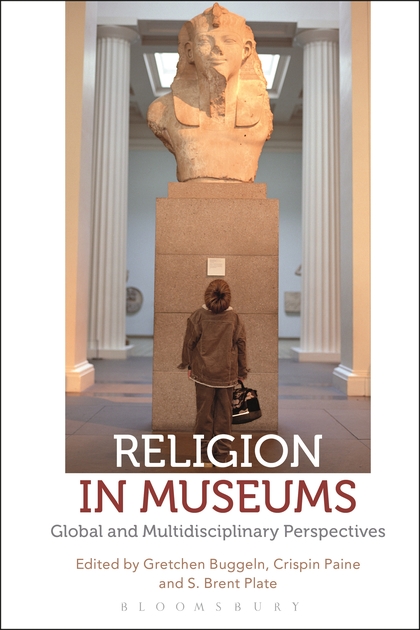
There have been so many events organized around the topic of art and religion in the past year that it’s hard to keep up. Below is a “Study Day” that slipped by before I had the chance to promote it; I’m posting the info here so that you can see the kinds of conversations that are going on among religious studies scholars and museum professionals and can look for future opportunities to join in. (If you’re not in either field but are a museumgoer—and if you’re reading this blog, I imagine you are—a great way to get involved would be to give feedback to the museums you visit. Did their presentation of religion through art and artifact, and wall text, help you connect in a deeper way to your own faith tradition, or see others in a new light? Or did you feel it was offensive, unfair, or in some way else deficient, and if so, why?)
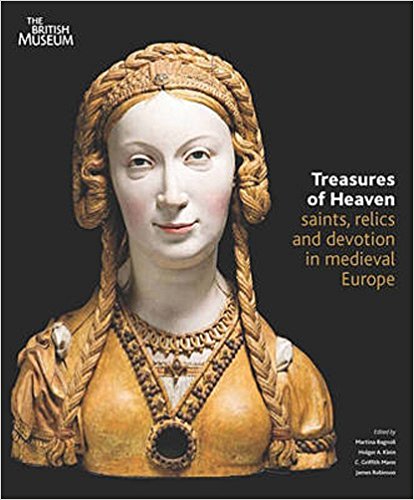
Title:“Encountering the Sacred in Museums” Date: March 15, 2017 Cost: £35 Location: Stevenson Lecture Theatre, British Museum, London Organizer:British Museum Description: This day of discussions on the role museums play in caring for and presenting religious art and artifacts included the lectures “What Is Sacred?” by religious historian Karen Armstrong and “Beyond Belief: The Role of Museums in Interpreting Religion” by Rickie Burman, development manager of London’s National Gallery. In other sessions, visitor experiences at diverse venues were discussed: the Museum of Witchcraft and Magic in Cornwall, the Creation Museum in Kentucky, and the British Museum during its “Treasures of Heaven: Saints, Relics, and Devotion in Medieval Europe,” an exhibition shaped by consultation with community groups.
Now Jesus stood before the governor, and the governor asked him, “Are you the King of the Jews?” Jesus said, “You have said so.” But when he was accused by the chief priests and elders, he gave no answer. Then Pilate said to him, “Do you not hear how many things they testify against you?” But he gave him no answer, not even to a single charge, so that the governor was greatly amazed.
—Matthew 27:11–14
Consider the incredible self-control Jesus exercises in his appearance before Pilate. He has just come from his religious trial, where he was passed from Annas to Caiaphas to the Sanhedrin and found guilty of blasphemy. But the Sanhedrin does not have the authority to issue death sentences, so they turn Jesus over to the civil authorities, claiming he’s a threat to Roman power, guilty of sedition.
Both charges are false, and yet Jesus gives no defense against either one. Why? Why not prove that he truly is the Son of God, and that he’s no insurrectionist? Why not clear his name? In John’s account of the trial before Pilate (18:33–38), Jesus is more verbal; he explains, “My kingdom is not of this world.” But still, he offers no hard evidence, calls no witnesses (they’ve scattered anyway). He essentially sits back and lets the judgment fall.
English poet and clergyman Richard Crashaw (1612–1649) was inspired by Christ’s silence under pressure to pen an epigrammatic verse unpacking its significance. As a teenager attending Charterhouse School in London, he and his fellow students were required to write epigrams based on the epistle and Gospel readings from the day’s chapel services, and it’s a practice Crashaw continued throughout his life. The following was originally published in Steps to the Temple: Sacred Poems, with Other Delights of the Muses in 1646.
“Matthew 27” by Richard Crashaw
And he answered them nothing.
O Mighty Nothing! unto thee,
Nothing, we owe all things that be.
God spake once when he all things made,
He sav’d all when he Nothing said.
The world was made of Nothing then;
’Tis made by Nothing now again.
In “Matthew 27,” Crashaw apostrophizes the word Nothing. (Apostrophe is a poetic device in which the speaker addresses an absent person, an abstract idea, or a thing; Paul does it, for example, in 1 Corinthians 15:55: “O death, where is thy sting? O grave, where is thy victory?”) He plays on its opposite: everything. By no thing comes all things. Continue reading “The “Nothing” that won our salvation”→
There are many people and organizations committed to integrating faith and the arts, and they often organize opportunities for public participation. Here are some such opportunities being offered this spring and summer, organized by date. The last one, a weeklong course taught by David Taylor, looks especially appealing to me and my context, and I’m considering registering.
A few early-bird registration/application deadlines are coming up very soon, on March 31, so give these a gander sooner than later. Click on the links for information on schedules/syllabi, speakers, accommodations, and fee breakdowns. Room and board are not included in the cost quotes I’ve listed unless specifically noted.
If you’re reading this post sometime after spring 2017, or the application deadlines are too tight for you, you’ll be pleased to know that some of these events occur yearly, and if not, you’re sure to find similar ones. Check out the websites of the organizing bodies to see what they have going on.
Title:“Art and Theology” (course) Dates: March 26–29, 2017 Location: Ripon College Cuddesdon, Oxford, England Organizer:Art and Christianity Enquiry (ACE) Cost: £225 (~ $280 US) (includes room and board) Instructors: Christopher Irvine; Alison Milbank; Sophie Hacker; Stephen Stavrou; Laura Moffatt Description: “This short course is designed to give participants the opportunity to both engage with Christian art and to reflect through class presentations and discussion how art is perceived. Each day will balance theoretical input with visits to see art in churches, galleries, and chapels in Oxford. We will examine the contexts in which Christian art is viewed, suggest ways of how we may reflect theologically on contemporary art, and look at the place of art in churches within its architectural and liturgical context.” (I’m intrigued by the lecture title “Museums and Galleries as a Theological Resource”!)
Title:“Lux Ecclesiae: The Light of the Church” (lecture series) Dates: April 25–29, 2017 Location: Paraclete Retreat House, Cape Cod Bay, Massachusetts, USA Organizer:Community of Jesus Speakers: Msgr. Timothy Verdon; Filippo Rossi Cost: $1,000 (includes room and board; single-lecture options available) Description: “Practically from the beginning of its history, the Church has used architecture and the visual arts to express its life, investing thought, creative energies and resources. The reasons for this choice are theological and pastoral, but also anthropological: human beings want to ‘see’, are frustrated if they cannot see, define ‘seeing’ as understanding (as when, grasping a point, we say, ‘I see’), and desire above all things to see the God who, invisible in himself, became visible in Jesus Christ.” Monsignor Timothy Verdon, academic director of the Mount Tabor Ecumenical Centre for Art and Spirituality in Barga, Italy, will develop these themes in a series of seven lectures, and sacred artist Filippo Rossi will give a talk as well.
Title:Movies and Meaning Festival Dates: April 27–30, 2017 Location: KiMo Theatre, Albuquerque, New Mexico, USA Organizer:The Porch Cost: $189 Speakers: Alice Walker; Mona Haydar; Gareth Higgins; Brian McLaren; Malidoma Somé Description: The third annual Movies and Meaning Festival, an interfaith initiative, is centered on the theme “Hope in the Dark.” Over one weekend, participants will be inspired and challenged on this theme by artists and activists who work at the intersection of creativity, peace, spirituality, and social change. Films will serve as touchstones throughout the event; screenings include Pete’s Dragon; The Red Balloon; Mary andMax; Alice Walker: Beauty in Truth; Embrace of the Serpent; Reds; I Am Belfast; The ColorPurple; and more. Participants will walk away with a renewed spirit for social justice and tools for community healing. Continue reading “Upcoming courses, workshops, conferences”→
Gulap K. Hajarathbai (Indian), Temptation, 20th century. Oil on canvas, 18 × 20 in. Source: Herbert E. Hoefer, Christian Art in India (Chennai, India: Gurukul Lutheran Theological College and Research Institute, 1982)
“Tempted”by Eugene H. Peterson
Mark 1:12–13
Still wet behind the ears, he’s Spirit-pushed
up Jordan’s banks into the wilderness.
Angels hover praying ’round his head.
Animals couch against his knees and ankles
intuiting a better master. The Man
in the middle—new Adam in old Eden—
is up against it, matched with the ancient
Adversary. For forty days and nights
he tests the baptismal blessing and proves to his dismay
the Man is made of sterner stuff than Adam:
the Man will choose to be the Son God made him.
Mark dedicates a spare two verses to this initiatory event in the life of Christ: the forty days of temptation he endured immediately following his baptism: “The Spirit immediately drove him out into the wilderness. And he was in the wilderness forty days, being tempted by Satan. And he was with the wild animals, and the angels were ministering to him” (Mark 1:12–13, ESV; cf. Matthew 4:1–11, Luke 4:1–13).
I’m intrigued by Mark’s use of the word driven (ekballō) to describe the manner in which the Spirit imparts motion to Christ. Whereas Matthew and Luke use the gentler led (anagō), Mark implies something more forceful: ejected, cast forth, hurled. In his idiomatic translation of the Bible, The Message, Eugene H. Peterson uses push: “At once, this same Spirit pushed Jesus out into the wild” (emphasis mine).
So the same Spirit who had just alighted on Jesus in the waters of the Jordan, presiding over God’s pronouncement that “You are my beloved Son; with you I am well pleased” (Mark 1:11), now pushes Jesus into the Judean desert, away from civilization. Why? So that in the quiet, he could get to better know himself and the Father, to better discern the task to which he had been called. This process necessarily involved doing battle with the prospects of other paths, other identities.
“Turn these stones into bread.” “Jump; let’s see if God saves you.” “Worship me; I’ll give you the kingdom of earth.”
Satan tries to draw Jesus from a messiahship of self-sacrifice to a messiahship of power. Performing miracles for his own benefit, to avoid any discomfort or pain in life; performing miracles for show, like a magician, to impress the masses; becoming an earthly king, with political control and dominion—these are all temptations Jesus would face again. Here he has the opportunity to confront them head-on in preparation for his imminent ministry to the Israelites. Over this period of forty days, Jesus solidifies his mission, rejecting the vision of himself and his life that Satan lays out for him. Instead of gratification, pride, and riches, Jesus chooses purity, humility, and poverty. Continue reading “Voices in the desert—whose blessing will we heed?”→
Prior to 1848, anyone wanting to cross the Niagara River had to do so by ferryboat, making it difficult for people and cargo to travel between New York and Upper Canada. Endeavoring to better connect the Atlantic coast with new territories in the West, entrepreneur William Merritt got permission to build a railway suspension bridge over the river, two and a half miles north of Niagara Falls. Charles Ellet Jr. was hired as the chief engineer.
Ellet’s first challenge was how to get a line across the gap. Cannonballs, rockets, and steamers were among the proposals, but Ellet ultimately decided to use a kite. To generate publicity, he held a kite-flying contest in January 1848, offering a cash prize to the first boy to anchor a string from country to country, 800 feet across the chasm and about 240 feet above the Whirlpool Rapids. Sixteen-year-old Homan Walsh won, flying his kite from the Canadian shoreline to the American side, where he had it fastened to a tree. Ellet’s team attached a light cord to Walsh’s kite string, then pulled the joined lines back across. Over the next month or so, they pulled successively heavier and stronger lines back and forth, back and forth, until the final bridge cable was in place.
Donna Marie Campbell, Kite Flying Contest Held To Get The First Line Across [The Gorge] For The Suspension Bridge (after a 19th-century sketch by an unknown artist), 1975. Watercolor, 23.7 × 31.4 cm.Edwin Markham (1852–1940) interprets this story as a parable in his poem “Anchored to the Infinite,” likening faith and love to cords that grow in strength the more they are sent out, and that have their anchor in God.
“Anchored to the Infinite” by Edwin Markham
The builder who first bridged Niagara’s gorge,
Before he swung his cable, shore to shore,
Sent out across the gulf his venturing kite
Bearing a slender cord for unseen hands
To grasp upon the further cliff and draw
A greater cord, and then a greater yet;
Till at the last across the chasm swung
The cable then the mighty bridge in air!
So we may send our little timid thought
Across the void, out to God’s reaching hands—
Send out our love and faith to thread the deep—
Thought after thought until the little cord
Has greatened to a chain no chance can break,
And—we are anchored to the Infinite!
This poem is very close in form to a Petrarchan sonnet—it consists of an octave and a sestet in iambic pentameter, with a caesura (turn) between them, but it doesn’t rhyme.
The first stanza recounts the construction of Ellet’s suspension bridge across the Niagara River, especially his use of a kite to hang the initial cable.
The second stanza identifies in this historic building project an extended metaphor of spiritual significance. We are the children who stand at the edge of a vast unknown, timidly putting our faith and love out there, just hoping it will be received and answered. Sure enough, God stands on the other side, reaching out to grab ahold of our most feeble efforts to know him and to trust him, and anchor us to himself.
The last phrase (and the poem’s title)—“anchored to the Infinite”—is not quite a paradox, but it is difficult to visualize: being fixed to that which has no limits. Infinity cannot be pinned down, and yet it (or should I say “he”) pins us down, stabilizes us. We need only faith as small as a mustard seed, or as thin as a kite string, and God will catch it from across the void, attaching us securely to himself.
Terry Widener produced a beautiful, impressionistic illustration on page 32 of the children’s book The Kite That Bridged Two Nations that shows Homan Walsh flying his kite over Niagara Gorge. Although it is meant to be taken literally—an artistic interpolation of a historic event—it speaks volumes to me about what it means to exercise faith. Unfortunately, my request to reproduce it here was denied by the publisher, but I can describe it: Two rocky, snow-capped precipices rise up on either side of the picture, and a turbulent river courses between them, moving down a slight fall and crashing against four large rocks that protrude from the riverbed. The top fifth of the painting is blue sky, and a cumulus cloud hangs dead center, making visible a tiny red speck of a kite on a wisp of a string. Follow that string to the right side, and you can just barely make out a human figure holding the reel on the edge of the cliff. Because the gorge dominates the painting, the mood at first glance is one of panic and tumult. But in the upper register there’s a sense of peace and calm, as the kite drifts above the waves in search of an anchor. It’s still a scary endeavor—the small traversing the vast—and there’s the risk of losing the kite altogether, but there’s a thrill in it, in putting yourself out there.
One aspect of the metaphor that’s not addressed in Markham’s poem is the wind, which in the Bible is associated with the Holy Spirit. Just as the wind gives the kite lift, so does the Spirit give flight to our faith and love, powering us forward toward God.
As we unreel those two virtues, God works with us to “thread the deep”—to bridge the gap between finite and Infinite. And he strengthens us in them so that one day we will be able to walk out over the rapids, all the way across to the other side.
“Anchored to the Infinite” by Edwin Markham originally appeared in The Shoes of Happiness and Other Poems (New York: Doubleday, Page & Company, 1919) and is now in the public domain.
Shepherds, I sing you this winter’s night
Our Hope new-planted, the womb’d, the buried Seed:
For a strange Star has fallen, to blossom from a tomb,
And infinite Godhead circumscribed hangs helpless at the breast.
Now the cold airs are musical, and all the ways of the sky
Vivid with moving fires, above the hills where tread
The feet—how beautiful!—of them that publish peace.
The sacrifice, which is not made for them,
The angels comprehend, and bend to earth
Their worshipping way. Material kind Earth
Gives Him a Mother’s breast, and needful food.
A Love, shepherds, most poor,
And yet most royal, kings,
Begins this winter’s night;
But oh, cast forth, and with no proper place,
Out in the cold He lies!
This poem is published in Collected Poems 1943–1987 by John Heath-Stubbs (Carcanet Press, 1988) and is reprinted here by permission of David Higham Associates.
+++
John Heath-Stubbs (1918–2006) was an English poet, translator, critic, and anthologist whose lifelong fascination with world history and literature was borne out in his career. He translated poetry from Greek (Sappho, Anyte, Anacreon), Latin (Horace, Catullus), Persian (Hafiz, Omar Khayyam), Italian (Dante, Giacomo Leopardi), and French (Paul Verlaine) and wrote many verses of his own influenced by classical myths, including an Arthurian epic, Artorius.
Described by friends as a “devout” and “committed” Christian, Heath-Stubbs sometimes turned to the lives of Christ and the saints as subjects for his poetry, as in “‘Through the Dear Might of Him That Walk’d the Waves,’” “Dionysius the Areopagite” (on a pagan’s response to the eclipse during the Crucifixion), “Canticle of the Sun” (on the Resurrection), “Alexandria,” “Maria Aegyptiaca,” and “Virgin Martyrs,” to name a few. In his introduction to his Collected Poems, he wrote that he was interested in “the reaffirmation of orthodox religious themes in the poetry of TS Eliot and Charles Williams and others.”
Among other distinctions, Heath-Stubbs was awarded the Queen’s Gold Medal for Poetry in 1973 and in 1989 was appointed OBE (Officer of the Most Excellent Order of the British Empire). At his death, publications celebrated his style and influence:
“His distinctive achievement was to forge a modern pastoral out of unlikely sources, a style which can encompass Yeatsian symbolism and dry irony.”—Poetry Archive
His diction was conservative, but his lyricism was always modern.—The Telegraph
“His finest work is to be found in his huge output of shorter poems. In their technical mastery, wry wisdom and gloriously deceptive lightness, these place him in the company of W.H. Auden and Robert Graves, a major English poet of the 20th century.”—The Independent
Heath-Stubbs was nearly blind from age three, his eyesight progressively worsening until he lost it completely at age fifty-nine. But rather than regard his blindness as a disability, he regarded it as a gift. “As a poet, I have found that blindness actually tends to stimulate the imagination,” he said.
+++
First published in 1965, “For the Nativity” by John Heath-Stubbs is an ode to the infant Jesus—to him who is Hope, Seed, Star, and Love.
The first stanza is a loose paraphrase of the Annunciation to the Shepherds in Luke 2:10–13, in which an angel tells a group of Jewish night workers that Emmanuel, God-with-us, has been born. Heath-Stubbs uses horticultural imagery: Jesus was planted in Mary’s womb, and now he breaks through into air, blooming for all the world to see. Foreshadowing future events, the “tomb” refers not only to the cave he was born in but also to the cave he’d be buried in. He’d be seeded once again (in death), and again (in resurrection) he’d flower forth with new life. The fourth line embraces the paradox of the Incarnation: that infinite God became a finite human being; the omnipotent Creator, an impotent babe reliant on his mother’s milk. Continue reading ““For the Nativity” by John Heath-Stubbs + choral setting”→
Whenever I meet new people and they ask what I do, I always tell them I’m a writer on Christianity and the arts. The follow-up question is often, “Oh, are you an artist?,” to which I respond with something like “No, but I love to study art, and I want to make Christians aware of the church’s rich artistic heritage.”
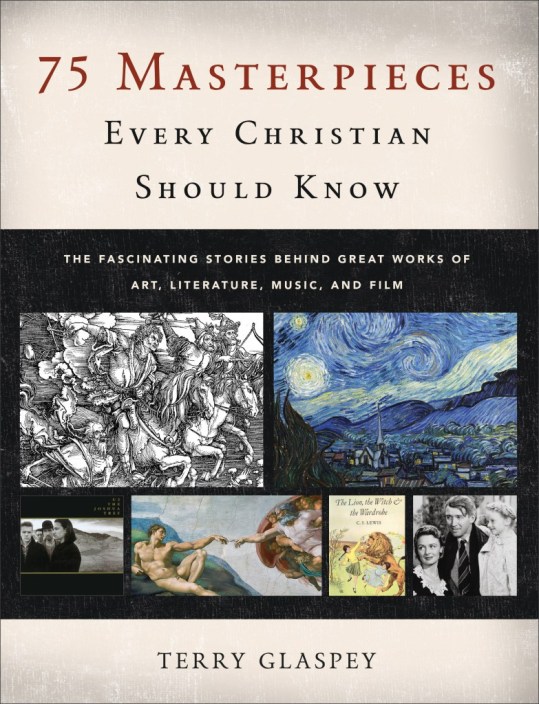
In this full-color survey, Glaspey—curator and tour guide—invites us to be “inspired, entertained, and challenged” as we encounter artists’ material witness to their faith through the ages. An Eastern Orthodox icon, a Renaissance altarpiece, a metaphysical poetry collection, a jazz suite, a rock album, children’s fantasy stories, an Italian neorealist film, a radio drama, and contemporary nihonga are just some of the many creative works featured. Organized chronologically from the Roman catacomb paintings to Terrence Malick’s TheTree of Life, the book encompasses almost all the major artistic disciplines (dance is conspicuously absent) and a variety of styles and eras, with a focus on Western art. (Sadao Watanabe’s Last Supper stencil print, Japanese American artist Makoto Fujimura’s illuminated Gospels project, and a few works from Russia are the only exceptions.) I’m impressed by how fluent Glaspey is in each area. He can speak just as easily about silent film as he can about Gothic architecture and contemporary folk art!
The author says his selection process was guided by these criteria:
works that are universally esteemed for their craftsmanship and creativity, admired not only by Christians but also by those outside the faith
works that stand up well to repeated exposure, the kind of art that can be visited again and again, because there is always something new to discover
works that speak to people across time, cultures, national boundaries, and denominational divides
Preempting readers’ tendencies to object to certain omissions, Glaspey adds,
This is most emphatically not a list of the absolute best or greatest works, nor does it imply any ranking system. Instead, it attempts to represent the breadth and depth of what Christians have accomplished in the arts, and is an intentionally quirky mix of the widely known and the mostly unknown.
Each of the seventy-five entries contains not only discussion of the content, formal qualities, and historical context of the highlighted work but also an overview of the artist’s oeuvre and a mini spiritual biography. These are not generic glosses or rote info dumps. On the contrary, Glaspey devotes individualized care to each one in the space of about four pages, giving us both concision and substance. He likens his offerings to movie trailers: they are meant to give you a sense of the artwork’s flavor and entice you to explore it more fully on your own.
Ceiling detail of La Sagrada Familia Cathedral in Barcelona, designed by Antoni Gaudí, begun 1882
Jyoti Sahi (Indian, 1944–), Thy Kingdom Come. Oil on canvas.
When the heart is hard and parched up, come upon me with a shower of mercy.
When grace is lost from life, come with a burst of song.
When tumultuous work raises its din on all sides, shutting me out from beyond, come to me, my lord of silence, with thy peace and rest.
When my beggarly heart sits crouched, shut up in a corner, break open the door, my king, and come with the ceremony of a king.
When desire blinds the mind with delusion and dust, O thou holy one, thou wakeful one, come with thy light and thy thunder.
This untitled poem is no. 39 from the collection Gitanjali (Song Offerings) by Rabindranath Tagore. Originally written and published in Bengali in 1910, it was translated into English by Tagore himself in 1912, along with other poems of his from various sources, and published by the India Society of London with an introduction by W. B. Yeats. For this volume he was awarded the Nobel Prize in Literature—the first non-European to receive such a distinction.
Here the speaker entreats God to break into his life, bestowing divine gifts: mercy, like rainwater, to moisten his dry heart; grace, like a song, to lift his spirit; and peace and rest to counteract the overwhelm of daily work. He asks God to come like a king and lavish his riches on all us spiritually impoverished, and like thunder and lightning, to jolt us awake from our sin and delusion. Each line of the poem works by contrast: man in his neediness, and the need-meeting God.
Tagore’s poetry bears Hindu influence but has wide cross-religious appeal and has inspired numerous musical settings in his native India and abroad. The composition below (a setting of “When the heart is hard and parched up”) is by the famous Indian classical singer and composer Jagjit Singh.
In 2010 American composer Joan Szymko wrote A Burst of Song, a short three-movement choral cycle that sets three poems from the English Gitanjali. Movement 1, “A Shower of Mercy,” excerpts our familiar text. Listen to a performance below (the first movement goes through 1:56) by Portland University’s Man Choir and its female choir, Vox Femina:
BLESSING: “Blessing for Getting the News” by Jan L. Richardson: August brought two devastating pieces of news to me; I wasn’t in the line of direct impact, but I hurt for the two families who were. A blessing by artist-author Jan L. Richardson came at just the right time. Here’s an excerpt:
. . . when the news comes, may it be attended by every grace, including the ones you will not be able to see now.
When the news comes, may there be hands to enfold and bless, even when you cannot receive their blessing now.
When the news comes, may the humming in your head give way to song, even if it will be long and long before you can hear it,
before you can comprehend the love that latched onto you in the rending— the love that bound itself to you even as it began its leaving and has never let you go.
ESSAY: “Transfiguring Gold: Andy Warhol’s Gold Marilyn Monroe” by James Romaine: In his latest visual meditation for ArtWay, art historian James Romaine writes on external versus essential beauty, and the Orthodox aesthetic, in one of Warhol’s most famous paintings. “A revelation of uncreated and transfiguring light” in the icon tradition, the use of gold, Romaine posits, was a theological choice on Warhol’s part, one influenced by his Byzantine Catholic faith. Warhol drew on celebrity imagery to encourage a transformation in viewers from material sight to metaphysical vision. This essay is adapted from a more extensive one titled “The Transfiguration of the Soup Can,” published in Beauty and the Beautiful in Eastern Christian Culture and linked to here with the author’s permission.
Andy Warhol (American, 1928–1987), Gold Marilyn Monroe, 1962. Silkscreen ink on synthetic polymer paint on canvas, 211.4 × 144.7 cm. Museum of Modern Art, New York.
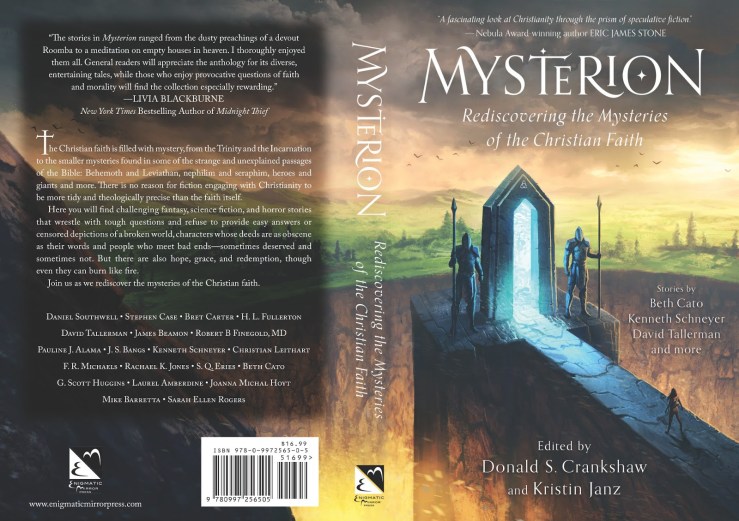
BOOK: Mysterion: Rediscovering the Mysteries of the Christian Faith, edited by Donald Crankshaw and Kristin Janz: Last week the husband and wife team of Donald Crankshaw and Kristin Janz published an anthology of science fiction, fantasy, and horror stories that engage with Christianity. It features twenty of the 450-plus submissions they received, all but four of which are published here for the first time. Describing their criteria for selection, Crankshaw writes in the introduction, “We wanted stories that were as untidy and as theologically imprecise as the Bible itself.” The result is a collection of diverse voices and approaches, exploring such topics as sin, forgiveness, the afterlife, the soul, mission, miracles, and supernatural agents. To read excerpts from the book, visit www.mysterionanthology.com.







 Art & Theology