“i thank You God for most this amazing” by E. E. Cummings

Chocorua Landscape by E. E. Cummings
E. E. Cummings (American, 1894–1962), Chocorua Landscape. Watercolor, 12 × 18 in.

i thank You God for most this amazing
day:for the leaping greenly spirits of trees
and a blue true dream of sky;and for everything
which is natural which is infinite which is yes

(i who have died am alive again today,
and this is the sun’s birthday;this is the birth
day of life and of love and wings:and of the gay
great happening illimitably earth)

how should tasting touching hearing seeing
breathing any—lifted from the no
of all nothing—human merely being
doubt unimaginable You?

(now the ears of my ears awake and
now the eyes of my eyes are opened)

This poem was originally published in Xaipe1 (New York: Oxford University Press, 1950), reissued in 2004 by Liveright, an imprint of W.W. Norton & Company. Reprinted here by permission of the publisher. Copyright expires 2045.


Edward Estlin Cummings (1894–1962), known as E. E. Cummings,2 is one of America’s most famous twentieth-century poets. Born in Cambridge, Massachusetts, he was raised, a pastor’s son, in the Unitarian faith, which emphasizes the oneness of God. As an adult he wed this spiritual framework to Emersonian transcendentalism, a philosophical movement that celebrates humanity and nature. Elements from these two complementary traditions can be detected in his praise poem “i thank You God for most this amazing,” in which the natural world triggers an awakening to Truth. And for Cummings, Truth is a person, a “You” with a capital Y.

Humanities students are always introduced to Cummings as a poet, but actually, painting is the endeavor he invested most of his time in.3 One of his favorite subjects to paint was the landscape surrounding his summer home at Joy Farm in Silver Lake, New Hampshire (see image above). The elation he felt in this environment of wooded hills, fields, and lake he worked into several of his poems. I wonder if the phrases “leaping greenly spirits of trees” and “blue true dream of sky” were inspired by a view from his farmstead one August day.

Cummings is notorious for his idiosyncratic poetic style, which is marked especially by unconventional syntax—that is, a nonlogical ordering of words. This device is at play in the awkward first line of our present poem, which dislocates “most”: instead of “i thank You God for this most amazing / day” (this day is so amazing) or even “i thank You God most for this amazing / day” (this day is what I’m most thankful for), we have “i thank You God for most this amazing / day.” By inverting the word order, Cummings draws attention to the word “most,” traditionally an adverb but in this position an indeterminate part of speech.  Continue reading ““i thank You God for most this amazing” by E. E. Cummings”

Catching the sun with Frans Claerhout

Boy and Cart by Frans Claerhout
Frans Claerhout (Belgian/South African, 1919–2006), Boy and Cart. Oil on canvas laid down on board, 37 × 45 cm.

Father Frans Claerhout (1919–2006) was a Belgian Catholic missionary to South Africa as well as a self-taught artist whose painting sales helped support the church’s work in and around the impoverished towns of Bloemfontein and Thaba ‘Nchu. For him, painting was an extension of his mission, for through it, he said, he sought to communicate joy and beauty. He often depicted the everyday scenes he observed around him—farmers harvesting grain, women carrying water or flowers, children playing, donkeys, chickens, sweethearts. Sometimes he transformed such scenes into biblical ones, such as the Annunciation, the Flight to Egypt, Peter’s denial, or the Good Shepherd.

Claerhout understood himself as having a dual vocation. In a 1999 interview with Esté de Klerk, he said, “I am a priest, but I am also an artist, and I have always combined the two. I am one and the same, Father Claerhout—priest and painter. Not two sides of a piece of bread but the whole piece.” In other words, he saw the two as perfectly integrated. He couldn’t turn over his priestly duties for part of the day to focus on his art, nor vice versa, because they were one and the same. In both roles, he administered the gospel.

With the money Claerhout made from his paintings, he funded the building of twenty churches and several houses for families in addition to the purchase of eight vehicles for the transport of schoolchildren, the sick, and the elderly. He liked to think of himself as “a breadwinner for the church.”

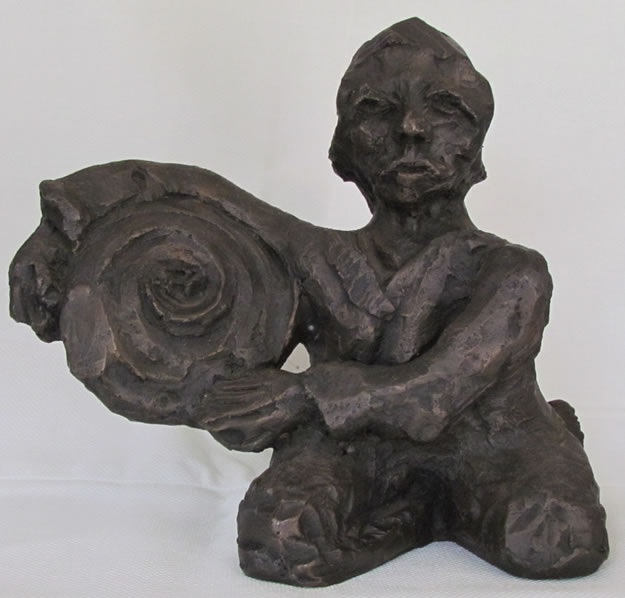
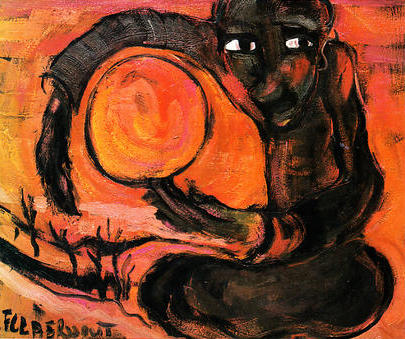
One recurrent motif in Claerhout’s work is what he called the “sun catcher” (sonnevanger): a person cradling the sun in his or her arms or toting it by hand or by cart. “Catching the sun” is a phrase that Claerhout used often in his teaching and poetry in reference to possessing joy—warmth, light—in Christ. It engages a theological wordplay that’s been in use since the earliest developments of the English language: sun/Son. Christ is both.

Sun Catcher by Frans Claerhout
Frans Claerhout (Belgian/South African, 1919–2006), The Sun Catcher. Bronze sculpture.
Sun Catcher by Frans Claerhout
Frans Claerhout (Belgian/South African, 1919–2006), The Sun Catcher.
Woman with Sun by Frans Claerhout
Frans Claerhout (Belgian/South African, 1919–2006), Woman with Sun. Mixed media on paper, 60 × 42 cm.

Continue reading “Catching the sun with Frans Claerhout”

“The Dawning” by George Herbert

He Is Risen by Romare Bearden
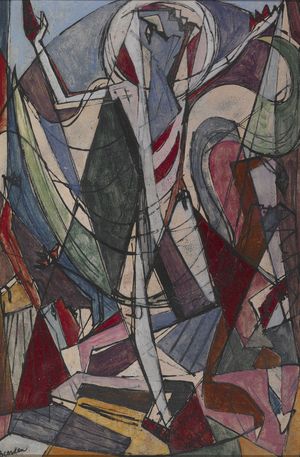
Romare Bearden (American, 1911–1988), He Is Risen, 1945. Oil on gessoed board, 36 × 24 in.

Awake, sad heart, whom sorrow ever drowns;
     Take up thine eyes, which feed on earth;
Unfold thy forehead, gathered into frowns;
     Thy Saviour comes, and with him mirth:
                                    Awake, awake,
And with a thankful heart his comforts take.
     But thou dost still lament, and pine, and cry,
     And feel his death, but not his victory.

Arise, sad heart; if thou dost not withstand,
     Christ’s resurrection thine may be;
Do not by hanging down break from the hand
     Which, as it riseth, raiseth thee:
                                    Arise, arise,
And with his burial linen dry thine eyes.
     Christ left his grave clothes, that we might, when grief
     Draws tears or blood, not want a handkerchief.

This poem was originally published in The Temple: Sacred Poems and Private Ejaculations by George Herbert (1633).

“Ecce Homo” by Andrew Hudgins

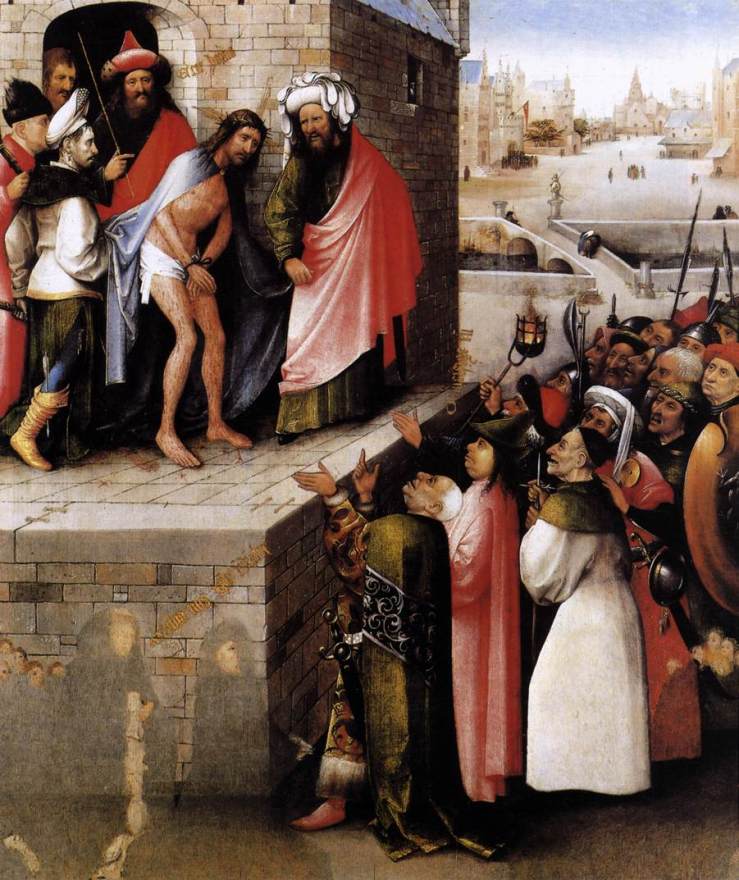
Ecce Homo by Hieronymus Bosch
Hieronymus Bosch (Dutch, ca. 1450–1516), Ecce Homo, ca. 1500. Tempera and oil on oak panel, 71 × 61 cm. Städel Museum, Frankfurt, Germany.

Christ bends, protects his groin. Thorns gouge
his forehead, and his legs
are stippled with dried blood. The part of us
that’s Pilate says, Behold the man.
We glare at that bound, lashed,
and bloody part of us that’s Christ. We laugh, we howl,
we shout. Give us Barabbas,
not knowing who Barabbas is, not caring.
A thief? We’ll take him anyway. A drunk?
A murderer? Who cares? It’s better him
Than this pale ravaged thing, this god. Bosch knows.
His humans waver, laugh, then change to demons
as if they’re seized by epilepsy. It spreads
from eye to eye, from laugh to laugh until,
incited by the ease of going mad,
they go. How easy evil is! Dark voices sing,
You can be evil or you can be good,
but good is dull, my darling, good is dull.
And we’re convinced: How lovely evil is!
How lovely hell must be! Give us Barabbas!

Lord Pilate clears his throat and tries again:
I find no fault in this just man.
It’s more than we can bear. In gothic script
our answer floats above our upturned eyes.
O crucify, we sing. O crucify him!

This poem was originally published in The Never-Ending (Boston: Houghton Mifflin, 1991) and is reprinted here with the permission of the poet.   Continue reading ““Ecce Homo” by Andrew Hudgins”

“The Burden” by Philip Rosenbaum

Triumphal Entry by Gustave Dore
Gustave Doré (French, 1832–1883), The Entry of Christ into Jerusalem, 1876. Oil on canvas, 38-1/4 × 51 in.

Unaccustomed to her burden, she knows not
That never beast bore such a Man as this,
Who meekly rides to His appointed lot,
A crown of thorns and a betrayer’s kiss.
And never man will carry such a weight
As He bears now in this, His day of power,
Ascending toward a strait and narrow gate,
His agonizing last and finest hour.
She bravely struggles on, despite her fear
Of cheering men, whom He as gravely views
As an admiral watching distant storms draw near
To lash bright waves to dark and deadly hues;
He knows the death decreed in ancient psalms,
The Tree that looms beyond these scattered palms.

“The Burden” © 2004 by Philip Rosenbaum. Reprinted with permission. Published privately as one of twenty-four poems in the volume Holy Week Sonnets. To purchase a copy of the book, contact the author through his website, ChristianPoet.org. (Take it from me: both the physical book and its content are of high quality. It’s a lovely, professionally designed and printed hardcover edition with textured paper and a ribbon marker and a foreword by Joni Eareckson Tada, containing skillfully written poems from various points along the Christ narrative, and various perspectives. The latter half contains correlative scripture passages.)

“The Pleasure Principle” by Raymond Oliver

Who are you? Why do you not let me live
As I please? And how could your caress, so rough,
Be kinder than my smooth alternative?

Your steel-brush strokes are forcing me to slough,
Daily, my fleshy growths of appetite,
But still they come; I cannot have enough.

I would forever scratch my itches, light
At first, then harder at the thickened sore;
But you would give me radical delight,
Gouging my itches till I have no more.

“The Pleasure Principle” is published here with the permission of Southern Humanities Review, where the poem first appeared in Spring 1974.

+++

In this poem, sinful desires are characterized as skin sores whose itchiness is temporarily relieved when scratched—but the scratching also makes the sores become irritated and enlarged and even more vile-looking, and the itch comes back not too long after.

The speaker addresses God, first in a posture of defensiveness. God has presumably penetrated his conscience, illuminating his sin, and he responds with a string of accusatory questions to the effect of, “Who do you think you are, coming into my life, telling me what I can and can’t do? I am happy as I am, thank you very much.”   Continue reading ““The Pleasure Principle” by Raymond Oliver”

Roundup: Fiction for Lent, art as commodity, major Bosch retrospective, Easter art retreat

Sarah Arthur is the editor of the just-published Between Midnight and Dawn: A Literary Guide to Prayer for Lent, Holy Week, and Eastertide. She has written an article for Christianity Today, “The Best Books to Read for Lent (That You Won’t Find in a Christian Bookstore).”

+++

Writing for the New Yorker, Ken Kalfus reviews the new novel Laurus by Russian medievalist Eugene Vodolazkin: “Medieval Russia was a land trembling with religious fervor. Mystics, pilgrims, prophets, and holy fools wandered the countryside. . . . [Laurus] recreates this fervent landscape and suggests why the era, its holy men, and the forests and fields of Muscovy retain such a grip on the Russian imagination.”

+++

In “Art as a Commodity: Does Time Equal Value in Art?” artist Scott Laumann discusses one of the most annoying questions he is asked at gallery shows: “How long did that take you?”

+++

Garden of Earthly Delights
Hieronymus Bosch (Dutch, ca. 1450–1516), The Garden of Earthly Delights. Oil on oak panels, 220 × 389 cm. Museo del Prado, Madrid.

This year marks the five hundredth anniversary of the death of Dutch artist Hieronymus Bosch, known for his grotesque depictions of human depravity. To commemorate his life and work, the Noordbrabants Museum in ’s-Hertogenbosch, the city of Bosch’s birth, has brought together his panels and drawings from all over the world in what is the largest Bosch exhibition of all time. Bosch invented an entirely new religious iconography: landscapes filled with bizarre, nightmarish creatures doing freakish things to or with humans—meant not as a prediction of what will one day happen to the damned but as a lament for what is already happening. Jonathan Jones, reviewer for The Guardian, gives the retrospective five stars.

+++

Lumen Christi: In the Light of the Risen Christ—Easter Encounters with Art”: The monastic ecumenical Community of Jesus on Cape Cod will be hosting a five-day art retreat from April 5 to 9, led by art historian Timothy Verdon and artist Gabriele Wilpers. Focused on the theme of resurrection, the retreat will feature lectures and discussion, group workshops, studio mentoring, and daily worship services. For more information, follow the link above.

Excerpts from “The Everlasting Mercy” by John Masefield

The poet laureate of the United Kingdom from 1930 until his death in 1967, John Masefield occasionally turned to Christian themes in his writing. In 1911 he wrote “The Everlasting Mercy,” a long poem that tells the tale of a man’s conversion from a life of sin to life in Christ. Masefield takes us down into the darkness felt by the poem’s antihero and speaker, Saul Kane—a belligerent drunk and a womanizer—and then up into the light he experiences when, in his own words, “the Lord took pity on me” and “brought me into grace.”

The bulk of the poem takes place during one of Saul’s drinking binges: he has just clobbered one of his friends in a boxing match, defending his (knowingly false) claim to a piece of land, and is celebrating at the Lion, a local pub. As is his custom, he starts flirting with a barmaid and then makes a sexual pact with her. He feels a sting of moral conviction about this—

And while we whispered there together
I give her silver for a feather
And felt a drunkenness like wine
And shut out Christ in husks and swine.
I felt the dart strike through my liver.
God punish me for’t and forgive her.

—but not enough to stop him from carrying out the deed. To ease his conscience, he issues a direct address to his fellow males, urging them away from such behavior:

O young men, pray to be kept whole
From bringing down a weaker soul.
Your minute’s joy so meet in doin’
May be the woman’s door to ruin;
The door to wandering up and down,
A painted whore at half a crown.
The bright mind fouled, the beauty gay
All eaten out and fallen away,
By drunken days and weary tramps
From pub to pub by city lamps
Till men despise the game they started
Till health and beauty are departed,
And in a slum the reeking hag
Mumbles a crust with toothy jag,
Or gets the river’s help to end
The life too wrecked for man to mend.

Found Drowned by G. F. Watts
George Frederic Watts (British, 1817–1904), Found Drowned, 1850. Oil on canvas. Watts Gallery, Guildford, Surrey, England.

Throughout the poem Saul’s narration is shot through with this sort of guilty awareness of his own depravity. It disgusts him, but he represses that disgust while he’s in the act of perpetrating whatever sin is at hand, whether it be lying, stealing, poaching, punching, speaking irreverently, or taking sexual advantage of young women.   Continue reading “Excerpts from “The Everlasting Mercy” by John Masefield”