“The Pleasure Principle” by Raymond Oliver

Who are you? Why do you not let me live
As I please? And how could your caress, so rough,
Be kinder than my smooth alternative?

Your steel-brush strokes are forcing me to slough,
Daily, my fleshy growths of appetite,
But still they come; I cannot have enough.

I would forever scratch my itches, light
At first, then harder at the thickened sore;
But you would give me radical delight,
Gouging my itches till I have no more.

“The Pleasure Principle” is published here with the permission of Southern Humanities Review, where the poem first appeared in Spring 1974.

+++

In this poem, sinful desires are characterized as skin sores whose itchiness is temporarily relieved when scratched—but the scratching also makes the sores become irritated and enlarged and even more vile-looking, and the itch comes back not too long after.

The speaker addresses God, first in a posture of defensiveness. God has presumably penetrated his conscience, illuminating his sin, and he responds with a string of accusatory questions to the effect of, “Who do you think you are, coming into my life, telling me what I can and can’t do? I am happy as I am, thank you very much.”   Continue reading ““The Pleasure Principle” by Raymond Oliver” →

Roundup: Fiction for Lent, art as commodity, major Bosch retrospective, Easter art retreat

Sarah Arthur is the editor of the just-published Between Midnight and Dawn: A Literary Guide to Prayer for Lent, Holy Week, and Eastertide. She has written an article for Christianity Today, “The Best Books to Read for Lent (That You Won’t Find in a Christian Bookstore).”

+++

Writing for the New Yorker, Ken Kalfus reviews the new novel Laurus by Russian medievalist Eugene Vodolazkin: “Medieval Russia was a land trembling with religious fervor. Mystics, pilgrims, prophets, and holy fools wandered the countryside. . . . [Laurus] recreates this fervent landscape and suggests why the era, its holy men, and the forests and fields of Muscovy retain such a grip on the Russian imagination.”

+++

In “Art as a Commodity: Does Time Equal Value in Art?” artist Scott Laumann discusses one of the most annoying questions he is asked at gallery shows: “How long did that take you?”

+++

Garden of Earthly Delights
Hieronymus Bosch (Dutch, ca. 1450–1516), The Garden of Earthly Delights. Oil on oak panels, 220 × 389 cm. Museo del Prado, Madrid.

This year marks the five hundredth anniversary of the death of Dutch artist Hieronymus Bosch, known for his grotesque depictions of human depravity. To commemorate his life and work, the Noordbrabants Museum in ’s-Hertogenbosch, the city of Bosch’s birth, has brought together his panels and drawings from all over the world in what is the largest Bosch exhibition of all time. Bosch invented an entirely new religious iconography: landscapes filled with bizarre, nightmarish creatures doing freakish things to or with humans—meant not as a prediction of what will one day happen to the damned but as a lament for what is already happening. Jonathan Jones, reviewer for The Guardian, gives the retrospective five stars.

+++

“Lumen Christi: In the Light of the Risen Christ—Easter Encounters with Art”: The monastic ecumenical Community of Jesus on Cape Cod will be hosting a five-day art retreat from April 5 to 9, led by art historian Timothy Verdon and artist Gabriele Wilpers. Focused on the theme of resurrection, the retreat will feature lectures and discussion, group workshops, studio mentoring, and daily worship services. For more information, follow the link above.

Excerpts from “The Everlasting Mercy” by John Masefield

The poet laureate of the United Kingdom from 1930 until his death in 1967, John Masefield occasionally turned to Christian themes in his writing. In 1911 he wrote “The Everlasting Mercy,” a long poem that tells the tale of a man’s conversion from a life of sin to life in Christ. Masefield takes us down into the darkness felt by the poem’s antihero and speaker, Saul Kane—a belligerent drunk and a womanizer—and then up into the light he experiences when, in his own words, “the Lord took pity on me” and “brought me into grace.”

The bulk of the poem takes place during one of Saul’s drinking binges: he has just clobbered one of his friends in a boxing match, defending his (knowingly false) claim to a piece of land, and is celebrating at the Lion, a local pub. As is his custom, he starts flirting with a barmaid and then makes a sexual pact with her. He feels a sting of moral conviction about this—

And while we whispered there together
I give her silver for a feather
And felt a drunkenness like wine
And shut out Christ in husks and swine.
I felt the dart strike through my liver.
God punish me for’t and forgive her.

—but not enough to stop him from carrying out the deed. To ease his conscience, he issues a direct address to his fellow males, urging them away from such behavior:

O young men, pray to be kept whole
From bringing down a weaker soul.
Your minute’s joy so meet in doin’
May be the woman’s door to ruin;
The door to wandering up and down,
A painted whore at half a crown.
The bright mind fouled, the beauty gay
All eaten out and fallen away,
By drunken days and weary tramps
From pub to pub by city lamps
Till men despise the game they started
Till health and beauty are departed,
And in a slum the reeking hag
Mumbles a crust with toothy jag,
Or gets the river’s help to end
The life too wrecked for man to mend.

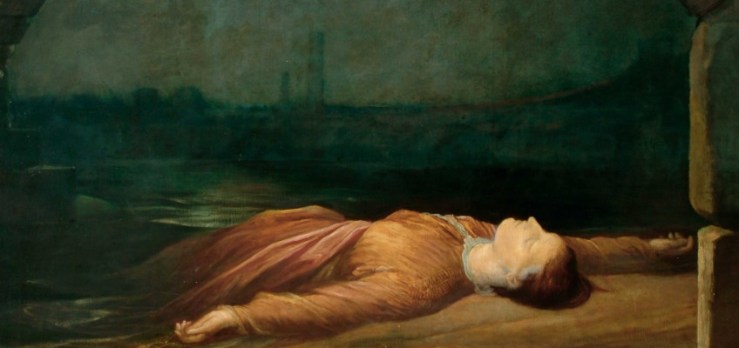
Found Drowned by G. F. Watts
George Frederic Watts (British, 1817–1904), Found Drowned, 1850. Oil on canvas. Watts Gallery, Guildford, Surrey, England.

Throughout the poem Saul’s narration is shot through with this sort of guilty awareness of his own depravity. It disgusts him, but he represses that disgust while he’s in the act of perpetrating whatever sin is at hand, whether it be lying, stealing, poaching, punching, speaking irreverently, or taking sexual advantage of young women.   Continue reading “Excerpts from “The Everlasting Mercy” by John Masefield” →