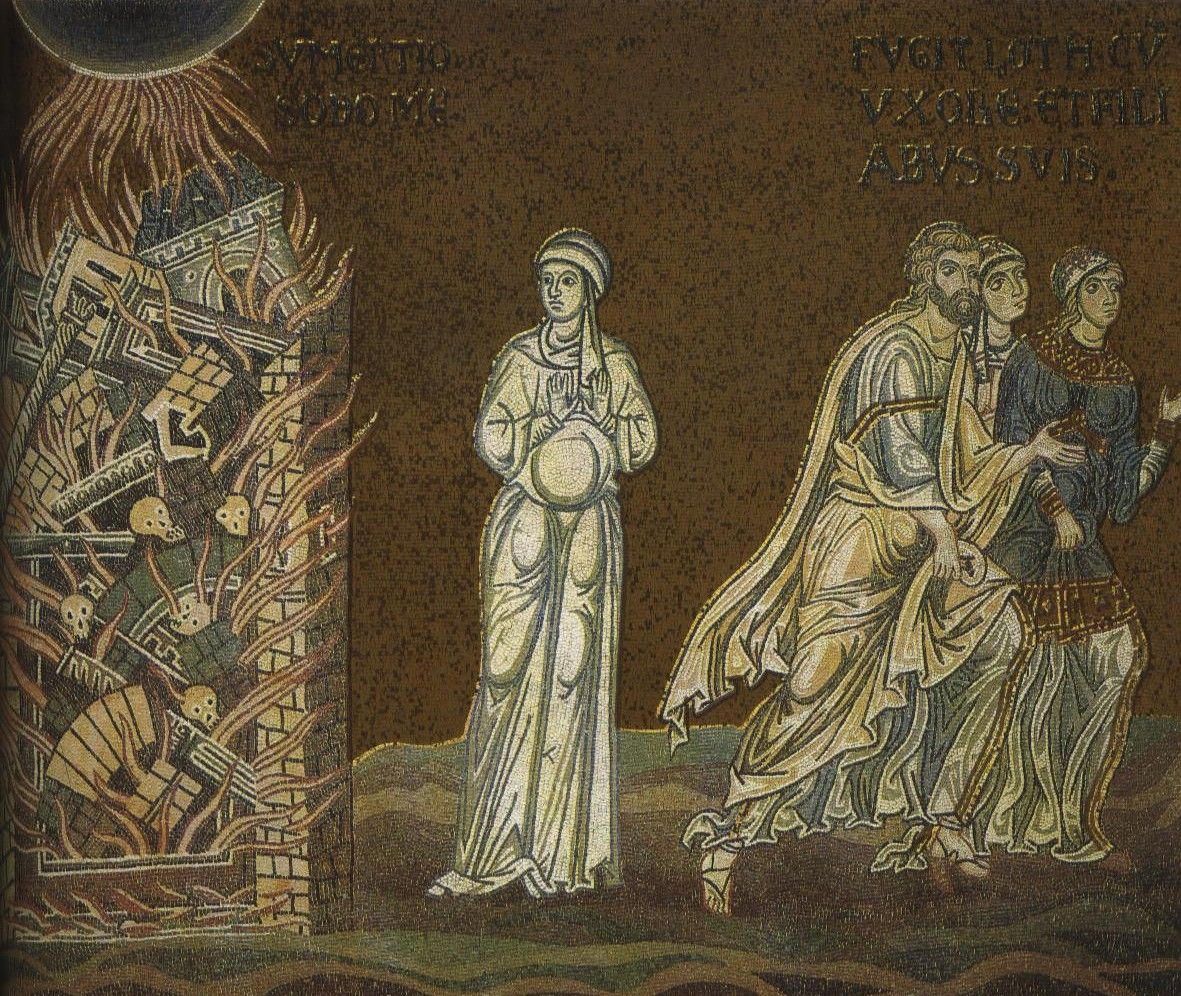
The Destruction of Sodom, 1175–90, mosaic, Monreale Cathedral, Palermo, Sicily
Even to the nameless dog I said farewell.
Madness took him long since,
but I remember his sharp bark,
how he warmed my feet on cool evenings.
I nursed my father in that city,
raised a cup to his lips the night he died.
We laid him near the fig tree,
its twisted trunk his monument.

Now ash marks his place, and Mother’s too,
and all the others whose bread sometimes burnt,
whose clay pots shattered, who wept with me.
They were not good people, and yet . . .
Lot’s back was not enough to see.
I turned. One sign, one glance
for all we left behind.
My faith is strong—
yea, stronger even than salt.
I wait for God to forgive my love.
From To Love Delilah: Claiming the Women of the Bible by Mary Cartledgehayes (San Diego: LuraMedia, 1990). Used by permission of the author.
Lot’s wife, unnamed and unvoiced in scripture, was probably a native of Sodom, the thriving city where Abraham’s nephew had settled. But the people there harbored sin. They were prideful, and did not share their wealth with the poor (Ezek. 16:49–50). To say they lacked hospitality is an understatement: they tried to gang-rape two visitors (Gen. 19:1–11; cf. Jude 1:7). For their persistence in doing evil, God destroyed them.
Genesis 19:12–29 records the story of Lot’s family’s escape. Two angels warn them of the coming judgment, tell them to run and not look back. But in their sudden flight, as the fire and brimstone are raining down behind them, wiping out the life they’ve known together, Lot’s wife turns to see. In an instant, she’s transmogrified into a pillar of salt.
This narrative is often preached as a lesson against looking back on one’s old (preconversion) life with longing, or clinging to the things of this world. Typically Lot’s wife’s reason for turning, disregarding the angels’ instruction, is interpreted as unbelief or covetousness.
But in this poem Mary Cartledgehayes cuts through the moralistic framing of the story and taps into its human emotional component. She suggests that the backward look of Lot’s wife was her taking a moment to mourn the loss of the people she loved and the only home she ever knew—could this be wrong? In To Love Delilah Cartledgehayes writes, “I don’t think she was motivated by greed or stupidity but by love: the love she felt for others, the love of a hometown that was a place of relationship, the love of the security in seeing the same faces at the well day after day, of sharing the births and deaths of children, of hearing the same chickens scratching in the dirt and the same dogs barking for a bite of food” (34).
For Cartledgehayes, Lot’s wife was a pillar of faith, strength, and compassion. Anna Akhmatova (“Lot’s Wife”) and Natalie Diaz (“Of Course She Looked Back”) imagine similar qualities in their poems on the subject. I’ve heard at least one commentator suggest that the salt Lot’s wife becomes is metaphoric, representing the salty tears she shed for her city, her being encrusted by grief, a monument of grief.
It’s common for those displaced by disasters to look back on their hometowns, both literally and in remembrance, and grieve the destruction, the loss of life, property, and possessions, and all the memories held there. In the case of Lot’s wife, God explicitly tells her and her family, through two angels, not to look back, so it’s her disobedience that’s punished. There’s no indication in the story that she engaged in the unrighteous behaviors of her Sodomite neighbors and relatives, or that a prior life of indulgence is what she yearns for. And yet because the punishment seems harsh, many of us try to read some kind of nefarious motive into her looking back. Or else we receive this simply as a cautionary tale about the severe consequences of defying God’s word.
Because Lot’s wife is given no backstory or dialogue (external or internal) in Genesis, nor does the narrator explain, we don’t know why she looked behind her as she fled. (The Polish poet Wisława Szymborska provides a whole list of options in “Lot’s Wife”!) I’m thankful to poets, like Cartledgehayes and others, who poke the trope of the “worldly” wife of Lot in an attempt to find the multidimensional woman beneath.
Mary Cartledgehayes is a writer and an ordained minister in the United Methodist Church, living in Louisville, Kentucky. Possessing an MFA in creative nonfiction from Goucher College and an MDiv from Duke University, she has led workshops across the US on writing and spirituality and enjoys mentoring other writers. In addition to numerous essays, poems, and sermons, she is the author of Grace: A Memoir (Crown / Random House, 2003), about love, death, praxis, fury, and entering pastoral ministry as a middle-aged woman.
Have you been delighted or inspired by the Art & Theology blog this year or its Instagram offshoot, @art_and_theology? If so, please consider donating to the work through a secure online form or PayPal, or by buying me a book from my Amazon wish list (my address is privately stored). Thank you to my five regular monthly supporters, and others who have blessed me with one-off donations of funds and books. These gifts not only provide important material assistance but also serve as an emotional boost, a validation that my work has value and is worth continuing.
My blog-related expenses this year have included a replacement of my old laptop, a conference registration and travel fees, a trip to New York, museum admissions, books, licensing fees for two images (I occasionally pay for images when good photos are not available online), and the yearly WordPress Premium fee to keep this site ad-free and mapped to a custom domain. Donations will go toward covering these, and if there is any left over, toward a new camera lens that will enable me to take wider shots, great for cathedrals and for larger artworks in tight quarters.
SPOTIFY PLAYLIST: October 2024 (Art & Theology): Every month I create a digital mixtape of Christian and Christian-adjacent music that deserves attention, consisting of old and brand-new recordings alike. Two hours of beautiful, soulful expressions of praise, prayer, and lament for your ears and heart.
+++
VIDEO: Animal Service at Ely Cathedral: On September 22, Ely Cathedral in England held its annual animal service, attended by some 450 animal lovers and their pets and service animals, mainly dogs. “Our annual Animal Service is an opportunity to give thanks for the animal companions with whom we share our lives and our planet, to bring them into our Cathedral, to ponder how best to care for animals and to ask God to bless them.” Marley the donkey, from the Donkey Sanctuary, led a procession up the nave. The liturgy was led by Canon James Garrard, and, in addition to several congregational hymns, including “All Creatures of Our God and King,” the cathedral’s children’s choir, the Ely Imps, sang “The Barnyard Song” by Rhonda Gowler Greene and “Look at the World” by John Rutter.
In addition to a special prayer of confession, act of commitment, and benediction, the service included this litany from the Book of Common Prayer:
God said, “Let the waters bring forth living creatures, and let birds fly across the sky.”
We thank you for the teeming life of the seas, And the flight of the birds. Help us to protect the environment So that all life may flourish. God of life: Hear our prayer.
God said, “Let the earth bring forth living creatures of every kind.”
We rejoice in the variety of animal life. Grant us grace to treat all animals with respect and care; To protect endangered species, To preserve the variety of habitats, And to honor the delicate balance of nature. God of life: Hear our prayer.
Heavenly Father, you have filled the world with beauty. Open our eyes to behold your gracious hand in all your works, That, rejoicing in your whole creation, We may learn to serve you with gladness, For the sake of him through whom all things were made, Jesus Christ our Lord. God of life: Hear our prayer.
Two volunteer representatives from the charity Medical Detection Dogs were invited to share about the work of dogs who are trained to detect the odor of human disease.
Several churches worldwide hold animal services around this time of the year, the Feast of St. Francis (known for his love and care of animals) being on October 4. These are usually in addition to the regular Sunday morning worship service and are not eucharistic. UMC’s Discipleship Ministries provides a sample liturgy for “A Service for the Blessing of Animals.” Many such services are held outdoors, such as the one organized annually by Washington National Cathedral, which is taking place this Sunday, October 6, at 2 p.m.
>>“There’s a Special Providence”by Seth Wieck, Texas Poetry Assignment:Seth Wieck [previously] is a writer from Amarillo, Texas. Published the week of the last US presidential inauguration, this poem muses on the impermanence of earthly empires, contrasting such with the steady, indifferent labor of birds, which continues on through administration changes and the passing of generations. The title and opening line are a clever rhyming twist on a line from the final act of Shakespeare’s Hamlet, “There’s a special providence in the fall of a sparrow.” For the poetic speaker, there’s a sense of comfort in God’s sovereignty and an orientation toward Christ’s lordship that puts election poll results, though not negligible, in proper perspective.
In a Substack post from February 2021, Wieck wrote, “I am no politician’s acolyte; they’re public servants, not saviors. I catch some heat in private conversation when I say that I couldn’t care less about national politics. That’s not a true statement, but the tense conversations in which I claim my ambivalence usually leave me no room for nuance. Those conversations demand my total wide-eyed attention to the firehouse of information being created by national elections. But as Mary Oliver said, ‘The beginning of devotion is attention.’ Forgive me if I am unwilling to develop devotion for those people whose only interest in my community is the exploitation of our devotion and resources.”
>> “Jesus Heals a Paralytic” by Ryan Keating, Reformed Journal: Ryan Keating is a pastor on the Mediterranean island of Cyprus (he preaches in Turkish and English), an academic writer and poet, and the owner of Exile Coffee and Wine. This poem retells the miracle from Mark 2:1–12 in the voice of the paralyzed man whom Jesus heals. Whereas many artists depict the episode with ropes used as a lowering mechanism, Keating says it’s much more likely, given the typically low ceilings of Middle Eastern homes, that the man would have been received by “a net of hands” raised up by the people in the room.
The poem repeats the word “temple” three times, remarking how the man was “suspended / in a temple by a temple / and landed on holy ground / as a temple . . .” The temple is the place where the crowd is gathered because Jesus is in it, and the four faith-filled friends who bring the paralyzed man there themselves constitute a temple, and the man too becomes a temple, a dwelling-place of God, after being made whole by Jesus. Drawing on Old Testament imagery of the garden of Eden and the exodus, the final stanza is one of restoration. The sea of people parts as the man steps outside into a garden, his friends buoyed by amazement.
+++
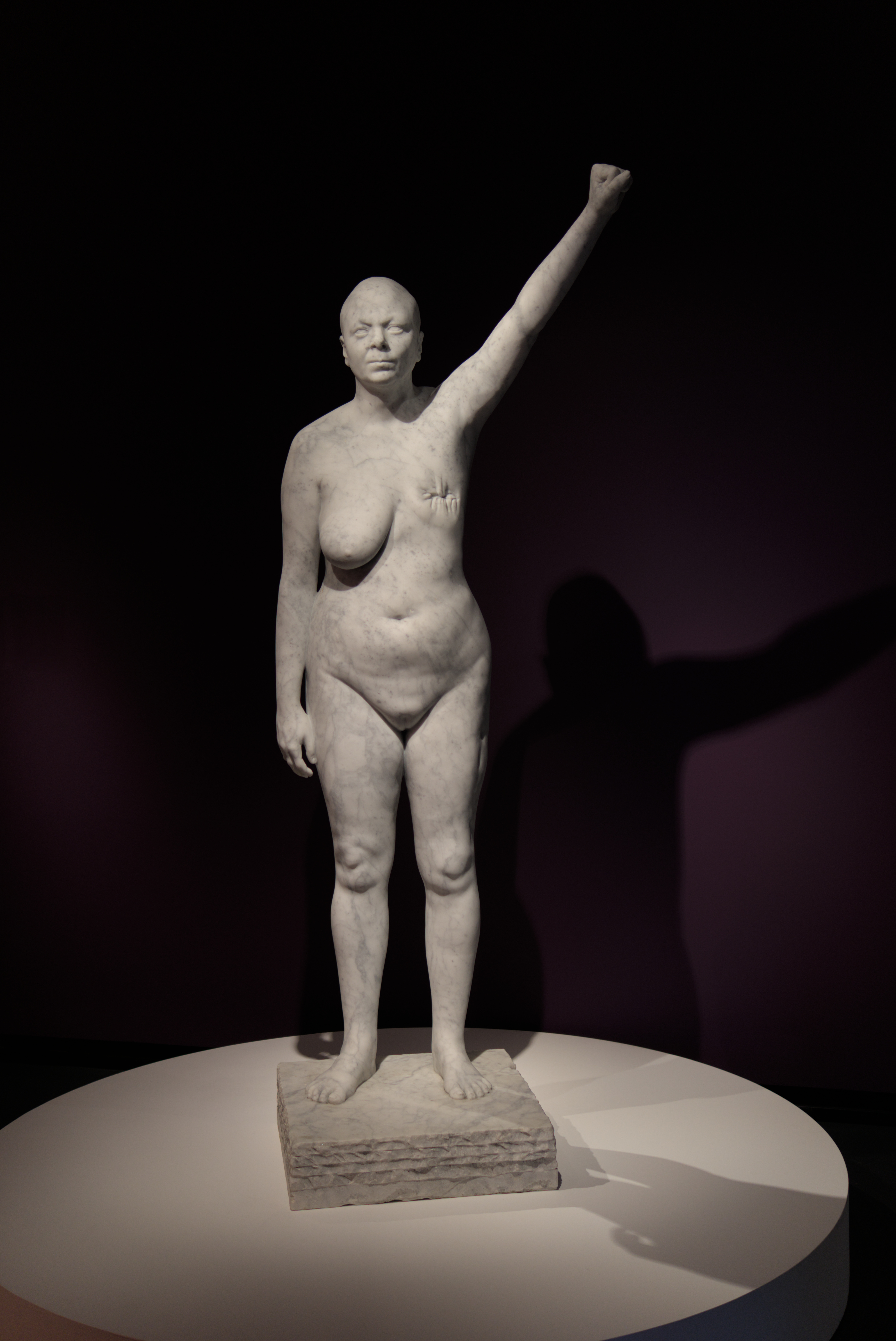
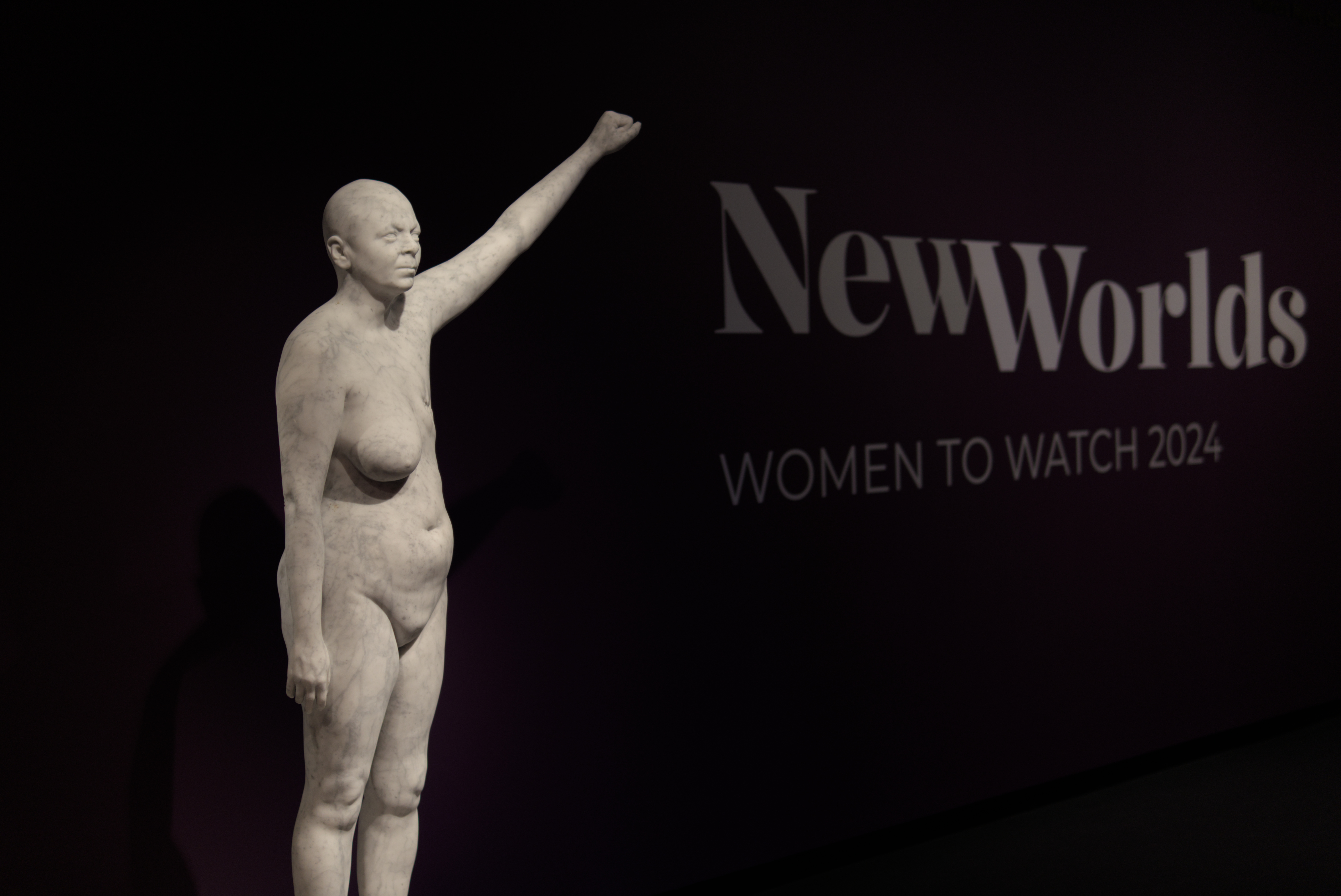
ARTWORK: Intra-Venus by Marina Vargas: October is Breast Cancer Awareness Month, so I wanted to share an artwork I encountered on the subject this summer at the New Worlds: Women to Watch 2024 exhibition at the National Museum of Women in the Arts. Intra-Venus is a nude self-portrait in marble by Spanish artist and breast cancer survivor Marina Vargas, frankly depicting her body after a mastectomy, chemotherapy, and radiation. Owning her scars and her baldness, she uses the language of classical sculpture to monumentalize a common female experience. (The chance of a woman in the US getting breast cancer in her lifetime is 1 in 8, and more than 100,000 US women undergo some form of mastectomy each year; global statistics are harder to come by.) Vargas lost the use of her left arm for a time during treatment, but here she shows herself with her left arm raised in triumph. The sculpture highlights the heroism of women who endure breast cancer and the dignity of their changed form.
Marina Vargas (Spanish, 1980–), Intra-Venus, 2019–21. Carrara marble, 77 1/2 × 26 3/4 × 26 in. Photo: Victoria Emily Jones.
NEW ALBUM: By Babylon’s River by the Pharaoh Sisters: A folk band from the foothills of North Carolina, the Pharaoh Sisters [previously] are Austin Pfeiffer, Jared Meyer, Kevin Beck, and John Daniel Ray. On September 13 they released their second album, By Babylon’s River, unveiling a new genre they call “saloon Christian.” The title track is a western waltz adaptation of Psalm 137. Also included on the album are a version of Psalm 81 (“Sing, Oh Sing”); bluegrass arrangements of the gospel standards “Leave It There” and “Hold to God’s Unchanging Hand”; retunes of the hymns “All Things Bright and Beautiful” by Cecil Frances Alexander and “’Tis Finished” by Charles Wesley; a cheeky take on the story of Samson, and more.
I was introduced to Hurt over a decade ago through his recording of the African American spiritual “I Shall Not Be Moved,” based on Psalm 1. The songs he sang were a mix of sacred and secular.
+++
ARTISTS’ PROFILE: “Sunny Taylor / Jack Baumgartner,”Artful, season 3, episode 6: The BYUtv docuseries Artful, which is available to watch freely online, profiles a variety of artists of faith—many of them Latter-day Saints, but some (non-LDS) Christian or Jewish.
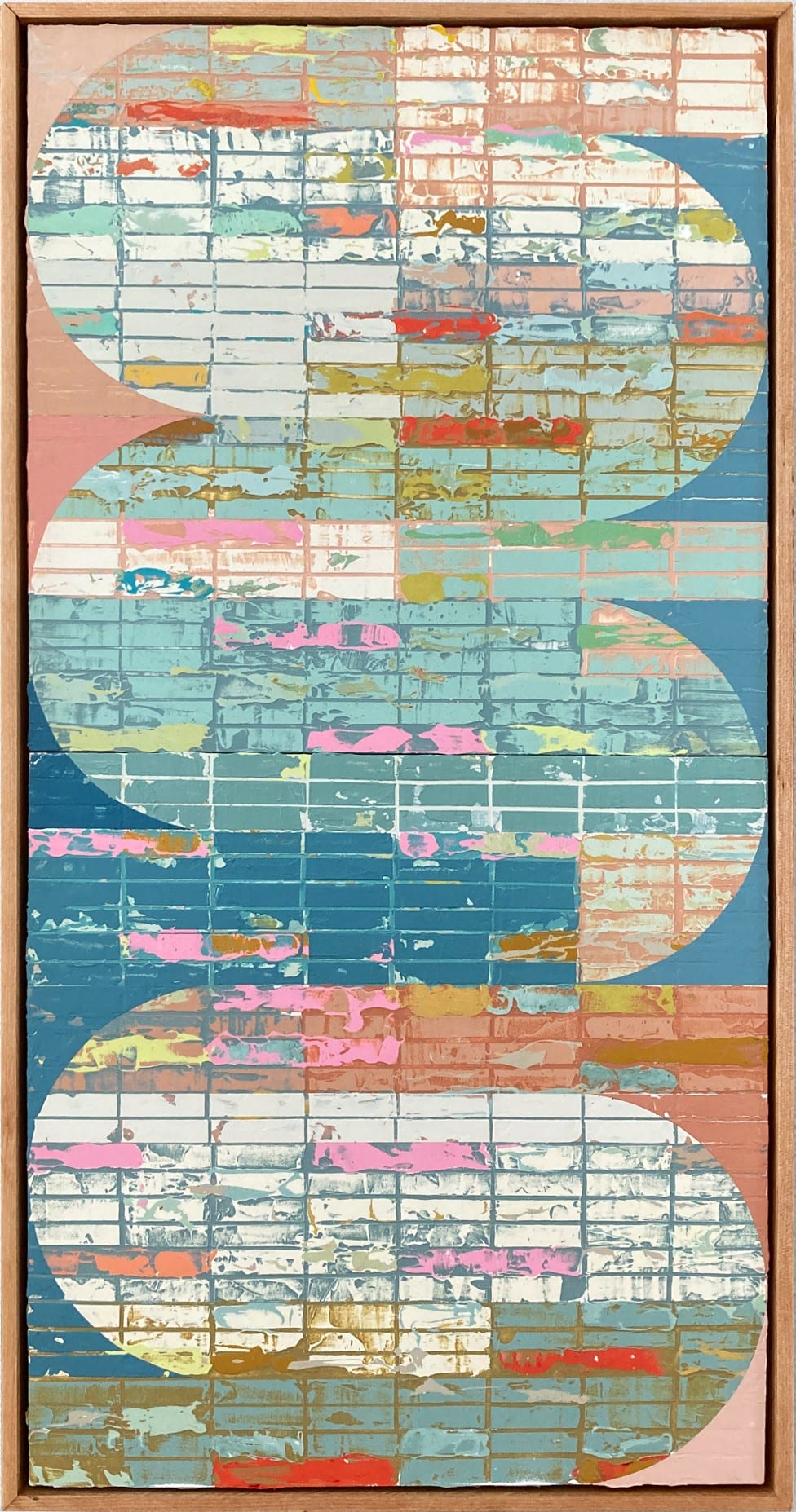
The first half of episode 6, season 3, highlights the work of Sunny Taylor, who lives in Wilton, Maine, and engages with painting’s geometric tradition. She values process over product and wants viewers to observe the surface and textures of her paintings, built up through meticulous layering techniques that involve scraping and grinding. She sees beauty in imperfection, and sorrow and joy as bound up together. Follow her on Instagram @sunnytaylorart.
Sunny Taylor (American, 1979–) Connections, 2024. Acrylic on panel, 24 × 12 in. [for sale] [artist’s statement]
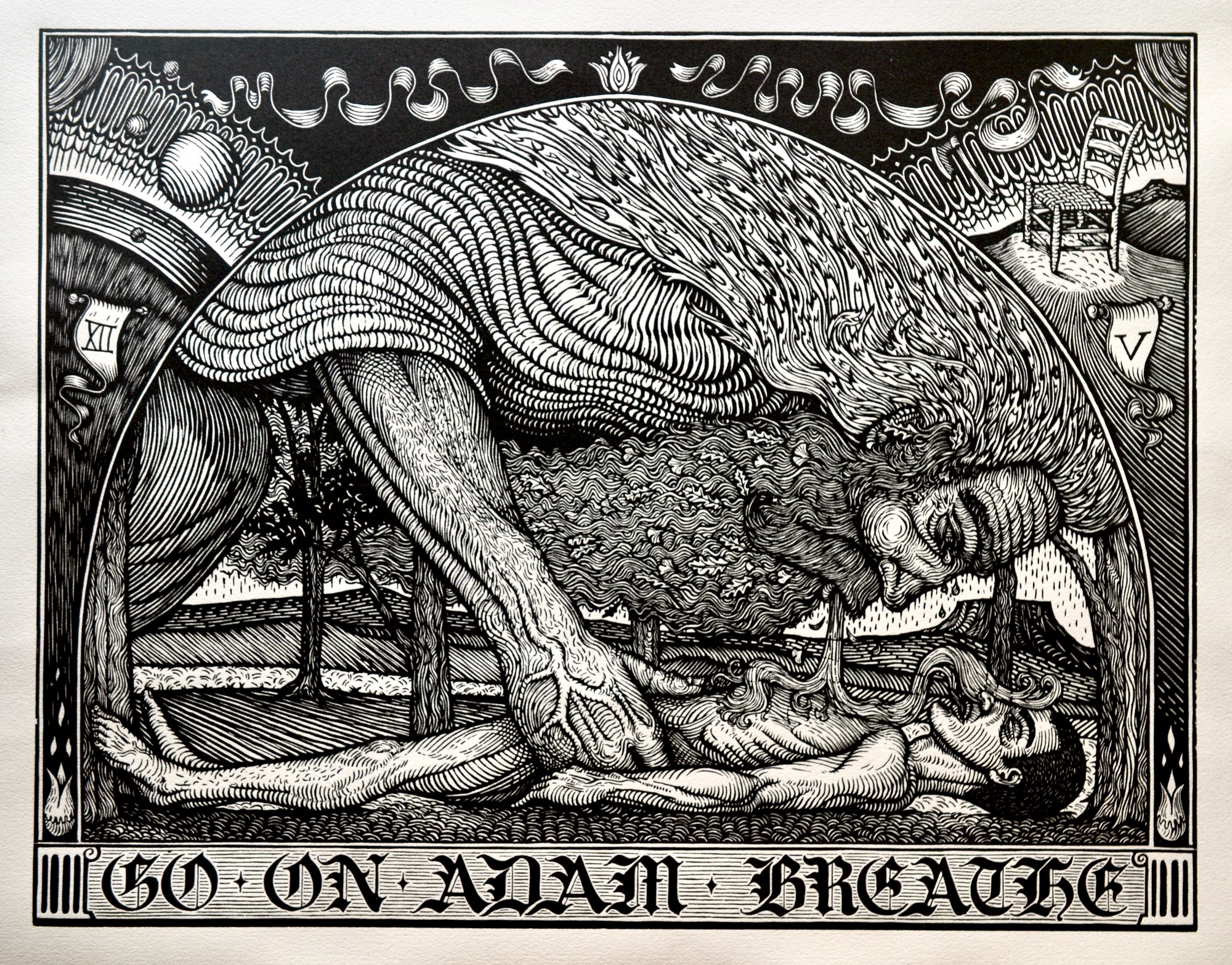
Beginning at the 13:38 time stamp, the second half is on multidisciplinary artist Jack Baumgartner of Kansas. Baumgartner, who has a Presbyterian background, is a printmaker, painter, farmer, woodworker, puppeteer, and musician. He raises sheep, goats, and chickens, builds furniture, plays the banjo, and cohosts the podcast The Color of Dust with two poet friends, “exploring the seen and unseen in the soil of art and agriculture.” He is also a husband and a father of five. I first learned about Baumgartner through an Image journal profile; and Plough published an article about him in 2018. I really enjoyed this twelve-minute video segment that shows him at work and at play in and around his home—especially his puppet theater performance of The Two Deaths of John Beartrist Laceroot! Follow him on Instagram @baumwerkj.
Jack Baumgartner (American, 1976–), Go On, Adam, Breathe, 2023. Linocut, 14 × 18 in. [for sale]
+++
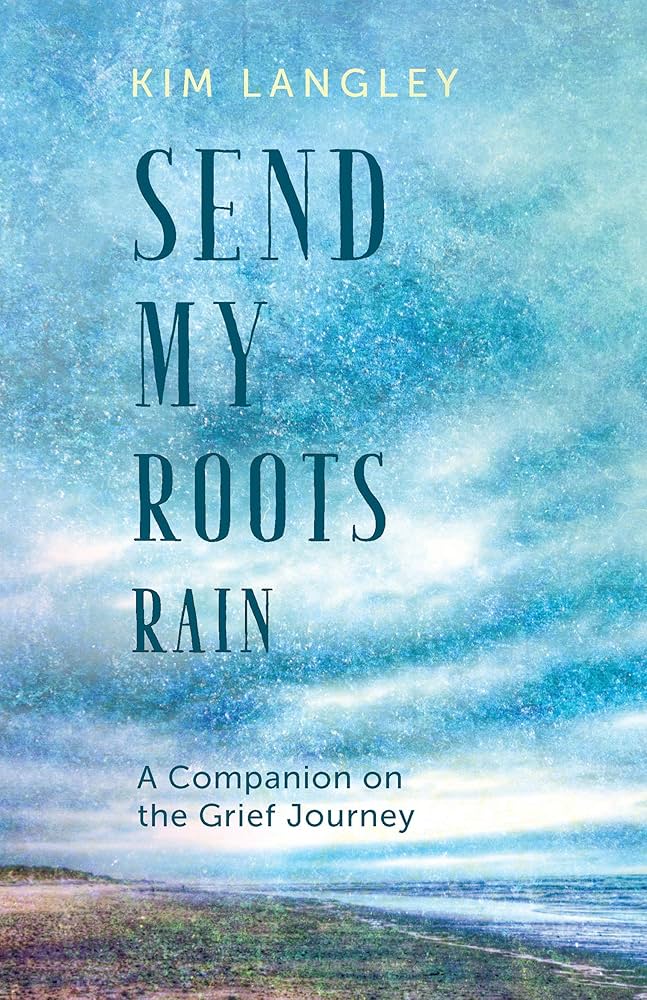
PODCAST EPISODE: “Grief and Poetry, with guest Kim Langley,”Faith and Imagination, October 4, 2021: Kim Langley is a certified spiritual director and retreat leader from Ohio; she is also the founder of WordSPA (acronym for “Spirituality Poetry Appreciation”) and author of Send My Roots Rain: A Companion on the Grief Journey (Paraclete, 2019), a compilation of sixty poems interwoven with narrative and commentary, in preparation for which she interviewed some three dozen chaplains, pastors, grief counselors, hospice workers, funeral directors, and bereaved people. She wrote the book after the death of her parents. “I found such comfort in the poems,” she writes, “written by a host of people just like us, picking up their pain, juggling it awkwardly in their arms at first—or maybe for a long time—then gradually finding the resilience to carry it, to know when and how to put it down, when to pick it up, and how to develop strong muscles for the long haul. They helped me carry my pain, and I think they will help you to survive, and maybe even thrive a little.” In this podcast episode, she and the host read and discuss four poems from the book: “Let Evening Come” and “Otherwise” by Jane Kenyon, “Those Winter Sundays” by Robert Hayden, and “Stillbirth” by Laure-Anne Bosselaar.
Launched in 2020, Faith and Imagination [previously] is the podcast of the BYU Humanities Center, hosted by founding director Matthew Wickman. It features interviews with a range of writers, scholars, clergy, and others. View the full archive at https://humanitiescenter.byu.edu/podcast/. And in addition to the Langley episode, let me turn your attention to an excellent recent release with an author I’ve mentioned before: “On Deepening Our Religious Experience: An Invitation to Poetry for the Church, with Abram Van Engen.” You may have heard Van Engen discuss his new book elsewhere, but this interview brings some great insights to the fore.
+++
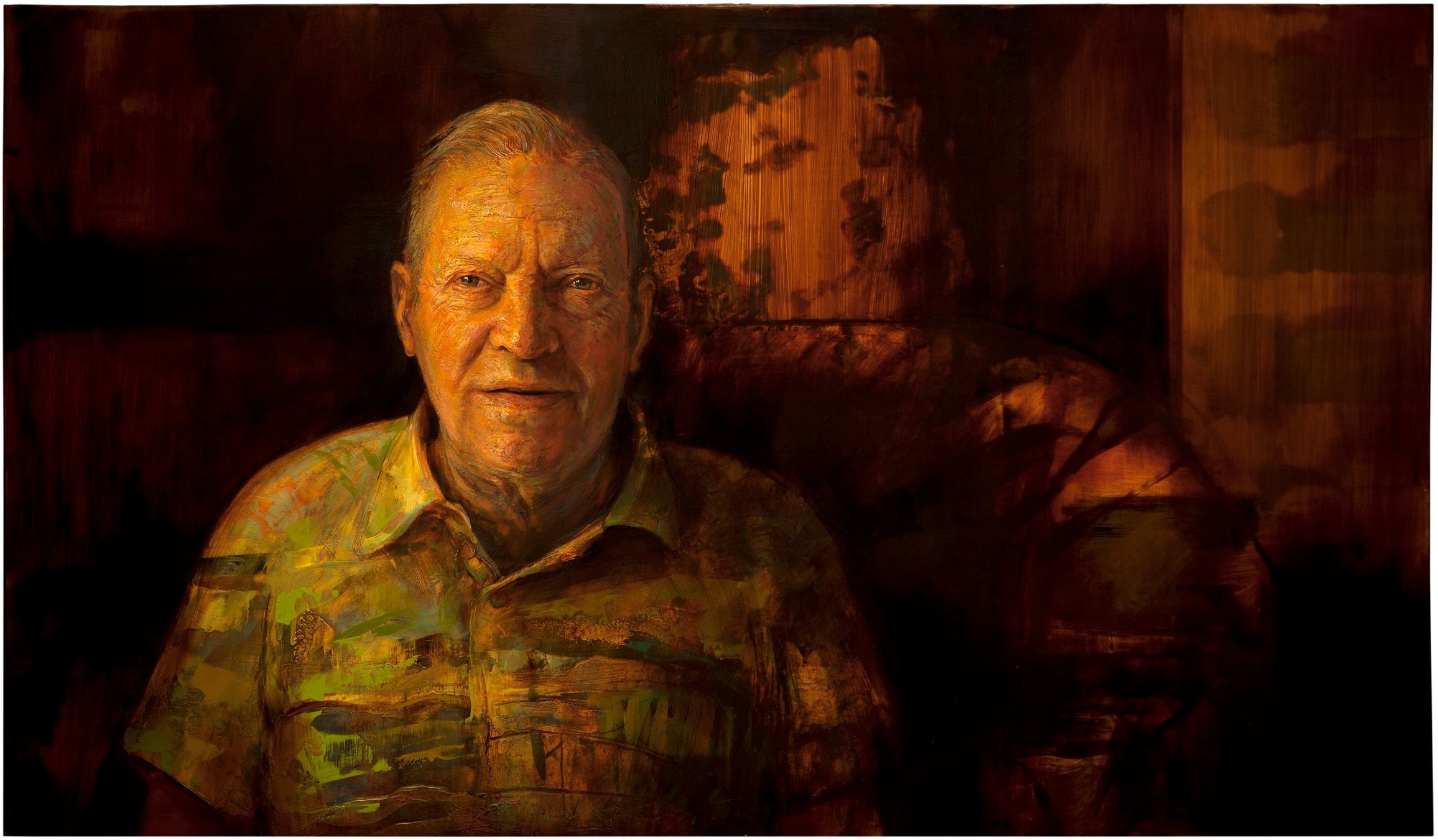
CREATIVE COLLABORATION: Ordinary Saints, a project by artist Bruce Herman, poet Malcolm Guite, and composer J.A.C. Redford: When Bruce Herman’s parents died unexpectedly in 2009, three months apart, painting their portraits was a key way in which he moved through his grief. Poet Malcolm Guite saw Herman’s portrait of his father exhibited at a Christians in the Visual Arts conference in 2011 and, struck by its sheer sense of presence, wrote a sonnet about it. This act of ekphrasis then developed into a three-way collaboration when their mutual friend J.A.C. Redford, a composer, responded by setting Guite’s poem to music.
Bruce Herman (American, 1953–), Portrait of the Artist’s Father: William C. Herman, 2010. Oil and alkyd on wood, 30 5/8 × 51 in. Collection of the artist.
The basis of Ordinary Saints is a series of portraits Herman painted of family and friends throughout the 2010s, which spawned a series of poems by Guite, which in turn spawned a suite of instrumental music and a song cycle by Redford. The first public presentation of the multidisciplinary project was at a Laity Lodge retreat in the Texas Hill Country on October 26–28, 2018, and it has since traveled to Nashville and Oxford.
The project attempts “to render . . . a glimpse of the glory of our mortal faces when turned toward God . . . faces that point toward the one Face we all must seek,” Herman says. Or, as Guite puts it: “to explore what it means to be truly face to face with one another, how we might discern the image of God in our fellow human beings, and how that discernment might ready us for the time when, as we are promised, we will no longer see ‘through a glass darkly’ but really see God and one another face to face in the all-revealing, and all-healing light of Heaven.”
Here is the title poem, followed by Redford’s title composition for voice, piano, cello, and clarinet:
Ordinary Saints
by Malcolm Guite
The ordinary saints, the ones we know, Our too-familiar family and friends, When shall we see them? Who can truly show Whilst still rough-hewn, the God who shapes our ends? Who will unveil the presence, glimpse the gold That is and always was our common ground, Stretch out a finger, feel, along the fold To find the flaw, to touch and search that wound From which the light we never noticed fell Into our lives? Remember how we turned To look at them, and they looked back? That full- Eyed love unselved us, and we turned around, Unready for the wrench and reach of grace. But one day we will see them face to face.
>> “Ordinary Sugar” by Amanda Gunn: Pádraig Ó Tuama reads and comments on this food poem in the July 10, 2023, episode of Poetry Unbound. “How can russet potatoes be made to taste of sugar and caramel? By dedication, love, and craft. Amanda Gunn places her poetry in conversation with the farming and culinary skills of her forebears: women who cultivated land, survival, strength, and family bonds.”
>> “Given”by Anna A. Friedrich: This poem by Anna A. Friedrich is a beautiful tribute to her grandmother, Juanita Powell Alphin, who died this June. Friedrich imagines all the gifts her memama ever gave—jump ropes, stuffed animals, homemade fudge, thrift-store doodads, five-dollar bills, a kitten, a plane ticket, etc.—tumbling out onto the golden streets of heaven, a testimony to her generous, loving spirit.
John Linnell (British, 1792–1882), Wheat, ca. 1860. Oil on canvas, 94.2 × 140.6 cm. National Gallery of Victoria, Australia.
Summer ends now; now, barbarous in beauty, the stooks arise
        Around; up above, what wind-walks! what lovely behaviour
        Of silk-sack clouds! has wilder, wilful-wavier
Meal-drift moulded ever and melted across skies?

I walk, I lift up, I lift up heart, eyes,
        Down all that glory in the heavens to glean our Saviour;
        And, eyes, heart, what looks, what lips yet gave you a
Rapturous love’s greeting of realer, of rounder replies?

And the azurous hung hills are his world-wielding shoulder
        Majestic—as a stallion stalwart, very-violet-sweet!—
These things, these things were here and but the beholder
        Wanting; which two when they once meet,
The heart rears wings bold and bolder
        And hurls for him, O half hurls earth for him off under his feet.
The beauty of Christ suffuses the landscape in “Hurrahing in Harvest” by Gerard Manley Hopkins, written September 1, 1877, while he was studying theology at St Bueno’s College in the Vale of Clwyd, Wales. A hurrah is a jubilant shout, an exclamation of joy, and in this poem the object of that joy is the kingdom of God manifest in a late summer day during the wheat harvest. Hopkins wrote to his friend and fellow poet Robert Bridges—the man who championed his work and is responsible for its being known at all—that “the Hurrahing Sonnet was the outcome of half an hour of extreme enthusiasm as I walked home alone one day from fishing in the Elwy.”
Stooks are bound sheaves of wheat, and Hopkins describes them as savage-looking (“barbarous in beauty”), perhaps suggesting their resemblance to an unkempt head of hair. In their wonderfully wild way, when propped up, they point to the clouds, which glide along moving aerial sidewalks—the wind (“wind-walks”). Through metaphor, Hopkins refers to the clouds as “silk-sack[s]” (they’re bulky yet smooth, substantial yet wispy) and not snowdrift but “meal-drift” (mounds of coarsely ground white grain). The clouds are willful and wavy; they mold together and melt into sky.
Hopkins lifts up his eyes and heart—language reflecting the Sursum corda of the liturgy—to behold the day’s glory. “Down” in line 6 can be read as an adverb or verb: Hopkins looks down across the valley, or he “downs” the scene, takes it all in. And seeing the freshly reaped fields, he “glean[s]” Christ. He likens the rapture he feels to receiving a kiss of greeting from a lover, real and round. Addressing his eyes and heart, he says that no adoring human gaze nor tender human lips have ever imparted such pleasure as Christ imparts through nature.
In the final stanza Hopkins perceives the hills as the majestic shoulders of Christ supporting the sky. He compares Christ to a stallion (wild, strong) and a violet (delicate, humble).
The image of a stallion returns in the second-to-last line, where he says his own heart “rears” (raises upright) wings, which enable him to launch himself upward, his legs pushing off the ground. It’s a leaping of the spirit, an ascent of the soul—an intimate meeting of self and Savior in the goodness of the cloudy-blue afternoon. The Divine is always here, he says, “and but the beholder / Wanting”; that is, lacking awareness.
Throughout the poem there’s a strong sense of propulsion, carried in part by all the alliteration: “barbarous in beauty,” “wind-walks,” “silk-sack,” “wilder, wilful-wavier,” “meal-drift moulded . . . melted . . . ,” “glory . . . glean,” “realer, rounder replies,” “hung hills,” “world-wielding,” “stallion stalwart,” “heart . . . hurls.”
Hopkins’s eyes have been oriented to perceive the spiritual in the material, and the result is ecstasy.
Gerard Manley Hopkins (1844–1889) was a preeminent English poet and a Jesuit priest, whose most famous works include “The Wreck of the Deutschland,” “Pied Beauty,” “God’s Grandeur,” and “The Windhover.” In 1866 he converted from Anglicanism to Roman Catholicism, a decision that estranged him from his family; then he entered the Jesuit novitiate in 1868 and was ordained to the priesthood in 1877. He spent the last five years of his life as a classics professor at University College Dublin, struggling with depression, during which time he wrote the “terrible sonnets,” so-called because of their expression of deep anguish and desolation. Very few of his poems were published during his lifetime, and widespread recognition didn’t come until nearly three decades after his death, in 1918, when his friend Robert Bridges edited the first collection of his poems. Hopkins was the most innovative poet of the Victorian era, his “sprung rhythm” creating new acoustic possibilities and anticipating the modernist movement.
Out of the living word
Come flower, serpent and bird.

All things that swim or fly
Or go upon the ground,
All shapes that breath can cry
Into the sinews of sound,
That growth can make abound
In the river of the eye
Till speech is three-ply
And the truth triply wound.

Out of the living word
Come flower, serpent and bird.
Howard Nemerov (1920–1991) was a major figure in midcentury American poetry, whose Collected Poems won the Pulitzer Prize, the National Book Award, and the Bollingen Prize. He served as US poet laureate from 1963 to 1964 and again from 1988 to 1990, and he also wrote fiction and essays. “Romantic, realist, comedian, satirist, relentless and indefatigable brooder upon the most ancient mysteries—Nemerov is not to be classified,” Joyce Carol Oates remarked in the New Republic. From an artistic family, Nemerov was the older brother of the photographer Diane Arbus.
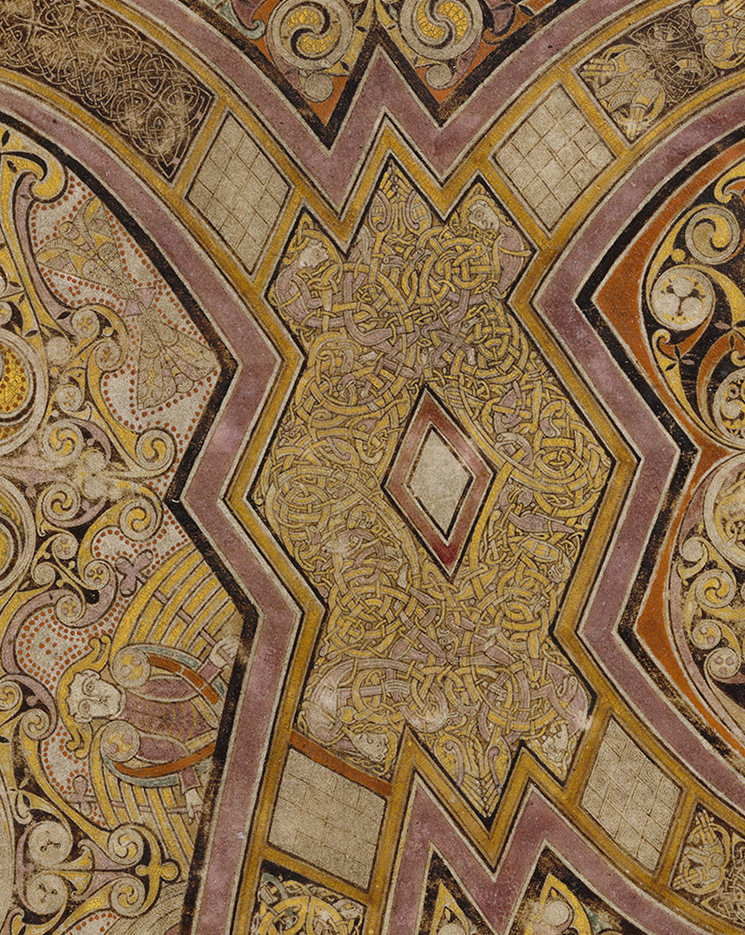
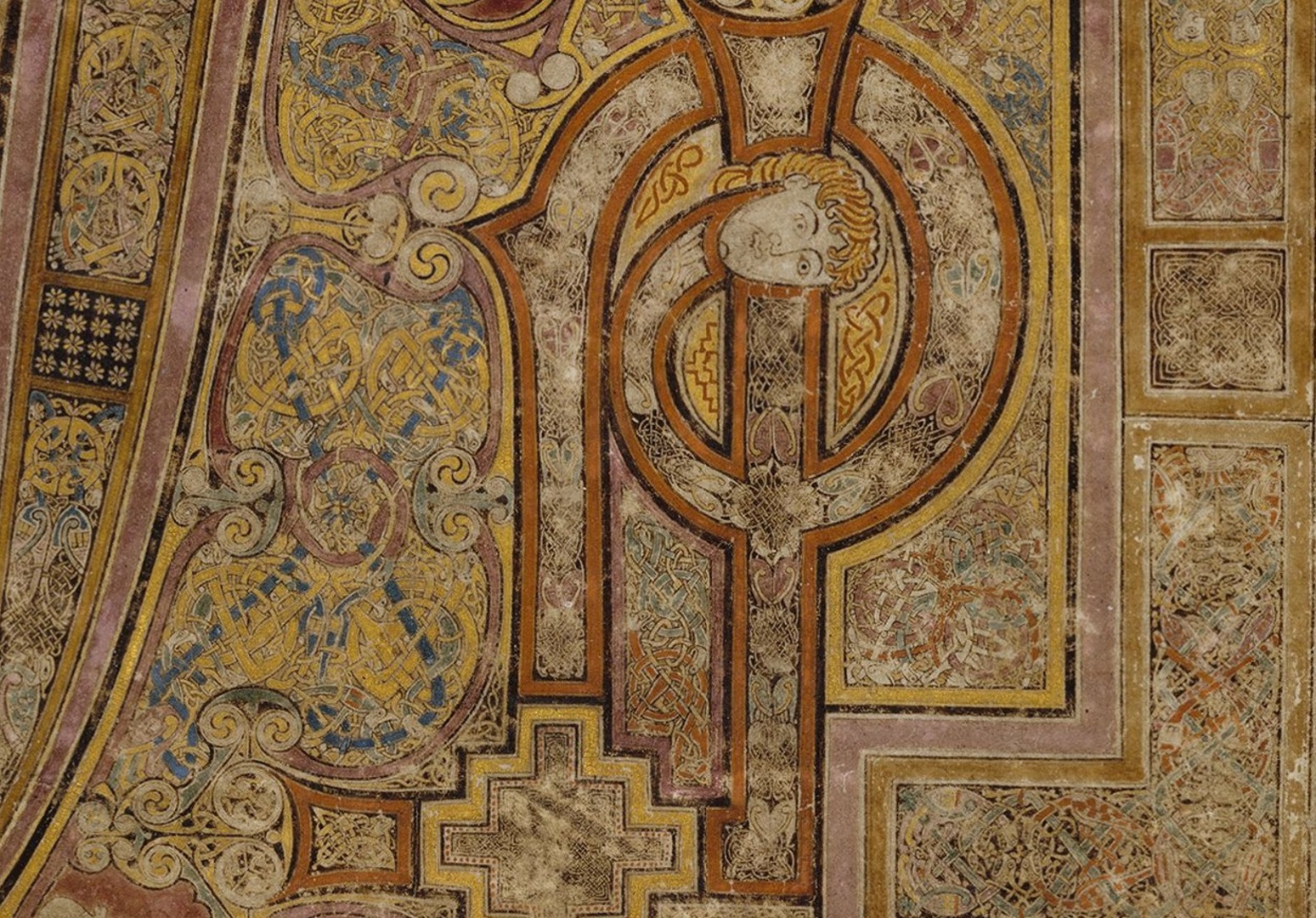
The exuberantly decorated Book of Kells is widely agreed to be the most beautiful book ever made. The crown jewel of Celtic art, it is a manuscript copy of the Four Holy Gospels in Latin, with ten surviving full-page illuminations and many more marginal illuminations and decorated initials throughout the other 670 pages—the work of three artists and four scribes.
Most art historians believe the book was created on the Scottish island of Iona by a group of monks sometime around 800. Viking raids at that time forced the monks to flee to the monastery of Kells in Ireland; they were able to save the book, but it was left unfinished.
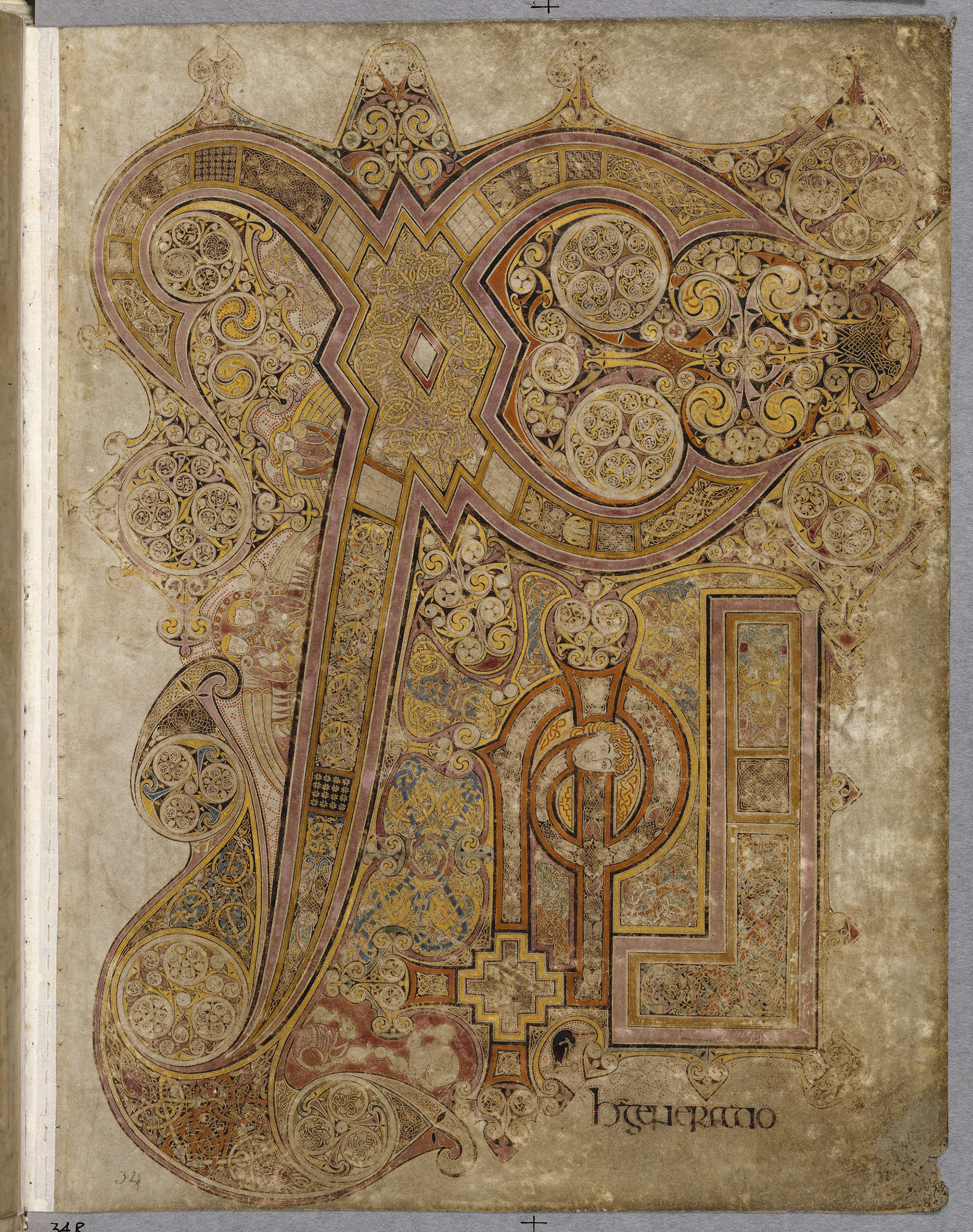
The most famous page from the Book of Kells is folio 34r, often referred to as the Christi autem or Chi-Rho page.
The Chi-Rho page from the Book of Kells, ca. 800. Trinity College Dublin MS 58, fol. 34r.
The page illuminates the “second beginning” of the Gospel of Matthew, following the genealogy and opening the narrative of the life of Christ: Christi autem generatio (“Now the birth of Christ . . .”) (Matt. 1:18). The anonymous artist represents the Holy Name of Jesus with a monogram, enlarged and embellished, consisting of the Greek letters chi (Χ) (pronounced “kai”), rho (ρ), and iota (ι), the first three letters in the word Χριστός, Christos. H generatio (where h is shorthand for autem) is written in Latin in Insular majuscule script at the bottom right of the page.
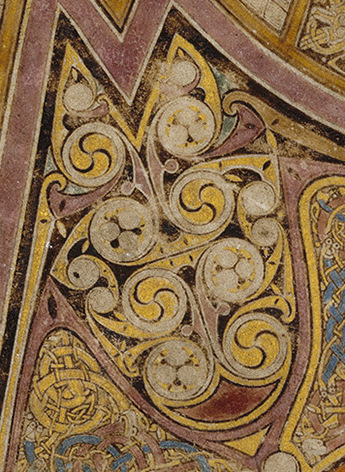
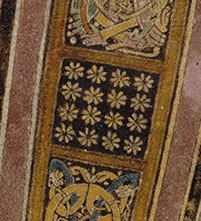
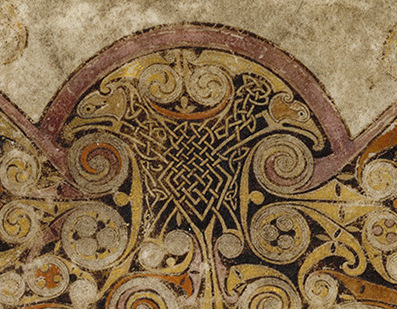
The chi-rho monogram is accorded special dignity in Christian art. Here the chi takes up nearly the whole page, its arms and legs extending to the four corners, exuding a kinetic energy. It reaches, it leaps; it blossoms and enfolds. It is beautified with intricate interlaces, spirals, and lozenges, and it’s teeming with life! Creatures of the land, air, and sea dwell within and around—cats and mice (nibbling on a eucharistic wafer!), birds and moths, an otter and a fish, humans and angels. There are vines and flowers too, and the whirling gears of the cosmos—all of it spilling out of the precious name of Christ.
Peering out from the inner tip of the rho is a red-haired man. Might this represent Jesus? Scholars tend to think so.
This illuminated page combines word (speech) and Word (Logos) with glorious liveliness. “The decoration of the text of Christ’s birth suggests the identification of Christ incarnate with Christ the Creator-Logos,” writes art historian Jennifer O’Reilly. “Christ as the divine Word is here revealed in a word, a single letter, concealed within the design. Similarly, commentators meditating on the name at this point in Matthew’s gospel, described his divinity as lying hidden in his creation, beneath his human flesh at his Incarnation and beneath the literal letter of the scriptural text.”
In his ekphrastic poem “The Book of Kells,” Howard Nemerov subtly draws out this theology—Christ as the Creator of the universe in and by whom all things consist (Col. 1:17). Bearing a rhyme scheme of aa bcbccbbc aa, the poem opens and closes with the same couplet: “Out of the living word / Come flower, serpent and bird.” Again, the word “word” is multivalent, referring to the written word “Christ” that fills the Book of Kells page in the form of a stylized monogram, as well as to Christ the person, the living Word of God, the source of all life. It can also refer to the Bible, which is “living and active” (Heb. 4:12) and which reveals Christ.
Nemerov alludes to the Chi-Rho page’s knotwork, its geometric shapes, its zoomorphic interlaces, and its triskeles (triple spirals), glorying in the sacred beauty and abundance they signify, which some unnamed early medieval monk laboriously sketched and painted over the course of who knows how long, to honor the story of the birth of Jesus Christ.
The Book of Kells’ Chi-Rho page is a phenomenal work of art. The symbol of Christ is all-encompassing, and all of creation is united in harmony with it.
The 2009 animated fantasy drama The Secret of Kells, made by the Irish studio Cartoon Salon, features a wondrous animation of the Chi-Rho page at the end, bringing to life some of its many details:
Emily Dickinson (1830–1886) of Amherst, Massachusetts, is one of America’s most celebrated poets. There are hundreds of musical settings, from various genres, of her poems. Here are ten I really like.
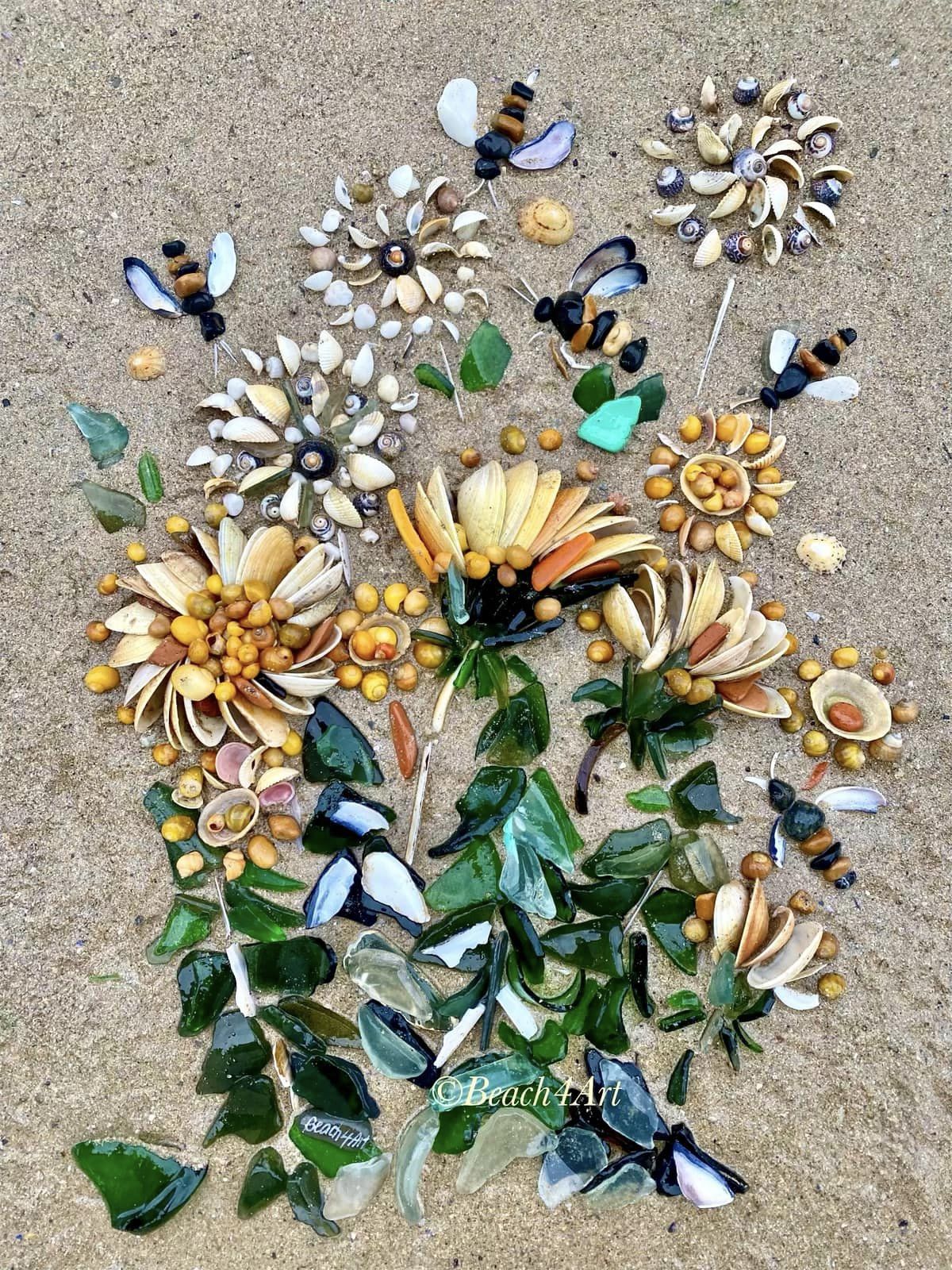
Created by Beach4Art, a family of four who assemble rocks and shells into images on the beaches of Devon, England
1. “I’m Nobody” by Emma Wallace: This is the first poem I ever read by Dickinson—in sixth grade. I was hooked, and I relished the assignment to memorize it and recite it to the class. The idea of being famous was apparently distasteful to Dickinson, and though she was a prolific writer of almost 1,800 poems, only ten were published during her lifetime, and those anonymously; some she sent in letters to friends, but most she kept private. She wrote this one in 1861, and it has contributed to her mystique. Singer-songwriter Emma Wallace turned it into a lovely, understated, minor-key waltz for The Thing with Feathers (2021), one of her several literary-themed albums.
I’m Nobody! Who are you? Are you – Nobody – too? Then there’s a pair of us! Don’t tell! they’d advertise* – you know!
How dreary – to be – Somebody! How public – like a Frog – To tell your name – the livelong June – To an admiring Bog!
* Dickinson often provided alternative words in the margins of her pages, which some editors have favored; “advertise” she marked as a possible substitute for “banish us.”
2.“I Shall Not Live in Vain” by Bard and Ceilidh (Mary Vanhoozer): Mary Vanhoozer’s debut album, Songs of Day and Night(2015), comprises original settings of classic poems by the likes of Emily Dickinson, Christina Rossetti, Henry Wadsworth Longfellow, and others. “Music has a unique ability to transform ordinary things into special things—the mundane into the extraordinary,” she writes. “This song cycle is all about exploring that further. Each song roughly represents an hour of the day. The CD begins at dawn and ends at dusk. As we travel through the day, we learn to perceive familiar objects and situations in a new light, infusing joy and a sense of mystery into the everyday experience.” For this track she is joined by her husband, Josh Rodriguez, on guitar. The text is a sort of purpose statement, committing to a life of love, kindness, and compassionate outreach.
If I can stop one Heart from breaking I shall not live in vain If I can ease one Life the Aching Or cool one Pain
Or help one fainting Robin Unto his Nest again I shall not live in vain.
3. “His Feet Are Shod with Gauze” by Emily Lau: The natural world, especially bees, was one of Dickinson’s favorite topics to write about. I think of her as a poet of summer. (Other great bee poems: “Bee! I’m expecting you!” and “Bees are Black, with Gilt Surcingles –.”) “His Feet are shod with Gauze –,” a panegyric, praises bees’ delicacy, might, and beauty. This musical setting is part of the suite Seven Dickinson Songs by composer and vocalist Emily Lau, which appears on her album Isle of Majesty (2019). Be sure to check out the other songs, including “I Can Wade Grief” and “I Never Saw a Moor,” in which Lau is joined by her chamber music ensemble, The Broken Consort.
His Feet are shod with Gauze – His Helmet, is of Gold, His Breast, a single Onyx With Chrysophras, inlaid –
His Labor is a Chant – His Idleness – a Tune – Oh, for a Bee’s experience Of Clovers, and of Noon!
4. “Some keep the Sabbath going to Church” by Michael McGuane: Dickinson was raised as a Congregationalist but never officially joined the church and by 1868 had stopped attending altogether. Her poems vary in tone toward Christianity, with some expressing devout sentiments and others irreverence. One thing that’s clear is that she often encountered God in nature. In this poem the fruit trees create a sanctuary for her and the birds serve as choir—an elevating, worshipful experience. Christians throughout history have spoken of how the “book of nature” complements the book of scripture, both revealing God’s truth. Here Dickinson acknowledges the same, emphasizing the goodness of creation, our enjoyment of which is sacred. On YouTube, the Americana musician Michael McGuane performs a guitar-picked, folk-rock tune he wrote for the poem.
Some keep the Sabbath going to Church – I keep it, staying at Home – With a Bobolink for a Chorister – And an Orchard, for a Dome –
Some keep the Sabbath in Surplice – I, just wear my Wings – And instead of tolling the Bell, for Church, Our little Sexton – sings.
God preaches, a noted Clergyman – And the sermon is never long, So instead of getting to Heaven, at last – I’m going, all along.
5. “Split the Lark” by Drum & Lace (Sofia degli Alessandri-Hultquist) and Ian Hultquist, feat. Ella Hunt: This pop music setting of “Split the Lark” was written by husband-and-wife composing duo Drum & Lace and Ian Hultquist for the Apple TV+ comedy-drama Dickinson (which I have mixed feelings about). It’s featured in season 2, episode 6, where it’s sung by Ella Hunt, the actress who plays Emily’s sister-in-law (and in the show, secret lover), Susan Huntington Gilbert Dickinson. Emily is attending an opera performance in Boston and imagines—in place of the soprano—Sue, singing her own words to her.
Split the Lark – and you’ll find the Music – Bulb after bulb, in Silver rolled – Scantily dealt to the Summer Morning Saved for your Ear, when Lutes be old –
Loose the Flood – you shall find it patent – Gush after Gush, reserved for you – Scarlet Experiment! Sceptic Thomas! Now, do you doubt that your Bird was true?
Containing echoes of William Wordsworth’s “We murder to dissect,” this poem derides empiricism as the sole method of arriving at truth. The addressee wants to better comprehend the lark’s song, to observe the internal apparatus that enables it to make such beautiful music. Go ahead, the speaker exasperatedly tells him: take up your scalpel and dissect the bird. You’ll unleash a flood of blood and guts (“bulb after bulb” could refer to globular anatomical structures—e.g., the aortic bulb, the jugular bulb—or organs, or to musical notes). But would such prying really bring you closer to knowing the lark? Your experiment will have only caused the song to stop. The poem references the apostle Thomas, who demanded physical proof of Christ’s resurrection (personally, I think he’s unfairly maligned for this; his probing does, in fact, lead him to a deeper level of knowledge).
Dickinson was very much a supporter of science, but she also recognized its limitations when it comes to explaining certain mysteries or trying to produce physical evidence of the invisible. On one level, this poem may describe Dickinson’s stance on poetry, which, once you start to pick it apart, can sometimes lose its magic. I’m all for poetic analysis, but there’s something to be said for simply letting the sounds and musicality of poetic verse wash over you without going at it with a scalpel.
6. “I Had No Time to Hate” by Gerda Blok-Wilson: Look what Dickinson can do with the cliché “Life is too short to be angry”! She had a dark wit, which you get a glimmer of here. The poem is structured in two stanzas, the first about hate, so we might expect the second to wax rhapsodic about the virtues of love. But instead we get a matter-of-fact admission that life is also too short to complete the work of love. However, because we must choose either hate or love, she chooses love—it’s for us to fill in why it’s the superior choice. I like the interplay of littleness and largeness, suggesting that even in small caring acts, there’s a substantiality and a sufficiency, no matter how imperfect our love may be. The following recording, from June 2021, is of the premiere performance of Gerda Blok-Wilson’s choral setting of “I had no time to Hate –” by the Vancouver Chamber Choir, directed by Kari Turunen.
I had no time to Hate – Because The Grave would hinder me – And Life was not so Ample I Could finish – Enmity –
Nor had I time to Love – But since Some Industry must be – The little Toil of Love – I thought Be large enough for Me –
7. “I felt a Funeral, in my Brain” by Andrew Bird, feat. Phoebe Bridgers: This is another Dickinson poem that made a strong impression on me when I read it in school—what a fabulous first line. Though some have interpreted the poem as Dickinson imagining her own funeral, I see the funeral as a metaphor—for, possibly, the loss of a cherished friendship, long-held belief, or hope or dream, any of which would take a heavy psychological toll, or for the temporary loss of sanity, a mental breakdown, due to some stressor. The mood is oppressive, and the speaker grows increasingly unraveled. The singer-songwriter, violinist, and whistler Andrew Bird set the poem to “a simple two-note melody,” he said, and, in collaboration with the Emily Dickinson Museum in Amherst, made a music video featuring Dickinson’s handwriting and footage of her lifelong home.
I felt a Funeral, in my Brain, And Mourners to and fro Kept treading – treading – till it seemed That Sense was breaking through –
And when they all were seated, A Service, like a Drum – Kept beating – beating – till I thought My mind was going numb –
And then I heard them lift a Box And creak across my Soul With those same Boots of Lead, again, Then Space – began to toll,
As all the Heavens were a Bell, And Being, but an Ear, And I, and Silence, some strange Race Wrecked, solitary, here –
And then a Plank in Reason, broke, And I dropped down, and down – And hit a World, at every plunge, And Finished knowing – then –
8. “Because I Could Not Stop for Death” by Susan McKeown: From the 2002 album Prophecy by Susan McKeown, a Grammy-winning musical artist from Ireland, this song takes as its lyrics one of Dickinson’s most famous poems, one that promotes a gentle, welcoming attitude toward death. It personifies Death as a kindly gentleman driving a carriage, transporting the speaker at a casual pace past the final traces of her mortal life and into eternity. (Note: Emma Wallace, from the first entry, also wrote a compelling setting!)
Because I could not stop for Death – He kindly stopped for me – The Carriage held but just Ourselves – And Immortality.
We slowly drove – He knew no haste And I had put away My labor and my leisure too, For His Civility –
We passed the School, where Children strove At Recess – in the Ring – We passed the Fields of Gazing Grain – We passed the Setting Sun –
Or rather – He passed Us – The Dews drew quivering and Chill – For only Gossamer, my Gown – My Tippet – only Tulle –
We paused before a House that seemed A Swelling of the Ground – The Roof was scarcely visible – The Cornice – in the Ground –
Since then – ’tis Centuries – and yet Feels shorter than the Day I first surmised the Horses’ Heads Were toward Eternity –
9. “Hope’s the Thing with Feathers” by Julie Lee: Another classic poem, this one about the warmth and persistence of hope. Julie Lee gives it an uplifting banjo tune.
“Hope” is the thing with feathers – That perches in the soul – And sings the tune without the words – And never stops – at all –
And sweetest – in the Gale – is heard – And sore must be the storm – That could abash the little Bird That kept so many warm –
I’ve heard it in the chillest land – And on the strangest Sea – Yet – never – in Extremity, It asked a crumb – of me.
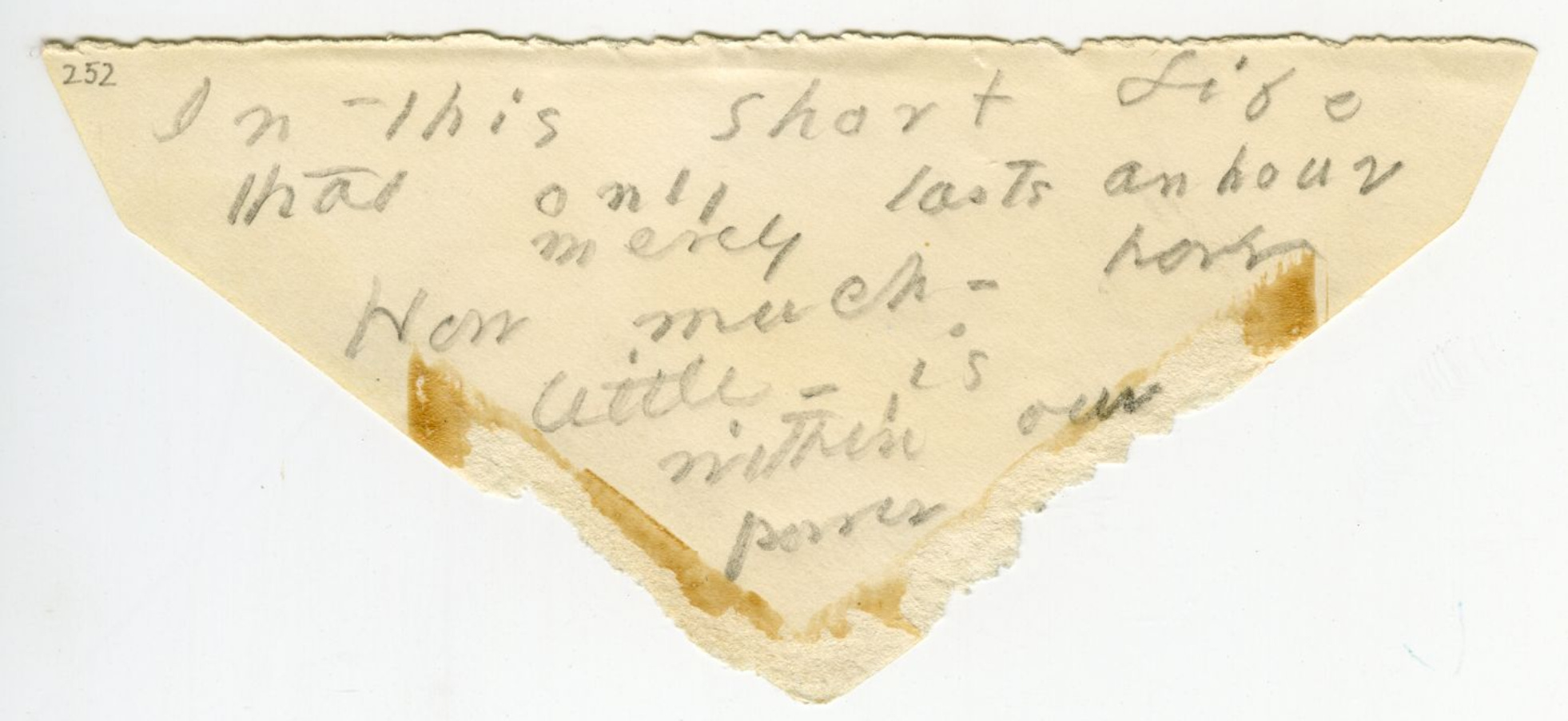
10. “In this short Life” by Scott Joiner: Dickinson wrote this compact poem of just two lines on an upcycled envelope flap, as she was wont to do, around 1873 and saved it. It expresses the paradox that we humans possess free will, a potent trait, and yet so many things are beyond our control. Composer Scott Joiner wrote a piece for voice and piano for this text, performed by Jessica Fishenfeld and Milena Gligić on the album Emily that released just this month (it features settings by Joiner of five poems by Dickinson and five by her near contemporary from across the pond, Emily Brontë). The tone is contemplative and resigned.
In this short Life that only lasts an hour How much – how little – is within our power
Envelope poem by Emily Dickinson, ca. 1873, from the Emily Dickinson Collection, Amherst College (Amherst Manuscript #252, Box 3, Folder 88)
SPOTIFY PLAYLIST: August 2024 (Art & Theology): An assortment of psalms, hymns, and spiritual songs, old and new.
+++
OBITUARIES:
>> Jürgen Moltmann (1926–2024): Jürgen Moltmann, one of the leading Christian theologians of the twentieth century, died June 3 at age ninety-eight. His conversion to Christianity began while he was a German soldier in a POW camp in Belgium during World War II, and he afterward spent most of his career as a theology professor at the University of Tübingen, confronting the theological implications of Auschwitz, among other topics. The pastors of the first church I joined as an adult were deeply influenced by Moltmann (and his protégé Miroslav Volf), so I have been shaped by his theology, especially in the areas of theodicy (which he binds inextricably to Christology) and eschatology.
Moltmann challenged the classical doctrine of divine impassibility, which says God does not feel pain or have emotions, in his seminal book The Crucified God (1974), articulating how God the Father, not just God the Son, is a being who feels and is moved and who also suffered on Good Friday; understanding this, he says, is key to understanding how God relates to the suffering of the world. In Theology of Hope (1964), Moltmann tackled eschatology, which he defines not as the theology of last things but as the theology of hope; not of the end of time but of the fullness of time toward which God is moving all creation, even now. The gospel, he says, must be taken as good news not just of a past event (the birth, life, death, and resurrection of Jesus Christ) but also of a promised future, with vast implications for the present.
>> Bernice Johnson Reagon (1942–2024):Bernice Johnson Reagon [previously], a civil rights activist who cofounded The Freedom Singers and later started the African American vocal ensemble Sweet Honey in the Rock, died July 16 at age eighty-one. I’m so inspired by her Christian witness through nonviolent resistance and music—her songs are on regular rotation in my house.
Beauty isn’t necessarily pretty, pleasant, soothing, Vander Lugt says. Beauty is whatever makes our being gasp a little—whether in delight, or in terrified awe. Beauty demands attention. It also dislodges us from the center of the story, Vander Lugt continues—it unselfs us, in a way, curving us outward. It can be present in what’s torn. (“God goes belonging to every riven thing,” as the poet Christian Wiman puts it.)
I was struck by a remark that Howell, the host, who is a pastor, made near the beginning of the conversation: he said preachers should be less like an instructor imparting moral lessons and more like a docent at an art museum who points out the beauty of the paintings, drawing people’s eyes to its various aspects. What a compelling way to frame the ministry of preaching!
>> Malcolm Guite on Poetry and the Imagination, The Habit: Conversations with Writers about Writing (Rabbit Room), May 7, 2020: In the eleventh poem of his “Station Island” cycle, Seamus Heaney writes about “the need and chance // To salvage everything, to re-envisage / The zenith and glimpsed jewels of any gift / Mistakenly abased.” In this podcast episode, poet-priest Malcolm Guite [previously] talks with host Jonathan Rogers about the “salvaging of the mistakenly abased gift of imagination.” Imagination, Guite says, is as much a truth-bearing faculty as reason; in order to know things well, wemust engage the imagination. It’s not about a private, subjective world or inward fantasies devised to compensate for the cruelty of the world; it’s about truly seeing.
One of the gifts mistakenly abased by our culture for about the last two or three hundred years is the gift of the imagination. We’ve sidelined it so it’s only about the subjective, [whereas] out there is the objective world of dry, rational facts. And we’ve abased that gift of intuitively knowing the truth and value of things and expressing that in warm and poetic imagery, rather than simply reducing everything to a set of tiny particles or mathematical formulae.
—Malcolm Guite
The Romantic poets, for example, Guite says, “aimed at awakening the mind’s attention, removing the film of familiarity and restoring to us that vision of the freshness and depth of nature for which we have eyes that see not, ears that hear not, and hearts that neither feel nor understand. So they weren’t trying to make stuff up. They were trying to take away this film which [Samuel Taylor Coleridge] says our selfishness and solicitousness have cast over the world, and unveil a deeper but equally real truth about nature which is more than just the surfaces we see.”
Also in this conversation, Guite reveals the poet who made him want to be a poet, the poem that prompted his reconversion to Christianity, what we lost when poetry changed from oral to written, and why he writes poetry in meter.
+++
SHORT FILM SERIES: SparkShorts, produced by Pixar, streaming on Disney+: Did you know Pixar Animation Studios launched an experimental shorts initiative in 2017, giving employees the opportunity, through funding and resourcing, to flex their creative muscles with a great measure of freedom? “The SparkShorts program is designed to discover new storytellers, explore new storytelling techniques, and experiment with new production workflows,” says Pixar President Jim Morris. “These films are unlike anything we’ve ever done at Pixar, providing an opportunity to unlock the potential of individual artists and their inventive filmmaking approaches on a smaller scale than our normal fare.”
Eleven SparkShorts have been released since 2019, all streaming on Disney+. Here are my favorites:
>>Self, dir. Searit Kahsay Huluf: Released February 2, 2024, this stop-motion–CGI hybrid is about a woman who self-sabotages to belong. Writer-director Searit Kahsay Huluf says it was inspired by her family story: her mother immigrated to the US from Ethiopia to escape a civil war and had to learn how to assimilate without losing herself, and as a second-generation African immigrant growing up in Los Angeles, she herself wrestled with identity issues. The way in which Huluf tells the story is beautiful, clever, and kind of dark! Notice the differentiation of textures and sound between the wood of the main character (portrayed by a puppet) and the metal of the “Goldies.”
>> Float, dir. Bobby Rubio: A father discovers his infant son has a unique characteristic that differentiates him from others and then tries to hide him to avoid judgment—but when doing so visibly deflates his son’s spirit, he vulnerably releases him out into the world to be who he is. Writer-director Bobby Rubio created Float for his son, Alex, who is on the autism spectrum. As a dad, Rubio initially struggled with the diagnosis, and this is his story of learning to embrace the beauty of it. It’s one of the few portrayals of a Filipino American family on film, and a warmhearted celebration of neurodivergence—or any other type of divergence.
>> Nona, dir. Louis Gonzales: Nona is looking forward to a day to herself to just chill in front of the TV, watching her favorite show, E.W.W. Smashdown Wrestling. But when her five-year-old granddaughter is unexpectedly dropped off, she has to adapt her plans—begrudgingly at first. Writer-director Louis Gonzales says Nona is based on his own grandma, with whom he shared a love of wrestling. I appreciate how the film addresses dealing with disruptions to a cherished routine; it’s honest about the frustration (even if the disrupter is someone you love dearly!) while also showing how a gracious, go-with-the-flow attitude can unlock surprising new joys. What a fitting watch for the current season of Ordinary Time!
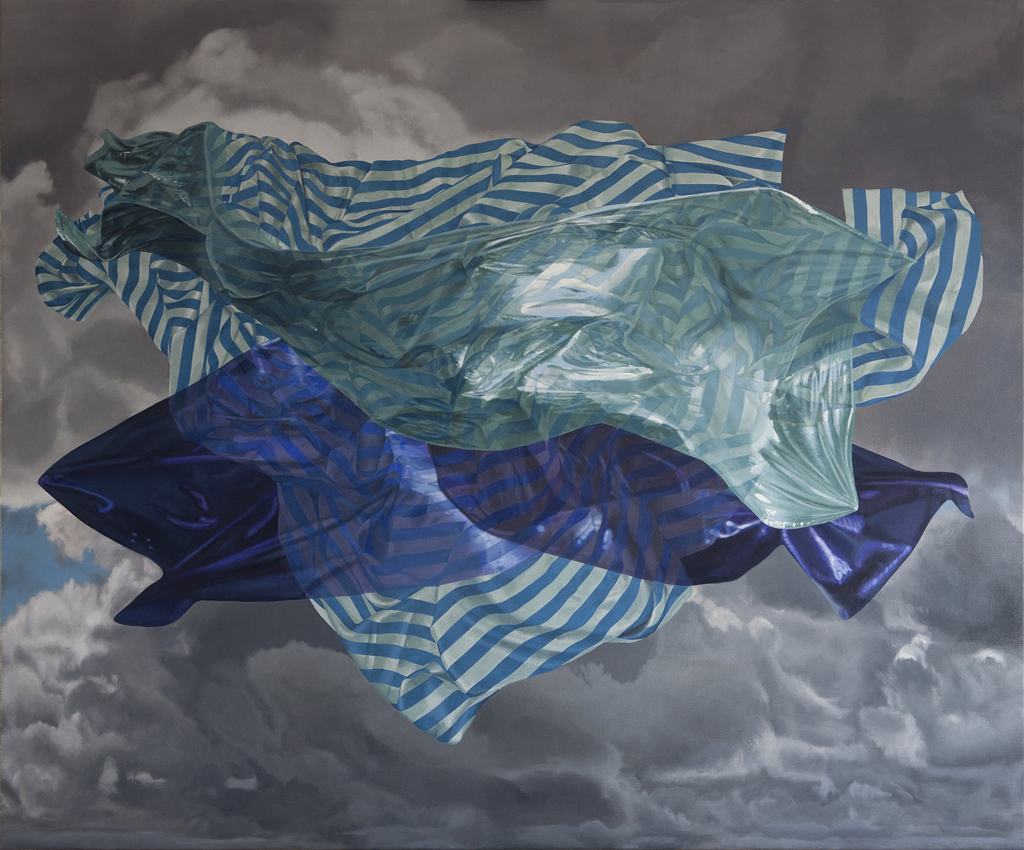
Hansa (Hans Versteeg) (Dutch, 1941–), Between Hope and Despair, 2015. Oil on canvas, 125 × 150 cm.
Everything is plundered, betrayed, sold,
Death’s great black wing scrapes the air,
Misery gnaws to the bone.
Why then do we not despair?

By day, from the surrounding woods,
cherries blow summer into town;
at night the deep transparent skies
glitter with new galaxies.

And the miraculous comes so close
to the ruined, dirty houses—
something not known to anyone at all,
but wild in our breast for centuries.
This poem was originally published in Russian (title: “Все разграблено”) in Anno Domini MCMMXI by Anna Akhmatova (Petrograd: Petropolis, 1922). The above translation by Stanley Kunitz, with Max Hayward, appears in Poems of Akhmatova (Boston: Mariner Books, 1997).
Akhmatova wrote “Everything Is Plundered” in June 1921, during a time of great social and political upheaval caused by the Russian Revolution (1917), which established Communism in the country, and the resultant Russian Civil War (1917–1922). Just two months later, her first husband, the father of her nine-year-old son, would be arrested and executed as a counterrevolutionary. Despite the death and destruction she was witnessing, she did not want to abandon hope. She grasps for a miracle, which is elusive but, she senses, near—will it land?
Like the poet, I too marvel at how such ugliness and beauty can coexist in the world. For Akhmatova, it’s in large part gifts from nature, such as the scent of cherry blossoms or the sparkle of a starry night sky, that prevent her from despairing, that rekindle in her that faith-flame. When humans make a terrible and violent mess of things, there’s still the persistence of seasons and the steadiness of sky. I consider such things graces from God, reminders of God’s deep-down, benevolent, outreaching presence.
Anna Akhmatova, the pen name of Anna Andreevna Gorenko (1889–1966), is one of the most significant Russian poets of the twentieth century. She was active as a writer during both the prerevolutionary and Soviet eras, though in the latter, her work was condemned and censored by Stalinist authorities, who viewed it as too pessimistic and rooted in bourgeois culture. Though many of her friends emigrated out of the country to escape oppression, she chose not to, believing that her poetry would die if she left her homeland; she wanted to stay and bear witness to the events around her, and to hold out hope for a better tomorrow. One of Akhmatova’s most famous poem cycles, Requiem, she wrote while her only child, Lev Gumilev, was detained in Kresty prison in 1938 along with hundreds of other victims of the Great Terror; he would spend the next two decades in forced-labor camps. It wasn’t until the late 1980s, after her death, that Akhmatova achieved full recognition for her literary accomplishments in her native Russia, when all her previously unpublishable works finally became accessible to the public.
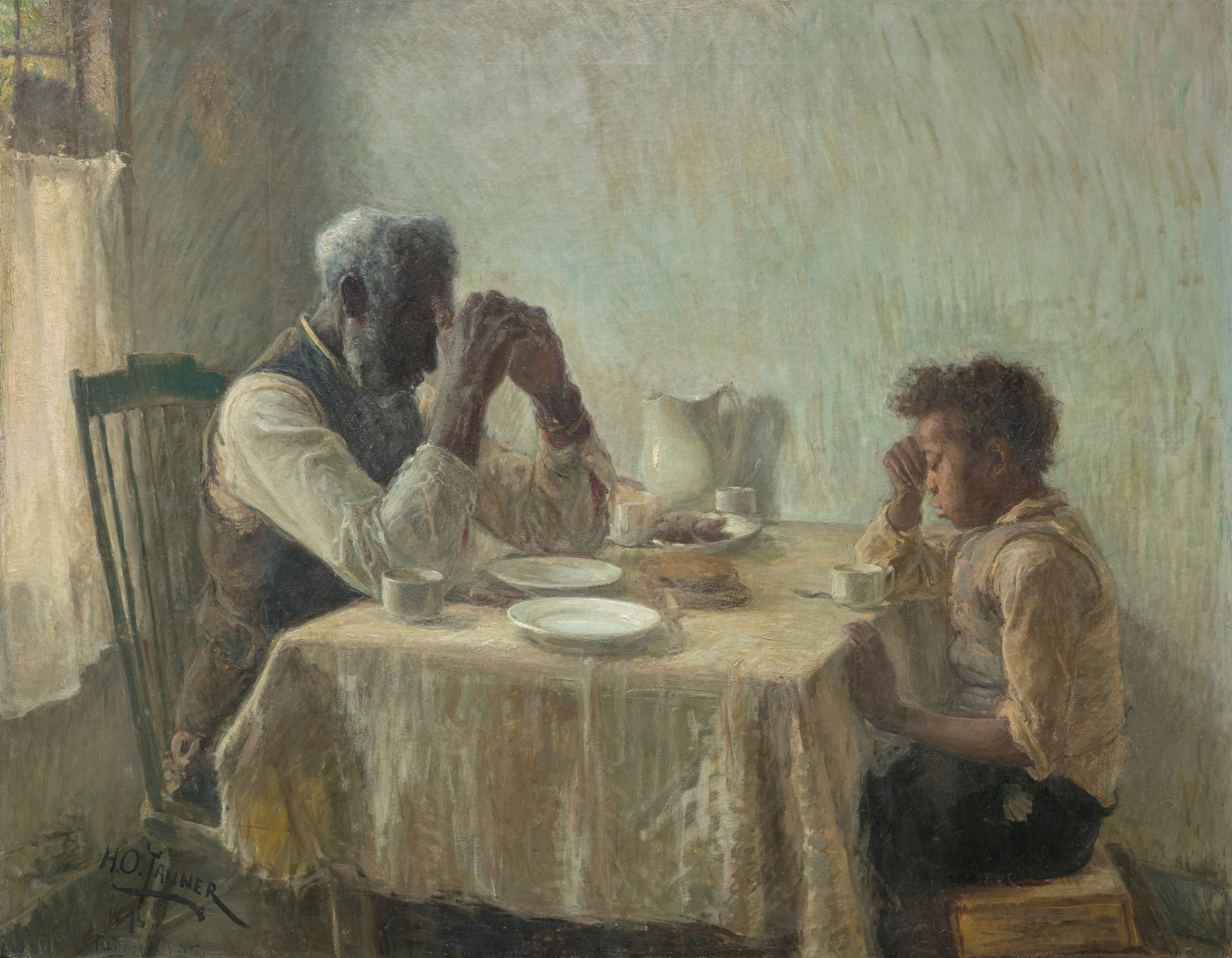
Henry Ossawa Tanner (American, 1859–1937), The Thankful Poor, 1894. Oil on canvas, 35 1/2 × 44 1/4 in. (90.2 × 112.4 cm). Collection of the Art Bridges Foundation, Bentonville, Arkansas.
Momma used to say
That when Jesus turned the
Loaves and fish
Into a picnic
For those hungry folks
In the wilderness
The God blessed victuals
Tasted like mouth watering
Mississippi catfish
Deep fried in the best store bought meal
Served with a healthy side helping
Of iron skillet cornbread—
Bread so fine that
No one asked for butter or honey
And nary a crumb hit the ground.
She grew up an orphan
In the Great Depression,
Where low cotton prices
And bad weather
Killed farms and families—
Times, she remembered, so hard
That sometimes even dinner
Was a miracle
And prayers offered
At the evening meal
Wafted in the air
Thick as coal oil smoke
In the fragrance of gratefulness.
This poem by Tom Darin Liskey was originally published June 16, 2019, on Kelly Belmonte’s All Nine blog. Used with permission of the author.
Tom Darin Liskey is a photographer and a writer of fiction, nonfiction, and poetry. A graduate of the University of Southern Mississippi, he spent nearly a decade working as a photojournalist in Venezuela, Argentina, and Brazil. He is the author of the short story collection This Side of the River (2022) and, with Kelly Belmonte, the poetry-photography collaboration Transit (2022), as well as a contributor to The Cultivating Project. He lives with his family in South Carolina.
Van Engen answers questions from poet Shane McCrae and from the audience, addressing how to read a volume of poetry, how poetry produces an experience, the role of understanding and not understanding when it comes to poems, why Christians in particular should read poetry, hymns as poetry, how Adam’s naming creation in Genesis 2 relates to the task of the poet, his favorite poets, and the qualities of a good poem.
Two especially great questions from attendees were:
How do you imagine poetry nourishing discipleship and/or corporate worship, if used by a church leader?
What, if anything, would you like to see more of from Christian poets writing today?
Regarding the first, he says,
I often think that ministers in particular—and especially the heavier the preaching tradition, the more true this is—need creative literature—poetry, novels, and other things—to enliven what it is they’re doing from the pulpit. Not just to understand human life in all of its flourishing and misery, but to connect to people in different kinds of ways than pure principle and message can do.
He mentions the recurring summer seminar for pastors co-led by Dr. Cornelius “Neal” Plantinga, “Imaginative Reading for Creative Preaching,” to help participants explore the possibilities and homiletical impact of engaging in an ongoing program of reading novels, poetry, short fiction, children’s lit, and nonfiction outside the category of Christianity—not just to mine for sermon illustrations but also to develop a “middle wisdom” (“insights into life that are more profound than commonplaces, but less so than great proverbs”) and to deepen their perception of people.
+++
PODCAST EPISODE: “Opening Your Bible? Turn on Your Imagination” with Russ Ramsey and Sandra McCracken, The Gospel Coalition Podcast, May 8, 2020: This is a recording of a breakout session—“Reading Scripture with an Engaged Imagination”—from the Gospel Coalition’s 2019 National Conference in Indianapolis. Pastor Russ Ramsey (author of Rembrandt Is in the Wind: Learning to Love Art through the Eyes of Faith) and singer-songwriter Sandra McCracken (“We Will Feast in the House of Zion,” “Thy Mercy, My God”) discuss the role the imagination plays in reading scripture and understanding and conveying its truth.
Scripture calls for reading with a fully engaged imagination, Ramsey says, because that’s how literature works and that’s how people work. “How are you supposed to understand Scripture if you’re not trying to empathize or get into a situation and walk around inside of it?” he asks. They discuss wonder, mystery, and paradox—the unresolved dissonance and complexity present in many Bible stories—and the need to take a Bible story on its own terms instead of always trying to extract a moral or “life application” from it.
Though they don’t use the term, they’re basically advocating for Ignatian contemplation, aka the Ignatian method of Bible reading and prayer, in which you put yourself into the story and try to experience it with all your senses. Ramsey demonstrates with the story of Mary and the nard. “In those hours as Jesus is being arrested and tried and flogged and crucified, he smells opulent. And I think we’re supposed to get that, you know. We’re supposed to . . . especially a first-century reader is going to say, ‘He left a lingering scent as he went down the Via Dolorosa, and it was the scent of royalty. And it was the scent of extravagance.’”
Some of the names that come up along the way are Robert Alter, Ellen Davis, Eugene Peterson, and Frederick Buechner.
+++
IMMERSIVE ART EXPERIENCE:Rembrandt’s Christ in the Storm on the Sea of Galilee at Frameless in London: I’ve been seeing these kinds of exhibitions advertised more and more—ones that use animation and projection-mapping technology and dozens of loudspeakers strategically placed around the room to create a wall-to-wall, multisensory experience built around one or more masterpiece paintings. Some people say it’s gimmicky or overstimulating, but though I’ve never been to one, I generally think they look like fun! They’re not meant to be a substitute for seeing the actual artwork in person.
In the case of Rembrandt van Rijn’s Christ in the Storm on the Sea of Galilee, though, that’s not possible, as the painting was stolen from the Isabella Stewart Gardner Museum in Boston in 1990 and has not been recovered. In collaboration with their long-term partner Cinesite, Frameless recently developed an immersive art experience based on the painting—the Dutch master’s only seascape—in which visitors can get a sense of the terror and exasperation Jesus’s disciples must have felt that night they were caught at sea in a torrential wind- and rainstorm while Jesus lay calmly asleep in the boat’s stern (see Matt. 8:23–27; Mark 4:36–41; Luke 8:22–25). Here’s a making-of featurette for that experience, which garnered a nomination for a prestigious Visual Effects Society award earlier this year:
Frameless is permanently housed in the Marble Arch Place in London’s West End cultural district. Christ in the Storm is one of forty-two works of art they riff on across four galleries.
+++
POEMS:
Here are two poems published this month that each explores a different episode from the story of Jacob’s family in the book of Genesis—one of his wife Rachel stealing her father’s household gods as they flee to Canaan, and one of Jacob’s sons avenging the rape of their sister, Dinah. Both are examples of how poems can stimulate renewed engagement with scripture, as these were stories I had forgotten some of the details of, and the poems did not make sense until I revisited the relevant Bible passages. Poems can help us walk around inside the biblical narratives, both familiar and unfamiliar ones, and see things from the perspectives of different characters, especially ones who are not given a voice in scripture, such as a Shechemite woman taken captive by Jacob’s sons.
>>“Rachel, Cunning”by Patricia L. Hamilton, Reformed Journal: Read the poem first, then Genesis 29–31, then my commentary.
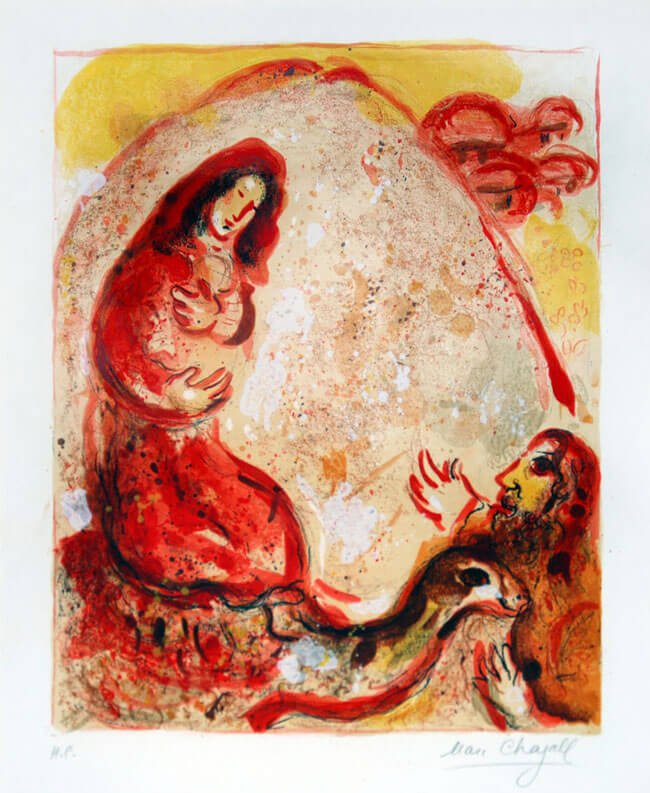
Voiced by Jacob’s second wife, Rachel, in this poem Rachel vents her jealousy over Jacob having first married her sister, Leah, who bore him six sons to her one at this point. This marriage was due to the trickery of her father, Laban, who also tried to cheat Jacob out of fair shepherding wages—so Rachel resents her father. As she prepares to secretly leave Paddan-aram for Canaan with Jacob, Leah, and their children, she steals her father’s teraphim (small images or cult objects used as domestic deities or oracles by ancient Semitic peoples).
In the biblical narrative, Rachel’s motive for stealing the idols is not given. Was she seeking to prevent Laban from consulting them to find out which way she and her family went? Was possession of the gods in some way connected to property inheritance, as some scholars have attested? Was she stealing a blessing from her ancestors? Did she take them for their monetary value? Or leaving her homeland, did she simply wish to take with her a little piece of home, for nostalgia’s sake?
I think the most likely reason is she still believed in these gods’ power—her allegiance to the God of Jacob had not yet been firmly established—and so she stole them for protection. That’s what Hamilton imagines in her poem: that Rachel sees them as “talismans against the spite of brothers,” averting the evil Jacob’s older twin brother, Esau, wished him for his having stolen their father’s blessing that belonged to him. (According to Genesis 27:41–45, before Jacob left for Paddan-aram, Esau had vowed to kill him.)
Marc Chagall (Belarusian French, 1887–1985), Rachel dérobe les idoles de son père (Rachel Hides Her Father’s Household Gods), from The Bible series, 1960. Original color lithograph on Arches wove paper, image size 14 × 10 1/2 in. (35.6 × 26.7 cm).
Caught between two tricksters—her husband and her father—Rachel herself becomes a trickster. When Laban catches up with their traveling party and searches among their possessions for the stolen gods, Rachel, who’s sitting on them, lies and says she cannot get up because she’s menstruating (Gen. 31:34–35). She deceives her deceitful father to keep her deceitful husband and her son Joseph safe from Esau’s rage, as she believes the gods will act in the interests of whoever possesses them. The poem explores the ever-thickening web of deceptions woven in Jacob’s and Rachel’s families and also reminds us that Rachel, remembered now as a great Jewish matriarch, was not raised in the then-still-developing Israelite religion, nor was her turn to Yahweh necessarily immediate upon her marriage to Jacob. I hear in the poem a lament for fraternal and sororal rivalries, and a subtle sad awareness of the vulnerabilities and pressures of women in patriarchal cultures, who are bought and sold in marriage, valued primarily for their childbearing capacities, and typically forced to rely on men for survival, often suffering the consequences of men’s mistakes. (In the poem at least, Rachel’s feeling of insecurity comes from Esau’s threat of vengeance.)
Based on a lithograph by Marc Chagall, this ekphrastic poem is one of twenty-four from the unpublished chapbook Voiced by Patricia Hamilton, all inspired by biblical artworks by Chagall. Hamilton is currently looking for a publisher to take on the collection.
>>“For the Circumcision of a Small City” by Emma De Lisle, Image: The deception continues in Genesis 34; like father, like sons. This poem is based on the episode of the massacre of the men at Shechem by Jacob’s sons Simeon and Levi to avenge the rape of their sister, Dinah. Shechem, meaning “shoulder,” was the name of both the city in Canaan where the rape took place and the Hivite prince’s son who committed the rape. Jacob and his family were sojourning there, having even bought land. After sexually assaulting Dinah, Shechem wanted to make her his wife. Dinah’s brothers were disgusted by this request, but they pretended they would entertain bride-price discussions on the condition that all the males in the city be circumcised. Shechem’s father agreed, and his position as ruler meant the people obeyed. A few days after the mass circumcision, while the men were still sore, Simeon and Levi attacked with swords, killing all the males in the city. Their brothers then joined them in capturing the men’s wives and children and plundering their wealth.
Emma De Lisle’s poem is written from the perspective of a woman of Shechem, taken captive in the slaughter. The women of the city scorned the lengths Shechem was willing to go to for the homely Dinah, barely old enough to have her period. “Jacob’s silence for you” alludes to Genesis 34:5, which says that when he found out about his daughter’s rape, “Jacob held his peace” until his sons returned from the fields. If he felt grief or outrage, it’s not apparent in the scripture text. His initial response was to say and do nothing, and then to defer to his sons, who exact an outsize punishment for the crime that Jacob admits after the fact disappointed him because when word spreads, it will negatively impact the hospitality of other Canaanite cities toward them.
Stanzas 4 and 5 refer to two of Jacob’s previous deceptions: donning goatskins on his hands and neck to impersonate his hairy brother, Esau, before their blind father, so as to steal the blessing of the firstborn (Gen. 27), and altering the breeding pattern of Laban’s flocks to increase the number of spotted sheep and goats (how this is accomplished is vague and has posed difficulties for interpreters) and so enrich himself, as the spotted animals were his agreed-upon wage (Gen. 30:25–43). The implication of this mention is, I think, that men will take what they feel is owed to them, whether by guile or force.
Sometimes women participate in this violence. The poetic speaker wonders whether Dinah will force her or the other captive women to bear children for her (future husband’s) family line, just as her mother, Leah, had used her slave, Zilpah, when her own womb had closed.
“The city bled one way // or another, before your brothers took interest,” the speaker says. Sexual violence was not new to them. The last sentence suggests that Dinah was not the only female victim of the lustful Shechem’s assault—the women of the city paid a price too, seeing their husbands, fathers, brothers, and sons murdered in retaliation and themselves taken prisoner.
+++
ORATORIO: The Book of Romans by Emily Hiemstra (2019): Consisting of musical settings of select passages from the apostle Paul’s letter to the Romans, this piece for SATB soloists, choir, and string orchestra was commissioned by Grace Centre for the Arts, a ministry of Grace Toronto Church, where it premiered October 22, 2019. (Hooray for churches that commission new art!) Read a statement from the composer on the Deus Ex Musica blog. The performers are Meghan Jamieson (soprano), Rebecca Cuddy (alto), Asitha Tennekoon (tenor), Graham Robinson (baritone), Lyssa Pelton (violin), Amy Spurr (violin), Emily Hiemstra (viola), and Lydia Munchinsky (cello).
Here is the video time stamp for each of the eight movements:
0:18: i. Who Has Known the Mind of the Lord? (Rom. 11:33–36)
3:56: ii. His Eternal Power and Divine Nature (Rom. 1:20)






 Art & Theology