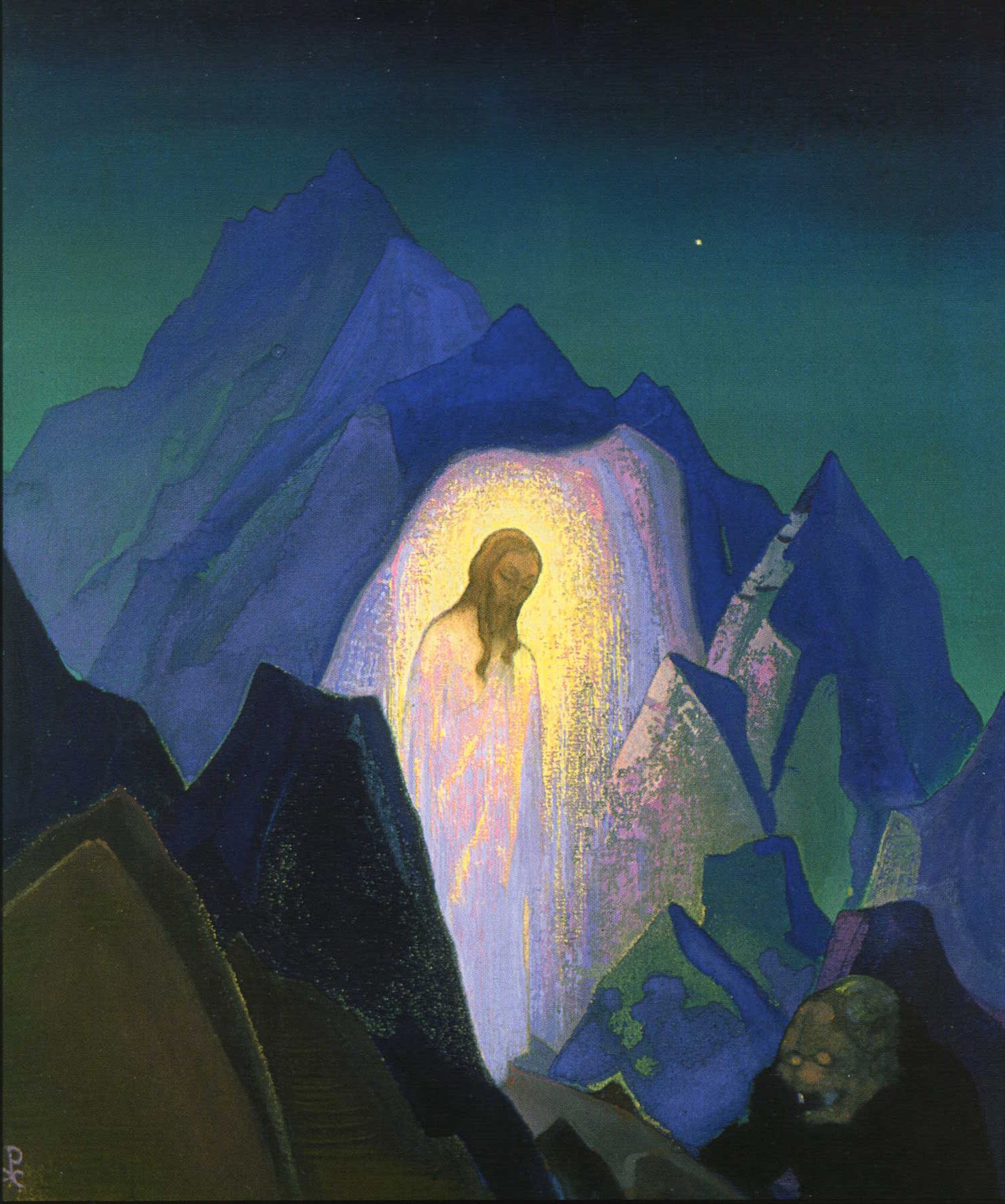
Nicholas Roerich (Russian, 1874–1947), Christ in the Desert, 1933. Tempera on canvas, 60 × 50.9 cm. Nicholas Roerich Museum, Moscow.
QUOTE:
The tradition of Lent means many different things to many different people. I honour the traditions and wisdom of the ages—and I’m interested in discerning what these practices mean [today].
At [my church], Lent is about learning from Jesus, particularly Jesus’ path through the real-life wilderness experiences we all face. We are interested in emulating and discovering a Jesus-shaped life in the hard things, the growing things, and the uncomfortable things. We believe not in an idealized plane of existence no one can quite attain; instead we believe in knowing and living out a Jesus way in the grey areas, the dirt and dust of our earthly lives here and now. . . .
Together and for you, this is our prayer (by Ann Siddall): “May this Lenten journey, with its stories about the hard places of Jesus’ experience, give strength and courage to all whose journey is far from easy. And may it inspire us to risk Christ’s Way of love as we share the journey with other travelers. We make this prayer in his name. Amen.”
>> “Ash Wednesday and the Practice of Truth-Telling” by Christine Valters Paintner: In this introduction to the season of Lent, spiritual writer and retreat leader Christine Valters Paintner discusses lament as a Lenten practice—lament as truth-telling, resistance, solidarity, and the release of God’s power. We need to touch those places of grief that we carry, and open ourselves in compassion to the grief of others. Paintner also unpacks the word “repentance,” visiting its Hebrew and Greek root words to further illuminate its meaning.
>> “Forty for 40: A Literary Reader for Lent” by Nick Ripatrazone:Nick Ripatrazone, the culture editor for Image journal and columnist at The Millions, offers suggestions and blurbs for forty stories, poems, essays, and books appropriate for Lent. Some pieces are inspired by feast days and Gospel readings, while others capture the discernment of the season. From Flaubert’s The Temptation of Saint Anthony and Hemingway’s one-act play Today Is Friday to Love & Salt: A Spiritual Friendship Shared in Letters and Karr’s “Disgraceland,” the selections are varied and intriguing. The dates are off because this was published in 2017, but the list is still valid, and many of the poems can be read online.
+++
LIVING ROOMEVENT: “Poetry of Lent”: On March 4, under the aegis of the local arts nonprofit the Eliot Society, I’m moderating an evening of crowdsourced Lenten poetry at a friend’s home in Crownsville, Maryland. If you’re in the Baltimore-Washington metro area, I’d love to see you there! The themes of this season are so expansive, and I’m looking forward to hearing what people share. Of course, I will have many poems in my back pocket as well. Some words I’ve been thinking of in preparation: pilgrimage; hunger; emptying; grace; greening; solitude; beloved; blood.
+++
SONGS:
>> “Circles” by Tow’rs: Tow’rs, an indie-folk band out of Flagstaff, Arizona, is made up of Gretta and Kyle Miller, drummer Dan Bagle, guitarist Kyle Keller, and cellist Emma Riebe. This song of theirs is about how God lovingly pursues us and clothes our shame.
>> “Parce Domini” by Jacob Obrecht:The Gesualdo Six perform a motet by the Flemish composer Jacob Obrecht (1457/58–1505), which sets a traditional Latin liturgical text based on Joel 2:17, 13.
Parce Domine, parce populo tuo quia pius es et misericors. Exaudi nos in aeternum, Domine.
Spare, O Lord, spare thy people, for Thou art gracious and merciful. Hear us for ever, O Lord.
+++
VISUAL COMMENTARY: “Handling Our Fragility, Seeking a Wise Heart” by Rachel Muers: As part of the Visual Commentary on Scripture project, theologian Rachel Muers has selected and comments on three artworks that resonate with Psalm 90 [previously], a song that combines communal lament with a meditation on wisdom. The psalm ends with the cry “Prosper for us the work of our hands—O prosper the work of our hands!”—which guided Muer in her curation. She gives us nine-thousand-year-old handprints on an Argentinian cave wall, a hospital drawing by Barbara Hepworth, and a cat’s-cradle sculpture by Mitzi Cunliffe. This mini-exhibition is a great way to enter into and engage with this typically Lenten psalm.
Cueva de las Manos (Cave of Hands), began ca. 7,000 BCE. Mural, UNESCO World Heritage Site, Santa Cruz, Argentina.
On a related note: For this Lent, the VCS is dipping into its archives to bring you “Lent Stations: Repentance and Forgiveness,” fourteen artworks with commentary (two per week) that relate to the stated theme. Follow the link to sign up.
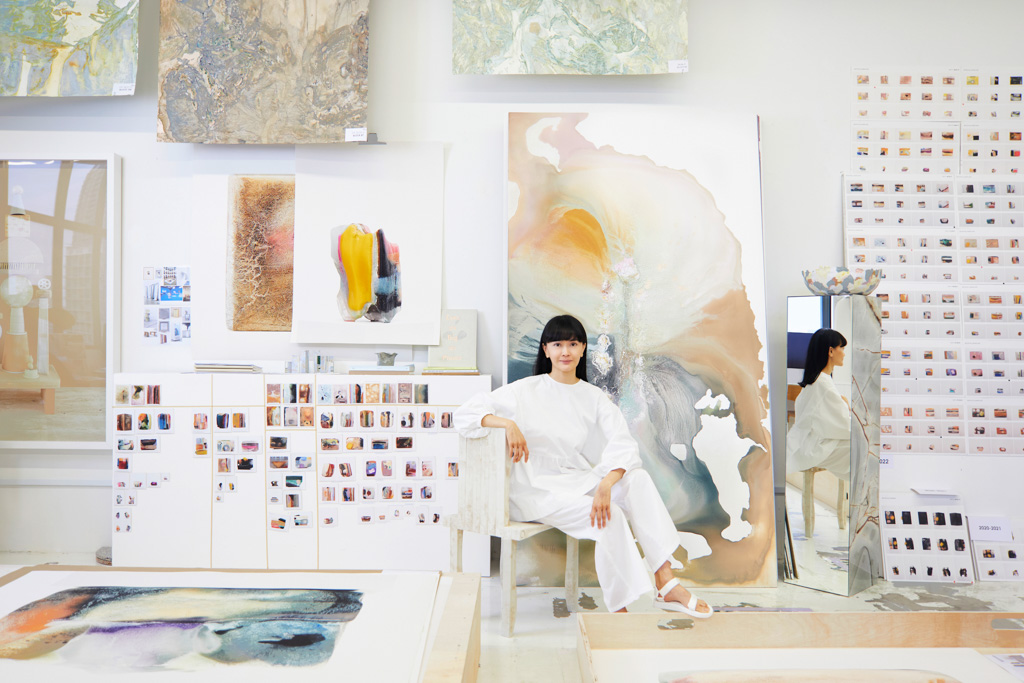
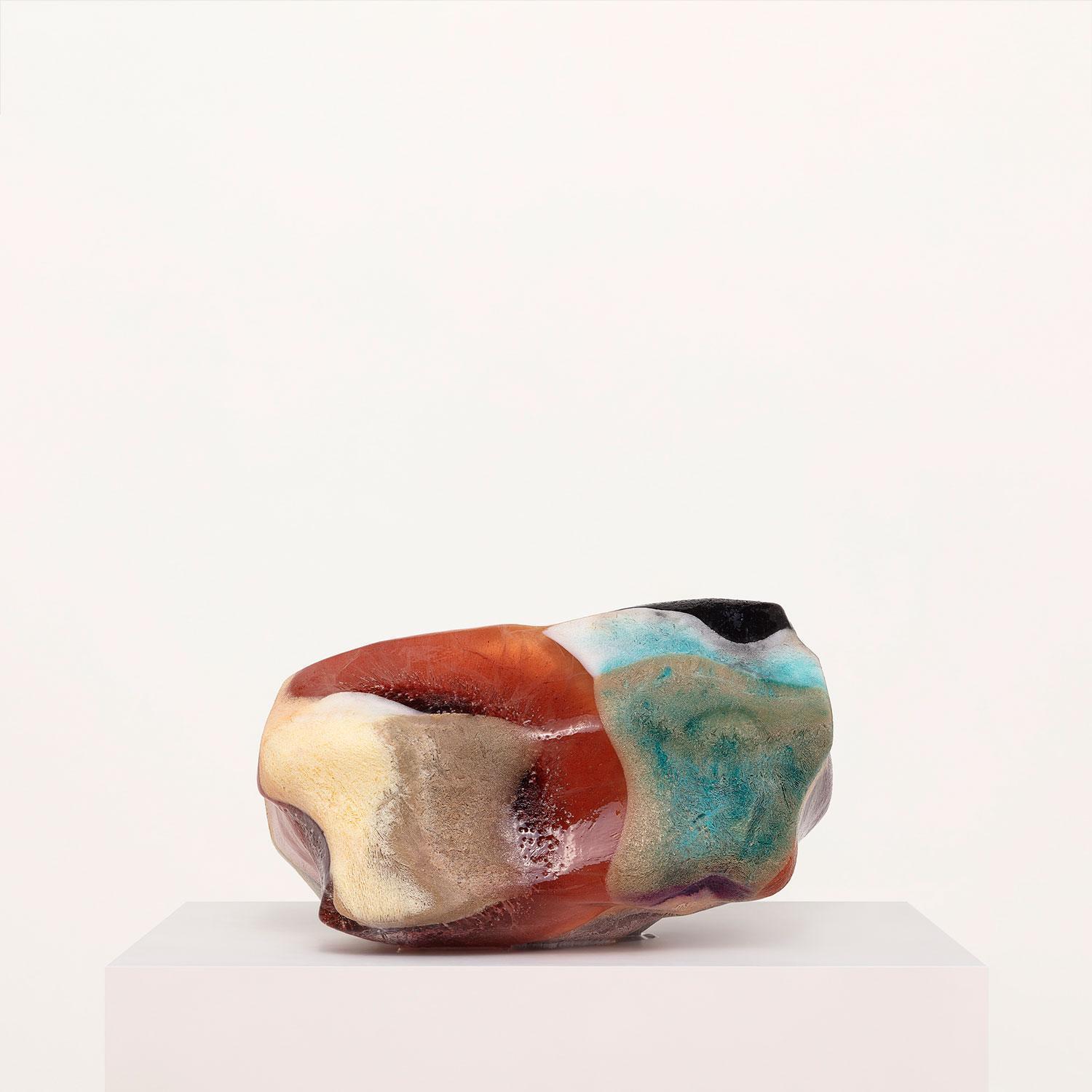
Dawn Ng is a Singaporean multidisciplinary artist whose practice deals with time, memory, and the ephemeral. For her recent body of work Into Air, Ng has crafted nearly 150 large sculptural blocks of frozen pigment and documented their dissolution in the form of photographs, film, and residue paintings. A poetic visual meditation on time and its passing, Into Air captures the metamorphosis of colored ice from solid to liquid to air, physicalizing transience. Presented by Sullivan+Strumpf, it premiered at a derelict ship factory in Singapore in January 2021 and from there traveled to Seoul, London, and Sydney. See the six-minute documentary below for more on the process and meaning behind the work.
Dawn Ng in her studio in Singapore, surrounded by studies and artworks from Into Air. Photo: Sean Lee. All photos courtesy of the artist.
Ng started working on Into Air in 2018, and it’s ongoing. The project encompasses three distinct series:
Clocks
Time Lost Falling in Love
Ash
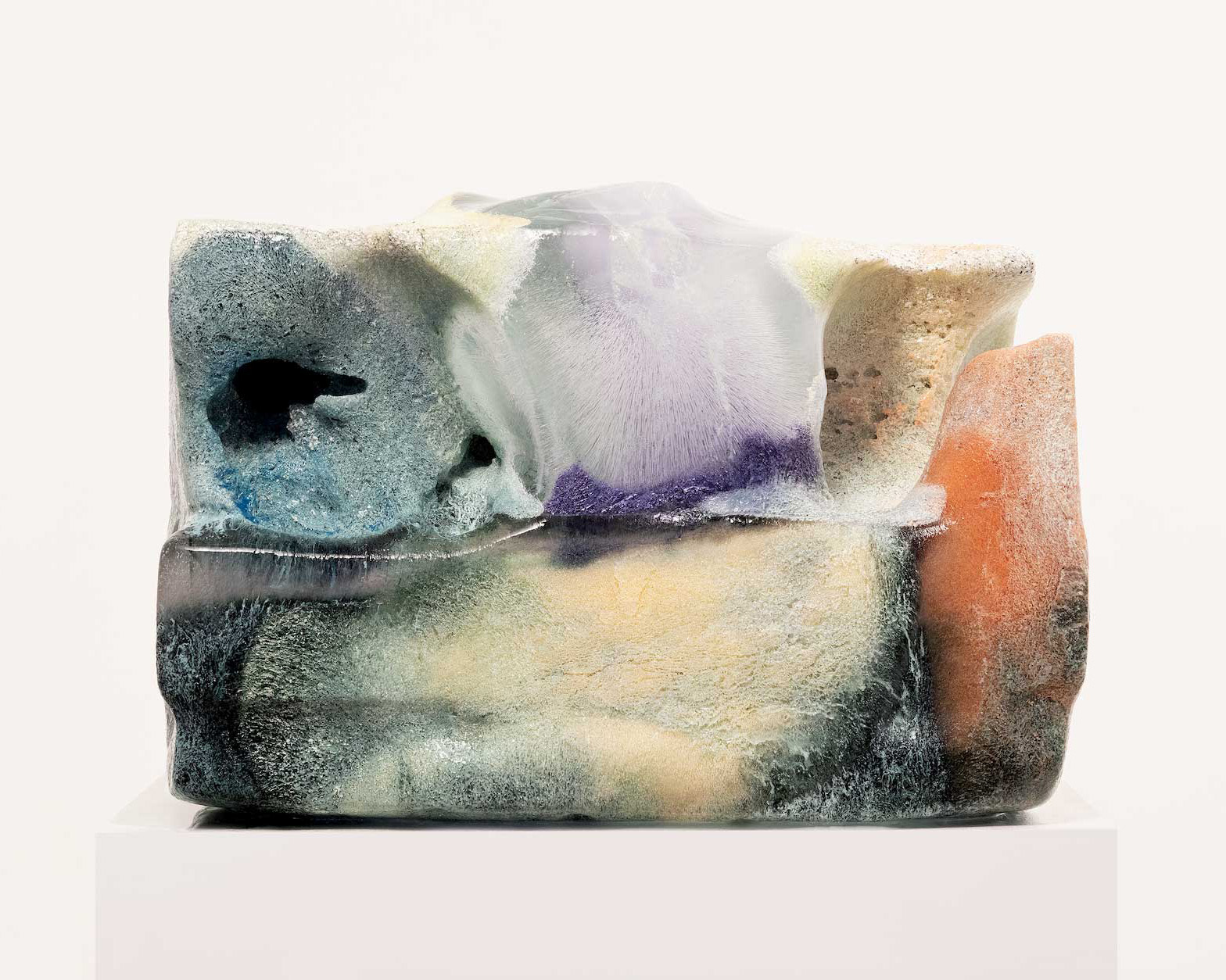
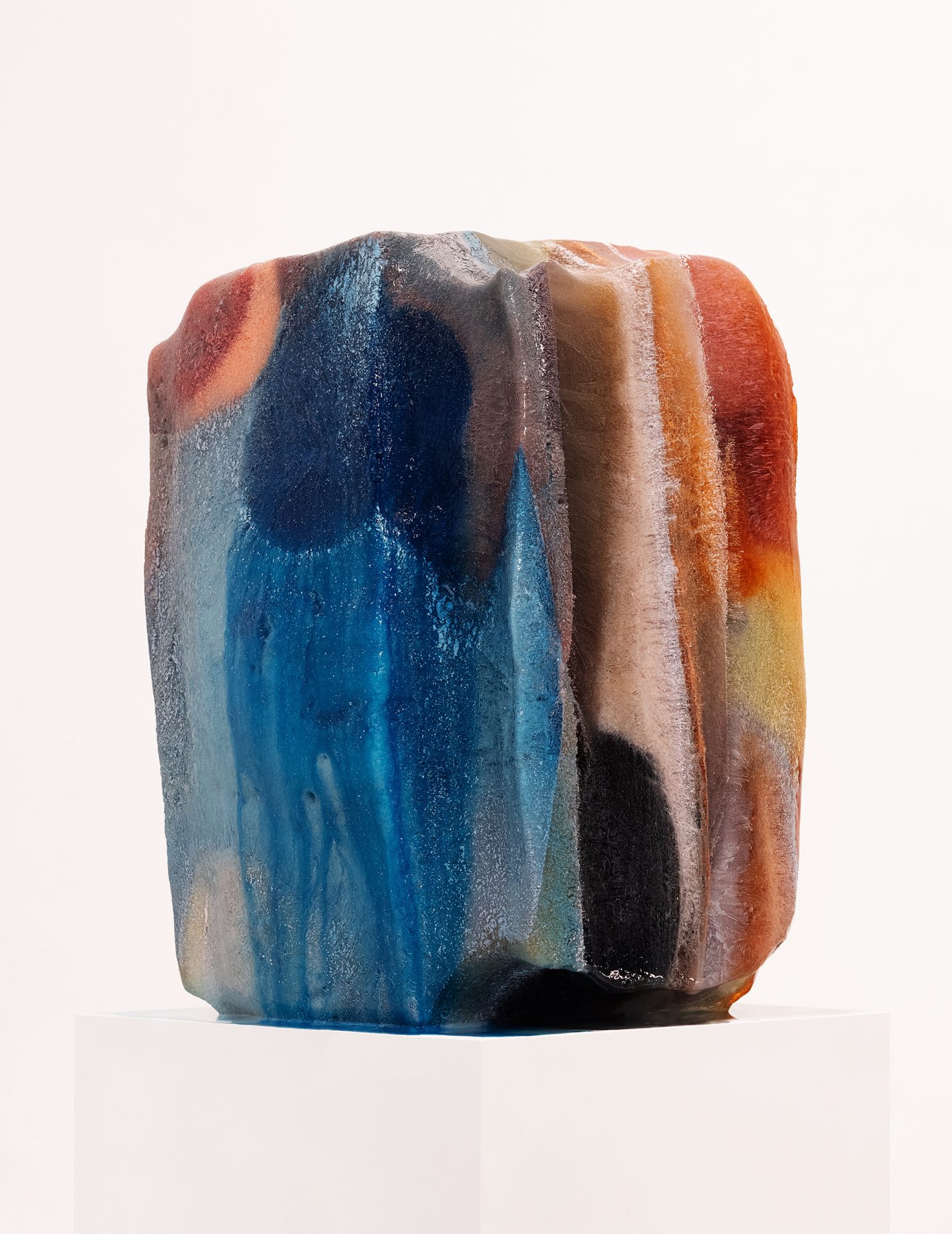
Clocks is the name Ng gives to the photo portraits of her colored glacier blocks at various stages of disintegration. Weighing about 132 pounds each, the blocks were constructed from acrylic paints, dyes, and inks that she froze together in her studio. After removing each block from the freezer, she and her team photographed it from ten different angles every four hours until it entirely eroded. “Like kaleidoscopic lodestones, the portraits visualize the shape, colour and texture that time inhabits in an ephemeral form,” Ng writes.
Dawn Ng (Singaporean, 1982–), If I could find a souvenir just to prove the world was here, from CLOCKS, 2021. Archival pigment print, 115 × 149 cm.Dawn Ng (Singaporean, 1982–), Some will fall in love with life and drink it from a fountain that is pouring like an avalanche coming down the mountain, from CLOCKS, 2021. Archival pigment print, 153 × 118 cm.Dawn Ng (Singaporean, 1982–), Don’t they know it’s the end of the world, from CLOCKS, 2022. Archival pigment print, 95 × 95 cm.
Time Lost Falling in Love is the collective title of the time-lapse videos Ng filmed of the thawing blocks. The collapse of each block into a puddle of liquid took fifteen to twenty hours, a process compressed into twenty to thirty minutes for each film. Ng says she wants to portray the fluidity of time—time as a “riot of colors” that swell and ebb, that form rivers and pools. By speeding up the frame rate of the film, Ng manipulates time, fast-tracking the dissolution of the blocks while simultaneously providing a calming evocation of a waterfall in slow motion. Time melting on. Here’s Avalanche II:
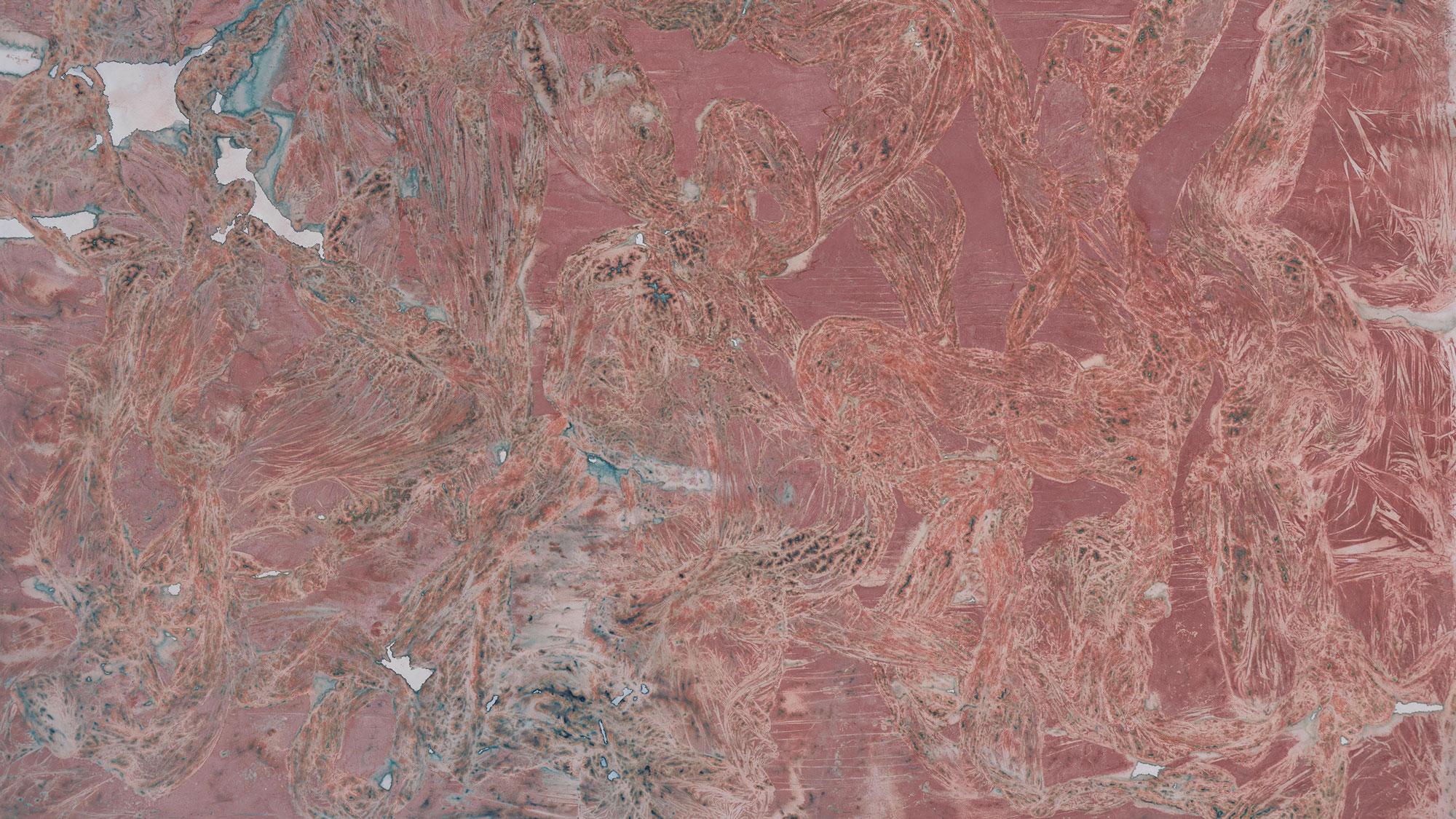
The third and final component of the Into Air project is Ash, a series of paintings created by blanketing the liquid remains of each melted pigment block with a large sheet of canvas-like paper. Ng leaves the paper there for weeks until all the liquid evaporates through it, creating marbled textures and thick buildups that she then peels away. Ng describes Ash as her attempt to “sieve time.”
Many of the photographs and residue paintings take their titles from song lyrics—by the Beatles, Genesis, the White Stripes, Death Cab for Cutie, Sufjan Stevens, and others.
Dawn Ng (Singaporean, 1982–), The Earth Laughs in Flowers I, 2020. Residue painting (acrylic, dye, ink) on paper, 165 × 142 cm.Dawn Ng (Singaporean, 1982–), Ever see, ever be, ever know my heart (detail), from ASH, 2022. Residue painting (acrylic, dye, ink) on paper, 199.5 × 150.3 cm.
There is an inescapable relationship between beauty and death. Death gives meaning to all of time. I don’t necessarily see death as something tragic, sad or final. It is that structure that gives true worth and true value to what comes before it. In Asia, especially as a Chinese Asian, we don’t like to talk about death. We feel it is bad luck. But in the paintings, I see death as something beautiful. Even in that last transition to nothingness, the pigments explode. They have a way of clinging on, they try to form tributaries, they flood a space. There is something very beautiful about that last gasp. It is not meek. It can be as strong as fireworks.
I would actually not use the word “nothingness” to describe the blocks’ final state. There’s definitely a “somethingness” still there after the melt! Behold the Ash paintings, which have a glory of their own. Although death is an end of sorts, it’s also a passing from this to that. Ng acknowledges as much. She even describes how “the melted pigments receive a form of resurrection through their incarnation as painterly formulae” in the Ash series. Resurrection!
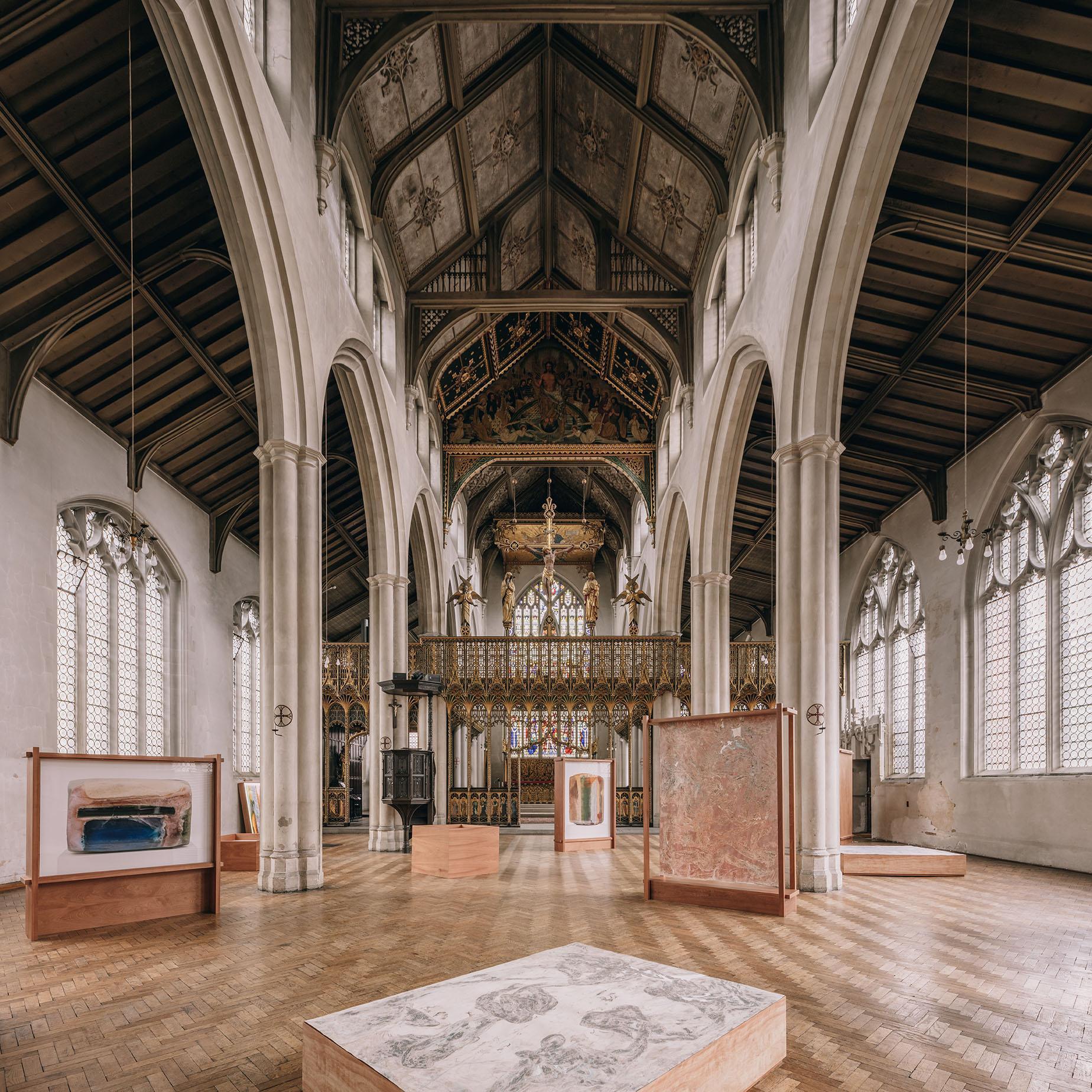
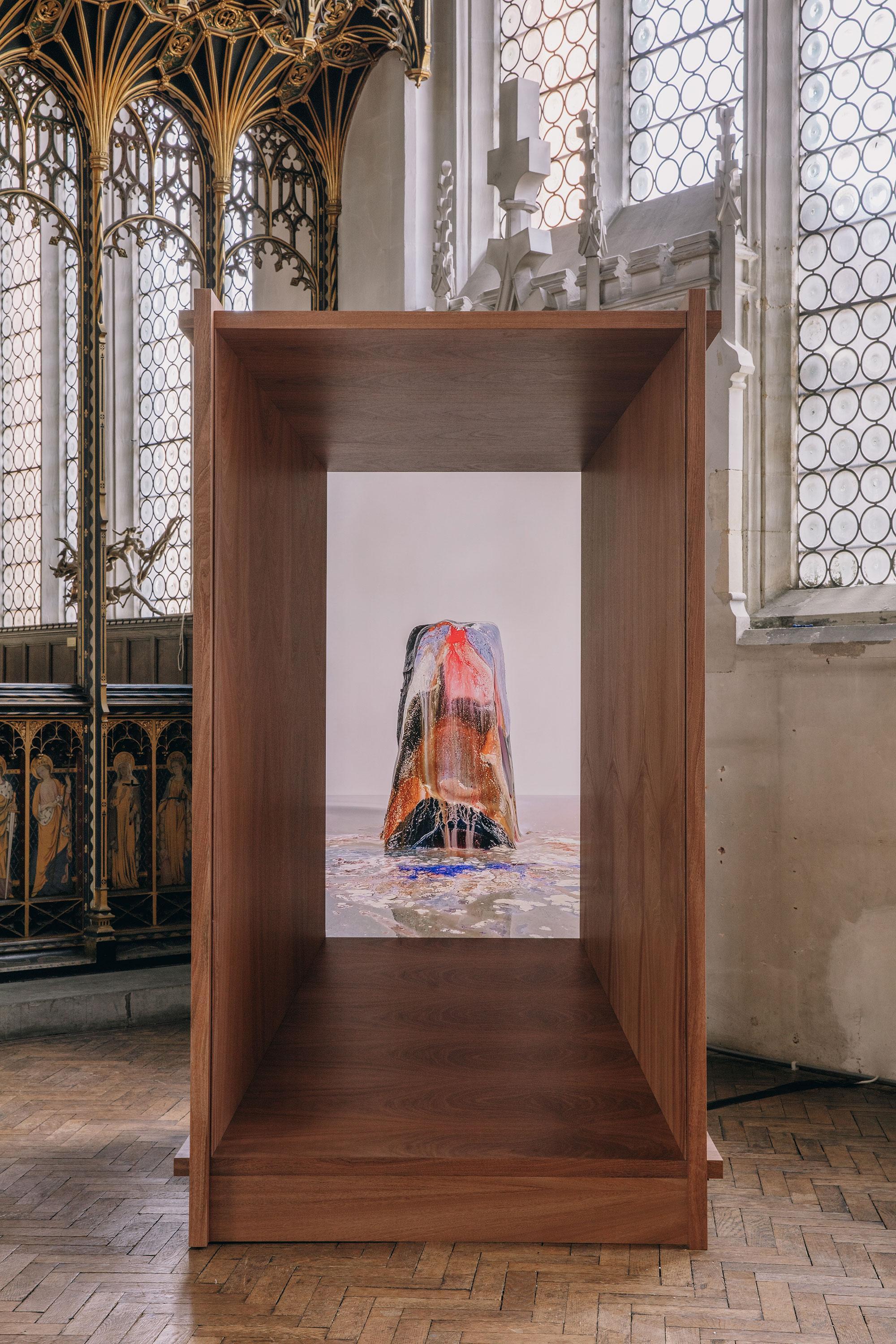
From July 7 to 23, 2022, Into Air was exhibited, under the curation of Jenn Ellis, at St Cyprian’s, Clarence Gate, a historic church in London’s Marylebone district. The midcentury pews, pulpit, and altar inside the Gothic revival interior inspired Ng to design, in collaboration with EBBA architects, new wooden box structures to house the works, some of which stand vertically, and others which lay parallel to the floor.
Exhibition view of Into Air by Dawn Ng, St Cyprian’s Church, London, July 7–23, 2022. Photo: James Retief.Installation shot of Waterfall VII, 2022. Single-channel 4K video, 25 mins, 24 sec. Photo: James Retief. [watch video]
By displaying these works inside a sacred space, their spiritual implications become even more pronounced.
Impermanence is a theme that shows up in the sacred texts of all major religions, not least in the Bible, where we humans are reminded again and again of our mortality. Our days are like grass, which sprouts up and then withers (Isa. 40:6–7; Ps. 103:15–16; 1 Pet. 1:24). Our lives, but a sigh (Ps. 90:9–10), a shadow (Ps. 102:11), a mist (James 4:14), a breath (Ps. 39:5; Job 7:7; 7:16). We are made of dust and return to dust (Eccles. 3:20).
And not only are we finite; so is the present order of things. Even heaven and earth will pass away, Jesus says (Matt. 24:35; Mark 13:31; Luke 21:33; cf. Heb. 1:10–12). But, crucially, God and God’s word stand forever (Isa. 40:8; Matt. 7:24–27). True stability and unchangingness can be found only in God, Christians believe. God is a Rock that does not crumble, a strong foundation on which to stand, in life and in death.
The brevity of life may sound like a fearsome reality, but actually, it can serve to make our moments here on earth more precious and purposeful. Because our lives are but a short span, we must make the most of them while we can. Christians believe that everyone will one day have to give an account of what we did with the time God gifted to us. Did we share it freely with others, or keep it all for ourselves? Did we use it to cultivate virtue or to pursue vice?
The exhibition at St Cyprian’s also involved the premiere of a site-specific choral work by the London-based Welsh composer Alex Mills. A direct response to Ng’s art, his composition is also called Into Air and lasts about twenty-five minutes, the length of Ng’s Waterfall VII.
“In the piece,” Mills writes,
five singers undergo a musical meditation where each moves through the music to the rhythm of their own breaths, one bar of music for every exhale. Musical structures slowly build and disintegrate, evolve and transform, melt and evaporate. Textures, harmonies and colours – some delicate, others more pronounced – appear, disappear and re-emerge. Combing different singers’ breathing patterns gives the piece an indeterminate quality: the piece will never be the same twice and may even be radically different from one performance to the next. As such, the piece is not a fixed musical object that can be ‘performed’. Instead, it is a transient, ephemeral and elusive moment in time to be experienced.
The first singer stands at a kneeler. The second, at a pulpit. They establish the solemn mood. Two male singers sing from the organ loft, and another stands behind the rood screen with his arms crossed over his chest, as if in prayer. Haunting and mesmerizing, the five voices reflect off the stone architecture and meld together, sometimes harmoniously, sometimes in dissonance.
To everything there is a season. Starting at around 10:35, Mills incorporates keywords from Ecclesiastes 3:1–8, a biblical passage made especially famous by the Byrds: “gather,” “scatter,” “heal,” “kill,” “dance,” “mourn.” The author of Ecclesiastes is describing the tide of events that make up a life.
Periodically throughout the performance, a metal singing bowl resounds—a tool commonly used to deepen meditation. It is struck alternately by Ng and Mills, who are seated cross-legged at the front side of the church.
Dawn Ng and Alex Mills at the premiere of Mills’s Into Air, St Cyprian’s Church, London, July 8, 2022. Photo: Damian Griffiths and Sarah Isabelle Tan.
Mills’s Into Air received a second performance just last week on February 8 at the launch of Music & Being, an initiative he founded with Jess Dandy. Music & Being is an open laboratory space in London exploring the intersection of art, music, psychology, spirituality, ecology, and movement.
As we near Ash Wednesday, the start of Lent, Ng’s and Mills’s works remind us of how time slips and slides and ultimately ceases, at least time as we know it. What will we do with our fleeting lives? As they dissipate, what will remain? When our breath stops, will a resonance linger?
Lent begins on Wednesday, February 22. I won’t be doing daily Lenten posts like I did last year, though I will be sharing seasonal content once or twice a week. If you want a set of new daily art-driven devotions that are freely accessible online, I’d encourage you to follow The Lent Project, run by the Center for Christianity, Culture, and the Arts at Biola University; each day features a scripture passage, a poem, a visual artwork, a piece of music, and a written reflection. I’d also direct you to my Lent Playlist (new additions at bottom) and Holy Week Playlist on Spotify.
Carl Spitzweg (German, 1808–1885), Ash Wednesday, 1860. Oil on canvas, 21 × 14 cm. Staatsgalerie Stuttgart, Stuttgart, Germany.
Another spiritual formation resource for Lent is the following series of Arts & Faith videos from Loyola Press, made in 2014–16. Each video features a three-minute commentary by Dr. Daniella Zsupan-Jerome on a historical artwork, chosen based on one of that day’s/week’s scripture readings from the Roman Catholic Mass Lectionary, which is currently in year A. Zsupan-Jerome is the director of ministry formation and field education at Saint John’s School of Theology and Seminary in Collegeville, Minnesota. Here she has crafted a “visual prayer experience” inspired by the Ignatian imagination. In his Spiritual Exercises, Saint Ignatius of Loyola, the founder of the Society of Jesus (the Jesuits), encourages Christians to apply the senses of sight, hearing, smell, touch, and taste to our reading of and meditation on the New Testament, imagining ourselves as present in the Gospel scenes.
Go to the “Arts & Faith: Lent” homepage, or see below, where the link on each artwork title will take you to a new tab where the corresponding video commentary is hosted on the Loyola website. I’ve included sample embeds of a few of the videos below.
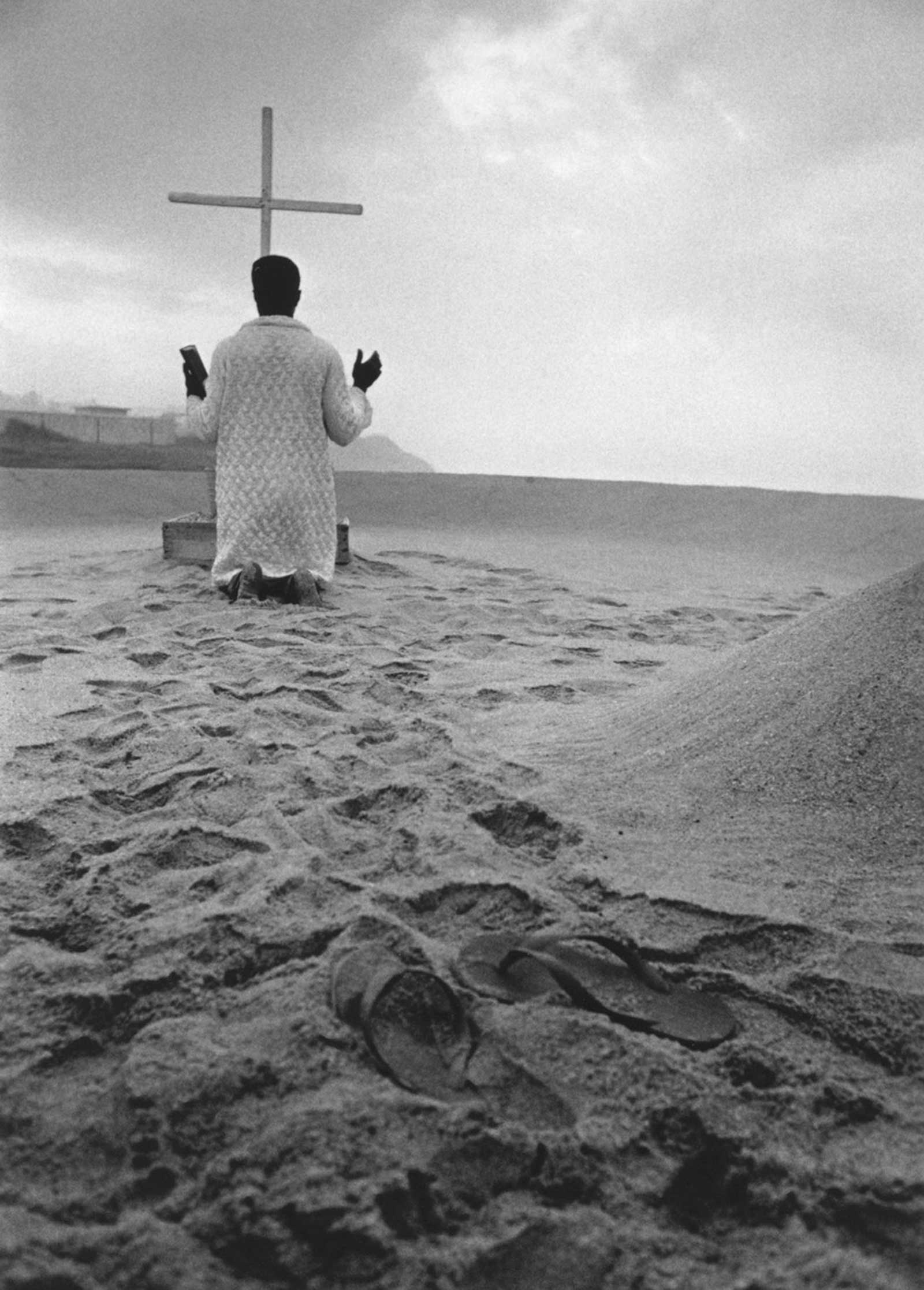
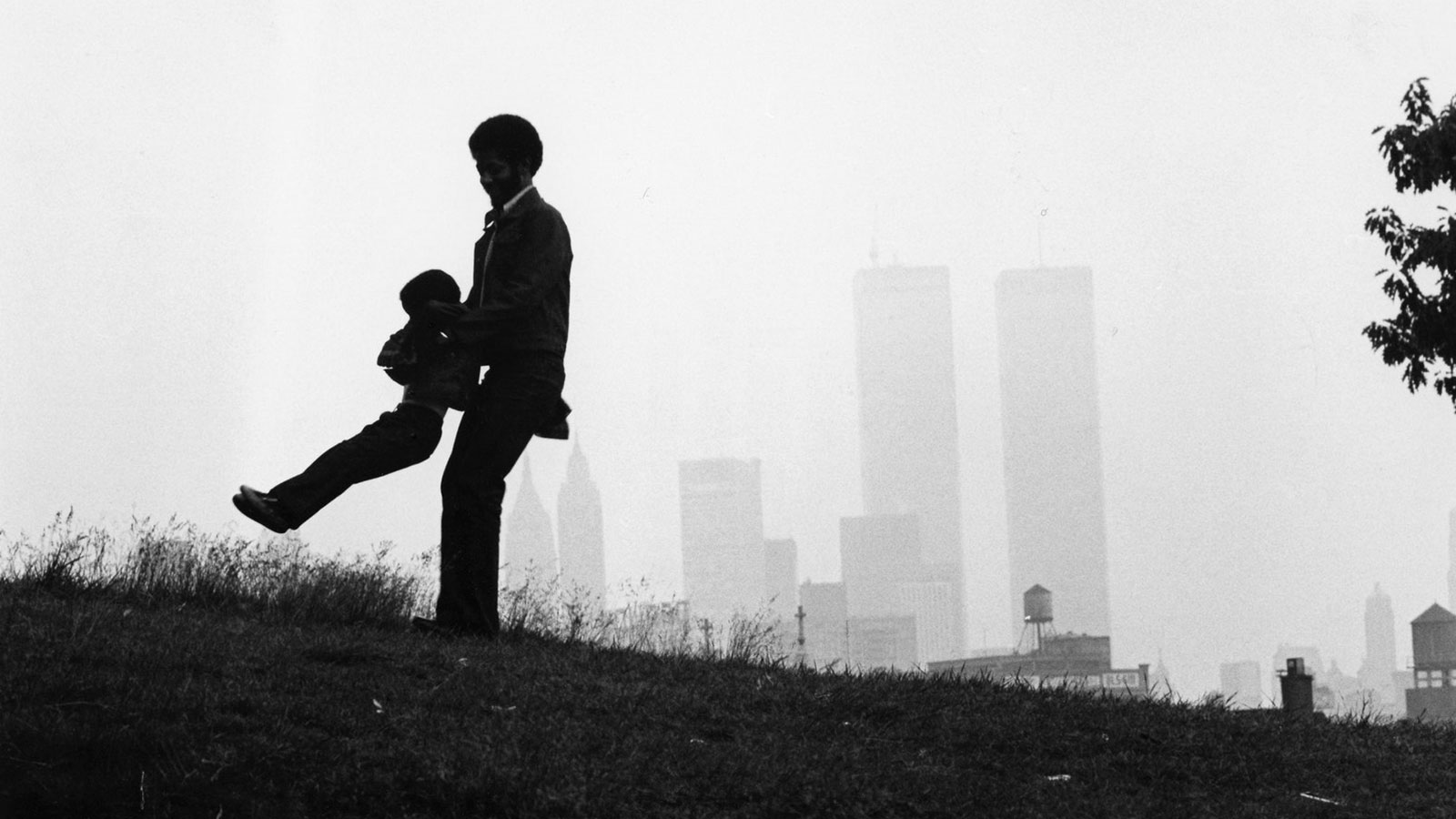
PHOTO COMPILATION: “Chester Higgins’s Life in Pictures”: Chester Higgins Jr. (b. 1946) is an American photographer whose work focuses on everyday Black life; “it is inside simple moments where I look for windows into larger meaning,” he says. He was a staff photographer for the New York Times for more than four decades, and his work is in the permanent collection of the Museum of Modern Art. This heavily illustrated New Yorker article is a good introduction to his oeuvre, in which religious belief and practice feature prominently. I found out about him through the photography compilation book Standing in the Need of Prayer: A Celebration of Black Prayer.
Chester Higgins (American, 1946–), Sunrise Prayer on Osu Beach, Accra, Ghana, 1973Chester Higgins (American, 1946–), Father Swinging Son, Brooklyn, 1972
+++
SONGS:
>> “El Shaddai” by Victory: On January 27 singer-songwriter Victory Boyd, who goes professionally by the mononym Victory, released her latest single, “El Shaddai.” El Shaddai is an ancient Hebrew name for God whose original meaning is unclear but which is often translated into English as “God Almighty”—although “God of the Mountains,” “the Full-Breasted God” (referring to God’s nourishment of God’s children), or “the All-Sufficient One” have also been posited. Its first appearance in the Bible is in Genesis 17:1, where God tells Abram, “’I am El Shaddai; walk before me, and be blameless.”
Read the lyrics in the YouTube video description.
>> “Come Unto Me” by Take 6: A friend recently introduced me to the American a cappella gospel sextet Take 6. Formed in 1980 on the campus of Oakwood College in Huntsville, Alabama, and still active, they incorporate sophisticated jazz harmonies into the tradition of Black gospel “quartet” singing. They are featured on Spike Lee’s Do the Right Thing soundtrack and have won ten Grammys.
This 1988 performance for a Heritage USA TV spot features the group’s six original vocalists: Claude V. McKnight III, Mark Kibble, Mervyn Warren, David Thomas, Cedric Dent, and Alvin Chea.
>> “He’s Got the Whole World in His Hands” by Peter Collins: I love what Peter Collins does with this African American spiritual! This video was his submission to Tyler Perry’s #HesGotTheWholeWorldChallenge from 2020 (which I featured here). It didn’t make the final cut, but I’m so glad it’s out there.
+++
LITERARY EXCERPT from The Color Purple by Alice Walker: This short passage from Alice Walker’s 1982 Pulitzer Prize–winning novel is taken from a conversation between the protagonist, Celie, and her friend Shug, about pleasure, gratitude, and grace. Shug refers to God as “it” (“God ain’t a he or a she”), and her statement about the necessity of enjoying God’s good creation and being open to surprise provides the source of the title.
I’m embarrassed to say that although I saw and really liked the 1985 Steven Spielberg film adaptation of The Color Purple, I’ve never read the book! I plan to rectify that before December, when another film adaptation—of the 2005 stage musical based on Walker’s novel—is coming out, directed by Blitz Bazawule. It stars Fantasia, H.E.R., Colman Domingo (Euphoria), Taraji P. Henson (Hidden Figures), Danielle Brooks (Orange Is the New Black), Jon Batiste, and more.
+++
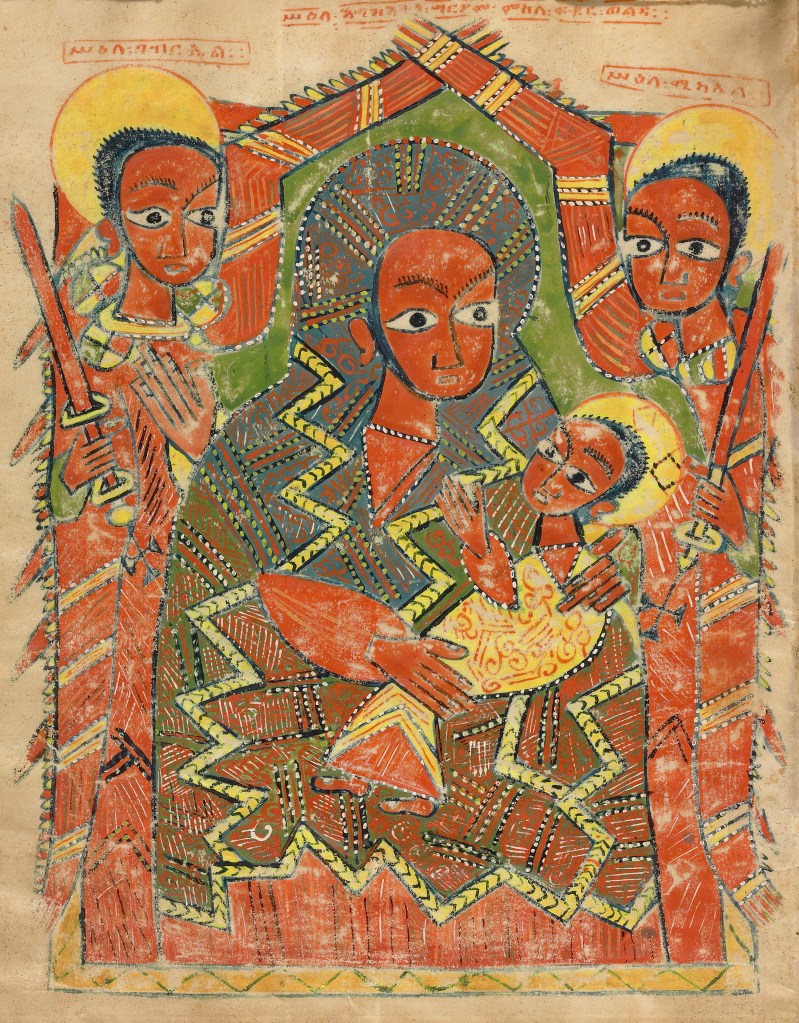
VIDEO: “Ethiopian Gospel Book”: In this six-minute instructional video, Dr. Beth Harris, executive director of Smarthistory, and Kelin Michael, a graduate curatorial intern of manuscripts at the Getty Museum, explore an early sixteenth-century Gospel book from Ethiopia. They discuss the book’s historical context and the formal qualities of its paintings, including the flatness of the figures and the colorful interlacing. They focus on a full-page illumination at the front of the Virgin and Child enthroned between two archangels, but they also touch on the book’s canon tables and its portrait of Saint John the Evangelist.
The Virgin and Child with the Archangels Michael and Gabriel, Ethiopia, ca. 1504–5. Tempera on parchment, 13 9/16 × 10 7/16 in. (34.5 × 26.5 cm). J. Paul Getty Museum, Los Angeles, Ms. 102, fol. 19v.
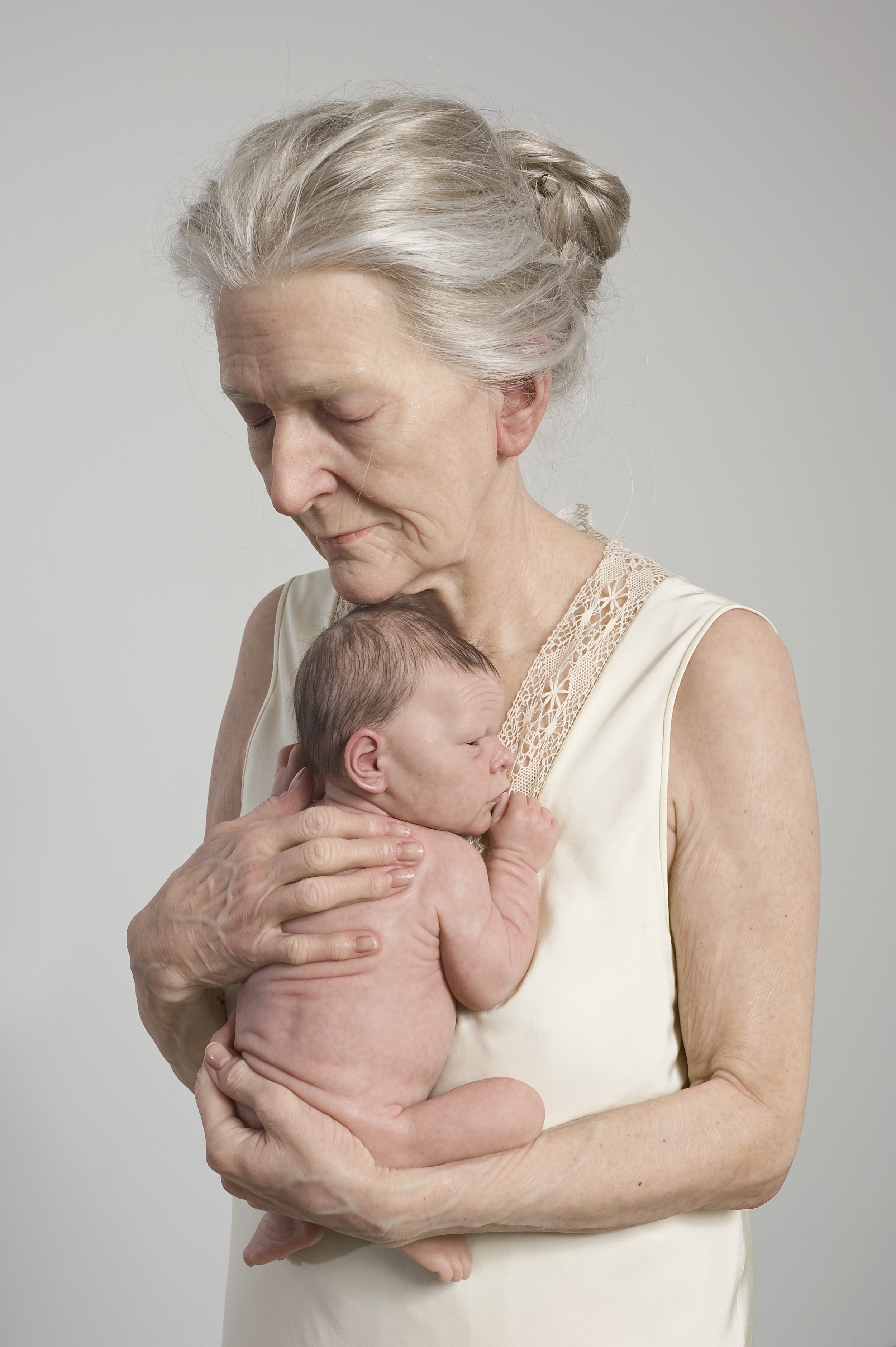
Sam Jinks (Australian, 1973–), Woman and Child, 2010. Silicone, silk, human hair, acrylic, nylon, polyurethane foam, timber, 145 × 40 × 40 cm. Shepparton Art Museum, Shepparton, Victoria, Australia.
Widows of Jerusalem, I too was once
young enough to believe my life mattered.
When I woke, the sun rose for me. I tucked lilies in my hair.
Now I am eighty years a temple dweller.

What a wonder of faith! they proclaim. Truth is,
I cry in the dark. I beg priests for bread

and pick insects from my hem. But today,
an infant came to be blessed. He curled

into the crook of my arm, and when his eyes
wandered to mine, I remembered every hope

stored in my childhood’s heart: gazelles
and henna shrubs, doves perched in the crags.

I touched his face—
that skin we were meant to wear forever.
Inspired by Luke 2:36–38, this poem appears in Tania Runyan’s first full-length poetry collection, Simple Weight (Lexington, KY: FutureCycle, 2010). Used by permission.
Tania Runyan, MA/MFA, lives in Illinois, teaching sixth-grade language arts, speaking at writing workshops, and writing poetry, much of which grapples with scripture. She is the author of five poetry collections—What Will Soon Take Place, Second Sky, A Thousand Vessels, Simple Weight, and Delicious Air—and the popular instructional guides How to Read a Poem and How to Write a Poem. Her most recent book is Making Peace with Paradise: An Autobiography of a California Girl, about her West Coast upbringing.
This roundup is a bit longer than usual, but I’ve found that these six items I’ve gathered over the last month complement each other well, so I’m sharing them all at once. The Art in America and Hyperallergic articles raise interesting points about sacred art—what it is, how it functions, what its relevance is to contemporary life—and this is a topic I discuss in a podcast episode that was released earlier this month. Tammy Nguyen and Wes Campbell are two artists whose work I am glad to have just learned about and plan to explore more of. And there’s always something going on in London’s art scene to remark on as relates to theology or Christian history—this time a National Gallery–sponsored virtual exhibition on the fruits of the spirit, and the latest winning entry for the Fourth Plinth competition, which honors a Baptist pastor and freedom fighter from Malawi.
ARTICLE: “Seeing and Believing: Christian Imagery in Painting Now,” a roundtable conversation with four artists moderated by Emily Watlington: Religion is the theme of the December 2022 issue of the influential contemporary art magazine Art in America, and its cover story is a conversation with painters Frieda Toranzo Jaeger, Tammy Nguyen, Alina Perez, and Jannis Marwitz on their “bold reinventions of traditional Christian iconography.” They discuss the generativity of Christian imagery, the power of sacred images, their favorite Christian paintings, the function of metal leaf in illuminated manuscripts, Jesus as recognizable not by his specific likeness but by body language and symbol, “revisiting and repurposing history” as “a core practice of decolonization,” and the role of storytelling and transcendence in art.
I especially appreciated being introduced to Nguyen’s work and hearing her thoughtful and nuanced perspectives. She mentions her Stations of the Cross series, inspired by her visit to the island of Pulau Galang in Indonesia to connect with her Vietnamese parents’ history as refugees on nearby Kuku Island following the Vietnam War. In the decommissioned Galang Refugee Camp, now a tourist site, fourteen golden Stations of the Cross statues are preserved in the forest, which served as devotional aids for the many Vietnamese Catholic refugees—but they are now overgrown by nature. Nguyen was struck by this tropical takeover, and her resultant body of work setting Christ’s passion in the jungle explores not only environmental agency but also legacies of colonialism and the important role of faith in circumstances of trauma and grief. Hear her discuss the series in this five-minute video that the gallery Lehmann Maupin put out:
Tammy Nguyen (American, 1984–), Man of Sorrow, 2022. Watercolor, pastel, vinyl paint, and metal leaf on paper stretched over wood panel, 84 × 60 in. (213.4 × 152.4 cm).
I regret that besides Nguyen’s, all the other featured contemporary paintings in the Art in America article have only a very tenuous, sometimes indiscernible, connection to Christianity. Toranzo Jaeger’s End of Capitalism, the Future, a “queer utopia,” is based on Lucas Cranach’s Fountain of Youth—but Cranach’s subject (elderly women entering a pool to become young again) is not Christian, it’s mythological. And Marwitz’s The Raid supposedly references Caravaggio’s Madonna of Loreto, but I don’t see it at all, compositionally or otherwise. Perez mentions growing up Catholic in Miami, but that influence isn’t apparent in It Never Heals, unless we’re meant to read it in the painting’s flair for violence and drama. So the article’s subtitle, “Christian Imagery in Painting Now,” is a bit of a misnomer.
With the criteria of currently active painters consciously engaging with Christian imagery in ways that are not merely illustrative, I might have chosen to interview, for example, Jyoti Sahi (India), Daozi (China), Emmanuel Garibay (Philippines), Wisnu Sasongko (Indonesia), Marc Padeu (Cameroon), Harmonia Rosales (US), Stephen Towns (US), Rodríguez Calero (US), Trung Pham (US), Laura Lasworth (US), Patty Wickman (US), James B. Janknegt (US), Mark Doox (US), Sergii Radkevych (Ukraine), Ivanka Demchuk (Ukraine), Natalya Rusetska (Ukraine), Paul Martin (England), Filippo Rossi (Italy), Michael Triegel (Germany), Janpeter Muilwijk (Netherlands), Arne Haugen Sørensen (Denmark), Brett a’Court (Australia), or Julie Dowling (Australia).
I’m also disappointed that, from what I can tell from the interview, none of the four artists approaches their subjects from a place of Christian belief. I absolutely welcome non-Christians to engage with Christian stories and symbols—to play with them, reinterpret them, question them, or even use them as tools of critique or subversion. I just wish that in a conversation about ways that Christian imagery is being used today, the editors had thought to invite a Christian to the table, who could have provided a different viewpoint. But, kudos to Art in America for at least broaching the topic of religion in contemporary art!
+++
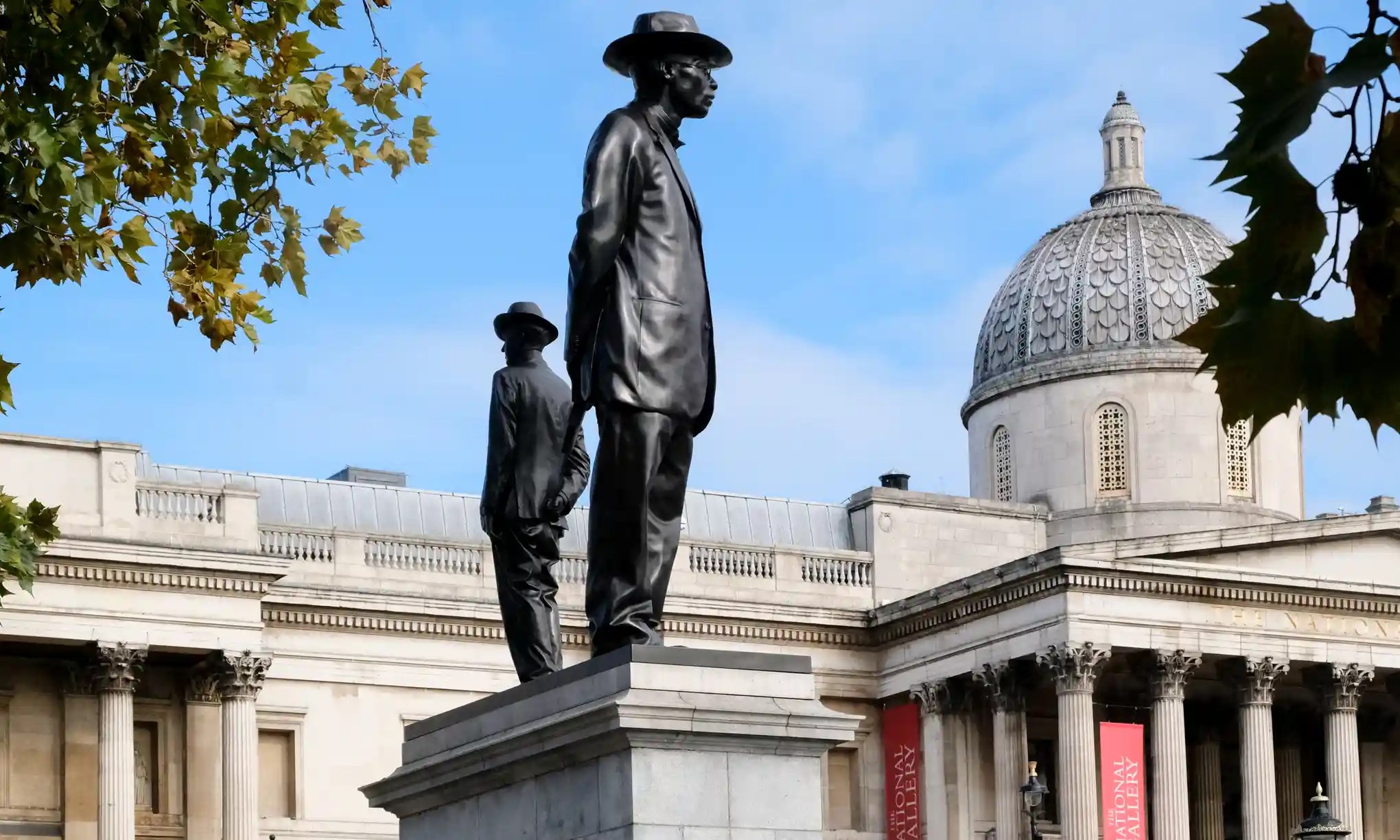
NEW STATUE: Antelope by Samson Kambalu: The fourth plinth in London’s Trafalgar Square is the prestigious site of rotating contemporary art installations, and from September 2022 to September 2024, it is home to Antelope by Malawian-born artist Samson Kambalu. This two-man bronze sculpture group reimagines a photograph of the pastor, educator, and revolutionary John Chilembwe (1871–1915) of Nyasaland (now Malawi) standing next to his friend John Chorley, a British missionary. Posing at the entrance of his newly built church, Chilembwe proudly wears a brimmed hat, flouting the law that Africans were not allowed to wear hats in the presence of their then colonial rulers. (Read more from Inno Chanza on Facebook, and from Harvard Magazine.) Kambalu’s sculpture shows the men facing away from each other instead of side-by-side, and he’s made Chilembwe almost twice as large as Chorley, elevating an underrepresented figure in the history of the British Empire in Africa.
Samson Kambalu (Malawian, 1975–), Antelope, 2022. Bronze, resin, 18 ft. high. Photo: Future Publishing / Getty Images.Pastor John Chilembwe and John Chorley at the dedication of Chilembwe’s New Jerusalem Baptist Church in Mbombwe village in what is today southern Malawi, January 24, 1914. The British colonial government demolished the church the next year and imprisoned or executed most of its leaders following an unsuccessful uprising against forced labor, racial discrimination, and conscription led by Chilembwe.
After years of agitating peacefully against British colonial rule to no avail, Chilembwe led an uprising in 1915, which resulted in his death but which laid the seeds for Malawian independence. John Chilembwe Day is observed annually on January 15 in Malawi.
+++
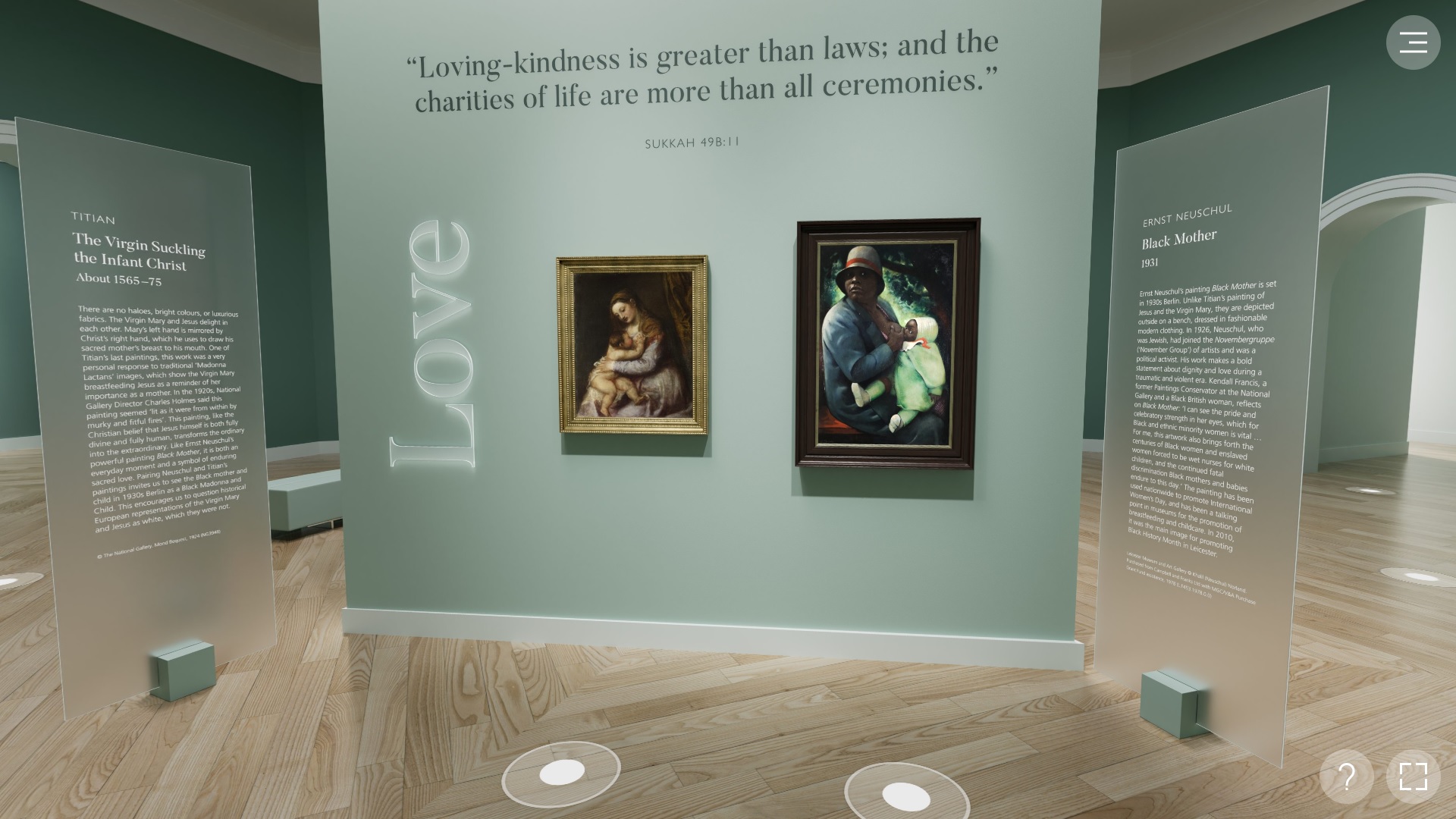
VIRTUAL EXHIBITION: Fruits of the Spirit: Art from the Heart: Curated by the Rev. Dr. Ayla Lepine as part of the National Gallery’s Art and Religion research strand, this new virtual exhibition was inspired by a passage from the apostle Paul’s letter to the Galatians, where he writes, “The fruit of the Spirit is love, joy, peace, patience, kindness, generosity, faithfulness, gentleness, and self-control. There is no law against such things” (5:22–23). The exhibition pairs nine artworks from the National Gallery’s collection with nine from UK partner institutions that represent these spiritual fruits, these virtues, which are held in common across faith traditions. The Renaissance through contemporary eras are represented. [HT: Jonathan Evens]
Screen capture from the online exhibition experience Fruits of the Spirit. This fictitious space consists of seven side galleries and two central displays, which can be navigated with your keyboard.
Accompanying the exhibition is a web-based catalog (with contributions by theologians, activists, novelists, artists), an audio guide, and a series of in-person and online events from November 2022 through April 2023. Next up is a free online talk by the curator on January 30 at 1 p.m. GMT (8 a.m. EST).
+++
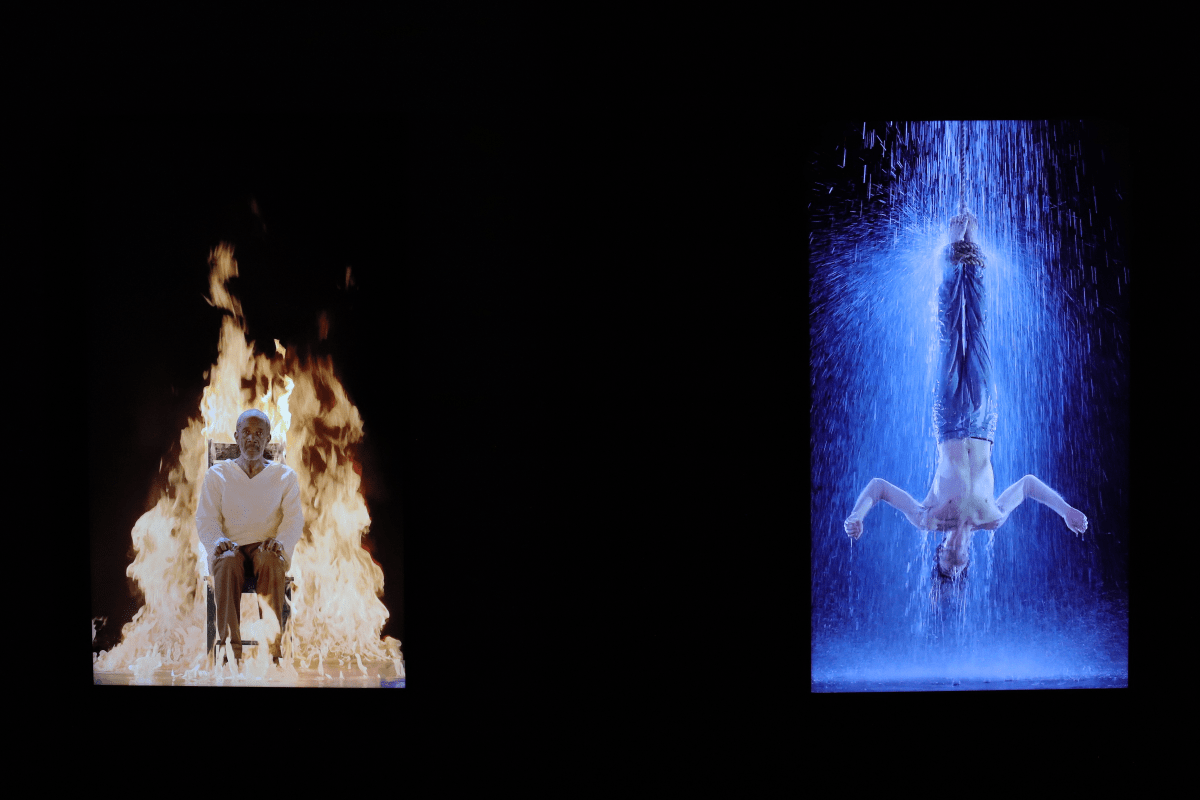
ARTICLE: “The Church of Secular Art” by David Carrier: “Bill Viola’s installation at a Naples church misses the spiritual mark,” reads the deck to this Hyperallergic article, a critic’s response to the Ritorno alla Vita (Return to Life) exhibition that ran from September 2, 2022, to January 8, 2023, at the Church of Carminiello in Toledo. The exhibition was organized by Vanitas Club, a Milan-based organization that throws artistic and cultural events in underutilized historic spaces, in collaboration with Bill Viola Studio.
Bill Viola, left: Fire Martyr (2014); right, Water Martyr (2014). Photo courtesy of Vanitas Club.
I didn’t see the exhibition, but I’m familiar with Viola’s work [previously], and I don’t agree with Carrier’s assertions, if my understanding of them is correct. It sounds to me like he’s saying that when a sacred artwork—say, a medieval altarpiece—is transplanted to a museum, the work becomes secular, and that when a secular artwork is shown in a sacred space, rather than the space sacralizing the work, the work secularizes and thus undermines the space. It seems that he’s saying that art made in a contemporary idiom, like Viola’s video art, does not belong in churches, because it does not and cannot function as religious art. Art museums and churches have fundamentally different goals that are irreconcilable.
“The paintings and sculptures in Neapolitan churches are meant to support and strengthen the spiritual lives of believers; representations of St. Gennaro and other saints are intended to reinforce faith. The videos in Ritorno alla Vita call for a fundamentally different response. The exhibition website notes that these videos ‘exemplify the human capacity to transform and to bear extreme suffering and even death in order to come back to life through action, fortitude, perseverance, endurance, and sacrifice.’ These are important ideals, but they can apply equally to secular and nonsecular contexts.” The description Carrier quotes does seem to water down the art’s Christian content/messaging in an attempt to make the art more widely accessible. I’ve noticed that fault with some other displays of contemporary art in churches—where the curator, seeing their role primarily as one of hospitality to the wider (unchurched) community, underinterprets the art’s Christian angle. Though it can be difficult, there is a way to honor a work’s particularity and universality in the exhibition text.
I think we need to let art function differently for different viewers. Cannot a contemporary artwork, regardless of the artist’s intentions or where the art is placed, cultivate my affection for Christ as much as a traditional artwork? How I as a Christian read and experience Viola will differ from how an atheist does, and that’s OK. The same is true for a religious painting hanging in a national gallery—it may elicit prayer in me, boredom or contempt in another, emotional identification in another, purely aesthetic contemplation in another, and historical curiosity in yet another. I don’t think an image loses or gains its sacredness by its location, though I don’t underestimate the power of the staged environment to enable that sacredness to best shine through. I think that if the viewer receives a work as sacred, then it is.
That Viola does not depict specific historical saints in his Martyr panels—originally commissioned as a quadriptych by St. Paul’s Cathedral in London—does widen their interpretive horizon, but it doesn’t make them less “Christian.” I see the work as a memorial to all the unknown martyrs. I think of all the contemporary Christian martyrs around the world whose names I do not know, who have died with Christ’s name on their lips and his Spirit within them, and am prompted to intercede immediately for believers suffering religious persecution in their countries, who worship Jesus under threat of imprisonment or execution.
+++
ARTICLE: “Openness to the world: Wes Campbell and his disturbing illusions of peace” by Jason Goroncy: In December 2022 theology professor Jason Goroncy spoke at the opening of a retrospective of the paintings of the Rev. Dr. Wes Campbell, hosted by Habitat Uniting Church in Melbourne. That talk is adapted here on the Australian Broadcasting Corporation’s Religion and Ethics web portal. Campbell is a retired Minister of the Word in the Uniting Church of Australia with experience in parish ministry, university chaplaincy, UCA synod and assembly roles, and a sustained commitment to peace, justice, and social responsibility. His roughly three decades of art making was integrally connected to these roles, as through his paintings he expounds a faith-fueled poetics of hope, “bearing witness to the trauma of creaturely existence alongside a refusal to abandon the world to its violence, nihilism, and despair.”
Wes Campbell (Australian, 1948–), Transfiguration of Christ, n.d. Acrylic on canvas, 59 × 23 5/8 in. (150 × 60 cm).
“Wes’s art . . . does not shy away from the risky boundaries where hope is threatened, sustained, lost, and birthed,” Goroncy says. “It, therefore, embraces the tragic and the ugly, as well as joy and beauty. Whether his subject matter is the human condition, or explicitly religious stories (such as the nativity or the transfiguration), or the Earth itself, Wes’s work is replete with this kind of fidelity to the contradictions that mark our lived experience. . . . It embodies the conviction that the arts can unmoor us, disrupt the worlds we assume, facilitate our lament, and open up possibilities for futures we hardly dare imagine.”
+++
PODCAST EPISODE: “Victoria Emily Jones: Art & Theology”: In early December I spoke with Luminous podcast host Peter Bouteneff, a systematic theology professor and the founding director of the Institute of Sacred Arts at St. Vladimir’s Orthodox Theological Seminary, about my work at Art & Theology. We discuss how I got into this cross-disciplinary field, definitions of “sacred art,” and more.
Bouteneff earned his DPhil in theology from Oxford University under the supervision of Metropolitan Kallistos Ware. Besides theology, he also has an academic background in music, having studied jazz and ethnomusicology at the New England Conservatory. He has written two books on the music of Estonian composer Arvo Pärt.
I’ve been following the podcast since its inception in 2021. My favorite episodes are the ones with poet Scott Cairns; artist Bruce Herman; art historian Lisa DeBoer, author of Visual Arts in the Worshiping Church; curator Gary Vikan, a specialist in Byzantine art and the director of the Walters Art Museum from 1994 to 2013; and historian Christina Maranci, an expert on the development of Armenian art and architecture. Browse all the episodes here.
I’ll be attending the first two, intermittently working the Daily Prayer Project table at Calvin. If you’re there, be sure to say hello!
Calvin Symposium on Worship Date: February 8–10, 2023 Location: Calvin University, Grand Rapids, Michigan Cost: $180 (or $25 for students and faculty of any school) Organizers:Calvin Institute of Christian Worship and the Center for Excellence in Preaching Presenters: James Abbington, Latifah Alattas, Jeremy Begbie, Carlos Colón, Justin Giboney, Wendell Kimbrough, Te-Li Lau, Karin Maag, Debra Rienstra, W. David O. Taylor, and many more Description: “The Calvin Symposium on Worship is an annual conference (since 1988) that brings together people from many different denominations and traditions, from a variety of roles in worship and leadership, including pastors, worship planners and leaders, musicians, scholars, students, worship bands and teams, organists, visual artists, preachers, chaplains, missionaries, liturgists, council and session leaders, and more; and encourages leaders in churches and worshiping communities of all sizes and settings.” This year’s theme is Paul’s letter to the Colossians.
Ordinary Saints—Creativity, Community, and Collaboration Date: February 17–18, 2023 Location: The Trust Performing Arts Center, Lancaster, Pennsylvania Cost: $210 Organizer:Square Halo Books Presenters: Malcolm Guite and Elissa Yukiko Weichbrodt (keynotes) Description: Celebrating Square Halo’s twenty-fifth year publishing “extraordinary books for ordinary saints,” as its tagline reads. Coincides with the release of Ordinary Saints: Living Everyday Life to the Glory of God, an anthology of essays by forty-plus writers on such topics as knitting, home repair, juggling, traffic, pipes, chronic pain, pretzels, and naps. Art historian Elissa Yukiko Weichbrodt, author of the forthcoming Redeeming Vision: A Christian Guide to Looking at and Learning from Art, will be speaking on “Corporeality and Modern Art in Dialogue” and will participate in a panel discussion with Ed Knippers and Ned Bustard, and poet Malcolm Guite will be giving several talks. There will also be breakout sessions led by a range of guests, a pop-up printmaking studio, songwriting roundtables, a performance by Reverie Actor’s Company, and a concert by The Arcadian Wild.
Society for Christian Scholarship in Music (SCSM) Annual Meeting Date: March 2–4, 2023 Location: Duke Divinity School, Durham, North Carolina Cost: $100–$150 Organizer:Society for Christian Scholarship in Music Presenters: Luke Powery (keynote) and others Description: The Rev. Dr. Luke A. Powery, dean of Duke Chapel and associate professor of homiletics at Duke Divinity School whose publications include devotionals based on the African American spirituals, will offer the keynote address. The conference will also include twenty-three research paper presentations, panel sessions, a lecture recital, a choral concert, and more. Full details will be published soon on the SCSM website.
Art, the Sacred, and the Common Good: Renewing Culture through Beauty, Education, and Worship Date: April 21–22, 2023 Location: Princeton Theological Seminary, Princeton, New Jersey Cost: Free Organizer:Scala Foundation Presenters: Aidan Hart, Jonathan Pageau, Anna Bond, Peter Carter, David Clayton, Margarita Mooney Clayton, Paul Coyer, Robert Jackson, and RJ Snell Description: “The modern myth that beauty emerges from the subconscious of a self-seeking creative genius goes against the traditional understanding that beauty emerges from a living tradition under the inspiration of God. For example, C.S. Lewis and J.R.R. Tolkien met regularly in Oxford’s pubs to discuss their writing and their faith. In the early 20th century, Russian exiles in Paris formed a community focused on the re-establishment of the great tradition of iconography so central to Christian worship. Composers like Handel and Mozart created beautiful music accessible to all people that directed listeners to the transcendent. “Conversations and community among creators and thinkers have always been essential to shaping culture. These eminently human moments—and the friendships they inspire—must be cultivated if we are to illuminate America’s darkening culture and society. “American culture is in rapid collapse in large part because of an abandonment of beauty in education and worship. The Scala Foundation’s 2023 conference on art, the sacred, and the common good grows out of its deep work around Princeton to bring together artists, students, teachers, and scholars. In a world increasingly hostile to the idea that beauty is anything more than self-aggrandizement or yet one more tool of oppression, this event offers the warmth of community to anyone who is passionate to restore the connections between beauty and truth and between reason and creativity.”
Hutchmoot UK (*open to UK residents only) Date: May 18–21, 2023 Location: Hayes Conference Center, Swanwick, Derbyshire Cost: £365 (all-inclusive) Organizer:The Rabbit Room Description: A weekend of live music, delicious food, conversation, and a series of discussions centered on art, faith, and the telling of great stories across a range of mediums.
And when Christ, who is your life, is revealed to the whole world, you will share in all his glory.
—Colossians 3:4
Epiphany, meaning “revelation,” is the capstone of the Christmas season. In this final post of this year’s Christmas series, I leave you with a striking, light-flecked painting from Japan and a slow-tempo Black gospel song from the US. What marvel, that God’s glory fills such places as ours, and that he invites us not only to behold his glory but also to participate in it.
May God’s light continue to guide and enfold you throughout the year, and may you never stop seeking his face.
To view a compilation of this season’s numbered Christmas posts, click here; for Advent, here.
LOOK: Morning Star by Hiroshi Tabata
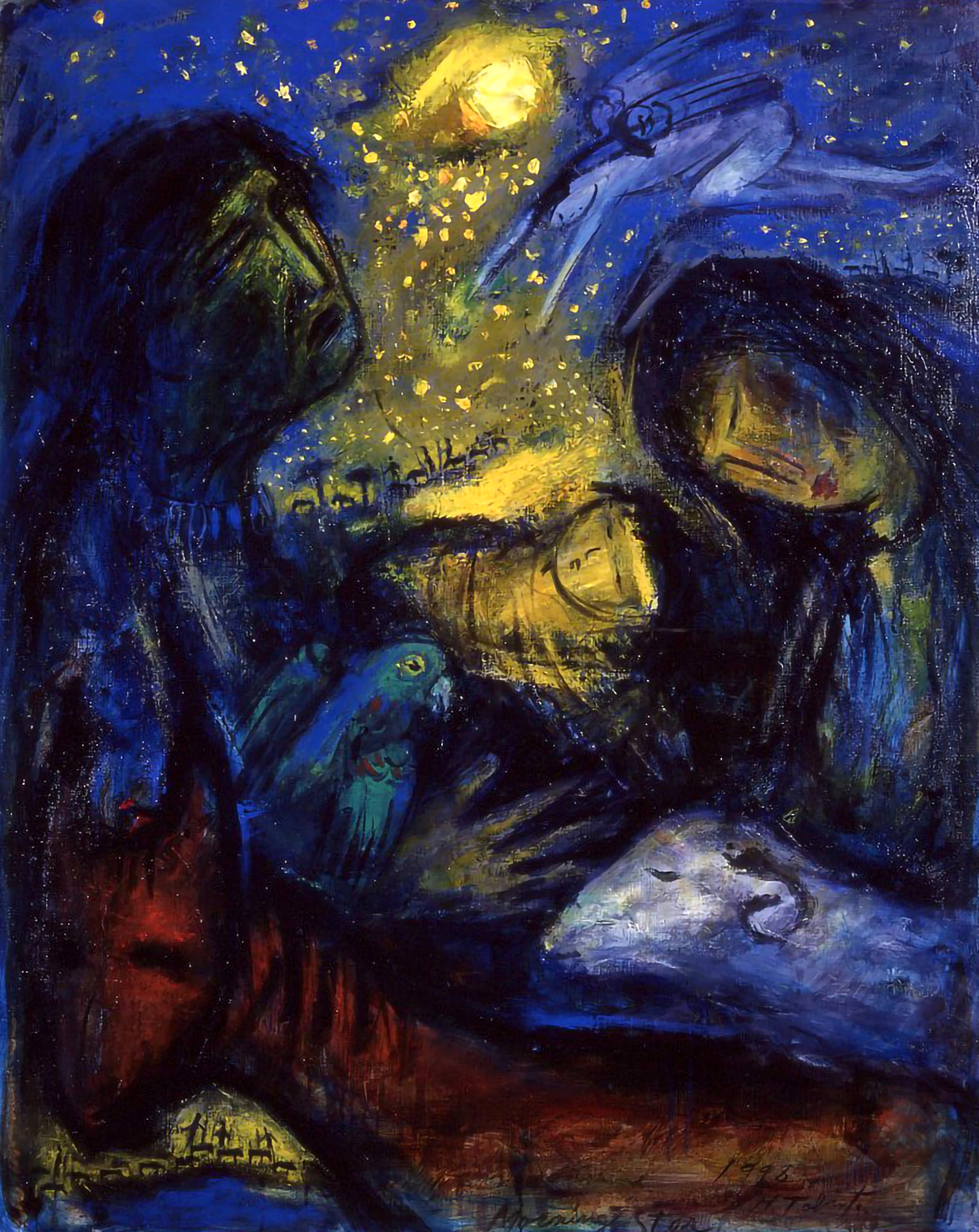
Hiroshi Tabata (田畑弘) (Japanese, 1929–2014), Morning Star, 1998. Oil on canvas, 90.9 × 72.7 cm. Private collection. Photo courtesy of the Estate of Hiroshi Tabata.
Born in Takaoka City, Hiroshi Tabata (1929–2014) studied art at the University of Toyama, later moving to France for two years for further art education. He exhibited his work throughout Japan and at Parisian salons. From 1966 to 1972 he lived intermittently in Brazil among the Xingu people, which led to his conversion to Christianity. From then on until his death, he painted biblical subjects. “The Bible is the ultimate theme for me,” he said; its world is “infinitely deeper” than we can comprehend.
In Tabata’s expressionistic Morning Star, starlight falls in a luminescent sheen over the face of the Christ child, whom Mary looks upon in tender adoration as Joseph wonders at the angelic activity above. The tight cropping around the Holy Family heightens the sense of intimacy. A sheep, donkey, and Amazon parrot (the latter a callback to his time in Brazil) crowd into the foreground, while on distant hills shepherds behold the glorious light display, hear the announcement that will propel them to their newborn Messiah. The wise men, too, are on their way. Epiphany is at hand. Heaven’s raining down (Isa. 45:8).
This visual reflection (by me) originally appeared in the Christmas/Epiphany 2022–23 edition of the Daily Prayer Project. Tabata’s art appears on the cover, by kind permission of his son-in-law. To view more biblical art by Tabata, see the beautifully produced, full-color book 田畑弘作品集 一つの星 (Hiroshi Tabata Works: Morning Star); the text is all Japanese.
LISTEN: “A Star Stood Still (Song of the Nativity)” | Words and music by Barbara Ruth Broderick and Johnny Broderick, 1956 | Performed by Mahalia Jackson with the Falls-Jones Ensemble, conducted by Johnny Williams, on Silent Night: Songs for Christmas, 1962
And we shall share In the glorious light
In Bethlehem The wind had ceased The Lamb lay sleeping On the hill
When all the earth Was stilled with peace Then lo, a star stood still
A star stood still On yonder hill Praise God that star still Shining still
And we shall share In the glory of love Because a star stood still That night a star stood still
A star stood still On yonder hill Praise God that star still Shining still
And we shall share In the glory of love Because a star stood still That night a star stood still
Note to readers: Art & Theology is noncommercial, but I do accept donations (monetary, or in-kind books!) to help keep it running.Learn more here.
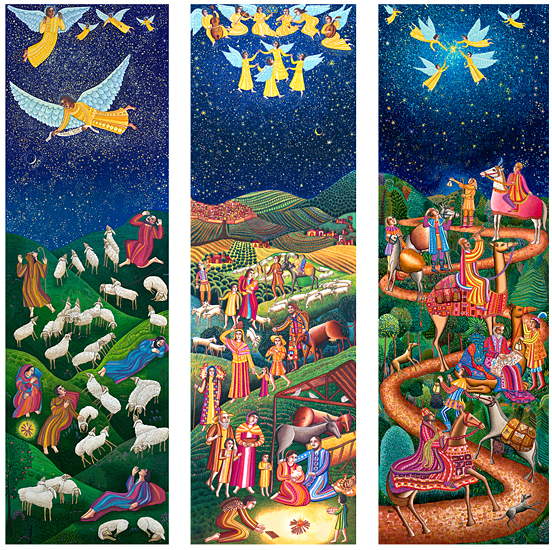
John August Swanson (American, 1938–2021), Epiphany, 1988. Serigraph, 38 × 12 in. Edition of 210. [for sale]
Tomorrow, January 6, is the feast of Epiphany, commemorating the visit of the magi to the infant Christ, an episode that represents God’s manifestation to the nations beyond Israel. Printmaker John August Swanson visualizes their journey in a starkly vertical composition that was conceived as the right wing of a triptych (three-paneled artwork), the other two panels depicting the Annunciation to the Shepherds and the Nativity. In subsequent years he addedA Visit (depicting the Annunciation to Mary), Flight into Egypt, and Presentation in the Temple to the set.
Epiphany depicts the journey of the three Magi as they travel up a serpentine trail. One of the Wise Men is seated as he looks at a map of the constellations with his magnifying glass; his servant holds a lamp so that he can see. Another Magi searches with his telescope into the sky. They look up in search of their beautiful guiding star as angels surround and point to it. They have exotic birds, peacocks, and dogs among their animals. I have tried to capture the details of the many plants, bushes, and trees and to create a variety of colors of green.
I used many symbols within the tapestries draping the animals. These patterns depict the Lion of Judah, the lamp in the darkness, the rain falling on the parched ground, the key to the locked door, the crown and the heart, and the gates to the city.
This is part of a series of three images (triptych). They were inspired by the Mexican tradition that I am familiar with for Christmas. Families will each create a beautiful crèche (nacimiento) with many figures and animals, creating a whole environment with landscaping in miniature around the Nativity figurines.
His other inspirations for this set include the opera Amahl and the Night Visitors by Gian Carlo Menotti and the medieval stained glass windows in Chartres Cathedral.
John August Swanson, Advent Triptych, 1985–88 [for sale as poster or card]
John August Swanson (1938–2021) [previously] was born in Los Angeles of a Mexican mother and Swedish father. His father died when he was young, and he was raised in a multigenerational Mexican Catholic home. He studied serigraphy under Corita Kent [previously], and it became his primary medium. A serigraph is a type of print in which each color is individually layered by applying ink through a silkscreen onto paper. Epiphany has forty-eight individual colors.
LISTEN:“Bright and Glorious” | Original Danish text (“Deilig Er Den Himmel Blaa”) by Nikolai F. S. Grundtvig, 1810 | English translation by Jens Christian Aaberg, 1927; first stanza adapted by the editors of the Lutheran Service Book and Hymnal, 1958 | Music by Seth Thomas Crissman and Greg J. Yoder, 2017 | Performed by the Walking Roots Band on Hark! A Walking Roots Band Christmas, 2017
Bright and glorious is the sky Radiant are the heavens high Where the golden star is shining All its rays to earth inclining Leading to the newborn king Leading to the newborn king
Him they found in Bethlehem Yet he wore no diadem They but saw a maiden lowly With an infant pure and holy Resting in her loving arms Resting in her loving arms
Guided by the star, they found Him whose praise the ages sound We, too, have a star to guide us That forever will provide us With the light to find our Lord With the light to find our Lord
As a star, God’s holy word Leads us to our King and Lord Brightly from its sacred pages Shall this light throughout the ages Shine upon our path of life Shine upon our path of life
The Walking Roots Band (TWRB) is an acoustic folk/bluegrass-ish music group steeped in Anabaptist hymn-singing traditions and based in Harrisonburg, Virginia. Several of its members are the creative forces behind The Soil and The Seed Project, a liturgy and arts initiative that launched in 2021.
Here they’ve retuned an Epiphany hymn from Denmark, which compares the star that led the magi to Jesus to the Bible, God’s word, which serves as a guiding light for spiritual seekers, leading us to Christ himself. Its pages offer countless epiphanies—revelations of God’s glory, opportunities for divine encounter. Its wisdom and truth can illuminate our paths if we let it.
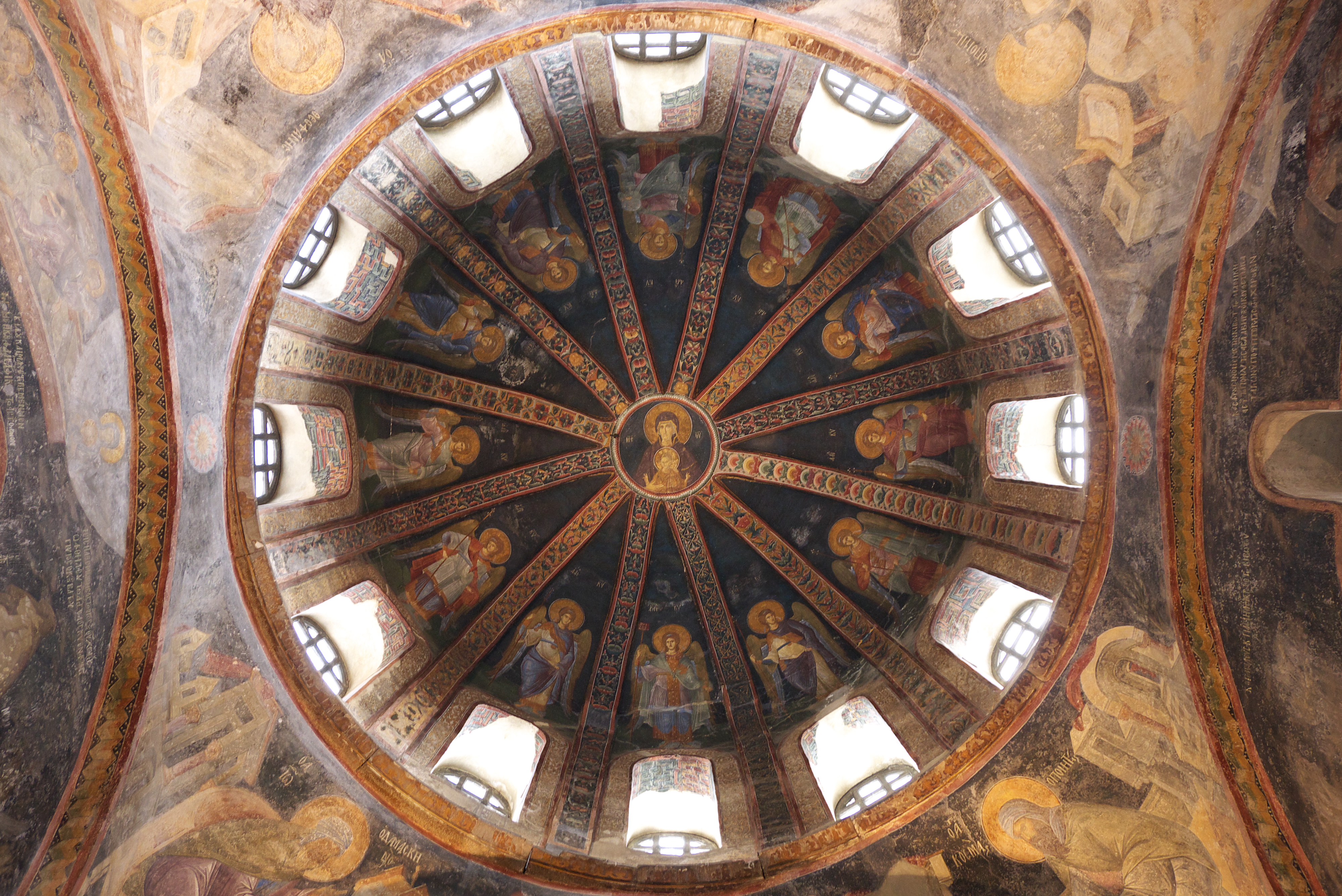
The Virgin and Child surrounded by angels, 14th century, frescoed dome of the parecclesion (side chapel) of the Church of the Holy Saviour in Chora, Istanbul.Chora dome, detail
LISTEN: “Hodie,” early monastic chant from the Celtic Church in Ireland | Performed by Mary McLaughlin on Sacred Days, Mythic Ways: Ancient Irish Sacred Songs from Mythology to Monasteries (2012)
Refrain: Hodie Christus natus est hodie Salvator apparuit: hodie in terra canunt angeli, laetantur archangeli: hodie exsultant justi, dicentes: Gloria in excelsis Deo. Alleluia!
Benedictus qui venit in nomine Domini. Deus dominus, et illuxit nobis. [Refrain]
Gloria Patri, et Filio, et Spiritui Sancto: sicut erat in principio, et nunc, et semper, et in sæcula sæculorum. Amen. [Refrain]
English translation:
Today Christ is born; today the Savior has appeared; today the angels sing, the archangels rejoice; today the righteous rejoice, saying: Glory to God in the highest. Alleluia!
Blessed is he who comes in the name of the Lord! The Lord is God, and he has made his light to shine upon us.
Glory be to the Father, and to the Son, and to the Holy Spirit, as it was in the beginning, is now, and ever shall be, world without end. Amen.
The texts that make up this Christmas chant are from the Latin Mass. The verses are the parts known as the Benedictus (Psalm 118[117]:26a, 27a) and the Gloria, which are sung at every Mass, and the refrain is the antiphon to the Magnificat that is sung at Vespers on Christmas Day.
The plainchant melody is from early medieval Ireland.







.png)




 Art & Theology