
What is happening? Today there is a great silence over the earth, a great silence, and stillness, a great silence because the King sleeps . . .
—Epiphanius of Cyprus, “The Lord’s Descent into Hell”
Ours is the long day’s journey of the Saturday. Between suffering, aloneness, unutterable waste on the one hand and the dream of liberation, of rebirth on the other.
—George Steiner, Real Presences
LOOK: Kesunyian by F. Sigit Santoso
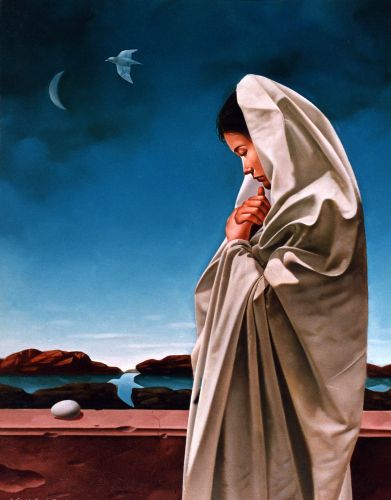
In this contemplative painting by the Javanese artist F. Sigit Santoso, a cloaked woman stands in profile near a stone ledge, holding her hands over her chest (a gesture of self-comfort? of nervous anticipation?) and staring down at an egg. Eggs typically represent resurrection and new life, since latent underneath that shell, if the egg is fertile, is a chick or other creature waiting to be born. It seems this woman is waiting for the egg to hatch. Maybe she doubts it ever will.
In the background, a body of water cuts through a rocky landscape. The moon is visible in the darkness, but so is a rising dawn on the horizon. A bird wings its way through the sky, a symbol of transformation and freedom. Cast like a bright shadow, its shape is repeated in silhouette near the egg; it reminds me of the bird paintings of the Belgian surrealist René Magritte.
LISTEN: “Silentium” by Arvo Pärt, 1977 | Performed by A Far Cry, feat. Alexi Kenney and Stefan Jackiw, 2025
The Estonian composer Arvo Pärt [previously], a devout Eastern Orthodox Christian, is one of the three greatest exponents of the contemporary Western classical movement known as “holy minimalism” (the other two are John Tavener and Henryk Górecki), characterized by an unadorned aesthetic and religious or mystical leitmotifs. Pärt uses the term tintinnabuli (from the Latin tintinnabulum, “little monastic bell”) to describe his meditative, two-voice compositional style.
Written in D minor, “Silentium” (Silence) is the second movement of Pärt’s Tabula Rasa, a double concerto for two solo violins, prepared piano, and chamber orchestra. Whereas the first movement, “Ludus” (Play), is full of energy and momentum, “Silentium,” writes Paula Marvelly, “is intentionally slower-paced with the delicate melody evolving gradually, carrying us through towards the dénouement. And yet as it approaches its tonic end, it progressively becomes more prolonged and gentle, until the final note is left unplayed.” The piece “resolves” on four written bars of silence.
In their recording of “Silentium” released last year (featured above), the Boston-based chamber orchestra A Far Cry plays the piece at nearly half the speed of the best-known version, released by ECM Records in 1984. The group notes that the piece is known for its healing properties for the dying and is often used in palliative care facilities, with one patient famously calling it “angel music.” In the Plough article “Harmonizing Silence,” composer Joel Clarkson writes of how Pärt’s music “speaks in an especially potent way to those who have been thrust into the dreaded silence of human suffering. In response to such silences – spaces that can feel so vacant of hope and meaning – Pärt’s hushed music doesn’t seek to fill the void or distract from it, but rather to gently hallow it, transfiguring a location of pain into a space of encounter with the love of the God who, as Psalm 34:18 says, is ‘close to the brokenhearted.’”
 Art & Theology
From the 1979 Book of Common Prayer:
O God, Creator of heaven and earth:
Grant that, as the crucified body of your dear Son was laid in the tomb
and rested on this holy Sabbath,
so we may await with him the coming of the third day, a
nd rise with him to newness of life;
who now lives and reigns with you and the Holy Spirit,
one God, for ever and ever. Amen.
LikeLike