
Holy Week: Silence

What is happening? Today there is a great silence over the earth, a great silence, and stillness, a great silence because the King sleeps . . .

—Epiphanius of Cyprus, “The Lord’s Descent into Hell”

Ours is the long day’s journey of the Saturday. Between suffering, aloneness, unutterable waste on the one hand and the dream of liberation, of rebirth on the other.

—George Steiner, Real Presences

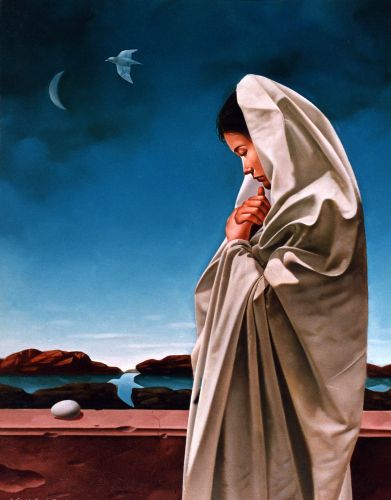
LOOK: Kesunyian by F. Sigit Santoso
Santoso, F. Sigit_Silence
F. Sigit Santoso (Indonesian, 1964–), Kesunyian (Silence), 1998. Oil on canvas, 50 × 40 cm.

In this contemplative painting by the Javanese artist F. Sigit Santoso, a cloaked woman stands in profile near a stone ledge, holding her hands over her chest (a gesture of self-comfort? of nervous anticipation?) and staring down at an egg. Eggs typically represent resurrection and new life, since latent underneath that shell, if the egg is fertile, is a chick or other creature waiting to be born. It seems this woman is waiting for the egg to hatch. Maybe she doubts it ever will.

In the background, a body of water cuts through a rocky landscape. The moon is visible in the darkness, but so is a rising dawn on the horizon. A bird wings its way through the sky, a symbol of transformation and freedom. Cast like a bright shadow, its shape is repeated in silhouette near the egg; it reminds me of the bird paintings of the Belgian surrealist René Magritte.

LISTEN: “Silentium” by Arvo Pärt, 1977 | Performed by A Far Cry, feat. Alexi Kenney and Stefan Jackiw, 2025

The Estonian composer Arvo Pärt [previously], a devout Eastern Orthodox Christian, is one of the three greatest exponents of the contemporary Western classical movement known as “holy minimalism” (the other two are John Tavener and Henryk Górecki), characterized by an unadorned aesthetic and religious or mystical leitmotifs. Pärt uses the term tintinnabuli (from the Latin tintinnabulum, “little monastic bell”) to describe his meditative, two-voice compositional style. 

Written in D minor, “Silentium” (Silence) is the second movement of Pärt’s Tabula Rasa, a double concerto for two solo violins, prepared piano, and chamber orchestra. Whereas the first movement, “Ludus” (Play), is full of energy and momentum, “Silentium,” writes Paula Marvelly, “is intentionally slower-paced with the delicate melody evolving gradually, carrying us through towards the dénouement. And yet as it approaches its tonic end, it progressively becomes more prolonged and gentle, until the final note is left unplayed.” The piece “resolves” on four written bars of silence.

In their recording of “Silentium” released last year (featured above), the Boston-based chamber orchestra A Far Cry plays the piece at nearly half the speed of the best-known version, released by ECM Records in 1984. The group notes that the piece is known for its healing properties for the dying and is often used in palliative care facilities, with one patient famously calling it “angel music.” In the Plough article “Harmonizing Silence,” composer Joel Clarkson writes of how Pärt’s music “speaks in an especially potent way to those who have been thrust into the dreaded silence of human suffering. In response to such silences – spaces that can feel so vacant of hope and meaning – Pärt’s hushed music doesn’t seek to fill the void or distract from it, but rather to gently hallow it, transfiguring a location of pain into a space of encounter with the love of the God who, as Psalm 34:18 says, is ‘close to the brokenhearted.’” 
Rejoice, O Virgin (Artful Devotion)

Blonsky, Alexander_Annunciation
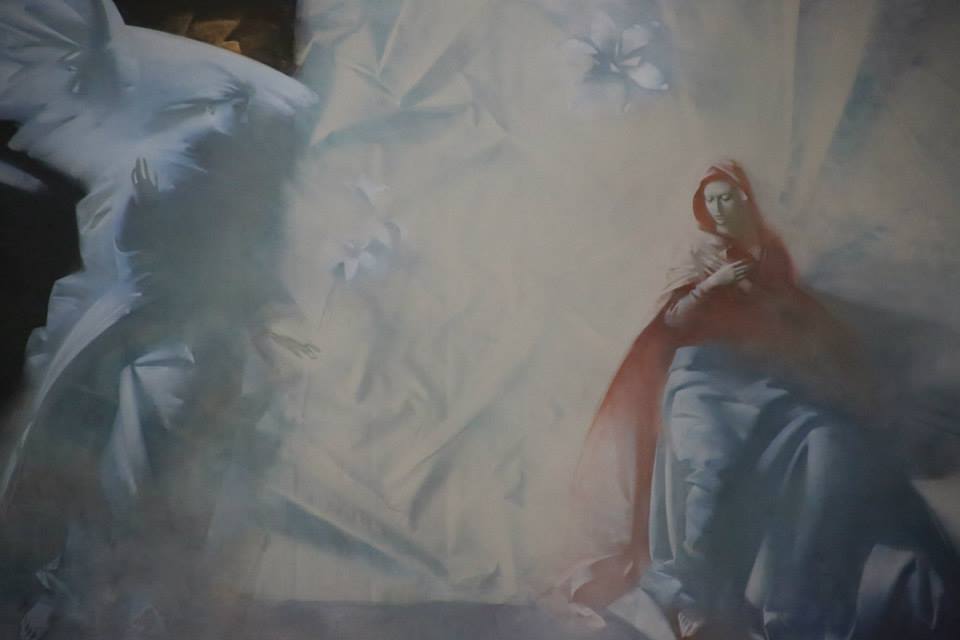
Alexander Blonsky (Ukrainian), The Annunciation, 2014. Oil on canvas, 82 7/10 × 129 9/10 in.

March 25, nine months before Christmas, is when the church celebrates the conception of Christ in the womb of Mary. The narrative of this event is known as the “Annunciation” because Gabriel comes from heaven to announce the good news to Mary that she has been chosen to give birth to and to mother the Son of the Most High God.

Because Luke 1:26–38 is such a familiar Bible passage, it helps to read it in less familiar translations so that it can land fresh in our ears. So here is Eugene Peterson’s translation from The Message:

In the sixth month of Elizabeth’s pregnancy, God sent the angel Gabriel to the Galilean village of Nazareth to a virgin engaged to be married to a man descended from David. His name was Joseph, and the virgin’s name, Mary. Upon entering, Gabriel greeted her:

Good morning!
You’re beautiful with God’s beauty,
Beautiful inside and out!
God be with you.

She was thoroughly shaken, wondering what was behind a greeting like that. But the angel assured her, “Mary, you have nothing to fear. God has a surprise for you: You will become pregnant and give birth to a son and call his name Jesus.

He will be great,
be called ‘Son of the Highest.’
The Lord God will give him
the throne of his father David;
He will rule Jacob’s house forever—
no end, ever, to his kingdom.”

Mary said to the angel, “But how? I’ve never slept with a man.”

The angel answered,

The Holy Spirit will come upon you,
the power of the Highest hover over you;
Therefore, the child you bring to birth
will be called Holy, Son of God.

“And did you know that your cousin Elizabeth conceived a son, old as she is? Everyone called her barren, and here she is six months pregnant! Nothing, you see, is impossible with God.”

And Mary said,

Yes, I see it all now:
I’m the Lord’s maid, ready to serve.
Let it be with me
just as you say.

Then the angel left her.

—Luke 1:26–38

(Read the English Standard Version)

+++

SONG: “Bogoroditse Dyevo” (Rejoice, O Virgin) | Words: Traditional | Music by Arvo Pärt, 1990 | Performed by The Singers (Minnesota Choral Artists), under the direction of Matthew Culloton, on Shout the Glad Tidings (2005)

This traditional Eastern Orthodox acclamation in Church Slavonic, based on Gabriel’s and Elizabeth’s words to Mary in Luke 1 (and better known by the closely related Latin Ave Maria from the West), has been set by various composers over the centuries, most famously by Sergei Rachmaninoff. His solemn interpretation is beautiful, but I’m partial to the celebratory setting by contemporary Estonian composer Arvo Pärt, commissioned by the King’s College Choir, Cambridge, for the festival of Nine Lessons and Carols on Christmas Eve 1990. It is for SATB a cappella choir.

(Related posts: “Book Review: The Annunciation: A Pilgrim’s Quest by Mark Byford”; “Three poems on Jan van Eyck’s Annunciation)

Богородице Дево, радуйся,
благодатная Марие, Господь с тобою.
Благословена ты в женах,
и благословен плод чрева твоего,
яко Спаса родила еси душ наших.

Transliteration:
Bogoróditse Dyévo, ráduisya,
Blagodátnaya Maríye, Gospód s tobóyu.
Blagoslovyéna ty v zhenákh,
i blagoslovyén plod chryéva tvoyevó,
yáko Spása rodilá yesí dush náshikh.

English translation:
Rejoice, O Virgin Theotokos,
Mary full of grace, the Lord is with thee.
Blessed art thou among women,
and blessed is the fruit of thy womb,
for thou hast borne the Savior of our souls.

All but a small number of Pärt’s ninety-odd compositions since 1976 are settings of biblical texts or Christian prayers. For an excellent article on him, see “How Arvo Pärt speaks prayer into a secular world” by Peter C. Bouteneff, published in the Christian Century. “Why are people listening so avidly?” Bouteneff wonders. “The same audience that would instinctively tune out anything with a whiff of Christian sensibility, that would normally be repulsed by pious petitions to Jesus or Mary for the forgiveness of their wretched sins, is held rapt by these very prayers when Pärt speaks them through his compositions.” Beauty has a way of penetrating people’s defenses, it seems. And that’s one reason we so desperately need artists.


This post belongs to the weekly series Artful Devotion. If you can’t view the music player in your email or RSS reader, try opening the post in your browser.

To view all the Revised Common Lectionary scripture readings for the feast of the Annunciation, cycle A, click here.