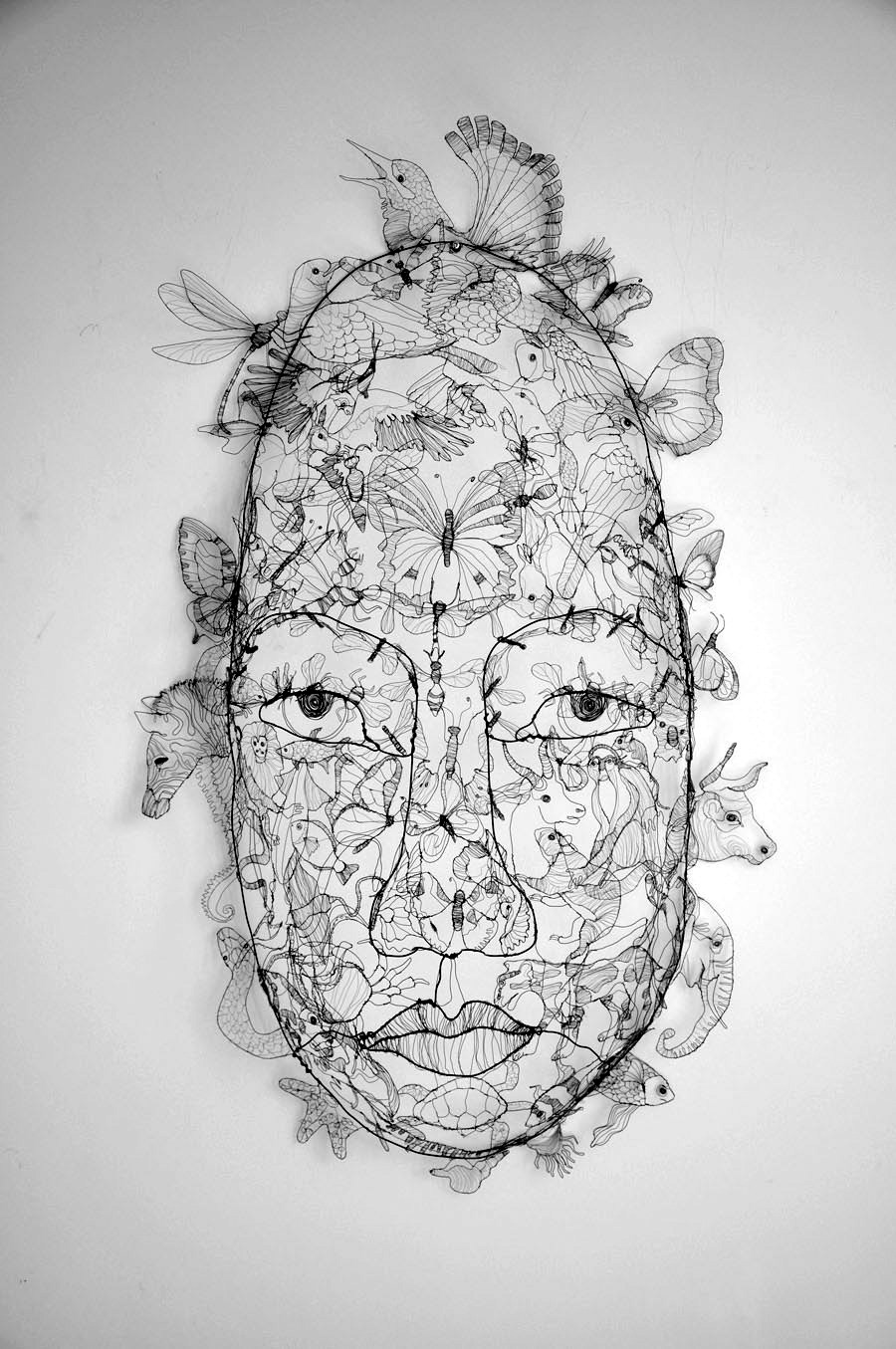
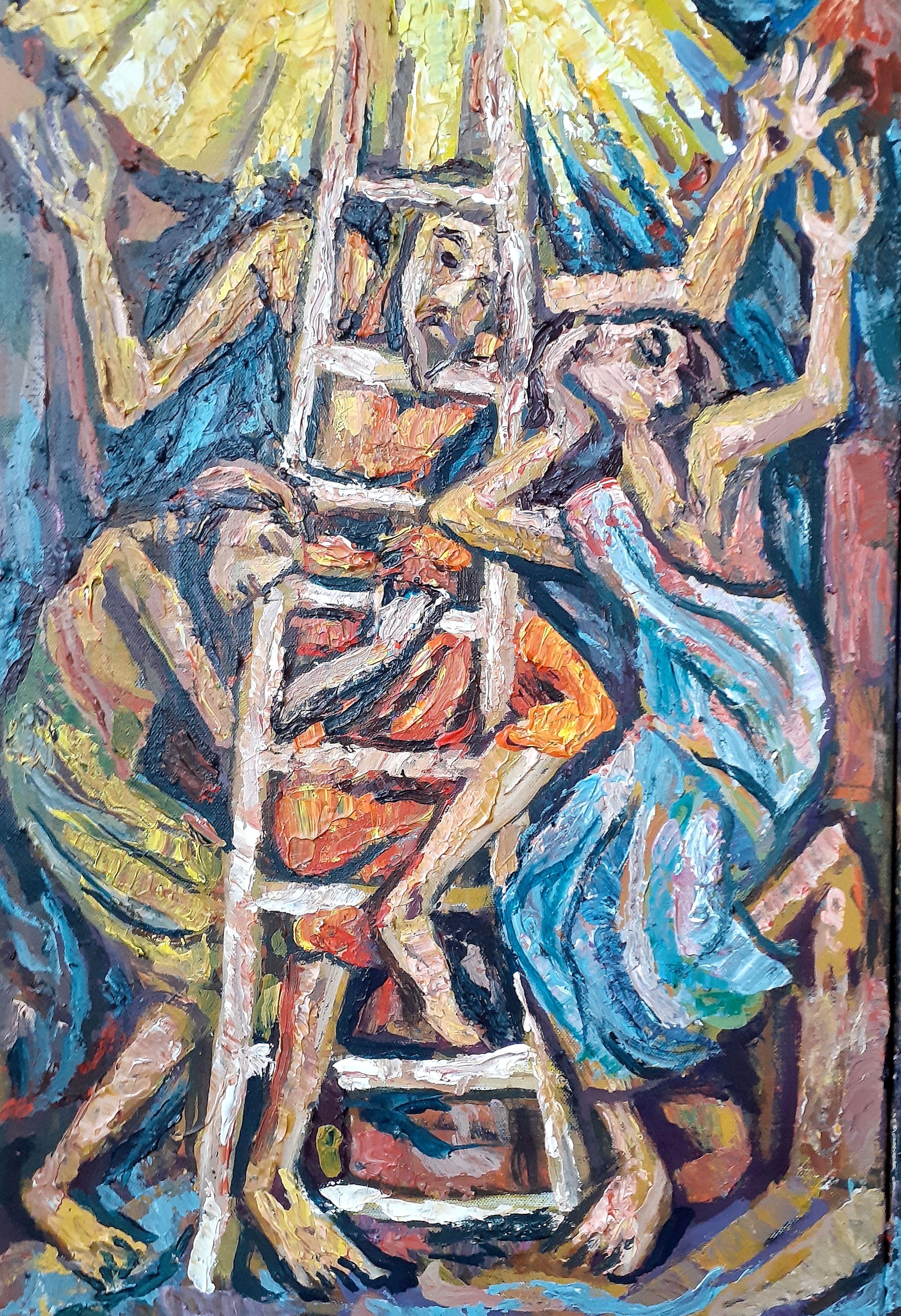
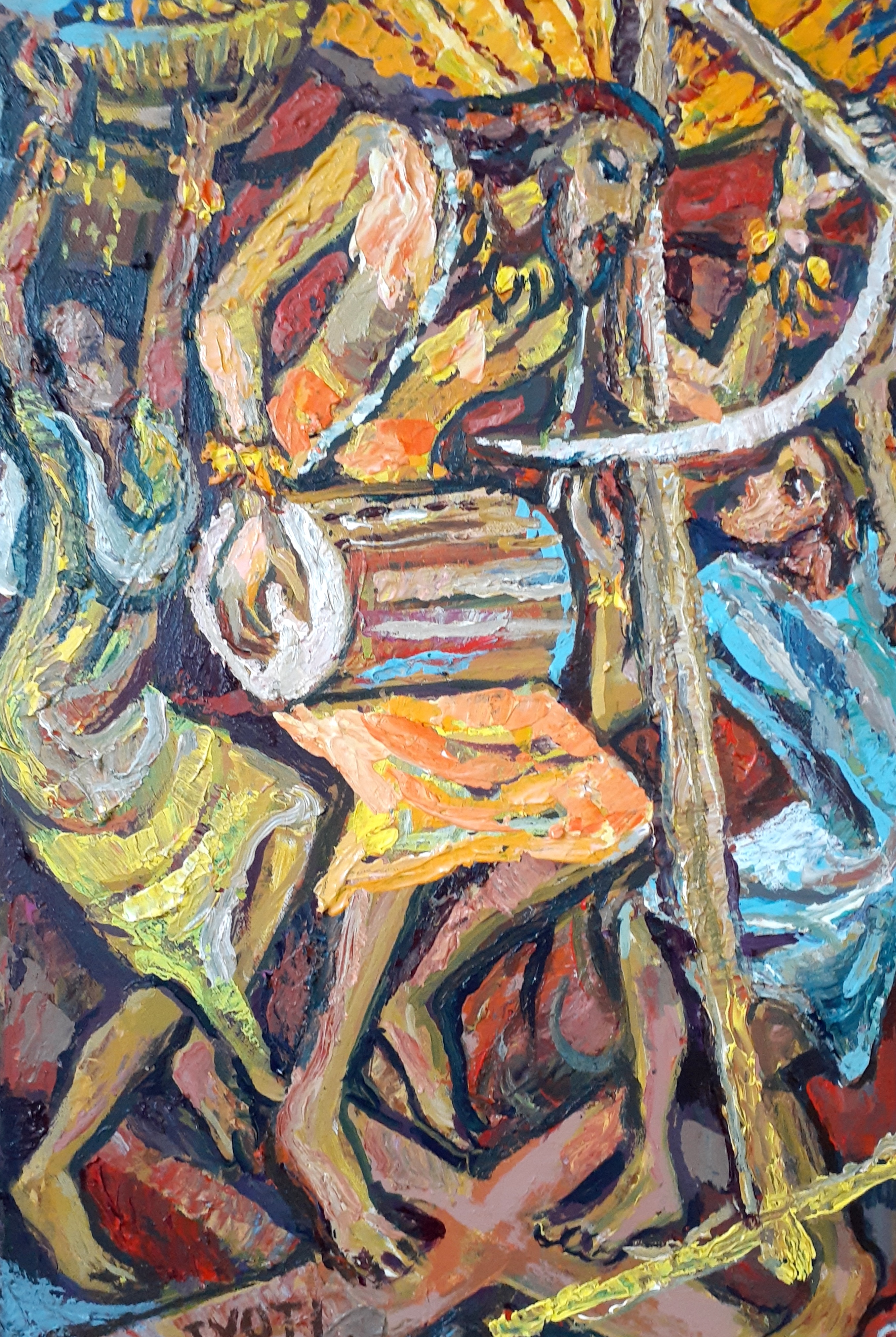
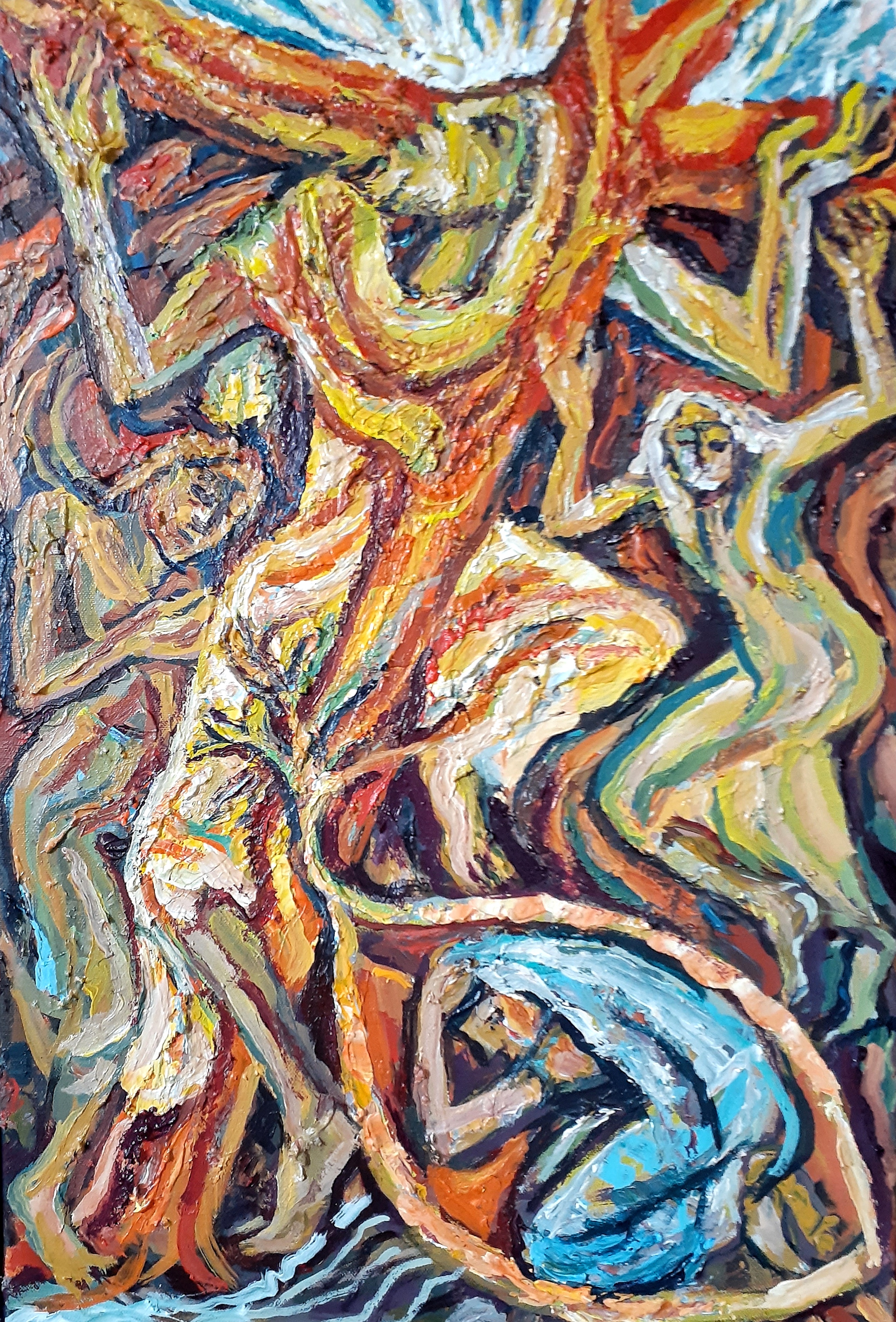
Fiona Morley (British, 1974–), You Are Everything, 2017–18. Stainless steel binding wire, 114 × 67 × 30 cm. Winner of the 2021 Chaiya Art Award on the theme of “God Is . . .”
If it is beauty you want, I [God] am beauty. If you want goodness, I am goodness, for I am supremely good. I am wisdom. I am kind; I am compassionate; I am the just and merciful God. I am generous, not miserly. I give to those who ask of me, open to those who knock in truth, and answer those who call out to me. I am not ungrateful but grateful and mindful to reward those who will toil for me, for the glory and praise of my name. I am joyful, and I keep the soul who clothes herself in my will in supreme joy. I am that supreme providence who never betrays my servants’ hope in me in soul or body.
How can people see me feeding and nurturing the worm within the dry wood, pasturing the brute beasts, nourishing the fish in the sea, all the animals on the earth and the birds in the air, commanding the sun to shine on the plants and the dew to fertilize the soil, and not believe that I nourish them as well, my creatures made in my image and likeness? As a matter of fact, all this is done by my goodness to serve them. No matter where they turn, spiritually and materially they will find nothing but my deep burning charity and the greatest, gentle, true, perfect providence.
—Catherine of Siena, The Dialogue, chap. 141, trans. Suzanne Noffke, in Catherine of Siena: The Dialogue (The Classics of Western Spirituality) (Mahwah, NJ: Paulist Press, 1980), p. 290
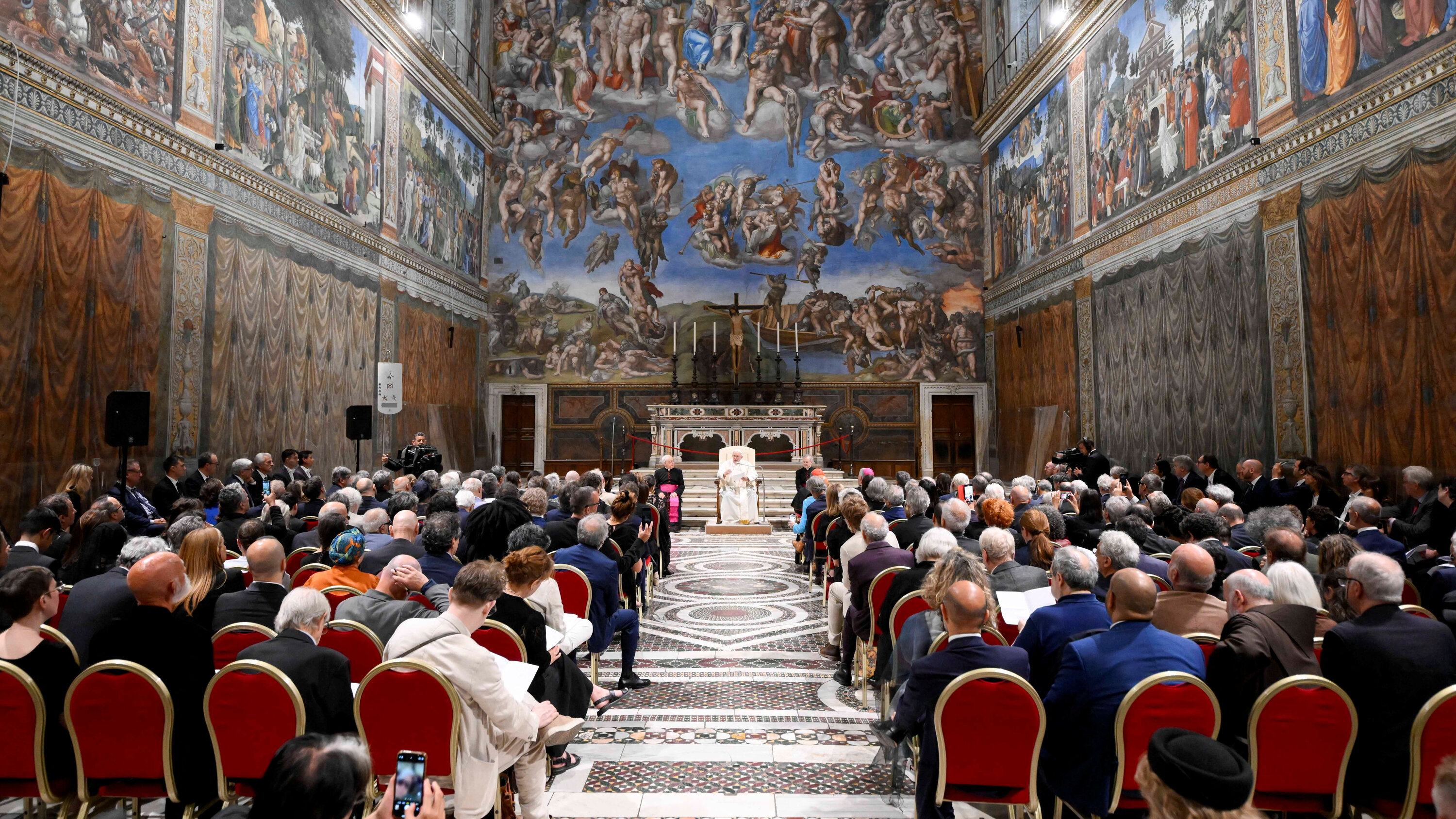
SPEECH: “Address of His Holiness Pope Francis to Artists for the 50th Anniversary of the Inauguration of the Vatican Museums’ Collection of Modern Art”: On June 23, at the invitation of Pope Francis, some two hundred select visual artists, filmmakers, composers, poets, and other creatives gathered at the Sistine Chapel to commemorate the fiftieth anniversary of the Vatican Museums’ Collection of Modern and Contemporary Art, inaugurated in 1973 by Pope John Paul VI. “One of the things that draws art closer to faith is the fact that both tend to be troubling,” Pope Francis said last Friday. “Neither art nor faith can leave things simply as they are: they change, transform, move and convert them.” He applauded how “artists take seriously the richness of human existence, of our lives and the life of the world, including its contradictions and its tragic aspects. . . . Artists remind us that the dimension in which we move, even unconsciously, is always that of the Spirit. Your art . . . propel[s] us forward.” For reporting on this event by the New York Times, see here.
Pope Francis addresses a group of artists, June 23, 2023. Photo: Vatican Media, via Reuters.
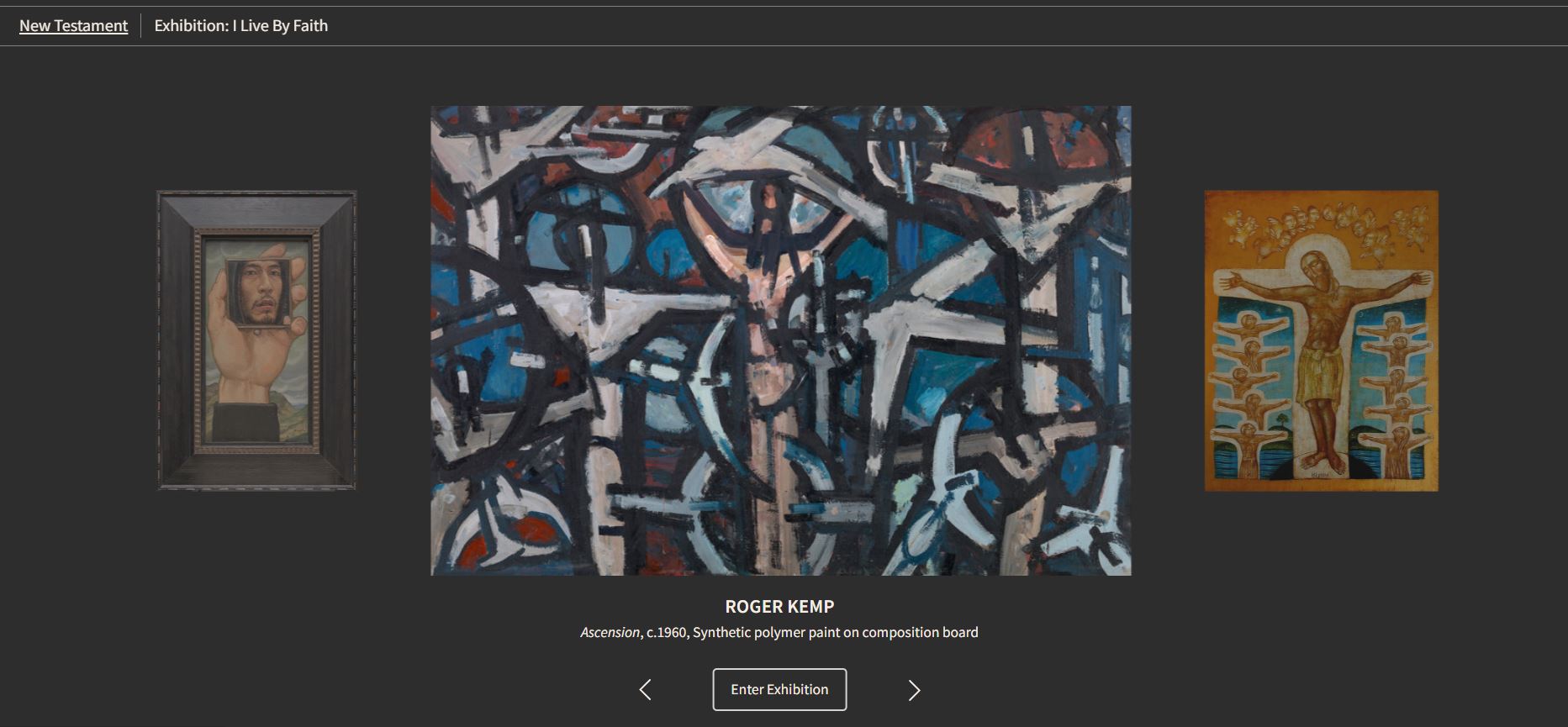
VISUAL COMMENTARY ON SCRIPTURE: “I Live by Faith (Galatians 2:15–21)” by Victoria Emily Jones: My latest set of commentaries for the VCS went live this month! It centers on one of Paul’s famous sayings: “I have been crucified with Christ, and it is no longer I who live, but it is Christ who lives in me.” I was bummed that one of the three commentaries I originally wrote had to be scrapped because the image permission was ultimately denied; I thus had to reconfigure and replace, and I ended up with two artworks in the three-piece exhibition that aren’t as diverse from each other as I had hoped. But still, each artwork brings a unique and compelling lens through which to examine this passage. (Note: If you’re viewing the exhibition on your phone, after you “Enter Exhibition,” you’ll need to expand the “Exhibition Menu” to access the “Show Commentary” button.)
VIDEO: “Abraham: An Interfaith Discussion at the Bode-Museum, Berlin”: Besides publishing written commentaries on works of art in dialogue with Bible passages, the Visual Commentary on Scripture also produces videos. This one brings together an Anglican Christian priest (who directs the VCS), a Jewish rabbi, and a Muslim theologian around a fifth-century ivory pyxis depicting Abraham, a figure held in common by all three faith traditions.
+++
POEM:“Gate A-4”by Naomi Shihab Nye: I’ve always loved this heartwarming poem about an unexpected moment of communion shared with strangers at an airport, made possible through kindness and the letting down of one’s guard. Listen to commentary by Joanne Diaz and Abram Van Engen on the Poetry for All podcast, episode 19; they answer the question “Why is this a poem?” Here’s a video of Nye reading it herself:
+++
NEW ALBUMS:
>> April 21: Worship for Workers by the Porter’s Gate: “In 2022 a group of songwriters, pastors, and professionals gathered in Nashville, Tennessee to write a series of worship songs for workers. Over three days they discussed the spiritual, emotional, and material struggles facing workers around the world today. Soon enough, they began to compose a series of songs specifically designed to help Christians carry their daily work before the Lord.” Here’s one of the thirteen songs on the album, “You Hold It All”:
The Worship for Workers album is part of a larger project, sponsored by the Brehm Center and a number of other institutions, to provide music, prayers, art, liturgies, and training to the church around the topic of work. It grew out of the book Work and Worship: Reconnecting Our Labor and Liturgy by Matthew Kaemingk and Cory Willson.
>> May 5: Glory Hour by Victory: Victory Boyd [previously] is a Grammy-winning soul and gospel artist who got her start singing with her siblings in the group Infinity Song but whose career really kicked into high gear when she worked as a songwriter for Kanye West’s Jesus Is King (2019). Glory Hour is her second full-length album as a solo artist; its title refers to the time of the morning when the sun rises. Most of the tracks are original songs or spoken word, but there are also three classic hymns/gospel songs: “His Eye Is on the Sparrow,” “Great Is Thy Faithfulness,” and “I Know It Was the Blood.” Here’s the music video for “Just like in Heaven,” based on the Lord’s Prayer:
>> May 19: Seven Psalms by Paul Simon: Paul Simon released this original seven-movement composition about doubt and belief as a single thirty-three-minute track, as it is meant to be listened to in one sitting. I’m a Simon fan; one of my early blog posts is a review of his and Garfunkel’s debut album, Wednesday Morning, 3 A.M. But if I’m honest, I was underwhelmed by this much-anticipated release. I’m in the minority there, so I think I’ll need to give it another listen. What do you think of it? Here’s the trailer:
>> June 2: Byrd: Mass for Five Voicesby the Gesualdo Six: One of my favorite vocal ensembles has just come out with an album of songs by William Byrd—his setting of the Mass along with a handful of motets. A Catholic composer in Protestant England in the late Renaissance, Byrd wove together musical “notes as a garland to adorn certain holy and delightful phrases of the Christian rite,” as he wrote in the preface to his second book of Gradualia (1607). Here’s the Gesualdo Six’s performance of his “Afflicti pro peccatis nostris,” a Latin prayer, a desperate plea for sanctification, that translates to “Afflicted by our sins, each day with tears we look forward to our end: the sorrow in our hearts rises to thee, O Lord, that you may deliver us from those evils that originate within us”:
“Lift up your hearts.” “We lift them up.” Ah me!
I cannot, Lord, lift up my heart to Thee:
Stoop, lift it up, that where Thou art I too may be.
“Give Me thy heart.” I would not say Thee nay,
But have no power to keep or give away
My heart: stoop, Lord, and take it to Thyself today.

Stoop, Lord, as once before, now once anew
Stoop, Lord, and hearken, hearken, Lord, and do,
And take my will, and take my heart, and take me too.
This poem was originally published in Time Flies: A Reading Diary (1885) and subsequently Verses (1893) and is in the public domain.
A devout Anglican from Victorian England and one of my favorite spiritual writers, Christina Rossetti (1830–1894) opens her poem “Sursum Corda” with a quotation from the ancient Eucharistic prayer compiled in the Book of Common Prayer: “Lift up your hearts . . .”
The Sursum corda, Latin for “Lift up your hearts,” is a Christian liturgical dialogue between priest/pastor and congregation that dates at least as far back as the third century (it’s mentioned in the Early Christian treatise Apostolic Tradition, as well as by Cyprian, Augustine, and Cyril of Jerusalem) and that is still used in Catholic, Orthodox, and Protestant churches today. Most, like my Presbyterian church, recite it as part of the celebration of the Eucharist, aka the Lord’s Supper, though some place it after the Call to Worship.
Here are the words used in the Roman Rite:
Priest: Dominus vobiscum.
People: Et cum spiritu tuo.
Priest: Sursum corda.
People: Habemus ad Dominum.
Priest: Gratias agamus Domino Deo nostro.
People: Dignum et iustum est.
Priest: The Lord be with you.
People: And with your spirit.
Priest: Lift up your hearts.
People: We lift them up to the Lord.
Priest: Let us give thanks to the Lord our God.
People: It is right and just.
Folio 1r from the Cambrai Missal, made in northern France, ca. 1120. Collection of Notre-Dame Cathedral, Cambrai, France. This page starts mid-liturgy with “Per omnia saecula saeculorum, amen” (Forever and ever, amen; or World without end, amen)—the inhabited initial P has a lion and a fantastical bird inside!—and then proceeds to the Sursum corda. The tildes indicate omitted letters.
The following is what my church uses—you’ll see it concludes with the Memorial Acclamation:
Pastor: The Lord be with you. People: And also with you. Pastor: Lift up your hearts! People: We lift them up to the Lord. Pastor: Let us lift up our hearts to the Lord our God. People: It is right to give him thanks and praise. Pastor: Therefore we proclaim the mystery of faith: All: Christ has died. Christ is risen. Christ will come again.
The phrase “Lift up your hearts” is taken from biblical passages such as Psalm 86:4—“Gladden the soul of your servant, for to you, O Lord, I lift up my soul”—and Lamentations 3:41, which says, in the context of confession and repentance, “Let us lift up our hearts as well as our hands to God in heaven.” The Sursum corda expresses an inclining of the whole self toward God in praise and offering.
Rossetti responds to this jubilant call with an admission of personal weakness. She lacks the power to lift up her heart, she says (perhaps because it’s so heavy); she needs God to lift it for her. She begs him four times to “stoop,” to condescend to her level, so that she might ascend to his throne. Line 4 contains a partial quotation of Proverbs 23:26: “My son, give me thine heart, and let thine eyes observe my ways.” She wants to give God her heart, but in her frail spiritual state, all she can do is bid him “take it.”
I often pray Rossetti’s poems, as I find her such a sensitive seeker, full of longing that so frequently reflects my own. You can find other Rossetti poems from the Art & Theology archives on my new Poetry Index tab. All her poems are accessible online, scattered across various volumes on Google Books, but if you want to read them all in one place and in physical book form, I recommend the Penguin Classics edition of her Complete Poems (which stands at a whopping 1221 pages!).
Today, June 4, is Trinity Sunday! Here’s a handful of art and music items on the topic.
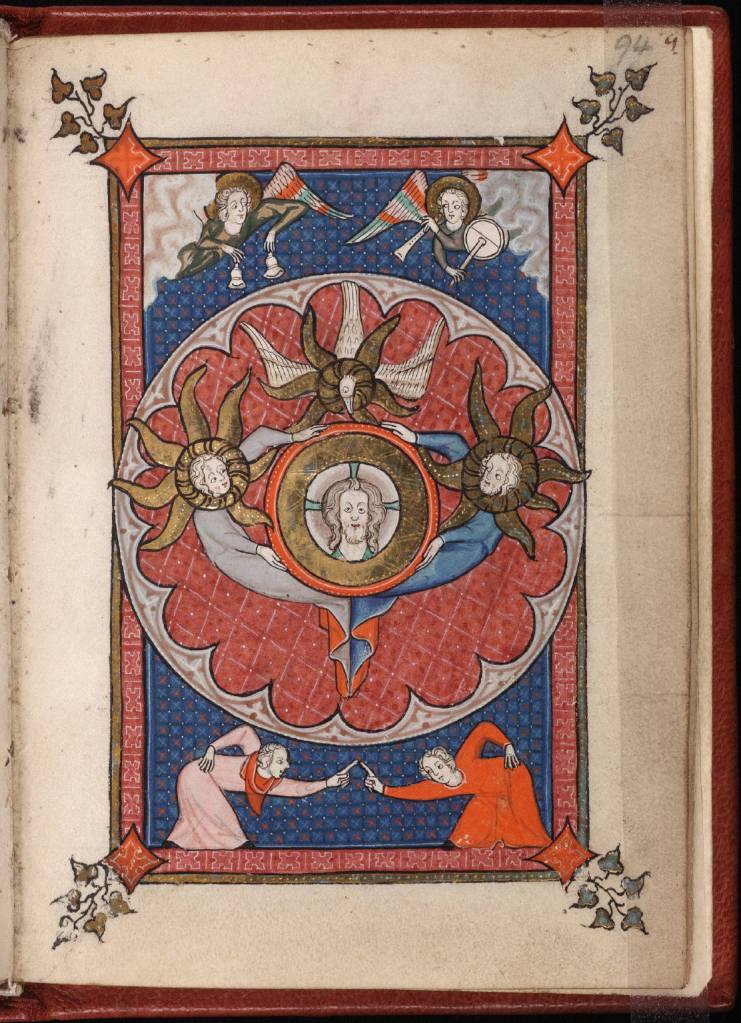
VISUAL MEDITATION: “The Wheeling Playfulness of the Trinity” by Victoria Emily Jones: The Rothschild Canticles [previously] from ca. 1300 Flanders contains some of the most inventive and delightful artistic renderings of the Trinity that I’ve ever seen. I key in on four of them in today’s visual meditation for ArtWay.
Beinecke MS 404, fol. 94r
+++
MUSICAL COMMENTARY: “Theology in Sound and Motion: Perichoresis, for Brass Quintet” by Delvyn Case:Delvyn Case provides musical and theological commentary on his brass quintet composition “Perichoresis” (2006), inspired by the divine dance of the Trinity. “Its overall mood is joyous, an ecstatic whirling-about in which all three members become lost in the ecstasy of divine fellowship,” he writes. “At the exact moment of the dance when one member moves, the other fills in the spot left vacant.” “Perichoresis” premiered by Boston’s Triton Brass and appears on Case’s 2018 album Strange Energy. About this piece, Bible scholar and theologian Walter Brueggemann said, “I . . . have pondered ‘perichoresis’ for a long time. This is the finest exposition of that thick idea that I have encountered.”
+++
SONGS:
>> “Trinity Song” by Paul Zach: Performed in 2021 by Solomon Dorsey with Liz Vice and Madison Cunningham, this song by Paul Zach evolved into “God of Grace and Mystery” for The Porter’s Gate’s 2022 album Climate Vigil Songs. This earlier iteration has a Trinitarian focus that’s just lovely. “God of all eternity / Father, Spirit, and the Son / Ever-loving Three-in-One / O divine community / . . . / Calling us to join your dance . . .”
>> “One-Two-Three” by the Chosen Gospel Singers: This song was recorded in Los Angeles for Specialty Records and released as a single in 1952, with singers J. B. Randall (bass), E. J. Brumfield (tenor), George Butler (tenor), Fred Sims (tenor), and Oscar Cook (baritone). It opens with a repetition of the lines “One, two, three / One-in-Three and the Trinity.” The refrain is:
One for the Father Two for the Son Three for the Holy Ghost All made of one
The song is largely eschatological. The first verse is about John the Revelator’s vision of the New Jerusalem descending, among other wonders; it ascribes a vision of the Trinity to John, even though that is not explicit as such in either John’s Gospel or the Apocalypse (but see “The Trinity in the Book of Revelation” by Edwin Reynolds). The second verse anticipates our singing and praising the Triune God in heaven, dressed in our brand-new robes. It also mentions David and Goliath, and I’m honestly not sure how that relates. But with gospel songs, floating lyrics are common, taken from one song and spliced into another, some more coherent than others in their new context.
+++
ESSAY: “The Hospitality of Abraham in the Work of Julia Stankova, Painter of Bulgarian Icons” by François Bœspflug: The first half of this peer-reviewed article introduces readers to the Bulgarian artist Julia Stankova, rehearsing her biography and examining her relationship to the icons tradition. The second half explores twelve of her paintings on the subject of the three angelic visitors to Abraham and Sarah in Genesis 18, whom the narrator suggests are a manifestation of God (“The LORD appeared to Abraham at the oaks of Mamre . . .”); because of the number of visitors, many Christians interpret this passage as revealing something of God’s triune nature, and for this reason traditional icons of the story are often titled The Trinity.
Julia Stankova (Bulgarian, 1954–), The Hospitality of Abraham, 2004. Tempera on primed wooden panel and lacquer technique, 46 × 41 cm.
Since the publication of this article in 2019, Stankova has made at least three more paintings on the subject, all of which foreground Sarah and are titled Sarah’s Smile. She has just heard the angels announce that she will conceive a son in her old age.
+++
POEM: “After Rublev’s Trinity”by Carrie Purcell Kahler: Published in Image no. 99 (Winter 2018), p. 21, this ekphrastic poem by Carrie Purcell Kahler interprets the famous fifteenth-century Trinity icon by Andrei Rublev. Sometimes referred to as “the hospitality of Abraham,” this biblical episode, as the iconographers interpret it, is really about the hospitality of God, who extends a hand to humanity, ever inviting us to sit at his table.
Andrei Rublev (Russian, 1360–ca. 1430), The Trinity, ca. 1411. Tempera on wood, 141.5 × 114 cm. Tretyakov Gallery, Moscow.
A new choral setting of this poem by Garrett John Law is premiering today at Holy Trinity Episcopal Church in Covina, California, where Law serves as music director and organist. I believe it can be heard on the 10:30 a.m. PT worship service livestream on the church’s YouTube channel, but I’m not sure whether the performance will be archived online for later viewing. (Update, 6/12/23: Here it is! Sung by Holy Trinity’s seven-person choir.)
AVANT-GARDE CLASSICAL: Klang—Die 24 Stunden des Tages (Sound—The 24 Hours of the Day) is a cycle of chamber-music compositions by the avant-garde German composer Karlheinz Stockhausen, which he worked on from 2004 until his death in 2007. (The intention was for there to be twenty-four pieces, but the cycle was unfinished at twenty-one.) The first two pieces in the cycle, on the themes of Ascension and Pentecost, were commissioned for the interdisciplinary Pause festival at Milan Cathedral by artache, a Milan-based nonprofit committed to showcasing contemporary artworks in public places of worship. The artistic director of artache at the time was Don Luigi Garbini, a priest at the church of San Marco in Milan and cofounding director of the artache initiative the Laboratorio di Musica Contemporanea al Servizio della Liturgia (Laboratory for Contemporary Music in the Service of the Liturgy).
>> No. 81: “KLANG, 1st Hour: Himmelfahrt (Ascension)” by Karlheinz Stockhausen, for organ or synthesizer, soprano, and tenor, 2004–5: This thirty-seven-minute piece premiered at Milan Cathedral on Ascension Day, May 5, 2005. The two hands of the organist almost always play in different, independent tempos of a chromatic time scale, while the soloists sing words or phrases associated with “ascension,” particularly the Ascension of Christ. According to the composer, “Asking a performer to break the barrier of time by playing simultaneously in different tempi is like submitting a man to physical disruption, allowing him to go in spirit form towards another world” (source). For musical analysis by Ed Chang, see here. The performance below is from the North American premiere at the Schwartz Center for the Performing Arts at Emory University in Atlanta on October 11, 2005, featuring organist Randall Harlow, soprano Teresa Hopkin, and tenor John Bigham.
>> No. 82: “KLANG, 2nd Hour: Freude (Joy)” by Karlheinz Stockhausen, for two harps and voice, 2005: This forty-minute piece premiered at Milan Cathedral on July 6, 2006. The text is taken from the medieval Pentecost hymn “Veni Creator Spiritus” [previously], which the harpists sing in spurts, “in alternation or sometimes together . . . , while plucking, picking, caressing, stroking, pinching, rubbing, striping, striking, pinking, jubilating,” as Stockhausen put it. In program notes dated February 15, 2006, he writes, “There is something unique about the adventure to combine two harps which are normally tuned in diatonic scales and to synthesise them into one large chromatic harp. . . . Pentecost unites what has been separated. My work FREUDE too.” For musical analysis by Ed Chang, see here. The performance below is from the Stockhausen Memorial Concert in Kürten, Germany, on December 16, 2017, featuring Marianne Smit and Miriam Overlach.
NEW DOCTORAL COHORT:The Sacred Art of Reading: The Eugene Peterson Center for Christian Imagination at Western Theological Seminary in Holland, Michigan, is offering a new, mostly remote, three-year DMin track called “The Sacred Art of Reading,” which begins this October, taught by Professor Chris E.W. Green. The program is centered on the reading of scripture—the Old Testament narrative books (Year 1), Old Testament poetry and wisdom literature (Year 2), and the Gospels and Apocalypse (Year 3)—alongside a number of additional primary texts, whose titles you can view on the website; authors include, among others, Avivah Gottlieb Zornberg, Amy-Jill Levine, Daniel Berrigan, Robert Alter, Shusaku Endo, and of course Eugene Peterson! Participants get together in person for one week each semester (times six semesters) and are responsible for, in addition to the $17,280 tuition, travel and lodging costs. The application deadline is June 30, 2023. Applicants must hold an MDiv degree or its educational equivalent and have at least three years of ministry experience since completing the MDiv. Here’s a condensed program description:
The Sacred Art of Reading cohort will be dedicated to collaboration in “the forbidding discipline of spiritual reading,” confident that such an undertaking cultivates the loving attentiveness, prophetic discernment, and childlike openness to surprise that characterize what St. Paul calls the faith that works by love. . . . The cohort is designed to cultivate an alternative awareness, one shaped by the slow, painstaking work of collaborative interpretation. And to that end, the heart of the program is the reading of the Christian Scriptures. The aim will be both philosophical and devotional, critical and celebratory, mystical and pastoral. No one reading method will be stipulated, but students will be encouraged to find ways to honor the traditions of the communities in which they learned to argue, to muse, and to pray.
Besides Scripture, the cohort will engage a wide range of texts including poems, memoirs, essays, treatises, sermons, and stories old and new, familiar and strange, sacred and “worldly,” in part and in whole, not so much in order to “plunder the Egyptians” as to bear glad witness to the wonder that God is never left without a witness because all truth, truly received, trues.
This approach really wets my whistle! I don’t have a master’s degree, so I’m out, but I feel so energized by the reading list and wanted to share the opportunity with you all, as the program seems doable for those with full-time jobs. A virtual interest meeting is being held on June 1. Click here to view other doctor of ministry cohorts at Western.
+++
FUNDRAISING CAMPAIGN: The Soil and The Seed Project: I’ve mentioned this project several times on the blog before, as I’m a big fan. A ministry of VMMissions (Virginia Mennonite Missions), The Soil and The Seed Project releases original music, art, and liturgies throughout the Christian year, especially suitable for families with littles. They launched in December 2021 and since then have put out seven collections, with their latest and largest yet—Vol. 7 // Ordinary Time—dropping this week. (Request a free download through their website, or stream the music through your favorite service.) Coinciding with this release, they have also launched a campaign to raise $27,000 by June 18 to cover the costs of recording, mixing, pressing, printing, shipping, etc., for future collections. Learn more in the five-minute video below, which features the new songs “In the Little Moments,” “Teach Me, O LORD,” and “Because of Jesus.”
The Soil and The Seed Project offers all their content for free, including physical CDs (as stock permits), and are committed to keeping it that way—which is why they need the support of donors. Donate to their campaign, and you can opt to receive stickers, notecards, and/or a T-shirt as a thank-you. Also note: they’ll be giving a concert at 6:30 p.m. on Saturday, June 3, at the Brethren & Mennonite Heritage Center in Harrisonburg, Virginia.
+++
SONG: “Holy Spirit” by Victoria Williams: “Part front-porch soothsayer, part quirky bayou princess, and part eternal child, Victoria Williams writes songs of indescribable originality that embrace the earthly and the divine with wit, charm, and understated vision,” writes Josh Kun for Bomb magazine. The song “Holy Spirit” [read lyrics] is from her 1990 album Swing the Statue!. It opens with the familiar invocation from a Gullah spiritual: “Kum ba yah, my Lord” (which translates to “Come by here”). She seeks God’s presence and then, given a renewed sensitivity to it, identifies and celebrates its flow throughout her daily goings. She feels the Holy Spirit while building a raft with friends on the shores of Louisiana’s Lake Bistineau and riding a New York City subway beside a whistling stranger, as well as in graveyards and at bars and out under open night skies. The Spirit flows through all of life. I can’t find the song online anywhere other than in this YouTube fan video, which sets it to photos. [HT: Jonathan Evens]
+++
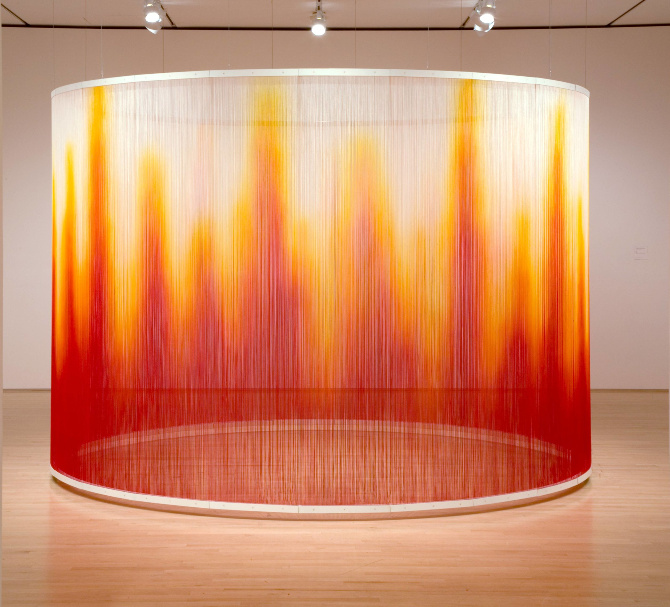
ARTWORK: Fire by Teresita Fernández: In the collection of SFMOMA, this ring of warm-colored silk yarn conveys something of the flickering quality of fire. At the link is a short video interview with the artist about the piece. Fernández says she is interested in the sensorial aspects of viewer engagement with art.
Teresita Fernández (American, 1968–), Fire, 2005. Silk yarn, steel armature, and epoxy, 243.8 × 365.8 cm. San Francisco Museum of Modern Art, California.
Fire was a highlight of the 2013 exhibition Beyond Belief: 100 Years of the Spiritual in Modern Art, jointly organized by SFMOMA and the Contemporary Jewish Museum. Here’s a video of the Lick Wilmerding High School Vocal Ensemble singing “Famine Song” by VIDA around the installation that year, a song inspired by the basket weavers of Sudan, who persist in their craft during times of hardship, their hands working natural fibers into beautiful, colorful vessels. “Weave, my mother; weave, my child; weave your baskets of rushes wild . . .”
SUMMER COURSES: Arts at Regent: Regent College in Vancouver is offering eight one- or two-week in-person courses on its arts track this summer, including “After Disenchantment” with Joy Marie Clarkson (reading list includes Charles Taylor, James K. A. Smith, Kazuo Ishiguro, etc.), “The Puritan Literary Imagination” (on Paradise Lost and Pilgrim’s Progress) with Johanna Harris, and “The Arts, Empathy, and Spiritual Formation” with Mary McCampbell. Several years ago I took a Regent summer course on worship and the arts and really enjoyed it!
+++
BIBLICAL COMMENTARY: “Ascension Sunday (Year A): Luke 24:44-53 and Acts 1:1-11” by SALT Project: This Sunday marks the risen Jesus’s departure after forty days of dwelling with the community of disciples. While SALT Project’s commentary doesn’t plumb all the meaning of the Ascension, I was struck by its pointing out of the significance of the Mount of Olives (in light of Zechariah’s prophecy and the “choreography” of Palm Sunday) and the resonances with Elijah’s ascent, particularly with Christ’s passing on his mantle to the church.
>> Music by Rowland Hugh Prichard, 1830: The hymn is often paired with the public-domain Welsh tune HYFRYDOL (which I know best from its association with “Jesus, What a Friend for Sinners”). It’s sung here by Ben Lashey and Chris Joyner:
>> Music by Rebecca Almazar and Brian Gurney, 2020: I really love this new tune that Almazar and Gurney wrote for the hymn while they were at New City Fellowship in Manassas, Virginia, which was released on the church’s EP A Liturgy. Gurney is now the director of contemporary worship at The Falls Church Anglican in Falls Church, Virginia. The song is not yet available on CCLI, but in the meantime, he has granted permission for license-free church use; here are the chords.
+++
CALL FOR ENTRIES: 2023 Sacred Art Competition and Exhibition: “Seeking the finest contemporary sacred art for an online juried exhibition hosted by the Catholic Art Institute, with a world-wide audience and the opportunity to sell work, be featured on the Catholic Art Institute website.” The top prize is $2,500. The deadline for submission is November 6, 2023. From what I can tell, participants need not be Catholic, but the artwork(s) should be suitable for devotional and/or liturgical use by Catholics.
In the fourteenth century, Hamman says, fathers generally loved their children but were less involved in the day-to-day tasks of caring for their physical and emotional needs, whereas mothers were deeply present. Julian wrote about how Christ gave birth to his children on the bed of the cross, how he nurses them from his side, and how he acutely hears and responds to their individual cries. This podcast episode is an excellent summation of a theological idea that may sound odd and unorthodox at first but that is in fact biblically derived, appearing throughout church history, and that grants us fuller insight into who Christ is.
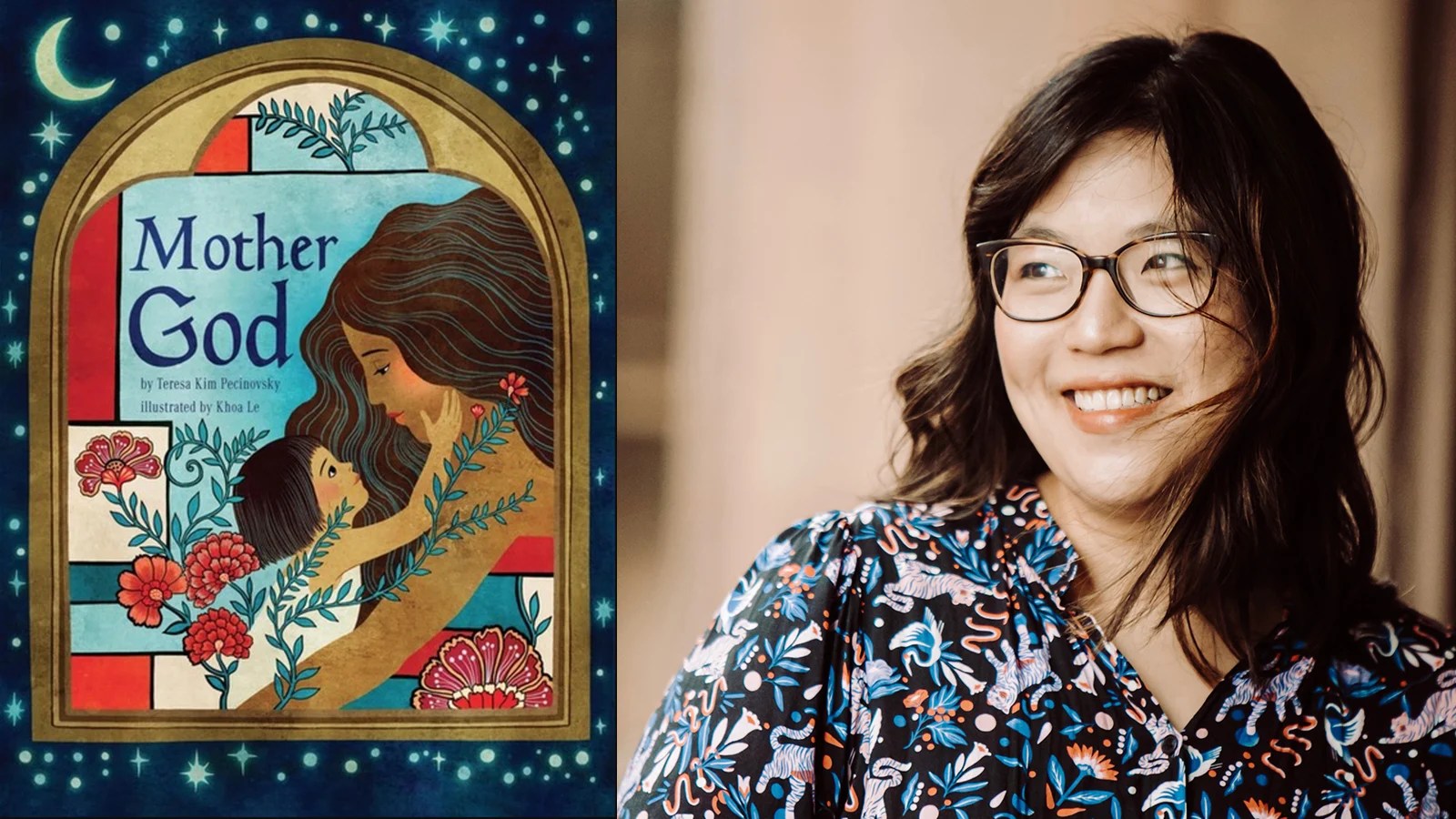
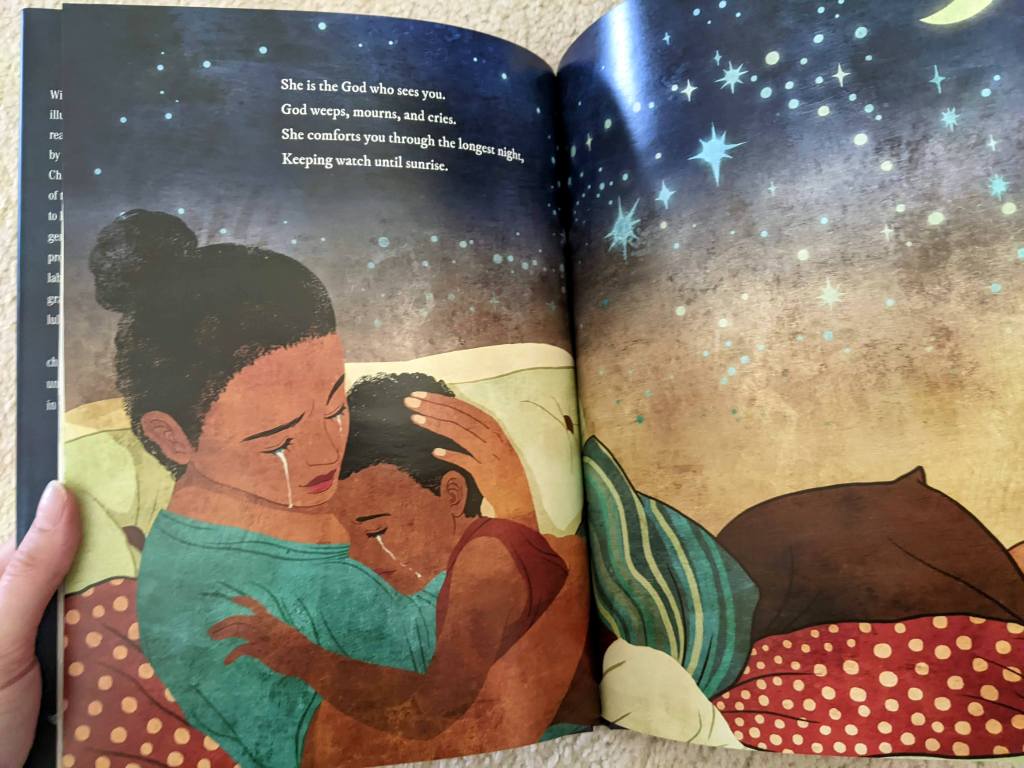
BOOK: Mother God by Teresa Kim Pecinovsky, illustrated by Khoa Le: Dovetailing with Hamman’s recent podcast episode is this beautifully unique children’s book that came out last year from Beaming Books. “With lyrical, rhyming text and exquisite illustrations, Mother God introduces readers to a dozen images of God inspired by feminine descriptions from Scripture. Children and adults alike will be in awe of the God who made them as they come to know her as a creative seamstress, generous baker, fierce mother bear, protective mother hen, strong woman in labor, nurturing nursing mother, wise grandmother, and comforting singer of lullabies. This gorgeous picture book welcomes children into a fuller, more diverse understanding of what it means to be made in the image of God.” Born in South Korea, raised in Iowa, and living in Texas, author Teresa Kim Pecinovsky (MDiv, MEd) (pictured below) is a hospice chaplain ordained in the Christian Church (Disciples of Christ) and a former elementary school teacher. Khoa Le is an artist from Vietnam.
Some traditionalists will no doubt have a visceral reaction against the cover and concept—“God reveals himself as Father, not Mother!” they’ll say, or “The Bible uses only masculine pronouns for God”—but it’s important to remember that God is nongendered, although God does contain both the masculine and the feminine (see, e.g., Gen. 1:27). “Father” is a metaphor, same as “mother.” God became incarnate as a male, Jesus, but as Hamman shows (see previous roundup item), Jesus also exhibited some qualities traditionally associated with women and mothers in particular, and therefore we can speak metaphorically of Christ as mother, as we can, too, of the First Person of the Trinity. Having an academic background in literature, I’m very comfortable with (and enthralled by!) metaphor, but I can understand, lamentably, how it trips some people up.
+++
ARTICLE: “Waking Ancient Seeds: Why the Middle Ages Matter” by Matthew J. Milliner, Comment, May 10, 2023: “For the medievals, Jesus is the Rosetta stone of cosmic meaning, with whom all things are aglow in the polyphonic resonance of truth, and without whom the world hurdles into centrifugal disconnection,” writes Matt Milliner, a theologically trained professor of art history at Wheaton College, an evangelical institution in Illinois. “It is our world that has been flattened, lacking the full-orbed splendour of medieval significance and depth.” In this article he contrasts the symbolism and sense of wonder and reverence of the Middle Ages with the deficits of the present, identifying several, sometimes unlikely places in which these “ancient seeds” are sprouting again.
The Easter season is a time of hope. There still is fear, there still is a painful awareness of sinfulness, but there also is light breaking through. Something new is happening, something that goes beyond the changing moods of our life. We can be joyful or sad, optimistic or pessimistic, tranquil or angry, but the solid stream of God’s presence moves deeper than the small waves of our minds and hearts. Easter brings the awareness that God is present even when his presence is not directly noticed. Easter brings the good news that, although things seem to get worse in the world, the Evil One has already been overcome. Easter allows us to affirm that although God seems very distant and although we remain preoccupied with many little things, our Lord walks with us on the road and keeps explaining the Scriptures to us. Thus there are many rays of hope casting their light on our way through life.
—Henri Nouwen, A Cry for Mercy: Prayers from the Genesee (1981) [HT]
+++
TRAVELING EXHIBITION: Arte de Lágrimas: Refugee Artwork Project: Started in August 2014 by the Rev. Dr. Gregory Cuéllar and Nohemi Cuéllar, Arte de Lágrimas (Art of Tears) is a traveling art exhibit and archive that aims to create greater public awareness of the lived migratory journeys of asylum-seeking children and youth from Central America. The Cuéllars and other volunteers have visited respite centers in Texas border towns like McAllen, Brownsville, and Eagle Pass, distributing art supplies to migrant children who are waiting for buses to take them to their longer-term destination. They want to give these children the option to express themselves or process their journeys through an artistic outlet. Some of the children have chosen to donate their artworks to the volunteers, and it is these that constitute the Arte de Lágrimas collection, which is currently on display at Fuller Theological Seminary in Pasadena, California.
This Thursday, April 27, Fuller is holding a gallery reception at Travis Auditorium (180 N. Oakland Ave., Pasadena) from 6 to 9 p.m., which will include a presentation by Gregory Cuéllar as well as a panel discussion; RSVP here. Cuéllar, who teaches Old Testament at Austin Presbyterian Theological Seminary, is the author of Resacralizing the Other at the US-Mexico Border: A Borderland Hermeneutic (Routledge, 2020) and Voices of Marginality: Exile and Return in Second Isaiah 40–55 and the Mexican Immigrant Experience (Peter Lang, 2008).
If you can’t make it to the exhibition at Fuller, you can at least tour the Virtual Showroom that the Cuéllars developed, which hangs the images in a digital space that gives users the impression of being in a physical gallery.
+++
ARTICLE: “‘He Is Not Here’: A Choral Easter Season” by Mark Meynell: This Rabbit Room blog post is part of 5&1, a weekly series from 2021 in which British chaplain Mark Meynell shares five short pieces of classical music and one long piece, drawing attention to some of their musical elements. For Easter he selected a setting of Psalm 118:24 by Renaissance composer William Byrd; “O dulce lignum” (O Sweet Wood) from Ēriks Ešenvalds’s Passion and Resurrection (below); “Christus Vincit” by Sir James MacMillan; an anthem for Ascension Day by Gerald Finzi; an Easter hymn from an Italian opera by Pietro Mascagni (also below); and the fifth movement of Mahler’s famous Resurrection Symphony. I appreciate that he provides lyrics and translations!
+++
BLOG POST: “The Good Fridays of Our Eastertide Lives” by W. David O. Taylor, feat. Sam Wedelich: W. David O. Taylor, a theology professor at Fuller Theological Seminary, shares a visual interpretation of Matthew 28:8 by Sam Wedelich, at the time a member of Hope Chapel in Austin, where Taylor served as arts pastor. Wedelich’s collage shows how both fear and joy gripped the hearts of the two Marys on Easter morning, reflecting the complexities of our own often muddled-up feelings. Whether we’re skipping to the tune of “Hallelujah” this Easter or standing still, immobilized—or experiencing, like the Marys, some strange mixture of stances—the Risen Lord meets us, Taylor writes.
Sam Wedelich, With Fear and Great Joy, 2005. Collage.
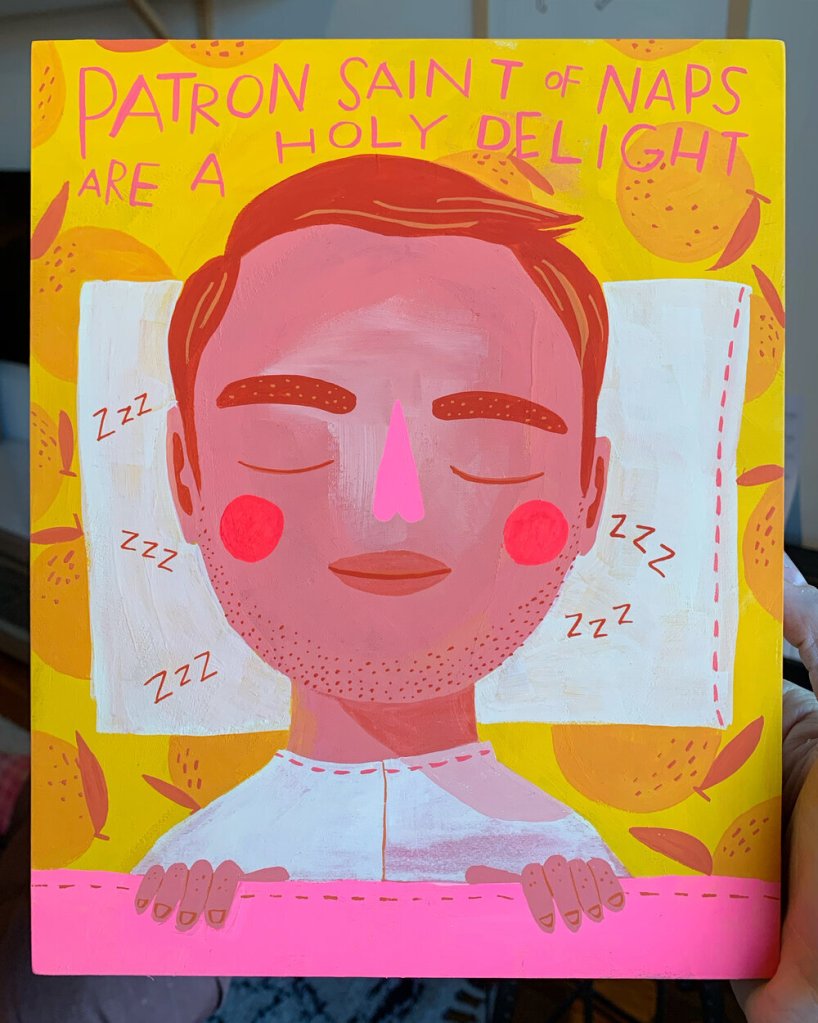
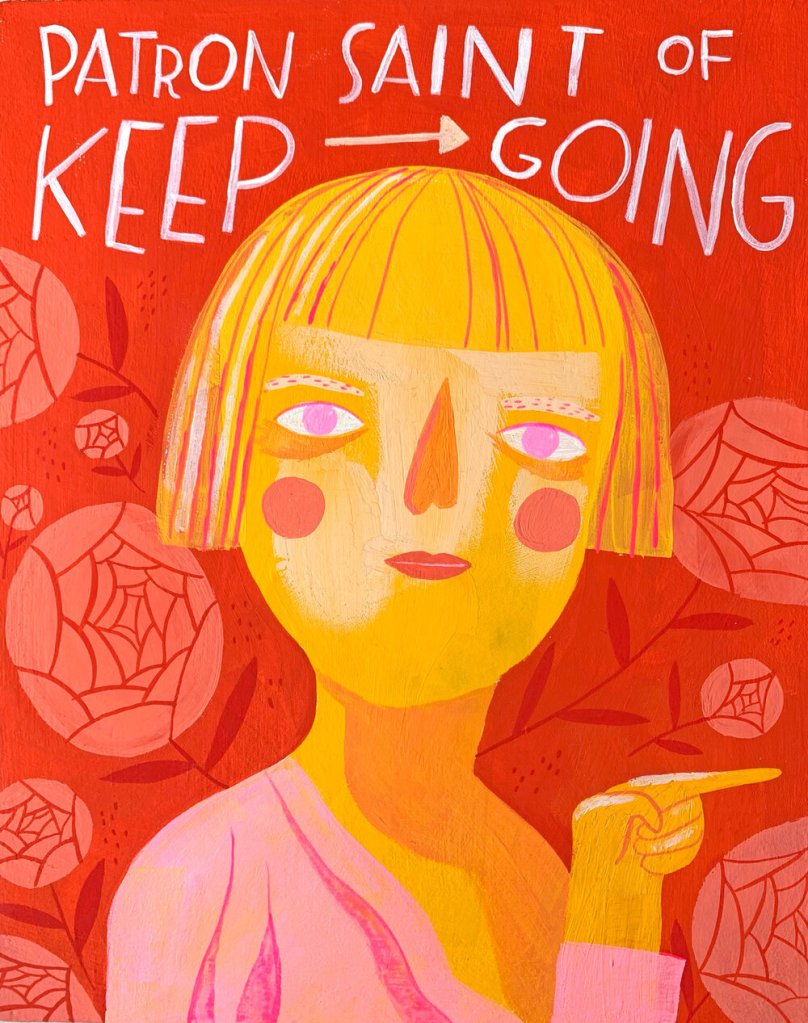
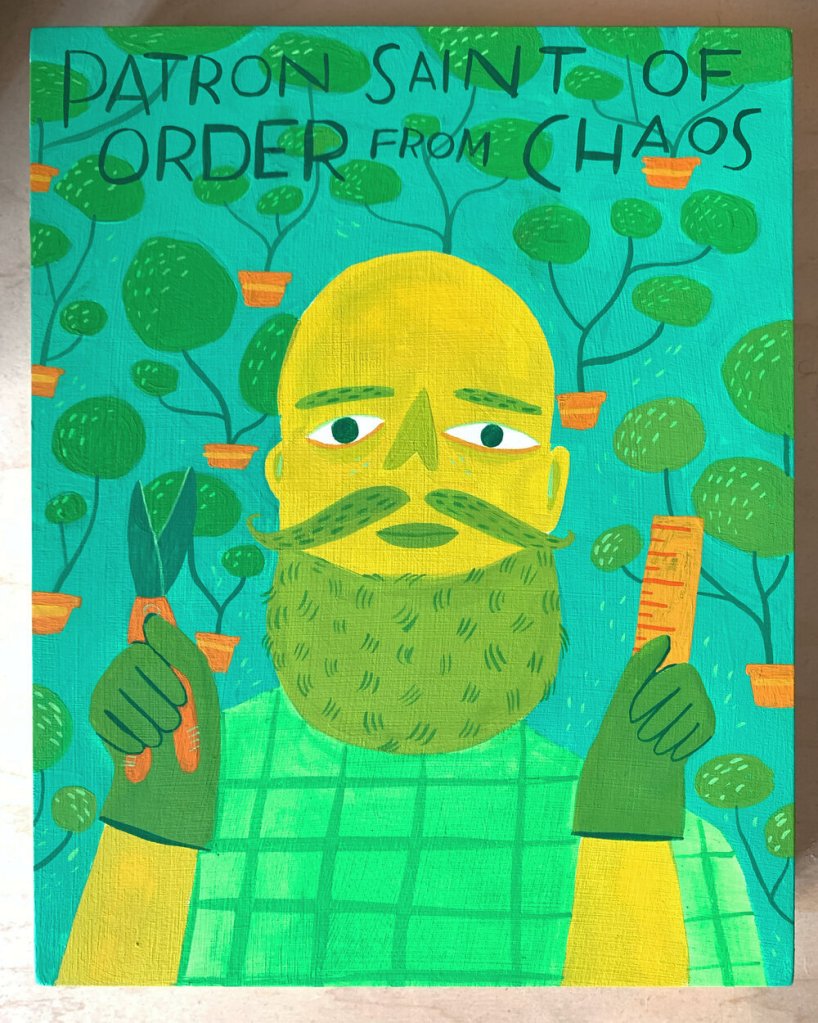
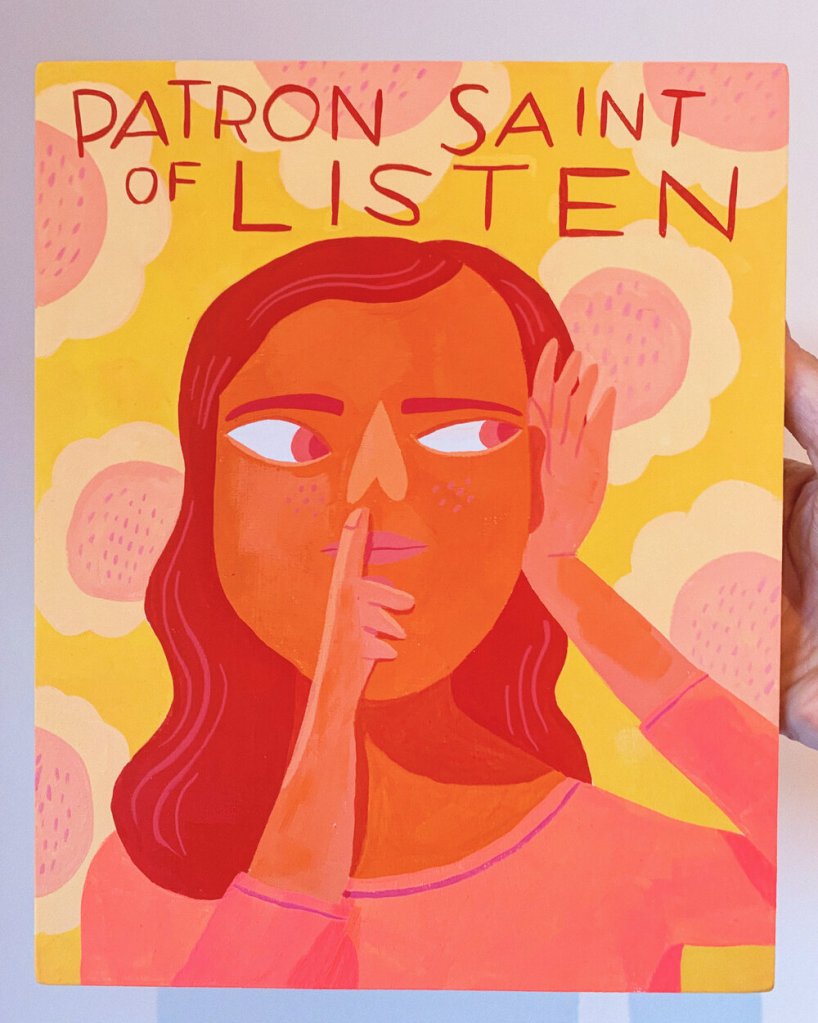
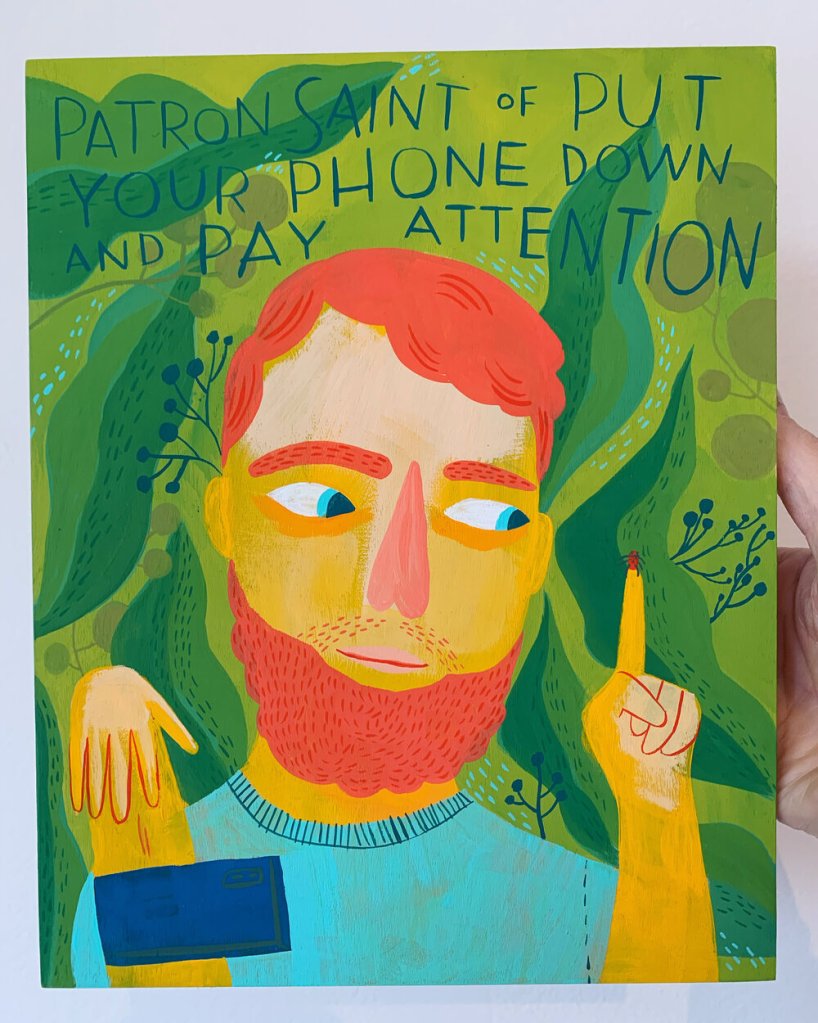
This is an early piece by Wedelich, which she made when she was a college student. She has since become well established as an illustrator. Follow her on Instagram @samwedelich. I especially like the series of “patron saint” paintings she did in 2020. Two of them are available for sale as prints from her online shop: Patron Saint of Keep Going and Patron Saint of Listen.
SONG: “To Thessalonica” by John Davis: Dedicated to his father, who passed away last month, Nashville-based rock singer-songwriter John Davis’s new album, My Hope Is Found in a God Who Can Raise Up the Dead, includes an original musical adaptation of 1 Thessalonians 4:14–18: “This we declare to you by word from the Lord: We who are alive, who are left until the coming of the Lord, will not precede those who sleep in death. The Lord will descend with a cry of command; the voice of an archangel too. And with the sound of the trumpet of God, the dead in Christ will rise up first. The dead in Christ will rise up first. I know, I know, I know we’re gonna meet in the air. Yeah! The shout of command and the voice of the angel, the trumpet of God will declare. Yeah! I believe, I believe in, I believe, I believe in . . . My hope is found in a God who can raise up the dead, yeah! . . . My hope is found in a God who has raised up the dead. . . .” [HT: Crowdfunding Christian Music]
Jyoti Sahi (Indian, 1944–), Triptych of Salvation, 2021. Acrylic, oil, and ocher on canvas, 24 × 48 in. All photos courtesy of the artist.
Death trampled our Lord underfoot, but he in his turn treated death as a highroad for his own feet. He submitted to it, enduring it willingly, because by this means he would be able to destroy death in spite of itself. Death had its own way when our Lord went out from Jerusalem carrying his cross, but when by a loud cry from that cross he summoned the dead from the underworld, death was powerless to prevent it.
Death slew him by means of the body which he had assumed, but that same body proved to be the weapon with which he conquered death. In slaying our Lord, death itself was slain. It was able to kill natural human life, but was itself killed by the life that is above the nature of mortals.
Death could not devour our Lord unless he possessed a body, neither could hell swallow him up unless he bore our flesh; and so he came in search of a chariot in which to ride to the underworld. This chariot was the body which he received from the Virgin; in it he invaded death’s fortress, broke open its strong room, and scattered all its treasure.
At length he came upon Eve, the mother of all the living. She was that vineyard whose enclosure her own hands had enabled death to violate, so that she could taste its fruit; thus the mother of all the living became the source of death for every living creature. But in her stead Mary grew up, a new vine in place of the old. Christ, the new life, dwelt within her. When death, with its customary impudence, came foraging for her mortal fruit, it encountered its own destruction in the hidden life that fruit contained. All unsuspecting, it swallowed him up, and in doing so released life itself and set free a multitude.
He who was also the carpenter’s glorious son set up his cross above death’s all-consuming jaws, and led the human race into the dwelling place of life. Since a tree had brought about the downfall of humankind, it was upon a tree that humankind crossed over to the realm of life. Bitter was the branch that had once been grafted upon that ancient tree, but sweet the young shoot that has now been grafted in, the shoot in which we are meant to recognize the Lord whom no creature can resist.
We give glory to you, Lord, who raised up your cross to span the jaws of death like a bridge by which souls might pass from the region of the dead to the land of the living. . . .
We give glory to you who put on the body of a single mortal and made it the source of life for every other mortal.
You are incontestably alive! Your murderers sowed your living body in the earth as farmers sow grain, but it sprang up and yielded an abundant harvest of people raised from the dead.
Come then, my brothers and sisters, let us offer our Lord the great and all-embracing sacrifice of our love, pouring out our treasury of hymns and prayers before him who offered his cross in sacrifice to God for the enrichment of all.
—Ephrem the Syrian, sections 3–4 and 9 of the Eastertide sermon “On Our Lord,” trans. the International Commission on English in the Liturgy in TheLiturgy of the Hours, vol. 2 (New York: Catholic Book Publishing Co., 1976), 735–36
Ephrem the Syrian (ca. 306–373) was a prominent Christian theologian, hymnist, and teacher who is venerated as a saint and a doctor of the church. Born in Nisibis (in modern-day Turkey), he served as a deacon and later lived in Edessa, a center of Greek and Syriac theological and philosophical thought in Upper Mesopotamia. He spoke and wrote in Syriac, a dialect of Aramaic, and is the most significant of all the Syriac Christian fathers.
The three-paneled painting at the top of this post is by my friend Jyoti Sahi, one of the most theologically exploratory artists working today. I saw this triptych at an earlier stage of development when I visited his home in Silvepura Village, India, in 2019 and am so pleased by how it turned out. “It represents Christ ascending the cross (left), harrowing the underworld as the drummer (center), and rising like the sprout from the seed that is Mary, from whose womb he sprang forth (right),” Jyoti told me.
The central panel is based on iconography of the Anastasis, in which Jesus descends into Hades following his crucifixion to liberate those who have died. In such icons, Adam and Eve, who represent all of humanity, are “drawn up from the earth,” as Jyoti puts it. Jyoti portrays this rescue as a dance, with Jesus beating out the rhythms of redemption, as well as a time of planting and harvest (he wields a plow and a scythe). Jesus’s death tilled the soil, making conditions right for the dead to be raised to new life.
Jyoti has long been interested in the symbolism of the ladder and the seed, and both symbols are employed here. The ladder is an instrument of both descent and ascent, and the seed, as Christ himself taught, must “die”—be buried in the ground—before it yields life. In the right panel of the Triptych of Salvation, Jesus, having gone down into the earth, bursts forth from his casing, emerging as the tree of life, whose roots are watered by the river of life, which flows across all three panels. This tree is the cross transformed.
His arms raised again as they were on the cross but no longer pinned down, Jesus leads the dance of resurrection, and Adam and Eve and the others who have been delivered join in. They are the fruitful crop of Christ the Gardener.
What then are we to say? Should we continue in sin in order that grace may increase? By no means! How can we who died to sin go on living in it? Do you not know that all of us who were baptized into Christ Jesus were baptized into his death? Therefore we were buried with him by baptism into death, so that, just as Christ was raised from the dead by the glory of the Father, so we also might walk in newness of life.
For if we have been united with him in a death like his, we will certainly be united with him in a resurrection like his. We know that our old self was crucified with him so that the body of sin might be destroyed, so we might no longer be enslaved to sin. For whoever has died is freed from sin. But if we died with Christ, we believe that we will also live with him. We know that Christ, being raised from the dead, will never die again; death no longer has dominion over him. The death he died, he died to sin once for all, but the life he lives, he lives to God. So you also must consider yourselves dead to sin and alive to God in Christ Jesus.
—Romans 6:1–11
LOOK: The Man and the Cross by Rufino Tamayo
Rufino Tamayo (Mexican, 1899–1991), The Man and the Cross, 1975. Oil on canvas, 130 × 97 cm. Collection of Modern and Contemporary Art, Vatican Museums.
Part 1:

In Christ we live
And in Christ we die
And in Christ we rise up again
Let heaven rejoice
And let earth be glad
And sing, “Alleluia, amen!”
Part 2:

In Christ
We live
In Christ we rise again
Let heaven
Rejoice
And sing, “Amen!”
>> Recorded by the Elnora Bible Institute Choir, 2020:
Part 1:

In Christ
We live
And die and rise again
Let heaven
Be glad
And sing, “Amen, amen!”
Part 2:

In Christ we live
And in Christ we die
And in Christ we rise up again
Let heaven be glad
And let earth rejoice
And sing, “Alleluia, amen!”
This buoyant song in two-part polyphony was written by John Bell of the Iona Community, an international, ecumenical Christian movement working for justice and peace, the rebuilding of community, and the renewal of worship. The community was founded in Glasgow in 1938, and its music arm is regarded in the UK as one of the most vibrant sources of new congregational music.
Bell, a Church of Scotland minister, worked for the Iona Community for over forty years before retiring from his position as resource worker last November, though he continues to be involved as a member. He leads workshops on liturgy, music, spirituality, and social justice; has written and edited song collections, sermon collections, and a wide range of liturgical materials as part of the Wild Goose Resource Group he founded with the late Graham Maule; and contributes regularly to the annual Greenbelt festival in England. Much of his work has been in convincing people they can sing, regardless of their ability to read music, and encouraging more congregational participation in music making.
The video above shows a session from a Music That Makes Community gathering at St. Paul’s Chapel in New York City in April 2008, led by Connecticut pastor Nancy Boldt McLaren. I love the enthusiasm of the group who is learning this song for the first time! The Spotify link is to a recording by a choir from Elnora Bible Institute in Indiana, which sings the words as published (whereas McLaren makes a few small tweaks).
This concludes the Easter Octave—but keep celebrating! Easter is a fifty-day season that culminates with the feast of Pentecost on May 28. I’ll be releasing a brand-new Pentecost playlist on Spotify next month, but until then, check out the one for Eastertide, which includes today’s featured song.
Again your Spirit sweeps, a wind over the deep; a new creation now arrives to rouse us from our sleep.
The breath of heaven brings the long-awaited spring into the fields and seas and skies and every barren thing.
Refrain: Creation blooms anew in fresh and joyful hue. In Christ’s arising all things rise to draw their breath from you.
Awaken by the sound of forging swords into plows. Come fill the Garden with your light, and we will till the ground.
The earth is being cleared for heaven to come near. From every depth an eager sigh is all that we can hear. [Refrain]
Nick Chambers [previously] is the worship pastor at Church of the Incarnation in Atlanta and a singer-songwriter whose debut album, Great Cloud, released last year. “Creation Blooms Anew” is not part of that LP, but he shared it on YouTube in 2020. It was inspired by a hymn of Adam of St. Victor, a major Latin-language poet from twelfth-century France:
Earth blooms afresh in joyous dyes; In Christ’s arising all things rise; A solemn joy o’er nature lies; Alleluia!
Now peace the sea, the sky doth fill; Heav’n’s breath wakes fair each vale and hill; Spring pours through barren hearts and chill; Alleluia!
Life wins from death the glorious prey; The cherub’s sword is turned away, And Eden’s paths are free today; Alleluia!
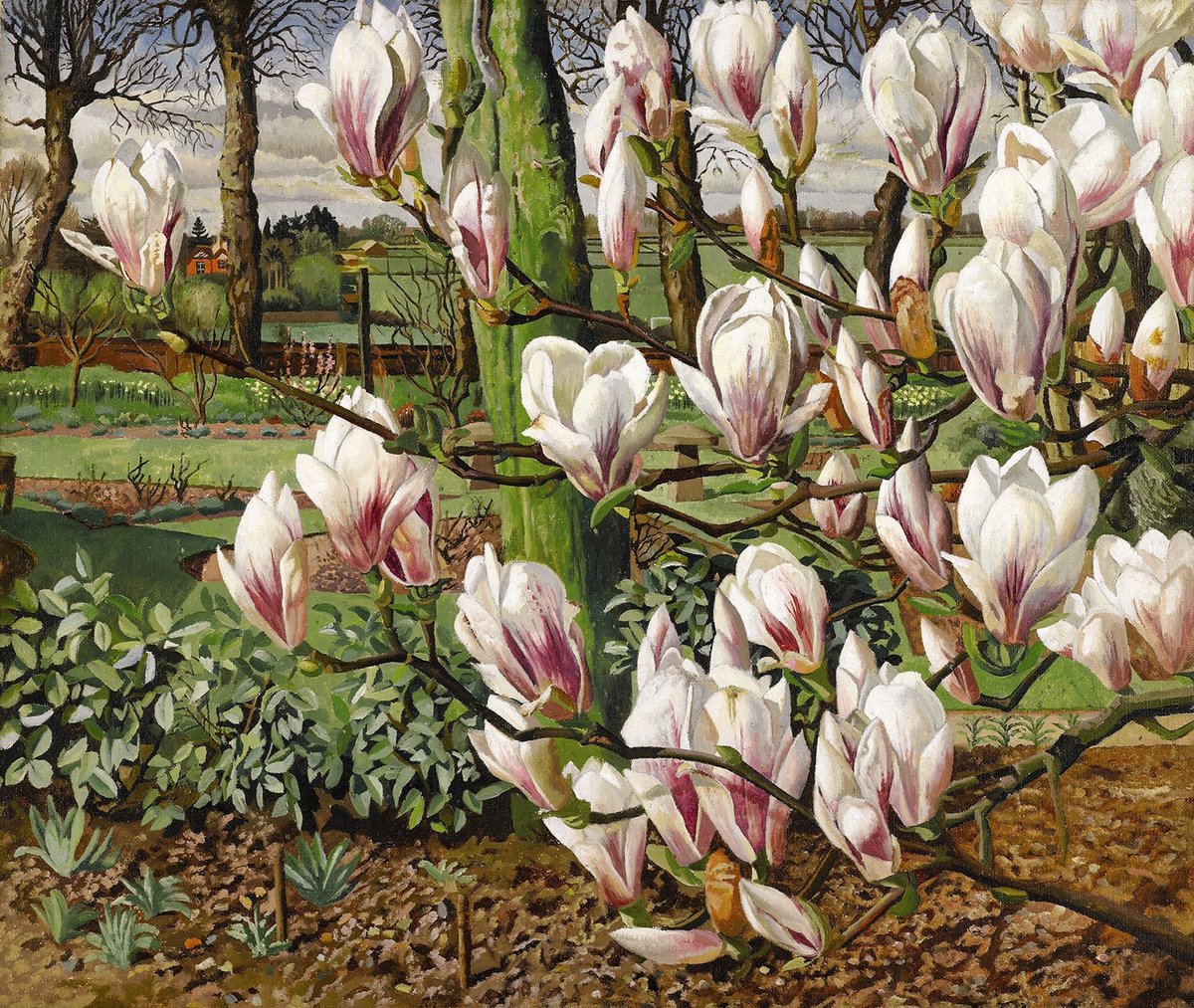
Memories of his family’s first Easter in Atlanta in 2017 also influenced the song. “More than anything I remember the magnolia flowers,” Chambers said, “bright white and big as our baby’s head. The branches bent with the weight of them, swinging like bells welcoming us into a new home, a new season of life.”
Chambers reflects further on the image of flowering:
Norman Wirzba, in one of his many reflections on gardening, writes, “It is significant that the material context for creation and for redemption should be a garden, for it is precisely through gardening that we most experience ourselves as created beings, as beings tied to a magnificent creation and to God. . . . [The writer of Genesis 2] is clear that we become authentic and truly fulfill our vocation as we learn to care for the garden which is creation itself.” He continues, “Gardens have long been a place of spiritual nourishment, because it is here that we can sense the vivifying and gracious power of the creator at work in the creation. Without much help from us, and sometimes in spite of our worst efforts, we can plainly see that we are in the presence of a life- and death-wielding power that overcomes and envelops us all” (The Paradise of God, 117).
In the beginning, God creates humanity to till the ground in a garden. Christ suffers anguish and grief in a garden, then to be resurrected in a garden and even mistaken for its caretaker. The story comes to its endless ending in a garden—steady streams in the shade of trees thick with healing leaves. We live from this past into this future, ourselves like flowers nourished by soil and bending toward the sun. Here and now, Easter invites us into this vision, into the wild surprises of spring to be both gardeners and the garden itself.