SPOTIFY PLAYLIST: September 2022 by Victoria Emily Jones: This month’s thirty-song lineup includes a tango, a Pentecostal praise song, a playful setting of the Heidelberg Catechism Q&A number one, an Americana lament for hard times, a Negro spiritual on sax, Christina Rossetti, guitar evangelist Mother McCollum with a unique Jesus metaphor (!), a 9/11-inspired interfaith prayer that I will write about in a separate post, and songs in Turkish (“Kutsal, Kutsal, Kutsal Allah” = Holy, Holy, Holy Lord God) and Sepedi (“Modimo re boka wena” = God, we praise you).
+++
LECTURE (AUDIO): “God’s Thumbprint” by Frederick Buechner: Ordained minister and Pulitzer Prize– and National Book Award–nominated author Frederick Buechner died August 15 at age ninety-six. He was a wonderful writer (of both fiction and spiritual nonfiction) and preacher, and I hear him quoted all the time. He once summed up the theme of all his work as “Listen to your life.”
In 1992 Buechner spoke for the biennial Festival of Faith and Writing at Calvin University in Grand Rapids, Michigan, about how “art and religion are twin expressions of the human spirit.” Discussing poetry, painting, and music, he shows how the arts help us to pay attention. Listen to the talk, “God’s Thumbprint,” on FFW’s Rewrite Radio podcast. It is an expansion of the “Art” entry Buechner wrote in his book Whistling in the Dark: An ABC Theologized (1988); read the full excerpt here.
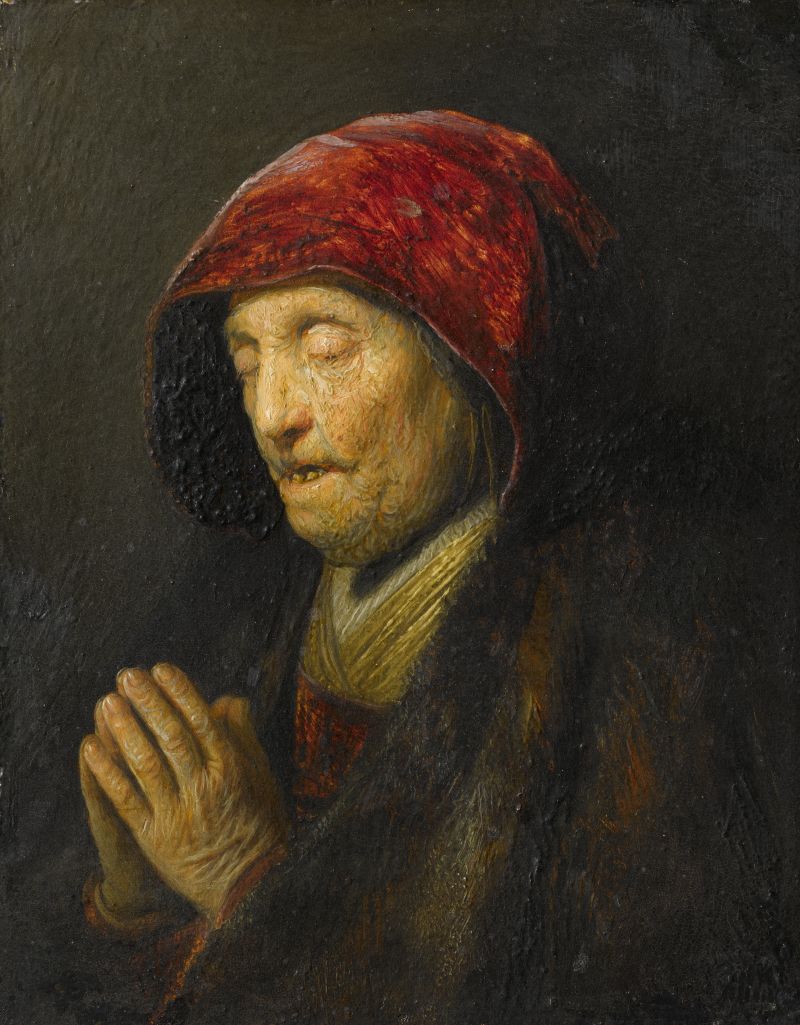
Rembrandt van Rijn (Dutch, 1606–1669), Old Woman Praying, 1629–30. Oil on gilded copper, 15.5 × 12.2 cm. Residenzgalerie Salzburg, Austria. This is one of the many careworn, lived-in elderly faces Rembrandt painted.
+++
LECTURE (VIDEO): “Difficult Beauty: Contemporary Art as Spiritual Discipline” by James K. A. Smith: In its content selection and development, the arts quarterly Image, says editor in chief James K. A. Smith, resists both nostalgia (old is better) and progressivism (new is better), charting a third way that he calls “archaic avant-garde.” The journal’s focus is on contemporary art, but contemporary art funded by tradition. Most of the writers and artists they feature see the tradition of religious art as a gift and a launchpad.
In this lunchtime Zoom talk from May 19, 2021, Smith considers why contemporary art so often feels alienating. He focuses on painting, giving a brief history of the onset of modernism in that medium, starting with the impact of photography, which pushed painters beyond the representation of objective reality. He shares compelling quotes by art critic Peter Schjeldahl and philosopher John Carvalho, about how we look and when thinking happens. Smith discusses the need for humility—to be comfortable with the not-knowing, to surrender our desire for mastery and control (i.e., demanding that paintings explain themselves).
What if the art that first alienates us is the art that might also stretch us? Or what if the literature that’s intimidating might also be the literature that has the possibility to kind of break us open in new ways, open us up to others, and even open us up to God? What if the difficulty of contemporary art is a virtue? And what if experiencing that difficulty is actually what we need? (12:42)
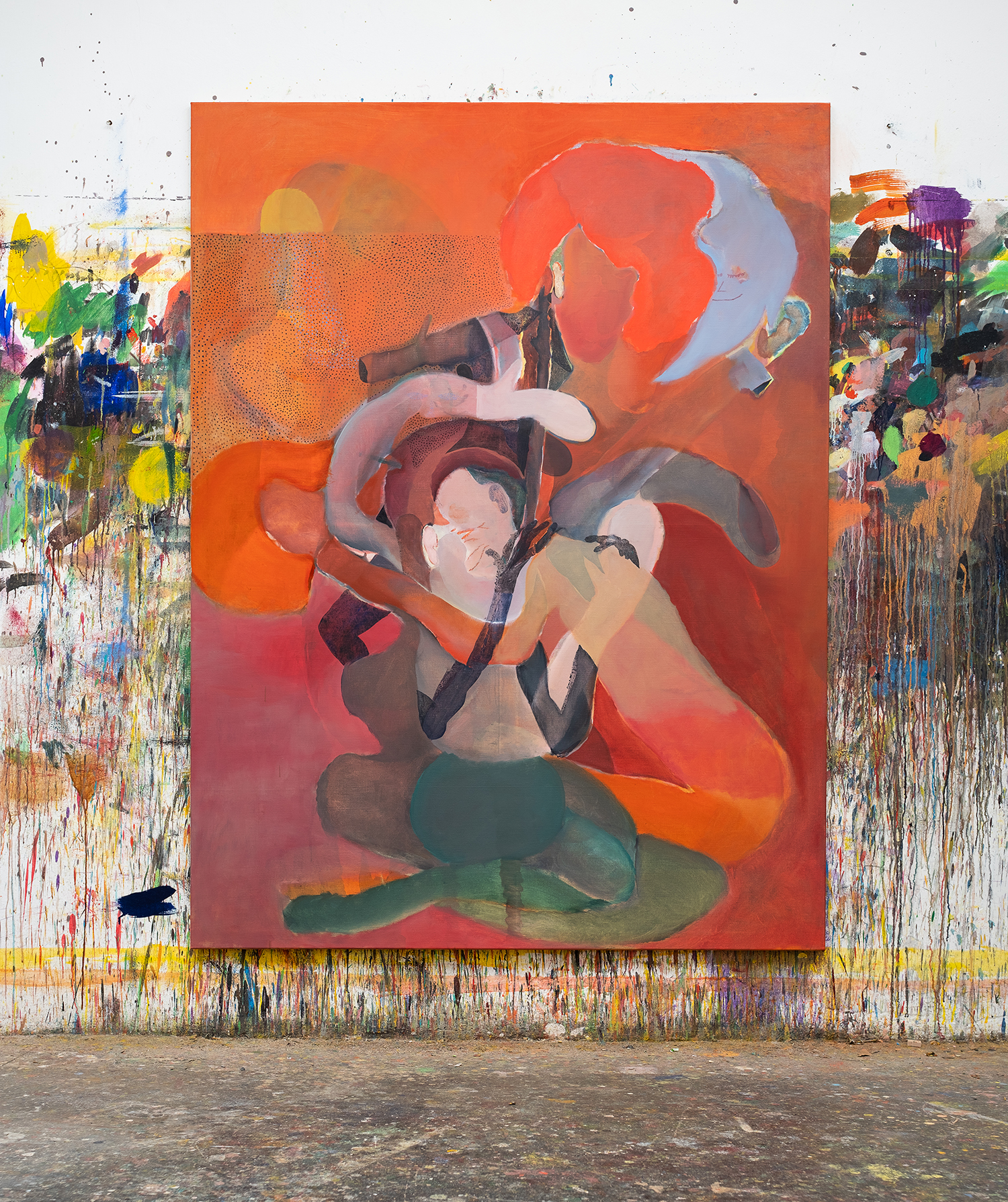
Daniel Domig (Canadian/Austrian, 1983–), Prayer Invites Chaos, 2019. Oil on mixed fibers, 75 × 59 in. [artist’s website]
The last twenty minutes consists of Q&A and addresses icons, art as propaganda, whether and how to engage art that comes out of a place of despair, and more.
I admit that I find much of contemporary art difficult, often unpleasantly so. A few readers have requested that I feature more abstract art, but I struggle to know how to talk about it. But I do want to learn. Image helps me do that.
+++
ESSAY: “Venice Undone” by Matthew J. Milliner: A core publication of Cardus, Comment magazine is committed to “the difficult work of being faithfully present in culture.” This summer they published an essay by art historian Matthew Milliner reflecting on the Anish Kapoor and Anselm Kiefer exhibitions at the 59th Venice Biennale, one of the art world’s largest and most significant recurring events.
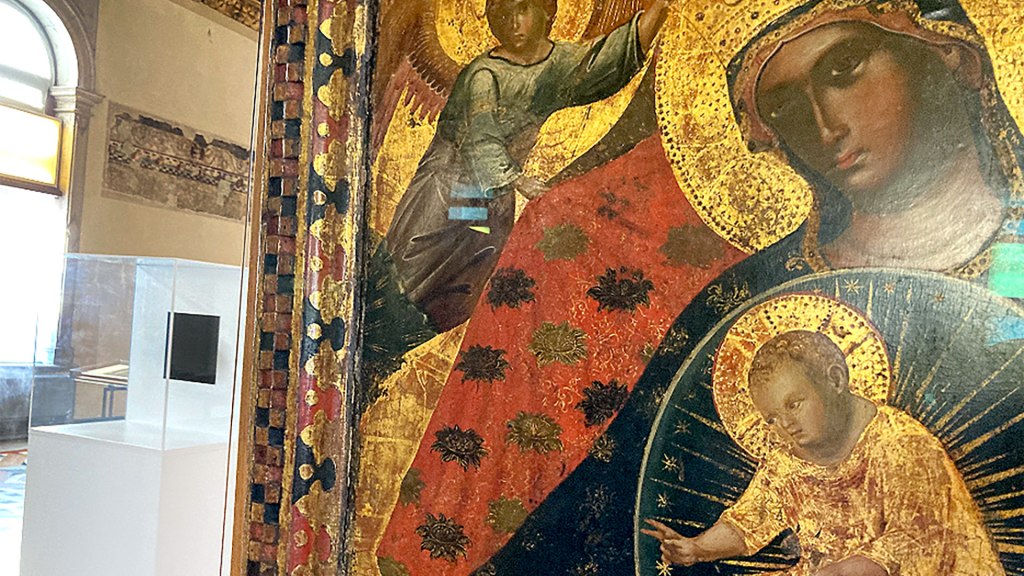
At the 59th Venice Biennale, the Infant Christ from Paolo Veneziano’s Madonna and Child Enthroned (1320s) seems to bless one of Anish Kapoor’s “voids,” a black-painted work that appears flat when viewed head-on but whose convexity becomes apparent when viewed from the side. Photo: Matthew J. Milliner.
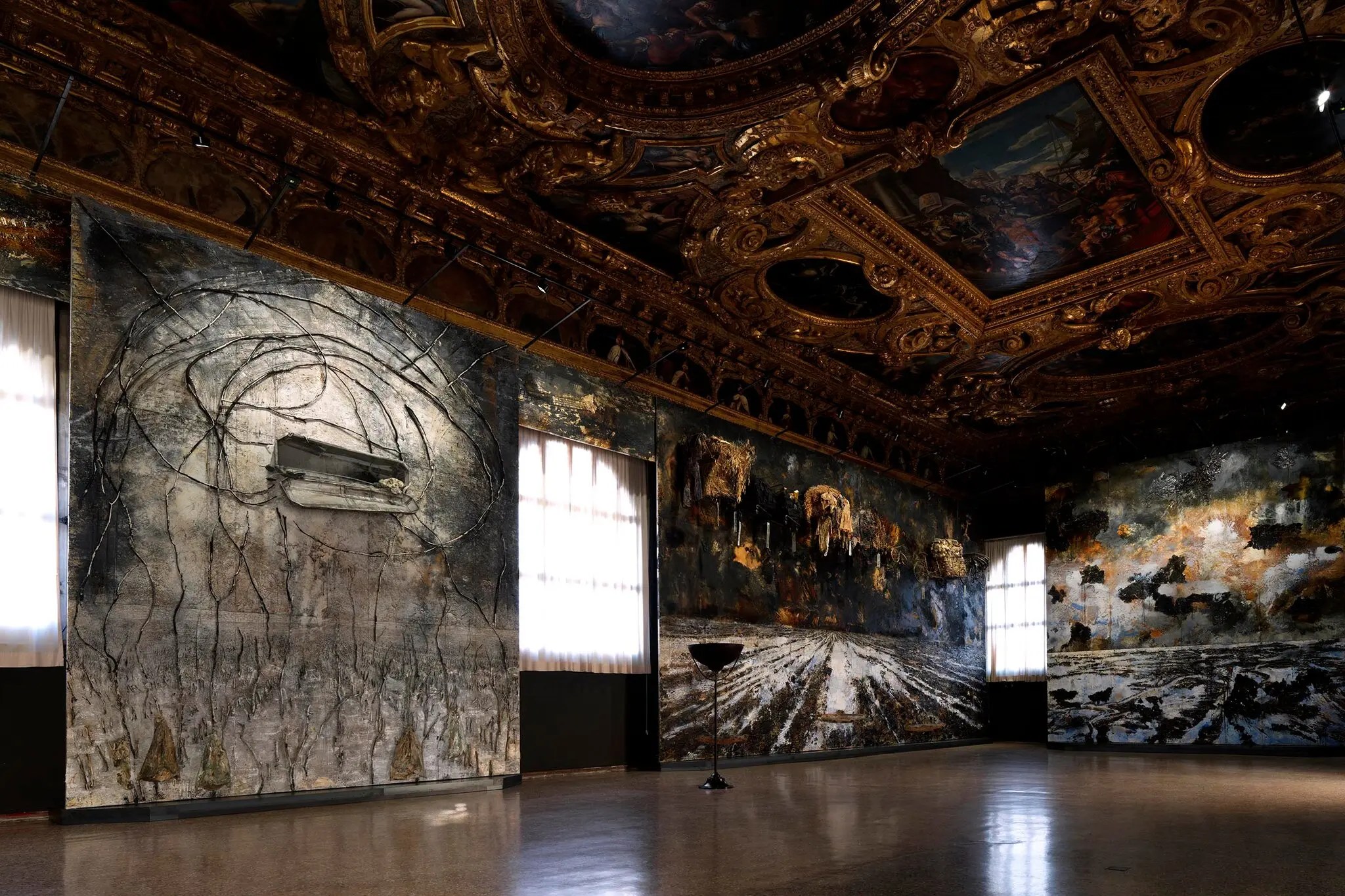
In part 2 of the essay, Milliner considers how the Kiefer show at the Doge’s Palace critiques Venice’s history of military conquest, replacing Titian’s The Conquest of Zara (1584) with an image of an empty tomb that evokes Jesus’s conquest over death. Apocalyptic themes have long been noted in Kiefer’s work; Milliner sees in particular traces of St. Paul and an interrogation of historic Venice’s bombastic displays of wealth and splendor, which are not lasting. And of course there’s the Jacob’s ladder motif. For a silent video tour of the exhibition, see here.
Anselm Kiefer (German, 1945–), These writings, when burned, will finally give some light, site-specific exhibition at the 59th Venice Biennale, 2022. Sala dello Scrutinio, Palazzo Ducale, Venice. Photo courtesy of the artist.
Prompted in part by their use of darkness, Kapoor and Kiefer have been read by some scholars through a lens of despair, but Milliner looks with eyes of hope and sees plenitude and light.
+++
SONG: “Jordan” by Jana Horn: One of Art & Theology’s subscribers sent this to me, and I’m not sure what to make of it, but I definitely find it intriguing, if a bit unsettling. A song from Jana Horn’s debut solo album, Optimism (2022), which Pitchfork calls “cryptic, bewildering, and daringly simple.” “Jordan” is full of veiled biblical allusions and touches on themes of pilgrimage, belief, destruction, incarnation, and burden bearing. I share it here in the spirit of Jamie Smith’s talk above, about not needing to nail down meaning in an artwork—even though I can’t help but ask, “Just who are the two dialogue partners?!” (God the Son and God the Father?)
Horn is a singer-songwriter from Austin, Texas, and a fiction-writing graduate student at the University of Virginia–Charlottesville.
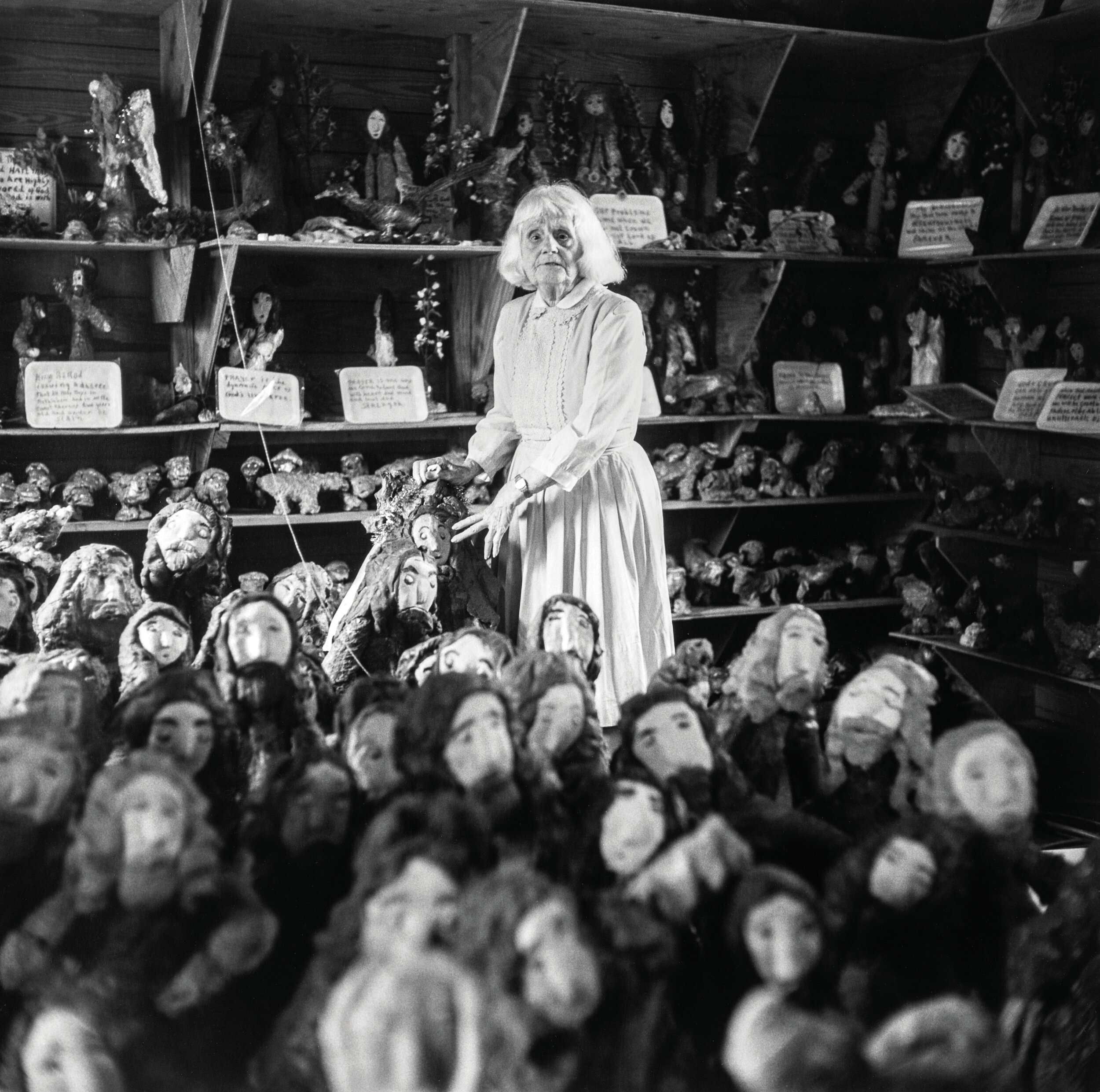
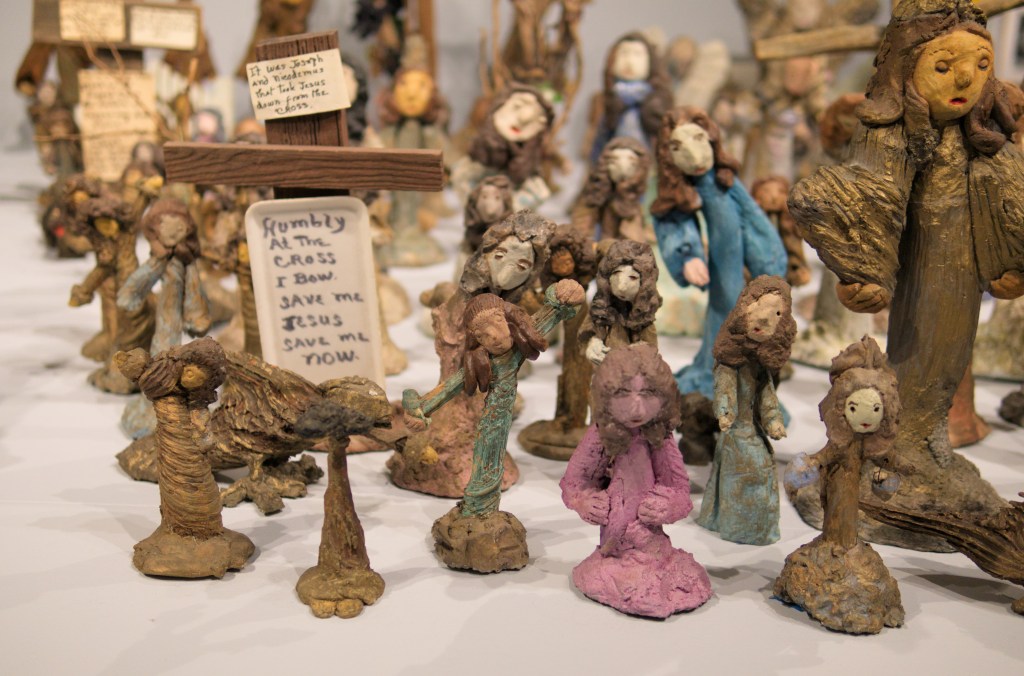
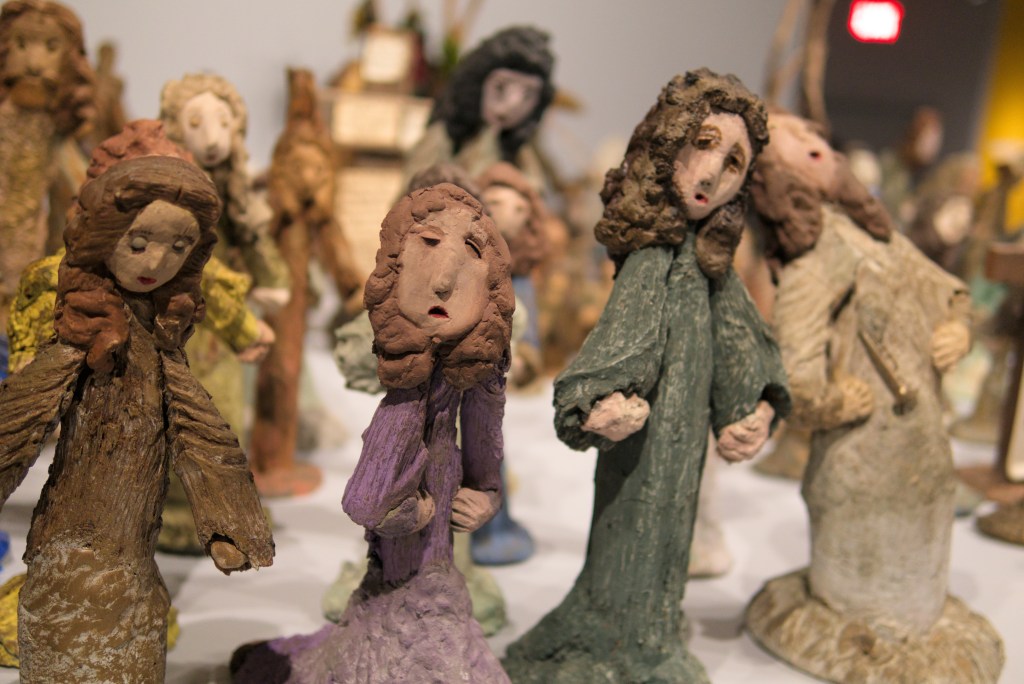
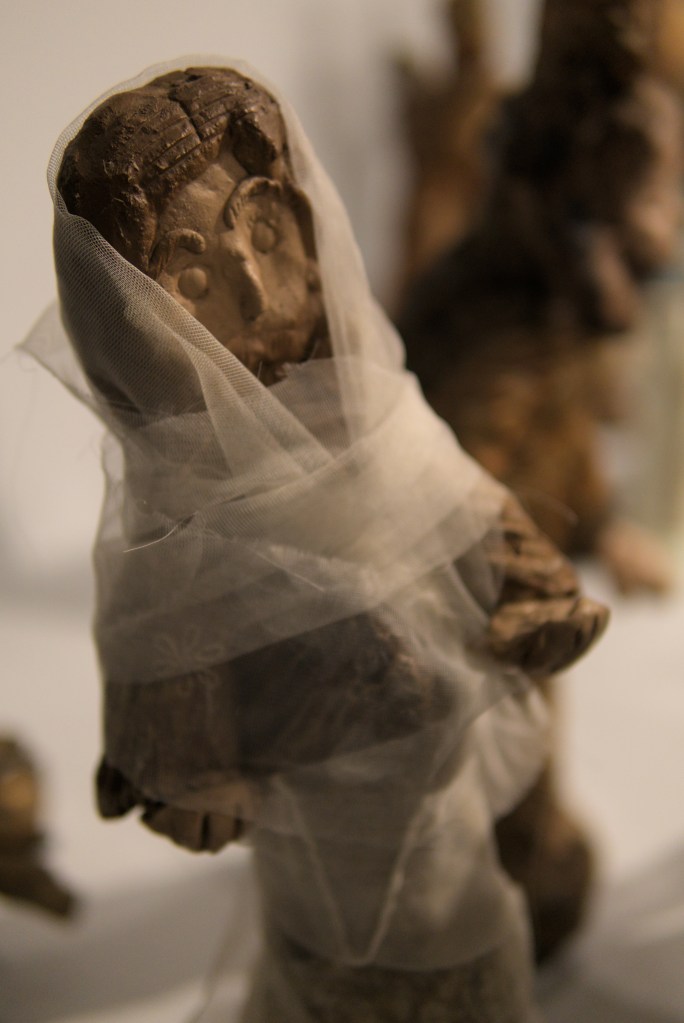
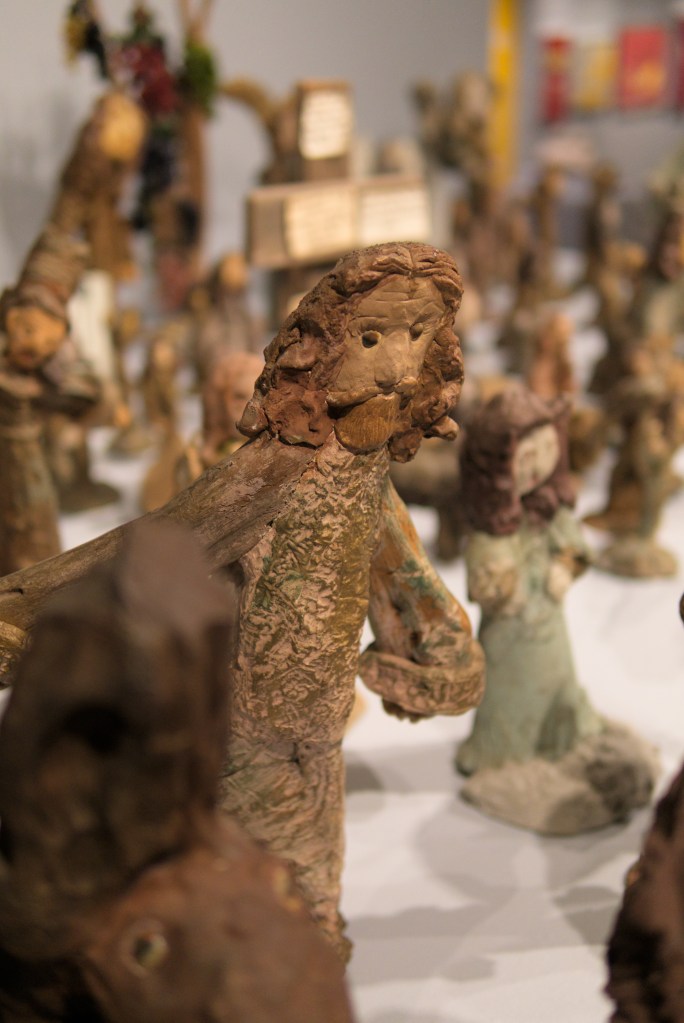
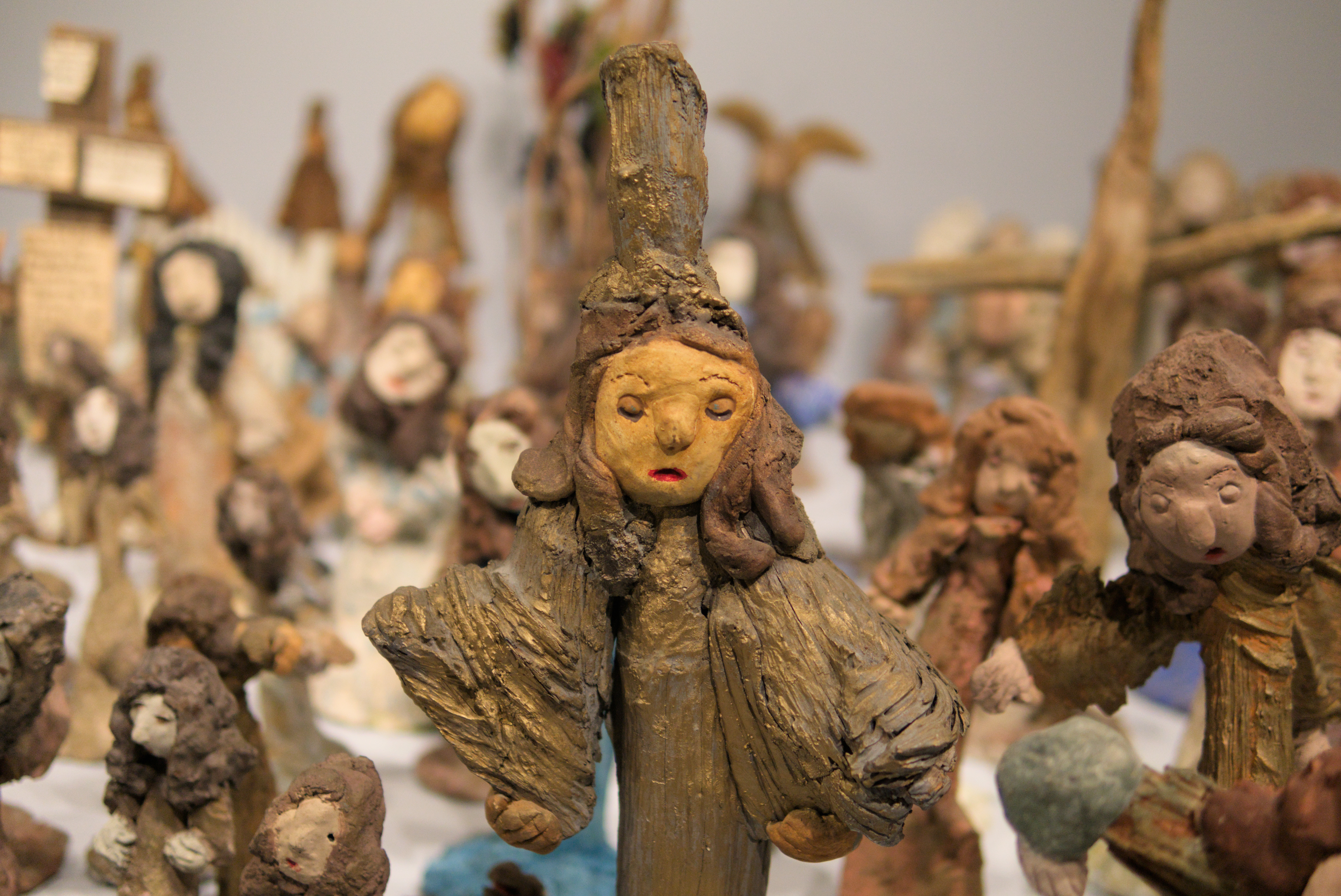
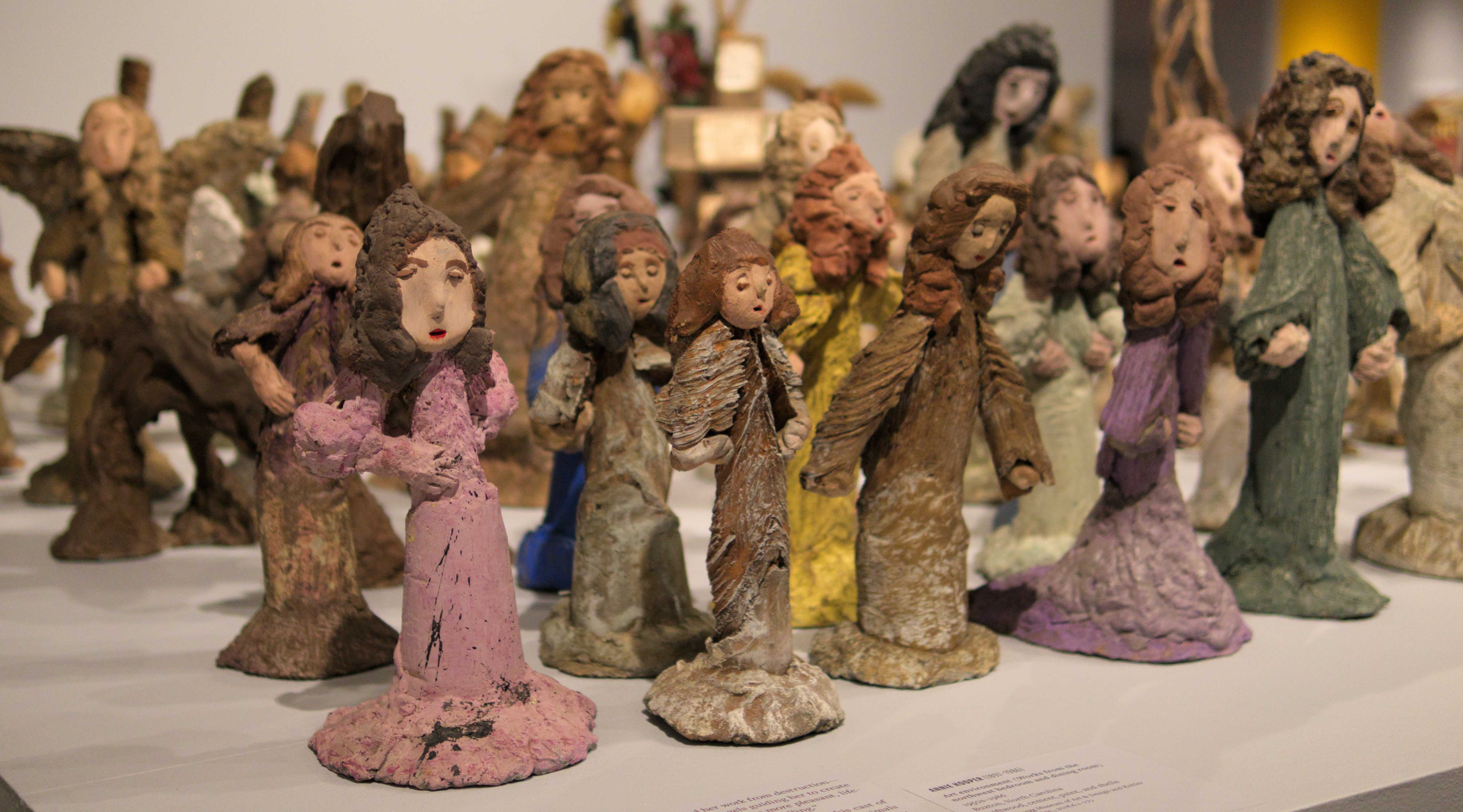
Earlier this month I visited the American Folk Art Museum in New York City and was struck by a large ensemble of painted driftwood sculptures by “outsider” artist Annie Hooper (1897–1986). Arranged on a broad platform in the main gallery, the figures are a mixture of apostles, prophets, patriarchs and matriarchs, pilgrims, pray-ers, angels, dancers, and mourners. They are but a small fraction of the thousands such figures that filled Annie’s remote coastal North Carolina home, where they beckoned friends and strangers alike to come in, take a look around, and hear God’s good word. Annie loved to tell stories through these her “symbols,” as she called them, interweaving her own life experiences with the narrative of scripture to communicate the hope of the gospel.
Annie Hooper (American, 1897–1986), Art environment (works from the northwest bedroom and dining room), Buxton, North Carolina, 1950s–1986. Driftwood, cement, paint, and shells, dimensions variable (average figure height 17 in.). American Folk Art Museum, New York, 2018.6.1–170. Photo: Victoria Emily Jones.
Annie (Miller) Hooper was born in 1897 in Buxton, North Carolina, on Hatteras Island in the Outer Banks. She was raised in a devout Methodist household that included her twelve siblings—one of them her twin sister, Mamie—and fourteen foster children.
After taking a few courses at Blackstone College for Girls in Virginia, she married John Hooper and moved across Pamlico Sound to Stumpy Point, North Carolina, where John was a commercial fisherman. Their son, Edgar, was born a year later, when Annie was nineteen.[1]
Annie was very involved in her church community—playing the organ for services, preaching sermons when called upon, teaching Sunday school for children and adults, writing poems for the church newsletter, composing songs.
During World War II, when Edgar was deployed to the South Pacific and John left to work in the naval shipyards in Norfolk, Annie experienced her first bout of depression, which was accompanied by blackouts. Her second bout came when Edgar, after returning safely home from overseas, developed lung problems that required him to convalesce for a year in the mountains. Overcome with the fear of losing him, she suffered a nervous breakdown that led her to seek treatment in Raleigh (likely electroconvulsive therapy).
Shortly before her four months of psychiatric care, Annie and John had moved back to her hometown of Buxton and opened a motel. She returned to Buxton in need of recuperation, and she turned often to a large illustrated Bible for diversion and comfort, filling her mind with images of the Divine at work.
Annie Hooper with her Sermon on the Mount, Buxton, NC, ca. 1983. Photo: Roger Manley.
Then one day in her fifties, Annie “heard voices and angels guiding her to create figures” that “were to reveal the more pleasant, life-affirming aspects of Christian storytelling,” as she later reported to folklorist Roger Manley.[2] She went out to the beach, picked up a suggestive piece of driftwood, fashioned a face on it with English putty, and colored it with leftover house paint. It was Moses on Mount Nebo, at the end of his life, looking over the river Jordan into the promised land (Deut. 32:48–52; 34:1–5).
Moses on Mount Nebo
Pleased with the result, she crafted more biblical figures using those same simple materials. She would often add seashells for eyes and cement limbs.
This art practice seemed to have a healing effect on her.
As her number of sculptures grew, Annie arranged them into tableaux around her house, starting in the dining room and a bedroom and expanding over a thirty-five-year period into every square inch of empty space—hallways, stairs, closets, tables, piano tops, stove burners, etc. “She had a kind of Cecil B. DeMille vision of the sweep of multitudes with casts of thousands,” Manley told me, “while her house was all but uninhabitable from the sheer volume of work packed into it. She used yardsticks to reach the light switches, and could barely get to the kitchen sink. The overall effect was dazzling, if a bit claustrophobically breathtaking.”[3]
Annie made use of preexisting furniture to raise elements of certain scenes, creating a spatial dynamic. “In Annie’s house,” Manley said, “angels gazed down on the shepherds with their flocks from atop dressers and chairs, the golden calf was elevated on a stool, the ‘mount’ in the Sermon on the Mount was the dining room table, and so on.” She separated the scenes with garlands of tinsel and bouquets of plastic flowers and strung Christmas lights through them. “Changing colored light played over the groupings to impart movement and dazzle.”[4]
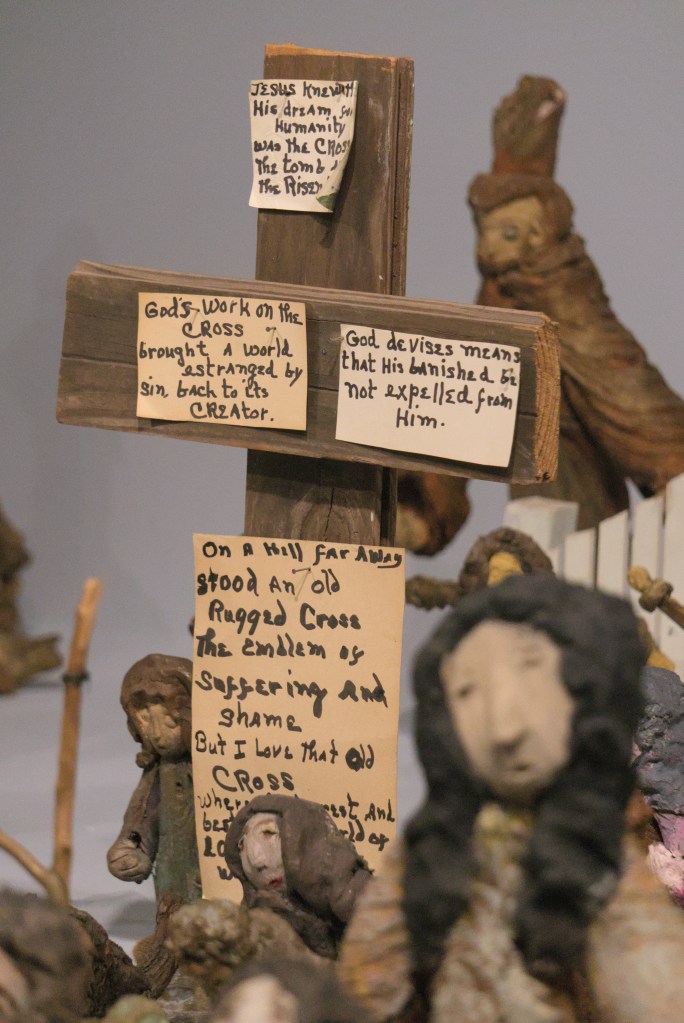
By the time Annie died in 1986 she had made about 2,500 figurative sculptures[5] inspired by the Old and New Testaments, on subjects like Jacob’s Ladder, the Exodus, Daniel in the Lions’ Den, Belshazzar’s Feast, the Visitation, the Flight to Egypt, the Sermon on the Mount, the Holy Women at the Tomb, Paul and Silas in Jail, and many more. Notably, there’s no Crucifixion scene; Annie said she couldn’t bear to put nails in the hands and feet of Christ.[6] And so we get empty crosses instead.
The final group she worked on, left unfinished when she died, was forty-seven grieving Hebrew mothers who had lost their sons to Pharaoh’s death edict (Exod. 1:22). This story of infant male genocide, along with its correlative in Matthew 2:16–18, is one she returned to frequently throughout her four decades of art making, as it held strong resonances for her. She likened her son’s being sent away to war to his being thrown to crocodiles.
Mournful moms are everywhere in Annie’s work, Manley said—“surrounding Lazarus, overlooking scores of dead babies, at the foot of the cross(es). She identified with all women experiencing loss. In WWII dead sailors (mostly American and British) occasionally washed up on the beaches near her house after their ships had been sunk by U-boats, and she pitied their mothers as well. It was a major thread running through the whole display.”[7]
Not all the figures correspond to characters in the Bible. Some are simply “bringing the message,” Annie said.[8] They may illustrate a hymn, such as “Will There Be Any Stars in My Crown?,” “It Is Well with My Soul,” “All Hail the Power of Jesus’ Name,” or “The Old Rugged Cross.”
Wanting to share these visual stories, Annie frequently welcomed visitors into her home, giving performative tours that involved narration and interactivity. For example, she would lean the Jesus figure over the prone Lazarus figure and bid him rise, or she would roll the stone away from Christ’s tomb while saying, “This is what God wants each of us to do—to roll away the stone of unbelief from our hearts.”[9]
Lazarus
In 1978 Annie’s husband became paralyzed from a stroke, and she stopped creating until John’s death in 1982 so that she could take care of him. She was devastated by the gradual loss of her best friend to whom she had been married for sixty-plus years and who had always supported her (some would say eccentric) calling. But even as John lay ill and as she grieved, she still welcomed people in to experience the mixed-media spectacle she had built in their living quarters, as she wanted it to continue fulfilling its main purpose of edification.
She set up hundreds of signs with messages—handwritten in marker on pieces of paper and foam meat trays—to accompany the figures so that people could take their own self-guided tours. Some of these consist of Bible quotations or hymn lyrics, but most are distillations of her own spiritual wisdom, in her own words, or else personal prayers. Examples include:
“God’s intent is that man should come to Him and enjoy Him forever.”
“Through the ages, heaven will never cease to resound with the glad hallelujahs from the grateful hearts of the redeemed.”
“The cry of the heart for God is the cry that brings down blessings from that high source.”
“There is a place where the tears of the forgiver and the forgiven mingle together (at the foot of the cross).”
“God’s work on the cross brought a world estranged by sin back to its Creator.”
“Whatever honors God, help me to take delight in.”
“Lord, bring me to the place where mine eye seeth Thee.”
(And the occasionally humorous) “Keep out of the manger, Santa Clause [sic]. That belongs to the Baby Jesus.”
Jesus (with donkey in foreground, from another scene)
Reflecting back on her life’s work, Annie said,
I feel like I’ve been dedicated and set apart for God’s work. I believe that, but I haven’t gotten to the point that I’m perfect. I’m not an angel, I’m an aged imp. I can only live in hope, fully believing that God will bless me by making me a blessing to others, and I think I have been. When people come, they come seeking something of the supernatural, and they get it when they get God’s word. Here they get not only God’s word but they get a symbol resembling the thought that they have.
My work is all the work of love, working out the biblical scenes that will last through the ages long after I’m gone. That is my motive, that is my purpose, making figures with some spiritual thought to go along. When I look back over the work I’ve done it amazes me—but still it is not something to be worshipped. It is something that will tell a story.[10]
In a different interview, at age eighty-seven, Annie described how she works in collaboration with God, in a sense, who has uniquely equipped her for the work:
I feel like I’ve had help. I feel like the Lord’s given me the desire to do, and the talent to do, and the material to work with, and the time to do. So I really feel like I’ve been a coworker, not only in making the material that I have, but also explaining it to those who come.[11]
Brimming with faith and battling emotional and mental distress, Annie created a world, channeling her pain and anxieties as well as her hopes and joys into the making of hundreds upon hundreds of sculptures inspired by sacred scripture. Some of the figures look lost or forlorn, whereas others look peaceful, even beatific; still others appear playful. She felt she could identify with many of the people represented—e.g., Job in his affliction, the Virgin Mary in her surrender.
Annie saw in these biblical stories a reflection of the human experience and assurances of how God meets us in our brokenness (in our doubts, fears, failures, sickness, grief, or what have you), bringing salvation. Lament and praise are joined together in her oeuvre.
Unfortunately, the AFAM exhibition does not preserve the narrative groupings of the figures, instead arranging them roughly by size and placing them all on the same level facing forward, rather than having them interact with one another. There are no visual dividers or spotlights to help viewers navigate the bunches. As such, and lacking much of Annie’s interpretive signage, it’s nearly impossible to precisely identify any of the characters or to discern a plot—though Manley was able to confirm a few of my hunches (labeled in my captions) and to guide me in identifying a few other figures.
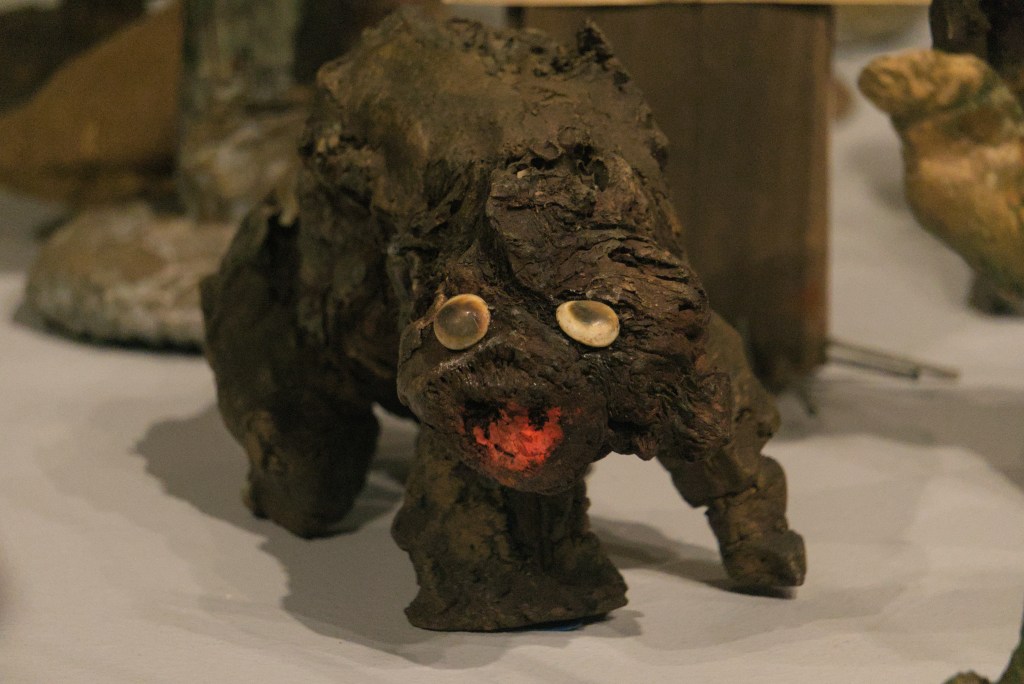
I was puzzled by the presence of what I thought might be a bear.
Manley suggested that it is probably a Gadarene swine from the story of Jesus healing a demoniac (Mark 5:1–20) but that it could also be from Annie’s “Valley of the Shadow of Death” scene, which featured a large human figure lying down on a piece of green shag carpet (a green pasture) surrounded by scary black and purple creatures.
Even in her lifetime, Manley informed me, Annie’s scenes were unfixed, constantly shifting and evolving. “Many of Annie’s figures played multiple roles,” he said. “If she had to move a scene to a different part of the house to make way for more, and the new location was too small to accommodate the entire scene, she would repurpose the ‘extras’ and make them part of some other scene. Her environment was not static—every time I went (perhaps 20 times?) a majority of the scenes would have been relocated and rearranged. Only a few ‘stayed put.’”[12]
Roger Manley, whose friendship with and research on Annie I’ve relied on extensively for this article, became the caretaker of Annie’s work after her death. He first encountered it in 1970 when, on Christmas break after his first semester at Davidson College, he was hitchhiking and happened to be picked up by one of Annie’s grandsons. Thinking Manley would be amused by his grandma’s sculptures, he brought him to the house. Manley was enthralled by what he saw. He took photos and returned many times since, each time developing a keener sense of responsibility to preserve the work for posterity.
At Manley’s behest, Catherine Peck, a graduate student in the folklore program at the University of North Carolina at Chapel Hill, spent August 1984 at Annie’s house in Buxton, labeling and photographing her work and interviewing her. When Annie died in 1986, she bequeathed all her sculptures to the Jargon Society in Highlands, North Carolina, which Manley helped arrange.
Ownership was transferred to North Carolina State University around 1988, when Manley curated the first solo exhibition of Annie’s work, A Blessing from the Source, at the university’s Visual Arts Center (now the Gregg Museum of Art & Design), showcasing six of her scenes and twenty-five photographs. The exhibition opened with an international symposium, the United States’ very first on visionary/self-taught/outsider art, which included participants from the Collection de l’Art Brut in Lausanne (Geneviéve Roulin), the Musgrave Kinley Outsider Art Collection (Monika Kinley), the Adolf Wölfli Foundation (Elka Spoerri), the Prinzhorn Collection (Inge Jádi), Rebecca Puharich (later to become Rebecca Hoffberger, founder of the American Visionary Art Museum in Baltimore), Roger Cardinal (author of Outsider Art, which named the “field”), John MacGregor (author of The Discovery of the Art of the Insane), Sam Farber (one of AFAM’s great champions, who largely funded their previous building next to MoMA), and others.
In 1995 Manley organized a much larger exhibition at NC State, A Multitude of Memory: The Life Work of Annie Hooper, that displayed the whole lot they had inherited.
In 2017 the Gregg Museum (of which Manley is the director) transferred the Annie Hooper Bequest to the Kohler Foundation for conservation treatment and stewardship. While many of the sculptures remain in the permanent collection of the Gregg and the John Michael Kohler Arts Center kept 233, the rest have been donated to nine other museums across the country—including the American Folk Art Museum, where I had the pleasure of being introduced to Annie’s work!
If you’d like to find out more about Annie Hooper, check out the freely accessible Digital Southern Folklife Collection at UNC, which houses four audio interviews and three on-site video tours with Annie, and the nineteen-page exhibition catalog from 1988, A Blessing from the Source.
All photos in this article, except the one of Annie Hooper, were taken by me (Victoria Emily Jones) at the multi-artistMultitudesexhibitionat the American Folk Art Museum in Manhattan in August 2022. The exhibition runs through September 5.
NOTES:
1. ^“The Life Summary of Edgar Ormond,”FamilySearch. Cf. Annie Hooper, interview by Catherine Peck, 1984, tape 1: Side 1, Catherine Peck Collection, 1981–1988, in the Southern Folklife Collection, Louis Round Wilson Special Collections Library, University of North Carolina at Chapel Hill, NC.
3. ^ Roger Manley, email to the author, August 23, 2022.
4. ^ Roger Manley, email to the author, August 21, 2022.
5. ^ “As for numbers of objects, there are about 2500 human and angel figures, dead babies, birds, crocodiles, sheep, lions, etc., and some 500 more ‘accessories’: bases for inserting artificial flowers, driftwood stumps that provided landscaping, gold-painted miniature furniture (all crudely made by Annie), textiles (shrouds, swaddling cloths, etc.), concrete food items (for various suppers and feasts, loaves and fishes). The original inventory included everything—bunches of plastic flowers, rotating color-wheel lights, garlands of tinsel—hence the 5000 number. The materials these were made of did not survive long-term storage, however; over time, low-grade plastics begin to turn gooey or brittle, tinsel sheds, etc., so the object count shrank.” Roger Manley, email to the author, August 21, 2022.
6. ^ Annie Hooper, interview by Catherine Peck, 1984, tape 6: Side 1.
PODCAST EPISODE: “Incarnation and Imagination (with Malcolm Guite),”Imagination Redeemed: On March 28, 2015, the Anglican poet-priest Malcolm Guite from Cambridge, England, gave a talk in Colorado Springs for the Anselm Society, an ecumenical Christian organization whose mission is a renaissance of the Christian imagination. They have just released it on their podcast.
Guite discusses how the job of the arts is to link earth and heaven, heaven and earth; where a poem or other work of art stays on only one of those planes, it typically fails. He unpacks Theseus’s monologue from Act 5, scene 1 of Shakespeare’s A Midsummer Night’s Dream, focusing on these six lines: “The poet’s eye, in fine frenzy rolling, / Doth glance from heaven to earth, from earth to heaven. / And as imagination bodies forth / The forms of things unknown, the poet’s pen / Turns them to shapes and gives to airy nothing / A local habitation and a name.”
Shakespeare, Guite says, is riffing on the prologue to John’s Gospel.
The Logos . . . is bodied forth perfectly and beautifully in the living, walking poem of Jesus Christ, in whom everything eternal is made particular, and who invites everybody to come towards him . . . because he is a habitation with open doors. So of course in John’s Gospel he says, ‘I am the door’! . . . Open up, walk in! (48:51)
And one more quote from Guite!
The church . . . is founded by one who is himself artistically embodied meaning—meaning made visible, meaning made beautiful, meaning made habitable and hospitable and welcoming in the touch of the body and in the physical event, which is then transfigured, because it is also a meaningful event, because earth and heaven meet. (55:34)
It’s a brilliant and inspiring talk, and it integrates other poetic verse besides Shakespeare’s.
>> “King Clave” by Planet Drum: In 1991 Mickey Hart (best known as a drummer of the Grateful Dead) and Zakir Hussain (a classical tabla virtuoso from Mumbai) formed the Grammy-winning global percussion ensemble Planet Drum, bringing together the world’s greatest rhythm masters into a one-of-a-kind improvisational supergroup. Prompted by ongoing international strife, Planet Drum reconvened over the past two years to record their third album, In the Groove, which released August 5. It features six unique compositions led by Hart, Hussain, Sikiru Adepoju of Nigeria, and Giovanni Hidalgo of Puerto Rico.
The centerpiece of the album is “King Clave” (the clave is a rhythmic pattern), created in partnership with Playing for Change and with funding from the United Nations Population Fund. The four core musicians mentioned above are joined by other percussionists and dancers from around the world. The music video uses the “Alternate Version” of the performance, released separately as a single.
Learn more about the Planet Drum project in this six-minute video:
+++
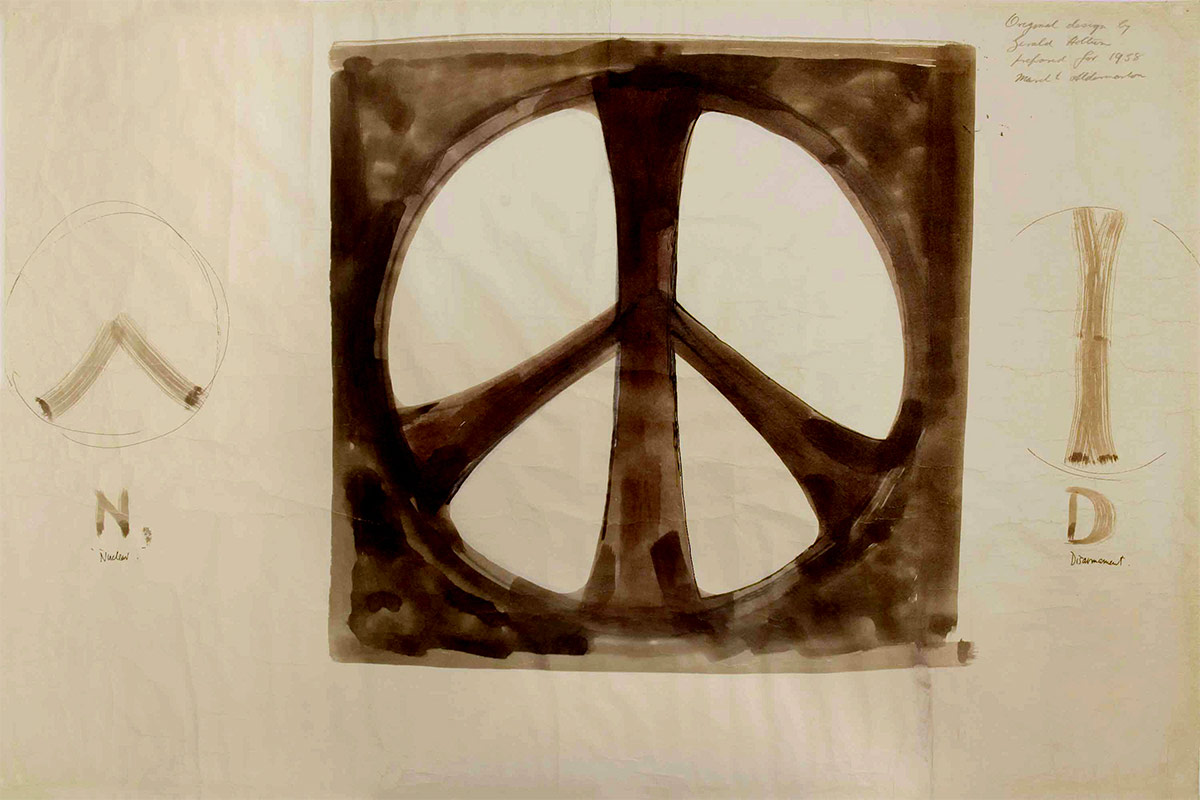
STILL LIFE EDITION: “The History of the Peace Symbol” by Michael Wright: Did you know that the peace symbol that spread worldwide during the 1960s was designed by a Christian from the UK? (Christian pacifism was one of the underappreciated drivers of the nuclear disarmament and antiwar movements.) Learn more about the symbol’s history and art historical and nautical influences in the August 15, 2022, edition of Michael Wright’s weekly letter on art and spirit, Still Life. Also included is the poem “Wildpeace” by Yehuda Amichai, and four weblinks of interest, such as an article on how the patristic tradition agrees with cognitive neuroscience, and a video of FKA Twigs performing in a church!
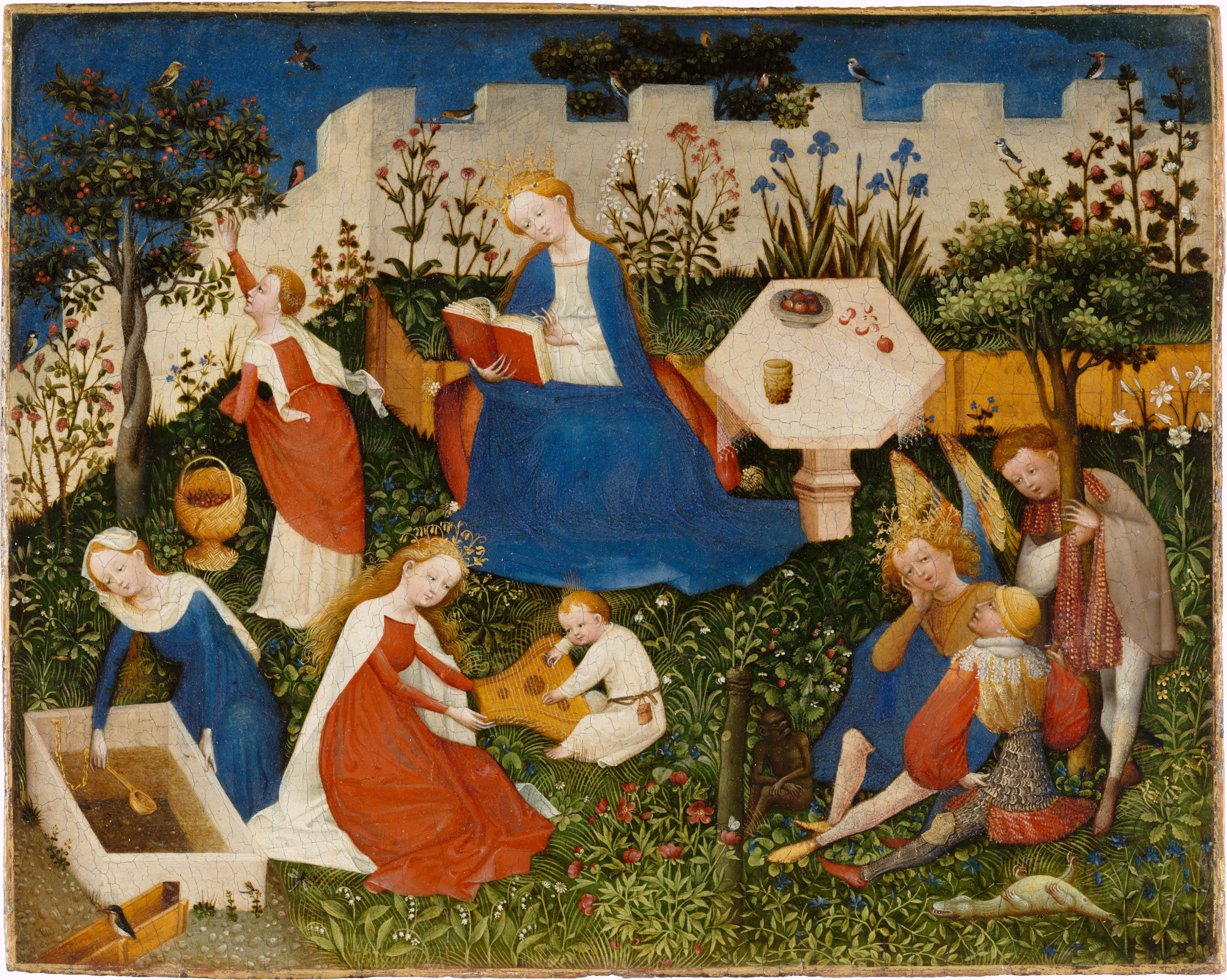
VIDEO LECTURE: “Symbolism and Sacramentality in Art: Medieval and Postmodern Representations of the Little Garden of Paradise” (Religion and Art Talks) by Tina Beattie: Dr. Tina Beattie is a professor emerita of Catholic Studies at the University of Roehampton whose research is at the intersections of art, gender, and theology. In this talk she explores the sacramental imagination of the medieval world through a Late Gothic painting from the Rhineland known as The Little Garden of Paradise. (You can zoom in in tremendous detail on the Städel Museum’s website.) It shows Mary reading in an enclosed garden in the company of saints, her little boy Jesus playing a psaltery at her feet. “Christ retunes the cosmos,” Beattie says. “The harmonies of creation were disrupted by sin. But all of creation is brought back into harmony through the Incarnation.”
Symbolism and allegory abound in medieval religious paintings, encoding profound meanings that can be discerned if we would but take the time to look and to meditate and to understand the world from which these images arose. “The visual image can say things that the theological text can’t,” Beattie asserts. “It can play with the doctrinal truth in ways that allow other meanings to emerge discreetly.”
Though many interpretations of hortus conclusus imagery focus on Mary’s virginity, and indeed that was a primary aspect motivating the creatives who developed such imagery, Beattie draws out themes of new creation and discusses the garden as the human soul.
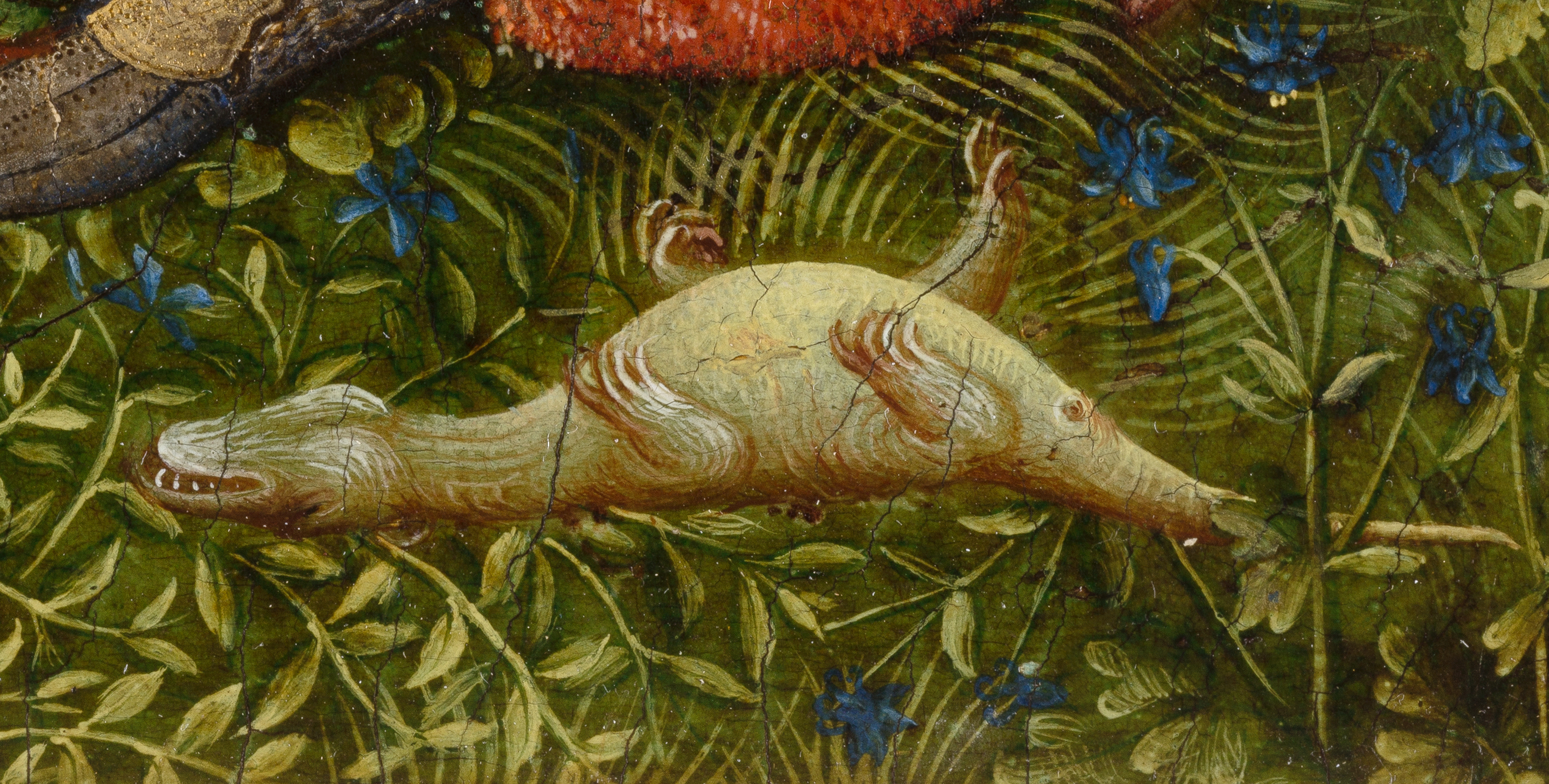
The Little Garden of Paradise, Upper Rhine, ca. 1410–20. Mixed media on oak, 26.3 × 33.4 cm. Städel Museum, Frankfurt am Main, Germany.A small, slain dragon lies belly-up beside a man in greaves and chain mail, probably Saint George.
The other artworks she glosses are:
Resurrection XI by Edward Armitage Robinson (1963)
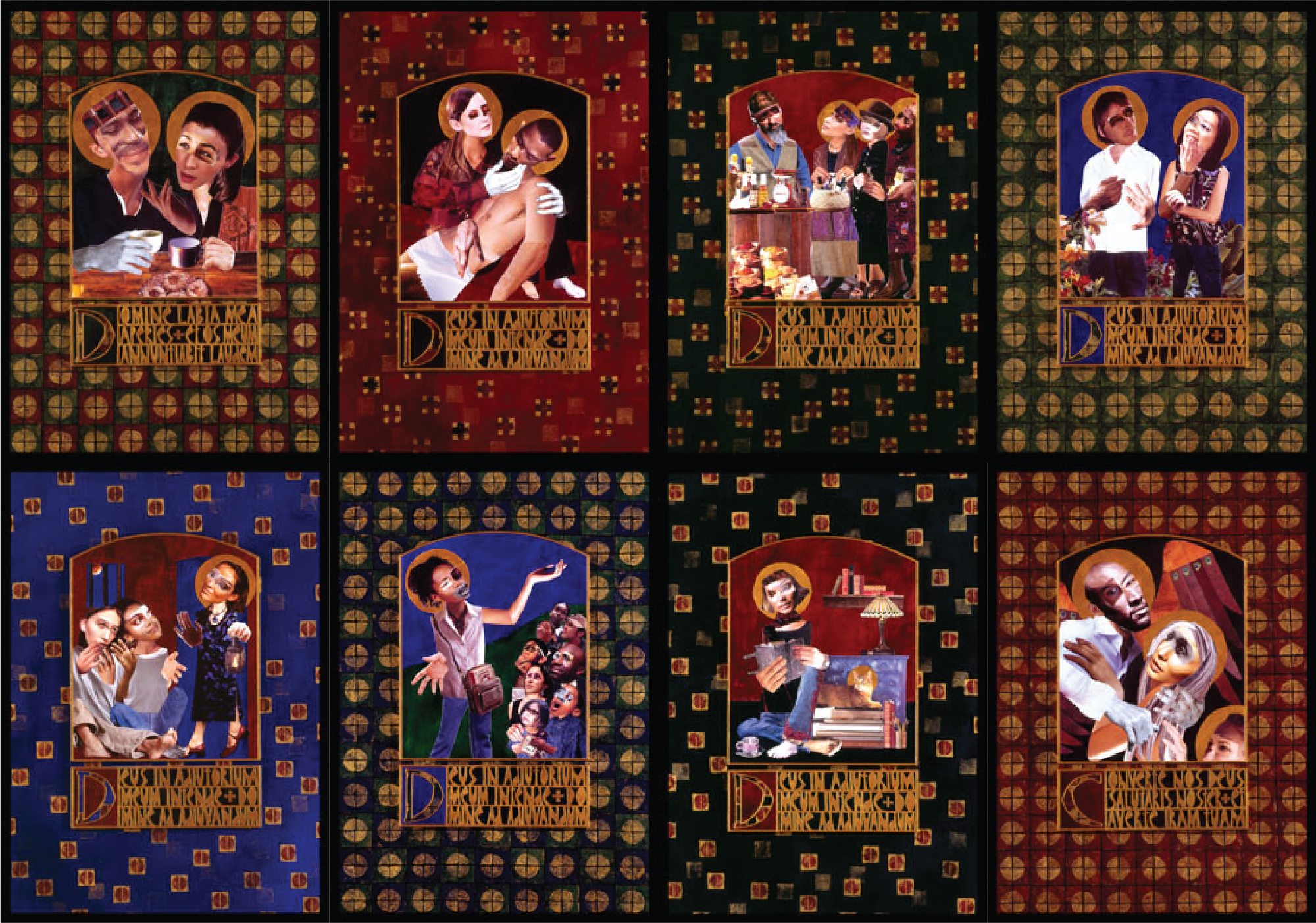
ART CYCLE: The Hours of Mary Magdalene by Jan L. Richardson: July 22 is the feast day of Mary Magdalene, one of Jesus’s closest disciples and the first witness and preacher of the Resurrection. American artist, writer, and minister Jan L. Richardson created a sequence of collages picturing events from her life, drawing on both the biblical narratives and medieval legends. The structure and presentation (decorative borders, Latin script) were inspired by medieval books of hours, used for the praying of the Divine Office. The text below each image reads, Deus, in adiutorium meum intende; Domine, ad adiuvandum me festina (“O God, come to my assistance; O Lord, make haste to help me”), the first verse of Psalm 70, which is prayed at the start of each of the canonical hours.
According to legend, after Jesus’s ascension Mary Magdalene moved to southern France, where she preached the gospel and performed miracles. The last thirty years of her life she lived as a hermit in a cave. Each time she prayed the hours, she was lifted up to heaven by angels, then brought back down at the end of her devotions.
Richardson put together a delightful little video showcasing the art cycle as well as the song “Mary Magdalena” by her late husband, Garrison Doles.
You can purchase these images as digital downloads from Richardson’s website:
DANCE: “Holy, Holy, Holy”: Choreographed by Betsey Beckman to a song by Karen Drucker, this dance number affirms the sacredness of every human being. It was filmed inside St. Gregory of Nyssa Episcopal Church in San Francisco, a church that “invites people to see God’s image in all humankind, to sing and dance to Jesus’ lead, and to become God’s friends.” Beckman dances with Dawon Davis and Corey Action throughout the worship space, which comprises a rectangular room where the Liturgy of the Word is celebrated and an octagonal rotunda for the Liturgy of the Table. The Dancing Saints icon that covers the walls is by Mark Doox. [HT: Global Christian Worship]
+++
MUSIC:
>> “Locus iste” by Anton Bruckner, performed by VOCES8: The British vocal ensemble VOCES8 performs Anton Bruckner’s sacred motet “Locus iste” (This Place) at Les Dominicains de Haute-Alsace in Guebwiller, France. Bruckner composed it in 1869 for the dedication of the Votivkapelle (votive chapel) at the New Cathedral in Linz, Austria, where he had been a cathedral organist. The text—a Latin gradual for church dedications and their anniversaries—is informed by Jacob’s saying, after his dream of the ladder uniting heaven and earth, that “surely the Lord is in this place; and I knew it not” (Gen. 28:16), and by the story of the burning bush where Moses is told to “put off thy shoes from off thy feet, for the place whereon thou standest is holy ground” (Exod. 3:5).
Locus iste a Deo factus est, inaestimabile sacramentum; irreprehensibilis est.
This place is made by God, a priceless sacrament; it is without reproach.
(Or, alternatively:) This dwelling is God’s handiwork; a mystery beyond all price, that cannot be spoken against.
>> “Tabernacle” by Josh Rodriguez, performed by Mary Vanhoozer: A modernist piano composition inspired by Psalm 19, dedicated to the composer’s father-in-law, the theologian Kevin Vanhoozer.
Tabernacle is a musical triptych shaped by the drama of Psalm 19. While this word, tabernacle, is loaded with religious affection within both Jewish and Christian traditions, some modern readers may not be familiar with its implications. Merriam-Webster offers three related definitions: “a house of worship, a receptacle for the consecrated elements of the Eucharist, or a tent sanctuary used by the Israelites during the Exodus.” By extension, it has come to represent a “dwelling place” or a “temporary shelter.” In short, this is no ordinary space, rather it is a place that is set apart, made holy for a terrifying transformative encounter with the Divine.
Fragments of a prayerful hymn-like melody appear underneath this canopy of sounds. Shifting metric changes, polyrhythms, and percussive primal-sounding harmonies climax in a loud, noisy quote from the 16th-century Genevan Psalter.
More extensive program notes can be found in the YouTube video description.
+++
ESSAY: “Precedents of the Unprecedented: Black Squares Before Malevich” by Andrew Spira, Public Domain Review: Considered one of the seminal works of modern art, Kazimir Malevich’s Black Square (1915) has been cast as a total break from all that came before it. Yet searching across more than five hundred years of images related to cosmology, religious devotion, mourning, humor, politics, and philosophy, art historian Andrew Spira uncovers a slew of unlikely foreshadows to Malevich’s radical abstraction.
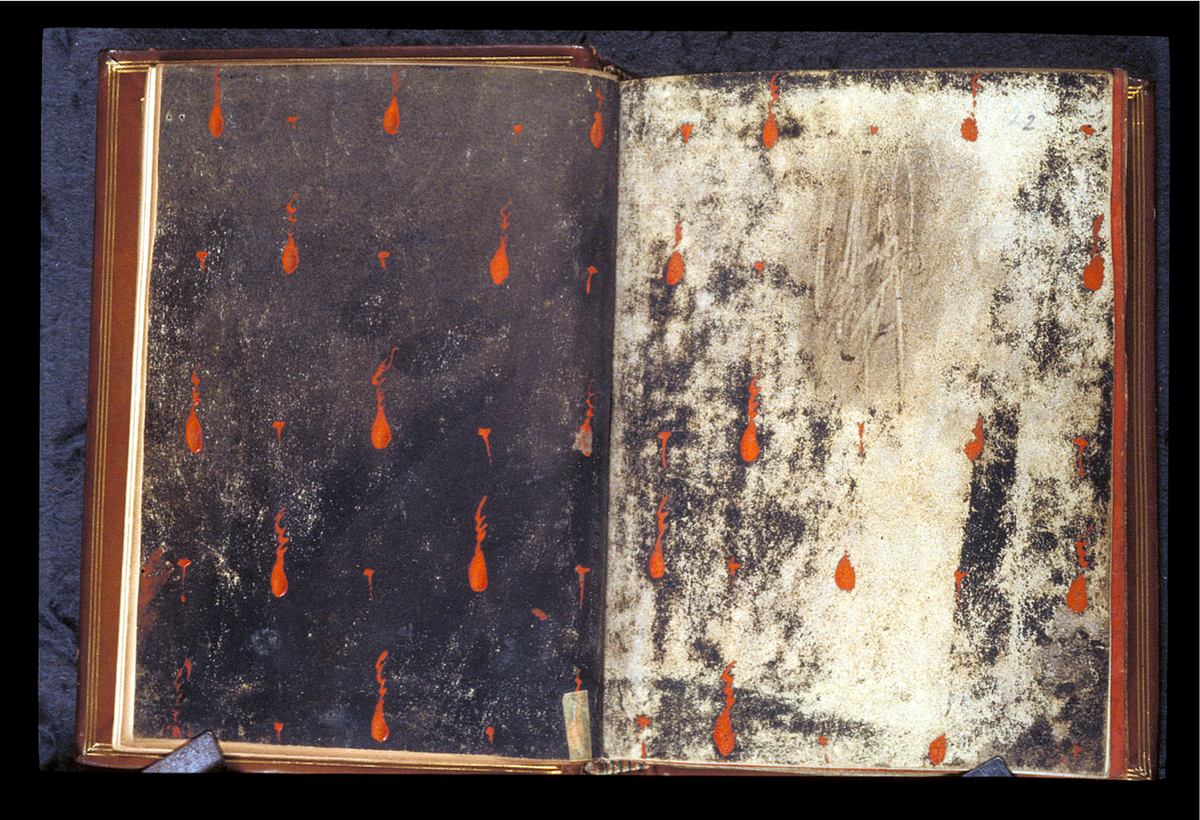
Robert Fludd’s black square representing the nothingness that was prior to the universe, from his Utriusque Cosmi (1617). On each side of the square is written “Et sic in infinitum…” (“And so on to infinity…”).Black pages with red drops of blood, signifying the wounds of Christ, from a psalter and rosary of the Virgin, ca. 1500. The recto is worn from devotional engagement, damaged through kissing and rubbing, perhaps.
For a much more extensive treatment of the topic, see Spira’s Foreshadowed: Malevich’s “Black Square” and Its Precursors, published this month. And for a faith-positive (non-nihilistic) reading of Malevich’s Black Square that honors the artist’s own views, see pages 209–25 of Jonathan A. Anderson and William A. Dyrness’s Modern Art and the Life of a Culture, where they discuss the work in relation to the Russian icons tradition and “apophatic or ‘negative’ theology—a mode of theology that meditates on the absolute Fullness and Otherness of God by way of negating the verbal, visual and conceptual forms used to signify (and to ‘grasp’) God” (220).
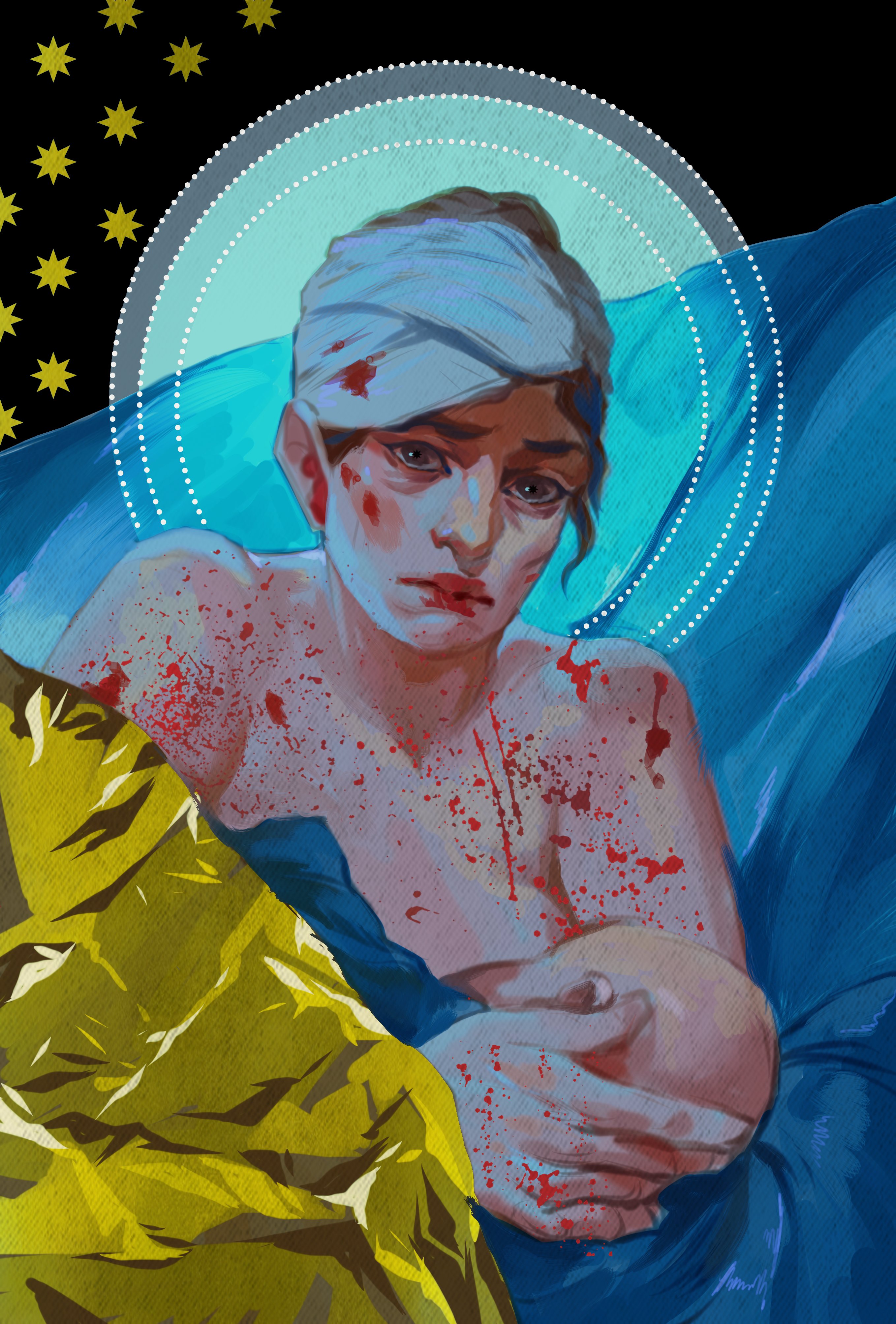
UKRAINIAN MADONNAS: Since Russia invaded Ukraine on February 24 and even still continues to aggress, artists have taken up their art to address the war—several drawing on iconography of the Madonna and Child, particularly the Maria lactans (breastfeeding Mary) type. Two Ukrainian artists were inspired by different news photos of young mothers protecting their infants from the shelling in Kyiv in March—one of whom was photographed in a hospital being treated for wounds she sustained from fallen glass while shielding her daughter with her body, and the other hiding from the blasts in a subway station.
These images show the vulnerability of Christ, who is with us in our suffering, and indict those who cause such suffering.
In his response to the war in Ukraine, Serbian artist Michael Galovic, who lives in Australia, also uses Christian iconography: the Theotokos Kyriotissa (Mother of God enthroned with Christ); Archangel Michael, the patron saint of Kyiv, fighting a dragon (Rev. 12:7–8) in an ethereal rendering of a scene from the Très Riches Heures du Duc de Berry, a fifteenth-century French book of hours; and a hellmouth from the twelfth-century Winchester Psalter. These three medieval images are superimposed on Picasso’s masterwork Guernica, named after the Spanish town bombed by Nazis in 1937 and representative of the horrors of war.
Michael Galovic (Serbian Australian, 1949–), Ukraine Response, 2022. Egg tempera and gold leaf on linen on board, 170 × 80 cm. Collection of the Australian Centre for Christianity and Culture, Canberra, Australia.
Whereas Frirean’s and Solomennykova’s paintings are more intimate, Galovic takes a more cosmic approach, showing wails of lament from abstracted forms intercut with epic battles between good and evil—but at the calm center, Christ is on the throne, holding the scroll of his good word. History is going somewhere. Hate will be damned. Love will triumph.
>> “Galoba (The Prayer),” performed by Trio Mandili: A sung performance of a poem written in 1858 by the Georgian poet and statesman Ilia Chavchavadze (1837–1907). An English translation follows.
Our Father, who art in heaven, With tenderness I stand before thee on my knees. I ask for neither wealth nor glory; I won’t debase my holy prayer with such matters. I desire instead for my soul to be enlightened by heaven, My heart to be radiant with thy love. Even if my enemies pierce me in the heart, I beg thee: “Forgive them, Lord, for they know not what they do!” Even if my enemies pierce me in the heart, I beg thee: “Forgive them, Lord, for they know not what they do!” [source, adapt.]
>> “Peace All Over the World” by Robert Bradley: Written and performed by Detroit musician Robert Bradley, this song originally appeared on the film Playing for Change: A Cinematic Discovery of Street Music (2005). To celebrate their twentieth anniversary, Playing for Change [previously] has remastered it and added new footage from Ukraine.
>> “Du som gick före oss” (You Who Went Before Us) |Words by Olov Hartman, 1968 | Music by Sven-Erik Bäck, 1959 | Performed by VOCES8, 2022: The melody uses all twelve semitones of the octave! I’ve provided a literal English translation of the Swedish below with the help of Google Translate; for a looser but more poetic translation by Fred Kaan, from 1976, see here. Note: The video identifies the song parenthetically as Psalm 74, not because it’s a setting of Psalm 74 from the Bible, but because it is no. 74 in Den svenska Psalmboken, the official hymnal of the Church of Sweden.
Du som gick före oss
längst in i ångesten,
hjälp oss att finna dig,
Herre, i mörkret.

Du som bar all vår skuld
in i förlåtelsen,
du är vårt hjärtas fred,
Jesus, för evigt.

Du som med livets bröd
går genom tid och rum,
giv oss för varje dag,
Kristus, det brödet.

Du som går före oss
ut i en trasig värld,
sänd oss med fred och bröd,
Herre, i världen.
You who went before us
in the depths of anxiety,
help us to find you,
Lord, in the dark.

You who bore all our guilt
into forgiveness,
you are the peace of our hearts,
Jesus, forever.

You who are the living bread
offered abundantly through all the earth,
give us each day,
dear Christ, that bread.

You who go before us
out into a broken world,
send us out likewise, Lord,
with peace and bread.
“The wild animals honor me, the jackals and the owls, because I provide water in the wilderness and streams in the wasteland . . .”
—Isaiah 43:20 (NIV)
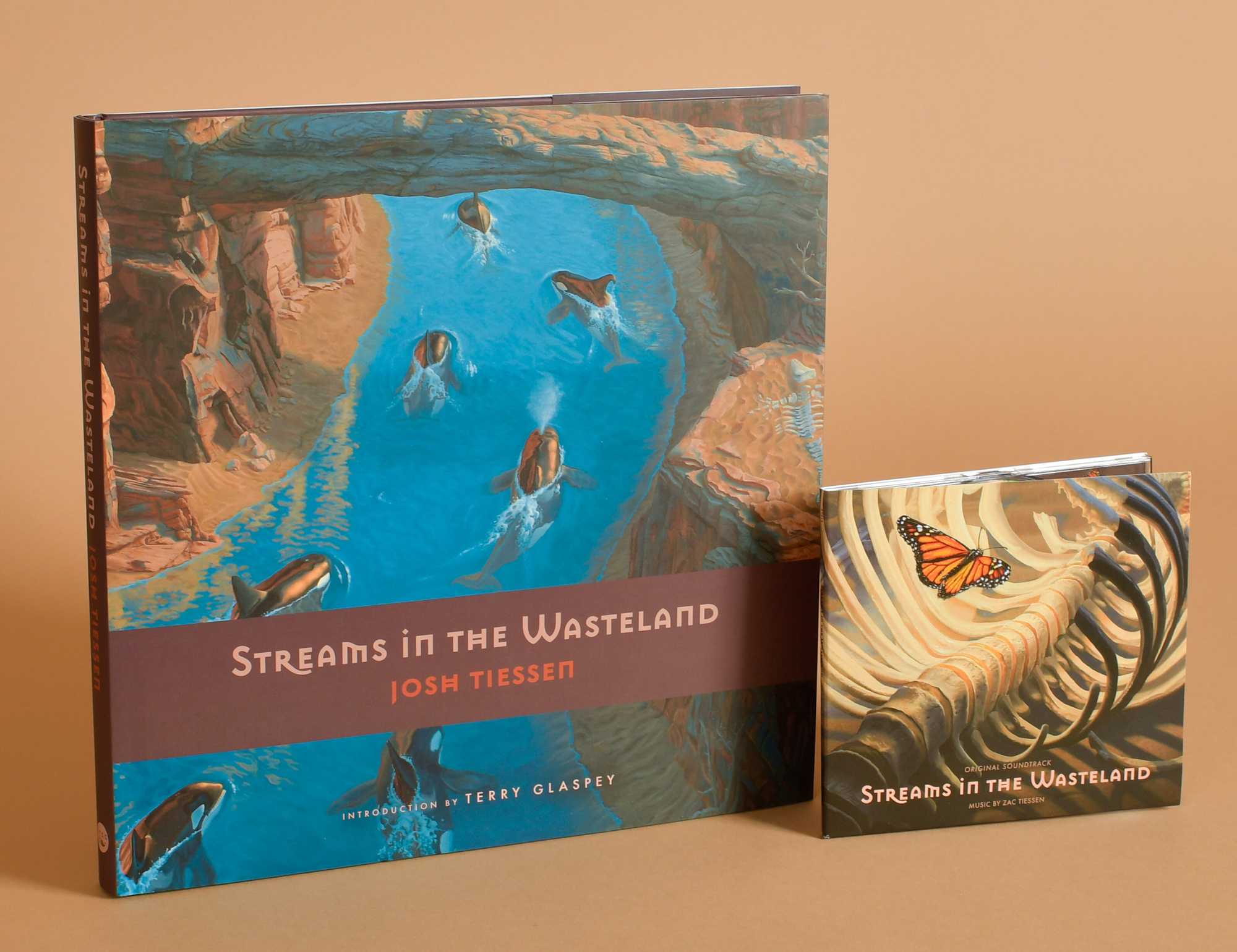
This verse from the prophetic book of Isaiah supplies the title of artist Josh Tiessen’s Streams in the Wasteland series. Comprising seventeen paintings of wild animals inhabiting abandoned cities, it took six years to complete, from 2015 to 2021. In this body of work Tiessen weds a biblical imagination with his passion for wildlife conservation to promote ecological ethics, or what Christians call “creation care”—the biblical imperative to be benevolent stewards of the environment and all its creatures. He says he wants to represent “the majesty, particularity, and beauty of animals” (Streams in the Wasteland, p. 33)—to evoke wonder, love, and empathy, and a greater sense of responsibility.
“The whole creation has been groaning,” the apostle Paul writes in Romans 8, seeking to “be liberated from its bondage to decay and brought into the freedom and glory of the children of God.” Creation has been damaged in large part by humanity’s sin, which has caused deforestation, land degradation, ozone depletion, and species endangerment and extinction, among other harms. Instead of enjoying the full flourishing God intended, the natural world suffers.
Streams in the Wasteland engages with the question, What would the liberation of animals from the bondage to decay look like? Some of Tiessen’s creative visual responses:
An Indian temple elephant breaks free of its shackles, no more to be prodded and paraded for the people’s religious festivals.
Released from aquarium amusement parks where they were exploited for entertainment, a pod of orcas journeys down a canyon river into the ocean past their ancestors’ skeletal remains, which will one day rise.
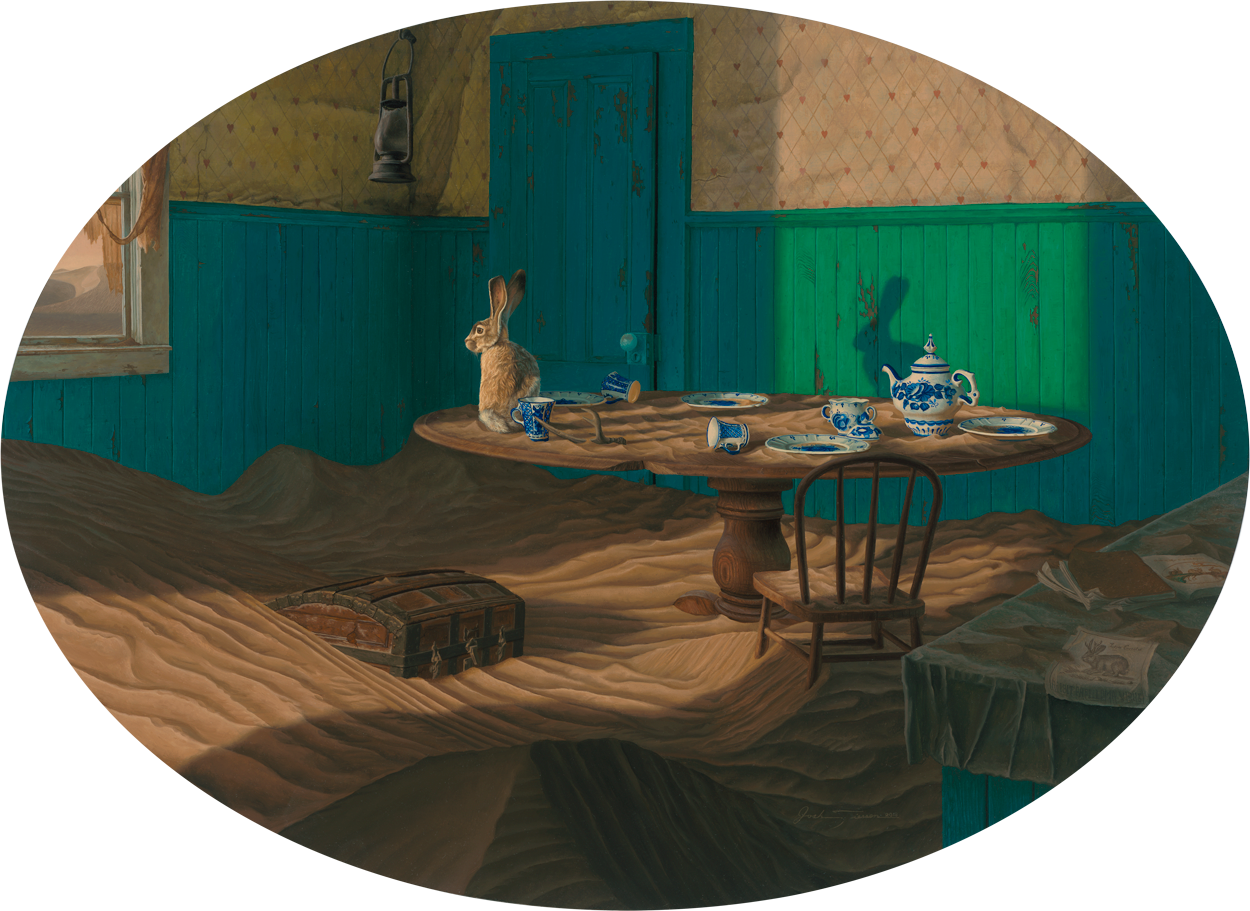
A jackalope—the mythical horned rabbit of North American folklore—sheds its antlers, a passing shadow of the old world. Rabbits with hornlike protrusions on or near their heads have actually been found in nature, the cancerous growths a result of a papillomavirus.
Josh Tiessen (Canadian, 1995–), Liberation of the Jackalope, 2018. Oil on braced Baltic birch, 21 × 29 in.
Tiessen calls his style “narrative hypersurrealism,” as he renders the animals with technical precision and great attention to naturalistic detail (hyperrealism) but places them in a postapocalyptic context, revealing strange beauty in the unexpected (surrealism). And in contrast to traditional wildlife art, Tiessen’s art tells a story. For Streams in the Wasteland, that story is one of reclamation and healing—but also one of warning for those who neglect God’s laws.
In preparation for this series, Tiessen wrote a research paper on zoological motifs in the book of Isaiah. He found that in several prophecies of judgment, God gives animals dominion over human civilization—an ironic reversal, the “weak” shaming the powerful.
Babylon, the jewel of kingdoms, the pride and glory of the Babylonians, will be overthrown by God like Sodom and Gomorrah. She will never be inhabited or lived in through all generations; there no nomads will pitch their tents, there no shepherds will rest their flocks. But desert creatures will lie there, jackals will fill her houses; there the owls will dwell, and there the wild goats will leap about. Hyenas will inhabit her strongholds, jackals her luxurious palaces. Her time is at hand, and her days will not be prolonged.
In addition to Babylon, Isaiah indicts other unjust nations: in Cush the fruit of the vine “will all be left to the mountain birds of prey” (18:6), and in Edom “the desert owl and screech owl will possess it; the great owl and the raven will nest there” (34:11). Concerning the kingdom of Judah: moles and bats will take over idols of silver and gold (2:20), lambs will feed on the food of the rich (5:17), and Jerusalem will become void of human activity and instead be “the delight of donkeys, a pasture for flocks” (32:14). It’s not just nocturnal animals and scavengers that crop up, but also harmless ones like foals and sheep.
Returning to the opening quote of this article, we see that Isaiah describes an eschatological reality in which God’s abundant provision elicits thanksgiving and praise from the animal kingdom. But they are Israel’s foil: whereas the animals are sensible of God’s goodness, God’s people are not. “Yet you have not called on me, Jacob. . . . You have burdened me with your sins and wearied me with your offenses” (43:22, 24).
Tiessen understands such animals “as the Creator’s special agents worthy of intrinsic value and a role in history. I caught a glimpse of Isaiah’s larger vision for animals serving as co-workers with the Creator to confront humanity, calling from within the ruins of human moral decay” (Streams in the Wasteland, p. 22).
Therefore, in Streams in the Wasteland, a barn owl stakes its place on a plinth of a Gothic cathedral alongside sculptures of the saints, meerkats lounge on a chaise inside a Baroque manor, lar gibbons swing from the entryway of a university, and a pack of spotted hyenas wanders through Bodie, a California Gold Rush boomtown known for its sin, now a ghost town.
Josh Tiessen (Canadian, 1995–), Occidental Babylon, 2017. Oil on braced Baltic birch, 52 × 75 in.
I’m very familiar with the Isaiah passages where creatures are presented as blessings of Edenic hope for the future, existing peaceably with humans (e.g., Isa. 11:6–9), but I had never really stopped to consider all the places where they are said to overtake what we deem human domains. Such passages are certainly more uncomfortable for us humans!
Though humans’ neglect or mistreatment of animals is not specifically what prompts God’s pledged use of animals to shame the rebellious nations, surely our disregard for the creation mandate in Genesis—to rule the earth with care and compassion—is a form of rebellion against God. And so Tiessen extends his reading of Isaiah to address that call in particular, which is echoed in other parts of scripture, such as Proverbs 12:10: “The righteous care for the needs of their animals.” By placing animals in human habitations, Tiessen compels us to remember our obligations to our nonhuman neighbors.
Perhaps my favorite painting from Tiessen’s series is Whale Hymn. The setting is the ruined shell of St. Dunstan-in-the-East, a twelfth-century church that once towered over the city of London but that was irreparably bombed during World War II. It has since been converted into a public garden. In his futuristic vision, Tiessen imagines it surrounded by floodwaters, a humpback whale swimming by. This giant of the deep sings its song to the Creator in the same place where generation after generation of Christians sang their praises until human violence rendered the building unusable.
Josh Tiessen (Canadian, 1995–), Whale Hymn, 2015. Oil on braced Baltic birch, 36 × 48 in.
Isaiah is not the only biblical source of inspiration for Tiessen. Ezekiel’s vision in the valley of dry bones inspired Can These Bones Live?, which shows a monarch butterfly gliding through the ribcage of a human skeleton, and its sequel, Rise Up—the only two paintings with human figures.
Tiessen was born in 1995 in Moscow to Canadian missionary parents. His Russian nanny, Lena Zhuk, taught him drawing basics, like perspective and shading, and, when he showed aptitude, bought him his first set of tempera paints, brushes, large heavy paper, and other materials. When he and his family moved back to Canada, Valerie Jones, a fellow church member and artist, noticed his talent and got him his first public art exhibition at age eleven. Then when Tiessen was fifteen, Canadian wildlife artist Robert Bateman took him on as a student and mentee. He graduated from high school at age sixteen and began exhibiting throughout North America while working on a bachelor’s of religious education in arts and biblical studies at Emmanuel Bible College in Kitchener, Ontario, which he earned in 2020. His professional memberships include Artists for Conservation, the Society of Animal Artists, and the International Guild of Realism.
He currently lives in Stoney Creek, Ontario.
Tiessen has self-published a hardcover, glossy-paged, full-color book that collates all the works from Streams in the Wasteland, providing commentary on them (additional to that on his website), which includes engagement with scholarly interpretations of the Isaiah passages. Through sketches and more, he sheds light on his artistic process and also provides autobiographical information. The book comes with a CD of instrumental compositions by his brother Zac Tiessen that respond to each of the paintings—an atmospheric soundscape. It would make a great gift.
The culmination of the series is Agnus Dei, a triptych featuring all the animals in the individual paintings gathering around a horned altar where the Lamb of God lies slain. Tiessen drew inspiration from Jan van Eyck’s Adoration of the Mystic Lamb, Francisco de Zurbarán’s Agnus Dei, and the paintings of Caspar David Friedrich featuring abandoned abbeys, churches, and cemeteries in winter.
Instead of saints from the Homo sapiens species surrounding the Lamb in worship, Tiessen shows a giant panda, a double-wattled cassowary, a narwhal, and other animals paying homage to Christ. They, too, are drawn up into God’s awesome story of redemption. They, too, participate in the “new thing” God is doing.
“My painting is . . . a critique of the human-centric bias within Western art history,” Tiessen writes. “This is best seen in Renaissance paintings where animals seldom appear, and if they do, it is simply for allegorical purposes. By enlisting wild animals as protagonists with intrinsic value amidst the wasteland of human existence, I endeavor to revise Western art history through a zoological lens, liberating the Judeo-Christian worldview from its perversion at the hands of anthropocentric Greek philosophy.”
This final image shows animals liberated from the effects of the fall, honoring the One whose atoning death and resurrection reconciles all to God (Col. 1:19–20).
To see which of these paintings are available for purchase—either the originals or reproductions or notecards—visit https://www.joshtiessen.com/store.
EXHIBITION: Afro-Atlantic Histories, National Gallery of Art, Washington, DC, April 10–July 17, 2022: There are still two more weeks to catch this excellent exhibition in the US capital, which I saw in June, before it travels to the Los Angeles County Museum of Art (December 11, 2022–April 30, 2023) and the Dallas Museum of Art (dates TBA). “For centuries, artists have told and retold the complex histories of the African Diaspora. Explore this enduring legacy in the exhibition Afro-Atlantic Histories, which takes an in-depth look at the historical experiences and cultural formations of Black and African people since the 17th century. More than 130 powerful works of art, including paintings, sculpture, photographs, and time-based media by artists from Africa, Europe, the Americas, and the Caribbean, bring these narratives to life.”
I wish I had more time to devote to it here before it wraps, as there are so many compelling artworks, but instead let me just share a two-minute video tour, followed by a lecture from April 10, which both provide a good overview:
The exhibition is divided into six sections: Maps and Margins, Enslavements and Emancipations, Everyday Lives, Rites and Rhythms, Portraits, and Resistances and Activisms. Kanitra Fletcher, associate curator of African American and Afro-Diasporic art at the National Gallery of Art, says in her talk,
The word histories in the title indicates the plurality of the narratives represented in the exhibition. They are fictional and nonfictional, mythical and factual. As a framework to coalesce narratives that have been left aside at the margins and forgotten, Afro-Atlantic Histories is open, plural, diverse, and inclusive, refusing the canon of traditional art history. This show resists the idea of a definitive history or a “grand narrative” of the Diaspora and presents diverse accounts of the past that challenge long-established hierarchies and forges new questions and connections that show how complex and intertwined are all of our histories.
Here’s an artwork that isn’t included in either of the above videos and that was new to me:
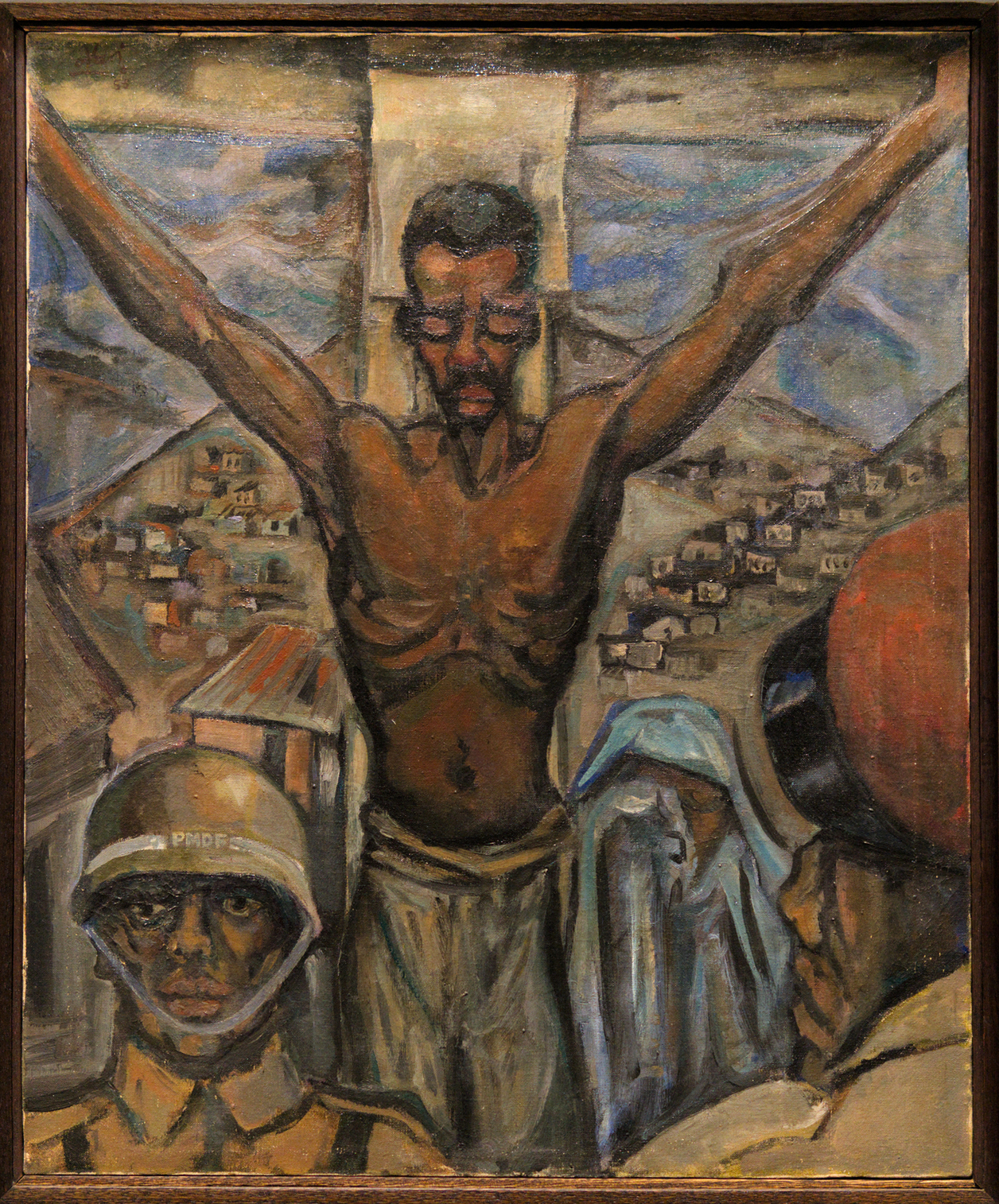
Octávio Araújo (Brazilian, 1926–2015), Cristo favelado (Slum Christ), 1950. Oil on canvas, 64 × 53 cm. Collection of the Instituto de Pesquisas e Estudos Afro-Brasileiros (IPEAFRO), Rio de Janeiro. Photo: Victoria Emily Jones, at Afro-Atlantic Histories at the National Gallery of Art, Washington, DC, June 2022.
Artist Octávio Araújo entered this painting in the Black Christ contest held in 1955 by the Teatro Experimental do Negro (Black Experimental Theater) in Rio de Janeiro (I mentioned this contest previously in relation to another submission, a painting by Djanira da Motta e Silva). It shows Christ crucified in a Brazilian favela, his Roman tormentors replaced with military police officers, perpetrators of state-sanctioned violence against the nation’s Black people.
+++
ONLINE COURSE: “Theology and the Arts,” with Jason Goroncy, Rod Pattenden, and guest artists, September 19, 20, 21, 26, 27, 28 and October 21, 2022: Whitley College, a teaching college of the University of Divinity outside Melbourne, is offering a seven-day intensive online course on theology and the arts this fall (description below), taught by the coeditors of the new book Imagination in an Age of Crisis: Soundings from the Arts and Theology. Registration is open to anyone, but participants will need to be available to engage live online from 9:30 a.m. to 3:00 p.m. (Melbourne time) on each of the scheduled days, for lectures, discussions, and other online activities, such as “meet the artist,” gallery visits, interviews, and student presentations. The cost to audit the course is AUD $500 (~ USD $343). There’s also an option to receive academic credit. Professor Goroncy writes,
When, in 1741, George Frideric Handel completed writing the Hallelujah Chorus for his oratorio Messiah, he reportedly told his servant: ‘I did think I did see all Heaven before me, and the great God Himself [sic] seated on His throne, with His Company of Angels’. More recently, the Australian musician Nick Cave described how the gods are closely associated with the flight of the imagination. Both musicians had a sense, each in their own way, of how closely related are the arts and theological work.
Theology and art are often considered separate expressions of human activity, but are they? How might they relate? What influence do they have on one another, and how might such inform our understanding of faith, of the human condition, of the creature’s vocation, and maybe even of God?
The registration deadline is July 15—but if there are still open spots available, it’s possible you could get in after that date. Email Dorothy Morgan at registrar@whitley.edu.au for an application form and more information.
+++
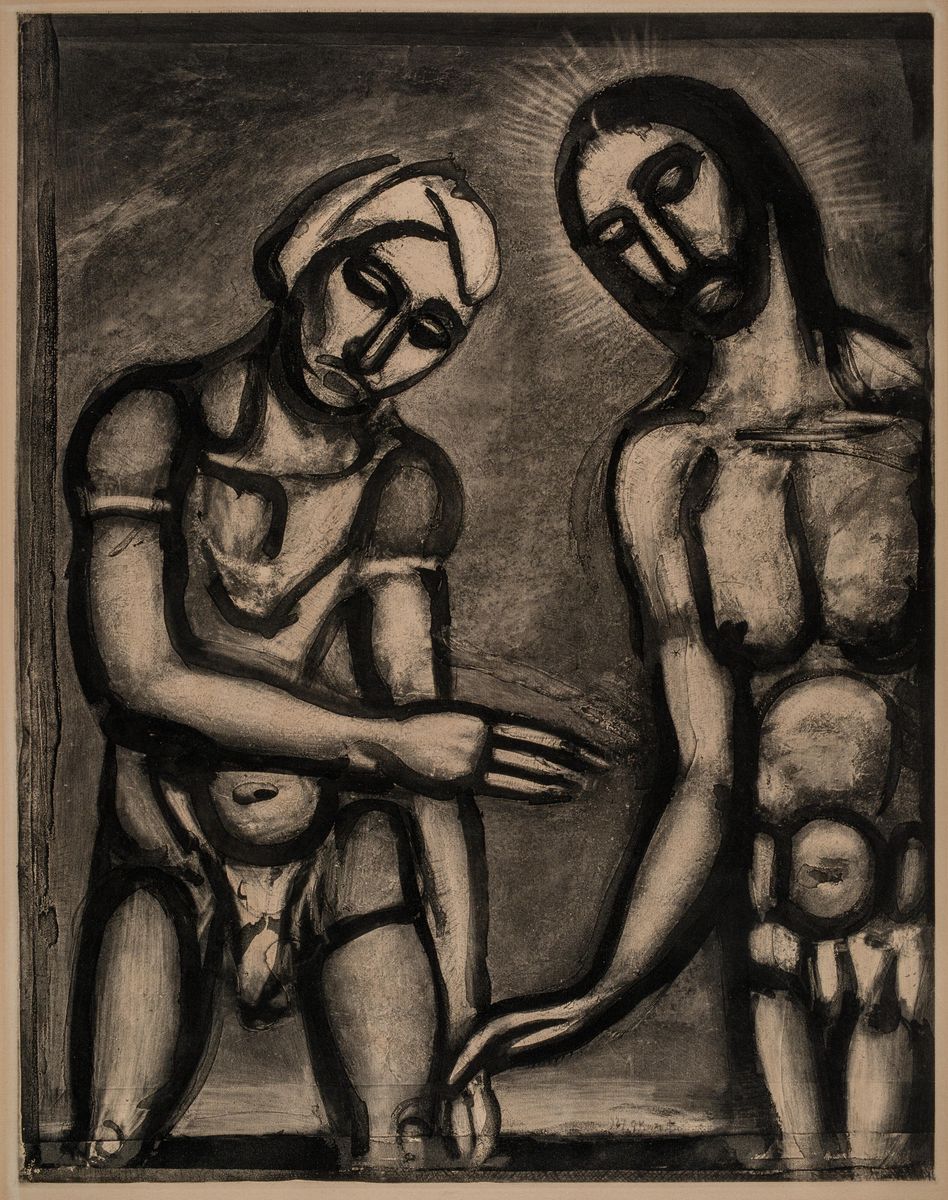
SYMPOSIUM: “Humanity Redeemed: The Theological Vision of Georges Rouault,” September 23–24, 2022, Gordon Conwell Theological Seminary, Charlotte, NC: I’m considering attending! The early-bird rate, good through July 23, is $80 for the general public and includes a Friday dinner and Saturday lunch. “Georges Rouault (1871–1958) was unique among French modernist artists due to his Christian commitment and its influence on his work. The theological vision unveiled through his art is honest and complex, one that reflects the changing climate and tumultuous events of the early twentieth century. In doing so, Rouault showed the possibility of salvation and hope within the inexplicable suffering and mundane realities of human life. His close friend Jacques Maritain identified this as ‘the art of humanity redeemed.’
“This symposium will gather teachers, pastors, artists, ministry leaders, and others to reflect on the theological vision of Georges Rouault and his ongoing impact. Prominent scholars and practitioners with expertise in theology, art history, philosophy, therapy, and community leadership will be offering papers and leading the discussion. One of the speakers, Philippe Rouault, is the great grandson of Georges Rouault and will be providing a personal introduction to his life, work, and family. In addition, several artists will present new work inspired by Rouault, which will both enrich our experience together and show the ongoing generativity of Rouault’s vision and style.”
Georges Rouault (French, 1871–1958), Seigneur, c’est vous, je vous reconnais [Lord, it is you, I know you], plate 32 from the Miserere et Guerre series, 1948. Aquatint, roulette, drypoint over heliogravure on paper, 57.4 × 44.9 cm (plate). Art Gallery of South Australia, Adelaide.
+++
SPOTIFY PLAYLIST: July 2022 by Victoria Emily Jones: Includes a thirteenth-century antiphon for the Holy Spirit by Hildegard of Bingen (“Love abounds in all . . .”); a Luganda praise song for children’s choir; an excerpt from an Orthodox Vespers service in the Yup’ik language from Kodiak, Alaska; a gospel-style setting of Psalm 23; and more. Below are live recordings on YouTube of a few songs from the list: a cover by Amir Darzi and Lital Regev of “Long, Long, Long” from the Beatles’ White Album, which songwriter George Harrison said addresses God; “Love Like There’s No Tomorrow” by gospel-blues husband-wife duo The War and Treaty; and “Here in the Vineyard of My Lord,” a Primitive Baptist hymn compiled in The Good Old Songs (1913) and performed by Americana/folk music duo Anna & Elizabeth.
As a caveat, I am a Protestant, and while I do have a profound respect and appreciation for icons, my theology of images, including my definition of sacred art, is not the same as the Orthodox Church’s—even though elements of it are influenced by the Orthodox position. All the same, I believe it’s important for Christians of all denominations to understand the significance of icons and what differentiates them from noniconic religious images. Those lines are being blurred a bit by the new schools of iconography coming out of western Ukraine and Poland, which honor tradition even as they push it forward into the contemporary era. Here are a few icon-related videos, articles, and weblinks that I’ve gathered over the past several months.
LECTURES:
>> “The Meaning of Icons” by Fr. Maximos Constas, November 13, 2019, Notre Dame Seminary: Father Maximos Constas, professor of patristics and Orthodox spirituality at Hellenic College Holy Cross Greek Orthodox School of Theology, explains the significance of icons in the Orthodox Church, with special attention to their aesthetic features and theological meaning, which is informed by the church’s Christology and cosmology. He answers such questions as, Why do the figures in icons look bored and unnatural? And, Doesn’t the Second Commandment forbid representations of Christ? He does not address icon veneration or details of the making process.
Constas spends the first fifteen minutes juxtaposing Eastern and Western approaches to religious images, discussing how the Renaissance values of humanism and naturalism came to prevail in the West. The Orthodox, he says, see this as the “secularization” or “carnalization” of sacred art—in its commitment to depicting observable realities, Western art from the Renaissance onward typically lacks overt signs of transcendence.
Constas also discusses the dogmatization of sacred images in the East. Icons are never simply works of art or pedagogical tools, he says. “They were understood to be visual artistic expressions of the church’s theology. And in the same way that church doctrines could not be changed, neither could the image in which the doctrines were embodied.”
Here are some notes I took on the talk, including some transcriptions:
An icon can be a panel painting, a fresco, a mosaic, a relief carving, an enameled plaque, a manuscript illumination, etc. “What ultimately defines an icon has nothing to do with artistic medium or style but rather depends on how the image is used and, most importantly, what it is believed to be. And every icon is a means of spiritual encounter and dialogue. It offers us the possibility of such an encounter because it shares in the holiness of the sacred figure whose likeness it bears.”
An icon is not a work of art but a work of witness that makes use of art.
“Icons are not simply portraits but manifestations of human persons in their new heavenly condition. They are images of the spiritual character of human beings reborn, as it were, in the womb of eternity.”
“The icon has the ability to evoke within me the memory of the forgotten depth of my own being. It enables me to see my true face. It orients me toward my destiny in God. And this vision, this remembrance, this knowledge fills me with unspeakable joy and profound consolation.”
We not only can but must make images of Christ; “to deny the icon is to deny the reality of the Incarnation.”
“All created things are intrinsically good, and all, therefore, have spirit-bearing potentialities. And to this essential goodness and beauty of the material world, the icon bears joyful witness. In the icon, we see matter restored to harmony and so fulfilling its true vocation, which is to reflect and transmit the divine glory. The icon, then, safeguards not only the authenticity of Christ’s physical body, but also the true value of creation in its unfallen state as created by God. Inherent in the very fact of the icon is an optimistic, affirmative vision of the material creation. As spirit-bearing matter, the icon has what we would call eschatological significance—it anticipates the final transfiguration of the cosmos at the last day, when the created world will be delivered from its present bondage to corruption, to quote St. Paul, and will enter into the glorious liberty of the children of God.”
Icons as:
windows, doors, thresholds into heaven (spiritual places of passage)
mirrors, a reflection of their living source
tracks or traces
32:40: Portrayal of figures in icons
Alteration of the natural symmetries and proportions of the body, including the features of the face (eyes and ears enlarged; nose elongated; mouth small and closed)
Full frontality—wholeness, completion, perfection; makes the icon dialogical and relational
Serene, controlled facial expression
No shadows cast; illumined from within
>> “Rajaton hengellinen kuva: Kärsimyksen ja ylösnousemuksen kuvat” (Boundless Spiritual Image: Images of Suffering and Resurrection) by Ari Luomajoki, March 26, 2021, Kuopio Cathedral, Kuopio, Finland: I don’t speak Finnish, but I share this seventy-minute video for the visuals (and of course for any Finnish speakers!) and to show how contemporary icons are spreading west. In August 2016 under the leadership of Pastor Ari Luomajoki, the Lutheran Monastic Community of Enonkoski in Ihamaniemi, Finland, organized its first international icon workshop (read more here, and follow @LutheranIcon on Facebook), which attracted iconographers from Poland and Ukraine, as well as a few domestic artists. It was reprised in 2017 (I mentioned this second workshop here). Icons that came out of these workshops have been exhibited several times in Finland, and have facilitated relationships that have led to new exhibitions—such as Kärsimyksen ja ylösnousemuksen kuvat (Images of Suffering and Resurrection) at Kuopio Cathedral, which ran March 26–April 11, 2021. Follow the boldface link to see a taping of the opening, which includes opening comments, a tour, and a lecture.
Danylo Movchan (Ukrainian, 1979–), Descent from the Cross, 2021. Watercolor on paper, 33 × 38 cm.Basia Mindewicz (Polish, 1978–), Lamentation, 2016. Acrylic on wood, 26 × 20 cm.
In the first sixteen minutes of the video, Pastor Olli Viitaniemi, one of the main organizers of the exhibition (with Pastor Salla Tyrväinen), shows screen captures from the website he built connected to the exhibition, https://sielunkuvat.net/. At around 16:24 he gives a tour of the exhibition around the church sanctuary.
At 32:48 Luomajoki—who is a Lutheran pastor in Kouvola, Finland, and has a master’s degree in art history—starts his half-hour lecture. He introduces Międzynarodowe Warsztaty Ikonopisów w Nowicy (International Iconography Workshop in Nowica) in Poland and Lviv National Academy of Arts and the Iconart gallery in Ukraine, two centers of contemporary Eastern iconography that inspired the icons project at the Enonkoski monastery in Finland. At 47:41 Luomajoki does side-by-side image comparisons to show similarities and differences across time. At 50:41 he discusses the use of images in early Lutheranism. He goes on to show some examples of religious art in Finland in the past century (including a really compelling Crucifixion painting by Helene Schjerfbeck and crucifix by Paavo Halonen!). He closes by spotlighting Hidden Life in Nazareth by Ivanka Demchuk and a Nativity by Arsen Bereza, participants in the workshop.
Luomajoki is a wonderful photographer of art. Follow him on Instagram @ari.luomajoki.
+++
INTERVIEW with contemporary iconographer Khrystyna Kvyk, by Kevin Antlitz: OK, Patheos blog posts are painful to read because of all the obtrusive ads, which is why I rarely link to them. But I’m making an exception for this one, where American Anglican pastor Kevin Antlitz interviews Ukrainian Greek Catholic iconographer Khrystyna Kvyk, who earned a master’s degree in sacral art in 2020. She discusses her process of painting icons, what makes an icon an icon, timelessness and transfiguration, the relationship between tradition and innovation, the idea of divine light as reflected in two of her icons, and more. I really love her work and was delighted to hear some of her own words about it.
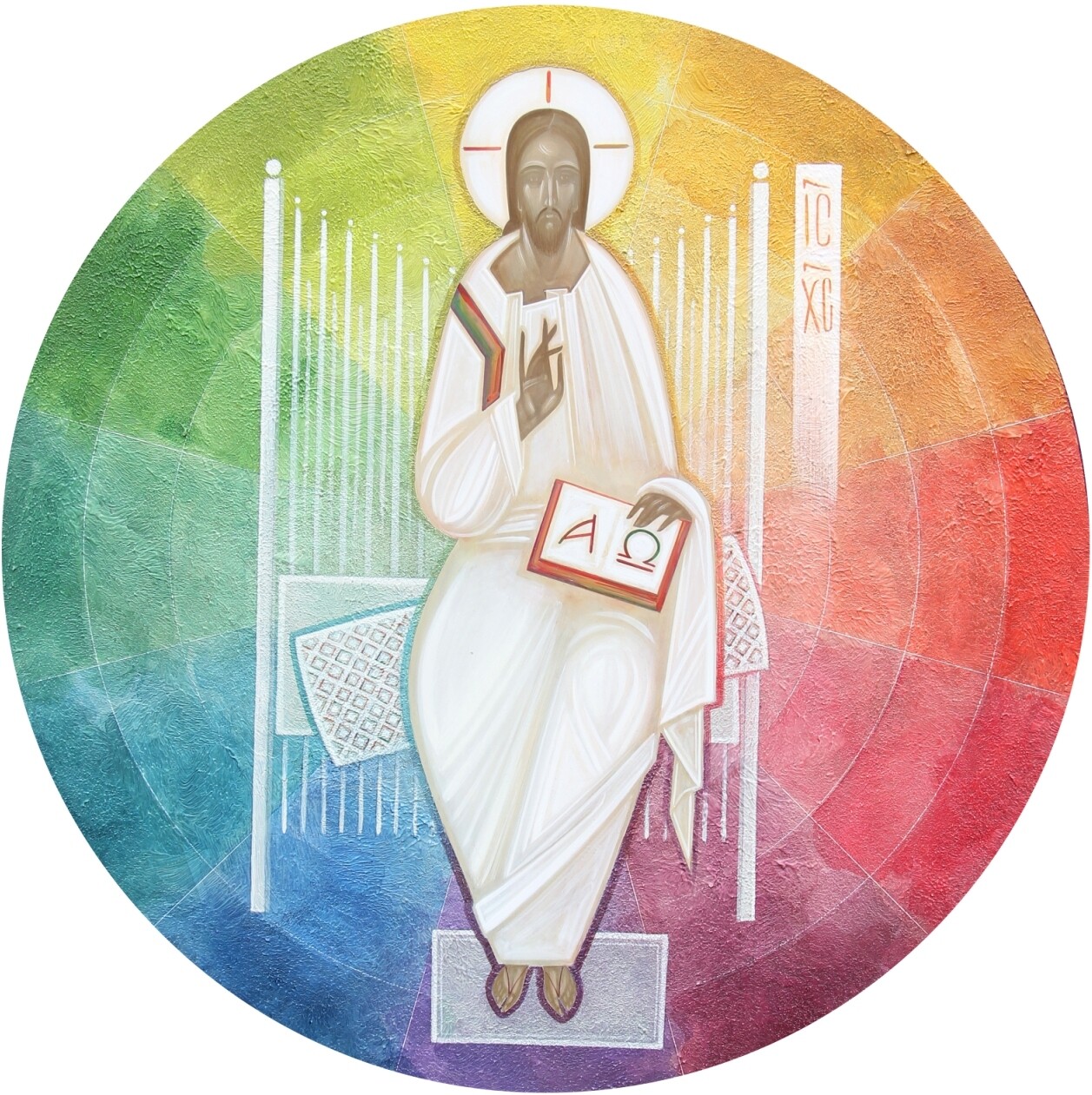
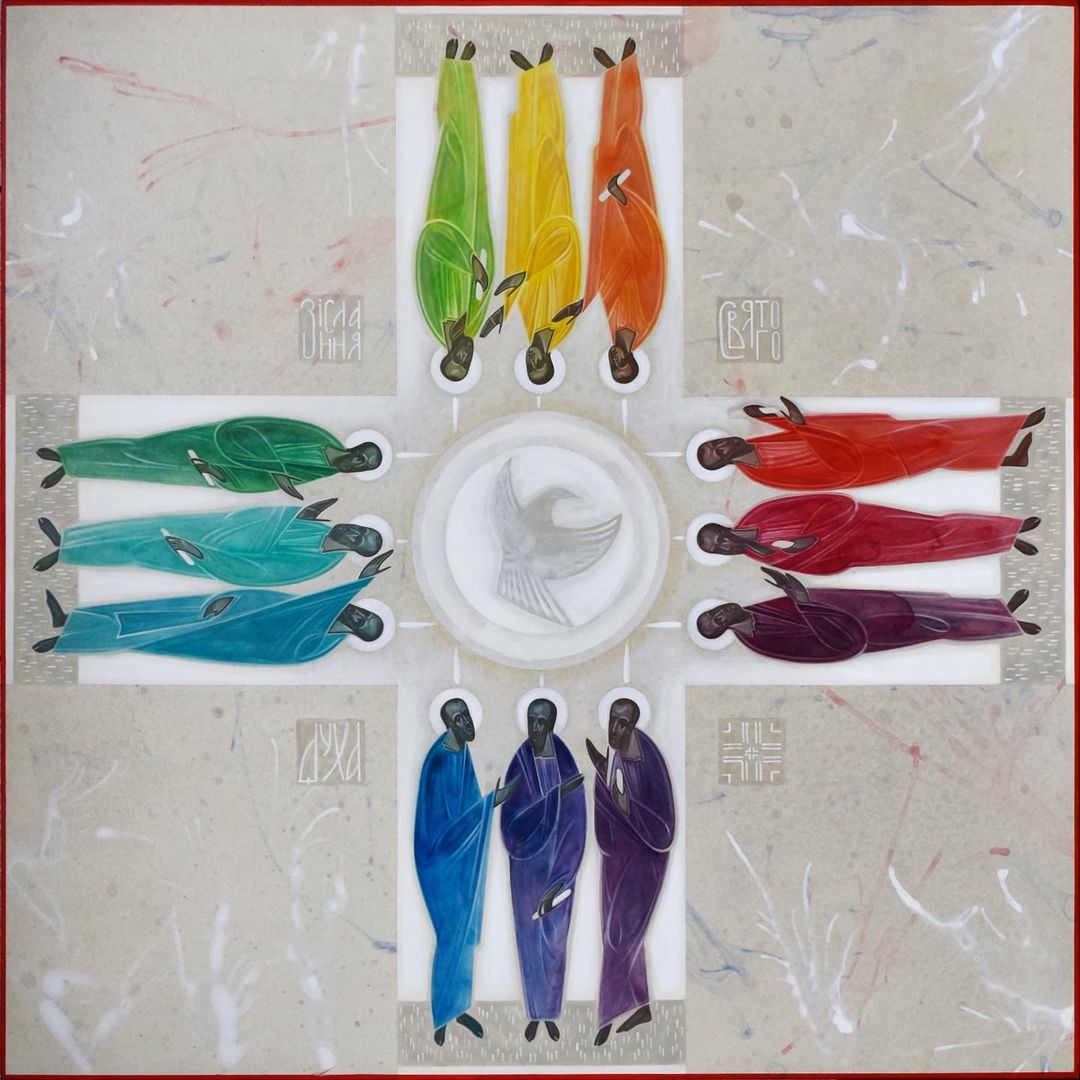
Khrystyna Kvyk (Ukrainian, 1994–), I Am the Light of the World, 2021. Acrylic on gessoed wood, diameter 35 cm.Khrystyna Kvyk (Ukrainian, 1994–), Pentecost, 2021. Acrylic on gessoed wood, 45 × 45 cm.
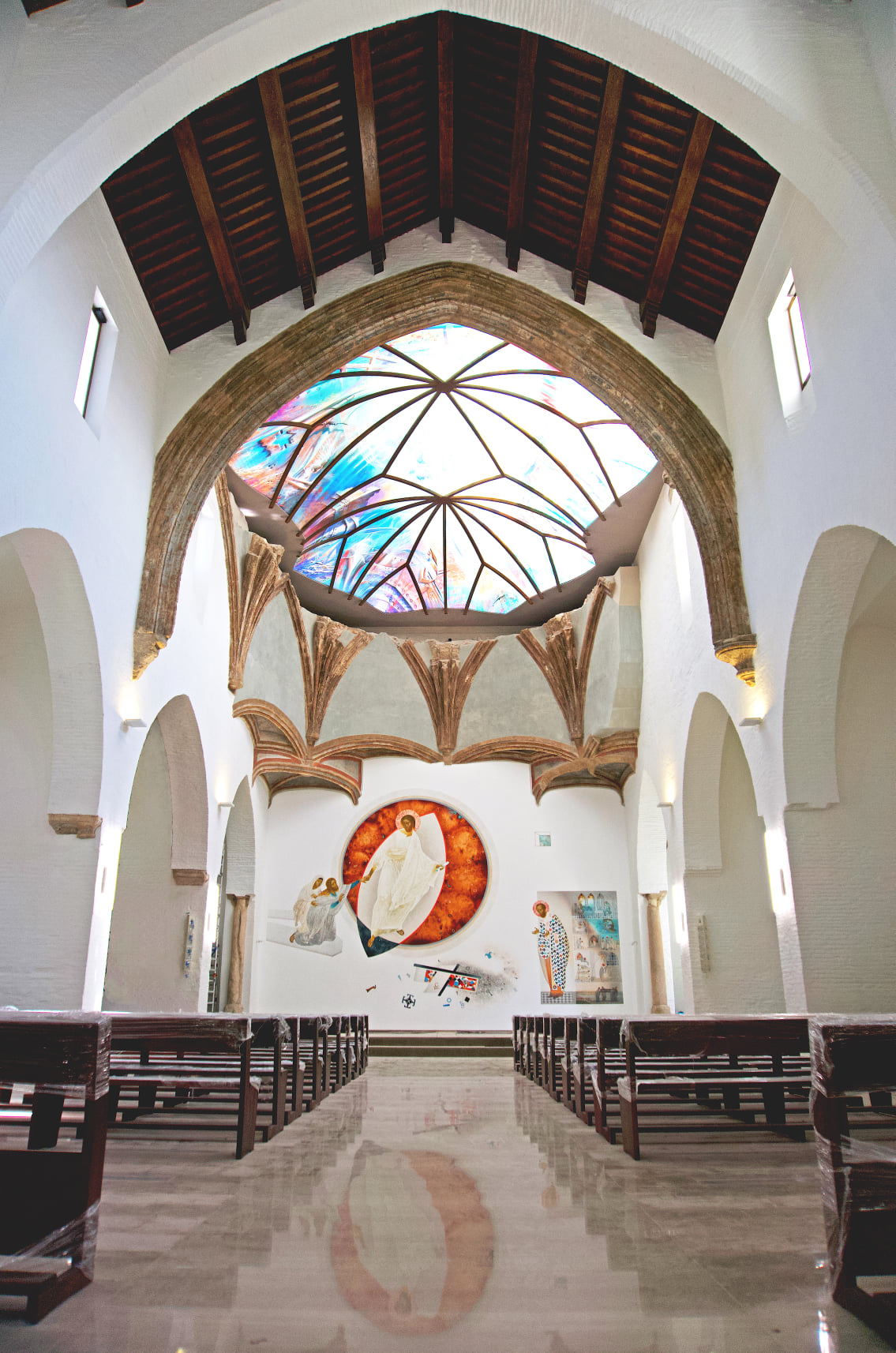
NEW CHURCH COMMISSION: Wall paintings at Iglesia de San Nicolás by Ivanka Demchuk and Arsen Bereza: Ukrainian artists Ivanka Demchuk and Arsen Bereza—a married couple!—have completed a monumental painting on the east wall of the Catholic church of Saint Nicholas in Granada. It was deeply influenced by Byzantine iconography, in which they’ve both been trained, but also contains some modern abstract and geometric elements.
The church building is from the sixteenth century and recently underwent extensive renovations, finally reopening to the public in April, which is when Demchuk and Bereza’s mural was unveiled. It portrays the Anastasis, the Eastern Orthodox image of Christ’s resurrection, which shows him breaking down the doors of hell to release its captives. In the video (which is in Ukrainian with Spanish subtitles), Demchuk describes how they painted two mandorlas behind him: the almond-shaped one symbolizing his divine light, and a round one symbolizing the cosmos.
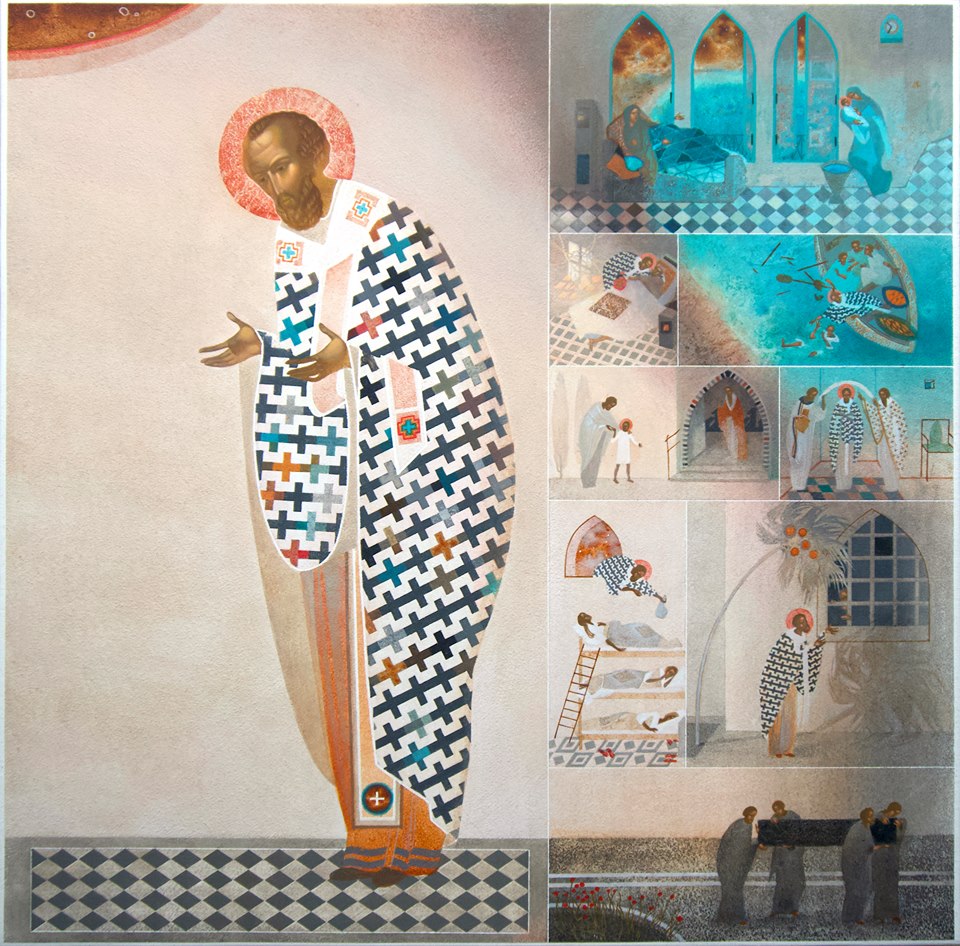
Appearing alongside this focal point is a portrait of the church’s namesake, Saint Nicholas, with eight scenes from his life—including my favorite, where he tosses three bags of gold through the window of an impoverished family’s home. (The legend of Santa Claus—Claus being a shortened form of “Nicholas”—evolved from this story of anonymous gift giving.)
Iglesia de San Nicolás, Granada, Spain, 2022, with east end mural by Ivanka Demchuk and Arsen BerezaIvanka Demchuk (Ukrainian, 1990–), Resurrection, 2018. Mixed media on wood. Design for the Church of St. Nicholas, Granada, Spain.Ivanka Demchuk (Ukrainian, 1990–), Saint Nicholas with Scenes from His Life, 2018. Mixed media on wood. Design for the Church of St. Nicholas, Granada, Spain.
BLOG POST: “The Meaning of Melchizedek in Icons” by David Coomler: Though he’s not religious, David Coomler is an expert on Christian icons and often consults on them. On his blog he unpacks the iconography of standard types but also more unusual ones, like You Are a Priest Forever After the Order of Melchizedek, inspired by Hebrews 7. This rare type is meant to show that Jesus is both the offering and the offerer. The variation pictured below shows, I think, three representations of Christ: as crucified seraph (still quite puzzling to me, but Coomler points out that the Greek of Isaiah 9:6 refers to the Messiah as the “Messenger of Great Counsel”), Holy Wisdom (aka Sophia), and high priest—hence the man in ecclesiastical garb in the back. Wild!
EXHIBITION: Paula Rego: Secrets of Faith, Victoria Miro Venice, April 23–June 18, 2022: Portuguese-born British artist Paula Rego died last Wednesday, June 8, after a seven-decade career, and in the midst of four solo exhibitions of her work—including this one at Victoria Miro’s gallery in Venice, which explores her small but significant body of religious art. [HT: Jonathan Evens]
In 2002 Jorge Sampaio, then president of Portugal, commissioned Paula Rego to create eight pastel drawings based on episodes from the life of the Virgin Mary, to be installed permanently in the chapel of the presidential palace (Palácio de Belém) in Lisbon. Titled Nossa Senhora (Our Lady), the cycle comprises Annunciation; Nativity; Adoration; Purification at the Temple; Flight into Egypt; Lamentation; Pietà; and Assumption. Rego had such fun with the commission that she produced additional works on the subject, which she decided to keep for herself. It is these, along with her watercolor studies, that are currently on display in Venice. (The original eight pastels are not allowed to leave the chapel for which they were made.)
Paula Rego (Portuguese British, 1935–2022), The Flight to Egypt, 2002. Watercolor and ink on paper, 8 1/4 × 11 3/4 in. (21 × 29 cm).Paula Rego (Portuguese British, 1935–2022), Descent from the Cross, 2002. Pastel on paper mounted on aluminum, 29 1/2 × 28 3/8 in. (75 × 72 cm).
I learned about Rego’s Marian cycle a few years ago and became enthralled by it, though I’ve never seen it in person, and most of these supplemental works are new to me. It’s unique, in part because of Mary’s corporeality. In a 2003 interview with Richard Zimler, Rego said, “If there is anything new about these representations of the Virgin, it is the fact that they were done by a woman, which is very rare. . . . It always used to be men who painted the life of the Virgin, and now it is a woman. It offers a different point of view, because we identify more easily with her.”
While the president praised the cycle and Rego insisted that “these pictures were created with admiration and respect,” an open letter to Sampaio referred to it as an “outrage done to the vast majority of the Portuguese people,” an “outrage against their religious beliefs and an offence to the Virgin Mary.” In brief: “blasphemous and scandalous.” I can see why Rego’s larger oeuvre, with its often menacing and/or transgressive imagery (not least of which is her Abortion Series), would scandalize conservative viewers, but I am a bit confused by the outrage at Nossa Senhora, which to me seems very honoring. The objectors, it sounds like, are those who prefer Mary to be more ethereal and sedate; they don’t want to see her, for example, slouching or wincing or expressing astonishment, or awkwardly struggling to hold the weight of her son’s corpse. There will always be those who resist any kind of updating of religious art. If the scenes are restaged in an unfamiliar way or rendered in an unfamiliar style or introduce a new element or the figures don’t look like how we have always pictured them, then some will oppose them outright—which is a shame, because such art often invites us more deeply into the story, helping us to see it afresh.
PODCAST EPISODE: “Past Hymns for the Present Moment,”Tokens, May 26, 2022: “Hymns are often sentimentalized in the American church, cast aside as merely retired songs with dated language, bearing no real appeal or relevance. But of course it may be that our old hymnals have some crucial things to say to us in our current cultural moment. This is the challenge I [Lee C. Camp] posed to Odessa Settles, Phil Madeira, and Leslie Jordan: find and perform some old hymns which might be both indicting and encouraging to the modern church, and to the world at large. Beautiful conversation and moving performances, taped at Nashville’s Sound Emporium.”
+++
POETRY UNBOUND EPISODES:
In each episode of this podcast from On Being Studio, host Pádraig Ó Tuama unpacks a contemporary poem in fifteen minutes. Here are two from season 5 (which just came to an end) that I particularly liked.
>> “Looking for The Gulf Motel” by Richard Blanco: “What happens when we remember?” Ó Tuama asks. “Why do we remember? Is it sweet or sad? Is it both? If you particularly associate warm memories, romantic memories, nostalgic memories with a place, and then that place is changed, does that mean that all those memories are gone?” In this poem from a collection of the same title (which I checked out from my local library at Ó Tuama’s recommendation, and it’s excellent!), Cuban American poet Richard Blanco, at age thirty-eight, reminisces about a family beach vacation from his childhood. Read the poem here.
If I were writing this poem, it would be called “Looking for The Blockade Runner,” as that’s the name of the Wrightsville Beach hotel in North Carolina that my family and I used to stay at for four days or so each summer. My little brother and I should still be running around on the waterfront lawn as our parents watch us from inside the giant window of the dining room, finishing up their breakfast. My dad should still be riding in a wave on a boogie board, teaching me technique. My mom should still be lounging at the pool in her black one-piece with sunglasses and a Vanity Fair, I feeling so grown up beside her sipping my virgin piña colada. My brother should still be exhilarated by the live hermit crabs at Wings, and I by the dried starfish and sand dollars. We should all still be walking back from the Oceanic, our bellies filled with she-crab soup and hush puppies and catch-of-the-day, down the shore at dusk.
>> “The change room” by Andy Jackson: A poet who’s interested in difference and embodiment, here Andy Jackson, who has severe spinal curvature due to Marfan syndrome, “is looking at the attention that he gets in his body and is refocusing it, extending it wider, looking at the deeper question of, what does it mean for any of us to be in a body, and how do we in bodies relate to others in bodies?” Read the poem here, from the collection Human Looking.
+++
CORITO VIDEOS: A corito (literally “short song”) is a type of Latino Christian worship song. Coritos have “fairly simple tunes, often with repetitive words, that the people sing by heart,” writes Justo L. González in ¡Alabádle!: Hispanic Christian Worship. “Most of them are anonymous, and pass by word of mouth from one congregation to another. For that reason, the tune or the words of a particular corito may vary significantly from one place to another. They are often sung to the accompaniment of clapping hands, tambourines, and other instruments.” To learn more about this genre, see the Calvin Institute of Christian Worship interview with Rosa Cándida Ramírez and Analisse Reyes and the entry in the Encyclopedia of Christianity in the Global South, vol. 2.
>> Joseph Espinozasings a corito medley consisting of “Cuando el pueblo del Señor” (When the People of the Lord), “No puede estar triste” (The Heart That Worships Christ Cannot Be Sad), “Ven, ven, Espiritu divino” (Come, Come, Holy Spirit), “Cantaré al Señor por siempre” (I Will Sing to the Lord Forever), and “El Poderoso de Israel” (The Mighty One of Israel). Aaron Barbosa is on keyboard, Fabian Chavez is on percussion, and Yosmel Montejo is on bass.
Federico Apecena provides the following translation. (The slashes indicate the number of times that line or passage is sung.)
//The heart that worships Jesus cannot be sad The heart that worships God cannot be sad//
//That’s why I sing, I sing hallelujah The heart that worships God cannot be sad//
//There’s victory, there’s victory, there’s victory in the blood of Jesus// The enemy will not be able to defeat our souls //Because there is victory, because there is victory, because there is victory in the blood of Jesus//
//That’s why I sing, I sing hallelujah The heart that worships God cannot be sad//
///Those that wait, that wait in Jesus/// //Like eagles, like eagles, their wings will open//
They will walk and will not get tired, they will run and will not stop //New life they will have, new life they will have, those that wait, that wait in Jesus//
//That’s why I sing, I sing hallelujah The heart that worships God cannot be sad//
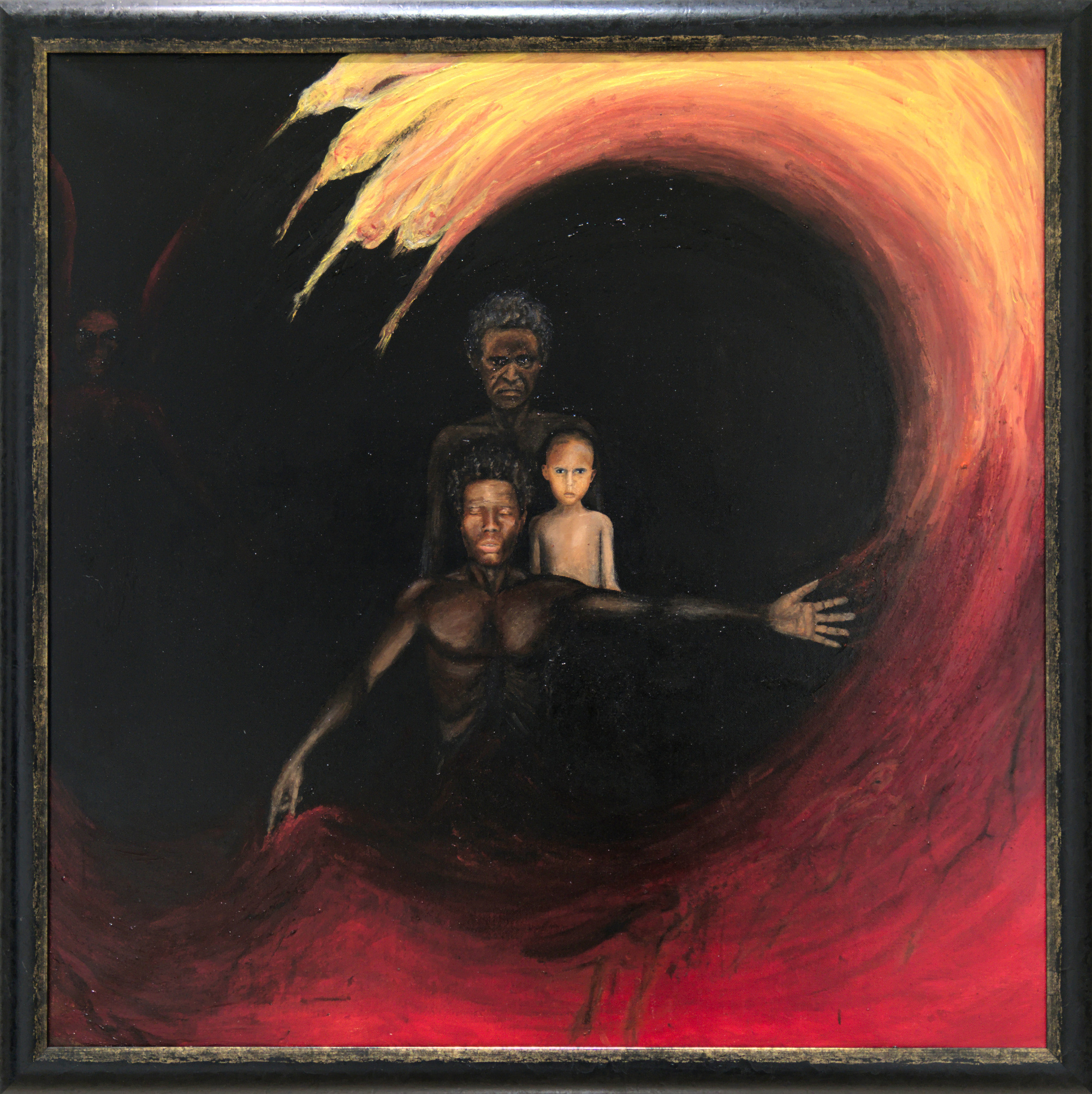
I first encountered the work of Welsh Catholic artist James Keay-Bright last year at the 8th Catholic Arts Biennial at the Verostko Center for the Arts at Saint Vincent College in Latrobe, Pennsylvania, where his Trinity Redemption painting was among the juried selections.
James Keay-Bright (Welsh, 1965–), Trinity Redemption, 2013. Oil on canvas, 40 × 40 in. Private collection, United States. All photos by Victoria Emily Jones, at the 8th Catholic Arts Biennial, Verostko Center for the Arts, Saint Vincent College, Latrobe, Pennsylvania.
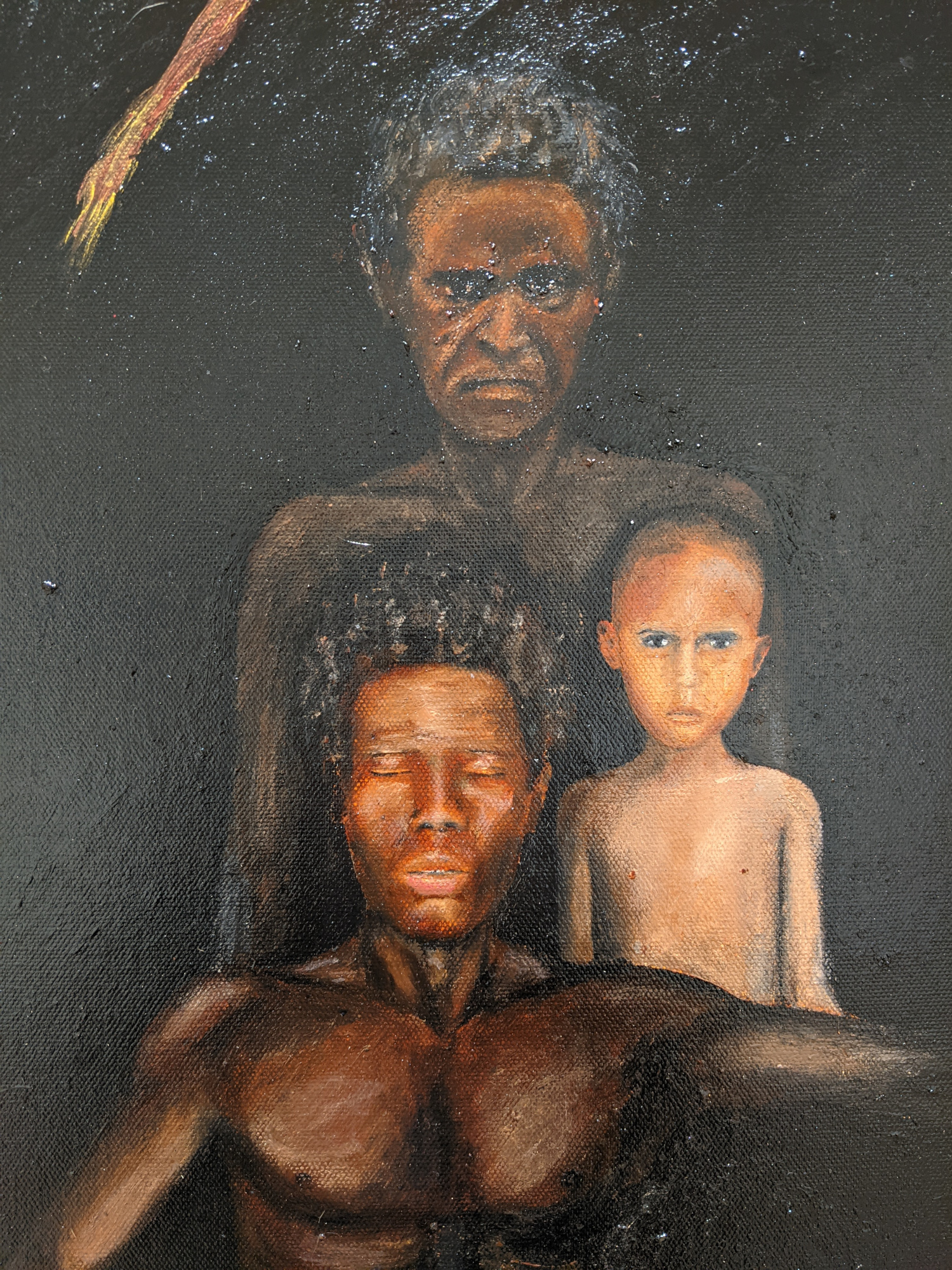
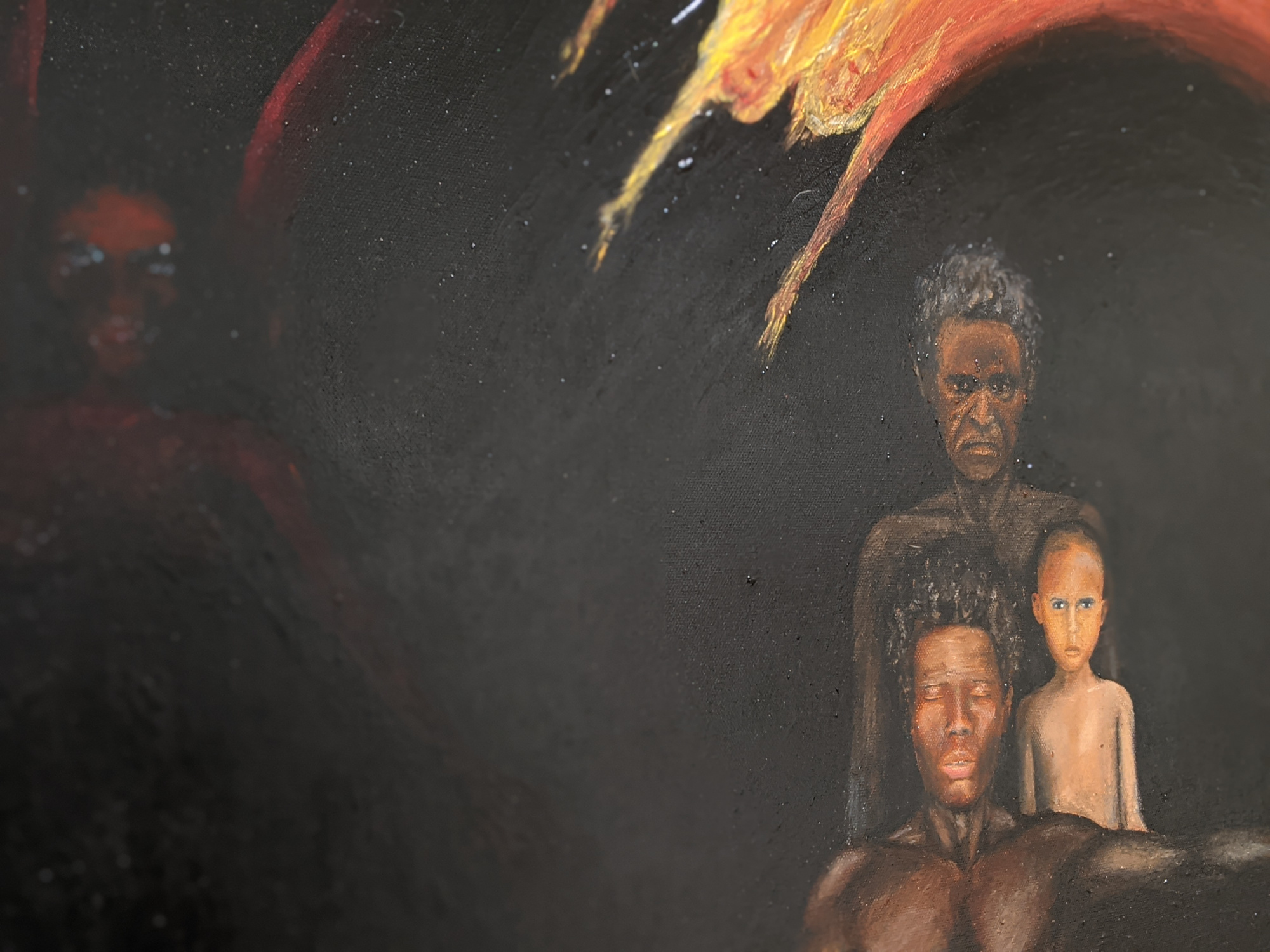
It shows God the Father, Son, and Holy Spirit standing one behind the other against a black background, facing forward. They are semi-encompassed by a wave of fire that emanates from the foreground figure’s outstretched hand. Vigorous and bright, it swells up and around the trio, its branching tip reaching like arms into the darkness.
The young African man in front represents the Holy Spirit sending forth his presence, Keay-Bright told me. (The illumination of his face is wonderful!) Jesus Christ is shown as a Middle Eastern boy of about eight years old, while God the Father is modeled after an elderly Aboriginal Australian.
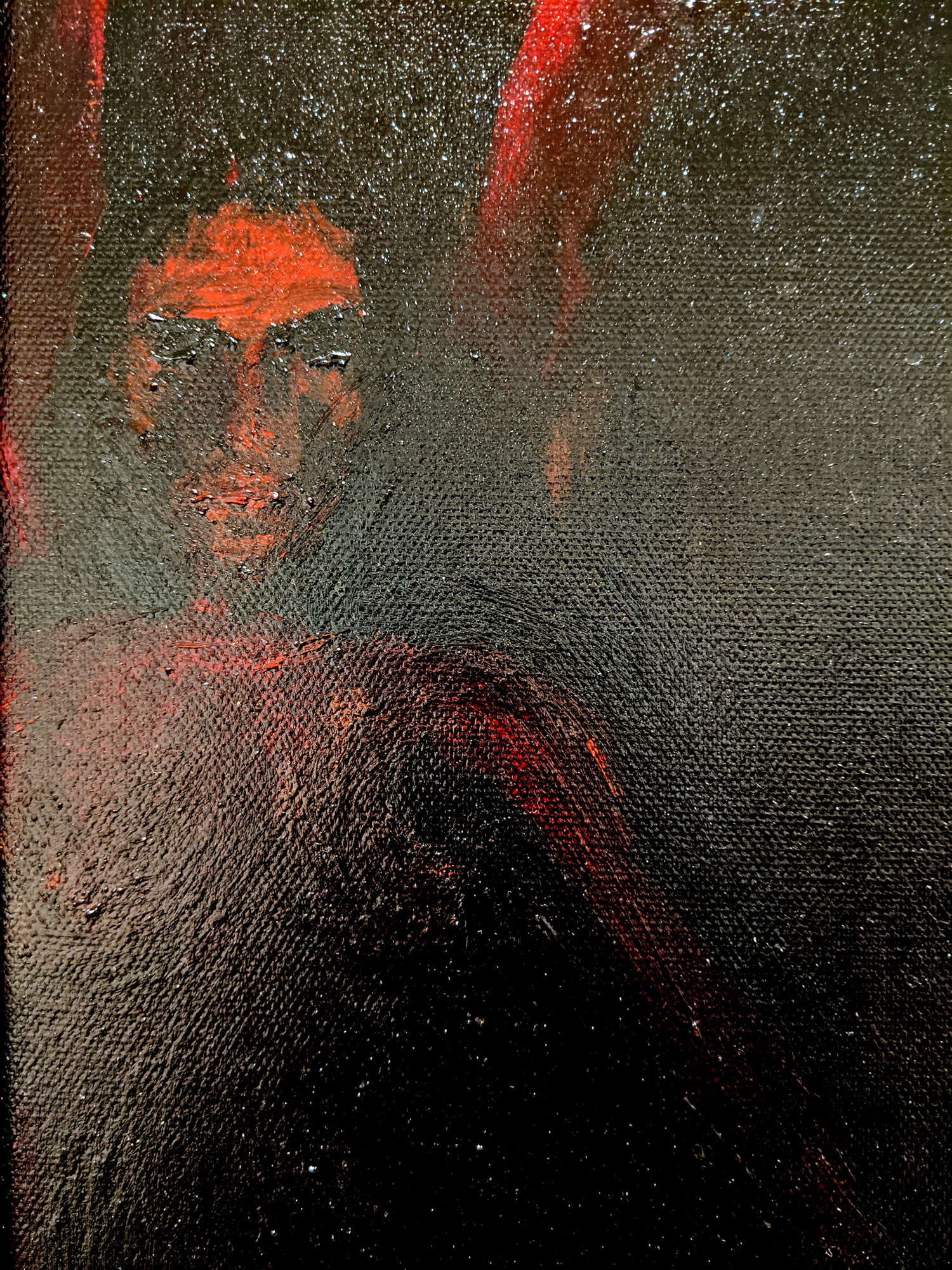
Unable to withstand the tidal wave of divine light, evil retreats into the shadows, symbolized by the satanic figure at the left.
In the Old Testament, fire often signifies the presence of God, as when Moses encounters God in the burning bush (Exod. 3:2), or as with the pillar of fire that leads the Israelites through the wilderness (Exod. 13:21).
In the New Testament, in Acts 2, the Holy Spirit descends like fire on the people who are gathered in Jerusalem for the feast of Pentecost. This “fire” ignites faith and has a sanctifying effect—purifying us of sin, making us holy.
Last Sunday the church celebrated the Spirit’s historic descent, and this Sunday is marked in liturgical calendars as Trinity Sunday. One of the scripture readings in the Revised Common Lectionary comes from Romans 5: “Therefore, since we are justified by faith, we have peace with God through our Lord Jesus Christ, through whom we have obtained access to this grace in which we stand, and we boast in our hope of sharing the glory of God. . . . And hope does not put us to shame, because God’s love has been poured into our hearts through the Holy Spirit that has been given to us” (vv. 1–2, 5). This passage describes the combined activity of the Triune God in bringing about salvation.
Commenting on his painting, Keay-Bright told me, “It’s about cycles of redemption. We respond to God’s call but then fall away. But we can always come back.” God’s “spirit and grace” are constantly extended to us, he says. The fire of divine love is always going out, sweeping through the world to reclaim and restore.
Keay-Bright is interested in non-Caucasian representations of biblical figures. That desire has sprung in part from his international humanitarian work, in which he has encountered the sacred through people of various races and ethnicities. He has worked with refugees in the Balkans, Uganda, and Algeria—first through an NGO and later through the UN Refugee Agency. This month he is traveling to Rwanda to serve refugees from Burundi and the Democratic Republic of Congo.




















 Art & Theology