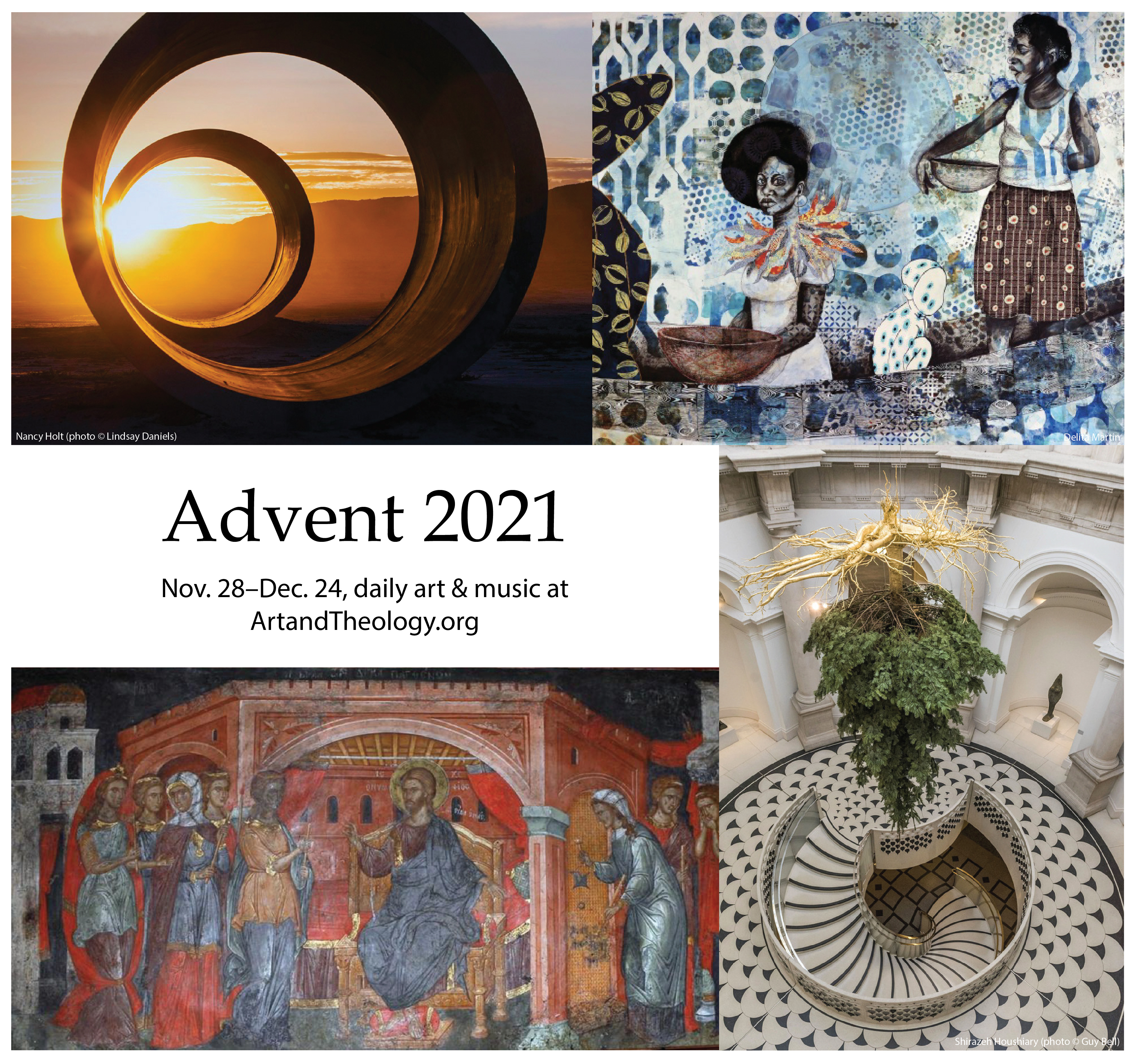
Advent begins November 28, and this year I will be publishing short daily posts that pair a visual artwork with a piece of music, most accompanied by brief commentary. (I did a trial run last Advent.) The primary purpose is to invite spiritual contemplation on the season’s themes, allowing artists to be our guide. I’ve been planning out the series since August—and ended up procuring ideas to last for three Advents!—and I’m really looking forward to presenting it. The daily posts in this format will extend through the twelve days of Christmas as well.
Contemporary singer-songwriters are heavily represented in the music selections, but there is also a Shaker hymn, an Appalachian spiritual, a Renaissance motet, a Byzantine troparion, a South African freedom song, sixties electronica, and a Victorian carol from Sussex. Many of these songs can be found on the Advent playlist I compiled. For the artworks, in addition to paintings there are a few installations, photographs, collages, a lithograph, a serigraph, a stencil print, a quilt, and a mosaic.
The recurring theme throughout, sometimes inherent to the artwork and in other cases brought about by a particular reading of it, is looking forward with hope and readiness to the coming of Christ, to the Light who will dispel darkness and bring justice and peace. “A new world is coming, and it’s just around the bend,” sings Nina Simone. May we welcome it with eager longing.
If you’d like to receive each post in your inbox, subscribe to the blog by entering your email address where prompted in the sidebar. I will also link to the posts on Facebook and Twitter. (Update: If you’re on your computer and you don’t see a sidebar, it’s probably because you’re viewing this post from the homepage; click on the post’s URL, and you should see the Subscribe button at the right. If you’re viewing this on your phone, the Subscribe button is at the bottom of the page, below the comments. Because this website is not self-hosted, WordPress does not allow me to manually add email addresses to the subscription list, nor to create a dedicated subscription tab—sorry!)
Art credits: In the poster above, clockwise from top left, are Sun Tunnels by Nancy Holt, a detail of Night Travelers by Delita Martin, Christmas Tree by Shirazeh Houshiary, and a fresco from the Monastery of Saint John the Theologian in Chora on the island of Patmos.
Advent is just around the corner, and here is some topical content for the season. (Much more to come!)
PODCAST EPISODES:
>>“On Journeying: Travel, Traditions, and Turning to the Psalms with Tsh Oxenreider,”Sacred Ordinary Days, December 22, 2020: Host Jenn Giles Kemper interviews author, travel guide, and fellow podcaster Tsh Oxenreider about her book Shadow and Light: A Journey into Advent. The liturgical calendar is a gift, not a burden, Oxenreider says; it provides scaffolding for our year and connects Christians to one another across time and place, in addition, of course, to promoting encounters with God and God’s story. Oxenreider provides book and music recommendations for the Advent season and shares one of her family’s favorite simple Advent traditions.
>>“The Annunciation and Art with Victoria Emily Jones,”Old Books with Grace, November 17, 2021:Old Books with Grace, hosted by Dr. Grace Hamman [previously], a specialist in medieval literature, is one of my favorite podcasts, so I was beyond excited to be invited on as a guest! In this conversation, Grace and I discuss four paintings and three poems that respond to the momentous event known as the Annunciation, where Gabriel tells Mary that she has been chosen to bear God’s Son. While the feast of the Annunciation is celebrated on March 25, we thought it nonetheless appropriate at this time just before Advent to consider how Mary welcomes Jesus, since we are preparing to welcome him ourselves. Available on YouTube and on all podcast streaming platforms.
Grace just wrapped up a fascinating series on Sir Gawain and the Green Knight, and for the four weeks of Advent she will be taking a closer look at four familiar Christmas carols from different eras, examining their history, theology, and language and recommending an Advent practice inspired by each carol. Follow Old Books with Grace on Instagram or Twitter.
NEW ALBUM: Advent Songs by the Porter’s Gate:The Porter’s Gate [previously] released a new album on November 12, a collection of ten original songs for Advent. The contributing songwriters are Nicholas Chambers, Paul Zach, Kate Bluett, Isaac Wardell, Liz Vice, Latifah Alattas (Page CXVI), and Tenielle Neda. Chambers, Zach, Vice, Alattas, and Neda are also featured as vocalists, as are Molly Parden, Jonathan Ogden, and Lauren Plank Goans. My favorites: “The Reign of Mercy,” “Mary’s Lullaby (Black Haired Boy),” “Simeon’s Song.”
+++
PAINTING + SHORT FILM: In 2017 Holy Family HTX, a church in Houston, commissioned artist-in-residence Lanecia Rouse Tinsley to create nine liturgical paintings, one for each major season of the church year. Called the Parament Collection, these six-by-six-foot pieces rotate throughout the year, signaling the change of season and inviting the congregation into a space of contemplation around seasonal themes.
The first painting in the cycle, Advent, is a minimalist composition predominantly in ultramarine, evoking Yves Klein’s blue monochromes; Tinsley says that, like Klein, she wants to “impregnate” the viewer with blue, which for her signifies hope. Blue (or alternatively, purple) is the primary color of Advent, but pink and white (for Gaudete Sunday and Christmas Eve, respectively) are also associated with it, which Tinsley makes reference to in her painting. At the white bar at the top, you can see a faint mark left by Hurricane Harvey; her studio flooded when the storm hit in August 2017, and this then-blank canvas suffered some water damage, but Tinsley made the conscious decision to use it to further press into the Advent theme of suffering. She lined the canvas in black, inspired by a line from Andy Warhol’s film Sunset: “Black means infinity.” All our longings, Tinsley says, are held within infinity.
The nine-minute film posted above is one of nine in a series by Chap Edmonson, titled Decoded, in which Tinsley discusses her Parament Collection piece by piece. View all nine films here.
+++
I also wanted to remind you about the Art & Theology Advent playlist I compiled on Spotify. Besides the ones mentioned above, here are the songs I’ve added to the mix since last Advent:
“Wonder” by MaMuse
“Better Days” by Chrisinti
“Peace Train” by Cat Stevens
“Peace” by Peter Bruun (a setting of a Gerard Manley Hopkins poem)
“Magnificat primi toni” by Palestrina
“From This Wicked Fall” (Cum erubuerint) and “The Flower Gleams” (Hodie aperuit) by Hildegard of Bingen, arr. Richard Souther
“Mary” by Buffy Sainte-Marie
“Like Mary” by Jess Ray and Langdon
“Restoration Song (Hold On)” by Son of Cloud
Nine songs by Tom Wuest
“Lighten Our Darkness” by Joel Clarkson
“For the Long Night” by Dan + Claudia Zanes
“La Luz” by Brother Isaiah
“Sunrise Song” and “Clouds of Waiting, Clouds of Returning” by Jacob Goins
“Break of Dawn” and “You Always” by Antoine Bradford
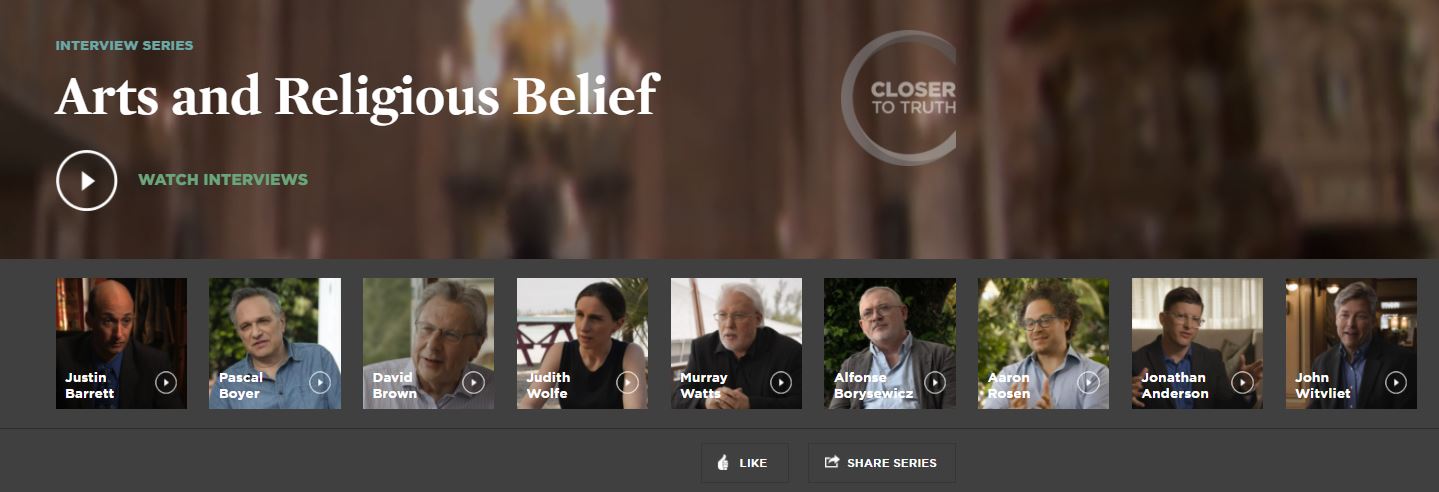
Created, written, and hosted by Robert Lawrence Kuhn, Closer To Truth is a public television series that explores fundamental questions relating to the cosmos, consciousness, religion, and the search for ultimate reality and purpose. The program boasts a robust website featuring over four thousand video interviews with scientists, philosophers, theologians, artists, and other scholars and practitioners.
I am particularly interested in the seven hours’ worth of interviews on art and religion/God that fall under the “Art Seeking Understanding” rubric. They are separated into three- to twelve-minute segments spread across these eight topical series:
Art and the Philosophy of Religion: “Can art inform topics in philosophy of religion? Can the existence and varieties of art address or affect theological questions about God, faith, belief, worship?”
Arguing God from the Arts?: “Is it possible to infer something of the nonphysical, divine existence of God from the physical, human existence of art? Can one argue for God from art?”
Can the Arts Reveal God’s Traits?: “If God is the Creator of human beings and art is a feature of human sentience, then can examining the arts help discern characteristics of God? Can one infer from various aspects of art various traits of God?”
Arts and Religious Experience: “What is the relationship between experiencing art and experiencing God? Can the arts generate or trigger religious experience? If so, can it be validated?”
Arts and Religious Belief: “Is there a relationship between diverse arts and belief in God? Can the arts express or encourage religious belief? If so, can it be validated?” (*This is my favorite.)
Arts and Religious Practice (Liturgy): “Why are the arts so deeply embedded in religious settings and services? How do the arts work in religious spaces and activities? What are differences among the arts, say music and painting, in the liturgy?” (*This is my second favorite!)
Arts and Religious Reality: “Art is deeply involved in the practice of religion, embedded in the rituals and liturgy of almost every religion. But how could the ubiquity of the arts in religion affect whether or not religion is real?”
Co-Evolution of Art and Religion: “Did art and religion co-evolve in parallel as archeology and anthropology suggest, and if so, what would be the significance? What do art and religion have in common that could enable their common, co-temporal development?”
Interviewees include Nicholas Wolterstorff, Matthew Milliner, Jonathan A. Anderson, Judith Wolfe, Aaron Rosen, Alfonse Borysewicz, John Witvliet, and others. I’m disappointed by the lack of diversity among interviewees—the program is very heavy on white male Christians—but I am nevertheless grateful for the wisdom these individuals share, and for the efforts of the Closer To Truth team to coax it out, capture it onscreen, and present it freely to the public.
Here are a few interviews I’ll call your attention to:
Art historian Matthew Milliner on the formative power of art in sacred spaces, and the concreteness of images as a risk but one that can be worthwhile. He describes the art commissioned for his own church, All Souls Anglican in Wheaton, Illinois, which includes a mural on the west wall by Joel Sheesley and a black-tar crucifix that they use as their processional cross every year during Lent.
Theologian Stephan van Erp on the whole of creation as God’s liturgy. Art in the liturgy isn’t making the world more beautiful than it actually is, van Erp says; rather, it is recognizing the beauty that is already there and reflecting it back. It’s participating in the beauty.
E. Thomas Lawson, a scholar of the cognitive science of religion, says, “I am convinced that the arts are a form of discovery. I think that the arts actually develop forms of knowledge for us. They show us surprising aspects of the world. They show us possible worlds. In fact, they can humble us.” Art, he continues, enables our intuition, describes our intuition, sometimes even fights our intuition.
ALBUM REVIEW:“Let’s Go Down: Joy and Humility in Psallos’s Philippians Album” by Victoria Emily Jones: Psallos’s latest album, a musical adaptation of Paul’s letter to the church at Philippi, released on Thursday, and, as I’ve come to expect from the collective, it’s a brilliant work of art, with much to discover! In this review I wrote for the Gospel Coalition, I of course couldn’t address all the album’s intricacies, but I trace a few main themes and motifs. This is the New Testament epistle that gives us such memorable lines, phrases, and passages as “Rejoice in the Lord always!,” “Be anxious for nothing,” “the peace of God that passes all understanding,” “I can do all things through Christ who strengthens me,” and the glorious Christ Hymn (“Let this mind be in you, which was also in Christ Jesus, who, being in the form of God . . .”). It’s delightful to hear what Psallos does with these oft-quoted verses and, even more, to be guided in understanding the larger context in which they appear.
It’s near impossible to choose favorite tracks, as they gain impact from being heard all together and in order, but if Ihad to choose, I’d say “Complete My Joy,” “Hymnos Christou,” “I Am Better Than You” (feat. Shai Linne), and “Will You Go Down?” (feat. Taylor Leonhardt).
+++
POETS’ PANEL:“Surprised by Joy: Poetry about Happiness,” recorded at the Festival of Faith and Writing, April 2018: In Rewrite Radio Episode 29 (a production of the Calvin Center for Faith and Writing), poets Anya Silver, Tania Runyan, Barbara Crooker, and Julie Moore “discuss the landscape of joy amidst suffering in their personal and public lives. Joy, distinct from happiness, can be a form of religious practice. They explore questions regarding what cheapens joy, how Christians view joy, and how to ‘balance the scale’ of joy and pain in writing.” Zora Neale Hurston, Ælfric of Eynsham, Ralph Waldo Emerson, Christian Wiman, Jane Kenyon, John Milton, Dietrich Bonhoeffer, Thornton Wilder, and the apostle Paul are just some of the additional voices they draw into their conversation. They each read three to four of their own poems, and there is an audience Q&A starting at 57:54. A transcript is provided.
Silver and Runyan are two of my favorite poets, and this is such a rich hour spent with them and two of their colleagues.
+++
INTERVIEW: “It’s Not a Poem Until You Discover Something: An Interview with Scott Cairns” by Andy Patton: In this conversation, poet Scott Cairns talks about writing as a discipline, the writer as reader (“The writing life is primarily the reading life”), staying conversant with tradition, the fallacy of originality, the one quality shared most between prayer and poetry, and writing not as giving, serving, but as getting, receiving.
+++
LECTURE: “What Did Jesus Look Like?” by Joan E. Taylor, St. Paul’s Cathedral, London, June 2, 2019: Historian Joan E. Taylor, a professor of Christian origins and Second Temple Judaism at King’s College London, discusses the influences on early depictions of Jesus in art and what they tell us about what he did, or definitely didn’t, look like. This talk is a great intro to her research on the topic, but if you want to learn more, I recommend her full-color book What Did Jesus Look Like? (T&T Clark, 2018), which goes into much more detail, examining artistic, literary, and archaeological evidence, including first- and second-century coins, textiles, skulls, and Egyptian mummy portraits. She also dedicates two chapters to the three most famous acheropitae (images “made without [human] hands”): the Veil of Veronica, the Mandylion, and the Shroud of Turin.
In her talk, Taylor shows how most of the visual representations of Jesus in the Early Christian era were based on Greco-Roman imagery of Zeus Olympus or Zeus Serapis (strong, powerful, seated on a throne; this image came after Constantine), Dionysus (young, curly-haired, beardless), or philosophers. These images aim to show us the meaning of Jesus but not necessarily his physical reality.
Interestingly, Taylor points out that while it’s common to picture Jesus in a long robe (stolē, plural stolai) with baggy sleeves, such clothing indicated social privilege in Jesus’s time, and in Mark 12:38, Jesus explicitly denounces those who parade around in such dress! Jesus would have worn a short, simple tunic, probably undyed—which is how he is depicted in the frescoes from the ancient Dura-Europos house church in present-day Syria.
She also identifies a common strain in early Christian and non-Christian writings that describes Jesus as “little and ugly and undistinguished” (Celsus), probably owing largely to the messianic interpretation of Isaiah 53:2: “he had no form or majesty that we should look at him, nothing in his appearance that we should desire him.” However, there were some claims to the contrary—for example, from Origen—that stated that Jesus was the epitome of physical beauty; after all, divinity must be beautiful, right? We often find throughout art history an attempt to backfill the earthly life of Jesus with his resurrected, ascended, glorified form.
Taylor is not suggesting, as far as I can tell, that all artistic representations of Jesus must be historically authentic to have validity. Rather, she says that if we are going to imagine Jesus humanly doing things—healing the paralytic, for example, or preaching the Sermon on the Mount—we will inevitably have to picture him in our mind, and we might as well have as accurate a picture as possible. She reminds us that if we imagine Jesus as supremely beautiful and well kept and richly arrayed instead of as the poor, bedraggled itinerant that he was, there’s a dissonance with his message; he becomes no longer one of the people but apart from them.
+++
ARTICLE: “Are Images of Jesus a Violation of the Commandments?” by Chad Bird: “Different groups within Christianity disagree as to whether Jesus should be depicted in icons, crucifixes, paintings, or other visual media. In this article, Chad Bird [scholar in residence at 1517] approaches the question from the angle of both the commandments and the incarnation.”
The most pushback I receive on my blogging ministry comes from those who believe it is inherently wrong, even “idolatrous,” to represent Jesus visually. Bird addresses this concern in much the same way I do when asked, and in such a succinct way!
NEW PLAYLIST: October 2021 (Art & Theology): This month’s playlist includes a benediction from the book of Jude; a percussion-driven setting of Francis of Assisi’s “Canticle of the Sun” by the Camaldolese monk Cyprian Consiglio; an Exodus-inspired song in Yorta Yorta, an indigenous Australian language, from the feature film The Sapphires; “Prodigal Son,” a little-known hymn by John Newton, from The Sacred Harp; a sixties gospel song by Shirley Ann Lee (famously covered by Liz Vice on her debut album); and closing out, in anticipation of All Saints’ Day on November 1, the jazz standard “When the Saints Go Marching In.” To save the playlist to your Spotify account, click the ellipsis and select “Add to Your Library.”
+++
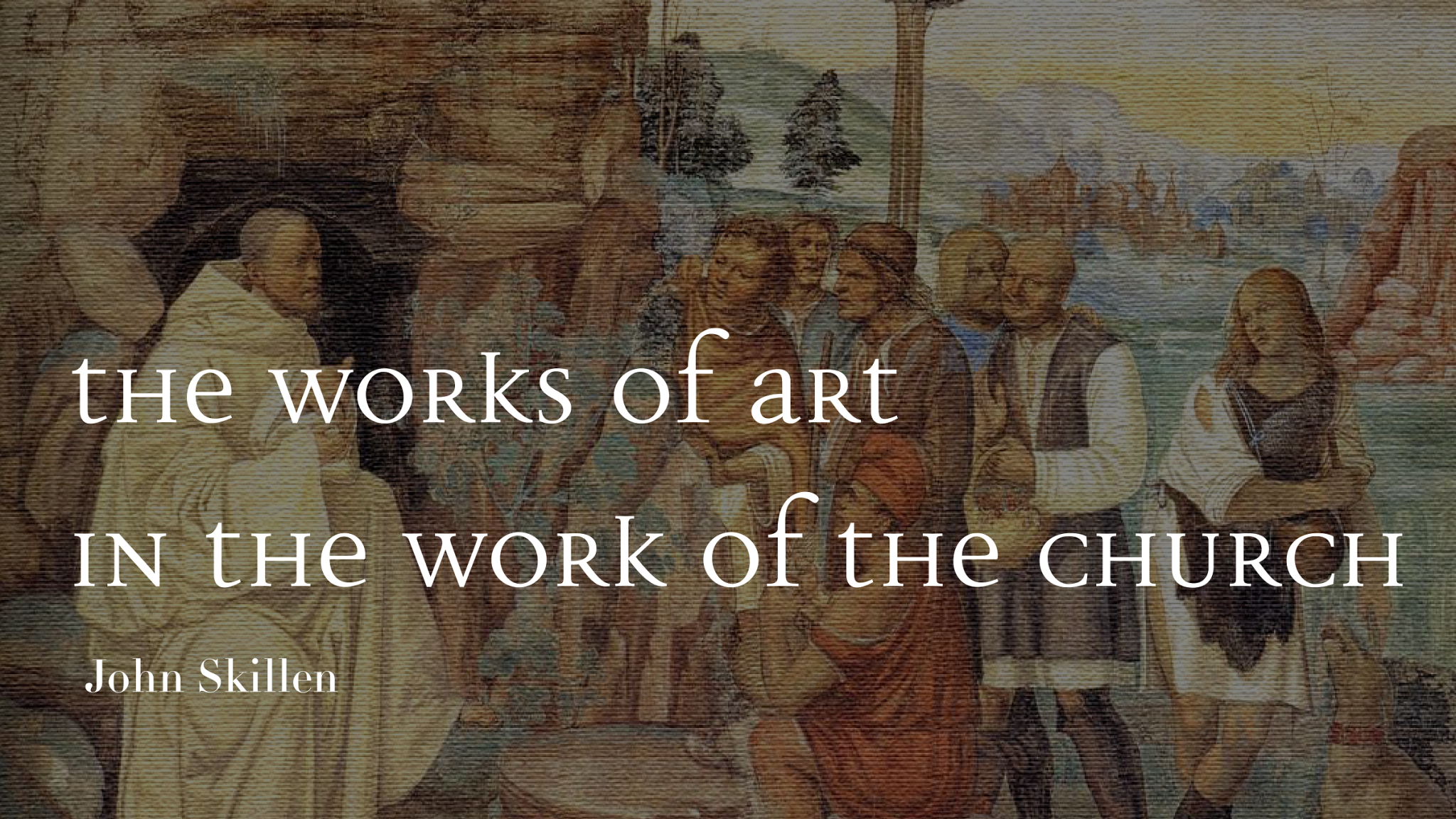
IN-PERSON LECTURE: “The Works of Art in the Work of the Church” by John Skillen, October 16, 2021, Crownsville, MD: The Eliot Society, an organization I work for, is hosting our first event in over a year and a half! It’s an art talk by Dr. John Skillen [previously], director of the Studio for Art, Faith & History in Orvieto, Italy. It will be at the home of two of our board members, so if you’re in the Washington–Baltimore metropolitan area two weekends from now, consider coming by! The event starts with hors d’oeuvres at 6:30 p.m., and an RSVP is requested.
In recent decades, a growing number of Christians—even those from church traditions formerly suspicious of the arts—are warming up to the idea that artworks can serve in the various practices of the life of faith, and not only in iconographic form as images of Jesus in worship. Scripturally sound and aesthetically sophisticated works of art can guide our prayer, help catechize our children, and shape the environments of our missional work. Many of us will welcome some pointers for putting art back in its place in the settings where we live and work.
To help us imagine possibilities, John Skillen will offer examples from a long period of Christian history when the arts were put to work in the collective life of the church in more places and in more ways than most of us nowadays can imagine. Not only churches but also hospitals, orphanages, the meeting rooms of parachurch organizations, baptisteries and bell towers, dining halls and cloisters in monasteries, town halls and civic fountains and public squares—all were places of serious decoration and design expected to be compatible with Christian faith.
No sphere of religious and civic life was off-limits for imagery able to instruct, to prompt memory, and to inspire emotion and action—the three functions of art most commonly cited during the Middle Ages to defend its value.
+++
UPCOMING ONLINE CONVERSATIONS:
Marc Padeu (Cameroonian, 1990–), Le souper a Penja, 2019. Acrylic on canvas, 82 7/10 × 106 3/10 in. (210 × 270 cm).
>> “Caravaggio in Cameroon: Marc Padeu and Jennifer Sliwka in Conversation,” October 14, 2021,11 a.m. EST (4 p.m. BST): I spoke about Padeu’s Le souper a Penja at a recent seminar on “Picturing Jesus,” so I’m looking forward to hearing the artist himself discuss it along with the larger body of work it’s a part of. Hosted by the National Gallery in London.
Artist Marc Padeu lives and works in Cameroon. Intriguingly, his monumental paintings – exploring tender and complex relationships between family, friends, lovers and working communities – often draw on Italian Baroque compositions and especially those of Caravaggio.
Marc Padeu joins Dr Jennifer Sliwka, specialist in Italian Renaissance and Baroque art. Her research explores how 17th-century painters developed innovative approaches to religious painting, imbuing their works with an immediacy, power, and dynamism.
Together, the speakers will take Padeu’s Le Souper a Penja and its relationship to Caravaggio’s Supper at Emmaus as a jumping-off point for conversation, exploring Padeu’s wider interest and understanding of historical works, his adoption and adaptation of the visual language of the Baroque and how these inform his evocations of contemporary life in Cameroon.
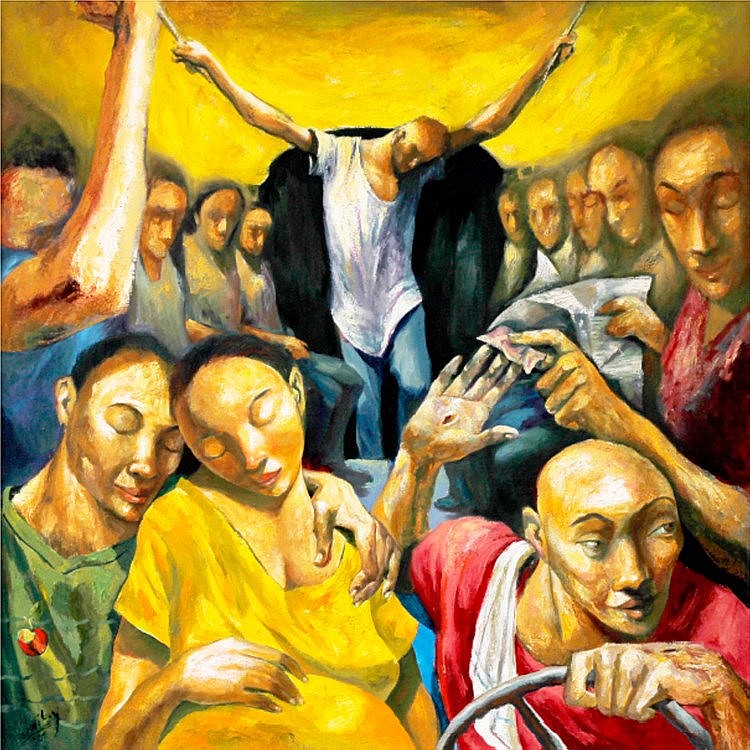
>> “In the Studio with Emmanuel Garibay,” November 11, 2021, 8:30 a.m. EST: The Overseas Ministries Study Center at Princeton Theological Seminary is hosting a conversation with Filipino artist Emmanuel “Manny” Garibay, a social realist painter who served as the 2010–2011 OMSC artist in residence. “It is the richness of the poor that I am drawn to and which I am a part of, that I want to impart,” he says. His paintings often portray Jesus among the marginalized and dispossessed and critique the church’s “compliance with greed, corruption, and social inequality.” Garibay’s children Alee, Nina, and Bam, who are also accomplished artists, will be present for the conversation as well. For more on Garibay, see this Q&A from the OMSC and the Image journal essay “Recognizing the Stranger: The Art of Emmanuel Garibay” by Rod Pattenden.
Emmanuel Garibay (Filipino, 1962–), Kaganapan, 2006. Oil on canvas, 48 × 48 in. (122 × 122 cm).
>> “Psalm 91” by Poor Bishop Hooper, released as part of the EveryPsalm project, through which the duo offers original weekly Psalm-based songs for free download:
WEBINAR: “Formational Films Round-Up: Movies That Matter,” hosted by Renovaré: Recorded August 24, this is an excellent eighty-minute conversation with film critic and professor Jeffrey Overstreet [previously], minister Catherine Barsotti, and theologian Chris Hall, led by Carolyn Arends [previously]. Each of the three guests identifies and discusses five films that have been spiritually formative to them—and what great selections! (Though there are four I have not yet seen.) Barsotti’s number one is one of my all-time favorites.
Because the movie ratings issue (that is, content like violence, sex, and/or profanity) is almost always raised by Christian audiences, Arends asks, “Are there some films that are bad for you to watch, and if so, why?” The question is wisely addressed from 34:52 to 49:40.
+++
INTERVIEW: “We must become poetry,”Still Life: For the September 13, 2021, edition of his weekly Still Life letter, Michael Wright [previously] interviewed Christian author Paul J. Pastor, having been intrigued by a recent tweet of his, which asks, “Where are the bardic preachers, wild at the eye, speaking not just to mind or heart, but to gut?” Pastor talks about the connection between the seen and the unseen; the relationality of poetry and finding shelter in the words, images, and emotions of another; holistic knowing; the disservice of reducing the Bible’s poetry to moral lessons with tidy applications; the nearness of Walt Whitman’s poetic vision to the Christian vision of sanctification; and more.
“My passion is for Christians to reclaim our way’s remarkable resources for living virtuously, beautifully, and well,” he says. Mine too!
To subscribe to Still Life, distributed for free every Monday over email, click here.
+++
Lecture by David Brinker for the 8th Catholic Arts Biennial, Verostko Center for the Arts at Saint Vincent College, Latrobe, PA, September 12, 2021: I mentioned the call for entries for this exhibition back in June. Of the 396 entries from artists from around the country, MOCRA director and guest juror David Brinker has selected 52. In this talk given the weekend after the exhibition’s opening (which starts at 14:47), he discusses the following three questions, pulling in artworks from the current exhibition and from his twenty-five-plus years as an art curator at a Catholic institution.
What identifies contemporary art as “Catholic”?
What contributions can Catholic art and artists offer to the broader contemporary art world?
What can Catholic art and artists receive from the broader art world?
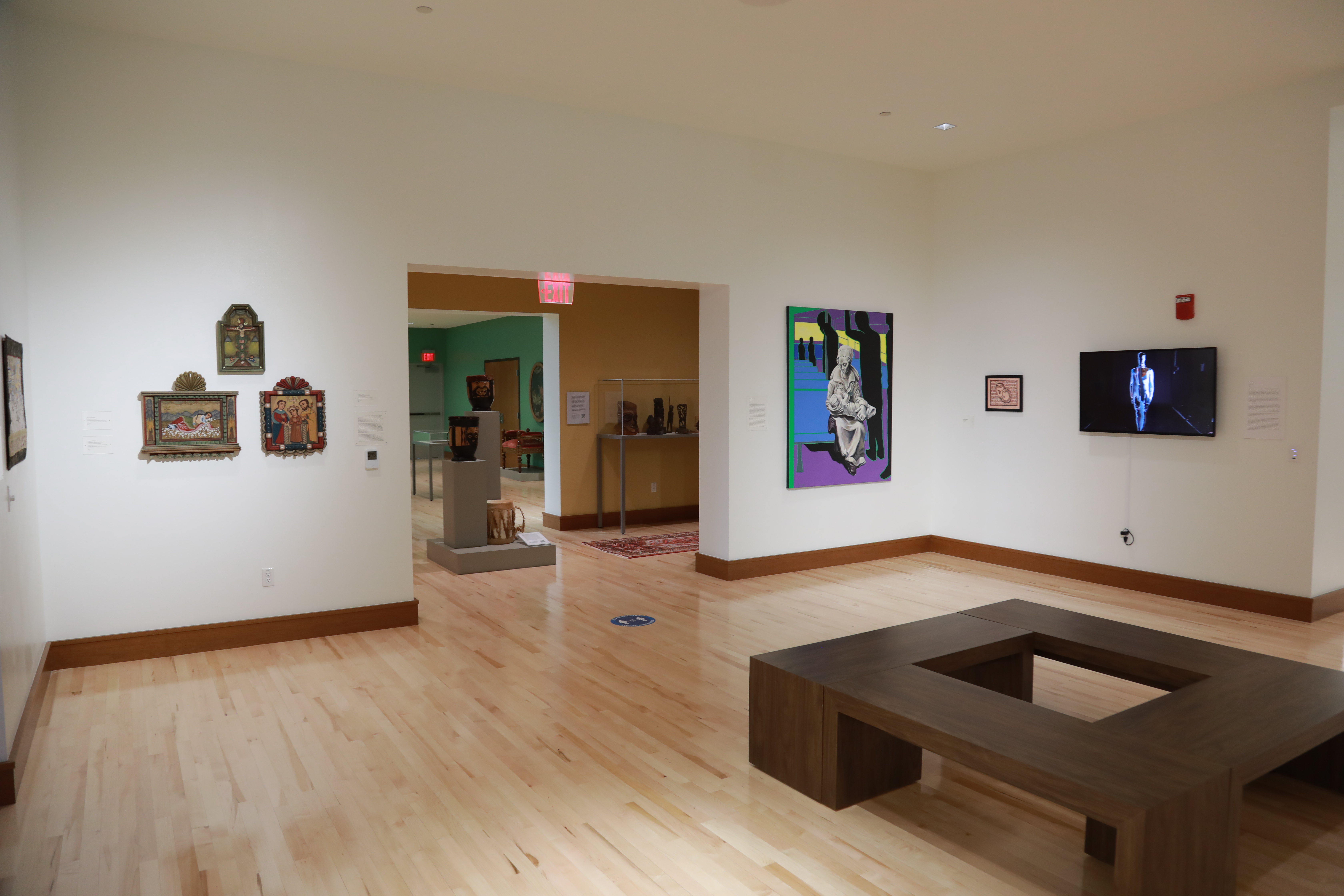
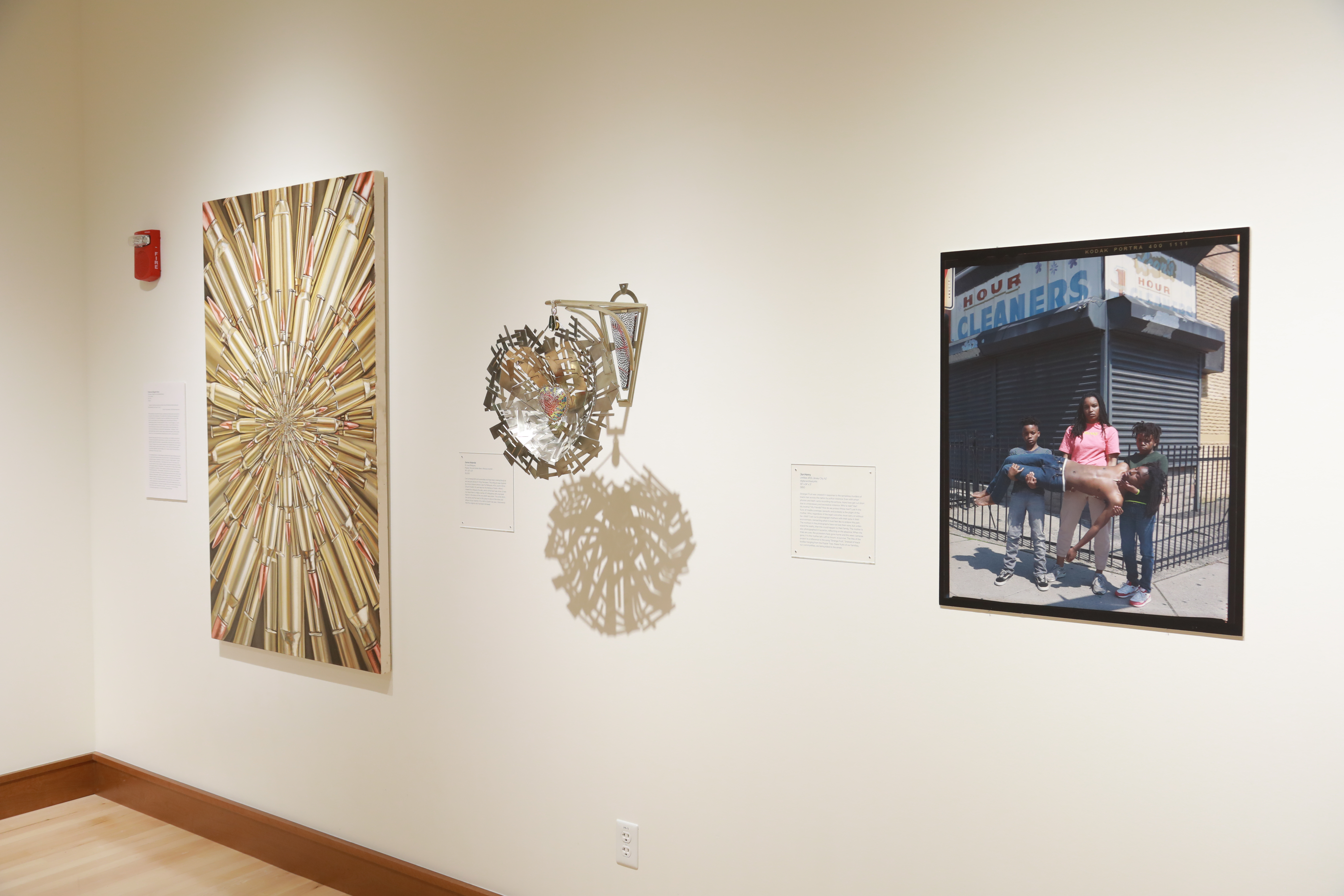
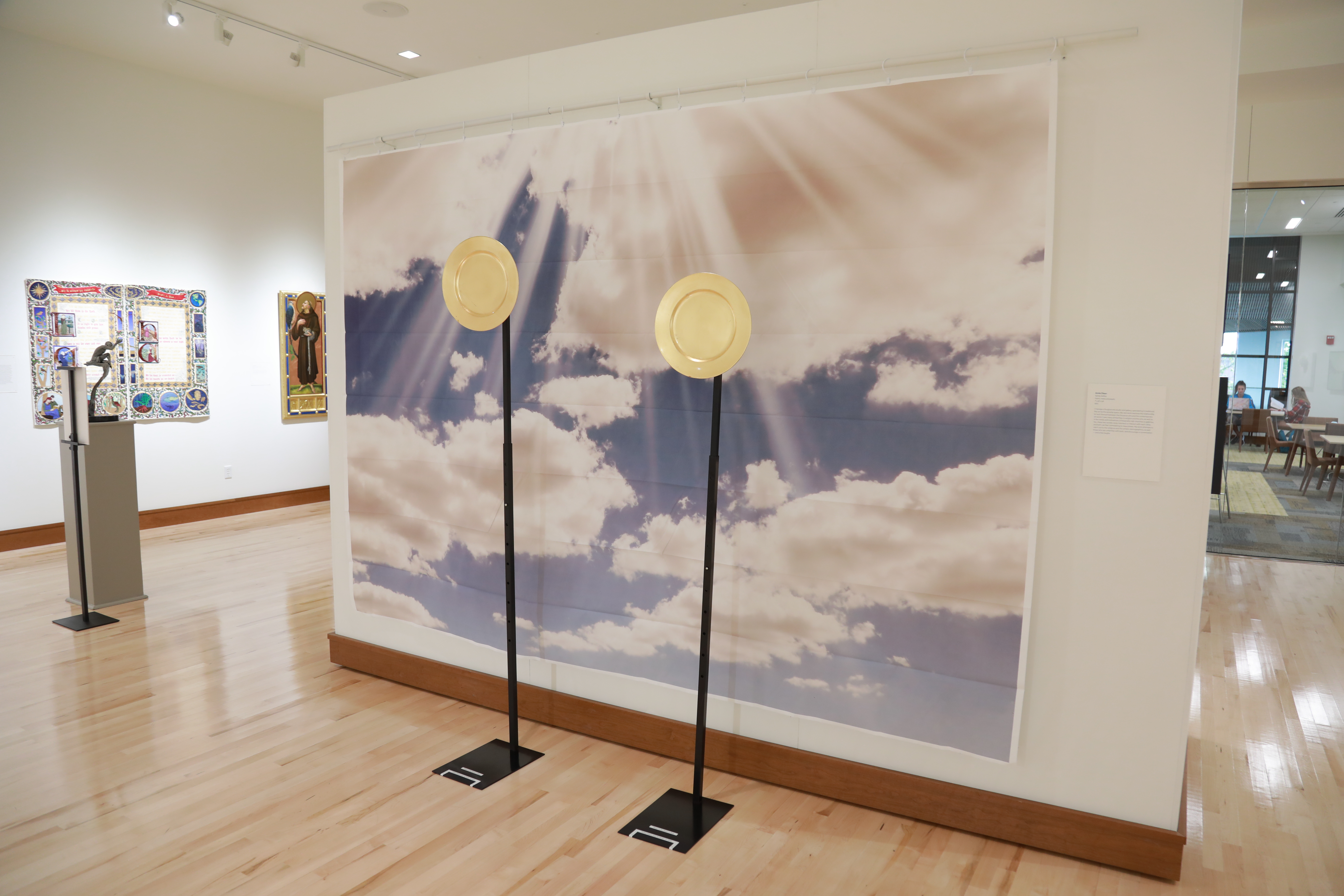
Exhibition view, 8th Catholic Arts Biennial. From left to right are three retablos by Vicente Telles, Maternidad by Piki Mendizabal, Iesu in Utero by Rebecca Spilecki, and The Living Temple by Jesse Klassen.The Heart of Man by Kristen van Diggelen Sloan; St. Laud Reliquary by James Malenda; Untitled, #33, Jersey City, NJ by Jon HenryForeground: Saintly Selfies by Annie Dixon
(The three photos above are provided courtesy of the Verostko Center for the Arts.)
Saint Vincent’s 8th Catholic Arts Biennial exhibition is on view through October 29, 2021; off-campus visitors are asked to make an appointment by emailing verostkocenter@stvincent.edu. While you’re in the area, you might also want to visit the Fred Rogers Center at Saint Vincent College, which houses artifacts from Mister Rogers’ Neighborhood as part of a larger permanent exhibition on his life, work, and influence. (Latrobe was Fred Rogers’s hometown.) And Pittsburgh is just an hour away!
+++
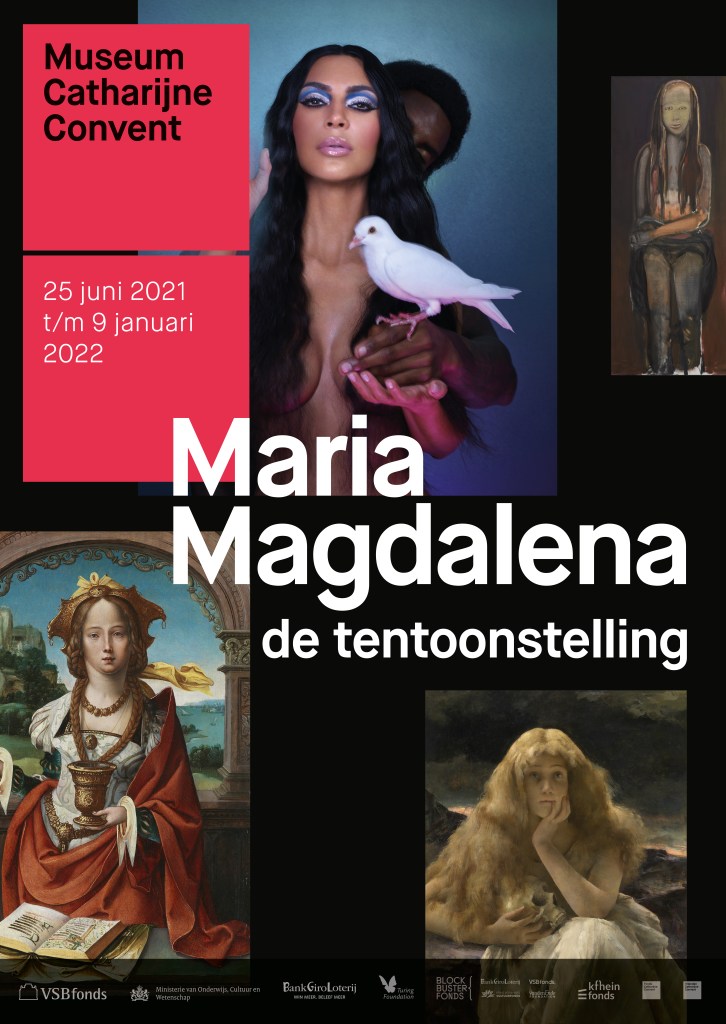
EXHIBITION: Maria Magdalena (Mary Magdalene),Museum Catharijneconvent, Utrecht, Netherlands, June 25, 2021–January 9, 2022: Curated by Lieke Wijnia. “Mary Magdalene is one of the most enigmatic women from the New Testament. Through a trans-historical display of artistic representations from the eleventh century to the present day, this exhibition explores the enduring fascination for this mysterious saint.” The catalog, Mary Magdalene: Chief Witness, Sinner, Feminist, is available in Dutch or English from the publisher Waanders. In addition to the exhibition page on the museum’s website, which hosts select images and a series of videos, resources in Dutch include an audio tour (with images), a podcast episode and accompanying article, and a video preview with commentary by Karin Haanappel.
I’m fascinated by Mary Magdalene, and while I won’t get to see this exhibition, it appears that it does an excellent job of exploring the many facets of her life and identity (including both before meeting Jesus and after his ascension), as told through canonical and apocryphal texts, and her complicated reception history. It addresses her role as the first witness to Jesus’s resurrection; the so-called Gnostic Gospel of Mary, which has Peter saying, “Sister, we know that the Savior loved you more than the rest of the women. Tell us the words of the Savior which you remember—which you know (but) we do not, nor have we heard them”; the legacy of Pope Gregory the Great’s infamous Easter sermon of 591 CE, which, in its (many would say erroneous) conflation of the Magdalen with other New Testament women, identified her as a converted prostitute; the development of legends about her later life in southern France, as an evangelist, a miracle-worker, and a penitent, cave-dwelling ascetic; modern films and literature that cast her as a romantic lover, or even the wife, of Jesus; and Pope Francis’s elevation of her liturgical commemoration from an obligatory memorial to a feast day in 2016, in which she is to be celebrated not as a fallen woman doing penance but as the “apostle to the apostles,” a title of hers dating back to the High Middle Ages.
The poster above features Mary Magdalene Receives the Holy Spirit by American photographer David LaChapelle, Magdalena by contemporary South African artist Marlene Dumas, The Magdalen from a sixteenth-century Flemish workshop, and Mary Magdalene by nineteenth-century Belgian artist Alfred Stevens.
+++
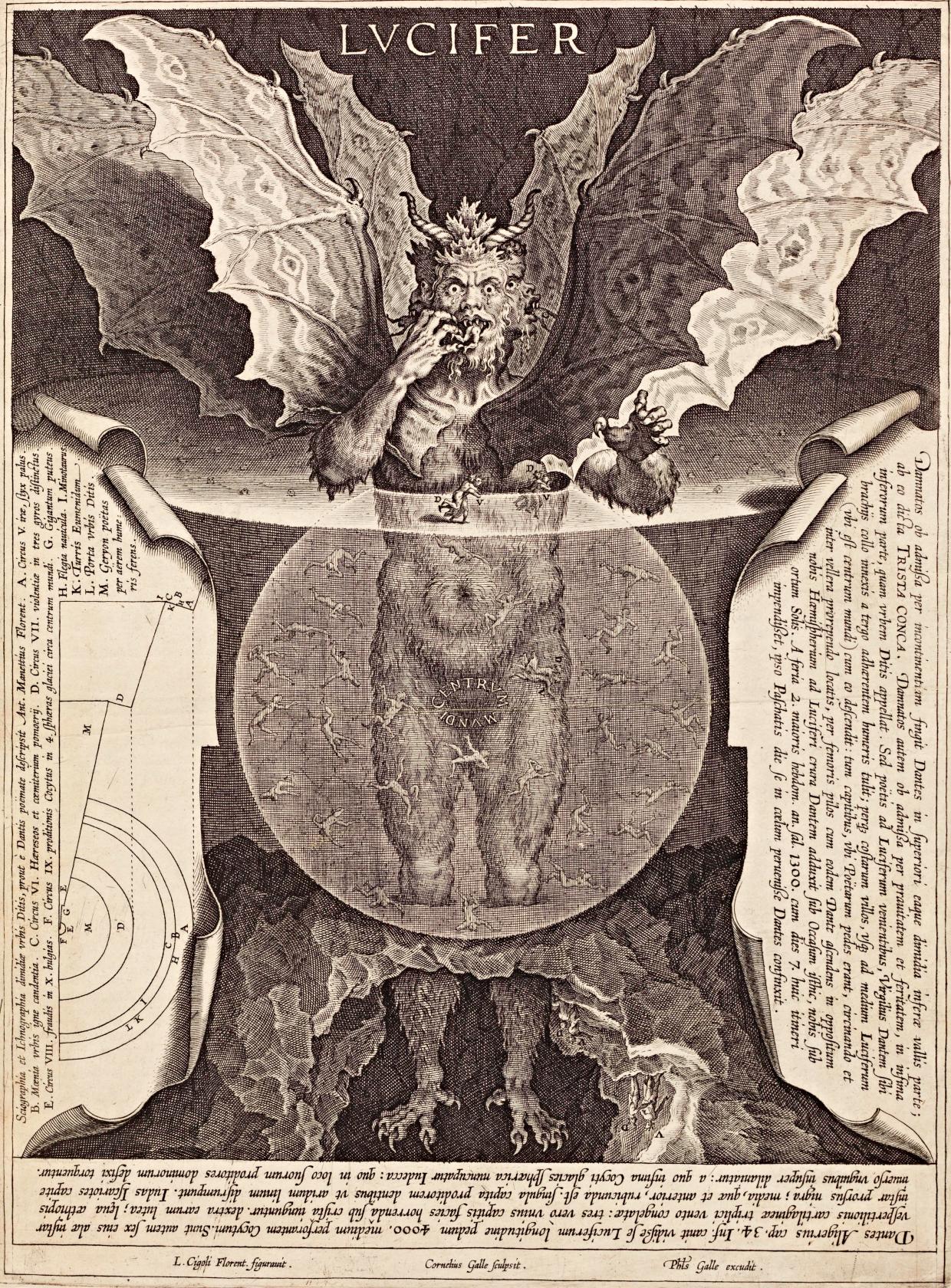
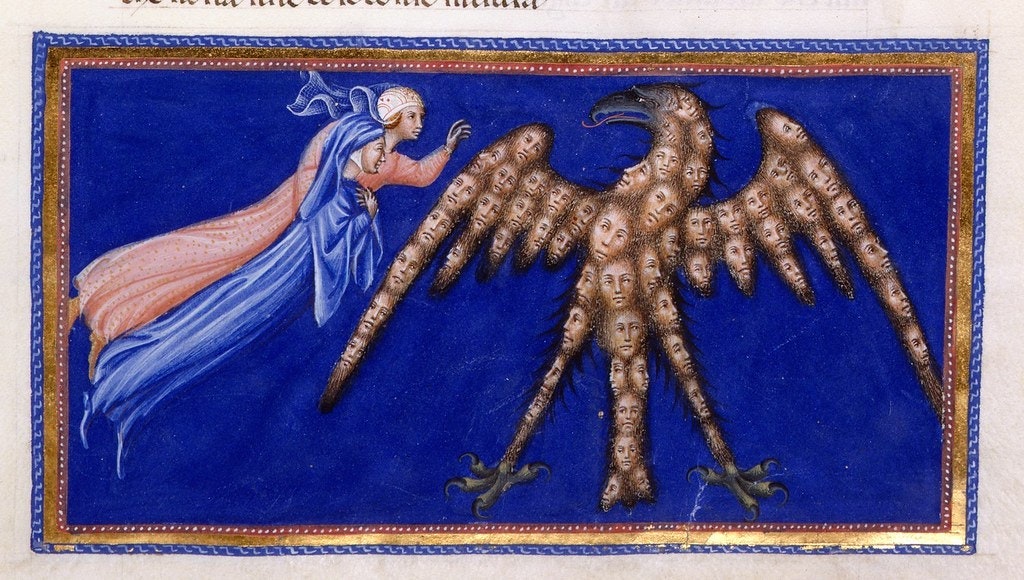
ARTICLE: “700 Years of Dante’s Divine Comedy in Art”: In honor of the seven hundredth anniversary of the Italian poet Dante Alighieri’s death on September 14, the Public Domain Review has collected art directly inspired by his Commedia from over the last seven centuries—on the nine circles of hell, the beatific vision, and much more. Under the tutelage of literature professor Stefano Gidari, I read and studied Dante’s groundbreaking afterlife-adventure trilogy—in Italian!—in 2009 while living in Florence, where it was written, which was such an invaluable experience.
Cornelis Galle I (Flemish, 1576–1650), Lucifer, after Stradanus, ca. 1595. Engraving, 27.5 × 20 cm.Giovanni di Paolo (Italian, ca. 1403–1482), Dante and Beatrice before the Eagle of Justice, ca. 1450. From Yates Thompson 36, fol. 162, British Library, London.
INTERACTIVE PERFORMANCE ART:DIG: A Hole to Put Your Grief In by Cara Levine: Last month artist Cara Levine led a weeklong collaborative project in which she invited those in and around Malibu to join her in digging a hole to visualize the depth of grief being experienced right now in response to personal losses as well as national and global crises. Carried out on a property owned by the Shalom Institute, the project was inspired in part by the Jewish ritual of shiva, the seven-day mourning period following the burial of a family member, during which the bereaved discuss their loss and accept comfort from the community.
“Whatever one is grieving is welcome—be it the loss of a loved one, or more nuanced and subtle grief—the grief that comes with aging, with watching children grow, loss of friendships, habitat, completions to other life cycles, opportunities, loves, that one won’t see flourish, and so on,” Levine wrote in an email to Hyperallergic.
Cara Levine, DIG: A Hole to Put Your Grief In, August 14–21, 2021, Shalom Institute, Malibu, California. Photo: Nir Yaniv.
“Part of the act of inviting others to share in the digging, is an invitation for the collective to lift the burden of the individual. I think digging together, expressing the depth and weight of the grief all around us, can be a shared burden.”
At week’s end the hole was filled with water and transformed into a mikvah (ritual bath) for a ceremonial hand washing, before being refilled with the original dirt. As arts writer Matt Stromberg reported, participants were invited to write down what they were grieving on sheets of paper embedded with flower seeds, which were then buried in small pots that could be taken home, while native seeds were scattered in the hole, a symbol of renewal. Though I, living on the opposite coast, didn’t participate, it sounds like it was a meaningful time of healing and of giving and receiving support.
+++
VIDEO:“Mending Trauma” by Makoto Fujimura: In this video from the 2019 Theology of Making series from Fuller Studio, artist and author Makoto Fujimura describes the Japanese art of kintsugi (literally “golden seams”) and how it reflects the beauty that can emerge from our own fractured hearts and lives.
“Kintsugi theology,” he says, is the theology of the new creation, and it’s embodied by Jesus himself. His resurrection body retains the wounds of crucifixion, but there is light flowing through them, suggesting how our traumas will be carried into the new creation but wholly transformed. Like broken bowls mended with gold.
SONG: This video, taken in June 2015 by someone from the Free Burma Rangers humanitarian service movement, shows an Assyrian Christian woman in Kurdistan lingering behind after church let out, singing a praise song to Jesus alone in a pew. She had recently returned home after having fled an ISIS attack. [HT: Global Christian Worship]
+++
NEW BOOKS:
>>The O in Hope by Luci Shaw, illustrated by Ned Bustard: “Combining a joyful poem from the much-celebrated poet Luci Shaw with playful cut-paper art created by Ned Bustard, The O in Hope helps us experience the goodness of God’s gifts of hope and love.” I found out about this recent release from IVP Kids at a Zoom event, where Shaw [previously] read the poem—it’s so delightful!
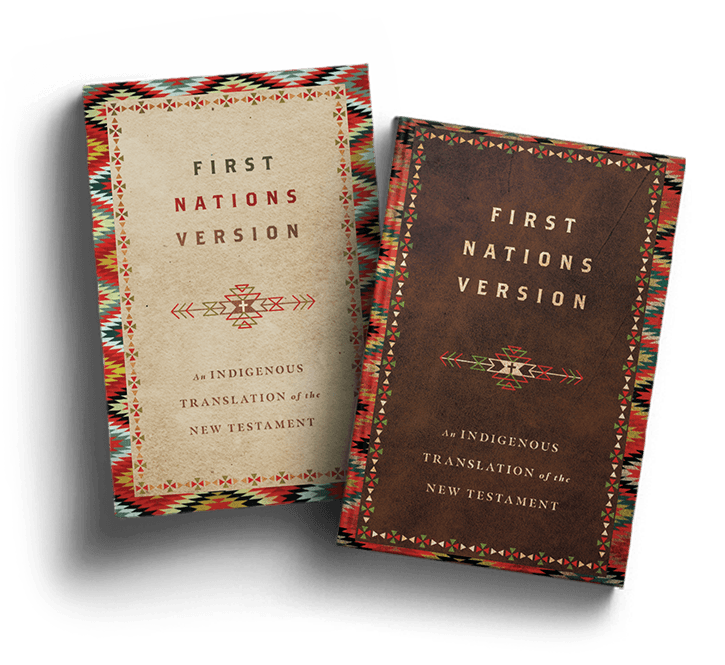
>> First Nations Version: An Indigenous Translation of the New Testament: “Many First Nations tribes communicate with the cultural and linguistic thought patterns found in their original tongues. The First Nations Version (FNV) recounts the Creator’s Story—the Christian Scriptures—following the tradition of Native storytellers’ oral cultures. This way of speaking, with its simple yet profound beauty and rich cultural idioms, still resonates in the hearts of First Nations people.
“The FNV is a dynamic equivalence translation that captures the simplicity, clarity, and beauty of Native storytellers in English, while remaining faithful to the original language of the New Testament.” The project was carried out by an eleven-member council selected from a cross-section of Native North Americans (elders, pastors, young adults, and men and women from different tribes and geographic locations) and overseen by Ojibwe storyteller Terry M. Wildman. Here is Wildman reciting the FNV translation of the Lord’s Prayer from the Gospels, accompanied by his wife, Darlene, on cedar flute:
ART EXHIBITION: De-Colonizing Christ, Riverfront Gallery, St. Stephen’s Episcopal Cathedral, September 12–December 19, 2021 (preview: September 11): St. Stephen’s Episcopal Cathedral in Harrisburg, Pennsylvania, is hosting a juried art exhibition that highlights non-Caucasian representations of Jesus. There are twenty-eight original artworks in the show, plus a dozen on loan from private collections. An opening reception (with hors d’oeuvres) will take place Saturday, September 11, from 7 to 9 p.m., which I’ll be attending! It is open to the public, and masks are required in the sanctuary and cloister gallery.
The poster image is Pantocrator in Black and Brown by Brian Behm from Chapel Hill, North Carolina, which has been awarded Best in Show.
“Recent events have opened conversations among churches, theologians, and biblical scholars, considering in what way the western portrayal of Jesus as a European has been used to marginalize people of color,” the press release reads. “Many suggest that the pursuit of racial justice demands the exploration of ways in which we can de-colonize the Christ—releasing the image of Jesus from a legacy of White Supremacy and exploring images of Jesus as a man of color. This exhibit invites the Central Pennsylvania community into the conversation.” Read more about the impetus behind the exhibition in this opinion piece by the dean of the cathedral, the Very Rev. Dr. Amy Welin.
In addition to the preview night, where many of the artists will be present, there are three related lectures scheduled:
October 17, 2 p.m.: “White Jesus: Mangling Christianity and the Birth of White Supremacy in the West” by Dr. Drew G.I. Hart, Assistant Professor of Theology, Messiah University
November 28, 2 p.m.: Discussion about the tensions inherent in inclusive worship in predominantly white congregations, led by the Rev. Dr. Catherine Williams, Assistant Professor of Preaching and Worship, Lancaster Theological Seminary
+++
BOOK LAUNCH EVENTS: God in the Modern Wing: Viewing Art with Eyes of Faith, September 17–18, 2021: In anticipation of this book’s release on October 12, Upper House in Madison, Wisconsin, is hosting a string of free events two weekends from now. The two lectures can be attended in person or virtually, but the workshop is in-person only. Coeditors Cameron J. Anderson (an artist) [previously] and G. Walter Hansen (a theologian and art collector) will be present.
God in the Modern Wing grew out of a series of lectures that Hansen organized in 2015, one of which I wrote about. The book description is as follows: “Should Christians even bother with the modern wing at the art museum? After all, modern art and artists are often caricatured as rabidly opposed to God, the church—indeed, to faith of any kind. But is that all there is to the story? In this Studies in Theology and the Arts volume, coeditors Cameron J. Anderson and G. Walter Hansen gather the reflections of artists, art historians, and theologians who collectively offer a more complicated narrative of the history of modern art and its place in the Christian life. Here, readers will find insights on the work and faith of artists including Marc Chagall, Jackson Pollock, Mark Rothko, Andy Warhol, and more.”
+++
(IN-PERSON) ARTS FESTIVAL: Faith in Arts Institute, October 13–16, 2021, Asheville, North Carolina: “The inaugural Faith in Arts Institute hosted by UNC Asheville and the Black Mountain College Museum + Arts Center, intended for anyone interested in the role of art in religious and spiritual experience, will be led and facilitated by artists and scholars. The number of participants for the institute itself will be limited to create the possibility for rich and meaningful dialogue and engagement among the participants and faculty.
“In addition to talks on religion and art in the 21st century, sacred art in secular spaces / secular art in sacred spaces, and small group discussions on topics including devotion and discipline, revelation and inspiration, faith and hope, ritual and routine, vision and imagination, the institute will also include several workshops, film screenings and more.” Registration is $60. View a schedule and find out more information here.
The presenters are:
Julie Levin Caro, Professor of Art History, Warren Wilson College (specializes in modern American art and African American art)
Curt Cloninger, artist, designer, writer
Marie T. Cochran, Founder and Director, Affrilachian Artist Project
David Hinton, essayist and translator of Chinese poetry
Rachel Elizabeth Harding, Associate Professor of Indigenous Spiritual Traditions, University of Colorado–Denver (specializes in religions of the Afro-Atlantic diaspora)
Jessica Jacobs, author of the coming-of-age memoir-in-poems Take Me with You, Wherever You’re Going
Kay Larson, author of Where the Heart Beats: John Cage, Zen Buddhism, and the Inner Life of Artists
Christopher-Rasheem McMillan, Assistant Professor of Dance and of Gender, Women’s, and Sexuality Studies, University of Iowa
Aaron Rosen, Professor of Religion and Visual Culture, Wesley Theological Seminary
Pamela D. Winfield, Professor of Religious Studies, Elon University (specializes in the visual/material culture of Japanese Buddhism)
+++
SONG FOR SUKKOT: “Whoever Is Thirsty” by Marty Goetz: Every fall Jews celebrate Sukkot, aka the Feast of Tabernacles or Festival of Booths, a seven-day commemoration of God’s provision for their people during their desert sojourn after the exodus. This year the holiday falls on September 20–27. Four Sukkots ago, singer-songwriter Marty Goetz, a Jewish believer in Jesus, posted this video of a song he composed, “Whoever Is Thirsty,” from his 2010 album Sanctuary. It is an original setting of Revelation 22:17 (a book that “herald[s] the return of Yeshua the Messiah,” he says), and he performs it here with his daughter Misha Goetz.
The Spirit and the bride say, “Come.” And let everyone who hears say, “Come.” And let everyone who is thirsty come. Let anyone who wishes take the water of life as a gift.
—Revelation 22:17
+++
NEW PLAYLIST:September 2021 (Art & Theology): I’m continuing to put together a short monthly Spotify playlist as a way to share great music mainly from the Judeo-Christian tradition. Per usual, it consists mostly of folk and gospel, which are my personal preferences. I realized after the fact that this month’s selection has quite a bit of banjo! (I do love that instrument . . .): a setting by bluegrass quintet Crooked Still of Wendell Berry’s poem “The Peace of Wild Things”; Béla Fleck jamming with Ugandan kalimba player Ruth Akello on “Jesus Is the Only Answer” [previously]; Rhiannon Giddens playing and singing the spiritual “I’m Gonna Tell God All of My Troubles”; Ellen Petersen and her siblings covering the Mark Bishop song “With the Spirit of the Lord Inside”; “Esa Einai,” a setting of Psalm 121:1–2 in English and Hebrew by Jewish bluegrass duo Nefesh Mountain; and an original song by the Westbound Rangers [previously], led by one of my high school friends, Graham Sherrill.
The closing song is “Kia Hora Te Marino,” a collection of Maori blessings and proverbs set to music by Christopher Tin. The first stanza goes,
Kia hora te marino, Kia whakapapa pounamu te moana, Kia tere te rohirohi. Kia hora te marino, Te marino ara Mo ake tonu ake.
English translation: May peace be widespread, may the sea glisten like greenstone, and may the shimmer of light guide you. May peace be widespread, be widespread now and forever more.
ONLINE EXHIBITION: A Global Icon: Mary in Context, created by the National Museum of Women in the Arts: Curated by Virginia Treanor, this digital resource was created as an expansion of the in-person exhibition Picturing Mary: Woman, Mother, Idea (see catalog), which ran from December 5, 2014, to April 12, 2015. Click through the pages to experience art images with descriptions, videos, and other content having to do with representations of Mary from across the world. The first video in the series is posted below, and here’s a playlist of all seven.
INTERVIEW (+ upcoming virtual conversation): “A God Who Wails and Dances: A Conversation with Yvonne Adhiambo Owuor”: This interview by Erika Kloss, which appears in the current issue of Image journal (no. 109), is so. good. Kenyan writer Yvonne Adhiambo Owuor is the author of the novels Dust and The Dragonfly Seaand award-winning short stories such as “The Weight of Whispers,” as well as the executive director of the Zanzibar International Film Festival. Here she talks about fiction, faith, coffee, and calling colonialism to account. To engage further, you can register for the Image-sponsored online event “The Art of Fiction: A God Who Wails and Dances with Yvonne Adhiambo Owuor,”which takes place September 23 at 3 p.m. ET.
Here’s just a snippet from her conversation with Kloss, where she describes what she would say to those who want nothing to do with Christianity because of all the evil that has been done in its name:
Dare to rescue God as Emmanuel from the dense debris of hubris, and from the weight and stench of whited sepulchers. For it is true, an excess of ghouls have appropriated for themselves the meaning and potency of the revolutionary One who dares to pronounce to humanity, “Love your enemies . . . Do good to those who hate you.”
Why should young people let themselves be revulsed by a legion who never fully entered into the depths of the subversive, seductive, paradigm-dissolving, drinking-and-hanging-out-with-sinners, beautiful, and heroic man-God? Why wouldn’t young people set out to experience for themselves the grand and compelling epic of a creator God in love, who loses his children and the earth to a defiant and rebellious once-beloved prince of light, and who struggles long and hard to regain the humanity he had loved and lost? So passionate and desperate is the creator in this endeavor that he will enter into humanity to try to court and secure these cherished children, even at the risk of his own murder—and even that does not stop the love. A love stronger than death? Don’t we all write anthems, in one form or another, yearning for this?
Let the next generation of seekers . . . visit old worlds that contain the spirit of the faith, not just in the Middle East, but also northern Africa, northern Sudan, Egypt, and Ethiopia, all those rubbed-out places (that colonialists presumed to suggest they were ‘civilizing’) from which Christianity entered into and transformed Europe and the world. . . . An historical quest for meaning at sites of origins might inspire young people to look again at the call to adventure and transcendent idealism that is the Way.
+++
VIDEO SERIES: How to Read the Bible by BibleProject: “Reading the Bible wisely requires that we learn about the ancient literary styles used by the biblical authors. . . . While the Bible is one unified story, it cannot all be read in the same way. The How to Read the Bible series walks through each literary style found in the Bible to show how each uniquely contributes to the overall story of Scripture.”
Led by Dr. Tim Mackie and Jon Collins, BibleProject is a crowdfunded animation studio that creates videos, podcasts, and small-group curricula. From 2017 to 2020 they executed a series called How to Read the Bible, which is nineteen episodes total. In it they examine the three major literary styles that comprise the Bible: narrative (chronicles, biographies, parables), poetry (celebratory, reflective, erotic, politically resistant, apocalyptic), and prose discourse (laws, sermons, letters). Each style lives by its own rules and structure, and we get into trouble, for example, when we don’t properly understand how metaphor works, or when we don’t recognize that Paul’s epistles were situated in a particular historical context. Here’s one of the videos in the series, on design patterns in biblical narrative:
MAVCORJournal is an open-access, peer-reviewed digital publication published by the Center for the Study of Material and Visual Cultures of Religion at Yale University. Its “Object Narrative” division is for explicating religious images, objects, monuments, buildings, spaces, performances, or sounds in 1500 words or less.
Visual culture encompasses not just “art” but also ephemera and what we might call “kitsch.” Because my field is art, I gravitate more to research in that vein, which is reflected in the five object narratives I’ve selected to highlight below. In addition to describing the object’s content, each writer also addresses, if applicable, its liturgical or devotional uses and includes relevant historical or cultural context. Click on the links to read more, and spend some time perusing the other offerings on MAVCOR’S website, https://mavcor.yale.edu.
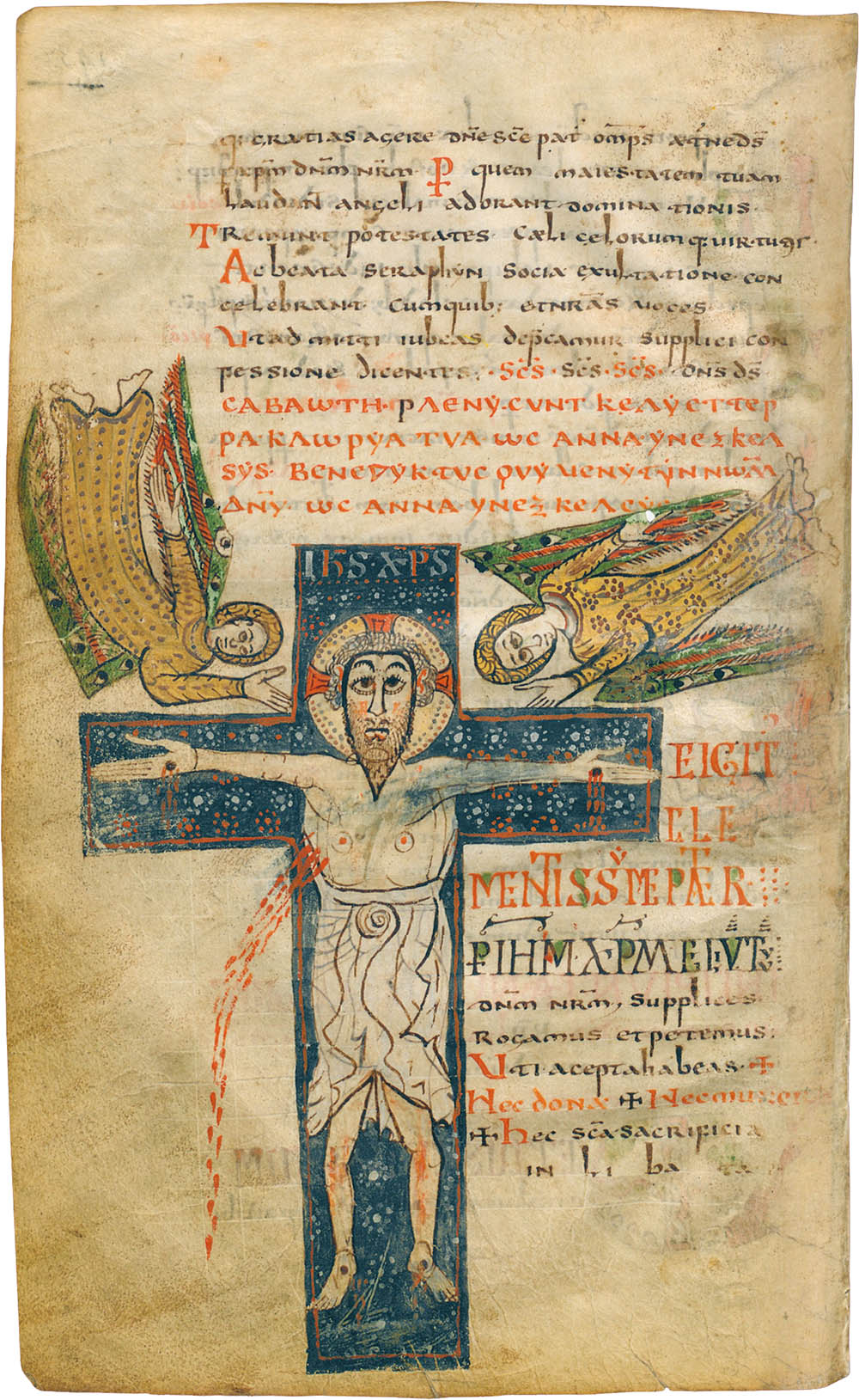
“Christ Crucified in the Gellone Sacramentary” by Lawrence Nees: This eighth-century manuscript illumination from the Frankish kingdom of Charlemagne is one of the earliest surviving images of Jesus on the cross, its viewership restricted to clergy. “He is . . . shown as if nailed to a cross, but this is no wooden cross and indeed no cross at all. It is colored deep blue, studded with white and red flower-like shapes suggesting stars, and indeed it actually is the letter T of the opening words of the Canon of the Mass, the consecration of bread and wine as the body and blood of Christ, in the Latin version here ‘Te igitur clementissime Pater . . . rogamus’ (‘Therefore we beseech Thee, most merciful Father’) . . .”
Crucifixion from the Gellone Sacramentary (Latin 12048, fol. 143v), made in France, ca. 790. Housed at the Bibliothèque nationale de France, Paris.
+++
“Kongo Triple Crucifix” by Cécile Fromont: The west central African kingdom of Kongo, which emerged in the fourteenth century, declared Christianity its official religion in 1509. Kongo participated in the commercial, political, and religious networks of the early modern Atlantic world, and its artists reformulated Christian figures from Europe into objects that are distinctly African—including the many brass crucifixes produced from the sixteenth through nineteenth centuries. (Read more in Fromont’s 2014 book The Art of Conversion: Christian Visual Culture in the Kingdom of Kongo, which I reviewed here.)
Triple Crucifix, central figure 16th–17th century; top and bottom figures 18th–19th century. Brass, iron nails, copper, wood, ultramarine pigment, 10 1/4 × 5 3/4 × 1 in. (26 × 14.5 × 2.5 cm). Metropolitan Museum of Art, New York.
+++
“Death Cart (La Muerte en su Carreta)” by Miguel de Baca: “Death carts” were instruments of penance used by the Penitente brotherhood of northern New Mexico and southern Colorado in the second half of the nineteenth century and the first half of the twentieth; this is the earliest known one. They were built in the style of an old oxcart, and seated inside was Doña Sebastiana, an allegorical figure of Death, wielding her bow and arrow. Each Good Friday, “an elected brother attached the heavy chassis to his torso with a horsehair rope and dragged it from the morada (meetinghouse) along the path to the calvario (Calvary site), inflicting abrasions upon his body as a demonstration of his faith and desire for closer union with God.” I must say, this skeletal figure with the close-set eyes and large forehead (and is that human hair and teeth?) terrifies me!
Nasario López, Death Cart (La Muerte en su Carreta), ca. 1860. Gesso, leather, cottonwood, pine, 51 × 24 × 32 in. (129.5 × 61 × 81.3 cm). Colorado Springs Fine Arts Center, Colorado Springs, Colorado.
“Georgia O’Keeffe, Black Cross with Stars and Blue”by Jeffrey Richmond-Moll: During a four-month stay in Taos, New Mexico, in the summer of 1929—her first visit to the Southwest—Georgia O’Keeffe painted four canvases of Penitente crosses with Taos Mountain visible in the distance. The Penitentes were a lay Catholic brotherhood whose rituals centered on the remembrance of Christ’s passion. They erected crosses all over the region, outside their moradas (meetinghouses) and along roadsides, which they picked up and carried on holy days.
Georgia O’Keeffe (American, 1887–1986), Black Cross with Stars and Blue, 1929. Oil on canvas, 40 × 30 in. (101.6 × 76.2 cm). Private collection.
+++
“James Latimer Allen, Madonna and Child” by Camara Dia Holloway: “Allen operated a studio in Harlem between 1926 and 1943, producing artistic and commercial photographs. . . . By contributing to the development of a new racial iconography, Allen’s Madonna and Child and other black Madonnas offered positive visual and material rejoinders to widely reproduced images that represented black women’s failure to parent their own children. The Mammy stereotype, the legend of Margaret Garner (known as the Black Medea), and portraits of white children held by their black nannies belong to this latter and negative set of portrayals.” This is a religious icon by and for African Americans, Latimer writes—one that reflects and affirms their own self-image.
James L. Allen (American, 1907–1977), Madonna and Child, 1930s. Photograph, 24.4 × 18.7 cm. New York Public Library.










 Art & Theology