Roundup: Pool of Bethesda, Argentine tango hymn, Ernesto Cardenal, beauty and suffering, “Spiritual Cosmonaut” playlist, and “The Two Popes”

VISUAL COMMENTARIES: “The Pool of Bethesda” by Naomi Billingsley: In a recent contribution to the online Visual Commentary on Scripture [previously], Naomi Billingsley has compiled and written about three artworks based on John 5:1–18, a story in which Jesus heals a paralyzed man at a reservoir in Jerusalem. A source of hydration, cleansing, and tranquility, the pool of Bethesda, Billingsley says, is a symbol that transcends individual religious traditions.

Pool of Bethesda

She discusses William Hogarth’s painting of the subject for a hospital, showing sick patients receiving care; a “Dreamtime” drawing from Aboriginal Australian artist Trevor Nickolls’s Bethesda series, created during his recovery from a major car accident; and The Angel of the Waters fountain in Bethesda Terrace in Manhattan’s Central Park, designed by Emma Stebbins in 1842 to celebrate an aqueduct that brought clean water to New York City and improved public health (and which you may recognize as the site where John the Baptist baptizes disciples in the opening sequence of the movie Godspell).

+++

ARGENTINE TANGO HYMN: “Tenemos Esperanza” (We Have Hope): This hymn text was written in 1979 by Federico Pagura (1923–2016), a Methodist bishop and human rights champion from Argentina, and set to tango music by Homero Perera (1939–2019) of Uruguay. Argentinian pastor Federico “Fede” Apecena, who lives in Georgia in the US, recently introduced the song to his friend Josh Davis, who heads the multicultural worship ministry Proskuneo, and the two banged out this awesome video performance. “The song is a record of all that Jesus came to do and to be,” Apecena explains at the end of the video. [HT: Global Christian Worship]

+++

OBITUARY: Ernesto Cardenal (1925–2020), poet and priest who mixed religion and politics in his commitment to social justice in Nicaragua, dies at 95: A Catholic priest, poet, and political revolutionary from Nicaragua, Ernesto Cardenal was a controversial figure. He supported the Sandinista insurrection against the dictatorial Somoza regime in the seventies and, when the Sandinista government (which claimed to integrate Marxist and Christian ideals) came to power, served as its minister of culture from 1979 to 1987. He viewed this post as an extension of his priestly office and, refusing to quit it at Pope John Paul II’s behest, was forthwith suspended from the priesthood in 1984. (Pope Francis absolved him of canonical censure in February 2019, permitting him to administer the sacraments once again.)

Cardenal’s most enduring achievement was his 1966 founding of a religious community among the peasant farmers and fishermen of the Solentiname archipelago in Lake Nicaragua. He saw to the construction of a small wooden church, where he led collaborative Masses: instead of giving a homily on the week’s assigned Gospel reading, he opened up dialogues about it with his parishioners, relishing their insights. Transcripts of these conversations were published in four volumes as El Evangelio en Solentiname (The Gospel in Solentiname) between 1975 and 1977, with English translations appearing in 1976–82—a classic work of liberation theology.

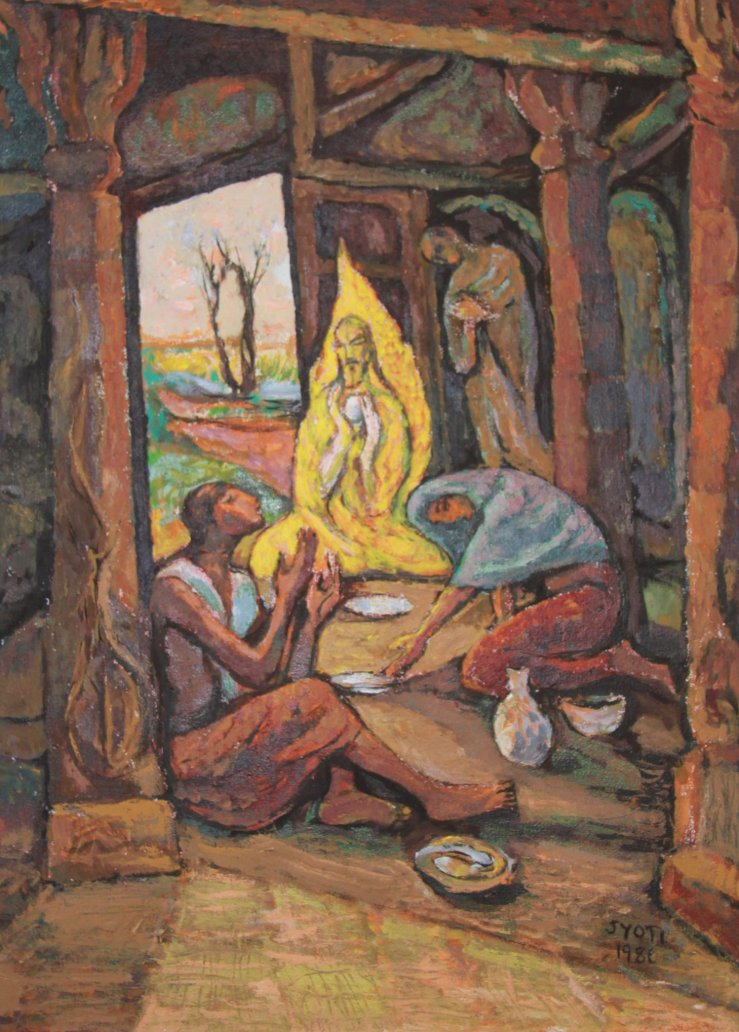
Besides cultivating the islanders’ interest in the Bible, Cardenal also took notice of their creative talents. He brought in artists to lead workshops, which led to the development of a primitivist art school that achieved international recognition for its paintings, many of them depicting Jesus’s birth, ministry, and passion taking place in Solentiname, in and around the familiar thatched-roof buildings, blue waters, and lush vegetation. In 1984 Orbis Books editors Philip and Sally Scharper combined several such images with a heavily abridged version of The Gospel in Solentiname and published it as The Gospel in Art by the Peasants of Solentiname, a slim, full-color hardcover that I highly recommend.

Guevara, Gloria_Visitation
Gloria Guevara (Nicaraguan, 1954–), The Visitation, 1981 [source: The Gospel in Art by the Peasants of Solentiname]
“It was the Gospel which radicalized us politically,” Cardenal said. “The peasants began to understand the core of the Gospel message: the announcement of the kingdom of God, that is, the establishment on this earth of a just society, without exploiters or exploited.” Afraid of the dangerous ideas taking root in Solentiname, Somoza’s National Guard razed the settlement to the ground in 1977, and Cardenal was forced to flee to Costa Rica. He gave his blessing to his community’s decision to join the Sandinistas, the people’s army, to attempt an overthrow of Somoza, a victory they achieved in 1979. The surviving peasants returned to Solentiname to rebuild, and their practice of art and faith continues to thrive to the present day.

Cardenal is also known as a poet. I’ve read only one volume of his poetry, in English translation: Apocalypse: And Other Poems (New Directions, 1977). I didn’t connect well with a lot of it, but it does have a few gems, like “Prayer for Marilyn Monroe,” “The Cosmos Is His Sanctuary (Psalm 150),” and “Behind the Monastery,” reprinted here in full:

Behind the monastery, down the road,
there is a cemetery of worn-out things
where lie smashed china, rusty metal,
cracked pipes and twisted bits of wire,
empty cigarette packs, sawdust,
corrugated iron, old plastic, tires beyond repair:
all waiting for the Resurrection, like ourselves.

(translated from the Spanish by Robert Pring-Mill)

+++

LECTURE: “On Beauty” by Natalie Carnes: “Beauty has been leveraged in ways that wound us, with legacies of misogyny, class hatred, and racial injustice,” says Dr. Natalie Carnes, associate professor of theology at Baylor University. “And yet I want to suggest that beauty tends those same wounds, and can be found in those same wounds, for beauty is a name for God.”

In this half-hour talk given November 1, 2017, at Dallas Theological Seminary as part of school’s Arts Week, Carnes examines the paradox, expressed in the church’s art and theology across history, that God is both beautiful and not beautiful. In his suffering, Carnes says—his entering the ravaged and scarred places of our humanity—God does not renounce his beauty but reveals it.

The divine presence in grotesque suffering is not a departure from the divine life but characteristic of it. And that movement into the grotesque is not antagonistic to beauty but the revelation of it. God’s faithfulness goes by way of intimacy with not-God, and beauty by way of the grotesque. The beauty that rejects suffering is false, and the one who follows the call of beauty faithfully will find herself in the scarred places of the world. Beauty, after all, is a name for God, and God does not abandon divinity in identifying with the suffering and afflicted but expresses through such identification the very marker of divine life.

This is not to say that suffering, affliction, or poverty is beautiful. Beauty is distinct from the mode of its arriving. Poverty and suffering can be important sites of beauty, even as they are not themselves beautiful, because they mediate the beauty of the God who is charity. . . .

Beauty and Suffering
Left: Michelangelo, Last Judgment (detail), 1536–41 | Right: Matthais Grünewald, Isenheim Altarpiece (detail), 1515

Natalie Carnes is the author of Beauty: A Theological Engagement with Gregory of Nyssa, Image and Presence: A Christological Reflection on Iconoclasm and Iconophilia, and (forthcoming) Motherhood: A Confession.

+++

PLAYLIST: “Spiritual Cosmonaut,” compiled by Latifah Alattas: Last month singer-songwriter and music producer Latifah Alattas [previously] curated a short Spotify playlist of “Spiritual songs that stir my soul. Melodies that tap into mystery. Sounds that open me up to the wonder and peace of God.” It’s great!

Alattas is the frontwoman of the band Page CXVI [previously], which has just returned from a six-year hiatus. I’m so moved by their recently released rendition of “Great Is Thy Faithfulness,” with piano, synthesizer, and pedal steel guitar. Alattas has made the song more communal, subbing out all first-person singular pronouns for first-person plural, even rewording whole lines, like the last two of the chorus, which become “Amidst the pain of this world you grieve with us—unfailing faithfulness, dwelling so near.” Or the final line of the final verse, which she changed from “Blessings all mine, with ten thousand beside!” to “Blessings for all, Christ within us resides.”

People who are attached to singing the song a certain way might object to such lyrical revisions, but I see them, along with the creative musical liberties she takes, as helping to bring out the themes that are already there. Alattas helped me to hear this classic hymn with new ears.

+++

FILM: The Two Popes (2019), dir. Fernando Meirelles: I recently watched this Oscar-nominated biographical drama and enjoyed it more than I thought I would! I wasn’t expecting the respect it gives to its subjects and to Christianity. Its title refers to the fact that, for the first time in six hundred years, the Roman Catholic Church has one reigning pope and one retired pope, the “pope emeritus.” (When Benedict announced his resignation in 2013, it shocked the world, as it’s expected that, if chosen, you serve in that role until death.)

The movie is primarily about the relationship between the traditionalist Pope Benedict XVI (born Joseph Ratzinger) and the progressive Pope Francis (born Jorge Bergoglio), which starts out antagonistically but buds into a friendship of sorts. It’s dialogue-heavy (it was adapted from a stage play), but in the most interesting way, as the two engage in “a series of philosophical and dogmatic discussions and disagreements about the nature of faith and forgiveness, and the direction of a church struggling to maintain relevance in the modern world” [source].

But it’s not just about the church’s struggle or the burdens of high office; it’s also about personal faith as a struggle—how to discern one’s calling in life, how to hear God’s voice and deal with his silence, and how to forgive oneself for one’s own tragic silences (in Benedict’s case, regarding the sex abuse perpetrated by clergy; in Francis’s, regarding the Dirty War in his home country of Argentina in the late seventies and early eighties, while he was serving as priest).

Francis’s backstory, of which I knew nothing beforehand, is told in flashbacks. (The fiancée is fictional, though the real Francis has admitted to having romantic crushes as a teenager and even as a seminarian.) The portrayal of both men, by Anthony Hopkins as Benedict and Jonathan Pryce as Francis, is very humanizing (not initially for Benedict, but his character gets there)—and not just because of the glimpse it provides into Francis’s life prior to the cloth, but also, in part, because of little nods it gives to their interests beyond the church, like Francis’s love of soccer and tango dancing, and Benedict’s piano playing and Fanta drinking. And because it shows their personal fallibility, their regret over past misdeeds.

It should be noted that the meeting of the two men at the papal summer residence of Castel Gandolfo prior to Benedict’s resignation is invented, as are many of their lengthy dialogues, which are nonetheless inspired by speeches, letters, and other writings of theirs, brought into conversation with one another by playwright and screenwriter Anthony McCarten.

Jesus Gave Me Water (Artful Devotion)

Pierce, Elijah_Christ and Lady
Elijah Pierce (American, 1892–1984), Christ and Lady, 1968. Wood, paint, and glitter, 21 1/2 × 16 1/2 × 1 1/4 in. High Museum of Art, Atlanta. Photo: Victoria Emily Jones.

A woman, a Samaritan, came to draw water. Jesus said, “Would you give me a drink of water?” (His disciples had gone to the village to buy food for lunch.)

The Samaritan woman, taken aback, asked, “How come you, a Jew, are asking me, a Samaritan woman, for a drink?” (Jews in those days wouldn’t be caught dead talking to Samaritans.)

Jesus answered, “If you knew the generosity of God and who I am, you would be asking me for a drink, and I would give you fresh, living water.”

The woman said, “Sir, you don’t even have a bucket to draw with, and this well is deep. So how are you going to get this ‘living water’? Are you a better man than our ancestor Jacob, who dug this well and drank from it, he and his sons and livestock, and passed it down to us?”

Jesus said, “Everyone who drinks this water will get thirsty again and again. Anyone who drinks the water I give will never thirst—not ever. The water I give will be an artesian spring within, gushing fountains of endless life.”

—John 4:7–14 MSG (read the full story)

+++

SONG: “Jesus Gave Me Water” by Lucie E. Campbell, 1946 | Performed by Sam Cooke and the Soul Stirrers, 1951

“One of the most regarded composers of African American religious song, Lucie E. Campbell [1885–1963] was a pioneering figure linking traditional hymnody to modern gospel composition and bridging gender and racial divides in the world of gospel music. Alongside such musical peers as Thomas A. Dorsey, Roberta Martin, and fellow Memphian Reverend W. Herbert Brewster, she helped forge the black gospel sound of the first half of the twentieth century and further belongs to a small coterie of composers who have set lasting standards for religious music in the black Baptist church.” (https://memphismusichalloffame.com/inductee/luciecampbell/)

Campbell’s song “Jesus Gave Me Water” was first recorded by Artis Kitchen in 1947. For a partial list of subsequent covers, see secondhandsongs.com. I like Sam Cooke’s version best, from 1951, when he was singing lead for the Soul Stirrers—no one can beat his honey-smooth vocals. You might know him, as I first did, as the singer of hits like “You Send Me,” “Chain Gang,” “Another Saturday Night,” “Twisting the Night Away,” “Cupid,” and “A Change Is Gonna Come.” (I have fond memories of listening to Oldies 100.7 FM in car rides with my dad growing up!) But like many famous soul singers, Cooke, a PK (preacher’s kid), got his start singing at church, at age six. His leadership of the popular black gospel group the Soul Stirrers from 1951 to 1956 propelled his career, and he crossed over into pop with great success.

For a throatier version of “Jesus Gave Me Water,” which is also quite good, see the Stars of Faith’s recording from 1965.

+++

A self-taught artist born in Baldwyn, Mississippi, Elijah Pierce began wood carving as a young child, using the pocketknife his father gave him. He knew he didn’t want to farm for a living like the rest of his family, so he left home as a teenager and eventually settled in Columbus, Ohio, where he ran a barbershop and led a church congregation. He described his wood carvings as sermons he used to teach people about the Bible. After encountering how Pierce used art to supplement his teaching, Leroy Almon (another celebrated folk artist, unknown at the time) apprenticed himself to Pierce.

The High Museum of Art in Atlanta has a wonderful collection of folk art, including works by Pierce and his student Almon. Pictured below, from my visit last year, are: Leroy Almon, The Baptism of Jesus, 1983; Elijah Pierce, Christ and Lady, 1968; Ulysses Davis, Jesus on the Cross, 1946; and Leroy Almon, Slavery Time, 1990.

High Museum of Art folk art (Almon, Pierce, Davis)

Though no well is visible in Christ and Lady and the title is generic, I see it as a depiction of the Samaritan woman from Sunday’s lectionary reading, and the description on the museum’s label also interprets it that way.


This post belongs to the weekly series Artful Devotion. If you can’t view the music player in your email or RSS reader, try opening the post in your browser.

To view all the Revised Common Lectionary scripture readings for the Third Sunday of Lent, cycle A, click here.

Roundup: Acoustic ecology, trees in religion, the Pharaoh Sisters, and more

Below you will find a mix of annotated links to songs, interviews, articles, and art showings of interest: “The Sound of Silence” on classical guitar; an acoustic ecologist whose job is to record nature’s music; giving up books for Lent; two interfaith art exhibitions (Faces of Prayer in Vienna and To Bough and To Bend in Los Angeles); and two new folk music albums (Old Wow by Sam Lee and Civil Dawn by the Pharaoh Sisters).

+++

MUSIC VIDEO: “The Sound of Silence” (arr. Lawson, Trueman): Classical guitarist Miloš Karadaglić collaborated with members of the string orchestra 12 Ensemble on this instrumental rendition of Simon & Garfunkel’s “The Sound of Silence.” [HT: Philip Chircop]

This is the title track of Karadaglić’s fifth album, Sound of Silence, released last fall. To watch him perform the piece in London’s Air Studios, as filmed by Classic FM in October for Live Music Month 2019, click here.

+++

PODCAST EPISODE: “Silence and the Presence of Everything,” On Being interview with Gordon Hempton: “Acoustic ecologist Gordon Hempton collects sounds from around the world. He’s recorded inside Sitka spruce logs in the Pacific Northwest, thunder in the Kalahari Desert, and dawn breaking across six continents. An attentive listener, he says silence is an endangered species on the verge of extinction. He defines real quiet as presence—not an absence of sound but an absence of noise.”

Such a unique vocation—listening to places, preserving natural soundscapes. “I hear music coming from the land,” Hempton says. “Some of the most sublime symphonies have been hidden away in something as simple as a driftwood log.” Among his other favorite “musics” are “grass wind” (“the tone, the pitch, of the wind is a function of the length of . . . the blade of grass”) and sounds from “the most musical beach in the world,” Rialto Beach.

Earth is a solar-powered jukebox. . . . We can go to the equator, listen to the Amazon, where we have maximum sunlight, maximum solar energy. The solar panels, the leaves, are harvesting that and cycling it into the bioacoustic system. And, to my ears, that’s a little too intense. That’s a little bit too much action.

Then we can jump up into Central America, and we can still feel and hear the intense solar energy, but it’s beginning to wane.

And we notice a really big difference when we start getting into the temperate latitudes, of which I particularly enjoy recording in because it’s not just about the sound, but it’s about something that I call the “poetics” of space. . . .

“Silence is really wonderful, isn’t it?” he beams. “Even when we just let it exist, it feeds our soul.”

+++

ESSAY: Last year Leah Slawson gave up books for Lent. When I first read that headline, I balked. Books are so life-giving to me! But as I read on, I came to understand Slawson’s reasoning (with which I can identify), and, while I’m not fasting from reading, I admire her choice. “I put a high value on reading, but I am keenly aware that I can use it as an escape from thinking my own thoughts or from noticing my feelings. . . . Reading, for me, is a distraction from the hard work of writing, and since it is so worthy of an activity, I feel justified and redeemed. I even read and study as a way to fool myself into thinking I am practicing faith; when really, I am just reading about someone else’s spiritual practice.” [HT: Rachel A. Dawson]

+++

EXHIBITIONS:

>> Faces in Prayer: Photography by Katharina Heigl, Weltmuseum Wien, Vienna, December 5, 2019–March 24, 2020: A series of thirty-one intimate black-and-white photographs showing people of different faiths in prayer. To capture these shots, photographer Katharina Heigl visited churches, temples, mosques, synagogues, and other places of worship in Austria and Israel, but, important to the display, there are no labels to tell you who is praying to which god(s). That’s because Heigl wishes to emphasize the universality of the human impulse to communicate with the Divine. There are signs, however, that reproduce quotes from anonymous sources, printed in German, English, Hebrew, and Arabic, such as “Prayer is like an oasis of calm inside me. Like a tree giving me shade.” [HT: ArtWay]

Faces in Prayer
Exhibition view of “Faces in Prayer: Photography by Katharina Heigl” (2019–20) at the Weltmuseum Wien, Vienna
Heigl, Katharina_Faces in Prayer
Photograph by Katharina Heigl, from the “Faces in Prayer” series

>> To Bough and To Bend, Bridge Projects, Los Angeles, March 11–April 25, 2020: Officially launched last October, Bridge Projects is an LA exhibition space with public programs connecting art history, spirituality, living religious traditions, and contemporary art practices. Their second exhibition, To Bough and To Bend, opens Wednesday, with thirty-two participating artists.

“The Tree of Life is found in both the beginning of the Jewish Tanakh and in the last book of the Christian Scriptures. The Bodhi Tree is said to be the site of Siddhārtha Gautama’s awakening as the Buddha. Ancient Chinook prayers address God as the ‘Maker of Trees.’ As the novelist Richard Powers said, trees are rightly called ‘architecture of imagination.’ Their shade and branches have been sites of contemplation, suffering, and imagining our renewal.

“Today, trees still speak: blunt stumps communicate deforestation and charred limbs speak of Los Angeles fires started by our own hands—or our negligence. New discoveries of communicating root systems speak to a tangled web of connections just below the surface of the visible world, just as LA’s iconic—and imported—palms evoke a colonial past. In To Bough and To Bend, artists explore these ecological issues and look to both religious and contemporary art practices that help us listen to these old friends, so that we might relearn to ‘walk slowly and bow often’ and find our way back into the living world we share.”

Shochat, Tal_Lessons in Time 3
Tal Shochat (Israeli, 1974–), Lessons in Time 3 (Yellow Apple Tree), 2016. C-prints, mounted and framed, 39 1/4 × 44 in. each. Photo courtesy of the artist and Meislin Projects.

The opening celebration on March 14 will consist of a communal poetry reading followed by a Tu B’Shevat (New Year of the Trees) ritual presentation by community organizer Michal David. Other events are: “Called to Shine: Trees in Myth, Symbol, and Art”; a live interview with artist Lucas Reiner on his Trees as Stations of the Cross project; a talk on indigenous trees of Southern California, given by a member of the Tongva tribe; a discussion of art’s role in nature preservation; a lecture by Dr. Kimberly Ball on Yggdrasil, the tree of life in Norse mythology; “Paradise and Agony in the Garden: Sacred Trees in Italian Renaissance Art”; Dr. Duncan Ryūken Williams on the intersections of Buddhism and ecology; a bonsai demonstration; and a poetry reading and song performance by Iranian-born writer Sholeh Wolpé.

+++

NEW ALBUMS: Both these were released in January.

>> Old Wow by Sam Lee: An avid collector and reinterpreter of traditional songs, Britfolk artist Sam Lee is acclaimed for “breaking the boundaries between folk and contemporary music and the assumed place and way folksong is heard . . . not only inviting in a new listenership but also interrogating what the messages in these old songs hold for us today.” He studied under the Scottish storyteller and ballad singer Stanley Robertson (1940–2009) and, in addition to singing, plays the Jew’s harp and the Indian shruti box. Other instruments in his unique fusion include the klezmeresque cello, tabla, Japanese koto, ukulele, violins, and percussion.

Below are two music videos from his latest album, Old Wow. The first is “Lay This Body Down,” a song about death; in the choreographed video, Lee is tugged and caressed by a gaggle of deceased souls, who at the end enfold him in the ground. “The Moon Shines Bright,” on the other hand, which features Elizabeth Fraser, is about life: its call (fitting for Lent) is to “Rise, arise, wake thee, arise / Life, she is calling thee / For it might be the mothering of your sweet soul / If you open your eyes and see.” I’ve heard many different iterations of this song, which usually appears on Advent/Christmas albums with verses about the Nativity, Crucifixion, etc., but this adaptation was gifted to Lee by an elderly Gypsy woman named Freda Black and is absent of overt Christological references.

Another highlight: “Soul Cake,” a song I know from Peter, Paul, and Mary’s 1963 “A’ Soalin’.” It refers to a medieval Hallowmas tradition.

>> Civil Dawn by the Pharaoh Sisters: The Pharaoh Sisters is a folk outfit from Winston-Salem, North Carolina, whose debut album has arrived! Influenced by mountain, old-time, and gospel traditions, the band consists of Austin Pfeiffer on acoustic guitar and lead vocals, Jared Meyer on acoustic guitar and backing vocals, Kevin Beck on lap steel guitar, and John Daniel Ray on upright bass. “Their music blends the cowboy sensibilities of Western-native frontman and lyricist Austin Pfeiffer with the Appalachian traditions of dark imagery and poignant guitars from their current home in the foothills of the Blue Ridge.”

The biblical narrative is deeply embedded in the album, with many sideways references to specific scriptures. Topography is used symbolically throughout—fissures, canyons, mountains—and helps establish the central metaphor of Jesus as a pioneer, opening up a new frontier for us, leading us through the wilderness into the land of promise.

The album’s title, Civil Dawn, is a scientific term referring to when the center of the sun is six degrees below the horizon in the morning—in other words, the moment before the sun rises. The first song, which muses on the paradoxical character of Jesus, ends with a yearning for “Healing wings / Righteous sun,” a subtle nod to Malachi 4:2. That leads into “Awake, my soul, to the sun,” a prayer that we would incline ourselves toward the Light that’s already shining. As the journey continues, there’s darkness, dryness, a feeling of lostness and thirst. But we are not abandoned by our co-traveler, who is our light, our rest and refreshment, our way-maker. The last song, “Homecoming,” celebrates the “pioneer man with sun-scorched hands” who “guides on a trail he’s blazed”—an evocative image, which makes me think of Christ’s glorious wounds (in many traditional religious paintings, the nail prints emit light), but also, in light of the whole record, Isaiah 58:11: “The LORD will guide you always; he will satisfy your needs in a sun-scorched land and will strengthen your frame. You will be like a well-watered garden, like a spring whose waters never fail.”

I Will Lift My Eyes (Artful Devotion)

McCahon, Colin_Tomorrow will be the same
Colin McCahon (New Zealand, 1919–1987), Tomorrow will be the same but not as this is, 1958–59. Solpah and sand on board, 188.6 × 127.8 cm. Christchurch Art Gallery, Christchurch, South Island, New Zealand.

I will lift up mine eyes unto the hills, from whence cometh my help.

My help cometh from the LORD, which made heaven and earth.

He will not suffer thy foot to be moved: he that keepeth thee will not slumber.

Behold, he that keepeth Israel shall neither slumber nor sleep.

The LORD is thy keeper: the LORD is thy shade upon thy right hand.

The sun shall not smite thee by day, nor the moon by night.

The LORD shall preserve thee from all evil: he shall preserve thy soul.

The LORD shall preserve thy going out and thy coming in from this time forth, and even for evermore.

—Psalm 121

+++

SONG: “Traveler’s Psalm” by Donald Boyd | Arranged and performed by Andy Zipf, on Traveler’s Psalms and Carols (2009)


https://open.spotify.com/track/3ixEsmd1RZr1NRupQGswwd?si=CT969notT1Cn8kLsUS3nlA


I will lift my eyes unto the hills
Whence cometh my help
My help cometh from the Lord
Who made heaven and earth
He will not allow my foot to stumble
For he’s always on my side
And he’ll guide me through all of the days of my life
Now and forevermore

Andy Zipf received this original song from his maternal grandfather, Donald Boyd (1919–1998), who, in addition to writing hymns, was the choir director of a church in Roland, Iowa, for fifty-one years. He had bought Zipf his first guitar and always encouraged him to sing. As a tribute to Grandpa Boyd and his formative impact, Zipf has made the song available for free download at Bandcamp.

+++

The dusky, reverberant landscape painting Tomorrow will be the same but not as this is by Colin McCahon [previously] shows a sun setting behind a range of dark New Zealand hills, with a gray body suggesting water in the midground. Art critic Justin Paton surmises that the mysterious form in the upper left corner (which he jokingly calls “the windshield wiper of God”) is the tail of a cross, because McCahon did a whole series of drawings of flying crosses within landscapes.

“I think it’s a kind of resurrection painting,” Paton said in an RNZ Saturday Morning interview last November. “It’s talking about the way in which an immense spiritual event could shake your world, but then you go to bed and you wake up the next day. It is still the same world, but how has it altered?” Paton continues, “He [McCahon] deals in visions, he deals in miracles, he deals in cataclysmic and elating spiritual events, but it’s always earthed in the everyday—in a world we recognize, a world we can smell . . .” The medium in Tomorrow is commercial flooring paint mixed with sand.


This post belongs to the weekly series Artful Devotion. If you can’t view the music player in your email or RSS reader, try opening the post in your browser.

To view all the Revised Common Lectionary scripture readings for the Second Sunday of Lent, cycle A, click here.

“After the Fig Leaves, Eve Cuts Her Hair” by LeighAnna Schesser

Bouguereau, William_The First Mourning
William-Adolphe Bouguereau (French, 1825–1905), The First Mourning, 1888. Oil on canvas, 79 9/10 × 98 2/5 in. (203 × 250 cm). Museo Nacional de Bellas Artes, Buenos Aires.

“After the Fig Leaves, Eve Cuts Her Hair”

So when they bury Abel, there is no veil
between her grief and her love. And there he stands,
so like his father, his cities yet unbuilt.

His father cuts open earth with bare hands,
leaving plough and shovel, the sharp edges
and the heavy handles, apart in furrowed field.
She calls each animal he resembles: mole, badger, fox.
He named them, once, and now she names him:
father unfathered, sonless, one son less. The sun hangs
round and clear, apple-red, above the dark tree line.

Once, when Cain was the only child in the world,
their fields withered and arrows flew fruitless.
Dull-eyed by the empty fire, beside the windless cedars,
he wailed at the dry breast. Much later,
after thunder dumbed the stars,
they faced the barren, muddied vale together. Adam said,
God made paradise, and we made this—
this is all we have to give him. He struck his staff
upon the seedless ground. Cain made two tiny fists.

Abel she cannot unsee as a splintered spear
of red lightning, reduced to kindling
on the perfumed grass, the churned earth
weeping red mud. Loss escapes her in a hiss
of distant fear: this time, the choice
for death has been made for her,
despite that it was life she’d sent into the world.
Her voiceless throat swells tight, dry as scales.

Her hair is short and stiff and gray. The world is young.
There will yet be other sons, and daughters more;
the seed of man must multiply. But this grief is older
than she knows, its gaze fixed far ahead
on what, someday, must be done. The wind’s voice
keens a long lament, a parent loss,
the form of sons’ deaths yet to come.

“After the Fig Leaves, Eve Cuts Her Hair” by LeighAnna Schesser was originally published in Presence: A Journal of Catholic Poetry 2018 and is used here by permission of the author. The poem will appear in Schesser’s first full-length poetry collection, Struck Dumb with Singing, to be published by Lambing Press in May 2020.

+++

LeighAnna Schesser’s poem “After the Fig Leaves, Eve Cuts Her Hair” explores parental grief following the death of a child—in particular, that of our primordial parents, Adam and Eve, who mourn the loss of their second-born son, Abel. Genesis 4:1–16 recounts how Abel was murdered by his older brother, Cain, in a fit of jealousy. This is the first human death in the Bible, and it was the direct result of sin.

The poem starts with the title, which flows with unbroken syntax into the first line: “After the fig leaves, Eve cuts her hair so when they bury Abel, there is no veil between her grief and her love.” The cutting of hair in response to death in the immediate family is a ritual practiced by women in many Native American tribes and Aboriginal people groups, where the act of severing, and the subsequent absence of, a cherished part of your self serves as a stark physical reminder of your loss. Similarly, after 9/11, many non-Native women in the US cut their hair as a sign of shock and sadness at the immense loss of life; one woman said, “I felt so different internally, I wanted something to express it externally.” Schesser imagines Eve taking part in some form of this ancient mourning ritual, wanting to leave her crying face exposed.

This is “after the fig leaves,” euphemistic shorthand for that landmark event earlier in her life in which she stole fruit from an off-limits tree and then, feeling shame for the first time, went to cover her nakedness with the first available foliage. The title/opening line, between that prepositional phrase and the first clause, skips over quite a long period of time—from the Genesis account, it sounds like at least two decades passed between Adam and Eve’s expulsion from Eden and the murder of Abel. But these two events are life-defining for Eve, so the chronology is collapsed.

“And there he stands / [. . .] his cities yet unbuilt.” The “he” here refers to Cain, who, after being confronted by God, went into exile “east of Eden,” to the land of Nod (Gen. 4:17). In his later life he built up the world’s first city, Enoch.

Like the burrowing species of animals he named, Adam digs into the earth with his bare hands—elemental. For this, the making of his son’s grave, he leaves aside plow and shovel as a sort of penance: he wants to feel directly the hard dirt, his body’s full labor and sweat, the effects of the curse he brought upon the world, which he feels implicates him in his son’s death. As he digs, the sun hangs above him “round and clear, apple-red,” a taunting reminder of his former trespass.

In the third stanza the speaker goes back to the time that’s elided in the poem’s opening, back to when Adam and Eve left God’s teeming garden and entered a dead world. They struggled to secure food for themselves. Eve gave birth to a baby boy, but soon her breast milk dried up. It was then that they resolved to get down to business and fight for a life in this inhospitable land. Even baby Cain expressed defiance against the odds with little fists as Adam broke new ground.

Snapping back to the present, Eve observes Abel’s limp body, bloody and broken and reddening the earth. “The churned earth / weep[s] red mud”—an arresting poetic image to match God’s in Genesis 4:11: “The ground . . . has opened its mouth to receive your brother’s blood from your hand,” he tells Cain. We are taken back again to the Fall through more figurative language, this time evoking the snake: fear “hiss[es]” in the distance; Eve’s throat is “dry as scales.” Eve, God’s child, chose death in the Garden, and now her child, the one to whom she gave life, has chosen death too. She now has a taste of the horror, disappointment, and sadness God must have felt.

“Though the world is young,” the poem continues, “this grief is older / than she knows.” Older, even, than God’s grief at the Fall. For another son, God’s “only begotten” (John 3:16), was destined to die millennia later—“the Lamb slain from the foundation of the world” (Rev. 13:8). In his foreknowledge God saw this death and mourned it immensely. His is the oldest grief.

+++

William-Adolphe Bouguereau’s painting The First Mourning shows the lifeless body of Abel sprawled out over Adam’s lap, and he and Eve ridden with grief. Adam clutches his broken heart, and Eve buries her face in her hands, sobbing uncontrollably. The only color in the bleak landscape is from the puddle of blood on the ground. In the background, smoke rises from an altar, mixing with the storm clouds in the sky; this is the remnant of Abel’s offering going up to God, the cause of Cain’s resentment that led him to commit murder.

By the time Bouguereau painted this scene in 1888, three of his five children had died of illness. (A fourth child of his would also die within his lifetime—twelve years later, at age thirty-two.) He knew the sorrow that accompanies such a traumatic event as seeing your kids leave this world before you do.

The iconography he uses is closely related to that of the Pietà, an image type that shows a grieving Virgin Mary holding her dead son, Jesus, on her lap following his crucifixion. The connection is intentional, as death—which Abel was the first person to experience—will ultimately be undone by the death and resurrection of Jesus. The writer of Hebrews says that “the sprinkled blood [of Jesus] speaks a better word than the blood of Abel” (Heb. 12:24), because Christ’s blood is redemptive, bringing us back to the Garden that we lost through sin.

For an adaptation of Bouguereau’s The First Mourning by African American folk artist Ellis Ruley, see http://collection.folkartmuseum.org/objects/2474/pieta.

Call to artists: I’d love to see you interpret Schesser’s poem visually: Eve shorn inside and out (her hair “short and stiff and gray”), wearing her grief openly; Adam animalistic, digging a grave by hand; Cain looking on; and the wind bearing their lament forward to the cross. If you pursue this suggestion, do let me know!

+++

LeighAnna Schesser is a Catholic writer and a homeschooling mom of four from Kansas, whose forthcoming book of poetry, Struck Dumb with Singing (out in May), “meditates on family, devotion, divine mysteries, and their rootedness in place.” Visit Schesser at her website, https://acanticleforhomestead.com/, where you will find, among other things, links to some of her other published poems and articles.

Fall of Man (Artful Devotion)

Gollon, Chris_Expulsion from Paradise
Chris Gollon (British, 1953–2017), Expulsion from Paradise, 2013. Acrylic on paper, 30 × 22 in. (76 × 56 cm).

So when the woman saw that the tree was good for food, and that it was a delight to the eyes, and that the tree was to be desired to make one wise, she took of its fruit and ate, and she also gave some to her husband who was with her, and he ate. Then the eyes of both were opened . . .

—Genesis 3:6–7

+++

SONG: “The Fall” by Gungor, on Ghosts Upon the Earth (2011)

The fall, the fall, oh God, the fall of man
The fruit is found in every eye and every hand
Nothing, there is nothing yet, in truest form
We walk like ghosts upon the earth; the ground, it groans

How long, how long will you wait?
How long, how long till you save us all, save us all?

Turn your face to me, turn your face to me

The light, the light, the morning light is gone
And all that’s left is fragile breath and failing lungs
The night, the night, the guiding night has come
Uniting lover with his bride, more precious than the dawn

How long, how long must we wait?

Turn your face to me, turn your face to me

Because of the music behind “Turn your face to me”—soft and smooth, consonant, calm not frantic like the rest—I read this refrain as being spoken by God. The humans lament their fall, asking how long they must wait for salvation, and God gently responds: it’s available now, just turn your face to me.

The idea of “ghosts upon the earth” is inspired by C. S. Lewis’s allegorical novel The Great Divorce, in which a group of travelers from a “grey town” are taken by bus to heaven, a land that proves to be far more solid, more real, than even the travelers’ own bodies. “Sometimes it seems like the most real thing is what we can see and experience with our senses around us—this life, the tangible,” Michael Gungor said. “Ideas like love, like God, these things sometimes feel more disconnected and ethereal, like that’s the ghostly realm. But what if that’s wrong and God and love is actually what is most real, and we are more like ghosts walking upon the earth, hoping to become more real?”

To watch a live performance of Gungor’s “The Fall” from 2012, click here.


This post belongs to the weekly series Artful Devotion. If you can’t view the music player in your email or RSS reader, try opening the post in your browser.

To view all the Revised Common Lectionary scripture readings for the First Sunday of Lent, cycle A, click here.

Come, Weak and Wounded (Artful Devotion)

Kershisnik, Brian_Wounded Saint
Brian Kershisnik (American, 1962–), Wounded Saint, 2002. Oil on panel, 40 × 30 in.

Blow the trumpet in Zion; sound the alarm on my holy mountain! Let all the inhabitants of the land tremble, for the day of the LORD is coming, it is near . . .

Yet even now, says the LORD, return to me with all your heart, with fasting, with weeping, and with mourning; rend your hearts and not your clothing. Return to the LORD, your God, for he is gracious and merciful, slow to anger, and abounding in steadfast love, and relents from punishing.

—Joel 2:1, 12–13

Let me hear joy and gladness; let the bones that you have crushed rejoice.

—Psalm 51:8

The sacrifice acceptable to God is a broken spirit; a broken and contrite heart, O God, you will not despise.

—Psalm 51:17

+++

SONG: “Come, Ye Sinners, Poor and Needy” | Words by Joseph Hart, 1759, with anonymous refrain, ca. 1811 | Music: American folk melody (RESTORATION), published in William Walker’s Southern Harmony, 1835 | Performed by Keith and Kristyn Getty, on The Greengrass Session: Six Hymns from the Old World and the New, 2014

Come, ye sinners, poor and needy,
Weak and wounded, sick and sore;
Jesus ready stands to save you,
Full of pity, love, and pow’r.

I will arise and go to Jesus,
He will embrace me in His arms;
In the arms of my dear Savior,
Oh, there are ten thousand charms.

Come, ye thirsty, come, and welcome,
God’s free bounty glorify;
True belief and true repentance,
Every grace that brings you nigh.

Come, ye weary, heavy-laden,
Lost and ruined by the fall;
If you tarry till you’re better,
You will never come at all.

Let not conscience make you linger,
Nor of fitness fondly dream;
All the fitness He requireth
Is to feel your need of Him.

The singing-songwriting duo Keith and Kristyn Getty [previously], who are married, are from Northern Ireland and split their time between there and Nashville, Tennessee, in the United States. In 2014 they recorded a medley of the (American) shape-note hymn “Come, Ye Sinners” with a traditional Irish reel tune known as MUSICAL PRIEST, blending the musics of their two homes. The song starts out at a slow, weary pace with spare violin accompaniment and then picks up with a brisk guitar and other strings, including a free-ranging fiddle. The dirge gives way to celebration—this is the movement of Lent.

“Come, Ye Sinners” appears in hymnals with slight variations in verses, sometimes with an additional two, but the text above is one of the most commonly used. The anonymous refrain (“I will arise . . .”), which makes an oblique reference to the parable of the prodigal son, was added to Hart’s text sometime in the nineteenth century; it is a “floating lyric” found in Southern hymnals as early as 1811.

Though I most associate the hymn with the tune RESTORATION (sometimes called ARISE), it has been set to several tunes over the years, both traditional and contemporary. These include BEACH SPRING, GREENVILLE (which uses a different refrain), and ones by Todd Agnew and Matthew S. Smith, to name a few.

+++

In his painting Wounded Saint, Brian Kershisnik [previously] shows us a young woman with downcast eyes and a bleeding gash in her right arm. This wound, a metaphor for the pain she carries inside, could be self-inflicted or inflicted by others or both, but either way, her child gently leads her forward toward healing, as two angels support her from behind. “Poor and needy, weak and wounded, sick and sore,” the woman returns to her God, whose light emanates faintly from her head. In his arms, as the hymn says, “there are ten thousand charms”—ten thousand graces, ten thousand traits that fascinate, allure, delight . . . and make whole.

+++

I’ve just published a piece on the Christians in the Visual Arts (CIVA) blog to mark Ash Wednesday tomorrow. It’s a short reflection on the interactive installation hash2ash by the Warsaw-based art collective panGenerator, which uses digital technology to turn selfies into a pile of ash. “Dust you are, and to dust you shall return,” as the liturgy goes. Visit https://civa.org/civablog/remember-you-are-dust/ to read more.


This post belongs to the weekly series Artful Devotion. If you can’t view the music player in your email or RSS reader, try opening the post in your browser.

To view all the Revised Common Lectionary scripture readings for Ash Wednesday, cycle A, click here.

Roundup: Lent devotionals, Joseph Shabalala, dancing with dust, kids’ songs and doodles

Lent begins next week, and as usual, I’ll be sharing visual art, music, poetry, and other media throughout the season that I hope will be a quiet support to your spiritual walk. If you are giving up social media for Lent but want to be kept aware of new Art & Theology posts, sign up to receive the posts by email by clicking the “Subscribe” button—on the right sidebar if you’re on a desktop, or at the bottom of this post if you’re on your phone. (Note that the sidebar/footer is not visible from the homepage; you have to click through into a post to see it.)

+++

Lent devotionals 2020

NEW LENT DEVOTIONALS: I’ve become aware of two new poetry devotionals for Lent published this year.

My Sour-Sweet Days: George Herbert and the Journey of the Soul by Mark Oakley: “George Herbert is one of the great 17th century poet-priests. His poems embrace every shade of the spiritual life, from love and closeness, to anger and despair, to reconciliation and hope. And his work is always rich with audacious playfulness: he seems to take God on, knowing God will win, as if he’s having an argument with a faithful friend he knows is not going to leave. In much of theology and spirituality, God is a critical spectator to human lives, but for Herbert, his sense of relationship with God is primarily of a friendship that can never be broken. These are some of the themes Mark Oakley explores in this book. He offers a poem for every day in Lent, with a two-page commentary on each of the forty included.”

Wendell Berry and the Sabbath Poetry of Lent by SALT Project: “In this Lenten devotional, biblical texts and simple, accessible practices walk hand-in-hand with Wendell Berry’s poetic vision of sabbath and the natural world. All you’ll need is your favorite Bible and Wendell Berry’s This Day: Collected and New Sabbath Poems. Week by week, we’ll walk through the woods together toward Easter morning, keeping sabbath as we go—with Wendell Berry as our guide.” Sold as a professionally designed, downloadable PDF with printing and folding instructions.

I really enjoyed SALT Project’s Lent devotional from last year, built around the poetry of Mary Oliver, so I bought this new one and gave it a breeze-through so I could recommend it here prior to Lent; I look forward to spending more time with it throughout the season. Devotions are provided for Ash Wednesday; the first, second, third, fourth, and fifth Sundays of Lent; Palm Sunday, Maundy Thursday, Good Friday, and Easter Sunday. Each one includes an instruction to read a Bible passage and a Wendell Berry poem, a short meditation that draws the two together, an additional reading of two more related Berry poems, a candle lighting and one-sentence prayer (on the themes of silence, trust, delight, care, insight, resurrection, joy, love, sorrow), a few recommended practices for the week, and personal questions to ponder and discuss with a friend, if desired.

I especially appreciate the “Practices” section, which includes ideas like: make a list of your favorite little delights (“the sunlight’s slant in the late afternoon, your dog’s ears, the steam rising from your coffee—no delight is too slight!”) and read it aloud with family or friends over a meal; take a neighborhood walk and count how many shades of green you see; ignore a household chore for an entire day each week.

+++

DANCE VIDEO: “Seas of Crimson”: In this music video for one of the pieces on Bethel Music’s album Without Words: Synesthesia, Jessica Lind of the Oregon Ballet Theatre dances with dust that by the composition’s end turns to vibrant color. A metaphor for the Lenten journey, perhaps? [HT: A Sacramental Life]

+++

OBITUARY: Joseph Shabalala, Ladysmith Black Mambazo Founder, Dies at 78: From the New York Times obituary by Jon Pareles:

Joseph Shabalala, the gentle-voiced South African songwriter whose choir, Ladysmith Black Mambazo, brought Zulu music to listeners worldwide, died on [February 11] in a hospital in Pretoria. He was 78. . . . Mr. Shabalala began leading choral groups at the end of the 1950s. By the early ’70s his Ladysmith Black Mambazo — in Zulu, “the black ax of Ladysmith,” a town in KwaZulu-Natal Province — had become one of South Africa’s most popular groups, singing about love, Zulu folklore, rural childhood memories, moral admonitions and Christian faith. Ladysmith Black Mambazo’s collaborations with Paul Simon on his 1986 album “Graceland,” on the tracks “Homeless” and “Diamonds on the Soles of Her Shoes,” introduced South African choral music to an international pop audience.

Joseph Shabalala

Shabalala was an ordained minister in the Pentecostal Church of God of Prophecy, having become a Christian in 1976. He said he hopes his music shows people “how to be good to God, how to praise God, how to respect, how to forgive each other . . .”

Below is a video of Shabalala with Ladysmith Black Mambazo singing one of his songs, “King of Kings,” live in Montreux, Switzerland, in 2000. Written during apartheid, it is a prayer for peace in South Africa and the rest of the world. It was first released on the 1987 album Shaka Zulu. [Listen on Spotify]

+++

KIDS’ SONGS: I’m not a mom, but I often enjoy listening to “children’s music,” as there’s so much of quality out there these days. Here are two songs released this year in that too-restrictively-titled genre (because hey, there’s much for grown-ups to love here too!), along with animated music videos.

“Glad You’re Here” by Justin Roberts: This new single by “the Judy Blume of kiddie rock” (New York Times) is for a new or soon-to-be-born baby. So fun, warm, and adorable! (Note: The video was produced by the same company that brought you the Wendell Berry devotional mentioned above.)

“Dinosaurs in Love” by Fenn Rosenthal, feat. Tom Rosenthal: This sad-sweet song about two dinosaurs eating cucumbers and having parties and then, well, you’ll have to listen . . . was written by three-year-old Fenn Rosenthal from London (with some help on the tune from her dad, Tom). At the end of January Tom Rosenthal, who is himself a singer-songwriter, posted a recording of Fenn singing this one-minute creation of hers on Twitter, and it went viral. Now the song is streaming on Spotify and is up on iTunes, Amazon, and other e-tailer websites, with all proceeds benefitting wildlife charities. It was also picked up by directorial team Hannah Jacobs, Katy Wang, and Anna Ginsburg, who created a music video using 2D frame-by-frame animation. [HT: Colossal]

+++

DRAWING CONTEST: “Doodle for Google,” for K–12 artists: Google Doodles are those special drawings, sometimes animated, that embellish Google’s logo on the website’s homepage from time to time. For the twelfth consecutive year, that highly visible space is up for grabs to one young artist in the US through the tech company’s “Doodle for Google” competition, open to ages K–12. This year the theme is “How do you show kindness?” In addition to having their work featured on Google’s landing page for an entire day, the winner will receive a $30,000 college scholarship, and the winner’s school will be awarded a $50,000 technology package. The deadline for submissions is March 13, 2020, at 11 p.m. ET. [HT: Hyperallergic]

Seeing Your Glory (Artful Devotion)

Velasco, Leandro Miguel_Transfiguration of the Lord
Leandro Miguel Velasco (Colombian, 1933–), The Transfiguration of the Lord. Mural, Great Upper Church Sacristy, Basilica of the National Shrine of the Immaculate Conception, Washington, DC. Photo: Fr. Lawrence Lew, OP.

And after six days Jesus took with him Peter and James, and John his brother, and led them up a high mountain by themselves. And he was transfigured before them, and his face shone like the sun, and his clothes became white as light. And behold, there appeared to them Moses and Elijah, talking with him. And Peter said to Jesus, “Lord, it is good that we are here. If you wish, I will make three tents here, one for you and one for Moses and one for Elijah.” He was still speaking when, behold, a bright cloud overshadowed them, and a voice from the cloud said, “This is my beloved Son, with whom I am well pleased; listen to him.” When the disciples heard this, they fell on their faces and were terrified. But Jesus came and touched them, saying, “Rise, and have no fear.” And when they lifted up their eyes, they saw no one but Jesus only.

And as they were coming down the mountain, Jesus commanded them, “Tell no one the vision, until the Son of Man is raised from the dead.”

—Matthew 17:1–9

In the artwork above, Moses is shown on the left holding the Ten Commandments and representing the law, and Elijah, on the right, holds a scroll, representing the prophets; Jesus stands in the center, the fulfillment of both. The painted inscription inside the picture is, of course, Peter’s words to Jesus in Matthew 17:4. The carved inscription below, however, comes from an earlier passage in Matthew’s Gospel, 13:16–17, where Jesus says to his disciples, “Blessed are your eyes, for they see, and your ears, for they hear. For truly, I say to you, many prophets and righteous people longed to see what you see, and did not see it, and to hear what you hear, and did not hear it.”

This is one of several paintings by Leandro Miguel Velasco located in the sacristy of the Basilica of the National Shrine of the Immaculate Conception in Washington, DC. (He also designed, in 2006–7, the church’s Incarnation and Redemption dome mosaics, in a much different style.) The sacristy is the room where the priest and attendants vest and prepare before the service, and where they return their vestments and used liturgical vessels afterward. It is not accessible to the general public.

+++

SONG: “Transfiguration Hymn” | Words adapted by Jeffrey Cooper from the Collect of the Feast of the Transfiguration | Music by J.J. Wright | Performed by the J.J. Wright Trio (J.J. Wright on piano, Ike Sturm on bass, and Nate Wood on drums) and vocalists Sharon Harms and Ashley Daneman on Vespers for the Feast of the Transfiguration (2017)

Seeing your glory in the face of your Son,
Hearing his words, and knowing what he has done,
Now we pray that just what we behold
In him we may become.

That, as the prophets spoke in days long before,
We may be heirs through faith with him we adore:
With the Spirit and with you he reigns
Now and forevermore.

Find the full program of J.J. Wright’s Jazz Vespers service for the feast of the Transfiguration, including a lead sheet for this song and others, at http://www.transfigurationvespers.com/program.

+++

In many Protestant liturgical calendars, the last Sunday in the Epiphany season (this year, February 23) is known as Transfiguration Sunday. To view Artful Devotions from previous Transfiguration Sundays, see https://artandtheology.org/2019/02/26/radiant-artful-devotion/ and https://artandtheology.org/2018/02/06/light-of-knowledge-glory-artful-devotion/.


This post belongs to the weekly series Artful Devotion. If you can’t view the music player in your email or RSS reader, try opening the post in your browser.

To view all the Revised Common Lectionary scripture readings for Transfiguration Sunday, cycle A, click here.

No Hard Feelings (Artful Devotion)

Reconciliation between knights
Detail from a 14th-century Sienese panel painting, showing two enemies being reconciled by an archangel, embracing each other after having cast aside their weapons. Collection of the Museum of Fine Arts, Boston.

“You have heard that it was said to those of ancient times, ‘You shall not murder’; and ‘whoever murders shall be liable to judgment.’ But I say to you that if you are angry with a brother or sister, you will be liable to judgment; and if you insult a brother or sister, you will be liable to the council; and if you say, ‘You fool,’ you will be liable to the hell of fire. So when you are offering your gift at the altar, if you remember that your brother or sister has something against you, leave your gift there before the altar and go; first be reconciled to your brother or sister, and then come and offer your gift.”

—Matthew 5:21–24

+++

SONG: “No Hard Feelings” by the Avett Brothers, on True Sadness (2016)

I could listen to Seth Avett [previously] sing all day—and sometimes I do. (Lately I’ve been gorging on his cover of the Tom Waits song “Fish and Bird”!) His light, plaintive, silvery voice moves my soul in a way that producer Rick Rubin embodies in the 2018 HBO documentary May It Last: A Portrait of the Avett Brothers, as in the clip below. (He’s the long-bearded guy swaying around with his eyes closed.) “No Hard Feelings” is the crux of the film, and it made me cry when I first watched it. It’s an aspiration to live without bitterness, without malice, without enemies—an aspiration arrived at by contemplating one’s eventual death.

When my body won’t hold me anymore
And it finally lets me free
Will I be ready?
When my feet won’t walk another mile
And my lips give their last kiss goodbye
Will my hands be steady?

When I lay down my fears
My hopes and my doubts
The rings on my fingers
And the keys to my house
With no hard feelings

When the sun hangs low in the west
And the light in my chest
Won’t be kept held at bay any longer
When the jealousy fades away
And it’s ash and dust for cash and lust
And it’s just hallelujah
And love in thoughts and love in the words
Love in the songs they sing in the church
And no hard feelings

Lord knows they haven’t done
Much good for anyone
Kept me afraid and cold
With so much to have and hold

When my body won’t hold me anymore
And it finally lets me free
Where will I go?
Will the trade winds take me south
Through Georgia grain or tropical rain
Or snow from the heavens?

Will I join with the ocean blue
Or run into the Savior true
And shake hands laughing
And walk through the night
Straight to the light
Holding the love I’ve known in my life
And no hard feelings

Lord knows they haven’t done
Much good for anyone
Kept me afraid and cold
With so much to have and hold

Under the curving sky
I’m finally learning why
It matters for me and you
To say it and mean it too
For life and its loveliness
And all of its ugliness
Good as it’s been to me
I have no enemies
I have no enemies
I have no enemies
I have no enemies

[Related post: “The Way of Love (Artful Devotion)”]

Directed by Judd Apatow and Michael Bonfiglio and filmed over the course of two years, May It Last charts the rise of the North Carolina folk rock band the Avett Brothers (Scott Avett [previously], Seth Avett, Bob Crawford, Joe Kwon) and follows them in the present during the creation of their multi-Grammy-nominated album True Sadness. The nucleus of the film is the brotherhood of Scott and Seth—their growing up in the South, their creative collaborations, and their constant love, respect, and support for one another. Marriage, divorce, parenthood, and illness are also highlighted, as these inform the songs on True Sadness, of which Seth says, “There are moments of undeniable celebration and camaraderie, others of quiet and lonely exhalation.” (This could really describe the Avett Brothers’ whole catalog.)

The documentary is wonderful; you should see it. It’s streaming for free on HBO or can be rented from YouTube, Amazon Prime, or Vudu.

+++

SALT Project paraphrases and expands on Jesus’s words from Sunday’s lectionary:

When God gave us this commandment, do you think the idea was that we would form a community in which we constantly antagonize each other, hate each other, abuse each other, wound each other—and then, at the last moment, refrain from murdering each other? Of course not. The spirit of “You shall not murder” is that your bearing toward your neighbors—both in your actions and in your dispositions, your hand and your heart—should never be enmity. Think of it this way: when you’re angry at your brother or sister, when you lash out with hateful words, isn’t that, too, in its own way a kind of violence, a lesser form of “murder”? Isn’t that, too, in its own way a violation of the commandment, an act of ruin against the healthy community the commandment is meant to help you create?


This post belongs to the weekly series Artful Devotion. If you can’t view the music player in your email or RSS reader, try opening the post in your browser.

To view all the Revised Common Lectionary scripture readings for the Sixth Sunday after Epiphany, cycle A, click here.