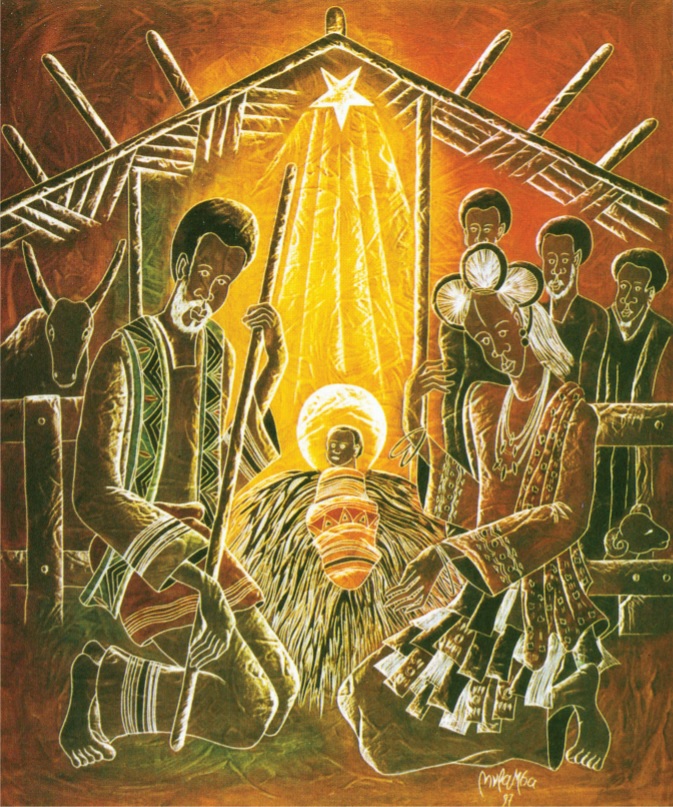
Noel, Noel
Yesu me kwisa ku zinga ti beto
Noel, noel
Yesu me kwisa ku zinga ti beto
Kana nge zola ku zaba mwana
Nge fwiti kwisa ku fukama
Kana nge zola ku zaba mwana
Nge fwiti kwisa ku fukama
English translation:
Noel, Noel
Jesus has come to live with us
Noel, Noel
Jesus has come to live with us
If you want to know the Child
You have to come kneel
If you want to know the Child
You have to come kneel
Kituba is the official language of the Democratic Republic of the Congo, where singer-songwriter Todd Smith grew up, from 1978 to 1986, as a missionary kid. (The country was then known as Zaire.) Smith is one of three members of the award-winning band Selah, which helped initiate a hymn revival in Christian music that is still thriving today.
+++
See the Artful Devotions for the last two Christmases:
This post belongs to the weekly series Artful Devotion. If you can’t view the music player in your email or RSS reader, try opening the post in your browser.
To view all the Revised Common Lectionary scripture readings for Christmas Day, cycle A, click here.
Bartolomé Esteban Murillo (Spanish, 1617–1682), The infant Christ asleep on the cross, ca. 1660–65. Oil on canvas, 24 4/5 × 34 3/5 in. (63 × 88 cm). Prado Museum, Madrid.
When, in the cavern darkness, Jesus
opened his small, bleating mouth (even before
his eyes widened to the supple world his
lungs had sighed into being), did he intuit
how hungrily the lungs gasp? Did he begin, then,
to love the way air sighs as it brushes in and out
through the portals of tissue to sustain
the tiny heart’s iambic beating? And how,
fueled by air, the dazzling blood tramps
the crossroads of the brain like donkey tracks,
corpuscles skittering to the earlobes and toenails?
Bottle of the breath of God, speaking in stories,
shouting across wild, obedient water, his voice
was stoppered only by inquisition, unfaith
and anguish. Did he know that he would,
in the end, leak all his blood, heave a final
groan and throw his breath,
oxygen for the world, back to its Source
before the next dark cave?
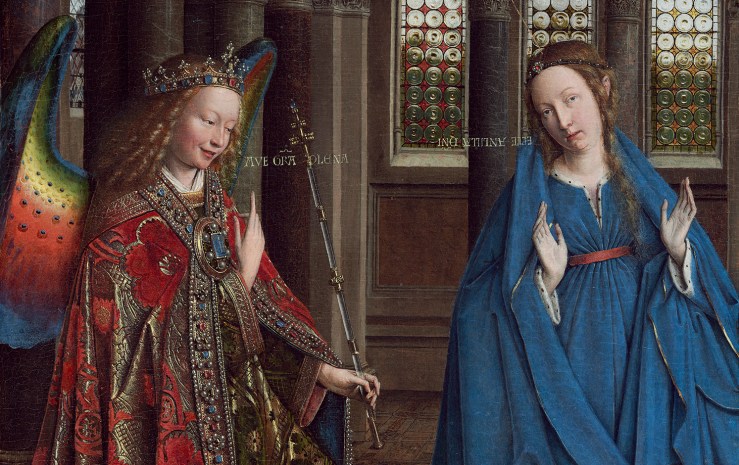
One of the most celebrated paintings of the Northern Renaissance, Jan van Eyck’s 1430s Annunciation depicts the moment of Christ’s conception in a world of forms that have weight and volume and shade and texture that was largely unprecedented in European painting at the time. The extraordinary realism of the Annunciation—its deep, rich, subtly gradated colors, varied textural details (from hard, polished gems to soft, fragile flower petals and plush velvet), and intricate play of light and shadow—were enabled by the use of oil paint, a medium that was not widely used then. van Eyck’s “virtuoso handling of the medium . . . represented a turning point in its eventual adoption as the major painting medium in Europe in the sixteenth century,” replacing egg tempera.
Jan van Eyck (Netherlandish, ca. 1390–1441), The Annunciation, 1434/36. Oil on canvas transferred from panel, 35 1/2 × 13 7/16 in. (90.2 × 34.1 cm). National Gallery of Art, Washington, DC.
This three-foot-tall painting probably originally formed the left wing of a triptych, whose other panels, now lost, may have depicted the Nativity or the Adoration of the Magi and the Visitation or the Presentation in the Temple. It likely spent its first centuries in the ducal chapel of a Carthusian monastery in Dijon, then-capital of Burgundy (van Eyck served as court painter to Philip the Good, duke of Burgundy, from 1425 to 1441), and has since passed through various other rich and powerful hands, including those of King William II of the Netherlands and Czar Nicholas I of Russia. It is now in the collection of the National Gallery of Art in Washington, DC, where it is viewed by people from all over the world.
Several iconographic elements in van Eyck’s Annunciation were already standard for the subject: the dove, the lilies, the Bible laid open to Isaiah 7:14. But van Eyck also introduced his own sophisticated program of typological imagery, which plays out in the background frescoes and the niello floor designs, connecting Old and New Testaments—in addition to other innovative touches that we will explore below.
He was also one of the first artists to locate this momentous event inside a church (as opposed to a portico or domestic space), which would become a popular choice in the Low Countries. In her 1999 Art Bulletin article “Van Eyck’s Washington Annunciation: Narrative Time and Metaphoric Tradition,” Carol J. Purtle argues that van Eyck was connecting the Lukan narrative of the Annunciation with the Golden Mass (“Missa Aurea”), a liturgical drama that was popular in the Netherlands at the time. Taking place yearly on Ember Wednesday (the Wednesday following the third Sunday of Advent), the Golden Mass featured a reenactment of the Annunciation, dove and all, by two young choirboys.
There’s much to lavish attention on in this painting, but I’d like to let three poets be our eyes: Pimone Triplett, Terri Witek, and Peter Steele, each of whom has written a poem reflecting on their encounter with the Annunciation by van Eyck. (The vivid poetic description of a work of visual art is known as ekphrasis, and it is an ancient tradition that I’ve seen explode in recent decades.) Notice what the poets notice in the painting as they pore over van Eyck’s artistic choices and their spiritual import. There is some overlap in their discoveries, but the landing point, and even the emphasis, of each poem is unique.
Starts with a stream of gold that’s ridden
      by a relentlessly linear dove,
ready to pierce a young girl’s head.

            Then, her face, her gaze looking up, out
past the easel and later, past the frame,
      eyes raised as if to ask a question. Take

the virgin robe, for instance, which van Eyck has made
      to fall luxuriously as a second chance
across the old storyline etched below her.

            And, further down, the church’s intricately
strict apse, each floorboard, painstaked as lace, showing here,
      David’s lesson in beheading, there Samson’s

tearing down the temple—that history
            interrupted by her silken, layered folds:
each blue built up from perfecting the oil.

            His favorite signature, “As best I can”
or “As I was able, but not just as I wished.”
      Imagine the endless effort: a man

in the distance, deep in the could have been,
      who sat before the easel, hours, perhaps,
past his patience for lasting regrets,

            flat refusals—the quick-drying water-based
attempts flung around a room.
      And how, alone with pigment barrels, chamber pots,

the canvasses stretched, the fire exhumed,
      he poured a stream of oil back and forth,
watching it catch the light, change a wooden bowl.

            For the sake of making the mundane
seem to marry the mysterious,
      her eyes raised—lacquered, slippery wells, caught—

her startled acceptance. Since it’s her choosing
      to be chosen that mattered, largest figure
in the frame, the virgin form layered

            with gold light, blue, her pale hands open
for the god imagined sick with thin horizon,
      and ready to enter thickness now, the body’s

blood, gristle, vertebrae, whorled fingerprint.
      The oil spread back and forth. His wrist stiffened.
“As I was able, but not just as I wished.”

            So, out to pay the right kind of attention
to detail, as if, in the lengthening
      carelessness of cracked roads leading away

from his town, beneath a matted pulp
      of the year’s leaves, he wished he could hear
silence taking shape: a weed, say, starting

            to split the surface, part vegetal
altar and example of dumb, green change.
      Or, say, through the window, a flock of geese

receding, advancing, by turns, as the sky’s gray
      sometimes meets the double strength gray of sea,
he might have looked between the shapes,

            their invisible lines blooded, some racing ahead,
others falling behind, each filling in, quickly,
      empty spaces where the wings once beat.

And still, she looks up, asking to be entered.
      So that if she turned away from shadows, wood panels,
chamber pots, winter coats lined against the wall,

            he might have looked so far into the difficult
that he finally could believe: behind her gaze,
      beneath her brow, under the layers of

shell, salt, finally skin-white, lay the mind
      of a mother giving birth to a father
and a son, the flesh—a color, an instant, spared.
Pimone Triplett’s poem explores the physicality of the oil-paint medium, focusing on van Eyck’s innovations in that area and as one who both accepts and transcends his limitations. She refers to the personal motto with which he signed several of his paintings (although not this one): Als ich chan, which means “As best I can.” Even with as advanced a painter’s toolkit as he developed and his great skill, how could he possibly succeed in depicting the holy mysteries?
The physicality of the artist’s studio, too, comments on the Incarnation. Christ came into a world of chamber pots! Triplett describes Jesus’s coming into human being, his traveling those seven thin gold rays of light into the womb of his mother, where he takes on flesh: “the god imagined sick with thin horizon, / and ready to enter thickness now, the body’s // blood, gristle, vertebrae, whorled fingerprint.”
There are also some lovely lines that touch on Mary’s agency (“it’s her choosing / to be chosen that mattered”; “she looks up, asking to be entered”) and her role as the Second Eve, whose obedience leads to the redemption of humanity (her robe “fall[s] luxuriously as a second chance” over the Old Testament story line told in the floor below her).
The two most visible floor designs depict Samson destroying the temple of Dagon, killing the Philistines inside, and David cutting off the head of Goliath. These and other Old Testament scenes are framed by stylized columbine and clover and roundels bearing signs of the zodiac.
I’m not entirely sure how to interpret the last stanza. It’s possible that “father” refers to van Eyck as the father of oil painting: his many Marian paintings in this medium cemented his reputation as such, so in that sense Mary gave birth to him as an artist, as well as, of course, to her son Jesus. Shell and salt were ground into pigments to render realistic flesh tones, and the slow drying time of oil paint enabled artists to better blend colors on the canvas, creating subtle variations, and to develop the painting gradually. But why “a color, an instant, spared”? Any thoughts?
+++
“Take a World”by Terri Witek
The Annunciation by Jan Van Eyck, 1434–36
Take a world in which each flower’s an Easter lily
and books chivvy open to the place where our names leap.
Then step into the temple where Mary,
gown belled like a Christmas tree angel’s,
speaks with a real one. Their hands negotiate:
Mary is asking why light curls to ribbony rainbow
on the angel’s back while through her own body
it shoots in stiff gold arrows. The angel nods, grins.
Nothing more gorgeous than their drapery-softened
gesticulation, the room’s blue-propped lilies
and plump ottoman. It’s enough to make us think
they’re standing in the world, two women alert
to the heft of their clothes as Mary asks,
“Who, me?”, her eyes sliding sideways to her painter,
master of distraction. She can’t see Jehovah
behind her, his one blazing window, though we can,
we see the room’s whole depth falling into light
as we wait for someone not transfixed by dilemma
who’s standing where we are. As we wait for Joseph.
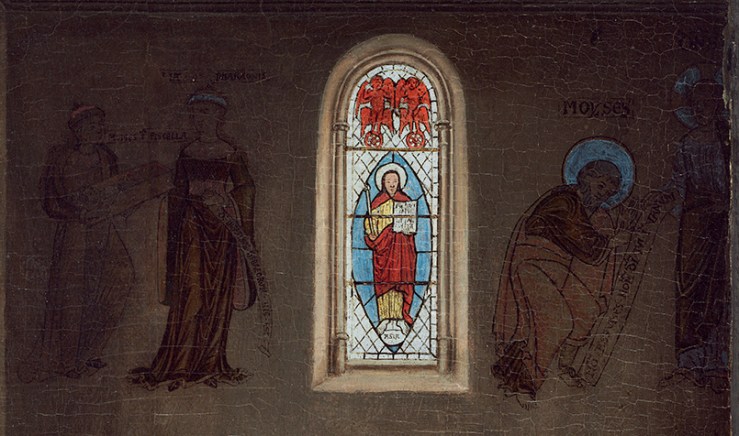
Terri Witek’s poem focuses on the paradox of the Annunciation’s being both an entirely thisworldly and yet profoundly otherworldly moment. The two figures in van Eyck’s painting have bulk and heft, and their clothes hang on their bodies, subject to the laws of gravity, and yet in the scene they inhabit, everything is so carefully placed, so perfect—so divine. Witek mentions the stained glass window in the back, which shows God in a mandorla, standing underneath his fiery chariot on a globe labeled ASIA and holding an open book and a scepter; the light that comes through this window and fills the room is thus refracted through him who is all-sovereign.
(Note: The iconography in the window is very similar to the type known as Christ in Majesty, though there’s no cross-shape inside the halo; I wonder whether the figure is meant to be Jesus in his then-future exaltation. But the art historians I’ve read identify him, along with Witek, as God the Father. I think a case could be made for either.)
To the left of the stained glass window, the baby Moses is presented to Pharaoh’s daughter, while on the right, God presents Moses with a scroll bearing the words of Exodus 20:7: “You shall not take the name of the Lord your God in vain.”Gabriel tells Mary that Jesus “will reign over the house of Jacob forever, and of his kingdom there will be no end” (Luke 1:33). The two roundels painted on the rear wall depict Isaac blessing Jacob (Gen. 27).
I especially like how Witek points out the contrast between the pleasant, blended, colorful way light interacts with the angel’s wings and the severe, narrow manner in which it comes diving toward Mary—and humorously suggests that Mary’s expansis manibus gesture is her asking why. This observation unpeeled for me an additional layer of van Eyck’s possible meaning: how God’s coming to Mary was direct and piercing. His messenger, sure, has a soft rainbow glow, but the actual implantation of God in the womb happens with a laser focus that sears Mary in ways that will be all the more keenly felt as the years go by (see Simeon’s prophecy in Luke 2:34–35).
I got stuck on the last two lines, though: Why do we wait for Joseph? Isn’t he peripheral to the event? And was he not also “transfixed by dilemma” for a time, as he debated whether to say yes or no to God’s plan? So I asked the poet what she had in mind. She said how, standing before the painting, we, like Mary, become transported into this drama that lifts us up to a heavenly plane (I’m paraphrasing here), where we interact vicariously with Gabriel. We need someone to bring us back down to earth, so “we will be glad of Joseph, the human, the touch of the everyday real,” Witek explained to me.
The room “falling into light” describes the painted scene but also the public gallery where the painting is on display, and the name Joseph also has a double meaning, as Witek’s husband’s name is Joseph. In their museum going, his presence sometimes shakes her gently out of her reveries, reminding her that it’s time “to move on to the next painting, though it might not be as gorgeous,” she told me.
+++
“Waiting for the Revolution”by Peter Steele
If love is ‘the bright foreigner’, then here’s
      not Amour himself but still
a follower afire, his wings a blend
      of peacock and rainbow, the pearled cope
blooming to crimson on its ground of gold,
      his hair a downspill from the lock
of a coronet badged with jewels, the fingered sceptre
      a rod of crystal, and the smile
something they practise in another country.

This is not wasted on the woman who,
      her hands come up from the shell of a robe
which seems to have been steeped in ocean when
      darkness and light were still contending,
gazes now from the blaze of being at
      van Eyck, the Duke of Burgundy,
a Tsar made out of ice and marble, or
      whoever gives the alms of an hour
in minute-hungry fuming Washington.

Outside, a beat or two of an angel’s wings
      away on the Capitol is Freedom,
one of the later products of the Bronze
      Age, equipped with shield and sword,
a wreath for some earthly use or other, plumes,
      an eagle-crested helmet. She eyes
the status quo from her eminence and murmurs,
      ‘The past is prologue’, a Delphic saying
which she construes as ‘blessed are those in possession’.

I have been in and out of the world worlds,
      amphibious and double-hearted,
and still am. The shimmer of July
      speaks now for a perpetual
immobility, bronzing the will. The pavement
      beneath woman and angel shows
Goliath down and done with, Samson at grips
      with a sheltering enslaving place:
and for some want of the white bird of esprit

that plunges goldrayed into the woman’s mind,
      I’m in the middle. They say that she
has her consent to the revolution printed
      upside down for easier reading
in heaven. It may be so, but I’m guessing that
      the words in their reversal figure
a world swung round upon its axis, the all-
      clear given to those in quest
of the bright foreigner who lightens angels.
“Waiting for the Revolution” by Peter Steele appears in Plenty: Art into Poetry (Melbourne: Macmillan Art Publishing, 2003).
Peter Steele (1939–2012), a Jesuit priest from Australia, opens and closes his poem with a phrase from a 1849 journal entry by Ralph Waldo Emerson that says, “Love is the bright foreigner, the foreign self.” Steele interprets Jesus as that “bright foreigner” from heaven, Love, Amour, whose light gives angels their light. Those who search for themselves, he suggests implicitly, can find themselves in Jesus, who created them in love and calls them back into that love that is the ground of their being.
Before moving to this conclusion, Steele first relishes the painting’s fabulous details, especially the clothing: Gabriel’s elaborate, brocaded silk cope, with gold embroidery and green fringe, and Mary’s ultramarine robe trimmed in ermine. He also notes the angel’s wry and mysterious smile, an expression that draws me in every time I see this painting.
He considers how Mary’s eyes gazed out first at van Eyck the painter, then at the painting’s various owners over the centuries, and now at any visitor to or resident of Washington, DC, who stands before it in its dimly lit gallery on the National Mall.
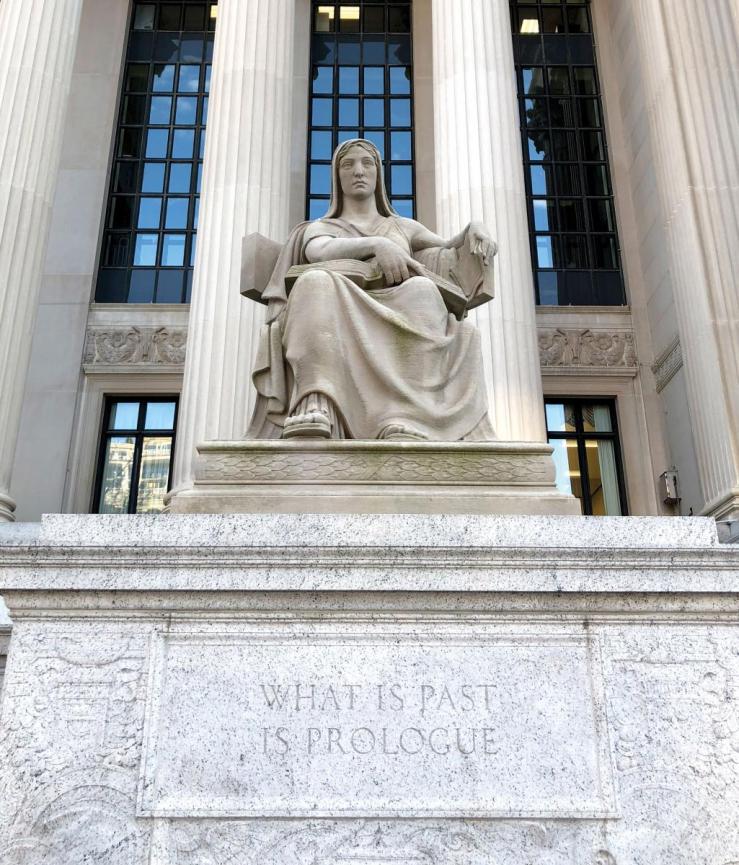
Its location in the United States capital city prompts Steele to contrast it with the nearby monument originally known as Freedom Triumphant in War and Peaceor Armed Freedom, an allegorical figure in bronze that crowns the Capitol building. He has Freedom reciting a famous line from act 2, scene 1 of Shakespeare’s The Tempest—“What’s past is prologue”—spoken by the villainous Anthony in an attempt to convince Sebastian to murder his sleeping father and thus make himself king; the idea is that his whole life up to this point was merely an introduction to the great story that will be underway if he goes through with the plan. (The line is inscribed on the base of Robert Aitken’s sculpture Future, located on the northeast corner of the National Archives Building, which shows a young woman holding an open blank book and contemplating the things to come.) Steele imagines this saying, in the mouth of Freedom, as bearing the subtext “Blessed are those in possession” (or, in its original Latin, Beati sunt possidentes), a proverb popularized by the Prussian general and military theorist Carl von Clausewitz in reference to the possession of power and force.
Thomas Crawford (American, 1814–1857), Statue of Freedom, 1863. Bronze, 19 1/2 ft. tall. Atop the dome of the US Capitol, Washington, DC.Robert Aitken (American, 1878–1949), Future, 1935. Indiana limestone, 20 × 8 × 12 ft. (sculpture), plus 12 × 12 × 15 ft. (base). Outside the National Archives Building, Washington, DC. Photo: Rania Hassan.
The two government-commissioned artworks and two quotes Steele’s poem references ping around in my mind as I think about how they relate to the Annunciation. The picture of Freedom as a colossal helmeted woman bearing a sword differs from the smaller, quieter way “Freedom” comes to reign in the Christmas story: that is, as a babe in a manger. And the self-protecting, self-aggrandizing path commended by Clausewitz butts heads against the self-emptying ethic at the heart of Christianity. So does the motivation of the Shakespearean character—treacherous, underhanded—who was the first to say, “What’s past is prologue.” But when considered in light of Luke 1 and even the Future sculpture in DC, this “Delphic” (obscure, ambiguous) saying from the Bard can be seen as alluding to Mary’s position at the Annunciation, at the turning point of history. Mary is fated to act; the past has set the stage for her yes, and for all that will happen next. The New Testament is as yet unwritten—until her bravely submissive response to the angel’s invitation sets God’s grand redemption plan, on hold for four hundred years, into motion once again, and what we call “gospel,” good news, arrives on earth at last in the person of Christ.
In van Eyck’s Annunciation, as in many others, the words AVE GRA[TIA] PLENA (“Hail, full of grace”) stream forth from Gabriel’s mouth in gold lettering, to which Mary replies, ECCE ANCILLA D[OMI]NI (“Behold the handmaiden of the Lord” [Luke 1:38]). Amusingly, van Eyck renders her response upside-down, a device he also uses in the Ghent Altarpiece, presumably so that God can read it from heaven. Steele playfully interprets the inversion as signaling the upside-down nature of God’s incoming kingdom; the world has been turned on its head by Mary’s yes—which is why that yes is rotated 180 degrees!
One aspect of this upside-down-ness is how Mary contradicts the aforementioned adage, used in diplomacy, “Blessed are those in possession.” In scripture Mary is called blessed, but not because she seizes or owns or controls anything. Quite the opposite: because she relinquishes her right to go on living a normal, play-it-safe life. And because she is humble, God raises her up, and those like her. (She sings about this in her Magnificat.) That’s not at all to say that Mary is passive or lacks agency. She stands actively with open hands to receive grace, to receive God himself, and to gift him to the world. She “consent[s] to the revolution.”
I’m reminded of the song “Canticle of the Turning,” written by Rory Cooney in 1990 based on Mary’s Magnificat and set to the traditional Irish tune STAR OF THE COUNTY DOWN. Listen to an acoustic performance by Katherine Moore:
“The world is about to turn.”
+++
For a further in-depth look at the symbolic significance of the architecture and objects in Jan van Eyck’s Annunciation—including the wall paintings and windows in the background, the nielli in the floor, the footstool in the foreground, and the missing boards in the ceiling—see Early Netherlandish Painting: The Collections of the National Gallery of Art by John and Oliver Hand and Martha Wolff, pages 76–86: a PDF of the entire book is provided for free download by the National Gallery of Art. See also the NGA’s special webpage for this collection highlight.
Yaroslava Tkachuk (Ukrainian, 1981–), Expectant, 2014. Linen, silk, seeds, copper, and acrylic, 100 × 40 cm. Photo courtesy of the artist. [Original for sale; click photo for more info]
Therefore the Lord himself will give you a sign. Behold, the virgin shall conceive and bear a son, and shall call his name Immanuel.
—Isaiah 7:14
+++
SONG: “Maria” by David Maloney, on A Christmas Album by Reilly & Maloney (1984, reissued 2012)
Christmas Day, it’s coming fast
Bringing joy to the world at last
Joy to the world
Maria . . .
This post belongs to the weekly series Artful Devotion. If you can’t view the music player in your email or RSS reader, try opening the post in your browser.
To view all the Revised Common Lectionary scripture readings for the Fourth Sunday of Advent, cycle A, click here.
So much to share today! Be sure not to miss “Psalm 126” by Drew Miller (a new favorite Advent song) and Matthew Milliner’s excellent presentation on the Virgin Mary in art, which opened an exhibition that’s running in Southern California—both below. (If you only have time to take in a few items from this post, those are the ones I’d recommend.)
PODCAST EPISODE:“A Time for Wanting and Waiting: An Advent Conversation with W. David O. Taylor”: In this recent episode of The Road to Now, hosts Bob Crawford and Chris Breslin interview liturgical theologian David Taylor [previously] about the season of Advent: what it is, its history and how it fits into the wider church year (see especially 43:29ff.), the canon of Advent and Christmas songs, and the gift the Psalms offers us during this season. Referencing his 2015 Washington Post article, Taylor says our picture of Christ’s coming, especially as expressed through our hymnody, tends to be unidimensional and far too sanitized:
We should permit the Nativity stories to remain as strange and bizarre and fantastical and difficult as they in fact are, rather than taming and distilling them down to this one nugget or theme of effusive joy. There is effusive joy in that—it’s simply that that’s not the only thing that characterizes these stories. Unfortunately, most of our canon of Christmas carols or hymns tends to focus on what I would argue is only 50 percent of the Nativity stories. Everything that begins with Elizabeth and Zechariah and goes all the way to, say, Anna and Simeon and the visit of the Magi and the flight to Egypt . . . it really is one whole story that is being told with these subplots.
I would love to see us create . . . new music that either retells portions that we are already telling but not the whole of it, or we need to tell parts that have not yet been told. . . . Let’s ask ourselves how God is at work in all the minor-key or difficult or dissonant parts of the Nativity stories, not absent from—those are not extraneous to God incarnating himself in Jesus Christ. Those are essential parts of it. And so how can our hymns become ways of praying ourselves into these stories so they can sink deeply into the fibers of our hearts and minds and bodies, and for us to say, “Oh, all the weird and difficult and dissonant parts of our lives are part and parcel of God’s good work,” not, again, on the margins of it, or things we should eschew.
To help deepen and expand the church’s repertoire of Christmas music, Taylor founded, along with a few others, the Christmas Songwriters Project. The Psalms are an inspiration in this task, as they express a joy that is at times quiet and at others raucous, as in the Nativity narratives, and that exists as part of a dynamic constellation of emotions and postures that praise can encompass. Most of us don’t recognize the pure, undistilled happiness that is marketed to us throughout December, Taylor says, and we shouldn’t force ourselves to try to feel it but rather should take a cue from the Psalms and also see the same emotional complexity at work at the beginning of the Gospels:
The Psalms, and I think Christian faith at its heart, can make space for joy and sorrow to exist alongside each other in a way that happiness, as we commonly understand it, cannot, or only with great difficulty. . . . What the psalms of praise do . . . is that in one movement, there’s this effusive joy or a shouting joy or a convivial joy, and then it segues to a quieter joy or a contemplative joy or a yearning, painful kind of joy. . . .
So in the season of Advent, when we look at the characters in scripture—you know, Mary and Joseph and Zechariah and Elizabeth and the shepherds and Anna and Simeon—every one of them has this moment, perhaps, of which we could say, “That sounds like joy.” . . . But immediately before or immediately after, it transitions to something else. So does that mean that joy is negated? Is joy squashed? Is joy extinguished? Or is joy able to continue to exist side by side, to subsist, with a continued experience of longing or a sudden moment of sadness?
+++
ART BY SCOTT ERICKSON: This month Portland-based artist Scott Erickson has been posting on Instagram Advent-themed images he has made, along with thoughtful meditations. Some emphasize the bodiliness of the Incarnation, which often gets overlooked, presumably out of a sense of propriety. But “grace comes to us floating in embryonic fluid . . . embedded in the uterine wall of a Middle Eastern teenage woman,” Erickson writes about With Us – With Child, to which one Instagrammer responded, “This is trajectory changing. Thank you for this. Nipples, vaginas, and Jesus CAN coexist!” Another mentioned how she had never seen Mary with a belly button and a linea nigra before. The image reminds us that Jesus was indeed “born of woman” (Gal. 4:4).
Scott Erickson (American, 1977–), With Us – With Child, 2016 [purchase as poster]Another imaginative image suggests that Christ came to set the world on fire, so to speak. God, who is of old, gives himself to earth as a Jewish babe (“Love has always been FOR GIVENESS,” Erickson writes), sparking a revolution.
LECTIONARY POEMS FOR ADVENT: This year Englewood Review of Books launched a new feature on their website: a weekly post of four to six poems that resonate with the Revised Common Lectionary readings for that week. “We will offer here a broad selection of classic and contemporary poems from diverse poets that stir our imaginations with thoughts of how the biblical text speaks to us in the twenty-first century. We hope that these poems will be fruitful not only for preachers who will be preaching these texts on the coming Sunday, but also for church members in the pews, as a way to prime our minds for encountering the biblical texts.” I’m really enjoying these stellar selections, several of which are new to me.
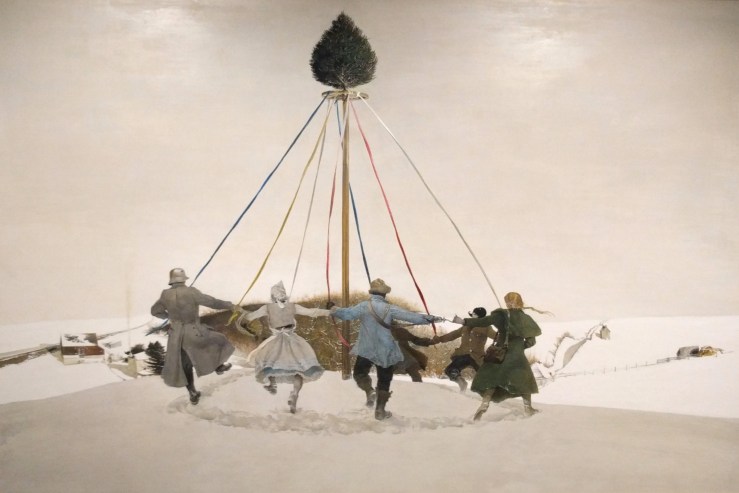
Andrew Wyeth (American, 1917–2009), Snow Hill, 1989. Tempera on hardboard panel, 48 × 72 in. (121.9 × 182.9 cm). Andrew and Betsy Wyeth Collection. Photo: Victoria Emily Jones (at the Brandywine River Museum of Art 2017 retrospective).
. . .
Then the eyes of the blind shall be opened,
and the ears of the deaf unstopped;
then shall the lame man leap like a deer,
and the tongue of the mute sing for joy.
. . .
And the ransomed of the Lord shall return
and come to Zion with singing;
everlasting joy shall be upon their heads;
they shall obtain gladness and joy,
and sorrow and sighing shall flee away.
—Isaiah 35:5–6a, 10
+++
SONG: “Therefore the Redeemed” by Ruth Lake, 1972 | Performed by Kim McLean, on Soul Solace, 2008
+++
Snow Hill by Andrew Wyeth [previously] is “a conscious summary of his artistic life that is both somber memoir and playful recalibration” (John Wilmerding). It shows six of his friends and neighbors, who modeled for him many times throughout his career, dancing around a beribboned Maypole in winter in Chadds Ford, Pennsylvania. Their coats, earflaps, and braids fly in the wind, as does one untouched white ribbon, which, it has been posited, could represent Christina Olson (who had a degenerative muscle disorder and could not walk), the artist’s wife Betsy, or the artist himself.
This painting, one of Wyeth’s last, was the finale of a major retrospective at the Brandywine River Museum of Art in 2017, which has been one of the most memorable art exhibitions I’ve ever attended. The wall text there read,
Painted over a two-year period, Snow Hill is both fantasy and memorial, a visual summation of the iconic places and people of Chadds Ford that occupied [Wyeth] for the previous fifty years. Wyeth looks backward and inward, bringing together many of these subjects from his past, a number of them now deceased. Depicted are Karl Kuerner (dressed in his German uniform), holding the hand of Anna Kuerner, who is in turn linked to William Loper, whose prosthetic hook is held by Helga Testorf, rounding the circle to Allan Lynch (of Winter 1946) and Adam Johnson (partially obscured). They are surrounded by a landscape that shows, left to right: the railroad tracks where Wyeth’s father, N. C. Wyeth, was killed in 1945; the Kuerner farmhouse and barn; the remains of Mother Archie’s octagonal church; the Ring family home in the distance; and Adam Johnson’s shed and haystack.
Wyeth’s models are shown holding ribbons—although one white ribbon is symbolically floating free—and dancing atop Kuerner Hill—a site at once iconic for its recurrence in Wyeth’s work and for its proximity to the site of his father’s death. . . .
I love how the dead and the living join together in this Yuletide circle dance, in which suffering is taken up into joy. Wyeth had lived through Karl Kuerner, a World War I veteran, succumbing to cancer, Allan Lynch to suicide, and Bill Loper to mental illness, as well as the early death of his father and nephew in a car accident. And while such darkness is not fully dissipated in this gray-day scene, a mood of celebration and hope and friendship does take over.
This post belongs to the weekly series Artful Devotion. If you can’t view the music player in your email or RSS reader, try opening the post in your browser.
To view all the Revised Common Lectionary scripture readings for the Third Sunday of Advent, cycle A, click here.
As the liturgical calendar was turning over into a new year this week, my husband Eric and I were at the tail end of a visit to India, staying with new friends Jyoti and Jane Sahi. Jyoti’s an artist, and Jane is a children’s educator, and together they live in the Christian village of Silvepura, north of Bangalore, where for years they ran, respectively, an art ashram and a school. It was a lot of fun getting to know them and their work, and discussing art, culture, theology, politics.
Before our flight departed in the wee hours of Sunday morning, the first day of Advent, Jane had set an oil lamp on the dinner table, decorated with flowers from the garden, and selected two poems for us to read aloud: an excerpt from the Gitanjali(Song Offerings) by Bengali poet Rabindranath Tagore [previously], and “Advent Calendar” by Rowan Williams. It was a meaningful welcoming in of the new season, and a beautiful blend of our hosts’ mixed cultural heritage: Indian and British.
All photos by Victoria Emily Jones
Gitanjali XLVby Rabindranath Tagore:
Have you not heard his silent steps? He comes, comes, ever comes.
Every moment and every age, every day and every night he comes, comes, ever comes.
Many a song have I sung in many a mood of mind, but all their notes have always proclaimed, “He comes, comes, ever comes.”
In the fragrant days of sunny April through the forest path he comes, comes, ever comes.
In the rainy gloom of July nights on the thundering chariot of clouds he comes, comes, ever comes.
In sorrow after sorrow it is his steps that press upon my heart, and it is the golden touch of his feet that makes my joy to shine.
“Advent Calendar”by Rowan Williams, published in After Silent Centuries (The Perpetua Press, 1994) and The Poems of Rowan Williams (The Perpetua Press, 2002; Carcanet Press, 2014):
He will come like last leaf’s fall.
One night when the November wind
has flayed the trees to bone, and earth
wakes choking on the mould,
the soft shroud’s folding.
He will come like frost.
One morning when the shrinking earth
opens on mist, to find itself
arrested in the net
of alien, sword-set beauty.
He will come like dark.
One evening when the bursting red
December sun draws up the sheet
and penny-masks its eye to yield
the star-snowed fields of sky.
He will come, will come,
will come like crying in the night,
like blood, like breaking,
as the earth writhes to toss him free.
He will come like child.
While I was at Jyoti’s, I bought three paintings of his. One of them is an Annunciation image that shows Mary in a termite mound, which are considered sacred in India—microcosms of the temple, sources of fertility, and containers of treasure. I saw these tall, hard, insect-built structures in many areas around Bangalore where I was traveling, including a few on Jyoti’s property. (Note that locals refer to termites misleadingly as “white ants,” so these are “anthills.”)
Jyoti Sahi (Indian, 1944–), Incarnation within the Anthill, 2019. Mixed media on canvas, 28 × 10 1/2 in. (71.1 × 26.7 cm). Collection of Victoria Emily Jones.
Anthill at Vishram in Silvepura with a Mary figure at the base, made of leaves and bark
According to Indian folklore, anthills are the ears of the earth, and Jyoti plays on that belief in his visualization of the moment of the Incarnation, of God’s becoming human in the person of Jesus. Mary’s womb is in the shape of an ear, which receives the Word of God. This Word is shown first at the top of the composition in the form of two hamsas (Sanskrit for “I am he,” or “I am that I am”), a mythical swan-like bird whose body resembles an AUM, the ancient threefold syllable, “the Sound that is believed to reverberate creatively through eternity,” Jyoti said. (“In the beginning was the Word . . .”)
Mary listens to the Word, becomes pregnant with the Word, which takes on flesh inside her. Christ, the primordial One, is implanted in the womb of the earth, of humanity—and a tree of life grows forth.
There’s a sixth-century hymn, known as the Akathist Hymn to the Theotokos (Mother of God), that celebrates Mary’s role as container of the Divine: “Hail! tabernacle of God and the Word. Hail! greater than the holy of holies. Hail! ark gilded by the Spirit. Hail! unfailing treasure-house of life.” Mary as temple, as holy of holies, as ark of the covenant, contains the world’s greatest Treasure: Jesus Christ, the Son of God.
You can hear Jyoti introduce the painting in the short video above, which is just a snippet of the footage Eric and I took while we were there. (More to come!)
As I traveled back home to the US with this rolled-up canvas last Sunday, I kept thinking about the words of the two poets I had just read—Tagore and Williams. I thought about how Christ came once “like child” but also how he “comes, comes, ever comes” even still today, “in sorrow after sorrow . . . press[ing] upon my heart . . . mak[ing] my joy to shine.”
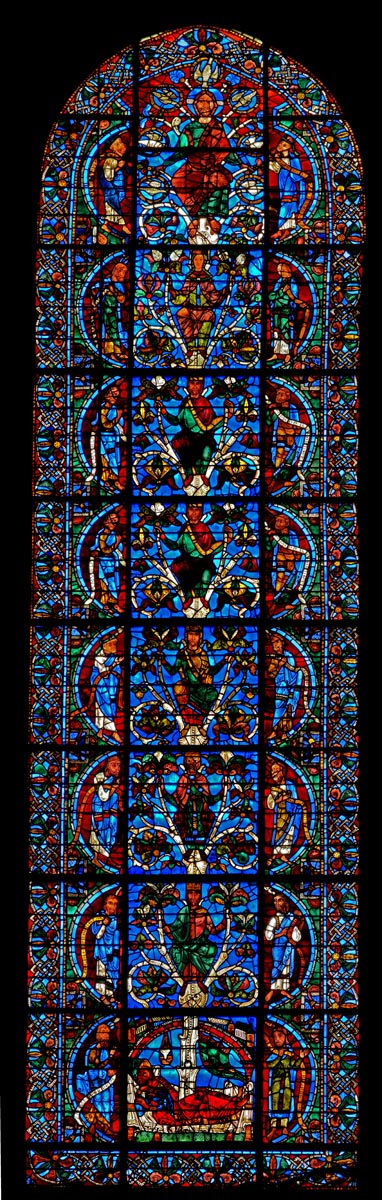
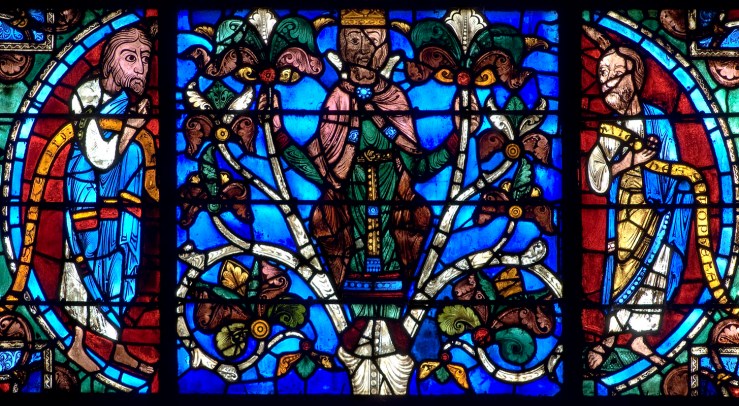
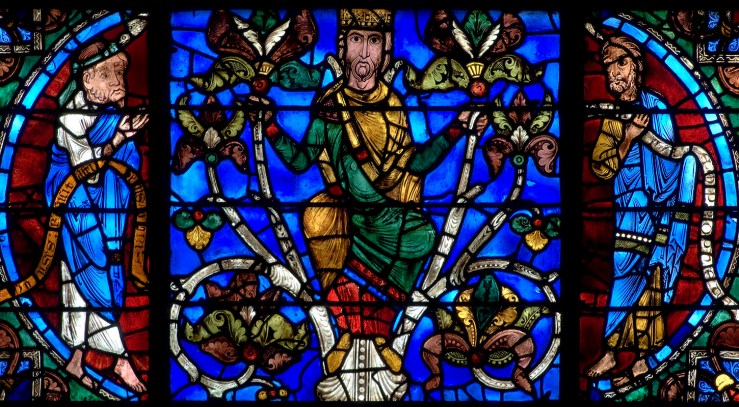
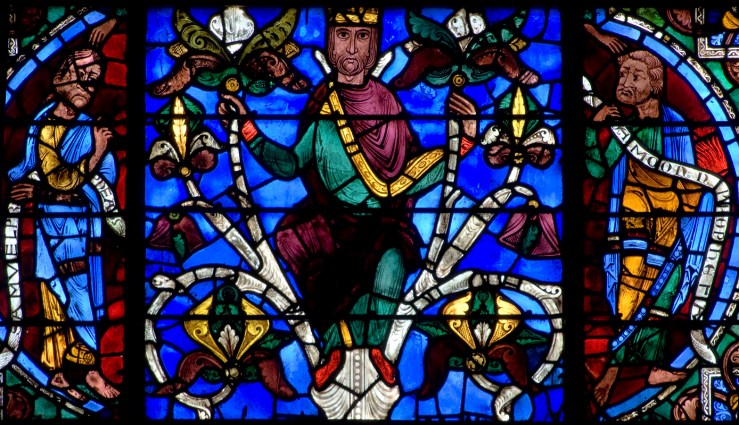
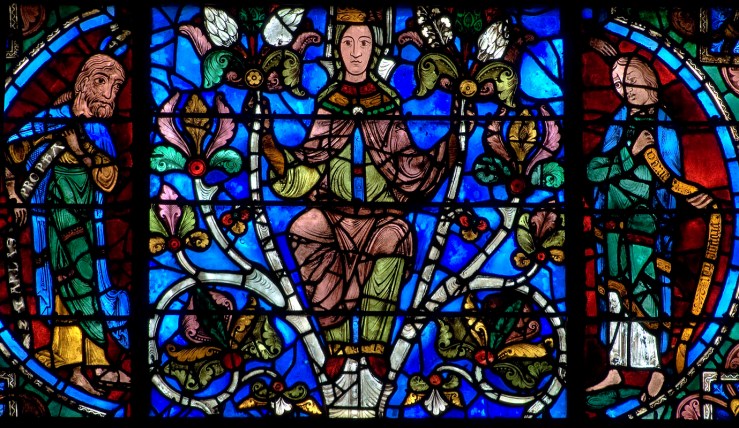
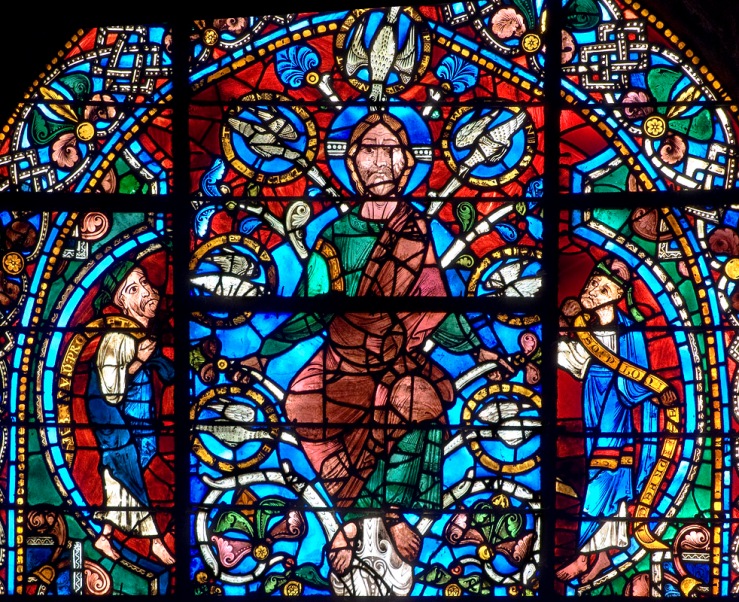
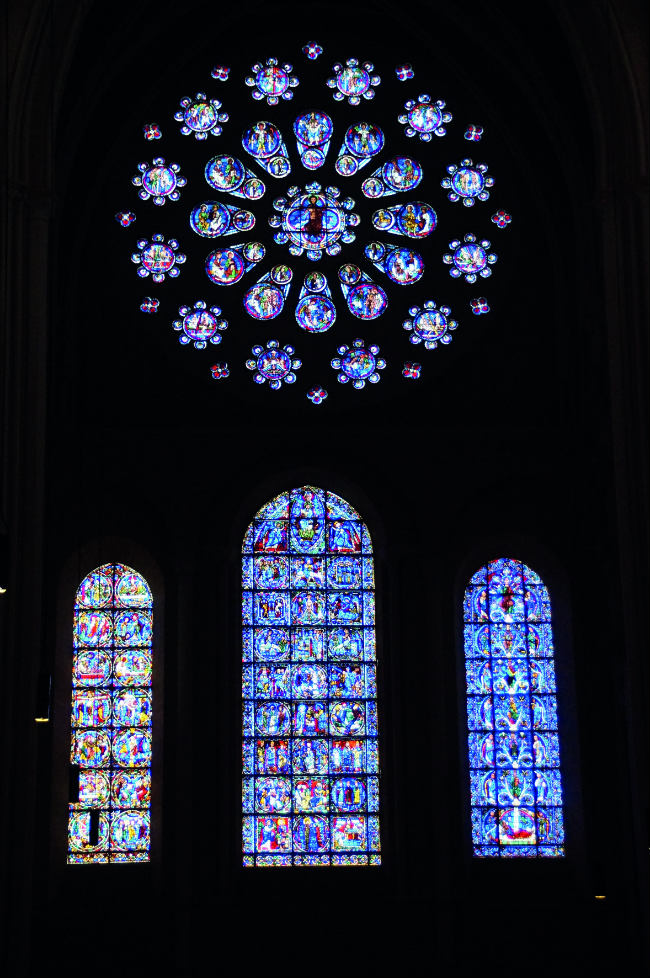
The Tree of Jesse, 12th century. Stained glass window (Bay 49), Chartres Cathedral, France. Photo: Painton Cowen.
There shall come forth a shoot from the stump of Jesse,
and a branch from his roots shall bear fruit.
And the Spirit of the Lord shall rest upon him,
the Spirit of wisdom and understanding,
the Spirit of counsel and might,
the Spirit of knowledge and the fear of the Lord.
And his delight shall be in the fear of the Lord.
He shall not judge by what his eyes see,
or decide disputes by what his ears hear,
but with righteousness he shall judge the poor,
and decide with equity for the meek of the earth;
and he shall strike the earth with the rod of his mouth,
and with the breath of his lips he shall kill the wicked.
Righteousness shall be the belt of his waist,
and faithfulness the belt of his loins.
. . .
In that day the root of Jesse, who shall stand as a signal for the peoples—of him shall the nations inquire, and his resting place shall be glorious.
—Isaiah 11:1–5, 10
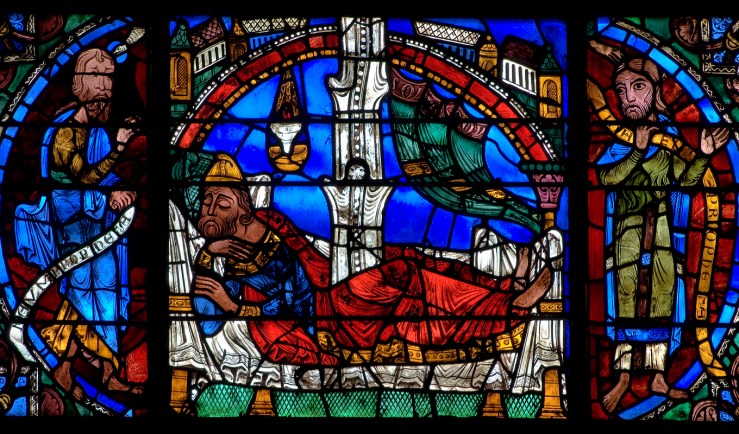
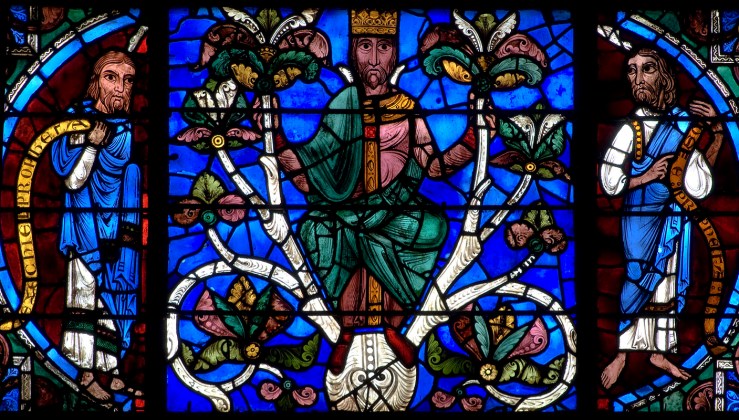
The bottom panel depicts Nahum, Jesse, and Joel. This and all the following detail photos are by Dr. Stuart Whatling.Ezekiel, David, HoseaIsaiah, Solomon, MicahMoses, generic king, BalaamSamuel, generic king, AmosZechariah, the Virgin Mary, DanielHabakkuk, Christ with the Seven Gifts of the Spirit (wisdom, understanding, counsel, fortitude, knowledge, piety, and fear of the Lord, per Isa. 11:2), Zephaniah
+++
SONG: “O Root of Jesse” | Text: Latin original from the sixth through eighth centuries, English translation from the Church of England’s Common Worship liturgy | Music by Ole Schützler (b. 1976) | Performed by the Junger Kammerchor Rhein-Neckar (Rhine-Neckar Youth Chamber Choir), under the direction of Mathias Rickert, on Advent (2014)
Latin: O Radix Jesse, qui stas in signum populorum, super quem continebunt reges os suum, quem Gentes deprecabuntur: veni ad liberandum nos, jam noli tardare.
English:
O Root of Jesse, standing as a sign among the peoples;
before you kings will shut their mouths,
to you the nations will make their prayer:
Come and deliver us, and delay no longer.
“O Radix Jesse” (O Root of Jesse) is one of the seven O Antiphons, names for Christ that are sung during Advent. (The others are O Wisdom, O Lord, O Key of David, O Dayspring, O King of Nations, and O God-with-Us.) Their precise origin is unknown, but their use in the eighth century is substantiated.
+++
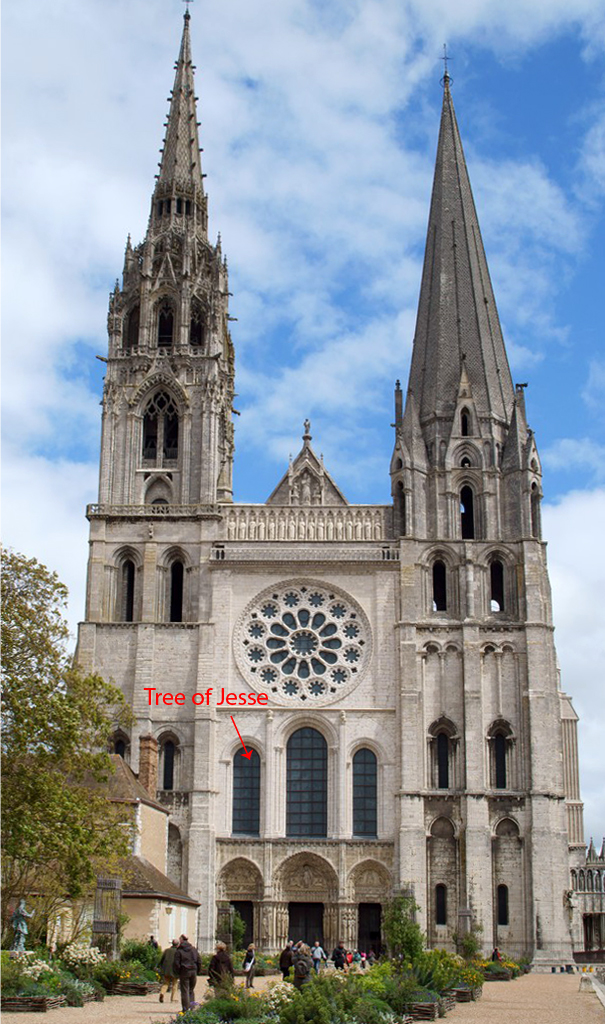
Chartres Cathedral is “the high point of French Gothic art” (UNESCO) and one of my must-sees before I die. Its portals boast many exquisite figural sculptures, and its interior is renowned for, among other things, its stained glass windows. The Tree of Jesse, showing the royal lineage of Jesus, is one of three large, rounded lancet windows at the west end—the other two depicting the Life of Christ (center) and the Passion of Christ.
This post belongs to the weekly series Artful Devotion. If you can’t view the music player in your email or RSS reader, try opening the post in your browser.
To view all the Revised Common Lectionary scripture readings for the Second Sunday of Advent, cycle A, click here.
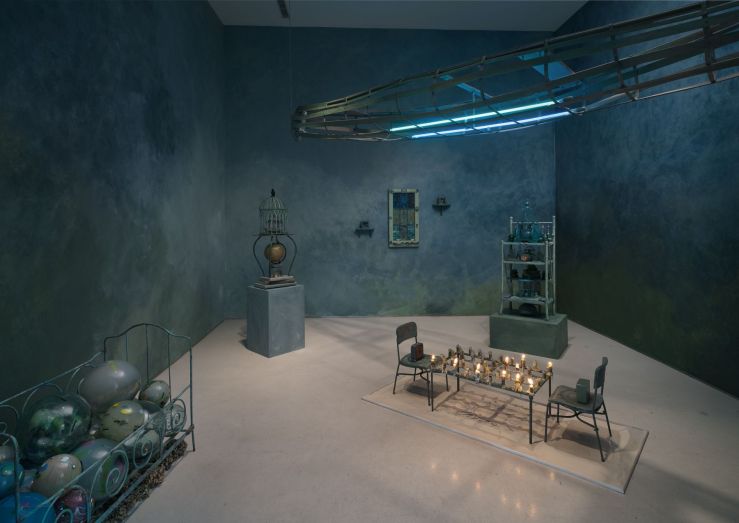
VISUAL MEDITATION: On The Alpha & The Omega by Betye Saar: A few weeks ago my commentary on a Betye Saar installation was published on ArtWay.eu. The idiomatic Hebrew in the title is a reference not to Christ but to the beginning and the end of life, a theme Saar explored by arranging around a blue-painted room such found objects as an antique cradle, dried hydrangeas, a boat shell, a mammy figurine, a washboard, empty apothecary bottles, books, clocks, a moon-phase diagram, etc.
Betye Saar, The Alpha & The Omega: The Beginning & The End, 2013. Installation at Roberts & Tilton, Culver City, California.
With an educational background in design, Saar began her career as a printmaker and working in theater on costumes and sets. She then ventured into collage, which led to assemblage (for which she is most celebrated), sculpture, and installations. With installations, she likes how “the whole body has the experience”—how you are quite literally inside the work. Saar is one of today’s leading American contemporary artists, with twoexhibitions currently running in the United States: one at MoMA, and the other at LACMA. I first encountered her in a college art history course, through her most famous work, The Liberation of Aunt Jemima. Race, memory, and spirituality are recurring themes in her oeuvre.
+++
ESSAY: “‘A pretty decent sort of bloke’: Towards the quest for an Australian Jesus” by Jason A. Goroncy: “What happens to religious images and symbols when they get employed outside of their traditional contexts and charged with unapproved and heterodox interpretations?” asks Goroncy. “From many Aboriginal elders, such as Tjangika Napaltjani, Bob Williams and Djiniyini Gondarra, to painters, such as Arthur Boyd, Pro Hart and John Forrester-Clack, from historians, such as Manning Clark, and poets, such as Maureen Watson, Francis Webb and Henry Lawson, to celebrated novelists, such as Joseph Furphy, Patrick White and Tim Winton, the figure of Jesus has occupied an endearing and idiosyncratic place in the Australian imagination. It is evidence enough that ‘Australians have been anticlerical and antichurch, but rarely anti-Jesus’. But which Jesus? In what follows, I seek to listen to what some Australians make of Jesus, and to consider some theological implications of their contributions for the enduring quest for an Australian Jesus.” [HT: Art/s and Theology Australia]
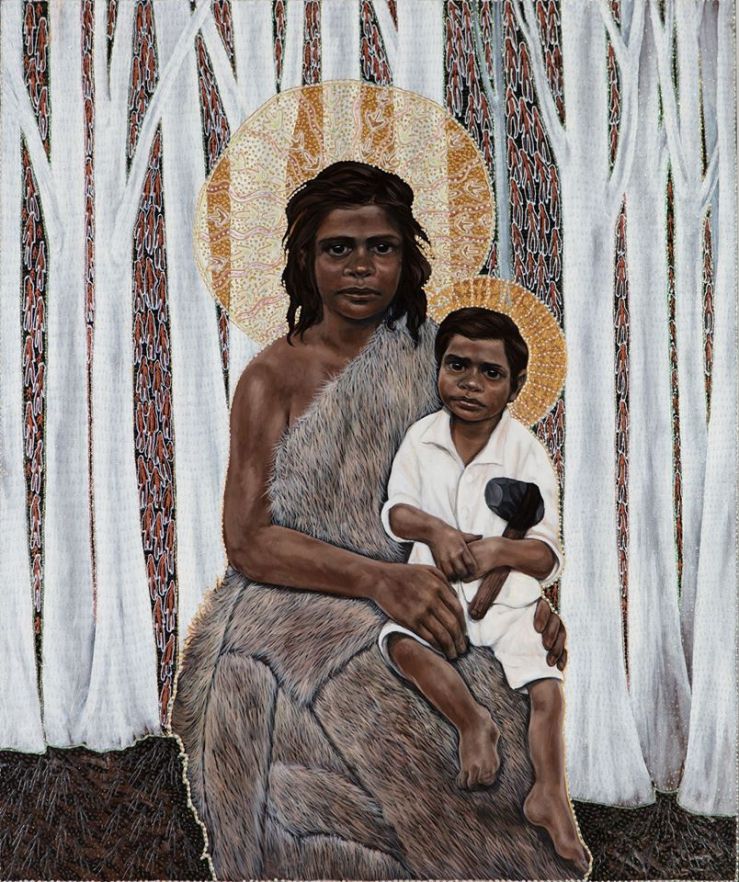
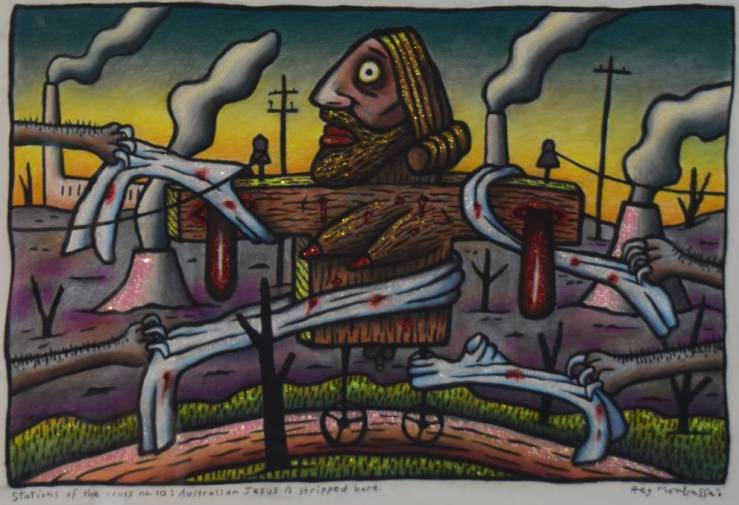
Julie Dowling (Badimaya/Yamatji/Widi, 1969–), Black Madonna: Omega, 2004. Synthetic polymer paint, red ocher, glitter, and metallic paint on canvas, 120 × 100 cm. Art Gallery of Western Australia. “I painted this in honour of First Nation mothers who have their children stolen from them by white governments in order to assimilate their children.”Chris O’Doherty (aka Reg Mombassa) (Australian, 1951–), Australian Jesus Is Stripped Bare, station 10 from the Stations of the Cross cycle. Chapel at the Australian Centre for Christianity and Culture, Barton, ACT, Australia. Photo: Katherine Spackman.
Goroncy quotes Wilson Yates, who says that Jesus has become “a part of the culture and life far beyond the final control of the church, . . . imaged in diverse ways by non-Christian as well as Christian artists, often contrary to the church’s dominant interpretation. . . . This should not be viewed as threatening,” however, but rather as “a means by which, paradoxically, the traditional symbols are kept vital – are kept alive in the midst of human life.”
+++
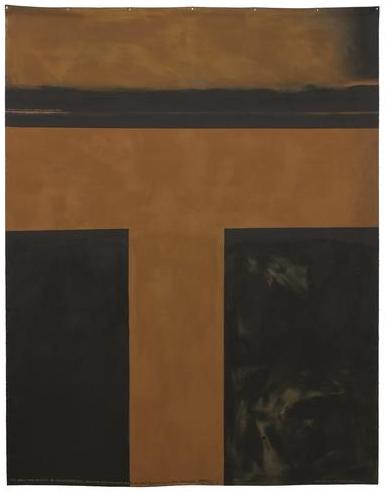
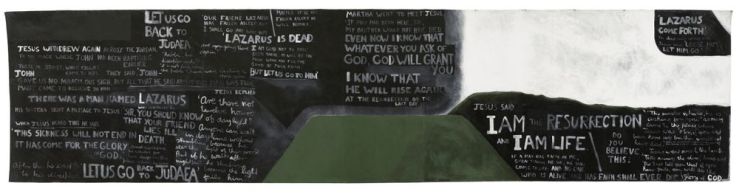
AUDIO INTERVIEW: Justin Paton on New Zealand artist Colin McCahon: In celebration of the centenary of Colin McCahon’s birth, art critic and curator Justin Paton has published McCahon Country, which examines nearly two hundred of the artist’s paintings and drawings. In this Saturday Morning (RNZ) interview, Paton says that McCahon is one of the great modern religious artists; an unabashed Christian, he grappled with how to make religious art in a post-religious age, often interweaving biblical themes and texts with New Zealand landscapes. His paintings, Paton says, are “an unequivocal statement of faith,” painted at times with “sophisticated unsophistication.” In 1948 one critic described them dismissively as “like graffiti in some celestial lavatory”—a comparison Paton affirms but sees as commendatory.
Colin McCahon (New Zealand, 1919–1987), The days and the nights in the wilderness showing the constant flow of light passing into a dark landscape, 1971Colin McCahon (New Zealand, 1919–1987), Practical religion: The resurrection of Lazarus showing Mount Martha, 1969–70. Acrylic on unstretched canvas, 207.5 × 807 cm. Te Papa (Museum of New Zealand), Wellington.
I was familiar with McCahon’s early works—Annunciations, Crucifixions—but not so much the later ones featured here. For example, The days and the nights, about which Paton says,
You could take a first look at this thing and you could think it’s not so exciting, in a way. It’s . . . smeary blacks and then there’s this . . . kind of clay color—muddy, you might say. . . . The form is this kind of ocher cross with black surrounding it. But give it some time, and you realize that the space above describes a horizon line. You can see the riffle of clouds along that horizon. If you know Muriwai on the West Coast, you can recognize it as a West Coast landscape, which is of course the spirit landscape up which souls travel in Maori mythology. And then you realize that this cross is also a kind of estuary, that it is descending through to areas or gates. So it is at once the Christian cross, it’s the Buddhist idea of light as grace which descends towards us . . .
About Lazarus:
McCahon said the Lazarus story was one of the great stories about seeing: all those people who were witnesses to this event saw as never before. What’s wonderful in the work is, as you read your way from left to right—and it really is this kind of epic telling of the story—when you’re about two-thirds of the way across, he almost makes you into Lazarus. He puts you into the position of this person who is emerging from the tomb, because there’s this sliver of light that opens up and bursts then fills the right-hand third of the painting. It’s like coming out of a dark space and suddenly being blinded by sunlight.
It’s a great example of what a great reader he was. He got into these texts with the avidity of a fan. You really felt he was there with these people in this ancient story and then tries to put us inside it as we stand and walk in front of this giant canvas. It has a terrific oscillation between something worldly and vernacular and then something exalted and sacred at the other end.
CHANT: “I Am Here in the Heart of God” by Erin McGaughan, adapt. & arr. Chandra Rule: At the Singing Beloved Community workshop held in September in Cincinnati, song leader Chanda Rule led participants in a chant that she adapted from Erin McGaughan. To McGaughan’s original, Rule added three new verses with a modulation between each, and she presented the whole of it in a call-and-response format. [HT: Global Christian Worship]
I am here in the heart of God
God is here in the heart of me
Like the wave in the water and the water in the wave
I am here in the heart of God
I am here in the breath of God
God is here in the breath of me
Like the wind in the springtime and the springtime in the wind
I am here in the breath of God
I am here in the soul of God
God is here in the soul of me
Like the flame in the fire and the fire in the flame
I am here in the soul of God
I am here in the mind of God
God is here in the mind of me
Like the earth in my body and my body in the earth
Like the flame in the fire and the fire in the flame
Like the wind in the springtime and the springtime in the wind
Like the wave in the water and the water in the wave
I am here in the heart of God
+++
SONG: “I Hunger and I Thirst,” words by John S. B. Monsell (1866), with new music by Wally Brath: I was listening to the video recording of the Grace College Worship Arts jazz vespers service that took place November 8 at Warsaw First United Methodist Church in Indiana, when I heard this striking hymn. Written by a nineteenth-century Anglican clergyman, it was set to music by Wally Brath, an assistant professor of worship arts at Grace College, who’s playing the piano in the video. The performance features Grammy Award–winning bassist John Patitucci, and vocalist Ethan Leininger. Click here to listen to the whole service and to see the full list of musicians. [HT: Global Christian Worship]
I hunger and I thirst:
Jesu, my manna be;
ye living waters, burst
out of the rock for me.
Thou bruised and broken Bread,
my life-long wants supply;
as living souls are fed,
O feed me, or I die.
Thou true life-giving Vine,
let me thy sweetness prove;
renew my life with thine,
refresh my soul with love.
Rough paths my feet have trod
since first their course began:
feed me, thou Bread of God;
help me, thou Son of Man.
For still the desert lies
my thirsting soul before:
O living waters, rise
within me evermore.
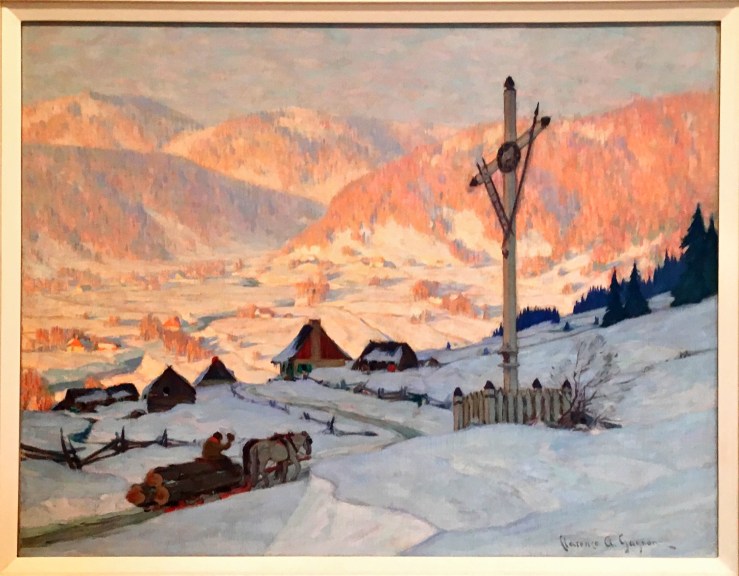
Clarence Gagnon (French Canadian, 1881–1942), The Wayside Cross, Winter, ca. 1916–17. Oil on canvas, 28 × 37 in. (71.1 × 94 cm). Art Gallery of Ontario, Canada. Photo: Jim Forest.
You know the time; it is the hour now for you to awake from sleep. For our salvation is nearer now than when we first believed; the night is advanced, the day is at hand.
This post belongs to the weekly series Artful Devotion. If you can’t view the music player in your email or RSS reader, try opening the post in your browser.
To view all the Revised Common Lectionary scripture readings for the First Sunday of Advent, cycle A, click here.

.jpg)








 Art & Theology