Three Kings Day (Artful Devotion)

Christmas isn’t over yet, so I hope you’re still celebrating! As has been the case for centuries, many Christians spread their holiday festivities over twelve days, from December 25 to January 5, followed by the culminating feast of the Epiphany on January 6. Epiphany commemorates the visit of the magi to the Christ child and thus God’s physical manifestation to the Gentiles. In Spanish-speaking countries and communities, it’s commonly known as Three Kings Day. This year it just so happens to fall on a Sunday.

+++

Three Kings by Juan Cartagena
Juan Cartagena, Los Tres Reyes Magos (The Three Kings), Puerto Rico, 19th century. Painted wooden bulto. Vidal Collection, National Museum of American History, Smithsonian Institution, Washington, DC.

Now after Jesus was born in Bethlehem of Judea in the days of Herod the king, behold, wise men from the east came to Jerusalem, saying, “Where is he who has been born king of the Jews? For we saw his star when it rose and have come to worship him.” . . .

After listening to the king, they went on their way. And behold, the star that they had seen when it rose went before them until it came to rest over the place where the child was. When they saw the star, they rejoiced exceedingly with great joy. And going into the house, they saw the child with Mary his mother, and they fell down and worshiped him. Then, opening their treasures, they offered him gifts, gold and frankincense and myrrh.

—Matthew 2:1–2, 9–11

+++

SONG: “Décimas de Nacimiento” (Décimas of the Nativity) by Pedro Flores | Recorded by Los Jíbaros, 1935, with vocals by Vilar and Pedro Dávila (aka Davilita) | Reissued on Where Will You Be Christmas Day?, 2004

Los Jíbaros, also known as the Cuarteto Flores, were a popular and influential Puerto Rican group founded in New York in 1930 by Pedro Flores. Their name refers to the peasant farmers of Puerto Rico, who developed a style of mountain music, jibaro music, that’s rooted in music brought to the island by early settlers from Andalusia and Extremadura in southern and western Spain during the seventeenth century.

The jibaro song “Décimas de Nacimiento” is an aguinaldo (Christmas carol; literally “gift”) that comprises four décimas (ten-line stanzas) performed in dialogue. In this traditional poetic form, each line contains eight syllables and follows a rhyme scheme of ABBAABBAAB—but here the poet has adapted the scheme to ABBAACCDDC. The two singers perform to an accompaniment of three guitars and a guiro (scratch gourd).

En un pesebre nacio
A eso de la medianoche
Un niño que sin reproche
Clamaron hijo de Dios
Una estrella iluminó
El sitio donde María
Tenía en brazos al Mesías
Que acaba de nacer
Al que empezaban a ver
Al amanecer del día

Los tres magos soberanos
De los reinos del Oriente
Vinieron muy diligentes
A ofrendar su Dios cristiano
Y todo el mundo pagano
Recuerda las profecías
Pues sabian que nacería
Pronto el hijo de Israel
Y que lo iban a ver
Al amanecer del día

Todas las aves cantaban
Olian todas las flores
Bonita luz y colores
Las astros del cielo daban
Los buenos sabios oraban
Los réprobos se escondian
En las pajas ya había
Nacido el niño sonriente
Se postró un mundo creyente
Al amanecer del día

Y a través de las edades
Recordando al soberano
El universo cristiano
Celebra las navidades
Dice así, felicidades
El humano se extasía
Y aún pedimos al Mesías
Hijo de María y José
Que algo de su gracia nos dé
Al amenecer del día

He was born in a manger
About midnight
An innocent child
Proclaimed the Son of God
A star shone upon
The place where Mary
Held our Savior in her arms
Who had just been born
They beheld him
At daybreak

The three wise men
From the Orient
Promptly came
To offer gifts to the Son of God
And all the pagan world
Remembered the prophecies
That foretold the birth
Of the Son of Israel
And they came to see him
At daybreak

All the birds were singing
All the flowers were perfumed
Stars in the sky were shedding
Beautiful light and colors
The wise men were praying
The scoundrels were hiding
Already, in the straw
The smiling child had been born
Everyone fell to their knees
At daybreak

Throughout the ages
In memory of our Sovereign
The Christian universe
Celebrates his birth
With good wishes
Humanity is ecstatic
And we still pray for the Messiah
Son of Mary and Joseph
To shed his grace upon us
At daybreak

This is one of many songs that might be heard at a parranda, a Puerto Rican caroling party that moves from house to house, lasting from around 10 p.m. to dawn on any given night of Christmas. The repertoire is a mix of sacred and secular songs, but unlike in the continental US, they are all festive and upbeat. As the carolers progress to each new stop, the head of that house invites them in for food and beverages. Parrandas are one of the leading social activities of the Christmas season on the island.

“Décimas de Nacimiento” was originally released by Columbia Records on vinyl in the 1930s. In 2004 it was reissued by Dust-to-Digital on a compilation Christmas album produced by folk music preservationist Lance Ledbetter and musicologist Dick Spottswood; there it appears alongside other rare recordings of American gospel, blues, and hillbilly music from the twenties and thirties.

Another vintage recording of the song, by Trio Armonico, can be found on The Music of Puerto Rico: Recordings 1929–1947, released in 2009 by Black Round Records. [Listen on Spotify]

(Related posts: “Flamenco-style devotional singing in southern Spain”; “Religious art highlights from New Mexico”)

+++

Celebrated annually on January 6, El Día de los Tres Reyes Magos, or simply Three Kings Day, is one of the most important holidays on the Puerto Rican calendar—so much so that Puerto Ricans invented a verb, reyar, that means “to celebrate Three Kings Day.” On the eve of the holiday, children put a shoebox filled with straw under their beds for the animal transports, be they camels or horses, of the Three Kings, who visit their homes with presents between midnight and dawn. Children awake not only to gifts but also to a day of parades and feasting with family and friends. Old San Juan throws an annual festival at the Luis Muñoz Marín Park with live music, food and drink, and free gifts, but the highlight of the day occurs when the Three Kings come walking into town. They start from their unofficial hometown of Juana Díaz in the south and travel around the island, stopping to celebrate in various localities—but no celebration is larger than that in Old San Juan.

(Listen to composer, playwright, and actor Lin-Manuel Miranda describe how he grew up celebrating Three Kings Day in New York City in this video from 2017.)

Three Kings bulto
Los Tres Reyes Magos (The Three Kings), Puerto Rico, late 19th century. Painted wooden bulto by a member of the Rivera family. Vidal Collection, National Museum of American History, Smithsonian Institution, Washington, DC.

Not surprisingly, the Three Kings are among the most popular santos (handmade images of saints and other religious figures) in Puerto Rico. Since camels were unknown to earlier local santeros (makers of religious images), the Three Kings are typically shown riding Paso Fino horses. The gifts they bear may be the three traditional ones—gold, frankincense, and myrrh—or typical Puerto Rican gifts, such as musical instruments. In Puerto Rico, Melchior is shown with dark skin, and he is often given special prominence, especially by santeros of African descent.

The two bultos (small religious carvings) pictured above were gifted to the Smithsonian, along with 3,200-plus other objects, by Puerto Rican folk art collector Teodoro Vidal. Learn more about the Vidal Collection at https://amhistory.si.edu/vidal/. (You may remember me speaking about another bulto donated by Vidal, Señor de la Humildad y la Paciencia, in my Stations of the Cross audio guide.)


This post belongs to the weekly series Artful Devotion. If you can’t view the music player in your email or RSS reader, try opening the post in your browser.

To view all the Revised Common Lectionary scripture readings for Epiphany, cycle C, click here.

The Way of Love (Artful Devotion)

Absolution by Andrey Yanev
Andrey Yanev (Bulgarian, 1965–), Fraternal Forgiveness, n.d. Oil on canvas, 130 × 100 cm.

Put on then, as God’s chosen ones, holy and beloved, compassionate hearts, kindness, humility, meekness, and patience, bearing with one another and, if one has a complaint against another, forgiving each other; as the Lord has forgiven you, so you also must forgive. And above all these put on love, which binds everything together in perfect harmony.

—Colossians 3:12–14

+++

MUSIC: “The Way of Love” by Béla Fleck | Performed by Béla Fleck, V. M. Bhatt, and Jie-Bing Chen, on Tabula Rasā (2011)

Tabula Rasā is a Grammy-nominated collaborative album by three virtuoso instrumentalists: American banjoist Béla Fleck, mohan veena (Indian slide guitar) player Vishwa Mohan Bhatt, and erhu (two-string Chinese fiddle) player Jie-Bing Chen.


This post belongs to the weekly series Artful Devotion. If you can’t view the music player in your email or RSS reader, try opening the post in your browser.

To view all the Revised Common Lectionary scripture readings for the First Sunday after Christmas Day, cycle C, click here.

Salvation Is Created (Artful Devotion)

Nativity by Wisnu Sasongko
Wisnu Sasongko (Indonesian, 1975–), Nativity, 2005. Acrylic on canvas, 48 × 34 in.

The LORD has bared his holy arm before the eyes of all the nations; and all the ends of the earth shall see the salvation of our God.

—Isaiah 52:10

For the grace of God has appeared, bringing salvation to all.

—Titus 2:11

To you is born this day in the city of David a Savior, who is the Messiah, the Lord.

—Luke 2:11

+++

SONG: “Salvation Is Created” (Op. 25, no. 5) by Pavel Tchesnokov, 1912 | Performed by St. Olaf Choral Ensembles, on What Child Is This? The St. Olaf Christmas Festival, vol. 3 (1991)

Salvation is created in the midst of the earth, O God, O our God. Alleluia!

A Russian composer, choral conductor, and teacher, Pavel Tchesnokov (1877–1944) wrote over four hundred sacred choral works up until 1912, when he was forced by the Soviets to focus exclusively on secular compositions; “Salvation Is Created” was his last one. It’s a communion hymn based on a synodal Kievan chant melody and Psalm 74:12: “For God is my King of old, working salvation in the midst of the earth.”

+++

Wisnu Sasongko is an artist from the Indonesian island of Java. In 2004–05 he served as artist in residence at the Overseas Ministries Study Center in New Haven, Connecticut, out of which came a catalog of his work, Think on These Things: Harmony and Diversity, published in 2007. He was also one of five artists featured in the 2007 exhibition The Christian Story: Five Asian Artists Today at the Museum of Biblical Art in New York City.


This post belongs to the weekly series Artful Devotion. If you can’t view the music player in your email or RSS reader, try opening the post in your browser.

To view all the Revised Common Lectionary scripture readings for Christmas Day, cycle C, click here.

Roundup: Short films on love and loss, Ashmolean Advent calendar, and more

ALBUM REVIEW: Hebrews by Psallos: My first published article for The Gospel Coalition! Psallos is a music collective led by Cody Curtis, and they’re doing amazing work—adapting entire New Testament epistles for folk rock band and chamber orchestra. (I reviewed the group’s first major album, Romans, two and a half years ago.) The track “Ex Paradiso” interprets John Piper’s favorite Advent text and implements a clever twist on Fauré’s Requiem. You’ll also hear a few other famous musical quotations, including, in track 3, “Angels We Have Heard on High”—again, with a lyrical twist—and a jarring rendition of “Nothing but the Blood.” Curtis is a wonderfully talented and versatile composer, writing in styles from bluegrass and Irish dance to slow hip-hop and hot jazz, all united under one overarching structure. The “Before the Throne” theme that’s developed throughout is truly sublime.

+++

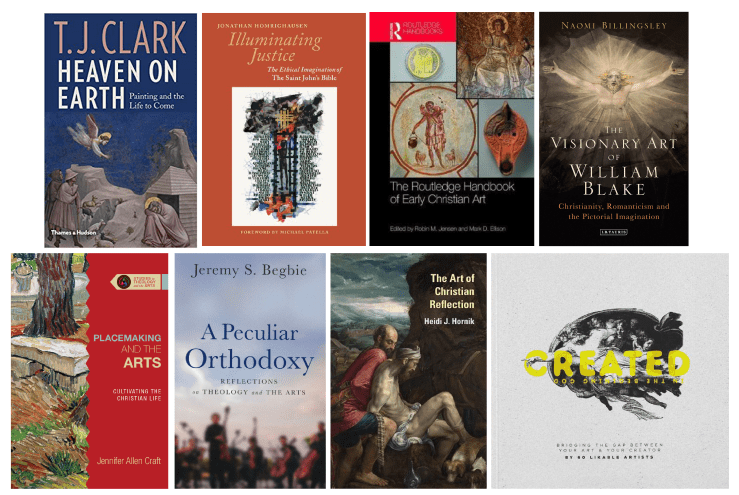
ANNOTATED BOOK LIST: “Art and theology” books published in 2018: I put together this compilation for ArtWay, so the emphasis is on visual art. I’ve already featured a few of the books on the blog, like Wounded in Spirit and The Annunciation: A Pilgrim’s Quest, but there are over a dozen more, a mix of academic and nonacademic. These include, among others, a large reference work on early Christian art; books on individual artists William Blake and Keith New; two books by Jeremy Begbie, which emphasize the need for biblically grounded creedal orthodoxy in discussions on the arts; and two books on the modern illuminated Saint John’s Bible—one of which (Illuminating Justice by Jonathan Homrighausen) was just named among the top twelve theology books of the year by the Englewood Review of Books. Like Homrighausen, art historian Heidi J. Hornik also links art and ethics, in her book The Art of Christian Reflection. Created: Bridging the Gap between Your Art and Your Creator is probably the most unique offering; published by Likable Art design studio, it features sixty-two responses to the question “What are your first five words to the world of artists?,” and edgy graphic designs.

Art and Theology books 2018

Let me know if I’m missing any titles. For book lists from previous years, see 2014–16 and 2017.

+++

ANIMATED SHORTS

Lost & Found (2018): Widely lauded at film festivals since its debut earlier this year, Lost & Found is an endearing stop-motion film that chronicles a dramatic turning point in the relationship between two crocheted animal toys, a fox and a dinosaur. Since finding each other in the lost-and-found bin of a Japanese restaurant, it was love. But when the fox topples into a fountain, the dinosaur must sacrifice himself, yarn by yarn, to save her. Directed by Andrew Goldsmith and Bradley Slabe.

Bao (2018): This computer-animated short film, written and directed by Domee Shi and produced by Pixar, premiered on June 15 with Incredibles 2. It’s about a lonely, aging Chinese Canadian mother, suffering from empty-nest syndrome, who receives an unexpected second chance at motherhood when she makes a dumpling that comes to life as a boy. “I was that overprotected little dumpling,” Shi said in an interview; this project, she said, was her attempt to try to better understand her mother. One of the strongest powers of film, I’ve always thought, is its ability to incite empathy. (Update, 12/25: It appears that this film was being offered for free online viewing for only a very limited time, as it is now behind a paywall: https://www.youtube.com/watch?v=ypEuSSwB1Rk.)

Bao (2018)

+++

DAILY ART: 2018 Advent Calendar by the Ashmolean Museum: I know the season’s almost over, but it’s still worth checking out this free online calendar published by the Ashmolean, an art and archaeology museum in Oxford. Each day of December, they’ve been revealing a different winter- or Christmas-themed object from their collection. Entries thus far have included a bronze “reindeer” brooch from second-century Amiens, a decorated star tile from thirteenth-century Iran, a winter kimono with a design of snowy pines, an ivory netsuke in the form of a boy rolling a yuki-daruma (snowman), and a Delftware tile depicting three ships a-sailing. I dig this creative idea for public engagement! I’ve seen art museums do Pinterest boards, but this is the first time I’ve seen an Advent calendar.

Below I’ve reproduced the etching from Day 2, Epiphany, which F. L. Griggs made to celebrate the end of World War I one hundred years ago. A tall memorial crucifix stands atop a triple bridge, towering over roofless homes and illuminated by bright starlight. The Latin inscription translates as “The King of Peace whom the whole world desireth to see, hath shown His greatness. The King of Peace hath shown His greatness above all kings of the whole Earth.” Griggs’s son would die in World War II.

Epiphany by Frederick Landseer Maur Griggs
Frederick Landseer Maur Griggs (British, 1876–1938), Epiphany, 1918–19. Etching, 17.3 × 12.5 cm. Ashmolean Museum of Art and Archaeology, Oxford, England.

+++

WALTZING MARBLES: Kinetic artist Mark Robbins of DoodleChaos made a series of Rube Goldberg-like contraptions with blocks and magnets and set a marble rolling along it to Tchaikovsky’s “Waltz of the Flowers” from The Nutcracker, with other marbles later joining the dance. The synchronization is perfect! I got such a kick out of this.

Born a Child and Yet a King (Artful Devotion)

The Infant Savior by Andrea Mantegna
Andrea Mantegna (Italian, ca. 1431–1506), The Infant Savior, ca. 1460. Tempera on canvas, 70.2 × 34.3 cm (27 5/8 × 13 1/2 in.). National Gallery of Art, Washington, DC.

But you, O Bethlehem Ephrathah,
who are too little to be among the clans of Judah,
from you shall come forth for me
one who is to be ruler in Israel,
whose coming forth is from of old,
from ancient days.
Therefore he shall give them up until the time
when she who is in labor has given birth;
then the rest of his brothers shall return
to the people of Israel.
And he shall stand and shepherd his flock in the strength of the LORD,
in the majesty of the name of the LORD his God.
And they shall dwell secure, for now he shall be great
to the ends of the earth.
And he shall be their peace.

—Micah 5:2–5

+++

SONG: “Come, Thou Long-Expected Jesus / Joy to the World,” adapted and arranged by Folk Angel, on Live at Green Lux: Christmas Songs, vol. 6, 2014 | Words by Charles Wesley, 1744, with refrain and bridge by Isaac Watts, 1719 | Music by Rowland Hugh Prichard, 1830, and Folk Angel

The backbone of this Folk Angel song is the Advent classic “Come, Thou Long-Expected Jesus,” but into this the band has integrated lines from “Joy to the World,” traditionally sung at Christmastime. While the verses plead, “Come!,” the chorus declares, “He has come,” holding together the cries of both seasons. He whom the nations desire is here, “born to reign in us forever.” May earth receive him.

Come, thou long-expected Jesus,
Born to set thy people free;
From our fears and sins release us,
Let us find our rest in thee.
Israel’s strength and consolation,
Hope of all the earth thou art;
Dear desire of every nation,
Joy of every longing heart.

Joy to the world!
The Lord has come;
Let earth receive her king.

Born thy people to deliver,
Born a child and yet a king,
Born to reign in us forever,
Now thy gracious kingdom bring.
By thine own eternal spirit
Rule in all our hearts alone;
By thine all-sufficient merit,
Raise us to thy glorious throne.

Joy to the world!
The Lord has come;
Let earth receive her king.

Let every heart prepare him room,
And heaven and nature sing!

Come, thou long-expected Jesus,
Born to set thy people free.
We are free.
We are free.
We are free.
We are free.

The verse melody is, of course, that well-loved Welsh tune HYFRYDOL, composed by Rowland Hugh Prichard. The chorus and bridge, however, employ an original tune by Folk Angel, resetting key excerpts from Isaac Watts’s carol that emphasize the kingly nature of the infant Christ. This crescendos into a triumphant repeat of the song’s first two lines, and a grateful acknowledgment of God’s fulfilled purposes: a people set free from their fears and sins, granted eternal rest under the loving rule of Christ. Even so, Lord, thy kingdom come.

+++

The Infant Savior by the great Renaissance painter Andrea Mantegna brings me such delight—that little rosy, chubby-cheeked baby blessing me, blessing the world, this Christmas. You might call the painting a Christ Pantocrator, but it doesn’t fit the standard iconography, because instead of a half-length adult it shows a full-length child of about one year. Still, this is Jesus, “born a child and yet a king”: he wears a velvet robe with a golden clasp and lining, but underneath, his humble swaddling cloths are revealed, and he’s barefoot. His right hand is raised in a gesture of blessing, and in his left hand he holds, instead of a book (as is traditional in Pantocrator images), a cross-shaped scepter. A cross shape also comprises his “crown”—the three streams of light emitted from his bald little head.

Mantegna’s painting suggests that Christ’s kingship was established at his birth, and that it would be furthered by way of the cross.


This post belongs to the weekly series Artful Devotion. If you can’t view the music player in your email or RSS reader, try opening the post in your browser.

To view all the Revised Common Lectionary scripture readings for the Fourth Sunday of Advent, cycle C, click here.

Roundup: Sheku Kanneh-Mason, Hanukkah lamps, building walls, and more

NEW MUSICAL ARRANGEMENTS FOR ADVENT/CHRISTMAS

For cello and piano: “In the Bleak Midwinter,” arr. Sheku Kanneh-Mason: Sheku Kanneh-Mason is a multi-award-winning cellist from England who, since being named 2016 BBC Young Musician of the Year, has gone on to release, this January with Decca, his first full-length album (a chart topper), to perform as a soloist at the marriage ceremony of Prince Harry and Meghan Markle, and to serve, for the 2018–19 season, as a Young Artist in Residence at the Royal Liverpool Philharmonic. Time magazine recently listed him as one of 25 Most Influential Teens of 2018. He’s nineteen years old.

Stream on Spotify | Purchase on iTunes

In a recent recording session at Abbey Road Studios, Sheku performed one of his own arrangements with his sister Isata Kanneh-Mason, a pianist who, like him, is on scholarship at the Royal Academy of Music. Sheku is the third of seven siblings, and all of them are musical. They competed together in 2015 on Britain’s Got Talent and regularly perform together. See the CBS Sunday Morning featurette “The family that plays together.”

This piece is, in the truest sense of the word, awesome. Gustav Holst’s melody, which the duo plays straightforwardly for the first verse, is already beautiful; Sheku’s creative coloring of each subsequent verse, utilizing different playing techniques, elevates the song’s beauty even more. I could listen to this on repeat all day long. Oh wait. I have.

For jazz trio and voice: “Love Came Down” and “Comfort Ye,” arr. Deanna Witkowski: This fall, jazz pianist and composer Deanna Witkowski released recordings of two of her arrangements of Advent/Christmas classics: Christina Rosetti’s “Love Came Down at Christmas” and, just last month, “Comfort Ye,” whose seventeenth-century text (based on Isaiah 40:1–8) is by Johann Olearius, with a later English translation by Catherine Winkworth. Witkowski is on piano, Daniel Foose is on bass, and Scott Latzky is on drums, making up the Deanna Witkowski Trio. Sarah Kervin is the vocalist.

“Love Came Down” (gospel/funk) – Purchase track on Bandcamp | Purchase piano/vocal score

“Comfort Ye” (gospel/R&B) – Purchase track on Bandcamp | Purchase choral (SAT) / piano score

+++

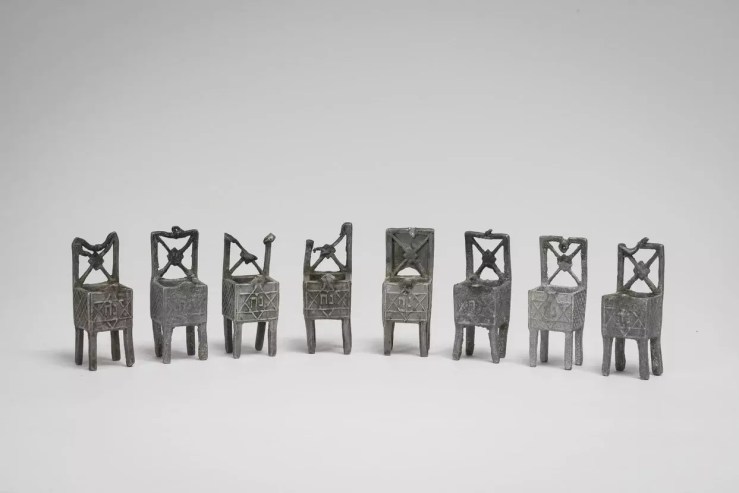
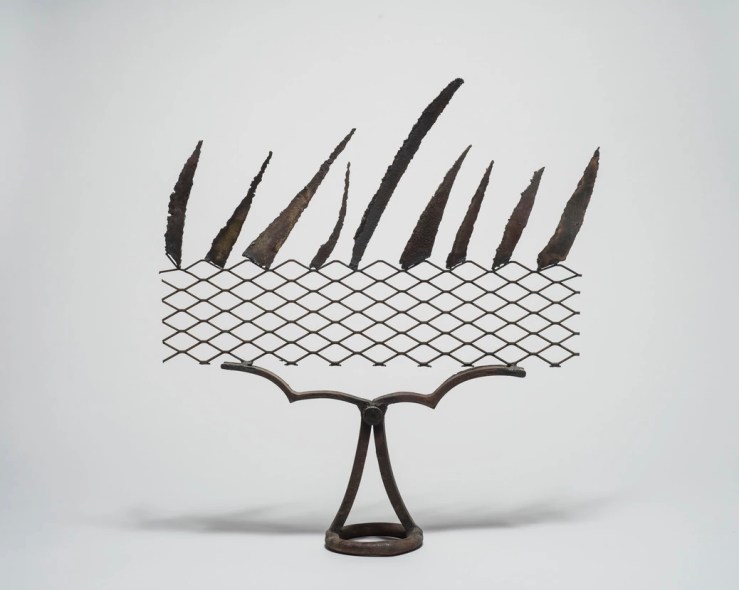
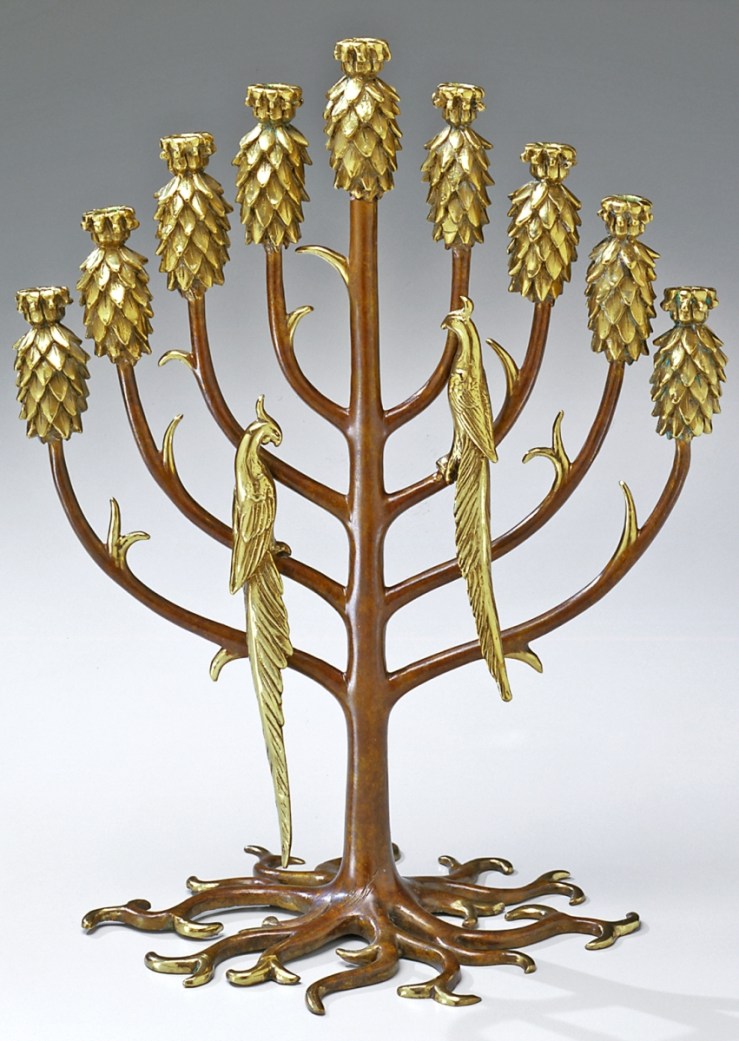
ART EXHIBITION: “Accumulations: Hanukkah Lamps,” Jewish Museum, New York City, October 12, 2018–February 9, 2020: This year’s Hanukkah celebrations have just passed (December 2–10), but the Jewish Museum in New York is still running, for quite a while, its exhibition of eighty-one Hanukkah lamps from its collection of nearly 1,050—the largest collection of Hanukkah lamps in the world. The lamps in the current show represent four continents, six centuries, and a range of materials. I’m most drawn to the modern ones, which rethink traditional ideas about the ritual object.

Hanukkah lamp (Belarus)
Hanukkah lamp from Stolin (Belarus), ca. 1885. Cast lead and tin, each 2 7/8 × 1 × 15/16 in. (7.3 × 2.5 × 2.4 cm). Jewish Museum, New York.
Kagan, Larry_Menorah Memories
Larry Kagan (American, 1946–), Menorah Memories, 1981–82. Welded steel scraps, 21 1/4 × 19 × 4 1/2 in. (54 × 48.3 × 11.4 cm). Jewish Museum, New York.
Erte_Tree of Life (menorah)
Erté (Romain De Tirtoff) (French, 1892–1990), Tree of Life, 1987. Polished bronze, 15 1/2 × 12 1/2 × 7 9/16 in. (39.4 × 31.8 × 19.2 cm). Jewish Museum, New York.

+++

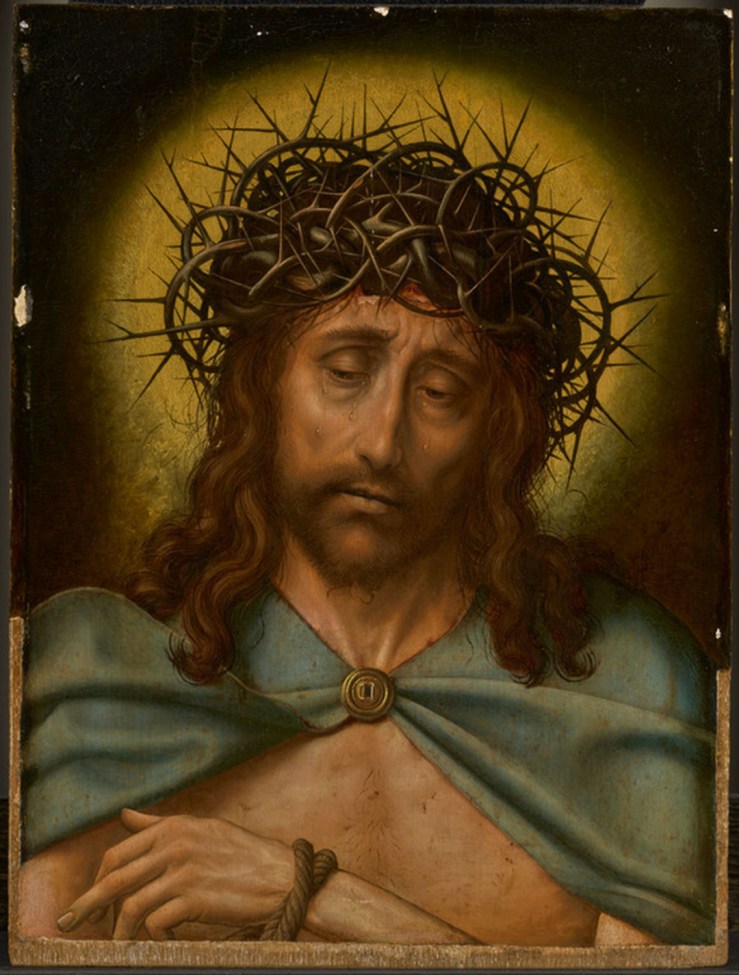
ART ACQUISITION: Christ as the Man of Sorrows by Quentin Metsys: On November 27 the J. Paul Getty Museum announced its acquisition of Christ as the Man of Sorrows by Quentin Metsys (alternatively spelled Massys), one of the leading painters in sixteenth-century Antwerp, known for his delicate modeling and crisp details. For centuries, the painting has been in a private collection, previously unknown to art historians; the Getty purchased it in a private sale. Its discovery and attribution expands Metsys’s oeuvre and is already attracting much attention from scholars. After a short period of conservation and technical study, it will go on view in spring 2019, exhibited to the public for the first time in modern history. It is the first work by Metsys in the Getty’s collection.

Christ as the Man of Sorrows by Quentin Metsys
Quentin Metsys (Netherlandish, 1466–1530), Christ as the Man of Sorrows, ca. 1520–30. Oil on panel, 19 1/2 × 14 1/2 in. J. Paul Getty Museum, Los Angeles. [pre-conservation]

+++

SONG: “Why We Build the Wall” by Anaïs Mitchell: Hadestown is a 2016 stage-musical adaptation of a 2010 folk-opera concept album of the same name, both by singer-songwriter Anaïs Mitchell. It invites audiences on an epic journey to the underworld and back, following two intertwining love stories—that of Orpheus and Eurydice and of Hades and Persephone. I was struck by the current US political resonances of the song “Why We Build the Wall,” which Mitchell says she wrote in 2006. In this A Prairie Home Companion broadcast, Mitchell sings as Hades, king of the underworld, leading her minions in an anthem that celebrates the importance of a nonporous border. She is joined by Chris Thile on mandolin and vocals and by the First-Call Radio Players. The song starts at 1:07.

+++

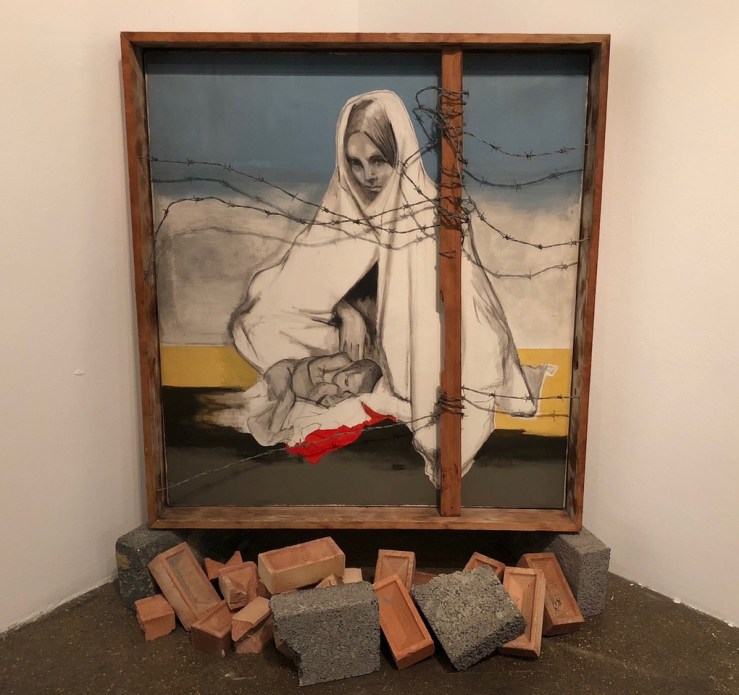
VISUAL MEDITATION: Mother and Child by Gilly Szego: In a recent contribution to ArtWay, Anglican vicar Jonathan Evens reflects on a work by UK artist Gilly Szego, the wife of a Hungarian refugee. Szego painted Mother and Child in response to the expulsion of South Asians from Uganda in 1972 following a wave of Indophobia. St.-Martin-in-the-Fields, one of London’s most prominent churches, displayed the painting that year, helping to raise awareness of these refugees’ plight and that of others around the world. The figures could easily be read as the Virgin Mary and Jesus, who were themselves displaced from their homeland.

Mother and Child by Gilly Szego
Gilly Szego (British, 1932–), Mother and Child, 1972. Oil on canvas with wood frame and barbed wire, 52 × 48 in.

Evens shares some words from Rev. Dr. Sam Wells, St. Martin’s current vicar:

Jesus is a displaced person in three senses. Fundamentally, he is the heavenly one who sojourned on earth. And it didn’t go well: as John’s Gospel puts it, ‘He came to what was his own, and his own people did not accept him’ (John 1:11). Then he finds himself a refugee in Egypt, his parents fleeing Herod’s persecution. Third, he spends his ministry as an itinerant preacher and healer, with nowhere to lay his head.

Meanwhile the story of Israel is one of migration from beginning to end. Adam and Eve leave the Garden; Noah and family sail away from destruction; Abraham follows God’s call; Joseph and family head down to Egypt; Moses leads the people back; Judah is taken into exile in Babylon; Ezra and Nehemiah tell of the return. None of these people were going on a package holiday: they were refugees, asylum seekers or trafficked persons. There is precisely one verse commanding the children of Israel, ‘You shall love your neighbour as yourself’; there are no less than 36 verses saying ‘love the stranger.’ Care of the alien is how Israel remembers its history with gratitude.

Rejoice Greatly, Daughter! (Artful Devotion)

The Third Sunday of Advent is known as Gaudete Sunday, from the Latin word for rejoice. Churches and families all over the world will be lighting the joy candle of their Advent wreath—traditionally rose-pink instead of purple like the other three—and worshipping with gusto in anticipation of the great joy to come at Christmas.

Eclat by Gill Sakakini
Gill Sakakini (British), Éclat, 2015. Acrylic on board, 120 × 90 cm.

Sing aloud, O daughter of Zion;
shout, O Israel!
Rejoice and exult with all your heart,
O daughter of Jerusalem!
The Lord has taken away the judgments against you;
he has cleared away your enemies.
The King of Israel, the Lord, is in your midst;
you shall never again fear evil.

On that day it shall be said to Jerusalem:
“Fear not, O Zion;
let not your hands grow weak.
The Lord your God is in your midst,
a mighty one who will save;
he will rejoice over you with gladness;
he will quiet you by his love;
he will exult over you with loud singing.
I will gather those of you who mourn for the festival,
so that you will no longer suffer reproach.
Behold, at that time I will deal
with all your oppressors.
And I will save the lame
and gather the outcast,
and I will change their shame into praise
and renown in all the earth.
At that time I will bring you in,
at the time when I gather you together;
for I will make you renowned and praised
among all the peoples of the earth,
when I restore your fortunes
before your eyes,” says the LORD.

—Zephaniah 3:14–20

+++

SONG: “Rejoice” | Adapted from the soprano air “Rejoice greatly, O daughter of Zion” from Handel’s Messiah | Performed by the Broadway cast of Mamma Mia, feat. Jenn Noth, Felicity Claire, Gerard Salvador, and Albert Guerzon, on Broadway’s Carols for a Cure, vol. 15 (2013)

(I was unable to find the name of the adapter/arranger of this song. If you know, please notify me.)

This song is a setting of Zechariah 9:9a:

Rejoice greatly, O daughter of Zion!
Shout aloud, O daughter of Jerusalem!
Behold, your king is coming to you;
righteous and having salvation is he . . .

Though this verse is not an assigned lectionary reading for this week, its sentiments are echoed in the Zephaniah passage.

+++

The title of Gill Sakakini’s painting pictured above is Éclat, a French word meaning brilliance, glow, glory, or a burst. Sakakini discusses it in an interview with Mark Byford in the book The Annunciation: A Pilgrim’s Quest (274). The painting captures a post-Annunciation moment, she says: Mary, alone in her room, responding to Gabriel’s news “through a bursting, embodied YES!” A bold, botanic wallpaper design forms the backcloth, emphasizing openness and fecundity; “the ‘garden,’ like creation itself, shares the immediacy of her joy through the shape of wide open, fully ripe petals which reinforce the openness of her limbs in this accepting gesture.” Sakakini says she’s aware that Mary almost surely cycled through other natural responses to the unexpected news of her pregnancy, like shock and fear, but that her ultimate posture was one of joyful acceptance, of celebration of what God was doing through her. “I’m not denying there were other stages, but this is the fruit of all those other interior conversations. . . . This is when she’s finally arrived.”

+++

Jucundare, filia Sion,
exsulta satis filia Jerusalem, alleluia.

Daughter Sion, be glad!
Dance, dance, daughter Jerusalem! Alleluia.

—from the monastic liturgy (Antiphonale Monasticum)


This post belongs to the weekly series Artful Devotion. If you can’t view the music player in your email or RSS reader, try opening the post in your browser.

To view all the Revised Common Lectionary scripture readings for the Third Sunday of Advent, cycle C, click here.

The Rich Man who passed through the eye of a needle

Poem: “Advent” by Suzanne Underwood Rhodes

Through the needle’s eye
the rich man came
squeezing through stars of razor light
that pared his body down to thread.
Gravity crushed his heart’s chime
and his breath that breathed out worlds
now flattened as fire between walls,
the impossible slit stripped him
admitting him
to stitch the human breach.

This poem was first published in What a Light Thing, This Stone (Sow’s Ear Press, 1999) and is used here by permission of the author.

My research interests have to do mainly with art’s theological potential and its ability to, as Walter Brueggemann puts it, “disclose” truths that are “closed” by prose. I love how it often surprises, and how it can make connections I would have never thought to make myself.

Suzanne Underwood Rhodes’s poem “Advent” demonstrates these values magnificently. Its topic is the Incarnation. But her mooring point is not John 1 or Luke 1–2 or Philippians 2 or any other scripture text traditionally associated with the doctrine. Instead she draws on the famous aphorism of Jesus that’s recorded in Matthew 19:24: “It is easier for a camel to go through the eye of a needle than for a rich person to enter the kingdom of God.”

In this Gospel interaction, Jesus is explaining how terribly difficult it is for wealthy people to enter heaven because they tend to cling tightly to their earthly wealth rather than to God; they let it make claims on them, and they trust in its promises, to the neglect of the claims and promises of God. While the needle saying, in context, pertains to human beings passing from earth to heaven, Rhodes turns it on its head to suggest the movement of God from heaven to earth. A seeming impossibility—infinity becoming finite, God becoming man. But “with God, all things are possible” (Matt. 19:26). To save us, he would give up all the riches of heaven, assuming the role of a servant and ultimately giving up his very life.

Rhodes uses harsh, uncomfortable words—“squeezing,” “razor,” “pared,” “crushed,” “flattened,” “stripped”—to convey a sense of compression into human flesh. God’s breath, once so powerful and expansive that it brought the universe into existence, is now, in the person of the Son, walled in by a rib cage and dependent on oxygen. His heart pumps actual blood. Thus pared down to thread, he slips through the needle “to stitch the human breach,” to repair what we have torn through our disobedience. Severed from God no longer, we are held together with him by Christ himself.

Musical composition: “As by Fire between Walls” by Joshua Stamper

The evocative imagery of this poem has inspired artists in other media to respond in kind. One of them is composer Joshua Stamper, who, commissioned in 2014 by City Church Philadelphia, wrote a four-and-a-half-minute experimental jazz piece for chamber orchestra titled “As by Fire between Walls.”

It starts with minor chords on the piano, floating around ethereally. Then a violin tremolo kicks in (suggestive of the “razor light”), and other sharp bowing techniques (“par[ing] his body down”). Then soulful, wordless vocals. Then a staccato rhythm played on the mellotron, and percussion. Brass too. It’s a wonderfully wrought piece of music, a soundscape of the Incarnation, inclining the ear back toward Rhodes’s words and the heart to the grand story of scripture.

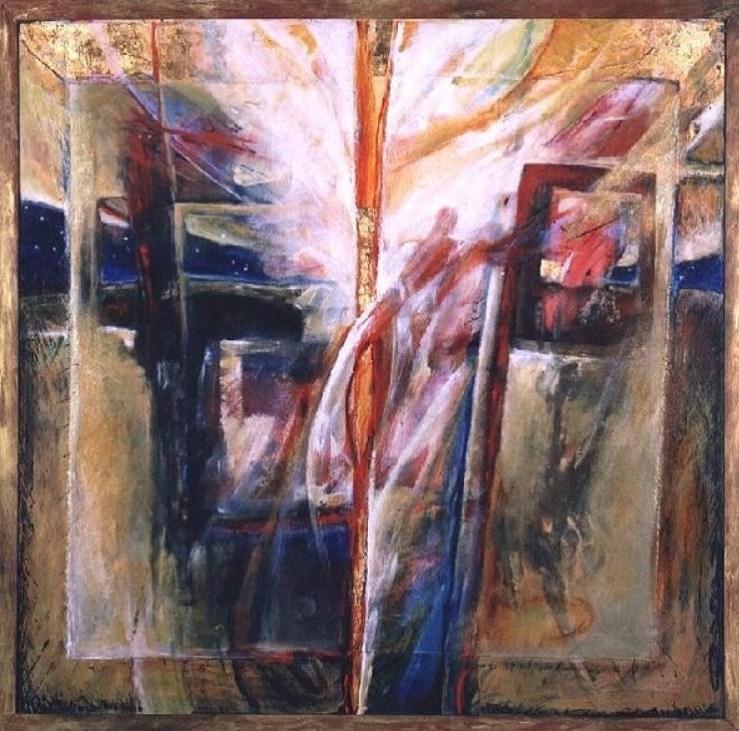
Painting: Through the Needle’s Eye the Rich Man Came by Grace Carol Bomer

Suzanne Rhodes is a friend of visual artist Grace Carol Bomer’s, who has a studio practice in Asheville, North Carolina. In 1993, Bomer was invited by the Asheville Art Museum to exhibit eight of her paintings for a Christmas show. Through the Needle’s Eye the Rich Man Came, inspired by Rhodes’s “Advent,” is one of those eight.

Through the Needle's Eye by Grace Carol Bomer
Grace Carol Bomer (Canadian American, 1948–), Through the Needle’s Eye the Rich Man Came, 1993. Mixed media on torn canvas on wood, 48 × 48 in.

About it, Bomer says,

The Christ of Christmas is God incarnate, the focal point or fulcrum of history. To show this glorious Incarnation, I chose to paint a piercing V (fulcrum) of light rending cloth (canvas on wood). The torn canvas symbolizes the veil of the temple. . . .

It was my personal challenge to show in painting that Christ is God, Spirit and flesh, in a way that would not be trite and sentimental. The Renaissance nativities are infected with beautiful Platonic realism, suited for Christmas card sentimentality. I feel they do not adequately exalt the “mystery hidden for ages,” the Christ of power and glory. Jesus Christ is Spirit and flesh, Son of God and Son of Man. Reality is both “abstract” and “realistic.” So too, art must seek to find this mysterious balance in order to proclaim the gospel. Art totally divested of realism, like Abstract Expressionism, becomes meaningless. Art must proclaim creation, fall, and redemption. I would like the poetic nuances in my work to stimulate the imagination to “see” in the abstract painting the spiritual truths that cannot be painted realistically.

In this piece there are suggestions of blood on doorways, symbolizing a Passover fulfilled, as Christ pushes open the door separating God and man.

So this painting integrates the coming down with the at-one-ing that happens at the cross, the physical tear of the canvas alluding simultaneously to the “human breach” of Rhodes’s poem and the tearing of the temple veil, which symbolizes humanity’s reconciliation to God. Birth and death are wrapped up in a single image, as both are key to Christ’s salvation project.

Through the Needle’s Eye is one of Bomer’s early works, but she has a whole series she calls Incarnation, which can be viewed on her website at https://gracecarolbomer.com/section/300298-Abstract-Incarnation.html.

+++

See how a poet’s imagination and craft can unfold the beauty and wonder of a heady doctrine with such concision? In Literature: Structure, Sound, and Sense, Laurence Perrine defines poetry as “a kind of language that says more and says it more intensely than does ordinary language” (509). That’s just what Suzanne Underwood Rhodes does in “Advent.” And that intense language of hers has inspired works of musical and visual art that explore even further what it means that the Son of God, the “Rich Man” from heaven, constricted himself for our sakes, becoming impossibly small, taking up residence in a virgin’s dark womb, in humanity’s dark world, so that he could stitch back together our ruptured relationships with the Father and with one another.

The Sunrise Shall Visit Us (Artful Devotion)

The Stell Falstone by Judith Appleby
Judith Appleby (British, 1952–), The Stell Falstone, 2011–14. Acrylic on canvas.

The following prophecy, known as Zechariah’s Canticle, is given by the temple priest after the birth of his son, John—who would become “John the Baptist,” the forerunner to Jesus Christ. Zechariah can taste the sweet nearness of redemption, and he sings its song.

Blessed be the Lord God of Israel,
for he has visited and redeemed his people
and has raised up a horn of salvation for us
in the house of his servant David,
as he spoke by the mouth of his holy prophets from of old,
that we should be saved from our enemies
and from the hand of all who hate us;
to show the mercy promised to our fathers
and to remember his holy covenant,
the oath that he swore to our father Abraham, to grant us
that we, being delivered from the hand of our enemies,
might serve him without fear,
in holiness and righteousness before him all our days.
And you, child, will be called the prophet of the Most High;
for you will go before the Lord to prepare his ways,
to give knowledge of salvation to his people
in the forgiveness of their sins,
because of the tender mercy of our God,
whereby the sunrise shall visit us from on high
to give light to those who sit in darkness and in the shadow of death,
to guide our feet into the way of peace.

—Luke 1:68–79

+++

SONG: “The Dawn Will Break Upon Us” by Mike Crawford and His Secret Siblings [previously], on Jacob’s Well, vol. 3: Songs for the Advent Conspiracy (2010)


This post belongs to the weekly series Artful Devotion. If you can’t view the music player in your email or RSS reader, try opening the post in your browser.

To view all the Revised Common Lectionary scripture readings for the Second Sunday of Advent, cycle C, click here.

Book Review: The Annunciation: A Pilgrim’s Quest by Mark Byford

The Annunciation—Gabriel’s announcement to Mary that she will bear the Son of God—is one of the most depicted biblical subjects of all time. This narrative episode from Luke’s Gospel has long enthralled me, and I’ve been collecting artistic responses to it over the past several years, cogitating on how I might develop the materials into a book. Turns out, author Mark Byford has beaten me to the punch!

The Annunciation: A Pilgrim's Quest (book cover)

The Annunciation: A Pilgrim’s Quest (Winchester University Press, 2018) sets out to explore the history and spiritual meaning of the Annunciation through interviews with 150-plus clerics, theologians, church historians, artists, curators, art historians, and others, and through encounters with works of visual art, music, and poetry inspired by the story. It’s very cleverly structured as a pilgrimage, so the book’s organizing principle is roughly geographic, following Byford through England, France, the Low Countries, Spain, Italy, and the Holy Land as he encounters people, places, and artworks in those regions that shed light on the topic.

The scope and diversity of interviewees, from different denominations and even religions (Jews, Muslims, agnostics), is impressive, and the quotes he elicits and compiles here are a valuable trove. The roster includes big names like Rowan Williams and Archbishop Kallistos Ware, as well as others whose insights are just as rich. My fingers were very, very busy taking notes as I read!

Byford’s starting point is The Annunciation by François Lemoyne (pictured on the front cover), which he found himself unexpectedly captivated by upon seeing it at the National Gallery one day. It’s a relatively unknown work that pales in comparison to the other, world-renowned Annunciation paintings at the Gallery. When he saw that it was on loan from Winchester College, where it was installed in 1729, he grew all the more intrigued, as he is from Winchester. He wanted to find out why such a flamboyantly Catholic painting of Mary by a leading French artist came to reside in a public school in Protestant England in the eighteenth century, and why it has been removed from its original setting for display at the museum.

“I am not especially enchanted by its imagery or by its aesthetic value,” Byford admits (13)—but for whatever reason, it grasped him. I share Byford’s assessment of the painting as too cloying, florid, conventionally pious, and seeing it on the page does nothing for me. But I love how in this book, we get to see how differently different people see, because as Byford goes about his journey, he shows a reproduction of Lemoyne’s painting to each interviewee, recording their reactions. Whereas many people read the angel’s presence as domineering or oppressive, overpowering Mary’s will, and his finger as phallic, others read the encounter as a tender one, his finger illustrating his saying, “You will receive power from on high,” and indicating that it’s all about God, not her. Many expressed dislike toward the image because they say it shows Mary as weak and simpering instead of strong and courageous—“it’s disempowering” (82); “I want her to have the same force of character as the muscular angel” (85); she’s too insubstantial, “anemic,” even; “the blood and guts of the woman has been taken out of her” (173). Others were incredibly moved by the image, and commented on the “wonderful sense of movement” (100), the “spectacular light” (204), or Mary’s expression of joyful surrender. Theologian Ben Quash comments on the tattiness of the interior establishing a contrast between broken, worldly space and luminous, heavenly space—and the peeling plaster as a metaphor for revelation, a stripping back (208).

Besides bringing up the Lemoyne painting, Byford asked each interviewee some variation of the following:

  • Is the Annunciation literal (historical, factual) or metaphoric/symbolic?
  • How important is it for Christians to believe in the virgin conception?
  • Do you believe, as Bishop Philip Egan does, that the Annunciation is “the most important event in human history”?
  • Why is the feast of the Annunciation barely acknowledged today?
  • What is the spiritual meaning of the Annunciation?
  • Do you see a parallel between your story and Mary’s? (That is, have you ever felt a call from God that you would consider an “annunciation moment”?)
  • Is Mary a bridge or a barrier to interdenominational dialogue?
  • Do you venerate Mary?

One common point of discussion that results is the agency of Mary—or lack thereof—and on this point, the variant interpretations of feminists are interesting to note. Some feminists hate the story of the Annunciation because, in their reading, God forces Mary to bear a child against her will, enacting something akin to divine rape—and a few interviewees attempt to make this case. But other feminists find the story absolutely empowering for women, in that God comes into the world without the aid of a man, and with Mary’s full consent—a critical detail. Tina Beattie, for example, says, “It’s now a woman who has the voice of authority on behalf of creation” (157).

The word submission has negative connotations in today’s culture, and so can the idea of being an empty vessel, but this is so central to the Annunciation story, and I was glad to see the majority of Christians interviewed here uphold the virtuousness of submission and also recognize that it often connotes strength, and it is itself an act of the will. Like Mary, we can choose to say yes to what God calls us to. There are lots of ways of talking about submission to God, and I enjoyed hearing different wordings and perspectives on it.

Byford is the former deputy director general and head of BBC journalism, and his whole approach in this book is indeed journalistic. He marks his observances of the native environments, demeanors, and mannerisms of his interview subjects, and he presents their words unedited. He doesn’t editorialize, for the most part—that is, until the end, when, after interviewing his wife and (grown) children, he confronts his own views about the Annunciation, including how they have been influenced by the conversations he’s had over the course of the project.

[Below is a small sampling of the 205 images reproduced and discussed in the book.]

The majority of the book unfolds in England, but as previously mentioned, Byford also visits other countries, including places like Chartres Cathedral, which contains at least ten Annunciation scenes; Florence, with its many famous Annunciation paintings, including ones by Simone Martini and Lippo Memmi, Fra Angelico, Sandro Botticelli, and Leonardo da Vinci; and the catacombs and churches of Rome. He even makes it as far as Nazareth, where there are two different churches—one Greek Orthodox, the other Catholic—that claim to be the original site of the Annunciation. He interacts with other pilgrims there, collecting their thoughts.

The artistic merit of the image selections is variable. Byford did not choose all the world’s best representations to highlight—though there are many of those; he’s most interested in images that have deep personal meaning for the people who created them or who have beheld them, which means, in the case of one of the women priests he interviewed, a painting gifted to her by an elderly church parishioner (138), or in the author’s own case, an illustration from a 1950s storybook (4). Not all the artworks are reverent, though. Some, such as the Annunciation sculpture by Chris Ofili, and a painting of the same name by Mati Klarwein, used for a Santana album cover, are controversial for their blatant sexuality. Others were made for devotional or liturgical contexts but are controversial for other reasons, like David Wynne’s The Virgin Mary in Ely Cathedral in England, which many describe as hideous.

I appreciate the chapter on global (that is, non-European) depictions of the Annunciation, from the United States, Mexico, Cameroon, Nigeria, Kenya, Australia, Indonesia, and Japan. New to me are the paintings by Tom Thompson, who sets the scene in the bush area of the Southern Tablelands of New South Wales, on the veranda of a dilapidated Federation-style house (606–7). The wood carving the author purchased from a street vendor in Jakarta is also intriguing.

Besides speaking with professionals in the field of visual arts, Byford also interviews a filmmaker and, after sitting in on a performance of John Tavener’s Annunciation, a choral conductor and Tavener’s widow. Some of the conversations in this book resulted in the making of new art, such as fused glass (402), and a poem that beautifully imagines Mary’s internal process as she moves from fear to acceptance to delight (498). In addition, poems on the Annunciation, both traditional and contemporary, are scattered throughout, contributing to the drawing out of meaning of that long-ago encounter between Gabriel and Mary.

The Annunciation: A Pilgrim’s Quest is chock-full of goodness, and it caused me to reflect back on my own views about the Annunciation while considering the views of others. Some, like John Shelby Spong’s (126–29), really grated me! Some made me raise an eyebrow or shake my head. But many opened me up to a deeper reading of Luke 1 and the wider narrative, and the inclusion of people from a wide range of theological persuasions and backgrounds was key in that. I join Byford in lamenting the loss of the status and significance of the Annunciation in the church’s celebration, and I hope this book can serve as a catalyst to reignite interest.

I do think its hefty page count, 674 pages, will deter a lot of would-be readers, unfortunately. It is amply illustrated—and in full color!—but most of the images are thumbnail-size, so the heft is mainly text. To trim it down, I think he could have done away with the Madonna and Child artworks, the standalone Gabriel statues, and St. Luke painting the Virgin, focusing more strictly on Annunciation artworks, of which there is an abundant supply. And occasionally I felt that too much context was given on the history of certain churches and the backgrounds of interviewees. But my interest was sustained. I found myself looking forward to each new chapter, to see what new artworks and facets of the Annunciation would be revealed. The integration of historical and practical theology, art commentary, and personal story (the author’s and that of all those who participated in his project) is a hallmark of the book.

From a functionality standpoint, I wish there was an index—at the very least, of the names of interviewees. I also wish source citations were provided for the quotes not from interviews, as the author quotes church fathers, pastors, and others, giving only inexact references like “a professor quoted on a British Library blog” (317), or “Athanasius said . . .”; interviewees also make statements that I wish I could more easily follow up on, like “Emil Brunner, the Swiss theologian, said that if there was a virgin birth, it was a secondary miracle compared to the primary miracle of the birth of the Son of God” (484).