One of the joys of blogging at Art & Theology is being introduced to new artists by my readers. I was pleased to receive in the mail recently, as a gift from one such reader, a color booklet and a 2018 documentary on the art of Dom Gregory de Wit (1892–1978), a Dutch artist and Benedictine monk who between 1938 and 1955 lived in the United States painting murals for Catholic churches and monasteries. This was the first time I’ve encountered the artist, and I enjoyed getting to know him better through these materials.
All photos in this post are provided courtesy of Edward Begnaud or Stella Maris Films.
Gregory was born Jan Aloysius de Wit on June 9, 1892, in Hilversum, Netherlands. He entered the monastic life in 1913 at age twenty-one, joining Mont César Abbey in Leuven, Belgium, and there taking the name Gregory. (His interest in liturgy and ecumenism is what drew him to that particular abbey.) de Wit was passionate about art making since a young age, and his order encouraged him to further develop his talent as a painter. He therefore studied at the Brussels Academy of Art, the Munich Academy, and throughout Italy. In 1923 he exhibited at The Hague and ended up selling forty-five paintings in one month! He then went on to fulfill three sacred art commissions—one in Bavaria, two in Belgium—while continuing to live as a monk.
This mural, painted in 1930 and photographed here in black-and-white, shows Jesus serving wine at a monastic banquet. It’s one of nine murals Gregory de Wit painted in the refectory of St. Michael’s Abbey in Metten, Bavaria, Germany.
In 1938, Abbot Ignatius Esser of Saint Meinrad Archabbey in southern Indiana met de Wit in Europe and invited him to design and execute paintings for the abbey’s church and chapter room—which he gladly accepted.
Here he started to develop his own style, which would come to be marked by brilliant (sometimes garish) colors, bold outlines, distortion or disfiguration (e.g., disproportionate hands), and “overlapping” perspective.
In Christus, Jesus is borne upward by a red-winged chariot. In his right hand he holds a victory wreath, and in his left, an open book that declares, EGO SUM VITA (“I am the Life”). The three small Greek letters in the rays of his halo, a traditional device in Orthodox iconography, mean “I am the Living One,” a New Testament echo of God’s “I am who I am” in Exodus 3:14.
This figure of the risen Christ, painted by Gregory de Wit in the 1940s, is found high on the wall of the church of Saint Meinrad Archabbey, St. Meinrad, Indiana.
+++
Shortly after de Wit arrived in the US, World War II broke out, and even after he completed his work at Saint Meinrad, he couldn’t return to Belgium. Luckily, another stateside commission came his way, from the newly builtSacred Heart Catholic Church in Baton Rouge, Louisiana. The parish priest, Father Dominic Blasco, hired him to paint a series of murals, which resulted in de Wit’s most polarizing work: his Christ Pantocrator in the apse behind the altar. Many of the parishioners hated it (and I have to say, I’m not partial to it). A humorous anecdote in the documentary recalls Maria von Trapp, who had once visited the church, expressing her horror at the image to de Wit, not knowing he was its artist!
Not only did de Wit’s art garner dislike, but so did his temperamental personality and sometimes irreverent behavior. For example, while at Sacred Heart, he smoked while he painted, dropping cigarette butts onto the floor during services. Although he did have his supporters, he was eventually fired from Sacred Heart. The last painting he did for the church was of the Samaritan woman at the well—descried as “pornographic” by the sisters of the school because of the suggestive way her dress clings to her forwardly posed thigh.
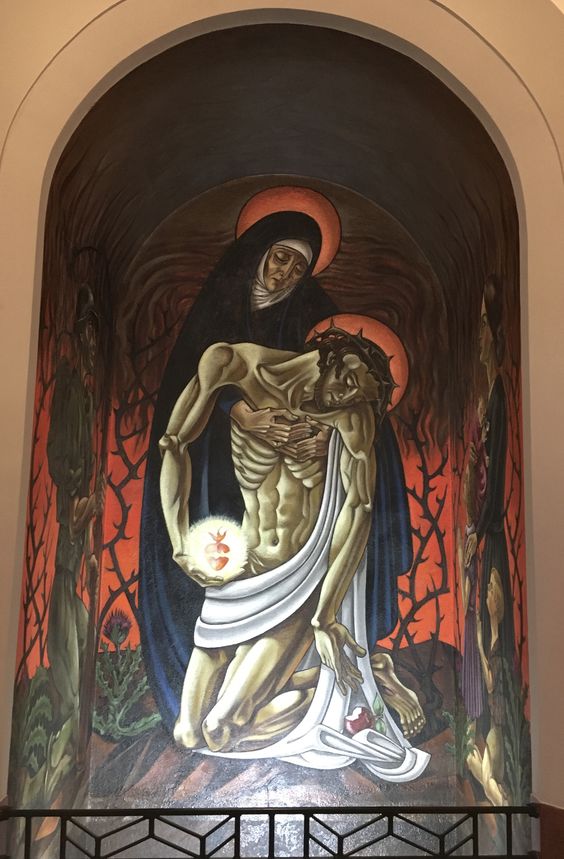
The painting at Sacred Heart that I’m most intrigued by is the Pietà in the narthex, which shows Mary holding her dead son. Genesis 3 is invoked by the thorns that not only crown Christ’s brow but that rise up all around him, symbolic of the curse. What’s more, a half-bitten apple rolls from his limp hand; he, like his forefather, Adam, has tasted death. And this he did willingly out of love, signified by the fiery, thorn-enwrapped heart of his that he holds in his right hand, whose glow illuminates the darkness.
Dom Gregory de Wit, OSB, Pietà, 1940–42. Narthex, Sacred Heart Catholic Church, Baton Rouge, Louisiana.
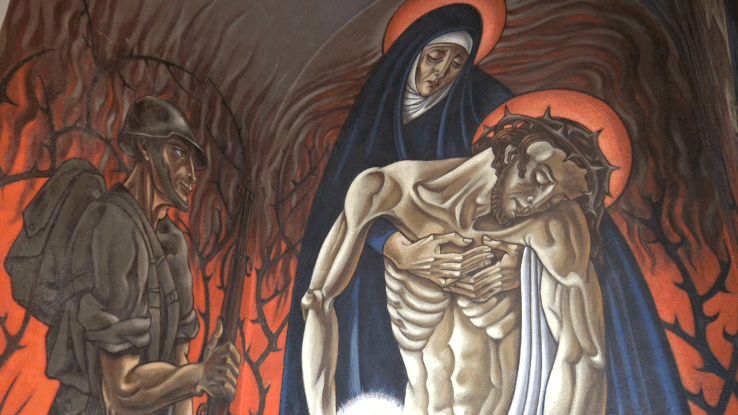
Because de Wit painted this image during the war, it is contextualized with a soldier on one side and the soldier’s wife and three children on the other, praying for his safe return. Why do they belong in this scene? Some wartime artists drew parallels between Christ and the soldiers’ sacrificial laying down of their lives (cf. John 15:13). I’m uneasy with this comparison for several reasons, not least of which is my Christian pacifism. But de Wit’s painting seems, rather, to use the soldier and his family as a representation of war and to suggest that Jesus, the Suffering Servant, is with us in our present suffering. He entered our world, after all, and died to redeem us from its evils—sin and death and all their extensions. The presence of Mary, Our Lady of Sorrows, must have been a comfort to the mothers at Sacred Heart whose sons were overseas fighting.
Moreover, even though its hieratic style may be off-putting to some, I also really like the crucifix de Wit created for Sacred Heart (but which is now at St. Paul the Apostle Catholic Church, also in Baton Rouge). The corpus is painted on solid mahogany, with real nails driven through the hands. Continue reading “The Art of Dom Gregory de Wit”→
It’s great to see how many gatherings are happening this spring around faith and the arts. I wish I could attend them all, but travel costs require me to be selective. I’m happy to say that I’ll be at the contemporary art symposium in Amsterdam in March (and taking a few side trips while I’m there) and the Anselm Society conference, “Your Imagination Redeemed,” in April, which convenes in the beautiful foothills of the Rocky Mountains in Colorado. If you’ll be at either, let me know so that I can be sure to meet you!
(This post has been updated to reflect new information.)
Calvin Symposium on Worship Date: January 24–26, 2019 Location: Calvin College, Grand Rapids, Michigan Cost: $270 (general; single-day options available); $30 (students) Organizers:Calvin Institute of Christian Worship and the Center for Excellence in Preaching Presenters:A very long list! Description: “The conference brings together a wide audience of artists, musicians, pastors, scholars, students, worship leaders and planners, and other interested worshipers. People come from around the world for a time of fellowship, worship, and learning together, seeking to develop their gifts, encourage each other and renew their commitment to the full ministry of the church.” There are tons of seminars and workshops to choose from, on topics such as congregational songwriting, multilingual singing for English-speaking congregations, skills and drills for the emerging worship leader, technology in worship, worship in times of crisis and trauma, engaging our bodies in worship, the visual arts in worship, using the Psalms in worship, music as exegetical art, the art and science of repetition in worship, and much more. One of the plenary sessions is on “The Many Streams of African American Congregational Song.”
Note: Although online registration has closed, walk-up registration is available. Also, the worship services and plenary sessions will be live-streamed for free (see times).
+++
“Worship, Theology, and the Arts in a Divided World” Date: February 9, 2019 Location: Fuller Theological Seminary, Pasadena, California Cost: $75 (general); $25 (student) – or, live-stream for free! (registration still required) [update: videos: Morning Session; Afternoon Session] Organizer:Brehm Center Presenters: David M. Bailey, Makoto Fujimura, W. David O. Taylor, Kutter Callaway, Lauralee Farrer, Todd E. Johnson, Robert K. Johnston, Roberta R. King, Shannon Sigler, Edwin M. Wilmington Description: “To say that we live in a divided world is to state the obvious. Less obvious, perhaps, is to believe that worship might become a vehicle for reconciliation, or that theology might serve as an invaluable aid to mend our personal and social brokenness, or that the arts might forge unity across the divides—whether political or economic, racial or relational, linguistic or cultural, whether in the academy or in the public square, whether inside the church or outside of it. But that is exactly what this conference wishes to suggest.
“A primary goal of this conference is to show how worship, theology, and the arts can become sources of good news to our divided world as well as resources to make tangible that good news by God’s grace. A secondary goal is to generate practical helps that extend beyond the immediate context of the conference in order to serve the broader community. This involves not just the presentations themselves, but online resource offerings: for instance, a one-page resource for small groups on art and racial reconciliation; a Spotify playlist for both pastors and worship leaders; a ‘top 10’ list of most common mistakes in multicultural worship; an annotated resource on global worship; a handout for church leaders on art in a post-Christian society; and more.”
+++
Salvador Dalí (Spanish, 1904–1989), The Ascension of Christ, 1958. Oil on canvas, 115 × 123 cm (45¼ × 48⅜ in.). Pérez Simón Collection, Mexico.
“Modernist Prodigals: Aesthetic Aftermaths of Religious Conversion” (panel discussion) Date: February 13, 2019 Location: New York Hilton Midtown, Manhattan Cost: This is one of the 300+ sessions available to registrants of the College Art Association’s Annual Conference. (Registration starts at $185 and is restricted to CAA members.) Organizer: Anne Greeley Panelists: Linda Stratford, Emily Worjun Wing, Zoë Marie-Jones, Elliott H. King, Douglas R. Giebel Description: “Over the past two decades, the long-presumed secularity of modern art has been called increasingly into question. Numerous scholars, from Sally Promey, to Jonathan Anderson and William Dyrness, to Thomas Crow, have challenged the secularization theory promulgated by art historians during the latter half of the twentieth century. Though the academy no longer finds it ‘inadmissible,’ as Rosalind Krauss once did, to connect the spiritual with the avant-garde, and while many religious impulses can be discerned throughout the field of modern art, it is nevertheless the case that many modern artists rejected religion outright—though some only temporarily.
“This panel aims to build on the discussion initiated by Jeffrey Abt in his 2014 panel on ‘Religion and the Avant-Garde.’ It seeks to further clarify modern art’s relationship to religion by examining the lives and work of certain ‘modernist prodigals,’ who during a period of religious apathy or disbelief made significant contributions to modernism before turning, or returning, to organized religion. If art can be said to constitute a mode of thought, and if thought is radically altered through religious conversion, then what might a study of the works of such artists, ‘pre-’ and ‘post-’conversion, reveal about the perceived compatibility of modern art (or of certain iterations or aspects thereof) with a religious worldview? Alternatively, what might it reveal about an artist’s faith?”
+++
“Art Matters” Date: February 16, 2019 Location: Leith School of Art, Edinburgh, Scotland Cost: ₤25 Organizer: Morphē Arts Description: “A day symposium on art, faith and social responsibility. We will discuss the importance of the creative arts in the formation and care of culture from the perspective of Christian belief. The morning will be a series of short talks from artists, musicians, writers, designers, theologians and art philosophers on why the arts matter at this time. An afternoon symposium will lead into a drawing workshop (TBC) followed by an evening music event.”
+++
“The Breath and the Clay” Date: March 22–24, 2019 Location: Awake Church, Winston-Salem, North Carolina Cost: from $150 Organizer: The Breath and the Clay Presenters: Stephen Roach, Josh Garrels, Emily P. Freeman, Amena Brown, CJ Casciotta, Marie Teilhard, Molly Kate Skaggs, Kelly Archer, and others Description: “The Breath & the Clay is a creative arts gathering exploring the intersections of art, faith & culture. The weekend event features keynote speakers, performances, workshops and our curated Art Gallery juried by Ned Bustard of CIVA.” To learn more about the Breath and the Clay movement, check out its official podcast, Makers & Mystics.
+++
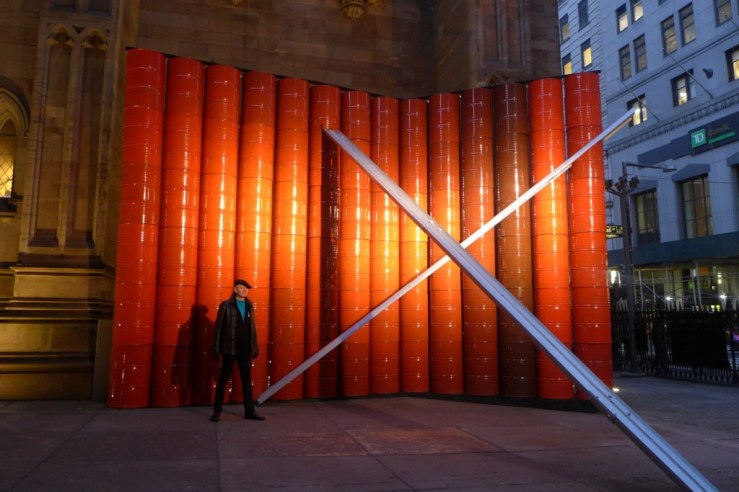
G. Roland Biermann (British, 1962–), Stations, 2018. 84 oil barrels on steel platform, 20 meters of guard rails. South churchyard, Trinity Wall Street, New York. Biermann participated in last year’s “Art Stations” and will be creating another site-specific installation for this year’s at Corvershof in Amsterdam.
“I Believe in Contemporary Art” Date: March 23, 2019 Location: Doopsgezinde Singelkerk, Amsterdam Cost: TBA Organizer:ArtWay Presenters: Adrienne Dengerink Chaplin, Alastair Gordon, and others (TBA) Description: This day-long symposium with workshops is tied to the Art Stations of the Cross exhibition in Amsterdam, which will run from Ash Wednesday through Holy Saturday (March 6–April 20). As with previous iterations of this project in London, Washington, DC, and New York, the art—this time selected by Marleen Hengelaar-Rookmaaker and Aniko Ouweneel-Tóth—is dispersed in locations throughout the city, and a free digital audio guide will be provided. More details to come.
+++
“Sacrament & Story: Recasting Worship Through the Arts” Date: April 5, 2019 Location: Resonance at SOMA Towers, Bellevue, Washington Cost: $80 Organizer:Brehm Cascadia Presenters: Tamisha Tyler, Stephen Newby, Jeffrey Overstreet, Shannon Sigler, and more Description: “How do artists experience the world? How do creative hearts respond to the Story of God? . . . We believe that artists have a unique capacity to recast God’s Story in ways that are experiential, accessible, and enlivening. The arts can create spaces for worship that encompass a broader understanding of the nature of the Triune God—with room for joy, lament, fear, delight, and mystery. Will you join us as we explore how the arts can help us reimagine and more fully engage God’s Story in our worship and in the world?”
+++
“Majesty: An Art & Faith Incubator” Date: April 18–21, 2019 Location: Nelson, New Zealand Cost: $360 (includes all workshops and materials) Organizer:ATELIER Studio|Gallery Description: “A new resurgence of creativity in the kingdom of God is underway – a Renaissance, if you will, highlighting again the importance and significance of the arts in the body of Christ and to the world. Many artists with a living faith in Jesus Christ have existed only on the periphery, many are isolated, and many are underground. Still, yet, there are many in art schools and in the marketplace, and there are also many rising in their God-given identities returning to the purpose of creative expression.
“The definition of what it means to be creative and a follower of Jesus is far broader than what we might encounter during a Sunday service, it is far more powerful than what the term ‘Christian art’ could ever signify, and far more necessary than what many forms of Christian expression would give credence to. . . .
“MAJESTY calls artists of faith together, to engage in a greater devotion to the One, to release a greater purpose through their making, and to reveal a greater promise – the heart of God. . . . [At this gathering,] visual art-making workshops, times of worship, new ideas and discussion, prophetic input, and plenty of ‘making time’ all flow together to release a new fire in the creative soul.”
+++
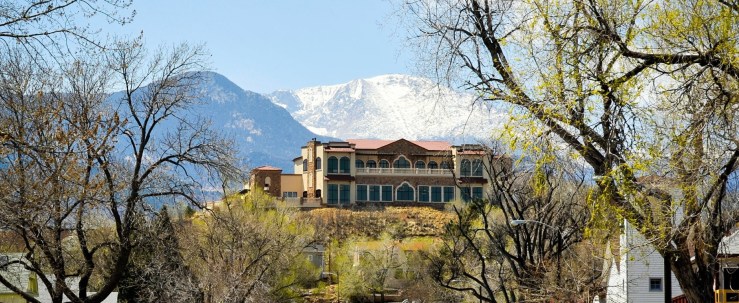
“Your Imagination Redeemed” Date: April 26–27, 2019 Location: The Pinery at the Hill, Colorado Springs, Colorado Cost: $225 Organizer:Anselm Society Presenters: Hans Boersma, John Skillen, Junius Johnson Description: “For nearly two thousand years, the church held that the good, the true, and the beautiful were inseparable. But somewhere along the line, they got fragmented. And the result has been a disenchanted Christianity; a slew of inadequate books, music, and movies; and generations of Christians missing out on the redeemed imagination. The disenchanted, the lost, and the Church itself need a renaissance of the Christian imagination. . . . We will explore the redeemed imagination, meet the sacred on its own terms, and carry its light back into our lives, creative arts, and congregations.”
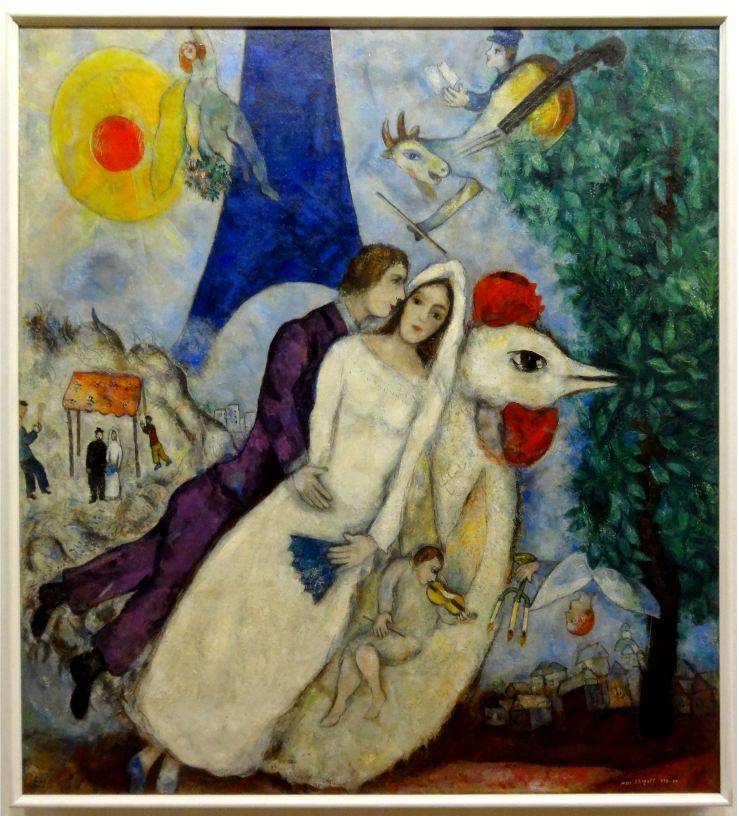
Marc Chagall (Russian French, 1887–1985), Les mariés de la tour Eiffel (The Bride and Groom of the Eiffel Tower), 1938–39. Oil on canvas, 150 × 136.5 cm. Centre Pompidou, Paris. Photo: Jim Forest.
Regarding Zion, I can’t keep my mouth shut,
regarding Jerusalem, I can’t hold my tongue,
Until her righteousness blazes down like the sun
and her salvation flames up like a torch.
Foreign countries will see your righteousness,
and world leaders your glory.
You’ll get a brand-new name
straight from the mouth of GOD.
You’ll be a stunning crown in the palm of GOD’s hand,
a jeweled gold cup held high in the hand of your GOD.
No more will anyone call you Rejected,
and your country will no more be called Ruined.
You’ll be called Hephzibah (My Delight),
and your land Beulah (Married),
Because GOD delights in you
and your land will be like a wedding celebration.
For as a young man marries his virgin bride,
so your builder marries you,
And as a bridegroom is happy in his bride,
so your GOD is happy with you.
The lyrics of “Fairland” are adapted from the poem “The Little Beach-Bird” by Richard Henry Dana (1787–1879), with the bridge referencing Jesus’s words to his disciples in John 14:1–3: “Let not your hearts be troubled. Believe in God; believe also in me. In my Father’s house are many rooms. If it were not so, would I have told you that I go to prepare a place for you? And if I go and prepare a place for you, I will come again and will take you to myself, that where I am you may be also.” These are the words of a bridegroom to his bride.
Thou little bird, thou dweller by the sea,
Why takest thou so melancholy,
And with that boding cry
Along the breaker fly?
O rather, bird, with me
Through the fair land rejoice!
Come and go with me
Back to my Father’s house
To my Father’s house
Come and go with me
+++
It is not difficult to see, . . . in his dreamlike images of adorned and beautiful Jewish brides, Chagall’s aspiration for the redeemed daughter of Zion.
This post belongs to the weekly series Artful Devotion. If you can’t view the music player in your email or RSS reader, try opening the post in your browser.
To view all the Revised Common Lectionary scripture readings for the Second Sunday after Epiphany, cycle C, click here.
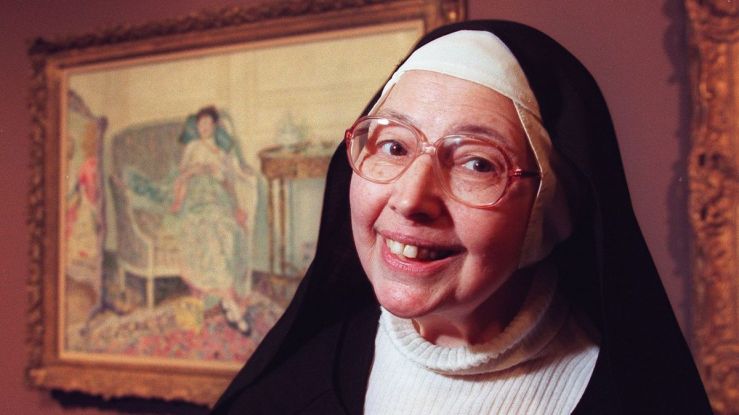
OBITUARY:“Sister Wendy Beckett, Nun Who Became a BBC Star, Dies at 88”: A nun since the age of sixteen, Sister Wendy spent most of her life living in silence in a windowless trailer on the grounds of the Carmelite monastery in East Anglia, England. She read voraciously about art but had never set foot in a museum or seen any great paintings in person—until in 1991, a BBC producer persuaded her to do a documentary about the paintings in London’s National Gallery. She agreed, thinking it would be a flash in the pan, but it was very successful, and so throughout the nineties she presented several other documentaries on the history of art, including Sister Wendy’s Odyssey, Sister Wendy’s Grand Tour, and Sister Wendy’s Story of Painting. She quickly became the world’s best-loved art critic, as her unscripted commentaries, so full of wonder and enthusiasm, connected well with the general public, making high art accessible. She also authored some thirty-five books.
“One of the ways, for me, of looking at God is by looking at art,” she says in the intro to Odyssey. Not that art is God but that art can lead us to a deeper understanding of who, and Whose, we are.
Sister Wendy was a major influence on my path to becoming a writer on Christianity and the arts. I first encountered her in high school through her Story of Painting series, which a studio art teacher made our class watch excerpts from. This was my entrée into art history, a subject that captivated me then and that inspired me to pursue some such coursework in college, including a semester abroad in Florence, Italy. Without this initial incitement of interest from Sister Wendy, I doubt I would be writing about art today.
What attracts me to her is what attracts most people: her utter joy and rapture as she discusses art. She is the first person who taught me how to look at a painting and read it. I appreciate her charitable stance toward modern and contemporary art (movements that large swaths of Christians reject), and her unabashed delight in the nude body. Over the years, people have tended to be either amused or shocked, or both, by her frankness in talking about sexuality in art, but she was always insistent on the goodness of the human body and of sex. When Bill Moyers asked her back in 2000 whether she’s scandalized by the carnality, the sensuality, of so much art, she really stumps him with her matter-of-fact response! (See 4:15 of the video below.)
+++
INTERVIEW: “Why You Should Read Devotional Poetry in 2019” by Leland Ryken: In this interview with Collin Huber, Ryken cites three reasons why Christians should read devotional poetry, elaborating on each one: (1) devotional poets express our spiritual experiences, (2) it sets our affections “in right tune,” and (3) it will take us to corners of the spiritual life that might otherwise remain unvisited. He also discusses how poetry has shaped him; the obstacles that keep people from enjoying poetry, and how to overcome them; what makes poetry distinctive as a genre; and the prevalence of poetry in the Bible. “Mastering a devotional poem by a famous English or American poet requires nothing beyond what mastering a psalm requires,” he says. “If you can possess Psalm 23, you can possess Milton’s sonnet on his blindness.”
STREET PERFORMANCE: Toccata and Fugue in D minor (BWV 565) by J. S. Bach: Bach’s Toccata and Fugue is probably the most famous organ work in existence. But last fall in Cologne, a group of four musicians, whose names I cannot find, performed it on two accordions, a violin, and a tuba! It’s uncanny how closely the collective timbre approximates that of an organ. The tuba grants sonority, and the other instruments contribute to the full-bodied sound.
This performance took place between Hohe Straße and Theo-Burauen-Platz in Cologne, Germany, but a few commenters on the video have reported witnessing near-identical performances in other parts of the country, so either this group travels, or the arrangement is circulating.
+++
SACRED ARCHITECTURE
I frequently encounter articles on or photos of contemporary religious architecture. Here are just two notable buildings I’ve come across recently—the first one, thanks to Michael Wright’s Still Lifenewsletter (to which you should subscribe!).
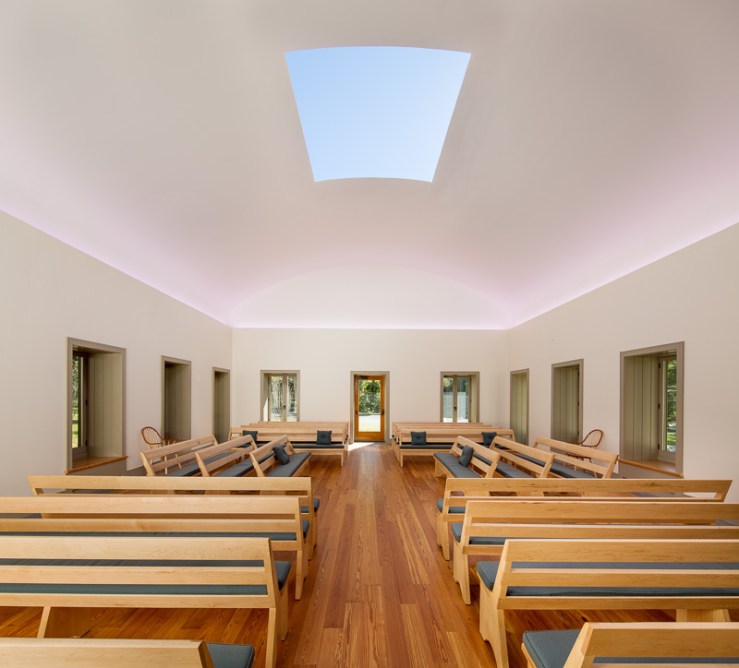
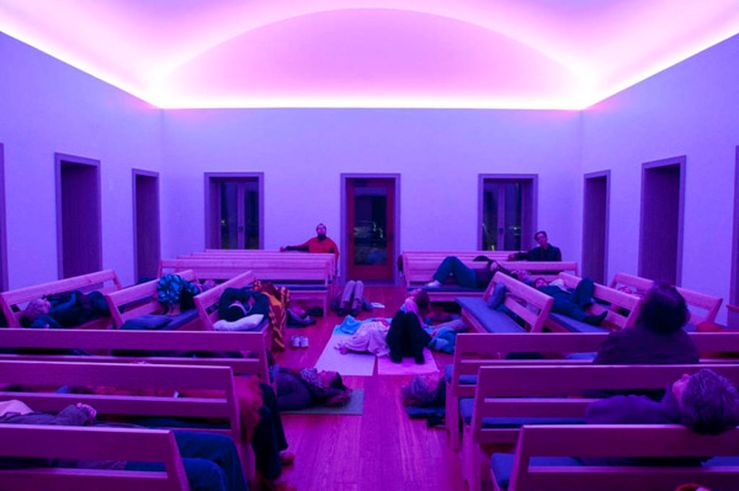
Chestnut Hill Friends Meeting (2013): When the Chestnut Hill Friends Meeting in northwest Philadelphia was building a new meetinghouse, they invited contemporary light artist James Turrell, himself a Quaker, to design one of his famous “Skyspaces” for the meeting room—that is, an aperture in the ceiling that’s open to the sky. From the beginning, Turrell collaborated with architect James Bradberry to achieve this permanent art installation; for example, Turrell wanted the aperture to have no perceptible thickness, so Bradberry and his team developed a sophisticated steel roof structure and “knife’s edge” opening. The achieved effect of paper thinness is impressive: when I first saw photos, I assumed the “sky” on the ceiling was just a painted patch! (Visitors have reported similar surprise.) Turrell calls this Skyspace Greet the Light, a reference not only to the light of the sun but to the Quaker doctrine of the “Inner Light,” God within.
Chestnut Hill Friends Meeting Room, Philadelphia, Pennsylvania, featuring a permanent Skyspace installation, titled Greet the Light (2013), by James Turrell.
The meeting room is open to the public, for free, on select days (more info here). Visitors are invited to bring a yoga mat, pillow, and blankets (when the retractable roof is open, the room is unheated) and to lie on their backs on the floor or benches. Silence is requested. Turrell’s installation also makes use of artificial light: over the course of fifty minutes or so, the vaulted ceiling is bathed in turn in four color variations—green, red, blue, and white—which augments the natural light projected by the opening.
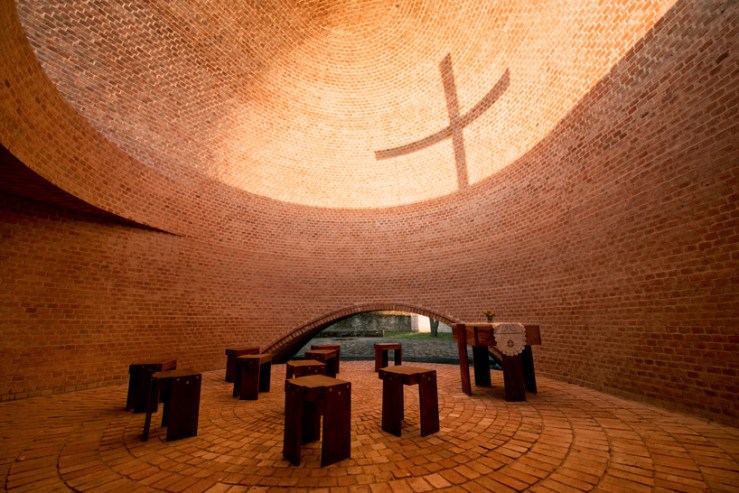
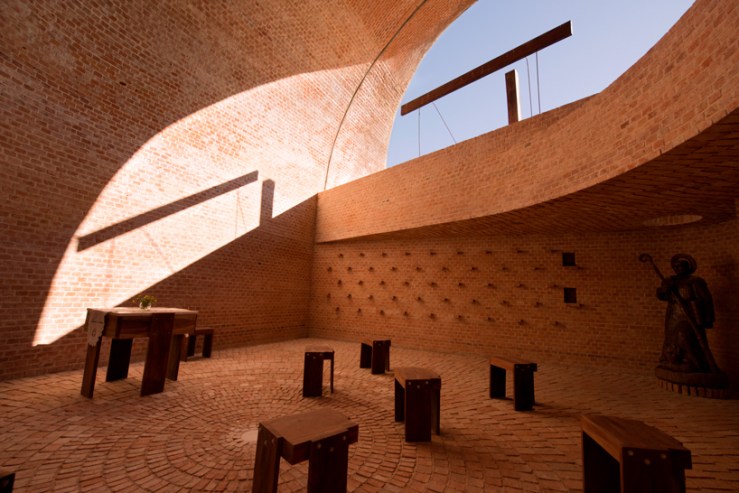
San Bernardo Chapel (2015): Located in a wooded grove in Argentina’s Pampas lowlands, just east of Córdoba, Capilla San Bernardo (St. Bernard Chapel) was designed by Nicolás Campodonico. It was constructed using hundred-year-old bricks that had been dismantled from the rural home and courtyard that previously stood on the site. There is no electricity in the area, so natural light plays a huge role, especially in the chapel’s most unique feature: two perpendicular beams, independently suspended from a large exterior opening, cast shadows onto an interior wall, which glide progressively toward each other throughout the day, ultimately overlapping to form a cross (see time lapse). Campodonico said he had in mind Jesus’s journey to Golgotha with the transverse beam, which, upon arrival at the execution site, was attached to the vertical mount; it’s as if the passion is being reenacted daily through the shadows, he said. See more photos at designboom.
Capilla San Bernardo (St. Bernard Chapel), La Playosa, Córdoba Province, Argentina. Photo: Nicolás Campodonico.
+++
FREE ALBUM: Into the Light by Joel LeMaire: Fans of Josh Garrels, Iron and Wine, and John Mark Pantana will probably enjoy Joel LeMaire’s 2015 EP, which is about finding hope in the letting go and stepping into the unknown. Download your own copy from NoiseTrade, and read more about the meaning behind the songs on LeMaire’s blog.
Baptism of Christ, from the evangeliary of the abbess Hitda von Meschede, first half of eleventh century. Hessische Landesbibliothek, Darmstadt, Germany.
As the people were in expectation, and all were questioning in their hearts concerning John, whether he might be the Christ, John answered them all, saying, “I baptize you with water, but he who is mightier than I is coming, the strap of whose sandals I am not worthy to untie. He will baptize you with the Holy Spirit and fire. His winnowing fork is in his hand, to clear his threshing floor and to gather the wheat into his barn, but the chaff he will burn with unquenchable fire.” . . .
Now when all the people were baptized, and when Jesus also had been baptized and was praying, the heavens were opened, and the Holy Spirit descended on him in bodily form, like a dove; and a voice came from heaven, “You are my beloved Son; with you I am well pleased.”
—Luke 3:15–17, 21–22
+++
MUSIC: “Jeux d’eau” (“Play of Water” or “Fountains”) by Maurice Ravel, 1901 | Performed by Martha Argerich, 1977
+++
The Hitda Codex is an eleventh-century manuscript containing an evangeliary, a selection of passages from the Gospels, commissioned by Hitda, abbess of Meschede, in about 1020. Its illuminations are highlights of the Cologne school in the later phases of the Ottonian Renaissance. View more at https://commons.wikimedia.org/wiki/Category:Hitda-Codex.
In the Baptism of Christ painting, Jesus stands waist-deep in Jordan’s rushing waters, which spill forth from an overturned jar in the bottom right held by a personification of the Jordan River. Jesus’s hands are open to receive the Holy Spirit (Spiritus Sanctus), who jets forth from the starry heavens in the form of a dove. God the Father is, by intention, not visualized, but his presence is suggested by the half-circle at the top, which represents the divine realm where he resides.
This post belongs to the weekly series Artful Devotion. If you can’t view the music player in your email or RSS reader, try opening the post in your browser.
To view all the Revised Common Lectionary scripture readings for the feast of the Baptism of the Lord, cycle C, click here.
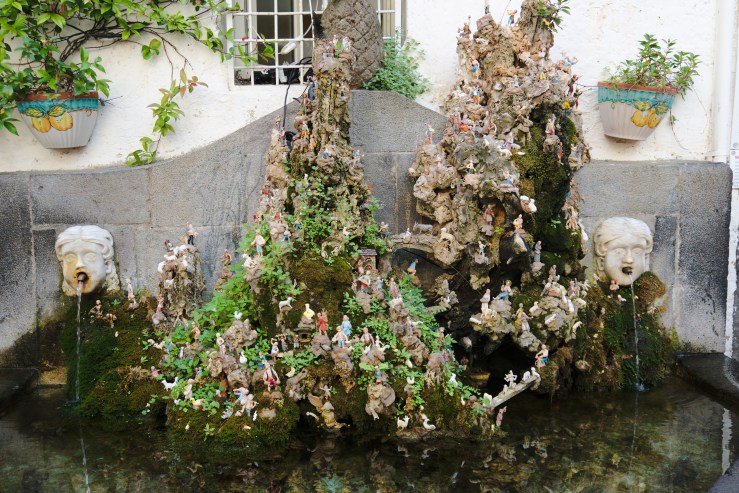
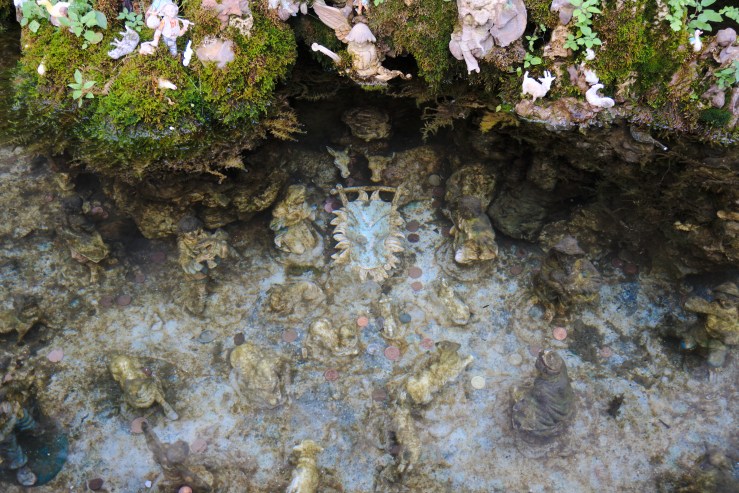
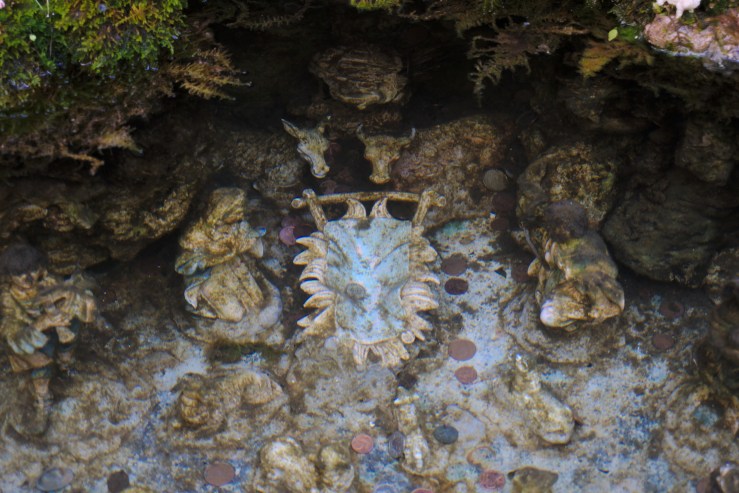
When Eric and I were in Amalfi on the southern coast of Italy last August, we chanced upon a charming little fountain just off the town’s main street in Piazza dello Spirito Santo. Built during the eighteenth century in stone, with two marble faces that spout water, it is known, in local dialect, as the Fontana de Cape ’e Ciucci (Donkey’s Head Fountain), since the donkeys arriving with heavy loads from the nearby mountain village of Pogerola would stop here for water.
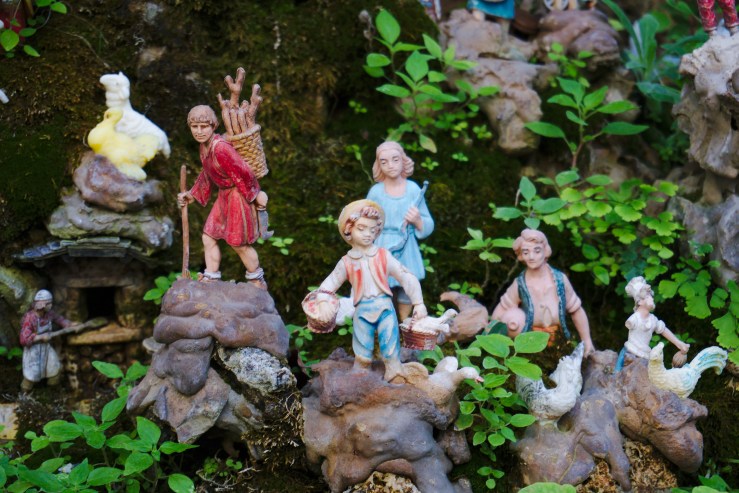
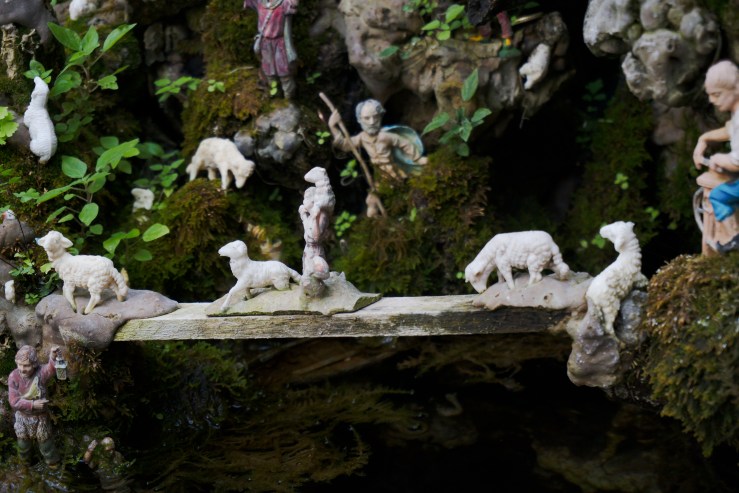
What makes the fountain unique, though, is the elaborate presepe (nativity scene) sited inside, an addition made in 1974 by Giuseppe Buonocore, Vincenzo Livano, and Nicola Pepe, who placed various small figurines on and around the rocky outcrop. Over the years, several of these figurines have become submerged by the flowing water. But a local family, the Infantes, takes care of maintaining the presepe, keeping it in decent condition.
Handmade presepi are a living tradition in and around Naples, and they are notable for their blending of the sacred and profane: biblical figures like the Holy Family, the shepherds, and the magi are set alongside vignettes of Neapolitan life in the eighteenth century (when the making of presepi was at its peak). Shoemakers and innkeepers, bakers and pizzaioli (pizza makers), fishmongers and butchers, carpenters and blacksmiths, bricklayers and fruit vendors and tailors—just ordinary people going about their everyday lives, with Jesus right in their midst (though in this case, it appears that he is missing from the manger! perhaps he is added at Christmas?). And in addition to the traditional ox and ass, there are geese, rabbits, ducks, chickens, and other native animal life present.
Photos by Victoria Emily Jones/ArtandTheology.org.
Christmas isn’t over yet, so I hope you’re still celebrating! As has been the case for centuries, many Christians spread their holiday festivities over twelve days, from December 25 to January 5, followed by the culminating feast of the Epiphany on January 6. Epiphany commemorates the visit of the magi to the Christ child and thus God’s physical manifestation to the Gentiles. In Spanish-speaking countries and communities, it’s commonly known as Three Kings Day. This year it just so happens to fall on a Sunday.
+++
Juan Cartagena, Los Tres Reyes Magos (The Three Kings), Puerto Rico, 19th century. Painted wooden bulto. Vidal Collection, National Museum of American History, Smithsonian Institution, Washington, DC.
Now after Jesus was born in Bethlehem of Judea in the days of Herod the king, behold, wise men from the east came to Jerusalem, saying, “Where is he who has been born king of the Jews? For we saw his star when it rose and have come to worship him.” . . .
After listening to the king, they went on their way. And behold, the star that they had seen when it rose went before them until it came to rest over the place where the child was. When they saw the star, they rejoiced exceedingly with great joy. And going into the house, they saw the child with Mary his mother, and they fell down and worshiped him. Then, opening their treasures, they offered him gifts, gold and frankincense and myrrh.
Los Jíbaros, also known as the Cuarteto Flores, were a popular and influential Puerto Rican group founded in New York in 1930 by Pedro Flores. Their name refers to the peasant farmers of Puerto Rico, who developed a style of mountain music, jibaro music, that’s rooted in music brought to the island by early settlers from Andalusia and Extremadura in southern and western Spain during the seventeenth century.
The jibaro song “Décimas de Nacimiento” is an aguinaldo (Christmas carol; literally “gift”) that comprises four décimas (ten-line stanzas) performed in dialogue. In this traditional poetic form, each line contains eight syllables and follows a rhyme scheme of ABBAABBAAB—but here the poet has adapted the scheme to ABBAACCDDC. The two singers perform to an accompaniment of three guitars and a guiro (scratch gourd).
En un pesebre nacio
A eso de la medianoche
Un niño que sin reproche
Clamaron hijo de Dios
Una estrella iluminó
El sitio donde María
Tenía en brazos al Mesías
Que acaba de nacer
Al que empezaban a ver
Al amanecer del día
Los tres magos soberanos De los reinos del Oriente Vinieron muy diligentes A ofrendar su Dios cristiano Y todo el mundo pagano Recuerda las profecías Pues sabian que nacería Pronto el hijo de Israel Y que lo iban a ver Al amanecer del día
Todas las aves cantaban Olian todas las flores Bonita luz y colores Las astros del cielo daban Los buenos sabios oraban Los réprobos se escondian En las pajas ya había Nacido el niño sonriente Se postró un mundo creyente Al amanecer del día
Y a través de las edades Recordando al soberano El universo cristiano Celebra las navidades Dice así, felicidades El humano se extasía Y aún pedimos al Mesías Hijo de María y José Que algo de su gracia nos dé Al amenecer del día
He was born in a manger
About midnight
An innocent child
Proclaimed the Son of God
A star shone upon
The place where Mary
Held our Savior in her arms
Who had just been born
They beheld him
At daybreak
The three wise men
From the Orient
Promptly came
To offer gifts to the Son of God
And all the pagan world
Remembered the prophecies
That foretold the birth
Of the Son of Israel
And they came to see him
At daybreak
All the birds were singing
All the flowers were perfumed
Stars in the sky were shedding
Beautiful light and colors
The wise men were praying
The scoundrels were hiding
Already, in the straw
The smiling child had been born
Everyone fell to their knees
At daybreak
Throughout the ages
In memory of our Sovereign
The Christian universe
Celebrates his birth
With good wishes
Humanity is ecstatic
And we still pray for the Messiah
Son of Mary and Joseph
To shed his grace upon us
At daybreak
This is one of many songs that might be heard at a parranda, a Puerto Rican caroling party that moves from house to house, lasting from around 10 p.m. to dawn on any given night of Christmas. The repertoire is a mix of sacred and secular songs, but unlike in the continental US, they are all festive and upbeat. As the carolers progress to each new stop, the head of that house invites them in for food and beverages. Parrandas are one of the leading social activities of the Christmas season on the island.
“Décimas de Nacimiento” was originally released by Columbia Records on vinyl in the 1930s. In 2004 it was reissued by Dust-to-Digital on a compilation Christmas album produced by folk music preservationist Lance Ledbetter and musicologist Dick Spottswood; there it appears alongside other rare recordings of American gospel, blues, and hillbilly music from the twenties and thirties.
Celebrated annually on January 6, El Día de los Tres Reyes Magos, or simply Three Kings Day, is one of the most important holidays on the Puerto Rican calendar—so much so that Puerto Ricans invented a verb, reyar, that means “to celebrate Three Kings Day.” On the eve of the holiday, children put a shoebox filled with straw under their beds for the animal transports, be they camels or horses, of the Three Kings, who visit their homes with presents between midnight and dawn. Children awake not only to gifts but also to a day of parades and feasting with family and friends. Old San Juan throws an annual festival at the Luis Muñoz Marín Park with live music, food and drink, and free gifts, but the highlight of the day occurs when the Three Kings come walking into town. They start from their unofficial hometown of Juana Díaz in the south and travel around the island, stopping to celebrate in various localities—but no celebration is larger than that in Old San Juan.
Los Tres Reyes Magos (The Three Kings), Puerto Rico, late 19th century. Painted wooden bulto by a member of the Rivera family. Vidal Collection, National Museum of American History, Smithsonian Institution, Washington, DC.
Not surprisingly, the Three Kings are among the most popular santos (handmade images of saints and other religious figures) in Puerto Rico. Since camels were unknown to earlier local santeros (makers of religious images), the Three Kings are typically shown riding Paso Fino horses. The gifts they bear may be the three traditional ones—gold, frankincense, and myrrh—or typical Puerto Rican gifts, such as musical instruments. In Puerto Rico, Melchior is shown with dark skin, and he is often given special prominence, especially by santeros of African descent.
The two bultos (small religious carvings) pictured above were gifted to the Smithsonian, along with 3,200-plus other objects, by Puerto Rican folk art collector Teodoro Vidal. Learn more about the Vidal Collection at https://amhistory.si.edu/vidal/. (You may remember me speaking about another bulto donated by Vidal, Señor de la Humildad y la Paciencia, in my Stations of the Cross audio guide.)
This post belongs to the weekly series Artful Devotion. If you can’t view the music player in your email or RSS reader, try opening the post in your browser.
To view all the Revised Common Lectionary scripture readings for Epiphany, cycle C, click here.
Andrey Yanev (Bulgarian, 1965–), Fraternal Forgiveness, n.d. Oil on canvas, 130 × 100 cm.
Put on then, as God’s chosen ones, holy and beloved, compassionate hearts, kindness, humility, meekness, and patience, bearing with one another and, if one has a complaint against another, forgiving each other; as the Lord has forgiven you, so you also must forgive. And above all these put on love, which binds everything together in perfect harmony.
—Colossians 3:12–14
+++
MUSIC: “The Way of Love” by Béla Fleck | Performed by Béla Fleck, V. M. Bhatt, and Jie-Bing Chen, on Tabula Rasā (2011)
Tabula Rasā is a Grammy-nominated collaborative album by three virtuoso instrumentalists: American banjoist Béla Fleck, mohan veena (Indian slide guitar) player Vishwa Mohan Bhatt, and erhu (two-string Chinese fiddle) player Jie-Bing Chen.
This post belongs to the weekly series Artful Devotion. If you can’t view the music player in your email or RSS reader, try opening the post in your browser.
To view all the Revised Common Lectionary scripture readings for the First Sunday after Christmas Day, cycle C, click here.
Salvation is created in the midst of the earth, O God, O our God. Alleluia!
A Russian composer, choral conductor, and teacher, Pavel Tchesnokov (1877–1944) wrote over four hundred sacred choral works up until 1912, when he was forced by the Soviets to focus exclusively on secular compositions; “Salvation Is Created” was his last one. It’s a communion hymn based on a synodal Kievan chant melody and Psalm 74:12: “For God is my King of old, working salvation in the midst of the earth.”
This post belongs to the weekly series Artful Devotion. If you can’t view the music player in your email or RSS reader, try opening the post in your browser.
To view all the Revised Common Lectionary scripture readings for Christmas Day, cycle C, click here.
ALBUM REVIEW: Hebrews by Psallos: My first published article for The Gospel Coalition! Psallos is a music collective led by Cody Curtis, and they’re doing amazing work—adapting entire New Testament epistles for folk rock band and chamber orchestra. (I reviewed the group’s first major album, Romans, two and a half years ago.) The track “Ex Paradiso” interprets John Piper’s favorite Advent text and implements a clever twist on Fauré’s Requiem. You’ll also hear a few other famous musical quotations, including, in track 3, “Angels We Have Heard on High”—again, with a lyrical twist—and a jarring rendition of “Nothing but the Blood.” Curtis is a wonderfully talented and versatile composer, writing in styles from bluegrass and Irish dance to slow hip-hop and hot jazz, all united under one overarching structure. The “Before the Throne” theme that’s developed throughout is truly sublime.
+++
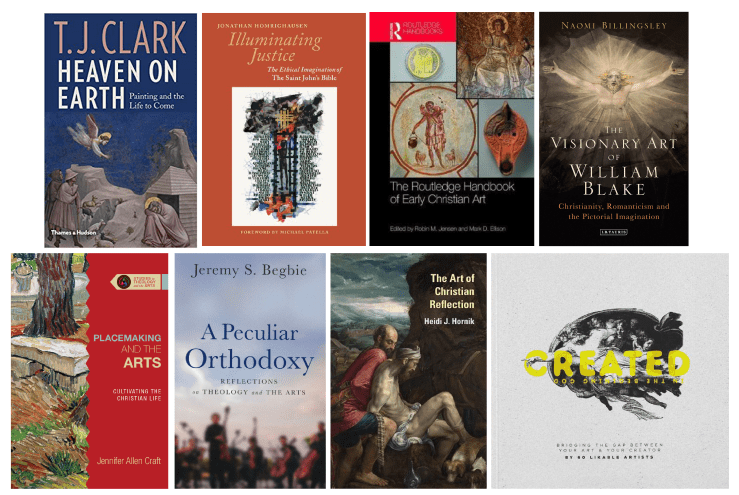
ANNOTATED BOOK LIST: “Art and theology” books published in 2018: I put together this compilation for ArtWay, so the emphasis is on visual art. I’ve already featured a few of the books on the blog, like Wounded in Spirit and The Annunciation: A Pilgrim’s Quest, but there are over a dozen more, a mix of academic and nonacademic. These include, among others, a large reference work on early Christian art; books on individual artists William Blake and Keith New; two books by Jeremy Begbie, which emphasize the need for biblically grounded creedal orthodoxy in discussions on the arts; and two books on the modern illuminated Saint John’s Bible—one of which (Illuminating Justice by Jonathan Homrighausen) was just named among the top twelve theology books of the year by the Englewood Review of Books. Like Homrighausen, art historian Heidi J. Hornik also links art and ethics, in her book The Art of Christian Reflection. Created: Bridging the Gap between Your Art and Your Creator is probably the most unique offering; published by Likable Art design studio, it features sixty-two responses to the question “What are your first five words to the world of artists?,” and edgy graphic designs.
Let me know if I’m missing any titles. For book lists from previous years, see 2014–16 and 2017.
+++
ANIMATED SHORTS
Lost & Found (2018): Widely lauded at film festivals since its debut earlier this year, Lost & Found is an endearing stop-motion film that chronicles a dramatic turning point in the relationship between two crocheted animal toys, a fox and a dinosaur. Since finding each other in the lost-and-found bin of a Japanese restaurant, it was love. But when the fox topples into a fountain, the dinosaur must sacrifice himself, yarn by yarn, to save her. Directed by Andrew Goldsmith and Bradley Slabe.
Bao(2018): This computer-animated short film, written and directed by Domee Shi and produced by Pixar, premiered on June 15 with Incredibles 2. It’s about a lonely, aging Chinese Canadian mother, suffering from empty-nest syndrome, who receives an unexpected second chance at motherhood when she makes a dumpling that comes to life as a boy. “I was that overprotected little dumpling,” Shi said in an interview; this project, she said, was her attempt to try to better understand her mother. One of the strongest powers of film, I’ve always thought, is its ability to incite empathy. (Update, 12/25: It appears that this film was being offered for free online viewing for only a very limited time, as it is now behind a paywall: https://www.youtube.com/watch?v=ypEuSSwB1Rk.)
+++
DAILY ART: 2018 Advent Calendar by the Ashmolean Museum: I know the season’s almost over, but it’s still worth checking out this free online calendar published by the Ashmolean, an art and archaeology museum in Oxford. Each day of December, they’ve been revealing a different winter- or Christmas-themed object from their collection. Entries thus far have included a bronze “reindeer” brooch from second-century Amiens, a decorated star tile from thirteenth-century Iran, a winter kimono with a design of snowy pines, an ivory netsuke in the form of a boy rolling a yuki-daruma (snowman), and a Delftware tile depicting three ships a-sailing. I dig this creative idea for public engagement! I’ve seen art museums do Pinterest boards, but this is the first time I’ve seen an Advent calendar.
Below I’ve reproduced the etching from Day 2, Epiphany, which F. L. Griggs made to celebrate the end of World War I one hundred years ago. A tall memorial crucifix stands atop a triple bridge, towering over roofless homes and illuminated by bright starlight. The Latin inscription translates as “The King of Peace whom the whole world desireth to see, hath shown His greatness. The King of Peace hath shown His greatness above all kings of the whole Earth.” Griggs’s son would die in World War II.
Frederick Landseer Maur Griggs (British, 1876–1938), Epiphany, 1918–19. Etching, 17.3 × 12.5 cm. Ashmolean Museum of Art and Archaeology, Oxford, England.
+++
WALTZING MARBLES: Kinetic artist Mark Robbins of DoodleChaos made a series of Rube Goldberg-like contraptions with blocks and magnets and set a marble rolling along it to Tchaikovsky’s “Waltz of the Flowers” from The Nutcracker, with other marbles later joining the dance. The synchronization is perfect! I got such a kick out of this.