Berndnaut Smilde (Dutch, 1978–), Nimbus II, 2012. Lambda print, 125 × 186 cm. Saatchi Gallery, London.
Then Moses said to Aaron, “Say to the whole congregation of the Israelites, ‘Draw near to the LORD, for he has heard your complaining.’”
And as Aaron spoke to the whole congregation of the Israelites, they looked toward the wilderness, and the glory of the LORD appeared in the cloud.
—Exodus 16:9–10
+++
SONG: “I Cry Out” by a ship at Sea, on Awake, Awake (2012)
+++
This is one of several passages in the Old Testament in which God appears to Israel in a cloud during their desert journey to the Promised Land, signifying both his aboveness and beyondness and his withness. Here he shows up in response to the Israelites’ groans of hunger, showering down quail and manna (see earlier Artful Devotion, “Open Your Mouth”).
Dovetailing with this divine manifestation described in Exodus is Berndnaut Smilde’s photograph Nimbus II, which shows a cloud hovering inside the sixteenth-century Lady Chapel (Mariakapel) in Hoorn, the Netherlands. Smilde created the cloud by misting the area with water vapor and pumping smoke from a machine; the water particles then stuck to the smoke to form a fleeting installation, lasting only about thirty seconds. The photograph plays with the idea of presence and absence: the Lady Chapel has been vacant since 1968, and yet filling the emptiness is this sign of God’s glorious presence. Like us sometimes, the ancient Israelites had trouble seeing God in their wilderness wanderings. But he was overshadowing them in his protective care the whole time. When they truly looked (per Aaron’s instruction), they saw. When they cried out, God answered.
Nimbus II is one of many photographs from Smilde’s Nimbus series, shot in a variety of locations, from museums and factories to castles and dungeons. The title is a play on words, as a nimbus is both a type of cloud and another word for halo, the divine radiance that encircles the head of Christ and the saints in religious art. For more on this series, see “An artist creates miniature clouds in spaces around the world” by Jim Martin or the book Builded Remnants. You can also take a glimpse behind the scenes in this short video, and this one.
This post belongs to the weekly series Artful Devotion. If you can’t view the music player in your email or RSS reader, try opening the post in your browser.
To view all the Revised Common Lectionary scripture readings for Proper 13, cycle B, click here.
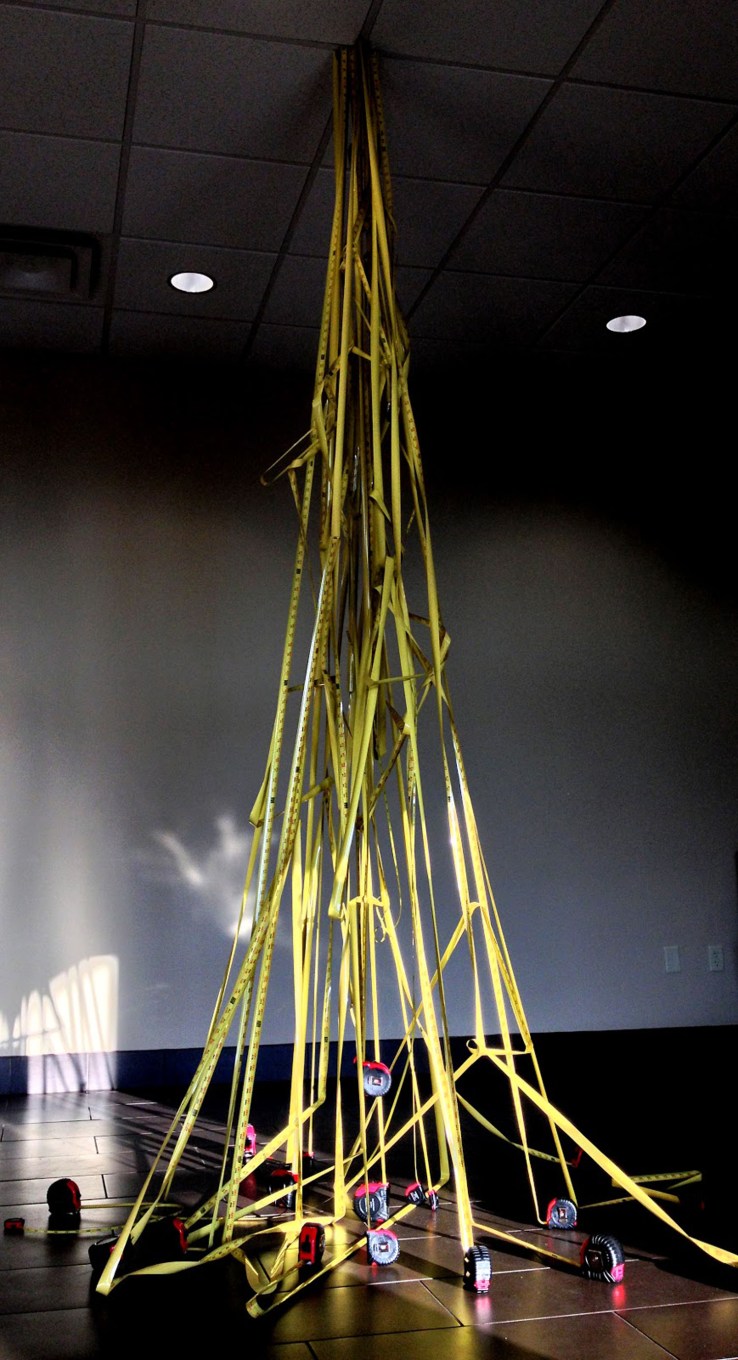
Stephen Watson (American), Breadth, 2013. Tape-measure shards. From the solo exhibition “Slapdash and Sacred” at the Arnold Art Gallery, Shorter University, Rome, Georgia.
I pray that you may have the power to comprehend, with all the saints, what is the breadth and length and height and depth, and to know the love of Christ that surpasses knowledge, so that you may be filled with all the fullness of God.
—Ephesians 3:18–19
+++
SONG: “O the Deep, Deep Love of Jesus” | Words by Samuel Trevor Francis, 1875 | Music by Thomas J. Williams, 1890 (Tune: Ebenezer) | Performed by the John Brown University Cathedral Choir, 1997
O the deep, deep love of Jesus,
Vast, unmeasured, boundless, free,
Rolling as a mighty ocean
In its fullness over me!
Underneath me, all around me,
Is the current of Thy love;
Leading onward, leading homeward
To my glorious rest above.
O the deep, deep love of Jesus—
Spread His praise from shore to shore!
How He loveth, ever loveth,
Changeth never, nevermore!
How He watcheth o’er His loved ones,
Died to call them all His own;
How for them He intercedeth,
Watcheth o’er them from the throne.
O the deep, deep love of Jesus,
Love of ev’ry love the best;
’Tis an ocean vast of blessing,
’Tis a haven sweet of rest.
O the deep, deep love of Jesus,
’Tis a heav’n of heav’ns to me;
And it lifts me up to glory
For it lifts me up to Thee.
+++
SONG: “The Love of God” | Words and music by Frederick M. Lehman, 1917, with third verse by Rabbi Meir ben Isaac Nehorai, ca. 1050 | Performed by Jonathon Strauss Brenner, 2018
The love of God is greater far
Than tongue or pen can ever tell;
It goes beyond the highest star,
And reaches to the lowest hell;
The guilty pair, bowed down with care,
God gave His Son to win;
His erring child He reconciled,
And pardoned from his sin.
O love of God, how rich and pure! How measureless and strong! It shall forevermore endure— The saints’ and angels’ song.
When hoary time shall pass away,
And earthly thrones and kingdoms fall,
When men who here refuse to pray,
On rocks and hills and mountains call,
God’s love so sure, shall still endure,
All measureless and strong;
Redeeming grace to Adam’s race—
The saints’ and angels’ song.
Could we with ink the ocean fill,
And were the skies of parchment made,
Were every stalk on earth a quill,
And every man a scribe by trade;
To write the love of God above
Would drain the ocean dry;
Nor could the scroll contain the whole,
Though stretched from sky to sky.
Frederick M. Lehman, the writer of this hymn, says it was inspired by lines scrawled on the walls of a psychiatric hospital cell (the third stanza), which as it turns out are from an eleventh-century Jewish liturgical poem by Rabbi Meir ben Isaac Nehorai, a cantor (Heb. hazzan) in Worms, Germany. Written in Aramaic, the ninety-line Akdamut (Prologue [to the Ten Commandments]) is chanted in Ashkenazic services on the first day of Shavuot (Pentecost) before the reading of Exodus 19–20, the revelation on Mount Sinai.
The reference to all the seas being ink and all the reeds pens is found also in Christian and Muslim traditions, as well as in earlier midrashic writings. It is unknown who originated the expression—for Jews, its ultimate formulation is the opening of Rabbi Meir’s Akdamut; Christians know it best from the hymn “The Love of God” (though it is also present in medieval Christian literature); and Muslims have it enshrined in the Koran (Surah Al-Kahf 18:109 and Surah Luqman 31:27).
+++
Stephen Watson is a multidisciplinary artist and an assistant professor of art at Samford University in Birmingham, Alabama. Many of his artworks originated as accompaniments to the Sunday services at Trinity Presbyterian Church in Tuscaloosa, Alabama, where they would be temporarily displayed throughout the year in the church foyer. “My art is my contribution to the church body,” says Watson, “and I aim to meaningfully expand the worship experience for the congregation with each artwork I share.” His liturgical installations are fantastic, and I plan to feature more of them in a future post. In the meantime, you can follow Watson on Instagram @stewatson.art.
Inspired by Ephesians 3:18–19, Breadth emphasizes the absurdity of trying to measure God or put limits on his love, a love that, as one of our songwriters puts it, is “vast, unmeasured, boundless, free.” The Breadth installation shown above, consisting of tape-measure shards arranged in a zigzag pattern, is from a gallery setting, but the concept has also been iterated in sacred spaces—for example, as a twisting, tangled mess of tape measures descending from the ceiling like a beam of light, or as a series of looped-tape sunbursts gradually opening from the niches along the north and south walls of a sanctuary.
Stephen Watson (American), Breadth and Length and Height and Depth, 2012. Temporary installation at Trinity Presbyterian Church, Tuscaloosa, Alabama.Stephen Watson (American), Breadth (detail), 2014. Site-specific installation of tape measures, Sojourn Community Church, Louisville, Kentucky.Stephen Watson (American), Breadth (detail), 2014. Site-specific installation of tape measures, Sojourn Community Church, Louisville, Kentucky.
When I was little, my mom and I would try to outdo each other in expressing with the extent of our arm span how vast was our love: “I love you THIS much!” “Well, I love you THIS much!” How much more immeasurably does God, whose arms are infinitely wide, love us.
This post belongs to the weekly series Artful Devotion. If you can’t view the music player in your email or RSS reader, try opening the post in your browser.
To view all the Revised Common Lectionary scripture readings for Proper 12, cycle B, click here.
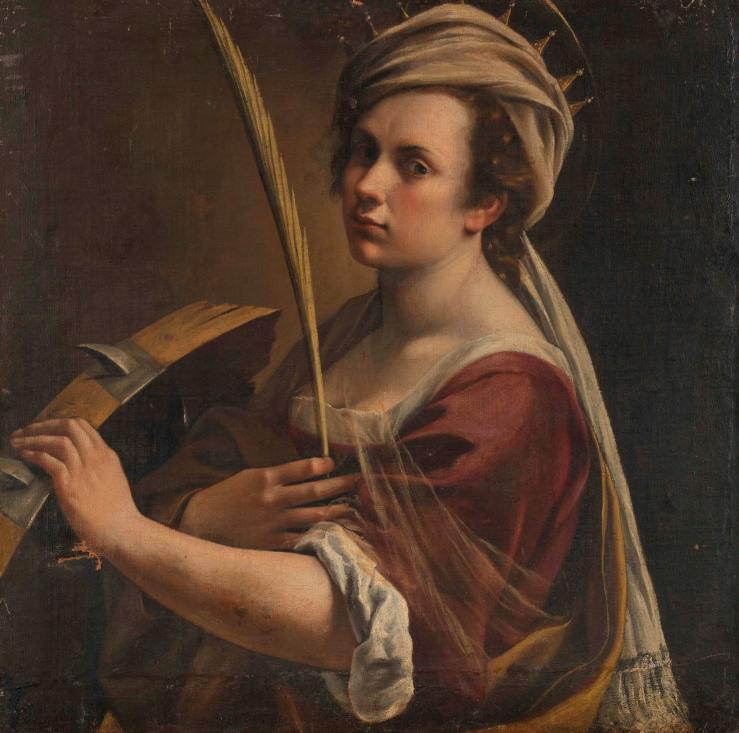
ACQUISITION:Self-Portrait as Saint Catherine of Alexandria by Artemisia Gentileschi, National Gallery, London: This month the National Gallery in London announced its acquisition of a self-portrait by Baroque artist Artemisia Gentileschi posed as the fourth-century Christian martyr Catherine of Alexandria. For centuries it has been in the private collection of a French family, hidden from public view; now it is undergoing restoration and framing before being permanently hung in 2019 alongside other Baroque masters like Caravaggio.
Artemisia Gentileschi (Italian, 1593–1653), Self-Portrait as Saint Catherine of Alexandria, ca. 1615–17. Oil on canvas, 71.1 × 71.1 cm (28 × 28 in.). National Gallery, London.
Gentileschi is best known for her dramatic paintings of strong female heroines, biblical and extrabiblical, and this painting is no exception. In her left hand she holds a spiked wheel, a torture device used on St. Catherine, and in the right she holds a palm branch, symbol of victory through martyrdom. The painting has biographical resonance, as just a few years earlier, when she was eighteen, Gentileschi was raped by one of her father’s artist colleagues, Agostino Tassi. During the highly publicized trial in 1612, she was subjected to a thumbscrew-like torture called the sibille to test the veracity of her testimony. Although Tassi was convicted, his sentence of five years of exile from Rome was not enforced, and he continued painting frescoes for Pope Paul V. To learn more about the challenges and successes Gentileschi faced as a female artist in the seventeenth century, see Jonathan Jones’s recent Guardian article.
+++
ACQUISITION:Rothschild Pentateuch, J. Paul Getty Museum, Los Angeles: “This is the most spectacular medieval Hebrew manuscript that’s come to market in over a century,” says Getty Museum Director Timothy Potts of the Rothschild Pentateuch, a thirteenth-century illuminated manuscript that the museum acquired last month—its first Jewish manuscript, consisting of the books of Genesis, Exodus, Leviticus, Numbers, and Deuteronomy. The extent and vibrancy of the illuminations, which feature fantastical beasts, humanoid figures, temple accoutrements, and foliate designs, set the manuscript apart from other Jewish Bibles, which are typically image-lite. Starting next month, the Rothschild Pentateuch will be featured in a small Getty exhibition, “Art of Three Faiths: A Torah, a Bible, and a Qur’an,” on view from August 7 through February 3, 2019.
Menorah of the Tabernacle (Book of Leviticus) from the Rothschild Pentateuch, France and/or Germany, 1296. Leaf: 27.5 × 21 cm (10 7/8 × 8 1/4 in.). Ms. 116 (2018.43), fol. 226v. J. Paul Getty Museum, Los Angeles.
+++
BLOG SERIES: “Monasticism in Lockdown America” by Chris Hoke, Good Letters: In this nine-part series, prison chaplain Chris Hoke, author of Wanted: A Spiritual Pursuit through Jail, Among Outlaws, and Across Borders (HarperOne, 2015), shares conversations and encounters he’s had with men whose lives are marked by gangs, addiction, violence, and mental illness. He encourages the newly sentenced to use prison as a spiritual retreat center, a monastery, reminding them that “some men choose to live out their days in all-male places wearing the same clothing, eating plain food, growing out their beards, leaving the ‘normal’ world behind, and spending much of their time in rooms called cells, walking deeper into the mystery of God’s heart.” And Hoke walks with them. I am impressed by his ability to reveal the depths of Christian theology in contextually appropriate ways, and to stoke enthusiasm for spiritual practice—praying, reading, fasting. Some of the teachings that have resonated with prisoners are on the darkened mind and the image of God. Revelations abound for both parties.
Icon by Nikolai Tsai
My favorite installments are the lasttwo, on the Psalms, a book that Hoke describes as “the mess of our shared condition, in all its forms, being welcomed into God.” Like many contemporary rap lyrics, the Psalms express uncensored emotion, not, necessarily, good, clean theology. And yet they are part of the church’s sacred tradition. “What’s in you? What’s your psalm?” Hoke asks. One of the responses, by a juvenile detainee, made me cry.
EXHIBITION:“Sacred Noise,” June 25–July 21, 2018, Christie’s London (8 King St., St. James’s): Curated by Cristian Albu, “Sacred Noise” aims to show the impact of the European legacy of Christian painting on postwar and contemporary artists. Each room is anchored by an Old Master painting. For example, a Crucifixion by Francisco de Zurbarán is displayed alongside Marlene Dumas’s Magdalena (one of the biblical characters in the Crucifixion scene) and Gerhard Richter’s Candle (picturing what would have been the Crucifixion’s original illumination source). I love this staged conversation between works and periods! A beautifully designed, 183-page catalog is available for free viewing and download.
I will say that “Modern Art and the Death of God,” the subtitle of the catalog’s main essay and of the trailer, is misleading in that it seems to promote a one-sided narrative of modern art history. It appears that the exhibition does try to subvert the notion that God is absent from modern art (and this is just a case of poor titling), but I can’t say for sure, since I haven’t seen it; I have only the catalog and trailer to go on. Religious traditions were indeed “offset” in many ways by twentieth-century artists, some of whom were atheist but others of whom were devoutly Christian. One can still challenge tradition from a place of faith, and of course people of no faith can “open new interpretive horizons” that we would do well to consider. Jonathan Evens, who did see the show, says in some places it lacks nuanced readings of artists and their work; he also reminds us that a different selection of canonical artists would tell a different story, one of how Christianity can weather quite well (and has) the storms of the modern era.
+++
NEW BOOK + LECTURE:“Encountering the Spiritual in Contemporary Art” by Leesa Fanning: Dr. Leesa Fanning is Curator of Contemporary Art at the Nelson-Atkins Museum of Art in Kansas City, Missouri, and this week a new major book she edited, Encountering the Spiritual Contemporary Art, was released by Yale University Press. While books have been published before on the topic, this one
significantly broadens the scope of previous studies to include new media and non-Western and Indigenous art (in addition to that of the West), presents art from diverse cultures with equal status, promotes cultural specificity, and moves beyond notions of “center and periphery,” celebrating the plurality and global nature of contemporary art today.
On June 7 Fanning gave a fifty-minute talk introducing some of the themes and artworks covered in the book. I’m sometimes turned off by discourse about vague, amorphous “spirituality,” but I found myself grabbed the whole way through. Though doctrinal specificity is avoided, Judaism, Christianity, Islam, Hinduism, Buddhism, and various indigenous belief systems are represented, and as with the book, the reach is unprecedentedly global. Beneath the video is a breakdown of the artworks Fanning discusses.
I. SOURCES OF INSPIRATION
Johanna Bresnick and Michael Cloud Hirschfeld, From Mouth to Mouth
Bill Viola, Ascension
Anselm Kiefer, Maria
Thomas Struth, San Zaccaria
Y. Z. Kami, Daya’s Hands; White Dome IV; Konya
Monir Shahroudy Farmanfarmaian, Ordibebesht (Convertible Series)
Yelimane Fall, Ocean of Generosity
Jim Chuchu, Pagans XII
Mariko Mori, Tom Na H-iu
Abie Loy Kemarre, Bush Hen Dreaming A12933
Maringka Baker, Ngura Kamanti
Kathleen Petyarr, Mountain Devil Lizard Dreaming—Winter Storm
David Ruben Piqtoukun, Bear in shamanic transformation
Monty Claw, We Pray for Rain
Christi Belcourt, Water Song
Calvin Hunt, Thunderbird Mask and Regalia
Marianne Nicolson, The House of Ghosts
Aaron Taylor Kuffner, Gamelatron Empat Bunga (4 Flowers)
II. ARTIST’S BODY AS SIGNIFIER OF SPIRITUAL CONTENT
Kimsooja, A Needle Woman—Kitakyushu
Anselm Kiefer, Falling Stars
Ana Mendieta, Corazón de Roca con Sangre (Rock Heart with Blood)
Marina Abramović, The Artist Is Present
James Lee Byars, Autobiography alla veneziana; The Holy Ghost
III. MATERIALS/FORM/COLOR
James Lee Byars, Is; The Chair for the Philosophy of Question; The Rose Table of Perfect
Mierle Ukeles and Stephen Handel, I’m Talking to You: A Scent Garden
Sonam Dolma, My Father’s Death
Natvar Bhavsar, KETAK
Anish Kapoor, Shelter
Martin Puryear, A Distant Place
Anish Kapoor, Ascension
IV. ART MAKING AS SPIRITUAL PROCESS
Spinifex Women’s Collective, Minyma Tjuta
Meghann O’Brien, Sky Blanket
Lonnie Vigil, Jar
Shirazeh Houshiary, Echo
Wolfgang Laib, Pollen from Hazelnut; Milkstone; Ziggurat
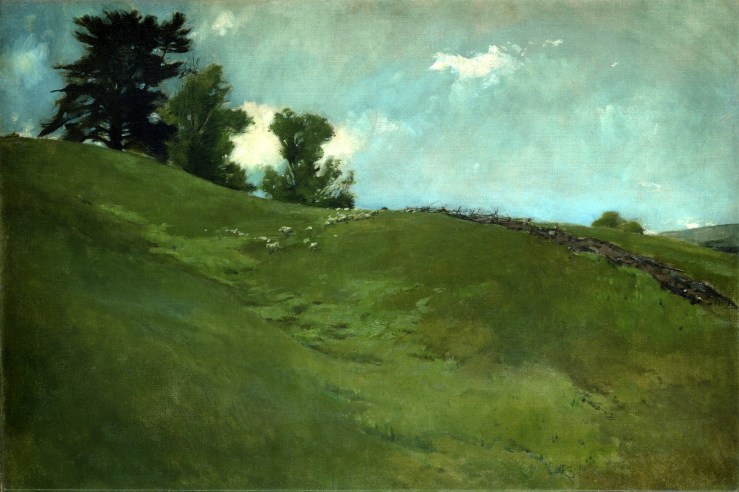
John White Alexander (American, 1856–1915), Landscape, Cornish, N.H., ca. 1890. Oil on canvas, 30 3/8 × 45 in. (77.2 × 114.2 cm). Smithsonian American Art Museum, Washington, DC.
The LORD is my shepherd; I shall not want.
He maketh me to lie down in green pastures:
he leadeth me beside the still waters.
He restoreth my soul . . .
Yea, though I walk through the valley of the shadow of death,
I will fear no evil:
for thou art with me;
thy rod and thy staff,
they comfort me.
—Psalm 23:1–3a, 4
+++
MUSIC: “Sheep May Safely Graze,” from BWV 208 | Composed by Johann Sebastian Bach (1713) | Performed by London Symphony Orchestra, on Night in Berlin (2001)
The aria “Schafe können sicher weiden” (Sheep May Safely Graze) comprises the ninth movement of Bach’s Was mir behagt, ist nur die muntre Jagd (The Lively Hunt Is All My Heart’s Desire)—known informally as the Hunting Cantata. Written for the thirty-first birthday of Duke Christian of Saxe-Weissenfels, the cantata was performed as a surprise at a banquet at the ducal hunting lodge, and it’s full of flattery. The text of “Sheep May Safely Graze,” written by Solomon Franck, praises Christian for his wise, protective leadership (in actuality, he was a lousy ruler):
Sheep may safely graze and pasture
In a watchful shepherd’s sight.
Those who rule, with wisdom guiding,
Bring to hearts a peace abiding,
Bless a land with joy made bright.
At 1:31 in the above recording, you can hear potential danger lurking nearby, but the attentive shepherd neutralizes the threat, keeping safe his flock.
Bach originally scored this piece for soprano with two recorders and continuo, but it has since been transcribed for orchestra and countless other combinations of instruments and is most popular without words. I enjoy playing Egon Petri’s transcription for solo piano, performed here by Alessio Bax:
Its pastoral mood, befitting Psalm 23, and its celebration of a good shepherd’s care have led it to be applied to the Good Shepherd and performed in church services. I’ve even come across some piano arrangements that interfuse it with “Savior, Like a Shepherd Lead Us” (for an intermediate arrangement of such by Cindy Berry, see Classical Hymns).
This post belongs to the weekly series Artful Devotion. If you can’t view the music player in your email or RSS reader, try opening the post in your browser.
To view all the Revised Common Lectionary scripture readings for Proper 11, cycle B, click here.
A masterpiece of French Gothic art, the Latin Psalter of Blanche of Castile was produced in Paris in the first third of the thirteenth century by an anonymous master using tempera, ink, and gold leaf on parchment. The book was most likely commissioned by or for Blanche of Castile (1188–1252), the mother of Louis IX, whom it passed to after her death (which is why it is sometimes referred to jointly as the Psalter of Saint Louis and Blanche of Castile—not to be confused with the even more lavish Paris Psalter of Saint Louis that followed it). Whoever the original owner was, she is depicted praying before an altar on page 122v.
Discussing the transition from Romanesque to Gothic art and the new structures surrounding it, an online Encyclopedia of Art History states,
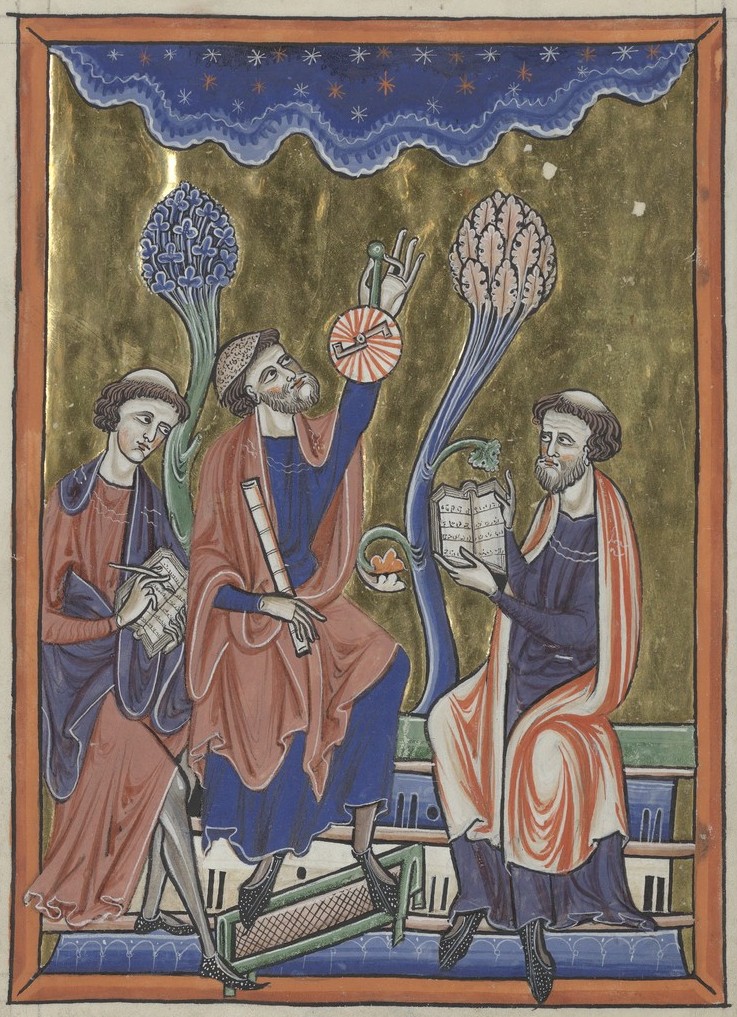
It is no accident that this new style of Christian art was born in France. The University of Paris was the intellectual centre of Europe throughout the thirteenth century, and from the time of St Louis (1226-70) the French court became increasingly important. Students and scholars from all over the continent flocked to Paris to learn and to discuss scholarly matters. Knights returning from the Crusades introduced Eastern theory and science. [This partially explains the unusual frontispiece depicting three geometers in the Psalter of Blanche of Castile, below.] With the ascendancy of the university, the importance of monasteries as centres of book illustration and illumination declined. Commercial guilds were founded and books were produced for private ownership. Large ceremonial books, lavishly illuminated and ornamented with jewellery, became less common and we must follow the stylistic developments principally in Psalters, which the highborn laity made their own.
An alternate name for the manuscript is the Sainte-Chapelle Psalter, due to the fact that it was preserved in the Sainte-Chapelle treasury from 1335 to the end of the eighteenth century, when it was moved to the Bibliothèque de l’Arsenal, now part of the Bibliothèque nationale de France. Louis IX built the Sainte-Chapelle (“Holy Chapel”) inside the royal palace complex between 1238 and 1248 to serve as a private devotional space and to house the thirty-plus relics of Christ he had bought, including what he believed to be the crown of thorns and a fragment of the cross.
Among the 192 pages of the Psalter of Blanche of Castile are twenty-seven full-page miniatures, twenty-two of which are divided into interlocking medallions containing distinct narrative episodes from the Old and New Testaments (mostly). All of them are reproduced below, sourced from https://gallica.bnf.fr/ark:/12148/btv1b7100723j (Bibliothèque de l’Arsenal MS 1186 réserve). Folio numbers and subjects are provided as captions.
This is one of thousands of Christian illuminated manuscripts that have been digitized by libraries and museums around the world, enabling people like you and me to be nourished by their beauty. People often ask me how I incorporate visual art into my devotional practice, and one way is by simply paging (digitally) through painting cycles from old books, letting the medieval imagination be my guide through God’s story of redemption. My eyes do the reading, my soul rests. There’s no rigid program I follow, and no particular goal, but I find I am often led to respond in prayer. Try it!
Fol. 1v: An astronomer with a looking tube takes the bearings of a star with the alidade of an astrolabe. One assistant holds open a book with Arabic ciphers (a star chart?) while the other records the results in Latin.Fol. 9v: The Fall of the Rebel AngelsFol. 10r: The Creation of Eve
Blood that bled into a cry!
The elements
felt its touch and trembled,
heaven heard their woe.
O life-blood of the maker,
scarlet music, salve our wounds.
—“Antiphon for the Redeemer” by Hildegard of Bingen, translated from the Latin by Barbara Newman
This post belongs to the weekly series Artful Devotion. If you can’t view the music player in your email or RSS reader, try opening the post in your browser.
To view all the Revised Common Lectionary scripture readings for Proper 10, cycle B, click here.
Here are some recently published articles on religious art that I enjoyed, and I hope you do too:
“Shouldering the ‘Yoke of Love’: The Shared Passion of Simon and Jesus in Stone and Verse” by Victoria Emily Jones, Literary Life: Like Jonathan Stockland, I remember visiting Nicholas Mynheer’s home and seeing his Simon and Jesus sculpture and being moved by it. Stockland wrote a poem in response to his encounter, one that fits nicely within the tradition of ekphrastic poetry (poems about a visual work of art). Jump on over to LiteraryLife.org to read my reflection on it, from Sunday. As I was writing this essay, lines like “borders of despair” and “tents of desperation” rang out especially loudly, reminding me of the cross being borne by Latin American immigrants seeking entry into the United States, many of them fleeing violence in their home countries.
Nicholas Mynheer (British, 1958–), Simon and Jesus, 2010. Limestone, 36 cm tall.
+++
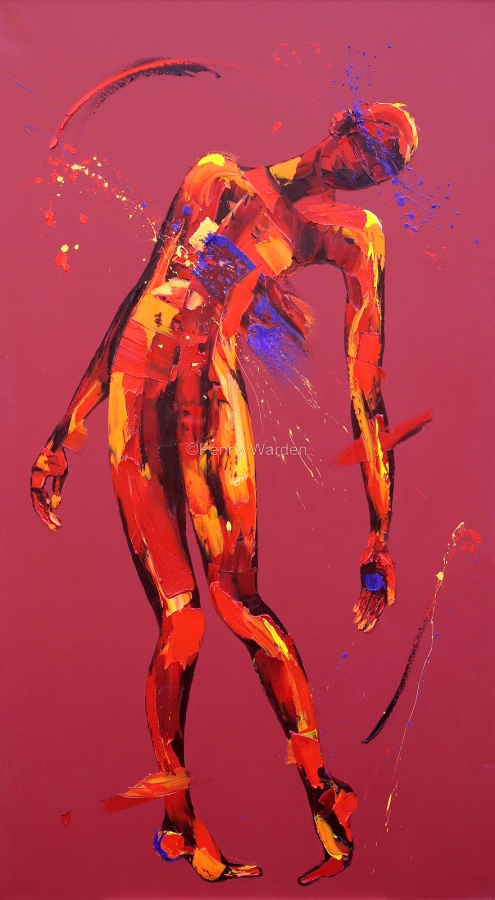
“Theology, Arts, and Culture Series: An Interview with Penny Warden” (+ Part 2), Transpositions: The British artist Penny Warden is best known for her fifteen Stations of the Cross paintings at Blackburn Cathedral. In this excellent two-part interview, she answers questions such as: What does “Christian art” mean in today’s culture? Is there a place for the didactic in religious art? What contemporary artists are making compelling art of theological relevance? Warden also discusses the challenges and advantages of making permanent art for a worship space, how theology informs her practice, the role of tradition versus innovation, and more.
Penny Warden (British, 1956–), Station 9: Jesus Falls for the Third Time, 2005. Oil on canvas, 6 × 3 ft. Blackburn Cathedral, Lancashire, England.
“Creating Sacred Space through Art and Light: The Vision of the Calvary Chapel Sacred Art Renovation”: Aesthetic renovations are underway at Biola University’s chapel in Southern California. Not only are significant changes in flooring, walls, seating, and lighting being made, but new permanent art installations have been commissioned by Danish artists Maja Lisa Engelhardt and Peter Brandes: Engelhardt is making an abstract, gilded Resurrection altarpiece for the west wall and a gilded bronze cross for the wooden entry doors, while Brandes is creating thirty-two hand-blown stained glass windows depicting biblical narratives. This is the first time the husband and wife have collaborated this closely on an art project.
The impetus for this revitalization was a concern that the sacred function and experience of the chapel and its interior architectural space had gradually become disassociated as a result of the increased multipurpose demands put upon the space. “The new artwork and proposed renovations seek to restore the chapel’s sacredness through creating a greater architectural and artistic balance between the interior space and the worship experience,” the Biola news article states. Click on the link to learn more or to contribute to the renovation fund.
+++
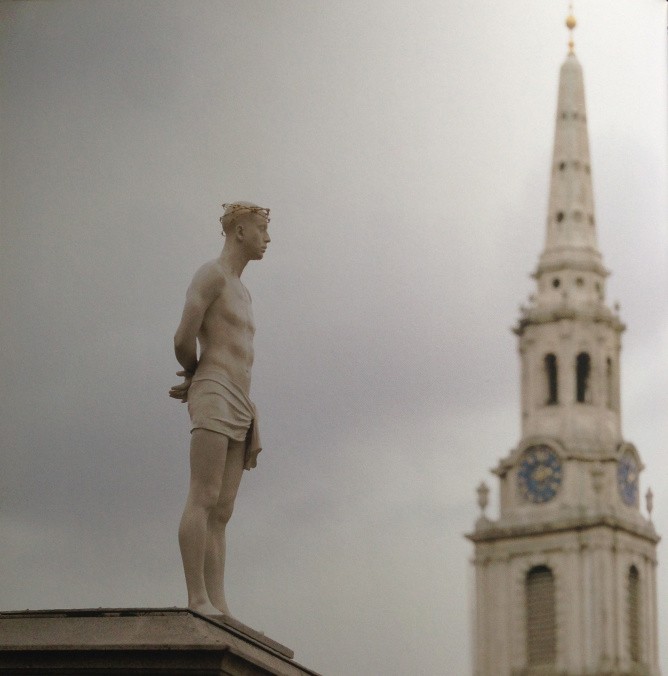
“A Model for All Humanity: Mark Wallinger’s Ecce Homo” by Nigel Halliday, ArtWay: The marbleized plastic sculpture Ecce Homo by Mark Wallinger is one of my favorite works of contemporary religious art, and Halliday introduces it beautifully. The artist created it in 1999 to top the empty Fourth Plinth in London’s Trafalgar Square—where the plinths in the three other corners display sculptures of British royals and military commanders. Though the sculpture has since been removed (and shown elsewhere) to allow for the rotation of other new public artworks, Halliday shows how its original location is key to interpreting its meaning, which has to do with worldly power and glory versus spiritual power and glory.
Mark Wallinger (British, 1959–), Ecce Homo, 1999. Polyester resin, life-size. Temporary installation, Trafalgar Square, London.
+++
Meet the animals of the medieval bestiary, a Christian compendium of real and imagined beasts, The Iris: The blog of the J. Paul Getty Trust recently ran a series of features interpreting the symbolism of various animals from medieval bestiaries. (“A bestiary is a collection of stories about animals—including land creatures, fish, birds, and serpents [some real, some fantastical]—whose properties and behaviors were interpreted as symbols for God’s divine order.”) The phoenix, for example, is a mythical bird who sets himself on fire but on the third day rises again from the ashes of his pyre—a symbol of Christ. Another common symbol of Christ cemented by bestiaries and found in much medieval Crucifixion art is the pelican, who was said to peck at her breast until it bleeds, and then the blood feeds (or, in another variation, revives from the dead) her young. To learn more about this medieval literature genre, visit http://bestiary.ca.
A Pelican Feeding Her Young, from a Franco-Flemish bestiary (Ms. Ludwig XV 4, fol. 75), 13th century. Tempera, pen and ink, and gold leaf on parchment, 23.3 × 16.4 cm (9 3/16 × 6 7/16 in.) (full leaf). J. Paul Getty Museum, Los Angeles.Masolino da Panicale (Italian, ca. 1383–ca. 1447), Crucifixion, ca. 1424. Tempera on wood. Pinacoteca Vaticana, Rome. The pinnacle of this altarpiece shows a “pelican in her piety,” a symbol of Christ’s self-sacrifice.
Brandon Maldonado (American, 1980–), Transcendence, before 2010. Oil on panel.
. . . a thorn was given me in the flesh, a messenger of Satan to harass me, to keep me from becoming conceited. Three times I pleaded with the Lord about this, that it should leave me. But he said to me, “My grace is sufficient for you, for my power is made perfect in weakness.” Therefore I will boast all the more gladly of my weaknesses, so that the power of Christ may rest upon me. For the sake of Christ, then, I am content with weaknesses, insults, hardships, persecutions, and calamities. For when I am weak, then I am strong.
—2 Corinthians 12:7b–10
For a collection of commentaries on this scripture passage, visit Textweek.com.
+++
SONG: “Cold Is the Night” by the Oh Hellos, on The Oh Hellos (2011)
This post belongs to the weekly series Artful Devotion. If you can’t view the music player in your email or RSS reader, try opening the post in your browser.
To view all the Revised Common Lectionary scripture readings for Proper 9, cycle B, click here.
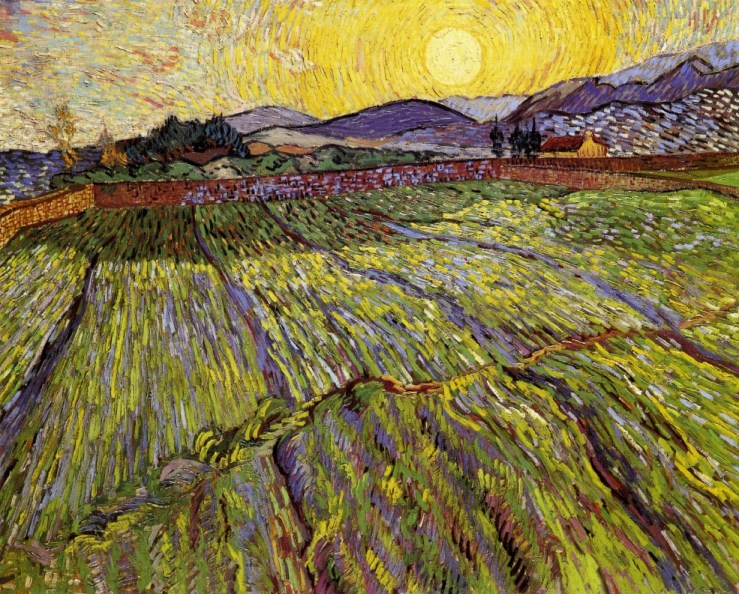
Vincent van Gogh (Dutch, 1853–1890), Enclosed Field with Rising Sun, 1889. Oil on canvas. Private collection.
The steadfast love of the Lord never ceases;
his mercies never come to an end;
they are new every morning;
great is your faithfulness.
—Lamentations 3:22–23
+++
SONG: “Great Is Thy Faithfulness” | Words by Thomas O. Chisholm, 1923 | Music by William Marion Runyan, 1923 | Arranged and performed by Sam JC Lee on bass, with Gabriela Martina on vocals, 2013
This post belongs to the weekly series Artful Devotion. If you can’t view the music player in your email or RSS reader, try opening the post in your browser.
To view all the Revised Common Lectionary scripture readings for Proper 8, cycle B, click here.
Consenses is a global, multidisciplinary arts initiative developed by singer-songwriter Sally Taylor in which participants contribute to “interpretive chains,” responding to an assigned artwork in their own medium. The aim is to promote a more expansive view of the world through the engagement of all five senses and through exposure to diverse ways of seeing, as well as to foster connectedness across geographic divides. I found out about the project two years ago when proofreading herbalist Holly Bellebuono’s The Healing Kitchen: she said she was invited to interpret a photograph of a woman reclining in the sunshine as a tea blend—which was in turn brewed and enjoyed by another artist, who interpreted the blend as a short film.
Launched in 2012, the initial series of chains went like this: Taylor collected twenty-two photographs, each by a different photographer, and then commissioned twenty-two musicians to write a song based on one of those photos. Those songs were then given to dancers to interpret as movement, and then recordings of those dances were given to painters, whose painted responses were given to perfumers, who extracted the essence of the paintings and gave the resultant perfumes to poets, whose poems were given to chefs, whose culinary creations were given to sculptors. And no artist in this chain was allowed to see more than one link back. The final chains were then given to set designers, who created a physical space within which all the art could live. These twenty-two sets opened to the public in August 2014 and toured for four months, attracting more than seven thousand attendees.
Here’s a video excerpt of one of the chains:
Consenses continues, in part through a “Monthly Challenge” posted on the website—a catalytic work of art that invites creative responses. This month’s is a photograph titled Dreamhouse. The media in past months have been very diverse, including a woven basket, a graffitied wall, a comic strip, and a LEGO set.
Dreamhouse, a photograph by Jane Rosemont, is the prompt for Consenses’s June 2018 Monthly Challenge. Rosemont writes, “I recently photographed a remote town on the Salton Sea, in California. Many homes are abandoned and trashed. Someone lovingly placed items of comfort in one of the dilapidated homes, and it almost brought me to tears.”
Over the past few years, primary and secondary schools and colleges have approached Taylor, wanting to incorporate Consenses into their curricula, so she has been hard at work designing and overseeing those efforts. The fruits of one such partnership are about to go on display at MASS MoCA’s Kidspace in North Adams, Massachusetts, where “Come to Your Senses: Art to See, Hear, Smell, Taste, and Touch” opens tomorrow (June 23) and runs through May 27, 2019. In this exhibition, paintings by fifth-grade students in North Adams and Northern Berkshire schools will be on display, which respond to the prompt of either “Joy” or “Fear.”
Taylor met with these kids last year and guided them through first steps, telling them to close their eyes with the blank piece of paper in front of them and ask themselves, “What would fear taste like if it were a flavor? What would it feel like as a texture? What would it be as a weather system? What would it look like if it were a painting?” She did the same with “joy.”
One child wrote, “Fear is sticky. It is large rocks. It is fire. It is the sound of thunder. It is the last petal falling. My pain of this is fear of darkness and large spiders. This is something trying to escape. Trying to escape from terror.” Another wrote of joy: “If joy were a flavor it would be cotton candy. It would be pink and light and smell like lemons on a sunny day. It would be confetti, balloons, night mist and starlight in the night sky. My painting is a starry night with confetti over it. It gives me joy because it reminds me of bright colors in the world.” (Read more about Taylor’s process with the kids here.)
After the kids finished their paintings, Taylor enlisted the talents of musicians, dancers, poets, photographers, painters, perfumers, a tea maker, a chef, sculptors, animators, and set designers to respond in Consenses-like fashion; among them were Taylor’s parents, James Taylor and Carly Simon, the latter of whom will be performing, along with others, at “An Evening with Sally Taylor and Friends” at MASS MoCA on opening night (Saturday, June 23).
To learn more about Taylor’s background and her vision for Consenses, listen to her TEDx talk from 2015:
Also be sure to check out https://consenses.org/, where you can browse past interpretive chains and participate in new ones.















 Art & Theology