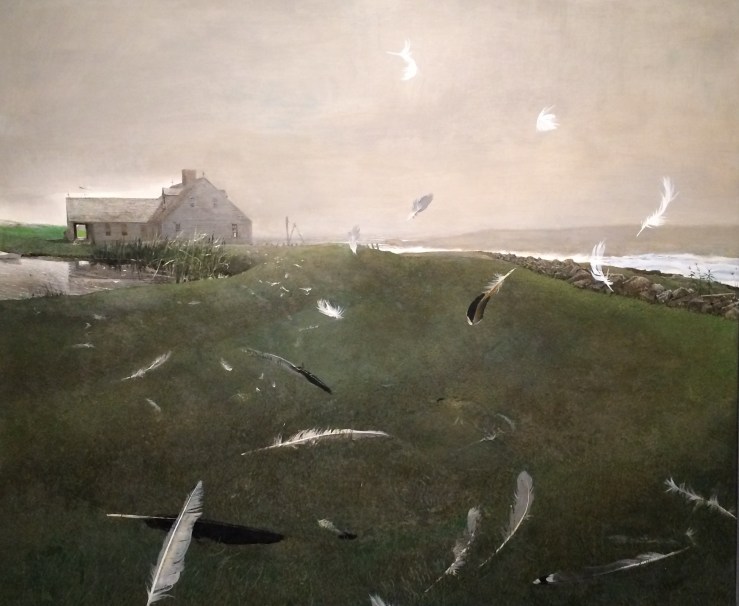
Andrew Wyeth (American, 1917–2009), Airborne, 1996. Tempera on hardboard panel. Crystal Bridges Museum of American Art, Bentonville, Arkansas.
For this is the love of God, that we keep his commandments. And his commandments are not burdensome. For everyone who has been born of God overcomes the world.
—1 John 5:3–4a
+++
SONG: “How Gentle God’s Commands” | Words by Philip Doddridge (1702–1751) | Music by Hans Georg Nägeli (1773–1836) | Performed by Ordinary Time, on At the Table (2009)
How gentle God’s commands!
How kind his precepts are!
Come, cast your burdens on the Lord
And trust his constant care.
Beneath his watchful eye,
His saints securely dwell;
That hand which bears all nature up
Shall guard his children well.
Why should this anxious load
Press down your weary mind?
Haste to your heav’nly Father’s throne
And sweet refreshment find.
His goodness stands approved,
Unchanged from day to day;
I’ll drop my burden at his feet
And bear a song away.
+++
I cannot see, my God, a reason why
From morn to night I go not gladsome, free;
For, if thou art what my soul thinketh thee,
There is no burden but should lightly lie,
No duty but a joy at heart must be:
Love’s perfect will can be nor sore nor small,
For God is light—in him no darkness is at all.
This post belongs to the weekly series Artful Devotion. If you can’t view the music player in your email or RSS reader, try opening the post in your browser.
To view all the Revised Common Lectionary scripture readings for the Sixth Sunday of Easter, cycle B, click here.
UPCOMING CONFERENCE / CALL FOR PAPERS: “Visual Theology I: Transformative Looking Between the Visual Arts and Christian Doctrine (1850–Now),” October 19–20, 2018, The Palace, Chichester, Sussex, England: The inaugural conference of the Visual Theology Symposium will take place this fall, and paper proposals are now being accepted (deadline June 15). “The divide between confessional and critical positions has long impoverished and polarised the academic analysis of the arts,” and this conference seeks to help bridge that divide. Click on the link to learn more, including eight possible paper approaches. Not only are scholars of art history, visual culture, and theology encouraged to submit but also clergy and artists. Jonathan A. Anderson and Ayla Lepine are among the several confirmed speakers so far.
+++
ALBUM: the rain is a handsome animal by Tin Hat (2012): I’ve really been enjoying these seventeen “classical gypsy jazz” settings of the poetry of E. E. Cummings. They’re so dreamsome. Tin Hat consists of violinist and vocalist Carla Kihlstedt, guitarist Mark Orton, clarinetist Ben Goldberg, and accordionist and pianist Rob Reich, and all four are involved in composing. Below is Kihlstedt’s “sweet spring.” For a PDF of the album lyrics, click here. To further engage with Cummings, check out my analysis of his poem “i thank You God for most this amazing,” which also features a musical setting and happens to be the most visited post on this blog.
+++
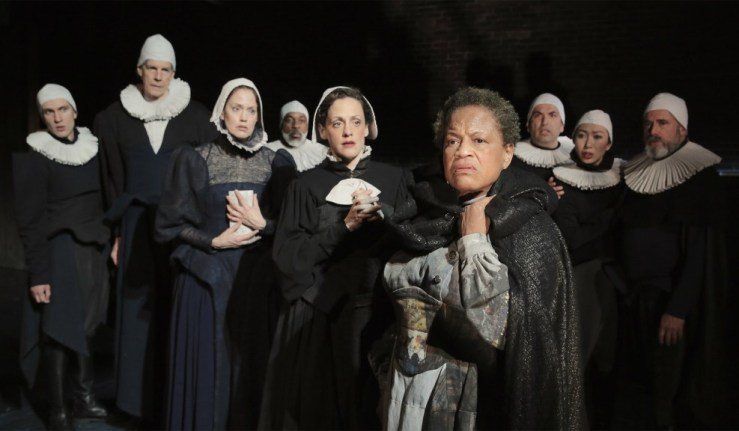
PLAY: Babette’s Feast, Theatre at St. Clement’s, New York City: I’ve heard Babette’s Feast cited many times in Christian literature and addresses, and now it’s been adapted into a stage play, currently running off-Broadway and starring Michelle Hurst (Orange Is the New Black) in the titular role. “Based on Isak Dinesen’s short story made famous by the 1987 Academy Award-winning [Danish] film, this new stage adaptation of Babette’s Feast premiered in January 2018 in Portland, Maine to rave reviews. The play tells the story of Babette, a French refugee, who finds asylum in a pious Norwegian village. With boundless generosity, she throws a lavish feast that becomes an agent of transformative grace, healing a fractured community.” (Update 5/1: Just after I published this post, Image journal published a great interview with director Karin Coonrod.)
Photo: Carol Rosegg/National Review
+++
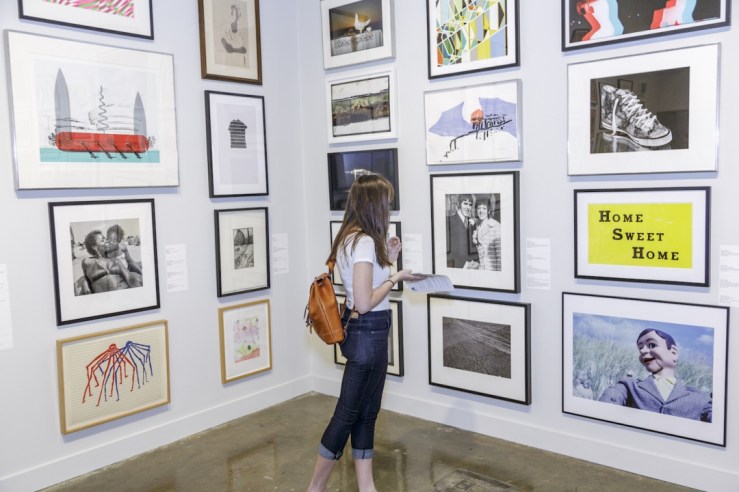
ARTICLE: “Can Art Lending Libraries Empower a New Generation of Collectors?” by Kealey Boyd: “For centuries, those who lacked the space or resources to collect artworks really only had one option—experiencing whatever fine art they could find in public spaces like museums. But in many cities, it’s now possible to borrow art for free. All you need is a local ‘art lending library’—an innovation in art sharing that could, just maybe, help democratize an activity that was once considered inaccessible.”
An MIT student peruses some of the 600 works available for free borrowing through the school’s Student Loan Art Program, established in 1969 and including pieces by Louise Bourgeois, Cindy Sherman, and others. Photo: John Kennard, courtesy MIT List Visual Arts Center.
+++
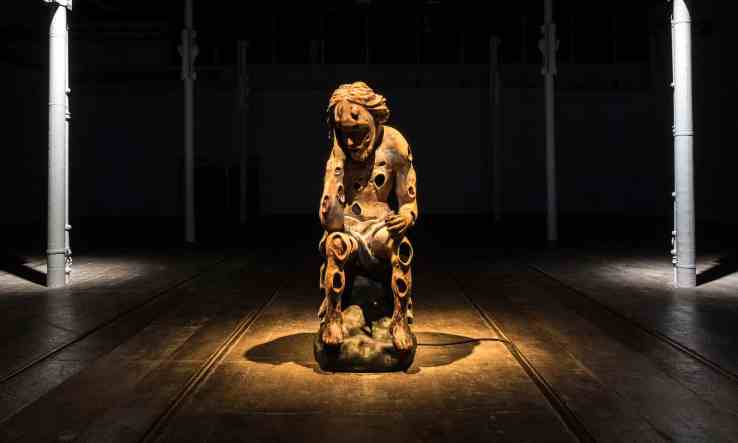
INSTALLATION: “Nobodaddy” by Mark Leckey, Tramway, Glasgow, Scotland, April 20–July 1, 2018: The wounds of Job speak in this solo exhibition by Turner Prize-winning artist Mark Leckey, part of the Glasgow International contemporary art festival. “Nobodaddy”—the title a reference to a William Blake poem about God’s seeming absence—features a spotlit, oversize Job figure that’s based on an eighteenth-century wooden statuette from Germany; he is covered in boils and excrescences and sitting in melancholy contemplation. The open wounds of the figure are embedded with speakers, and they broadcast a monologue of grief, voiced by Leckey and accompanied by horrible gurglings and rumblings. A video screen opposite Job projects a CGI apparition of the same figure and images of his hollowed-out insides. [HT: Jonathan Evens]
Mark Leckey (British, 1964–), Nobodaddy, 2018. Installation view at Tramway in Glasgow. Photo: Keith Hunter.
+++
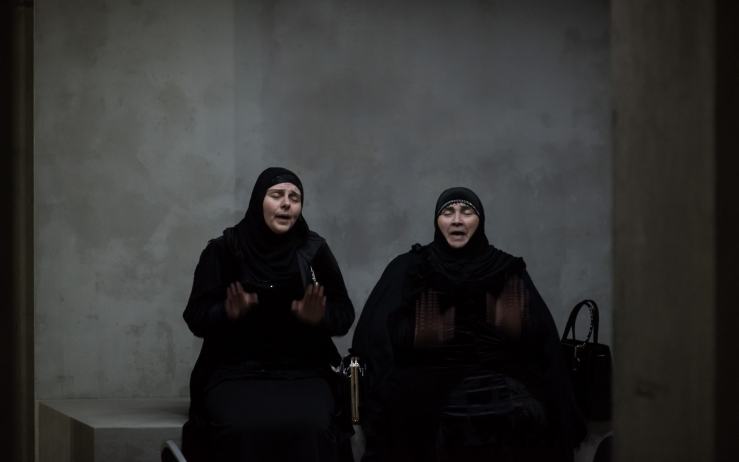
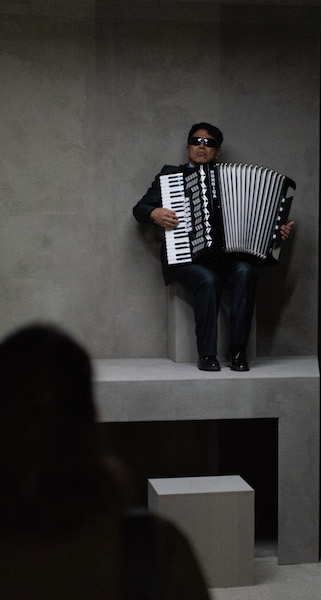
PERFORMANCE ART:An Occupation of Loss by Taryn Simon, Corner of Islington Green, Essex Road, London, April 17–28, 2018, co-commissioned by Park Avenue Armory and Artangel: I’m late on this one, unfortunately. For this work, reprised from its 2016 premiere in New York City, artist Taryn Simon brought together professional mourners from around the world (Albania, Armenia, Azerbaijan, Bhutan, Burkina Faso, Cambodia, China, Ecuador, Ghana, Greece, India, Kyrgyzstan, Romania, Russia, and Venezuela) to simultaneously enact their rituals of grief over the course of a half hour. The result is a cacophony of culturally diverse lamentations that reach a sustained climax and then fall away to a single voice and, eventually, a deep silence. Performed inside an underground concrete auditorium in Central London, balconied and three levels deep, the work is concerned not with the mourning of any one event or person in particular but with the phenomenon of loss itself.
Haji Rahila Jafarova and Lala Ismayilova are professional Yezidi mourners from Azerbaijan. Photo: Hugo Glendinning, courtesy Artangel and Taryn Simon Projects.
In a New York Timesreview, William L. Hamilton explains that
traditionally, professional mourners are hired by families of the deceased to mark the occasion and to guide the dead to the place where they will lead their afterlife. Mourners are [also] called upon to mark larger losses within their communities, like displacement or exile, in a cultural role that is part witness, part historian and part poet. . . . Their laments, wails and cries are also testament to their own bereavements. They can be political testimony, too.
Simon describes the purpose of professional mourners this way: “The bereaved solicit the authority of professional mourners to occupy, negotiate, and shape their loss. The mourners control a psychological experience by directing and embodying the emotion of others.” An Occupation of Loss is the culmination of her seven years of research into professional mourning, which relied heavily on interviews with anthropologists, historians, linguists, musicologists, and other experts. Finding these performers, and then securing visas for them, was itself a herculean task. Listen to the artist discuss the project at more length in this Channel 4 news segment. [HT: Jonathan Evens]
Hugo Aníbal González Jiménez is an Ecuadorian mourner who sings accordion-accompanied laments known as yaravíes and who is blind.
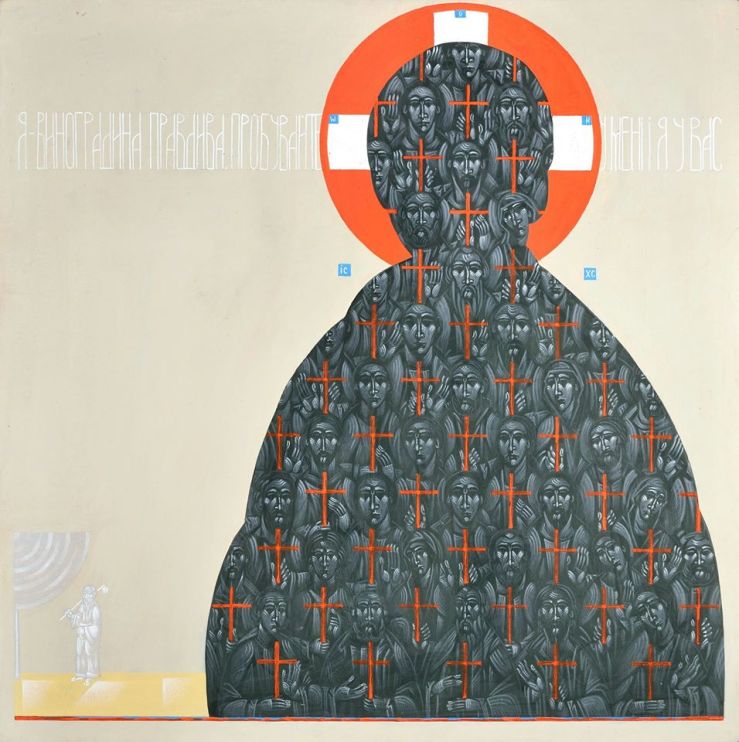
Ostap Lozynsky (Ukrainian, 1983–), I Am the True Vine, 2015
I am the vine; you are the branches. Whoever abides in me and I in him, he it is that bears much fruit, for apart from me you can do nothing. If anyone does not abide in me he is thrown away like a branch and withers; and the branches are gathered, thrown into the fire, and burned. If you abide in me, and my words abide in you, ask whatever you wish, and it will be done for you. By this my Father is glorified, that you bear much fruit and so prove to be my disciples.
—John 15:5–8
+++
SONG: “Make of Our Hearts” by Hiram Ring, on Songs for Liturgy (2012)
This post belongs to the weekly series Artful Devotion. If you can’t view the music player in your email or RSS reader, try opening the post in your browser.
To view all the Revised Common Lectionary scripture readings for the Fifth Sunday of Easter, cycle B, click here.
During Easter 2016 I published an article on Jesus as the gardener of our souls, featuring a roundup of Noli me tangere (“Touch me not”) paintings that portray the risen Christ as a literal gardener, including a fresco by Fra Angelico from the convent of San Marco in Florence.
Fra Angelico (Italian, ca. 1395–1455), Noli me tangere, 1440–42. Fresco from the convent of San Marco, Florence, Italy.
I spent the spring semester of my junior year of college living in Florence and, while there, fell in love with Renaissance art, and in particular the paintings of Fra Angelico (ca. 1395–1455). Born Guido di Pietro, he took vows as a Dominican friar and, together with his assistants, painted two corridors and the forty-four cells in the newly built San Marco, where he lived. The convent is now a state museum and is one of my favorite sites in the city.
In 1990 art historian Georges Didi-Huberman published a monograph on Fra Angelico, spending considerable time on his Noli me tangere, especially its red flowers, which he reads as a figural displacement of Christ’s stigmata (nail wounds). (More on this below.) In the painting, he writes, Christ’s blood “soaks the earth and makes a new humanity grow there, a humanity in the imitation of Christ, a humanity redeemed from sin” (161). He notes how the floral imagery is echoed in the Annunciation in the hallway outside the cell, serving to visually connect these two stages of redemption: Christ’s “flowering,” or conception, in the womb of Mary and his flowering forth from the womb of the earth on Easter.
The figure of the Christ-flower was already a common one in the medieval West. For example, the great thirteenth-century theologian Albertus Magnus writes,
The Christ-flower [flos Christus] blossomed in the Nativity, as we read in Isaiah 11:1: “There shall come forth a rod out of the stem of Jesse.” It withered in the Passion, when there was no longer aspect or beauty. . . . It blossomed again at the Resurrection according to human nature, in the very place where it had withered. Thus it is said: “And my flesh blossomed anew” (Psalm 27:7). [De laudibus 12.4.2]
Fra Angelico furthered the development of this metaphor in visual form, picturing Christ’s blood (according to Didi-Huberman) as a fertilizing material, the agent of regeneration.
The following excerpt is taken from Fra Angelico: Dissemblance and Figuration* by Georges Didi-Huberman, translated from the French by Jane Marie Todd (Chicago: University of Chicago Press, 1995), pages 19–22. I find some of the semiotics discourse to be abstruse, but I’ve highlighted a few standout ideas in boldface—ideas that have helped me to see Fra Angelico’s Noli me tangere (and the Resurrection!) with new eyes.
Angelico sprinkled little spots, deposited little splotches all over this “field” [of green]: more or less regular blotches, made of Saint John White [bianco di San Giovanni]—that is, the very material that constitutes the intonaco of the pigment—and, on top of that, red. It is a bright color, a terra rossa, and it forms a slight relief from the wall; the rhythmic effect, the pattern effect, is only that much stronger.
But what about this “field” in the economy of representation? And in particular, what exactly do these little spots of red pigment spread across the surface like stars represent? To what category of signs do they belong? A response suggests itself at first glance, a response relating to the obviousness of the storia and, consequently, to the overall mimetic, “realist” nature of the fresco: these little red blotches without a doubt represent flowers in the meadow. In [Charles Sanders] Peirce’s semiotic typology, these little red blotches would therefore be icons of flowers in a meadow. Peirce noted quite rightly, concerning this concept of the icon, the extent to which we have a tendency when contemplating a painting to forget the distinction between the present sign (in this case, the red blotches) and the absent reality (the flowers). We therefore need to go a bit further in our contemplation of the little blotches themselves.
We notice at this point that the colored patterns are absolutely not painted like flowers. They do not describe anything, do not suggest any distinguishing features: in these flowers, there are no calyxes, no corollas, no pistils, no stamens. They are colored blotches, no more and no less. And it would be completely absurd to invoke at this point some incompetence on Fra Angelico’s part in representing a flower with its pistil and stamens: he carried out the task perfectly well elsewhere, and moreover, he proved himself competent in the face of much greater mimetic difficulties. It would be just as pointless to imagine the painter “not having the time,” or the coat of paint drying too quickly. If Angelico had wanted to paint a flower like a flower, he would have done so; he would have applied himself. But that is precisely the point: he did not decide to do so. He was satisfied with laying on little circular “heaps” of terra rossa. Why? The response is not in absentia, in a meadow or a text, for example; it is in praesentia, on the fresco itself. For if we persist in wondering what the red blotches are painted like, we can give as our response only what we see: in all rigor, these red blotches are painted like—that is, exactly in the same manner as—Christ’s stigmata.
These red blotches are even painted the way Fra Angelico painted stigmata in general, Christ’s or Saint Francis’s, everywhere in San Marco: they are small circular inflections of the brush that deposits its thick pigment of terra rossa. And the evidence of such a relation is accentuated, specified, virtually demonstrated by the constellation effect Angelico actually bestowed on his little blotches: these flowers scattered across a green ground follow a trajectory that ends with a repetition of the same pictorial sign on Christ’s hand and foot.
Detail sketches of Fra Angelico’s Noli me tangere, showing Christ’s dispersal of his stigmata. Source: Fra Angelico: Dissemblance and Figuration, p. 20
Confronted with what amounts to a real displacement of the iconic sign, I can no longer affirm anything that has the minimal stability required for the notion of a motif: speaking in absolute terms, I can no longer say “it is” or “it is not” in a decisive way. There is a displacement of the iconic value and hence an equivocal representation. For example, I can very well affirm that Christ’s stigmata are, according to Fra Angelico, the flowers of his body. And I will have no difficulty, by the way, in finding a Thomist text to support an affirmation of this kind: for instance, the article in his Summa theologica that Aquinas devotes to the question of whether Christ’s risen body had or did not have scars. To the objector who maintained that stigmata are wounds, and hence a “corruption” and a “defect,” Aquinas responds yes, but those wounds, on Christ, possess a “special beauty” (specialis decor) which is Beauty itself, the (bleeding, of course) Beauty of the Virtue of Humility [Summa theologica 3a.54.4].
But I could just as easily affirm, confronted with Angelico’s fresco, that Christ is here represented in the emblematic act of “sowing” his stigmata in the garden of the earthly world, just before going to rejoin the right hand of his Father in heaven. The idea finds support, by the way, if we pay attention to the fact that, seven times in the fresco and especially next to the stigmata stricto sensu, the red “flowers” appear in groups of five, the symbolically very pregnant number of Christ’s wounds.
In short, in considering these little red blotches in terms of the how of their presence in the fresco, we are led to equivocate on the question of what they represent mimetically. The iconic character of these red signs moves to the background, submits to a logical aporia, while their nature as indexes, as blotches, as pure physical, colored traces, takes center stage. And their way of signifying—between the flower and the stigmata, creating the notion of a relation above all—no longer has anything to do with the way the story delivers its very recognizable meaning.
Finally, as if to definitively convince his meditative fellow friar that he was not merely recounting a too well-known anecdote from the Gospels, Fra Angelico placed a third type of sign at the level of the gaze, something that does not look like anything recognizable in a meadow or even in the story of the Noli me tangere: it is a symbol, three little bleeding crosses, placed between Mary Magdalene and the risen Christ. Here is something that does not “resemble” anything in the order of meadow reality, but nonetheless possesses an obvious memorative function, pointing toward a meditation on Christ’s Passion and the Trinity.
It is particularly important to note that Angelico’s fresco signifies a great deal beyond the conventional iconographical attributes of its story. The example of the little patterns of red in itself raises the possibility of a painter’s using pictorial signs that constitute, strictly speaking, signa translata, a term I will translate as “transit signs,” signs or operators of conversion. And these signs of conversion are not simply metaphors, because their material existence sets up a labile movement between signs of very different semiotic status—icons, indexes, and symbols. That is why such pictorial signs immediately prohibit any univocal relation of attribution—a word to be understood in its two senses, logical and iconological. Such signs have the value of displacement, movement, and association rather than definition, identification, or predication.
But that does not mean they have a lesser value. On the contrary: if there is a type of thinking characteristic of images, it is associative—translata—thinking, a thinking that structures itself by shifting. To represent flowers in a field, Fra Angelico chose to produce only stigmata, simple marks, red colored traces; but these traces, arranged in series, in some sense bridge the gap between two completely heterogeneous (but theologically articulable) orders of thought: a field in springtime on the one hand, and Christ’s body “decorated” with wounds, his stigmata, on the other. That is what, in all rigor, is called a practice of figurability. The image, incapable of—or rather oblivious to—strict logical thinking, draws from this obliviousness all its signifying force. It is only a matter of seeing in Angelico’s fresco how a single material element—that famous terra rossa color—can function on the whole surface of the work as the privileged operator of displacements and structurers of meaning: this red speaks to us of sin in Mary Magdalene’s robe, but it is also, across from her, the very place of Christ’s suffering, the stigmata; it returns to Mary Magdalene in the converted form of compassion; it is disseminated as spring flowers, as an emblem of the Passion, but also of the Resurrection; it continually shifts between the flesh of man—since it is in general a stroke of that same red that outlines bodies in Angelico’s frescoes—and the glory of Christ’s risen flesh, the incarnate of his lips, the red cross of his halo. . . .
* This is an Amazon affiliate link, meaning that Art & Theology will earn a small commission on any purchase that originates here.
FLASH MOB: On Easter 2011 at City Mall in Beirut, Lebanon, a flash mob broke out singing the Paschal troparion in Arabic: Christ is risen from the dead, trampling down death by death, and on those in the tombs bestowing life! [HT: Global Christian Worship]
+++
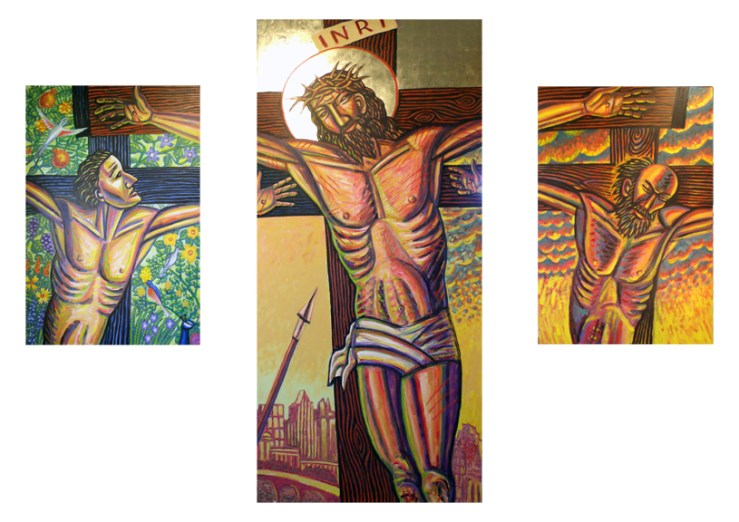
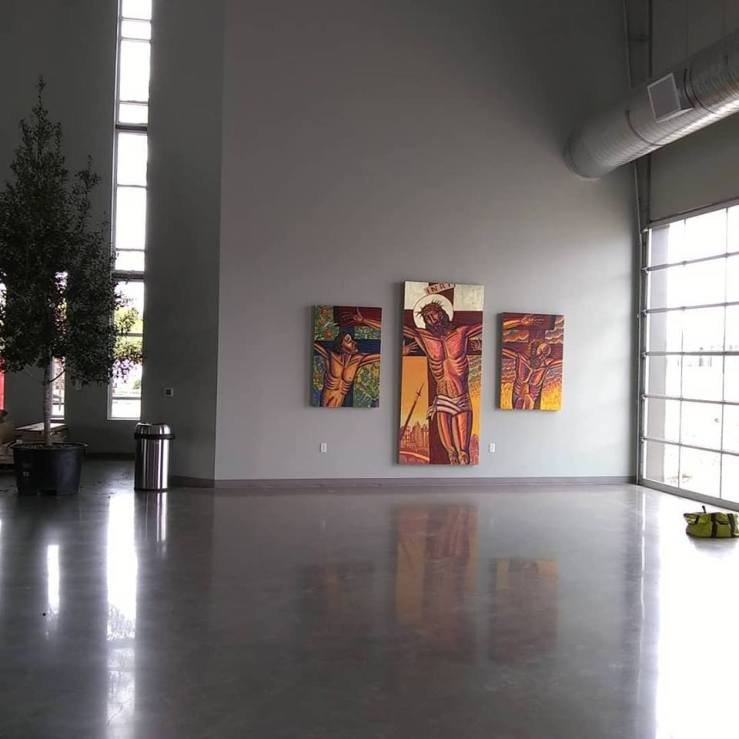
NEW PAINTING INSTALLED: James B. Janknegt is a Christian artist from Texas who is known for transposing biblical stories into contemporary American settings. He recently completed a large triptych for the new Unity Hall at Community First! Village in Austin, a planned community, developed by Mobile Loaves & Fishes, that provides affordable, permanent housing for the chronically homeless. (See the development and learn more about it in this short video, presented by MLF founder Alan Graham.) The painting shows Jesus in conversation with the “good thief” who, as he dies, acknowledges his crime and asks Jesus to “remember me when you come into your kingdom” (Luke 23:42). Behind him paradise flowers forth, indicating not only his new home but his inward regeneration. The other thief, by contrast, turns his head away in stubbornness. This episode demonstrates that repentance is always met by Christ with love, affirmation, and seeds of new life.
James B. Janknegt (American, 1953–), Good Thief, 2018. Oil on three panels, 8 × 12 ft. Unity Hall, Community First! Village, Austin, Texas.
+++
SHORT FILM: “Dance Dance” by French film director Thomas Blanchardevokes each of the four seasons through different elements acting on flowers, captured in either time lapse or slow motion. For fall, a rose is set on fire; for winter, foliage afloat in water becomes frozen in ice; for spring, lilies bloom; and for summer, colored inks hit the flowers and billow up in dusty clouds. Stunning images!
+++
CHAIYA ART AWARD FINALIST: The inaugural Chaiya Art Award competition ended last month, with the winner taking home £10,000 and being exhibited, along with forty-one other juried selections, at London’s gallery@oxo March 29–April 9. The theme was “Where Is God in Our Twenty-First-Century World?”
One entry I really love is finalist Sheona Beaumont’s Natal, a photographic work that shows a nude pregnant woman standing against a dark wall in profile, her hair blown wildly by a gust of wind, opposite a corpse. These are two different spaces set in juxtaposition—two photos stitched together. The black-and-white photo of the dead body, on the left, is Fred Holland Day’s The Entombment from 1898, in which he himself posed as Christ, laid out on a bier before a doorway, his crown of thorns and titulus crucis on the ground beside him. Beaumont rotated this horizontal image 90 degrees clockwise so that the Christ figure is propped upright. She then posed her female model to form a sort of mirror image, but one full of vitality; the woman’s belly, the site of new life about to be born, is brightly lit. This combination photograph makes a powerful Holy Saturday image, one that hints toward resurrection as the stillness gives way to stirrings. The photo is also an allusion to the new life believers have in Christ, and in fact it forms the first in a new series titled Born Again. Visit Beaumont’s website to view the artwork and to read a bit about her process and the meaning the work holds for her.
+++
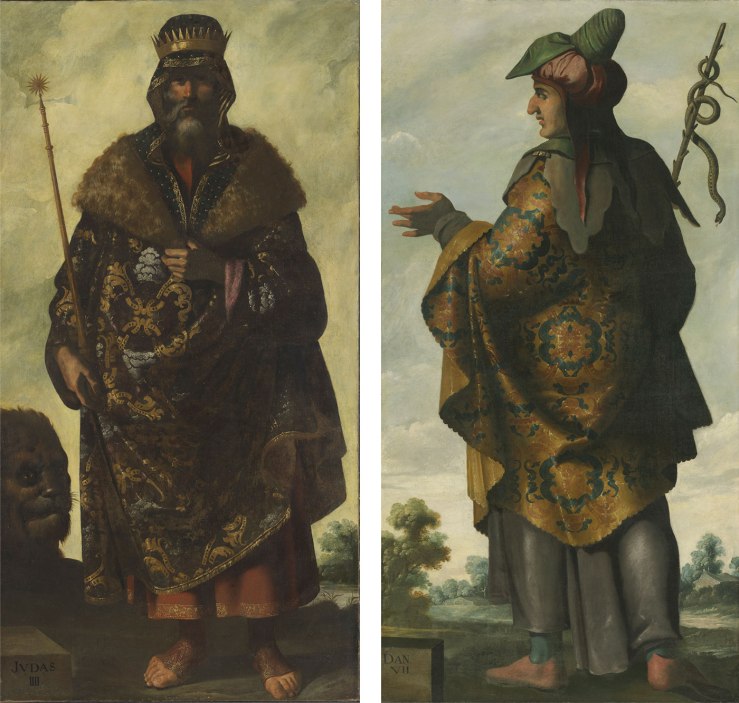
EXHIBITION: “Zurbarán’s Jacob and His Twelve Sons: Paintings from Auckland Castle”: Last fall, Spanish Golden Age artist Francisco de Zurbarán’s Jacob and His Twelve Sons made its North American debut at the Meadows Museum in Dallas, traveling for the first time in centuries, and now the exhibition is at the Frick Collection in New York City—but only through the end of this week! Twelve of the thirteen paintings in the set are from Auckland Castle in County Durham, England, the residence of the eighteenth-century Anglican bishop Richard Trevor, who acquired them in 1756 and had them displayed in his dining room, where they have remained ever since. Trevor was outbid on the painting of Benjamin, however, which is on loan from Grimsthorpe Castle in Lincolnshire, reuniting the set for the first time since the paintings’ 1756 sale.
Francisco de Zurbarán (Spanish, 1598–1664), Judah; Dan, 1640–44. Oil on canvas, 79 1/4 × 40 3/4 in. each. Photos: Robert LaPrelle.
The iconography of the paintings is derived from the prophecies Jacob utters over each of his sons on his deathbed, as described in Genesis 49. For example, Judah, from whom “the scepter shall not depart,” holds said scepter and is regally draped in a gold brocade robe and fur that hint at his descendants kings David and Solomon (Zurbarán was the son of a haberdasher, and gave great care to the depiction of textiles); Dan, on the other hand, holds up a serpent on a stick, alluding to his craftiness. To view all the paintings, click here.
+++
3-D SHOW: As of last month and through the end of July, Artainment Worldwide Shows, in cooperation with the Vatican Museums, presents “Giudizio universale: Michelangelo and the Secrets of the Sistine Chapel”by Marco Balich, an immersive 3-D show that brings to life Michelangelo’s Sistine Chapel frescoes inside the Rome Conciliation Auditorium. Half the room is covered, from the walls to the ceiling, with a 270-degree screen that projects extremely high-res photos of the paintings, dramatized through movement, music, lighting, sound effects, narration, live actors, and dance. Lasting sixty minutes, the show concludes with the thirteenth-century Latin hymn Dies irae (“Day of Wrath”), set to new music by Sting and arranged for chamber orchestra and choir by Rob Mathieson. Watch the trailer below, or click here to see some of the 3-D animation of the Last Judgment.
Embedded in my heart is a melody.
I hear it now and again, faintly.
It disturbs my quest for power with hints of grace.
It haunts my dreams of control with intimations of selflessness.
It stays my hand lifted in anger
And softens my chest tight with rage.
It whispers to me of justice,
And sings to me of compassion.
It is the song of God and I shall sing it yet.
But not alone.
We each bear the song
And someday we will sing it together in harmony.
On that day the mountains of discord will melt before us;
Idols of ego, tribe, and boundary will shatter,
And together we will sing the world awake.
This post belongs to the weekly series Artful Devotion. If you can’t view the music player in your email or RSS reader, try opening the post in your browser.
To view all the Revised Common Lectionary scripture readings for the Third Sunday of Easter, cycle B, click here.
Modern American artist Robert Rauschenberg (1925–2008) is probably best known for his “Combines,” a term he invented to describe a series of works that present found objects on canvas and therefore combine aspects of painting and sculpture. Art critic Jonathan A. Anderson and theologian William A. Dyrness address the religious references that proliferate through his oeuvre, and that of many other late nineteenth- and twentieth-century artists, in their book Modern Art and the Life of a Culture: The Religious Impulses of Modernism* (Downers Grove, IL: InterVarsity Academic, 2016), part of IVP’s Studies in Theology and the Arts series. The following excerpt is taken from pages 308–9.
Robert Rauschenberg (American, 1925–2008), Untitled, ca. 1955. Oil, paper, fabric, and newspaper on canvas with string, nail, funnel, and wood, 31 1/2 × 25 1/8 × 9 in. (80 × 63.8 × 22.9 cm). San Francisco Museum of Modern Art.
Rauschenberg’s Untitled black painting with a funnel (c. 1955) is presented as a kind of figure: the open circular collar of a t-shirt positions a head relatively high in the field, and the fragment of a sleeve on the right-hand edge indicates a lifted hand. Nearly all of the collaged scraps of cloth and paper on the surface are painted over in flat black paint—one of the few portions that is not is a prayer card just to the right of the center of the painting that displays a reproduction of Carl Bloch’s Doubting Thomas (1881). Flurries of red, yellow, green and white paint have been slashed across the surface immediately below this image (the only place such color appears in the painting), which within the figure suggested by the cloth fragments correspond to the position of the wound in Christ’s side, as depicted in the prayer card. The painting’s surface subtly stands in for the wounded body of the resurrected Jesus, and as such the ball of twine placed in the funnel on the left side of the panel becomes doubly suggestive of incarnation (descending downward into the funnel) and ascension (being pulled upward out of the funnel). But if Rauschenberg is allegorizing the surface of the painting with the resurrected body of Christ, then he is also placing himself (and the viewer) in the position of the incredulous Thomas. It is a painting that powerfully articulates both a longing to touch and see (Lk 24:39; cf. Lk 6:19) and the persistence and seeming ineluctability of doubt in the age of modernity (including doubt that images, much less paintings, can any longer serve as vehicles for the kind of religious touching and seeing that we long for). Like much modern art, this is not a work of unbelief as much as it is of fragilized belief, one that is caught oscillating (or struggling) between doubt and belief.
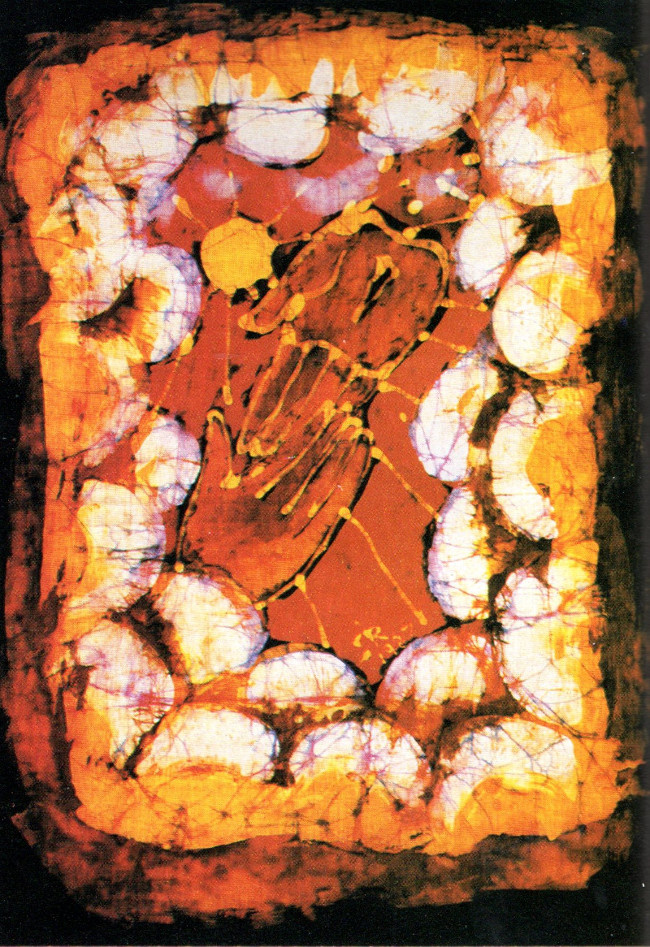
P. Solomon Raj (Indian, 1921–), You and I, before 1993. Batik. Source: Living Flame and Springing Fountain (Indian Society for Promoting Christian Knowledge, 1993)
Then [Jesus] said to Thomas, “Put your finger here, and see my hands; and put out your hand, and place it in my side. Do not disbelieve, but believe.”
“We do not know . . . how can we know the way?” Courageous master of the awkward question, You spoke the words the others dared not say And cut through their evasion and abstraction. O doubting Thomas, father of my faith, You put your finger on the nub of things: We cannot love some disembodied wraith, But flesh and blood must be our king of kings. Your teaching is to touch, embrace, anoint, Feel after him and find him in the flesh. Because he loved your awkward counter-point, The Word has heard and granted you your wish. O place my hands with yours, help me divine The wounded God whose wounds are healing mine.
[Click here to listen to a short sermon Guite preached on St. Thomas back in 2012, which opens with his reading of this poem.]
This post belongs to the weekly series Artful Devotion. If you can’t view the music player in your email or RSS reader, try opening the post in your browser.
To view all the Revised Common Lectionary scripture readings for the Second Sunday of Easter, cycle B, click here.
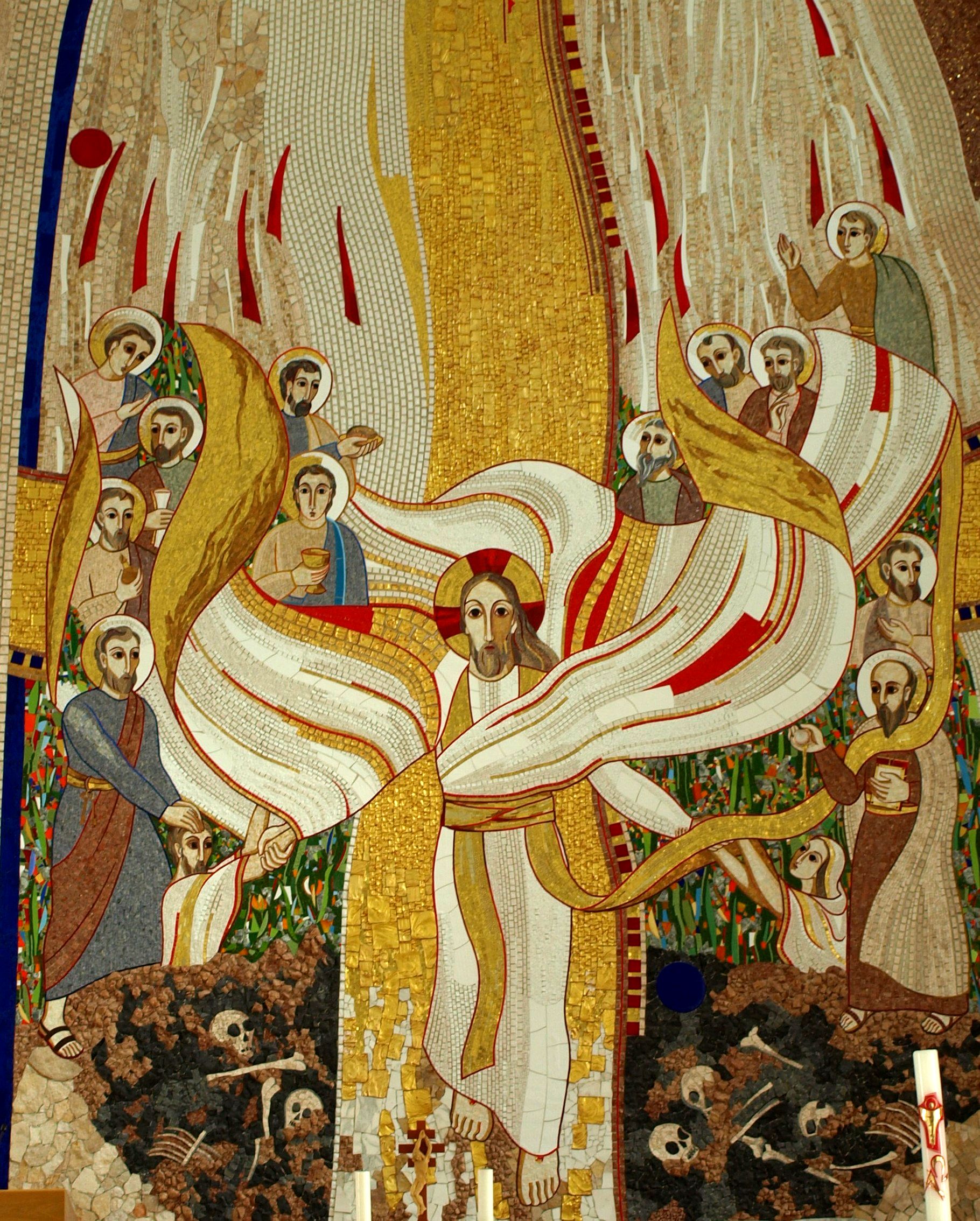
Marko Ivan Rupnik (Slovenian, 1954–), Resurrection of Christ (detail), 2006. Mosaic, St. Stanislaus College Chapel, Ljubljana, Slovenia.
And he will destroy on this mountain the shroud that is cast over all peoples, the sheet that is spread over all nations; he will swallow up death forever. . . . This is the LORD for whom we have waited; let us be glad and rejoice in his salvation.
—Isaiah 25:7, 9b
Kristus je vstal! Zares je vstal! (Slovenian) | Christ is risen! He is risen indeed!
My church is a part of the New City Network; we have several favorite James Ward songs, and this is one of them. I can’t wait to sing it together as a congregation this morning!
+++
Let no one fear death,
for the death of our Savior has set us free.
He has destroyed it by enduring it.
He destroyed hell when he descended into it.
He put it into an uproar even as it tasted of his flesh. . . .
Hell grasped a corpse, and met God.
It seized earth, and encountered heaven.
It took what it saw, and was overcome by what it did not see.
O Death, where is thy sting?
O Hell, where is thy victory?
Christ is risen and you are cast down! . . .
Christ is risen and life is set free!
This post belongs to the weekly series Artful Devotion. If you can’t view the music player in your email or RSS reader, try opening the post in your browser.
To view all the Revised Common Lectionary scripture readings for Easter (Resurrection of the Lord) Sunday, cycle B, click here.
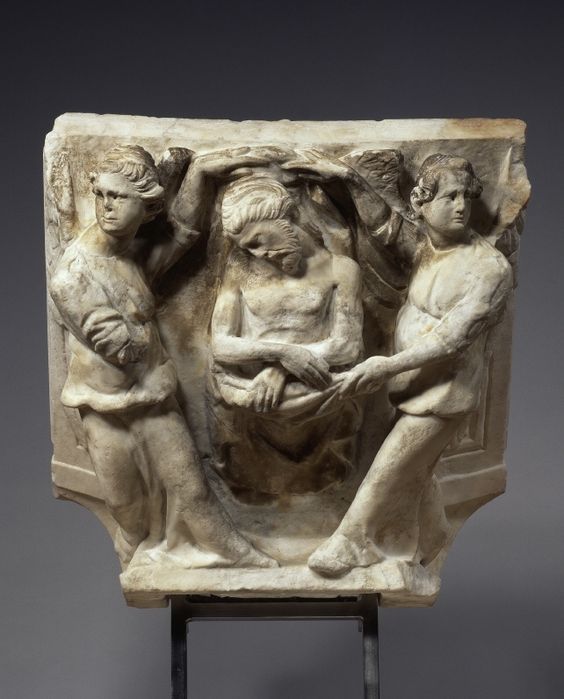
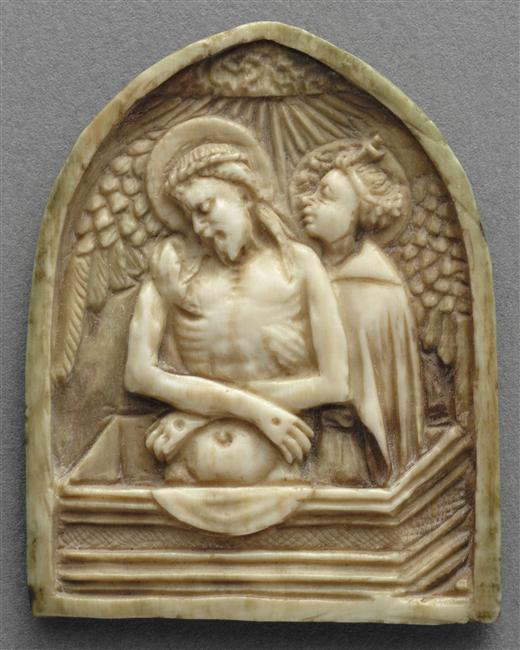
A type of “Man of Sorrows” image, the Dead Christ Supported by Angels is a devotional trope originating in the late Middle Ages. It typically shows a naked, half-length Christ standing up in a sarcophagus, his wounds prominently displayed so as to invite meditation on his suffering. One or more angels tend to him—they may embrace him, mourn his passing, unwrap his burial shroud (to give viewers a better look), display instruments of the passion, keep him propped up in the tomb, or, as we will see below, prepare to welcome him back to life.
One of the earliest examples of this imagery is the marble relief at the Gemäldegalerie in Berlin. Originally a lectern adornment for the pulpit in Pisa’s cathedral, it shows two angels unveiling Christ’s body, presenting it to us like a eucharistic host. Their raised arms and slanted legs form a mandorla-like frame around him.
Giovanni Pisano (Italian, 1245/48–1314), Angel Pietà, 1300. Marble relief, 44 × 45 × 36 cm. Gemäldegalerie, Staatlichen Museen, Berlin, Germany.
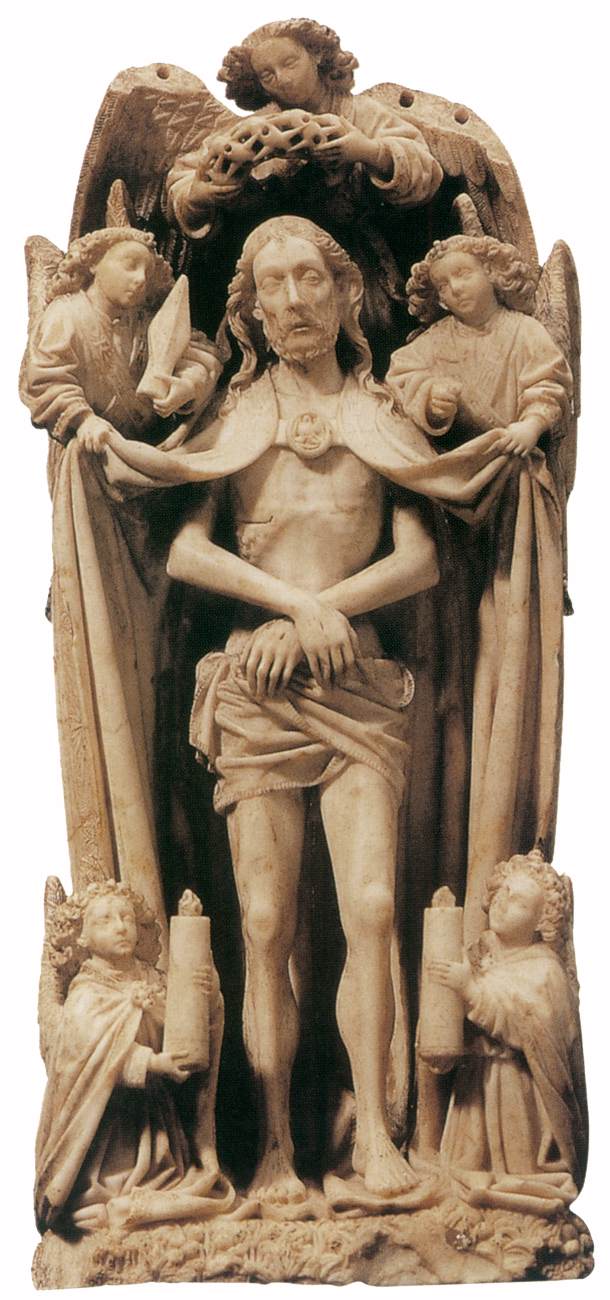
The fifteenth-century alabaster sculpture shown below was formerly partially painted, and the angels formerly wore diadems on their foreheads (one survives). “This is an immensely virtuoso carving for such a small scale,” writes art historian Kim W. Woods—notice the texture of the angels’ wings and hair, the lining of Christ’s ecclesiastical robe, and the plants at Christ’s feet. Notice, too, the intricately carved emblem on Christ’s brooch: a pelican pecking at her breast. Reputed to have fed her young with own blood, the pelican was a common medieval symbol of Christ’s sacrificial love.
Christ as a Man of Sorrows, mid-15th century. Alabaster, 40 cm high. Museum Mayer van den Bergh, Antwerp, Belgium. Photo: Jean-Luc Elias/KIK-IRPA, Brussels.
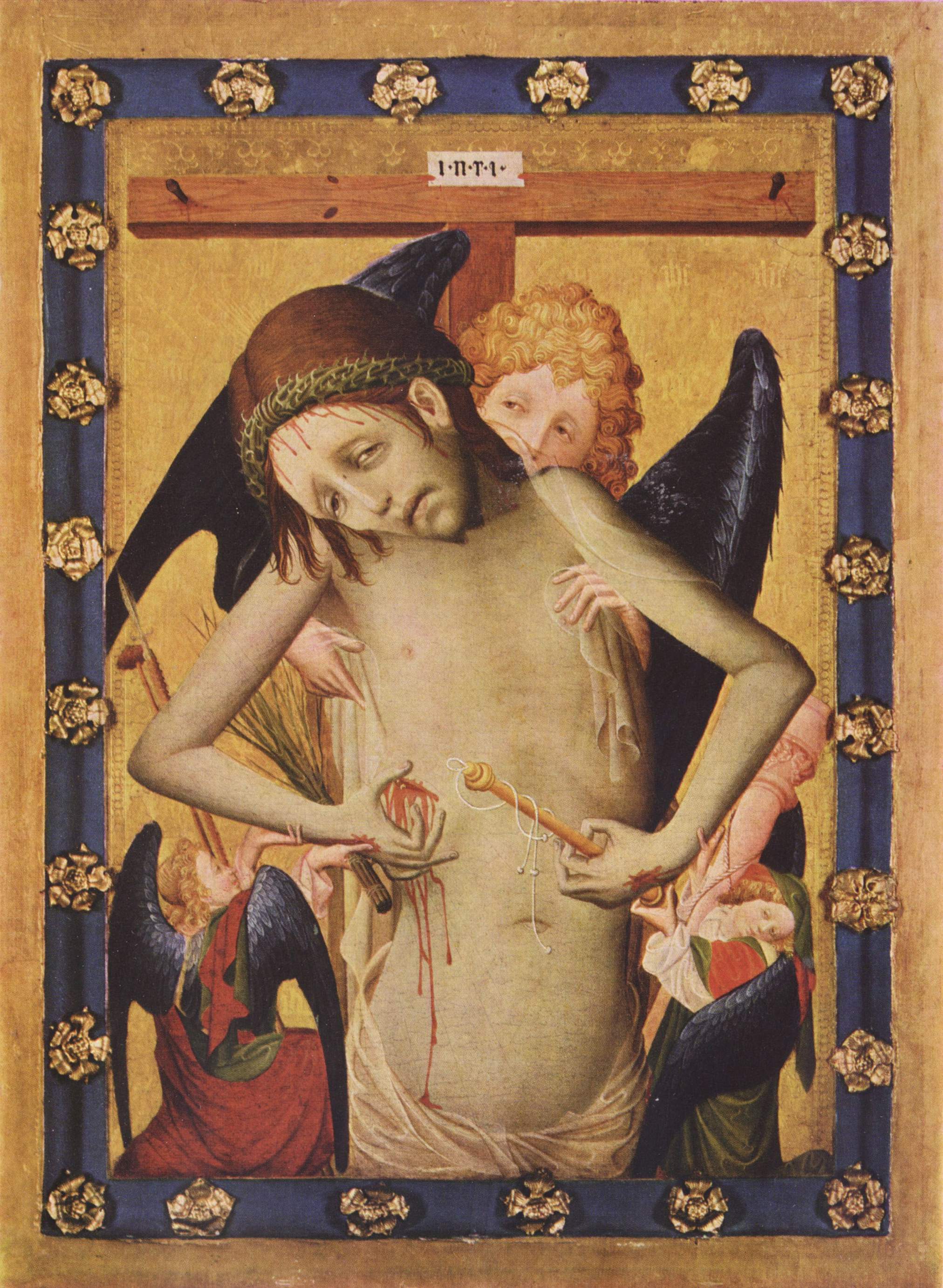
In the Leipzig Man of Sorrows by Master Francke, Christ and three angels stand in a shallow space in front of the cross. It’s unclear whether Christ is on the edge of death or has already crossed over. In his left hand he holds the scourge—or tries to (his hand is either weak and cramped with pain, if alive, or if dead, afflicted rigor mortis). His other hand gestures to his side wound, still wet with blood, as if, like Thomas, he’s about to probe it. Peeking up over Christ’s shoulder is a full-size angel, who tenderly drapes him with a diaphanous veil. At the bottom of the painting two smaller angels kneel on either side, the one holding the birch, the lance, and the sponge-topped reed, the other holding the pillar of flagellation; they both struggle to support the dead weight of Christ’s arms.
Master Francke (German, 1380–1435), Man of Sorrows, ca. 1430. Tempera on oak, 42.5 × 31.3 cm. Museum der Bildenden Künste, Leipzig, Germany.
The angels at Christ’s waist in Master Francke’s Hamburg Man of Sorrows, instead of holding instruments of torture, hold a lily and a sword, symbols of the Last Judgment. (In visualizations of that event, Christ is often shown with a lily coming out of his right ear, signifying an “innocent” verdict for the faithful, and a sword coming out of his left ear, declaring guilty those who did not know him.) Three angels at the top remove the cheap, mock kingly garment the Romans had thrown on him to replace it with his due: a finely embroidered robe befitting a true king.
Master Francke (German, ca. 1380–ca. 1435/40), Man of Sorrows, ca. 1435. Tempera on oakwood, 92 × 67 cm. Hamburger Kunsthalle, Hamburg, Germany.