PRAYER: “God, I Wake” by Rev. Maren Tirabassi: A morning prayer for Ordinary Time.
+++
SONG: “Sólo le pido a Dios” (I Only Ask of God), performed by the Alma Sufí Ensamble: This is a cover of a 1978 song written in Spanish by the Argentine folk rock singer-songwriter León Gieco—a personal prayer that he would not be unfeeling, not numb to injustice. In a November 2023 collaboration with the Alma Sufí Ensamble, Gieco joined the Argentine Jewish cantor Gastón Saied (also a guest artist) and the ensemble’s own Nuri Nardelli, a practicing Sufi (Muslim mystic), in singing the song in Spanish, Hebrew, and Arabic, respectively. “Three languages, one heart. And one prayer for peace in the Middle East,” they write. View the original Spanish lyrics and English translation here.
+++
VIDEOS:
The following videos are two of thirteen—the ones focusing on the continent’s Christian heritage—from the docuseries Africa’s Cultural Landmarks, produced by the Metropolitan Museum of Art in collaboration with the World Monuments Fund and directed by Sosena Solomon. The series was commissioned to coincide with the reopening of the museum’s Arts of Africa galleries this May, after being closed for four years as part of a major redesign and renovation of the Michael C. Rockefeller Wing.
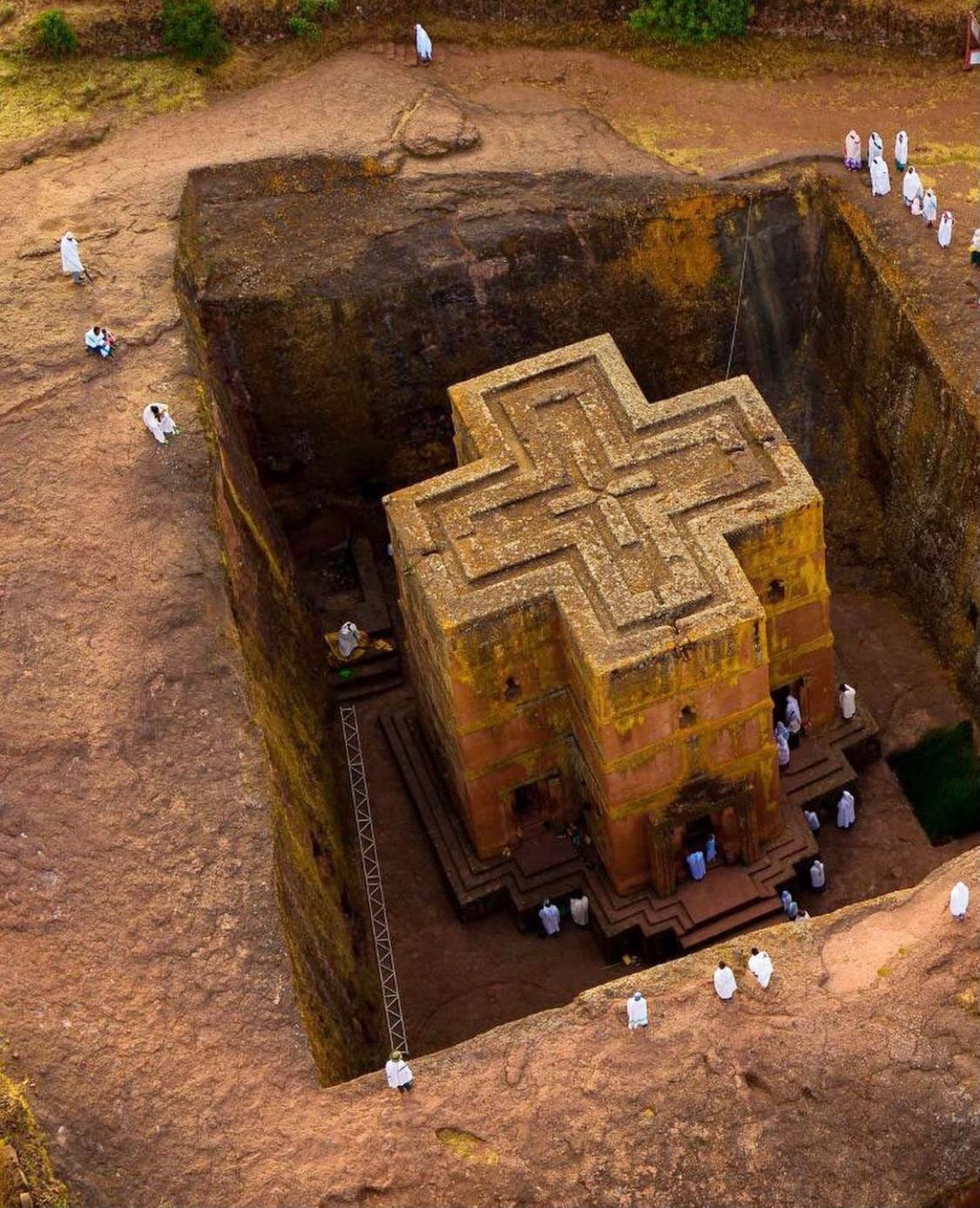
>> “Rock-Hewn Churches of Lalibela, Ethiopia”: “Stepping into one of the rock-hewn churches of Lalibela is an experience unlike any other. Carved directly from volcanic rock, from the top to bottom, unlike traditional buildings built from the ground up, the eleven wondrous churches of Lalibela are monumental expressions of devotion and symbols of Ethiopia’s spiritual heartland. Visually captivating and rich with personal insights from priests entrusted with care of the churches, this documentary reveals how these sanctuaries—both magnificent and fragile—face the constant threat of erosion. Meet the dedicated guardians balancing conservation and sacred duty, to ensure Lalibela’s living pilgrimage tradition thrives for generations to come.”
Bete Giyorgis (Church of Saint George), Lalibela, Ethiopia, 13th century
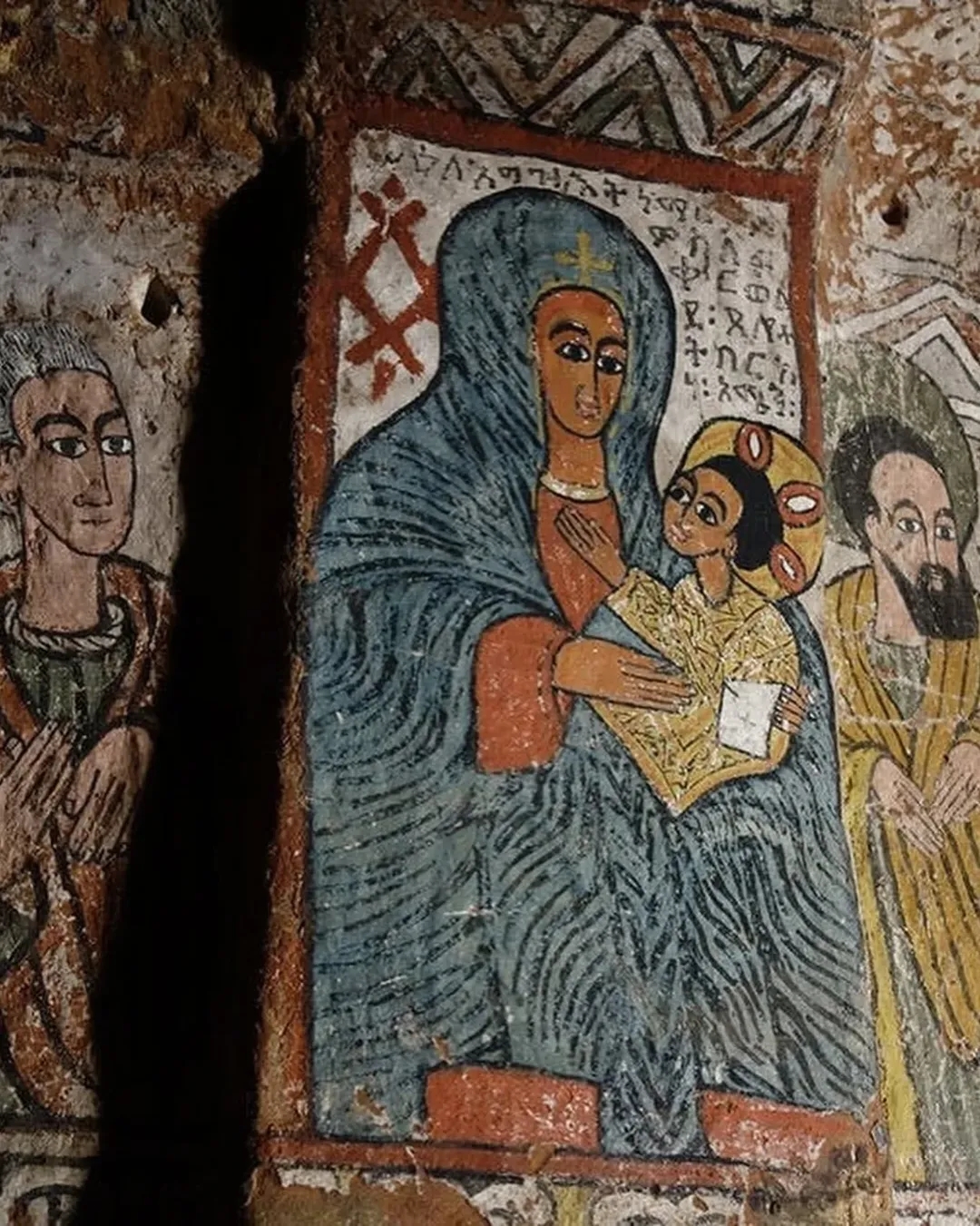
>> “Rock-Hewn Churches of Tigray, Ethiopia”: “High in Ethiopia’s Northern Highlands, the rock-hewn churches of Tigray stand as breathtaking sanctuaries of faith carved into sandstone cliffs. For centuries, some 120 rock-hewn churches, and the paintings and artifacts preserved within their walls, were protected by their remote locations. However, during the 2020–2022 war in Tigray, some churches were targeted, and the use of heavy weapons resulted in vibrations that caused cracks in the stone. Through evocative imagery and intimate testimonies, this documentary explores the endurance of these remarkable sites of devotion, as local priests reflect on the spiritual and cultural legacies at risk.”
Virgin and Child wall painting, 15th century, inside Abuna Yemata Guh (The Chapel Near the Sky) in Tigray, Ethiopia, which contains the best-preserved medieval paintings in the region
+++
ESSAY: “Shaped for People: Sacred Harp Singing in the Age of AI” by Mary Margaret Alvarado: From Image journal’s summer 2025 issue: “What is that, I thought, when I first heard shape note singing. It was groaning, and some voices keened. It was loud. It was muscular, this music. There was glory, but it was not pretty. The voices did not blend, and the sound was not nice. All I knew was that I wanted to hear it again. Maybe it seemed to me like an aesthetic that does not lie? I feel surrounded, often, by aesthetics that do lie. . . . So there’s a contrarian appeal to a song that sounds sung by humans in their (young, old, crooked, fat, gorgeous, hairy, halt, jacked, sexy, bald, injured, hale) human bodies . . .”
Writer Mary Margaret Alvarado reflects on her experiences participating in shape-note hymn sings, a democratic form of communal music making using the “sacred harp” of the human voice. She provides an abridged history of such singing, which developed in late eighteenth- and early nineteenth-century New England but is now carried on throughout the US and in the UK and Germany. I’d love to take part in a shape-note hymn sing someday, as I’ve long been drawn to the sound and tradition, which I know only from recordings. Besides the small gatherings organized by local communities, there are also large conventions, and I’ve been intrigued to learn that, despite the hymns’ deep rootedness in Christianity, non-Christians are often among the attendees.
Below are a few of the hymns Alvarado mentions in her essay: “Youth like the Spring Will Soon Be Gone” (MORNING SUN), “David’s Lamentation” over the death of his son Absalom, and “I’m Not Ashamed of Jesus” (CORINTH). Traditionally, the singers start by singing through an entire verse using only the four syllables of the Sacred Harp notation system (fa, sol, la, mi) as their lyrics, to orient themselves to the tune.
To browse previous Art & Theology posts that have featured hymns from the Sacred Harp tradition—albeit not all performed in a traditional manner; several are arranged for soloists or otherwise stylistically adapted—see https://artandtheology.org/tag/sacred-harp/.
+++
NEW ALBUM: Radiant Dawn by the Gesualdo Six: Released August 1 by the British vocal ensemble the Gesualdo Six, this album features “an ethereal combination of trumpet and voices to explore different shades of light . . . from the soft, golden glow of a summer evening as shadows lengthen to the shimmering of moonlight on calm waters,” writes director Owain Park. “Some texts contrast the terror of darkness with the brilliance of dazzling sunlight; others explore the blurred boundaries between heaven and earth. Plainchant threads this programme together . . .” A range of composers are represented, from the Middle Ages to the present day.
Several of the songs are based on biblical episodes—Simeon’s response to having held the Christ child in the temple, the transfiguration of Christ on Mount Tabor, the arrival of the holy women at Jesus’s tomb on Easter morning, the walk to Emmaus—or passages such as Psalm 5:2 (“O hearken thou . . .”) and Revelation 21:23 (“And the city had no need of the sun . . .”). There are bedtime prayers, a meditation on the glory of the angels, an O Antiphon for the approach of Christmas, and settings of contemporary poems, like “Grandmother Moon” by the Mi’kmaq poet Mary Louise Martin and “Aura” by Emily Berry, about the death of her mother. View the track list at https://www.hyperion-records.co.uk/dc.asp?dc=D_CDA68465.
Below, from the album, is the Gesualdo Six’s performance of “Night Prayer” by Alec Roth, a setting of the Te lucis ante terminum, featuring Matilda Lloyd on trumpet. “The stark setting reminds me of the ravages of war,” one YouTube user remarks. “The singing, of a prayer sent out over the carnage, blessing those who have suffered. Sacred space indeed.”
Based at the Faculty of Classics at the University of Oxford, the Manar al-Athar (“Guide to Archaeology”) digital archive provides high-resolution photographs of archaeological sites, buildings, and art from the Levant, North Africa, the Caucasus, and the Balkans, covering the time of Alexander the Great (ca. 300 BCE) through the Byzantine and early Islamic periods, with special emphasis on late antiquity. All the images are freely downloadable, made available for teaching, research, and academic publication under a Creative Commons Attribution-NonCommercial-ShareAlike 2.0 UK (CC BY-NC-SA 2.0) license.
Manar al-Athar was established in 2012 by Dr. Judith McKenzie (1957–2019) and since 2020 has been directed by Dr. Ine Jacobs. It is in continuous development. The photos are cataloged by geographical region and are labeled in both English and Arabic. They picture a range of historical structures—some intact, others in ruins; both interiors and exteriors, where applicable—including mausoleums, churches, mosques, khanqahs (Sufi lodges), hammams (public bathhouses), palace complexes, madrasas (colleges for Islamic instruction), forums, fountains, cisterns, aqueducts, civic buildings, theaters, markets, fortifications, and hostels.
Of primary interest to me is the Christian art from churches and tombs, from countries such as Egypt, Syria, Turkey, Armenia, Georgia, and Serbia, and Jewish art that pictures stories from the Hebrew Bible.
Unfortunately, the subjects of the artworks aren’t labeled and there’s no commentary or transcription/translation of inscriptions, nor are the buildings or artworks dated. Inevitably, many of the frescoes and mosaics have degraded with age, sometimes making the iconography difficult to read. There’s also no way to filter by religion; Christianity accounts for only a portion of the images, with others coming from Jewish, Islamic, or pagan traditions, and a number are from nonreligious contexts. I’d love to see a more robust tagging system and advanced searchability functions as the archive continues to evolve.
The archive is by no means comprehensive, but I hope it will encourage further scholarship and attract more digital image donations.
Below is a sampling of the hundreds of images you can find on the Manar al-Athar website.
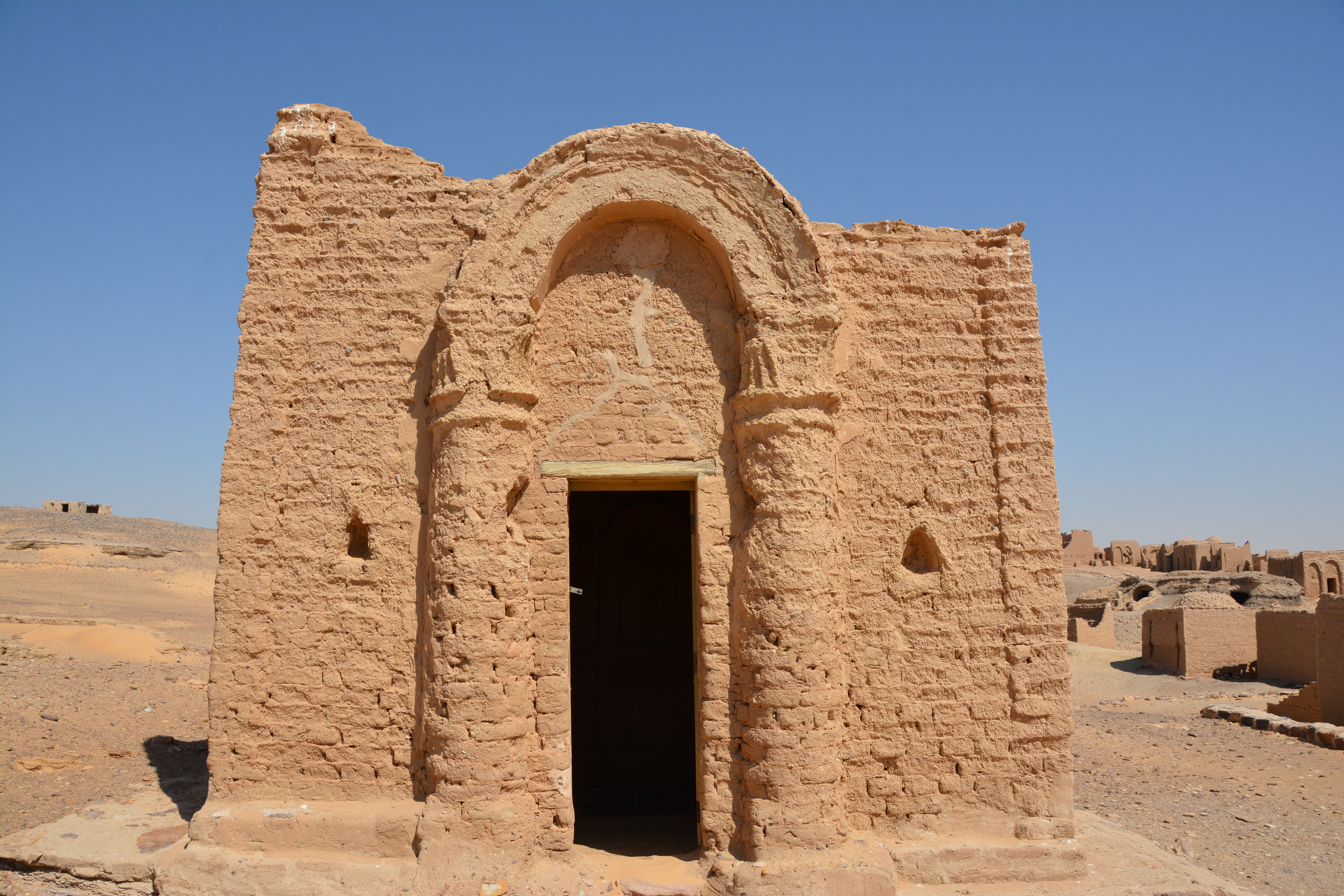
One of the earliest surviving and best-preserved Christian cemeteries in the world, used by Christians from the third to eighth centuries, is Bagawat Necropolis in the Kharga Oasis in Egypt’s Western Desert. The Chapel of Peace is one of 263 mud-brick funerary chapels in the cemetery, celebrated for the painting of biblical, early Christian, and allegorical figures inside its dome.
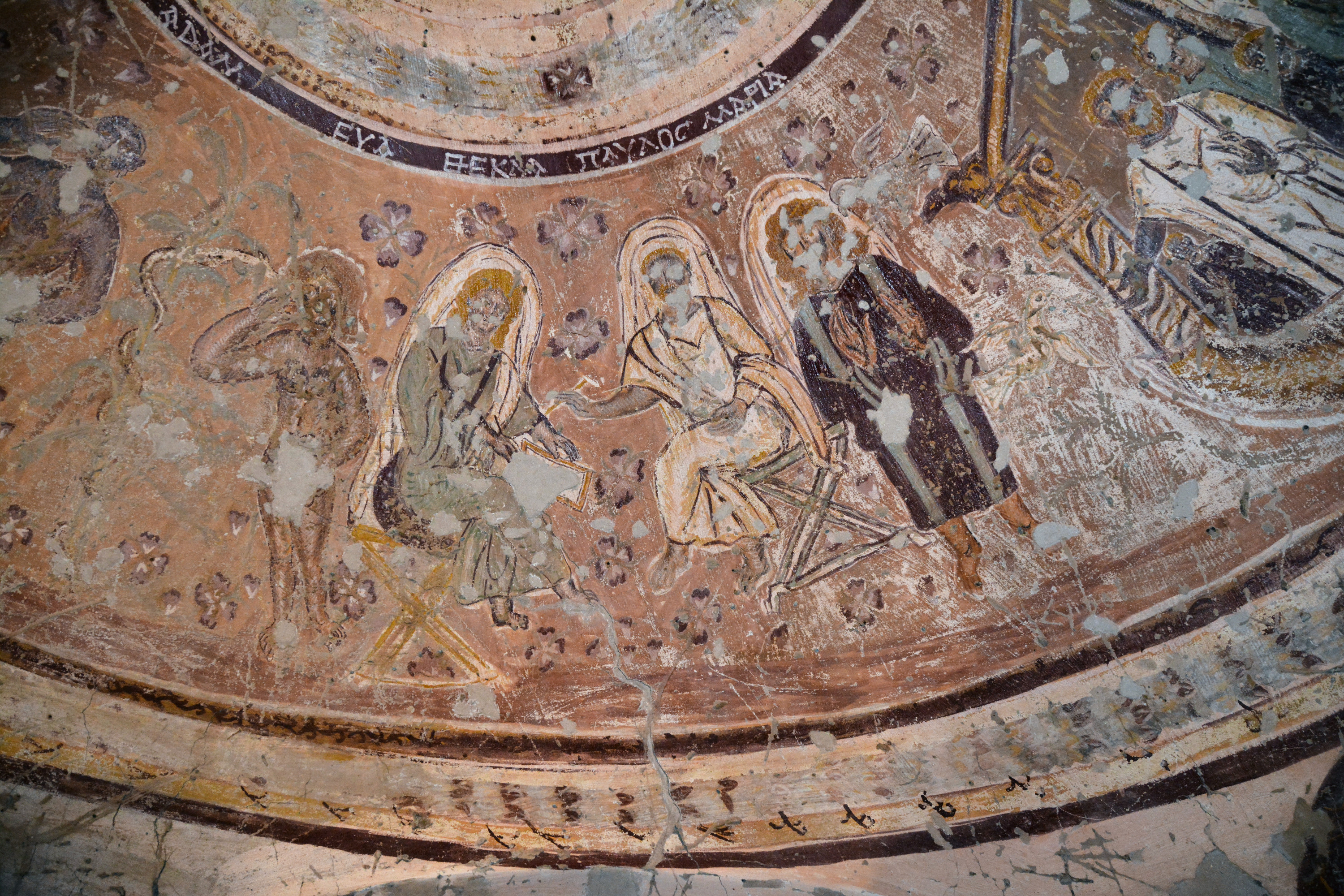
The Chapel of Peace, a monumental Christian tomb at Bagawat Necropolis, Kharga Oasis, Egypt, built 5th or 6th century. Photo: Mohamed Kenawi / Manar al-Athar.Dome fresco detail from the Chapel of Peace at Bagawat Necropolis in Kharga Oasis, Egypt, 5th or 6th century. Photo: Mohamed Kenawi / Manar al-Athar.
The detail pictured above shows the female saint Thecla (Θέκλα), a first-century Christian preacher and martyr, learning from the apostle Paul (Παῦλος), as described in the ancient apocryphal Acts of Paul and Thecla. They both sit on stools, Thecla holding open a book on her lap, pen in hand, while Paul points out a particular text.
In addition to Paul and Thecla, the dome fresco also depicts, clockwise from that pair: Adam and Eve; Abraham about to sacrifice his son Isaac, with Sarah stretching out her hand (it’s unclear whether this gesture signifies her surrender to God’s will or an attempt to stop her husband’s act); Peace, holding a scepter and an ankh; Daniel in the Lions’ Den; Justice, holding a cornucopia and balance scales; Prayer; Jacob; Noah’s Ark; and the Virgin Annunciate, the New Eve, who heard the word of God and obeyed it and thus brought forth life, unlike her ancestor, who listened to the lies of the Evil One and brought forth death (the snake and dove at the women’s respective ears emphasize this contrast). View a facsimile of the full dome here.
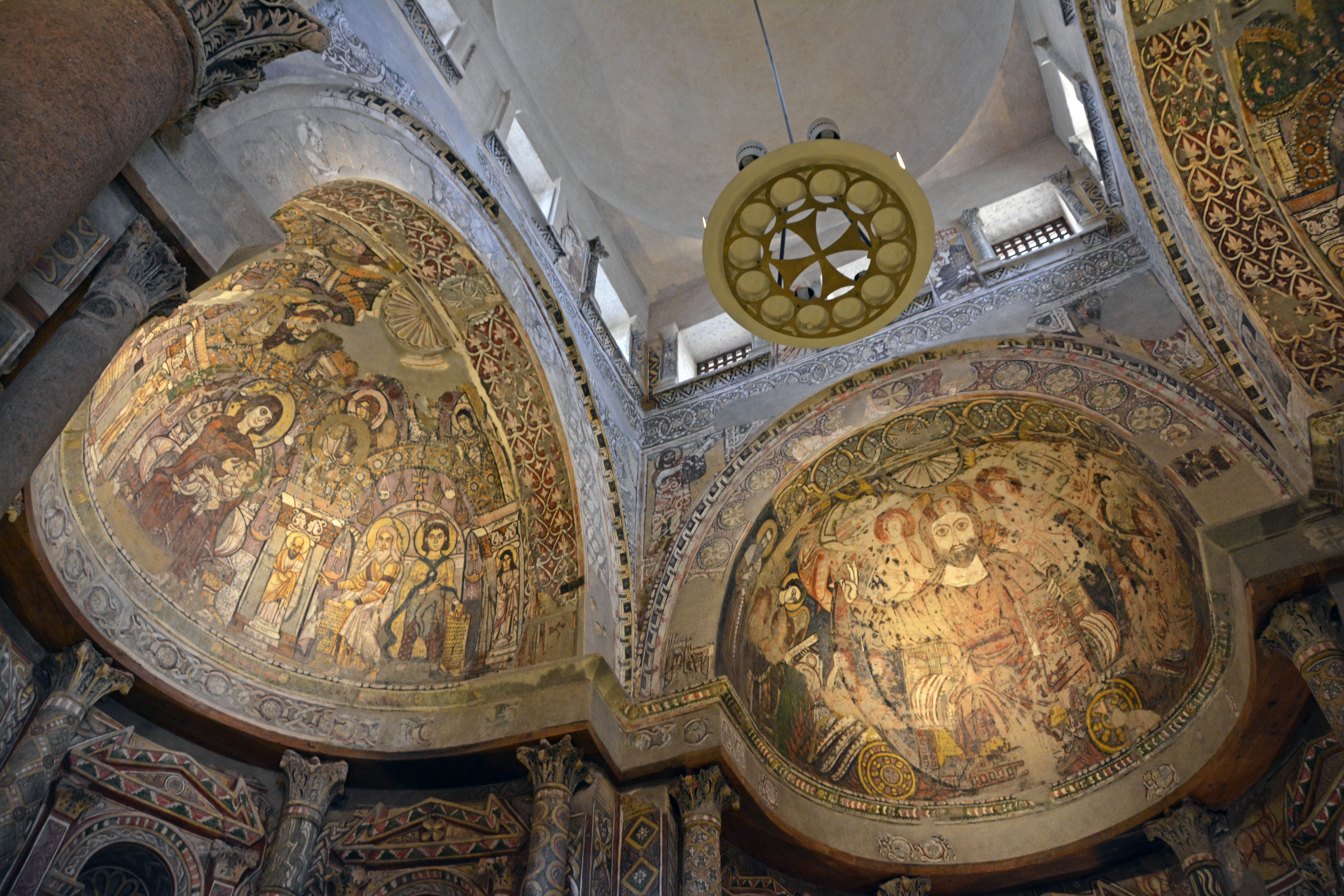
Also in the Egyptian folder are photos of one of Byzantine Egypt’s most glorious encaustic-painted sanctuaries, that of the Red Monastery Church, a triconch (three-apse) basilica that’s part of the (Coptic Orthodox) Monastery of Apa Bishuy near Sohag.
North apse (Virgin Galaktotrophousa, aka the Nursing Madonna) and east apse (Christ Pantocrator), painted 6th–7th or 8th century, Red Monastery Church, near Sohag, Egypt. Photo: Mohamed Kenawi / Manar al-Athar.
Here’s a video that presents a 3D reconstruction and fly-through of the basilica:
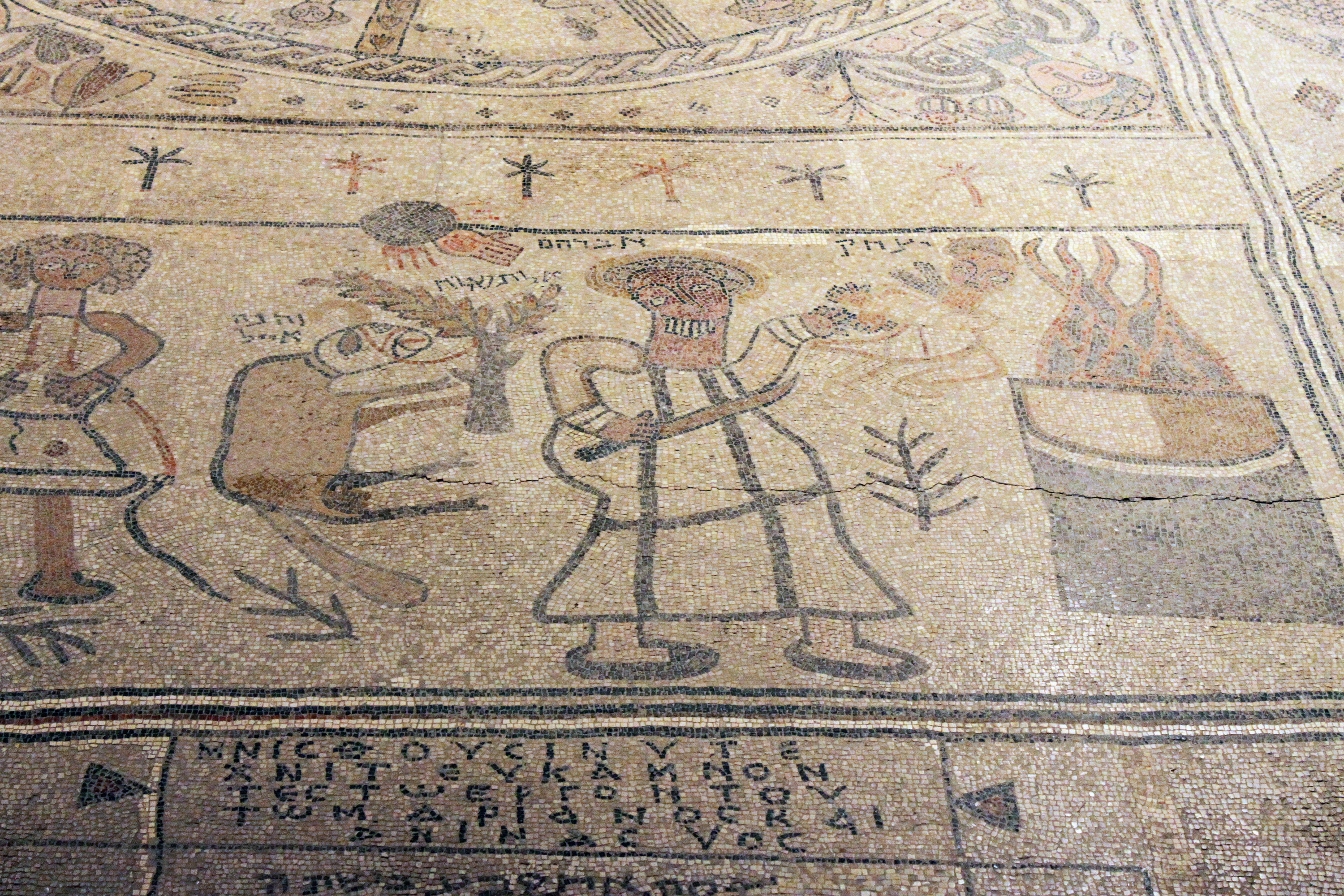
Moving northeast into Israel, we come to the sixth-century Bet Alpha (sometimes rendered as Beit Alfa) Synagogue, located in the Beit She’an Valley. The excavation of Jewish sacred sites like this one reveal that, contrary to what is popularly alleged, Judaism is not a strictly aniconic religion. Many Jewish communities have understood the prohibition against graven images in Exodus 20:3–6 and Leviticus 26:1 as a prohibition against idol worship, not figurative art (art that depicts people and animals) in general. Thus several ancient synagogues, not to mention Jewish manuscripts, portray episodes from the biblical narrative, such as the Akedah (Binding [of Isaac]), told in Genesis 22.
The Binding of Isaac, early 6th century. Mosaic pavement, Bet Alpha (Beit Alfa) Synagogue, Heftziba, Israel. Photo: Sean Leatherbury / Manar al-Athar.
Rendered in a primitive style, this scene is one of three from the mosaic pavement in the central hall of Bet Alpha. It shows Abraham, sword in hand, about to throw his son Isaac onto a fiery altar, when God, represented by a hand from the sky, intervenes, telling him to stop; it’s then that Abraham notices a ram tangled up in a nearby thicket, which he sacrifices instead. The Hebrew inscriptions read, from right to left, “Yitzhak” (Isaac), “Avraham” (Abraham), “al tishlakh” (Do not lay [your hand on the boy]), and “v’hineh ayil” (Here is a ram). Stylized palm trees line the top of the scene.
Here is video footage of the full floor mosaic in its space, showing wide views as well as details, including of the remarkable zodiac wheel in the center:
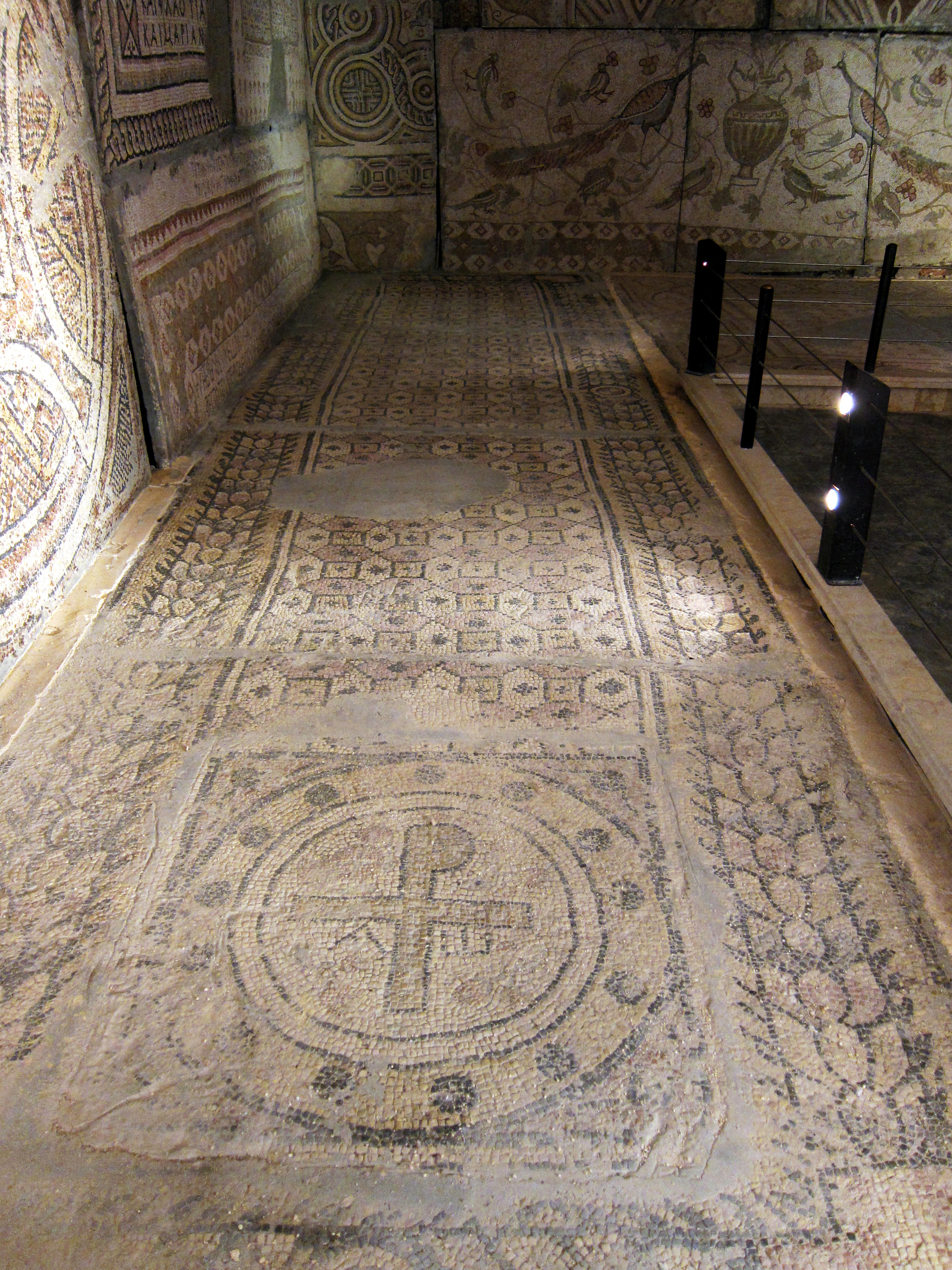
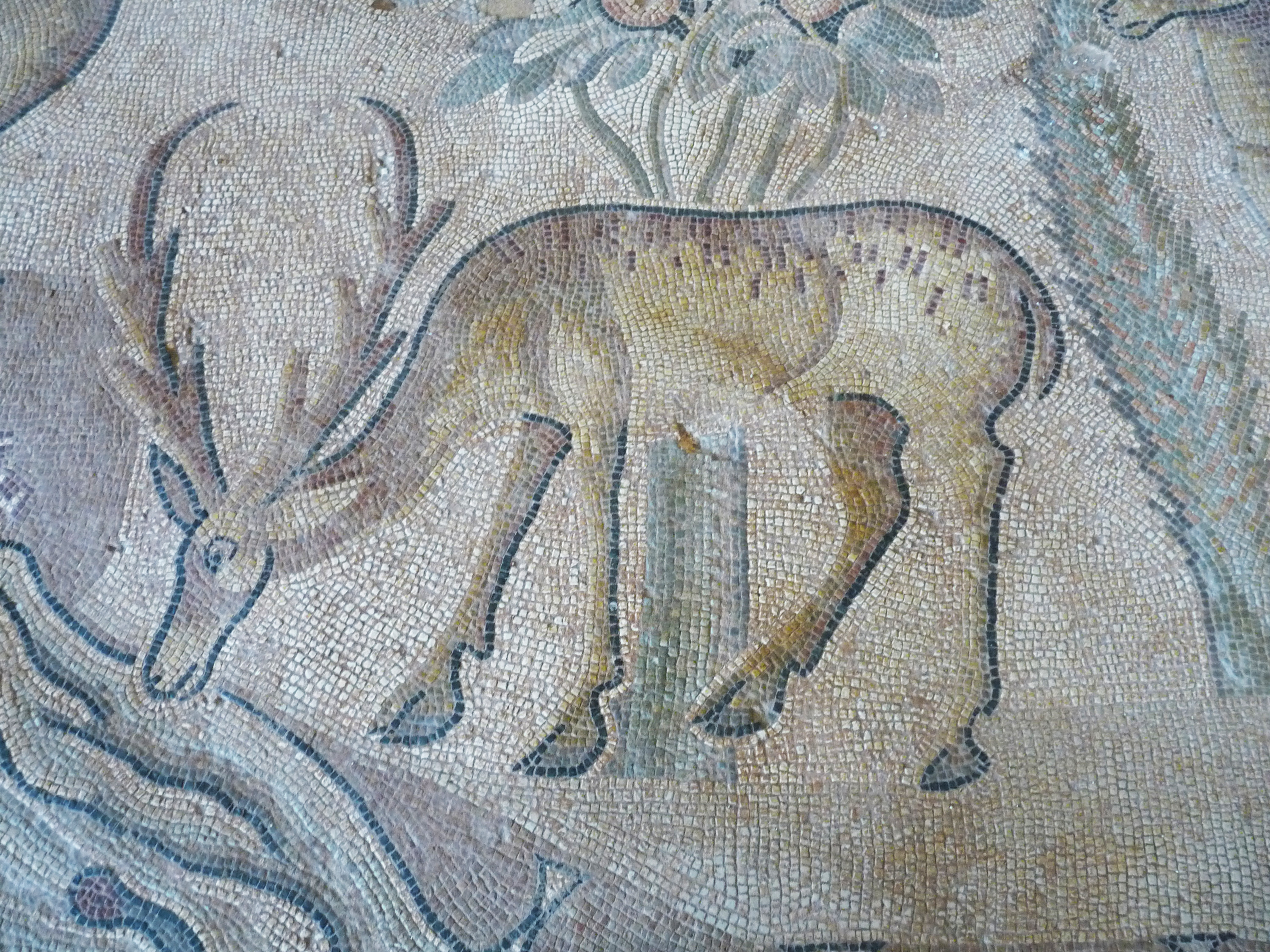
Mosaic was a common form of late antique decoration in places of worship. Here are two examples from Syria:
Mosaics from the ancient Tell Aar church, including a chi-rho monogram with an alpha and omega (foreground) and peacocks flanking an amphora (background), housed in the Maarat al-Numan Museum, Syria. Photo: Sean Leatherbury / Manar al-Athar.Deer drinking from a stream, 5th century. Mosaic, Church of the Martyrs, Taybat al-Imam, Syria. Photo: Jane Chick / Manar al-Athar.
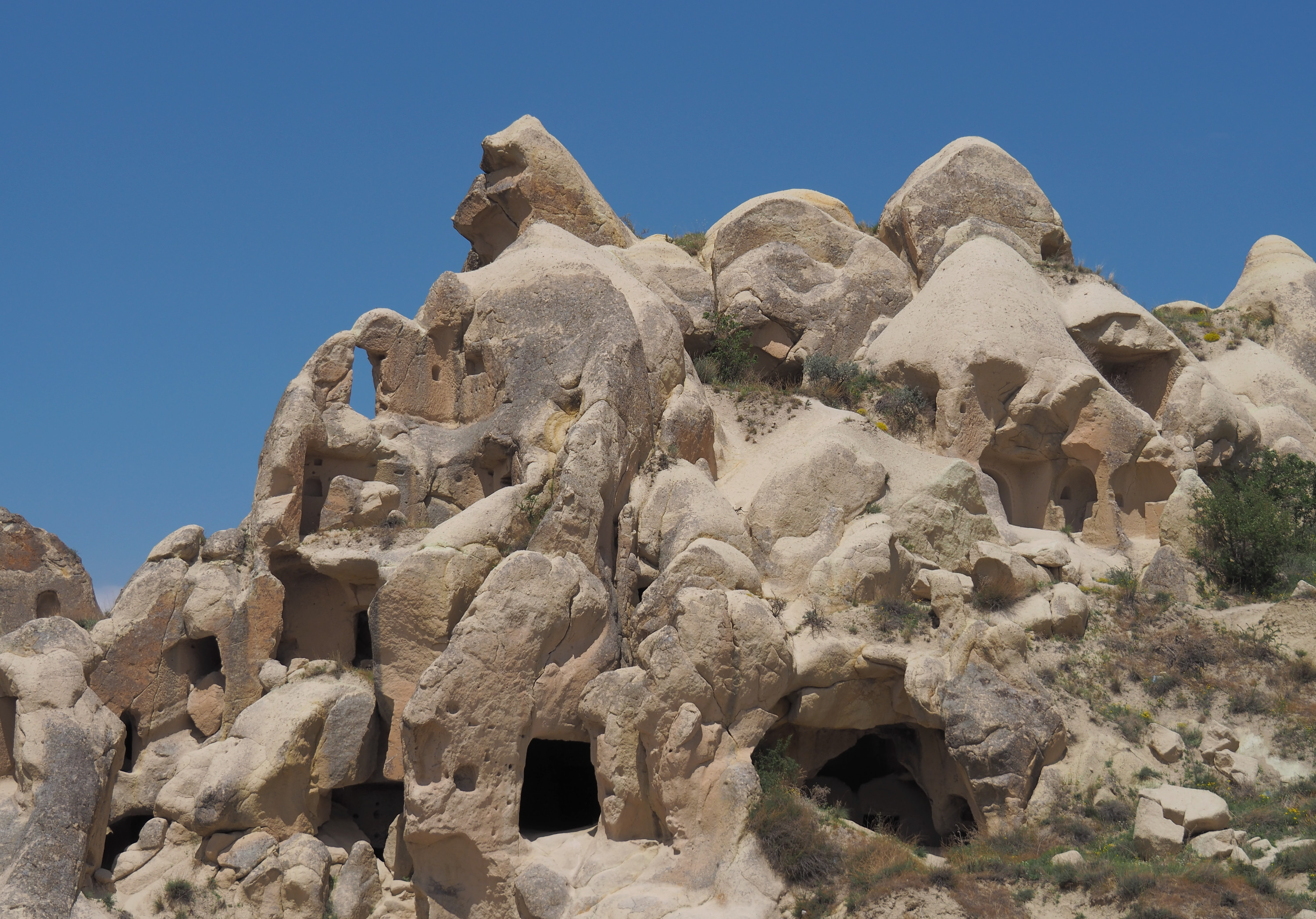
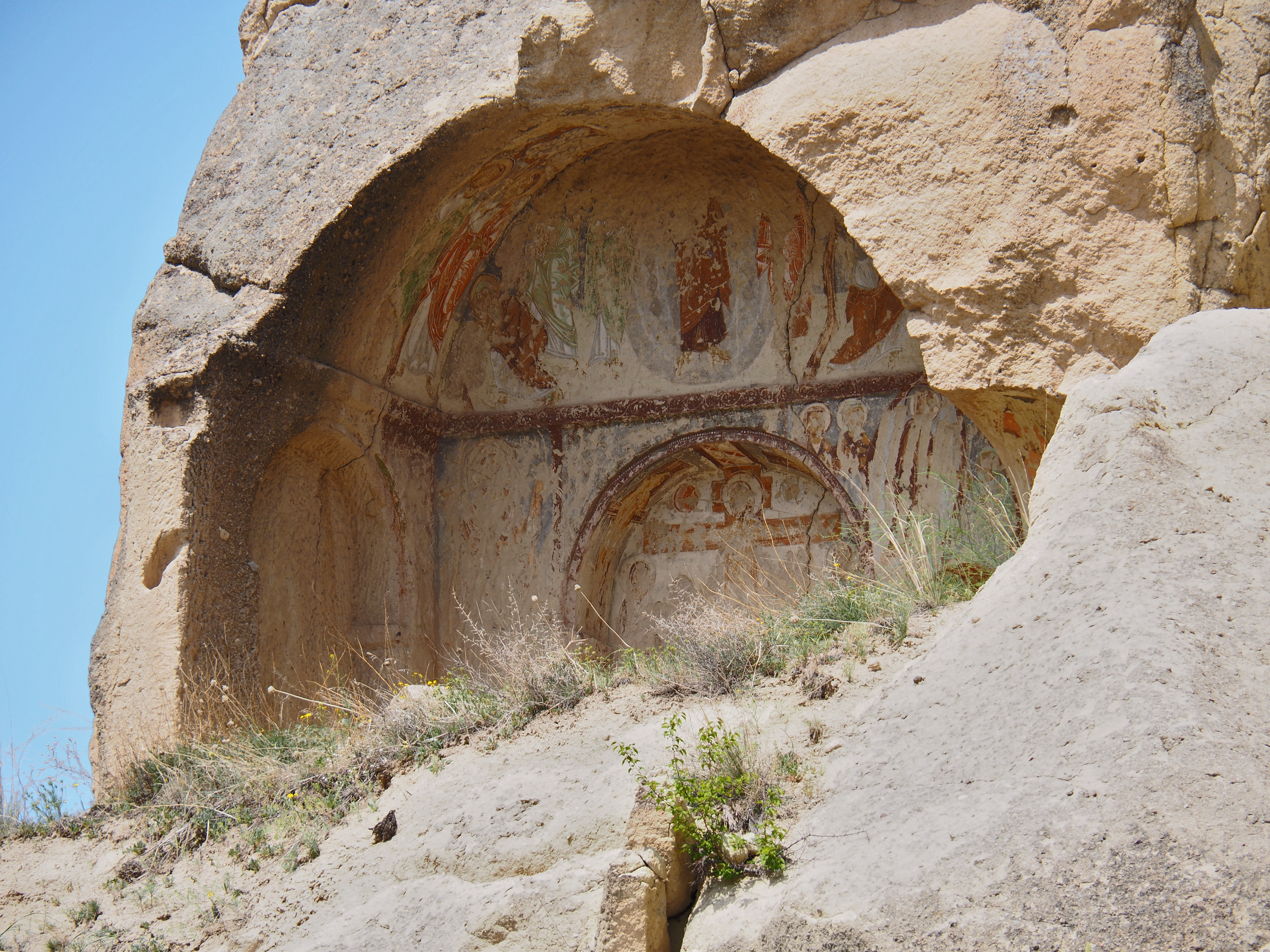
To the north of Syria in Turkey—cataloged by Manar al-Athar under “Anatolia,” the ancient name for the peninsula that comprises the majority of the country—there are the Cappadocian cave churches, hewn out of volcanic tufa. They began to be built in the fifth century, with a boom happening in the ninth through eleventh centuries, which is the period to which almost all the surviving paintings can be dated. There are over a thousand such churches, some very simple inside, and others elaborately painted. The architecture has been described as eccentric and enchanting. I like to imagine the monks, nuns, and other Christians who worshipped there all those centuries ago.
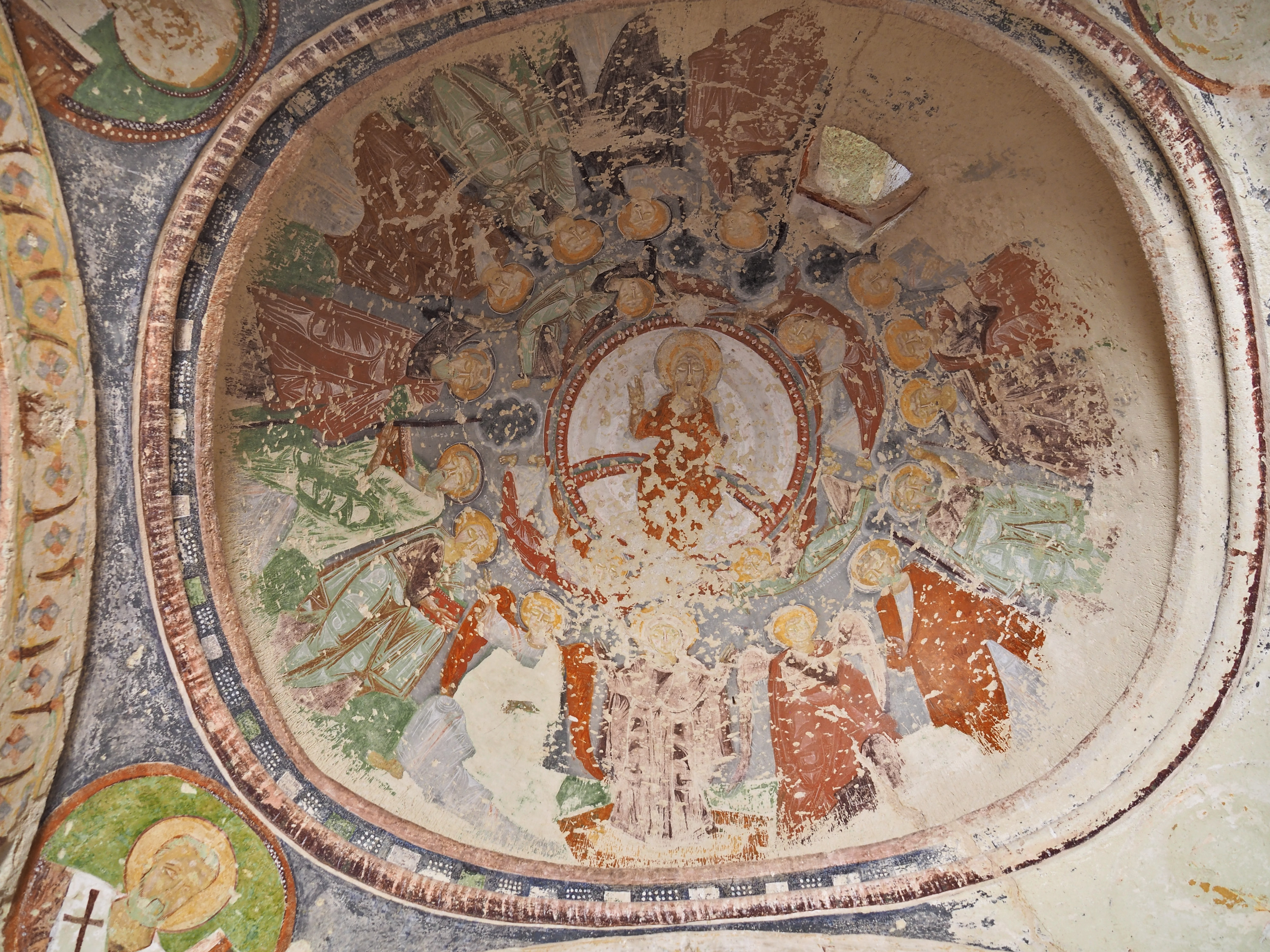
Middle Byzantine cave church, Göreme Open Air Museum, Cappadocia, Turkey. Photo: Marlena Whiting / Manar al-Athar.Frescoes depicting the Crucifixion and the Transfiguration, from a rock-cut chapel at the Göreme Open Air Museum, Cappadocia, Turkey. Photo: Marlena Whiting / Manar al-Athar.The Ascension of Christ, 10th century. Dome fresco, Church of the Evil Eye (El Nazar Kilise), Göreme, Cappadocia, Turkey. Photo: Marlena Whiting / Manar al-Athar.
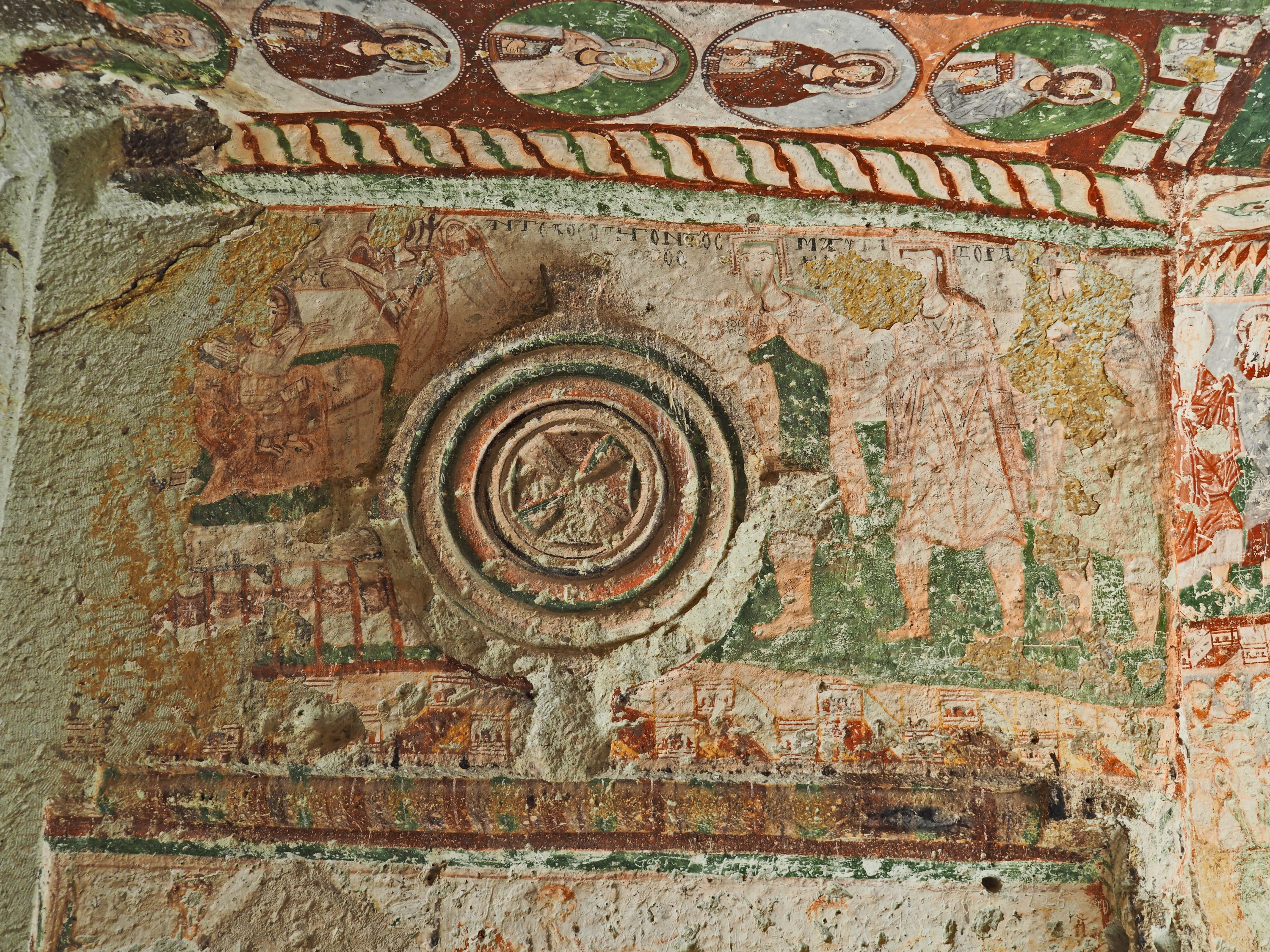
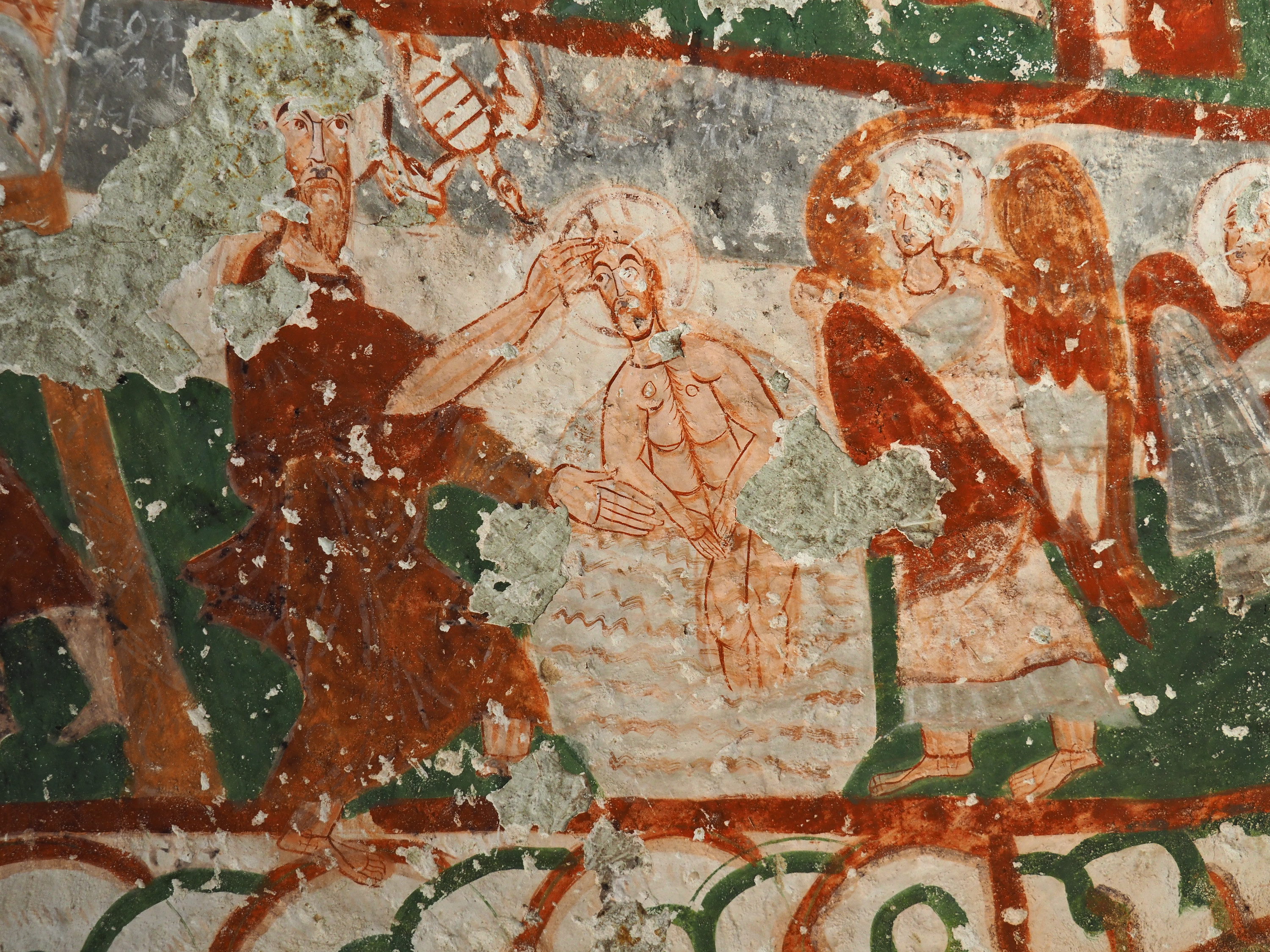
One of the cave churches in Cappadocia, part of an ancient monastic settlement, is Pancarlik Church, home to an impressive fresco cycle on the Life of Christ that’s painted mainly in rusty red and bean green.
Adoration of the Magi fresco and Greek cross relief carving, probably early 11th century. Pancarlik Church, Cappadocia, Turkey. Photo: Marlena Whiting / Manar al-Athar.The Baptism of Christ, probably early 11th century. Fresco, Pancarlik Church, Cappadocia, Turkey. Photo: Marlena Whiting / Manar al-Athar.
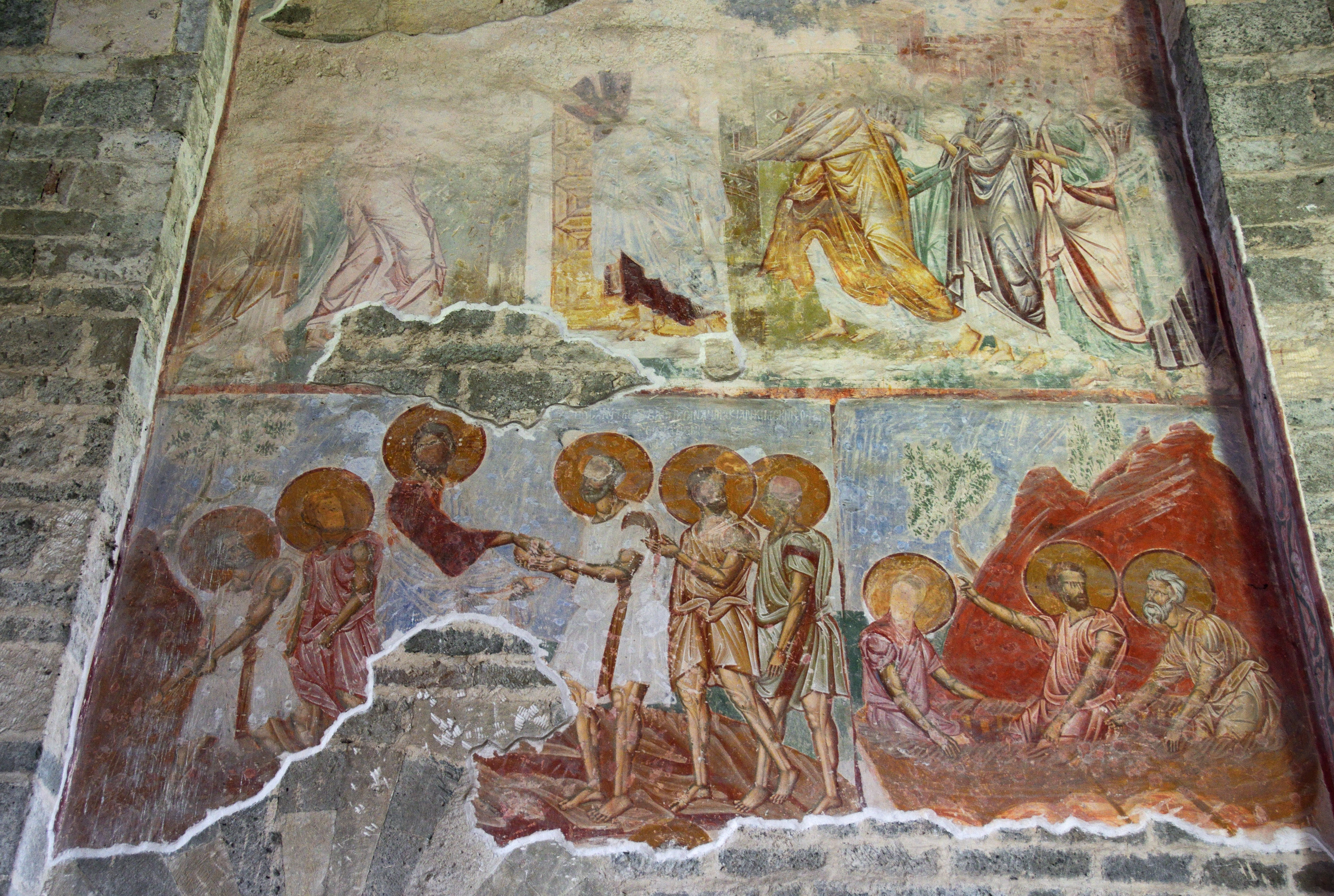
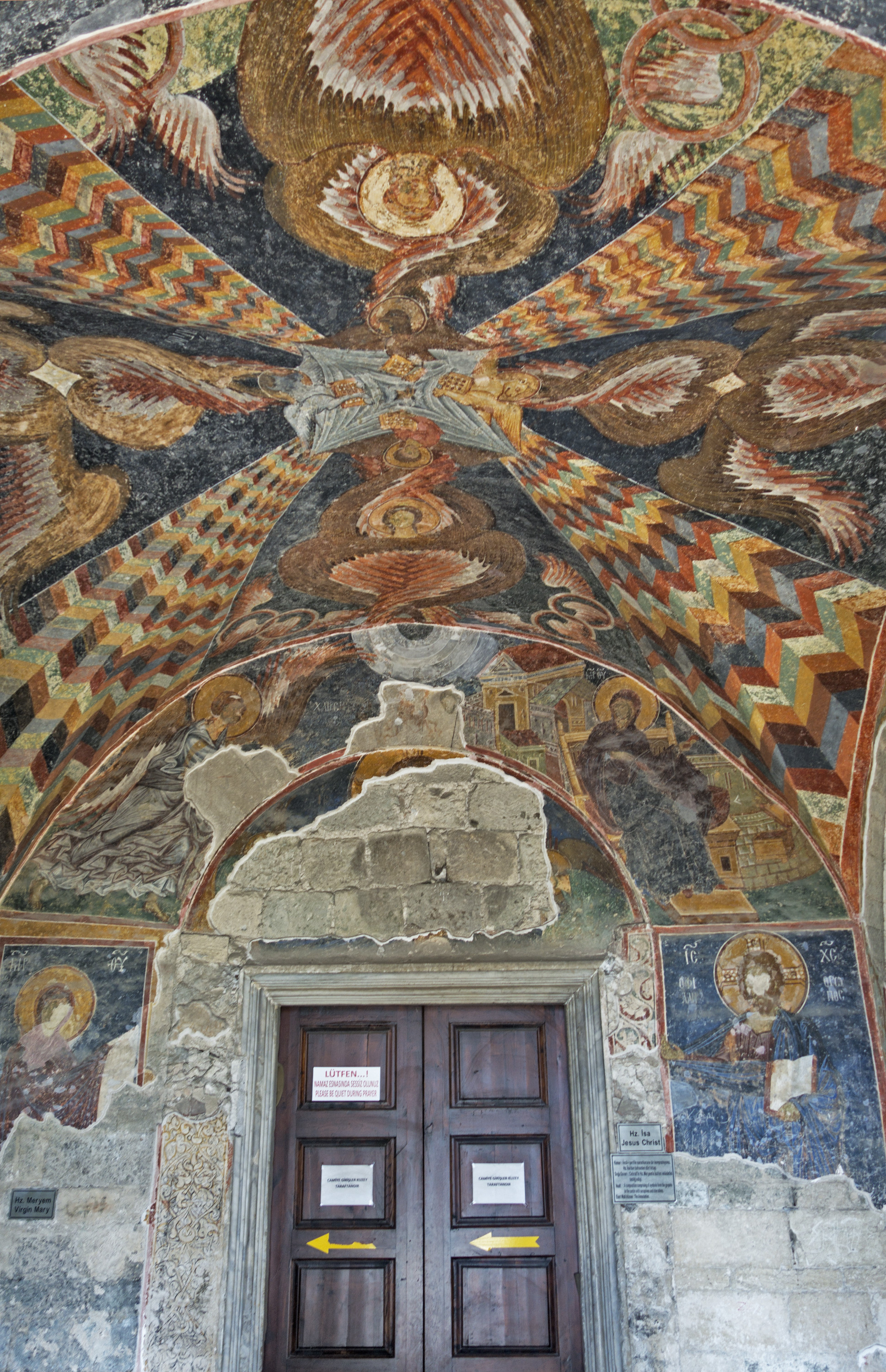
Beyond Cappadocia but also in Turkey is Hagia Sophia (Holy Wisdom) in Trabzon, not to be confused with the more famous Hagia Sophia in Istanbul, 650 miles away. Originally a Greek Orthodox church, it was converted into a mosque following the conquest of Trabzon (then called Trebizond) by Mehmed II in 1461. During prayer the frescoes in the nave, made by Christians who built and previously occupied the space, are covered by curtains to honor the Islamic prohibition against images—the veils are pulled aside during tourist hours—while the frescoes in the narthex remain uncovered at all times.
The Incredulity of St. Thomas (top) and The Risen Christ Appears on the Shore (bottom), late 13th century. Frescoes, Hagia Sophia (Aya Sofya Mosque), Trabzon, Turkey. Photo courtesy of Manar al-Athar.
One of the frescoes shows Christ appearing to his disciples after his resurrection on the shore of the Sea of Galilee. He hands a fish and a loaf of bread to Peter, who stands at the front of the group, so that they can all share a joyous breakfast together after the tragic, upending events of the previous week.
Frescoed narthex, late 13th century, Hagia Sophia (Aya Sofya Mosque), Trabzon, Turkey. Photo: Matthew Kinloch / Manar al-Athar.
Another fresco, on the vaulted ceiling of the narthex, shows the four living creatures of Revelation 4—long interpreted by Christian artists as symbols of the Four Evangelists—situated along the four sides of the canopy of the heavens, each holding a golden Gospel-book and surrounded by seraphim and blazes of rainbow light.
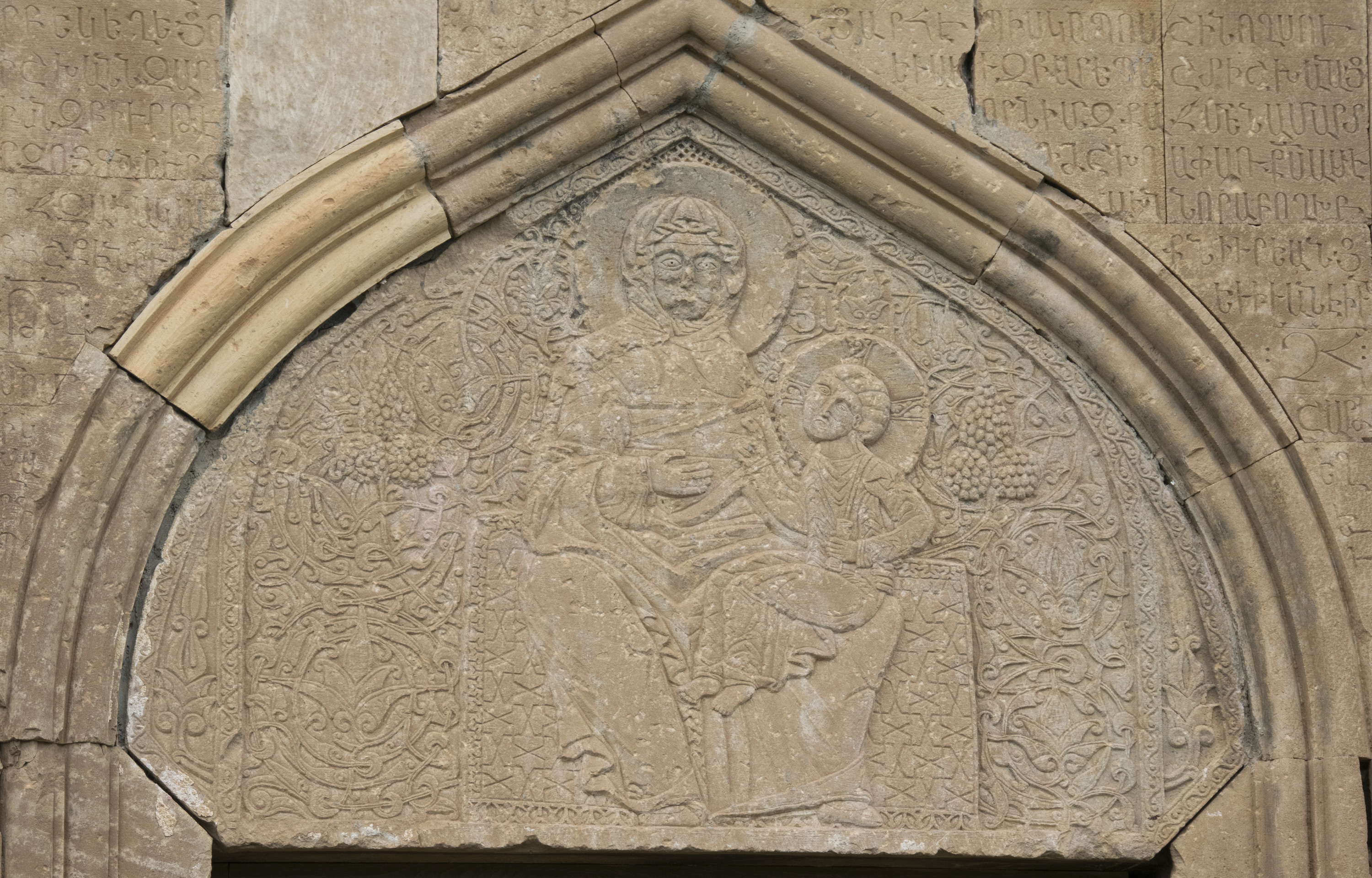
In the Caucasus region, Armenia has a long and rich tradition of Christian art, especially relief carving and painting, as the faith took root there early on in the fourth century.
Momik Vardpet, Virgin and Child, ca. 1321. Carved tympanum, west portal, Church of St. Astvatsatsin (Holy Mother of God), Areni, Armenia. Photo courtesy of Manar al-Athar.
Overlooking the village of Areni on the eastern bank of the river Arpa is the Church of St. Astvatsatsin, which has a beautiful relief carving in the tympanum above the west portal by the Armenian architect, sculptor, and manuscript illuminator Momik Vardpet (died 1333). It depicts the Christ child seated on the lap of his mother, holding a scroll in one hand and raising the other in blessing. Decorative vines rise up behind and around the pair, suggesting verdancy.
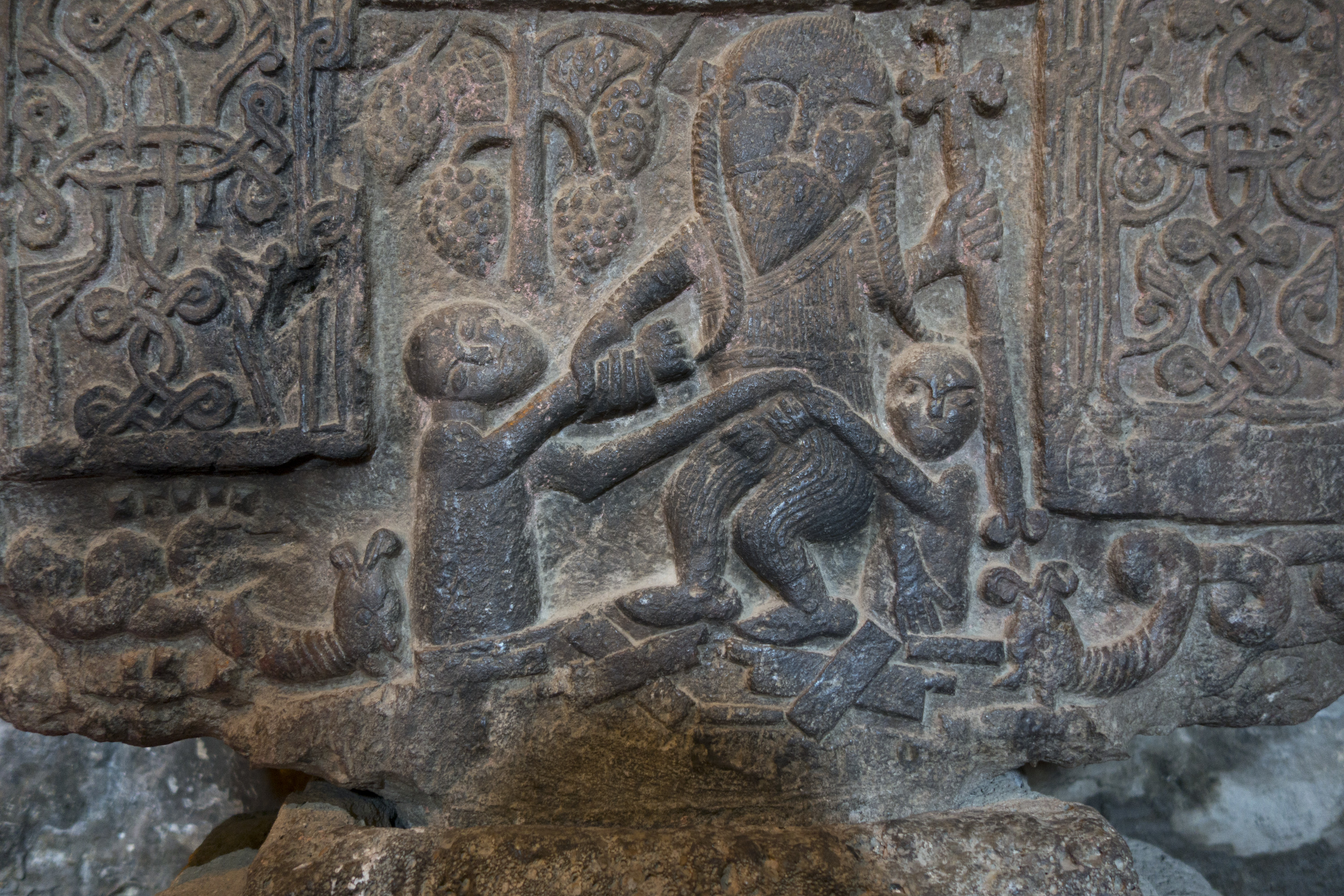
The most distinctive Christian art form in Armenia is the khachkar, a carved memorial stele bearing a cross and often botanical motifs, and only occasionally a Christ figure. In the village of Sevanavank, at a different Church of St. Astvatsatsin, there’s a particularly striking khachkar that portrays the crucified Christ in the center, and below that, a scene of the Harrowing of Hell.
The Harrowing of Hell, detail of a khachkar from the Church of St. Astvatsatsin (Holy Mother of God) in Sevanavank, Armenia. Photo: Matthew Kinloch / Manar al-Athar. [view full khachkar]
Holding aloft his cross as a scepter, the risen Christ breaks down the gates of death and rescues Adam and Eve, representatives of redeemed humanity, while serpents hiss vainly at his heels. I’m struck by the uniqueness of Christ’s hair, which flows down in two long braided pigtails. Was this a common hairstyle for males in medieval Armenia? I have no idea.
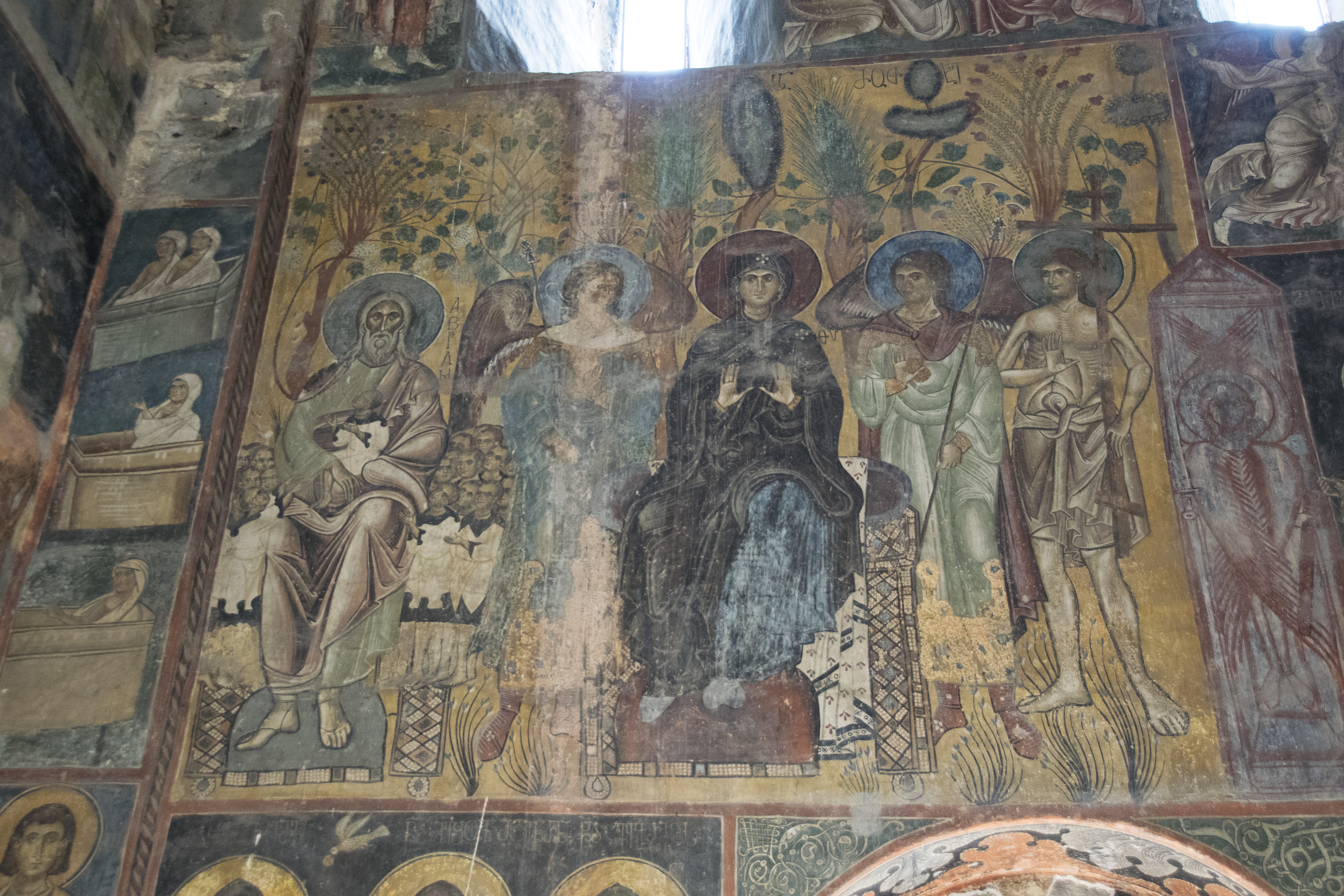
The last artwork from Armenia that I’ll share is an icon of paradise from the Church of St. Astvatsatsin (yes, it’s a popular church name in that country!) at Akhtala Monastery.
Paradise, 1205–16. Fresco, west wall, Church of St. Astvatsatsin (Holy Mother of God), Akhtala Monastery, Akhtala, Armenia. Photo courtesy of Manar al-Athar.
In the center is the Mother of God flanked by two angels. On the left is Abraham with a child, representing a blessed soul, sitting on his lap (Luke 10:22 describes how the righteous dead go to “Abraham’s bosom,” a place of repose). On the right is Dismas, the “good thief” who repented on the cross of his execution, and to whom Jesus promised paradise (Luke 23:39–43); he is venerated as a saint in the Catholic and Orthodox churches.
The image is part of a larger Last Judgment scene that covers the entire west wall. A few panels above, at the very top, Christ is enthroned on a rainbow.
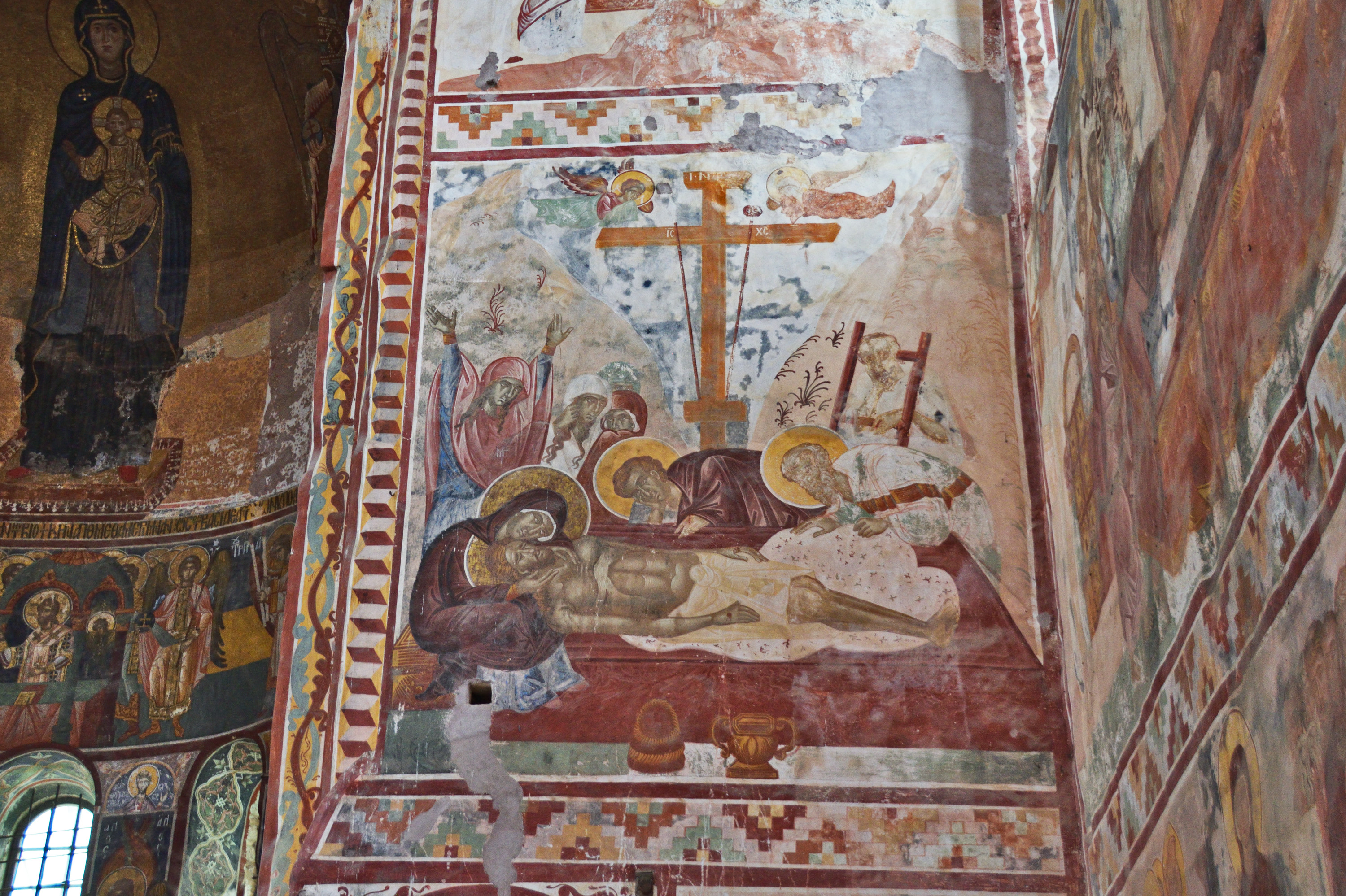
The neighboring country of Georgia has also cultivated a tradition of Christian icon painting. The main church of Gelati Monastery, founded in 1106, is richly decorated with painted murals dating from the twelfth through seventeenth centuries. One of them is the Lamentation over the Dead Christ: The Virgin Mary gently cradles the head of her son and Mary Magdalene throws her arms up in grief while the apostle John leans in close to mourn the loss and Joseph of Arimathea begins to wrap the body in a shroud.
Lamentation over the Dead Christ, fresco, Church of the Blessed Virgin, Gelati Monastery, near Kutaisi, Georgia. Photo courtesy of Manar al-Athar.
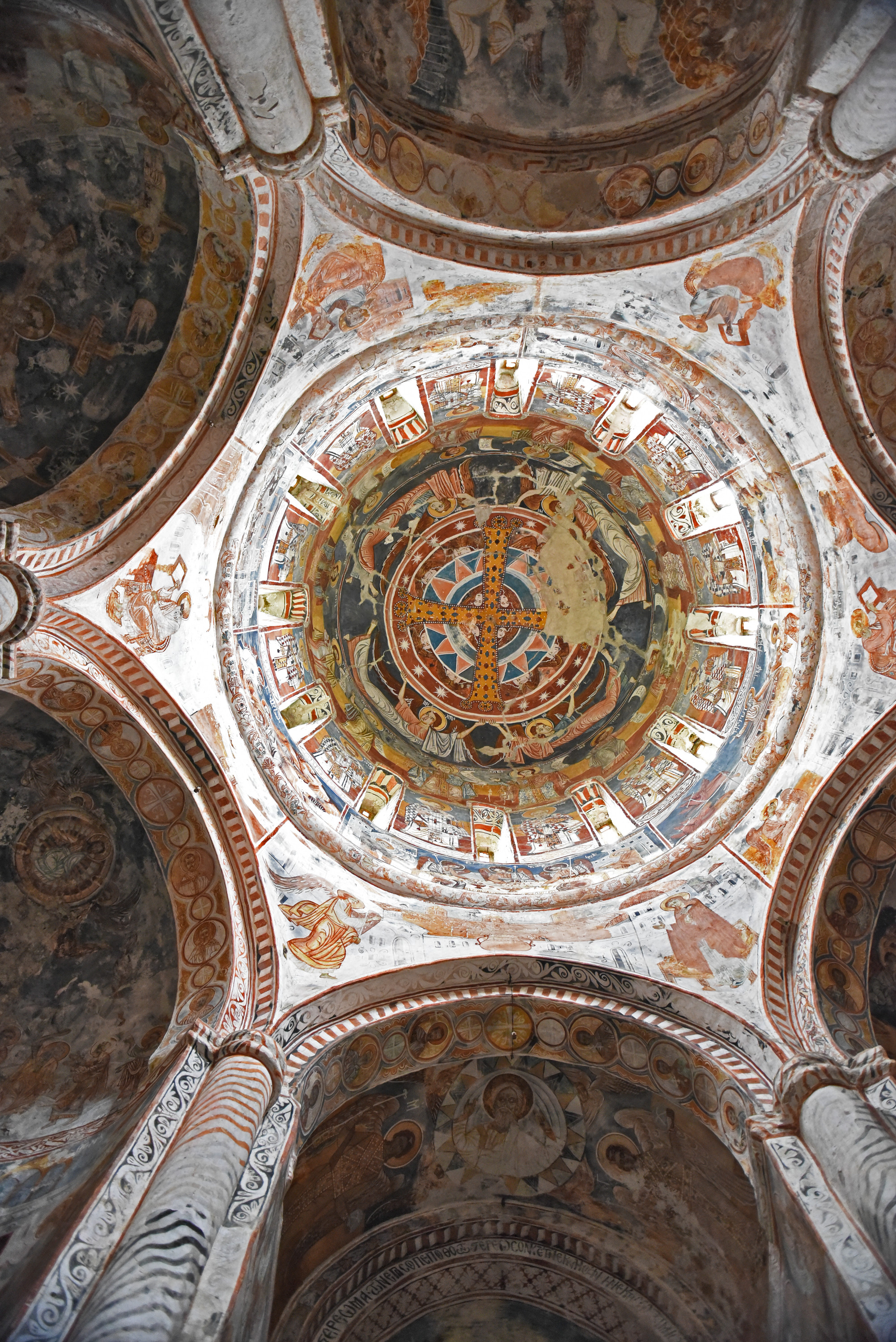
Another Georgian icon painting, from the central dome of the Church of St. Nicholas in Nikortsminda, shows angels bearing aloft a jeweled cross, surrounded by the twelve apostles.
Central dome, Church of St. Nicholas, Nikortsminda, Georgia. Photo: Ross Burns / Manar al-Athar.
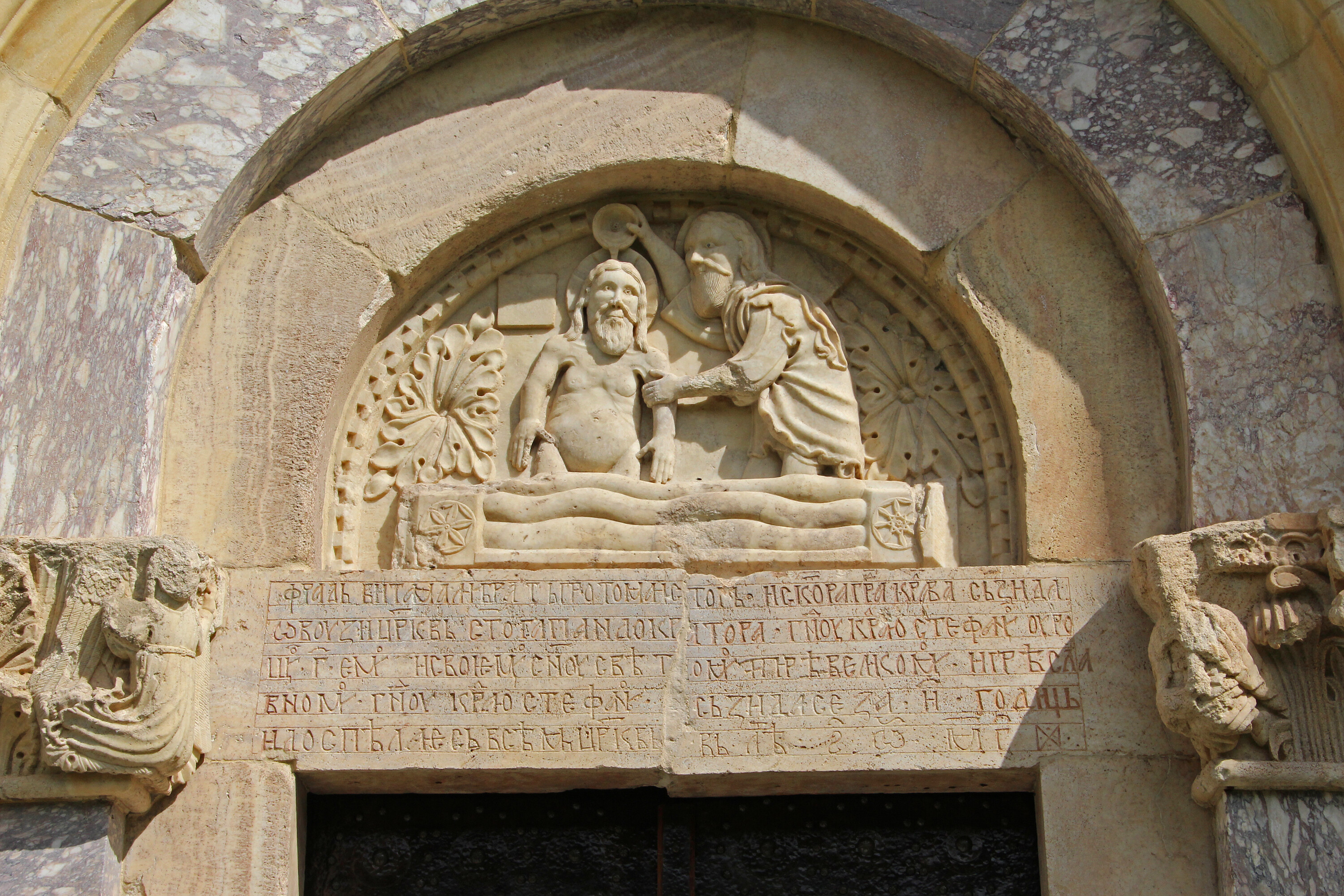
Lastly, from the Balkans, I want to point out Decani Monastery in Kosovo, a Serbian Orthodox monastery built in the fourteenth century in an architectural style that combines Byzantine and Romanesque influences. The tympana of its katholicon (main church) lean into the Romanesque. The one over the south entrance portrays John baptizing Jesus in the river Jordan, and the Serbian inscription below describes the monastery’s founding.
The Baptism of Christ, 1327–35. Carved tympanum, south portal, Christ Pantocrator Church, Decani Monastery, near Deçan, Kosovo. Photo: Mark Whittow / Manar al-Athar.
It’s important to note that this is one of a number of churches from the Manar al-Athar archive that are still active sites of Christian worship, where communities of believers are nurtured through word, image, and sacrament.
If you are interested in volunteering with Manar al-Athar—helping with image processing, labeling, fundraising, or web building—or if you have taken any photographs that may be of interest to the curatorial team, email manar@classics.ox.ac.uk.
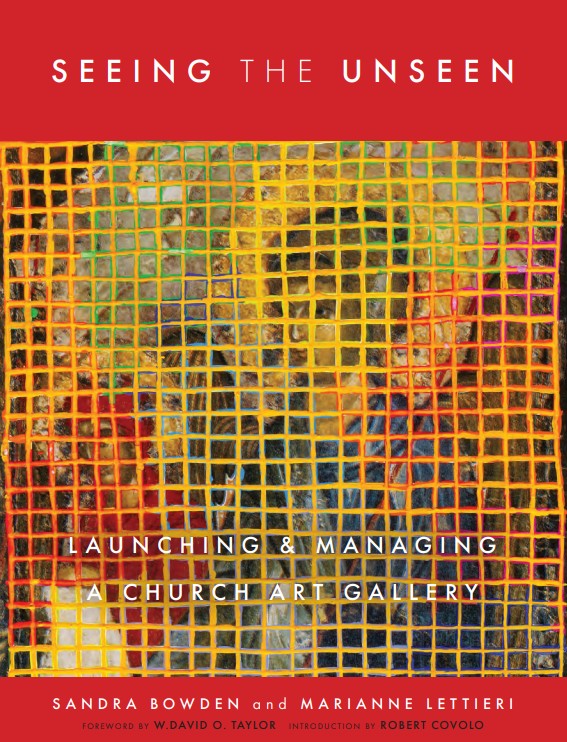
FREE E-BOOK: Seeing the Unseen: Launching and Managing a Church Art Gallery by Sandra Bowden and Marianne Lettieri: I own a copy of the original 2015 edition of this book written by two wise, experienced friends of mine and published by the now-defunct Christians in the Visual Arts; this revised edition, published this year by Square Halo Books, includes all-new images and other updates. It’s an excellent resource for churches looking to start an art gallery, covering the logistics of defining the gallery program, designing the gallery space, funding the gallery, organizing exhibits and juried shows, handling art, engaging viewers, and more. The authors and publisher are generously making it available for free download!
+++
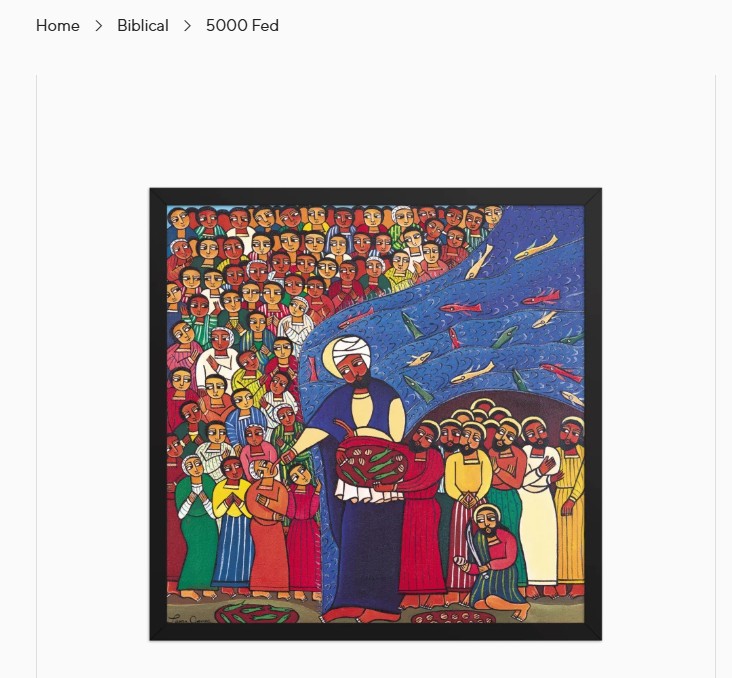
New this summer, the popular artist Laura James [previously], who frequently paints biblical subjects, now has a simple form on her website through which you can license digital image files of hers for use in publications, presentations, or websites: https://shop.laurajamesart.com/product/image-licensing/.
Screenshot from laurajamesart.com: Laura James (American, 1971–), 5000 Fed, 1999
Also, folks often ask me where they can purchase affordable art: Check out James’s online store, as she sells giclée prints of many of her paintings.
+++
ESSAY: “Toward a Genuine Dialogue between the Bible and Art” by J. Cheryl Exum: J. Cheryl Exum (1946–2024) was a Hebrew Bible scholar renowned for her work on the Song of Songs, feminist biblical studies, and the reception of the Bible in culture and art history. In much of her writing and teaching she staged a dialogue between biblical texts and biblical art, the latter of which, she said, constitutes a form of exegesis. She argued “for adding visual criticism to other criticisms (historical, literary, form, rhetorical, etc.) in the exegete’s toolbox—for making visual criticism part of the exegetical process, so that, in biblical interpretation, we do not just look at the text and the commentaries on the text but also at art as commentary.” More than simply enhancing our appreciation of a biblical text, art “can point to problematic aspects of the text and help us ‘see’ things about the text we might have overlooked, or enable us to see things differently.”
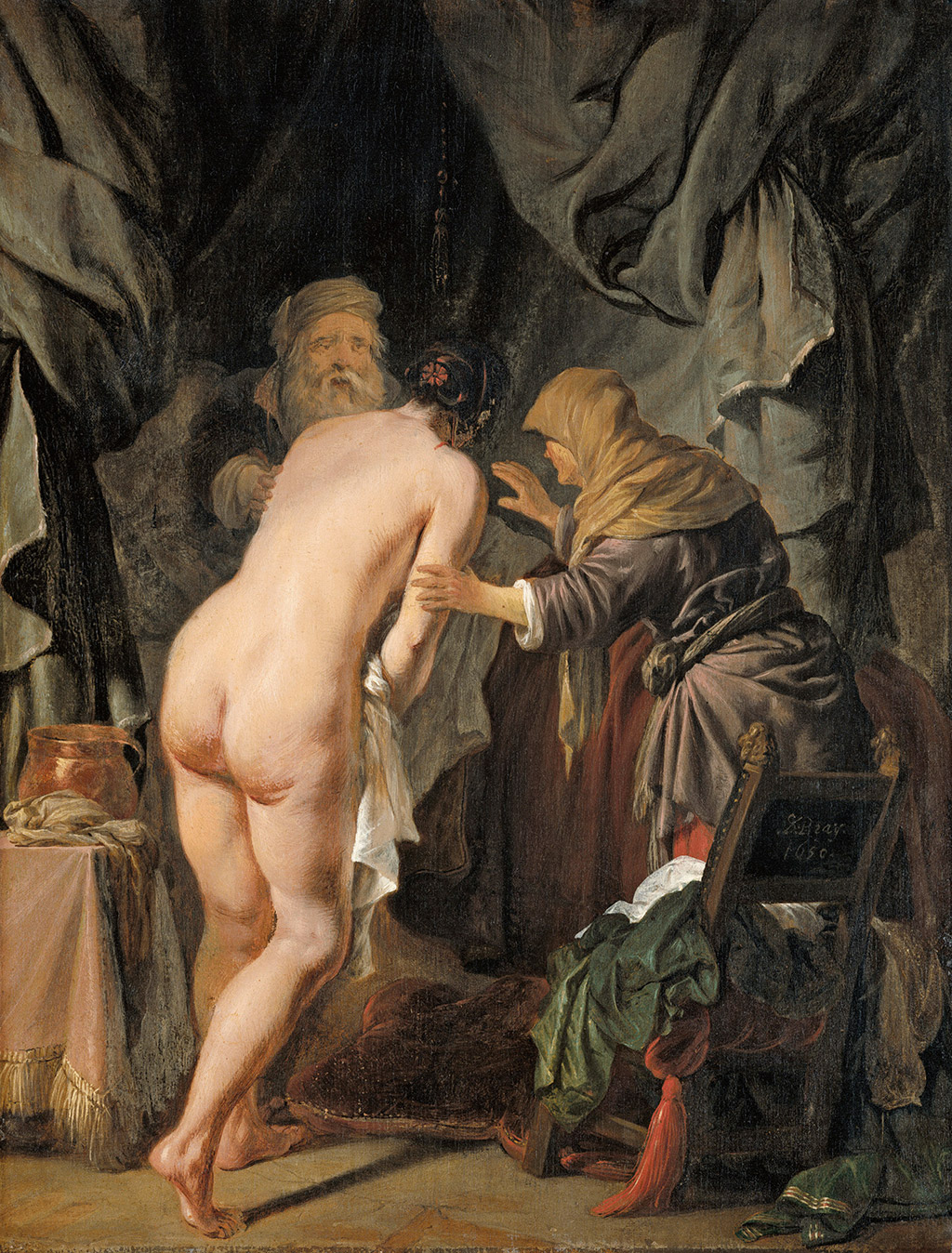
In this paper from 2012, Exum examines two episodes from the life of Hagar: the Expulsion of Hagar and Ishamel (Gen. 21:8–14), and Sarah Presenting Hagar to Abraham (Gen. 16:3–4). I found the second section particularly illuminating in how it addresses a narrative gap in Genesis 16, which is Hagar’s being raped (made to have sex without her consent) by Abraham at Sarah’s behest. Customary in many ancient patriarchal societies, the use of slaves to bear children for one’s family line is what is dramatized in the popular novel-turned-TV series The Handmaid’s Tale. Exum looks at six seventeenth-century paintings of Sarah leading a reluctant and sometimes humiliated Hagar, who tries in vain to cover her nakedness, into Abraham’s bed. “These paintings,” Exum writes, “require us to consider what assumptions about women and slaves and their rights to their bodies lie behind the biblical narrator’s simple ‘he went in to her and she conceived’, assumptions commentators too readily ignore.”
Salomon de Bray (Dutch, 1597–1664), Hagar Brought to Abraham by Sarah, 1650. Oil on panel, 31.2 × 23.5 cm. Agnes Etherington Art Centre, Queen’s University, Kingston, Ontario.
In the final section of the paper, Exum considers a disturbing verse in the Song of Songs that has stumped commentators but that the artist Gustave Moreau chose to visually interpret.
+++
POEM: “He Who Sees Hagar”by Michelle Chin: “She buys me for my birth canal / but beats me for the birth. / I despise her . . .” Published in Reformed Journal.
+++
VIDEO SERIES: Dramatic Encounters (proof of concept pilot), created by Martin J. Young: Martin J. Young, a UK-based speaker, writer, and mentor to church leaders and creatives, is developing a film series with writer-director Ethan Milner of Cedar Creative that explores people’s dramatic encounters with Jesus in John’s Gospel. Inspired in part by David Ford’s The Gospel of John: A Theological Commentary (Baker Academic, 2021), the series will adapt particular gospel stories to screen and, uniquely, will include a documentary component that highlights the creative process from start to finish.
Each episode will consist of four primary elements (expanded from the three showcased in the pilot):
The Roundtable, a conversation with theologians, pastors, and artists about the given gospel story, examining its form, meaning, themes, and interpretations
The Rehearsal, in which the actors, informed by the roundtable discussion, work out how to perform the story, choosing facial expressions, postures and movements, vocal tones and inflections
Behind-the-Scenes, exploring the various cinematographic choices made by Milner and his filmmaking team (e.g., sets, lighting, framing, editing, scoring)
The Film, a roughly ten-minute drama that brings the gospel story to life
The proof of concept pilot episode below is based on John 12:1–8, in which Mary of Bethany anoints Jesus with expensive perfume, much to Judas’s chagrin. The short starts at 24:13. I’m impressed by the quality! And the “voyage of discovery” approach of the overall episode—wrestling with scripture in preparation for inhabiting its characters, and translating it into a filmic narrative—pays off, as viewers are granted insight into the crafts of acting, filmmaking, and literary adaptation.
Young is seeking funding to produce and distribute a season of eight to ten episodes. (None have been made yet.) If you’re interested in helping out financially, visit https://www.cedarcreative.net/encounters, and click “Donate Today.” Explore more at https://this-is-that.com/.
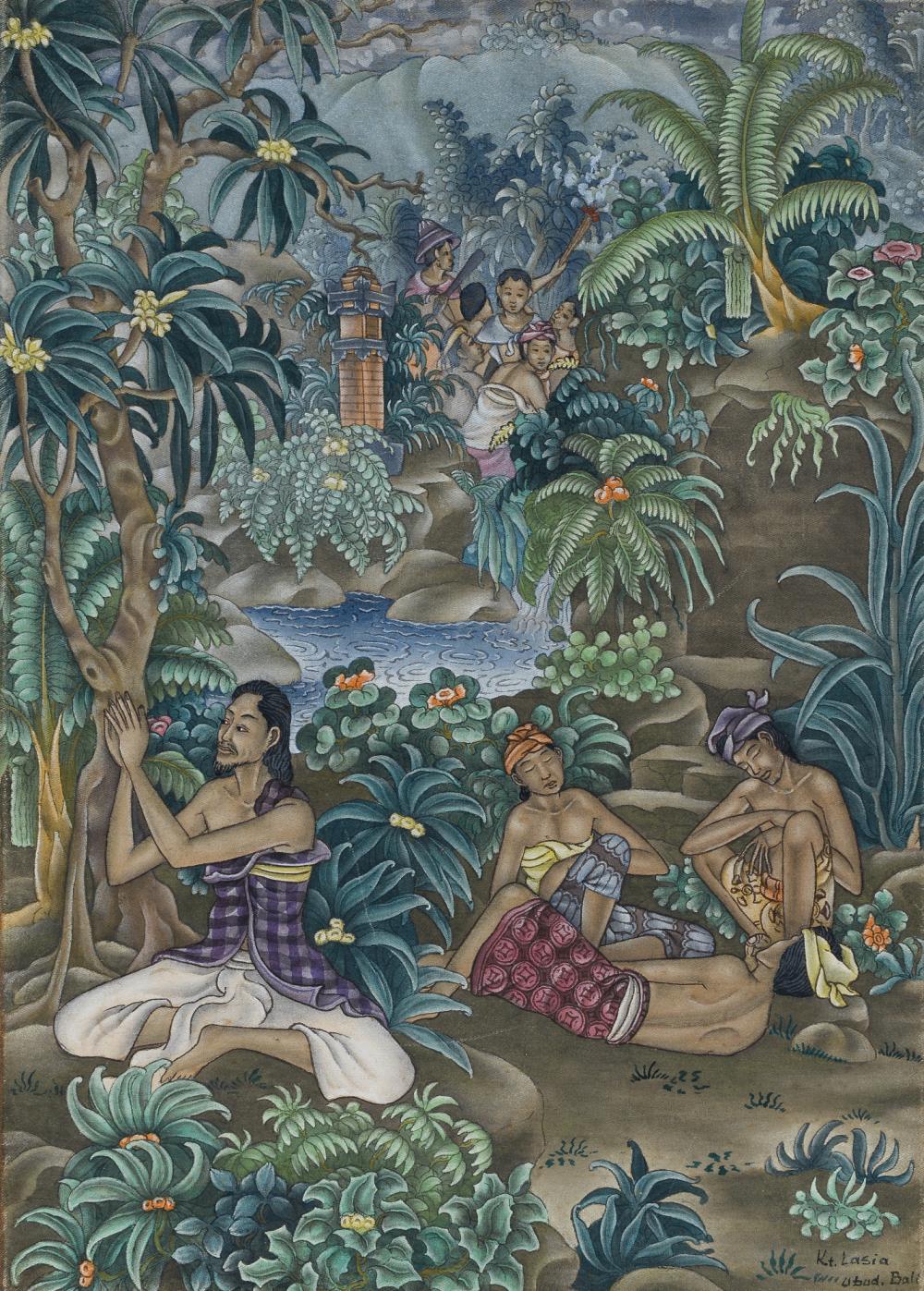
BROADCAST NEWS SEGMENT: “Ketut Lasia: The Last Generation of Ubud Traditional Painters,” UTV Televisi Indonesia, January 7, 2025: This three-minute video was filmed in the home studio of Ketut Lasia (born 1945), one of the last traditional Balinese painters, who studied under I Wayan Turun (1935–1986) and is still active at age eighty. As an adult, Lasia converted from Hinduism to Christianity, and he paints primarily biblical scenes. The video shows his visual interpretations of Jesus calming the storm, Jesus’s entry into Jerusalem, the miraculous catch of fish, the Crucifixion, Jesus in the house of Mary and Martha, and the Ascension.
Ketut Lasia (Indonesian, 1945–), Gethsemane, n.d. Acrylic on canvas, 61 × 43 cm.
+++
ESSAY: “Christian Art in Indonesia” by Volker Küster, Karel Steenbrink, and Rai Sudhiarsa: This chapter is from the thousand-page, open-access book A History of Christianity in Indonesia, edited by Karel A. Steenbrink and Jan S. Aritonang (Brill, 2008). The authors discuss the development of an indigenized Indonesian Christian art, starting with the West Javanese sculptor Iko, a Muslim who worked in both wood and stone and fulfilled commissions for the (Catholic) Sacred Heart Chapel on the premises of the Joseph Schmutzer sugar estate in Ganjuran in the 1920s. They then cover a handful of artists who came in the wake of the Second Vatican Council in the 1960s and amid the global trend toward contextual theology promoted by international Protestantism—focusing especially on the most famous two, Bagong Kussudiardja (1929–2004) [previously] and Nyoman Darsane (1939–2024), both Christian converts.
Iko, Christ the King with Angels, 1924–27. Jati wood. Missiemuseum Steyl, Limburg Province, Netherlands. Photo: Fred de Soet, 2019.Crucifixion batik by Bagong Kussudiardja, Yogyakarta, Indonesia. Private collection, Geneva. Jesus is rendered in the style of a Javanese shadow puppet. Source: On a Friday Noon by Hans-Ruedi Weber (Eerdmans / World Council of Churches, 1979)Nyoman Darsane, Creation of Sun and Moon, 1979
(This essay is not to be confused with the one I shared in 2022, where Volker Küster profiles five Christian artists from Yogyakarta, including one overlap with this present essay.)
+++
VIDEO PROMO:“OMSC Artist in Residence Program”: “Each year, the director of the Overseas Ministries Study Center at Princeton Theological Seminary (OMSC@PTS) invites one Artist in Residence to the Princeton campus to stay with us for a full academic year (September to May). Since its inauguration in 2001, the OMSC Artist in Residence program has hosted outstanding artists from the global South. Today, OMSC’s art collection is comprised of over one hundred fifty pieces, many of which are now on display throughout the campus of Princeton Theological Seminary. They represent some of the finest work being done by contemporary artists who are Christian.” Artists include Sawai Chinnawong (Thailand), Nalini Jayasuriya (Sri Lanka), Wisnu Sasongko (Indonesia), and Emmanuel Garibay (Philippines), among others.
The current OMSC artist in residence is KimyiBo, a Korean American artist based in Berlin. Explore more at http://www.omsc.org/.
+++
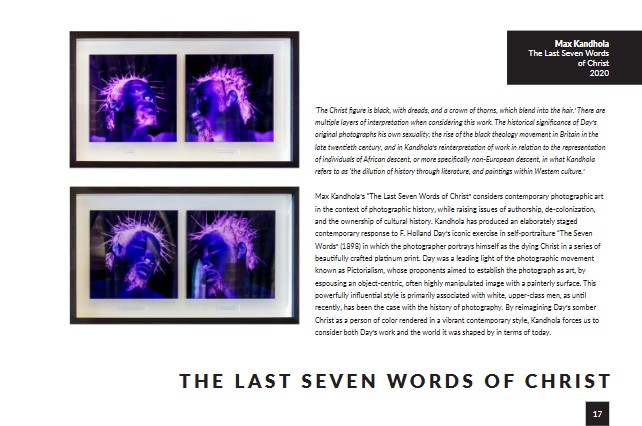
EXHIBITION CATALOG: Global Images of Christ: Challenging Perceptions: This free digital catalog documents an art exhibition that ran from September 25 to October 30, 2021, at Chester Cathedral in the UK. Artists include Lorna May Wadsworth, Max Kandhola, Silvia Dimitrova, John Muafangejo, Solomon Raj, Jyoti Sahi, and more.
+++
FIJIAN HYMN: “Oqo Na Noqu Masu” (This Is My Prayer): This Christian hymn is sung regularly in Fiji in churches and at rugby training camps and matches. The lyrics translate roughly to: “Lord, this is my prayer. I need your help in my time of need. I will always praise your name, and I ask that you grant me the desires of my heart. I sing and cry to you, Lord—to you and you alone. Hallelujah.” Here are some examples:
>> From the Rugby League World Cup, Fiji v. USA, 2017:
>> Again, the Fiji Bati rugby team singing before a match, this time against Papua New Guinea in 2022:
>> And here’s the hymn in a church context—sung by the Nawaka Methodist Village Choir in Nadi, Fiji:
Awareness of the deep-rooted Fijian tradition of four-part Christian hymn singing increased last summer when videos of the country’s Olympic team went viral. In the Christianity Today article “Yes, Fiji Olympians Are Singing Hymns,” Kelsey Kramer McGinnis writes,
Although Fijian hymnody grew out of Methodist songs brought by 19th-century missionaries, it has become a deeply rooted tradition that makes space for indigenous practices across the diverse country. Christianity’s connection to the legacy of colonialism in Fiji (which was a British colony from 1847 to 1970) is undeniable, but Fijian vocal music stands as an example of the ways Fijians have been contextualizing Christian worship and integrating it into their communities for nearly two centuries.
Here’s a 2024 video from a Sunday worship service at the Team Fiji camp in the Olympic Games Village in Paris, showing the team singing a different hymn, whose title and words I don’t know:
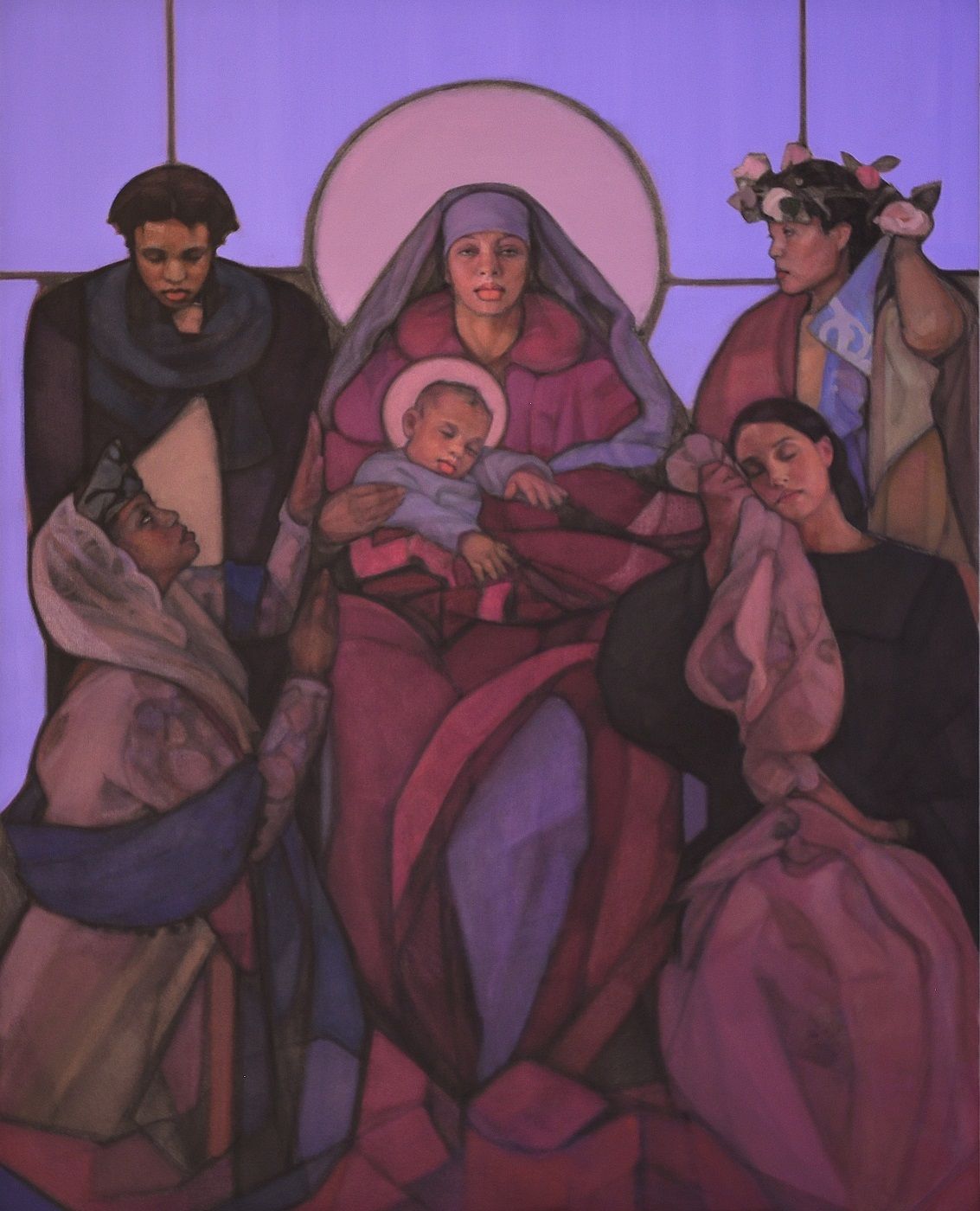
Janet McKenzie, The Divine Journey: Companions of Love and Hope, 2017. Oil on canvas, 48 × 36 in. Memorial Church, Harvard University, Cambridge, Massachusetts.Khrystyna Kvyk (Ukrainian, 1994–), The Descent into Hell, 2023. Acrylic on gessoed wood, 40 × 40 cm. Private collection.
+++
FREE ZOOM CONVERSATION: Social music with Dan Zanes, July 16, 2025, 8 p.m. ET: I met the Baltimore-based folk musicians Dan and Claudia Zanes [previously] two years ago at a local family concert they put on. Joyous, bighearted, faith-filled, community-focused, committed to social justice—I love who they are and what they’re about and all the rich music they share.
In a social mediapost on June 11, Dan posed the question, “Is there anyone out there who wants to become a music maker and help uplift their community?” Followed by a generous offer: “I can teach you how to play guitar and sing songs (and write songs if you want). No cost, this is a different approach. It will be through a series of Zoom lessons (unless you live down the street). Whether you’re a beginner or someone who’s been dabbling and wants to take it out of the house, I can get you to a confident place so you can play for and with people.” The caveat? You just have to promise to put in the practice and to share your music freely in your community! And to teach someone else what you’ve learned.
“There are so many ways to make positive social change,” Dan says, “and creating music in our communities is certainly one of them.” I believe he has already selected a set of students to take on, but having received so many messages of interest, he has also decided to host a Zoom conversation on social music this coming Wednesday evening. On July 9, he wrote on socialmedia:
Social music in chaotic times, people! Let’s talk about it. I’ve been hearing from many folks who want to be more useful in their communities and see music as the way.
Yes! Music can be healing, galvanizing, uplifting, energizing, and calming. Imagine if every community had many more music makers to play for the young folks, the elders, to lead singalongs and dance parties, to offer songs during times of loss and celebration. Of course it’s happening now, and still I believe there’s so much more that is possible.
If you’re interested in joining the meeting, send Dan an Instagram message @danzanes or a Facebook message @danandclaudiazanes and he’ll send you the link.
To give you a sense of Dan and Claudia’s vibes, here’s one of their original songs, which they debuted on their YouTube channel in 2020:
+++
ONLINE RETREAT: “Read for Your Life: Creating a Story-Formed Home” with Sarah Clarkson, August 5, 2025: Join author Sarah Clarkson [previously] for a daylong online retreat exploring children’s literature, childhood reading, and the development of imagination. “My goal,” she writes, “is to provide a vision for the beauty of the reading life, some good research, and a generous stack of practical booklists to help you begin to outfit and build a home library for the children in your life.” The cost is $35. The event begins at 9:30 a.m. UK time, but all live sessions will be recorded and offered on-demand afterward to registrants.
+++
PODCAST EPISODE: “The Green Man,”Gone Medieval, June 23, 2025: In this episode, Dr. Eleanor Janega talks with Imogen Corrigan, author of The Green Man: Myth and Reality (Amberley, 2025), about the enigmatic “green man” figure, or foliate head, which can be found in almost every pre-Reformation English cathedral and in many churches, decorating arches, corbels, roof bosses, choir stalls, and chancel screens. Corrigan claims that “the image has to be one of the most misunderstood, misinterpreted and misrepresented in the history of church carvings,” having nothing to do with pagan fertility rites. She suggests, rather, that the Green Man gestures toward the resurrection of, and resurrection in, Christ—to spiritual rebirth and eternal life.
Misericord from King’s Lynn Minster, England, ca. 1370s, depicting a Green Man disgorging oak leaves. Photo: Lucy Miller. (Click on image for great compilation!)
The two medievalists speak on location at St Mary’s at Minster-in-Thanet and St Nicholas-at-Wade in Kent. The conversation really starts to pick up at 19:47.
+++
This past month has seen the death of two rock ’n’ roll legends whose music, which played regularly on Oldies 100.7 WTRG, formed part of the soundtrack of my 1990s childhood: Brian Wilson (of the Beach Boys) and Sly Stone (of Sly and the Family Stone).
Much has been written about both trailblazers. I just want to mention two things:
1. Love and Mercy, the 2014 film directed by Bill Pohlad about Brian Wilson (played by Paul Dano and John Cusack), is excellent. Elliot Roberts makes the case that it’s the best music biopic ever made, and I’m inclined to agree; New York Times film critic Alissa Wilkinson also cites it as her favorite, at least within the rock genre. The story alternates between Wilson’s production of the Pet Sounds album in the mid-sixties and his psychological treatment under his abusive therapist and conservator Eugene Landy in the late 1980s, which coincided with his meeting Melinda Ledbetter, who would become his wife. The title is taken from one of Wilson’s solo songs from 1988. Here’s the film trailer:
2. Active from 1966 to 1983, Sly and the Family Stone was one of the very few multiracial, mixed-gender bands of the time, modeling integration when the notion was still fairly new in America. Perhaps you’ve heard their most famous hit, “Everyday People,” a call for unity across lines of difference (“There is a blue one who can’t accept the green one / For living with a fat one, tryna be a skinny one . . .”). Sly Stone was the front man—singer, songwriter, multi-instrumentalist, and producer. As is common among so many African American musicians, he got his musical start in church; from infancy, he was immersed in gospel music as a member of the Church of God in Christ, and his musical talent was nurtured there. I learned that in the fifties, he and three of his four siblings even formed a gospel group called the Stewart Four, locally releasing a single in August 1956. Here’s the B-side, “Walking in Jesus’ Name,” with a thirteen-year-old Sly singing lead:
I’m late in notifying you about my June 2025 playlist (a random compilation of faith-inspired songs I’ve been enjoying lately), but be sure to check it out on Spotify.
Romare Bearden (American, 1911–1988), The Block, 1971. Cut-and-pasted printed, colored, and metallic papers, photostats, graphite, ink marker, gouache, watercolor, and ink on Masonite, 4 × 18 ft. (121.9 × 548.6 cm). Metropolitan Museum of Art, New York. Photo: Victoria Emily Jones.
+++
PODCAST EPISODE: “The Body as Sacred Offering: Ballet and Embodied Faith” with Silas Farley, For the Life of the World, April 30, 2025: An excellent interview! “Silas Farley, former New York City Ballet dancer and current Dean of the Colburn School’s Trudl Zipper Dance Institute, explores the profound connections between classical ballet, Christian worship, and embodied spirituality. From his early exposure to liturgical dance in a charismatic Lutheran church to his career as a professional dancer and choreographer, Farley illuminates how the physicality of ballet can express deep spiritual truths and serve as an act of worship.”
I was especially compelled by Farley’s discussion of turnout, the rotation of the leg at the hips—foundational to ballet technique. It gives the body an “exalted carriage” and allows for “a more complete revelation of the body,” he says, because you see more of the leg’s musculature that way. This physical positioning, he says, reflects the correlative “spiritual turnout” that’s also happening in dance, and that Christians are called to in life—a posture of openness and giving. He cites the theological concept of incurvatus in se, coined by Augustine and further developed by Martin Luther, which refers to how sin curves one in on oneself instead of turning one outward toward God and others.
Farley also discusses how liturgical dance is like and unlike more performative modes of dance (“liturgical dance . . . is a kind of embodied prayer . . . a movement that goes up to God out of the body”); how discipline and freedom go together; the body as instrument, and how dancers cultivate a hyperawareness of their bodies; the two basic design elements of ballet, the plié and the tendu, and their significance; his formation, from ages fourteen to twenty-six, under the teaching of Rev. Dr. Tim Keller at Redeemer Presbyterian Church; the Four Loves ballet he choreographed on commission for the Houston Ballet, based on a C. S. Lewis book (see promo video below, and his and composer Kyle Werner’s recent in-depth discussion about it for the C. S. Lewis Foundation); Songs from the Spirit, a ballet commissioned from him by the Metropolitan Museum of Art (see next roundup item); Jewels by George Balanchine, a three-act ballet featuring three distinct neoclassical styles; “Hear the Dance” episodes of City Ballet the Podcast, which he hosts; and book recommendations for kids and adults.
+++
SITE-SPECIFIC BALLET: Songs from the Spirit, choreographed by Silas Farley: Commissioned by MetLiveArts [previously], Songs from the Spirit by Silas Farley is a three-part ballet for seven dancers that interprets old and new Christian spirituals, having grown out of an offertory Farley gave at Redeemer Presbyterian Church based on the song “Guide My Feet, Lord.” Staged in the museum’s Assyrian Sculpture Court, the Astor Chinese Garden Court, and the glass-covered Charles Engelhard Court of the American Wing, the ballet progresses from “Lamentation” to “Contemplation” to “Celebration.” Here’s a full recording of the March 8, 2019, premiere:
For the project, Farley solicited new “songs (and spoken word poetry) from the spirit” from men who were currently or formerly incarcerated at San Quentin State Prison in California, whose creative talent he learned about through the Ear Hustle podcast. Recordings of these contributions form about half the score, while the other half consists of traditional spirituals sung live by soprano Kelly Griffin and tenor Robert May. My favorite section is probably “Deep River” at 26:54, a duet danced by Farley and Taylor Stanley, picturing a soul’s “crossing over” to the other side, supported by an angelic or divine presence, or perhaps one who’s gone before.
In his artistic statement, Farley says he wanted to invite viewers “to accompany us [dancers] on this journey: from darkness to light, bondage to freedom, exile to home.”
I am struck by how a contemporary work that is, in Farley’s words, so “unequivocally Christ-focused and Christ-exalting” was welcomed, even made financially possible, by a prestigious secular institution. I find apt Farley’s response when asked by Macie Bridge from the Yale Center for Faith & Culture about his consideration of his audiences (see previous roundup item):
All the people coming to the performance are hungry in different ways. Some are longing for beauty. Some are longing for a prophetic image of a better world. Some are longing to see something reflected back to them from their own lives. And I’m just trusting that as I offer the artwork as an act hospitality, and as I offer the artwork as an act of adoration and worship back to God, that in his own beautiful, winsome, totally personalized way, he’ll meet each of the audience members in the way they need to be met.
+++
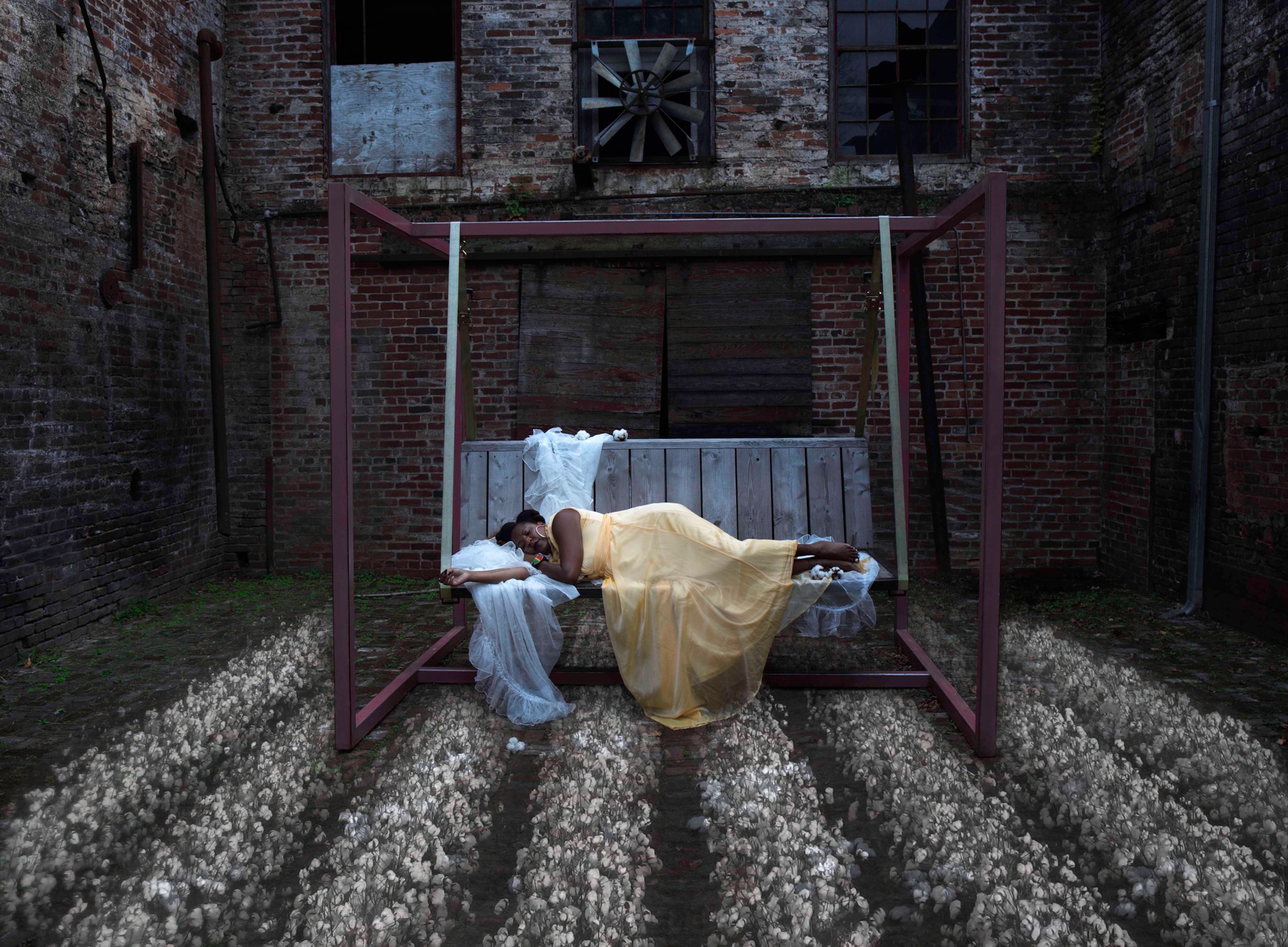
ARTWORK: Dreaming with the Ancestors by Charlie Watts and Tricia Hersey [HT: Visual Commentary on Scripture]: Tricia Hersey is a poet, performance artist, spiritual director, and community organizer living in Atlanta, Georgia. She is the founder of The Nap Ministry, an organization that promotes rest as a form of resistance against capitalism (which fuels contemporary grind culture) and white supremacy, and the author of the New York Times best-selling Rest Is Resistance: A Manifesto (2022) and We Will Rest! The Art of Escape (2024). She pursued graduate research in Black liberation theology, womanism, somatics, and cultural trauma, earning a master of divinity degree from Candler School of Theology at Emory University.
Charlie Watts and Tricia Hersey, Dreaming with the Ancestors, 2017. Archival digital print photograph, 76.2 × 101.6 cm.
The photograph Dreaming with the Ancestors, taken by Charlie Watts, portrays Hersey reclining on a wooden bench inside an open brick enclosure and above rows of cotton plants. Dressed in a soft yellow gown, she closes her eyes in rest, practicing what she calls “the art of escape”—from the incessant demand of productivity and overwork, from oppression of body and spirit, from noise that drowns out voices of wisdom.
In We Will Rest!, Hersey advises:
Every day, morning or night, or whenever you can steal away, find silence. Even if for only a few minutes. Look for quiet time, quiet breathing, quiet wind, quiet air. It is there. Even if it’s cultivated in your body by syncing with your own heart beating. Guilt and shame will be a formidable and likely opponent in your resistance. We expect guilt and shame to surface. Let them come. We rest through it. We commit to our subversive stunts of silence, truth, daydreaming, community care, naps, sleep, play, leisure, boundaries, and space. Be passionate about escape. (107)
The album also includes a cover of Zoe Mulford’s “The President Sang Amazing Grace,” written in response to the racially motivated mass shooting at Mother Emanuel AME Church in Charleston, South Carolina, on June 17, 2015 (its ten-year anniversary is next Tuesday). In his eulogy at the funeral of one of the nine victims, Rev. Clementa Pinckney, President Barack Obama chose “the power of God’s grace” as his theme, and he closed by singing the first stanza of “Amazing Grace,” a moving gesture that Mulford’s song remembers.
Other songs on Grace Will Lead Me Home address John Newton’s love for his wife Polly, his impressment into naval service, and his friendship with William Cowper. There are also songs that grapple with the harm and suffering Newton inflicted on others through his involvement in the slave trade, and that wonder at his hymn’s being so mightily embraced not only by the Black church, many of whose members are descendants of enslaved Africans, but also by other traumatized communities, who insist amid all the wrongs and afflictions they’ve suffered that God is amazingly gracious.
It’s a myth that John Newton (1725–1807), who converted to Christianity in 1748 after surviving a turbulent sea voyage, immediately gave up his employment as a slave trader upon embracing Christ. In fact, he was soon after promoted from slave ship crew member to captain and sailed three more voyages to Africa as such, trafficking human beings for profit until 1754, when his ill health forced him to retire. But he continued to invest in slaving operations for another decade, until becoming a priest in the Church of England. It wasn’t until 1788, in the pamphlet Thoughts Upon the African Slave Trade, that he publicly denounced slavery and confessed his sin of having participated in that evil institution, and this was the start of his abolitionism.
+++
SONG: “Amazing Grace,” performed by the Good Shepherd Collective: This adaptation of “Amazing Grace” premiered at Good Shepherd New York’s digital worship service on June 1. Listen via the Instagram video below, or cued up on YouTube. The vocalists are, from right to left, Charles Jones on lead, Solomon Dorsey (also on bass), Jon Seale, Dee Wilson, and Aaron Wesley. James McAlister is on drums, Michael Gungor is on electric guitar, and Tyler Chester is on keys.
I’m always intrigued by how artists respond creatively to sacred Christian spaces when invited to do so by the owning ecclesial bodies. Such invitations tend to appeal to artists, even those of different or no faith backgrounds, because of the chance to work with a (often) grand architectural space already charged with meaning and to make something that will live with a community over time, either temporarily or permanently, likely forming them in some way.
Because the feast of Pentecost is coming up on June 8, in which the church celebrates its “birthday,” effectuated by the descent of the Holy Spirit after Jesus’s ascension (see Acts 2), here are four striking artistic interventions in active or former churches that reference that spectacular event of wind and fire. Only the first was commissioned specially for Pentecost, but the other three bear Pentecostal resonances.
1. Tongues of Fire by Nancy Chinn, Grace Cathedral, San Francisco
Nancy Chinn (American, 1940–), Tongues of Fire, 1988. Fifty painted nylon-net strips, 18 in. × 10–50 ft. (dimensions variable). Temporary installation at Grace Cathedral, San Francisco.
Nancy Chinn is a liturgical artist and lay feminist theologian living in California, working in fibers and mixed media. Her Tongues of Fire was originally installed in Grace (Episcopal) Cathedral in San Francisco for Pentecost 1988, and she has since reprised it in a handful of other churches throughout her career.
It consists of fifty strips of nylon netting, painted in red, orange, and gold and suspended along the expansive neo-Gothic nave. She chose that number based on the etymology of the word “Pentecost,” which means “fiftieth” in Koine Greek; it was the name Hellenistic Jews used to refer to the Jewish festival of Shavuot, celebrated fifty days after Passover, but it also became a Christian festival in the first century CE when, fifty days after Jesus rose from the dead, his Spirit descended to empower his nascent community of followers.
Draped in a mighty sweeping movement and overlapping one another, the streamers respond to air flow in the space, furthering the sense of dynamism.
2. Tilting at Giants by Dayton Castleman and Fall to Flight by Alison Dilworth, Broad Street Love, Philadelphia
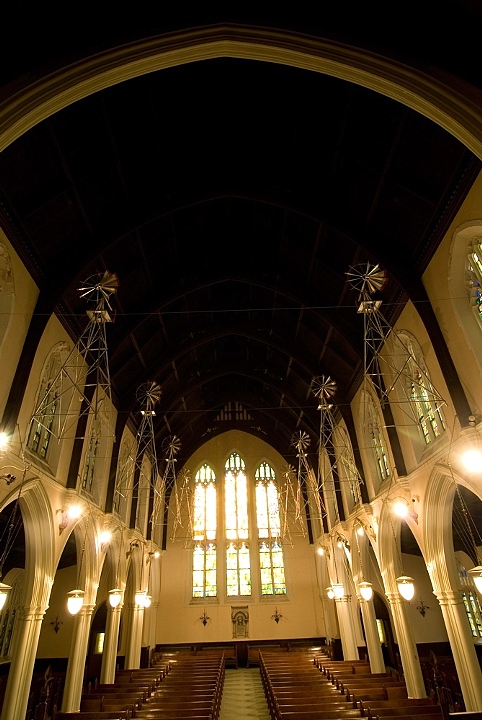
Dayton Castleman (American, 1975–), Tilting at Giants, 2006. Aluminum, steel, votive candles, glass votive holders, braided fishing line, steel cable, and rigging hardware. Permanent site-specific sculpture, Broad Street Love, Philadelphia.
Tilting at Giants was commissioned by Broad Street Ministry (renamed Broad Street Love in 2024), a nonprofit organization in downtown Philadelphia providing stabilizing services to individuals experiencing deep poverty. It’s housed inside the former Chambers-Wylie Memorial Presbyterian Church, a historic turn-of-the-century Gothic Revival church that closed its doors in 1999 due to dwindling membership and the death of its pastor. The Presbytery of Philadelphia (PCUSA) leased the building for a few years to the University of the Arts, who used it for classes and events.
Then in May 2005, Rev. Bill Golderer rejuvenated the dormant church by opening Broad Street Ministry, billed as “an innovative Christian faith community that emphasizes the Gospel imperatives of extending generous hospitality, demonstrating justice and compassion, and providing a ground for artistic expression.” He removed the pews and set communal dining tables in their place, inviting in guests off the streets to enjoy chef-prepared meals all week long. The organization also provides legal help, fresh clothes, medical assistance, and a mailbox for those who lack a permanent address.
In its first year, Golderer issued an open call for proposals for a site-specific art installation that would be funded by the city’s Percent for Art program. Multidisciplinary artist DaytonCastleman, who lived in Philly at the time but who is now based in Northwest Arkansas, was awarded the commission.
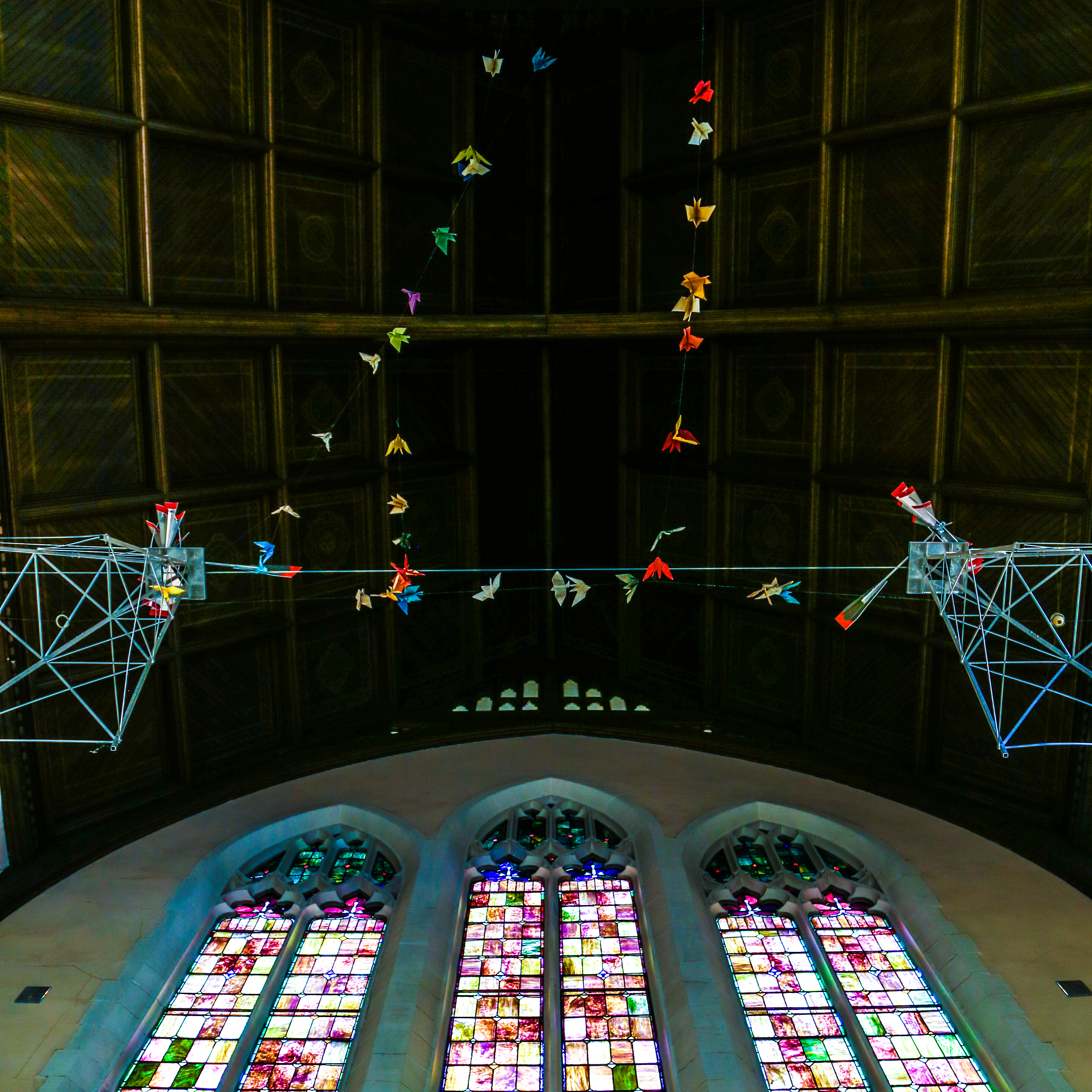
His project comprises twelve large windmills that hover in the air, six in a line down each side of the vault—“unexpected, anachronistic, misplaced . . . [and] completely still,” Castleman says. He elaborates:
This stillness infuses the atmosphere with a sense of uneasy expectation. The brilliant towers, tall and clean, flash against the dark, vaulting canopy above. Like sentinels keeping watch, the sun-burst fans are poised, brimming with potential energy, waiting for a mysterious, transcendent wind to fill the space and make it sacred. Cradled within each tower, nearly lost in the spectacle, hover votive candles, glowing, unflickering, in prayer. This sanctuary is a living prayer—an aching, tense, expectant prayer—and a hair pulled taut, waiting to snap. . . .
The air is rich with suggestions and intimations of the invisible.
His artist’s statement also mentions Pentecost. On that seminal day two millennia ago, the disciples were gathered in Jerusalem with anticipation, as Jesus had told them, just before returning to the Father, to remain in the city until they received their new baptism, “for John baptized with water, but you will be baptized with the Holy Spirit not many days from now” (Acts 1:5).
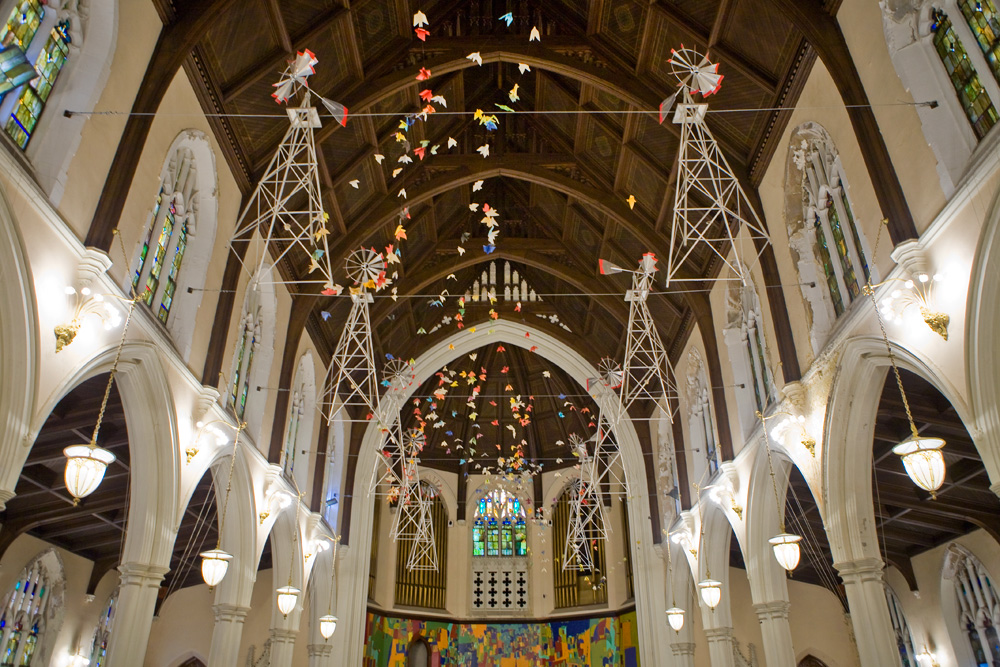
Broad Street Love in Philadelphia, with art installations by Dayton Castleman (windmills) and Alison Dilworth (swallows). Photo: Bradley Maule.
Shortly after Castleman’s Tilting at Giants was installed, it was joined by Fall to Flight, a flock of approximately six hundred origami swallows suspended from the ceiling, containing written prayers of the community. Created by Philadelphia-based artist Alison Dilworth, the multicolored birds winging overhead evoke the unleashed joy of the Holy Spirit, who is sometimes compared in scripture to a dove, but also Jesus’s encouragement in the Sermon on the Mount that God will provide for the needs of his children, just as he provides for our avian friends who neither sow nor reap nor gather.
3. HS by Maciej Urbanek, St. Michael’s Church, Camden Town, London
Maciej Urbanek (British, 1979–), HS, 2014. Digital photographic print, 10 × 7.5 m. St. Michael’s Church, Camden Town, London.
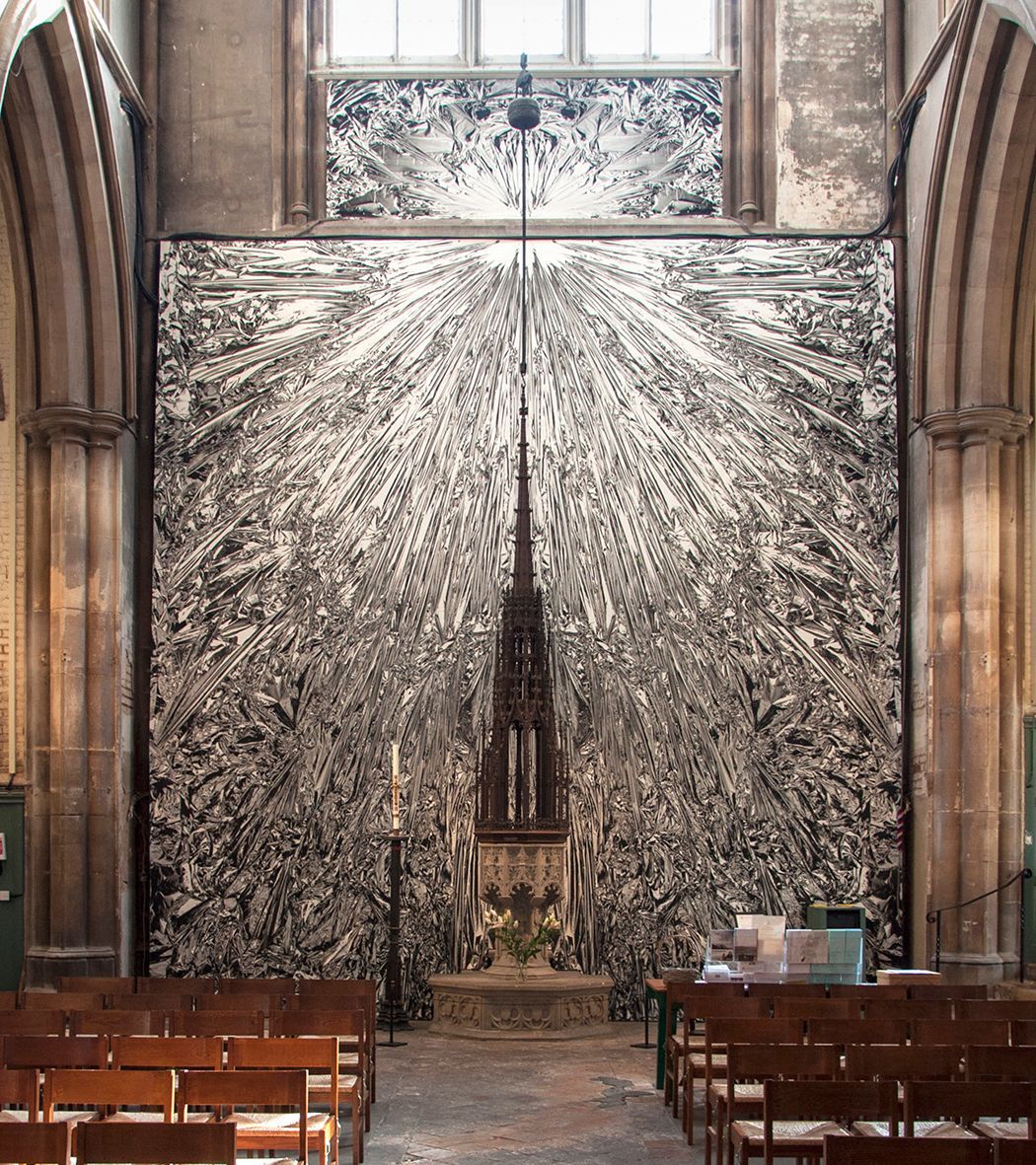
HS by the Polish-born British artist Maciej Urbanek is a monumental composite digital print installed on the west wall of St. Michael’s (Anglican) Church in Camden Town, London, covering up damaged plasterwork in need of restoration. What appears to be an explosion of silvery light is an effect produced with black plastic trash bags, which the artist crumpled up, lit, photographed, digitally reworked, and inkjet-printed on a large scale. Winner of the 2015 Art+Christianity Award for Art in a Religious Context, the work brings a baroque aesthetic to the Victorian interior.
“I am interested in elevating the banal and prosaic elements of life and turning them into powerful and rich visual statements,” Urbanek has said. A sign at the church says that Urbanek’s use of an everyday material to make something so beautifully radiant is “a metaphor for God’s work in taking ordinary human lives and making them extraordinary.”
Commissioned by Father Philip North (then the team rector of the parish of Old St Pancras) and privately funded by John Booth, HS was intended to be a temporary installation, but it was so well received by the parish that it has become a permanent fixture. According to the church’s X account, it “represent[s] the Holy Spirit breaking in from the outside world.”
The artwork’s location just behind the church’s baptismal font creates a linkage between the sacrament of baptism—in the Church of England, marking the beginning of a journey with God and the baptizand’s membership in the community of faith—and the work of the Spirit, who came at Pentecost with great power to set ablaze and send out. Indeed, HS can be read as that dramatic moment of the Spirit’s outpouring, and that parishioners walk past it when they exit the sanctuary is a reminder that they leave empowered by the Spirit to live and proclaim Christ’s gospel.
CHILDREN’S BOOK: Let There Be Light by Desmond Tutu, illustrated by Nancy Tillman: I saw this enchanting little book at my local library recently—a retelling of the creation narrative from Genesis 1 by the late South African Anglican bishop, theologian, and Nobel Peace Prize laureate Desmond Tutu. Published by Zonderkidz in 2014, it opens, “In the very beginning, God’s love bubbled over when there was nothing else . . .” Hear it read aloud, and view the illustrations, in this video from the Seuss’s Gooses YouTube channel:
+++
ARTICLES:
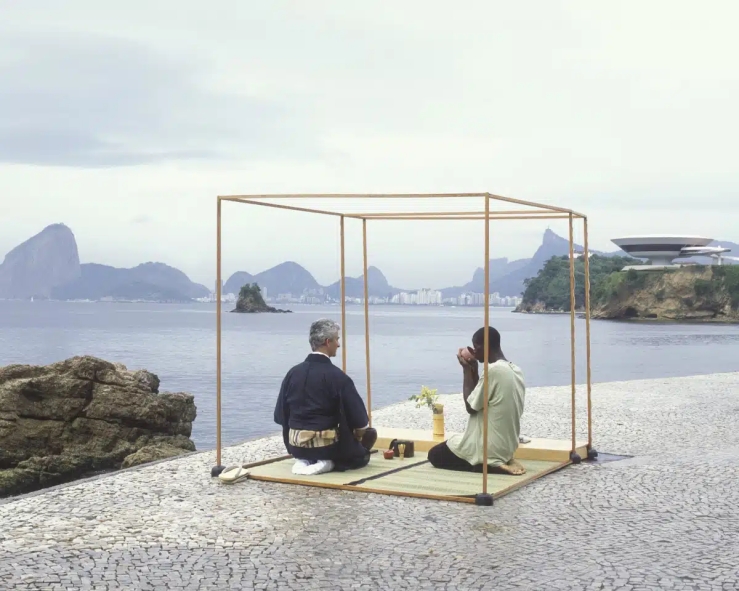
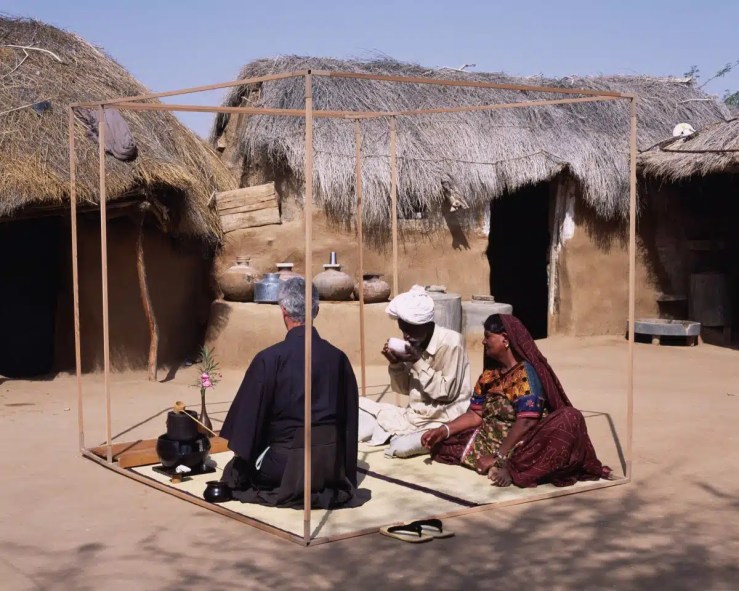
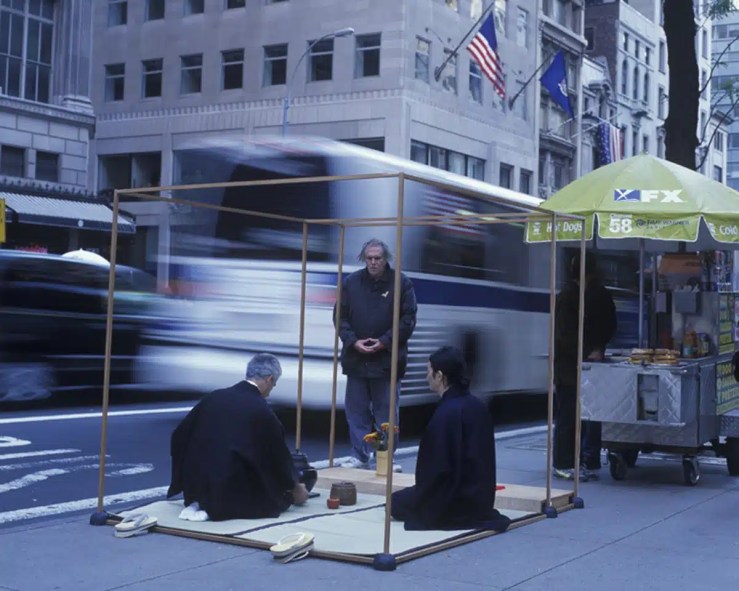
>> “Artist Traveled to Over 30 Cities to Perform Tea Ceremony with Strangers,” an interview with Pierre Sernet by Jessica Stewart: From 2001 to 2008, artist Pierre Sernet (French-born and residing in Japan) traveled to over thirty countries to spontaneously enact abbreviated Japanese tea ceremonies, inviting passersby to come sit and drink the cup of matcha he prepared in front of them. From deserts and beaches to villages and construction sites, he would set up a portable, open-air wooden cube that denoted the “tea room,” and the ensuing encounters were documented with photography. Called One (and nicknamed Guerrilla Tea), the series was meant to promote respect across cultures and “to emphasize to viewers the importance of each moment we live in.”
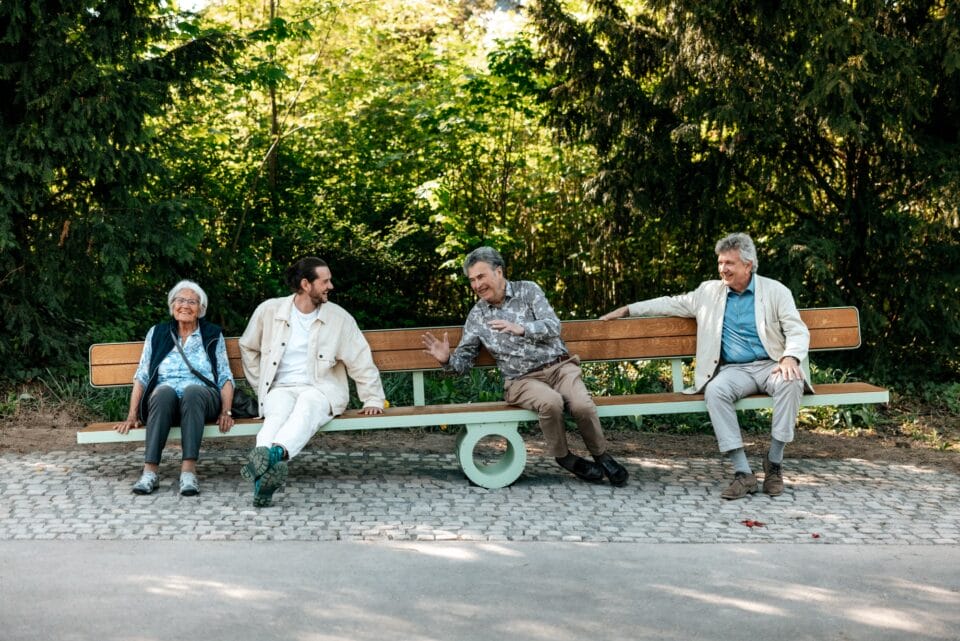
>> “A Teeter-Totter Style Bench Invites Sitters to Find Common Ground” by Grace Ebert: “In the Garden of Generations in Einbeck, Germany, a playful new installation asks park goers to find equilibrium with their neighbors. ‘Balance Bench” is the latest project of Berlin-based artist Martin Binder. Installed in his hometown, the interactive artwork rests on a central cylinder rather than four legs, requiring that at least two people sit on either side to level. ‘It cannot be used alone—it demands awareness, consensus, and cooperation between people to become a functional public space,’ he says.”
Martin Binder (German, 1990–), Balance Bench, 2025. Steel, oak. Installation at the Garden of Generations, Einbeck, Germany. Construction by Henning Müller Sondermaschinen. Photo by Spieker Fotografie.
+++
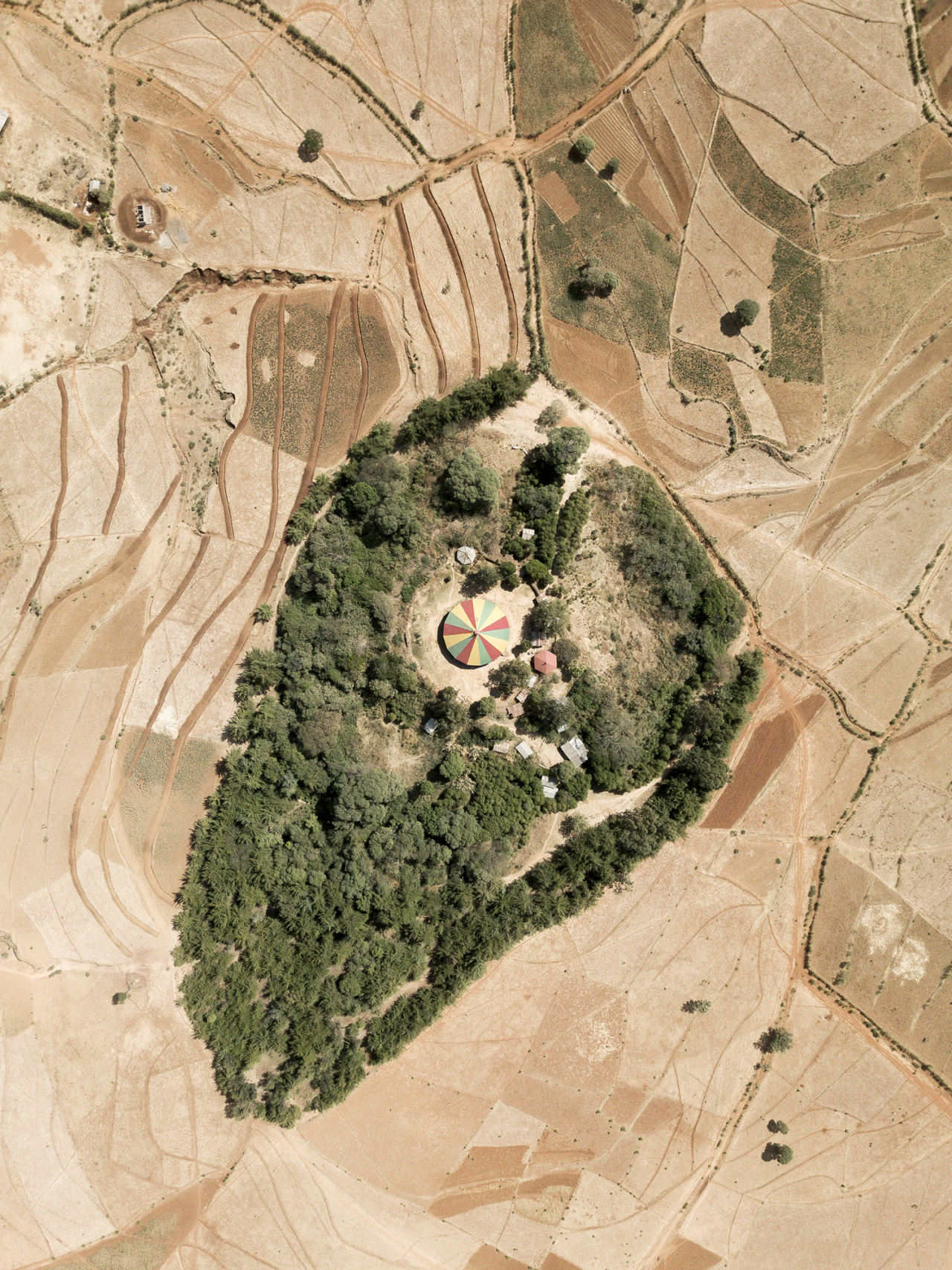
PHOTO SERIES: Hierotopia by Kieran Dodds: “Kieran Dodds (Scottish, b. 1980) is a non-fiction photographer known for his research-driven photo stories and portraiture. His personal work considers the interplay of environment and culture, and the importance of spiritual belief in global conservation.” In his Hierotopia series (from the Greek for “sacred place”), carried out from 2015 to 2018, he explores the green “church forests” east of Lake Tana in Ethiopia—little islands of biodiversity scattered throughout the region’s desert landscape. “To its guardians,” Dodds writes, “each forest resembles a miniature Garden of Eden and is essential to the dignity of the building. . . . The air inside the forests is cool, fragrant and filled with a cacophony of life. This is in stark contrast to the arid silence of the surrounding land which is feeling the strain of centuries of human activity and agriculture.”
Debre Mihret Arbiatu Ensesa church near Anbesame, Ethiopia, surrounded by woodland and fields. Photo: Kieran Dodds, from the Hierotopia series, 2015–18.
“The core Christian belief in stewardship for the environment is a powerful concept,” Dodds continues, remarking on the Ethiopian Orthodox Tewahedo Church’s commitment to conservation, “and, if applied globally by people who are at least nominally Christian, could transform the world for better.”
+++
SONGS:
>> “Hold You in Our Circle” by Emily Roblyn: This simple song of blessing by UK-based singer-songwriter and retreat leader Emily Roblyn has been sung at the bedsides of the sick or dying, over women about to be released from prison, and through myriad other life transitions and trials, by friends and communities seeking to voice their support. “We hold you in our circle, hold you in our love.” [HT: Nadia Bolz-Weber]
>> “The Lord Bless You and Keep You” by Peter C. Lutkin: Performed by the Capital University Chapel Choir in 2020, this song is a choral setting by the Midwestern composer Peter C. Lutkin (1858–1931) of the Aaronic Blessing from Numbers 6:24–26: (in Lutkin’s rendering) “The LORD bless you and keep you; the LORD lift his countenance upon you, and give you peace; the LORD make his face to shine upon you, and be gracious unto you.” God instructed the Levitical priests of ancient Israel to pronounce these words over the people, and though the Levitical priesthood is no more, this particular benediction is still used regularly in Jewish and Christian liturgies.
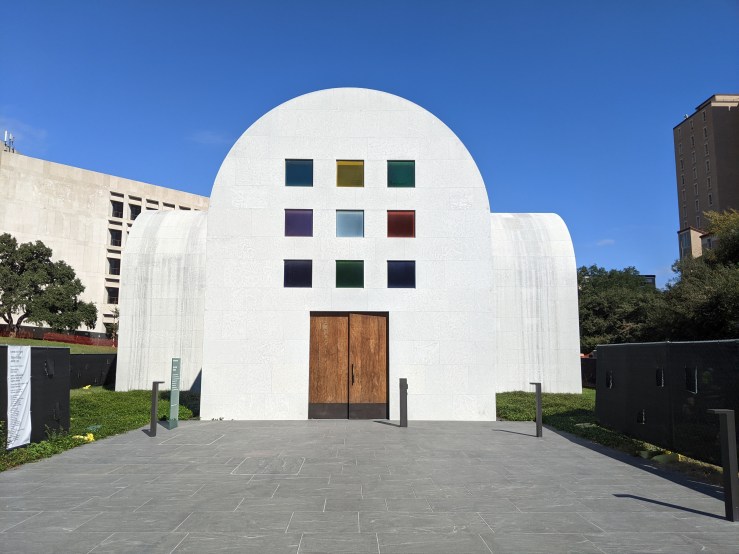
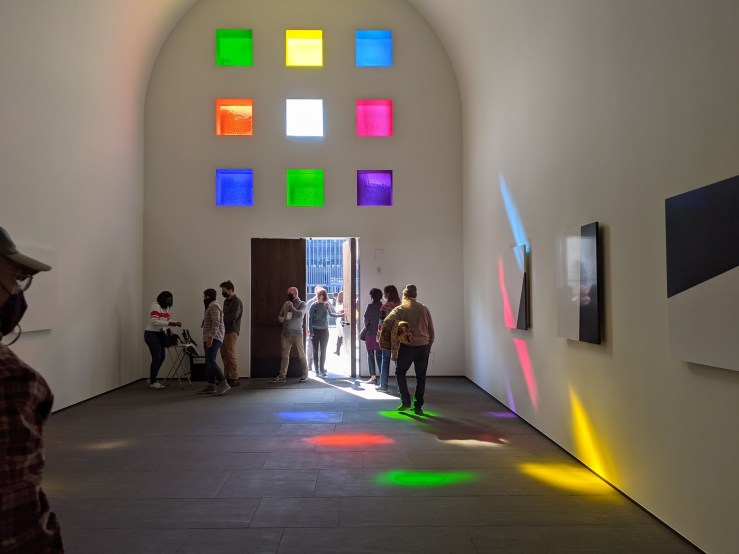
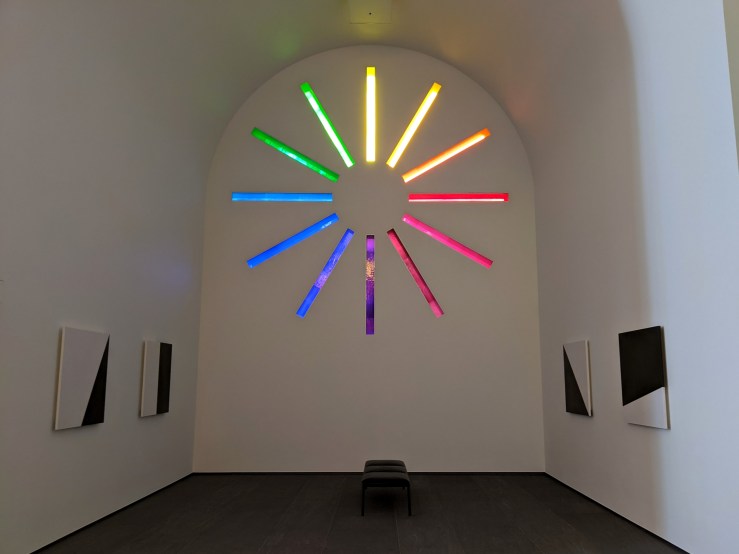
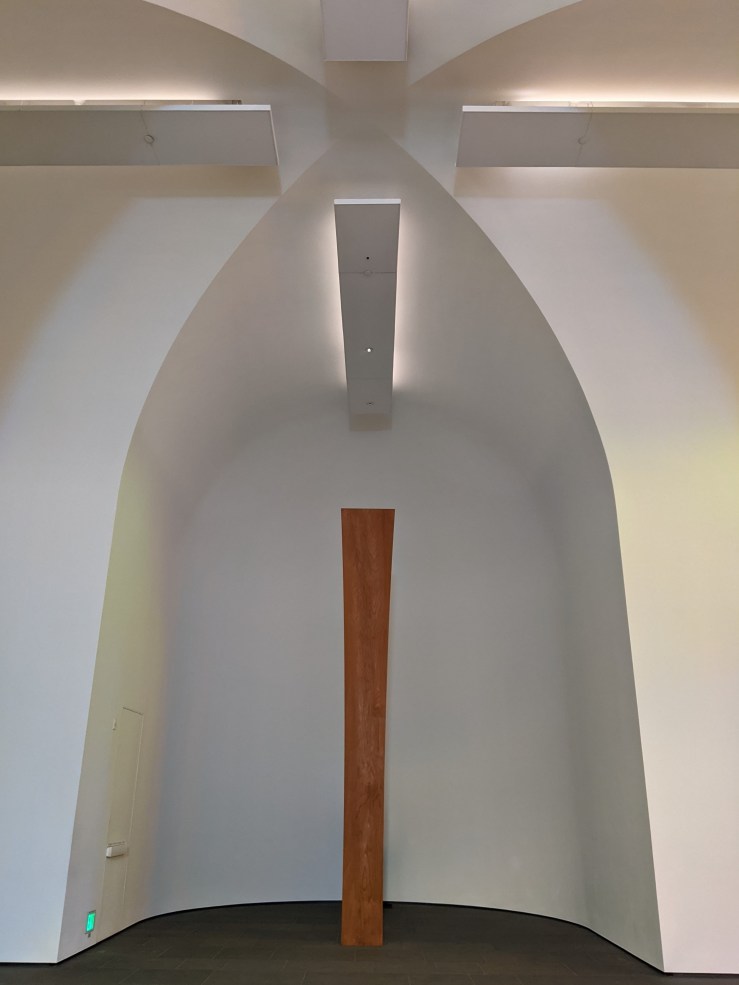
>> “What Remains: The Making of Ellsworth Kelly’s Last Work,”Image interview with Rick Archer: I got to experience Ellsworth Kelly’s Austin—a modernist “chapel” containing three stained glass windows, fourteen black-and-white marble panels (Stations of the Cross), and a redwood totem—while in Texas for a CIVA conference in 2021; see some of my photos below. Kelly was an atheist inspired by Romanesque church architecture, and the architect he chose to collaborate with on Austin, Rick Archer, is a Christian. In this wonderful new interview by Bruce Buescher, Archer discusses his working relationship with Kelly, Kelly’s desire for randomization and form over meaning, the technical and architectural challenges of bringing Kelly’s vision to life, religious references, and the artist’s objective for the space. “I hope when people go in here, they will experience joy,” Archer remembers Kelly saying.
Ellsworth Kelly (American, 1923–2015), Austin, 1986/2015. Artist-designed building with colored glass windows, black-and-white marble panels, and redwood totem, 63 × 76 × 28 ft. Blanton Museum of Art, University of Texas at Austin. Photo: Victoria Emily Jones.
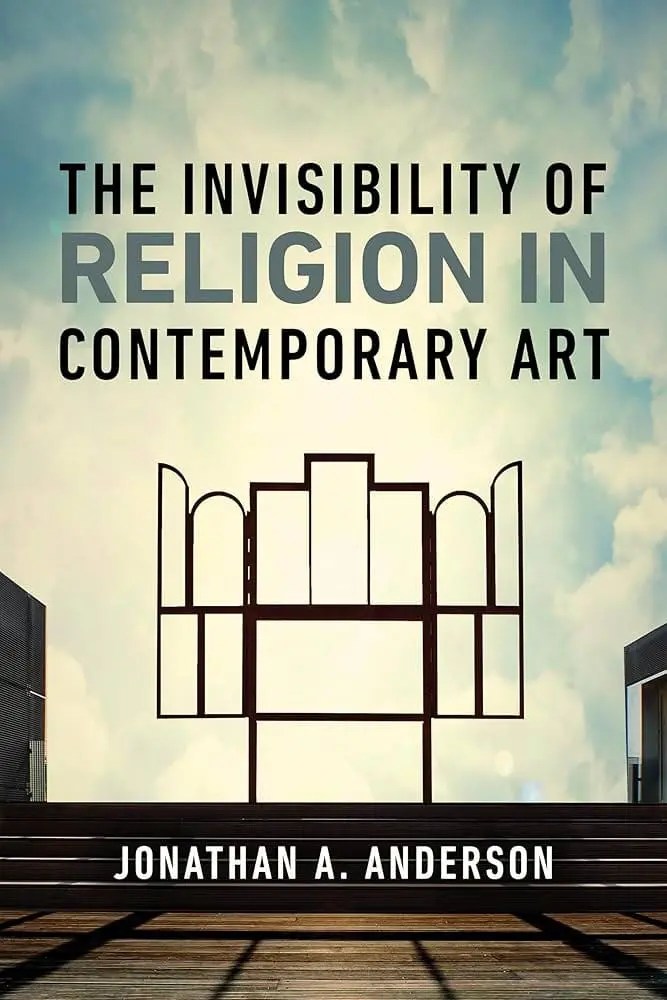
In this recent interview for Comment magazine, Anderson explains his purpose in writing the book:
I have become increasingly convinced that so many pivotal artists and artworks over the past century are deeply shaped by religious traditions and seriously engaged in theological questioning, but this remains severely under-interpreted or misinterpreted in the scholarship about these artists. One might see these threads running through an artist’s artworks and personal writings and even discuss these topics with the artist in their studio, but when one moves to the scholarly writing and teaching about that same artist, that language consistently disappears or is transposed into another register—usually politics, occasionally a highly esoteric spirituality. I wanted to understand, at a non-superficial level, why this was the case, and I wanted to see how other ways of speaking and writing about this topic might be possible.
Don’t miss, at the end of the article, his three hopes for the field of “art and theology,” which I very much share!
+++
LECTURE: “The Problems and Possibilities of Visual Theology: The Ascension as a Case Study” by Jonathan A. Anderson: With Ascension Day coming up on May 29, it’s timely to share this talk given by Jonathan Anderson (see previous roundup item) a few years ago at Duke Divinity School, where he worked as a postdoctoral associate of theology and the visual arts from 2020 to 2023. Anderson explores a handful of images depicting the Ascension of Christ, a particularly challenging subject because of the spatial ambiguity. The scriptural accounts of the event (Luke 24:50–53 and Acts 1:6–11) beg the question, “What does ‘lifted up’ mean? Where is Jesus?” Attempting to work out these spatial difficulties visually can be theologically and exegetically productive, Anderson claims—even if it sometimes leads to unsatisfying results, as, Anderson says, it often does in Western art from the Renaissance onward. By contrast, when artists foster intertextual readings across the biblical canon and focus not so much on what the Ascension looks like as a historical event but rather on what it means, they are generally more successful.
Here are some time stamps, with links to the artworks discussed:
38:33: The Ascension by Andrei Rublev: “Fundamental to all [the Ascension icons of the East],” Anderson says, “is the notion that the Ascension doesn’t have much to do with a higher part of the atmosphere (which Western images are continually struggling with) but with an entirely different kind of space. The relevant coordinates here are not down and up, or even higher and lower, but earth and heaven, old creation and new creation.” Anderson’s quotation of Douglas B. Farrow’s Ascension Theology is illuminating!
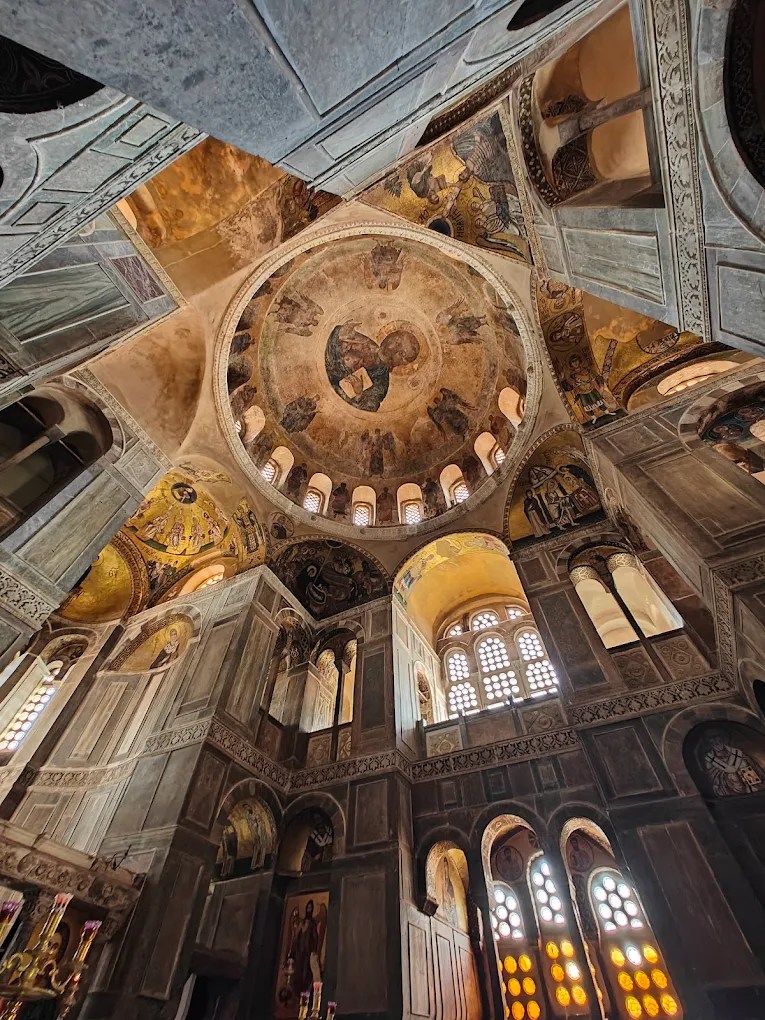
44:30: Interior of the katholikon (principal church) of Hosios Loukas
53:40: Q&A
Katholikon of Hosios Loukas monastery, Boeotia, Greece, 1011–12
+++
INSTRUMENTAL JAZZ: “Prayer” by Cory Wong: This video shows a live performance of Cory Wong’s “Prayer” on July 4, 2023, at Gesù music hall in Montreal. Wong, on guitar at far left, is joined by Ariel Posen on guitar, Victor Wooten on bass, and Nate Smith on drums. I learned about Wong through his collaborative album with Jon Batiste, Meditations (2020), which includes a version of this piece featuring Batiste’s piano playing.
+++
EXHIBITION: OMG! Reli Popart, Museum Krona, Uden, Netherlands, April 5–September 7, 2025: This exhibition at Museum Krona (housed in the complex of the still-active Birgittine Abbey of Maria Refugie in Uden, Netherlands) explores the connection between the pop art movement and Christianity through works by artists such as Andy Warhol, Corita Kent, Niki de Saint Phalle, and especially Dutch artists, including Woody van Amen and Wim Delvoye. Pop art is characterized by the use of imagery from popular culture, sourced from television, magazines, comic books, ads—and sometimes from the trash bin.
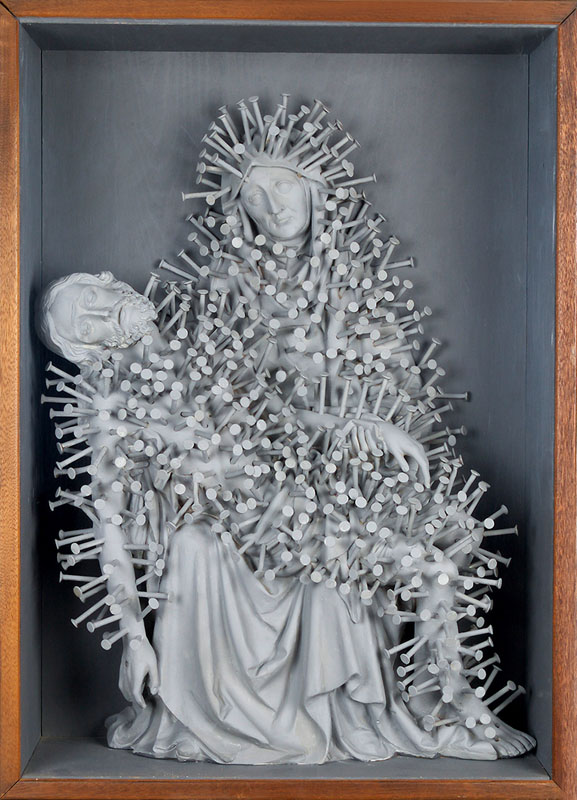
Jacques Frenken [previously], for example, built a body of work by salvaging discarded plaster sculptures of Christ and the saints—mass-produced for Catholic devotional use—and reconstructing them into assemblages. For his Spijkerpiëta, he “brought the Pietà back into our midst and accentuated the pain it radiates with nails,” the artist said.
Jacques Frenken (Dutch, 1929–2022), Spijkerpiëta (Nail Pietà), 1967. Plaster, paint, iron, wood. Museum Krona, Uden, Netherlands.
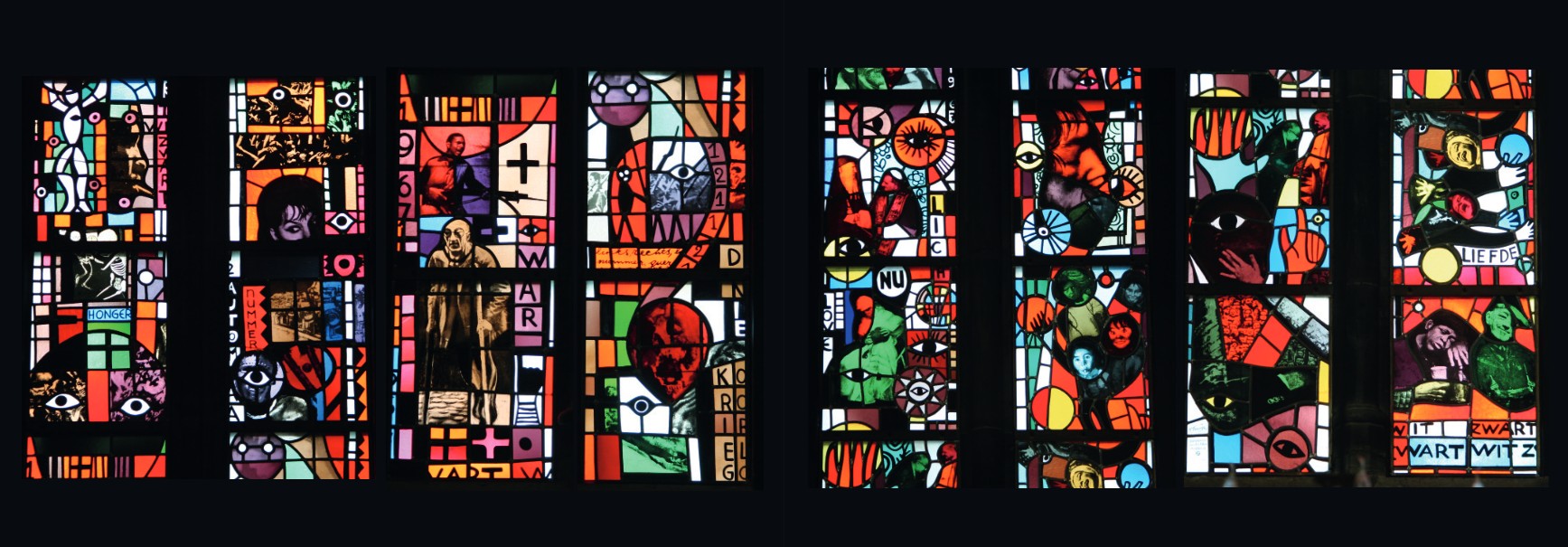
Another artist represented in the exhibition is Hans Truijen, who was commissioned in the 1960s by St. Martin’s Church in Maastricht to design eight stained glass windows for their worship space. The four along the left aisle of the nave depict human and divine suffering, whereas those on the right express hope, love, freedom, and happiness. He chose photographic images from various periodicals, including ones of the Vietnam War, and transferred them to glass using a special screen-printing process.
Hans Truijen (Dutch, 1928–2005), Studies for the eight stained glass windows commissioned by St. Martinuskerk, Wyck-Maastricht, Netherlands, 1966–68. Courtesy of the artist’s son, Marc Truijen.
Last month I saw the exhibition Elizabeth Catlett: A Black Revolutionary Artist at the National Gallery of Art in Washington, DC, an impactful display of over two hundred prints and sculptures from throughout Catlett’s illustrious seven-decade career. Organized in partnership with the Brooklyn Museum of Art, where it first opened last year, the show focuses on Catlett’s advocacy, through her art and her on-the-ground activism, against poverty, racism, war, and gender oppression—her promotion of human dignity and freedom for all. Her work especially celebrates the beauty and strength of African American working-class women.
The exhibition title comes from a speech Catlett delivered in May 1970 by phone from Mexico to attendees at the Conference on the Functional Aspects of Black Art at Northwestern University outside Chicago, which she could not attend in person because the United States refused her entry to the country on the grounds of her allegedly dangerous politics: “I have been, and am currently, and always hope to be a Black revolutionary artist, and all that it implies,” Catlett stated.
Born in 1915 in Washington, DC, and raised there, Catlett witnessed class inequality, racial discrimination, and US imperialism firsthand, which formed her consciousness and influenced the direction her art would go. After graduating from Howard University, she spent time teaching in Durham (North Carolina), New Orleans, and Harlem and studying art in Iowa and Chicago before permanently settling in Mexico in 1946, becoming a Mexican citizen in 1962. She married the Mexican printmaker and muralist Francisco Mora in 1947, and they had three children together, all sons.
Black motherhood is a recurring subject in Catlett’s work, starting with her MFA thesis project in 1941 at the University of Iowa, a limestone sculpture of a mother and child that won first prize at the America Negro Exposition in Chicago that year but that is now lost. “Black women have been cast in the role of carrying on the survival of Black people through their position as mothers and wives, protecting and educating and stimulating children and Black men,” Catlett said. “We can learn from Black women. They have had to struggle for centuries.”
The social justice framework of the current retrospective exhibition leaves plenty of room for Catlett’s depictions of mothers with their children. What follows are photos I took of some such works.
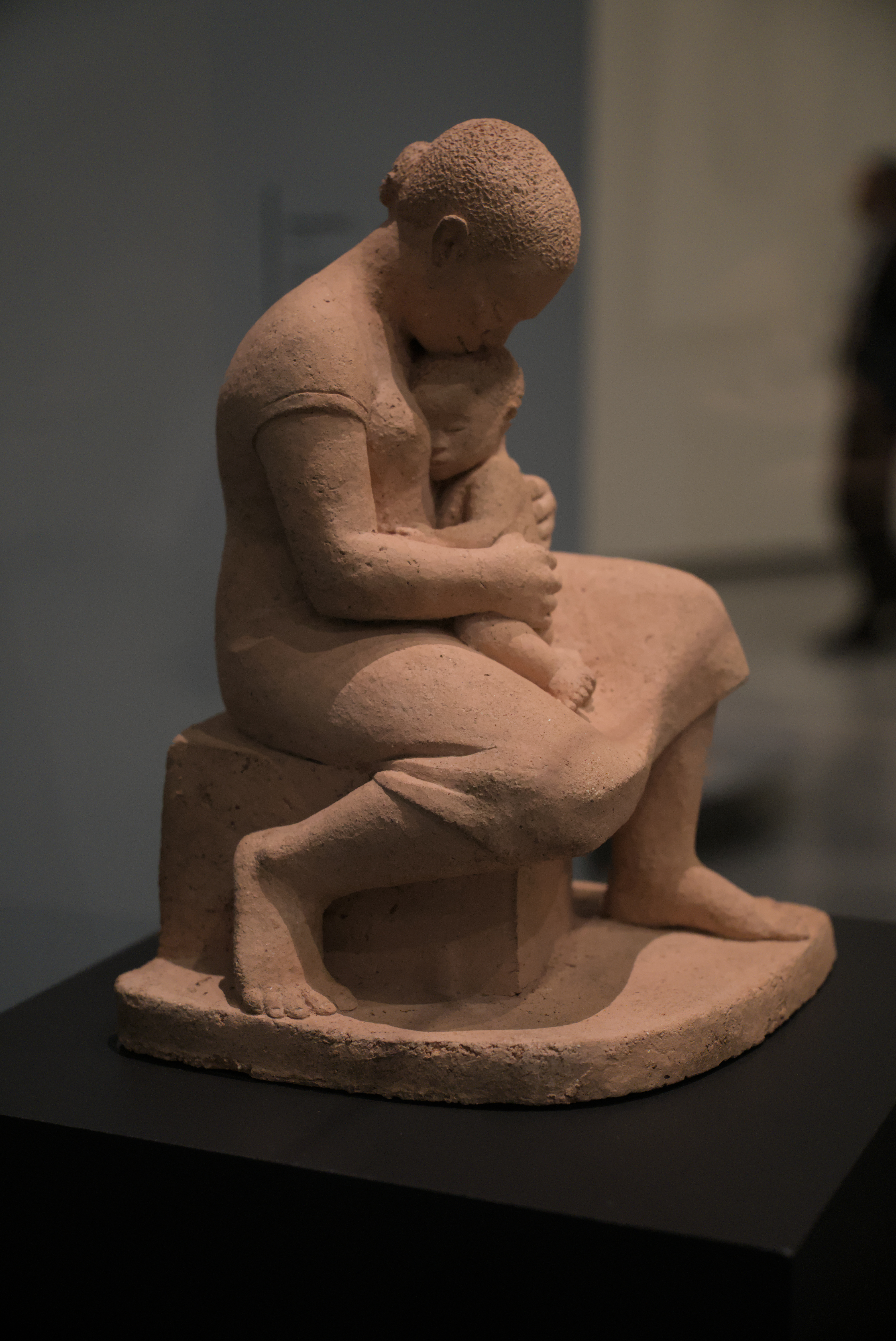
Elizabeth Catlett (American, active in Mexico, 1915–2012), Mother and Child, 1956. Terracotta, 28.6 × 17.8 × 17.8 cm (11 1/4 × 7 × 7 in.). Museum of Modern Art, New York.
My favorite is a terracotta sculpture made just a year after the lynching of fourteen-year-old Emmett Till, whose mother Mamie Till’s response was an important catalyst of the civil rights movement. It brings two bodies—that of mother and infant son—into one volume. Art historian Leah Dickerman remarks on
the uncanny way that it seems both intimate and monumental at once. Intimacy lies in the way the weight of the child’s face presses against the mother’s breast, the mother’s right leg pushed back to stabilize her balance and her head nestled against the child’s scalp, breathing in that smell. Tenderness, both affectionate and shielding, is conveyed so keenly it almost aches. . . . Catlett seems to capture, somehow, the idea of remembering something fleeting, the sculpture a tiny memorial to loving protection that cannot be maintained.
Platformed across from this sculpture is another, in mahogany, this one modernist, abstracted:
Elizabeth Catlett (American, active in Mexico, 1915–2012), Mother and Child, 1970. Mahogany, 49.5 × 33 × 21 cm (19 1/2 × 13 × 8 1/4 in.). Currier Museum of Art, Manchester, New Hampshire.
It shows a mother holding her baby in a swaddle, his or her head gleefully poking out from the folds. While the baby seems happy, the mother seems stressed, as she turns her head away and grabs her head with her hand, which I interpret as her taking a deep breath to compose herself for several more hours of caregiving before bedtime.
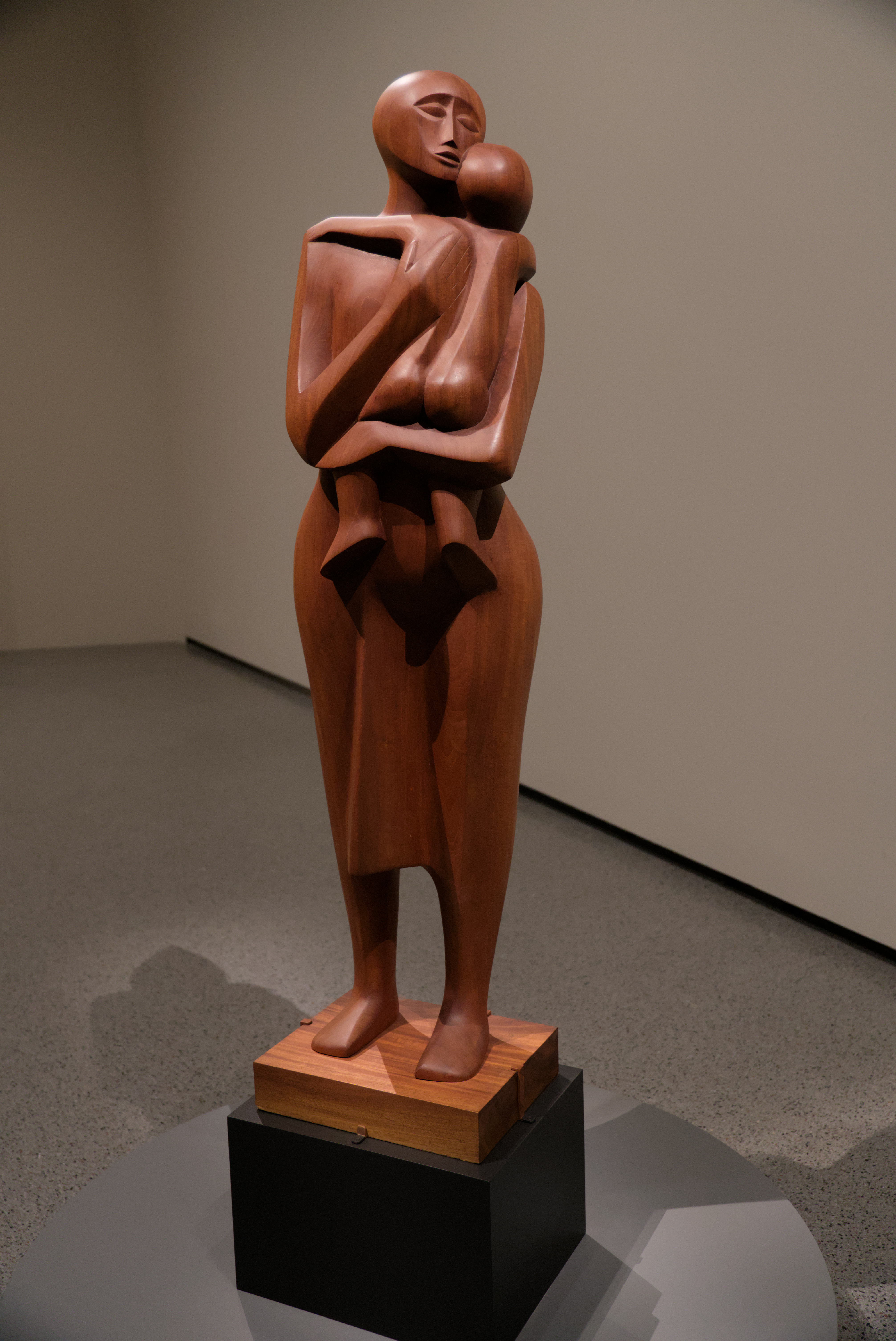
Another mahogany sculpture is borrowed from the New Orleans Museum of Art:
Elizabeth Catlett (American, active in Mexico, 1915–2012), Mother and Child, 1983. Mahogany, 134.6 × 33 × 33 cm (53 × 13 × 13 in.). New Orleans Museum of Art, Louisiana.
The adjacent wall text quotes art historian Melanie Anne Herzog, author of Elizabeth Catlett: An American Artist in Mexico:
Becoming a mother, Catlett told me, was her most creative endeavor. She returned to the theme of maternity throughout her career in sculptures that illuminate the intimate physical bond between mother and child, a child’s comfort in its mother’s embrace, and the anguish of mothers who know they cannot protect their children from future harm. Catlett’s boldly corporeal rendering of maternity centers Black and Brown women in her depiction of this universal theme. I feel the fierce tenderness of this stately standing figure cradling her child, its body melded with hers. Her pensive expression and resolute stance call us to reflect on what she has endured and what her child, too, will encounter in the world that awaits.
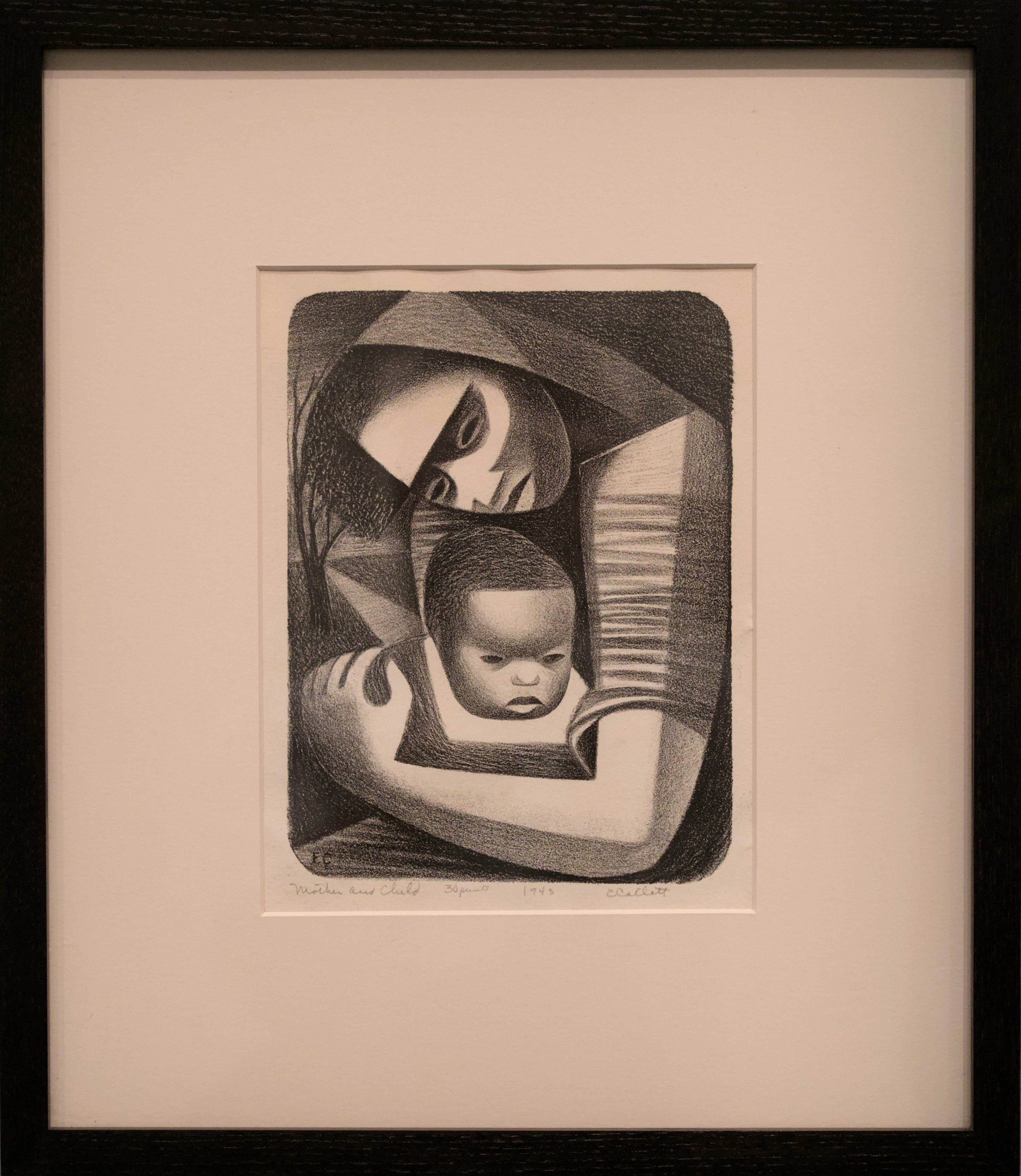
One of Catlett’s earliest prints of the mother-child subject is a lithograph from 1944:
Elizabeth Catlett (American, active in Mexico, 1915–2012), Mother and Child, 1944, printed 1945. Lithograph, image: 19.7 × 14.3 cm (7 3/4 × 5 5/8 in.); sheet: 31.4 × 23.8 cm (12 3/8 × 9 3/8 in.). Canton Museum of Art, Canton, Ohio.
The label notes how it “recasts Christian Madonna and Child iconography in the context of a racially segregated United States. A leafless tree in the background and the mother’s protective clutch hint at the brutal history of lynching and violence against Black people.”
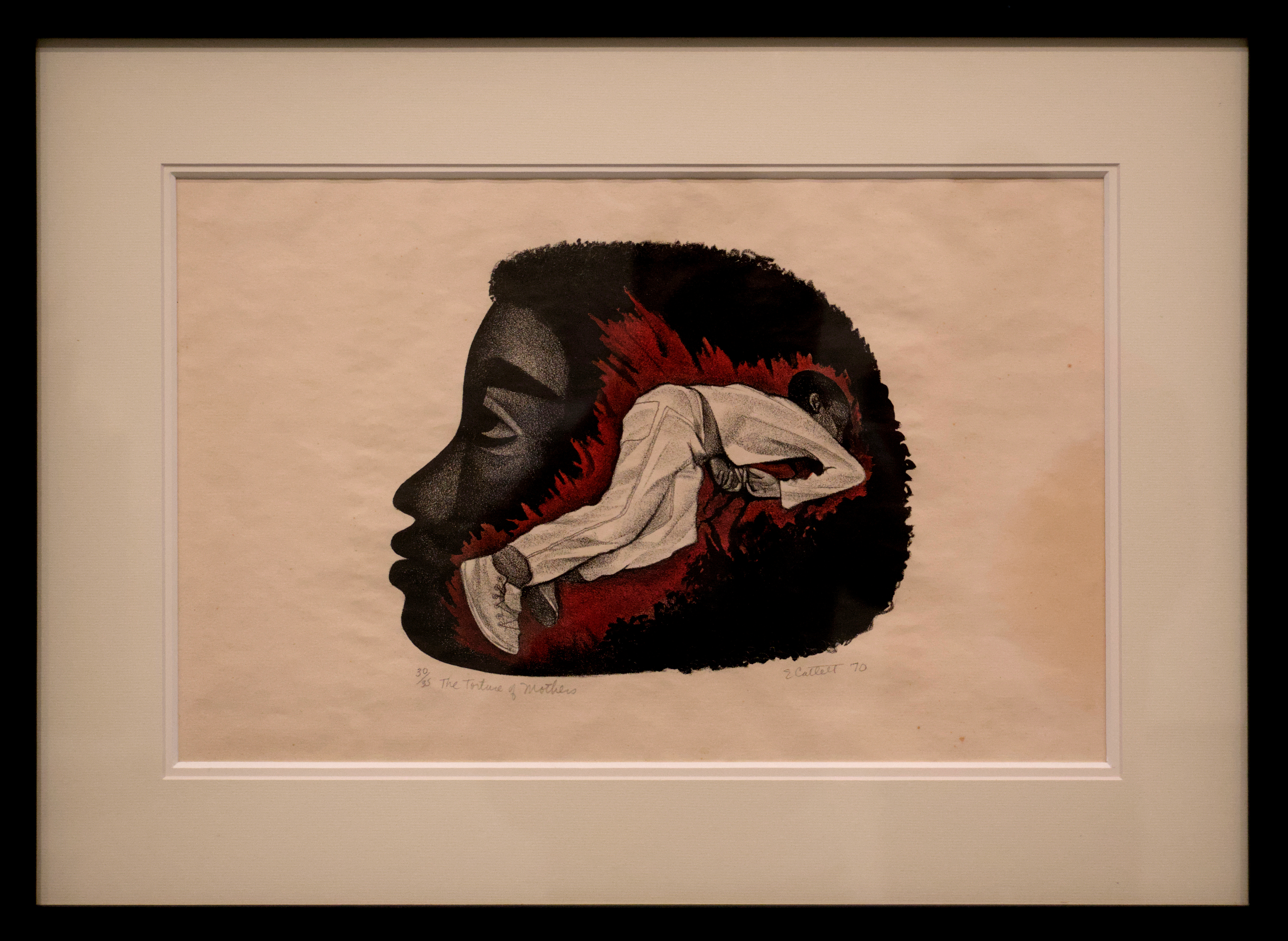
Even after her move to Mexico, Catlett remained connected to the Black liberation struggle in the US. Her Torture of Mothers from 1970 is based on the photograph by Bud Lee published on the cover of Life magazine’s July 28, 1967, issue, showing a twelve-year-old Black boy lying in a pool of his own blood in the middle of a street in Newark, New Jersey, having been shot by two stray police bullets. The police were trying to suppress the riots that had erupted in protest of the beating of a Black cab driver in Newark by two white police officers, and while Joe Bass Jr. was outside playing with his friends, he got caught in the crossfire.
Elizabeth Catlett (American, active in Mexico, 1915–2012), Torture of Mothers, 1970. Hand-colored lithograph, sheet: 38.1 × 56.5 cm (15 × 22 1/4 in.); framed: 48.3 × 66 cm (19 × 26 in.). Collection of Juanita and Melvin Hardy.
“Catlett’s composition visualizes the emotional toll such events have on Black mothers and women of color more broadly,” the gallery label reads—mothers whose minds are continually haunted by the racial violence, sometimes even state-authorized, that threatens the safety of their boys. “While Catlett was tracking police brutality in the US, she was also aware of similar state violence against Mexican youth, including the mass shooting of student protestors in 1968 by police at the Universidad Nacional Autónoma de México where Catlett taught.”
Several of the mothers in Catlett’s art are posed in a protective embrace that seeks to shield their children from harm. The arms of her 1982 Madonna, for example, wrap around a son and a daughter, though her averted eyes look worried:
Elizabeth Catlett (American, active in Mexico, 1915–2012), Madonna, 1982. Lithograph, sheet: 76.2 × 56.5 cm (30 × 22 1/4 in.). Stanley Museum of Art, University of Iowa, Iowa City.
In African American families, children are often raised by their grandmothers. Reflecting adaptability and support, such kinship care is memorialized in These Two Generations, which shows in profile a young boy and the primary maternal figure and caregiver in his life: his grandma.
Elizabeth Catlett (American, active in Mexico, 1915–2012), These Two Generations, 1979, printed 1987. Lithograph, image: 48.3 x 55.7 cm (19 x 21 15/16 in.); sheet: 56.7 x 76.2 cm (22 5/16 x 30 in.); framed: 69.9 x 80 cm (27 1/2 x 31 1/2 in.). Collection of Otis and Harryette Robertson.
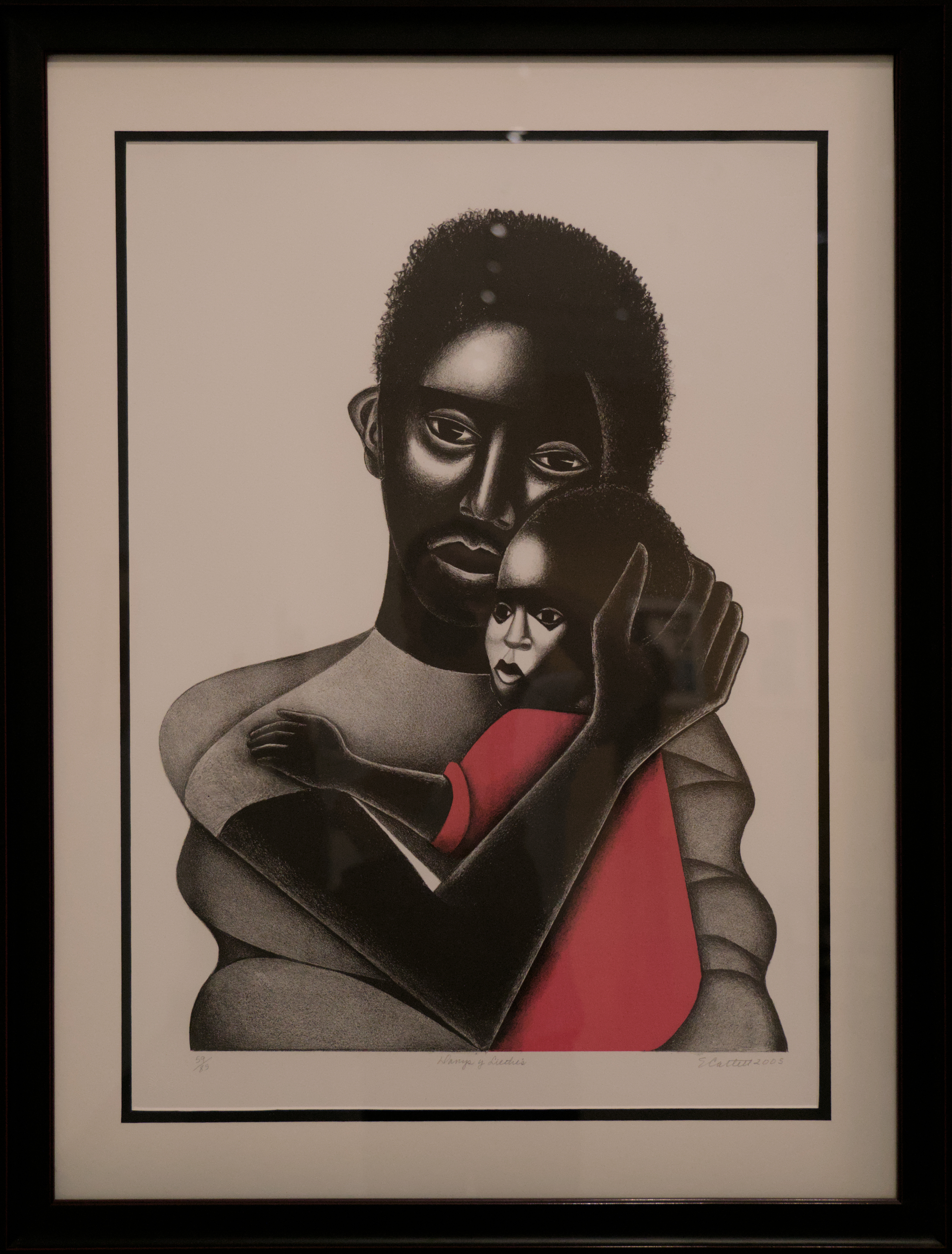
Skipping ahead to this millennium, the exhibition includes Danys y Liethis, a portrait of the artist’s niece and great-niece:
Elizabeth Catlett (American, active in Mexico, 1915–2012), Danys y Liethis, 2005. Offset lithograph, sheet: 71 × 50.8 cm (27 15/16 × 20 in.); framed: 91.4 × 71.1 cm (36 × 28 in.). Collection of Barbara J. Luke.
Lastly, suspended from the ceiling at the exhibition’s entrance/exit, is Catlett’s most unique mother-child sculpture, Floating Family:
Elizabeth Catlett (American, active in Mexico, 1915–2012), Floating Family, 1995. Mexican primavera wood, overall length: 304.8 cm (120 in.). Collection of the Chicago Public Library.
In many of her depictions of motherhood, Catlett unifies the mother and child into a single form, emphasizing their intimacy. But I’ve been thinking about her large-scale sculpture Floating Family, which usually hangs above the circulation desk at the Legler Branch of the Chicago Public Library. Here, mother and daughter are still tethered together, but instead of standing upright they are now perfectly horizontal. Are they maple seed pods, spinning and falling to the earth to plant something new? Or a rotor, lifting upwards, leaving gravity behind? Despite the seeming precarity of the moment, the mother’s face is calm and set, and the daughter looks up at her, trusting.
I imagine that it does something different in the context of a library than as the closing object in a museum retrospective. For me in October, after seeing so many sculptures of mothers cuddling their children close, this work evoked the particular terror and thrill of parenting adolescents. Now, it suggests more than that: the labor and love we give not only our children but our communities and the way that hope can sometimes feel like a free fall.














 Art & Theology