God’s patient “stet”: Richard Wilbur on divine mercy

Two-time Pulitzer Prize winner and second poet laureate of the United States Richard Wilbur died on October 14. In memoriam, I provide the following walk-through of his poem “The Proof,” followed by some of his reflections on the influence his Christian faith has had on his work.

+++

“The Proof” by Richard Wilbur

Shall I love God for causing me to be?
I was mere utterance; shall these words love me?

Yet when I caused his work to jar and stammer,
And one free subject loosened all his grammar,

I love him that he did not in a rage
Once and forever rule me off the page,

But thinking I might come to please him yet,
Crossed out delete and wrote his patient stet.

This poem was originally published in the Atlantic Monthly 213, no. 3 (March 1964): 62. It can be found in Wilbur’s Collected Poems 1943–2004.

+++

I am a proofreader by trade, so Richard Wilbur’s witty eight-line poem “The Proof” delights me much. Filled with wordplay, it imagines God as the Cosmic Author, reviewing a set of book proofs (the typeset version of a manuscript), considering a particular edit: there’s a word that’s discordant with the whole—delete it, or not?

Creative control is God’s to exercise over his manuscript of life, whose first chapter was conceived with the utterance “Let there be . . .”—Light! Sky! Water! Land! Vegetation! Animals! And finally, “Let there be humankind.” Let there be Susie. Let there be Sal.

Our names belong to God’s story. He established us as characters at the very beginning. And yet he also made us “free subjects,” imbuing us with free will, with the power to follow his script or not. We decided NOT. Playing fast and loose with his “grammar” (his system of principles that make for right functions of and relationships among parts), we looked for life in all the wrong places. We introduced chaos, suffering. Now mired in this mess, we question whether or not “to be”—to exist—is a blessing or a curse.

The word “subject” in line 4 has a double meaning. First, it identifies us as being under God’s authority, as the word “rule” in the next stanza stresses. Maybe “free subject” sounds like an oxymoron, because how is it possible to be both free and subject to? Actually, our status as “free subjects” in relation to the Divine has been amply teased out by moral philosophers like Kant. And before that, in the realm of politics, the term was used (without contradiction) to describe members of a state—people who submit themselves to the sovereign laws of the land, all the while possessing civil liberties. (“Citizen” has since replaced the term “free subject” in popular parlance.)

Second, a “subject” is a part of speech, an integral element of basic sentence structure. In grammar, the subject is the doer of the action. In his poem, Wilbur suggests that when we free humans do, we often do wrong. We jar God’s creation—wrench it out of harmony, destabilize it. We stammer—are repetitious in our sin. This displeases God, our author, who wonders whether, to preserve the integrity of the whole, he ought to remove us.

But God is a merciful author; he allows us to remain. In our imperfection, he loves us. Even though we mar his work, he recognizes that we do add value to the story—in part, because we magnify his grace.

Stet illustration (Photo by Victoria Emily Jones)

Stet is an industry term used by proofreaders. From the Latin for “let it stand,” it indicates that the person inputting the changes into the master document is to disregard a change that was previously marked.   Continue reading “God’s patient “stet”: Richard Wilbur on divine mercy”
Let Justice Roll Down (Artful Devotion)

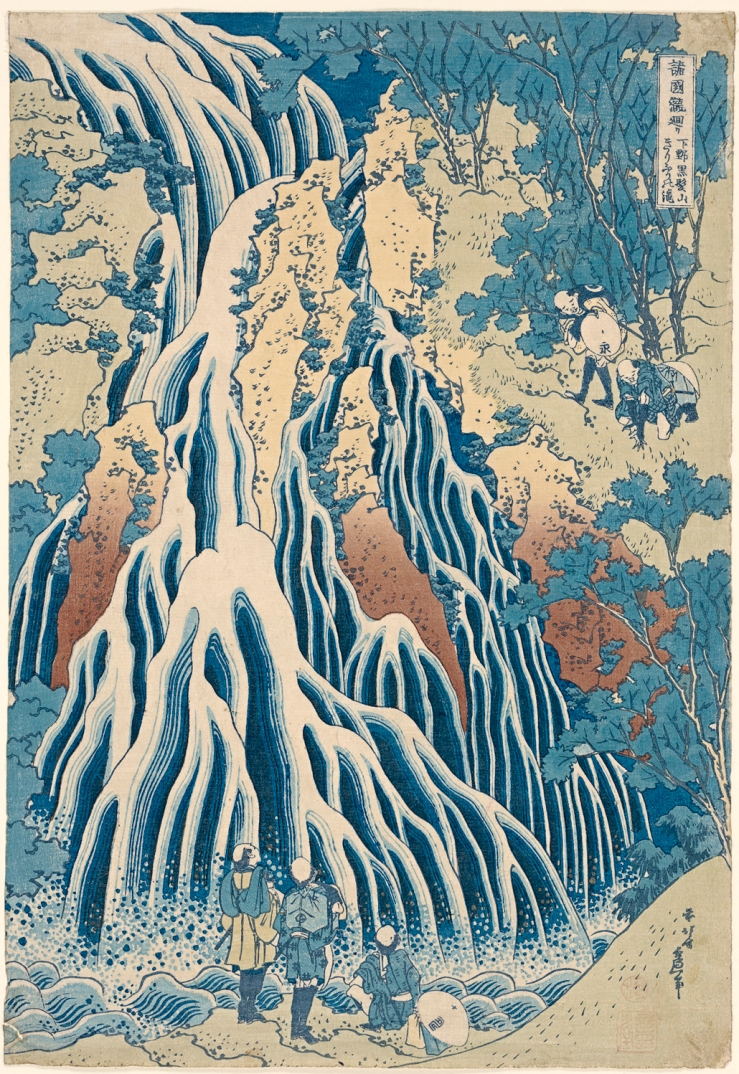
Misty Kirifuri Waterfall at Kurokami Mountain by Katsushika Hokusai
Katsushika Hokusai (Japanese, 1760–1849), Misty Kirifuri Waterfall at Kurokami Mountain, ca. 1833. Woodblock print on dyed paper, 37.6 × 27 cm. National Gallery of Victoria, Melbourne.

God condemns the two-facedness of his people, who offer praise to him in song and sacrifice but fail to uphold his laws of social justice:

I hate, I despise your feasts,
and I take no delight in your solemn assemblies.
Even though you offer me your burnt offerings and grain offerings,
I will not accept them;
and the peace offerings of your fattened animals,
I will not look upon them.
Take away from me the noise of your songs;
to the melody of your harps I will not listen.
But let justice roll down like waters,
and righteousness like an ever-flowing stream.

—Amos 5:21–24

+++

SONG: “Instead of a Show” by Jon Foreman, from Summer (2008)

+++

I have not said to my people: “Get rid of your discontent.” Rather, I have tried to say that this normal and healthy discontent can be channeled into the creative outlet of nonviolent direct action. And now this approach is being termed extremist.

But though I was initially disappointed at being categorized as an extremist, as I continued to think about the matter I gradually gained a measure of satisfaction from the label. Was not Jesus an extremist for love: “Love your enemies, bless them that curse you, do good to them that hate you, and pray for them which despitefully use you, and persecute you.” Was not Amos an extremist for justice: “Let justice roll down like waters and righteousness like an ever-flowing stream.” Was not Paul an extremist for the Christian gospel: “I bear in my body the marks of the Lord Jesus.” Was not Martin Luther an extremist: “Here I stand; I cannot do otherwise, so help me God.” And John Bunyan: “I will stay in jail to the end of my days before I make a butchery of my conscience.” And Abraham Lincoln: “This nation cannot survive half slave and half free.” And Thomas Jefferson: “We hold these truths to be self-evident, that all men are created equal . . .”

So the question is not whether we will be extremists, but what kind of extremists we will be. Will we be extremists for hate or for love? Will we be extremists for the preservation of injustice or for the extension of justice? In that dramatic scene on Calvary’s hill three men were crucified. We must never forget that all three were crucified for the same crime—the crime of extremism. Two were extremists for immorality, and thus fell below their environment. The other, Jesus Christ, was an extremist for love, truth and goodness, and thereby rose above his environment. Perhaps the South, the nation and the world are in dire need of creative extremists.

—Martin Luther King Jr., Letter from a Birmingham Jail


This post belongs to the weekly series Artful Devotion. If you can’t view the music player in your email or RSS reader, try opening the post in your browser.

To view all the Revised Common Lectionary scripture readings for Proper 27, cycle A, click here.

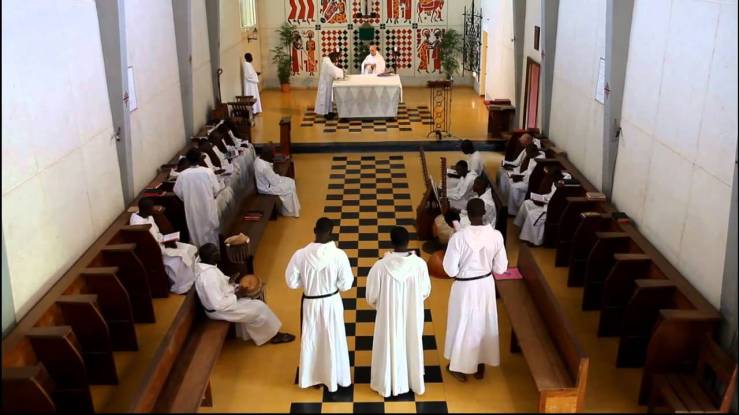
Music making at Keur Moussa Abbey, Senegal

Mass at Keur Moussa Abbey in Senegal

Lately I’ve been enjoying the music of the monks at Keur Moussa Abbey, a brotherhood of French expatriates and Senegalese who wed Western liturgical chant with the rhythms and instrumental textures of West Africa. One of their income streams is musical recording sales—in North America, for example, Sounds True distributes Keur Moussa: Sacred Chant and African Rhythms from Senegal. It’s an excellent, seventeen-track CD that comprises songs of praise, exhortation, confession, and supplication in French and Wolof. Below you will find two of those tracks, embedded with the kind permission of Sounds True.

The first is “Suma Hol Nam” (“I Was Glad”), an adaptation of Psalm 122 in Wolof, accompanied by tom-tom. “Let peace reign in your tents, joy within your walls!” it exclaims. The refrain is “How glad I was when they said to me, ‘Let us go to the house of the Lord.’”


The second is “Yesu Dekalikuna” (“Jesus Is Risen”), a brisk instrumental kora interlude that evokes the holy women hastening from the tomb on Easter morning.


From the liner notes:

In 1963, nine monks from the French monastery of Saint-Pierre of Solesmes—a centuries-old stronghold of the ancient Gregorian plainchant tradition—journeyed to the remote Wolof village of Keur Moussa in Senegal to found the Benedictine Abbey of the Immaculate Heart of Mary [Abbaye du Cœur Immaculé de Marie]. Keur Moussa Abbey, as it is known to the villagers, means “House of Moses.” It is above all a place of prayer, where praise of God is celebrated through hard work, contemplative silence, and joyful music. From the first day of their arrival, these expatriate monks sought to invite the traditions, music, and people of their host village into the monastery grounds.

Today, Keur Moussa Abbey houses 35 brothers, 24 of whom are Senegalese. [According to OSB International, the current number of brothers is 44.] The abbey also sponsors an elementary school and dispensary, run by sisters and laypeople. The monks themselves live from the work of their hands, tending fruit trees, making cheese, and hand-crafting their renowned koras.

The kora, employed for both solos and accompaniment, is an African lute-harp of Mandingo origin. Enchanted by its lyrical voice, the first monks of Keur Moussa Abbey learned from the griots (nomadic Mandingo kora players and storytellers) to play the instrument, and eventually adapted it for use in their liturgical services. Through careful changes in the kora’s construction, they have made it easier to tune—a process that once frustrated even the most experienced of players—without altering its extraordinarily beautiful timbre. . . .

Through the continual exploration of their convergent musical worlds, the monks of Keur Moussa have created an entirely new liturgical choral tradition . . . weav[ing] the rhythms and instrumental textures of the African continent with the sacred words and compositional structures of traditional Western plainchant (sung in French and Wolof, the language of the region). Here, as in the daily masses at the abbey, the choral works are occasionally preceded or followed by instrumental performances on kora, tabala (a large Mauritanian camel-skin drum), balafon (a Malinke instrument similar to the xylophone), tom-tom, and flute.

The notes include English translations of all the songs, plus background information on each one.   Continue reading “Music making at Keur Moussa Abbey, Senegal”

Send Out Your Light (Artful Devotion)

Lighthouse in Westkapelle by Piet Mondrian
Piet Mondrian (Dutch, 1872–1944), Lighthouse in Westkapelle [in Orange], 1909. Oil on canvas, 39 × 29 cm. Galleria d’Arte Moderna, Milan.

O send out your light and your truth;
let them lead me;
let them bring me to your holy hill
and to your dwelling.

—Psalm 43:3

+++

SONG: “Let Your Light Shine on Me” | Traditional, performed by Blind Willie Johnson, 1929

+++

About the painting: Before he became a world-famous pioneer of geometric abstraction, Piet Mondrian (1872–1944) spent his early artistic career painting pastoral images of his native Netherlands in an impressionist style—churches, windmills, fields, rivers, sand dunes, and lighthouses. He made several paintings, using different color palettes, of the “tall lighthouse” of Westkapelle, which stands at the entrance to the village. The structure is actually a fifteenth-century Gothic church tower that was converted into a lighthouse in 1818 after the church burned down. It is still active, serving along with the “short lighthouse” to lead vessels coming in from the northern part of the North Sea. The loose pointillist technique Mondrian uses here enables him to fuse the lighthouse with the surrounding sky, producing a sense of vibration and ethereality.

About the singer: Blind Willie Johnson (1897–1945) was a gospel blues singer, slide guitarist, and evangelist from Texas about whom little is known. Besides the one-time payments he received from Columbia for his studio recordings of 1927–30, most of his income was earned by performing and preaching on the streets; appreciative passersby would drop coins into the tin cup tied to his Stella. Johnson is known for his unique style of singing: in a gravelly “false bass,” or growl, which he drops into in verse 2 of “Let Your Light Shine on Me.” His is the earliest known recording of this traditional gospel song.


This post belongs to the weekly series Artful Devotion. If you can’t view the music player in your email or RSS reader, try opening the post in your browser.

To view all the Revised Common Lectionary scripture readings for Proper 26, cycle A, click here.

Around the Throne (Artful Devotion)

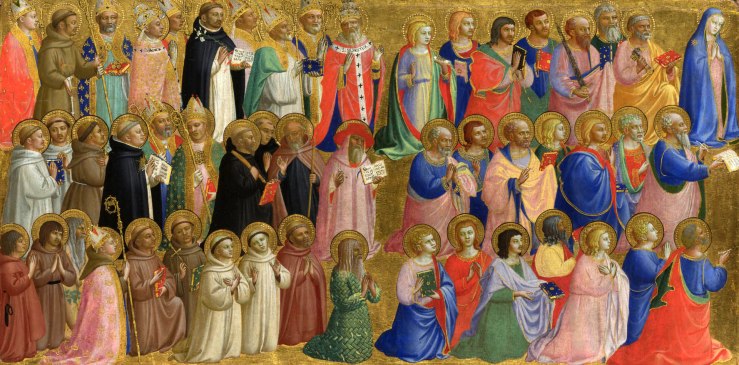
Predella of the San Domenico Altarpiece (Fiesole)
Predella of the San Domenico Altarpiece at Fiesole, ca. 1424, probably by Fra Angelico (Italian, ca. 1395–1455). Tempera and gold leaf on panels, 32 × 244 cm. National Gallery, London.

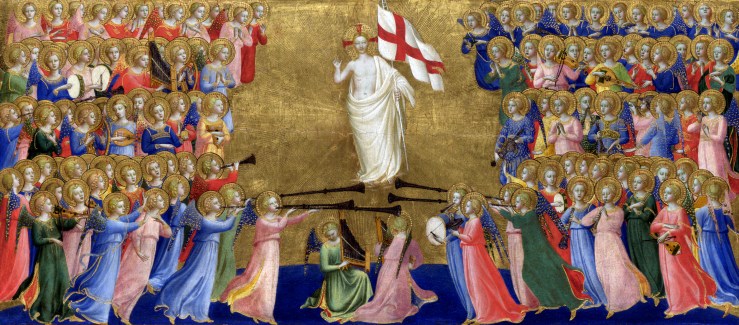
This week the Revised Common Lectionary assigns an additional set of readings, on top of Sunday’s, for the special celebration of All Saints’ Day (Hallowmas) on November 1. Among them is John’s vision of a multitude of angels and faithful departed surrounding the enthroned Christ in heaven, sounding forth his praise.

After this I looked, and behold, a great multitude that no one could number, from every nation, from all tribes and peoples and languages, standing before the throne and before the Lamb, clothed in white robes, with palm branches in their hands, and crying out with a loud voice, “Salvation belongs to our God who sits on the throne, and to the Lamb!” And all the angels were standing around the throne and around the elders and the four living creatures, and they fell on their faces before the throne and worshiped God, saying, “Amen! Blessing and glory and wisdom and thanksgiving and honor and power and might be to our God forever and ever! Amen.”

—Revelation 7:9–12

+++

O quam gloriosum est regnum (“O how glorious is the kingdom”) — A cappella motet for four voices composed by Tomás Luis de Victoria, 1572 | Performed by the University of Utah Chamber Choir

O quam gloriosum est regnum
in quo cum Christo gaudent omnes sancti!
Amicti stolis albis,
sequuntur Agnum quocumque ierit.

O how glorious is the kingdom
in which all the saints rejoice with Christ!
Clad in robes of white,
they follow the Lamb wherever he goes.

+++

Explore the individual panels from Fra Angelico’s “court of heaven” predella in greater detail on the National Gallery of London’s website, and rejoice this All Saints’ Day in the Christian witness of those who have gone before us!

The Virgin Mary with the Apostles and Other Saints
Probably Fra Angelico (Italian, ca. 1395–1455), The Virgin Mary with the Apostles and Other Saints, ca. 1424. Tempera and gold leaf on panel, 32 × 64 cm. From the San Domenico Altarpiece predella, National Gallery, London.
Christ Glorified in the Court of Heaven
Probably Fra Angelico (Italian, ca. 1395–1455), Christ Glorified in the Court of Heaven, ca. 1424. Tempera and gold leaf on panel, 31.7 × 73 cm. From the San Domenico Altarpiece predella, National Gallery, London.
Saints and Martyrs (Fra Angelico)
Probably Fra Angelico (Italian, ca. 1395–1455), The Forerunners of Christ with Saints and Martyrs, ca. 1424. Tempera and gold leaf on panel, 31.9 × 63.5 cm. From the San Domenico Altarpiece predella, National Gallery, London.

This post belongs to the weekly series Artful Devotion. If you can’t view the music player in your email or RSS reader, try opening the post in your browser.

To view all the Revised Common Lectionary scripture readings for All Saints’ Day, cycle A, click here.

Meg Hitchcock’s Sacred-Text Drawings

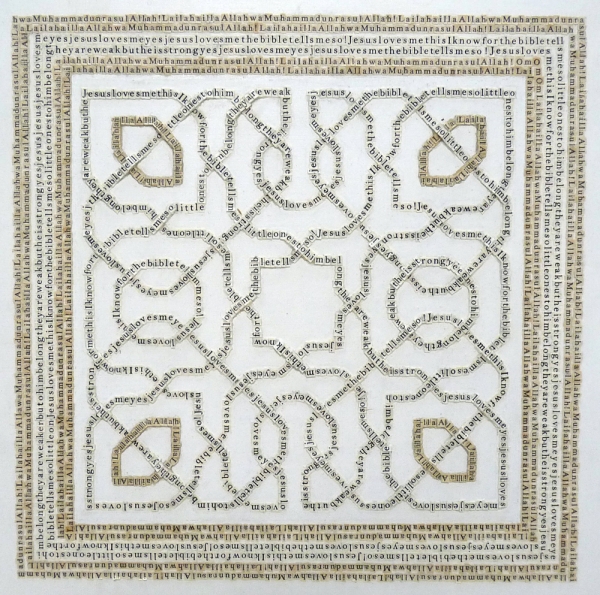
Christian confessions, Jewish prayers, Islamic surahs, Buddhist sutras, and Vedic Sanskrit hymns are de- and re-constructed in contemporary artist Meg Hitchcock’s typographic collages—or “text drawings,” as she calls them. Seeking to highlight the beauty of the world’s various religions, she cuts individual letters from one religious text and then rearranges them on paper in an intricate pattern that spells out the beliefs of another tradition. The continuous, run-on line, which weaves in and out without spaces or punctuation, creates a “visual mantra of devotion,” Hitchcock says.

Hitchcock, Meg_Jesus Loves Me
Meg Hitchcock (American, 1961–), Jesus Loves Me, 2013. Letters cut from the Koran, 8 1/2 × 8 1/2 in. Weaves together a Christian children’s song with the Shahada.

When asked how she responds to reactions of horror that she is cutting up and reauthoring the word of God, she said, “I’m very respectful of a person’s faith, and would never intentionally insult anyone. If my work is seen as an affront, it’s only because that person hasn’t heard the meaning behind the work. In short, I don’t see it as a desecration, but a celebration of the word of God.” (Read the full interview at StudioInternational.com.)

Hitchcock was raised Methodist. She had a “born-again experience” (her words) at age twelve and continued in that profession until age thirty, when she decided to step away from the faith. Now, she says, she’s not religious or even spiritual, but she’s definitely “not an atheist.” She says she follows a “pathless path.”

Despite the distance she keeps from organized religion, she is fascinated, she says, by its texts—not necessarily what they say, but what they mean to the people who deem them sacred. The words are so alive and true to communities of believers who recite them, sing them, chant them, pray them with all their heart and soul. People seek direction through these words. They seek comfort and healing. They seek meaning, and self-definition. And in the seeking, believers across all faith traditions are united. It’s this universal impulse—to connect with something larger than ourselves—that Hitchcock wants to explore.

Here are some works that reconstruct (Judeo-)Christian texts—songs, prayers, creeds, and scripture passages.   Continue reading “Meg Hitchcock’s Sacred-Text Drawings”

More Love (Artful Devotion)

Mary Magdalene at Foot of Cross
Right: Mary Magdalen at the Foot of the Cross, Netherlands, ca. 1420–30. Alabaster, 8 7/16 × 3 11/16 × 4 1/16 in. (21.5 × 9.3 × 10.3 cm). Metropolitan Museum of Art, New York. Photo: Victoria Emily Jones. This fragment served as the base of a now-lost crucifix.

“You shall love the Lord your God with all your heart, and with all your soul, and with all your mind. This is the greatest and first commandment.” (Matthew 22:37–38)

+++

SONG: “More Love to Thee” | Words by Elizabeth Prentiss, 1869 | Music by William H. Doane, 1868 | Arranged and performed by One Eighty (Amy J. Kim, Joon Park)

(Listen in Korean.)

+++

“O Lord, from now on let me love You as intensely as I have loved sin.”

—John Chrysostom

“To Thee alone my spirit cries;
In Thee my whole ambition lies,
And still Thy Wealth is far above
The poverty of my small love.”

—Dhul-Nun al-Misri, 9th-century Egyptian Sufi mystic (trans. A. J. Arberry)


This post belongs to the weekly series Artful Devotion. If you can’t view the music player in your email or RSS reader, try opening the post in your browser.

To view all the Revised Common Lectionary scripture readings for Proper 25, cycle A, click here.

Roundup: Memento mori; works of mercy; ring shout; The Seventh Seal

Affiliate links: Art & Theology is now a participant in the Amazon Associates program, an affiliate marketing tool that enables me to potentially collect a little change by hosting Amazon links on my website. I already do that anyway—link to Amazon product pages when I mention books, movies, or less often, music (I try to drive sales directly to the artist’s website, if one exists)—so you will not notice any change in blog post appearance or the frequency of links. But now that I’m registered, if you were to click through one of those Amazon links (for example, Shout Because You’re Free or The Seventh Seal below) and make a purchase, any purchase, I would earn a referral fee of 2.5% to 5% of the purchase price. I have to generate at least three purchases every 180 days to stay in the program. As of now, this is the website’s sole income stream.

+++

EXHIBITION: “The Ivory Mirror: The Art of Mortality in Renaissance Europe,” June 24–November 26, 2016, Bowdoin College Museum of Art, Brunswick, Maine: Skeletons, skulls, and other dark images of death from the fourteenth and fifteenth centuries were meant to remind their owners of life’s brevity and thereby prompt repentance. Some target specific sins, like clinging too tightly to one’s wealth or good looks. “This exhibition represents a significant contribution to our understanding of the rich visual culture of mortality in Renaissance Europe. The appeal of the memento mori, featuring macabre imagery urging us to ‘remember death,’ reached the apex of its popularity around 1500, when artists treated the theme in innovative and compelling ways. Exquisite artworks—from ivory prayer beads to gem-encrusted jewelry—evoke life’s preciousness and the tension between pleasure and responsibility, then and now.” A symposium, “Last Things: Luxury Goods and Memento Mori Culture in Europe, ca. 1400-1550,” will be held November 3–4. You can read a review of the exhibition at Hyperallergic.

Memento mori (prayer bead)
Ivory prayer bead, France or southern Netherlands, 1530. Victoria and Albert Museum, London. On one side of the carving is a man, on another a woman, and grinning sardonically between them is a skull, worms crawling through its bared teeth.
Vanitas (16th century)
Vanitas, Germany, ca. 1525. Boxwood. Harvard Art Museums/Busch-Reisinger Museum, Cambridge, Massachusetts.

+++

ART COMMENTARY: The Seven Works of Mercy by the Master of Alkmaar: The corporal works of mercy, seven in number, are a traditional Catholic practice of serving the physical needs of others. Derived from Matthew 25:31–46 (cf. Isaiah 58:6–10) and Tobit 1:16–22, they are to: (1) feed the hungry, (2) give water to the thirsty, (3) clothe the naked, (4) shelter the homeless, (5) care for the sick, (6) visit the imprisoned, and (7) bury the dead. Earlier this month Marleen Hengelaar-Rookmaaker wrote a two-part visual meditation on a Netherlandish polyptych (altarpiece with four or more panels) from the sixteenth century that treats this topic. In the background of each contemporary enactment of mercy stands a silently affirming Jesus. To view the panels in high resolution, visit the Rijksmuseum website.

Seven Works of Mercy
The Master of Alkmaar, The Seven Works of Mercy, 1504. Oil on seven panels, 120 × 472 cm. Rijksmuseum, Amsterdam.

+++

ALBUM: Spirituals and Shout Songs from the Georgia Coast by the McIntosh County Shouters: The McIntosh County Shouters from coastal Georgia are the last community in America to perform the traditional ring shout, a shuffle-step devotional movement, accompanied by singing, that is rooted in the ritual dances of West Africa and was forged by the Atlantic slave trade. Shouting differs from traditional black religious music in repertory, style, and execution, Art Rosenbaum writes in Shout Because You’re Free: The African American Ring Shout Tradition in Coastal Georgia. In 1980 two folklorists, astonished to find the form still in use, encouraged practitioners to take it public. The community thus assembled a small touring group, and in 1984, under the Smithsonian Folkways label, they released their first album. This year they released their second, with a mostly new selection of songs (all but three) and all-new performances. You can watch “Jubilee” below. (Thanks, Global Christian Worship, for the tip!)

+++

FILM: The Seventh Seal (1958): After receiving several recommendations, I finally watched this classic of world cinema, directed by Ingmar Bergman, and actually enjoyed it more than I expected. It follows the medieval knight Antonius Block as he returns, disillusioned and exhausted, from a decade-long Crusade, only to encounter Death, whom he challenges to a fateful game of chess. (This central image, Bergman said, was inspired by a church fresco, reproduced below.)

Death Playing Chess by Albertus Pictor
Albertus Pictor (Swedish, ca. 1440–ca. 1507), Death Playing Chess, 1480s. Fresco, Täby Church, Uppland, Sweden.

The movie’s title is taken from Revelation 8:1—“And when the Lamb opened the seventh seal, there was silence in heaven for about half an hour”—establishing the silence of God as a major theme. Antonius’s monologue in the chapel confessional evinces his struggle between doubt and belief:

I want to confess as best I can, but my heart is void. The void is a mirror. I see my face and feel loathing and horror. My indifference to men has shut me out. I live now in a world of ghosts, a prisoner in my dreams. . . .

Is it so hard to conceive God with one’s senses? Why must he hide in a mist of vague promises and invisible miracles? How are we to believe the believers when we don’t believe ourselves? What will become of us who want to believe but cannot? And what of those who neither will nor can believe? Why can I not kill God within me? Why does he go on living in a painful, humiliating way? I want to tear him out of my heart, but he remains a mocking reality which I cannot get rid of. . . .

I want knowledge. Not belief. Not surmise. But knowledge. I want God to put out his hand, show his face, speak to me. . . . I cry to him in the dark, but there seems to be no one there.

But along his way he ends up meeting a “holy family”—simple and with pure faith and hope—whose names, Mia and Jof, are diminutives of Mary and Joseph. Bergman presents their worldview as a contrast to the bitter skepticism of Antonius.

For reviews that trace themes of faith and doubt in The Seventh Seal, see David Nilsen and Steven D. Greydanus.

Sing! (Artful Devotion)

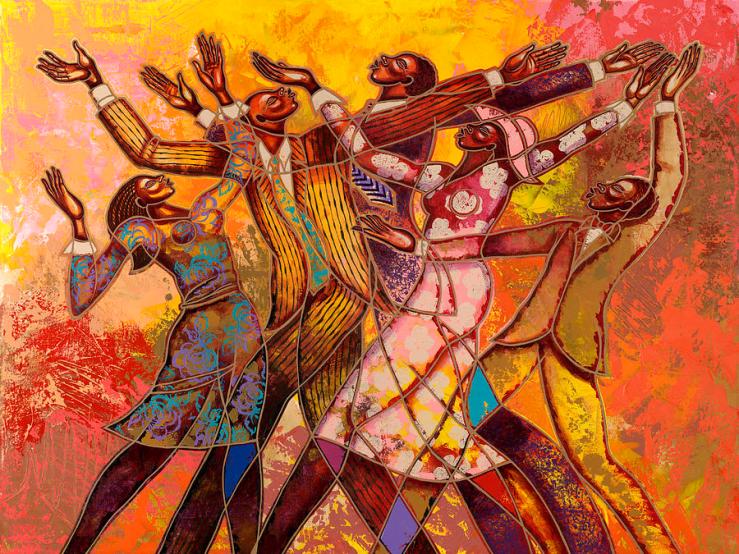
Brown, Larry Poncho_Every Round Goes Higher
Larry Poncho Brown (American, 1962–), Every Round Goes Higher, 2009. Acrylic on canvas. Commissioned by the Douglass Memorial Community Church Inspirational Choir, Baltimore, Maryland.

Oh sing to the LORD a new song;
sing to the LORD, all the earth!

—Psalm 96:1

+++

SONG: “Come on Children, Let’s Sing” | Traditional, performed by Mahalia Jackson


This post belongs to the weekly series Artful Devotion. If you can’t view the music player in your email or RSS reader, try opening the post in your browser.

To view all the Revised Common Lectionary scripture readings for Proper 24, cycle A, click here.

Wednesday Morning, 3 A.M. by Simon and Garfunkel (album review)

For Christmas 1999 my parents bought me, a sixth grader at the time, the new Best of Simon and Garfunkel album released by Columbia. I was already familiar with about half the songs, which played frequently on Oldies 100.7, the station to which my family’s radios were always tuned. (Even so, who hasn’t heard “Mrs. Robinson” and “Bridge Over Troubled Water”?) The other half I taught myself through repeated listening on my boombox, following along with the lyrics printed in the CD insert. I’m grateful to my parents for educating my musical tastes beyond Backstreet Boys and Britney Spears.

Simon and Garfunkel
Simon and Garfunkel, 5th Avenue and 53rd Street subway station, New York City, 1964. Photo: Henry Parker (cover shoot for Wednesday Morning, 3 A.M.).

It wasn’t until after college that I ventured into the duo’s lesser-known discography. That’s when I discovered their debut album, Wednesday Morning, 3 A.M. “Exciting new sounds in the folk tradition,” the cover boasts. Released October 18, 1964, to lukewarm reviews, it was a commercial failure, selling only one thousand copies in the first eight months. Even today critics say it pales in comparison to their subsequent work. But I actually love this album—it’s one of my favorites not only of theirs but of any artist. I was pleasantly surprised to find it chock-full of biblical references, many of them explicit.

Its seven covers include an upbeat gospel song, a Negro spiritual, a Renaissance canticle (adapted), a visionary antiwar song, an atom-bomb lament, a traditional Scottish ballad, and the Dylan classic “The Times They Are a-Changin’.” The five originals include a fable about loving the immigrant, an elegy for a civil rights martyr, a farewell song (in the voice of a criminal), and two poetic expressions of urban loneliness.

1. You Can Tell the World. [Listen] A joyous blast of praise, this traditional black gospel song begins,

Well, you can tell the world about this
You can tell the nation about that
Tell ’em what the master has done
Tell ’em that the gospel has come
Tell ’em that the victory’s been won
He brought joy, joy, joy, joy, joy, joy
Into my heart

It then goes on to extol Jesus’s preaching and testify to the personal revelation God gives.

As is often the case with traditional songs, the tune and lyrics have been adapted over time. Other versions have been recorded under names like “He Brought Joy to My Soul” (Ethel Waters, 1926); “I Can Tell the World About This” (Morris Brown Quartet, 1940); “Joy, Joy to My Soul” (The Soul Stirrers, feat. Sam Cooke, 1951); “Tell the World” (The Tarriers, 1960); and so on. In 1961 Bob Gibson recorded an arrangement he and Hamilton Camp had written, which is what Simon and Garfunkel credit in their liner notes. This was my first time hearing this song that has apparently been making the rounds for decades, and I enjoyed listening to what other artists have done with it. To view a partial list of recordings, click here. (And be sure to check out the choral arrangement by Alice Parker, on the 2010 album Listen, Lord.)

2. Last Night I Had the Strangest Dream. [Listen] In this song, written by Ed McCurdy in 1950, the speaker dreams about a treaty being signed by all nations to put an end to war. As the signers hold hands and pray together, the people toss their guns, swords, and uniforms into trash heaps, for they have been rendered obsolete. A call for world peace, “Last Night” has been recorded in seventy-six languages, and the Peace Corps adopted it as their official theme song in 1980. It’s a little too singsongy for my tastes, but I support the dream 100 percent!

3. Bleecker Street. [Listen] The first original song on the album, “Bleecker Street,” typifies the melodic grace and themes (e.g., alienation, discontent) that Paul would come to be known and praised for. Its title is the name of one of the famous avenues of Greenwich Village, a haven for artists of all types and a major hub of 1960s countercultures. But Paul doesn’t characterize it as a place of salvation. Quite the opposite: he says, “It’s a long road to Canaan / On Bleecker Street.”

It sounds to me like Paul (assuming he’s the speaker here) is voicing his disillusionment and trying to come to grips with humanity’s failings. For all the lofty ideals born and preached there, the Village is no paradise. People were coming there looking to receive and help effect freedom, enlightenment, beauty, and change, but loneliness and suffering persists. Fog covers Bleecker “like a shroud,” blanketing homeless men asleep in alleys and “hid[ing] the shepherd from the sheep.” (Most residents were so self-involved, they couldn’t see God.) There’s a spiritual emptiness, and a loss of real human connection (“I saw a shadow touch a shadow’s hand”).

The poets write, and “holy, holy is their sacrament” (a reference, perhaps, to Allen Ginsberg). But their rhymes are “crooked” (dishonest?), and they sell them for thirty dollars’ rent, a reference to Judas’s betrayal of Jesus.

And yet on the other side of this moral desert, “a church bell softly chime[s],” beckoning seekers to a higher and truer hope, to a promise that will not fail. Its “melody sustain[s]” the human spirit like nothing else can.

4. Sparrow. [Listen] This sung fable, written by Paul Simon, tells the story of a little sparrow “who’s traveled far and cries for rest.” She seeks love but is rebuffed at every turn. The oak tree denies her shelter in his branches, not wanting to lend his strength to such an unworthy creature; for fear of derision from her peers, the beautiful swan declines to speak a kindly word; and the self-interested wheat refuses the sparrow food, preferring to keep all his resources to himself: “I would if I could but I cannot I know. / I need all my grain to prosper and grow.”   Continue reading Wednesday Morning, 3 A.M. by Simon and Garfunkel (album review)”