Gustave Doré (French, 1832–1883), The Entry of Christ into Jerusalem, 1876. Oil on canvas, 38-1/4 × 51 in.
Unaccustomed to her burden, she knows not
That never beast bore such a Man as this,
Who meekly rides to His appointed lot,
A crown of thorns and a betrayer’s kiss.
And never man will carry such a weight
As He bears now in this, His day of power,
Ascending toward a strait and narrow gate,
His agonizing last and finest hour.
She bravely struggles on, despite her fear
Of cheering men, whom He as gravely views
As an admiral watching distant storms draw near
To lash bright waves to dark and deadly hues;
He knows the death decreed in ancient psalms,
The Tree that looms beyond these scattered palms.
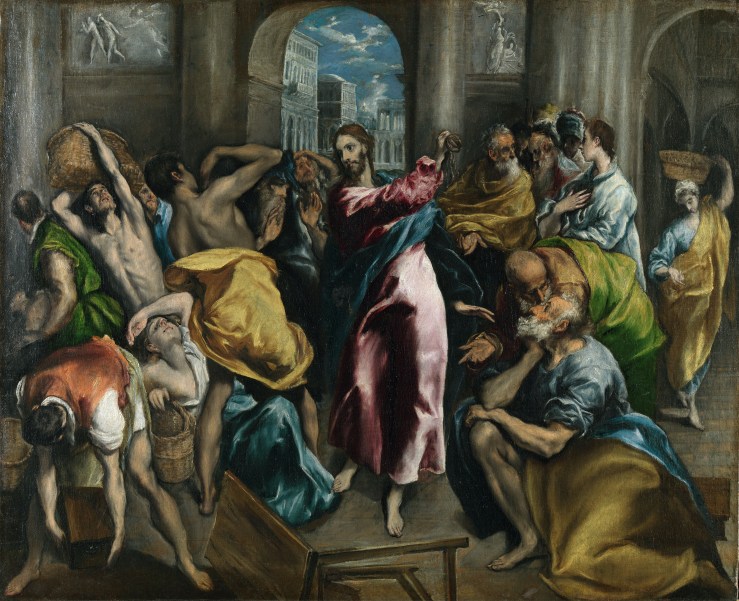
“Inspired to Follow: Art and the Bible Story,” St.-Martin-in-the-Fields, London: This program comprises a series of weekly noontime gatherings that use famous local paintings as a springboard into discussion of the biblical narrative and its implications for us today. I’ve enjoyed reading the few presentations given by associate vicar Jonathan Evens, posted on his blog: first, on J. M. W. Turner’s two paintings of Noah’s flood, and more recently, on El Greco’s Christ Driving the Money Changers from the Temple.
El Greco (Greek, active Spain, 1541–1614), Christ Driving the Money Changers from the Temple, 1600. Oil on canvas, 106 × 130 cm (42 × 51 in.). National Gallery, London.
+++
VIBRANT music and arts festival, Cahaba Park Church, Birmingham, Alabama: On November 1, 2015, Cahaba Park Church held a Psalms-inspired music and arts festival. Eight visual artists from the church were selected to display their paintings, which were auctioned off to raise money for four nonprofits. The Corner Room performed songs from their new album, Psalm Songs, Volume 1; “Psalm 23” (music by Adam Wright) is the soundtrack for the recap video above. This next VIBRANT festival will be held on July 22.
+++
“Art and Spirit” exhibition, First Congregational Church, Los Angeles: Through April 24, the works of over fifty artists will be on display in the Neo-Gothic Shatto Chapel of the First Congregational Church of Los Angeles. Most of the works are by emerging LA artists from Art Division, an organization that provides art training to young adults who lack the resources to attend university but who want to pursue a career in the visual arts; they were asked to respond to the theme “art and spirit.” A few of the works in the exhibition are by well-known artists such as Rembrandt, Albrecht Dürer, Corita Kent, and Ed Ruscha.
+++
Portraits of Resurrection, 2015 Easter initiative, Saddleback Church, Lake Forest, California: Ex Creatis, the arts ministry at Saddleback, is always coming up with unique ways to incorporate art into the life of its church. Last Easter twenty-three volunteer artists sketched portraits of church attendees onto one of three floral prints (of the sitter’s choosing) made by three different artists in the church. These personalized works of art were meant to remind those who took them home of the new life they have in Christ.
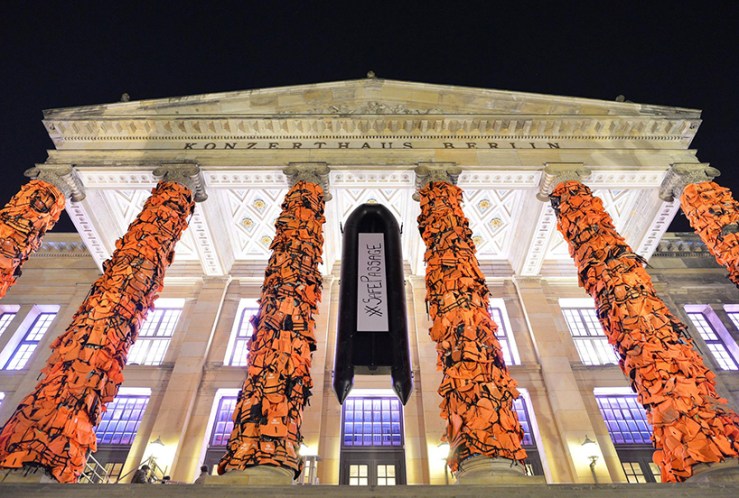
Last month the six front columns of Berlin’s historic Konzerthaus were decked out with fourteen thousand bright orange life jackets—an installation by Chinese artist Ai Weiwei, titled Safe Passage. A tribute to those who have risked their lives on the Mediterranean Sea to escape persecution in the Middle East and North Africa, the work was made to coincide with Cinema for Peace’s annual award gala on February 15, part of the Berlin International Film Festival. The money raised at this year’s gala was used to purchase five thousand rescue blankets and one thousand emergency baby kits (for births that have taken place at sea), which the Cinema for Peace Foundation delivered this past week to the Greek island of Lesbos, the most popular port of entry for people fleeing to Europe through Turkey.
Ai Weiwei’s crew finishes hanging life jackets on the sixth column of Berlin’s Konzerthaus, just before putting up an inflatable dinghy with the title of the installation: Safe Passage. Photo: Markus Winninghoff.Safe Passage: installation of fourteen thousand life jackets by Ai Weiwei, Konzerthaus, Berlin, February 14–17, 2016. Photo: Oliver Lang.
Weiwei visited Lesbos in December to see for himself the human faces of the current refugee crisis. He shared on Instagram photos and videos he took inside a refugee camp, to show the world what’s going on in Lesbos, and has opened an additional studio there.
One thing that visually struck Weiwei were the giant mounds of life jackets heaped up on the beaches. Refugees shed them as soon as they disembark their boats, setting foot, at last, on land, and ready to start their new lives. Seeing in them a poignant symbol of the crisis, he asked the mayor of the island if he could take a small portion—and yes, fourteen thousand is only a small portion—with him to Europe to use for an art installation. His request was granted. Wrapped around the grand facade of Berlin’s nineteenth-century concert house, they bear witness to the scale of the crisis and even allude to its human cost: last year, a reported 3,770-plus refugees died while attempting to cross the Mediterranean, and the death toll for this year has already exceeded 400. Some of these deaths were due to defective life jackets sold to migrants by a Turkish company looking to cut down on production costs.
While some have questioned the efficacy of staging such a large awareness raiser in Germany, a country that has taken in more refugees than any other European Union member state, others point out that several antirefugee organizations have emerged there, such as Patriotic Europeans Against the Islamization of the West (PEGIDA), which calls on the German government to enact stricter asylum laws. Not all the German people are proud of the measures its country has taken to invite in Syrians, Afghans, and other huddled masses yearning to breathe free. Instead they fear the repercussions. Weiwei’s Safe Passage protests against that fear-based mentality that denies and excludes.
Weiwei has not been the first person to recycle used life jackets into art. Last December British artist Arabella Dorman incorporated three life jackets into her installation Flight in St. James’s Church in Piccadilly, London, which has them tumbling out of a capsized dinghy hanging from the ceiling. She also filled the Christmas crèche at the front of the church with a few dozen more: they cushion the ground where the sculpted figures kneel in adoration of the newborn Christ child. Continue reading “Discarded life jackets used by artists to raise awareness of refugee crisis”→
Noted for its dramatic intensity and tragic beauty, the saeta is a type of devotional song performed during Holy Week processions in the Andalusia region of Spain, inspired by images of the suffering Christ and Virgin. It is sung during pauses in the procession, usually without accompaniment: a loud, melismatic wail of praise and lament. Sometimes such performances are planned, with a professional singer standing on a balcony; other times they are improvised by someone in the crowd, as he or she feels moved. Either way, the performances are typically quite emotional.
Here’s a spontaneous male duet performance that took place in the village of San Fernando in the Andalusian province of Cádiz in 2011:
The word saeta means “arrow” in Spanish, referring to the way in which the song soars through the air, piercing the hearts of its listeners.
Most experts agree that the early primitive form of saeta was composed of Gregorian psalms sung by friars and monks during missions. Later the musical structure broke free and was adapted for singing in the street, reshaped by converso Jews [Jewish converts to Catholicism] in the sixteenth century.
While some of these Jewish Catholic songs may have expressed genuine devotion to a newly embraced Christ, most of them—one theory notes—were coded expressions of the singer’s own sorrow at having been forced to renounce his or her former faith by threat of exile or death. This was the time of the Spanish Inquisition, after all.
The saeta was also developed early on by the Andalusian gypsies (gitanos), who have adopted the Catholicism of their host country and who remain the saeta’s most popular interpreters today. They brought to it the elements of flamenco, such that the saeta is now regarded as a subset of that art form and is a part of every flamenco singer’s cante jondo (“deep song”) repertoire.
Julio Romero de Torres (Spanish, 1874–1930), La Saeta, 1918. Oil on canvas. Painted in response to the following saeta lyrics: “¡Oh Santo Cristo de Gracia! / Volved la cara atrás. / Dadle a los ciegos vista / y a los presos libertad.” (Oh Holy Christ of Grace! / Turn your face upon us. / Give sight to the blind / and liberty to the prisoners.)
Even though the saeta has made its way into concert halls, it is still best known as a song of the people, an integral part of Andalusian folk culture, especially among gypsy communities. Sometimes gypsy saeteros (saeta singers) incorporate into the lyrics expressions of ethnic pride—for example, identifying Jesus and his mother, Mary, as one of their own: Continue reading “Flamenco-style devotional singing in southern Spain”→
The salty, twisted treats that we call pretzels have their origin, it is thought, in a seventh-century European monastery—according to lore, either in southern France, northern Italy, or Germany. Allegedly a monk invented them by shaping scraps of leftover bread dough to resemble arms crossed in prayer over the chest. (Think upside-down pretzel.)
During the Middle Ages the church’s fasting requirements for Lent were stricter than they are today, forbidding the intake of all nonaquatic animal by-products, including eggs, lard, milk, and butter. Because pretzels could be made with a simple recipe that avoided these banned ingredients, they soon became associated with the season.
Detail from The Battle between Carnival and Lent by Pieter Bruegel, 1559, showing the gaunt Lady Lent (a man cross-dressed as a nun) riding a cart bearing traditional Lenten fare: pretzels, waffles, and mussels. He holds, like a lance, a baker’s peel topped with two herring.
The pretzel’s Lenten link, not to mention its popularity as a year-round snack both inside and outside monastic communities, led artists to sometimes paint pretzels into Last Supper images.
The Last Supper, from a bishop’s benedictional made in Bavaria, Germany, ca. 1030–40. J. Paul Getty Museum, Los Angeles: MS Ludwig VII 1, fol. 38.
Alena Antonova was born in Czechoslovakia in 1930. From 1949 to 1955 she studied graphic arts at the College of Applied Arts in Prague under the acclaimed Cubist painter Emil Filla. Since then she has specialized in printmaking. The primary technique she uses is drypoint, which involves incising a picture with a needle onto a metal plate, then inking it and pressing it onto paper, but she has also done etchings, woodcuts, and linocuts. The female figure is a common theme in her work.
In 1997 Antonova created a series of very small drypoints based on New Testament episodes. Here is a selection of Passion-themed ones from the Sacred Art Pilgrim Collection.
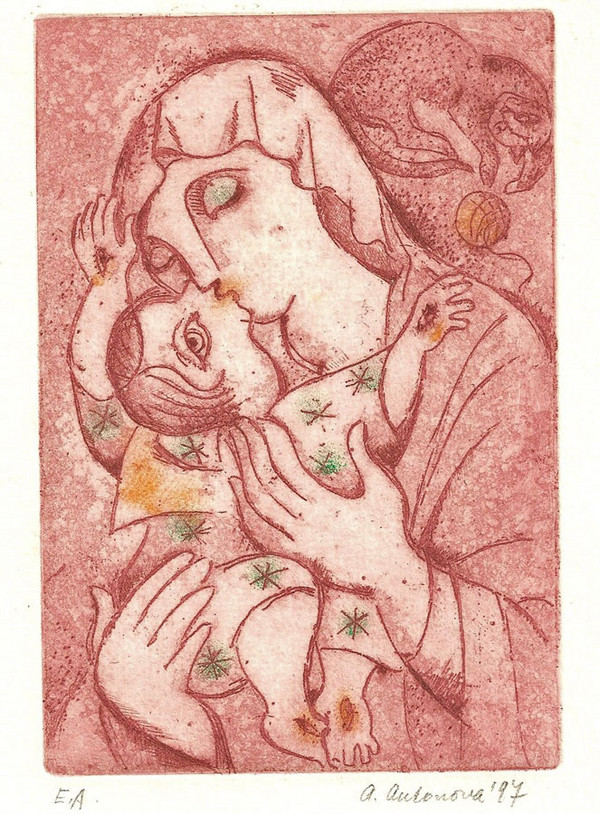
Alena Antonova (Czech, 1930–), Madonna and Child, 1997. Tinted drypoint, 14.5 × 10 cm.
First, a Madonna and Child. This subject—Mary holding the baby Jesus—is obviously not set during Holy Week, but in her interpretation Antonova alludes to the Crucifixion by giving the infant Christ nail prints in his hands and feet. While it’s not uncommon for artists to foreshadow Jesus’s early death in Madonna and Child images by making him appear corpse-like, the overt display of wounds is something I’ve never seen before. I’ve also never seen Mary kissing baby Jesus on the lips—such a tender expression of mother love; she closes her eyes, as if to shut out the formidable omen Simeon had spoken to her at the temple. I’m not sure whether the cat playing with a ball of yarn in the background has a symbolic significance or serves only to domesticate the scene. I guess you could see it as an allusion to Jesus’s future unraveling in Gethsemane, his coming undone.
Alena Antonova (Czech, 1930–), The Last Supper, 1997. Tinted drypoint, 14 × 10 cm.
Fast-forward to that day, and we’re at the Last Supper. In traditional fashion, Antonova’s print shows Jesus at the head of the table, with John leaning on his shoulder. Judas is on the other end with his head in hand, stressing out about whether to go through with the betrayal; a moneybag is tied to his waist. I’m not sure where the twelfth disciple is in the picture. Maybe he’s getting drink refills. Continue reading “Passion prints by Alena Antonova”→
Who are you? Why do you not let me live
As I please? And how could your caress, so rough,
Be kinder than my smooth alternative?
Your steel-brush strokes are forcing me to slough,
Daily, my fleshy growths of appetite,
But still they come; I cannot have enough.
I would forever scratch my itches, light
At first, then harder at the thickened sore;
But you would give me radical delight,
Gouging my itches till I have no more.
“The Pleasure Principle” is published here with the permission of Southern Humanities Review, where the poem first appeared in Spring 1974.
+++
In this poem, sinful desires are characterized as skin sores whose itchiness is temporarily relieved when scratched—but the scratching also makes the sores become irritated and enlarged and even more vile-looking, and the itch comes back not too long after.
The speaker addresses God, first in a posture of defensiveness. God has presumably penetrated his conscience, illuminating his sin, and he responds with a string of accusatory questions to the effect of, “Who do you think you are, coming into my life, telling me what I can and can’t do? I am happy as I am, thank you very much.” Continue reading ““The Pleasure Principle” by Raymond Oliver”→
Writing for the New Yorker, Ken Kalfus reviews the new novel Laurus by Russian medievalist Eugene Vodolazkin: “Medieval Russia was a land trembling with religious fervor. Mystics, pilgrims, prophets, and holy fools wandered the countryside. . . . [Laurus] recreates this fervent landscape and suggests why the era, its holy men, and the forests and fields of Muscovy retain such a grip on the Russian imagination.”
Hieronymus Bosch (Dutch, ca. 1450–1516), The Garden of Earthly Delights. Oil on oak panels, 220 × 389 cm. Museo del Prado, Madrid.
This year marks the five hundredth anniversary of the death of Dutch artist Hieronymus Bosch, known for his grotesque depictions of human depravity. To commemorate his life and work, the Noordbrabants Museum in ’s-Hertogenbosch, the city of Bosch’s birth, has brought together his panels and drawings from all over the world in what is the largest Bosch exhibition of all time. Bosch invented an entirely new religious iconography: landscapes filled with bizarre, nightmarish creatures doing freakish things to or with humans—meant not as a prediction of what will one day happen to the damned but as a lament for what is already happening. Jonathan Jones, reviewer for The Guardian, gives the retrospective five stars.
+++
“Lumen Christi: In the Light of the Risen Christ—Easter Encounters with Art”: The monastic ecumenical Community of Jesus on Cape Cod will be hosting a five-day art retreat from April 5 to 9, led by art historian Timothy Verdon and artist Gabriele Wilpers. Focused on the theme of resurrection, the retreat will feature lectures and discussion, group workshops, studio mentoring, and daily worship services. For more information, follow the link above.
When Jesus’s disciples asked him how to pray, he recited a sample that has come to be known as the “Lord’s Prayer,” or the Pater Noster (Our Father). In it the pray-er addresses God as Father and asks him to bring his kingdom down to earth, to accomplish his will far and wide. The pray-er asks, too, for the daily provision of food, forgiveness, and freedom from temptation and evil. Then he concludes with an attribution of power and glory to God. Amen.
If Jesus told us to request these things of God, surely the implication is that God loves to give them, do them. But why, then, is his kingdom so obviously not breaking in? Why does temptation continue to trip us up? Why does evil still run rampant, both inside us and outside?
Singer-songwriter Corey Kilgannon finds the Lord’s Prayer hard to pray sometimes—so in the tradition of the Jewish psalms, he wrote his own “Doubter’s Prayer,” which engages Jesus’s prayer rubric with sincere questioning and seeking. To the line “Our Father, who art in heaven,” he responds, “Why are you so far away?” In response to “thy kingdom come, thy will be done,” he insists that God clarify what it means for earth to manifest heaven—what would that even look like? Is it really possible? Regarding God’s promise to lead us out of temptation, he wonders, “Were you being honest when you said” it?
The prayer ends on a note of humility, with the speaker acknowledging his crookedness, asking forgiveness for his doubt, and begging for the presence of God to be made real to him. Continue reading ““Doubter’s Prayer” by Corey Kilgannon”→
While working at a rehabilitation center for torture survivors in Chicago, Greg Halvorsen Schreck was struck by the profound physical and emotional traumas these individuals had experienced. He thought of Christ, who suffers in solidarity with those who suffer. And he thought that as a fine-art photographer, maybe he could tell the story of this via dolorosa (“way of sorrow”) they were traveling, by linking it to the medieval Christian devotional practice of the fourteen stations of the cross.
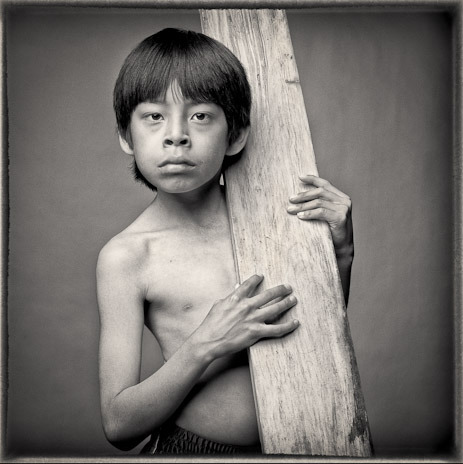
Greg Halvorsen Schreck (American, 1957–), Station 2: Jesus is given his cross, from the Via Dolorosa project, 2012. Photograph.
The stations of the cross originated in the thirteenth century as a way for Christians to enter more fully into Jesus’s last hours by praying visually, verbally, and bodily with fourteen images that highlight various points along his journey to the cross, from his trial to his entombment. Derived from the scriptural accounts (save for the legendary addition of Veronica’s veil, plus the embellishment of Christ’s three falls), the stations offered a stay-at-home alternative for Christians who couldn’t afford a pilgrimage to Jerusalem: instead of literally walking the road between Antonia fortress and Golgotha, they could walk it metaphorically, in their imaginations, with fourteen way stations to provide particular foci.
The models Schreck used in his Via Dolorosa cycle—which can be viewed in full here, and in the video below—are not themselves torture survivors. (That would have posed a safety risk.) But “the stories and the general ethos of those in our midst wounded by war, political upheaval, and unspoken violence shaped my approach,” he said.
It was important to him to portray a range of ethnicities—which is why his stations include people not only of European descent but of Latin American, Caribbean, Middle Eastern, East Asian, and African descent, including a few of mixed race. The falling Christ is portrayed by a Mexican American veteran of the Iraq War. Simone of Cyrene is portrayed by an Ethiopian woman. Mary Magdalene, with her jar of incense, is portrayed by a woman who is half-Syrian.
Schreck also included his two children, adopted from Guatemala, in the project. His daughter, Magdalena, is cast alongside three of her friends as a daughter of Jerusalem in station 8 (top left). His son, Teo, is featured in stations 2 and 13; in the latter, Schreck himself stands in for Joseph of Arimathea or Nicodemus, a reference to Michelangelo’s self-portrait in his Florence Deposition sculpture, Schreck says.