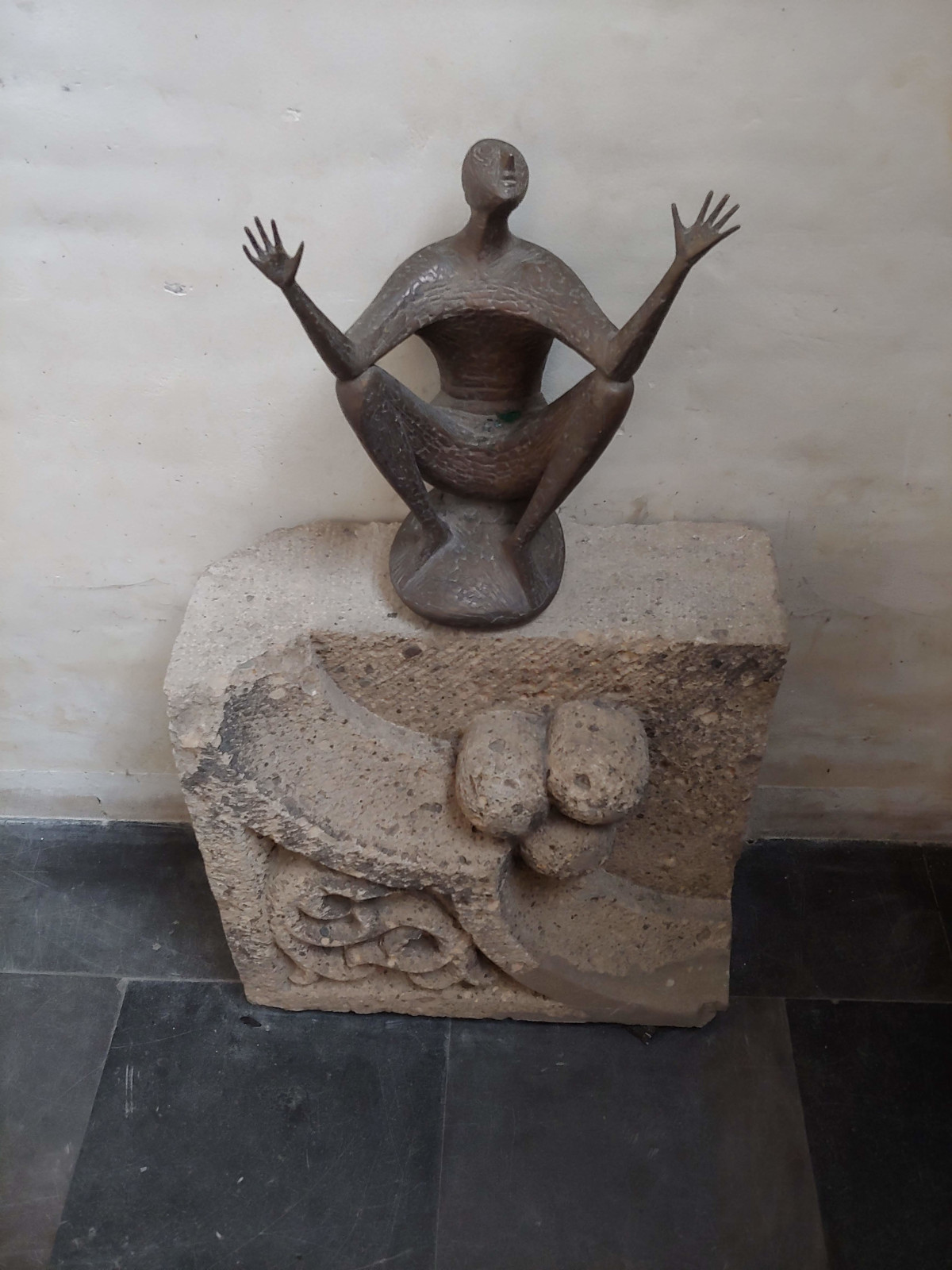
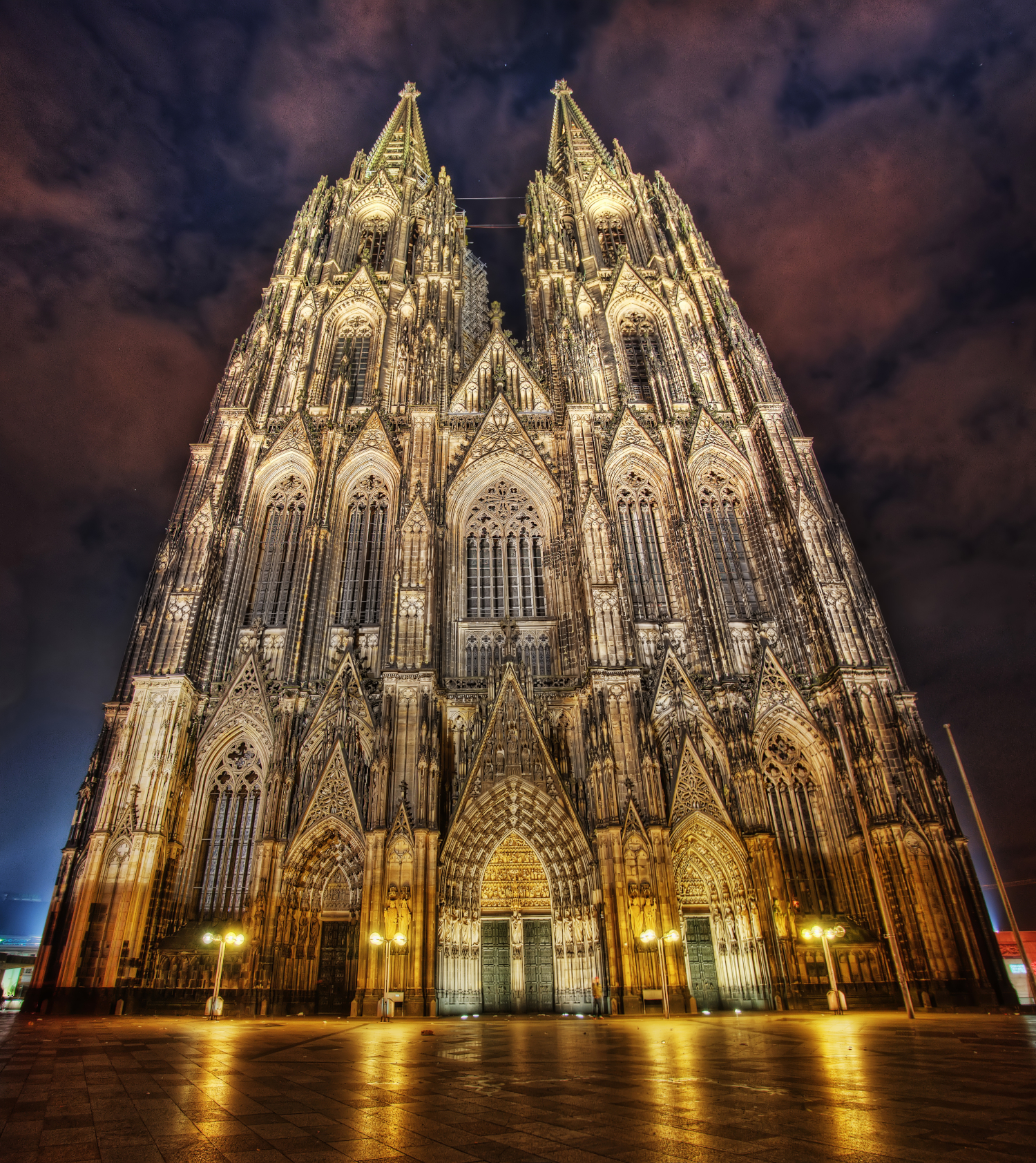
Unidentified sculpture at the Grote of Sint-Laurenskerk (Church of Saint Lawrence), Rotterdam, Netherlands. Photo: Victoria Emily Jones.
Would God I knew there were a God to thank
     When thanks rise in me, certain that my cries
Do not like blind men’s arrows pierce the skies
     Only to fall short of my quarry’s flank.
Why do I thirst, a desperate castaway
     Quaffing salt water, powerless to stop,
Sick lark locked in a cellar far from day,
     Lone climber of a peak that has no top?

To praise God is to bellow down a well
     From which rebounds one’s own dull booming voice,
          Yet the least leaf points to some One to thank.
The whorl embodied in the slightest shell,
     The firefly’s glimmer signify Rejoice!
          Though overhead, clouds cruise a sullen blank.
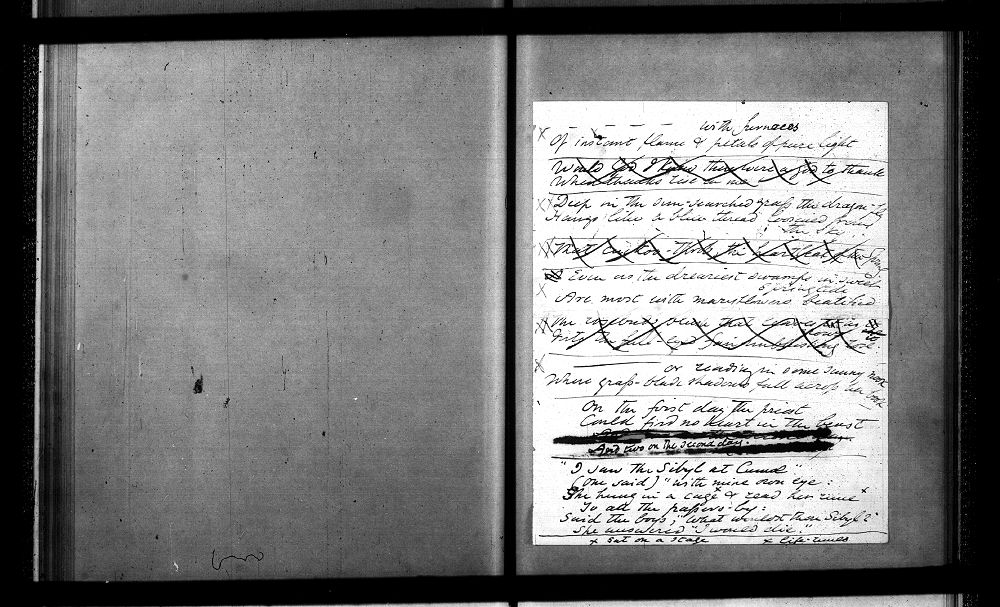
The first line and a half of this sonnet are a crossed-out fragment from one of the notebooks of the British poet and artist Dante Gabriel Rossetti (1828–1882), which he used to work out poetic ideas. This one never went anywhere. But Rossetti’s brother, William Michael Rossetti, saw something in it worthy of preservation; he salvaged it and other select scraps from his brother’s papers, publishing them posthumously in a “Versicles and Fragments” section of Rossetti’s collected works in 1901.
Page 16 of Sonnets and Fragments by Dante Gabriel Rossetti (Princeton/Troxell bound manuscript volume), 1848–81. The first deletion, by Rossetti’s hand, is “Would God I knew there were a god to thank / When thanks rise in me.” [object record]
The modern American poet X. J. Kennedy developed Rossetti’s fragment into a full poem that grapples with the silence of God and, despite such, the impulse to praise. The speaker is confounded by the contradiction that the world seems infused with God’s presence—the natural world points to a Creator—and yet God is unresponsive when the speaker initiates contact. The prayers he launches toward heaven like arrows appear not to reach their target. He’s experiencing spiritual aridity. He feels like a thirsty castaway whose only drink is salt water (why doesn’t God satiate as promised?); a bird trapped in a dark cellar; a mountain climber endlessly climbing, never catching sight of the vista.
The poem tugs back and forth between despondency and awe, between clench-fisted frustration and open-handed surrender. Each glorious tree leaf, the intricate design of conch shells, the whimsy of lightning bugs—these are gifts, but where’s the giver? Gratitude must be directed to someone, but whom does one thank for the wonders and small joys experienced in nature? Who or what is their source? Oh, how I wish I knew there were a God out there to thank, when thanks well up in me. The speaker wants to place his thanks somewhere, but when he places them in God, he receives no confirmation of receipt. There’s a disconnect between what nature testifies and what the speaker has suffered: the “sullen blank” of heaven.
Dante Gabriel Rossetti’s brother, William, wrote in 1895 that, unlike their devout sister Christina [previously], Dante was “a decided sceptic. He was never confirmed, professed no religious faith, and practised no regular religious observances; but he had sufficient sympathy with the abstract ideas and the venerable forms of Christianity to go occasionally to an Anglican church—very occasionally, and only as the inclination ruled him.” Starting in mid-adolescence, he rejected organized religion.
Kennedy, similarly, was raised in a religious household: his father was Catholic, his mother Methodist. And yet in his adulthood he has come to question and reject some of the tenets of orthodox Christianity. But still, he searches for God. “There is a clash in his poems between his skepticism or uneasy agnosticism and his unresolved longing for faith in God,” reads his bio on the Harvard Square Library website. Kennedy’s desire to believe but his inability to do so is expressed recurringly in his work—as in this poem, in which he, taking the baton from Rossetti, is very likely the speaker.
X. J. Kennedy (born 1929) is an American poet, translator, editor, and author of children’s literature and textbooks on English literature and poetry. Born Joseph Charles Kennedy in Dover, New Jersey, he adopted the nom de plume X. J. Kennedy in 1957 to avoid being mistaken for the better-known Joseph Kennedy, then US ambassador to England and father of future president John F. Kennedy. His award-winning poetry collections include Nude Descending a Staircase (1961) and Cross Ties (1985). He lives in Lexington, Massachusetts.
SYMPOSIUM: “Kunst en religie nu” (Art and Religion Now), October 20, 2023, 1:30–4:30 p.m., Museum Catharijneconvent, Utrecht, Netherlands: A week from Friday, attend a free afternoon of talks (in Dutch) on the topic of religion in modern and contemporary art. The speakers are Lieke Wijnia, who will present the results of her past two years of research on religious themes that crop up in modern and contemporary artworks in the Collectie Nederland (Netherlands Collection); Rozanne de Bruijne, on religion in art of the interwar period (1918–1940), the topic of a spring 2025 exhibition she’s curating; Wouter Prins from the Museum Krona, on the state of religious art in the post-Nietzsche era; and Joost de Wal on contemporary art in church spaces. Here’s the autotranslated description:
“The more modern the art, the smaller the presence of religion.” This frequently heard approach appears to be anything but justified. In fact, at the beginning of the twenty-first century, spirituality seems to be on the rise in the visual arts, resulting in a multitude of artistic interpretations. What does this say about the relationship between religion and art?
This symposium focuses on the multifaceted and sometimes unexpected presence of religion in visual art. For example, how does contemporary (religious) art relate to ongoing secularization on the one hand and to flourishing international religious communities on the other? What does the growing interest in spirituality mean for the arts? And what about the use of religious symbolism in visual art, both inside and outside the church? The speakers also shed light on how the wealth of (religious) stories and images can provide guidance in times of social uncertainty and uprooting.
ONLINE WORKSHOP: “Deep Dive into Poetry Comics,” led byMadeleine Jubilee Saito, November 2, 9, 16, 30, 5–7 p.m. Pacific (8–10 p.m. Eastern):Madeleine Jubilee Saito [previously] is a cartoonist from Seattle who makes “poetry comics” about the environment and the sacred—and in four virtual sessions offered through Push/Pull, she’ll teach you how to make your own on topics of your choice!
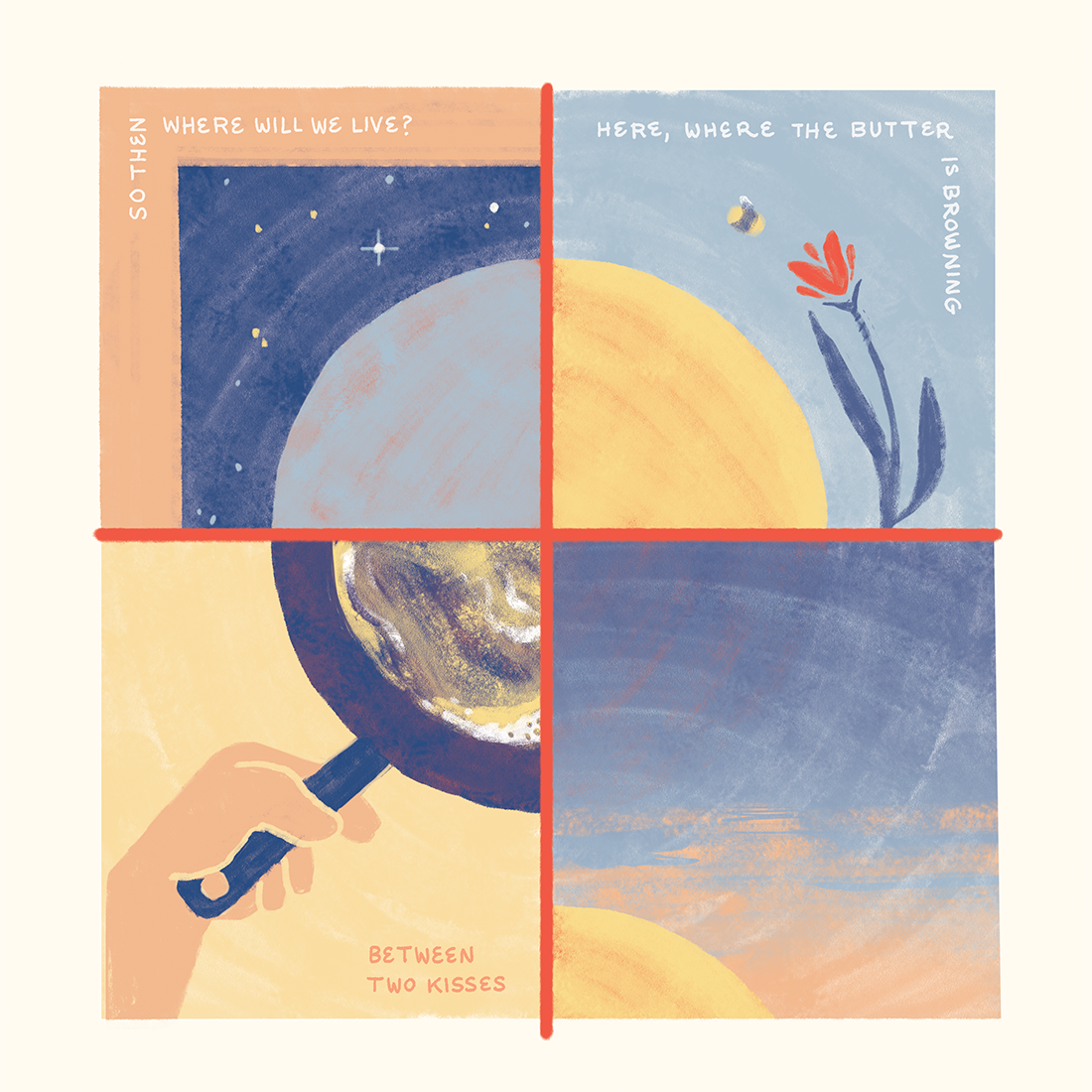
Madeleine Jubilee Saito, Love Poem, 2019
“In this online course, you’ll practice exercises to explore your own voice and interests in drawing and text, creating poetry comics in a variety of styles. You’ll learn about minicomics, how to do basic layout for printing, and how to print a quarter-page minicomic. We’ll end the course with a celebratory comics reading for friends and family on Zoom. Students need to either be comfortable drawing digitally (Procreate, Photoshop, etc.) or have access to a scanner. Students will be also need access to a printer or local print shop for the last phase of the course.”
NEW ALBUM: You Don’t Carry It Alone by Leila Way:Leila Way is a singer-songwriter from Austin, Texas, writing songs for the church. Her first full-length album, “You Don’t Carry It Alone is a collection of songs for hard times. Some of these are old hymns; some were written during a period of intense grief and loneliness, while others grew out of prayers for friends. The album was created to comfort those who mourn; to remind God’s people that He is always faithful, always present and at work, even when we can’t see what He’s up to.”
The album consists of four original songs, two original instrumentals, a cover of “Be Still, My Soul,” and new retunes of George Matheson’s “O Love That Wilt Not Let Me Go” (one of my favorite hymns) and James Montgomery’s “I cannot call affliction sweet.”
+++
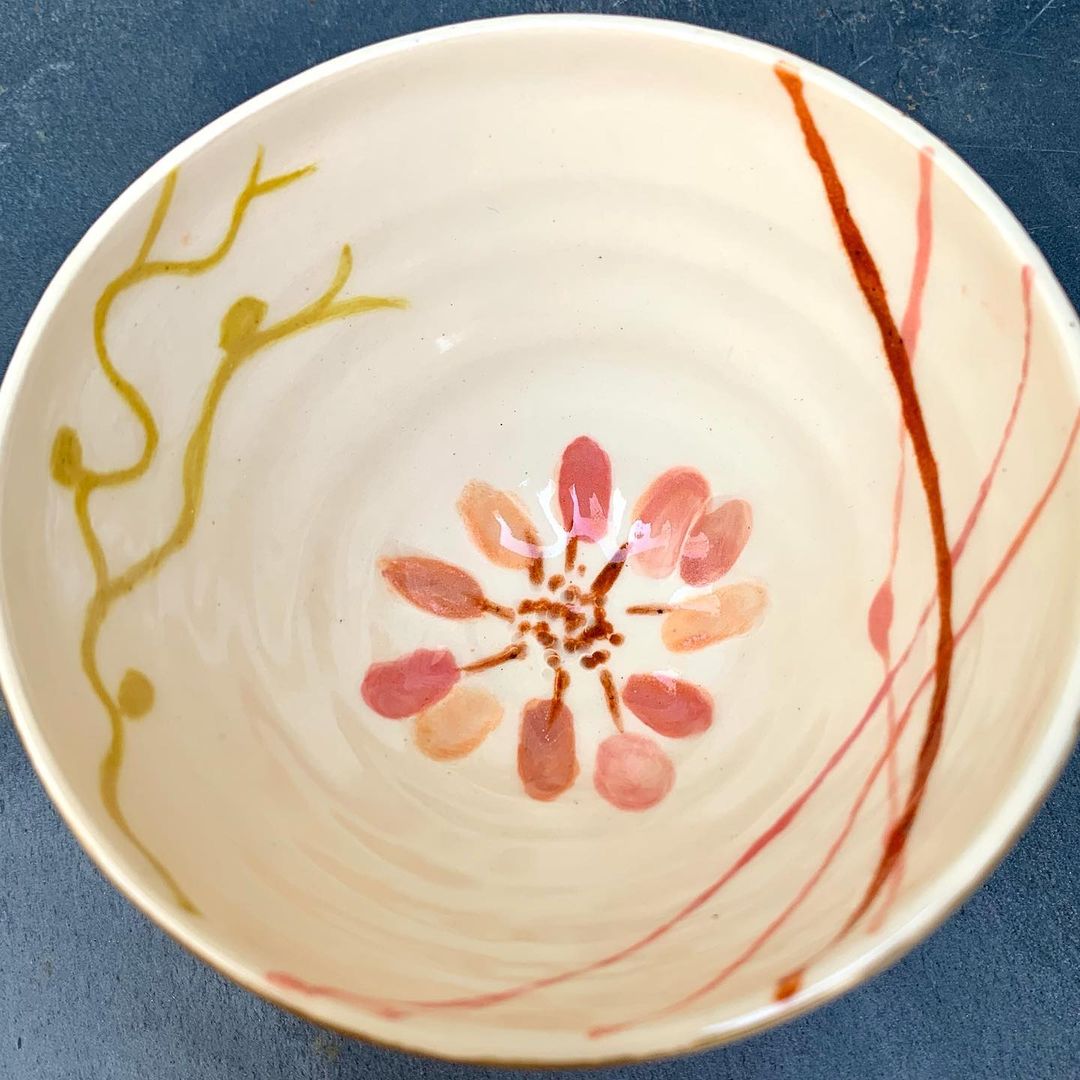
CERAMIC BOWLS:Nurture Collection by Jane Boutwell: I met artist Jane Boutwell at a Christians in the Visual Arts (CIVA) conference in 2021 after she presented this body of work that really moved me—a collection of ceramic bowls that take as their three design elements anatomical features of the female breast: lymph nodes (gold, river-like), mammary glands (pink and blooming), and musculature. She started the Nurture Collection after having one of her milk ducts surgically removed in 2019 for a biopsy (it turned out not to be cancer), as a meditation on the strength and inner beauty of this part of the body that is so often objectified or shamed. She recommends the bowls as a gift for a woman in your life who has had a tender year with regard to her breasts—cancer, nursing, etc.—to honor her journey.
Bowl from the Nurture Collection by Jane Boutwell, 2020
I share these now because October is Breast Cancer Awareness Month. Below is an eight-minute video explanation by the artist, followed by a short “making of” montage:
There are five Nurture bowls currently for sale in Boutwell’s online shop: Joan, Tracy, Colleen, Rita, and Wendy. Each is named after a woman she knows with breast cancer.
+++
PODCAST EPISODES:
>> “Landscape of the Body with David Taylor,”Makers & Mystics, September 13, 2023: Constructing a cogent theology of the body, theologian W. David O. Taylor discusses why it’s important that we honor and understand our bodies, and why having a right relationship to our bodies is imperative to the quest of art. Christians have often feared, distrusted, or despised the body; sin has meant that we’ve become alienated from our own bodies and the bodies of others, that we harm our bodies and others’, and that we often flee from our bodies, dissimulate. But Jesus wants us to be at home in our bodies, Taylor says—in worship, and in day-to-day life. He talks about Jesus as an icon of care-filled touch and the implications of that.
>> “On Being in a Body,”On Being with Krista Tippett, September 21, 2023: At the 2023 Aspen Ideas Festival, Krista Tippett interviewed Kate Bowler, author of Everything Happens for a Reason (and Other Lies I’ve Loved), a reflection on how she moved through learning at age thirty-five that she had Stage IV colon cancer. “From the new reality in our time of living with cancer as a chronic illness, to the telling of truths to our young as we face precarity in our collective body, this conversation is full of the vividly-whole humanity that Kate Bowler singularly embodies.” I heard Kate in person at Duke University a few years ago talking on a panel about suffering. She’s full of wisdom, wit, and raw tenderness and so, so endearing, and even though I’ve heard her story many times, every conversation with her brings up something new.
Your skin slit round with a scalpel: be brave. Rise to the aluminum tray, the biopsy needle. Go, nipple; go, milk ducts; go, veins. Take with you my lymph nodes, canaries of illness, blood cells’ puff balls.
Blessed be my chest wall for surrendering.
Now you will never shrink and wrinkle with age, clove-studded orange, bittersweet.
Taken in your beauty, let the last hands that hold you be gentle.
This poem is from The Ninety-Third Name for God(Baton Rouge: Louisiana State University Press, 2010). Used by permission of the publisher.
Anya Krugovoy Silver (1968–2018) was an American poet who authored five poetry collections: Saint Agnostica (posthumously published, 2021), Second Bloom (2017), From Nothing (2016), I Watched You Disappear (2014), and The Ninety-Third Name of God (2010). Diagnosed with inflammatory breast cancer in her thirties, she wrote often about life’s precariousness, the trauma of chronic and terminal illness, and holding on to joy and religious faith. She was named Georgia Author of the Year for Poetry in 2015 and was awarded a Guggenheim Fellowship in 2018. She taught at Mercer University until her death in 2018.
Be still and know that I am God Be still and know that I am Be still and know Be still Be
Rev. Dr. Cynthia Bourgeault, an Episcopal priest, writer, and retreat leader, mentions this chant in her book Chanting the Psalms. “Each time the line is repeated,” she writes, “key words are taken away. The result is a funnel-like effect that leads straight down into silence. . . . Each phrase expresses its own unique meaning and understanding as the prayer moves toward utter simplicity” (185). Bourgeault recommends working with the recording “Be Still and Know” found on the album Songs of Presence: Contemplative Chants for the New Millennium from Praxis Publishing House; I couldn’t find the audio online, but I did find a song by The River’s Voice (Trish and Richard Bruxvoort Colligan) that’s also based on this exercise of Fr. Rohr’s: “Be (Still and Know That I Am God)”:
+++
PODCAST EPISODES: Here are two podcast episodes I caught up with recently and enjoyed. Both links include transcripts.
>> “Jan Richardson: Stubborn Hope,”Everything Happens with Kate Bowler, October 27, 2020:Kate Bowler, a historian and cancer survivor who has done much academic work on the prosperity gospel, talks with spiritual writer Jan Richardson [previously], whose husband died unexpectedly in 2013, about the hidden rooms of grief, being disciplined by hope, and how the concept of blessing in the Jewish and Christian traditions differs from the #blessed culture of social media. Don’t miss the three discussion questions in the show notes.
POEM COMMENTARY:“Learning about Constellations” by Saddiq Dzukogi, commentary by Pádraig Ó Tuama: On this episode of On Being’s Poetry Unbound podcast, host Pádraig Ó Tuama unpacks a poem written by Saddiq Dzukogi in the aftermath of his one-year-old daughter’s death. It’s from his 2021 collection Your Crib, My Qibla.
Fernando Peña Defilló (Dominican, 1928–2016), La ofrenda (The Offering), 1993. Oil and acrylic on canvas, 126 × 166 cm. Private collection. Source: Latin American Art in the Twentieth Century, ed. Edward J. Sullivan (Phaidon, 1996), p. 110.
May those whose hell it is To hate and hurt Be turned into lovers Bringing flowers.
—Shantideva, eighth century
These lines are from chapter 10, stanza 9, of the Bodhicharyavatara (Way of the Bodhisattva), a Mahayana Buddhist text by the eighth-century Indian monk Shantideva. I first encountered this religious classic, originally written in Sanskrit, while working at Shambhala Publications. The excerpt above was adapted by author David Richo from a translation by the Padmakara Translation Group. Here’s 10.9 in full, as translated by PTG:
May the hail of lava, fiery stones, and weapons Henceforth become a rain of blossom. May those whose hell it is to fight and wound Be turned to lovers offering their flowers. [source]
Other translations include those by Stephen Batchelor—
May the rains of lava, blazing stones, and weapons From now on become a rain of flowers, And may all battling with weapons From now on be a playful exchange of flowers. [source]
—and Fedor Stracke:
May the rain of leafs, embers, and weapons Become forthwith a rain of flowers. May those cutting each other with knives Forthwith throw flowers for fun. [source]
I am so struck by this short benediction that prays our hate be transformed into love, our hardness into softness, our cold, sterile weaponry into delicately petaled, fragrant blooms. Shantideva recognized that when we lash out in physical or verbal violence, we create a hell that’s all our own. We may intend to inflict suffering on another, but in doing so, we often wound ourselves—psychologically, spiritually. When we dehumanize others, we become less human.
Instead of hurling rocks, punches, bullets, or insults, what if we were to completely confound our enemies by offering them words or tokens of love? Love is the way of the bodhisattva, the “enlightened being.” It’s the way of Jesus—he who said, “Love your enemies; do good to those who hate you; bless those who curse you; pray for those who mistreat you” (Luke 6:27–28).
Loving people doesn’t mean we can’t be angry at them—but we cannot allow our anger to fester into bitterness and ill will or to explode in harmful outbursts. It should be a productive anger.
How might we use an ethic of love to direct our anger or somebody else’s toward a good end, to defuse a contentious situation? Not taking the easy way out by simply ignoring or retreating from a problem, but confronting our opponent in peaceful, creative, and potentially transformative ways?
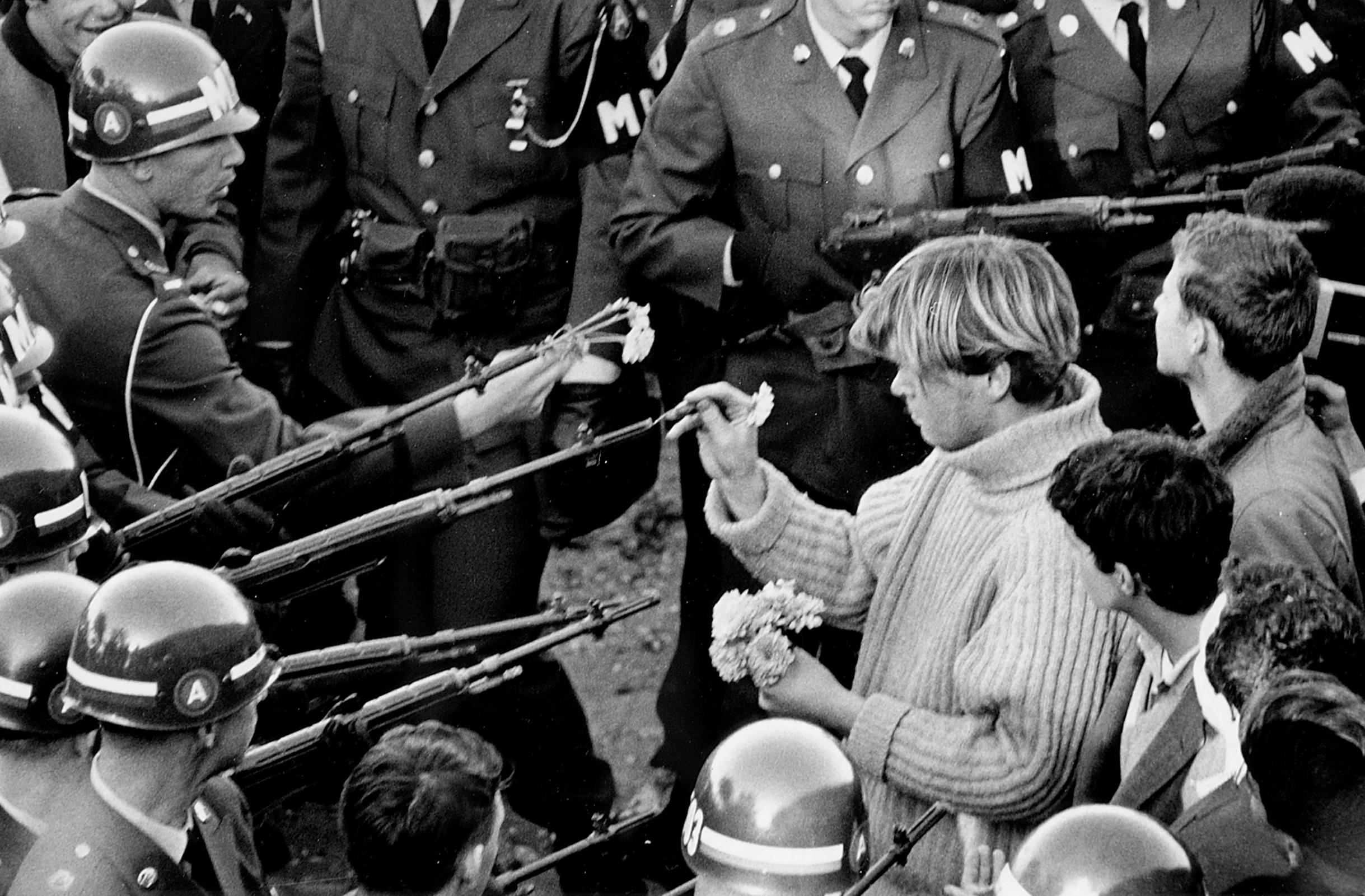
I’m reminded of the historic Pulitzer Prize–nominated photograph Flower Power, taken by Washington Star photojournalist Bernie Boston on October 21, 1967, when he was covering an antiwar march on the Pentagon. As the 503rd Military Police Battalion formed a semicircle around demonstrators to prevent them from climbing the Pentagon steps, Boston captured eighteen-year-old George Edgerly Harris III, aka Hibiscus, placing a carnation into the barrel of an M14 rifle held by one of the soldiers. What a powerful image!
Bernie Boston (American, 1933–2008), Flower Power, Arlington, Virginia, 1967
Two years earlier in his essay “How to Make a March/Spectacle,” Allen Ginsberg was the first to expound on the potency of flowers as a spectacle to simultaneously disarm opponents and influence thought. He said “masses of flowers” should be handed out on the front lines of protests to police, the press, and onlookers as a symbol of nonviolent advocacy. He also suggested candy bars and toys.
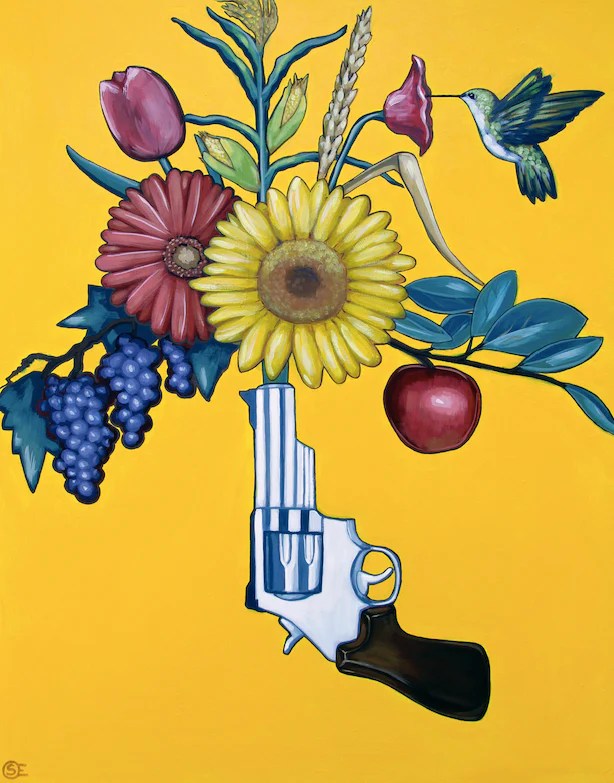
Artist Scott Erickson seems to have drawn on Boston’s Flower Power photograph in his visual interpretation of Isaiah 2:4, Swords into Plowshares, which shows a sprig of foliage growing out of the barrel of a pistol, oriented upward like a vase. Its deadly power mocked and reversed, the gun releases a benign projectile that attracts and nourishes rather than strikes fear.
The evocative Bible verse on which this painting is based prophesies a day when all the nations “shall beat their swords into plowshares, and their spears into pruning hooks”—a poetic way of describing the cessation of violence, as tools of destruction are transformed into gardening tools.
Christian activist Shane Claiborne has been instrumental in helping me see the immense beauty of Isaiah’s visions of the eschaton—he has worked with RAWtools to decommission firearms and literally forge them into shovels, spades, and other life-giving implements!—along with the holy foolishness of the gospel and all that implies. Before becoming a leader of the new monasticism movement, Claiborne went to circus school, and he has often put that training to use on the streets of Philadelphia where he lives. In his first book, The Irresistible Revolution: Living as an Ordinary Radical (2006), he writes,
Whenever there is a fight on our block, my first instinct is to run inside and grab our torches and begin juggling them, to upstage the drama of violent conflicts in our neighborhood. Perhaps the kids will lose interest in the noise of a good fight and move toward the other end of the block to watch the circus. I truly believe we can overwhelm the darkness of this world by shining something brighter and more beautiful. (285)
He has also written about Jesus’s “triumphal” entry into Jerusalem as a theatrical parody of power: he rode in on a dinky donkey instead of a warhorse, showing a much different alternative to the military might of empires. (“Imagine the president riding a unicycle in the Fourth of July parade”! Jesus for President, p. 122) And then on the cross, Jesus made a spectacle of human violence. In exchange for taunts and blows, he gave forgiveness, a metaphorical bouquet.
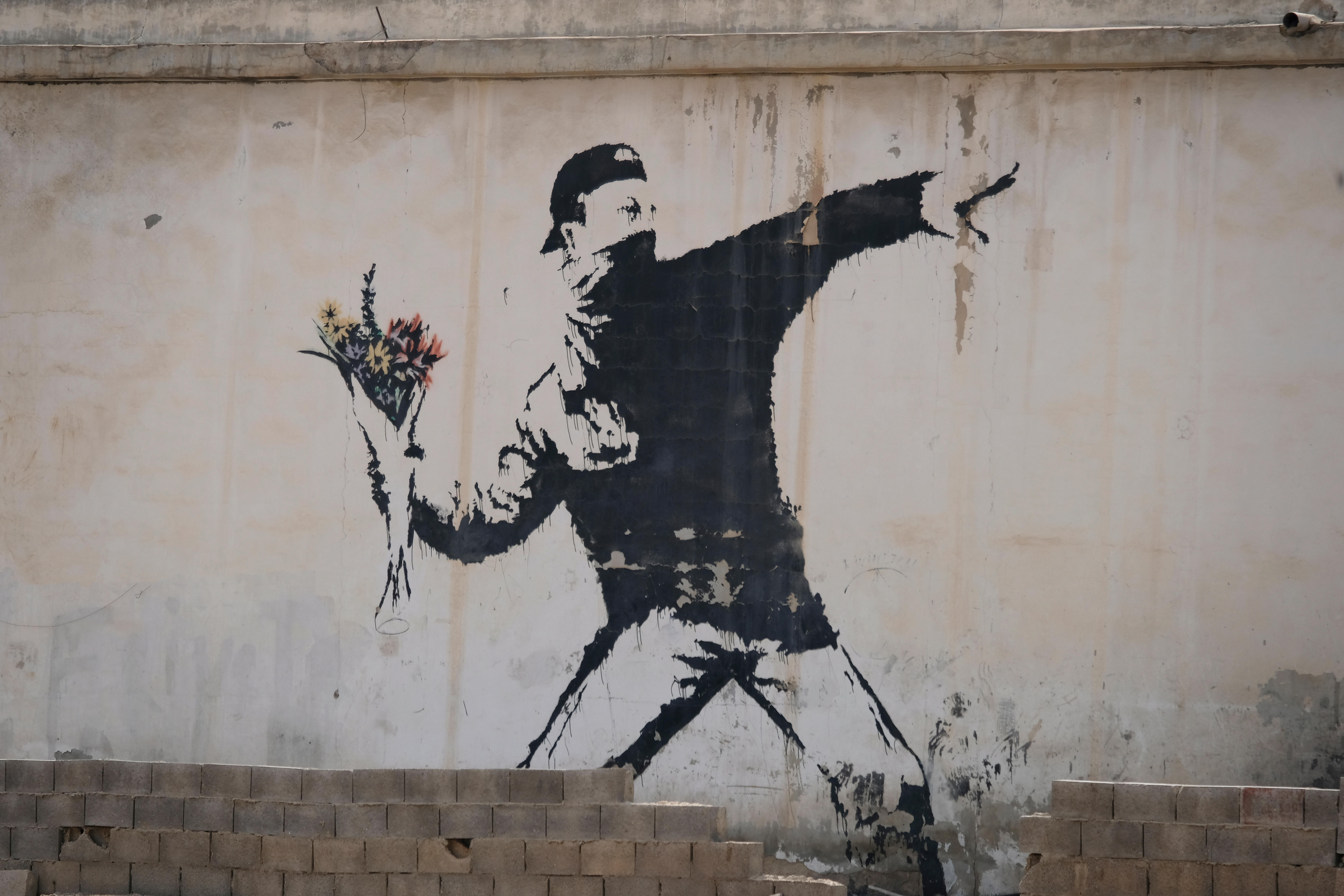
The UK-based street artist Banksy draws on the association of flowers with love and peace and their playful ability to disrupt violence in his mural Rage, Flower Thrower, which debuted on the West Bank wall in Israel-Palestine. Nathan Mladin, a researcher for Theos think tank, wrote about this artwork for the Visual Commentary on Scripture’s Logics of Reversals exhibition:
With a balaclava drawn over his face, the young protester is shown leaning back, as though braced to hurl a Molotov cocktail. But instead of a weapon, he wields a flower bouquet, the only coloured element in this otherwise monochrome work. We expect an act of aggression—all other elements of the mural suggest imminent violence—but instead we are offered a call to peace. . . . Theologically construed, the mural hints at the eschatological terminus of violence.
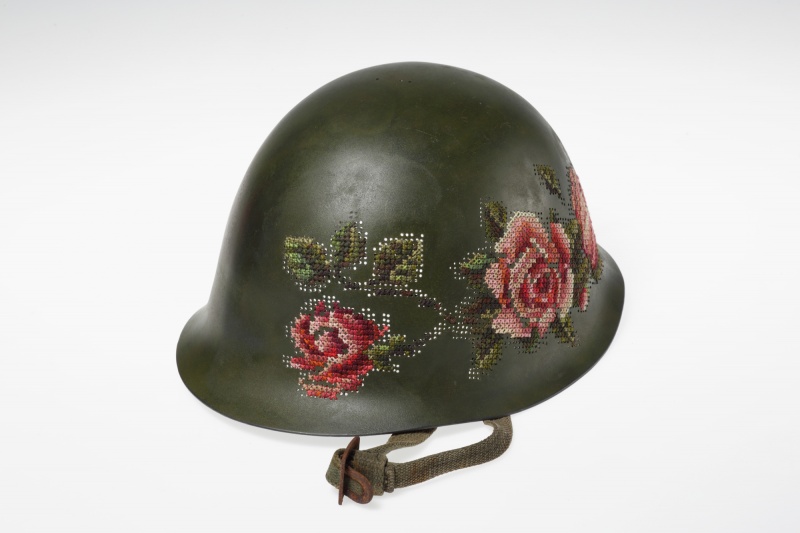
The absurd juxtaposition of flowers and violence is employed too by Lithuanian artist Severija Inčirauskaitė-Kriaunevičienė, who embroiders floral patterns onto antique soldiers’ helmets sourced from various countries, and Natalie Baxter of Lexington, Kentucky, whose Warm Gun series comprises over one hundred quilted stuffed guns, “droopy caricatures of assault weapons,” she says, “bringing ‘macho’ objects into a traditionally feminine sphere and questioning their potency.”
Severija Inčirauskaitė-Kriaunevičienė (Lituanian, 1977–), from the series Kill(ed) for Peace, 2016. Antique soldier’s helmet, cotton, cross-stitch embroidery, drilling, and industrial needle punching, 30 × 22 × 21 cm. Private collection, Latvia.Natalie Baxter (American, 1985–), Rose to the Occasion, from the Warm Gun series, 2016. Fabric and polyfill, 15 × 42 × 3 in.
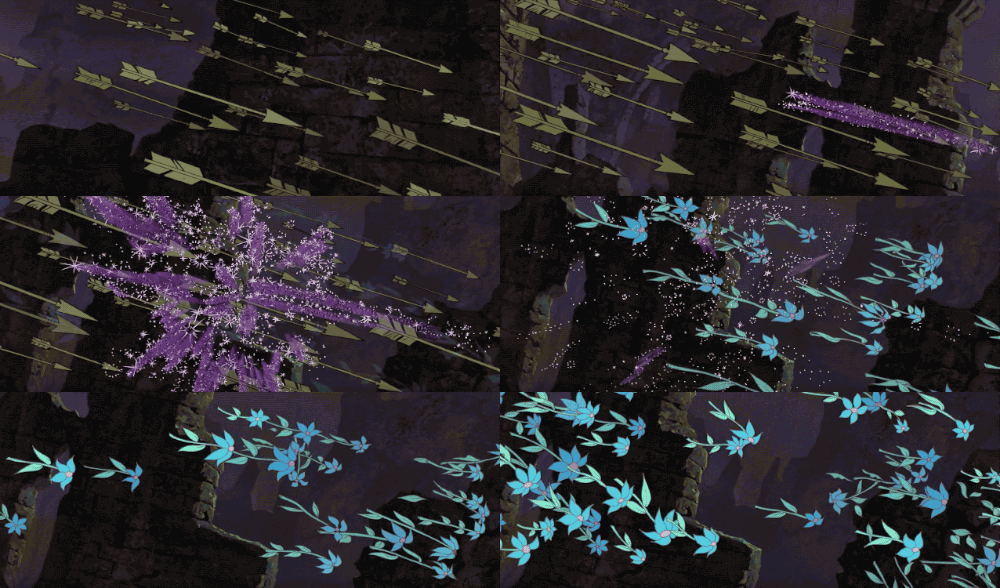
Another artistic example of overcoming brutality with gentleness can be found in the climactic battle sequence from Disney’s animated classic Sleeping Beauty (1959). As Prince Phillip escapes from Maleficent’s dungeon with the aid of the three good fairies, Maleficent’s goons shoot arrows at him—but Flora transforms them by magic into flowers, which fall innocuously about his booted feet. (The animation is by Dan McManus.)
Flora’s other enchantments include turning launched boulders into soap bubbles and a curtain of boiling water, tipped from a cauldron over a doorway, into a rainbow. Each of these deflective maneuvers involves the transformation of something threatening into something whimsical. While they do not ultimately deter the villain from her murderous rampage, and alas, Phillip conquers evil with a sword (albeit the Sword of Truth—there’s metaphor at play here), Flora’s few creative interventions at the outset of the battle assert an attractive counterethic that we would do well to embrace.
I need the dreams of Isaiah and the prayers of Shantideva, I need the ridiculous street theater of Hibiscus and Shane Claiborne and the activist blacksmithing of RAWtools, I need Banksy’s murals in zones of conflict and other subversive art, I need fairy tales from writers and animation studios, to help me relinquish my hate and imagine wholesome new ways of engaging my enemies. Most of all, I need Christ’s vibrant, upending gospel embedded more deeply in my heart, and the Holy Spirit—renewer, transformer—to melt the disdain and loathing I feel for certain figures in the current US political landscape and reshape it into loving regard.
While I do not have an urge to enact physical violence on anyone, I often seethe and think unkindly thoughts toward those I deem morally odious. Sometimes I pray they get what’s coming to them. But then I am convicted by that un-Christlike posture. I crave the eyes and mind of Christ, who sees everyone as redeemable and worthy of love, bearers of the divine image, and who moves toward them with open arms instead of clenched fists.
“May those whose hell it is to hate and hurt be turned into lovers bringing flowers.”
I pray this, sincerely, for others (I have a few particular names in mind), and also for myself.
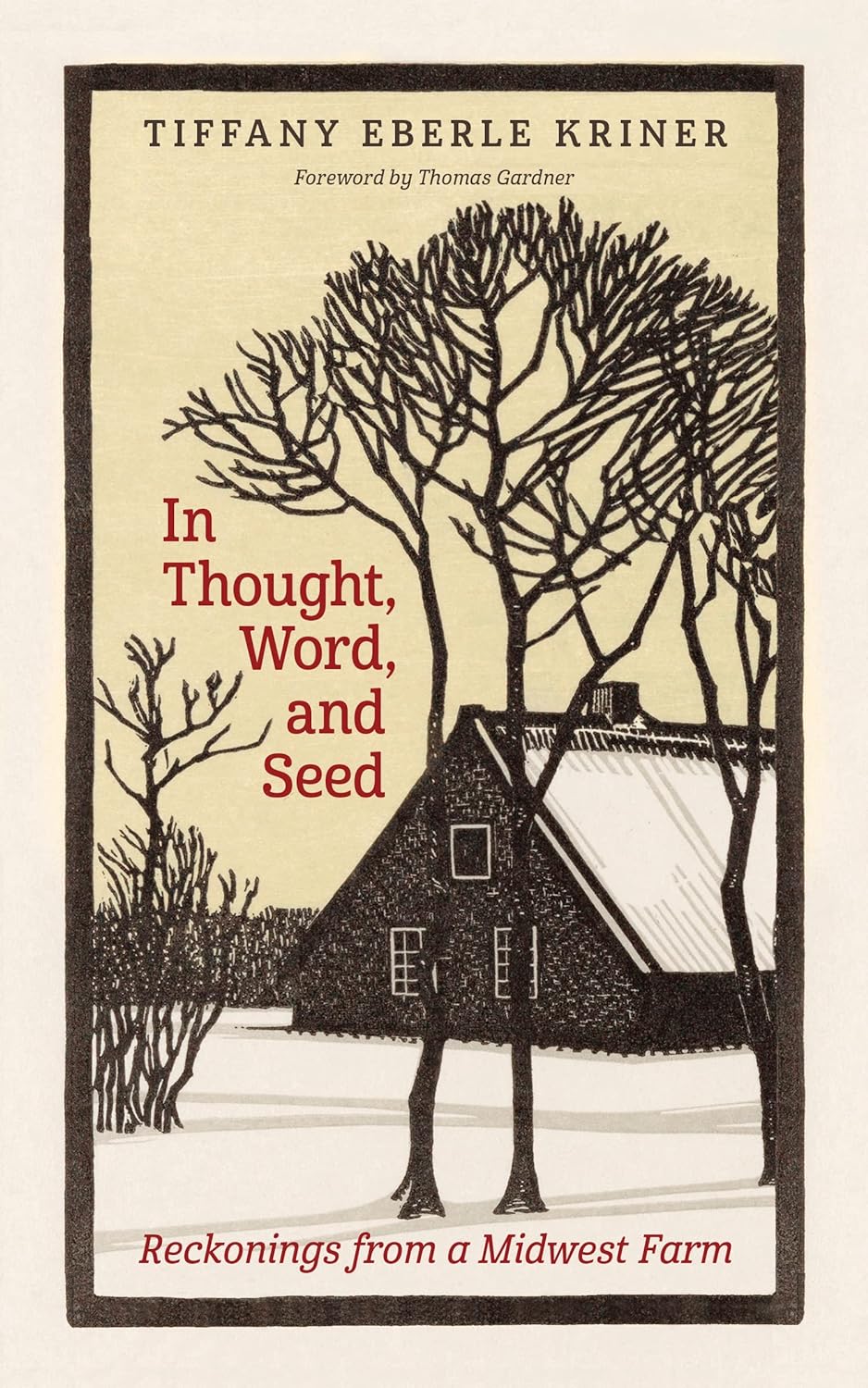
NEW BOOK: In Thought, Word, and Seed: Reckonings from a Midwest Farmby Tiffany Eberle Kriner: As a freelance copyeditor, I’ve worked on many projects for Eerdmans, and this has been one of my favorites: an essay collection by Tiffany Kriner, a Wheaton English professor and farmer from Illinois. It’s a unique blend of literary criticism, nature writing, and memoir. Virgil, George Eliot, James Baldwin, and Walt Whitman are among the authors she engages, respectfully weaving their stories into and around her own experiences of cultivating sixty acres of land and raising livestock with her husband, Josh. Today is the book’s official release date, and I can’t recommend it enough!
+++
(FIVE-WEEK) ONLINE COURSE: “Notes of Rest: Receiving Rest from Scripture and Black Music in Our Restless World,” taught by Julian Davis Reid: On Monday evenings from October 9 to November 6, pianist, speaker, and writer Julian Davis Reid, MDiv, of Chicago will be leading five, seventy-five-minute virtual discussions and meditations on the theme of rest, explored through the lenses of scripture and Black music. “Salvation,” “Sabbath,” “Sleep,” “Stillness,” and “Sanctuary” are the organizing principles. “The purpose of the class is to help the Body of Christ hear God’s invitation to rest,” Reid told me. “The means of getting there is through a mixture of artistic reflection and practical theology grounded in biblical analysis, reflection questions, and musical performance.” No prior musical knowledge is required.
The spiritual “Give Me Jesus” is an example of one of the songs Reid will be playing and guiding participants through (this recording is from his 2021 album Rest Assured, with album art by Shin Maeng):
This course is presented by the Candler Foundry, an initiative of Emory University’s Candler School of Theology that aims to make theological education accessible to everyone. It’s only $29! Reid has been leading Notes of Rest sessions since 2021, and he is currently accepting bookings from churches, universities, and parachurch ministries; you can contact him through his website.
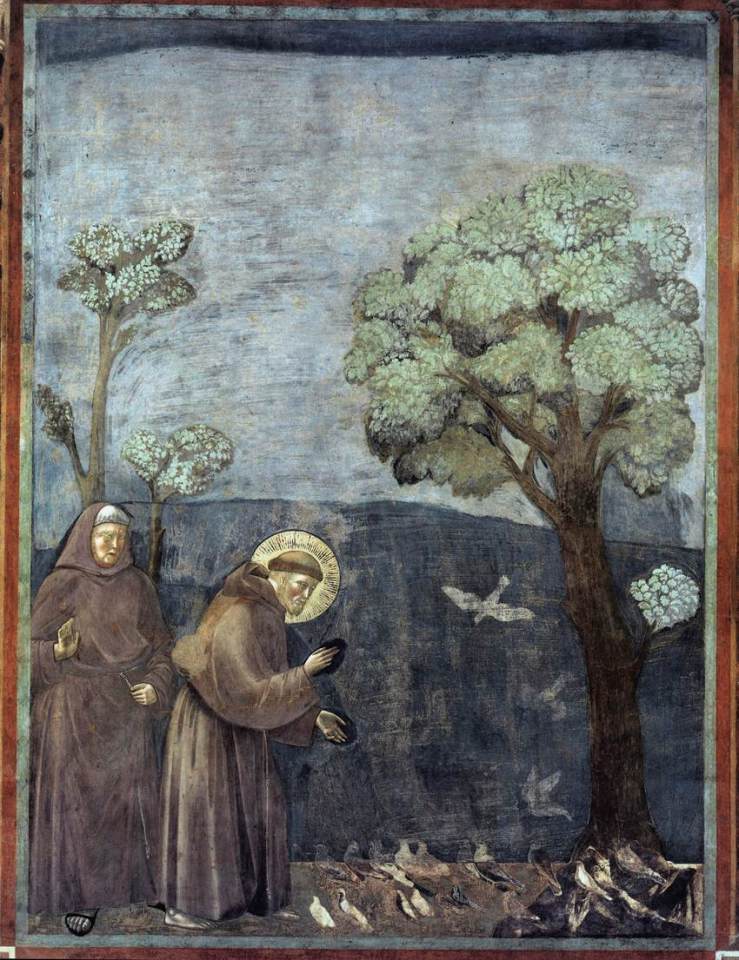
POEM: “Saint Francis and the Birds” by Seamus Heaney: Giovanni di Pietro di Bernardone (ca. 1181–1226), better known as Francis of Assisi, was an Italian mystic and friar who founded the religious order named after him, the Franciscans. Because of his love for all God’s creatures, he is considered the patron saint of animals, and his feast day is October 4. One story about him says he preached to the birds, as he believed the gospel is for them too, and that they, too, have a duty to praise God. This poem by the Nobel Prize–winning Seamus Heaney evokes Saint Francis’s sermon to his feathered friends.
“Sermon to the Birds,” from the Legends of Saint Francis cycle, attributed to Giotto, 1297–1300. Fresco, 270 × 200 cm. Upper Church, Basilica of St. Francis of Assisi, Assisi, Italy.
From the blog archives: For another poem about this legend, see “Saint Francis Endeth His Sermon” by Louise Imogen Guiney. For a brilliant literary essay by Kimberly Johnson on Francis’s “Canticle of the Creatures” (which evolved into the hymn “All Creatures of Our God and King”), see here.
+++
INTERVIEW: “The Artist’s Gift of Reckless Courage” with Betty Spackman: Comfort, confront, teach, heal—those are just a few of the actions the arts can perform, says Canadian installation artist Betty Spackman in this insightful interview for Radix Magazine (available in audio format wherever you get your podcasts, and in print). Spackman discusses misconceptions about artists and the arts, the expansive definition of “creativity,” the gifts artists offer the church, and the charge of elitism. She also gives advice to pastors and to artists.
Here are just two snippets:
“The artist can reveal the heart of God in unique ways, and that gives us a responsibility. We can be vessels of wonder and light, through sound and image and movement and story. . . . By their very nature, [artists] are more open to thinking outside the box, to going past the status quo, to dreaming and to imagining. . . . Scripture tells us a child will lead us and it is childlike faith that will lead us forward. Perhaps what we can learn from artists is to be more childlike.”
“When someone paints their pain, or sings it, or dances it, our response should not be to ignore or condemn it because it’s not pretty or is outside of our worldview. We should find out what it is, and then respond in a meaningful way to the person who made it. The arts are really a place of opportunity to both express and to listen to the grief of the world, and Christians need to be there to do both.”
I came upon it stretched against the starlight,
a black lace
of stone. What need to enter and kneel down?
It said my prayers for me,

lifted in a sculptured moment of imploring
God in granite,
rock knees rooted in depths where all men
ferment their dreams in secret.

Teach marble prayers to us who know no longer
what to pray,
like the dumb worship’s lovely gesture carven
from midnight’s sweated dews.
This poem was originally published in Onions and Roses (Middletown, CT: Wesleyan University Press, 1968) and is compiled inIf I Had Wheels or Love: Collected Poems of Vassar Miller(Dallas: Southern Methodist University Press, 1991).Used by permission of Wesleyan University Press.
Vassar Miller (1924–1998) was a poet and creative writing instructor from Houston who lived with cerebral palsy. Over a literary career that spanned almost forty years, she published ten volumes of poetry, of which Wage War on Silence (1960) was nominated for a Pulitzer Prize, and she was twice named poet laureate of Texas. Her poems explore religious faith, social isolation, and physical disability. When asked to describe the meaning of her life, she said, “To write. And to serve God.”
Each item in a roundup represents hours of combing through and evaluating other possibilities to feature, to find that one I deem will be of most value to readers of Art & Theology. None of these spots are ever bought or coerced, but rather represent sincere recommendations on my part. If you appreciate the resources I curate, would you consider making a donation to make this continued work possible? Or buying me a book from my Amazon wish list (to support my research)? Regardless, I really appreciate you being here!
+++
SONGS:
>> Ambai Praise Medley: This summer Palmer Keen, an American ethnomusicologist based in Yogyakarta who runs the online repository Aural Archipelago, visited the Christian village of Kawipi in the Ambai Islands of Papua, Indonesia, to learn more about songgeri, a worship music tradition indigenous to that area. When he arrived, the villagers formed a welcome party to greet him at the church steps with much music making! That is what this clip is from:
Palmer writes,
Songgeri is a gospel string band tradition from the Ambai archipelago of Papua. The Ambai people, fervent Pentecostals since mass conversion in the mid-20th century, have taken the string band format popular across Melanesia . . . and embraced it as a vehicle for a unique gospel sound unlike anything else in Indonesia.
The name songgeri itself means “joy” in the Ambai language, and every bit of the music is designed to channel a particularly Pentecostal religious ecstasy: handmade lutes (four-string “ukulele” and five string “gitar”) stick to just three easy chords, while giant double bass-like stembas are turned towards the players and plucked with both hands and hand-carved wooden picks to get a thunderous sound. Musicians play a non-stop medley of “praise and worship” verses sung in Ambai and Indonesian—in one piece, “Nemunu Doana Kamia Wowong,” for example, they sing: “His house is built on coral / The gates of heaven are open / He awaits us!”
For more on the history, form, and instruments of songgeri, including additional videos, see Palmer’s recent blog post. (Shout-out to Sam Connour for alerting me to this fantastic music!)
>> “Campfire Coritos,” performed by Israel and New Breed: This corito [previously] medley features the songs “Con mis manos y mi vida” (With My Hands and My Life), “Alabaré” (Oh, Come and Sing), “Te alabarán oh Jehová” (They Will Praise You, O Jehovah), “Quién como tú” (Who Is Like You?), “Hay poder” (There Is Power), and “Ven, ven, ven, Espíritu Divino” (Come, Come, Come, Holy Spirit). The first female soloist is Israel Houghton’s wife, Adrienne Bailon-Houghton, and the second female soloist (with dark hair) is Adrienne’s sister, Claudette Bailon.
And here’s another corito medley sung by the same group:
+++
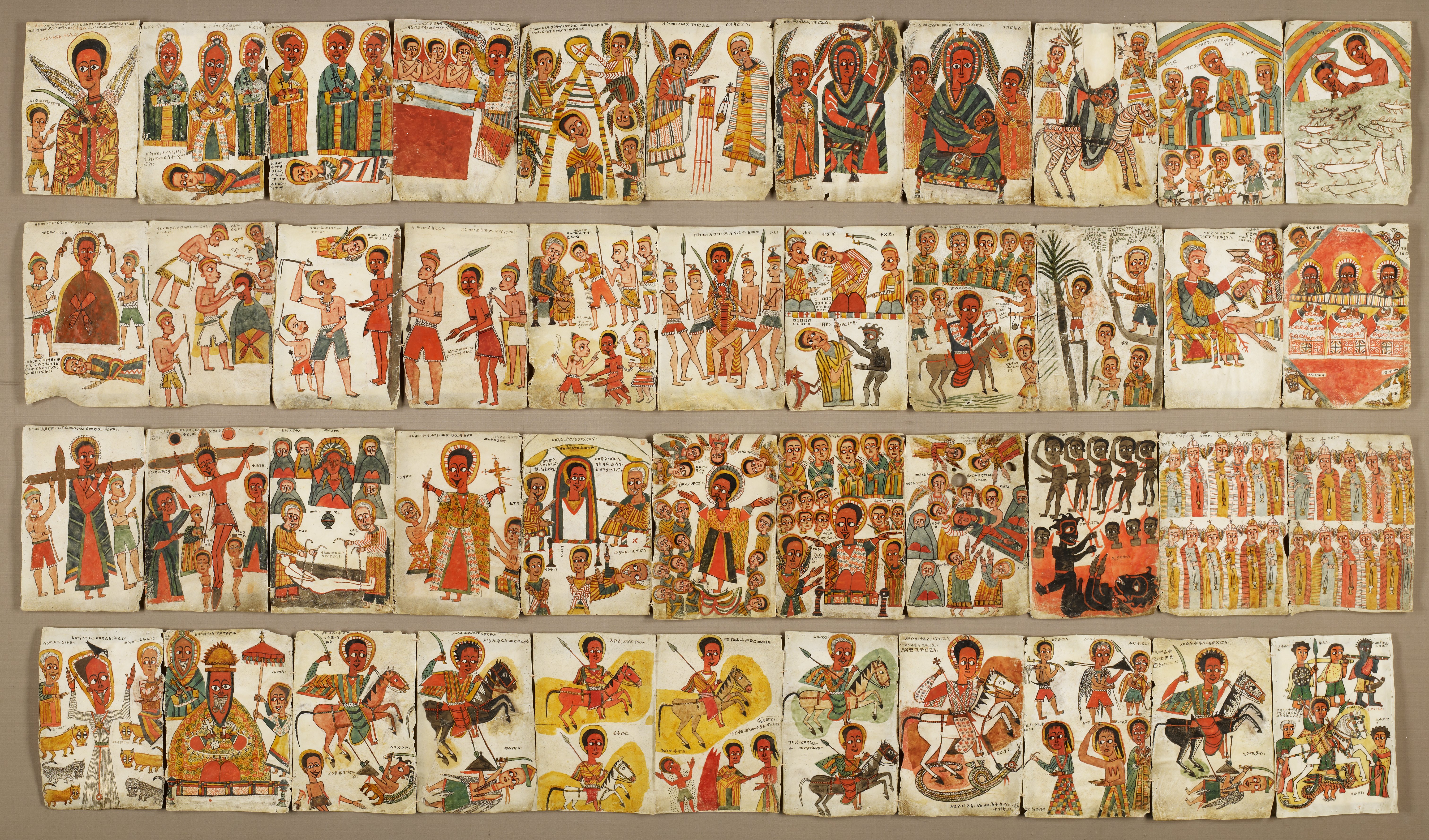
ART: 44 Plates from a Christian illuminated album, Ethiopia: When I was at the Minneapolis Institute of Art a few years ago, I saw on display three paintings on vellum from seventeenth-century Ethiopia, in the First Gondarene style, featuring Ethiopian saints and Bible stories. They are from a set of forty-four pages that were at one time sewn together and used as a prayerbook. The inscriptions are in Ge‘ez, an ancient language that originated in northern Ethiopia and is now only used in religious ceremonies.
Ethiopian saints and scenes from the Hebrew scriptures and the Christian Bible, from a disbound album, Ethiopia, late 17th century. Collection of the Minneapolis Institute of Art, Minneapolis, Minnesota.
Learn more about this illuminated album through ArtStories, an interactive multimedia feature on MIA’s website that allows for in-depth exploration of select objects from the museum’s collection. On the “More” tab is a video on “Connecting with World Religions,” a photo of each individual page with accompanying descriptions, and a behind-the-scenes video with Ethiopian manuscript cataloger Getatchew Haile.
PODCAST EPISODES: The first season of the podcast Visually Sacred: Conversations on the Power of Images, hosted by Arthur Aghajanian, wrapped this summer, altogether featuring conversations with thirteen luminaries in the field of religion and the arts. These were two of my favorite episodes:
>> “William Dyrness: Protestant Aesthetics, Modernism, and Theopoetics”: Theologian William Dyrness from Fuller Theological Seminary discusses the importance of art to spirituality, and the history and theology of images in Protestantism versus Catholicism. He also shares how Christianity influenced many canonical modern artists, and introduces theopoetics, a Christian movement that seeks to broaden our understanding of orthodoxy by bridging art forms and connecting art to daily life.
>> “Natalie Carnes: Iconoclasm, Beauty, and Aesthetics”: Theologian Natalie Carnes [previously], a professor at Baylor University, discusses iconoclasm, particularly the controversy around public monuments; the ambivalence of images as mediators of the Divine (giving us access and blocking access); suffering and beauty; feminist theology; and Christian asceticism as a form of abundance.
Solomia Kazanivska (Соломія Казанівська) (Ukrainian, 1996–), Mother of God, 2019. Acrylic and soil on wood, 60 × 40 cm.
I.
Here mothers move more than others
into Mary’s mourning, each chorus
a soul full of crosses, weighted
with her child dying
continuously in the contemplation
of our contrition.

II.
That once-upon-a-time angel’s voice
stretching anew her middle-aged womb,
she who once sang Magnify, O Magnify,
when all she screams for now
is mercy in her urgent rebirth
of sorrow.

III.
When he stumbles,
she cannot fix his fall,
cannot cradle the boyhood
scrapes and bruises bleeding
into crowd-sanctioned murder.
No cock crows; she hears his groans
as if the world’s bones
are splintering within her.

IV.
Besides the tree, he carries
the tears of the one who carried him
beneath her Eve ribs, lifted him
into a world he breathed as good,
gone now into this God-crucified-
as-her-son catastrophe
for salvation’s sake.

V.
Simon of Cyrene stands close.
Understanding too well the two sorrows—
mother and son helpless to comfort the other—
he heaves up and shoulders
the burdens of both,
his back the black tablet
of Moses’ commandments fulfilled
to the jot and tittle.

VI.
Veronica—eyes swollen
for the Madonna and Child
wrenched from their rightful honor—
lifts her veil to cool the Savior’s pain,
alleviate, however slightly, a mother’s anguish.

VII.
Thorns gouge the brow she stroked.
The sweat-caked man that came out of her
stumbles again. Already,
the sharp nails gnaw her own palms.

VIII.
Oh, daughters of Jerusalem,
your tears sweep the streets,
wet the weary soles of Mary.
Weep for your own children
forever dashing away from Yahweh.

IX.
Wretched stones that tip her sinless child,
dirt that drives down the innocent son.
His own earth hurts him more each tumble.
Three times he trips,
crashes to the dust we are,
mortal muscles turning their backs
on Man and his Mother.

X.
Threads twisted by her own fingers,
tugged carefully through cloth:
this is the tunic they rip from him,
fabric tattooed with red;
she remembers his baby body
blood-splattered and matted.

XI.
Her soul stabbed by the tree
that slays her son. Her heart nailed.
She swears his life spurts
from her barely breathing body.

XII.
Death is indigo and indelible,
the Roman sky collapsed and re-scribbled
on the shreds of her memories.
She cannot bear to look upon his face
when breath forgets its maker.

XIII.
Ten thousand stillborns better
than this: his torso in her arms,
icon of the inconsolable,
the flesh Pietà with its nails of pain,
pounding, pounding.

XIV.
The hewn tomb seals her grief.
She remembers his first words,
his final prayer. All else rots
within her. They swaddle him,
implant him quickly behind stone.
This poem is from Weeknights at the Cathedral (Cincinnati: WordTech Communications, 2006) and is anthologized in slightly revised form, as here, in Poems of Devotion: An Anthology of Recent Poets, ed. Luke Hankins (Eugene, OR: Wipf & Stock, 2012).Used by permission of the author.
Note: The Stations of the Cross are a form of Catholic devotion organized around the events of Christ’s passion, from his condemnation by Pilate to his crucifixion and burial.
Marjorie Maddox (born 1959) is the author of fourteen poetry collections, including Begin with a Question (Paraclete, 2022); Transplant, Transport, Transubstantiation from the Poiema Poetry Series (Wipf & Stock, 2018); and True, False, None of the Above (Wipf & Stock, 2016). She has also published a short story collection, four children’s and YA books, and 650-plus stories, essays, and poems in journals and anthologies. Living in Central Pennsylvania, she is a professor of English and creative writing at Lock Haven University and is the assistant editor of Presence: A Journal of Catholic Poetry.
SPOTIFY PLAYLIST: September 2023 (Art & Theology): Another monthly gathering of good, true, and beautiful music of a spiritual bent from a variety of sources, ranging from a Victorian lullaby to a hymn revamp by Ike and Tina Turner to a traditional Yom Kippur melodic motif reimagined to a bluesy saxophone prayer to an old-time song about Noah from the southern US to a Christian praise song sung by a Miskito church community in their native tongue. Two selections from the playlist are below.
>> “Abodah” by Ernest Bloch, performed by Sheku Kanneh-Mason: Ernest Bloch was a Swiss-born American composer who drew heavily on his Jewish heritage in his work. Abodah (עֲבוֹדָה) (more commonly transliterated avodah) is Hebrew for “service,” “work,” or “worship,” a word often used in relation to the ritual service that used to be performed by the Jewish high priest in Jerusalem each year on Yom Kippur (the Day of Atonement), before the temple was destroyed; described in Leviticus 16, it involved confession of sin and animal sacrifices.
“May the offering of our lips be accepted as a replacement for the sacrifice of bulls,” the rabbis now say—and thus present-day Yom Kippur liturgies feature poetic recitations from Leviticus 16 and related Mishnah texts, “an expression of the Jewish people’s yearning both for spiritual liberation and redemption,” writes Neil W. Levin. More conservative congregations will vocalize prayers for a rebuilding of the temple and the restoration of sacrificial worship. But for an example of a seder avodah from the Reform tradition, see here. Yom Kippur is celebrated on September 24–25 this year.
Bloch’s Abodah composition is based on a tune, part of a canon of tunes known as the missinai (lit. “from Sinai”), that originated in the Ashkenazi communities of medieval Germany and that is still used today in Ashkenazi synagogues on Yom Kippur. Bloch composed the piece for piano and violin, but it’s arranged here for solo cello and performed by the internationally acclaimed Sheku Kanneh-Mason [previously].
For Christians, the atonement rituals from Leviticus find their fulfillment in the once-for-all self-sacrifice of Jesus, and though this solemn tune has its roots in the Jewish faith tradition, its meditation on human sin and divine forgiveness can cross religious boundaries.
>> “I’ll Fly Away” (Yo volaré) from We the Animals: This spare, a cappella performance of a 1929 southern gospel song by Albert E. Brumley plays during the opening credits of the film We the Animals (2018), sung by Josiah Gabriel, one of the three main child actors. I’m interested in how and why religious songs are employed in nonreligious films, and this one was really effective in establishing not only the tone of the movie but also its theme of freedom.
Based on a semiautobiographical novel of the same name by Justin Torres, We the Animals follows three Puerto Rican brothers ages seven and up navigating a volatile family life in rural upstate New York. There’s violence and tenderness, depression and joy, and I appreciate its exploration of complicated masculinity, and how nuanced the character of the father is. (Torres has said that the process of writing the book was partly about finding empathy for his father who was abusive, and that the story is really about love and grace in a family.) In the film, flying is used as a visual metaphor for the youngest son’s, the narrator’s, rising above captivity (mainly psychological) and coming to a place of existential flourishing. The film is excellent, as is the book, though beware the R rating. Streaming on Netflix and Hulu.
+++
UPCOMING CONCERT: “Beyond Measure: An Evening of Music in Celebration of Abundantly More,” dir. Jeremy Begbie, September 8, 2023, Duke Divinity School, Durham, NC: To celebrate the release of Dr. Jeremy Begbie’s book Abundantly More: The Theological Promise of the Arts in a Reductionist World, Duke Initiatives in Theology and the Arts is presenting a special concert with the New Caritas Orchestra, conducted by Begbie. It will take place next Friday at 7:30 p.m. at Goodson Chapel on the campus of Duke Divinity School, and no tickets or registration are required. The program will explore the power of music—along with words and images—to expand our theological imagination, and it will be followed by a reception and book signing.
I suspect it will be similar in format to Begbie’s “Home, Away, and Home Again: The Rhythm of the Gospel in Music” event, which I attended in 2017 and was wonderful. (View the video recording below.) In his lecture-concerts, Begbie interweaves composer biography, musical analysis, theological commentary, storytelling, and performance to help audiences truly hear and appreciate the music. In “Home, Away, and Home Again,” he discusses the technical term “tonic” (the note upon which all other notes of a piece of music are hierarchically referenced, the one that gives the piece its sense of stability), demonstrating with various examples how 90 percent of Western music starts at home, goes places, then arrives back home but changed. Along the way he discusses themes of war, despotism, (up)rootedness, loss, hope, the resurrection, and new creation. Featured composers include Béla Bartók, Antonín Dvořák, Aaron Copland, Ennio Morricone, Leonard Cohen, and Benny Goodman.
+++
UPCOMING CONFERENCE: “Poets of Presence: Faith, Form, and Forging Community,” October 27–28, 2023, Loyola University, Chicago: Sponsored by Presence: A Journal of Catholic Poetry and The Francis and Ann Curran Center for American Catholic Studies at Fordham University, this poetry conference will feature the keynotes “The Art of Faith and the Faith of Art” by Christian Wiman and “The Forge and the Fire: God in the Blacksmith Shop” by Angela Alaimo O’Donnell. There will be workshops on writing formal poetry, translating poetry, and an editor’s secrets for successful submissions, among others, and poetry readings. I was excited to see Paul J. Pastor [previously] on the list of presenters! Cost: $60.
+++
DOCUMENTARY: Many Beautiful Things: The Life and Vision of Lilias Trotter, dir. Laura Waters Hinson (2015): Available for free on YouTube, this seventy-minute documentary shines a light on Lilias Trotter (1853–1928), an English painter and protégé of the leading Victorian tastemaker John Ruskin who, instead of pursuing an art career as Ruskin had urged her to do, became a Christian missionary in Algiers for forty years—as a single woman, self-funded (all the missions agencies rejected her because she had a heart condition that made her physically vulnerable). Her ministry centered on the women in the kasbah—teaching them to read, helping them attain economic independence. She also befriended a Sufi brotherhood whose members were eager to hear her talk about God. In Many Beautiful Things, Michelle Dockery of Downton Abbey voices words from Trotter’s books, journals, and correspondence, and art director Austin Daniel Blasingame has deliciously animated her art! (See behind the scenes of that process.) Sleeping at Last supplied the original soundtrack.
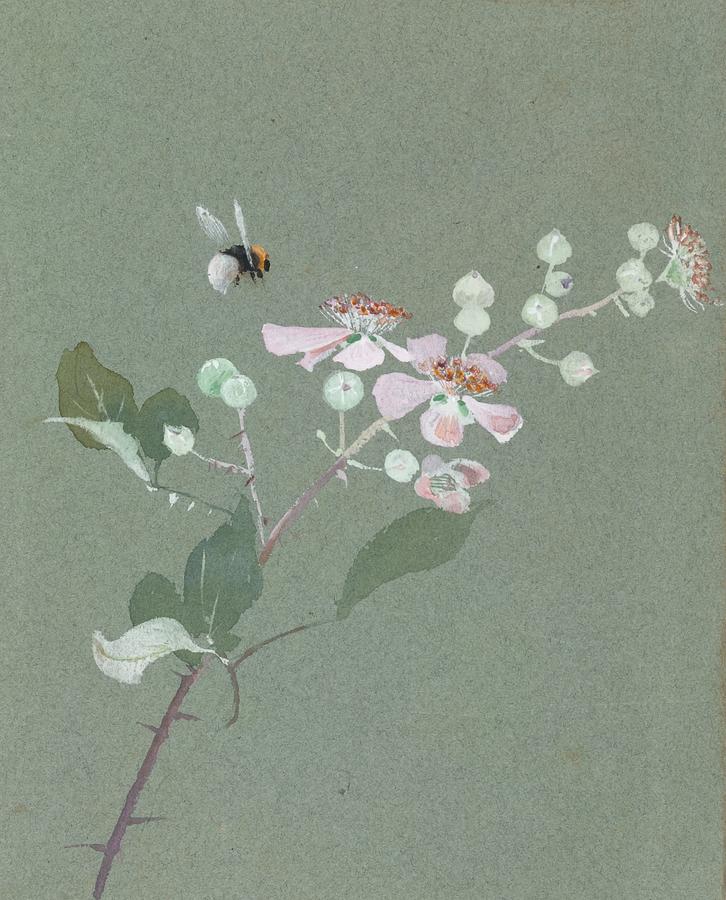
While in North Africa, Trotter continued making sketches and watercolors, documenting the everyday life that surrounded her—people, bees, flowers, sunsets. These are minor works/studies, not intended for the art market, but they were for Trotter a major way of delighting in God’s creation. I don’t like how the marketing of the film leans heavily into the narrative of “Oh, look at Lilias, so selfless and heroic, sacrificing artistic fame for service, she really could have been tops if she hadn’t given it up,” as it wrongly suggests that evangelistic or nonprofit work is more God-honoring than art making, or that recognition in one’s field is not something a Christian should desire. The film itself mostly avoids that way of looking at it, focusing instead on Trotter’s faithfulness in responding to a call that was particular to her and then finding ways to integrate art, as an avocation, into her new life in Algiers. “Her art . . . wasn’t lost in Algeria. If anything, it was fed,” says biographer Miriam Rockness. As viewers, we’re asked to reexamine our conception of success.
Watercolor by Lilias Trotter, July 9, 1907
I had never heard of Lilias Trotter before watching this documentary (thanks for the recommendation, Sarah!), but now I’m glad to know about her. Learn more at https://liliastrotter.com/, and follow the Lilias Trotter Legacy on Instagram, Facebook, and/or Twitter. Also, the current issue of Christian History magazine (no. 148) is devoted entirely to Trotter; you can download a free copy (or purchase a physical one) here.