SPOTIFY PLAYLIST: August 2022 by Victoria Emily Jones: Most months I compile thirty songs and other musical selections into a nonthematic playlist as a way to share good music, mostly from the Christian tradition but otherwise Christian-adjacent. This month’s list includes a traditional Black gospel song performed by Chris Rodrigues and professional spoon player Abby Roach (featured here); a Zulu song from South Africa about holding on to Jesus (bambelela = “hold on”); a song in the voice of Christ Our Mother by Irish singer-songwriter Sinéad O’Connor, from her album Gospel Oak; a portion of Barbados-born Judy Bailey’s Caribbean-style setting of the Anglican liturgy; a brass arrangement of a Golden Gate Quartet classic; Palestrina’s beautiful multivoiced setting of a Latin hymn by Bernard of Clairvaux; a future-looking song of celebration by country artist Naomi Judd, who passed away in April; a condensation of “In Christ Alone” by Texas soul artist Micah Edwards; and more.
The two videos below are from the list: a medley of the Twi praise chorus “Ayeyi Wura” (King of Our Praise) from Ghana and “Most High God” from Nigeria, led by Eric Lige at the 2018 Urbana missions conference, and a new arrangement by Marcus & Marketo of “I’ve Got a River of Life,” a song that I have fond memories of singing in children’s church as a kid (with hand motions!) (you can hear a more standard rendition here). The first line is derived from Jesus’s saying in John 7:38 (“Out of the believer’s heart shall flow rivers of living water”), and the refrain “Spring up, O well!” comes from Numbers 21:17, where the Israelites praise God for providing them water in the desert.
+++
Reading books is a key way that I grow intellectually and spiritually, and books are often where I find content to highlight on the blog, be it poems, visual art, people, or ideas. Because I’m not affiliated with an academic institution, I don’t have easy access to a lot of the books I need for my research, and I rely heavily on my personal library (as well as the Marina interlibrary loan system). If you’d like to support the work of Art & Theology, buying me a book from my wish list is a great way to do that! I’ll consider it a birthday gift, as my birthday is Saturday. 😊
+++
ESSAYS:
>> “Poetry’s Mad Instead” by Abram Van Engen, Reformed Journal: “I believe that poetry has a particular place in the church. I think it responds directly to the call and the invitation of God to ‘sing a new song,’” says Abram Van Engen, chair and professor of English at Washington University in St. Louis and cohost of the podcast Poetry for All. “And in the singing of poetry, the faithful can begin to understand and experience and engage God’s world afresh.” He adds, “Poets often invite us to practice thinking and noticing at a different pace. It is only at a slower speed of processing that we can begin to observe what we have too often missed or ignored.”
In this essay, Van Engen walks readers through the sonnet “Praise in Summer” by Richard Wilbur, which is what he begins with whenever he teaches poetry at church. He teaches you some of the poet’s tools so that you can feel more confident in approaching poems on your own.
>> “In Defense of Fiction: Christian Love for Great Literature” by Leland Ryken: An excellent article, by a professor emeritus of English at Wheaton College and author of The Christian Imagination: The Practice of Faith in Literature and Writing, A Complete Handbook of Literary Forms in the Bible, and more. “With so many valuable nonfiction books available to Christians, many wonder if reading fiction is worth the time. Others view fiction as a form of escapism, a flight from reality and the world of responsibility. But rightly understood, reading fiction clarifies rather than obscures reality. The subject of literature is life, and the best writers offer a portrait of human experience that awakens us to the real world. Fiction tells the truth in ways nonfiction never could, even as it delights our aesthetic sensibilities in the process. Reading fiction may be a form of recreation, but it is the kind that expands the soul and prepares us to reenter reality.”
+++
VISUAL MEDITATION: On Christ and the Samaritan Woman by Jacek Malczewski, by William Collen: William Collen introduced me to this unusual painting on the subject of Christ’s meeting with the woman at the well from John 4—a subject the artist painted several times (e.g., here, here, and here). Whereas Christ is traditionally shown pontificating to the woman with an air of formality, here there is an appealing casualness to their interaction, and the woman dominates the composition.
Jacek Malczewski (Polish, 1854–1929), Christ and the Samaritan Woman, 1912. Oil on plywood, 92 × 72.5 cm. Borys Voznytskyi Lviv National Art Gallery, Ukraine.
I’ve been working my way through Emily Dickinson’s complete poems and falling in love with her all over again.
Dickinson wrote a lot about death, eternity, immortality, the afterlife. Most people are familiar with “This World is not Conclusion,”“Because I could not stop for Death –,” and “I heard a Fly buzz – when I died –,” to name a few—all mainstays of middle school English curricula in the US. Below I’ve selected three of her lesser-known poems about heaven, which she describes as: Being truly known. Full sight. Day. The quenching of a deep thirst that nothing on earth can satisfy. Permanence.
I’ve reproduced them as they appear in Emily Dickinson’s Poems: As She Preserved Them, edited by Cristanne Miller (The Belknap Press of Harvard University Press, 2016). Dickinson did not title her poems, so scholars refer to them by their first line.
Seonna Hong (American, 1973–), World Without End, 2015. Acrylic and oil pastel on canvas, 48 × 60 in. (121.9 × 152.4 cm). [artist’s website]
At last – to be identified – At last – the Lamps upon your side – The rest of life – to see –
Past Midnight – past the Morning Star – Past Sunrise – Ah, what leagues there were – Between Our feet – and Day!
Late 1862 (revised from the 1860 version)
We thirst at first – ’tis Nature’s Act – And later – when we die – A little Water supplicate – Of fingers going by –
It intimates the finer want – Whose adequate supply Is that Great Water in the West – Termed Immortality –
Second half of 1863
It is an honorable Thought And makes One lift One’s Hat As One met sudden Gentlefolk Upon a daily Street
That We’ve immortal Place Though Pyramids decay And Kingdoms, like the Orchard Flit Russetly away
Jesus, Savior, pilot me, Over life’s tempestuous sea; Unknown waves before me roll, Hiding rock and treach’rous shoal; Chart and compass come from Thee: Jesus, Savior, pilot me!
As a mother stills her child, Thou canst hush the ocean wild; Boist’rous waves obey Thy will When Thou say’st to them, “Be still!” Wondrous Sov’reign of the sea, Jesus, Savior, pilot me!
When at last I near the shore, And the fearful breakers roar ’Twixt me and the peaceful rest, Then, while leaning on Thy breast, May I hear Thee say to me, “Fear not, I will pilot thee!”
The hymn text “Jesus, Savior, Pilot Me” was written in 1871 by Edward Hopper (1818–1888), pastor of the Church of Sea and Land in New York Harbor. Hopper ministered to sailors coming and going, many of whom became lost at sea; his was thus a transient congregation, and one well acquainted with grief and uncertainty.
This is the only hymn of Hopper’s to have survived. It uses nautical imagery to speak of how Christ guides us through life’s stormy waters, all the way safe to the other shore, heaven. It is a petitionary hymn that beseeches Jesus to be present and active, but it is also a hymn of consolation.
Though it has been published in a number of hymnals, I first encountered “Jesus, Savior, Pilot Me” through the Bifrost Arts retune released on the collective’s first album in 2008. In fact, several artists have composed new melodies for the hymn or revamped it since it was first set to music by John E. Gould a few months after the publication of Hopper’s text, and it continues to live on even in nonmaritime contexts.
I’m really interested in how hymns evolve. How one text can inspire a variety of musical settings and arrangements—and how they move around the globe into different languages and cultural contexts! The original tune of “Jesus, Savior” doesn’t particularly resonate with me, but the creative arrangements of it, and some of the modern retunes, do.
1. Music by John E. Gould, 1871
I found a straightforward choral rendition of Gould that was performed in 2012 by a choir from Salt Lake University, but it’s very bland.
So for an introduction to the hymn’s original tune, as reproduced in hymnals, I actually recommend this video by Siviwe Mhlomi and friends, who sing the hymn a cappella in four-part harmony in the Bantu language of Xhosa:
The Xhosa title is “Yesu Nkosi Ndiqhube,” and it’s widely popular in South Africa.
Xhosa uses the Roman alphabet, but the letters c, x, and q are pronounced with clicks that linguists call dental, lateral, and alveolar, respectively—so that’s why you hear some clicking speech sounds in the song.
>> Gospel
Mahalia Jackson recorded a slower, gospelized rendition with lush orchestral accompaniment in 1960:
The original tune is more difficult to recognize in the heavily stylized arrangement by the Roberta Martin Singers from 1968, which features Delois Barrett-Campbell on lead—but Gould was still used as the basis:
>> Country/Bluegrass
The hymn has been performed in a bluegrass idiom since at least the fifties. I don’t know who first arranged it in this style, but Lester Flatt and Earl Scruggs recorded it with their band the Foggy Mountain Boys in 1951 (see them perform the song at the Grand Ole Opry in Nashville in 1961 in the video below). In addition to using bluegrass instrumentation, their arrangement changes the traditional 3/4 meter (with dotted eighth notes) to 4/4 and adds more space between phrases. The Stanley Brothers recording from Hymns of the Cross (1964) follows this arrangement pretty closely—and Ralph Stanley later revisited the song with the Clinch Mountain Boys in 1977.
I first encountered the bluegrass version through the album A Hymn Revival, volume 1 by the sacred music collective The Lower Lights. They perform the song live in the following video, with Sarah Sample and Ryan Tanner on vocals (their singing style is more “indie folk” than bluegrass):
Other artists have sung “Jesus, Savior” with the 4/4 time signature popularized by Flatt & Scruggs, including Rumbi Lee, self-accompanied on ukulele:
(Lee puts out lots of hymn-sing videos on her YouTube channel.)
2. Music by Robbie Seay, 2004
Here’s CCM artist Robbie Seay in 2020 performing his retuned version of the hymn, which churches can license through CCLI:
It does a good job drawing out the emotion of the lyrics, especially the aspect of mournful yearning.
Like I said, although I grew up in church, I never heard of “Jesus, Savior, Pilot Me” until Bifrost Arts released it with a fresh tune in 2008. It was written by the cofounders of the collective, Isaac Wardell (a worship leader who now heads up The Porter’s Gate) and Joseph Pensak (a pastor from Vermont who ran a community art gallery for eight years and whose latest musical album, from 2019, is Hallowell). Laura Gibson is the vocalist on the recording, and Matthew Kay created this charming little stop-motion animation video for it:
Since its premiere, this tune has also been recorded by Pacific Gold (formerly Wayfarer) (2012) and Door of Hope (2012), among others.
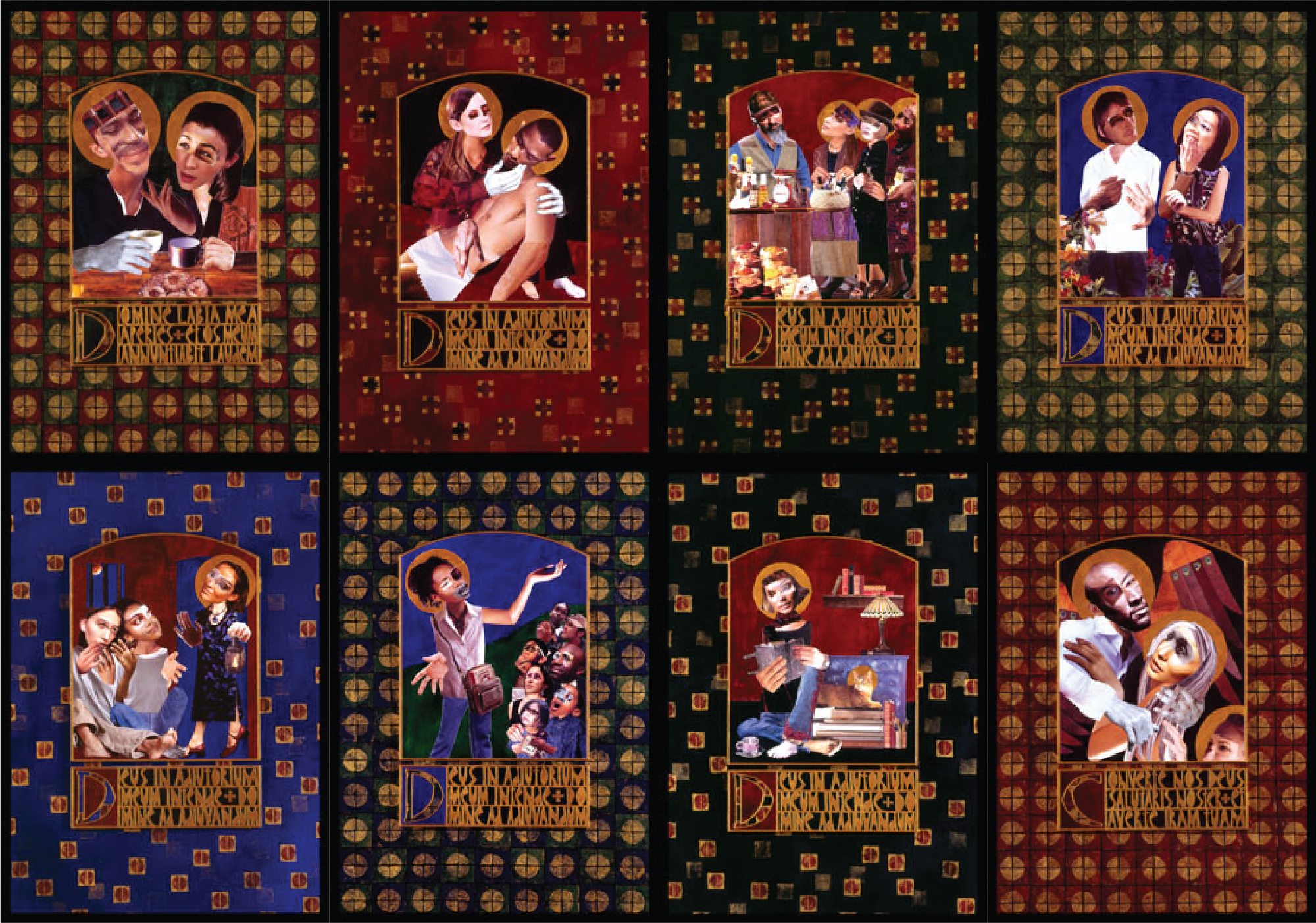
ART CYCLE: The Hours of Mary Magdalene by Jan L. Richardson: July 22 is the feast day of Mary Magdalene, one of Jesus’s closest disciples and the first witness and preacher of the Resurrection. American artist, writer, and minister Jan L. Richardson created a sequence of collages picturing events from her life, drawing on both the biblical narratives and medieval legends. The structure and presentation (decorative borders, Latin script) were inspired by medieval books of hours, used for the praying of the Divine Office. The text below each image reads, Deus, in adiutorium meum intende; Domine, ad adiuvandum me festina (“O God, come to my assistance; O Lord, make haste to help me”), the first verse of Psalm 70, which is prayed at the start of each of the canonical hours.
According to legend, after Jesus’s ascension Mary Magdalene moved to southern France, where she preached the gospel and performed miracles. The last thirty years of her life she lived as a hermit in a cave. Each time she prayed the hours, she was lifted up to heaven by angels, then brought back down at the end of her devotions.
Richardson put together a delightful little video showcasing the art cycle as well as the song “Mary Magdalena” by her late husband, Garrison Doles.
You can purchase these images as digital downloads from Richardson’s website:
DANCE: “Holy, Holy, Holy”: Choreographed by Betsey Beckman to a song by Karen Drucker, this dance number affirms the sacredness of every human being. It was filmed inside St. Gregory of Nyssa Episcopal Church in San Francisco, a church that “invites people to see God’s image in all humankind, to sing and dance to Jesus’ lead, and to become God’s friends.” Beckman dances with Dawon Davis and Corey Action throughout the worship space, which comprises a rectangular room where the Liturgy of the Word is celebrated and an octagonal rotunda for the Liturgy of the Table. The Dancing Saints icon that covers the walls is by Mark Doox. [HT: Global Christian Worship]
+++
MUSIC:
>> “Locus iste” by Anton Bruckner, performed by VOCES8: The British vocal ensemble VOCES8 performs Anton Bruckner’s sacred motet “Locus iste” (This Place) at Les Dominicains de Haute-Alsace in Guebwiller, France. Bruckner composed it in 1869 for the dedication of the Votivkapelle (votive chapel) at the New Cathedral in Linz, Austria, where he had been a cathedral organist. The text—a Latin gradual for church dedications and their anniversaries—is informed by Jacob’s saying, after his dream of the ladder uniting heaven and earth, that “surely the Lord is in this place; and I knew it not” (Gen. 28:16), and by the story of the burning bush where Moses is told to “put off thy shoes from off thy feet, for the place whereon thou standest is holy ground” (Exod. 3:5).
Locus iste a Deo factus est, inaestimabile sacramentum; irreprehensibilis est.
This place is made by God, a priceless sacrament; it is without reproach.
(Or, alternatively:) This dwelling is God’s handiwork; a mystery beyond all price, that cannot be spoken against.
>> “Tabernacle” by Josh Rodriguez, performed by Mary Vanhoozer: A modernist piano composition inspired by Psalm 19, dedicated to the composer’s father-in-law, the theologian Kevin Vanhoozer.
Tabernacle is a musical triptych shaped by the drama of Psalm 19. While this word, tabernacle, is loaded with religious affection within both Jewish and Christian traditions, some modern readers may not be familiar with its implications. Merriam-Webster offers three related definitions: “a house of worship, a receptacle for the consecrated elements of the Eucharist, or a tent sanctuary used by the Israelites during the Exodus.” By extension, it has come to represent a “dwelling place” or a “temporary shelter.” In short, this is no ordinary space, rather it is a place that is set apart, made holy for a terrifying transformative encounter with the Divine.
Fragments of a prayerful hymn-like melody appear underneath this canopy of sounds. Shifting metric changes, polyrhythms, and percussive primal-sounding harmonies climax in a loud, noisy quote from the 16th-century Genevan Psalter.
More extensive program notes can be found in the YouTube video description.
+++
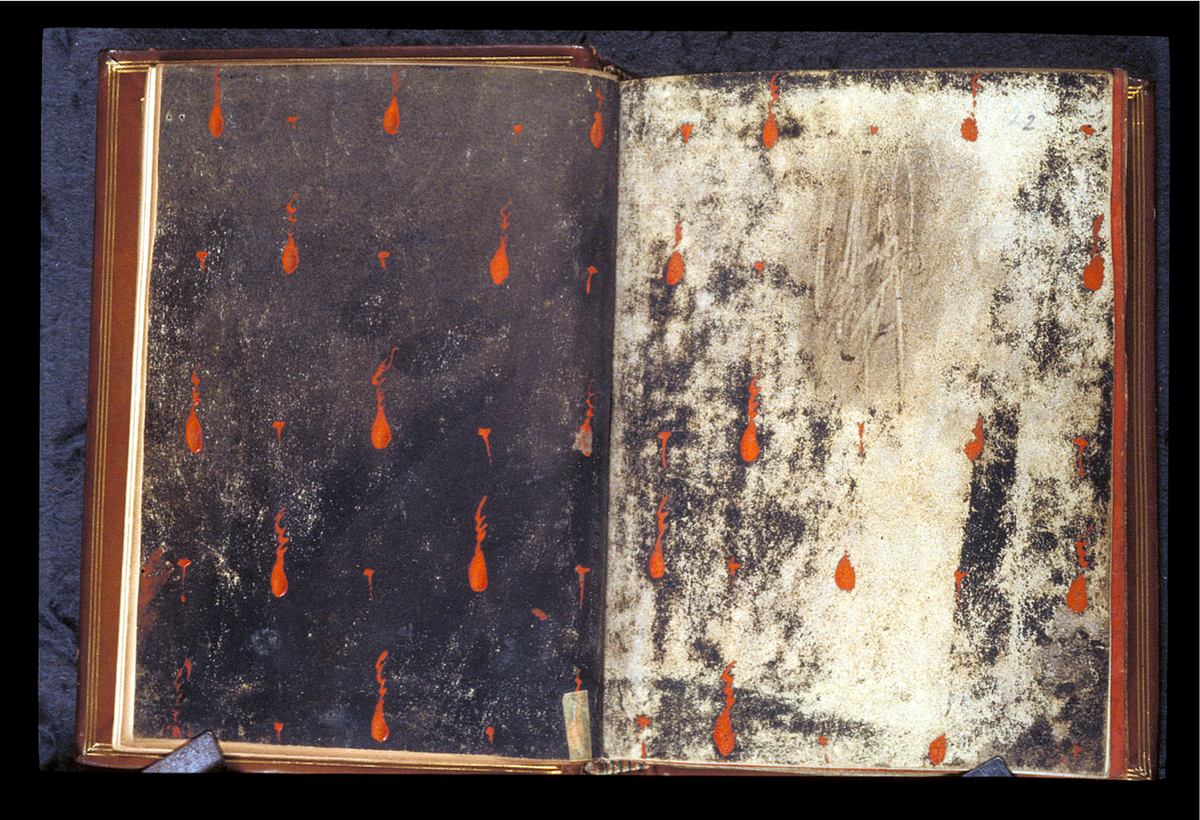
ESSAY: “Precedents of the Unprecedented: Black Squares Before Malevich” by Andrew Spira, Public Domain Review: Considered one of the seminal works of modern art, Kazimir Malevich’s Black Square (1915) has been cast as a total break from all that came before it. Yet searching across more than five hundred years of images related to cosmology, religious devotion, mourning, humor, politics, and philosophy, art historian Andrew Spira uncovers a slew of unlikely foreshadows to Malevich’s radical abstraction.
Robert Fludd’s black square representing the nothingness that was prior to the universe, from his Utriusque Cosmi (1617). On each side of the square is written “Et sic in infinitum…” (“And so on to infinity…”).Black pages with red drops of blood, signifying the wounds of Christ, from a psalter and rosary of the Virgin, ca. 1500. The recto is worn from devotional engagement, damaged through kissing and rubbing, perhaps.
For a much more extensive treatment of the topic, see Spira’s Foreshadowed: Malevich’s “Black Square” and Its Precursors, published this month. And for a faith-positive (non-nihilistic) reading of Malevich’s Black Square that honors the artist’s own views, see pages 209–25 of Jonathan A. Anderson and William A. Dyrness’s Modern Art and the Life of a Culture, where they discuss the work in relation to the Russian icons tradition and “apophatic or ‘negative’ theology—a mode of theology that meditates on the absolute Fullness and Otherness of God by way of negating the verbal, visual and conceptual forms used to signify (and to ‘grasp’) God” (220).
Abby Roach, known as Abby the Spoon Lady, is an American roots musician from Kansas, specializing in playing the spoons. It’s a skill she picked up in her late twenties while hopping freight trains around the United States and staying in homeless encampments. (A Peruvian man named Gil taught her.) Since then she has made a living performing primarily on the streets, creating a variety of sounds and rhythms with the simple castanet-like instrument. Her repertoire consists of early jazz, gospel, ragtime, country blues, jug band, Western swing, and Appalachian folk.
Abby grew up in Wichita but left her hometown at age twenty-five to start a new life. “Homeless by choice,” she used Nashville as a hub for a while until the police started discouraging busking in 2012. She spent 2013 to 2019 in Asheville, North Carolina, where she struck up a musical partnership with singer-guitarist Chris Rodrigues. The two are featured in Erin Derham’s Buskin’ Blues (2015) (watch for free!), an hour-long documentary about the street performance culture in Asheville, and they recorded an album together, Working on Wall Street (2017), titled after the picturesque side street where they regularly performed.
In Asheville Abby hosted a weekly radio broadcast at WPVM 103.7 FM and became president of the Asheville Buskers Collective, advocating for the interests of the busking community to the city council and local businesses.
“The real reason that street performance is important, and the reason it should be preserved, is because it turns our sidewalks into our front porch,” Abby says. “Since the invention of the air conditioner, we have all gone inside. Nobody’s sharing anything anymore. Nothing’s raw anymore. And when you do experience any kind of culture, it’s through a lens of some sort—on a screen. What street performance provides is a live avenue where people can experience, witness, and even sometimes partake in these cultures, and have it put in front of them.”
In 2019 Abby moved back to Kansas, purchasing a little green bus that she converted into a mobile home and, more recently, a house in Winfield, which she is fixing up. She releases YouTube videos through what she calls Spooniversal Studios, sharing music and stories, and travels the US, performing outside in downtown areas, at festivals, and at small music venues. Besides Rodrigues, she has also performed with the Tater Boys (Tub Martin and Dusty Whytis), the Steel City Jug Slammers, Matt Kinman, Les Blackwell, and others. Though the spoons are her primary instrument, she also plays the mountain dulcimer and the musical saw.
Abby doesn’t romanticize the nomadic life; she says it’s dangerous (especially for women), dirty, tiring, and often lonely. People love to ask her about her train-hopping days, and while she does have tales to regale, she emphatically warns folks not to ride freight trains—you don’t need to do that to be free, she says.
Below are filmed performances of some of the traditional gospel songs Abby has done over the past five years, starting with “Angels in Heaven” (aka “I Know I Been Changed”), which went viral in 2017 and currently has over 59 million views! Her beagle, Willie, often appears in the videos.
“John the Revelator,” which intersperses a refrain about the apostle John writing the Apocalypse with verses about Adam hiding from God in Eden, Jesus in Gethsemane the night of his arrest, and Jesus on Easter morning commissioning Mary Magdalene to preach the Resurrection:
“Jesus on the Mainline,” about how Jesus is always available to talk to:
“Don’t Let the Devil Ride,” not giving sin a foothold:
“Soldier in the Army of the Lord”:
“Gospel Plow,” a call to perseverance:
“Laid My Burden Down”:
“Ain’t No Grave” (a version of this song appears on Abby’s 2020 album with the Tater Boys, In the Dirt and Thriving):
“He’s Got the Whole World in His Hands”:
“I Feel the Lord Stretching Out in Me” (“I feel the Lord stretching out in me. I cleaned up my house, and I kicked the devil out. I feel the Lord stretching out in me!”):
You can support Abby the Spoon Lady through PayPal or Venmo (@SPOONIVERSALSTUDIOS), or by purchasing merchandise. View her travel schedule here, and follow her on Facebook and Twitter.
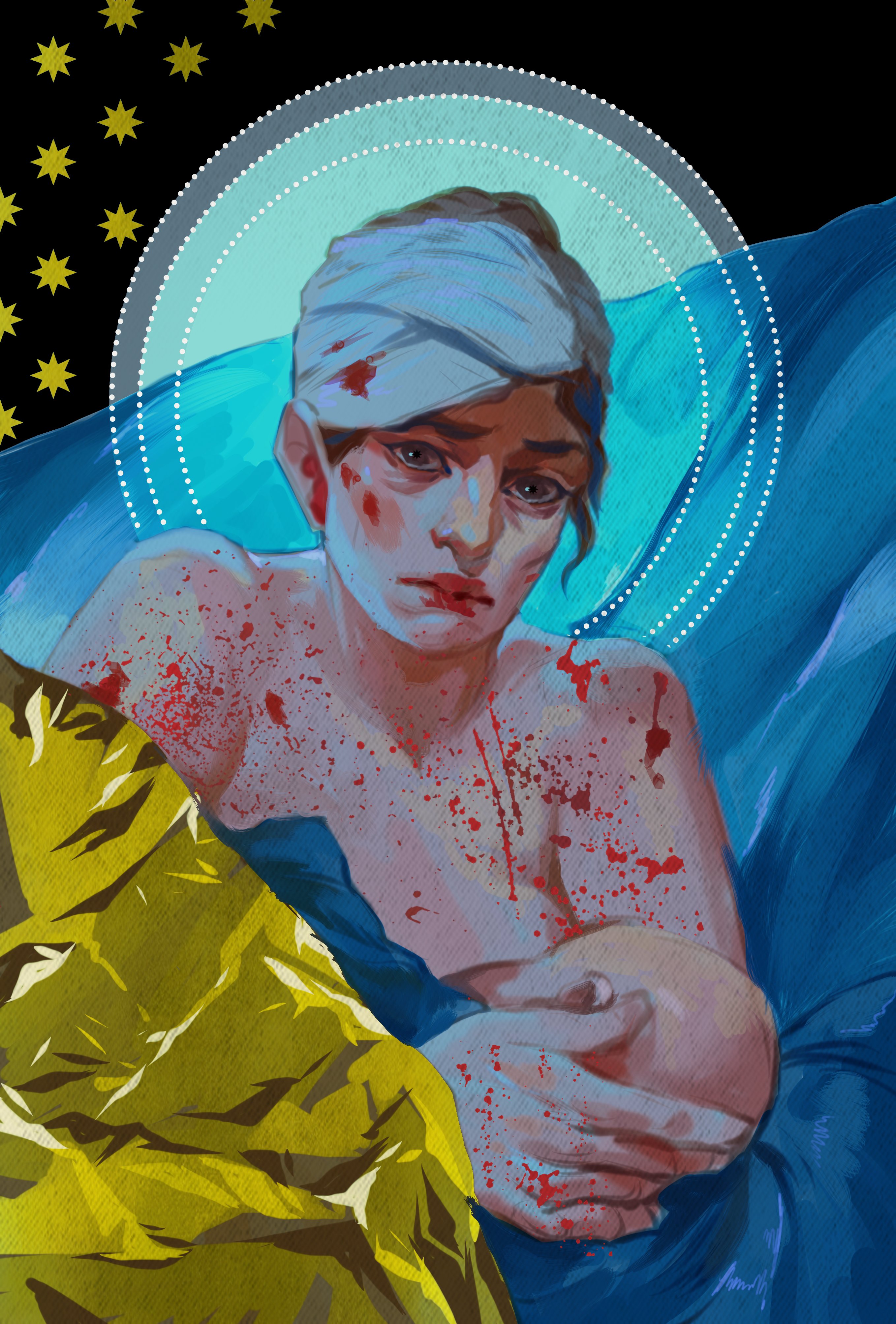
UKRAINIAN MADONNAS: Since Russia invaded Ukraine on February 24 and even still continues to aggress, artists have taken up their art to address the war—several drawing on iconography of the Madonna and Child, particularly the Maria lactans (breastfeeding Mary) type. Two Ukrainian artists were inspired by different news photos of young mothers protecting their infants from the shelling in Kyiv in March—one of whom was photographed in a hospital being treated for wounds she sustained from fallen glass while shielding her daughter with her body, and the other hiding from the blasts in a subway station.
These images show the vulnerability of Christ, who is with us in our suffering, and indict those who cause such suffering.
In his response to the war in Ukraine, Serbian artist Michael Galovic, who lives in Australia, also uses Christian iconography: the Theotokos Kyriotissa (Mother of God enthroned with Christ); Archangel Michael, the patron saint of Kyiv, fighting a dragon (Rev. 12:7–8) in an ethereal rendering of a scene from the Très Riches Heures du Duc de Berry, a fifteenth-century French book of hours; and a hellmouth from the twelfth-century Winchester Psalter. These three medieval images are superimposed on Picasso’s masterwork Guernica, named after the Spanish town bombed by Nazis in 1937 and representative of the horrors of war.
Michael Galovic (Serbian Australian, 1949–), Ukraine Response, 2022. Egg tempera and gold leaf on linen on board, 170 × 80 cm. Collection of the Australian Centre for Christianity and Culture, Canberra, Australia.
Whereas Frirean’s and Solomennykova’s paintings are more intimate, Galovic takes a more cosmic approach, showing wails of lament from abstracted forms intercut with epic battles between good and evil—but at the calm center, Christ is on the throne, holding the scroll of his good word. History is going somewhere. Hate will be damned. Love will triumph.
>> “Galoba (The Prayer),” performed by Trio Mandili: A sung performance of a poem written in 1858 by the Georgian poet and statesman Ilia Chavchavadze (1837–1907). An English translation follows.
Our Father, who art in heaven, With tenderness I stand before thee on my knees. I ask for neither wealth nor glory; I won’t debase my holy prayer with such matters. I desire instead for my soul to be enlightened by heaven, My heart to be radiant with thy love. Even if my enemies pierce me in the heart, I beg thee: “Forgive them, Lord, for they know not what they do!” Even if my enemies pierce me in the heart, I beg thee: “Forgive them, Lord, for they know not what they do!” [source, adapt.]
>> “Peace All Over the World” by Robert Bradley: Written and performed by Detroit musician Robert Bradley, this song originally appeared on the film Playing for Change: A Cinematic Discovery of Street Music (2005). To celebrate their twentieth anniversary, Playing for Change [previously] has remastered it and added new footage from Ukraine.
>> “Du som gick före oss” (You Who Went Before Us) |Words by Olov Hartman, 1968 | Music by Sven-Erik Bäck, 1959 | Performed by VOCES8, 2022: The melody uses all twelve semitones of the octave! I’ve provided a literal English translation of the Swedish below with the help of Google Translate; for a looser but more poetic translation by Fred Kaan, from 1976, see here. Note: The video identifies the song parenthetically as Psalm 74, not because it’s a setting of Psalm 74 from the Bible, but because it is no. 74 in Den svenska Psalmboken, the official hymnal of the Church of Sweden.
Du som gick före oss
längst in i ångesten,
hjälp oss att finna dig,
Herre, i mörkret.

Du som bar all vår skuld
in i förlåtelsen,
du är vårt hjärtas fred,
Jesus, för evigt.

Du som med livets bröd
går genom tid och rum,
giv oss för varje dag,
Kristus, det brödet.

Du som går före oss
ut i en trasig värld,
sänd oss med fred och bröd,
Herre, i världen.
You who went before us
in the depths of anxiety,
help us to find you,
Lord, in the dark.

You who bore all our guilt
into forgiveness,
you are the peace of our hearts,
Jesus, forever.

You who are the living bread
offered abundantly through all the earth,
give us each day,
dear Christ, that bread.

You who go before us
out into a broken world,
send us out likewise, Lord,
with peace and bread.
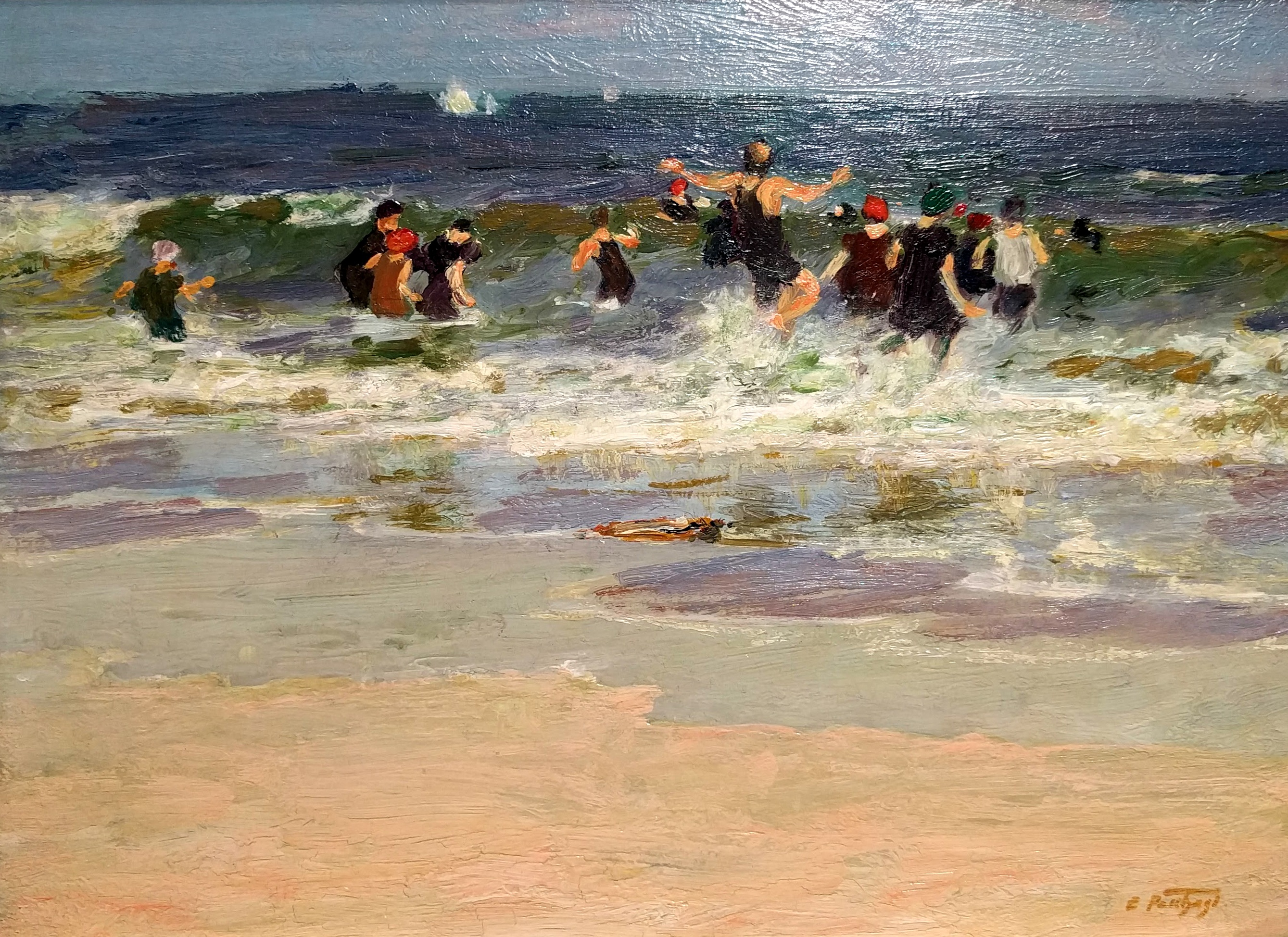
Edward Henry Potthast (American, 1857–1927), Beach Scene, Coney Island, 1915–18. Oil on wood panel, 11 7/8 × 16 in. (30.2 × 40.6 cm). Brandywine River Museum of Art, Chadds Ford, Pennsylvania. Photo: Victoria Emily Jones. [object record]
Why! who makes much of a miracle?
As to me, I know of nothing else but miracles,
Whether I walk the streets of Manhattan,
Or dart my sight over the roofs of houses toward the sky,
Or wade with naked feet along the beach, just in the edge of the water,
Or stand under trees in the woods,
Or talk by day with any one I love—or sleep in the bed at night with any one I love,
Or sit at table at dinner with my mother,
Or look at strangers opposite me riding in the car,
Or watch honey-bees busy around the hive, of a summer forenoon,
Or animals feeding in the fields,
Or birds—or the wonderfulness of insects in the air,
Or the wonderfulness of the sun-down—or of stars shining so quiet and bright,
Or the exquisite, delicate, thin curve of the new moon in spring;
Or whether I go among those I like best, and that like me best—mechanics, boatmen, farmers,
Or among the savans—or to the soirée—or to the opera,
Or stand a long while looking at the movements of machinery,
Or behold children at their sports,
Or the admirable sight of the perfect old man, or the perfect old woman,
Or the sick in hospitals, or the dead carried to burial,
Or my own eyes and figure in the glass;
These, with the rest, one and all, are to me miracles,
The whole referring—yet each distinct, and in its place.

To me, every hour of the light and dark is a miracle,
Every cubic inch of space is a miracle,
Every square yard of the surface of the earth is spread with the same,
Every foot of the interior swarms with the same;
Every spear of grass—the frames, limbs, organs, of men and women, and all that concerns them,
All these to me are unspeakably perfect miracles.

To me the sea is a continual miracle;
The fishes that swim—the rocks—the motion of the waves—the ships, with men in them,
What stranger miracles are there?
“Miracles” by Walt Whitman was originally published in the second edition of Leaves of Grass (Fowler & Wells, 1856). It is in the public domain.
“The wild animals honor me, the jackals and the owls, because I provide water in the wilderness and streams in the wasteland . . .”
—Isaiah 43:20 (NIV)
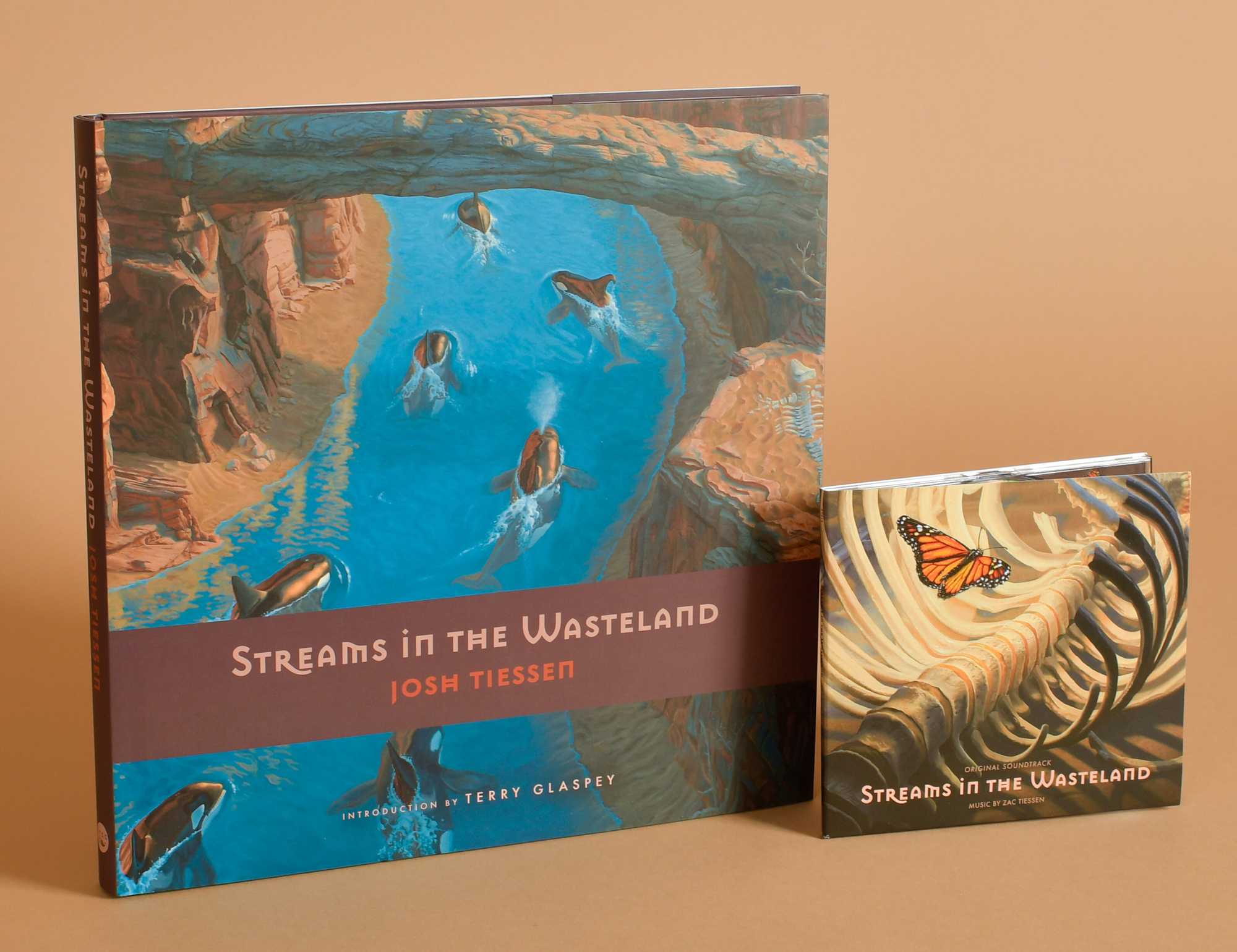
This verse from the prophetic book of Isaiah supplies the title of artist Josh Tiessen’s Streams in the Wasteland series. Comprising seventeen paintings of wild animals inhabiting abandoned cities, it took six years to complete, from 2015 to 2021. In this body of work Tiessen weds a biblical imagination with his passion for wildlife conservation to promote ecological ethics, or what Christians call “creation care”—the biblical imperative to be benevolent stewards of the environment and all its creatures. He says he wants to represent “the majesty, particularity, and beauty of animals” (Streams in the Wasteland, p. 33)—to evoke wonder, love, and empathy, and a greater sense of responsibility.
“The whole creation has been groaning,” the apostle Paul writes in Romans 8, seeking to “be liberated from its bondage to decay and brought into the freedom and glory of the children of God.” Creation has been damaged in large part by humanity’s sin, which has caused deforestation, land degradation, ozone depletion, and species endangerment and extinction, among other harms. Instead of enjoying the full flourishing God intended, the natural world suffers.
Streams in the Wasteland engages with the question, What would the liberation of animals from the bondage to decay look like? Some of Tiessen’s creative visual responses:
An Indian temple elephant breaks free of its shackles, no more to be prodded and paraded for the people’s religious festivals.
Released from aquarium amusement parks where they were exploited for entertainment, a pod of orcas journeys down a canyon river into the ocean past their ancestors’ skeletal remains, which will one day rise.
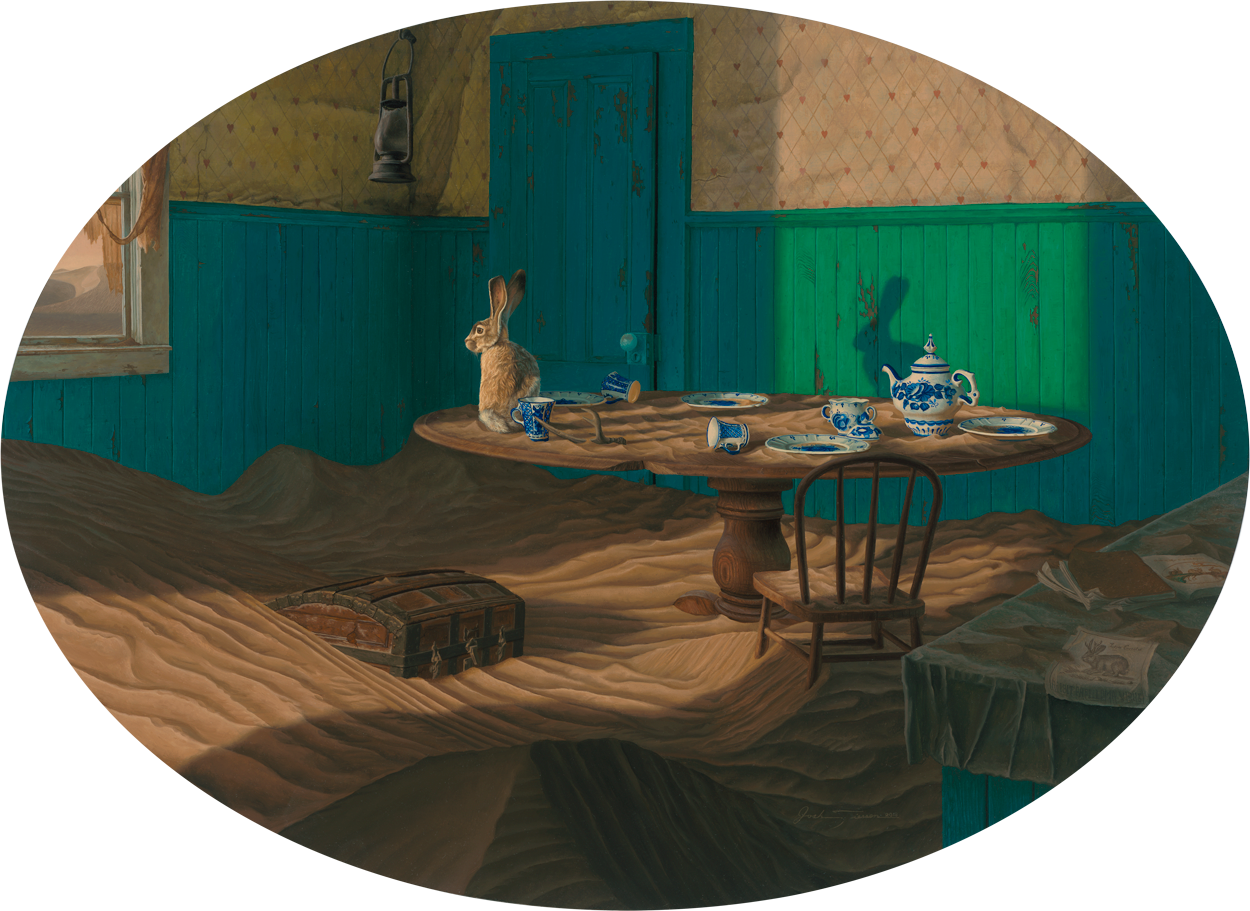
A jackalope—the mythical horned rabbit of North American folklore—sheds its antlers, a passing shadow of the old world. Rabbits with hornlike protrusions on or near their heads have actually been found in nature, the cancerous growths a result of a papillomavirus.
Josh Tiessen (Canadian, 1995–), Liberation of the Jackalope, 2018. Oil on braced Baltic birch, 21 × 29 in.
Tiessen calls his style “narrative hypersurrealism,” as he renders the animals with technical precision and great attention to naturalistic detail (hyperrealism) but places them in a postapocalyptic context, revealing strange beauty in the unexpected (surrealism). And in contrast to traditional wildlife art, Tiessen’s art tells a story. For Streams in the Wasteland, that story is one of reclamation and healing—but also one of warning for those who neglect God’s laws.
In preparation for this series, Tiessen wrote a research paper on zoological motifs in the book of Isaiah. He found that in several prophecies of judgment, God gives animals dominion over human civilization—an ironic reversal, the “weak” shaming the powerful.
Babylon, the jewel of kingdoms, the pride and glory of the Babylonians, will be overthrown by God like Sodom and Gomorrah. She will never be inhabited or lived in through all generations; there no nomads will pitch their tents, there no shepherds will rest their flocks. But desert creatures will lie there, jackals will fill her houses; there the owls will dwell, and there the wild goats will leap about. Hyenas will inhabit her strongholds, jackals her luxurious palaces. Her time is at hand, and her days will not be prolonged.
In addition to Babylon, Isaiah indicts other unjust nations: in Cush the fruit of the vine “will all be left to the mountain birds of prey” (18:6), and in Edom “the desert owl and screech owl will possess it; the great owl and the raven will nest there” (34:11). Concerning the kingdom of Judah: moles and bats will take over idols of silver and gold (2:20), lambs will feed on the food of the rich (5:17), and Jerusalem will become void of human activity and instead be “the delight of donkeys, a pasture for flocks” (32:14). It’s not just nocturnal animals and scavengers that crop up, but also harmless ones like foals and sheep.
Returning to the opening quote of this article, we see that Isaiah describes an eschatological reality in which God’s abundant provision elicits thanksgiving and praise from the animal kingdom. But they are Israel’s foil: whereas the animals are sensible of God’s goodness, God’s people are not. “Yet you have not called on me, Jacob. . . . You have burdened me with your sins and wearied me with your offenses” (43:22, 24).
Tiessen understands such animals “as the Creator’s special agents worthy of intrinsic value and a role in history. I caught a glimpse of Isaiah’s larger vision for animals serving as co-workers with the Creator to confront humanity, calling from within the ruins of human moral decay” (Streams in the Wasteland, p. 22).
Therefore, in Streams in the Wasteland, a barn owl stakes its place on a plinth of a Gothic cathedral alongside sculptures of the saints, meerkats lounge on a chaise inside a Baroque manor, lar gibbons swing from the entryway of a university, and a pack of spotted hyenas wanders through Bodie, a California Gold Rush boomtown known for its sin, now a ghost town.
Josh Tiessen (Canadian, 1995–), Occidental Babylon, 2017. Oil on braced Baltic birch, 52 × 75 in.
I’m very familiar with the Isaiah passages where creatures are presented as blessings of Edenic hope for the future, existing peaceably with humans (e.g., Isa. 11:6–9), but I had never really stopped to consider all the places where they are said to overtake what we deem human domains. Such passages are certainly more uncomfortable for us humans!
Though humans’ neglect or mistreatment of animals is not specifically what prompts God’s pledged use of animals to shame the rebellious nations, surely our disregard for the creation mandate in Genesis—to rule the earth with care and compassion—is a form of rebellion against God. And so Tiessen extends his reading of Isaiah to address that call in particular, which is echoed in other parts of scripture, such as Proverbs 12:10: “The righteous care for the needs of their animals.” By placing animals in human habitations, Tiessen compels us to remember our obligations to our nonhuman neighbors.
Perhaps my favorite painting from Tiessen’s series is Whale Hymn. The setting is the ruined shell of St. Dunstan-in-the-East, a twelfth-century church that once towered over the city of London but that was irreparably bombed during World War II. It has since been converted into a public garden. In his futuristic vision, Tiessen imagines it surrounded by floodwaters, a humpback whale swimming by. This giant of the deep sings its song to the Creator in the same place where generation after generation of Christians sang their praises until human violence rendered the building unusable.
Josh Tiessen (Canadian, 1995–), Whale Hymn, 2015. Oil on braced Baltic birch, 36 × 48 in.
Isaiah is not the only biblical source of inspiration for Tiessen. Ezekiel’s vision in the valley of dry bones inspired Can These Bones Live?, which shows a monarch butterfly gliding through the ribcage of a human skeleton, and its sequel, Rise Up—the only two paintings with human figures.
Tiessen was born in 1995 in Moscow to Canadian missionary parents. His Russian nanny, Lena Zhuk, taught him drawing basics, like perspective and shading, and, when he showed aptitude, bought him his first set of tempera paints, brushes, large heavy paper, and other materials. When he and his family moved back to Canada, Valerie Jones, a fellow church member and artist, noticed his talent and got him his first public art exhibition at age eleven. Then when Tiessen was fifteen, Canadian wildlife artist Robert Bateman took him on as a student and mentee. He graduated from high school at age sixteen and began exhibiting throughout North America while working on a bachelor’s of religious education in arts and biblical studies at Emmanuel Bible College in Kitchener, Ontario, which he earned in 2020. His professional memberships include Artists for Conservation, the Society of Animal Artists, and the International Guild of Realism.
He currently lives in Stoney Creek, Ontario.
Tiessen has self-published a hardcover, glossy-paged, full-color book that collates all the works from Streams in the Wasteland, providing commentary on them (additional to that on his website), which includes engagement with scholarly interpretations of the Isaiah passages. Through sketches and more, he sheds light on his artistic process and also provides autobiographical information. The book comes with a CD of instrumental compositions by his brother Zac Tiessen that respond to each of the paintings—an atmospheric soundscape. It would make a great gift.
The culmination of the series is Agnus Dei, a triptych featuring all the animals in the individual paintings gathering around a horned altar where the Lamb of God lies slain. Tiessen drew inspiration from Jan van Eyck’s Adoration of the Mystic Lamb, Francisco de Zurbarán’s Agnus Dei, and the paintings of Caspar David Friedrich featuring abandoned abbeys, churches, and cemeteries in winter.
Instead of saints from the Homo sapiens species surrounding the Lamb in worship, Tiessen shows a giant panda, a double-wattled cassowary, a narwhal, and other animals paying homage to Christ. They, too, are drawn up into God’s awesome story of redemption. They, too, participate in the “new thing” God is doing.
“My painting is . . . a critique of the human-centric bias within Western art history,” Tiessen writes. “This is best seen in Renaissance paintings where animals seldom appear, and if they do, it is simply for allegorical purposes. By enlisting wild animals as protagonists with intrinsic value amidst the wasteland of human existence, I endeavor to revise Western art history through a zoological lens, liberating the Judeo-Christian worldview from its perversion at the hands of anthropocentric Greek philosophy.”
This final image shows animals liberated from the effects of the fall, honoring the One whose atoning death and resurrection reconciles all to God (Col. 1:19–20).
To see which of these paintings are available for purchase—either the originals or reproductions or notecards—visit https://www.joshtiessen.com/store.
EXHIBITION: Afro-Atlantic Histories, National Gallery of Art, Washington, DC, April 10–July 17, 2022: There are still two more weeks to catch this excellent exhibition in the US capital, which I saw in June, before it travels to the Los Angeles County Museum of Art (December 11, 2022–April 30, 2023) and the Dallas Museum of Art (dates TBA). “For centuries, artists have told and retold the complex histories of the African Diaspora. Explore this enduring legacy in the exhibition Afro-Atlantic Histories, which takes an in-depth look at the historical experiences and cultural formations of Black and African people since the 17th century. More than 130 powerful works of art, including paintings, sculpture, photographs, and time-based media by artists from Africa, Europe, the Americas, and the Caribbean, bring these narratives to life.”
I wish I had more time to devote to it here before it wraps, as there are so many compelling artworks, but instead let me just share a two-minute video tour, followed by a lecture from April 10, which both provide a good overview:
The exhibition is divided into six sections: Maps and Margins, Enslavements and Emancipations, Everyday Lives, Rites and Rhythms, Portraits, and Resistances and Activisms. Kanitra Fletcher, associate curator of African American and Afro-Diasporic art at the National Gallery of Art, says in her talk,
The word histories in the title indicates the plurality of the narratives represented in the exhibition. They are fictional and nonfictional, mythical and factual. As a framework to coalesce narratives that have been left aside at the margins and forgotten, Afro-Atlantic Histories is open, plural, diverse, and inclusive, refusing the canon of traditional art history. This show resists the idea of a definitive history or a “grand narrative” of the Diaspora and presents diverse accounts of the past that challenge long-established hierarchies and forges new questions and connections that show how complex and intertwined are all of our histories.
Here’s an artwork that isn’t included in either of the above videos and that was new to me:
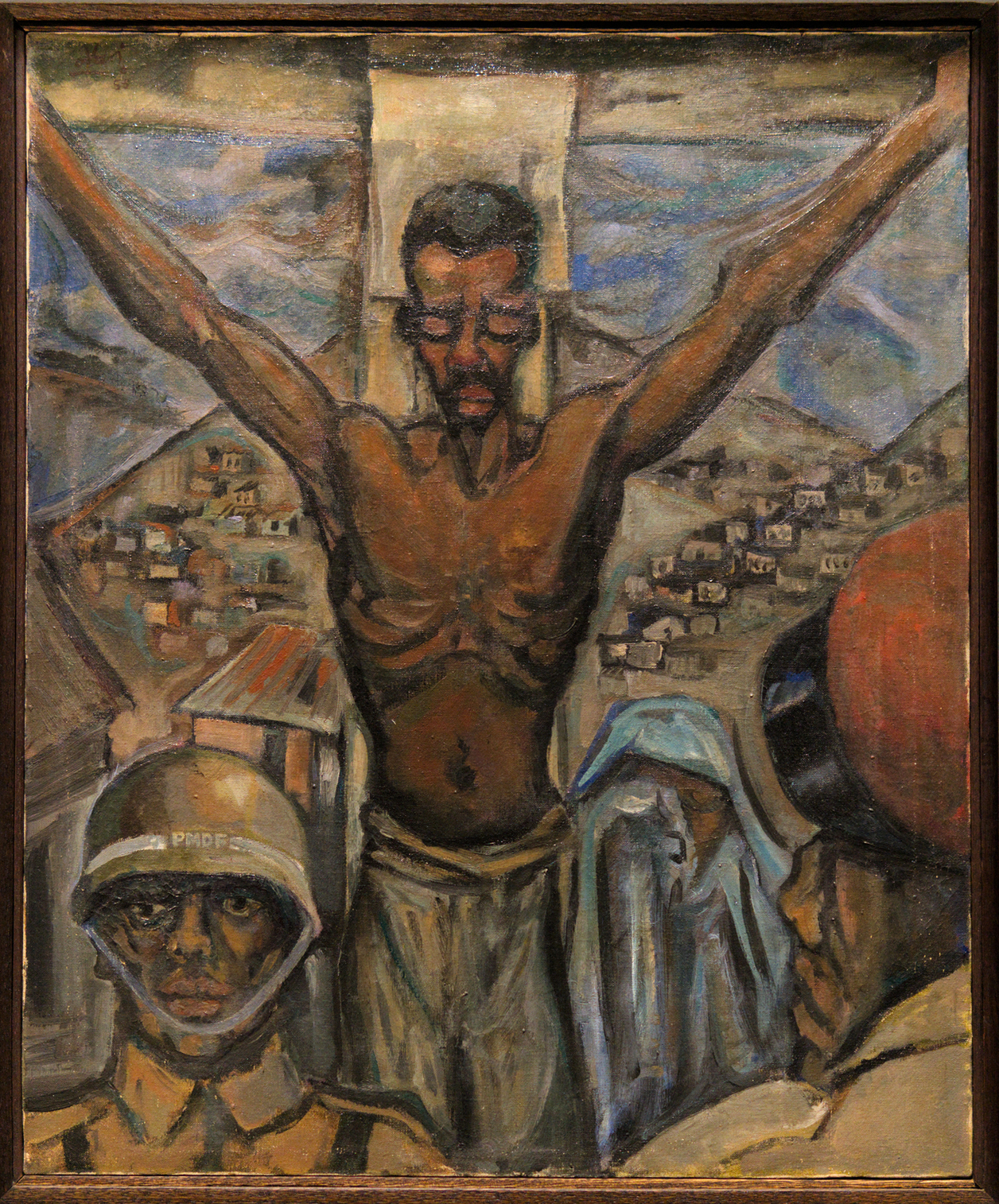
Octávio Araújo (Brazilian, 1926–2015), Cristo favelado (Slum Christ), 1950. Oil on canvas, 64 × 53 cm. Collection of the Instituto de Pesquisas e Estudos Afro-Brasileiros (IPEAFRO), Rio de Janeiro. Photo: Victoria Emily Jones, at Afro-Atlantic Histories at the National Gallery of Art, Washington, DC, June 2022.
Artist Octávio Araújo entered this painting in the Black Christ contest held in 1955 by the Teatro Experimental do Negro (Black Experimental Theater) in Rio de Janeiro (I mentioned this contest previously in relation to another submission, a painting by Djanira da Motta e Silva). It shows Christ crucified in a Brazilian favela, his Roman tormentors replaced with military police officers, perpetrators of state-sanctioned violence against the nation’s Black people.
+++
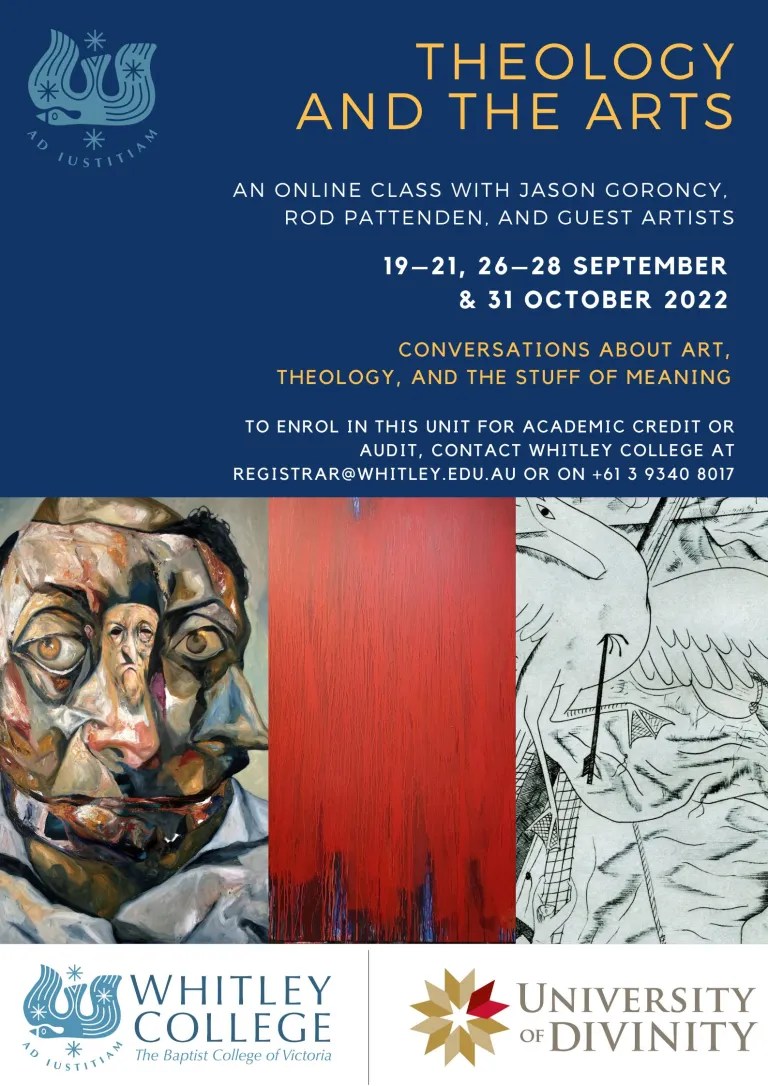
ONLINE COURSE: “Theology and the Arts,” with Jason Goroncy, Rod Pattenden, and guest artists, September 19, 20, 21, 26, 27, 28 and October 21, 2022: Whitley College, a teaching college of the University of Divinity outside Melbourne, is offering a seven-day intensive online course on theology and the arts this fall (description below), taught by the coeditors of the new book Imagination in an Age of Crisis: Soundings from the Arts and Theology. Registration is open to anyone, but participants will need to be available to engage live online from 9:30 a.m. to 3:00 p.m. (Melbourne time) on each of the scheduled days, for lectures, discussions, and other online activities, such as “meet the artist,” gallery visits, interviews, and student presentations. The cost to audit the course is AUD $500 (~ USD $343). There’s also an option to receive academic credit. Professor Goroncy writes,
When, in 1741, George Frideric Handel completed writing the Hallelujah Chorus for his oratorio Messiah, he reportedly told his servant: ‘I did think I did see all Heaven before me, and the great God Himself [sic] seated on His throne, with His Company of Angels’. More recently, the Australian musician Nick Cave described how the gods are closely associated with the flight of the imagination. Both musicians had a sense, each in their own way, of how closely related are the arts and theological work.
Theology and art are often considered separate expressions of human activity, but are they? How might they relate? What influence do they have on one another, and how might such inform our understanding of faith, of the human condition, of the creature’s vocation, and maybe even of God?
The registration deadline is July 15—but if there are still open spots available, it’s possible you could get in after that date. Email Dorothy Morgan at registrar@whitley.edu.au for an application form and more information.
+++
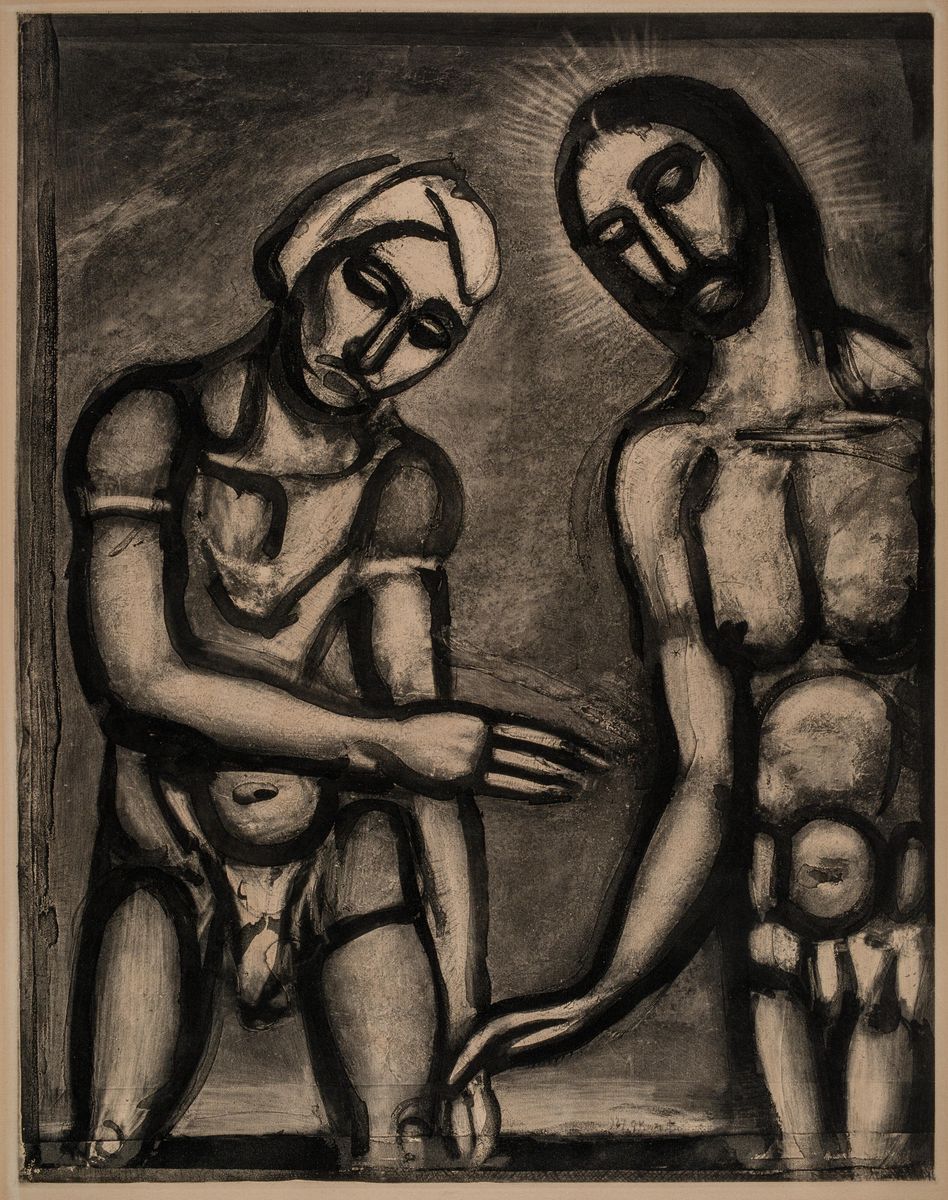
SYMPOSIUM: “Humanity Redeemed: The Theological Vision of Georges Rouault,” September 23–24, 2022, Gordon Conwell Theological Seminary, Charlotte, NC: I’m considering attending! The early-bird rate, good through July 23, is $80 for the general public and includes a Friday dinner and Saturday lunch. “Georges Rouault (1871–1958) was unique among French modernist artists due to his Christian commitment and its influence on his work. The theological vision unveiled through his art is honest and complex, one that reflects the changing climate and tumultuous events of the early twentieth century. In doing so, Rouault showed the possibility of salvation and hope within the inexplicable suffering and mundane realities of human life. His close friend Jacques Maritain identified this as ‘the art of humanity redeemed.’
“This symposium will gather teachers, pastors, artists, ministry leaders, and others to reflect on the theological vision of Georges Rouault and his ongoing impact. Prominent scholars and practitioners with expertise in theology, art history, philosophy, therapy, and community leadership will be offering papers and leading the discussion. One of the speakers, Philippe Rouault, is the great grandson of Georges Rouault and will be providing a personal introduction to his life, work, and family. In addition, several artists will present new work inspired by Rouault, which will both enrich our experience together and show the ongoing generativity of Rouault’s vision and style.”
Georges Rouault (French, 1871–1958), Seigneur, c’est vous, je vous reconnais [Lord, it is you, I know you], plate 32 from the Miserere et Guerre series, 1948. Aquatint, roulette, drypoint over heliogravure on paper, 57.4 × 44.9 cm (plate). Art Gallery of South Australia, Adelaide.
+++
SPOTIFY PLAYLIST: July 2022 by Victoria Emily Jones: Includes a thirteenth-century antiphon for the Holy Spirit by Hildegard of Bingen (“Love abounds in all . . .”); a Luganda praise song for children’s choir; an excerpt from an Orthodox Vespers service in the Yup’ik language from Kodiak, Alaska; a gospel-style setting of Psalm 23; and more. Below are live recordings on YouTube of a few songs from the list: a cover by Amir Darzi and Lital Regev of “Long, Long, Long” from the Beatles’ White Album, which songwriter George Harrison said addresses God; “Love Like There’s No Tomorrow” by gospel-blues husband-wife duo The War and Treaty; and “Here in the Vineyard of My Lord,” a Primitive Baptist hymn compiled in The Good Old Songs (1913) and performed by Americana/folk music duo Anna & Elizabeth.
Keith A. Barker (American, 1968–), Stone of Help, 2013–20
Lord of empty bowl and thrift store spoon,
of soil, of paint-flecked arms.
Lord of the mossed live oak, of blank paper, of lobe.
You are gingko leaf, its yellow tone,
an egg feather-stuck, a room.
The lingering scent of myrrh, of aloe, folded strips
of linen, cast light across the sandy floor of a tomb.

You live deep in ginger’s bite, snow’s precision,
the seed the wildflower’s thrown.
You are the Lord of all expectant
breath: height, cloud, vapor, mist.
You are the Lord of what’s been bitten down,
what’s dormant, the remaindered, the paused.

Molecule’s God, salamander’s God, ragweed’s
God, Lord of stones. Lord of green-bellied toad’s
burble and spit. Of broad-winged hawks,
of weather and wings, of wood mites’ burrows,
of whistles, of small things.

We balk, Lord, at how you nestle deep: our bulb, our bee,
juice, the Spirit of pear, the shadow of the dimple,
what’s under every ripple of the creek.

Lord of the hitch, the lob, the blink, the kiss, the shake.
Lord who rose, who wakes;
who lets us sleep, who satiates.
In our palms, cerebrum, nostrils, wrists,
your Spirit lives. What we miss,
forgive.

In our liminal lives, Great and Patient Mystery,
bless us, and if you will,
share with us your margins today.
“Resurrection Psalm” by Kristina Erny, reproduced here with her permission, was originally published in the catalog for Again + Again (2021), a CIVA-organized photography exhibition that invites contemplation of the ordinary and extraordinary through the seasons of the Christian liturgical year. In the exhibition, as here, the poem is presented with Keith Barker’s photographic collage Stone of Help.
Kristina Erny is a third-culture person—an American raised in Seoul, who has spent much of her career teaching abroad. Most recently she has served as an assistant professor of English and the director of the creative writing program at Asbury University in Wilmore, Kentucky. Her poetry has appeared in the Los Angeles Review, Tupelo Quarterly, Rattle, Yemassee, Bluestem, and elsewhere, and her manuscript Wax of What’s Left was a multi-award finalist. She and her family are currently preparing to move to Shanghai, where they will continue their journey as international school educators.










 Art & Theology