Roundup: Adoration ’N Prayze, “Elogio all’Innocenza,” and more

DANCE: “I Wanna Be Ready”: The African American spiritual “I Wanna Be Ready” forms the soundtrack to this iconic solo from Alvin Ailey’s contemporary ballet Revelations. The dancer in this first video is Amos Machanic:

In 2018, in honor of the Alvin Ailey American Dance Theater’s sixtieth anniversary, Matthew Rushing, who is currently the company’s interim artistic director, traveled to Ailey’s birthplace of Rogers, Texas, to dance “I Wanna Be Ready” at Mount Olive Baptist Church, one of the few landmarks of Ailey’s childhood that’s still standing in Rogers. He was accompanied live by five local singers. The performance was filmed, edited, and released on YouTube.

I’m so excited that in January, for the first time, I’m going to see AILEY live in New York! The company will be performing three pieces, including the brand-new Sacred Songs, choreographed by Rushing.

+++

SONGS:

>> “Time Is Running Out” by Adoration ’N Prayze: Adoration ’N Prayze was a female gospel quartet from Detroit that was active in the early nineties, consisting of Damita Bass, Marguerita Bass, Pamela Taylor, and Shontae Graham (later replaced by Audra “Dodi” Alexander). This original song is the title track of their first and only album, released in 1991. The live recording is from a concert they gave at Clowes Memorial Hall in Indianapolis in 1992.

>> “Oil in My Vessel,” traditional gospel song performed by Rani Arbo & daisy mayhem: Rani Arbo & daisy mayhem are a New England–based folk quartet made up of Rani Arbo (fiddle, guitar), Andrew Kinsey (bass, banjo, ukulele), Anand Nayak (electric and acoustic guitars), and Scott Kessel (percussion). This song they perform is based on a recording by Joe Thompson (1918–2012), who was raised in a Holiness Church in Alamance County, North Carolina. Thompson said the song was in his church hymnal, and that he learned it from his mom when he was about five years old (in the 1920s). Its refrain is a statement of intent to “be ready when the Bridegroom comes,” and its stanzas are taken from the seventeenth-century hymn “Must Jesus Bear the Cross Alone?” by Thomas Shepherd and, from the eighteenth century, “Amazing Grace” by John Newton.

+++

PHOTOGRAPH SERIES: Elogio all’Innocenza (In Praise of Innocence) by Gloria Mancini: Gloria Mancini is an Italian artist working mainly in photography. One of her recent series, divided into three parts, is based on Revelation 3:1–6 (Gli Innocenti, or The Innocents), 12:1 (La Donna Vestita di Sole, or The Woman Clothed with the Sun), and 5:1–7 (L’Agnello, or The Lamb). “Becoming small to become great has been the aim of my exploration of the Book of Revelation,” she writes in her artist’s statement. “Inspired by the visionary and magnetic power of the Kyrios (the Christ, the Lamb), I chose to focus my reflection on innocence as a fundamental and revolutionary value of being, reaffirming its virtue.” She says she is compelled by how in Revelation, it is a meek and vulnerable lamb who defeats evil.

Jesus’s message to the church in Sardis, a wealthy city in west-central Asia Minor, is so seldom (or not at all?) visualized in art history—I’m grateful to Mancini for drawing attention to this passage through her thoughtful work! Jesus tells the church to “wake up,” to “remember . . . what you received and heard; obey it and repent,” following the example of the few there “who have not soiled their clothes.” Those people, he says, “will walk with me, dressed in white, for they are worthy.” He admonishes the Sardis Christians to be watchful and to strengthen and perfect their good works so that they might conquer evil and their names be preserved in the book of life.

Mancini pictures the faithful remnant at Sardis praying, keeping watch, persevering in purity, and gamboling about in the life of the Spirit.

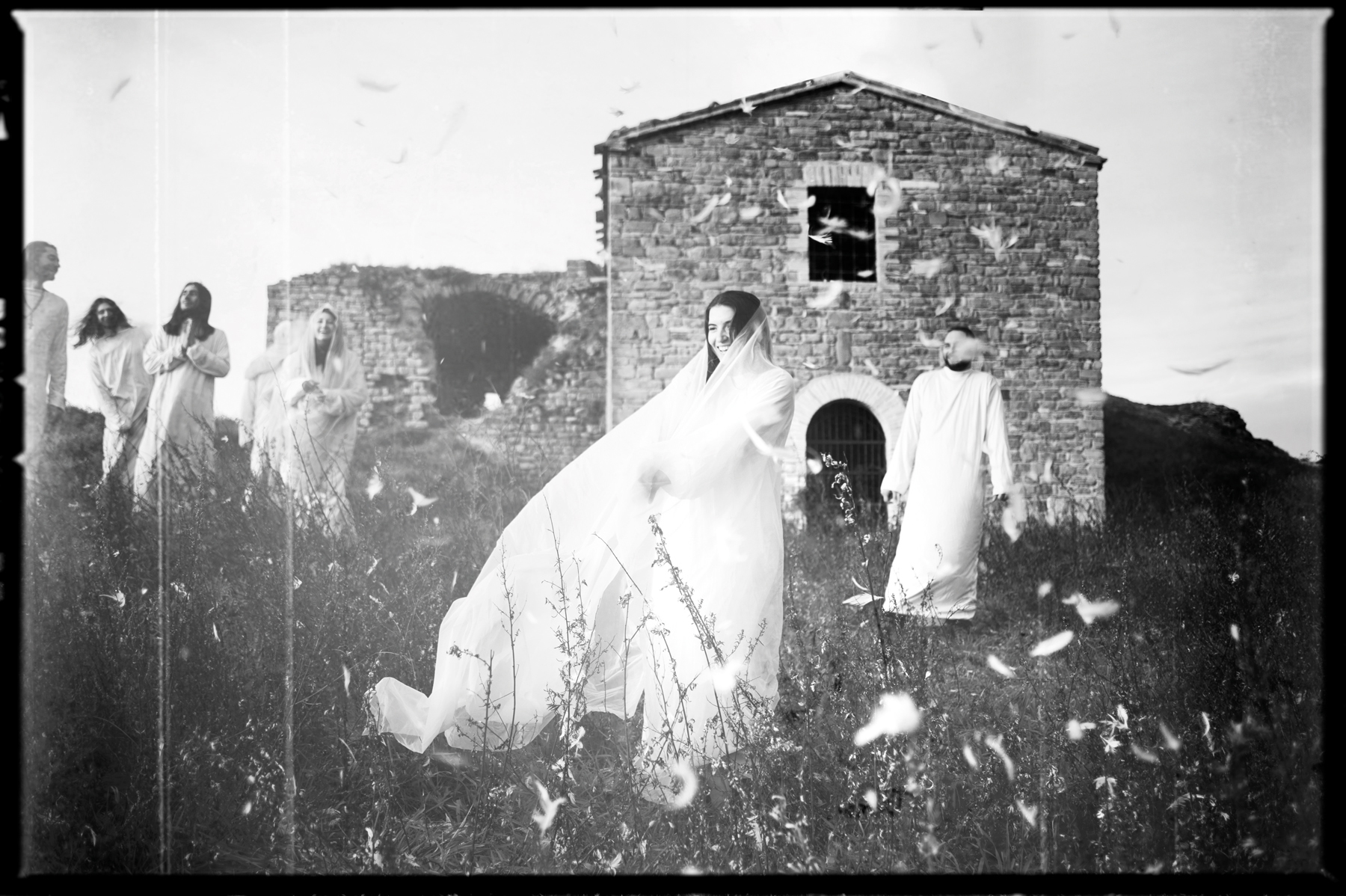
Mancini, Gloria_In Praise of Innocence
Gloria Mancini (Italian, 1992–), photograph from the Elogio all’Innocenza series, 2023

Mancini, Gloria_In Praise of Innocence
Gloria Mancini (Italian, 1992–), photograph from the Elogio all’Innocenza series, 2023

The Woman Clothed with the Sun from Revelation 12, on the other hand, is widely represented in art, and since the twelfth century has been associated with the Virgin Mary, because the woman gives birth to a son who is pursued by the Dragon. In church tradition Mary is also likened to the burning bush in Exodus, because she bore the fire of divinity—God in Christ—within her but was not consumed. Mancini plays on both associations, showing Mary cautiously holding a flame, bringing it closer to her breast: she accepts the Incarnation and is set alight.
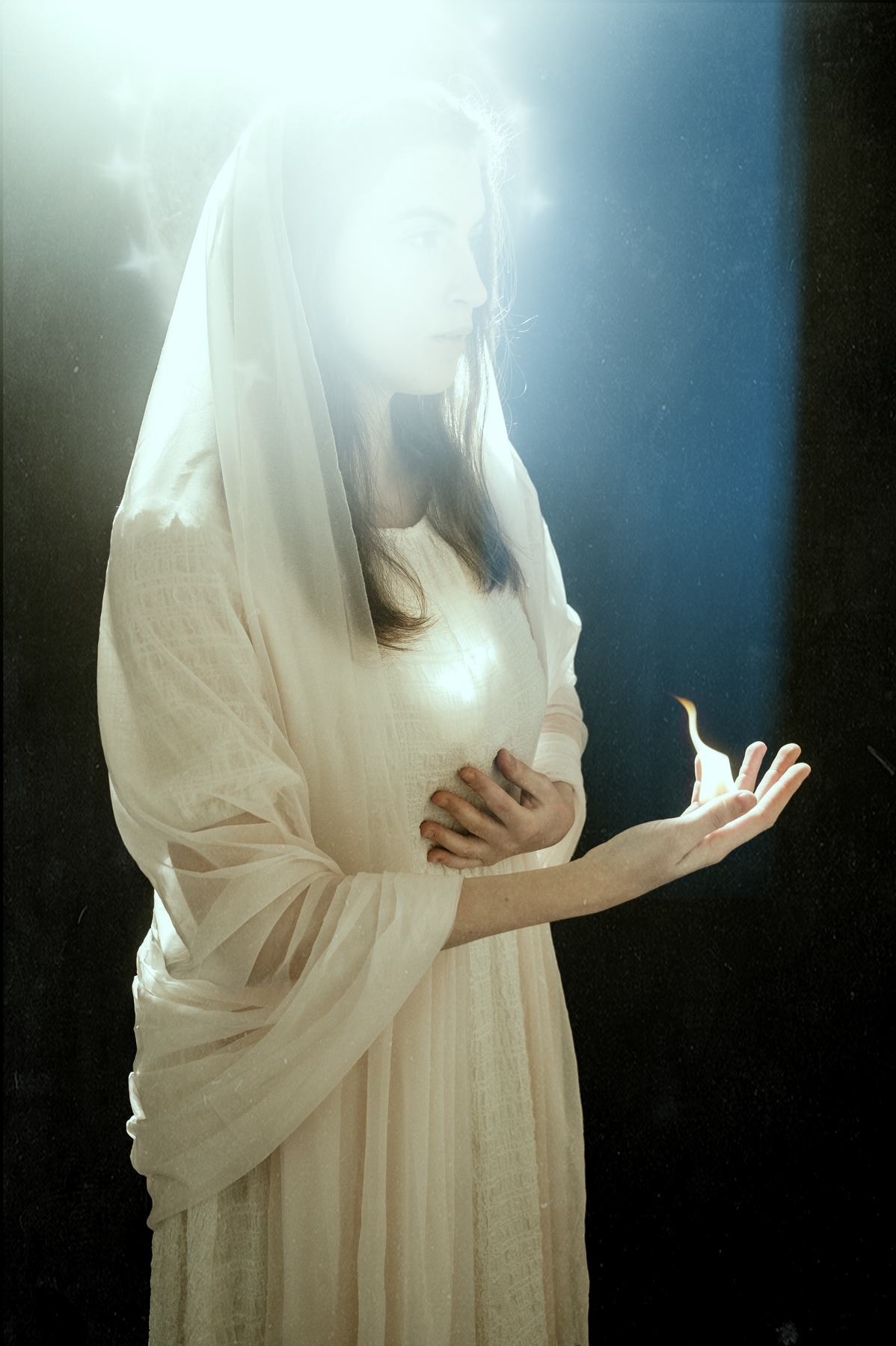
Mancini, Gloria_In Praise of Innocence
Gloria Mancini (Italian, 1992–), photograph from the Elogio all’Innocenza series, 2023

+++

ART SPOTLIGHT: “Yellow Silence: Miniature from the Silos Apocalypse (ca. 1100),” Public Domain Review: One of the most dramatic pauses in scripture comes about a third of the way through the book of Revelation. John has just described the nations’ loud and jubilant praises around the throne of God, and then he opens the next chapter, “When the Lamb broke the seventh seal, there was silence in heaven for about half an hour” (Rev. 8:1). This is the calm before the next storm of judgment breaks with the blowing of the seven trumpets, through which God purges the earth of evil.

While artists have historically relished the chance to visualize the rain of blood, fire, locusts, and such initiated by the trumpet blasts, the anonymous artist of a twelfth-century copy of an Apocalypse commentary from Spain saw fit to also visualize the sonic absence that preceded these spectacular occurrences. He did so with a rectangular swath of yellow.

Silence in Heaven (Silos Apocalypse) (detail)
Miniature from the Silos Apocalypse, northern Spain, 1091–1109. British Library, Add MS 11695, fol. 125v.

This swath calls readers to somber, speechless awe and reflection. God’s earlier word spoken to and through the prophet Zephaniah is appropriate here: “Be silent before the Sovereign LORD, for the day of the LORD is near” (Zeph. 1:7).

Click here to browse more images from the Silos Apocalypse.
Roundup: “Art and Religion Now” symposium, landscape of the body, and more

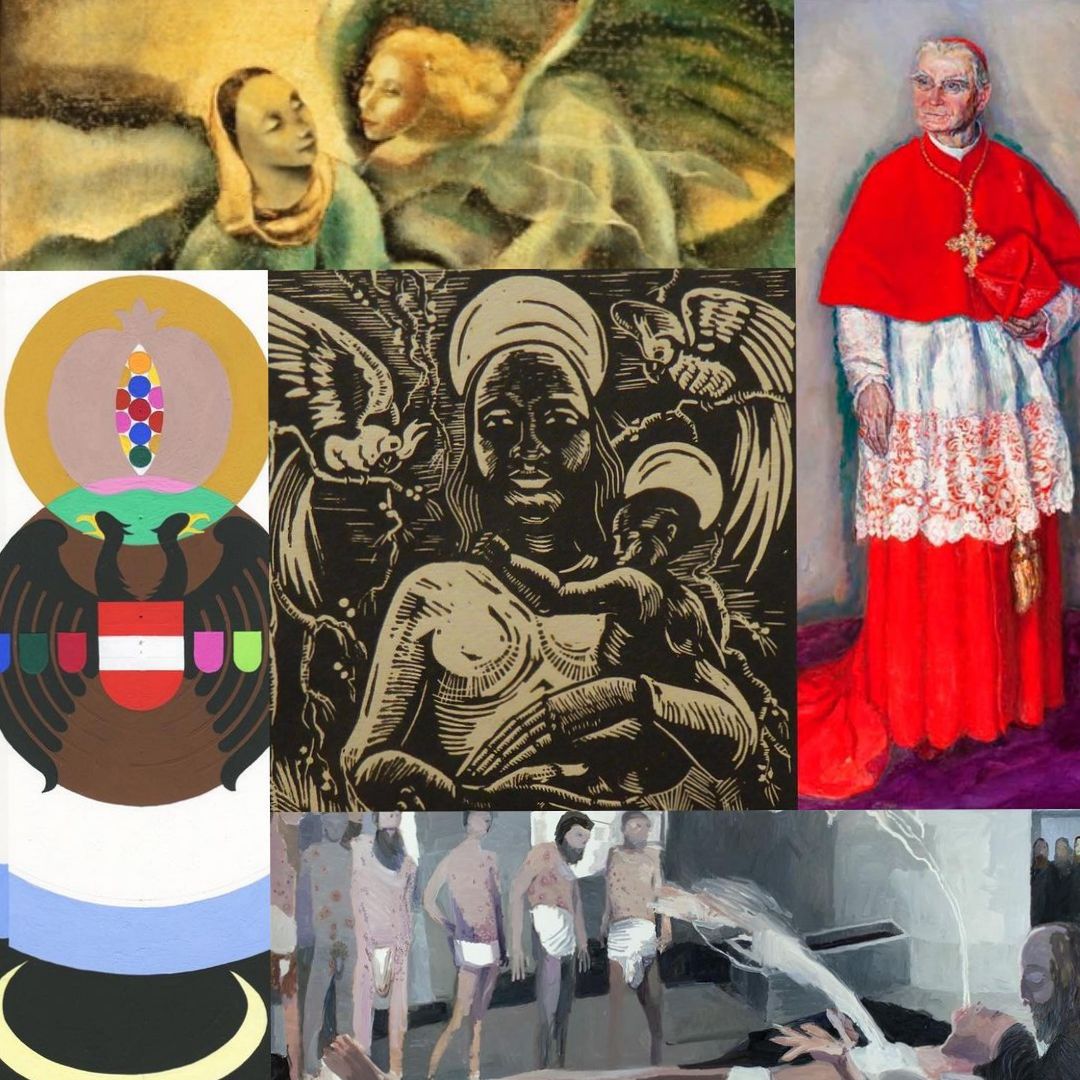
SYMPOSIUM: “Kunst en religie nu” (Art and Religion Now), October 20, 2023, 1:30–4:30 p.m., Museum Catharijneconvent, Utrecht, Netherlands: A week from Friday, attend a free afternoon of talks (in Dutch) on the topic of religion in modern and contemporary art. The speakers are Lieke Wijnia, who will present the results of her past two years of research on religious themes that crop up in modern and contemporary artworks in the Collectie Nederland (Netherlands Collection); Rozanne de Bruijne, on religion in art of the interwar period (1918–1940), the topic of a spring 2025 exhibition she’s curating; Wouter Prins from the Museum Krona, on the state of religious art in the post-Nietzsche era; and Joost de Wal on contemporary art in church spaces. Here’s the autotranslated description:

“The more modern the art, the smaller the presence of religion.” This frequently heard approach appears to be anything but justified. In fact, at the beginning of the twenty-first century, spirituality seems to be on the rise in the visual arts, resulting in a multitude of artistic interpretations. What does this say about the relationship between religion and art?

This symposium focuses on the multifaceted and sometimes unexpected presence of religion in visual art. For example, how does contemporary (religious) art relate to ongoing secularization on the one hand and to flourishing international religious communities on the other? What does the growing interest in spirituality mean for the arts? And what about the use of religious symbolism in visual art, both inside and outside the church? The speakers also shed light on how the wealth of (religious) stories and images can provide guidance in times of social uncertainty and uprooting.

Clockwise from top left: Annunciation by Mariette Lydis (1931); Portrait of Cardinal W.M. van Rossum by Jan Sluijters (1927); The Exorcism of Mary Magdalene by Helen Verhoeven (2020); Path and Puddle, panel 4, by Kasper Bosmans (2022); Black Madonna by Genia van der Grinten-Lücker (1934)

+++

ONLINE WORKSHOP: “Deep Dive into Poetry Comics,” led by Madeleine Jubilee Saito, November 2, 9, 16, 30, 5–7 p.m. Pacific (8–10 p.m. Eastern): Madeleine Jubilee Saito [previously] is a cartoonist from Seattle who makes “poetry comics” about the environment and the sacred—and in four virtual sessions offered through Push/Pull, she’ll teach you how to make your own on topics of your choice!

Saito, Madeleine Jubilee_Love Poem
Madeleine Jubilee Saito, Love Poem, 2019

“In this online course, you’ll practice exercises to explore your own voice and interests in drawing and text, creating poetry comics in a variety of styles. You’ll learn about minicomics, how to do basic layout for printing, and how to print a quarter-page minicomic. We’ll end the course with a celebratory comics reading for friends and family on Zoom. Students need to either be comfortable drawing digitally (Procreate, Photoshop, etc.) or have access to a scanner. Students will be also need access to a printer or local print shop for the last phase of the course.”

If you don’t have time to commit to four classes, there’s a single one offered on October 27.

+++

NEW ALBUM: You Don’t Carry It Alone by Leila Way: Leila Way is a singer-songwriter from Austin, Texas, writing songs for the church. Her first full-length album, “You Don’t Carry It Alone is a collection of songs for hard times. Some of these are old hymns; some were written during a period of intense grief and loneliness, while others grew out of prayers for friends. The album was created to comfort those who mourn; to remind God’s people that He is always faithful, always present and at work, even when we can’t see what He’s up to.”

The album consists of four original songs, two original instrumentals, a cover of “Be Still, My Soul,” and new retunes of George Matheson’s “O Love That Wilt Not Let Me Go” (one of my favorite hymns) and James Montgomery’s “I cannot call affliction sweet.”

+++

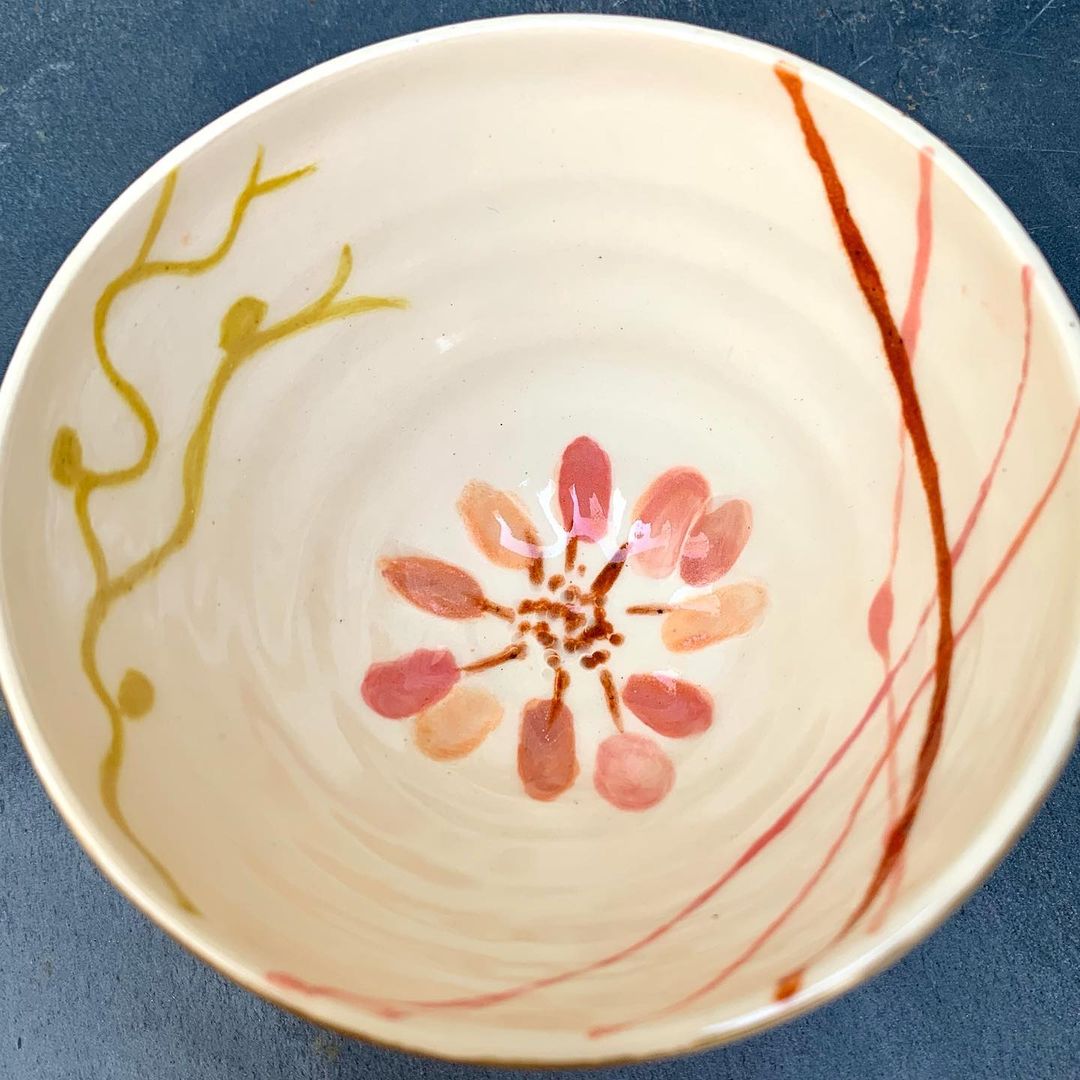
CERAMIC BOWLS: Nurture Collection by Jane Boutwell: I met artist Jane Boutwell at a Christians in the Visual Arts (CIVA) conference in 2021 after she presented this body of work that really moved me—a collection of ceramic bowls that take as their three design elements anatomical features of the female breast: lymph nodes (gold, river-like), mammary glands (pink and blooming), and musculature. She started the Nurture Collection after having one of her milk ducts surgically removed in 2019 for a biopsy (it turned out not to be cancer), as a meditation on the strength and inner beauty of this part of the body that is so often objectified or shamed. She recommends the bowls as a gift for a woman in your life who has had a tender year with regard to her breasts—cancer, nursing, etc.—to honor her journey.

Boutwell, Jane_Mammary bowl
Bowl from the Nurture Collection by Jane Boutwell, 2020

I share these now because October is Breast Cancer Awareness Month. Below is an eight-minute video explanation by the artist, followed by a short “making of” montage:

There are five Nurture bowls currently for sale in Boutwell’s online shop: Joan, Tracy, Colleen, Rita, and Wendy. Each is named after a woman she knows with breast cancer.

+++

PODCAST EPISODES:

>> “Landscape of the Body with David Taylor,” Makers & Mystics, September 13, 2023: Constructing a cogent theology of the body, theologian W. David O. Taylor discusses why it’s important that we honor and understand our bodies, and why having a right relationship to our bodies is imperative to the quest of art. Christians have often feared, distrusted, or despised the body; sin has meant that we’ve become alienated from our own bodies and the bodies of others, that we harm our bodies and others’, and that we often flee from our bodies, dissimulate. But Jesus wants us to be at home in our bodies, Taylor says—in worship, and in day-to-day life. He talks about Jesus as an icon of care-filled touch and the implications of that.

>> “On Being in a Body,” On Being with Krista Tippett, September 21, 2023: At the 2023 Aspen Ideas Festival, Krista Tippett interviewed Kate Bowler, author of Everything Happens for a Reason (and Other Lies I’ve Loved), a reflection on how she moved through learning at age thirty-five that she had Stage IV colon cancer. “From the new reality in our time of living with cancer as a chronic illness, to the telling of truths to our young as we face precarity in our collective body, this conversation is full of the vividly-whole humanity that Kate Bowler singularly embodies.” I heard Kate in person at Duke University a few years ago talking on a panel about suffering. She’s full of wisdom, wit, and raw tenderness and so, so endearing, and even though I’ve heard her story many times, every conversation with her brings up something new.  

+++

DANCE PERFORMANCE: Chroma, Grace, Takademe, and Revelations, performed by Alvin Ailey American Dance Theater: I’ve shared a video of Alvin Ailey’s Revelations here before. Well, this rebroadcast from 2015 includes that, plus performances of three other works by the prestigious Alvin Ailey American Dance Theater. I especially enjoyed Chroma, with music by Joby Talbot and choreography by Wayne McGregor—it’s the first twenty-six minutes of the video.

Juneteenth roundup: Documentary, playlists, Alvin Ailey’s Revelations

DOCUMENTARY: Juneteenth: Faith and Freedom, dir. Ya’Ke Smith: Released June 7 by Our Daily Bread Ministries, this film follows Where Ya From? podcast host Rasool Berry to Texas to talk with pastors, historians, activists, artists, and elected officials about the spiritual significance of America’s newest federal holiday, and to visit historic sites associated with it. You can watch the full seventy-five-minute film for free on YouTube. Here’s the trailer:

The interviewees, in order of appearance, are:

  • Dr. Michael W. Waters, pastor, Abundant Life African Methodist Episcopal Church
  • Sam Collins, president, Juneteenth Legacy Project
  • Lisa Fields, founder, Jude 3 Project
  • DJ Norman-Fox, historian, author of Juneteenth 101: Popular Myths and Forgotten Facts
  • Lawrence Thomas, Juneteenth organizer
  • Dr. Carey Latimore, history professor, Trinity University
  • Sharon Batiste Gillins, genealogist, Institute of Genealogy and Historical Research
  • Diane Henderson-Moore, member, Reedy Chapel AME
  • Deborah Blacklock-Sloan, historical researcher and genealogist, Rutherford B. H. Yates Museum
  • Jacqueline W. Bostic, chairman, Fourth Ward Redevelopment Authority
  • Jacqueline Bostic-McElroy, assistant district attorney, Fort Bend County
  • Rev. Art McElroy, senior pastor, Antioch Missionary Baptist Church
  • Opal Lee, civil rights activist and “grandmother of Juneteenth”
  • Lecrae, hip-hop artist

+++

SPOTIFY PLAYLISTS by Lara Downes (with commentary!):

>> Songs for Freedom: A Juneteenth Playlist (2021): Award-winning pianist and NPR radio host Lara Downes curated an excellent Spotify playlist for Juneteenth last year—a mix of jazz, classical, and soul. It is full of wonderful surprises, introducing me to the work of several African American composers, new and old, such as Wynton Marsalis’s The Democracy! Suite for jazz ensemble; a symphony by William Grant Still titled “Song of a New Race”; “Adoration” by Florence Price (originally written for organ but arranged here for violin and piano); “Fanfare on Amazing Grace” by Adolphus Hailstork; and “Startin’ Sumthin’” by Jeff Scott, a French hornist who performs “urban classical chamber music.”

There are also several well-known names—Billie Holiday, Mahalia Jackson, Aretha Franklin, Nina Simone, Duke Ellington, John Coltrane, Stevie Wonder—and more recent popular artists like Jon Batiste and Rhiannon Giddens. Batiste’s arrangement of “What a Wonderful World” is gorgeous, and the music video—wow (see below). It features a group of Black nuns having fun around London—picnicking on a park bench, traversing monkey bars, sharing the gospel with passersby, eating cotton candy, riding bumper cars. It captures the tone of the song perfectly.

From Downes’s list I also really like the blues song “I Knew I Could Fly” by Allison Russell and Leyla McCalla, excerpted in the following featurette. It’s from the album Songs of Our Native Daughters, which sheds light on African American women’s stories of struggle, resistance, and hope.

Be sure to read the NPR article that introduces the playlist. Downes calls out nine of the musical selections with blurbs that provide some background, and throughout there is a smattering of historical photographs of Black flourishing in and around Washington, DC, from 1904 onward, taken by the Black-owned Scurlock Studio.

YWCA camp for girls
YWCA camp for girls. Highland Beach, Maryland, 1930. This photo is from the Scurlock Studio Collection at the Smithsonian National Museum of American History.

>> Songs to Believe In: A Juneteenth Playlist (2022): As I was formatting this post I realized that Downes just published a brand-new playlist for Juneteenth 2022. I haven’t had time to listen yet, but it looks awesome. “I offer you a collection of music that insists on the promise of freedom, however long in coming,” she writes. “Music that counters the shrieking dissonance of conflict with the radiant warmth of its harmonies, that offers us comfort in our sorrow and sustenance in our struggle. Songs that ground us with the steadiness of their rhythms and embrace us in the lines of their melodies. Music that brings us hope and faith and even joy, urging us to stand and fight another day, reminding us that what we are celebrating on this holiday is our freedom to believe, even in the hardest of times.”

+++

YOUTUBE PLAYLIST: Juneteenth Playlist by Victoria Emily Jones. Nineteen songs of freedom and faith—gospel, pop, funk, R&B, and spirituals. I wanted to choose all live performances or music videos so that there’s a visual element to engage.

One of the songs is “Clap Praise” by Diane White-Clayton, performed by Selah Gospel Choir. It’s a setting of Psalm 47, which opens, “Clap your hands, all you peoples; shout to God with loud songs of joy!”

Dr. Diane White-Clayton is a composer, conductor, pianist, and lecturer in ethnomusicology specializing in Black sacred music. I love the exuberance and all the body percussion in this widely performed piece of hers. I learned about Selah Gospel Choir through Bridge Projects, an art gallery in Los Angeles where they recently performed. The choir was founded in 2007 “as a space for people who want to sing gospel music birthed by the spirit of the Black church and the ancestry of Black community but are either unable to find it in their home place of worship or do not identify with being in a church at all.”

+++

DANCE WORK: Revelations, choreographed by Alvin Ailey: This classic thirty-six-minute work choreographed by the pioneering Alvin Ailey premiered in New York in 1960 and since then has been performed continually around the globe. This particular performance at Lincoln Center premiered online on December 6, 2020, as part of Alvin Ailey American Dance Theater’s virtual season during the pandemic. “Using African American spirituals, song-sermons, gospel songs, and holy blues, Revelations fervently explores the places of deepest grief and holiest joy in the soul.” Ailey said it was born of the “blood memories” of his childhood in rural Texas and his affection for the Baptist church that nurtured him.

All the numbers are great, but my favorite is “Wade in the Water” (part of the “Take Me to the Water” sequence that begins at 9:41). Second favorite: “Fix Me” (5:22).

Roundup: Advent calendar of songs, free Alvin Ailey season, Bill Murray plays Job, and more

For those readers who are new, welcome! I want to alert you to (and remind others of) the Art & Theology Advent Music Playlist. I released it last year on Spotify and have made some additions since then, including all six songs from Lo Sy Lo’s excellent album St Fleming of Advent, selections from recent releases by the Porter’s Gate’s, Andrew Bird, and Caroline Cobb, some Nina Simone and Jackson 5, a musical setting of an Emily Dickinson poem by Julie Lee and a Count of Monte Cristo quote by the Duke of Norfolk, the shape-note hymn “Bozrah,” and more. I’ve structured the list as a journey from the early promise of a Savior in God’s covenant with Abraham (Gen. 22:18), through Isaiah’s prophecies about a great light dawning and a shoot springing up out of a stump and valleys being lifted and swords being beaten into plowshares, to the angel’s announcement to Mary and her subsequent Magnificat and pregnant waiting, which I transition into the church’s waiting for Christ’s second coming, with warnings to keep our lamps trimmed and burning, to stay awake, to watch and pray. Sprinkled throughout are groanings from God’s people as well as expressions of joyful expectancy.

A Christmas playlist will be forthcoming in just two weeks.

+++

Bard and Ceilidh Advent Calendar: This Advent, multi-instrumentalist and melodist Mary Vanhoozer (aka Bard and Ceilidh) is offering a digital “Advent calendar” with twenty-four traditional, Celtic-infused Christmas carols played on various folk instruments. For $20, you will receive a code that unlocks a new song daily for download. Here are two of Vanhoozer’s previous releases, to give you a sense of the style she plays in. The first is her own arrangement of “I Saw Three Ships” with “Branle des Chevaux” (The Horse’s Brawl). The second, “When Icicles Hang by the Wall,” is an original setting of the winter hymn from Shakespeare’s Love’s Labours Lost, which celebrates the season of biting cold and red, runny noses and sloshy roads and singing owls and simmering crabapples and interior warmth.

+++

“Veni Emmanuel: A brief meditation on the meaning of Advent” by John B. Graeber: This short piece published last year in Curator is a great introduction to the liturgical season we’re entering into on November 29. It begins, “Advent is the hope of redemption, sung in minor key. It is the promise of resurrection, and the sorrow of that hope not yet fulfilled. In this the midnight of the liturgical year, these few weeks before we celebrate the birth of Christ, we confront a world not yet reborn and embody what Saint Paul calls the ‘hope against hope,’ a hope that endures when the world says it should not. A hope that looks back to the birth of our savior, and forward to His coming again, when all will be made new.”

+++

VIRTUAL DANCE PERFORMANCES: On December 2, Alvin Ailey American Dance Theater is launching its first-ever virtual winter season—and, in the spirit of making dance accessible to all, it’s free! The season will feature the world premiere of the dance films A Jam Session for Troubling Times (choreographed by Jamar Roberts) and Testament (Matthew Rushing, Clifton Brown, and Yusha-Marie Sorzano), plus sixtieth anniversary tributes to Alvin Ailey’s Revelations, a classic that “explores the places of deepest grief and holiest joy in the soul . . . using African American spirituals, song-sermons, gospel songs, and holy blues.” The season will run through December 31. Learn more here.

+++

DRAMATIC READING AND DISCUSSION: The Book of Job: On Sunday, December 6, 4–6 p.m. ET, Theater of War Productions will be hosting a free online event where actors, including Bill Murray, will be performing Stephen Mitchell’s translation of the book of Job, adapted and directed by Bryan Doerries. “The Book of Job is an ancient Hebrew poem that timelessly explores how humans behave when faced with disaster, pestilence and injustice,” Doerries writes, and this dramatic reading aims to serve “as a catalyst for powerful, guided conversations about the impact of the COVID-19 pandemic upon individuals, families, and communities.” After the reading, four community panelists will kick off the discussion with their gut responses to what resonated with them, and then discussion will open up to the audience. RSVP here.

“Theater of War Productions works with leading film, theater, and television actors to present dramatic readings of seminal plays—from classical Greek tragedies to modern and contemporary works—followed by town hall-style discussions designed to confront social issues by drawing out raw and personal reactions to themes highlighted in the plays. The guided discussions underscore how the plays resonate with contemporary audiences and invite audience members to share their perspectives and experiences, and, helping to break down stigmas, foster empathy, compassion, and a deeper understanding of complex issues.” Their many past projects include A Streetcar Named Desire (followed by a discussion on domestic violence), scenes from King Lear (the challenges of aging and dementia), and Sophocles’s Ajax (the invisible wounds of war).

Beginning in May, the company started presenting their projects online. Because they want to cultivate “a dynamic space to participate in an ephemeral experience, in which risks can be taken, interpretations shared, and truths told,” the projects are not available afterward for on-demand views. To get an idea of the format they follow and some of the work they’ve done, see the Theater of War trailer below.

+++

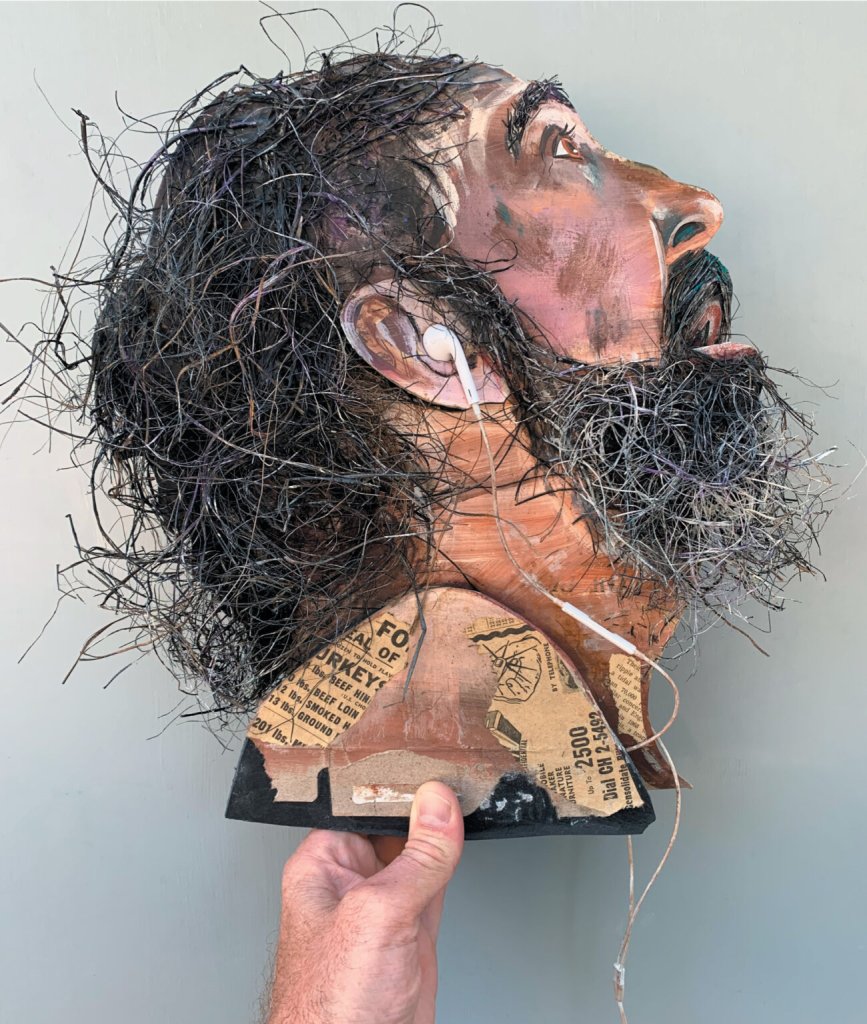
INTERVIEW: “Grief Is Hard to Look At: An Interview with Wayne Brezinka” by Brooke West, The Rabbit Room: Wayne Brezinka, a Nashville-based mixed media artist specializing in multidimensional portraits, recently launched a Kickstarter to crowdfund 2020 Disrupted: A Re-Assembled Life. (I just missed the deadline, but it turns out the project was successfully funded!)

As we sit in the year 2020 and struggle to remember what normal even feels like, I’ve been wondering about people’s emotions and how I might capture the painful realities of human existence we all seem to be feeling this year. In this new work, I will explore the pain and anxiety of massive disruption and how we are changed by it. I’ve been thinking about the biblical character Job from the land of Uz. What might he look like, plucked out of the ancient text, and plopped into modern-day? This is my attempt to bring a re-imagined 21st century Job to life in a way that encapsulates not only his experience, but also our own. I’ll be using a combination of found and repurposed objects, multi-media visuals, and incorporating input from the public on multiple panels that measure 8 feet by 5 feet—my biggest project to date.

Brezinka, Wayne_Job
Early working prototype for 2020 Disrupted: A Re-Assembled Life by Wayne Brezinka

Next year Brezinka will be taking the completed art on tour across the country in a glass box truck. “The plan is to park at notable cathedrals or churches and community centers in each city. I want to give those who funded this project and the general public an opportunity to pause, interact with the art, and reflect on the last year—the disruptions, the beauty, and the changes it all brings.” He says the art is an invitation for people to feel their sorrow and their grief. Read the interview to find out more about his process and his hopes for the project.

+++

NEW SONG RELEASE: “O Love That Casts Out Fear”: This is my favorite track from the new sacred chamber pop EP by Bobby Krier, Jon Green, and friends, Cast Out All Our Fears. The hymn text was written by Horatius Bonar in 1861, and the music is by Bobby Krier and Justin Ruddy [previously], who collaborated often as musicians at Citylife Presbyterian Church in Boston. (Their retuned version premiered on the 2013 album Castle Island Hymns; they have since moved on from Citylife.) This rendition is sung by Molly Parden.

Roundup: The Crucifixion in modern art, “Lift Every Voice” ballet solo, and more

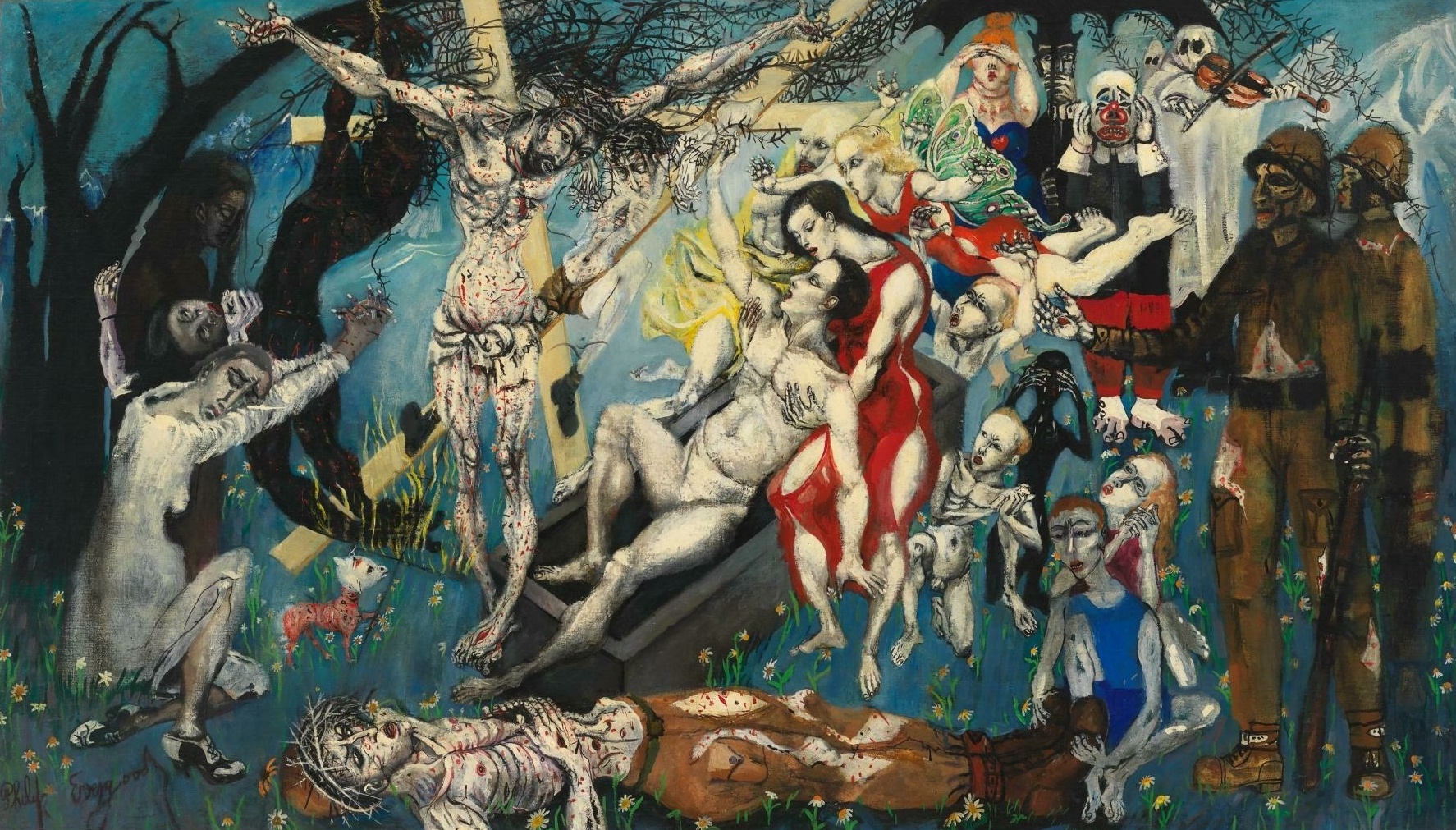
VISUAL MEDITATION: “Waking Up from Apathy,” on Philip Evergood’s The New Lazarus: My latest visual meditation for ArtWay has just been published. It’s on a crowded, noisy, garish painting that, honestly, is distressing to look at. And it’s supposed to be. Because it exposes what Martin Luther King Jr. called the triple evils of society: racism, militarism (war), and economic exploitation (aka extreme materialism, a systematic cause of poverty). Though Philip Evergood was not a Christian, he draws on Christian narrative and iconography, with the figures of Lazarus and Christ, to protest the cycles of violence that we need to rise out of before we self-destruct.

Evergood, Philip_The New Lazarus
Philip Evergood (American, 1901–1973), The New Lazarus, 1927–54. Oil and enamel on canvas mounted on wood, 148 × 237.2 cm. Whitney Museum of American Art, New York.

The see-nothing, hear-nothing, say-nothing figures in the background remind me of people today who insist that racism does not exist and therefore tune out the cries of Black Lives Matter, for instance. I’m implicated too by these symbols of willful ignorance, because I admit that I do not often care to question where my food, clothes, coffee, chocolate, and other conveniences come from, or how the businesses I regularly support with my dollars treat their employees.

Evergood was politically engaged in both his art and his life, espousing egalitarian ideals. He participated in strikes and demonstrations for workers’ rights and was jailed more than once and beaten by police. He was greatly influenced by Mexican muralism, and he embraced the label of “propaganda” for his art, acknowledging that he was trying persuade the public to join the cause of social justice. “He was a figurative painter when much of the art world placed greater value on abstraction,” writes the University of Kentucky Art Museum, “and he was a moralist when moralizing was not considered an option for serious painters.” Nevertheless, he had a successful career, and his work is in many major museum collections, including the Tate Gallery, the Los Angeles County Museum of Art, the Art Institute of Chicago, the Hirshhorn Museum, the Museum of Modern Art, and the Whitney Museum of American Art.

+++

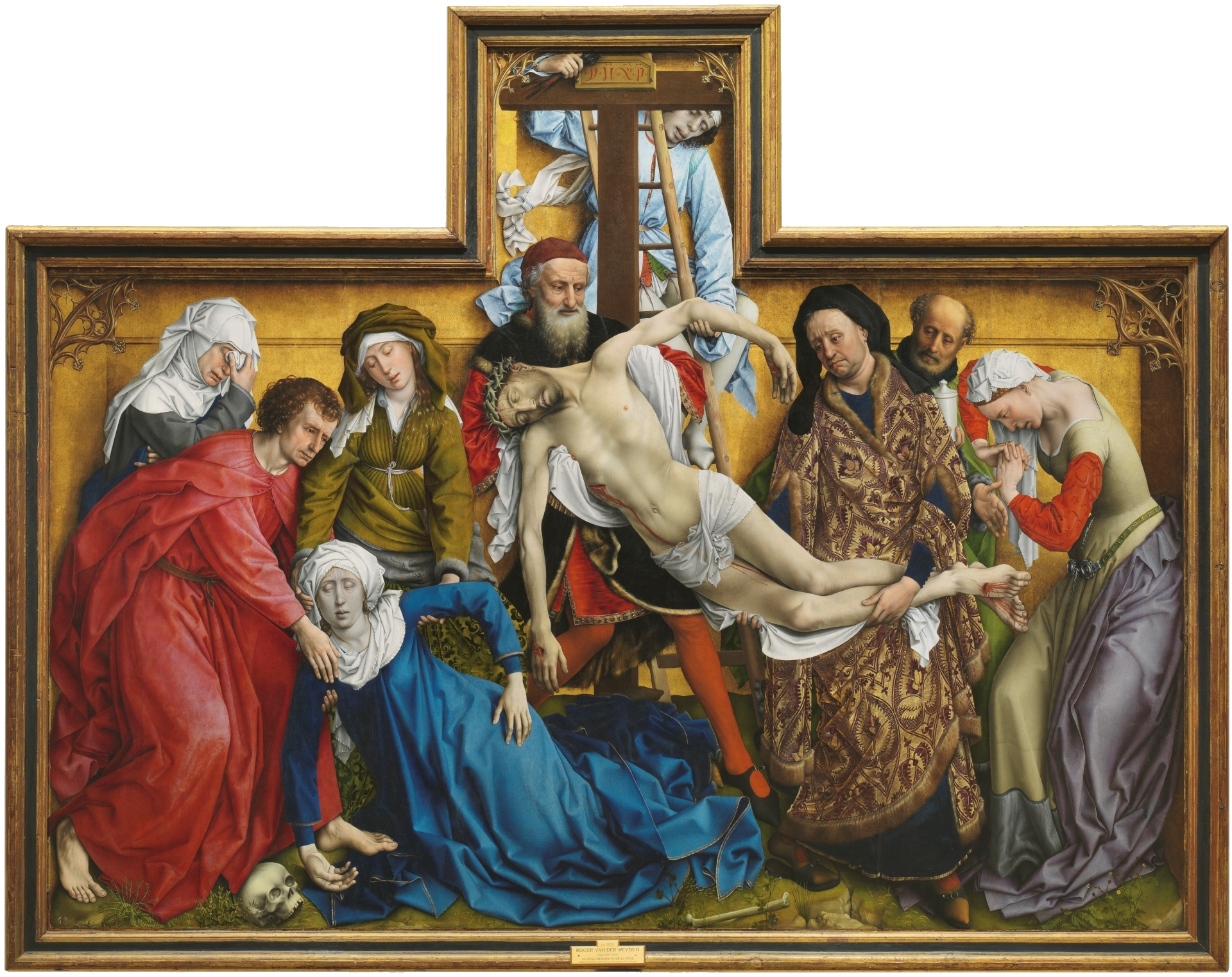
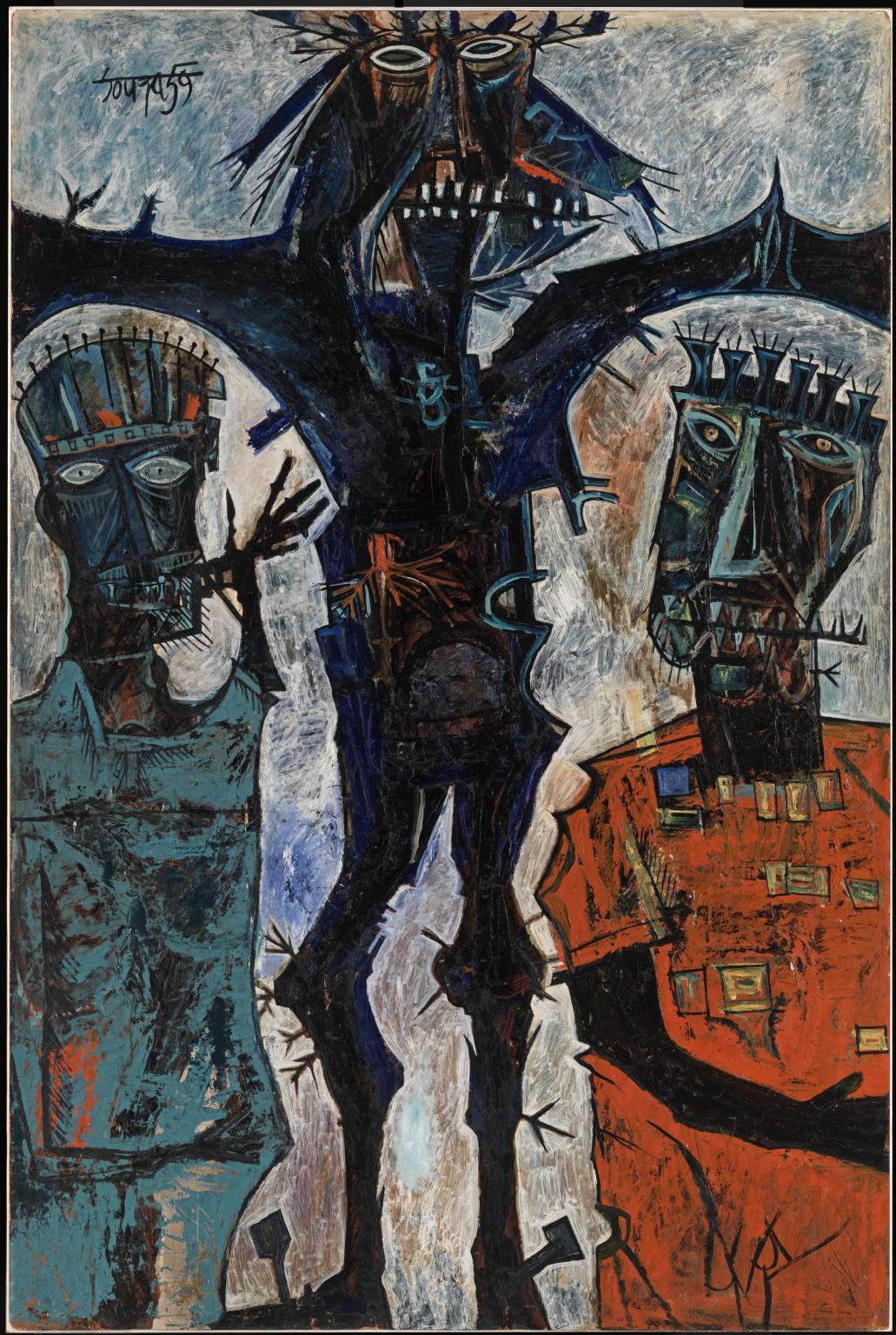
PODCAST EPISODE: “How a ‘biblically illiterate’ generation can discover Christian art,” Holy Smoke, July 28, 2020: I love hearing Ben Quash [previously] discuss specific artworks in detail! He brings such reverence, inquiry, wonder, curiosity, and openness to his looking and interpreting. For this interview with Carmel Thompson he has selected six Christ images spanning the early Renaissance through contemporary eras: the side-by-side Byzantine-inspired Healing of the Man Born Blind and Transfiguration panels of the Maestà Altarpiece by Duccio, the classically beautiful Descent from the Cross by Rogier van der Weyden at the Prado (“probably the painting that put realistic tears on the map of Western art”), Albrecht Dürer’s daring self-portrait as Christ, a homely Christ in the Wilderness: Consider the Lilies by Stanley Spencer, a grotesque Crucifixion by F. N. Souza (with reference to crucifixions by Grünewald, Picasso, Sutherland, and Bacon), and Michael Landy’s kinetic sculpture Doubting Thomas.

In addition to providing individual commentaries, Quash also talks about reading art theologically instead of just aesthetically, art as developing physical sight toward spiritual insight (external and internal seeing), the persistence of Christian iconography in the art of today, and the ways in which art can implicate the viewer.

Weyden, Rogier van der_Descent from the Cross
Rogier van der Weyden (Netherlandish, 1399–1464), Descent from the Cross, before 1443. Oil on panel, 204.5 × 261.5 cm. Museo Nacional del Prado, Madrid.

Crucifixion by F. N. Souza
F. N. Souza (Indian, 1924–2002), Crucifixion, 1959. Oil on board, 183.1 × 122 cm. Tate Modern, London.

There’s so much that’s quotable in the conversation, but because it applies to the ArtWay meditation I linked to above, I’ll just highlight part of his discussion of nonreligious artists’ attraction to Crucifixion imagery in the twentieth century. The Isenheim Altarpiece (1515), he says, a visual reference point for many modern artists,

shows an agonized Christ whose tongue is swollen and protruding from his mouth, whose body is covered in sores, whose skin is tinged green, whose fingers are curled up in agony. There’s no idealization here of what a death like that might have been. Instead there’s a strong assertion that the extremes of human pain and suffering are not alien to the Christian message. And yet it’s a religious image—this is a Christian image painted for a Christian context.

When that work comes into contact with the new traumas of the twentieth century—we talked about [Stanley] Spencer and the Second World War, here [Francis Newton] Souza experiencing colonialism in India—when that painting comes into contact with those sorts of extremes of human experience, it activates, it speaks to them, and calls forth new artistic responses, because it feels as though Christianity can still speak, even in those extremes. And I think Souza, like [Graham] Sutherland and [Francis] Bacon, while they may not have felt comfortable with traditional Christianity, saw the power of that Christian tradition to in some way help them articulate the traumas and the horrors of their own time.

So that’s a very interesting work, and typical of several examples of the extraordinary way in which we might think we’re in a secular age, but Christian iconography is probably as lively as ever—although it’s doing new things—in the work of modern and contemporary artists.

+++

SONGS . . .

from the GOOD SHEPHERD COLLECTIVE: Spearheaded by David Gungor and Tyler Chester, the Good Shepherd Collective [previously] “creates liturgical art to inspire the Christian imagination, that we may embody the love of Christ for the good of our neighbors.” They’ve just released an album of ten hymns. One of them is “Joyful, Joyful, We Adore Thee,” queued up in the liturgical service video below, and though it didn’t make the final album cut, I also really like their version of “His Eye Is on the Sparrow.”

from Family Company: Charles Jones, the lead singer on both of the above videos, is also a part of Family Company, an LA-based music collective celebrating the traditions of soul, blues, and R&B. You might enjoy these seventies covers of theirs: “Heaven Help Us All” (popularized by Stevie Wonder), featuring Charles Jones, and “Let Us Love” by Bill Withers, featuring Teddy Grossman. See more on their YouTube channel.

+++

BALLET SOLO: “Lift Every Voice and Sing”: Premiering at the Lincoln Center in 2019, Ounce of Faith is a contemporary ballet choreographed by Darrell Grand Moultrie, the score a mix of jazz standards, original music, and spoken word. This excerpt is performed by Khalia Campbell of the Alvin Ailey American Dance Theater, with movements suggestive of both struggle and pride.

Known as the Black National Anthem, “Lift Every Voice and Sing” was written in 1899 by writer and activist James Weldon Johnson and set to music by his brother, John Rosamond Johnson. The hymn is sung here, just the first of its three verses, by Aisha Jackson, with Dante Hawkins on piano. It’s a song of historical remembrance and lament but also of hope, a rallying cry to move forward together, in unity, out of our “dark past,” into the truth of God, continuing to fight injustice wherever we find it so that everyone can live free. It acknowledges that God is the one who leads his people in love and who wills liberty, and it supplicates: “Keep us forever in the path [of Your light], we pray.” Learn more about the hymn in this NPR feature. See also this UMC Discipleship article, especially the part where Dr. James Abbington, a choir director and a scholar of African American sacred music, answers the question, “Is this a hymn just for African Americans or is it for all people?”

+++

LITERARY ESSAY: “To Sit with an Onion” by Elizabeth Harwell: God “is tethered to this world in delight” and does not weary of it as we do, writes Elizabeth Harwell after having sat with a mussel shell for one hour, upon the advice of Robert Farrar Capon. (An exercise in wonder! Any inanimate object will do.) Harwell marvels at how the shell—blueberry-blue and milk-white, cold, curvaceous, smooth—was “an entire world to the mussel who called [it] home,” and now, since she picked it up off a Maine beach, it sits in a silver dish in her dining room, a reminder of the Creator’s quiet mirth. And there’s much more where that came from. “That shell represented one of thousands (millions?) of pearly homes that will never lay bare in front of human eyes—miles of ocean floor, covered in secret delights, that began as thoughts in my Father’s mind. We humans can be so self-important that we’ve never considered that God is enjoying parts of creation that none of us will ever see.” Read the whole essay at The Rabbit Room.

(Quash’s discussion of Stanley Spencer’s Wilderness series in the abovementioned podcast, in which Christ gets down on the ground like a curious child to observe wildflowers, scorpion, hen, dovetails nicely with this essay!)