Great Spirit of the God who is alive, Whose risen Son I seek before the dawn, Who makes the black and gold sunflower thrive, The earthworm loosen soil beneath the lawn; Great Spirit, grant my great-grandmother’s looks Attend me while I rub her cherry hutch. Great Spirit, grant my late grandfather’s books Preserve his signature I love to touch. Surround and show to me that massive cloud Of witnesses—undauntable or docile. Allow their countenances to enshroud My shoulders, spoken of by Your Apostle. Send generous Nunnehi to my steeple, Returning me, at last, to my dark people.
Note: Nunnehiare spirit people in Cherokee mythology. The Cherokee word has been translated as “The People Who Live Anywhere” or “The People Who Live Forever.”
Jennifer Reeser (born 1968) is a formalist poet of Anglo-Celtic and Native American descent. Her seven poetry collections are Strong Feather (2022), Indigenous (2019), Fleur-de-Lis (2016), The Lalaurie Horror (2013), Sonnets from the Dark Lady and Other Poems (2012), Winterproof (2005), and An Alabaster Flask (2003), and she is anthologized in Christian Poetry in America since 1940 (2022). In addition to writing original poems, she also translates poetry from Russian, French, and Cherokee. A member of the Cherokee Nation, she divides her time between Louisiana, where she was born and raised, and the Cherokee Reservation in Indian Country near Tahlequah, Oklahoma.
Charles White (American, 1918–1979), Mother Courage II, 1974. Oil on canvas, 49 3/4 × 39 7/8 in. National Academy of Design, New York.
She lay, skin down in the moist dirt, the canebrake rustling with the whispers of leaves, and loud longing of hounds and the ransack of hunters crackling the near branches.
She muttered, lifting her head a nod toward freedom, I shall not, I shall not be moved.
She gathered her babies, their tears slick as oil on black faces, their young eyes canvassing mornings of madness. Momma, is Master going to sell you from us tomorrow?
Yes. Unless you keep walking more and talking less. Yes. Unless the keeper of our lives releases me from all commandments. Yes. And your lives, never mine to live, will be executed upon the killing floor of innocents. Unless you match my heart and words, saying with me,
I shall not be moved.
In Virginia tobacco fields, leaning into the curve of Steinway pianos, along Arkansas roads, in the red hills of Georgia, into the palms of her chained hands, she cried against calamity, You have tried to destroy me and though I perish daily,
I shall not be moved.
Her universe, often summarized into one black body falling finally from the tree to her feet, made her cry each time into a new voice. All my past hastens to defeat, and strangers claim the glory of my love, Iniquity has bound me to his bed,
yet, I must not be moved.
She heard the names, swirling ribbons in the wind of history: nigger, nigger bitch, heifer, mammy, property, creature, ape, baboon, whore, hot tail, thing, it. She said, But my description cannot fit your tongue, for I have a certain way of being in this world,
and I shall not, I shall not be moved.
No angel stretched protecting wings above the heads of her children, fluttering and urging the winds of reason into the confusions of their lives. They sprouted like young weeds, but she could not shield their growth from the grinding blades of ignorance, nor shape them into symbolic topiaries. She sent them away, underground, overland, in coaches and shoeless. When you learn, teach. When you get, give. As for me,
I shall not be moved.
She stood in midocean, seeking dry land. She searched God’s face. Assured, she placed her fire of service on the altar, and though clothed in the finery of faith, when she appeared at the temple door, no sign welcomed Black Grandmother. Enter here.
Into the crashing sound, into wickedness, she cried, No one, no, nor no one million ones dare deny me God, I go forth along, and stand as ten thousand. The Divine upon my right impels me to pull forever at the latch on Freedom’s gate.
The Holy Spirit upon my left leads my feet without ceasing into the camp of the righteous and into the tents of the free.
These momma faces, lemon-yellow, plum-purple, honey-brown, have grimaced and twisted down a pyramid of years. She is Sheba and Sojourner, Harriet and Zora, Mary Bethune and Angela, Annie to Zenobia.
She stands before the abortion clinic, confounded by the lack of choices. In the Welfare line, reduced to the pity of handouts. Ordained in the pulpit, shielded by the mysteries. In the operating room, husbanding life. In the choir loft, holding God in her throat. On lonely street corners, hawking her body. In the classroom, loving the children to understanding.
Centered on the world’s stage, she sings to her loves and beloveds, to her foes and detractors: However I am perceived and deceived, however my ignorance and conceits, lay aside your fears that I will be undone,
Maya Angelou (1928–2014) was an African American poet, storyteller, civil rights activist, and lecturer, most famous for her autobiography I Know Why the Caged Bird Sings (1969). She began her career as a singer, dancer, and actress but started writing in the late 1950s, often combining personal narrative with advocacy for racial and gender equality. In 1960 she worked as the northern coordinator for Martin Luther King Jr.’s Southern Christian Leadership Conference, before moving to Egypt and then Ghana with her son. She returned to the US in 1965 to help Malcolm X build the Organization of Afro-American Unity.
In addition to seven autobiographies and multiple poetry collections, Angelou also wrote children’s books, cookbooks, essays, short stories, stage plays, screenplays, documentaries, and music (including film scores). She was a recipient of three Grammys for her spoken-word albums, an Emmy nomination for her portrayal of Kunta Kinte’s grandmother in the miniseries Roots (1977), the National Medal of Arts (2000), the Presidential Medal of Freedom (2010), the Literarian Award (2013), and many other honors. Recurring themes in her literary works include hardship and loss, love, social justice, Black beauty, the strength of women, and the human spirit.
I often wonder what would happen if I could come face to face with a grandparent, a great-great-great-grandparent. Suppose you did? Just imagine. What would happen? Not a specter, a real person, 200 years old, who said, “So . . . You’re the reason I took the lash, you’re it, huh? So you’re the reason I took the auction block, and stayed alive . . . you’re it, are you? How is it with you? How are you doing with the gifts I gave you?”
She went on to describe how her grandmother and mother used to sing the African American spiritual “I Shall Not Be Moved” around the house. Its lyrics are based on Jeremiah 17:7–8: “Blessed are those who trust in the LORD, whose trust is the LORD. They shall be like a tree planted by water, sending out its roots by the stream. It shall not fear when heat comes, and its leaves shall stay green; in the year of drought it is not anxious, and it does not cease to bear fruit” (cf. Ps. 1:3; 62:6).
Angelou then talked about the importance of “being flexible so one can bend, resilient so that one can stand erect after being knocked down,” before proceeding to read her poem “Our Grandmothers.”
The poem celebrates the strong Black women who have gone before, that great cloud of witnesses, the ancestors, who stood firm in the face of all kinds of adversity, giving life to succeeding generations. The queen of Sheba (who gifted gold, spices, and jewels to King Solomon of Israel, as 1 Kings 10 relates, and who the ancient historian Josephus said ruled over Ethiopia and Egypt), abolitionist Harriet Tubman, writer Zora Neale Hurston, and educator and philanthropist Mary Bethune are among the women named. Self-assertive, tenacious, filled with holy desire, steadfast in the pursuit of freedom and justice.
Angelou is one of the most banned authors in the United States, particularly in high schools, where some districts deem her books inappropriate for their use of racial epithets and frank depictions of violence, including sexual assault. “Our Grandmothers” is mild by comparison to her first autobiography, but it does allude to lynching and rape and contains a litany of vulgar, demeaning names. She does not want to sugarcoat these realities, this history.
While acknowledging the suffering endured by Angelou’s female forebears, the poem is triumphant in tone. It’s that refusal to despair, that holding on to faith, that Angelou so admires and that impels her to join in that old refrain, composed in chains and having carried her people through countless trials and acts of resistance: “Like a tree planted by the water, I shall not be moved.”
Tomorrow begins Allhallowtide, a three-day Christian festival in which the saints in heaven are remembered. Several friends of mine have lost loved ones this year—siblings, parents, uncles—and just this month my church said goodbye to one of its dear members who passed on. All Hallows’ Day, the central observance of the triduum, recognizes that a spiritual bond still exists between the departed saints and those on earth, whom Christ binds together in one communion. So let us honor this week the memory of those who have gone before us in faith, praising our great and gracious God who sanctifies his people—and who is preparing a family reunion like no other!
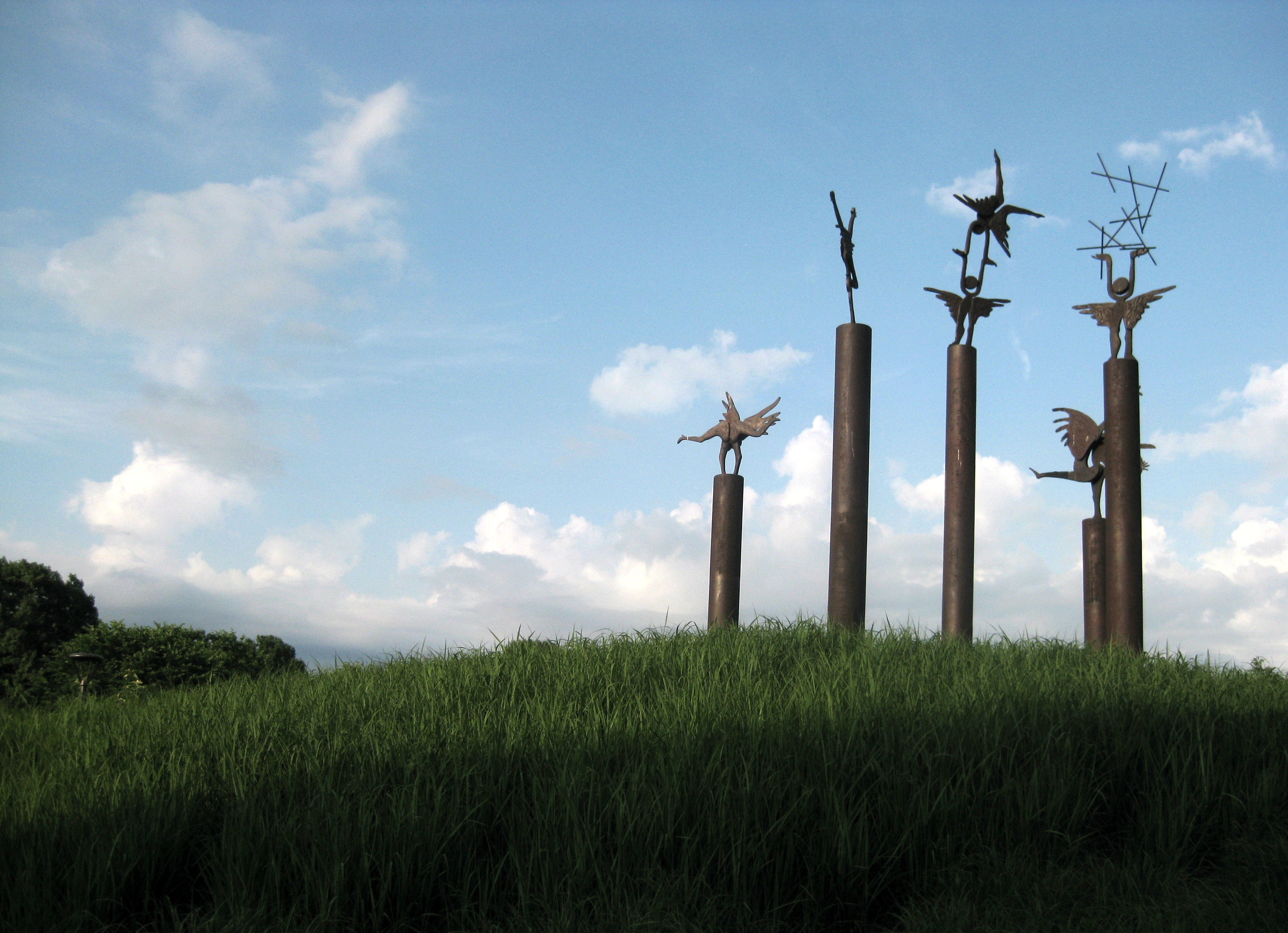
Joseph Kinnebrew (American, 1942–), Visitations: Gifts; A Slight Lapse of Purpose; Hand Stands; Yea; Majorette, 1994–97. Cast iron, 54 to 69 inches tall. Frederik Meijer Gardens and Sculpture Park, Grand Rapids, Michigan. Photo: Victoria Emily Jones.
. . . they seemed to have died, and their departure was thought to be an affliction, and their going from us to be their destruction; but they are at peace. . . . Their hope is full of immortality.
—Wisdom of Solomon 3:2–4
(Note: The Wisdom of Solomon, or the Book of Wisdom, is a deuterocanonical book, meaning it is part of the Septuagint but not the Hebrew canon and therefore is not recognized as canonical by Protestants. However, it still contains spiritual wisdom and, as Martin Luther believed, is “useful and good to read” alongside the inspired scriptures.)
+++
SONG: “Sky World” | Words and music by Theresa Bear Fox, 2015 | Performed by Teio Swathe (vocals) and Supaman (dance), 2017
“Sky World” was written in Mohawk and English by Theresa Bear Fox of the Akwesasne Mohawk Nation as a song of remembrance for those who have passed on. An abridged version was recently recorded by Teio Swathe and released as a music video with Apsáalooke hip-hop artist Supaman fancy-dancing (that’s actually the name of the style!) in White Sands, New Mexico. On October 12 the video won a Nammy Award.
Ha io ho we iaa
Ha na io ho we ia he
Io ha io ha io ho we ia
Ha na io ho we ia he
Ha io ha io ho we ia
Ha na io haioho we ia
Iooho we ia
We ha na io ho we ia he
Let’s put our minds together as one
And remember those who have passed on to the sky world
Their life duties are complete, they are living peacefully
In the sky world, in the sky world
Supaman lives on the Crow Nation reservation in south-central Montana. His own music fuses rapping with traditional Native American sounds and aims to inspire hope; he is best known for his “Prayer Loop Song,” which has over 2.3 million views on YouTube. In 2011 Supaman was interviewed on NPR’s All Things Considered, where he shared the story of his conversion to Christianity as an adult and the influence it has had on his life and work.
+++
This world is not conclusion;
A sequel stands beyond,
Invisible, as music,
But positive, as sound.
—Emily Dickinson
This post belongs to the weekly series Artful Devotion. If you can’t view the music player in your email or RSS reader, try opening the post in your browser.
To view all the Revised Common Lectionary scripture readings for All Saints’ Day, cycle B, click here.


 Art & Theology