Holy Week: Sweet Son

LOOK: The Crucifixion by Andrea Mantegna

Mantegna, Andrea_Crucifixion (San Zeno Altarpiece)
Andrea Mantegna (Italian, ca. 1431–1506), The Crucifixion, 1457–59. Tempera on panel, 75 × 96 cm. Musée du Louvre, Paris. [object record]

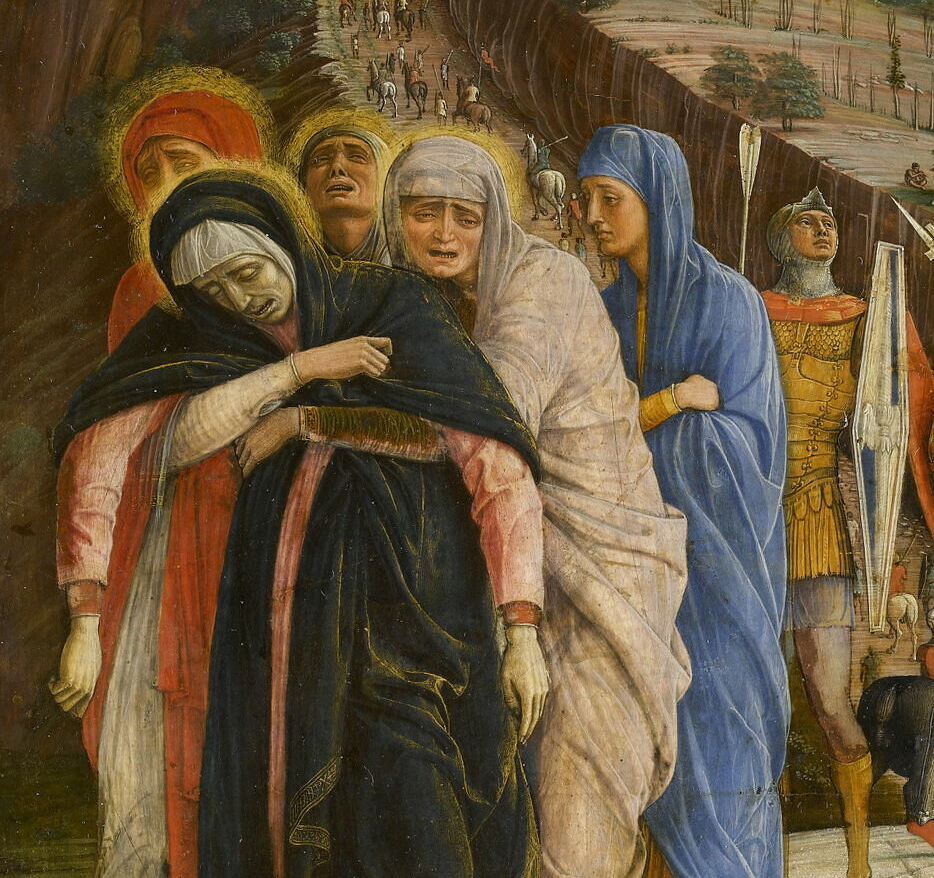
There’s much to look at in this painting. I want to focus on Jesus’s grieving mother under the cross to our left.
Mantegna, Crucifixion detail

In Renaissance art of the Crucifixion, Mother Mary is often shown swooning, supported by John or by one of her female companions. Here she’s with a group of four women—the other Marys—two of whom wrap an arm around her to bolster her up when her legs give out. Her son has just died, and she can’t bear to look.

This work was painted by Andrea Mantegna between 1457 and 1459 as the central element of the predella (base) of the high altarpiece at San Zeno in Verona, Italy, a monumental work of art. In 1797, French Napoleonic forces plundered the altarpiece and brought it to Paris; the country returned the three main panels to Verona in 1815 when Napoleon lost power, but they kept the three predella panels, which are on display in museums: The Crucifixion at the Louvre, and The Agony in the Garden and The Resurrection at the Musée des Beaux-Arts in Tours.

LISTEN: “Swete Sone” | Words: Anon., 14th century (before 1372) | Music by Katharine Blake, 1998 | Performed by Mediæval Bæbes on Worldes Blysse, 1998

This song is in Middle English. If you’re reading along with the lyrics, you’ll want to know that the letter thorn, þ, says th; and u makes a w or v sound. I’ve bracketed the two words that the Mediæval Bæbes leave out.

Suete sone, reu on me, & brest out of þi bondis;
For [nou] me þinket þat i se, þoru boþen þin hondes,
Nailes dreuen in-to þe tre, so reufuliche þu honges.
Nu is betre þat i fle & lete alle þese londis.

Suete sone, þi faire face droppet al on blode,
& þi bodi dounward is bounden to þe rode;
Hou may þi modris herte þolen so suete fode,
Þat blissed was of alle born & best of alle gode!

Suete sone, reu on me & bring me out of þis liue,
For me þinket þat i se þi detȝ, it neyhit suiþe;
Þi feet ben nailed to þe tre—nou may i no more þriue,
For [al] þis werld with-outen þe ne sal me maken bliþe.

Source: Edinburgh, National Library of Scotland, Adv.MS.18.7.21, fol. 120r (DIMEV 5089); as transcribed by Carleton Brown in Religious Lyrics of the XIVth Century (1924)

MODERN ENGLISH TRANSLATION:

Sweet son, have pity on me, and break out of your bonds;
For I think I see through both your hands
Nails have been driven into the tree, so painfully you hang there.
It would be better if I fled now and abandoned all these lands.

Sweet son, your beautiful face is dripping with blood,
And your body beneath is bound to the cross;
How will your mother’s heart endure [the suffering of] such a sweet child,
Who was born most blessed of all and was the most goodly of all!

Sweet son, have pity on me and deliver me from this life,
For I think I see your death approaches quickly;
Your feet have been nailed to the tree—now I may never prosper,
For without you, all this world can never make me happy.

These three monorhyming quatrains are from John of Grimestone’s commonplace book, where he jotted down material for sermons; it’s unknown whether they’re original to him or compiled from some other source. (For other lyrics I’ve featured from this notebook, see “Undo Thy Door, My Spouse Dear” and “Love Me Brought.”)

In the poem, written in Mother Mary’s voice, Mary reveals a premonition she’s had of her son being nailed on a tree to die. (At least that’s how I read it, mainly because of the “I think I sees.”) She agonizes over this nightmare and asks Jesus that if it be true, to deliver her from this life, as she won’t be able to endure the sorrow of losing him.

Verses like these really humanize Mary, a woman who, faithful though she was to God’s unfolding plan, nevertheless felt the intense parental pangs that inevitably accompany witnessing one’s child being brutalized and killed.

The poem has been set to medieval-style music by Katharine Blake, the founder of Mediæval Bæbes, a classical chart–topping British music ensemble celebrating its thirtieth anniversary this year.

The song opens with an unaccompanied solo voice singing in free time. In the second half of the first stanza, additional voices enter, as well as a strummed instrument. Then with “& þi bodi dounward is bounden to þe rode,” the tempo quickens; a 2/4 meter takes shape and regularizes, with percussion keeping the beat; and the volume amplifies with twelve women now singing. With the final stanza, there’s once again a softening as the song returns to a single vocalist and the instrumentation drops out. This movement from weary pain, Mary barely able to speak it aloud, to foot-stomping anger, which her friends join in solidarity, and back to solitary desolation captures different shades of grief.

For a wholly a cappella solo rendition, see this performance by Ariana Ellis:

“After Luke 2:19” by Michelle Ortega

Mantegna, Andrea_Madonna with Sleeping Child
Andrea Mantegna (Italian, 1431–1506), Madonna with Sleeping Child, ca. 1465. Tempera on canvas, 16 1/2 × 12 1/2 in. (42 × 32 cm). Gemäldegalerie, Berlin.

She took it all in: the shepherds and the royal and learned
men with their prophecies and proclamations. Resting among
common beasts, nipples sore and womb-ached, she smiled at
their praise—but her awe had begun with the angel’s decree.
At the mysterious life-pulse deep inside her. When flicker-
kicks strengthened to rolls and turns, elbows and heels in her
ribs. As buttocks bounced on her bladder.

The brightest star above them—a wondrous sign, but no
more miraculous than when, far from her mother and the
other village women, the flesh of her depth awakened and she
willed the baby from contentment into a harsh night. His cry
pierced the darkness, then quieted as, pressed to her breast,
he found her heartbeat again.

“After Luke 2:19” by Michelle Ortega, reproduced here by the author’s permission, was written for the 2021–22 exhibition Mary, Mary: Contemporary Poets and Artists Consider Mary at St. Michael’s Episcopal Church in Arlington, Virginia. Ortega is the author of the chapbooks Don’t Ask Why (Seven Kitchens Press, 2020) and Tissue Memory (Porkbelly Press, forthcoming).

Born a Child and Yet a King (Artful Devotion)

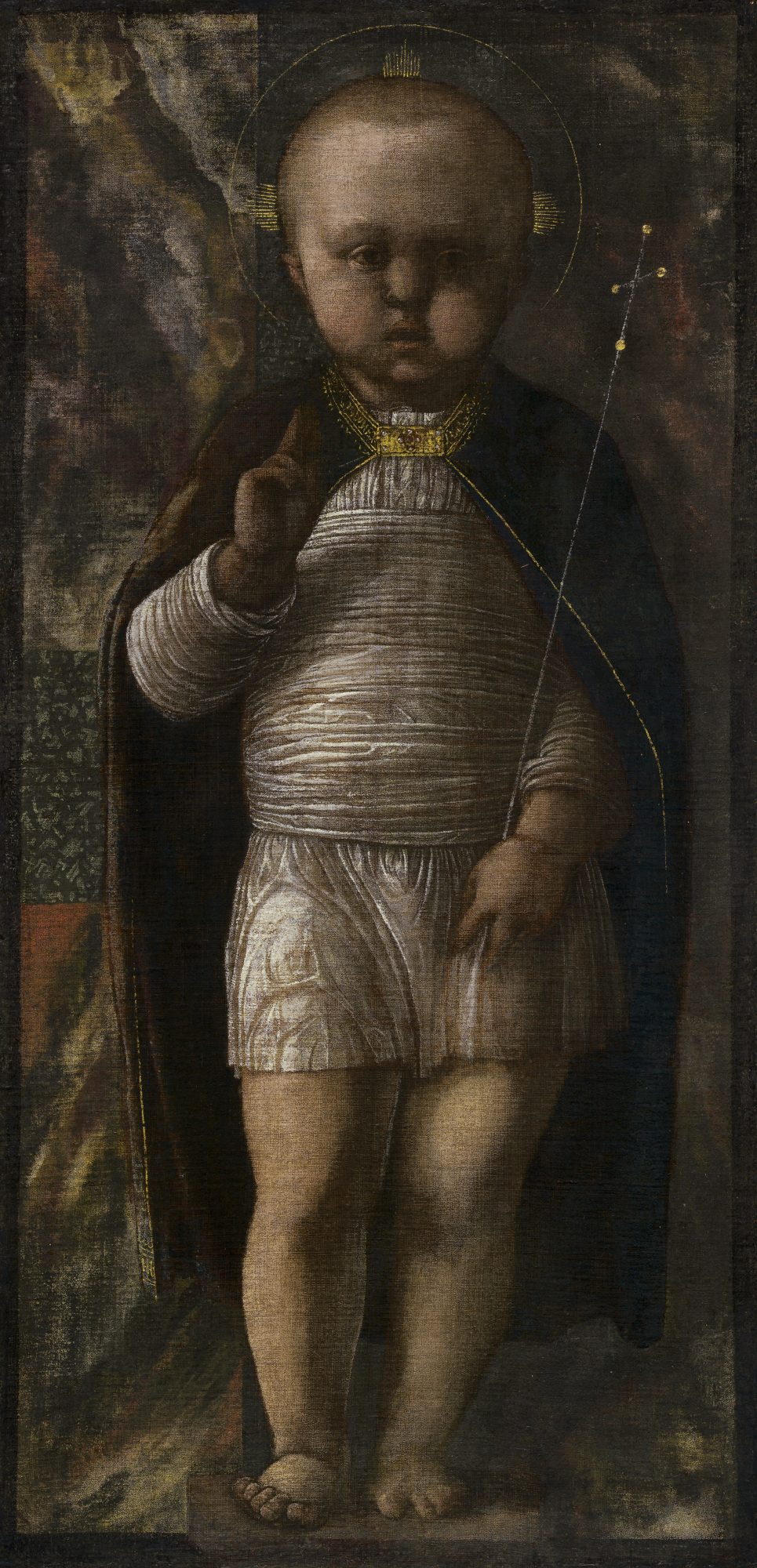
The Infant Savior by Andrea Mantegna
Andrea Mantegna (Italian, ca. 1431–1506), The Infant Savior, ca. 1460. Tempera on canvas, 70.2 × 34.3 cm (27 5/8 × 13 1/2 in.). National Gallery of Art, Washington, DC.

But you, O Bethlehem Ephrathah,
who are too little to be among the clans of Judah,
from you shall come forth for me
one who is to be ruler in Israel,
whose coming forth is from of old,
from ancient days.
Therefore he shall give them up until the time
when she who is in labor has given birth;
then the rest of his brothers shall return
to the people of Israel.
And he shall stand and shepherd his flock in the strength of the LORD,
in the majesty of the name of the LORD his God.
And they shall dwell secure, for now he shall be great
to the ends of the earth.
And he shall be their peace.

—Micah 5:2–5

+++

SONG: “Come, Thou Long-Expected Jesus / Joy to the World,” adapted and arranged by Folk Angel, on Live at Green Lux: Christmas Songs, vol. 6, 2014 | Words by Charles Wesley, 1744, with refrain and bridge by Isaac Watts, 1719 | Music by Rowland Hugh Prichard, 1830, and Folk Angel

The backbone of this Folk Angel song is the Advent classic “Come, Thou Long-Expected Jesus,” but into this the band has integrated lines from “Joy to the World,” traditionally sung at Christmastime. While the verses plead, “Come!,” the chorus declares, “He has come,” holding together the cries of both seasons. He whom the nations desire is here, “born to reign in us forever.” May earth receive him.

Come, thou long-expected Jesus,
Born to set thy people free;
From our fears and sins release us,
Let us find our rest in thee.
Israel’s strength and consolation,
Hope of all the earth thou art;
Dear desire of every nation,
Joy of every longing heart.

Joy to the world!
The Lord has come;
Let earth receive her king.

Born thy people to deliver,
Born a child and yet a king,
Born to reign in us forever,
Now thy gracious kingdom bring.
By thine own eternal spirit
Rule in all our hearts alone;
By thine all-sufficient merit,
Raise us to thy glorious throne.

Joy to the world!
The Lord has come;
Let earth receive her king.

Let every heart prepare him room,
And heaven and nature sing!

Come, thou long-expected Jesus,
Born to set thy people free.
We are free.
We are free.
We are free.
We are free.

The verse melody is, of course, that well-loved Welsh tune HYFRYDOL, composed by Rowland Hugh Prichard. The chorus and bridge, however, employ an original tune by Folk Angel, resetting key excerpts from Isaac Watts’s carol that emphasize the kingly nature of the infant Christ. This crescendos into a triumphant repeat of the song’s first two lines, and a grateful acknowledgment of God’s fulfilled purposes: a people set free from their fears and sins, granted eternal rest under the loving rule of Christ. Even so, Lord, thy kingdom come.

+++

The Infant Savior by the great Renaissance painter Andrea Mantegna brings me such delight—that little rosy, chubby-cheeked baby blessing me, blessing the world, this Christmas. You might call the painting a Christ Pantocrator, but it doesn’t fit the standard iconography, because instead of a half-length adult it shows a full-length child of about one year. Still, this is Jesus, “born a child and yet a king”: he wears a velvet robe with a golden clasp and lining, but underneath, his humble swaddling cloths are revealed, and he’s barefoot. His right hand is raised in a gesture of blessing, and in his left hand he holds, instead of a book (as is traditional in Pantocrator images), a cross-shaped scepter. A cross shape also comprises his “crown”—the three streams of light emitted from his bald little head.

Mantegna’s painting suggests that Christ’s kingship was established at his birth, and that it would be furthered by way of the cross.


This post belongs to the weekly series Artful Devotion. If you can’t view the music player in your email or RSS reader, try opening the post in your browser.

To view all the Revised Common Lectionary scripture readings for the Fourth Sunday of Advent, cycle C, click here.