
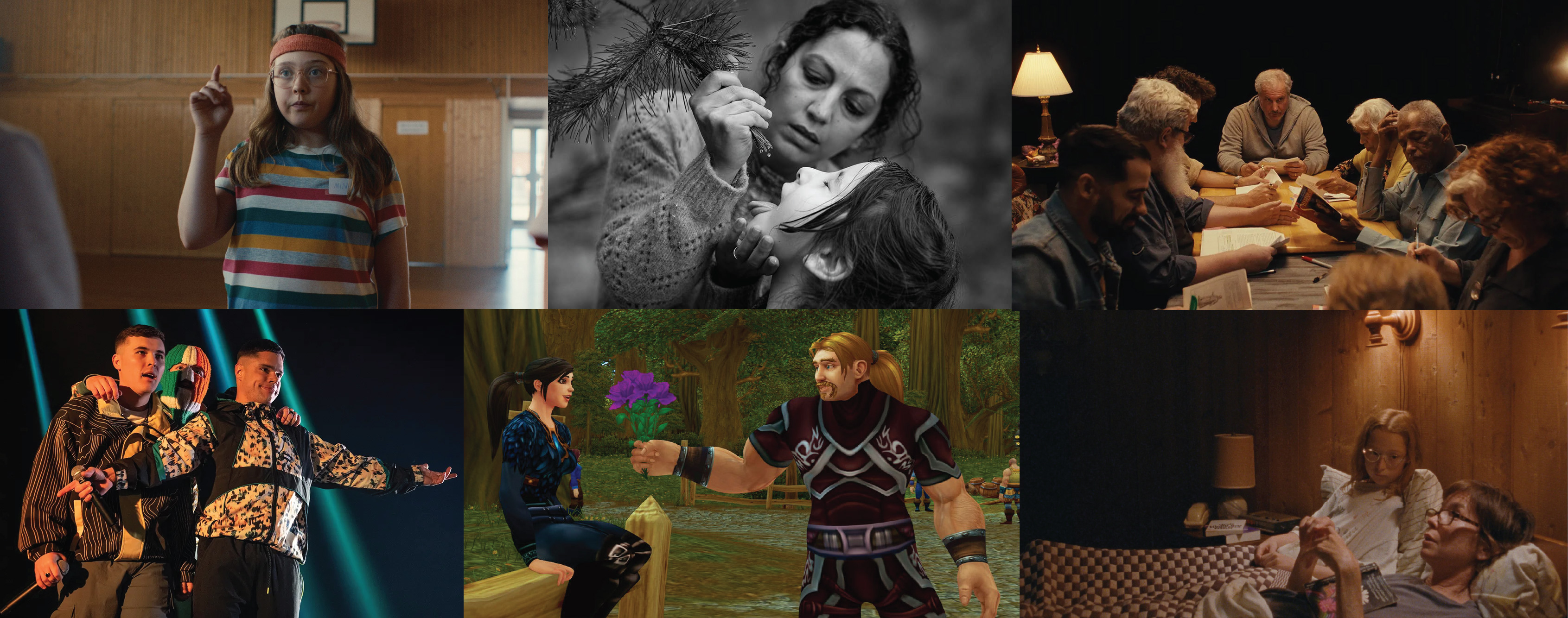
11. Dancing Queen, dir. Aurora Gossé. This coming-of-age dramedy from Norway was not promoted at all in the US but quietly arrived on Google Play early this year—thanks to my YouTube algorithm for suggesting it! Seventh-grade Mina (Liv Elvira Kippersund Larsson) has a crush on Edwin (Vilijar Knutsen Bjaadal), aka E.D. Win, a hip-hop dancer with a large social media following who has just transferred to her school. Despite having no dance experience, Mina decides to audition for his crew ahead of a local competition, and she enlists her grandma (Anne Marit Jacobsen) to train her, and her best friend Markus (Sturla Harbitz) to help her practice the partner work. The film is so endearing, even if a bit predictable in its beats.
12. Ghostlight, dir. Alex Thompson and Kelly O’Sullivan. Dan (Keith Kupferer) is a construction worker who’s grieving a grave loss and is unwilling to open up about it with his wife Sharon (Tara Mallen) and daughter Daisy (Katherine Mallen Kupferer). (The three actors are father-mother-daughter in real life.) One day he inadvertently stumbles into a rehearsal of a community theater production of Romeo and Juliet. The head of the troupe, Rita (Dolly De Leon), invites him to stay, which he reluctantly does. He’s never acted before, but he finds himself taking on a role in the play, which helps him connect with his emotions and with other people and begin his healing journey.
Streaming on AMC+.
13. Janet Planet, dir. Annie Baker. The free-spirited but weary Janet (Julianne Nicholson) lives with her eleven-year-old daughter, Lacy (Zoe Ziegler), in western Massachusetts, running an acupuncture practice out of their home. Lacy is lonely and quirky and craves her mom’s affection; Janet gives it but is usually also absorbed in some kind of interpersonal entanglement. Over the summer of 1991, during which the film is set, a succession of three visitors come in and out of Janet’s life: a live-in boyfriend, a woman trying to escape a cult, and said cult leader. Lacy tolerates these ephemeral presences but wishes her mom were more exclusively available to her. The film is about Lacy learning to share her mom with others and coming to grips with the fact that she is not the only person her mom needs. The last scene, where Lacy comes to this realization while watching her mom contradancing, gutted me!
Streaming on Max.
14. Green Border, dir. Agnieszka Holland. This film is a difficult watch. It dramatizes the humanitarian crisis precipitated in fall 2021 when Alexander Lukashenko, the dictator of Belarus, lured several thousand asylum seekers from the Middle East and Africa to his country with the promise of free transit to the European Union, then dumped them on the borders of Poland, Lithuania, and Latvia as payback for EU sanctions against Belarus. Green Border focuses on a Syrian refugee family of six (Jalal Altawil plays the father) and an Afghan woman (Behi Djanati Atai) they befriend on the plane ride over—their being tossed (like a football, as one character laments) back and forth across the militarized Polish-Belarussian border, cold and hungry, with neither country willing to receive them.
The film also follows two Poles: border guard Jan (Tomasz Wlosok), who contracts PTSD, and budding activist Julia (Maja Ostaszewska), who joins a group providing water, food, clothing, first aid, power banks, and legal counsel to those crossing the forested swampland into Poland. We see one aid worker cradling the head of a hypothermic refugee as she spoon-feeds him hot soup, and another tenderly rubbing ointment onto the swollen, blistered feet of a weary woman traveler. Sadly, government policy has made these tangible acts of loving care acts of political resistance and grounds for arrest. But there’s a double standard at play, as we see in the epilogue.
Streaming on Kanopy.
15. Juror #2, dir. Clint Eastwood. A taut legal thriller, Juror #2 is all about conscience. Family man Justin (Nicholas Hoult) finds himself on the jury of a murder trial, and when the details of the alleged crime are revealed, he realizes he may have been the unwitting perpetrator. He is torn between his integrity and his self-preservation instincts, between his loyalty to the law and his loyalty to his wife and soon-to-be-born child. What I like about the film is how it prompts you to consider what you would do in the same situation—let someone with less to lose and with lower morals take the fall (the defendant, a single man with gang involvement, is a known abuser of women, and the prosecution has a strong case against him), or own up to what you know and have your and your family’s lives upended.
Streaming on Max.
16. Kneecap, dir. Rich Peppiatt. UNESCO classifies the Irish language as “endangered,” as the number of native speakers has continued to decline ever since English became the national language during British rule. However, more recently there’s been an urban revival, owing in part to the proliferation of Irish-language immersion schools—and to the popularity of Kneecap, a hip-hop trio from West Belfast who rap mostly in Irish, for them a sign of national identity and pride. Formed in 2017, they’re a controversial group whose lyrics often contain Irish republican themes along with profanity and references to drugs and sex. Many young Irish people have embraced them and been inspired by their music to learn Irish.
Band members Liam Ó Hannaidh (stage name Mo Chara), Naoise Ó Caireallain (Móglaí Bap), and JJ Ó Dochartaigh (DJ Próvai) play versions of themselves in this riotous, fictionalized origin story that compelled me mostly because of its fresh take on the musical biopic genre and in how it addresses the politicization of language. Also, it’s funny. But expect irreverence.
Streaming on Netflix.
17. The Outrun, dir. Nora Fingscheidt. Based on the best-selling memoir by Amy Liptrot, The Outrun follows Rona (Saoirse Ronan), an alcoholic in her late twenties who drops out of her PhD program in biology and returns to the remote Orkney Islands of Scotland, where she grew up, to pursue recovery. Rona is closely attuned to the natural forces around her, which gives the film an elemental quality, and Ronan attacks the role with an admirable ferocity. It’s a vital portrait of addiction and the journey to and through sobriety. Unlike some other films that tackle the subject, it doesn’t revel in the character’s misery; it shows the destructiveness of addiction, for sure, but it also shows Rona finding happiness along the way in things other than drink, like dancing with neighbors, barking at seals, baking bread, collecting and drawing seaweed, or pretending she’s a sailor at sea.
18. We Live in Time, dir. John Crowley. In nonlinear fashion, this affecting rom dram traces the relationship of Tobias (Andrew Garfield) and Almut (Florence Pugh), from their initial meeting in a hospital hallway, to the birth of their daughter, to Almut’s death from cancer, and a hundred little moments in between. It’s a beautiful picture of committed romantic love and how it negotiates change, crisis, and conflicting aspirations, but also the many joys it holds.
19. The Remarkable Life of Ibelin, dir. Benjamin Ree. The subject of this Norwegian documentary is Mats Steen (1989–2014), a video gamer who was born with Duchenne disease, a rare form of muscular dystrophy. When he died at age twenty-five, his parents had thought he lived an isolated life. But then they started receiving emails from strangers, numbering in the hundreds, who knew Mats through the online role-playing game World of Warcraft, where Mats interacted with friends daily as the character Ibelin Redmoore.
To bring Mats’s story to life, the film starts out conventionally, with home video footage from and interviews with the family. But then it transitions into animated segments that re-create some of Mats’s personal experiences within the world of the game. An actor voices Mats using Mats’s own words, taken from gaming transcripts and blog posts. These segments are interspersed with in-person interviews with some of Ibelin’s fellow Starlight guild members. I appreciate how the film challenges the stereotype of video games as shallow, time-wasting, and solitary, showing how for Mats, who had limited mobility, they were a means of exercising agency and cultivating meaningful connections with people all over the world.
Streaming on Netflix.
20. A Different Man, dir. Aaron Schimberg. Part dark comedy, part psychological thriller, this film stars Sebastian Stan as Edward, a man living with neurofibromatosis, which causes noncancerous tumors to grow on nerve tissue. He undergoes an experimental procedure that undoes his facial disfigurement and thrusts him into an identity crisis, even more so when he meets a man named Oswald (Adam Pearson) who looks a lot like his presurgery self. He envies Oswald’s confidence and charisma and feels increasingly threatened by him when Oswald is cast to play a version of him in a stage play written by his former next-door neighbor Ingrid (Renate Reinsve). We’re made to wonder whether there’s something insidious about Oswald, or Edward’s insecurities are just acting up.
Writer-director Aaron Schimberg, who has a cleft palate, said this film arose in part from his own contradictory feelings about his disfigurement, and the odd experience of looking in a mirror after having had multiple surgeries and wondering if the face he sees is his own or one that was only created by doctors. He also said he wanted to write a role for Pearson, whom he had worked with before, that defies the two roles he is typically offered—either a sympathetic victim who’s deemed heroic simply for existing, or a horror villain—and that makes use of his naturally gregarious, extroverted personality.
Streaming on Max.
HONORABLE MENTIONS: Inside Out 2 (Disney+), Thelma (Hulu), Spermworld (Hulu), Civil War (Max), Problemista (Max), The Promised Land (Hulu)





 Art & Theology