Landmark exhibition “Ethiopia at the Crossroads” explores cross-cultural influences on Ethiopian art

All photos in this post, except for the last one (of the processional icon), are my own.

(Note: WordPress seems to have disabled the feature that allows you to expand an image upon clicking, but if you’re reading on a computer, you can right-click an image and open it in a new tab to view it in full resolution; if you’re reading on a phone, you can pinch to zoom.)

Located in the Horn of Africa and with access to the Red Sea, Nile River, Mediterranean Sea, and Indian Ocean, Ethiopia stands at the nexus of historical travel, trade, and pilgrimage routes that brought it into contact with surrounding cultures and influenced its artistic development. Coptic Egypt, Nubia, South Arabia, Byzantium, Armenia, Italy, India, and the greater African continent were among those influencers. But Ethiopia not only absorbed influences; it transmitted them too.

A major art exhibition is centering Ethiopia’s artistic traditions in a global context. For Ethiopia at the Crossroads at the Walters Art Museum in Baltimore (running through March 3), curator Christine Sciacca has brought together more than 220 objects from the Walters’ own extraordinary Ethiopian art collection and private and institutional lenders both domestic and international. Icons, wall paintings, processional crosses and hand crosses, illuminated Gospel books and psalters, sensuls (chain manuscripts), healing scrolls, and more are on display throughout the galleries, whose walls have been painted bright green, yellow, and red—the colors of the Ethiopian flag. To round off the exhibition, guest curator Tsedaye Makonnen, an Ethiopian American multidisciplinary artist, was tasked with curating a few works from contemporary artists of the Ethiopian diaspora.

Ethiopia at the Crossroads exhibition view

The majority of objects are Christian, made for liturgical or private devotional use. Ethiopia is one of the world’s oldest Christian nations: in the early fourth century, persuaded by a missionary from Syria, King Ezana of Aksum embraced Christianity, and it has been the dominant religion of Ethiopia ever since. But the exhibition does also include some Islamic and Jewish objects.

One of the first works you’ll encounter is a mural that would have originally been mounted on the outer wall of an Ethiopian Orthodox church sanctuary (mäqdäs), portraying the Nativity, the Presentation of Christ in the Temple, and the Adoration of the Magi.

Nativity, Presentation of Christ in the Temple, and Adoration of the Magi, Ethiopia, 18th century. Glue tempera on overlapping canvas pieces mounted to a new stretched canvas, 49 3/16 × 66 15/16 in. (124.9 × 170 cm). Walters Art Museum, Baltimore. [object record]

Remarkably, at the Nativity, there is a feast taking place, and Jesus is feeding his mother with what looks like a Communion wafer! As the theologian Lester Ruth has said, “The sound from most baby beds is a cry to be fed. But the cry from the manger is an offer to feed on his body born into this world.”

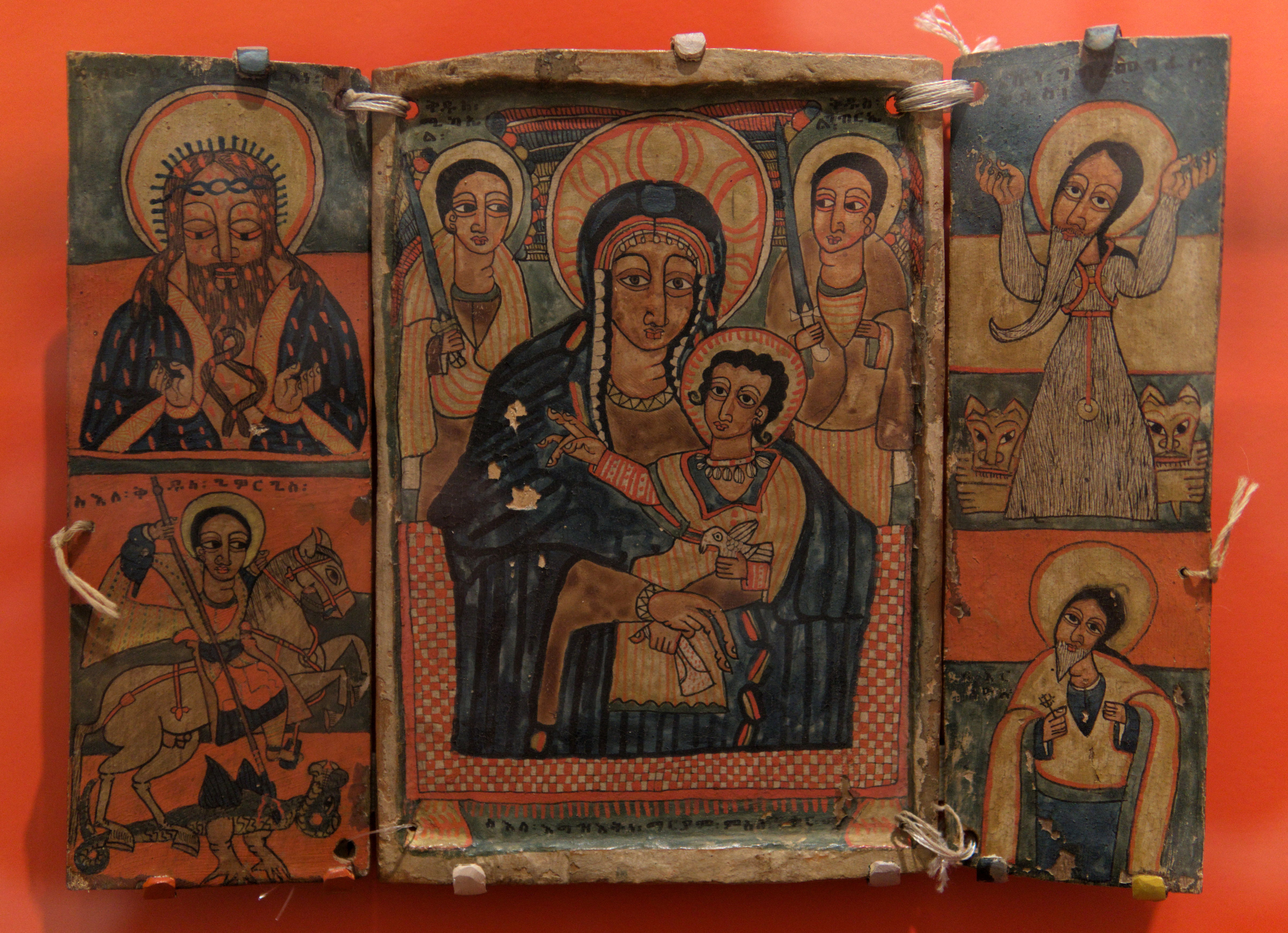
One of history’s most famous Ethiopian painters is Fre Seyon, who worked at the court of Emperor Zara Yaqob (r. 1434–1468) and was of the first generation of Ethiopian artists who painted icons on wood panels. He was also a monk. He likely introduced one of the characteristic features of Ethiopian icons of the Virgin and Child: the archangels Michael and Gabriel flanking them with drawn swords, acting as a kind of honor guard.
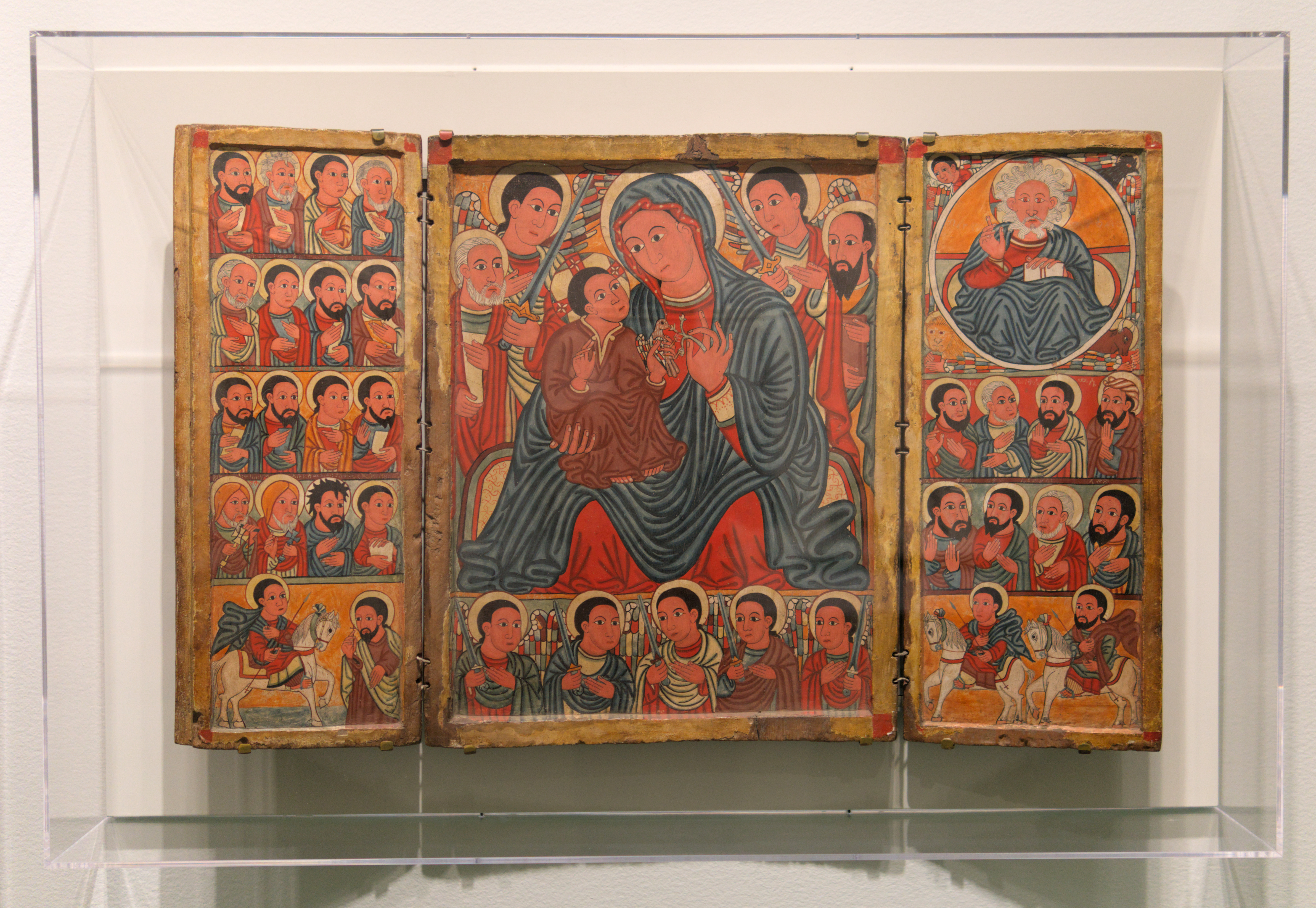
Fre Seyon triptych
Fre Seyon (Ethiopian, active 1445–1480), Triptych Icon with the Virgin Mary and Christ Child Flanked by Archangels and Saints (center), Twelve Apostles and Saints (left), and Prophets and Saints (right), mid- to late 15th century. Tempera on gesso-primed wood. Institute of Ethiopian Studies, Addis Ababa University, acc. no. IESMus4186.

My two favorite details of this triptych by Fre Seyon are (on the right wing) the image of the Ancient of Days surrounded by the tetramorph, his wild gray locks being blown about, and in the center, the bird that Christ holds, its feet grasping at a three-branched twig. On a literal level, the bird is a plaything for the boy that charmingly emphasizes his humanity (in the late Middle Ages, at least in Europe—I’m not sure about in Ethiopia—it was common for young children to keep tame birds as pets). On another level, the bird may be symbolic. In traditional Western art, Jesus sometimes holds a goldfinch, a bird with distinctive red markings that’s fond of eating thistle seeds and gathering thistle down and thus came to be read as a prefiguration of Christ’s thorny, blood-spilt passion. I’m not sure whether Fre Seyon intended a symbolic significance for this bird.

The Ancient of Days, enthroned in the tetramorph

Here’s another triptych from the exhibition, this one from a century and a half later:

Virgin and Child triptych
Triptych Icon with the Virgin Mary and Christ Child Flanked by Archangels, Scenes from the Life of Christ, Saint George, and Saints Honorius, Täklä Haymanot, and Ewostatewos, Ethiopia (Tigray), early 17th century. Glue tempera on panel, 16 3/4 × 22 5/16 in. (42.5 × 56.7 cm). Walters Art Museum, Baltimore. [object record]

The composition of the Virgin and Child is based on prints of a painted icon from Santa Maria Maggiore in Rome brought to Ethiopia by Portuguese Jesuit missionaries—but it innovates. As the wall text notes, “Mary’s cloak stretch[es] out in either direction to embrace the scene of Christ Teaching the Apostles below. Umbrella-like, Mary appears as both the protector and personification of the church.”
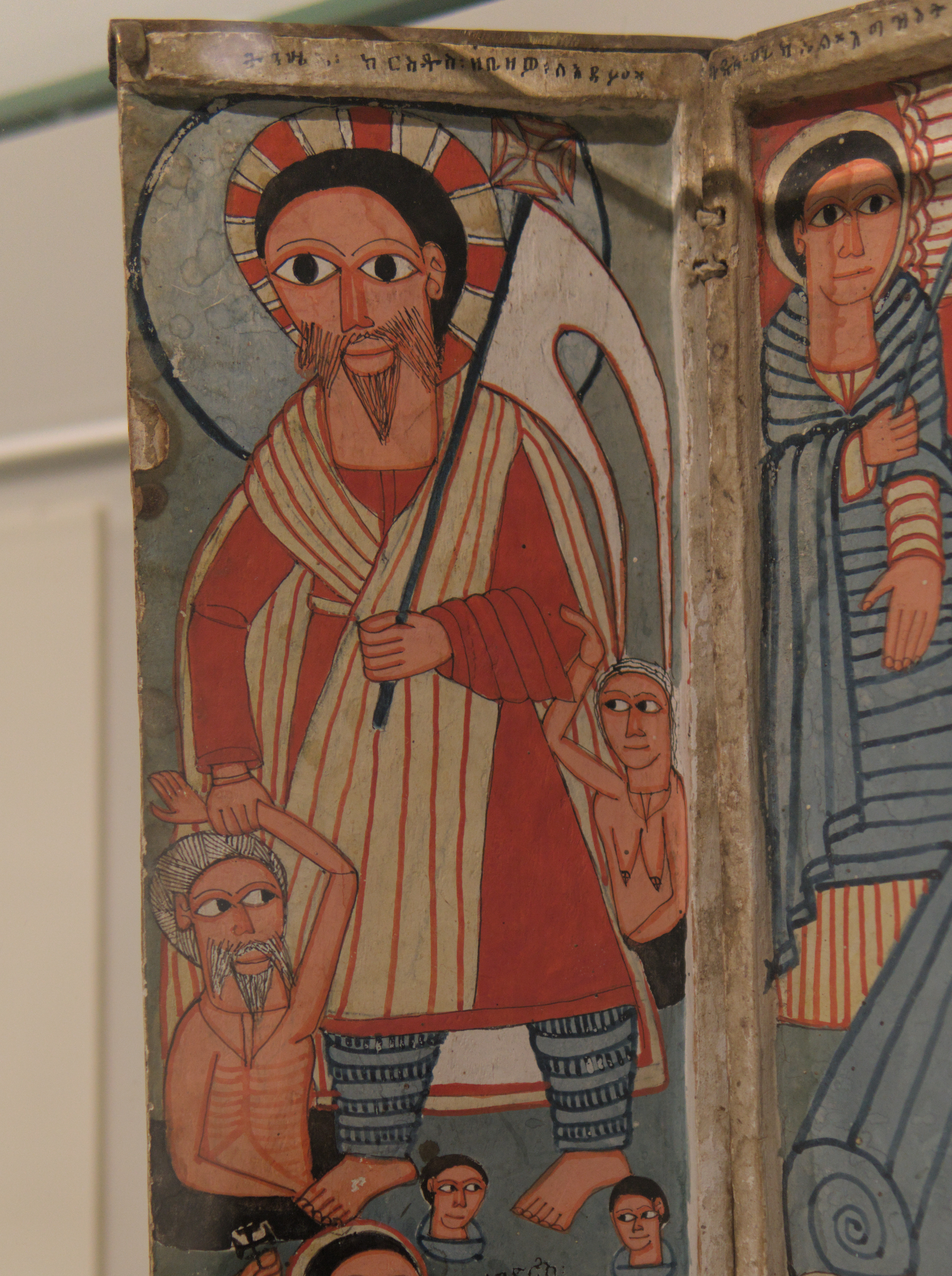
Harrowing of Hell

On the right wing, angels hold up chalices to collect the blood that flows from Jesus’s wounds on the cross, while below that, Joseph of Arimathea and Nicodemus carry Jesus’s wrapped corpse to the tomb. On the left wing is one of my favorite traditional religious scenes: the Harrowing of Hell, or Christ’s Descent into Limbo, in which, on Holy Saturday, Jesus enters the realm of his dead to take back those whom Death has held captive, first of which are our foreparents Adam and Eve. Below that scene is an image of the dragon-slaying Saint George, a late third-century figure from the Levant or Cappadocia who is the patron saint of Ethiopia.

At the bottom center is a scene of Christ teaching the twelve apostles, plus two Ethiopian saints. They all hold hand crosses, like those carried by Ethiopian priests and monks.
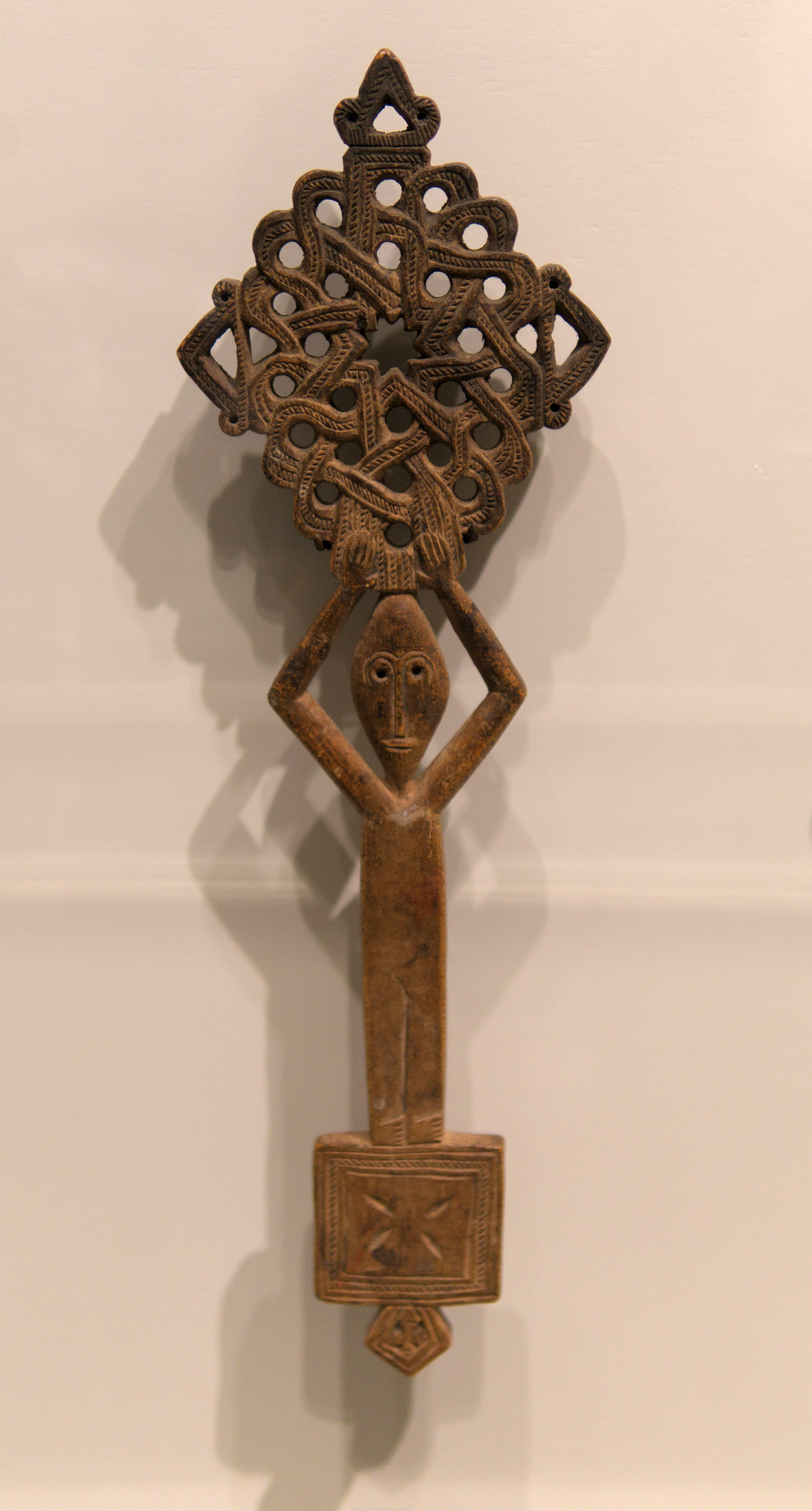
Hand Cross with Figure
Hand Cross with Figure, Ethiopia, probably 18th–19th century. Wood, 13 3/8 × 4 3/16 × 9/16 in. (34 x 10.7 × 1.4 cm). Walters Art Museum, Baltimore. [object record]

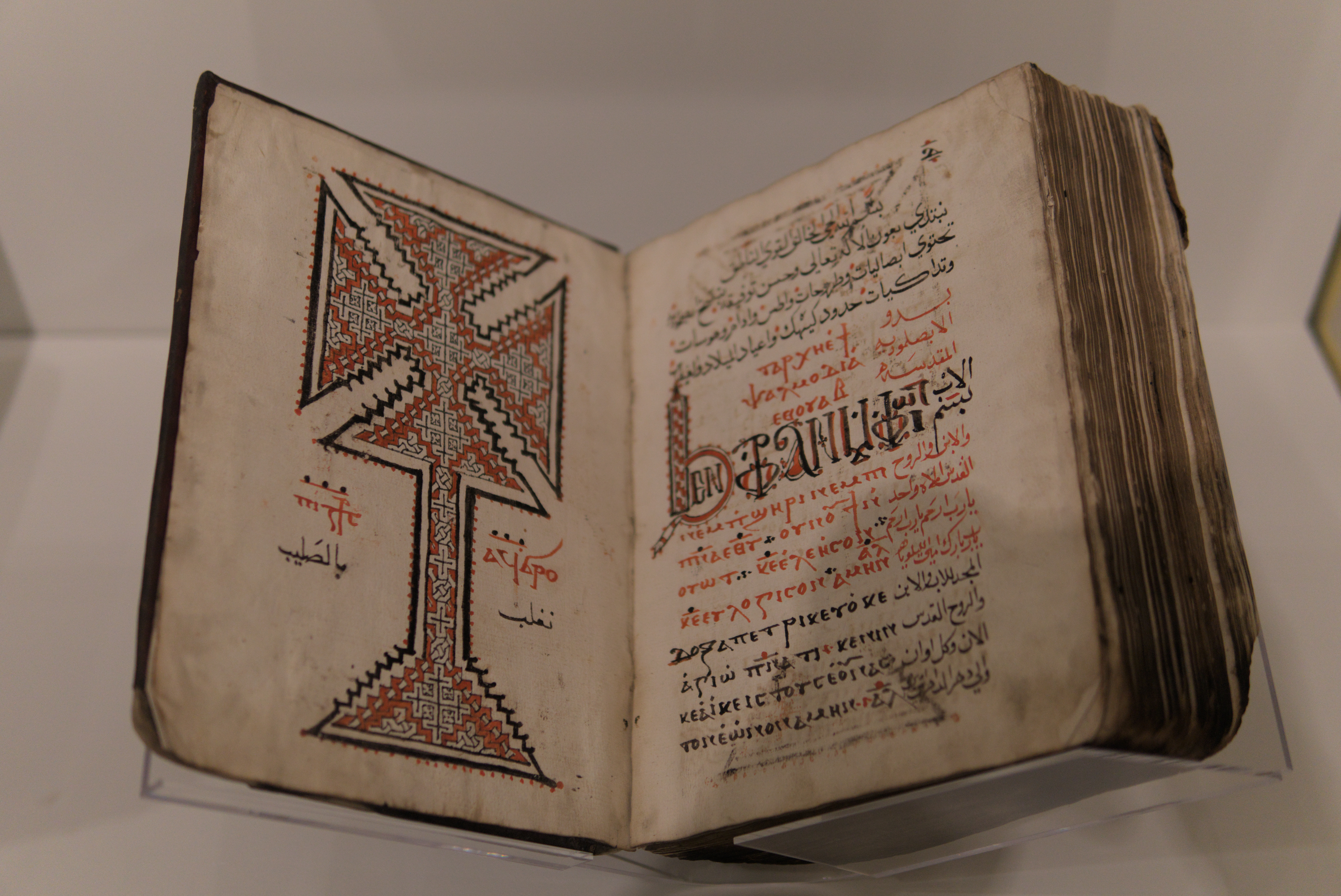
Coptic-Arabic Book of Prayer
Coptic-Arabic Book of Prayer, Egypt, 18th century. Tempera and ink on parchment, 11 3/4 × 9 in. (29.8 × 22.8 cm). Melikian Collection. [object record]

One of the hallmarks of the exhibition is its multisensory nature: attendees are immersed not only in the sights of Ethiopia but also in the sounds and smells. Scratch-and-sniff cards invite people to take a whiff of frankincense, which would have filled the censer on display. Or to smell berbere, a hot spice blend that would have been stored in the woven baskets nearby.

Frankincense

This olfactory element was produced by the Institute for Digital Archaeology, which, as part of its efforts to record and preserve ephemeral culture, has launched an ambitious program to preserve the heritage of smells. “The aim is to provide the technical means for documenting the aromas of today for the benefit of future generations – and to find new methods and opportunities for experiencing the odors of the past.”

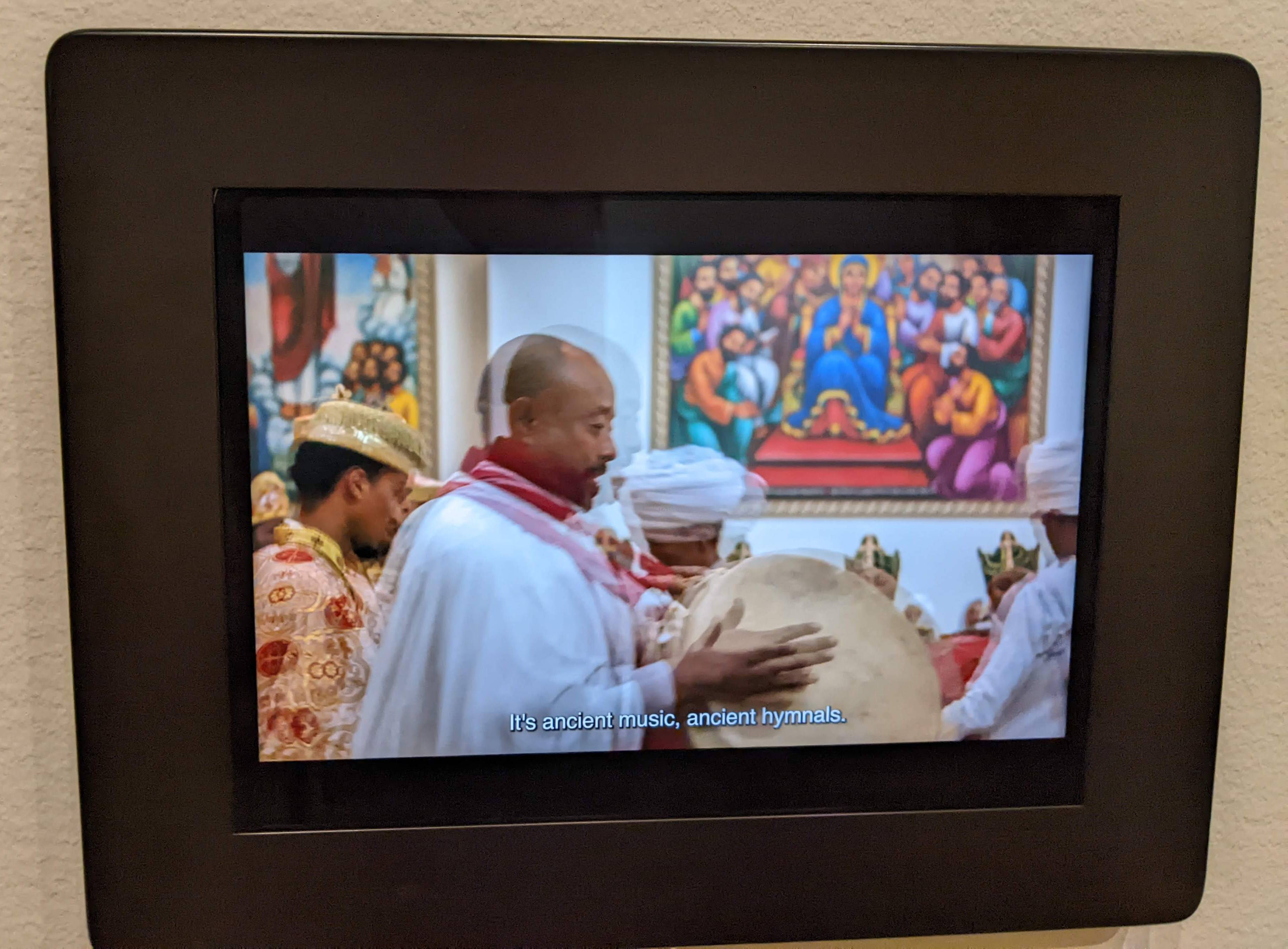
Also in the exhibition there are screens where you can watch videos of Ethiopian Orthodox worship, including music and liturgies, where you will see some of the objects in use. You can also listen to interviews with members of the local Ethiopian diaspora community. (The Washington metropolitan area has the largest Ethiopian population outside Ethiopia.)
Further contextualizing the objects and enhancing the sense of place, pasted onto the wall is a blow-up photograph of a Christian holy-day celebration wending through the streets. This serves as a backdrop to two physical artifacts present in the room: a qämis (dress) and a debab (umbrella).

Dress and umbrella
Left: Dress (qämis), Ethiopia, 20th century(?), cotton, Peabody Essex Museum, E72559. Right: Umbrella (debab), Ethiopia, 20th century, silk and velvet, Peabody Essex Museum, E68713.

The inscriptions on many of the Ethiopian icons and manuscript illuminations, which identify the figures and scenes, are in Ge‘ez (aka classical Ethiopic), an ancient South Semitic language that originated over two thousand years ago in what is now northern Ethiopia and Eritrea. It’s no longer spoken in daily life, but it is still used as the language of the Ethiopian Orthodox Church and taught to boys in Sunday school. I really wish I could read it, as it would be a great help in interpreting the Ethiopian images I come across in my studies!

Contrary to what some may assume, Ethiopians in the medieval era were not an isolated people. They traveled—to Rome, to Jerusalem, and so forth. Evidence of Holy Land pilgrimage is suggested by an early fourteenth-century Gospel book that includes the domed Church of the Holy Sepulcher as the backdrop for Christ’s resurrection:
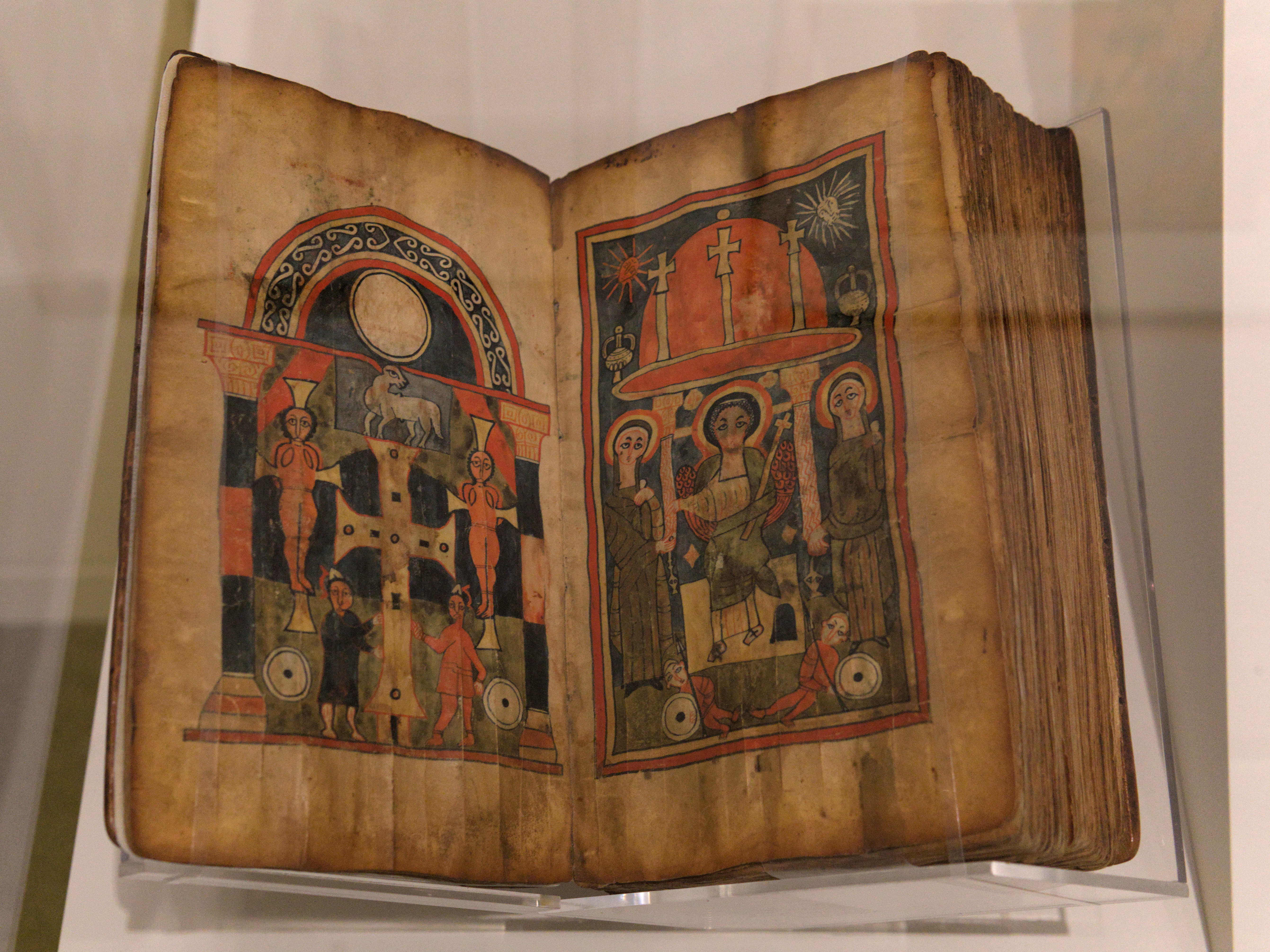
Crucifixion and Resurrection
Gospel Book with the Crucifixion and Christ’s Resurrection, Ethiopia (Tigray), early 14th century. Ink and paint on parchment, 10 1/2 × 6 11/16 in. (26.7 × 17 cm). Walters Art Museum, Baltimore, W.8.36, fols. 6v–7r. [object record]

This is an extraordinary book, one of the oldest surviving Ethiopian manuscripts and the oldest in North America. Ethiopian artists weren’t yet depicting Jesus on the cross, so to represent the Crucifixion, this artist has painted a living lamb surmounting a bejeweled cross, with the two thieves crucified on either side.

Also from the fourteenth century, a manuscript opened to a page spread of Christ’s Entry into Jerusalem:

Triumphal Entry
Christ’s Entry into Jerusalem, folios added from an earlier Gospel book to a Ta’ammera Maryam manuscript, Ethiopia, 14th century. Tempera and ink on parchment. Private collection.

I like how the scene extends across both pages, creating a sense of forward progression, and the two onlookers above the city gate.

One of my favorite objects from the exhibition is a sensul from Gondar depicting ten scenes from the life of Mary. A sensul is an Ethiopian chain manuscript, in this case pocket-size, created out of a single folded strip of parchment attached to heavy hide boards at each end, which creates a small book when folded shut. Here’s a detail showing the Annunciation:
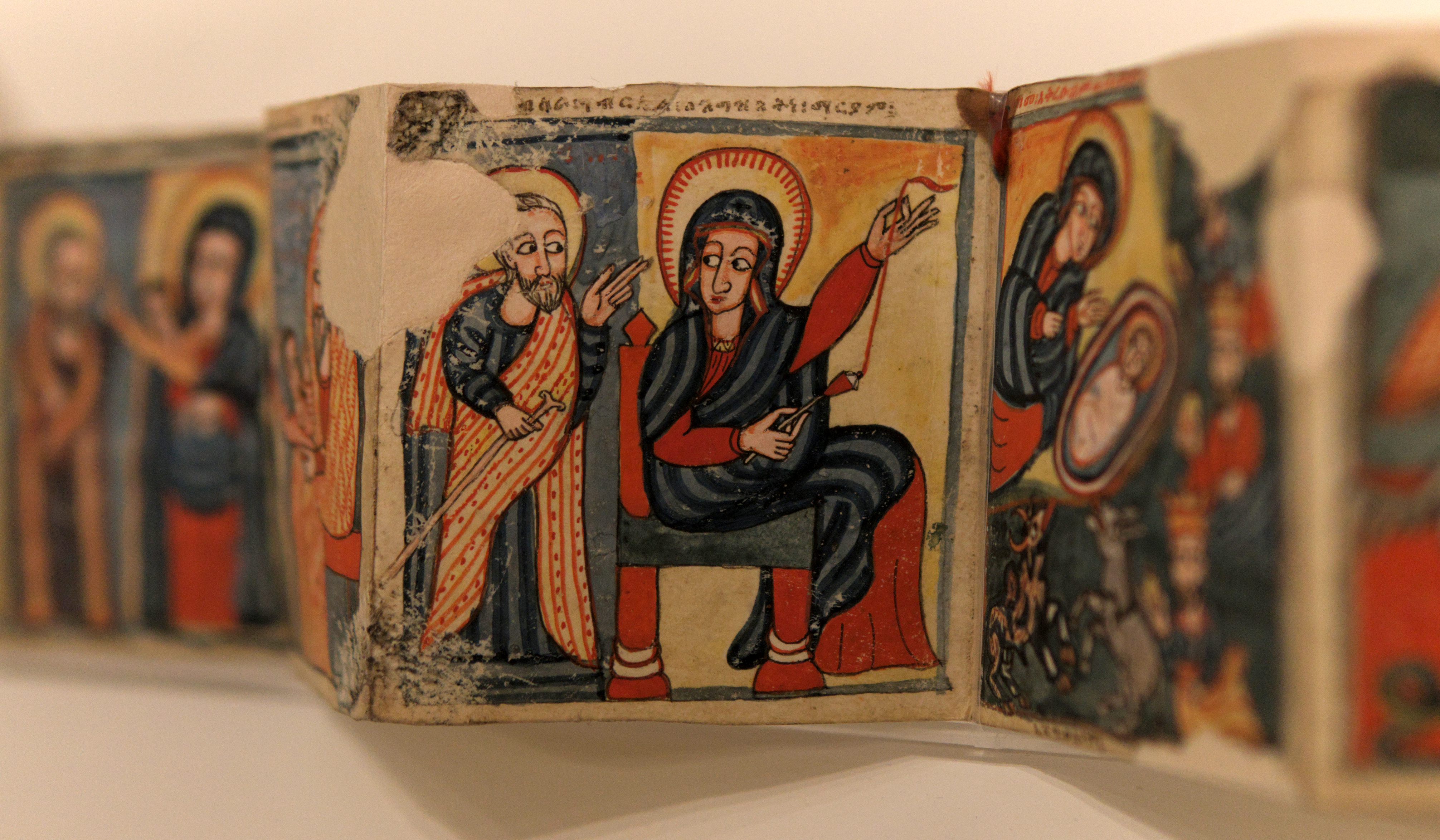
Annunciation (from a sensul)
Annunciation, from a Gondarine sensul (chained manuscript), Ethiopia (Gondar), late 17th century. Ink and paint on parchment, each panel 3 5/8 × 3 1/8 in. (9.2 × 9 cm). Walters Art Museum, Baltimore. [object record] [GIF]

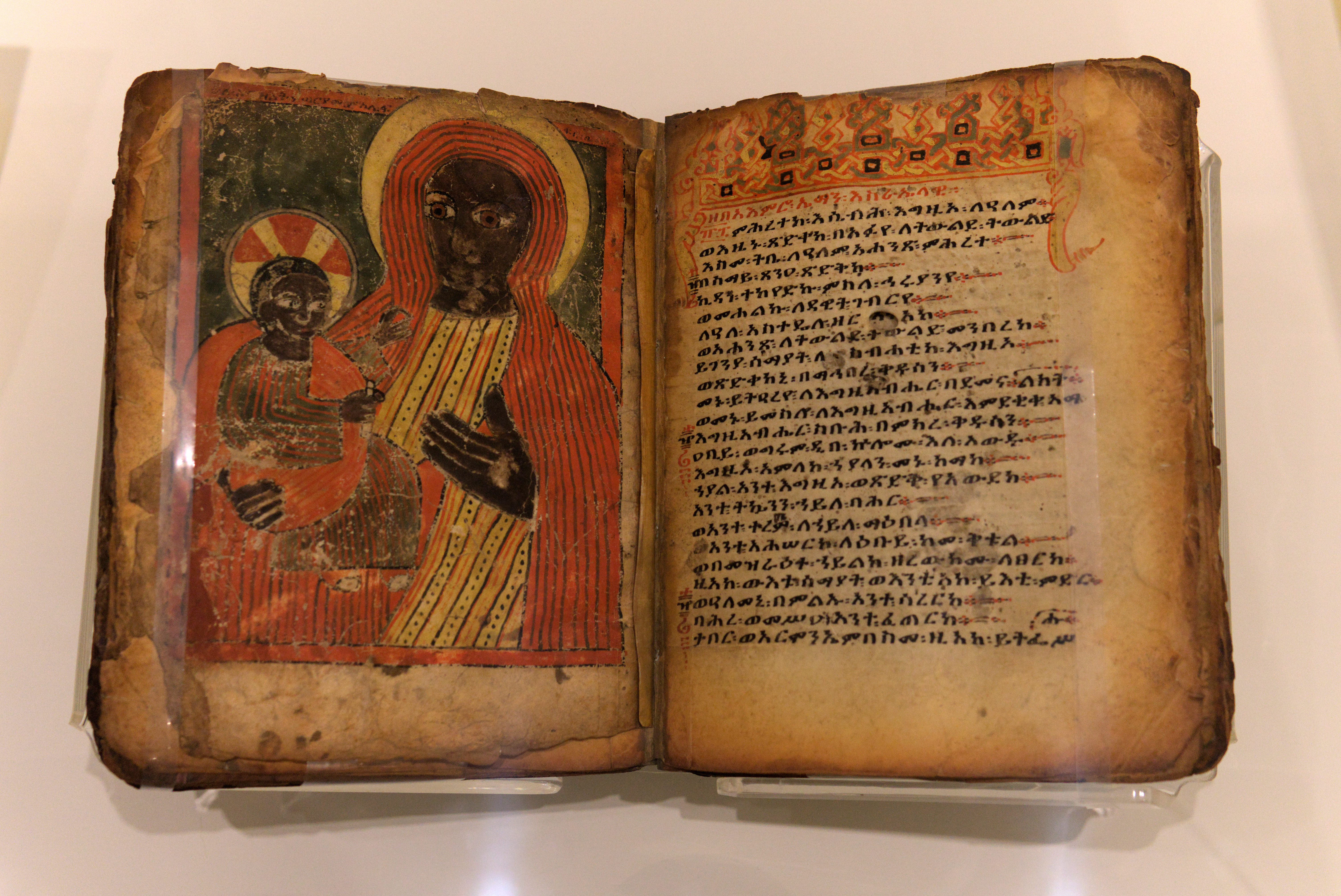
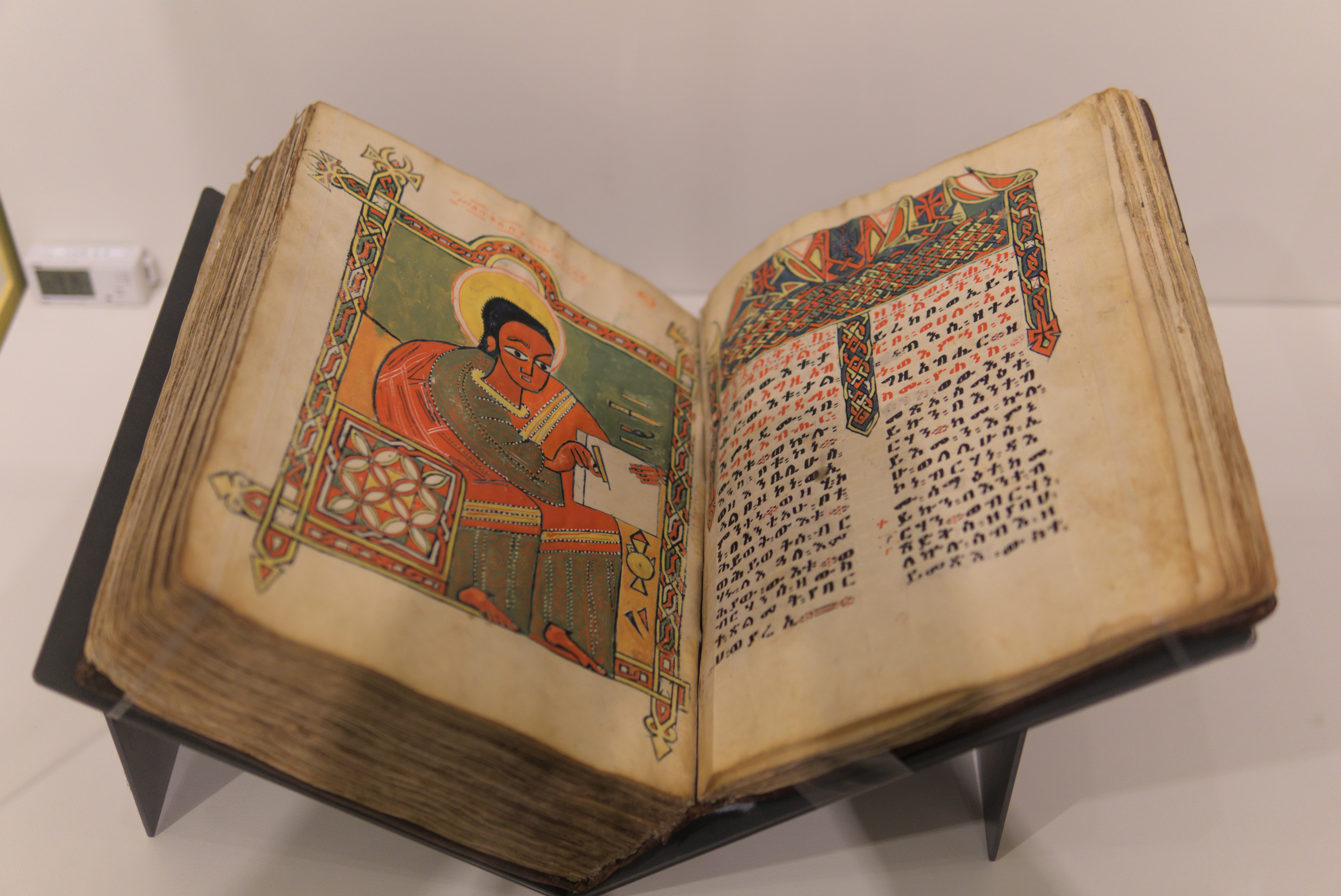
It’s a common misconception that Ethiopians have always depicted biblical figures as dark-skinned to reflect the local population. Such treatment didn’t become normative until the eighteenth century, although some earlier artists did choose black complexions for holy persons:
Virgin and Child
Virgin and Child, from a Psalter with the Wəddase Maryam (Praise of Mary) and Mähalǝyä Näbiyyat (Canticles of the Prophets), Ethiopia, 15th century. Ink and pigments on parchment with wooden boards, open: 8 7/8 × 6 11/16 × 3 15/16 in. (22.5 × 17 × 10 cm). Toledo Museum of Art, Ohio. [object record]

Portrait of John the Evangelist
The Opening of the Gospel of John, from a Gospel book, Ethiopia, ca. 1504–5. Tempera on parchment, 13 9/16 × 10 7/16 in. (34.5 × 26.5 cm). J. Paul Getty Museum, Los Angeles, Ms. 102, fols. 215v–216r. [object record]

Virgin and Child triptych
Triptych Icon with the Virgin Mary and Christ Child Flanked by Archangels (center), the Kwer‘atä re’esu (Man of Sorrows) and Saint George (left), and Saint Gäbrä Mänfäs Qeddus and Abba Arsanyos (right), Ethiopia (Gondar), late 17th–early 18th century. Tempera on gesso-primed wood. Institute of Ethiopian Studies, Addis Ababa University, acc. no. IESMus3492.

In the triptych shown above, not only is the infant Jesus depicted as Black, but he also wears a necklace made of cowrie shells, which are traditionally given to Ethiopian children for protection!

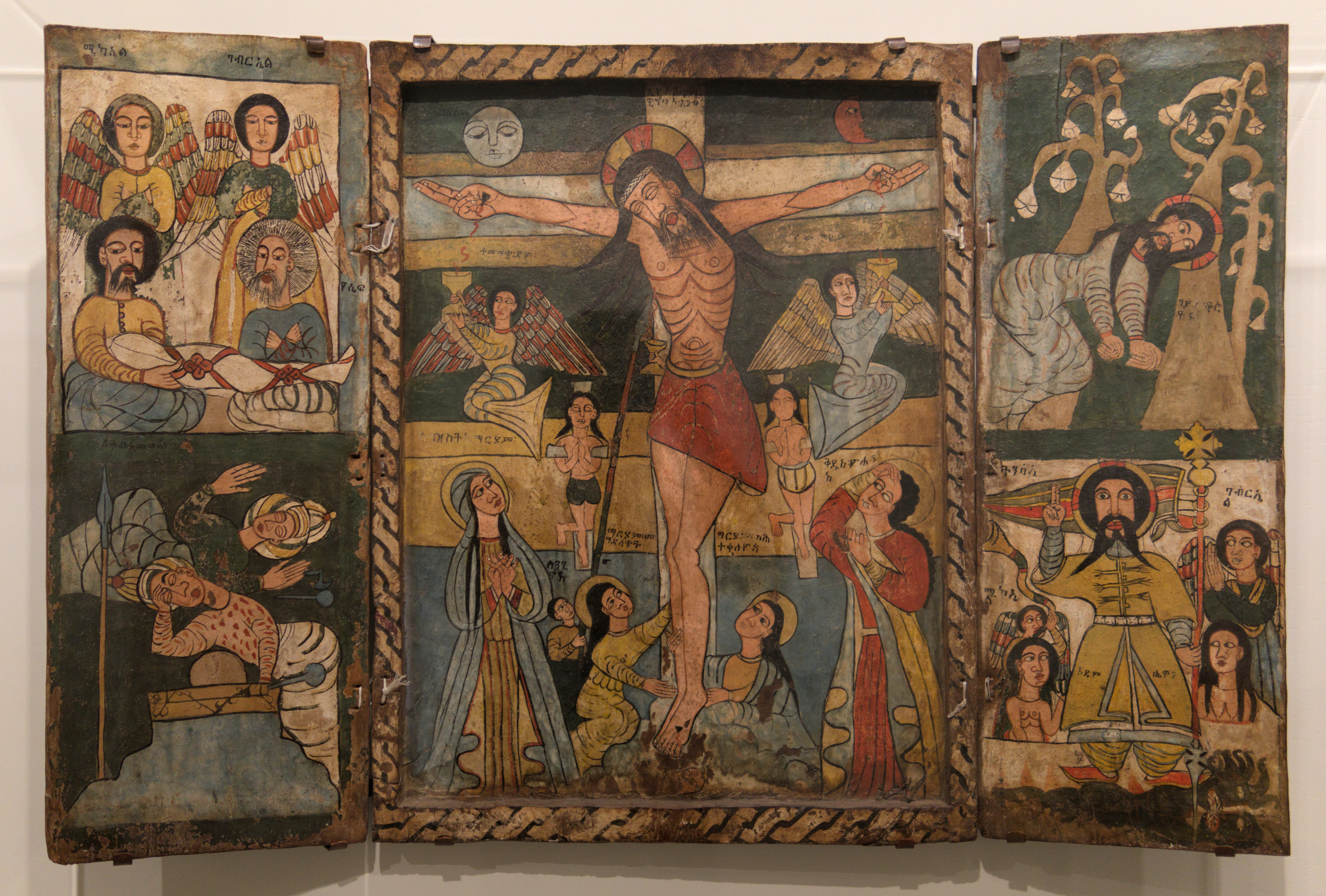
My favorite artwork from the exhibition is probably this triptych:
Crucifixion triptych
Triptych Icon with the Crucifixion (center), Entombment and Guards at the Tomb (left), and Temptation in the Wilderness and the Resurrection of Christ (right), Ethiopia, late 16th century. Tempera on gesso-primed wood. Institute of Ethiopian Studies, Addis Ababa University, acc. no. IESMus4126.

Its central panel depicts the Crucifixion, Christ’s head bowed in death and his fingers gesturing blessing, even as his palms are nailed. At the top, the sun and the moon mourn his passing. As we saw before, angels catch the blood that drips from his body (notice the cute little hand sticking out from behind his torso!). At the base, the two larger-scale figures are the Virgin Mary and St. John, while next to Mary on a smaller scale is Longinus, the centurion who pierces Christ’s side with a spear.

The left wing shows the Entombment of Christ, with two guards, wearing pointed turbans, sleeping at their post. The right wing shows a scene that the label identifies as “Temptation in the Wilderness” (presumably a translation of the inscription on the tree) but that looks to me more like an Agony in the Garden. Below that is the Resurrection, with Christ holding a victory banner, standing atop Hades. An angel blows a shofar and the dead rise up out of their graves, following Christ, the firstfruits of the resurrection (1 Cor. 15:20–22). Christ wears a short-sleeved, knee-length jacket with frog closures, and bunched sleeves and trousers, both of which reflect clothing from regions east of Africa.

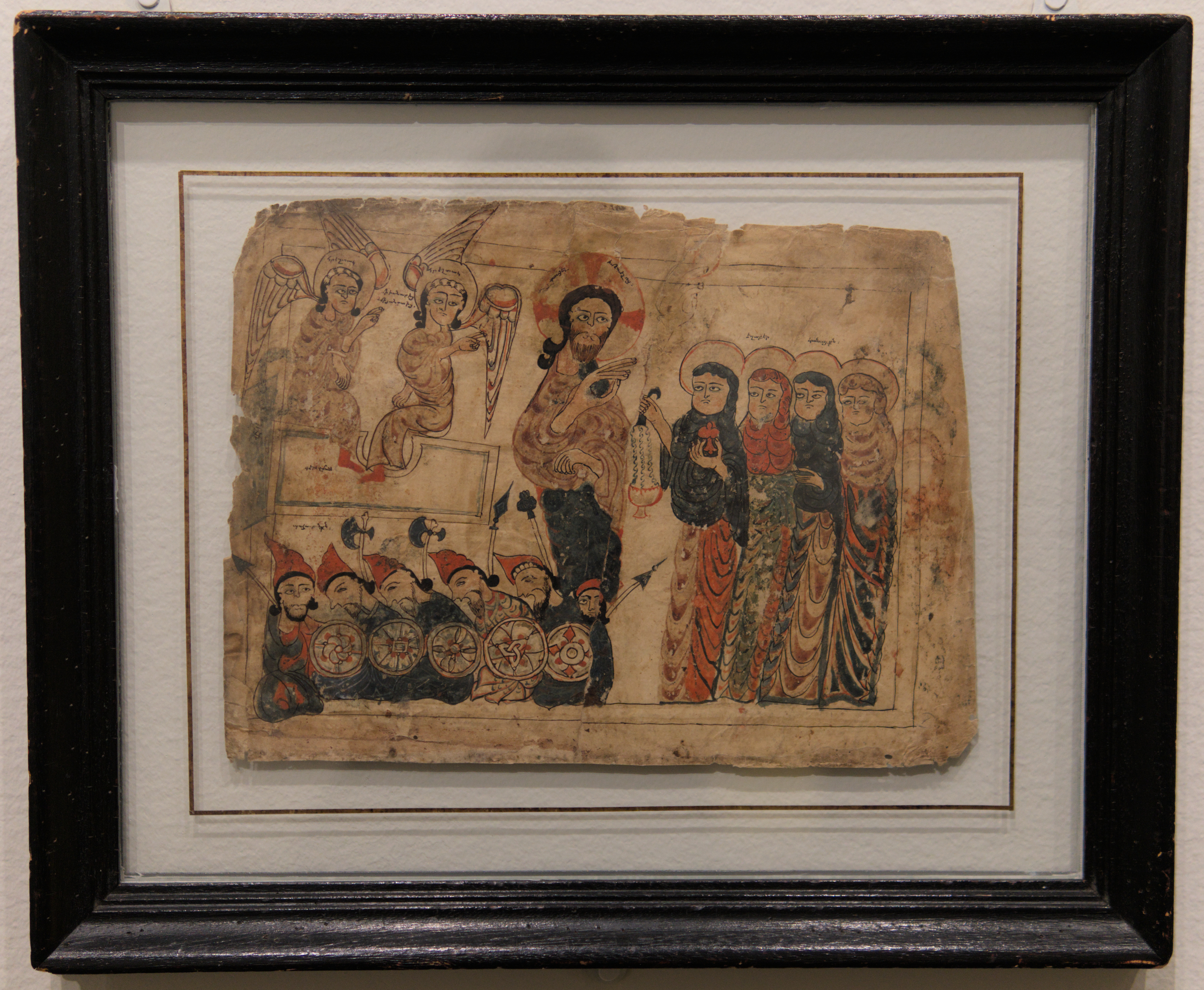
The wall text notes the fine, wavy lines used to render the figures’ draperies, perhaps influenced by Armenian artists from the Lake Van region.
Armenian Resurrection
Yovsian of Vaspurakan (Armenian), Leaf from a Gospel book with the Resurrection of Christ and Visit of the Women to the Tomb of Christ, ca. 1350. Tempera on cotton paper. Private collection.

Here’s another Crucifixion, this one painted in what’s called the Second Gondarine style, characterized by smoothly modeled figures, often with darker skin tones, and wide horizontal bands of red, yellow, and green filling the background:
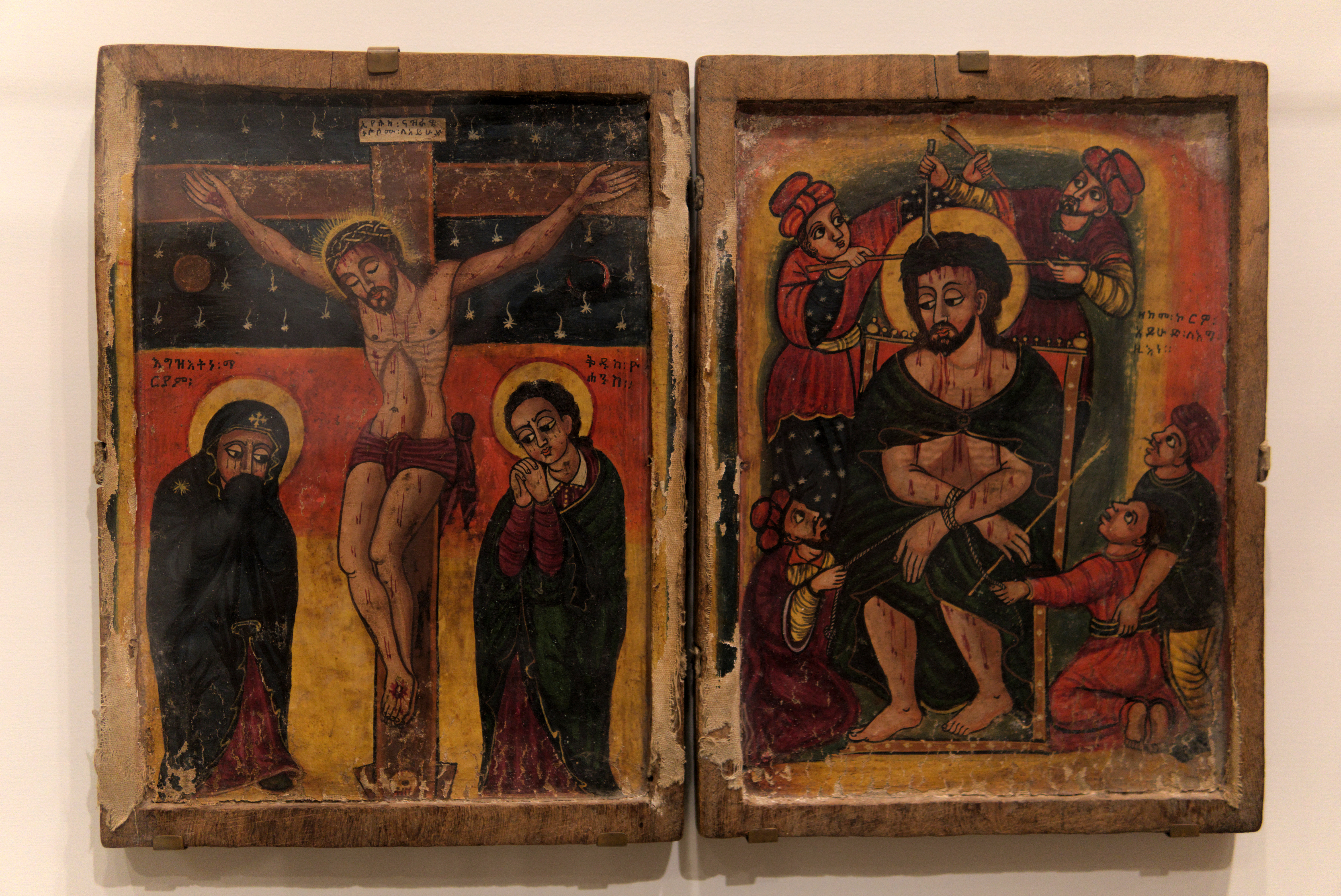
Crucifixion-Mocking diptych
Diptych Icon with the Crucifixion (left) and the Mocking of Christ (right), Ethiopia, late 17th–early 18th century. Wood, polychrome, 13 1/2 × 9 7/8 in. (34.3 × 25.1 cm). Virginia Museum of Fine Arts, Richmond. [object record]

The squiggles behind Christ at the top left may simply be a decorative motif, but to me they look like falling stars, an apocalyptic sign, and as if the sky is weeping.

The right panel of the diptych shows Christ being cruelly fitted with a crown of thorns.

Two other passion images I want to share are a Last Supper wall painting and an Entombment from a disbound album.
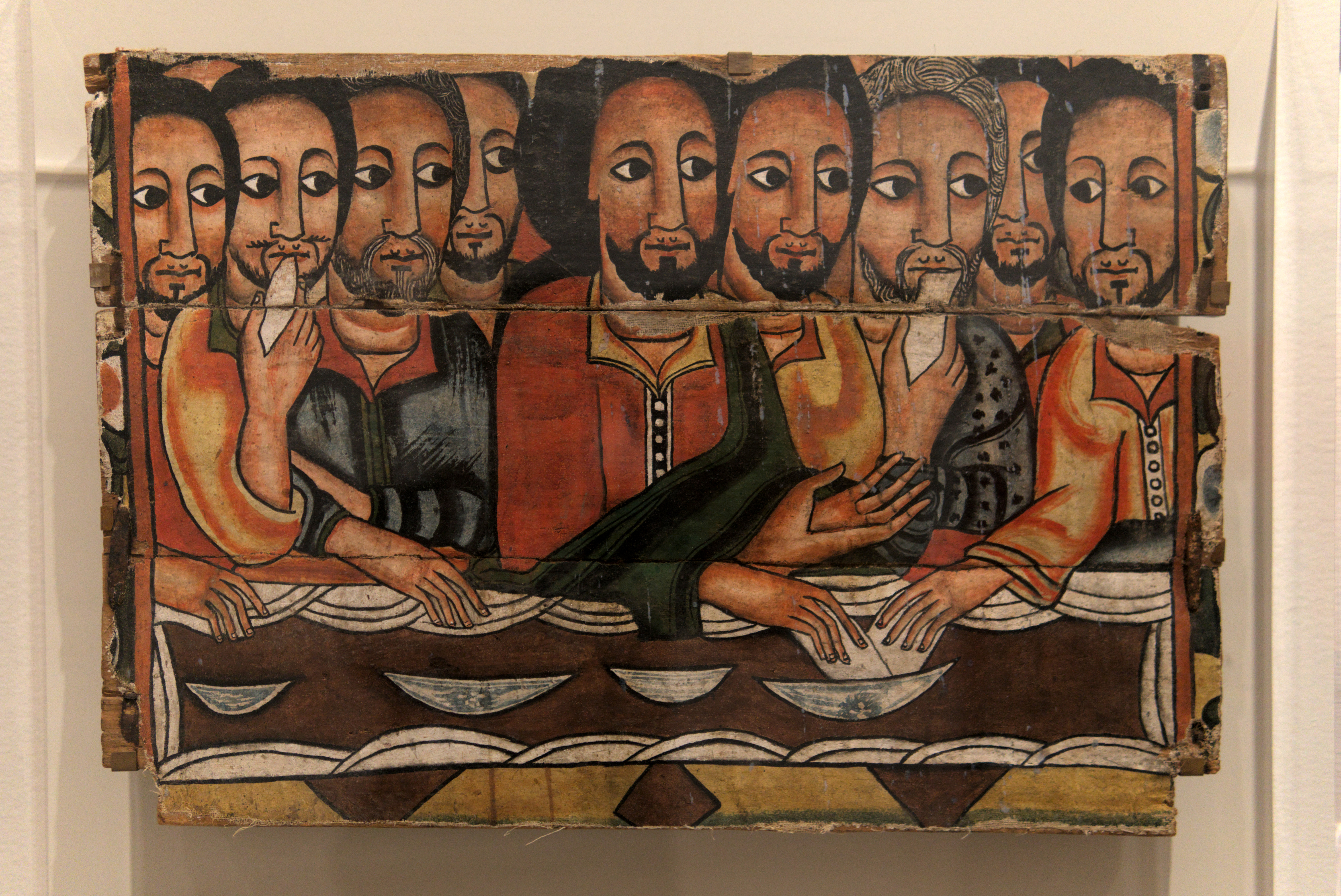
Last Supper
Last Supper, Ethiopia, 18th century. Tempera on linen, mounted on panel, 16 3/4 × 24 in. (42.6 × 61 cm). Virginia Museum of Fine Arts, Richmond. [object record]

Entombment
Album Leaf with the Entombment of Christ, Ethiopia (Sawa?), late 17th century. Pigments on vellum. Minneapolis Institute of Art, 2009.39.3y. [object record]

In the Last Supper, Jesus and Judas both dip their bread (injera!) into the same bowl and exchange a knowing glance.

In the Entombment, Jesus, wrapped in white linen, is lowered into the ground, mourned by several of his women followers. The portrayal of his mother Mary’s weeping, her hands covering her eyes and her face stained with tears, is particularly poignant. This leaf is from a set of forty-four, now matted separately but originally arranged in series and likely painted on several long sheets of parchment that were sewn together and folded accordion-style to form a sensul.

One of the most extraordinary objects on display is a rare folding processional icon that adopts the form of a fan, from the late fifteenth century:

Processional icon (Ethiopia)
Folding Processional Icon in the Shape of a Fan, Ethiopia, late 15th century (Stephanite). Ink and paint on parchment, thread, extended: 24 1/4 × 154 1/8 × 4 3/4 in. (61.6 × 391.4 × 12 cm). Walters Art Museum, Baltimore. Photo courtesy of the museum. [object record]

Thirty-eight identically sized figures span the surface of this elongated parchment: the early Christian martyrs Julitta (Juliet) and Cyricus, St. George, St. John the Baptist, the archangel Michael, the Virgin Mary, the archangel Raphael, St. Paul, the Ethiopian artist-priest Afnin, and unidentified Old Testament patriarchs and prophets. There would have been a wooden handle attached to either end that, when pulled together, created a double handle for a giant wheel to be displayed during liturgical processions and church services (see here). As the museum website notes, “The Virgin Mary, whose hands are raised in a gesture of prayer, is then at the top of the wheel. By depicting Mary in the company of saints and angels, the icon powerfully evokes the celestial community of the church.”

This is just a sampling of all the wonderful art objects that are a part of the Ethiopia at the Crossroads exhibition. I’ll share more photos on Instagram (@art_and_theology) in the coming weeks.

I strongly encourage you to go see this! I think it would be enjoyable for children as well, especially Christian children, who will be able to identify many of the painted stories. For Christians, it’s an opportunity to connect with our artistic heritage and with African church history. If you can’t catch the exhibition at the Walters in Baltimore before it closes March 3, it will be traveling to the Peabody Essex Museum in Salem, Massachusetts (April 13–July 7, 2024), and the Toledo Museum of Art in Ohio (August 17–November 10, 2024).

Also, a catalog is coming out in April, where you will find photos of all the artworks in addition to illuminating essays.

Roundup: Worship album by Parchman inmates, major new acquisition at Toledo Museum of Art, and more

SPOTIFY PLAYLIST: November 2023 (Art & Theology): In this month’s playlist I nod, in part, to All Saints’ Day (November 1), Christ the King Sunday (November 26), and world events. It includes “Ad Ana” (How Long), a setting of Psalm 13 in its original Hebrew by Miqedem (a Tel Aviv–based band made up of Shai Sol [previously] and three other musical artists from a mix of Jewish and Christian backgrounds), and “Touba” (Blessed), a sung recitation of the Beatitudes in Arabic by the Sakhnini Brothers [previously], Arab Christians from Nazareth, with oud and keyboard accompaniment.

As American Thanksgiving is November 23, you may also want to check out my Thanksgiving Playlist, comprising songs of gratitude. Originally created in 2021, each year I add to and remix the list as I encounter new recordings. One of the newer additions is “He Has Made Me Glad” by Leona Von Brethorst, based on Psalm 100, as arranged and performed on organ by the amazing Cory Henry.

The Christian life consists of both praise and lament, both tears and laughter—which is why in any given worship service or Art & Theology playlist or blog post, as in the biblical psalter, you can find songs that express joy and others, heaviness. They don’t negate one another but rather give fuller expression to the breadth of religious experience.

+++

NEW ALBUM: Some Mississippi Sunday Morning by Parchman Prison Prayer: After a bureaucratic process that took over three years, music producer Ian Brennan was finally granted permission in February to record a Sunday worship service at the Mississippi State Penitentiary, aka Parchman Farm, a notorious prison with a rich musical history. The prison chaplains convened a unique service of inmate singers from various Christian denominations ranging in age from twenties to seventies, who were given turns at the mic and even collaborated on a few tracks. Brennan said he wanted to give the men a platform for their voices to be heard. All profits from the album benefit the Mississippi Department of Corrections Chaplain Services.

Here’s “You Did Not Leave Me, You Bless Me Still,” a cover of a Melvin Williams gospel song sung by J. Sherman, age sixty-three.

“You can hear the way Sunday services are particularly restorative for someone incarcerated – not simply because of the promise of redemption, but the solace of not being alone,” writes Sheldon Pearce for the Guardian. “Some Mississippi Sunday Morning feels like these men reaching out for the things such a barbaric system tries to deny them: compassion, intimacy, and mercy. The songs are not just purges of anxieties accrued on the inside or calls for the Lord’s embrace, but also pleas to be acknowledged as a person and not an ID number.”

(Thanks to Art & Theology reader Ted Olsen for alerting me to this! He compared the album to Angola Prison Spirituals, recorded in the 1950s.)

+++

PODCAST EPISODE: “Sarah Clarkson: The Gift of Beauty,” Life with God: A Renovaré Podcast, October 20, 2023: Sarah Clarkson, author of This Beautiful Truth: How God’s Goodness Breaks into Our Darkness, speaks with Renovaré community life director Nathan Foster about her struggle with OCD and, amid the great suffering wrought by that illness, how God’s goodness has been mediated to her by beauty—in nature, poetry, music, story, tea, ritual, and so on. Responding to the idea that beauty is a luxury for the affluent, she says, “Well, [it is] if beauty is about having a perfect house. But beauty is healing those who have been hurt in a war zone. It’s creating shelters where children can have refuge. It’s rebuilding what has been destroyed. . . . Beauty is a defiance of the forces of evil and disorder and destruction because it is [their] opposite: where evil tears down, beauty creates; where there is absence, beauty fills.”

+++

PRESS RELEASE: “Toledo Museum of Art Adds Armenian Gospel Manuscript with 46 Paintings to the Collection”: After centuries passing through private collections, in June the Pozzi Gospels, a sixteenth-century illuminated manuscript from Armenia, entered the collection of the Toledo Museum of Art, which will make it more accessible to the public. (I’m not sure when the book will go on display. And it doesn’t have an object page on the museum’s website yet.) The artist and scribe of this extraordinary, sumptuous manuscript was Hakob Jughayets’i. His forty-six full-page miniatures and marginal decorations combine Christian iconography with Byzantine, Islamic, and Buddhist design elements. 

The Sam Fogg gallery, which exhibited the manuscript last year as part of The Medieval Body, created this short video about it, narrated by art historian Jack Hartnell:

Creation of Eve and Temptation (Pozzi Gospels)
Hakob Jughayets’i (Armenian, ca. 1550–1613), The Pozzi Gospels, 1586. Paper with blind-stamped brown leather binding, 403 folios with 46 full-page illuminations and numerous marginal miniatures, 7 3/4 × 5 3/4 in. (19.8 × 14.5 cm). This spread shows the Creation of Eve and the Temptation of Eve.

The Pozzi Gospels is one of nine extant illuminated manuscripts by Hakob. For more information, see Hakob’s Gospels: The Life and Work of an Armenian Artist of the Sixteenth Century by Timothy Greenwood and Edda Vardanyan (2006).

+++

VIRTUAL MUSIC COLLECTION: Armenian Spiritual Music Special Vol. 1: NTS Radio in London has curated ninety minutes of traditional Armenian Christian music. (They’ve done the same for Byzantine chant, Welsh hymns, Hildegard von Bingen, and numerous other categories.) I wish the lyrics and translations were provided, but regardless of my understanding of the words, what beauty. [HT: ImageUpdate]

Roundup: Christmas art Digitorial, Norwegian jazz, bluegrass “Carol of the Bells,” Chopin meets Hillsong, Armenian Gospel art

DIGITAL EXPERIENCE: “Holy Night: The Christmas Story and Its Imagery”: This “Digitorial”—a responsive, multimedia, educative webpage—was created as a supplement to a physical exhibition at the Liebieghaus Skulpturensammlung in Frankfurt that ran from October 12, 2016, to January 29, 2017, which brought together over one hundred paintings, sculptures, and other precious objects, mostly from medieval Germany, to tell the story of Jesus’s birth. Featured online are a magnificent Rhenish tapestry (seriously, click that link and zoom in!), an ivory relief carving, an altar, a wooden statuette of Mary with a removable flap on her belly that reveals the Christ child, a liturgical cradle and doll, a manuscript illumination, a woodcut, and more. Also included, for listening, are readings from the Revelations of Saint Bridget of Sweden (a fourteenth-century mystic whose vision of the nativity had widespread influence) and the Gospel of Pseudo-Matthew (source of the legend of the miraculous palm tree on the Holy Family’s flight to Egypt), as well as a lullaby from a medieval mystery play at Leipzig and perhaps also sung as part of the custom of Kindleinwiegen. Curator Stefan Roller introduces the exhibition in this video:

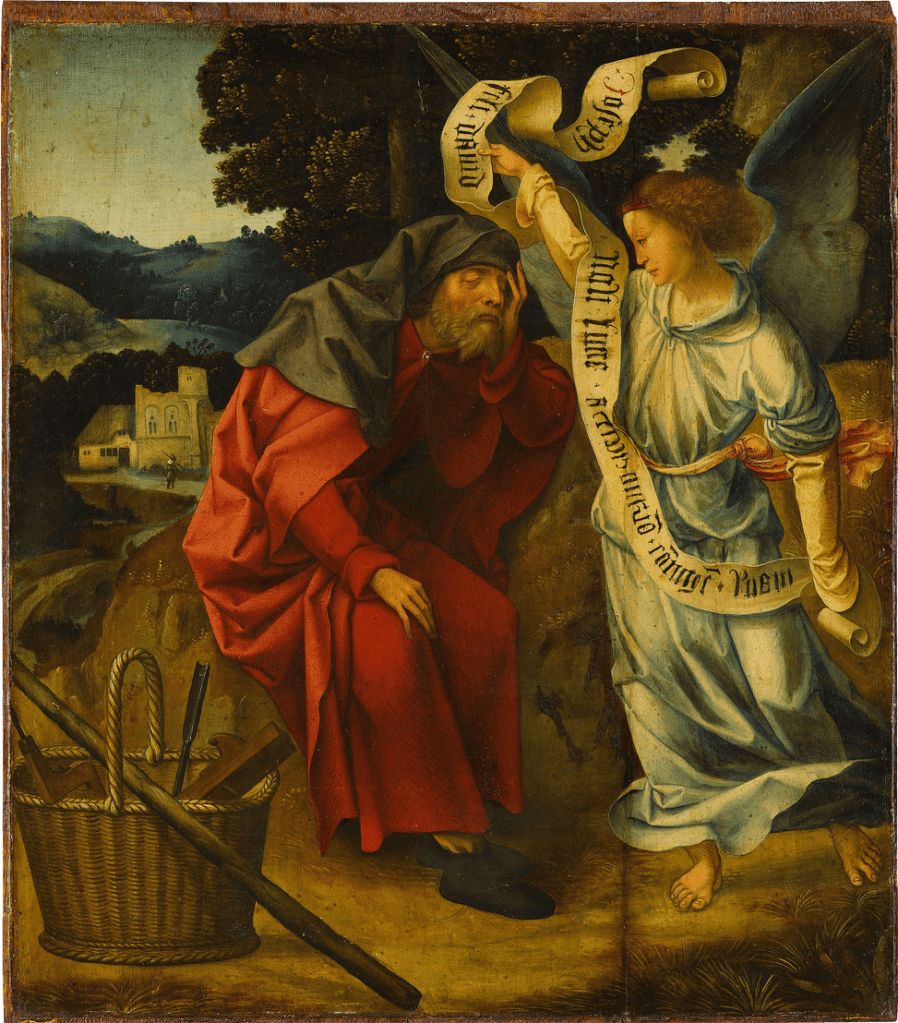
Joseph's First Dream (Antwerp)
The Angel Appears to Joseph in His Dream, 1518, from the predella of the Antwerp Altarpiece in the Lady Chapel of Saint Mary’s Church, Lübeck, Germany. Mixed media on oak, 46 × 40.2 cm. Staatsgalerie Stuttgart, Germany.

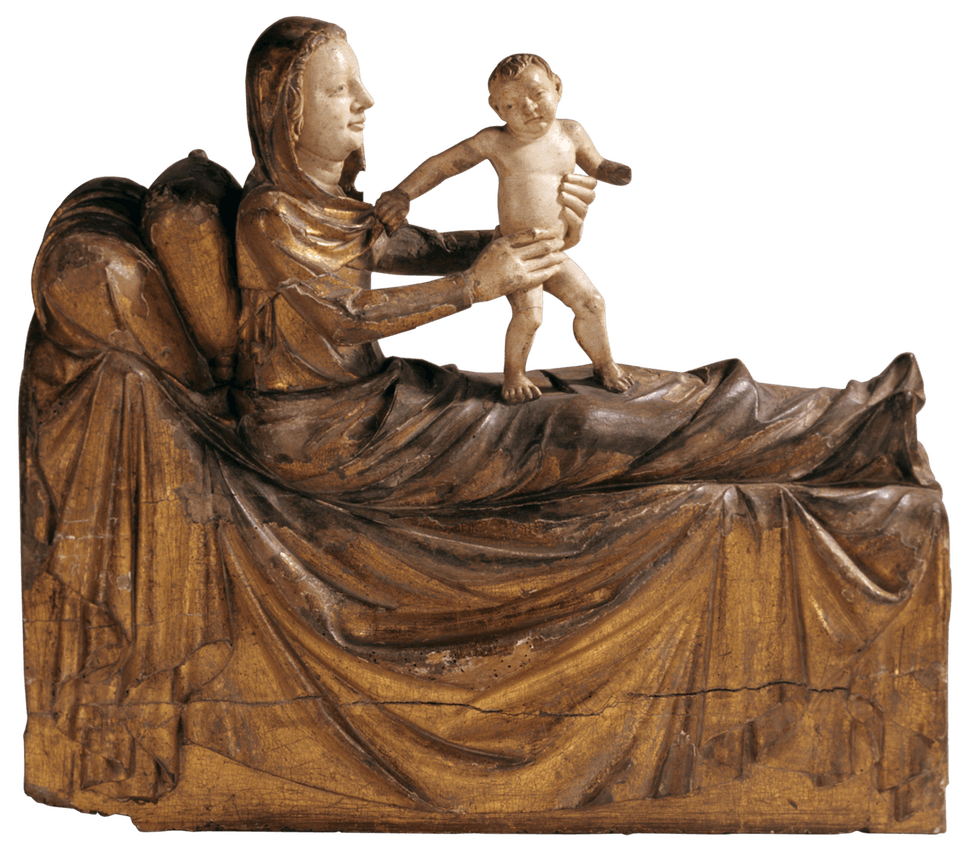
The Virgin Mary's Confinement
The Virgin Mary’s Confinement, Meuse region, ca. 1380. Walrus tooth with remains of the old coating, 51.8 × 58 × 14 cm. Badisches Landesmuseum, Karlsruhe, Germany. Photo: Thomas Goldschmidt.

The “Holy Night” Digitorial is written for a middle-grade reading level, I’d say; some of the narration seems geared toward kids. It doesn’t assume any knowledge of the Nativity story, and in addition to highlights from the biblical accounts, it mentions some apocryphal story elements, like Joseph’s backstory, the midwives at the birth, the palm tree and wheatfield miracles, and the identity of the “kings.” I appreciate how it covers the full story, including Jesus’s circumcision and the flight to Egypt. My only two wishes are that the images were provided in higher resolution and that full credits (especially the collection these objects are from) were given at the bottom. 

I really love the Digitorial format! It’s engaging. If I could afford it, I would endeavor to hire web designers to help me produce products like this. This one was designed and developed by Scholz & Volkmer with funding by the Aventis Foundation. More about Digitorials: “Digitorials are short, interactive, online editorials that combine text, images and animations into a meaningful whole and enable innovative storytelling. Digitorials are not intended to replicate or replace physical exhibitions. Rather, they are a useful way of adding breadth and depth, and are usually used before or after visiting an exhibition. The format was developed by the Städel Museum, Liebieghaus Skulpturensammlung and Schirn Kunsthalle in Frankfurt and is breaking new ground in art mediation, as it uses digital technology to offer an accessible and approachable way of engaging with art. It has already been awarded the Grimme-Preis.” See other examples: https://www.staedelmuseum.de/en/digitorial; https://www.liebieghaus.de/de/angebote/digitorial; https://www.schirn.de/en/program/offerings/digitorial/.

+++

SONGS:

>> “Jeg Synger Julekvad” (In dulci jubilo): This Christmas hymn of German origin often appears in English-language hymnals as “Good Christian Men, Rejoice!” or the gender-neutral “Good Christian Friends, Rejoice!” This jazz arrangement by Heidi Skjerve, with Norwegian lyrics by Magnus Brostrup Landstad, is performed by Skjerve (she’s the vocalist on the left) and students from the Norwegian University of Science and Technology (NTNU) Department of Music [previously]. The other two vocalists are Liv Ellen Rønning and Jakob Leirvik. See the full list of musicians in the YouTube description. [HT: Global Christian Worship]

>> “Carol of the Bells,” arr. Al White, performed by the Berea College Bluegrass Ensemble: Al White, who taught Appalachian instruments at Berea College in Kentucky until retiring in May, founded the Berea College Bluegrass Ensemble in fall 1999 to give students with backgrounds or potential in bluegrass music an opportunity to play in a bluegrass band with weekly rehearsals, performances, and travel. This is one of the many arrangements he wrote—sometime around 2008. In this 2016 video, recorded inside Berea’s Danforth Chapel and outdoors, White plays mandolin and leads four other musicians: Brenna Macmillan on banjo and vocals and Theo Macmillan on fiddle (the two are siblings, now performing and recording as the Theo & Brenna Band), Matt Parsons on guitar, and Casey Papendieck on upright bass (he’s part of the Handshake Deals). As of this fall, the Berea College Bluegrass Ensemble is under the direction of Sam Gleaves. [HT: Global Christian Worship]

>> “Peace Upon the Earth” by Hillsong Worship: Since being introduced to Chopin by my piano teacher as a kid, he’s been one of my favorite composers to play—his etudes, nocturnes, waltzes, fantasias. In this 2017 song from Hillsong’s Christmas: The Peace Project, Marty Sampson wrote lyrics for Chopin’s Nocturne in E-flat major (op. 9, no. 2), which actually works really well! It’s a beautiful handling of the iconic melody. Starting at 3:44, Sampson talks about his songwriting process. He says he was inspired by “Hark! the Herald Angels Sing,” which came about when William Hayman Cummings adapted the melody of “Vaterland, in deinen Gauen,” a song from Mendelssohn’s secular Gutenberg Cantata, to fit Charles Wesley’s hymn text.

+++

NEW ACQUISITIONS: “2 Armenian Manuscripts Join the Getty Collection”: This year the J. Paul Getty Museum in Los Angeles acquired, among other art objects, (1) a detached leaf with a full-page Nativity illumination from a seventeenth-century Armenian Gospel-book, and (2) a sixteenth-century Armenian Gospel-book illuminated by a brother and sister team, Ghoukas and Eghisabet. (A female illuminator named in an early modern manuscript—woot woot!) “Little is known about the involvement of women in the trade of manuscript illumination, but we hope that highlighting figures like Eghisabet will spark further research and understanding about their role,” write Elizabeth Morrison and Nava Streiter in this Getty blog post.

Mesrop of Khizan (Armenian, active 1605–1651), The Nativity with the Adoration of the Shepherds and Magi, from a Gospel-book made in Isfahan, Persia, 1615. Tempera, gold, and ink on parchment, 23 × 16 cm. J. Paul Getty Museum, Ms. 118 (originally from Ms. Ludwig II 7).

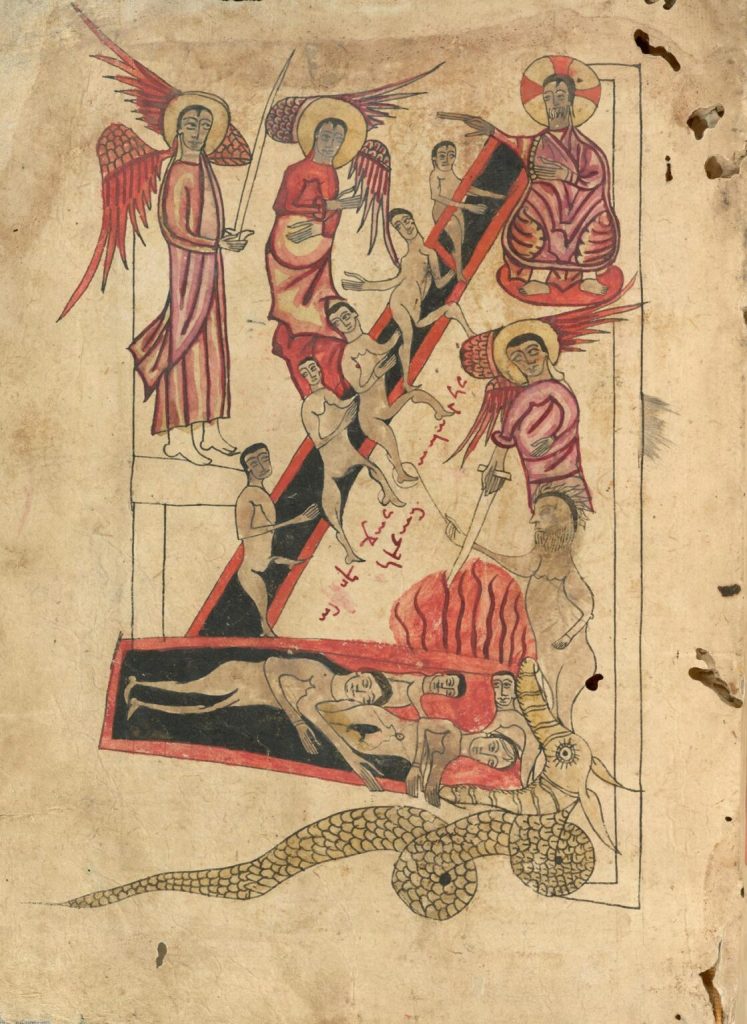
The Way into Eternal Life
Eghisabet (Armenian), The Way into Eternal Life, from an Armenian Gospel-book, 1583. Tempera and ink on parchment, 24.8 × 17.9 cm. J. Paul Getty Museum, Ms. 119, fol. 6v.

Ms. 119 is now the third Armenian Gospel-book in the museum’s collection, and Morrison and Streiter compare one of the illumination subjects side-by-side across all three books—in addition to providing visual comparisons with Ethiopian and Byzantine Gospel-books.

Roundup: Round dance of praise; minimalist church architecture; Psalm 46 sung in Spanish; Armenian Christian heritage destroyed; and more

Image journal subscriptions are 50% off through the summertime—only $24 for four full-color issues! This is the magazine I most look forward to receiving in the mail. So much great poetry, art, essays, and more.

+++

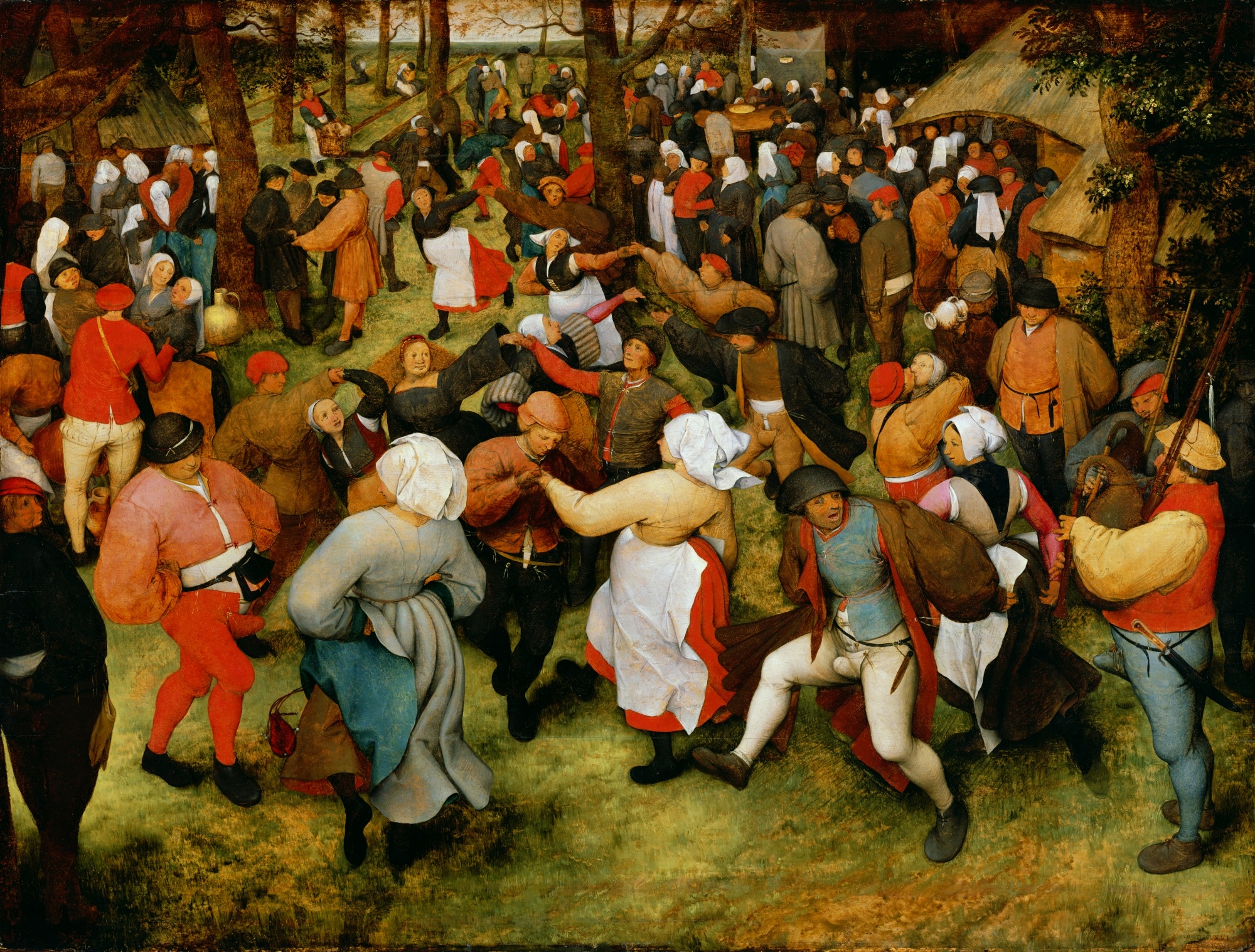
NEW POEM: “They Too Go Round” by Paul Mariani: This poem from the current issue of Image journal (no. 101) brings together Pieter Bruegel the Elder’s Wedding Dance with Fra Angelico’s Last Judgment at San Marco, gesturing toward a vision in which the terrestrial is taken up into the celestial. Bruegel’s Dutch peasant dancers “pound” and “rollick” with beer foam on their faces and general bawdiness; the saints from the Fra Angelico painting, by contrast, step lithely and with reverence in their round dance on the very grasses of paradise. Disparate though they are in tone, Mariani connects these two images, playing with the idea of circling. Just as the wedding guests dance round and round, so too does time; so too the spheres. And at the center of this cosmic round dance is praise: humanity linked hand in hand with the angels, not closed in on themselves but opening up into the glory of God.

The Wedding Dance by Pieter Bruegel the Elder
Pieter Bruegel the Elder (ca. 1525–1569), The Wedding Dance, ca. 1566. Oil on panel, 119.3 × 157.4 cm. Detroit Institute of Arts, Michigan, USA.

Fra Angelico_Last Judgment
Fra Angelico (ca. 1395–1455), The Last Judgment (detail), ca. 1431. Tempera on wood, 105 × 210 cm. Museum of San Marco, Florence, Italy.

The last stanza quotes an excerpt from a famous medieval Catholic prayer: “Sinning daily, and not repenting, the fear of death disturbs me, for there is no redemption in Hell. Have mercy on me, O God, and save me.” The speaker’s anxiety has been building up as he reflects on the empty pleasures to which he has been so long devoted and the imminence of death. This anxiety, however, is swept away in one turn as he catches a glimpse of God’s abundant salvation and its final consummation—a “sea-changing moment, now and forever.” Christ, the fulfillment of all desire, sits on his throne at the center of this turning world, beckoning us into the dance of the redeemed.

(FYI, Paul Mariani will be one of the plenary speakers at the Catholic Imagination Conference at Loyola in September. Registration is still open!)

+++

CHURCH ARCHITECTURE: Known for his work in concrete, Spanish architect Fernando Menis designed the new Holy Redeemer Church in Tenerife, Spain, consecrated May 12. I’m digging the minimalism. Learn more and view more photos on the architect’s website. [HT: ArtWay]

Holy Redeemer Church (Tenerife)
Holy Redeemer Church, Tenerife, Spain. Designed by Fernando Menis, completed 2019.

Holy Redeemer Church (Tenerife)
Interior: Holy Redeemer Church, Tenerife, Spain. Designed by Fernando Menis, completed 2019.

+++

CHORAL ARRANGEMENT: “Dios es Nuestro Amparo” (God Is Our Refuge), arr. Alfredo Colman: I love this traditional setting of Psalm 46 in Spanish, recently arranged by Alfredo Colman and performed by the Coro del Seminario Internacional Teológico Bautista (Choir of the International Baptist Theological Seminary) in Buenos Aires, Argentina. [HT: Global Christian Worship]

I was curious about the history of the song, so I wrote to Colman; he said he first encountered it in Paraguay, where he grew up, but doesn’t know its country of origin. The song, he told me, has been well known in Latin America since the 1970s. While this particular arrangement of Colman’s has not yet been published, you can find a simpler arrangement for congregational singing in the bilingual hymnal Santo, Santo, Santo: Cantos para el pueblo de Dios / Holy, Holy, Holy: Songs for the People of God, released just this month. Edited by the Calvin Institute of Christian Worship (CICW) in partnership with GIA Publications, it contains over 700 songs in Spanish and English.

For a vision and resources for singing together in Spanish and English, see this recorded CICW workshop, led by Colman and five others, and also the article “Expand Your Church’s Bilingual Music Repertoire.” Introducing bilingual music to a church congregation is “like introducing a new vegetable to toddlers,” says María Eugenia Cornou, the CICW program manager for international and intercultural learning. “Some kids love it, but usually it takes time. It’s a new flavor.”

+++

CULTURAL DESTRUCTION: “A Regime Conceals Its Erasure of Indigenous Armenian Culture” by Simon Maghakyan and Sarah Pickman: An investigative report published in February exposed Azerbaijan’s destruction of thousands of medieval Christian Armenian artworks and objects at the necropolis of Djulfa in Nakhichevan. The cemetery at Djulfa contained the world’s largest collection of khachkars, ornately carved memorial steles with crosses, characteristic of Armenian Christianity; 2,920 were documented clandestinely by native Argam Ayvazyan from 1964 to 1987, half of the 5,840 he documented in Nakhichevan as a whole. But, other than the dozen that were removed from the region during or before the Soviet era into church or museum collections, all these were demolished by Azerbaijani soldiers in 1997, 2002, and 2005–6, expunging the region’s last remaining traces of Christianity. (This was in addition to the demolition of 89 Armenian churches and 22,000 tombstones in Nakhichevan.)

Djulfa cross-stone
A 1915 photograph of researcher Aram Vruyr’s son with one of many thousand khachkars (cross-stones) at Djulfa, enhanced by Judith Crispin’s Julfa Cemetery Digital Repatriation Project. Courtesy Aram Vruyr Archives.

St. Thomas Cathedral (Armenia, now lost)
Surb Tovma (St. Thomas Cathedral) in Agulis, Nakhichevan, Azerbaijan, which tradition states was founded as a chapel by Bartholomew the Apostle. Now destroyed. Photo © Argam Ayvazyan Archives, 1970–1981.

“Unlike the self-publicized cultural destruction of ISIS, independent Azerbaijan’s covert campaign to re-engineer Nakhichevan’s historical landscape between 1997 and 2006 is little known outside the region. . . . While some Azerbaijanis have embraced their government’s vandalism as either righteous revenge or a national security measure against potential Armenian territorial claims, other Azerbaijanis . . . have mourned the destruction.”

Here is a short video posted in December 2005 by Nshan Topouzian, the leader of north Iran’s Armenian church, who was tipped off to the destructive activity taking place at the Djulfa cemetery by an Iranian border patrol. (Djulfa is located at the border of Azerbaijan and Iran.)

Hyperallergic pointed out the “cruel irony” and “insult” of Azerbaijan hosting UNESCO’s World Heritage Committee session earlier this month. UNESCO not only avoided a public condemnation of the destruction of Armenian Christian artifacts and churches in Nakhichevan but also praised Azerbaijan (one of its biggest donors) as a “land of tolerance.”

+++

ARTICLE: “6 Works of Classical Music Every Christian Should Know” by Jeremy Begbie: Theologian and pianist Jeremy Begbie is a superstar in the field of theology and the arts. Most of his books, published for academic audiences, are pretty dense, but this article that he wrote for The Gospel Coalition is wonderfully accessible. It opens, “Why bother with classical music? On the face of it, it seems like a serious indulgence to give time and attention to something so trivial as music—classical or otherwise. Yet the fact remains that no human society, however impoverished, has yet managed to do without music in some form. The impulse to sing, to blow air through wooden tubes, and to draw hair across strings seems ineradicable. What’s more, it’s long been recognized that people pour their deepest longings and passions into music-making. Music can be a remarkable index of the profoundest impulses and stirrings of a culture—impulses and stirrings that are often theologically charged.”

He then recommends six works of classical music to spend time with, highlighting the best recordings and musical guides available. From the “bubbling, joyful abundance” of a Mozart piano concerto (“a fresh iteration of creation’s hallelujah”) to the “aching beauty” of Rachmaninov, there’s variety here. Find out what Begbie considers to be “the greatest Christian musical achievement of the early modern era,” and which symphony contains, from its penultimate to final movement, one of the best transitions in Western music.

Begbie is the founder Duke Initiatives in Theology and the Arts, and the program is throwing a big symposium in September to celebrate its ten-year anniversary. I’ll be there! Join me? If you can’t swing the registration cost but live in the Triangle area of North Carolina, consider coming out on Saturday night to “Making All Things New: The Sound of New Creation,” a concert featuring a range of music, “from Bach to Bernstein, Rachmaninov to Latino, medieval to jazz, concert music to film music,” as well as a reflection by N. T. Wright. I attended a similar Begbie-led concert at Duke two years ago, and it was phenomenal.

+++

FILM: Ida (2013), dir. Pavel Pawlikowski: This Oscar Award–winning film about identity and faith is a great watch, especially for its stunning cinematography by Lukasz Zal and Ryszard Lenczewski. Shot in high-contrast black-and-white in the classic 4:3 format, it is almost entirely made up of static frames, exquisitely composed. I really just can’t get over the visuals. Watch the trailer and film clip below, and you’ll get a sense of what I mean. The movie is available on Kanopy, an on-demand streaming service provided for free by many public libraries.