The Rich Young Ruler (Artful Devotion)

'For he had great possessions' by George Frederic Watts
George Frederic Watts (British, 1817–1904), ‘For he had great possessions,’ 1894. Oil on canvas, 139.7 × 58.4 cm. Tate Britain, London.

And as he was setting out on his journey, a man ran up and knelt before him and asked him, “Good Teacher, what must I do to inherit eternal life?”

And Jesus said to him, “Why do you call me good? No one is good except God alone. You know the commandments: ‘Do not murder, Do not commit adultery, Do not steal, Do not bear false witness, Do not defraud, Honor your father and mother.’”

And he said to him, “Teacher, all these I have kept from my youth.”

And Jesus, looking at him, loved him, and said to him, “You lack one thing: go, sell all that you have and give to the poor, and you will have treasure in heaven; and come, follow me.”

Disheartened by the saying, he went away sorrowful, for he had great possessions.

—Mark 10:17–22 (cf. Matthew 19:16–30; Luke 18:18–30)

+++

SONG: “Iesū Me Ke Kanaka Waiwai” (Jesus and the Rich Young Man) | Words and music attributed to John Kamealoha Almeida, 1915 | Performed by Mark Yamanaka, with Sean Naleimaile, 2018

The origins of this song are debated, which is why it often circulates with the credit “Traditional,” but many sources attribute it to John K. Almeida (1897–1985), a famous singer, songwriter, and bandleader from Oahu, who said he wrote it in 1915. According to music archivist Harry B. Soria Jr., Almeida offered “Kanaka Waiwai” to the Mormon Church, of which he was a member, but his gesture was turned down when the piece was deemed too “hula sounding” and unsuitable for a worship service [liner notes, John Kameaaloha Almeida (HanaOla Records, 2003)].

Almeida first recorded it, along with secular mele (songs), in 1946, accompanied by Genoa Keawe’s Trio. It gained immense popularity in 1971, when the Sons of Hawaii recorded it with Moe Keale on vocals. Now it is one of Hawaii’s best-loved hymns and is widely performed not only in recording studios but in churches. I’ve combed through dozens of performances to find what I consider the best, which is Mark Yamanaka’s. You’ll notice he employs a characteristic Hawaiian vocal technique known as leo ki’eki’e (“high-pitched voice”), a yodel-like break between registers. The video above is from a HiSessions acoustic live session shot earlier this year, but you can also hear him singing the song on his 2013 album Lei Maile.

Ma ke alahele ʻo Iesû
I hālāwai aku ai
Me ke kanaka ʻōpio hanohano
Kaulana i ka waiwai
Pane mai e ka ʻōpio
ʻE kuʻu Haku maikaʻi
He aha hoʻi kaʻu e hana aku ai
I loaʻa e ke ola mau?

E hāʻawi, e hāʻawi lilo
I kou mau waiwai
Huli a hahai mai iaʻu
I loaʻa e ke ola mau ia ʻoe

Minamina e ka ʻōpio
I kona mau waiwai
I ke kūʻai a hāʻawi lilo aku
I ka poʻe nele a hune
Huli aʻe ʻo Iesū lā
Pane aku i ka ʻōpio
ʻAʻole aʻe hiki ke kanaka waiwai
I ke aupuni o ka lani

A literal English translation, by Haunani Bernardino, is as follows:

Along the road, Jesus
Met
With a distinguished young man
Who was known for his wealth.
The young man said,
“My good lord,
What must I do
To gain eternal life?”

“Give, give away all
Of your possessions,
Then come and follow me
In order to gain eternal life.”

The young man grieved
Over his wealth,
Unwilling to sell and give all
To the poor and destitute.
Jesus then turned
And answered the man,
“Rich man, you will not enter
The Kingdom of Heaven.” [source]

When the song is sung in English, however (even by native Hawaiians), a completely different set of lyrics is used, going something like this:

Let me walk through paradise with you, Lord
Take my hand and lead me there
All my earthly treasures I will gladly give
Teach me how to love and how to share

Greed and lust and vanity were mine, Lord
Till I found your love divine
Now on my knees I pray that I will find a way
Let me walk through paradise with you

Oh, my Lord, my Savior
Guide my poor feet along that lonely road
Faith and hope and love will light the way before me
And I’ll walk through paradise with you

Oh, my Lord, my Father
Take my hand and lead me to paradise
Oh, my Lord, let me follow in your footsteps
Let me walk through paradise with you

I’m not sure where these lyrics originated, nor why a closer approximation of the original has not been attempted. This English rewrite drastically changes the content of the song, shifting it from a retelling of a Gospel narrative that ends on a sad note to a personal prayer that, while touching on some of the themes of the rich man’s encounter with Jesus, is sweet and bright and indicates conversion. One could say it’s a revisionist account told in the rich man’s voice—if he had surrendered to Jesus’s call rather than resisted, unwilling to give up his material wealth. He is thus held up as a positive model in this version, and we are enjoined to respond with similar boldness of vow (“All my earthly treasures I will gladly give”) and fervency of petition (“Let me walk through paradise with you”).

In the following video, an unnamed woman with beautiful vocals performs this English version to a simple ukulele accompaniment:


This post belongs to the weekly series Artful Devotion. If you can’t view the music player in your email or RSS reader, try opening the post in your browser.

To view all the Revised Common Lectionary scripture readings for Proper 23, cycle B, click here.

Let the Children Come (Artful Devotion)

Jesus with Children (thangka)
Detail of a Himalayan “Life of Christ” thangka, 19th century. Private collection of Terry Anthony. (Click on image to learn more)

And they were bringing children to him that he might touch them, and the disciples rebuked them. But when Jesus saw it, he was indignant and said to them, “Let the children come to me; do not hinder them, for to such belongs the kingdom of God. Truly, I say to you, whoever does not receive the kingdom of God like a child shall not enter it.” And he took them in his arms and blessed them, laying his hands on them.

—Mark 10:13–16

+++

MUSIC: “Children’s Medley” | Solo piano arrangement by Marilynn Ham, 1985 | Performed by Cheryl Johnston, 2011

Marilynn Ham is probably my favorite arranger of sacred piano music—I own many of the books she’s published over the decades. “Children’s Medley” is from Ivory Exaltation: Arrangements for the Advanced Pianist, and here a parishioner from Green Valley United Methodist Church in Henderson, Nevada, performs it at the beginning of a worship service as an acolyte processes forward to light the two candles at the altar. In this context, the piece functions as a call to worship, combining “Praise Him, All Ye Little Children” by Carey Bonner with excerpts from Mozart’s Piano Sonata in C Major, “Jesus Loves Me” by William Batchelder Bradbury, and “Music Box Dancer” by Frank Mills. While these two primary songs are often sung by kids (whose belonging they affirm), they hold truth for people of all ages, for we are all called to come into God’s presence like little children—praising him with wonder and excitement, loving him without conditions, relying on his strength, receiving his love.

I have fond memories of singing both of these songs in children’s church when I was young. “Praise Him, All Ye Little Children,” not quite as familiar as “Jesus Loves Me,” was written by a Baptist minister from England who served as the General Secretary of the National Sunday School Union from 1900 until 1929. In 1905 it was published in The Sunday School Hymnary: A Twentieth Century Hymnal for Young People, a 674-page songbook Bonner compiled, now in the public domain. Here’s an adorable little two-year-old girl singing the first verse:

Praise Him, praise Him, all ye little children,
God is love, God is love;
Praise Him, praise Him, all ye little children,
God is love, God is love.

Love Him, love Him, all ye little children,
God is love, God is love;
Love Him, love Him, all ye little children,
God is love, God is love.

Thank Him, thank Him, all ye little children,
God is love, God is love;
Thank Him, thank Him, all ye little children,
God is love, God is love.

If you’re an advanced pianist and you liked Ham’s medley arrangement above, you will also want to check out “The Child in Each of Us” in Notes from a Thankful Heart, a medley of “Chopsticks,” “Deep and Wide,” “Running Over,” “If You’re Happy and You Know It,” and “I Am a ‘C.'” I have such fun playing these!


This post belongs to the weekly series Artful Devotion. If you can’t view the music player in your email or RSS reader, try opening the post in your browser.

To view all the Revised Common Lectionary scripture readings for Proper 22, cycle B, click here.

If It Had Not Been (Artful Devotion)

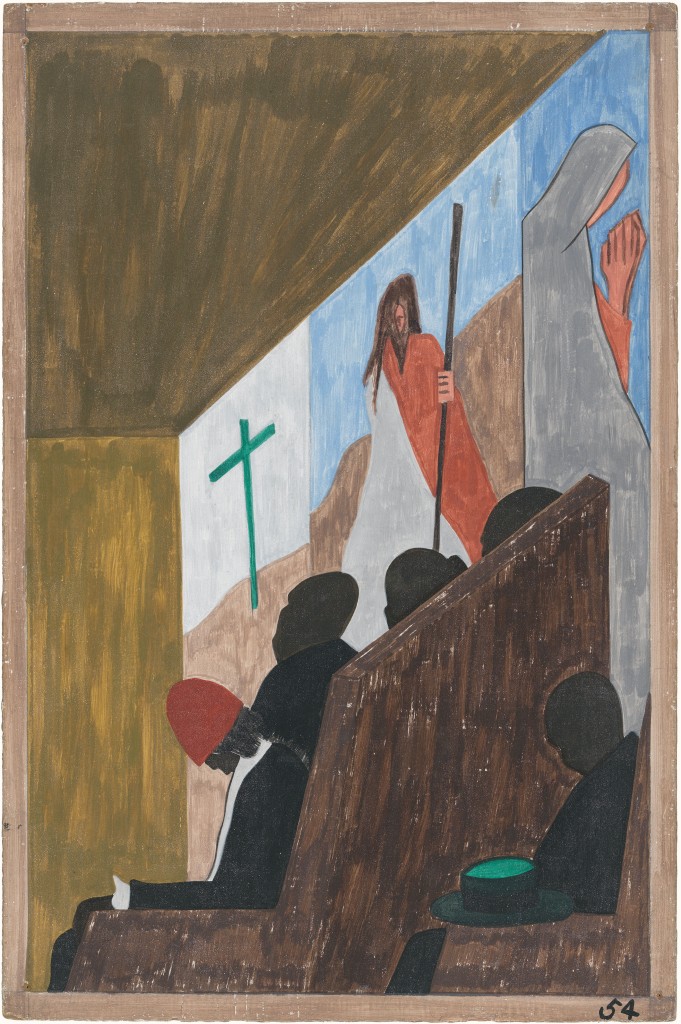
Great Migration 54 by Jacob Lawrence
Jacob Lawrence (American, 1914–2000), The Migration of the Negro (panel 54), 1941. Casein tempera on hardboard, 18 × 12 in. (45.7 × 30.5 cm). Museum of Modern Art, New York.

If it had not been the LORD who was on our side—
let Israel now say—
if it had not been the LORD who was on our side
when people rose up against us,
then they would have swallowed us up alive,
when their anger was kindled against us;
then the flood would have swept us away,
the torrent would have gone over us;
then over us would have gone
the raging waters.

Blessed be the LORD,
who has not given us
as prey to their teeth!
We have escaped like a bird
from the snare of the fowlers;
the snare is broken,
and we have escaped!

Our help is in the name of the LORD,
who made heaven and earth.

—Psalm 124

+++

SONG: “If It Had Not Been for the Lord” | Words and music by Margaret Pleasant Douroux, 1980 | Performed by Lynda Randle (vocals) and Andraé Crouch (piano), 2001


This post belongs to the weekly series Artful Devotion. If you can’t view the music player in your email or RSS reader, try opening the post in your browser.

To view all the Revised Common Lectionary scripture readings for Proper 21, cycle B, click here.

Resist (Artful Devotion)

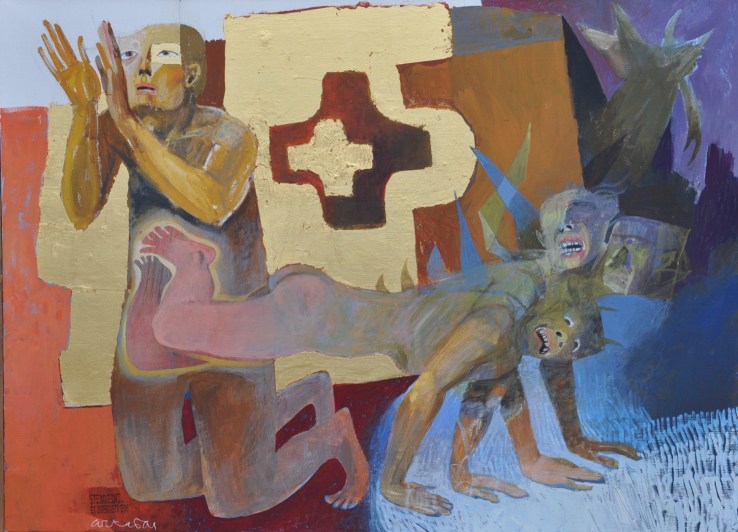
Prayer by Arcabas
Painting by Arcabas (French, 1926–2018)

Submit yourselves therefore to God. Resist the devil, and he will flee from you.

—James 4:7

+++

SONG: “Way Down in the Hole” by Tom Waits, on Franks Wild Years (1987)


This post belongs to the weekly series Artful Devotion. If you can’t view the music player in your email or RSS reader, try opening the post in your browser.

To view all the Revised Common Lectionary scripture readings for Proper 20, cycle B, click here.

Preaching Skies (Artful Devotion)

Untitled (No. 29) by Fumihiro Kato
Fumihiro Kato (Japanese, 1958–), Untitled (No. 29). Oil on canvas, 91 × 116.7 cm.

The heavens declare the glory of God,
and the sky above proclaims his handiwork.
Day to day pours out speech,
and night to night reveals knowledge.
There is no speech, nor are there words,
whose voice is not heard.
Their voice goes out through all the earth,
and their words to the end of the world.

In them he has set a tent for the sun,
which comes out like a bridegroom leaving his chamber,
and, like a strong man, runs its course with joy.
Its rising is from the end of the heavens,
and its circuit to the end of them,
and there is nothing hidden from its heat.

—Psalm 19:1–6 (ESV)

God’s glory is on tour in the skies,
God-craft on exhibit across the horizon.
Madame Day holds classes every morning,
Professor Night lectures each evening.

Their words aren’t heard,
their voices aren’t recorded,
But their silence fills the earth:
unspoken truth is everywhere.

God makes a huge dome
for the sun—a superdome!
The morning sun’s a new husband
leaping from his honeymoon bed,
The daybreaking sun an athlete
racing to the tape.

That’s how God’s Word vaults across the skies
from sunrise to sunset,
Melting ice, scorching deserts,
warming hearts to faith.

—Psalm 19:1–6 (The Message)

+++

SONG: “The Spacious Firmament” | Words by Joseph Addison, 18th century | Music by Herbert Sumsion, 20th century | Performed by the Ecclesium Choir, 2005

The spacious firmament on high,
With all the blue ethereal sky,
And spangled heavens, a shining frame,
Their great Original proclaim.

The unwearied sun from day to day
Does his Creator’s power display,
And publishes to every land
The work of an almighty hand.

Soon as the evening shades prevail,
The moon takes up the wondrous tale,
And nightly to the listening earth
Repeats the story of her birth:

Whilst all the stars that round her burn,
And all the planets in their turn,
Confirm the tidings, as they roll,
And spread the truth from pole to pole.

What though in solemn silence all
Move round the dark terrestrial ball?
What though no real voice nor sound
Amid their radiant orbs be found?

In reason’s ear they shall rejoice,
And utter forth a glorious voice,
Forever singing as they shine,
“The hand that made us is divine.”

Sumsion’s setting of Addison’s hymn text for SATB and organ is beautiful, but it’s too complex for congregational singing. For those of you who want to introduce this hymn to your church with a more singable melody, there are two precedents: you could use either LONDON by John Sheeles, composed around 1720 (listen here), or CREATION, taken from the chorus “The Heavens Are Telling” in Haydn’s 1798 oratorio The Creation (adapted, e.g., in The Hymnal 1982 #409).


This post belongs to the weekly series Artful Devotion. If you can’t view the music player in your email or RSS reader, try opening the post in your browser.

To view all the Revised Common Lectionary scripture readings for Proper 19, cycle B, click here.

Ephphatha (Artful Devotion)

Healing of the Deaf (9th c)
Healing of the Deaf Man, ca. 830. Fresco, north wall of nave, Church of St. John, Müstair, Switzerland.

Then he returned from the region of Tyre and went through Sidon to the Sea of Galilee, in the region of the Decapolis. And they brought to him a man who was deaf and had a speech impediment, and they begged him to lay his hand on him. And taking him aside from the crowd privately, he put his fingers into his ears, and after spitting touched his tongue. And looking up to heaven, he sighed and said to him, “Ephphatha,” that is, “Be opened.” And his ears were opened, his tongue was released, and he spoke plainly. And Jesus charged them to tell no one. But the more he charged them, the more zealously they proclaimed it. And they were astonished beyond measure, saying, “He has done all things well. He even makes the deaf hear and the mute speak.”

—Mark 7:31–37

+++

Deaf people represent one of the largest groups worldwide that is unreached and unengaged with the gospel, with an estimated 2 percent of the world’s seventy million being followers of Christ. Thankfully, in Kenya, Deaf Christian leaders are bucking this statistic, translating scripture into Kenyan Sign Language and accessible art forms, like drama, dance, and drumming.

In the video below, Pastor Benard Mburu Mwangi Thuku presents four works he commissioned from Deaf friends, all rooted in Sunday’s Gospel lectionary reading. (Thanks to Paul Neeley at Global Christian Worship for bringing this video to my attention!) Created by and for the Kenyan Deaf community, the song at 5:41 consists of loud drum beats—whose vibrations can be felt by Deaf people—that accentuate three men’s rhythmic signings of the story of Jesus’s healing of the deaf man of Decapolis; you can hear the emotional responses of the offscreen audience. This performance is followed by a brief lesson in dialogue format.


This video, posted on Facebook by Michelle Petersen, is excerpted from a class on scripture engagement that was held July 25, 2016, at the Canada Institute of Linguistics, originally a department of Wycliffe Bible Translators. To adjust the volume, click the megaphone icon on the far right.


This post belongs to the weekly series Artful Devotion. If you can’t view the music player in your email or RSS reader, try opening the post in your browser.

To view all the Revised Common Lectionary scripture readings for Proper 18, cycle B, click here.

Welcome the Word (Artful Devotion)

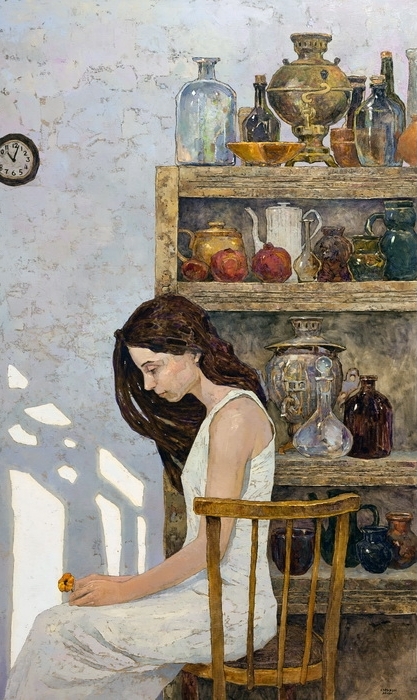
Rays by Denis Sarazhin
Denis Sarazhin (Ukrainian, 1982–), Rays, 2012. Oil on canvas, 150 × 90 cm.

Rid yourselves of all sordidness and rank growth of wickedness, and welcome with meekness the implanted word that has the power to save your souls.

—James 1:21

+++

SONG: “He Is Able” by Josh White, on Achor (2010)


This post belongs to the weekly series Artful Devotion. If you can’t view the music player in your email or RSS reader, try opening the post in your browser.

To view all the Revised Common Lectionary scripture readings for Proper 17, cycle B, click here.

Siyahamba (Artful Devotion)

Zionists by Charles B. S. Nkosi
Watercolor by Charles B. S. Nkosi (South African, 1949–), 1979. Source: Christliche Kunst in Afrika, p. 260

Finally, be strong in the Lord and in the strength of his might. Put on the whole armor of God, that you may be able to stand against the schemes of the devil. For we do not wrestle against flesh and blood, but against the rulers, against the authorities, against the cosmic powers over this present darkness, against the spiritual forces of evil in the heavenly places. Therefore take up the whole armor of God, that you may be able to withstand in the evil day, and having done all, to stand firm. Stand therefore, having fastened on the belt of truth, and having put on the breastplate of righteousness, and, as shoes for your feet, having put on the readiness given by the gospel of peace. In all circumstances take up the shield of faith, with which you can extinguish all the flaming darts of the evil one; and take the helmet of salvation, and the sword of the Spirit, which is the word of God . . .

—Ephesians 6:10–17

+++

SONG: “Siyahamba” (We Are Marching) | South African folk song | Arrangement by Walt Whitman performed by the Soul Children of Chicago, July 21, 2008, as the finale of “Hope in Action,” a celebration of Nelson Mandela’s ninetieth birthday | For a congregational hymn arrangement, see African American Heritage Hymnal #164

This exultant hymn, which likely originated during South Africa’s apartheid era, consists of permutations of the Zulu phrase Siyahamb’ ekukhanyen’ kwen khos’ (“We are marching in the light of God”), with subsequent verses substituting alternate verbs like “dancing,” “singing,” and “praying.” In 2008 Walt Whitman arranged the song for Soul Children of Chicago, a choir he formed as a means of “encouraging our youth and providing hope and inspiration in a world filled with challenges and despair.” His version is a lot of fun, albeit busier than others, with a more densely textured, orchestral sound. For a more straightforward rendition with clear vocals and simple percussion, check out the University of Notre Dame Folk Choir’s Crossroads of Praise album from 1999.

To learn more about “Siyahamba,” see “History of Hymns: ‘Siyahamba’” by C. Michael Hawn.


This post belongs to the weekly series Artful Devotion. If you can’t view the music player in your email or RSS reader, try opening the post in your browser.

To view all the Revised Common Lectionary scripture readings for Proper 16, cycle B, click here.

Lady Wisdom, Lady Love (Artful Devotion)

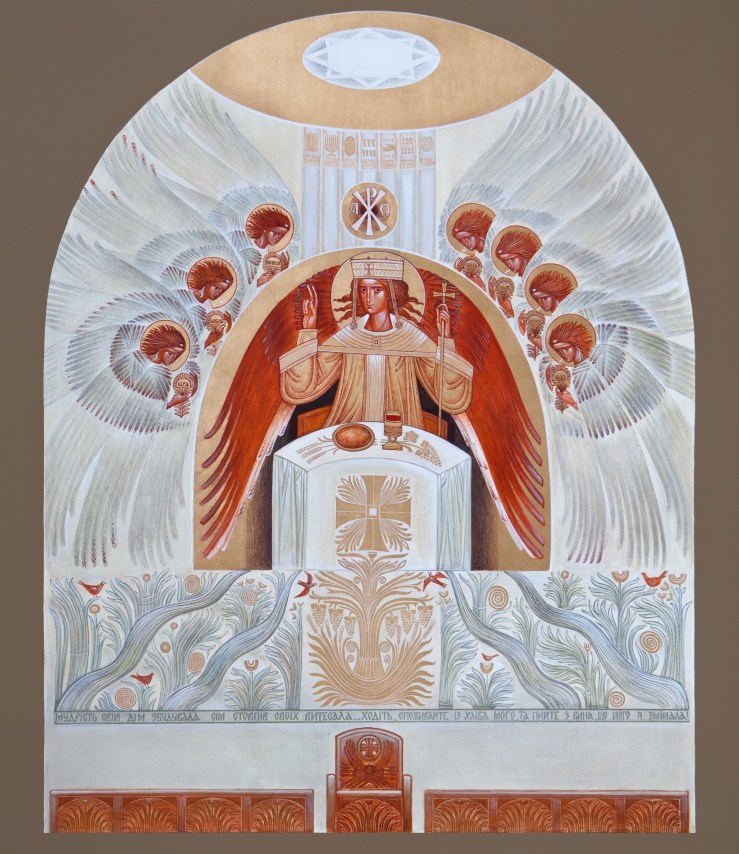
Sophia by Lyuba Yatskiv
Lyuba Yatskiv (Ukrainian, 1977–), Sophia (Holy Wisdom), 2015. Design for the apse of the Church of Sophia, Wisdom of God, Ukrainian Catholic University, Lviv, Ukraine.

Wisdom has built her house;
she has hewn her seven pillars.
She has slaughtered her beasts; she has mixed her wine;
she has also set her table.
She has sent out her young women to call
from the highest places in the town,
“Whoever is simple, let him turn in here!”
To him who lacks sense she says,
“Come, eat of my bread
and drink of the wine I have mixed.
Leave your simple ways, and live,
and walk in the way of insight.”

—Proverbs 9:1–6

+++

Lady Wisdom, or Holy Wisdom (Hagia Sophia), is a female allegorical figure from the book of Proverbs (1:20–33, 2:13–18, 8:1–36, 9:1–6). I enjoyed searching for songs about her; the pool is ampler than I expected. I found a few that directly reference Sunday’s lectionary passage—“Wisdom (Has Built Her House)” by Angela Lashley, “Wisdom’s Table” by John L. Bell and Doug Gay, and “God’s Wisdom Spreads Her Table Well” by Kevin Keil—but didn’t find them as compelling as the two I settled on, below.

(Update, 11/28/20: I’ve just come across “How Long?” by Ordinary Time, based on the Call of Wisdom in Proverbs 1. It’s quite good!)

LATIN JAZZ INSTRUMENTAL: “Lady Wisdom” by Lannie Battistini, on Nomenclatura (2014)

FOLK ROCK: “Lady Wisdom” by PureFusion, on Elegy (2010)

+++

In Divine Wisdom: The Wisdom Writings of Vladimir Solovyov, Judith Deutsch Kornblatt writes,

The symbolism of icons of the Divine Sophia is far from standardized and is decidedly ambiguous. . . . Images of wisdom remain the most abstract of all holy pictures, for the Divine Sophia never existed as a real being. Even the gender of Sophia in Russian icons is ambiguous, as in different centuries and locations the personified figure is sometimes associated with Christ or Mary or depicted as an androgynous angel with “feminized” features otherwise attributed to Gabriel. (56)

In 2015 contemporary Ukrainian Greek Catholic iconographer Lyuba Yatskiv secured a major commission to decorate the interior of the newly built Church of Sophia, Wisdom of God, on the campus of Ukrainian Catholic University in Lviv. Her design for the apse (the semicircular recess behind the church’s main altar), reproduced above, shows Wisdom as a winged bishop holding a cross-shaped crozier in her left hand while raising her right hand in a gesture of blessing. At her table are the wine and bread of the Eucharist, which she invites all to come and partake of. The chi-rho monogram above her, with an alpha and omega on either side, is a reference to Christ, while the seven pillars bear symbols of the seven gifts of the Holy Spirit, and the bright star of the Father sheds light from above. Below Wisdom, there blossoms the tree of life in the Garden of Eden, with its four rivers flowing, and flanking her are personifications of the seven virtues.

To learn more about the project, including design proposals from other artists, click here.


This post belongs to the weekly series Artful Devotion. If you can’t view the music player in your email or RSS reader, try opening the post in your browser.

To view all the Revised Common Lectionary scripture readings for Proper 15, cycle B, click here.

An On-Time God (Artful Devotion)

Waiting by Susanne Mitchell
Susanne Mitchell (American, 1973–), Waiting (from the series Silence of the Ordinary), 2015. Oil and mixed media on canvas, 162.6 × 149.9 cm (64 × 59 in.).

I wait for the LORD, my soul waits,
and in his word I hope.

—Psalm 130:5

+++

SONG: “Wait on the Lord” by Ben Keyes, on Were You There? Are You Here? (2007)

+++

O Master, my desires to work, to know,
To be aware that I do live and grow—
All restless wish for anything not thee
I yield, and on thy altar offer me.
Let me no more from out thy presence go,
But keep me waiting watchful for thy will—
Even while I do it, waiting watchful still.

—George MacDonald, from A Book of Strife in the Form of the Diary of an Old Soul (1880)


This post belongs to the weekly series Artful Devotion. If you can’t view the music player in your email or RSS reader, try opening the post in your browser.

To view all the Revised Common Lectionary scripture readings for Proper 14, cycle B, click here.