Berndnaut Smilde (Dutch, 1978–), Nimbus II, 2012. Lambda print, 125 × 186 cm. Saatchi Gallery, London.
Then Moses said to Aaron, “Say to the whole congregation of the Israelites, ‘Draw near to the LORD, for he has heard your complaining.’”
And as Aaron spoke to the whole congregation of the Israelites, they looked toward the wilderness, and the glory of the LORD appeared in the cloud.
—Exodus 16:9–10
+++
SONG: “I Cry Out” by a ship at Sea, on Awake, Awake (2012)
+++
This is one of several passages in the Old Testament in which God appears to Israel in a cloud during their desert journey to the Promised Land, signifying both his aboveness and beyondness and his withness. Here he shows up in response to the Israelites’ groans of hunger, showering down quail and manna (see earlier Artful Devotion, “Open Your Mouth”).
Dovetailing with this divine manifestation described in Exodus is Berndnaut Smilde’s photograph Nimbus II, which shows a cloud hovering inside the sixteenth-century Lady Chapel (Mariakapel) in Hoorn, the Netherlands. Smilde created the cloud by misting the area with water vapor and pumping smoke from a machine; the water particles then stuck to the smoke to form a fleeting installation, lasting only about thirty seconds. The photograph plays with the idea of presence and absence: the Lady Chapel has been vacant since 1968, and yet filling the emptiness is this sign of God’s glorious presence. Like us sometimes, the ancient Israelites had trouble seeing God in their wilderness wanderings. But he was overshadowing them in his protective care the whole time. When they truly looked (per Aaron’s instruction), they saw. When they cried out, God answered.
Nimbus II is one of many photographs from Smilde’s Nimbus series, shot in a variety of locations, from museums and factories to castles and dungeons. The title is a play on words, as a nimbus is both a type of cloud and another word for halo, the divine radiance that encircles the head of Christ and the saints in religious art. For more on this series, see “An artist creates miniature clouds in spaces around the world” by Jim Martin or the book Builded Remnants. You can also take a glimpse behind the scenes in this short video, and this one.
This post belongs to the weekly series Artful Devotion. If you can’t view the music player in your email or RSS reader, try opening the post in your browser.
To view all the Revised Common Lectionary scripture readings for Proper 13, cycle B, click here.
Stephen Watson (American), Breadth, 2013. Tape-measure shards. From the solo exhibition “Slapdash and Sacred” at the Arnold Art Gallery, Shorter University, Rome, Georgia.
I pray that you may have the power to comprehend, with all the saints, what is the breadth and length and height and depth, and to know the love of Christ that surpasses knowledge, so that you may be filled with all the fullness of God.
—Ephesians 3:18–19
+++
SONG: “O the Deep, Deep Love of Jesus” | Words by Samuel Trevor Francis, 1875 | Music by Thomas J. Williams, 1890 (Tune: Ebenezer) | Performed by the John Brown University Cathedral Choir, 1997
O the deep, deep love of Jesus,
Vast, unmeasured, boundless, free,
Rolling as a mighty ocean
In its fullness over me!
Underneath me, all around me,
Is the current of Thy love;
Leading onward, leading homeward
To my glorious rest above.
O the deep, deep love of Jesus—
Spread His praise from shore to shore!
How He loveth, ever loveth,
Changeth never, nevermore!
How He watcheth o’er His loved ones,
Died to call them all His own;
How for them He intercedeth,
Watcheth o’er them from the throne.
O the deep, deep love of Jesus,
Love of ev’ry love the best;
’Tis an ocean vast of blessing,
’Tis a haven sweet of rest.
O the deep, deep love of Jesus,
’Tis a heav’n of heav’ns to me;
And it lifts me up to glory
For it lifts me up to Thee.
+++
SONG: “The Love of God” | Words and music by Frederick M. Lehman, 1917, with third verse by Rabbi Meir ben Isaac Nehorai, ca. 1050 | Performed by Jonathon Strauss Brenner, 2018
The love of God is greater far
Than tongue or pen can ever tell;
It goes beyond the highest star,
And reaches to the lowest hell;
The guilty pair, bowed down with care,
God gave His Son to win;
His erring child He reconciled,
And pardoned from his sin.
O love of God, how rich and pure! How measureless and strong! It shall forevermore endure— The saints’ and angels’ song.
When hoary time shall pass away,
And earthly thrones and kingdoms fall,
When men who here refuse to pray,
On rocks and hills and mountains call,
God’s love so sure, shall still endure,
All measureless and strong;
Redeeming grace to Adam’s race—
The saints’ and angels’ song.
Could we with ink the ocean fill,
And were the skies of parchment made,
Were every stalk on earth a quill,
And every man a scribe by trade;
To write the love of God above
Would drain the ocean dry;
Nor could the scroll contain the whole,
Though stretched from sky to sky.
Frederick M. Lehman, the writer of this hymn, says it was inspired by lines scrawled on the walls of a psychiatric hospital cell (the third stanza), which as it turns out are from an eleventh-century Jewish liturgical poem by Rabbi Meir ben Isaac Nehorai, a cantor (Heb. hazzan) in Worms, Germany. Written in Aramaic, the ninety-line Akdamut (Prologue [to the Ten Commandments]) is chanted in Ashkenazic services on the first day of Shavuot (Pentecost) before the reading of Exodus 19–20, the revelation on Mount Sinai.
The reference to all the seas being ink and all the reeds pens is found also in Christian and Muslim traditions, as well as in earlier midrashic writings. It is unknown who originated the expression—for Jews, its ultimate formulation is the opening of Rabbi Meir’s Akdamut; Christians know it best from the hymn “The Love of God” (though it is also present in medieval Christian literature); and Muslims have it enshrined in the Koran (Surah Al-Kahf 18:109 and Surah Luqman 31:27).
+++
Stephen Watson is a multidisciplinary artist and an assistant professor of art at Samford University in Birmingham, Alabama. Many of his artworks originated as accompaniments to the Sunday services at Trinity Presbyterian Church in Tuscaloosa, Alabama, where they would be temporarily displayed throughout the year in the church foyer. “My art is my contribution to the church body,” says Watson, “and I aim to meaningfully expand the worship experience for the congregation with each artwork I share.” His liturgical installations are fantastic, and I plan to feature more of them in a future post. In the meantime, you can follow Watson on Instagram @stewatson.art.
Inspired by Ephesians 3:18–19, Breadth emphasizes the absurdity of trying to measure God or put limits on his love, a love that, as one of our songwriters puts it, is “vast, unmeasured, boundless, free.” The Breadth installation shown above, consisting of tape-measure shards arranged in a zigzag pattern, is from a gallery setting, but the concept has also been iterated in sacred spaces—for example, as a twisting, tangled mess of tape measures descending from the ceiling like a beam of light, or as a series of looped-tape sunbursts gradually opening from the niches along the north and south walls of a sanctuary.
Stephen Watson (American), Breadth and Length and Height and Depth, 2012. Temporary installation at Trinity Presbyterian Church, Tuscaloosa, Alabama.Stephen Watson (American), Breadth (detail), 2014. Site-specific installation of tape measures, Sojourn Community Church, Louisville, Kentucky.Stephen Watson (American), Breadth (detail), 2014. Site-specific installation of tape measures, Sojourn Community Church, Louisville, Kentucky.
When I was little, my mom and I would try to outdo each other in expressing with the extent of our arm span how vast was our love: “I love you THIS much!” “Well, I love you THIS much!” How much more immeasurably does God, whose arms are infinitely wide, love us.
This post belongs to the weekly series Artful Devotion. If you can’t view the music player in your email or RSS reader, try opening the post in your browser.
To view all the Revised Common Lectionary scripture readings for Proper 12, cycle B, click here.
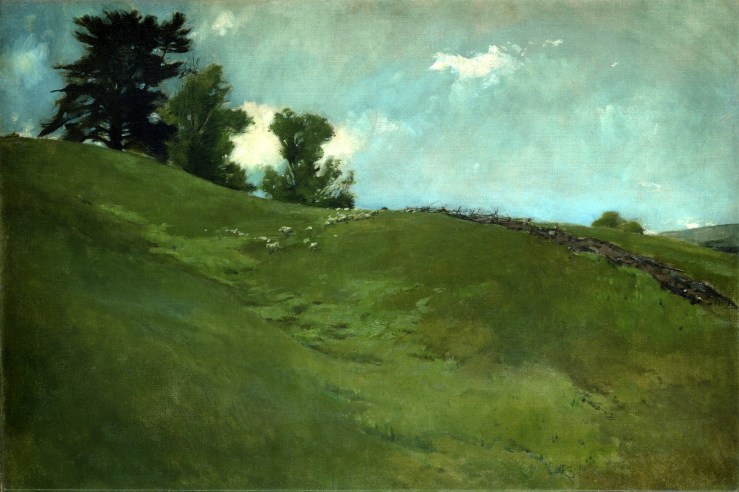
John White Alexander (American, 1856–1915), Landscape, Cornish, N.H., ca. 1890. Oil on canvas, 30 3/8 × 45 in. (77.2 × 114.2 cm). Smithsonian American Art Museum, Washington, DC.
The LORD is my shepherd; I shall not want.
He maketh me to lie down in green pastures:
he leadeth me beside the still waters.
He restoreth my soul . . .
Yea, though I walk through the valley of the shadow of death,
I will fear no evil:
for thou art with me;
thy rod and thy staff,
they comfort me.
—Psalm 23:1–3a, 4
+++
MUSIC: “Sheep May Safely Graze,” from BWV 208 | Composed by Johann Sebastian Bach (1713) | Performed by London Symphony Orchestra, on Night in Berlin (2001)
The aria “Schafe können sicher weiden” (Sheep May Safely Graze) comprises the ninth movement of Bach’s Was mir behagt, ist nur die muntre Jagd (The Lively Hunt Is All My Heart’s Desire)—known informally as the Hunting Cantata. Written for the thirty-first birthday of Duke Christian of Saxe-Weissenfels, the cantata was performed as a surprise at a banquet at the ducal hunting lodge, and it’s full of flattery. The text of “Sheep May Safely Graze,” written by Solomon Franck, praises Christian for his wise, protective leadership (in actuality, he was a lousy ruler):
Sheep may safely graze and pasture
In a watchful shepherd’s sight.
Those who rule, with wisdom guiding,
Bring to hearts a peace abiding,
Bless a land with joy made bright.
At 1:31 in the above recording, you can hear potential danger lurking nearby, but the attentive shepherd neutralizes the threat, keeping safe his flock.
Bach originally scored this piece for soprano with two recorders and continuo, but it has since been transcribed for orchestra and countless other combinations of instruments and is most popular without words. I enjoy playing Egon Petri’s transcription for solo piano, performed here by Alessio Bax:
Its pastoral mood, befitting Psalm 23, and its celebration of a good shepherd’s care have led it to be applied to the Good Shepherd and performed in church services. I’ve even come across some piano arrangements that interfuse it with “Savior, Like a Shepherd Lead Us” (for an intermediate arrangement of such by Cindy Berry, see Classical Hymns).
This post belongs to the weekly series Artful Devotion. If you can’t view the music player in your email or RSS reader, try opening the post in your browser.
To view all the Revised Common Lectionary scripture readings for Proper 11, cycle B, click here.
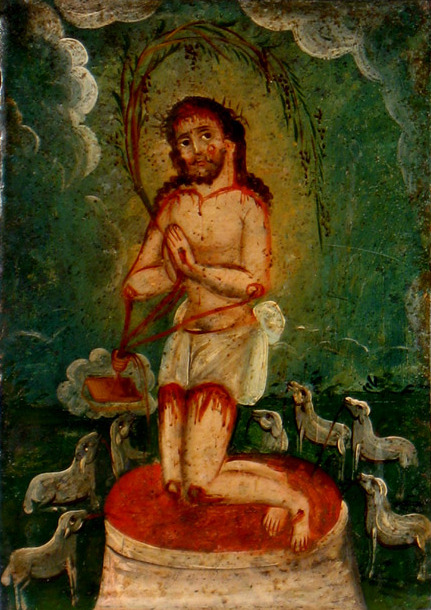
Blood that bled into a cry!
The elements
felt its touch and trembled,
heaven heard their woe.
O life-blood of the maker,
scarlet music, salve our wounds.
—“Antiphon for the Redeemer” by Hildegard of Bingen, translated from the Latin by Barbara Newman
This post belongs to the weekly series Artful Devotion. If you can’t view the music player in your email or RSS reader, try opening the post in your browser.
To view all the Revised Common Lectionary scripture readings for Proper 10, cycle B, click here.
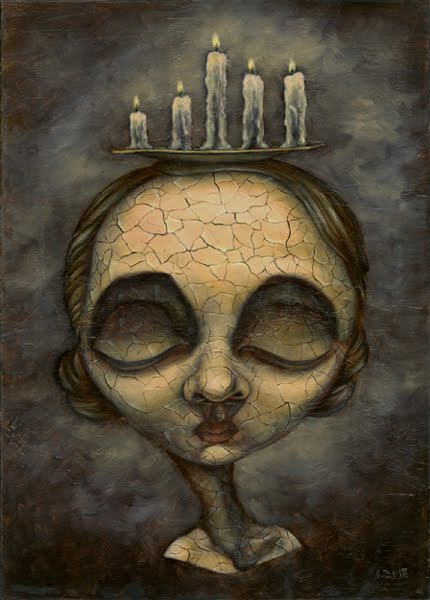
Brandon Maldonado (American, 1980–), Transcendence, before 2010. Oil on panel.
. . . a thorn was given me in the flesh, a messenger of Satan to harass me, to keep me from becoming conceited. Three times I pleaded with the Lord about this, that it should leave me. But he said to me, “My grace is sufficient for you, for my power is made perfect in weakness.” Therefore I will boast all the more gladly of my weaknesses, so that the power of Christ may rest upon me. For the sake of Christ, then, I am content with weaknesses, insults, hardships, persecutions, and calamities. For when I am weak, then I am strong.
—2 Corinthians 12:7b–10
For a collection of commentaries on this scripture passage, visit Textweek.com.
+++
SONG: “Cold Is the Night” by the Oh Hellos, on The Oh Hellos (2011)
This post belongs to the weekly series Artful Devotion. If you can’t view the music player in your email or RSS reader, try opening the post in your browser.
To view all the Revised Common Lectionary scripture readings for Proper 9, cycle B, click here.
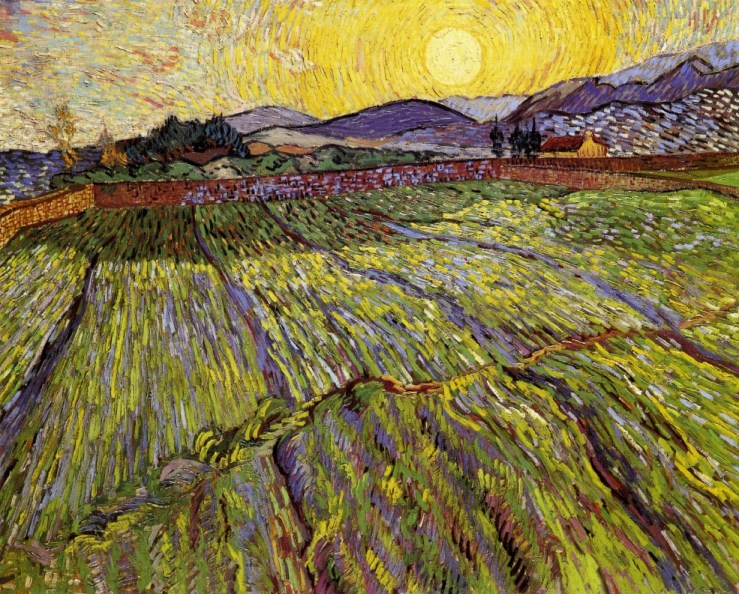
Vincent van Gogh (Dutch, 1853–1890), Enclosed Field with Rising Sun, 1889. Oil on canvas. Private collection.
The steadfast love of the Lord never ceases;
his mercies never come to an end;
they are new every morning;
great is your faithfulness.
—Lamentations 3:22–23
+++
SONG: “Great Is Thy Faithfulness” | Words by Thomas O. Chisholm, 1923 | Music by William Marion Runyan, 1923 | Arranged and performed by Sam JC Lee on bass, with Gabriela Martina on vocals, 2013
This post belongs to the weekly series Artful Devotion. If you can’t view the music player in your email or RSS reader, try opening the post in your browser.
To view all the Revised Common Lectionary scripture readings for Proper 8, cycle B, click here.
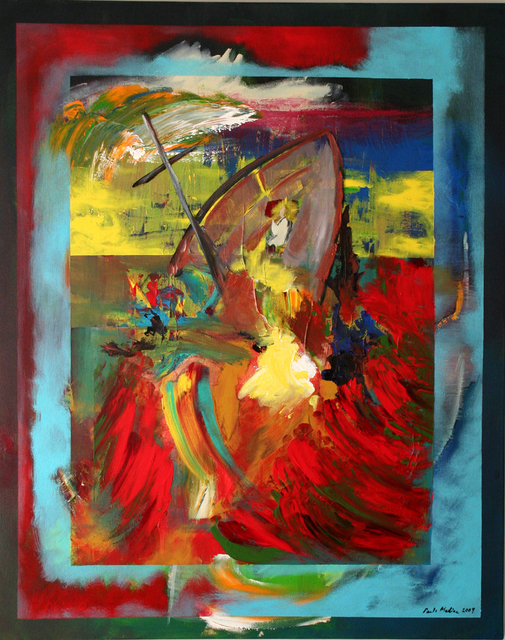
Paulo Medina (Mexican, 1964–), Navecilla, 2007. Acrylic on canvas, 100 × 80 cm.
Some went down to the sea in ships,
doing business on the great waters;
they saw the deeds of the Lord,
his wondrous works in the deep.
For he commanded and raised the stormy wind,
which lifted up the waves of the sea.
They mounted up to heaven; they went down to the depths;
their courage melted away in their evil plight;
they reeled and staggered like drunken men
and were at their wits’ end.
Then they cried to the Lord in their trouble,
and he delivered them from their distress.
He made the storm be still,
and the waves of the sea were hushed.
Then they were glad that the waters were quiet,
and he brought them to their desired haven.
Let them thank the Lord for his steadfast love,
for his wondrous works to the children of man!
—Psalm 107:23–31, describing one of four groups of exiled Judahites whom God rescued in their distress
On that day, when evening had come, [Jesus] said to [his disciples], “Let us go across to the other side.” And leaving the crowd, they took him with them in the boat, just as he was. And other boats were with him. And a great windstorm arose, and the waves were breaking into the boat, so that the boat was already filling. But he was in the stern, asleep on the cushion. And they woke him and said to him, “Teacher, do you not care that we are perishing?” And he awoke and rebuked the wind and said to the sea, “Peace! Be still!” And the wind ceased, and there was a great calm. He said to them, “Why are you so afraid? Have you still no faith?” And they were filled with great fear and said to one another, “Who then is this, that even the wind and the sea obey him?”
—Mark 5:35–41
+++
SONG: “Stand by Me” | Words and music by Charles A. Tindley, 1905 | Performed by Seth Avett, 2013 | United Methodist Hymnal #512
Paulo Medina’s painting Navecilla (Ship) was inspired by a letter St. Thérèse of Lisieux wrote to her older sister, Céline, on July 23, 1893, which references the narrative from next week’s Gospel lectionary reading and says in part,
Be assured, dear Céline, that even though your dinghy is far asea, it is perhaps already very close to your harbor. The wind of suffering that is propelling it is a wind of love, and that wind is faster than lightning. [translated by Victoria Hebert and Denis Sabourin]
Read the full letter, in an alternate translation from the French by John Clarke, at the Archives du Carmel de Lisieux.
This post belongs to the weekly series Artful Devotion. If you can’t view the music player in your email or RSS reader, try opening the post in your browser.
To view all the Revised Common Lectionary scripture readings for Proper 7, cycle B, click here.
Detail of the Last Judgment, 1240–1300. Mosaic dome, Baptistery of Saint John (San Giovanni), Florence, Italy. Photo: Johann H. Addicks.
For we must all appear before the judgment seat of Christ, so that each one may receive what is due for what he has done in the body, whether good or evil.
POEMS: “The Last Judgment” by Raymond Oliver is darkly humorous and a true account of how some medieval artists stuck it to the man. For a more reverent reflection on the topic, read “Judgment Day” by R. S. Thomas, in which a perpetrator of injustice against the sick and the poor on earth stands before God’s heavenly throne, contrite; the speaker could well be Dives from the parable of the Rich Man and Lazarus—or, to name a more recent literary example, Scrooge from A Christmas Carol. She could also be you or me, if we heed not the many commands of scripture to love and support the needy.
This post belongs to the weekly series Artful Devotion. If you can’t view the music player in your email or RSS reader, try opening the post in your browser.
To view all the Revised Common Lectionary scripture readings for Proper 6, cycle B, click here.
Photo and embroidery by Brazilian artist Aline Brant, 2017
So we do not lose heart. Though our outer self is wasting away, our inner self is being renewed day by day. For this light momentary affliction is preparing for us an eternal weight of glory beyond all comparison, as we look not to the things that are seen but to the things that are unseen. For the things that are seen are transient, but the things that are unseen are eternal. For we know that if the tent that is our earthly home is destroyed, we have a building from God, a house not made with hands, eternal in the heavens.
—2 Corinthians 4:16–5:1
+++
SONG: “The Sweet Forever” (When They Ring Those Golden Bells) | Words and music by Daniel (“Dion”) de Marbelle (1887) | Arranged and performed by the Sensational Nightingales, on It’s Gonna Rain Again (1972, re-released 1998)
There’s a land beyond the river
That we call the sweet forever,
And we only reach that shore by faith’s decree;
One by one we’ll gain the portal,
There to dwell with the immortal,
When they ring those golden bells for you and me.
I wonder, can you hear those bells a-ringing? I wonder, can you hear those angels singing? Talkin’ ’bout glory, glory, hallelujah, Jubilee! In that far-off sweet forever, Just beyond that shining river, When they ring those golden bells for you and me.
We shall know no sin or sorrow
In that haven of tomorrow,
When our barque shall sail beyond the silver sea;
We shall only know the blessing
Of our Father’s sweet caressing,
When they ring those golden bells for you and me.
When our days shall know their number,
When in death we sweetly slumber,
When the Savior commands the spirit to be free,
Nevermore with anguish laden,
We shall reach that lovely Eden,
When they ring those golden bells for you and me.
This post belongs to the weekly series Artful Devotion. If you can’t view the music player in your email or RSS reader, try opening the post in your browser.
To view all the Revised Common Lectionary scripture readings for Proper 5, cycle B, click here.
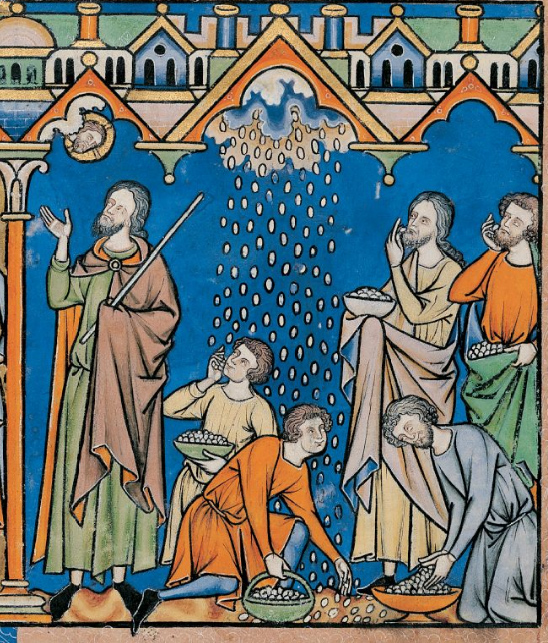
Manna from heaven: illumination from the Maciejowski Bible, Paris, 1240s. Morgan Library MS M.638, fol. 9v (detail).
“Open your mouth wide, and I will fill it.”—Psalm 81:10b
+++
SONG: “Guide Me, O Thou Great Jehovah” (Bread of Heaven) | Words by William Williams (1745), translated from the Welsh by Peter Williams (1771) | Music by John Hughes (1905; tune: Cwm Rhondda) | Performed by Kelly Joe Phelps, on Brother Sinner and the Whale (2012)
I love Phelps’s gentle, guitar-picked rendition of this classic hymn. For performance snippets interspersed with interview footage, click here.
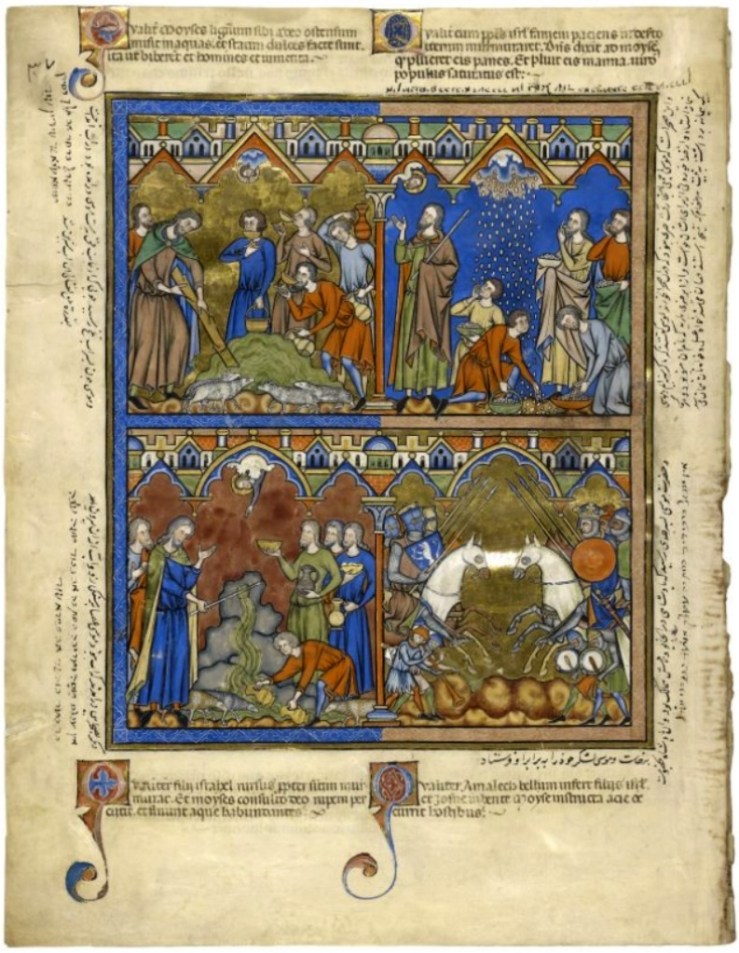
Bitter water made sweet; manna from heaven; water from the rock at Horeb; Joshua fights the Amalekites. Morgan Library MS M.638 (Maciejowski Bible), fol. 9v, Paris, 1240s.
This post belongs to the weekly series Artful Devotion. If you can’t view the music player in your email or RSS reader, try opening the post in your browser.
To view all the Revised Common Lectionary scripture readings for Proper 4, cycle B, click here.








 Art & Theology