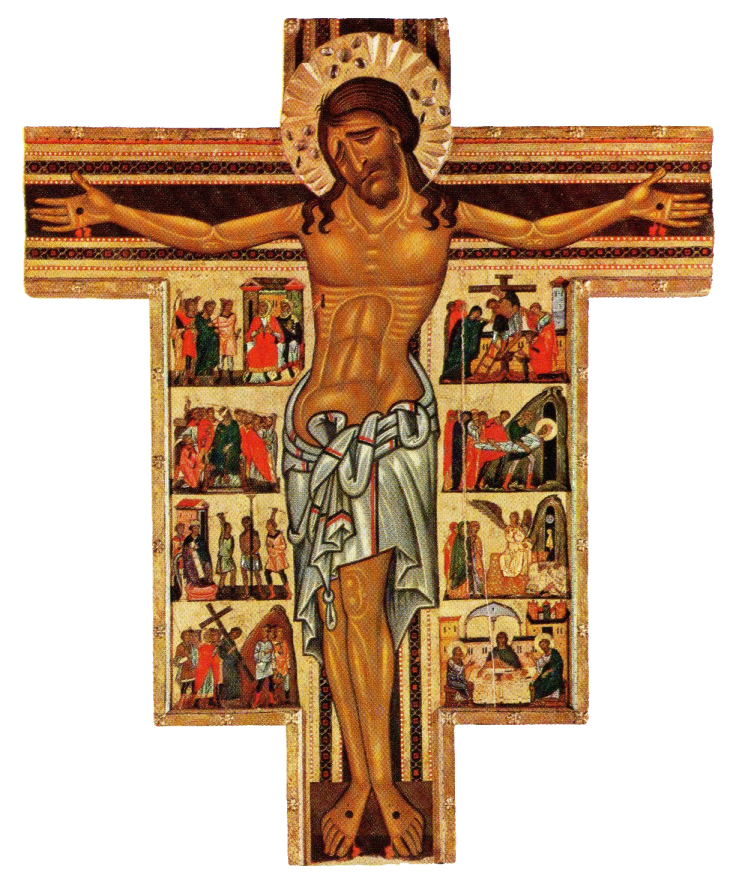
Crucifix with scenes of the Passion, Pisa, Italy, ca. 1240. Tempera on wood, 247 × 202 cm. Uffizi Galleries, Florence, Italy. Left: the Trial of Christ before Annas and Caiaphas, the Mocking of Christ, the Flagellation, Christ Carries His Cross; right: the Descent from the Cross, the Entombment, the Holy Women at the Tomb, the Supper at Emmaus.
“. . . they crucified him . . .”—John 19:18
+++
SONG: “Crucifixus” for 8 voices | Words: from the Nicene Creed | Music: Antonio Lotti (1667–1740) | Performed by Tenebrae, 2016
Crucifixus etiam pro nobis; sub Pontio Pilato passus et sepultus est.
(He was crucified also for us; under Pontius Pilate he suffered and was buried.)
This post belongs to the weekly series Artful Devotion. If you can’t view the music player in your email or RSS reader, try opening the post in your browser.
To view all the Revised Common Lectionary scripture readings for Good Friday, cycle B, click here. An Easter devotion will be published Sunday morning.
Julia Stankova (Bulgarian, 1954–), The Entry into Jerusalem, before 2002. Tempera, gouache, watercolors, and lacquer technique on wood, 40 × 22 cm.
The next day the large crowd that had come to the feast heard that Jesus was coming to Jerusalem. So they took branches of palm trees and went out to meet him, crying out, “Hosanna! Blessed is he who comes in the name of the Lord, even the King of Israel!” And Jesus found a young donkey and sat on it, just as it is written, “Fear not, daughter of Zion; behold, your king is coming, sitting on a donkey’s colt!”
—John 12:12–15
+++
SONG: “King of Kings and Lord of Lords” | Music: Traditional Hebrew folk tune | Words: Sophie Conty and Naomi Batya (stage name: Nomi Yah), 1974 | Performed by Glenn Tompkins, 2011 | CCLI #23952
This Hebrew folk melody, with its gradually increasing tempo, is in the tradition of the Israeli hora, or round dance. In 1974 two Christian gal pals, Sophie Conty and Naomi Batya, put their own words to it when they were only thirteen. Since then the song has been published in at least sixteen hymnals. I learned about it two Palm Sundays ago when we sang it at my church. Tying it to that particular liturgical occasion was, I think, a really insightful choice on the part of the music leader. The beats are evocative of a clopping donkey, and the quickening pace builds tension, as when Christ approached the swell of praises in Jerusalem that preceded his doom.
It was hard to search for recordings of “King of Kings” because the title is such a common one. I’ve found that it is often performed by children’s choirs (replete with side steps and hand motions!), and the rock band Petra covered it in the late eighties. I chose to feature this solo accordion arrangement because it best captures the flavor of the song. Even without a vocalist, it’s easy to follow along:
King of Kings and Lord of Lords
Glory, hallelujah
King of Kings and Lord of Lords
Glory, hallelujah
Jesus, Prince of Peace
Glory, hallelujah
Jesus, Prince of Peace
Glory, hallelujah
This post belongs to the weekly series Artful Devotion. If you can’t view the music player in your email or RSS reader, try opening the post in your browser.
To view all the Revised Common Lectionary scripture readings for Palm Sunday, cycle B, click here.
Sergio Gomez (Mexican American, 1971–), Serenity, 2016. Acrylic on canvas, 30 × 30 in.
Psalm 51:1–2, 8 (two translations):
KJV: Have mercy upon me, O God, according to thy lovingkindness: according unto the multitude of thy tender mercies blot out my transgressions. Wash me throughly from mine iniquity, and cleanse me from my sin. . . . Make me to hear joy and gladness; that the bones which thou hast broken may rejoice.
The Message:
Generous in love—God, give grace!
Huge in mercy—wipe out my bad record.
Scrub away my guilt,
soak out all my sins in your laundry.
. . .
Tune me in to foot-tapping songs,
set these once-broken bones to dancing.
+++
SONG: “Wash Me Clean” by Page CXVI, on Hymns IV (2011)
Wash me clean
In the warm sun dry me
Cleanse my heart
From all iniquity
Baptize me
In the Holy Spirit sea
Renew my mind
That wickedness may flee
In those days
His Son will save
His Spirit will pour
On all who call on the Lord
In those days
His Son will save
His Spirit will fill
Empty jars of mud and clay
In these days
Barren fields will sprout trees
The deaf and blind will hear and see
The dead will rise, begin to breathe
The dead will rise, begin to breathe
The earth will groan in pain to see
The sons of God declared to be
His full and glorious family
The beautiful, perfect bride of Thee
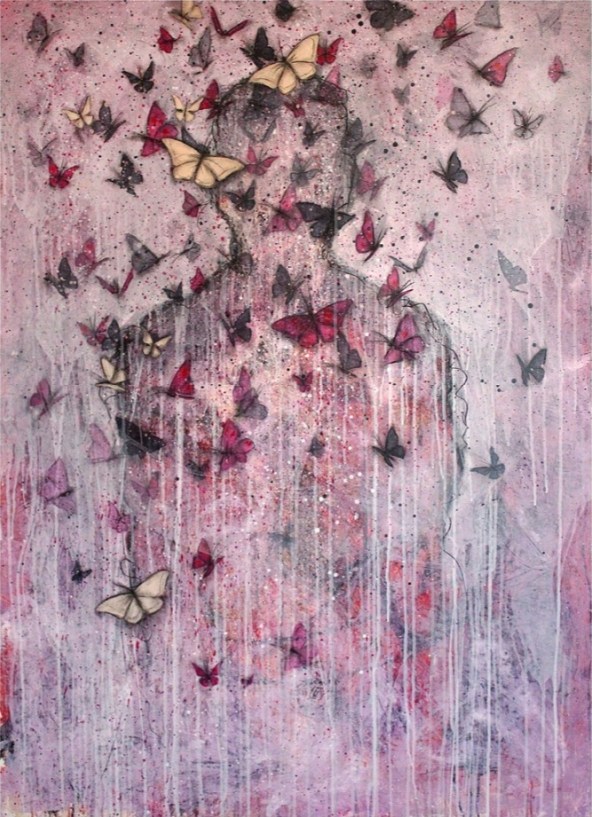
Sergio Gomez (Mexican American, 1971–), New Beginnings 3, 2016. Mixed media on canvas, 40 × 54 in. Available for sale via the ACS Gallery, Chicago (click on image for more info).Sergio Gomez (Mexican American, 1971–), Healing Series, 2016. Mixed media on canvas, 82 × 42 in. Available for sale via the ACS Gallery, Chicago (click on image for more info).
This post belongs to the weekly series Artful Devotion. If you can’t view the music player in your email or RSS reader, try opening the post in your browser.
To view all the Revised Common Lectionary scripture readings for the Fifth Sunday of Lent, cycle B, click here.
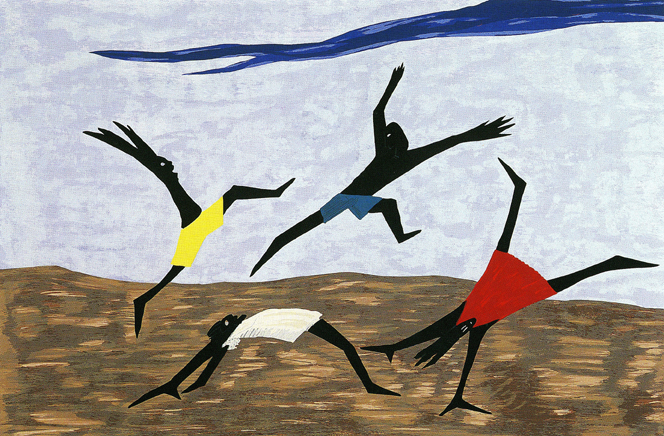
Jacob Lawrence (American, 1914–2000), The Life of Harriet Tubman (Panel #4), 1940. Casein tempera on hardboard, 30.5 × 45.4 cm.
Ephesians 2:1–10 (two translations):
ESV: And you were dead in the trespasses and sins in which you once walked, following the course of this world, following the prince of the power of the air, the spirit that is now at work in the sons of disobedience—among whom we all once lived in the passions of our flesh, carrying out the desires of the body and the mind, and were by nature children of wrath, like the rest of mankind. But God, being rich in mercy, because of the great love with which he loved us, even when we were dead in our trespasses, made us alive together with Christ—by grace you have been saved—and raised us up with him and seated us with him in the heavenly places in Christ Jesus, so that in the coming ages he might show the immeasurable riches of his grace in kindness toward us in Christ Jesus. For by grace you have been saved through faith. And this is not your own doing; it is the gift of God, not a result of works, so that no one may boast. For we are his workmanship, created in Christ Jesus for good works, which God prepared beforehand, that we should walk in them.
The Message: It wasn’t so long ago that you were mired in that old stagnant life of sin. You let the world, which doesn’t know the first thing about living, tell you how to live. You filled your lungs with polluted unbelief, and then exhaled disobedience. We all did it, all of us doing what we felt like doing, when we felt like doing it, all of us in the same boat. It’s a wonder God didn’t lose his temper and do away with the whole lot of us. Instead, immense in mercy and with an incredible love, he embraced us. He took our sin-dead lives and made us alive in Christ. He did all this on his own, with no help from us! Then he picked us up and set us down in highest heaven in company with Jesus, our Messiah.
Now God has us where he wants us, with all the time in this world and the next to shower grace and kindness upon us in Christ Jesus. Saving is all his idea, and all his work. All we do is trust him enough to let him do it. It’s God’s gift from start to finish! We don’t play the major role. If we did, we’d probably go around bragging that we’d done the whole thing! No, we neither make nor save ourselves. God does both the making and saving. He creates each of us by Christ Jesus to join him in the work he does, the good work he has gotten ready for us to do, work we had better be doing.
This post belongs to the weekly series Artful Devotion. If you can’t view the music player in your email or RSS reader, try opening the post in your browser.
To view all the Revised Common Lectionary scripture readings for the Fourth Sunday of Lent, cycle B, click here.
Stanley Spencer (British, 1891–1959), Christ Overturning the Money Changers’ Table, 1921. Oil on canvas, 74 × 60 cm. Stanley Spencer Gallery, Cookham, England.
When it was almost time for the Jewish Passover, Jesus went up to Jerusalem. In the temple courts he found people selling cattle, sheep, and doves, and others sitting at tables exchanging money. So he made a whip out of cords, and drove all from the temple courts, both sheep and cattle; he scattered the coins of the money changers and overturned their tables. To those who sold doves he said, “Get these out of here! Stop turning my Father’s house into a market!” His disciples remembered that it is written: “Zeal for your house will consume me.”
Hosanna! Welcome to our hearts! Lord, here
Thou hast a temple too; and full as dear
As that of Sion, and as full of sin:
Nothing but thieves and robbers dwell therein:
Enter, and chase them forth, and cleanse the floor:
Crucify them, that they may never more
Profane that holy place
Where Thou hast chose to set Thy face!
—Jeremy Taylor (1613–1667)
Savior, who dost with anger see
The lusts which steal my heart from thee,
The thieves out of thy temple chase,
And plant thy Spirit in their place,
And when my God inhabits there,
My heart shall be thine house of prayer.
—Charles Wesley, from Short Hymns on Select Passages of the Holy Scriptures (1762)
This post belongs to the weekly series Artful Devotion. If you can’t view the music player in your email or RSS reader, try opening the post in your browser.
To view all the Revised Common Lectionary scripture readings for the Third Sunday of Lent, cycle B, click here.
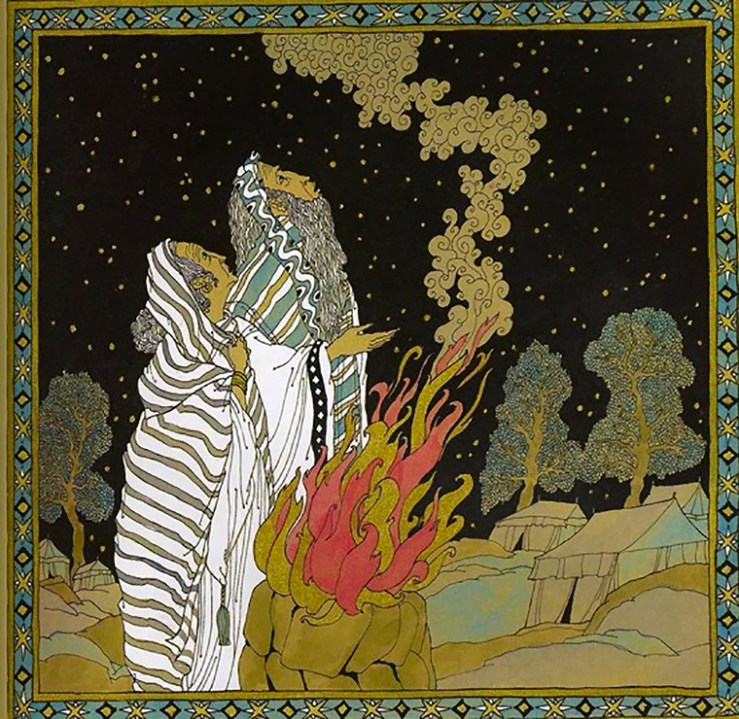
Renáta Fucíková (Czech, 1964–), The Promise, 1996. Illustration from the book Stories from the Old Testament, published in France and the Czech Republic.
For the promise to Abraham and his offspring that he would be heir of the world did not come through the law but through the righteousness of faith. For if it is the adherents of the law who are to be the heirs, faith is null and the promise is void. For the law brings wrath, but where there is no law there is no transgression.
That is why it depends on faith, in order that the promise may rest on grace and be guaranteed to all his offspring—not only to the adherent of the law but also to the one who shares the faith of Abraham, who is the father of us all, as it is written, “I have made you the father of many nations”—in the presence of the God in whom he believed, who gives life to the dead and calls into existence the things that do not exist. In hope he believed against hope, that he should become the father of many nations, as he had been told, “So shall your offspring be.” He did not weaken in faith when he considered his own body, which was as good as dead (since he was about a hundred years old), or when he considered the barrenness of Sarah’s womb. No unbelief made him waver concerning the promise of God, but he grew strong in his faith as he gave glory to God, fully convinced that God was able to do what he had promised. That is why his faith was “counted to him as righteousness.” But the words “it was counted to him” were not written for his sake alone, but for ours also. It will be counted to us who believe in him who raised from the dead Jesus our Lord, who was delivered up for our trespasses and raised for our justification.
—Romans 4:13–25 (cf. Genesis 17:1–7, 15–16)
+++
SONG: “The Story of Abraham” by Psallos, onRomans(2015)
This is one of twenty-three songs by Cody Curtis that comprise a complete musical setting of the book of Romans. See my review of the concept album here.
This post belongs to the weekly series Artful Devotion. If you can’t view the music player in your email or RSS reader, try opening the post in your browser.
To view all the Revised Common Lectionary scripture readings for the Second Sunday of Lent, cycle B, click here.
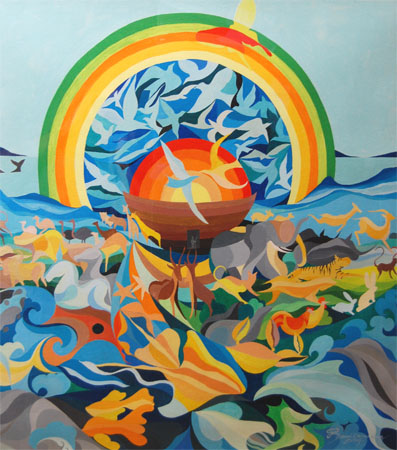
Sawai Chinnawong (Thai, 1959–), Genesis 9:13, 2004. Acrylic on canvas, 27 × 27 in.
Then God said to Noah and to his sons with him, “Behold, I establish my covenant with you and your offspring after you, and with every living creature that is with you, the birds, the livestock, and every beast of the earth with you, as many as came out of the ark; it is for every beast of the earth. I establish my covenant with you, that never again shall all flesh be cut off by the waters of the flood, and never again shall there be a flood to destroy the earth.”
And God said, “This is the sign of the covenant that I make between me and you and every living creature that is with you, for all future generations: I have set my bow in the cloud, and it shall be a sign of the covenant between me and the earth. When I bring clouds over the earth and the bow is seen in the clouds, I will remember my covenant that is between me and you and every living creature of all flesh. And the waters shall never again become a flood to destroy all flesh. When the bow is in the clouds, I will see it and remember the everlasting covenant between God and every living creature of all flesh that is on the earth.”
God said to Noah, “This is the sign of the covenant that I have established between me and all flesh that is on the earth.”
—Genesis 9:8–17
+++
MUSIC: Keyboard Sonata in C Major (K. 159, L. 104) by Domenico Scarlatti | Arranged for banjo by Béla Fleck and for mandolin by Edgar Meyer | Performed by Béla Fleck and Chris Thile on Perpetual Motion (2001)
+++
This art and music may seem inappropriately light and bright for the first Sunday of Lent, a season that’s stereotypically thought of as gloomy and self-deprecating. But the Old Testament reading the Revised Commentary Lectionary assigns to this day is God’s covenant with Noah after the Flood, a passage filled with great hope.
Contrary to popular misconceptions, Lent does not mean forty days of beating yourself up. It literally means “springtime,” and it’s a time of renewal in preparation for Easter. Self-examination is a major component, yes, but so is grabbing hold of the divine promise—of God’s wondrous love and mercy.
In my church’s liturgy (and this is common across denominations), the confession of sin is always followed by words of assurance—a verse of scripture, spoken by the pastor, that reminds us of the pardon we receive through Christ. We are not left in the darkness of our failures; we are brought into the light, and given power to live as children of the light. Repentance is a joyous thing! That’s why the Constitution on the Sacred Liturgy, a Second Vatican Council document, refers to Lent as the “joyful season.” It’s joyful because God’s mercy is amazing.
After forty days on a dark boat, and then some, Noah, his family, and a whole bunch of animals come out to a renewed earth, and to a promise painted across the sky in bright colors that never again will all God’s creation be destroyed. Similarly, during Lent we choose to enter a period of darkness, taking stock of our sin. It may be a rocking journey, but it’s ultimately a period of regeneration, and when we arrive at Easter we receive, as confirmation of the new life that’s possible, the resurrected Christ. He’s there for us all along—we need not wait till Lent’s over to enter his forgiveness and to rise with him. But we also don’t want to skip over the necessary steps of first acknowledging the depth of our sin, and confessing it with a contrite heart.
+++
Excerpt from “The Agreement” by Henry Vaughan, from Silex Scintillans:
But while Time runs, and after it
Eternity, which never ends,
Quite through them both, still infinite,
Thy covenant by Christ extends;
No sins of frailty, nor of youth,
Can foil His merits, and Thy truth.
And this I hourly find, for Thou
Dost still renew, and purge and heal:
Thy care and love, which jointly flow,
New cordials, new cathartics deal.
But were I once cast off by Thee,
I know—my God!—this would not be.
+++
Tomorrow is Ash Wednesday, and I have a poem planned for publication here at Art & Theology. But I also wrote a short visual meditation for the Anglican Church in North America, which you can find at the bottom of their Lent website, https://giftoflent.org/. It’s on Ted Prescott’s mixed-media artwork All My Sins, which incorporates paper ash, the residue left over from the artist’s burning of a list of his personal sins.
Theodore Prescott (American, 1944–), All My Sins, 1996. Cherry, lead, hand-blown glass, paper ash, and silicon, 36.5 × 24.5 × 5 in.
This post belongs to the weekly series Artful Devotion. If you can’t view the music player in your email or RSS reader, try opening the post in your browser.
To view all the Revised Common Lectionary scripture readings for the First Sunday of Lent, cycle B, click here.
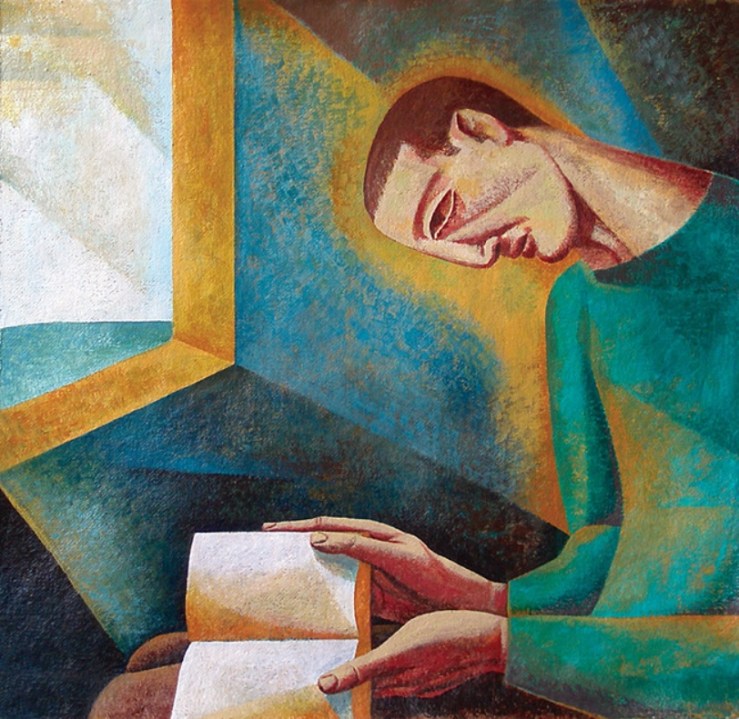
Michael Cook (British, 1966–), Golden Edges. Acrylic on handmade paper, 58 × 56 cm. For sale (click on image to contact artist).
Second Corinthians 4:3–6, two translations:
And even if our gospel is veiled, it is veiled to those who are perishing. In their case the god of this world has blinded the minds of the unbelievers, to keep them from seeing the light of the gospel of the glory of Christ, who is the image of God. For what we proclaim is not ourselves, but Jesus Christ as Lord, with ourselves as your servants for Jesus’ sake. For God, who said, “Let light shine out of darkness,” has shone in our hearts to give the light of the knowledge of the glory of God in the face of Jesus Christ. (ESV)
If our Message is obscure to anyone, it’s not because we’re holding back in any way. No, it’s because these other people are looking or going the wrong way and refuse to give it serious attention. All they have eyes for is the fashionable god of darkness. They think he can give them what they want, and that they won’t have to bother believing a Truth they can’t see. They’re stone-blind to the dayspring of brightness of the Message that shines with Christ, who gives us the best picture of God we’ll ever get. (The Message)
This post belongs to the weekly series Artful Devotion. If you can’t view the music player in your email or RSS reader, try opening the post in your browser.
To view all the Revised Common Lectionary scripture readings for the Sixth Sunday of Epiphany (Transfiguration Sunday), cycle B, click here.
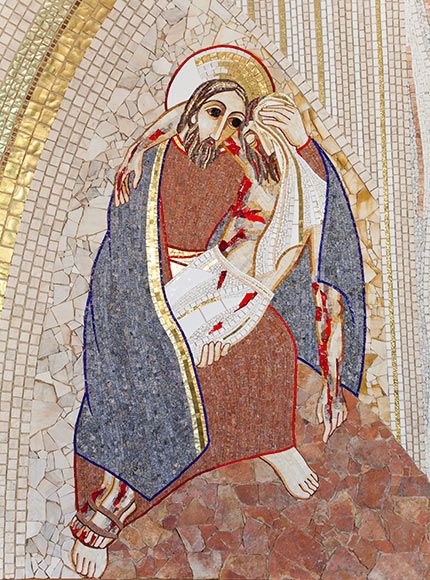
Fr. Marko Ivan Rupnik (Slovenian, 1954–), The Good Samaritan (detail), 2010. Mosaic. Church of Saint Eusebius (Chiesa parrocchiale di Sant’Eusebio), Cinisello Balsamo, Milan.
“He heals the brokenhearted, and binds up their wounds.” (Psalm 147:3)
+++
SONG: “Pass Me Not” | Words by Fanny J. Crosby, 1868 | Music by William H. Doane, 1870 | Performed by Joe and Nichole Kurtz on The Harp Family Hymnbook, Vol. II, 2017
This post belongs to the weekly series Artful Devotion. If you can’t view the music player in your email or RSS reader, try opening the post in your browser.
To view all the Revised Common Lectionary scripture readings for the Fifth Sunday of Epiphany, cycle B, click here.
Rembrandt van Rijn (Dutch, 1606–1669), Simeon in the Temple, 1669. Oil on canvas, 98.5 × 79.5 cm. Nationalmuseum, Stockholm, Sweden.
Candlemas, celebrated every year on February 2, commemorates the presentation of Jesus at the temple forty days after his birth, according to Jewish custom (Luke 2:22–40). While there, the Holy Family encountered Simeon, an elderly man, “righteous and devout,” who was “waiting for the consolation of Israel.” Though weak and tired with age, he was told by the Holy Spirit that he would not die before laying eyes on the messiah of his people, and he banked on that promise. When the Spirit led him to the temple that day, he beheld the baby Jesus and knew instantly that this was the One he had been waiting for—and not only him, but the whole world. He took the child in his arms and sang this canticle, known in church tradition as the “Nunc dimittis” (“Now you dismiss . . .”):
Lord, now you are letting your servant depart in peace,
according to your word;
for my eyes have seen your salvation
that you have prepared in the presence of all peoples,
a light for revelation to the Gentiles,
and for glory to your people Israel. (vv. 28–32)
+++
SONG: “Until My Dying Day Has Come” by Carl-Eric Tangen, from Incarnation Hymns (2008)
+++
Probably Rembrandt’s last painting, Simeon in the Temple was found unfinished on an easel in his studio when he died. It depicts this enlightening moment from Luke 2, in which Simeon recognizes the Christ and exults—quietly, gratefully—in his salvation. The woman in the shadows, thought to be a later addition by another’s hand, is probably the prophetess Anna, though some suppose her to be Mary.
This post belongs to the weekly series Artful Devotion. If you can’t view the music player in your email or RSS reader, try opening the post in your browser.
To view all the Revised Common Lectionary scripture readings for the feast of the Presentation of the Lord, cycle B, click here.







 Art & Theology