Torn-Down Kingdom (Artful Devotion)

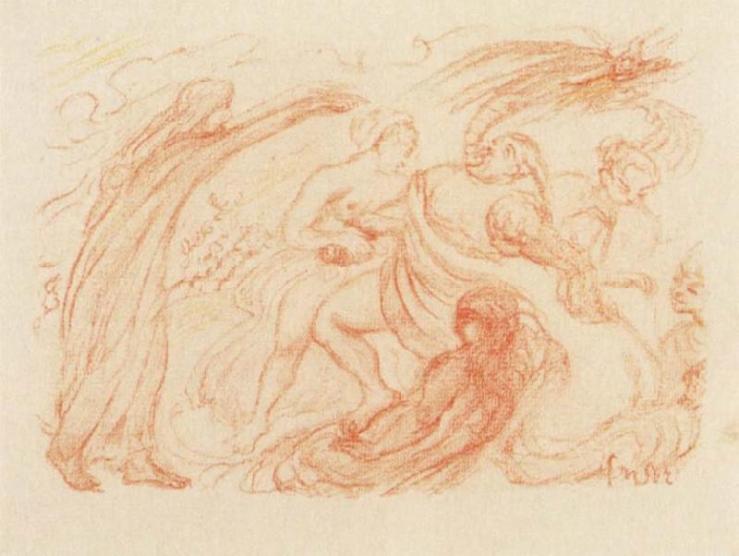
Christ Exorcising the Evil Spirit by James Ensor
James Ensor (Belgian, 1860–1949), Christ Exorcising the Evil Spirit, 1921. Color lithograph from the portfolio Scènes de la vie du Christ (Scenes from the Life of Christ).

And immediately there was in their synagogue a man with an unclean spirit. And he cried out, “What have you to do with us, Jesus of Nazareth? Have you come to destroy us? I know who you are—the Holy One of God.” But Jesus rebuked him, saying, “Be silent, and come out of him!” And the unclean spirit, convulsing him and crying out with a loud voice, came out of him. And they were all amazed, so that they questioned among themselves, saying, “What is this? A new teaching with authority! He commands even the unclean spirits, and they obey him.” And at once his fame spread everywhere throughout all the surrounding region of Galilee.

—Mark 1:23–28

+++

SONG: “Satan, Your Kingdom Must Come Down” | Traditional, performed by Willie Nelson on Country Music (2010)

This spiritual was first recorded and released by Blind Joe Taggart in 1931. An alternative version, “Satan, We’re Gonna Tear Your Kingdom Down,” is #485 in the African American Heritage Hymnal.

+++

Haste to me, Lord, when this fool-heart of mine
Begins to gnaw itself with selfish craving;
Or, like a foul thing scarcely worth the saving,
Swoln up with wrath, desireth vengeance fine.
Haste, Lord, to help, when reason favours wrong;
Haste when thy soul, the high-born thing divine,
Is torn by passion’s raving, maniac throng.

Fair freshness of the God-breathed spirit air,
Pass through my soul, and make it strong to love;
Wither with gracious cold what demons dare
Shoot from my hell into my world above;
Let them drop down, like leaves the sun doth sear,
And flutter far into the inane and bare,
Leaving my middle-earth calm, wise, and clear.

—George MacDonald, from A Book of Strife in the Form of the Diary of an Old Soul (1880)


This post belongs to the weekly series Artful Devotion. If you can’t view the music player in your email or RSS reader, try opening the post in your browser.

To view all the Revised Common Lectionary scripture readings for the Fourth Sunday after Epiphany, cycle B, click here.

Let Jesus Lead You (Artful Devotion)

Promised Land by Maximino Cerezo Barredo
Mural by Maximino Cerezo Barredo (Spanish, 1932–)

“Follow me.” (Mark 1:17)

+++

SONG: “He’s a Mighty Good Leader” (Let Jesus Lead You) | Traditional, performed by Skip James, 1931

“Let Jesus Lead You” was recorded by numerous gospel quartets and bluesmen in the late 1920s and 1930s, the most influential rendition being Nehemiah “Skip” James’s, a pioneering slide guitarist and sometime preacher from Mississippi. Other versions I like, from later, include the Detroiters (1951), Marion Williams & the Stars of Faith (1962), the Morning Star Gospel Singers (1963), and Josh Harmony (2011).

+++

“There” by Robert B. Shaw

There where the lion dines on straw
and walks at ease with dogs and men,
and a boy’s idling fingers draw
the unfanged adder out of his den;
. . . . . . . . . . . . . . . . . . . . . . . . . . . . . . . . .
there is our home. Then lead us there.

(Read the full poem at poetryfoundation.org.)


This post belongs to the weekly series Artful Devotion. If you can’t view the music player in your email or RSS reader, try opening the post in your browser.

To view all the Revised Common Lectionary scripture readings for the Third Sunday after Epiphany, cycle B, click here.

Listening (Artful Devotion)

I'm Listening by Ginger Slonaker
Ginger Slonaker (American), I’m Listening, 2009. Mixed media on paper, 7 × 6 in.

. . . if he calls you, you shall say, “Speak, LORD, for your servant is listening.” . . . (1 Samuel 3:9)

+++

SONG: “Reverently, Quietly” | Words and music by Clara W. McMaster, 1959 | Arranged for solo piano and performed by Paul Cardall, on Primary Worship, 2005

+++

Lord, teach me to listen. The times are noisy and my ears are weary with the thousand raucous sounds which continuously assault them. Give me the spirit of the boy Samuel when he said to Thee, “Speak, for thy servant heareth.” Let me hear Thee speaking in my heart. Let me get used to the sound of Thy voice, that its tones may be familiar when the sounds of earth die away and the only sound will be the music of Thy speaking voice. Amen.

—A. W. Tozer, from The Pursuit of God


This post belongs to the weekly series Artful Devotion. If you can’t view the music player in your email or RSS reader, try opening the post in your browser.

To view all the Revised Common Lectionary scripture readings for the Second Sunday after Epiphany, cycle B, click here.
“And nations shall come to your light . . .” (Artful Devotion)

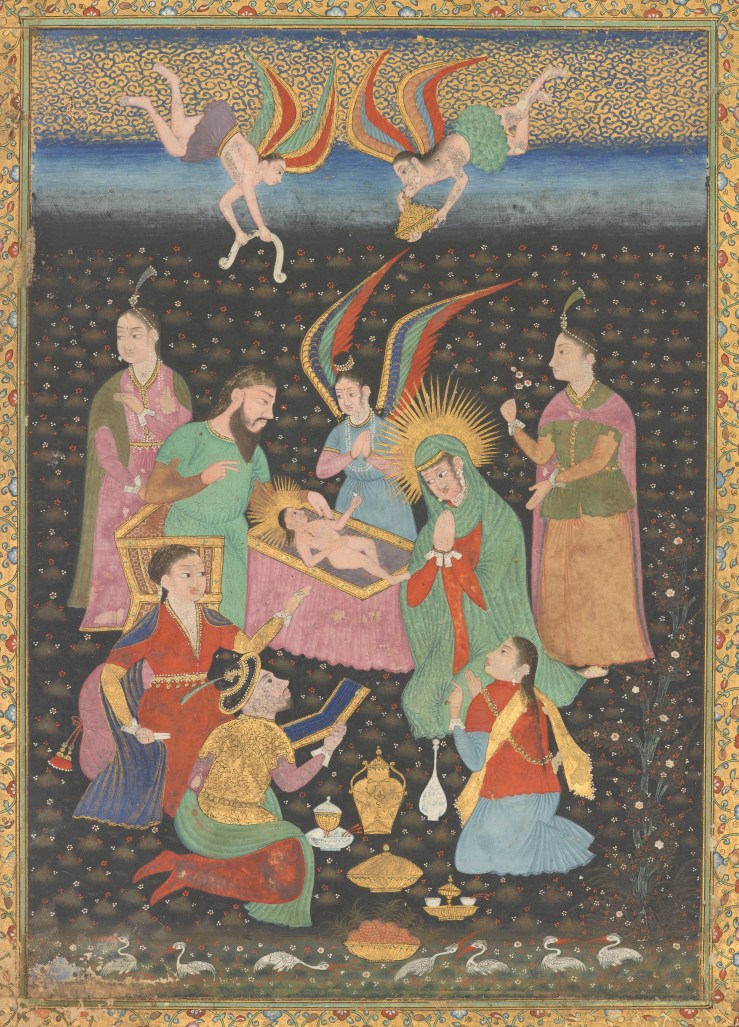
Adoration of the Christ Child (India, 17th c)
Adoration of the Christ Child, Mughal India, ca. 1630. Opaque watercolor and gold on paper, 15.6 × 11 cm. Freer Gallery of Art, Smithsonian Institution, Washington, DC.

This Saturday, January 6, marks Epiphany, a Christian feast celebrating the manifestation of God incarnate to the peoples of the world, encapsulated in the visit of the Magi to the newborn Christ. In the first lectionary reading I’ve excerpted, Isaiah speaks to Israel, rejoicing that God will one day cause his light of revelation to shine upon them, drawing the nations—a prophecy fulfilled at Christmas; in the second, Paul writes to the church at Ephesus about the glorious expansion of God’s family made possible through Christ, and the unity experienced therein across barriers of race, culture, geography, and so on:

And nations shall come to your light,
and kings to the brightness of your rising. . . .

Then you shall see and be radiant;
your heart shall thrill and exult,
because the abundance of the sea shall be turned to you,
the wealth of nations shall come to you. . . .
They shall bring gold and frankincense,
and shall bring good news, the praises of the LORD.

—Isaiah 60:3, 5–6

The mystery of Christ . . . was not made known to the sons of men in other generations as it has now been revealed. . . . This mystery is that the Gentiles are fellow heirs, members of the same body, and partakers of the promise in Christ Jesus through the gospel.

—Ephesians 3:4–5

+++

SONG: “Miladuka” (“Thy Nativity”) | Arabic Christmas hymn arranged by David Düsing | Performed by the Robert DeCormier Singers & Ensemble, feat. Sandra Arida, on Children Go Where I Send Thee: A Christmas Celebration Around the World (1996)

“Miladuka” is a Christmas troparion, or liturgical hymn, from the Byzantine church. Its English translation, from the CD liner notes, is as follows:

Thy Nativity, O Christ our God,
Hath given rise to the light of knowledge in the world.
For they that worshipped the stars did learn therefrom to worship thee,
O son of justice,
And to know from the east of the highest
Thou didst come.
O Lord, glory to thee.


This post belongs to the weekly series Artful Devotion. If you can’t view the music player in your email or RSS reader, try opening the post in your browser.

To view all the Revised Common Lectionary scripture readings for Epiphany, cycle B, click here.
Springing Up (Artful Devotion)

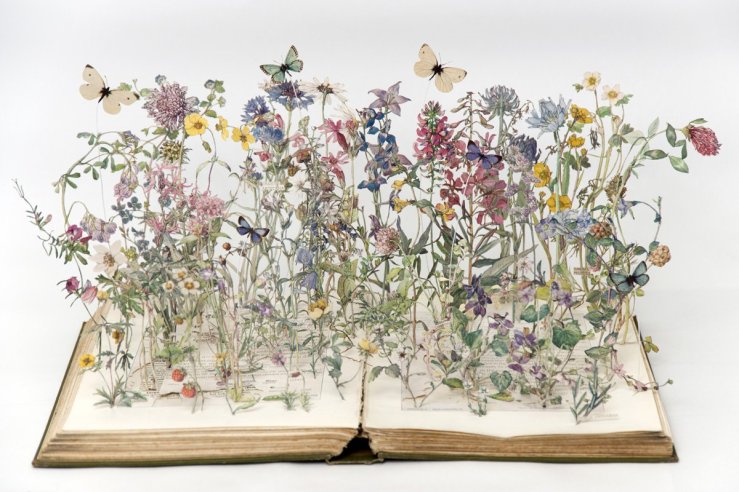
Wild Flowers of the British Isles by Su Blackwell
Su Blackwell (British, 1975–), Wild Flowers of the British Isles, 2013. Cut paper from a 1907 book written and illustrated by botanist Harriet Isabel Adams.

I will greatly rejoice in the LORD;
my whole being shall exult in my God,
for he has clothed me with the garments of salvation;
he has covered me with the robe of righteousness,
as a bridegroom decks himself with a garland,
and as a bride adorns herself with her jewels.

For as the earth brings forth its shoots,
and as a garden causes what is sown in it to spring up,
so the Lord GOD will cause righteousness and praise
to spring up before all the nations.

—Isaiah 61:10–11

+++

SONG: “Amen” | Negro spiritual, arr. Jester Hairston | Performed by Harry Belafonte on Streets I Have Walked, 1963; re-released on Belafonte’s 2001 compilation album, Christmas

The word “Amen” is a transliteration of the Hebrew word for “surely,” “indeed,” or “truly.” Here’s Hairston introducing and leading his arrangement at a concert in Odense, Denmark, in April 1981:

For a fantastic overview of the song’s recording history, including audio, click here. I was excited to find it included in The Presbyterian Hymnal I recently bought, #299, arranged by Nelsie T. Johnson. My church always sings the Danish Amen at the conclusion of our worship service, but I think this African American call-and-response “Amen” would be a fun twist for high holy days like Christmas or Easter.

Wild Flowers of the British Isles (detail) by Su Blackwell

For Further Reading:


This post belongs to the weekly series Artful Devotion. If you can’t view the music player in your email or RSS reader, try opening the post in your browser.

To view all the Revised Common Lectionary scripture readings for the First Sunday after Christmas Day, cycle B, click here.

Io, io, io! (Artful Devotion)

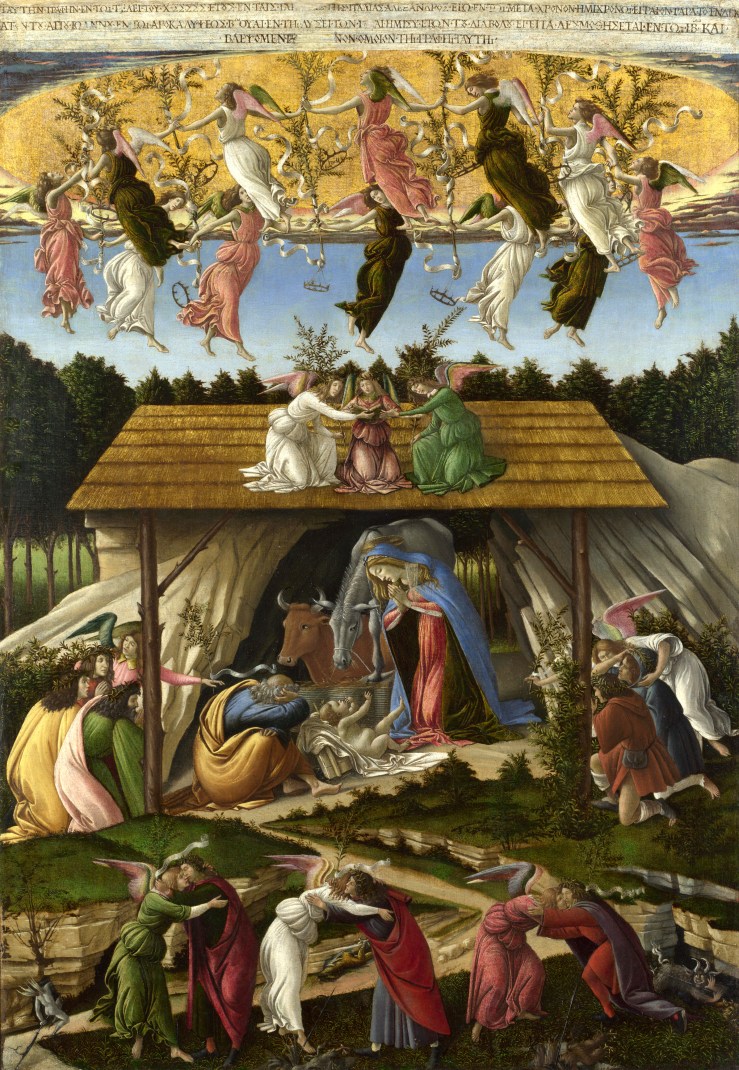
Mystic Nativity by Sandro Botticelli
Sandro Botticelli (Italian, ca. 1445–1510), Mystic Nativity, 1500. Oil on canvas, 108.6 × 74.9 cm. National Gallery, London.

Messenger: Don’t be afraid! Listen! I bring good news, news of great joy, news that will affect all people everywhere. Today, in the city of David, a Liberator has been born for you! He is the promised Anointed One, the Supreme Authority! You will know you have found Him when you see a baby, wrapped in a blanket, lying in a feeding trough. . . .

Heavenly Choir: To the highest heights of the universe, glory to God! And on earth, peace among all people who bring pleasure to God! . . .

Shepherds: Let’s rush down to Bethlehem right now! Let’s see what’s happening! Let’s experience what the Lord has told us about!

—Luke 2:10–12, 14, 16 (The Voice)

+++

SONG: “Ding Dong Merrily on High” | Music: French dance tune, 16th century | Words: George Ratcliffe Woodward, 1924 | Adapted and performed by Rend Collective, from Campfire Christmas, 2014

Ding dong! merrily on high,
In heav’n the bells are ringing:
Ding dong! verily the sky
Is riv’n with angel singing.

Gloria!
Hosanna in excelsis!

E’en so here below, below,
Let steeple bells be swungen,
And “Io, io, io!”
By priest and people sungen.

Gloria!
Hosanna in excelsis!

Ding dong! merrily on high,
The curse of sin is broken:
Ding dong! open up your eyes,
The celebration’s starting.

Gloria!
Hosanna in excelsis!

[The third verse above, by Rend Collective, replaces the original:
Pray you, dutifully prime
Your matin chime, ye ringers;
May you beautifully rhyme
Your evetime song, ye singers.]

For a fun instrumental version in a more traditional mode, see the album Bright Day Star: Music for the Yuletide Season by the Baltimore Consort:

+++

At the birth of God’s Son, heaven and earth danced. For heaven and earth embrace. All things are filled with divine music, and we too are invited to move our lives with grace, in harmony with divine love.

—Richard Harries, from A Gallery of Reflections: The Nativity of Christ—Devotional reflections on the Christmas story in art

Do you blame me that I sit hours before this picture?
But if I walked all over the world in the time
I should hardly see anything worth seeing that is not in this picture.

—G. K. Chesterton on Botticelli’s Mystic Nativity, from his notebooks (mid-1890s)

The dance of the Mystery of Christ is always going on: the band playing the music of forgiveness never takes a break. . . . The real job of Christians as far as the world is concerned is simply to dance to the hidden music—and to try, by the joy of their dancing, to wake the world up to the party it is already at.

—Robert Farrar Capon, from The Mystery of Christ . . . And Why We Don’t Get It


This post belongs to the weekly series Artful Devotion. If you can’t view the music player in your email or RSS reader, try opening the post in your browser.

To view all the Revised Common Lectionary scripture readings for the Nativity of the Lord, cycle B, click here.

Unveiled Mystery (Artful Devotion)

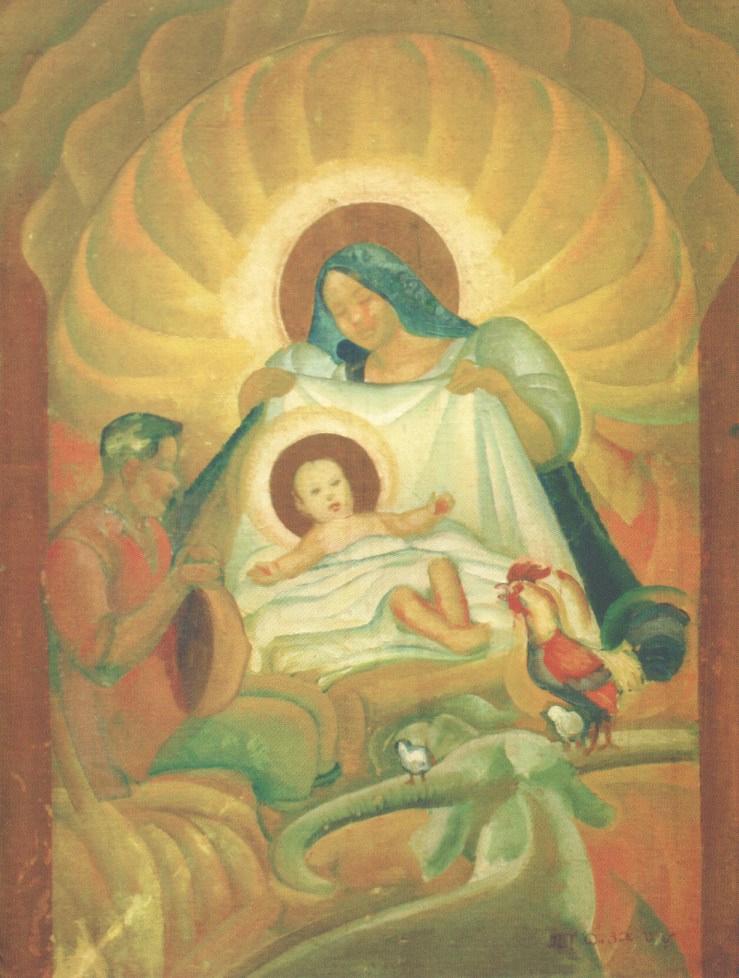
Nativity by Galo Ocampo
Galo Ocampo (Filipino, 1913–1985), Nativity, late 1930s. Oil on canvas. UST Museum (University of Santo Tomas Museum of Arts and Sciences), Manila, Philippines.

“The revelation of the mystery that was kept secret for long ages . . . is now disclosed.” (Romans 16:25–26)

+++

SONG: “Come Behold the Wondrous Mystery” | Words and music by Matt Boswell, Matt Papa, and Michael Bleecker, 2012 | Arranged for a cappella choir by Cliff Duren | Performed by Doxology Vocal Ensemble

For lyrics and music scores, click here.


This post belongs to the weekly series Artful Devotion. If you can’t view the music player in your email or RSS reader, try opening the post in your browser.

To view all the Revised Common Lectionary scripture readings for the Fourth Sunday of Advent, cycle B, click here.

Jina la Bwana ni takatifu! (Artful Devotion)

At that time Mary got ready and hurried to a town in the hill country of Judea, where she entered Zechariah’s home and greeted Elizabeth. When Elizabeth heard Mary’s greeting, the baby leaped in her womb, and Elizabeth was filled with the Holy Spirit. In a loud voice she exclaimed: “Blessed are you among women, and blessed is the child you will bear! But why am I so favored, that the mother of my Lord should come to me? As soon as the sound of your greeting reached my ears, the baby in my womb leaped for joy. Blessed is she who has believed that the Lord would fulfill his promises to her!”

And Mary said:

“My soul glorifies the Lord
and my spirit rejoices in God my Savior,
for he has been mindful
of the humble state of his servant.
From now on all generations will call me blessed,
for the Mighty One has done great things for me—
holy is his name.
His mercy extends to those who fear him,
from generation to generation.
He has performed mighty deeds with his arm;
he has scattered those who are proud in their inmost thoughts.
He has brought down rulers from their thrones
but has lifted up the humble.
He has filled the hungry with good things
but has sent the rich away empty.
He has helped his servant Israel,
remembering to be merciful
to Abraham and his descendants forever,
just as he promised our ancestors.”

—Luke 1:39–55

+++

SONG: “Jina la Bwana: An African Magnificat” by Steven C. Warner, 1995 | Performed by the University of Notre Dame Folk Choir, on Prophets of Joy (1996)

The Swahili refrain, “Jina la Bwana ni takatifu,” translates as “The name of the Lord is holy.”

+++

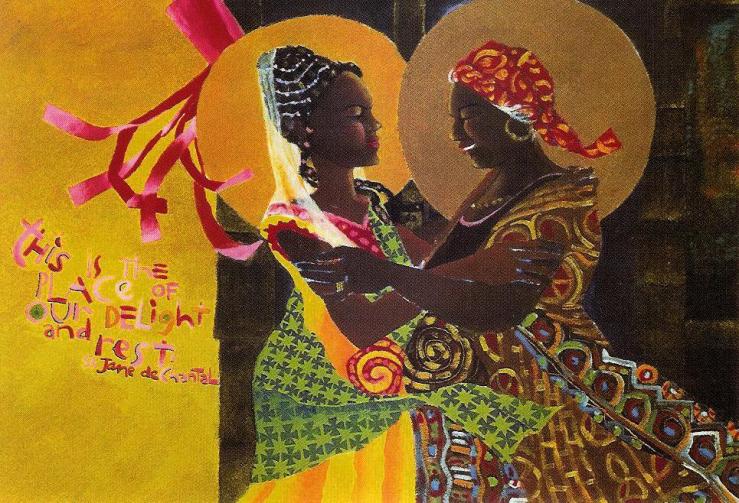
Windsock Visitation by Mickey McGrath
Mickey McGrath, OSFS (American), Windsock Visitation, 1995. Visitation Monastery of Minneapolis.

Artist’s statement:

This image of the Visitation of Mary and Elizabeth was commissioned for the Monastery of the Visitation in north Minneapolis, a group of monastic sisters very near and dear to my heart. In what has become a well-known neighborhood tradition, the sisters hang a windsock outside their house every other day of the week as a signal to the neighborhood children that they can come in and enjoy after-school activities. They read and paint. They pray and have fun. The sisters celebrate birthdays with the kids and walk through hard times with them as well. The spirit of the first Visitation, where Jesus was so lovingly shared between two kinswomen, is very much alive today and is the inspiration for this painting.

Mary, dressed in gold because she is the woman clothed with the sun, also wears a cape with green stars and blue crosses, which symbolize Bethlehem and Calvary. She is a little fearful of the news she has recently received herself, that she was pregnant with God’s child. But Luke tells us that she put her fears aside to be with her cousin Elizabeth and help her in her own miraculous pregnancy. Elizabeth’s bright and welcoming smile assures Mary, and us, that in God’s plans, everything always works out for the best. The tops of their halos form a heart which meets at the bottom in the wombs of the two women. The fluttering windsock behind them reminds us of the wind of the Holy Spirit, ever fresh, ever new.


This post belongs to the weekly series Artful Devotion. If you can’t view the music player in your email or RSS reader, try opening the post in your browser.

To view all the Revised Common Lectionary scripture readings for the Third Sunday of Advent, cycle B, click here.

Prepare the Way (Artful Devotion)

Serima Mission Church door (detail)
Teak wood relief door panel carved by Cornelio Manguma, 1958, showing John the Baptist preaching repentance (upper register) and baptizing Christ (lower register). St. Mary’s Church, Serima Mission, Zimbabwe. [full door]

A voice cries:

“In the wilderness prepare the way of the LORD;
make straight in the desert a highway for our God.
Every valley shall be lifted up,
and every mountain and hill be made low;
the uneven ground shall become level,
and the rough places a plain.
And the glory of the Lord shall be revealed,
and all flesh shall see it together,
for the mouth of the Lord has spoken.”

—Isaiah 40:3–5

The beginning of the gospel of Jesus Christ, the Son of God.

As it is written in Isaiah the prophet,

“Behold, I send my messenger before your face,
who will prepare your way,
the voice of one crying in the wilderness:
‘Prepare the way of the Lord,
make his paths straight,’”

John appeared, baptizing in the wilderness and proclaiming a baptism of repentance for the forgiveness of sins. And all the country of Judea and all Jerusalem were going out to him and were being baptized by him in the river Jordan, confessing their sins. Now John was clothed with camel’s hair and wore a leather belt around his waist and ate locusts and wild honey. And he preached, saying, “After me comes he who is mightier than I, the strap of whose sandals I am not worthy to stoop down and untie. I have baptized you with water, but he will baptize you with the Holy Spirit.”

—Mark 1:1–8

+++

SONG: “Prepare the Way, O Zion” | Text by Frans Mikael Franzen, 1812; trans. Augustus Nelson, 1958; adapt. Charles P. Price, 1980 | Music: Then Swenska Psalmboken, 1697 | Arranged and performed by Chicago Metro Presbytery Music, on Proclaim the Bridegroom Near, 2011

+++

In A Tourist in Africa (1960), the British writer Evelyn Waugh describes St. Mary’s Church in Serima, Zimbabwe, as the “African Chartres.” Designed by the Swiss Catholic missionary Fr. John Groeber, it was built in 1956–66 and filled with hundreds of carvings, murals, and ecclesiastical artworks by the Shona people. To see more photos of the church and to learn more about it, visit ZimFieldGuide.com or, if you can get your hands on a copy, check out the bilingual (English-German) book Serima: Towards an African Expression of Christian Belief (Gwelo, Rhodesia: Mambo Press, 1974), edited by Albert B. Plangger and Marcel Diethelm.

Another great resource for learning about the Serima Mission, and African Christian art in general, is Christliche Kunst in Afrika by Josef Franz Thiel and Heinz Helf (Berlin: Dietrich Reimer Verlag, 1984), whence I scanned the above photo. The text is all German, but there are hundreds of magnificent art images from all over the African continent that make this volume one of my favorites from my personal library.


This post belongs to the weekly series Artful Devotion. If you can’t view the music player in your e-mail or RSS reader, try opening the post in your browser.

To view all the Revised Common Lectionary scripture readings for the Second Sunday of Advent, cycle B, click here.

Come Down, Shine Forth (Artful Devotion)

Sunday will mark the start of Advent and a new liturgical year (cycle B in the Revised Common Lectionary). In this season we dwell on the “three comings” of Christ—into human history, into our hearts, and at the eschaton. We cry out with Asaph the psalmist, “Shine forth!”

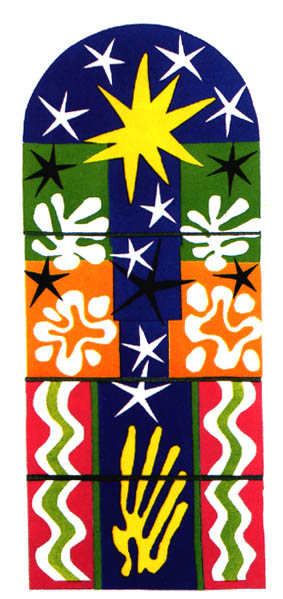
Nuit de Noel by Henri Matisse
Henri Matisse (French, 1869–1954), Maquette for Nuit de Noël, 1952. Gouache on paper, cut and pasted, mounted on board, 271.8 × 135.9 cm (107 × 53.5 in.). Museum of Modern Art, New York.

Give ear, O Shepherd of Israel,
you who lead Joseph like a flock.
You who are enthroned upon the cherubim, shine forth.
Before Ephraim and Benjamin and Manasseh,
stir up your might,
and come to save us!

Restore us, O God;
let your face shine, that we may be saved!

—Psalm 80:1–3

+++

SONG: “Holy Love Come Down” by David Isaac Rivers, from Psalms (2016)


This post belongs to the weekly series Artful Devotion. If you can’t view the music player in your email or RSS reader, try opening the post in your browser.

To view all the Revised Common Lectionary scripture readings for the First Sunday of Advent, cycle B, click here.