Every Right to Receive My Praise (Artful Devotion)

Christus Rex by Peter Eugene Ball
Peter Eugene Ball (British, 1943–), Christus Rex, 1999. Wood sculpture covered in copper and embellished with silver and gold leaf. Ely Cathedral, Cambridgeshire, England.

The final Sunday in the 2016–17 lectionary year, November 26 is designated in the Western church as the feast of Christ the King, known formally as the Solemnity of Our Lord Jesus Christ, King of the Universe. One of the scripture readings for the conclusion of cycle A is as follows:

I pray that the God of our Lord Jesus Christ, the Father of glory, may give you the Spirit of wisdom and of revelation in the knowledge of him, having the eyes of your hearts enlightened, that you may know what is the hope to which he has called you, what are the riches of his glorious inheritance in the saints, and what is the immeasurable greatness of his power toward us who believe, according to the working of his great might that he worked in Christ when he raised him from the dead and seated him at his right hand in the heavenly places, far above all rule and authority and power and dominion, and above every name that is named, not only in this age but also in the one to come. And he put all things under his feet and gave him as head over all things to the church, which is his body, the fullness of him who fills all in all.

—Ephesians 1:17–23

+++

SONG: “Every Right” | Words and music by Josh Davis, Dawn Anthony, and Billy Anthony | Performed by Josh, Dawn, and others from Proskuneo Ministries, on With One Heart (2009)

+++

If to Christ our Lord is given all power in heaven and on earth; if all people, purchased by his precious blood, are by a new right subjected to his dominion; if this power embraces all people, it must be clear that not one of our faculties is exempt from his empire. He must reign in our minds, which should assent with perfect submission and firm belief to revealed truths and to the doctrines of Christ. He must reign in our wills, which should obey the laws and precepts of God. He must reign in our hearts, which should spurn natural desires and love God above all things, and cleave to him alone. He must reign in our bodies and in our members, which should serve as instruments for the interior sanctification of our souls, or to use the words of the Apostle Paul, as instruments of justice unto God.

Encyclical of Pope Pius XI on the Feast of Christ the King (1925)


This post belongs to the weekly series Artful Devotion. If you can’t view the music player in your email or RSS reader, try opening the post in your browser.

To view all the Revised Common Lectionary scripture readings for Proper 29, cycle A, click here.

Awake and Sober (Artful Devotion)

Nepsis by John R. P. Russell
John R. P. Russell (American, 1980–), Nepsis, 2006. Acrylic on wooden door, 80 × 24 in.

The day of the Lord will come like a thief in the night. While people are saying, “There is peace and security,” then sudden destruction will come upon them as labor pains come upon a pregnant woman, and they will not escape.

But you are not in darkness, brothers, for that day to surprise you like a thief. For you are all children of light, children of the day. We are not of the night or of the darkness. So then let us not sleep, as others do, but let us keep awake and be sober. For those who sleep, sleep at night, and those who get drunk, are drunk at night.

But since we belong to the day, let us be sober, having put on the breastplate of faith and love, and for a helmet the hope of salvation. For God has not destined us for wrath, but to obtain salvation through our Lord Jesus Christ, who died for us so that whether we are awake or asleep we might live with him.

—1 Thessalonians 5:2b–10

+++

MUSIC: “Riding Light” | Composed and performed by Joshua Roman

The cello composition “Riding Light” was commissioned in 2013 by Grace Cathedral in San Francisco to complement an installation by artist-in-residence Anne Patterson. This video captures a performance from May 2017, filmed in the Crypt chapel beneath the Church of the Intercession in Manhattan. The venue is home to the “Crypt Sessions” concert series organized by Unison Media, a company that seeks new ways to present and promote classical music.

+++

John R. P. Russell, a Byzantine Catholic priest and artist, on his painting Nepsis:

Nepsis means “watchfulness” and it is a spiritually aware state of being ever vigilant against temptation and attacks of the enemy. It is both a means to the end of theosis and a trait of those who have become one with God. This posture of the figure in this painting is taken from paintings of monks in the church of St. Mercurius in Old Cairo, Egypt. I think of the halo, which has obliterated even the face of the figure, as representing the divinity with which the person is united and the lower part of the figure’s body as representing the passions against which the person is struggling.


This post belongs to the weekly series Artful Devotion. If you can’t view the music player in your email or RSS reader, try opening the post in your browser.

To view all the Revised Common Lectionary scripture readings for Proper 28, cycle A, click here.

Let Justice Roll Down (Artful Devotion)

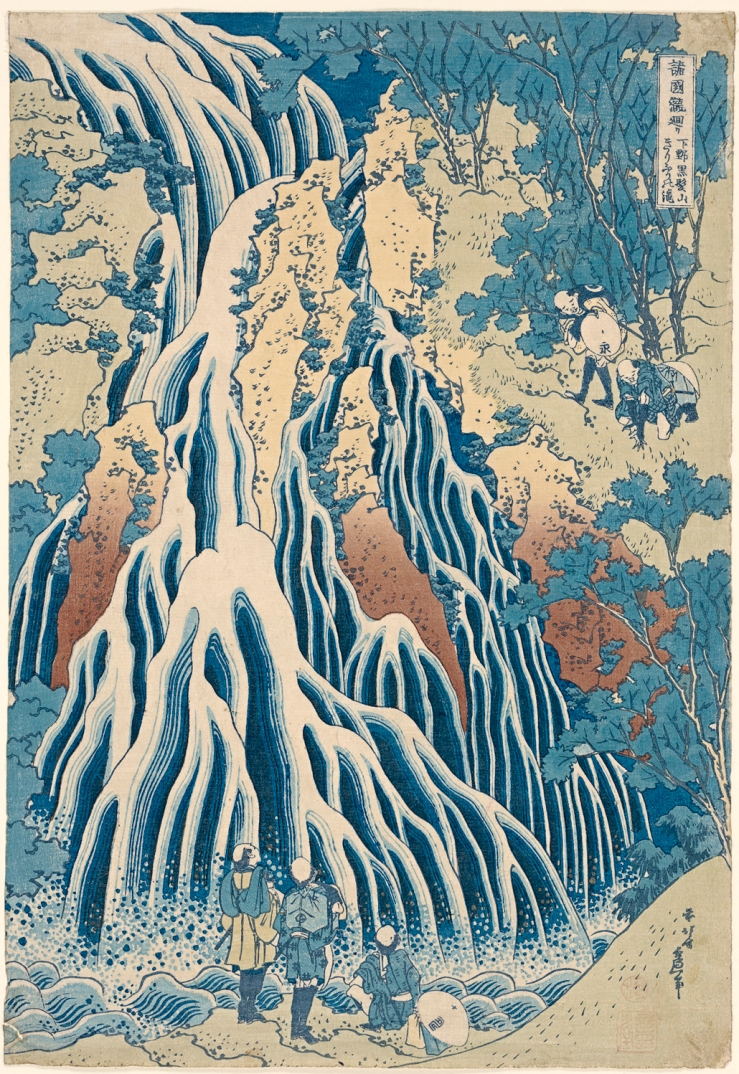
Misty Kirifuri Waterfall at Kurokami Mountain by Katsushika Hokusai
Katsushika Hokusai (Japanese, 1760–1849), Misty Kirifuri Waterfall at Kurokami Mountain, ca. 1833. Woodblock print on dyed paper, 37.6 × 27 cm. National Gallery of Victoria, Melbourne.

God condemns the two-facedness of his people, who offer praise to him in song and sacrifice but fail to uphold his laws of social justice:

I hate, I despise your feasts,
and I take no delight in your solemn assemblies.
Even though you offer me your burnt offerings and grain offerings,
I will not accept them;
and the peace offerings of your fattened animals,
I will not look upon them.
Take away from me the noise of your songs;
to the melody of your harps I will not listen.
But let justice roll down like waters,
and righteousness like an ever-flowing stream.

—Amos 5:21–24

+++

SONG: “Instead of a Show” by Jon Foreman, from Summer (2008)

+++

I have not said to my people: “Get rid of your discontent.” Rather, I have tried to say that this normal and healthy discontent can be channeled into the creative outlet of nonviolent direct action. And now this approach is being termed extremist.

But though I was initially disappointed at being categorized as an extremist, as I continued to think about the matter I gradually gained a measure of satisfaction from the label. Was not Jesus an extremist for love: “Love your enemies, bless them that curse you, do good to them that hate you, and pray for them which despitefully use you, and persecute you.” Was not Amos an extremist for justice: “Let justice roll down like waters and righteousness like an ever-flowing stream.” Was not Paul an extremist for the Christian gospel: “I bear in my body the marks of the Lord Jesus.” Was not Martin Luther an extremist: “Here I stand; I cannot do otherwise, so help me God.” And John Bunyan: “I will stay in jail to the end of my days before I make a butchery of my conscience.” And Abraham Lincoln: “This nation cannot survive half slave and half free.” And Thomas Jefferson: “We hold these truths to be self-evident, that all men are created equal . . .”

So the question is not whether we will be extremists, but what kind of extremists we will be. Will we be extremists for hate or for love? Will we be extremists for the preservation of injustice or for the extension of justice? In that dramatic scene on Calvary’s hill three men were crucified. We must never forget that all three were crucified for the same crime—the crime of extremism. Two were extremists for immorality, and thus fell below their environment. The other, Jesus Christ, was an extremist for love, truth and goodness, and thereby rose above his environment. Perhaps the South, the nation and the world are in dire need of creative extremists.

—Martin Luther King Jr., Letter from a Birmingham Jail


This post belongs to the weekly series Artful Devotion. If you can’t view the music player in your email or RSS reader, try opening the post in your browser.

To view all the Revised Common Lectionary scripture readings for Proper 27, cycle A, click here.

Send Out Your Light (Artful Devotion)

Lighthouse in Westkapelle by Piet Mondrian
Piet Mondrian (Dutch, 1872–1944), Lighthouse in Westkapelle [in Orange], 1909. Oil on canvas, 39 × 29 cm. Galleria d’Arte Moderna, Milan.

O send out your light and your truth;
let them lead me;
let them bring me to your holy hill
and to your dwelling.

—Psalm 43:3

+++

SONG: “Let Your Light Shine on Me” | Traditional, performed by Blind Willie Johnson, 1929

+++

About the painting: Before he became a world-famous pioneer of geometric abstraction, Piet Mondrian (1872–1944) spent his early artistic career painting pastoral images of his native Netherlands in an impressionist style—churches, windmills, fields, rivers, sand dunes, and lighthouses. He made several paintings, using different color palettes, of the “tall lighthouse” of Westkapelle, which stands at the entrance to the village. The structure is actually a fifteenth-century Gothic church tower that was converted into a lighthouse in 1818 after the church burned down. It is still active, serving along with the “short lighthouse” to lead vessels coming in from the northern part of the North Sea. The loose pointillist technique Mondrian uses here enables him to fuse the lighthouse with the surrounding sky, producing a sense of vibration and ethereality.

About the singer: Blind Willie Johnson (1897–1945) was a gospel blues singer, slide guitarist, and evangelist from Texas about whom little is known. Besides the one-time payments he received from Columbia for his studio recordings of 1927–30, most of his income was earned by performing and preaching on the streets; appreciative passersby would drop coins into the tin cup tied to his Stella. Johnson is known for his unique style of singing: in a gravelly “false bass,” or growl, which he drops into in verse 2 of “Let Your Light Shine on Me.” His is the earliest known recording of this traditional gospel song.


This post belongs to the weekly series Artful Devotion. If you can’t view the music player in your email or RSS reader, try opening the post in your browser.

To view all the Revised Common Lectionary scripture readings for Proper 26, cycle A, click here.

Around the Throne (Artful Devotion)

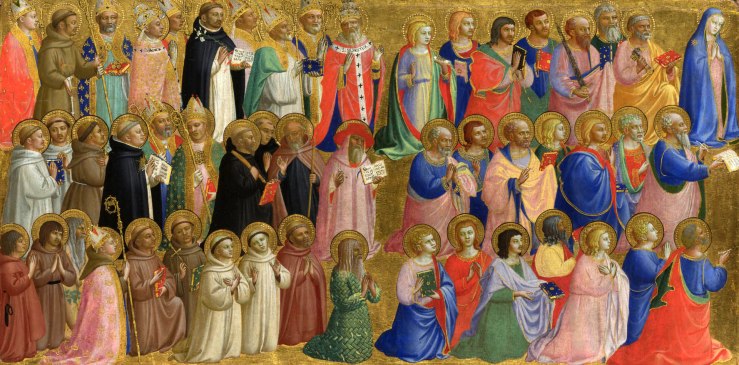
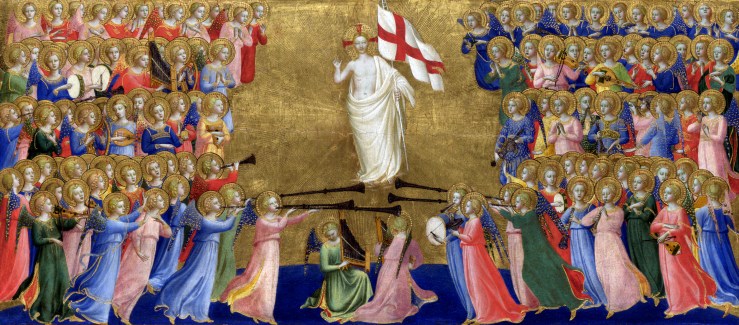
Predella of the San Domenico Altarpiece (Fiesole)
Predella of the San Domenico Altarpiece at Fiesole, ca. 1424, probably by Fra Angelico (Italian, ca. 1395–1455). Tempera and gold leaf on panels, 32 × 244 cm. National Gallery, London.

This week the Revised Common Lectionary assigns an additional set of readings, on top of Sunday’s, for the special celebration of All Saints’ Day (Hallowmas) on November 1. Among them is John’s vision of a multitude of angels and faithful departed surrounding the enthroned Christ in heaven, sounding forth his praise.

After this I looked, and behold, a great multitude that no one could number, from every nation, from all tribes and peoples and languages, standing before the throne and before the Lamb, clothed in white robes, with palm branches in their hands, and crying out with a loud voice, “Salvation belongs to our God who sits on the throne, and to the Lamb!” And all the angels were standing around the throne and around the elders and the four living creatures, and they fell on their faces before the throne and worshiped God, saying, “Amen! Blessing and glory and wisdom and thanksgiving and honor and power and might be to our God forever and ever! Amen.”

—Revelation 7:9–12

+++

O quam gloriosum est regnum (“O how glorious is the kingdom”) — A cappella motet for four voices composed by Tomás Luis de Victoria, 1572 | Performed by the University of Utah Chamber Choir

O quam gloriosum est regnum
in quo cum Christo gaudent omnes sancti!
Amicti stolis albis,
sequuntur Agnum quocumque ierit.

O how glorious is the kingdom
in which all the saints rejoice with Christ!
Clad in robes of white,
they follow the Lamb wherever he goes.

+++

Explore the individual panels from Fra Angelico’s “court of heaven” predella in greater detail on the National Gallery of London’s website, and rejoice this All Saints’ Day in the Christian witness of those who have gone before us!

The Virgin Mary with the Apostles and Other Saints
Probably Fra Angelico (Italian, ca. 1395–1455), The Virgin Mary with the Apostles and Other Saints, ca. 1424. Tempera and gold leaf on panel, 32 × 64 cm. From the San Domenico Altarpiece predella, National Gallery, London.
Christ Glorified in the Court of Heaven
Probably Fra Angelico (Italian, ca. 1395–1455), Christ Glorified in the Court of Heaven, ca. 1424. Tempera and gold leaf on panel, 31.7 × 73 cm. From the San Domenico Altarpiece predella, National Gallery, London.
Saints and Martyrs (Fra Angelico)
Probably Fra Angelico (Italian, ca. 1395–1455), The Forerunners of Christ with Saints and Martyrs, ca. 1424. Tempera and gold leaf on panel, 31.9 × 63.5 cm. From the San Domenico Altarpiece predella, National Gallery, London.

This post belongs to the weekly series Artful Devotion. If you can’t view the music player in your email or RSS reader, try opening the post in your browser.

To view all the Revised Common Lectionary scripture readings for All Saints’ Day, cycle A, click here.

More Love (Artful Devotion)

Mary Magdalene at Foot of Cross
Right: Mary Magdalen at the Foot of the Cross, Netherlands, ca. 1420–30. Alabaster, 8 7/16 × 3 11/16 × 4 1/16 in. (21.5 × 9.3 × 10.3 cm). Metropolitan Museum of Art, New York. Photo: Victoria Emily Jones. This fragment served as the base of a now-lost crucifix.

“You shall love the Lord your God with all your heart, and with all your soul, and with all your mind. This is the greatest and first commandment.” (Matthew 22:37–38)

+++

SONG: “More Love to Thee” | Words by Elizabeth Prentiss, 1869 | Music by William H. Doane, 1868 | Arranged and performed by One Eighty (Amy J. Kim, Joon Park)

(Listen in Korean.)

+++

“O Lord, from now on let me love You as intensely as I have loved sin.”

—John Chrysostom

“To Thee alone my spirit cries;
In Thee my whole ambition lies,
And still Thy Wealth is far above
The poverty of my small love.”

—Dhul-Nun al-Misri, 9th-century Egyptian Sufi mystic (trans. A. J. Arberry)


This post belongs to the weekly series Artful Devotion. If you can’t view the music player in your email or RSS reader, try opening the post in your browser.

To view all the Revised Common Lectionary scripture readings for Proper 25, cycle A, click here.

Sing! (Artful Devotion)

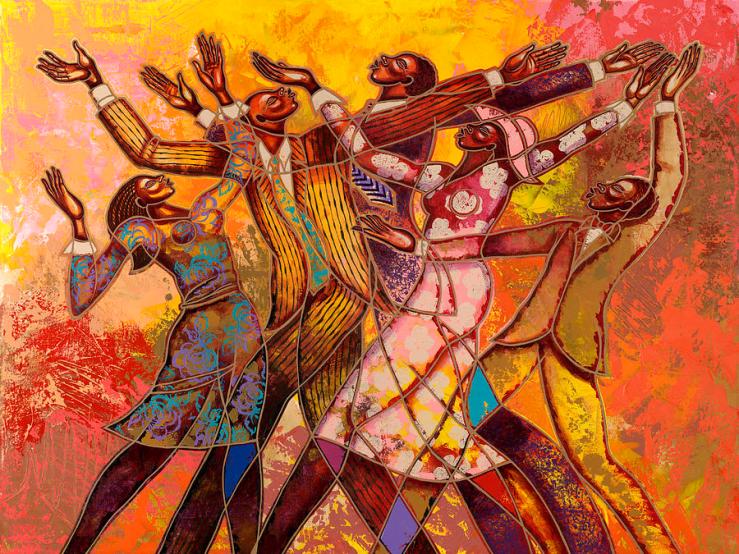
Brown, Larry Poncho_Every Round Goes Higher
Larry Poncho Brown (American, 1962–), Every Round Goes Higher, 2009. Acrylic on canvas. Commissioned by the Douglass Memorial Community Church Inspirational Choir, Baltimore, Maryland.

Oh sing to the LORD a new song;
sing to the LORD, all the earth!

—Psalm 96:1

+++

SONG: “Come on Children, Let’s Sing” | Traditional, performed by Mahalia Jackson


This post belongs to the weekly series Artful Devotion. If you can’t view the music player in your email or RSS reader, try opening the post in your browser.

To view all the Revised Common Lectionary scripture readings for Proper 24, cycle A, click here.

Grief and Loss Will Be Undone (Artful Devotion)

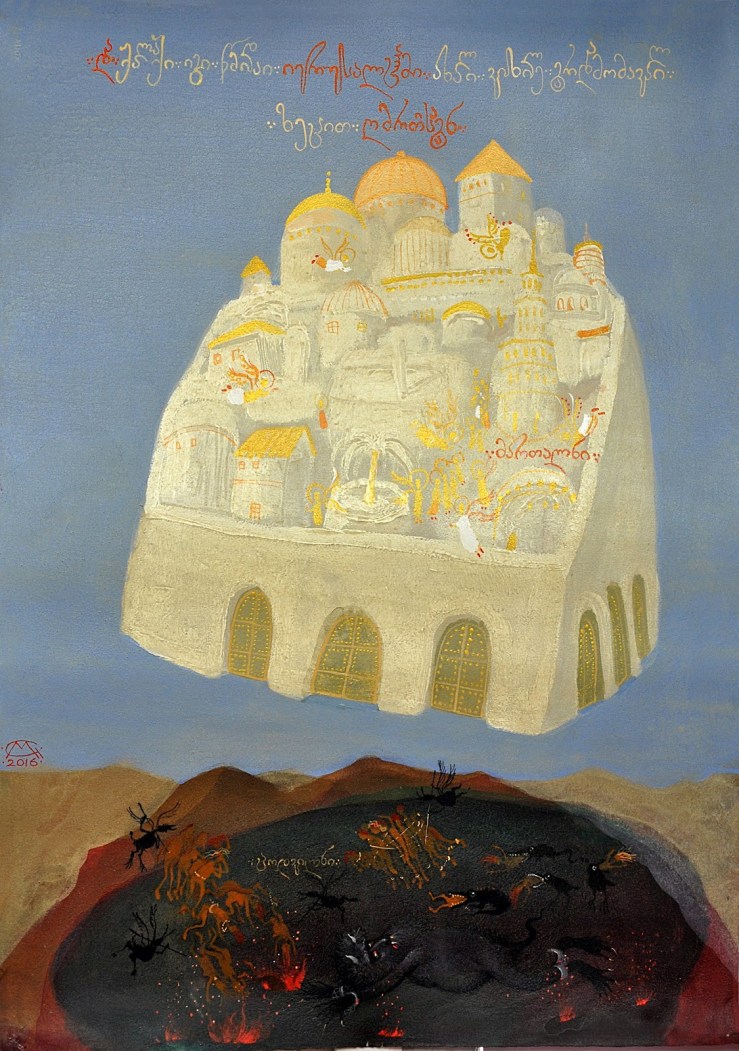
Descent of the New Jerusalem (Georgian icon)
Gocha Kakabadze (Georgian, 1966–), Descent of the New Jerusalem, 2016. Gouache on paper.

On this mountain the LORD of hosts will make for all peoples
a feast of rich food, a feast of well-aged wines,
of rich food filled with marrow, of well-aged wines strained clear.
And he will destroy on this mountain
the shroud that is cast over all peoples,
the sheet that is spread over all nations;
he will swallow up death forever.
Then the Lord GOD will wipe away the tears from all faces,
and the disgrace of his people he will take away from all the earth,
for the LORD has spoken.
It will be said on that day,
Lo, this is our God; we have waited for him, so that he might save us.
This is the LORD for whom we have waited;
let us be glad and rejoice in his salvation.

—Isaiah 25:6–9 (NRSV)

+++

SONG: “When Your Kingdom Comes” by the Silver Pages, feat. Mona Reeves, on The Silver Pages: Part II (2015)

Christians are called to be “aching visionaries,” writes Nicholas Wolterstorff in the classic Lament for a Son—much like the Hebrew prophets, who by the Spirit’s enlightening were able to see through the pain of this present era into a future where all things are made new, where sorrow is undone and Love reigns. Blessed are those who cling to this vision, and who actively live into it here and now, not ignoring hurt but acknowledging its wrongness (that’s what lament is: to say, “This is not right”) and co-laboring with God to heal it. For this task we are equipped with God’s Spirit.

(Related posts: “A sweeping vision of all things made new”; “‘Jis’ Blue’ by Etta Baldwin Oldham”)

The Christian fixation on heaven is sometimes perceived by outsiders as escapist, as opioid. Claiming its promise does console, it’s true. It does give us power to push through pain and guards us against despair. But what it absolutely does not allow is retreat from reality. On the contrary, it helps us to inhabit reality more fully. Talk of heaven doesn’t numb us to the world—or at least it shouldn’t. It makes us hyperaware, especially of history’s path. History is going somewhere! It has a telos, and it has manifestly not arrived there yet. Until then, we ache. We labor. We hope. Rather than having an idling effect, seeing the goal actually motivates us to live presently in tighter line with God’s values, because we see how beautiful a world they usher in. We know that we cannot ourselves create the final fullness that Christ will institute when he returns, nor can we remove the pall of evil (again, that’s only within Christ’s power), but we can certainly live as citizens of God’s kingdom and thus practitioners of the gospel in all its transformative goodness.

Brothers Philip and Paul Zach (The Silver Pages) are aching visionaries who write songs and sing. “When Your Kingdom Comes,” performed with Mona Reeves, helps us to see with greater clarity the glorious future that’s in store for this earth. One day when we come home to it, it will be heaven. The New Jerusalem will descend, and we’ll be wed eternally to its king.

To download the album version of the song (which has more pronounced percussion) along with five other Silver Pages tracks, go to NoiseTrade. It’s free in exchange for your email address.

Update, 9/21/20: Paul Zach posted a solo acoustic version of the song on his Instagram today.

And here he is singing the song with his friend Patrick Bagaza from Rwanda, who translated the song into Swahili:

+++

[After the Ring is destroyed]

“Gandalf! I thought you were dead! But then I thought I was dead myself. Is everything sad going to come untrue? What’s happened to the world?”

“A great Shadow has departed,” said Gandalf, and then he laughed and the sound was like music, or like water in a parched land; and as he listened the thought came to Sam that he had not heard laughter, the pure sound of merriment, for days upon days without count.

—J. R. R. Tolkien, from The Return of the King


This post belongs to the weekly series Artful Devotion. If you can’t view the music player in your email or RSS reader, try opening the post in your browser.

To view all the Revised Common Lectionary scripture readings for Proper 23, cycle A, click here.

So Sweet (Artful Devotion)

Tongue Gilding by Lauren Kalman
Lauren Kalman (American, 1980–), Tongue Gilding, 2006. Digital print, laminated on acrylic, 32 × 23 in. (81.3 × 58.1 cm). Still from a 12-minute short film. Museum of Fine Arts, Boston.

“The law of the LORD is perfect,
reviving the soul;
the testimony of the LORD is sure,
making wise the simple;
the precepts of the LORD are right,
rejoicing the heart;
the commandment of the LORD is pure,
enlightening the eyes;
the fear of the LORD is clean,
enduring forever;
the rules of the LORD are true,
and righteous altogether.
More to be desired are they than gold,
even much fine gold;
sweeter also than honey
and drippings of the honeycomb.”
—Psalm 19:7–10

“Oh, taste and see that the LORD is good!”—Psalm 34:8a

“How sweet are your words to my taste,
sweeter than honey to my mouth!”
—Psalm 119:103


“Jesus Name So Sweet” was written in 1977 by the Jamaican musician Bobby Aitken (early vinyl pressings had his surname as “Akins” or “Atkins”) after his conversion to Christianity. The song was internationally popularized by Donnie McClurkin in 2000, who performed it in London as part of his “Caribbean Medley”—but as it turns out, I discovered it through a trio of car-riding nuns! I sourced the embedded audio excerpt from the Caribbean Gospel YouTube channel; the names of the performers and the year of the recording are not given, and efforts to track down this info were unsuccessful.

Of the short patois refrain “Every rock we rock upon Jesus,” musicologist Melvin L. Butler writes,

This phrase does not translate easily into Standard English. However, Jamaican churchgoers explained to me that the repetition of the word rock and the idea of rocking “upon Jesus” suggest the idea of “movement” with Jesus—literally, through holy dancing, and metaphorically, through life’s ups and downs. The chorus thus celebrates the “sweetness” of Jesus, who serves not only as a spiritual dancing partner during collective praise but also as a guide and comforter amid the “rocky” road of everyday life. [“Performing Pentecostalism: Music, Identity, and the Interplay of Jamaican and African American Styles,” in Rhythms of the Afro-Atlantic World: Rituals and Remembrances, p. 46]

+++

[Addendum, 10/20/17]

“The Name of God” by Anya Silver

Like a baker, swaddling the juice and heft of apples in pastry,
I want my mouth to cradle the delicious name of God.

>>Read the rest of the poem on Good Letters.


This post belongs to the weekly series Artful Devotion. If you can’t view the music player in your email or RSS reader, try opening the post in your browser.

To view all the Revised Common Lectionary scripture readings for Proper 22, cycle A, click here.

Let Me Know Your Roads (Artful Devotion)

The Sheltered Path by Claude Monet
Claude Monet (French, 1840–1926), The Sheltered Path, 1873. Oil on canvas, 54.1 × 65.7 cm (21 5/16 × 25 7/8 in.). Philadelphia Museum of Art. Photo: Victoria Emily Jones.

Your roads, God, let me know them.
Your pathways, help me recognize them from the rest.

Lead me down the way of your truth;
teach me its nature.

—Psalm 25:4–5 (trans. Pamela Greenberg)

+++

SONG: “Heaven’s Gate” by Dawn Landes and Piers Faccini, on Desert Songs (2016)


This post belongs to the weekly series Artful Devotion. If you can’t view the music player in your email or RSS reader, try opening the post in your browser.

To view all the Revised Common Lectionary scripture readings for Proper 21, cycle A, click here.